







Abstract
Social interaction is an important aspect of adolescent and young adult (AYA) development. One place where social interaction frequently occurs is on social media (boyd, 2014; Pew Research Center [PRC], 2018a). In the United States in 2018, 88%–97% of AYAs reported using at least one major social media platform (PRC, 2018a). This high rate calls to question the impact of social media use on AYA psychosocial development (Shapiro & Margolin, 2014; Subrahmanyam & Šmahel, 2011; Uhls et al., 2017). Social media provide a space for AYAs to negotiate privacy and autonomy, display and construct a sense of self, and manage peer relationships (boyd, 2014; Yang, 2018). While most AYAs report positive experiences on social media (PRC, 2018b), not all AYAs experience benefits from social media use (George & Odgers, 2015; Odgers, 2018). In particular, AYAs facing psychological, behavioral, and social stressors offline are more vulnerable to negative online experiences, such as receiving negative feedback from peers and being less actively engaged with peers online (George & Odgers, 2015; Odgers, 2018). Given the unique challenges faced by AYAs with cancer, it is curious what roles social media play in their psychosocial development after being diagnosed with cancer.
Like their healthy counterparts, AYAs with cancer have developmental needs for autonomy, positive body image, and social connectivity, but they face more challenges in these areas (Barakat et al., 2016; Zebrack, 2011). Many AYA cancer survivors reflect that their illness experiences challenged their autonomy by making them feel emotionally dependent, reliant on adults for medical decision making, and overprotected by parents (Ang et al., 2018; Smits-Seemann et al., 2017). AYAs with cancer also report heightened concerns about appearance, such as being afraid to go out in public due to being unsure of how peers will react to hair loss and weight fluctuations (Ang et al., 2018; Larouche & Chin-Peuckert, 2006). Further, AYAs with cancer report feeling different from their healthy peers and losing some friendships due to being confined to the hospital (Ang et al., 2018; Breuer et al., 2017; Warner et al., 2016). In addition to the unique psychosocial stressors experienced by all AYAs with cancer, some AYAs on treatment also meet the criteria for psychological disorders such as depression and anxiety (Muffly et al., 2016; Zebrack, 2011).
It is plausible that social media play complex roles for AYAs with cancer who experience these unique developmental and psychosocial challenges related to illness, but these roles remain understudied. For instance, typically developing AYAs feel pressure to post content that makes them look good to others (PRC, 2018b); this pressure may be heightened for AYAs with cancer as they negotiate their changing body image throughout treatment. On the other hand, when feeling insecure about body image or when feeling socially isolated, AYAs with cancer say support from peers acts as a buffer from negative feelings (Breuer et al., 2017; Larouche & Chin-Peuckert, 2006); social media can provide a convenient channel to interact with and receive support from peers, even during hospitalization. Currently, there are only a few studies on the use of communication technologies by AYAs with cancer. Despite their contributions in showing that AYAs with cancer use the internet and social media to share illness narratives, relate to others, maintain normalcy, and seek health information (Dominguez & Sapiña, 2017; Maor & Mitchem, 2018; Peat et al., 2018), with a few exceptions (Borghi et al., 2018; Liu et al., 2015; Maor & Mitchem, 2018) many of these studies discuss the use of online patient communities or illness-specific blogs rather than engagement with healthy peers on AYAs' typical social media platforms (e.g., Instagram, Snapchat). The literature regarding the use of online patient communities indicate a positive role of social media for AYAs coping and adjustment (Myrick et al., 2016; Perales et al., 2016), but these resources are frequently introduced after diagnosis and designed specifically to provide illness-specific support (Keim-Malpass et al., 2016; Perales et al., 2016). It is important that researchers also study platforms most familiar to AYAs and explore how ongoing use of these media may impact psychosocial development throughout cancer treatment (Chou & Moskowitz, 2016). As such, the purpose of this paper is to describe AYA perspectives on popular social media use throughout cancer treatment, using qualitative methodology as a means of directly assessing the personal experiences of AYAs with cancer.
Methods
Participants and Data
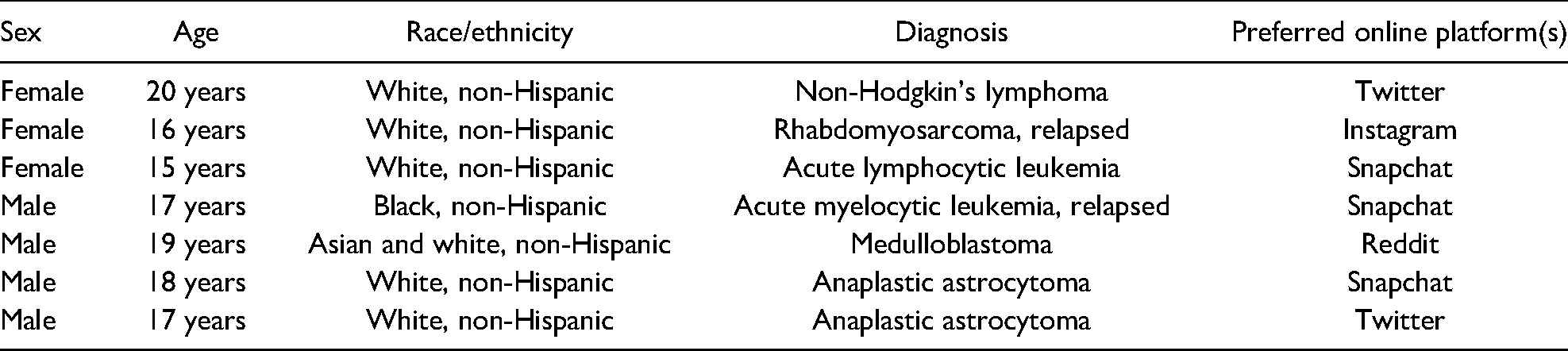
Participants for this study were seven AYAs treated for cancer, ages 15–20 years (57% male, 71% white). At the time of the interview, participants were either on active therapy for cancer or had received their last treatment within the past 9 months. Participants were interviewed about their use of social media during their treatment trajectory. All participants were approached by the first author and a co-author, both of whom were Certified Child Life Specialists familiar to the participants. Interviews were scheduled following indication of patient interest and conducted by the same Certified Child Life Specialists. Patients who agreed to the interview were consented via a Hospital Publicity and Fundraising HIPAA Authorization Form as recommended by the institution's privacy and safety officer. A legal guardian provided consent for any participant under the age of 18 years. The HIPAA form authorizes the disclosure of protected health information and gives permission for publicity. Prior to the current analysis, the Institutional Review Board determined that this consent was sufficient to proceed, and that re-consenting participants was unnecessary.
Interviews took place at the hospital in a private consult room, were video-recorded, and were about 30 min in length. A semi-structured interview guide was used to guide interviews and explored AYA habits, preferences, and experiences with social media. Examples of questions asked are, “What types of social media platforms do you use?” and “How has your use of social media changed since diagnosis?” (the full interview guide is available from the first author upon request). Following the interview, demographic and diagnostic information were obtained from the electronic medical record (see Table 1).
Demographic and Diagnostic Information of Participants.
Data Analysis
Interviews were de-identified and transcribed verbatim by the first author; a co-author verified the accuracy of the transcriptions. Informed by Saldaña (2009), the first author performed initial line-by-line coding on each transcript. Then descriptive coding was performed collaboratively with a co-author, with discrepancies in coding discussed until consensus was reached. All codes were then organized by occurrences and similarities to reveal broader meaning categories (i.e., Boles et al., 2017). The first author and co-author then combined similar categories into larger themes, re-reading and checking the transcripts for the relevance of themes across the data set. Final themes were constructed collaboratively via latent thematic analysis, which is an interpretive approach that seeks to identify broader conceptualizations and meanings from the semantic content of the data (Braun & Clarke, 2006).
Results
Analysis of the data revealed four major themes about social media use among AYAs with cancer: (1) changes in audience and feedback after diagnosis, (2) attitudes about body image and peer support, (3) control over personal, familial, and societal messages about illness, and (4) maintaining normalcy despite hospital stressors.
Theme 1: Changes in Audience and Feedback after Diagnosis
Six AYAs saw changes in the amount of audience and feedback on their social media platforms following diagnosis. For example, one participant noticed 85 new followers on the day he was diagnosed, a number that grew daily for at least 6 months and then tapered off. A second participant did not notice an increase in followers but said people he had lost touch with began to reach out again after diagnosis, but then suddenly stopped; he described this experience in a disappointed tone: Some people that you, like, totally forget about are, like, “hey, how are you, I care about you” and you’re like, “great!” and then they don't talk to you the next week and you’re like “…alright…” (Male, Medulloblastoma, 19).
The disappointment was shared by a third participant noticing changes in followers related to her treatment trajectory: I feel like no one cares about me, ‘cuz when I stopped treatment, I lost like 300 followers! And then now I started back up and then I’m almost at 11,000 followers. I guess they don’t really care about my normal life; they just care about my cancer life or something. (Female, Rhabdomyosarcoma, 16).
Among these six participants, four said the changes in audience and feedback made them feel that people only cared about them because of cancer. Conversely, two participants said these changes made them feel supported, with one saying these changes made him feel like people cared about him despite his diagnosis: I posted something on Instagram saying I was okay and everything and that got 250 ‘likes’ on it? So it was like a huge increase from, like, the last picture and it hasn't dropped below 130 on any pictures since that […] to me it’d mean that like, even though we’re here and we’re havin’ to go through something that most people would never in their lifetime have to go through, […] we still can live like the normal life, have friends and people that care about us, and not only just for what we have, but for, like, who we are and everything like that… It just gives more depth to us as a person. (Male, Anaplastic Astrocytoma, 18).
In sum, of the AYAs who noticed changes in audience and feedback on social media after diagnosis, many felt frustrated by these changes. Regardless of whether they felt positively or negatively, all AYAs were acutely aware of how their social media audience and feedback changed after their diagnosis and were thoughtful about what that might mean about others’ feelings toward them.
Theme 2: Attitudes about Body Image and Peer Support
All participants discussed their perceptions of peer judgment and support when posting images showing appearance changes throughout treatment. Two males thought about their body image when posting online, but never felt any negativity from others in response to their posts: Everyone's, like, supporting you… ‘cuz I’ll post a picture and I’ll have, like, a funky bald head and I’m makin’ some face and everyone's, like, “you’ve got this!” … No one's saying, “haha, what a loser,” you know- that's just not a thing (Male, Medulloblastoma, 19).
Female participants were more aware of body image and described how feedback impacted their feelings about themselves. One AYA commented that side effects from treatment prevented her from posting: A while back, when I was on Dex[amethasone] […] I didn't want anyone posting pictures of me, I didn't want to send pictures to anybody, just because I didn't like the way I looked. Because I had a big, giant face (Female, Acute Lymphoblastic Lymphoma, 15).
Another female did decide to post images of herself online and reported feeling sensitive to the feedback she received: I share pictures without my hair all the time and it's kinda weird they usually get […] more ‘likes’ and more comments […]and then the pictures with hair… they get ‘likes’ don't get me wrong […] but not as much attention. They just see me as like a normal girl, they don't see me as a sick person […]. It makes me feel like my worth isn't there! (Female, Rhabdomyosarcoma, 16).
All female participants noted that support from peers counteracted negative judgment and boosted self-confidence. For instance, compliments from friends helped one AYA feel better about her appearance when she was otherwise insecure. Another participant felt supported when her online peers defended her from negative comments: Someone said I was ugly […] and then recently I had another person say “uh, you’re gonna die,” […] and then all of my followers just rammed at her […] they were like, “you’re such a B-word!” (Female, Rhabdomyosarcoma, 16).
Although females discussed attitudes about body image and posting online more than males, all participants perceived peer support as a key element in negotiating feelings about body image when posting online.
Theme 3: Control over Personal, Familial, and Societal Messages about Illness
Every participant said they posted at least a few times about hospital and illness experiences as a way to keep friends updated. AYAs described managing posts for personal, familial, and societal reasons. When sharing information on a personal level, three AYAs appreciated ease in using social media to send mass-updates: If I wanted to send a message out to a lot of people, I’d usually use Instagram […]. Cuz, like, when I found out I had cancer it was really easy to just, like, post, “hey, by the way- everyone I know- I have cancer” (Male, Medulloblastoma, 19).
AYAs used social media to manage illness disclosure among peers, but also noted parents’ roles in documenting their illness journey online. Five AYAs mentioned their parents’ use of Facebook and/or Instagram. They expressed concerns about not approving of parents’ posts on Facebook, a platform the AYAs no longer frequently used and were less likely to monitor, but they cared even more about parents’ posts on Instagram or other platforms that their peers often used. Overall, AYA wanted more control over all posts shared by parents: I tell my mom, like, I don't want you posting pictures if I don't see them first […]. It's my story to tell, it's not anybody else's story to tell (Female, Non-Hodgkin's Lymphoma, 20).
Beyond controlling personal and familial messages, two AYAs used social media to impact societal impressions of childhood cancer. In fact, one AYA reflected that her desire to shape others’ impressions of cancer caused her to change her posting habits in a meaningful way: Before [diagnosis] I used to care so much, I used to be like “oh, I look kinda weird in this, I don't think I’m gonna post it” […] but now, like, you can see my Instagram, you see pictures of frickin’ hospital gowns and I’m not lookin’ great, […] but I post it just so people get a sense of what kids have to go through […]. ‘Cuz people get this image in their head of what childhood cancer's like, ‘cuz, like, they see all the smiling bald kids and they look so happy but it's not, it's nowhere near close to that (Female, Rhabdomyosarcoma, 16).
It was clear that all AYAs were intentional and desired control in managing their social media content about illness at personal, familial, and/or societal levels.
Theme 4: Maintaining Normalcy Despite Hospital Stressors
Finally, all AYAs used social media to maintain normalcy, even while in pain and separated from friends. Some said social media helped them achieve normalcy via distraction from the otherwise abnormal hospital environment: I also use Instagram kind of as a distraction from some things, ‘cuz Instagram has a bunch of funny […] accounts on there… so […] it's an escape from everything that's going on around me… because sometimes if I see a funny video, I’ll forget about the pain (Female, Acute Lymphoblastic Leukemia, 15).
Participants also reported using social media to maintain typical peer relationships and to stay updated about events at home: I was down here [at the hospital] when they… had their Fourth of July party, and…someone went on Instagram Live and I could watch it and […] it's like I was there, but I wasn't there […]. Even though I couldn't really talk to ‘em […] I could see all of them and I got some good laughs out of it (Male, Anaplastic Astrocytoma, 17).
Aside from using social media to remain connected, all participants used social media as part of their daily routines. Maintaining these routines, which are normal in the context of their homes, helps provide normalcy in the hospital setting: I just wake up in the morning and I send a Snapstreak
[1]
out ‘cuz you have to send one snap a day, so it's like a daily morning routine (Male, Anaplastic Astrocytoma, 17).
But their ability to maintain that routine often depended on health variables: Like, if I’m tired, I’m not gonna post a lot… but, like, if […] I felt more better then, like, I’mma be up all day, I’mma post throughout the day (Male, Acute Myeloid Leukemia, 17).
Several AYAs described feeling a sense of pressure to maintain normal habits, but found it difficult to do so throughout treatment: You’re gonna try to keep up the streak, ‘cuz if you break the streak it just shows nothing, it's so much cooler to have a streak than not to have a streak […]. I think my highest is maybe 200 days? … Like right now, […] I have a list that are of my streaks for 9 days, ‘cuz I broke my other streak […]. I was in the hospital and […] I had surgery and I was not feelin’ it, so, […], hopefully this time around I can get back to 200 (Female, Rhabdomyosarcoma, 16).
All AYAs felt tensions between appreciating the normalcy associated with social media use and accepting the pressure that accompanied the use.
Discussion
This paper describes AYA perspectives of social media use throughout cancer treatment. According to the participants, social media provided patients with a sense of normalcy and control throughout treatment. Social media also promoted peer connectivity and support after diagnosis. Conversely, participants also felt uncertainty about online feedback and a burden to maintain typical routines while hospitalized. Taken together, our findings suggest that AYAs treated for cancer experience both positive and negative aspects of social media use throughout cancer treatment. Understanding these experiences is important for assessing AYAs' adjustment to cancer and for enhancing psychosocial care for patients utilizing social media.
The participants largely discussed positive aspects of social media. These comments reflected how social media helped AYAs with cancer address the developmental needs for peer communication, acceptance of body image, and expression of autonomy. First, social media helped AYAs connect with peers for support despite hospitalization. It is well documented that, among typically developing AYAs, using social media to interact with others contributes to better well-being by increasing AYAs' perceived social support (Frison & Eggermont, 2016; Seo et al., 2016). Our findings showed that similar benefits were observed among AYAs with cancer. Communication with peers throughout treatment mitigates feelings of social isolation, and social media can be used during the hospitalization to stay involved (Liu et al., 2015; Maor & Mitchem, 2018). When asked what it would be like for them if social media no longer existed, the participants said they would, “panic,” “cry,” and “lose touch with friends.” It is clear that social connectivity is a critical reason for social media use among AYAs with cancer.
Another benefit of social media use among AYAs with cancer is receipt of peer support throughout the adjustment to physical appearance changes from treatment. It is typically challenging for AYAs to accept their body image (Subrahmanyam & Šmahel, 2011), but this task is especially difficult for AYAs whose appearances are altered by side effects of treatment and is most distressing for females (Ang et al., 2018). Peer feedback importantly informs the ways through which AYAs negotiate their body image into their overall sense of self (Smits-Seemann et al., 2017). Females were more aware of negative feedback than male interviewees, a pattern supported in literature (de Vries et al., 2016), but they nonetheless felt positively when peers supported them via comments and “likes” on posts depicting appearance changes.
AYAs with cancer experience a compromised sense of autonomy (Smits-Seemann et al., 2017) but can find a space of their own online (Borca et al., 2015). Negotiating privacy and autonomy on social media is common among typically developing AYAs (Yang, 2018), but AYAs with cancer must also make decisions about the sharing of illness information. During the treatment, the participants reported using social media to share illness information on their own terms, furthering their autonomy (also see Peat et al., 2018). When parents shared information online, it disrupted AYA sense of control over their cancer experience; when AYAs managed their own content, they controlled the message meaningfully. Social media thus provide spaces for AYAs with cancer to exercise control, and adults are encouraged to respect and support this ability.
Participants shared some negative experiences that seem to reflect the unique experiences of AYAs with cancer. All AYAs in our study described feeling pressure to keep up with routine via Snapstreaks or other communications despite hospitalization or feeling poorly. Although healthy AYAs similarly feel frustrated by pressure to keep up online (PRC, 2018b), this pressure is likely heightened for AYAs with cancer who crave normalcy yet lack control over treatment schedules and side effects that hinder their ability to obtain that normalcy. Several AYAs also experienced a surge in feedback on profiles following diagnosis. When attempting to make sense of these changes, most AYAs felt disappointed, interpreting that people only cared about their cancer content. Interestingly, the one participant who felt most positively about the changes was also the most newly diagnosed patient interviewed. It is possible that sensitivity to changes in feedback varies over time; however additional work will be needed to assess this. For healthy AYAs, immediacy and amount of feedback on social media relate to self-esteem and influence identity construction (Chua & Chang, 2016; Jong & Drummond, 2016). AYAs with cancer may be especially vulnerable to the impacts of feedback on sense-of-self as they experience profound changes in feedback online following diagnosis.
A cancer diagnosis changes the social media experiences of an AYA in many ways, but social media use among AYAs with cancer appears to resemble that of their healthy peers. While the narrative regarding AYAs’ social media use is usually preconceived, with adults believing AYAs spend too much time on their phones and that social media are detrimental for well-being (George & Odgers, 2015), AYA participants in our study reported predominantly positive experiences with social media. This narrative is consistent with findings based on typically developing AYAs describing social media as a space for an AYA to present oneself to others, separate from parents, and socialize with peers (PRC, 2018b). For the participants in this study, social media activities led to largely positive experiences of receiving social support and normalizing their experiences; unfortunately, these positive outcomes may not be true for all AYAs.
While this study importantly suggests a need for further exploration of AYA experiences on social media throughout cancer treatment, there are still several limitations. Convenience sampling was used for this single-site study in the United States and data were collected from a small sample. Thus, results may not generalize to other populations. The age range of participants was narrow, making issues regarding age differences hard to distinguish. The sample consisted of primarily white individuals, so differences by race/ethnicity could not be explored. Finally, although participants were asked to share about their perspectives of social media since being diagnosed with cancer and about their uses of social media throughout their treatment trajectory, some variability existed regarding the treatment status of each participant at the time of the interview. Furthermore, there was a minimal range in length of time since diagnosis, and thus differences regarding adjustment to diagnosis over time could not be made. Ultimately, this study provides insight about the experiences of AYAs on social media throughout treatment, but future research should consider which variables may contribute to differing experiences, such as social support, time since diagnosis, baseline use of social media, or preferred coping strategies.
Implications for Clinical Practice
Findings highlight the importance of social media for AYAs with cancer. As such, inviting conversation with AYAs with cancer about their experiences with social media during treatment could be an effective way to build rapport and more comprehensively assess adjustment to appearance changes, diminished independence, and social isolation that often accompany illness. By inquiring about social media routines, feedback, and posting habits, healthcare providers may further consider how to support AYAs on therapy in their psychosocial development as they continue to use social media with their healthy friends. For instance, providers may take insight from the experiences mentioned here to advise newly diagnosed AYAs about the changes they might expect to see on social media. They may additionally discuss ways to cope with sharing images representing their appearance changes or how to navigate conversations with caregivers about online privacy and control over cancer narratives. It will be important to facilitate these assessments and therapeutic interventions to promote positive coping as AYAs continue to use social media as a form of distraction, peer maintenance, and normalcy throughout treatment.
Ultimately, findings from this qualitative study emphasize the role of social media in the social experiences of AYAs with cancer. AYAs use social media to maintain connection with peers, to take control over their cancer narrative, and to preserve a sense of normalcy through the maintenance of online routines. Conversely, they may experience distress or conflicting emotions regarding alterations to their physical appearance as publicized online or changes in their follower numbers. Continual assessment of AYA experiences with social media may be a means of gaining insight into their coping and adjustment immediately following diagnosis and throughout treatment.
Footnotes
Acknowledgments
The videos analyzed for this article were presented at the 2018 Child life Annual Conference in May 2018. All videos have since been protected as confidential; the de-identified interview transcripts used for this analysis are thus confidential data and not available to the public. Portions of this work were previously reported in an oral presentation at the 2019 Conference for the Southeastern Association of Child Life Professionals.
Declaration of Conflicting Interests
The authors declared no potential conflicts of interest with respect to the research, authorship and/or publication of this article.
Funding
The authors disclosed receipt of the following financial support for the research, authorship, and/or publication of this article: this work was supported by the American Lebanese-Syrian Associated Charities (ALSAC).
