






Abstract
Language policies for the purpose of (re)vitalizing a minority language are analyzed as a dynamic cost-effectiveness problem. We focus on policy measures with two types of cost structures: costs largely proportional to the number of beneficiaries (a rival measure) and costs independent of the number of beneficiaries (a non-rival measure). An example of the former is home nursing in the minority language and an example of the latter is street signs in the minority language. Both types of measures are assumed to contribute positively to the vitality of the minority language. We stylize the analysis, letting the rival measure have an immediate direct effect on the vitality and the non-rival one a protracted indirect effect on the language’s status.
Two problems are addressed. Firstly, we study how the optimal combination of the two types of measure changes as the policy is implemented and the vitality of the minority language increases and show that a policy with fixed budget shares as a rule is sub-optimal. Secondly, we compare the opportune policy of a policy maker planning with a fixed time horizon with the optimal policy as the time horizon approaches infinity. The policy maker has incentives to plan for a sub-optimal policy with a reduction in the protracted measure for the whole planning period and making it equal to zero at the time horizon.
All effects are illustrated in numeric examples.
Keywords
Introduction
The dynamic modeling of language competition can be divided into macro and micro models. In the former, the change in the use (or, vitality) of different languages is described with the help of aggregated numbers over different types of individuals or families, whose average behavior is influenced by variables like the number of speakers or the status of the languages. In micro models, the behavior of single individuals is influenced by other single individuals in random encounters. For an introduction to the literature, see Templin and Wickström (2023) for a review from the perspective of individual behavior as a driving force and Boissonneault and Vogt (2021) for a systematic review based on the methodology and explanatory variables used. 1
Language competition and language policy
Early models generally considered the number of speakers as the endogenous driving force behind language change whereas other variables, like status – or prestige –, are exogenously given. The models of Abrams and Strogatz (2003) without bilinguals and Minett and Wang (2008) with bilinguals inevitably lead to the extinction of one language, which one depends on the initial distribution of speakers on the two languages. By introducing a process of family formation depending on the size of the three groups of speakers (monolinguals in each of the two languages and bilinguals) and preferences for choosing a partner with a similar linguistic profile, Wickström (2005) showed that all kinds of steady-state equilibria are possible (only monolinguals in either language, monolinguals in one or both languages as well as bilinguals, and only bilinguals). Again, at which equilibrium the system finally ends up depends on the initial situation and the exogenous relative status of the two languages. 2
Minett and Wang (2008) incorporate policy in the model in a very straight-forward (albeit non-realistic) manner: by changing the relative status of the two languages, the policy maker can affect the size of the threshold of speakers necessary for the language to survive. Each time a language is on its way to extinction, the policy maker increases its status thereby reversing the process. Fernando et al. (2010) show how a language policy which introduces education in the minority language and status planning, which increases its visibility in the linguistic landscape, can guarantee its survival. These contributions demonstrate that a given policy can preserve a minority language. The next step is to characterize an optimal policy. Given that public budgets are limited, the policy maker has to set priorities.
The cost-effectiveness of policy measures will depend on the characteristics of the group of beneficiaries, especially on the number of beneficiaries and their spatial habitation patterns. For example, mounting street signs in a minority language causes costs that increase with the territory but are independent of the numerical size of the beneficiaries; on the contrary, the costs of answering emails in the language of the clients depend on the number of clients, but not on where they live. The costs of other measures, like publishing law texts in a minority language, are independent of both habitation patterns and numerical size, and providing home health care causes costs dependent on both the size and the domicilation of the clients. The optimal choice of measures in a simple static setting with measures being perfect substitutes as far as their effect is concerned, is explored in Wickström (2021).
The main contributions of the present essay are: (1) the extension of the analysis to policy measures that show different degrees of complimentarity/substitutability in a fully dynamic setting; (2) the optimal relative strength of an instantaneous and a sustained, protracted measure under a given budget; 3 and (3) the implications of a finite time horizon.
Investing in the status or prestige of a minority language is an example of a protracted measure. The higher the status of the language, the more likely its speakers are to pass it on to the next generation, thereby contributing to its vitality. Status-building measures are typically symbolic and directed to the collective of language users, like the naming of public institutions, bilingual names of cities and towns, the use of the language in prestigious publications, or, at important events, by prominent personalities. Such measures take effect peu à peu, but the effect typically lasts for a long time. Other measures, like the requirement that public servants be forced to use the language when interacting with its speakers, would increase the visibility and actual use of a language directly and faster. Teaching the language as a compulsory subject at schools is also a measure with a rather rapid effect. These two more or less instantaneous measures are also examples of measures with a different degree of substitution possibilities with the status-building measures. Compulsory teaching increases the number of people knowing the language, but does not necessarily increase its use. There exists considerable anecdotal evidence that a language must also be attractive to the speakers, that is, have a high status. We would claim that there is a high degree of complementarity between the acquisition planning in the form of compulsory learning and status planning. This is probably not so in the case of civil servants being forced to use the language in communicating with its speakers; that has a certain status effect of its own and the measure is a substitute to pure status planning.
The structure of the essay
The point of departure of this essay is that the vitality of a minority language (defined as its use by many individuals in many domains) is affected by language policy. The more resources that are spent on the policy measures, the higher the vitality of the language. 4 A language policy is here defined as a collection of policy measures that are implemented in order to create incentives for the speakers of a certain language to increase its use and to give it on to the next generation. Given that the implementation of a measure is benefiting the speakers of the language, and the aggregate benefits of all speakers are compared to the implementation costs in order to decide if the measure be implemented or not, we talk about a welfare – or cost-benefit – approach to language policy; see Wickström (2017, 2019). Since the estimation and quantification of benefits in a cost–benefit analysis can be very problematic – due both to practical difficulties of measurement and to theoretical inconsistencies and path dependencies – an alternative approach is cost-effectiveness analysis. Here the language planner aims at the fulfillment of objectively observable goals such as the vitality of a language in a given area or in given domains. 5 The degree of goal fulfillment then depends on the employment of different policy measures. 6 However, the choice of policy measures is constrained by the budget of the policy maker. The expenditure side of the budget is, of course, mainly determined by the implementation costs of the various enacted measures. The planner’s task is then to attempt to reach a high goal fulfillment within the constraints of the budget.
What both cost-benefit and cost-effectiveness analyses have in common is that the cost structures of different measures are very important; see Wickström (2017, 2020); Wickström et al. (2018). The costs of different language-planning measures can be classified over (at least) two dimensions, degree of rivalry and degree of spatiality of the resulting language-related goods. See the discussion above on language competition. Different types of language-policy measures cause costs of different magnitudes per capita of the beneficiaries in dependency on their number and habitation patterns. In other words, some planning measures, like the use of a language in public documents, are almost perfectly collective goods, being both non-rival and non-spatial. Only fixed costs – independent of the number of beneficiaries and their geographical distribution – are to be covered. To the other extreme, some planning measures, like providing social services – for instance home nursing – in a certain language, are almost purely individual goods. Here the costs are more or less proportional to the number of beneficiaries and to the size of the geographical region where the beneficiaries live.
The cost structure has important implications for the choice of policy in a cost-effectiveness analysis. Assume that the planner wants to preserve or increase the vitality of a minority language, and both status planning, like using the language in official documents or in the public space, and acquisition planning, like teaching the language in public schools, serve this purpose. Given that the costs of status planning are basically independent of the number of beneficiaries or their geographical distribution – the status resulting from the planning measure is a non-rival good – whereas the costs of acquisition planning are more or less proportional to both – teaching material and teaching as such are to a large extent rival goods, at least between schools – an implication might be that the effectiveness of status planning in comparison to acquisition planning increases with the size of the community of beneficiaries and with the spread of their living areas. To receive a certain effect in a small, concentrated community by a given budget, it can be sensible to put more effort into acquisition planning in relation to status planning than it is in a larger community spread over a large area.
In this essay, this observation is applied in a dynamic analysis. If the size of the target community increases, this is without consequences for the costs of provision of a non-rival good like status with only fixed costs, whereas, in the case of proportional costs, the costs increase as the number of beneficiaries increases. Given that the influence on an average individual of a given planning measure is independent of the size of the community, the effect of status planning at given costs is independent of the size of the community, whereas, for acquisition planning, the effect decreases with the increasing size of the community since available resources are divided among more individuals. This makes status planning progressively more attractive as vitality increases. However, since both budget and effect are influenced by changes in the measures, it is not obvious at the first glance how budget shares should change, and we discuss both the change in the optimal employment of different policy measures and in the corresponding budget shares as the vitality of a supported language increases. In the analysis, we limit ourselves to two types of planning measures, a perfectly non-rival and a perfectly rival one.
As we mentioned above, with the introduction of time, the possible types of goods are further differentiated with a dimension describing how long the good and its effects last. We can talk of instantaneous goods whose benefits last a very short time, for instance a glass of wine; once it is drunk it is gone. 7 On the other hand, there are goods with an extended life period, like the reputation of Château Margaux, which is reinforced every time we enjoy a few drops of the product. We then speak of a protracted good. Protracted goods like status or goodwill act over an extended period. In choosing between instantaneous and protracted goods to produce incentives for increased language use, policy makers might make different choices depending on whether they are myopic or hyperopic. In Templin et al. (2016); Wickström (2013, 2016); Templin (2020), the rôle of protracted status in a dynamic setting is analyzed. Here, we extend it to discussing effects due to both types of policy measures.
In the next section “Claims”, we intuitively discuss some expected implications for an optimal language policy of rival versus non-rival and immediate versus protracted language-related goods. Part of the discussion is made precise in the section “The dynamics of language use” with the help of a simple model presented in Sections “The model” and “The steady-state static optimization problem” and further illustrated in some simulations in Section “Examples”. Most of the formal analysis is found in online appendices.
Claims
The results emerging from this essay can loosely be summarized in two claims: 8
1. If a language policy with the goal of increasing the vitality of a minority language contains measures that are both rival and non-rival, the relative strength of the rival measure should, up to a certain time, decrease as the vitality of the language increases.
9
2. If the measures are complementary in their impact on the goal, the budget share of the rival measure should increase with increased vitality. 3. If the measures are substitutes in their impact on the goal, the budget share of the non-rival measure should, up to a certain time, increase with increased vitality. 4. A policy ignoring these properties of an optimal policy is likely to cause efficiency losses, especially if the measures are complementary.
The qualification “up to a certain time” is necessary because of the effect that uncertainty (or myopia) or short time horizons have on the planner:
1. Close to the time horizon, the strength of the rival measure should be increased at the cost of maintaining the protracted status by the non-rival measure in comparison with a situation with the planning horizon further in the future. 2. If the planning horizon is shortened, the optimal amount of resources spent on building up the status should be reduced. 3. A policy of short-term planning will cause efficiency losses in comparison to a policy of long-term planning.
Over the entire planning period, the non-rival measure undergoes two phases: at the beginning its budget share should increase and at the end decrease if the measures are substitutes. If they are complements, on the other hand, its budget share should decrease over the planning period. The first phase might disappear in the case of substitutes if the time horizon effect is very strong. This will be shown in the examples at the end of the essay.
We already argued that the non-rival measure becomes the more effective one as the size of the minority increases. This development also depends on the substitution possibilities between the two types of measures and on the restrictions reflected in the budget of the policy maker. The budget shares of the two measures might change in both directions. As the language receives more speakers, the aggregate costs of the rival measure increase. Whether the total budget for the rival measure decreases or not, depends on how much the per-individual expenditures on the measures decrease. If the two types of measures are perfect substitutes – the assumption in Wickström (2021) – the total budget will shift from the rival to the non-rival measure at a certain size of the number of speakers. If the two measures are perfect complements, the relative strength of the two measures will, in optimum, stay constant, and the budget share of the rival measure will increase as more people use the language. As a consequence the budget share of the status-increasing measure will decrease. The parallel to production and consumption theory is obvious. If two inputs (in production or consumption) display a substitution elasticity of one, optimization implies that the budget shares of the expenditures are given and constant. Hence, the implication is that, as vitality increases, the budget share of the non-rival good should decrease if the substitution elasticity is smaller than one and should increase if it exceeds one. It is also intuitively plausible that the efficiency loss of an inflexible policy is greater if the substitution possibilities are small, than in the case that the inputs are readily substitutable.
Status is accumulated as resources are spent on status-increasing measures, and at the same time status depreciates at a certain rate. An optimal value of status-building measures at any time will occur when the costs of the status-increasing measures equals the corresponding increase in benefits because of the higher status over the rest of the planning period. If the planning horizon is shortened, the value of the status at the original time horizon is lost but the costs were incurred over the whole planning period. Hence, if costs and benefits were balanced with the old time horizon, the costs will now exceed the benefits, and due to the concave structure of the benefits and Le Chatelier’s principle 10 the amount of resources spent on the status-building measure should be reduced over the entire planning period.
Close to a time horizon (for instance, at the end of an election period) another status-reducing effect will occur. It will pay to reduce the indirect status-planning measures and change to direct measures, since the status reacts slowly and the existing high status with its positive effects will last for some time without compromising the vitality of the language, but at the same time direct planning will, without delay, add to the vitality of the language, making the planner move resources from status-planning measures to acquisition-planning ones and the vitality at the time horizon will be higher than in the optimal steady state. Of course, this potential short-term gain is always tempting the planner, and the temptation is stronger the higher the discount rate of the planner is. 11
Instead of talking about a time horizon we could talk about the planner being myopic or hyperopic. A myopic planner, for instance due to uncertainty, will give too low weight to the future. This will have the same effects as shortening the time horizon. Myopia is often a politically opportune strategy, which in this case will lead to sub-optimal results.
The model
The model is basically the same as in Wickström (2005); Templin et al. (2016). We limit ourselves to two types of individuals: speakers of the majority language, type H, and speakers of the minority language – all bilinguals – type L. As fractions of the total population the sizes of the two communities are given by p
H
and
Family behavior and language choice
We describe the behavior of families with functions
The communication benefits depend on the number of individuals with whom the children can communicate. If the child is socialized as an H-individual, it can communicate with the H- and L-individuals, that is a fraction
Each family will rank the three linguistic profiles (H, M, and L) and choose the highest ranked one for their children. The communication benefits are the same for all families; the intrinsic benefits of each of the profiles increase with a stronger presence of the language(s) of the profile in the family, 13 and the costs will move in the opposite direction. We can then expect the average ranking of a certain profile to be higher, the stronger are its languages in the family. An increase in the status of the minority language through language policy will increase its intrinsic value in families where it is represented and make the choice of a profile involving the minority language (L or M) more likely; similarly, acquisition planning in favor of the minority language will decrease its learning costs and, hence, make the choice of profile L or M in the family more likely. The smaller is p M the higher the difference in communication costs between profile M and the other two profiles, making the choice of profile M less likely. We make the assumption that profile M will not be chosen due to its small communication benefits. 14 This makes the communication benefits of the two other profiles identical and equal to one, and the choice between H and L dependent on the intrinsic benefits that are dependent on the language profiles of the parents and influenced by the status planning, as well as on the learning costs that are influenced by the acquisition planning.
The function
The motivation of parents of providing their children with a certain linguistic repertoire is, as mentioned, at least twofold. On the one hand, the children should be able to communicate with other members of society;
15
on the other hand, there is an emotional motivation for passing the language on to the children since the language is an important carrier of the parents’ identity. In our setting, we assume that there are no monolinguals in the minority language, and the first motivation is irrelevant for the language decision of the parents.
16
As a consequence, we will drop the p dependence of α.
If both parents are speakers of the minority language it follows from the discussion above that more children who are bilingual in the minority language emerge from such a family than from a family with only one parent speaking the minority language. In addition, to simplify specific calculations, we will at times appeal to three technical assumptions:
This simplifies the analysis considerably. We can describe the functional form of each
Let For analytic purposes, we can – as in standard micro-economic theory – describe the function q using equivalence classes, the combination of Due to the concavity of q,
The function q is homothetic. That is, the function h is homogeneous of degree zero:
Steady-State solution
If in a given period the distribution of the two types is (p
H
, p
L
) and is designated by
In the online appendix, the following results are derived:
If the intermarriage rate between the language communities and the fraction of bilingual children emerging from mixed marriages on the average are sufficiently high, specifically if If
Language policy
We take the
Status planning typically involves measures leading to goods and services whose costs do not depend on the number of beneficiaries, and the average per capita benefits to the individuals are the same independently of the numerical strength of the community of beneficiaries. The annual expenditure for this kind of language planning is denoted by e
s
. The status is seen and measured as the result of aggregated expenditures over time. On the other hand, if the status is not maintained it might continuously depreciate due to people’s tendency to highly value the life-style of the majority. We assume that, if not attended to, the status depreciates at a rate of
Acquisition planning, for instance, also influences the parents’ choice of linguistic repertoire for their children. 18 These measures are rival, and total costs more or less proportional to the size of the population benefiting from the measures. The higher is the expenditure per capita of the minority population on such measures, the higher the probability that the off-spring of families of type LL and HL will become bilingual. We write the expenditure per capita as e a .
Let
We assume that the budget for language planning is a function of the size of the minority,
or, in the steady state
The steady-state static optimization problem
The planner wants to maximize the vitality of the minority language, as reflected in the value of p, and is constrained by the budget. Maximization of the steady-state vitality can then formally be written as
It is readily seen that the budget set is not convex. We, therefore, first have to investigate if the problem has a unique solution. In the online appendix, it is shown that this is the case. In addition, the following results are derived in the appendix:
The maximum steady-state vitality of a minority language, defined as the highest possible proportion of bilingual speakers of the language,
1. increases with the size of the budget for language stimulating policies, both in the fixed part of the budget and in the part proportional to the number of speakers. 2. decreases with the size of the total population in the jurisdiction in the case of only a fixed budget. 3. increases with the size of the total population in the jurisdiction in the case of only a proportional budget. 4. increases with the rate of intermarriage between bilinguals and monolinguals in the majority language given that the behavior of mixed families does not change.
19
The results to a large degree depend on the fact that status expenditures have a non-rival cost structure.
The dynamics of language use
The dynamics of p, given by equation (3), can be transformed into continuous time with a suitable normalization:
That is
The general dynamic problem of the policy maker can be written as
The first expression, 14a, is the maximand. If we divide it by the time horizon T it expresses the discounted average size of p, the vitality. This is what is to be maximized. Since T is an exogenously given constant, maximizing the expression 14a is the same as maximizing the discounted average size of the vitality. The discount rate r can be set equal to zero, as long as the time horizon is finite. The next two expressions, 14b and 14c, describe the dynamics of the vitality p and the status S, respectively. The speeds of adjustment,
This system is the most general formulation of the planner’s problem. Before attacking the general formulation, we consider two special cases of the status variable. We first ignore its protracted character in order to discuss the influence of the type of language-related goods on the optimal planning path. This is equivalent to letting the change in p, described by the parameter
Instantaneous status adjustment
In order to see how the two control variables behave before the time horizon makes its influence felt, we let the status adjust very fast, that is we let Budget constraints when S adjusts fast, expression 16b. (a) Fixed budget, (b) Proportional budget, (c) General budget.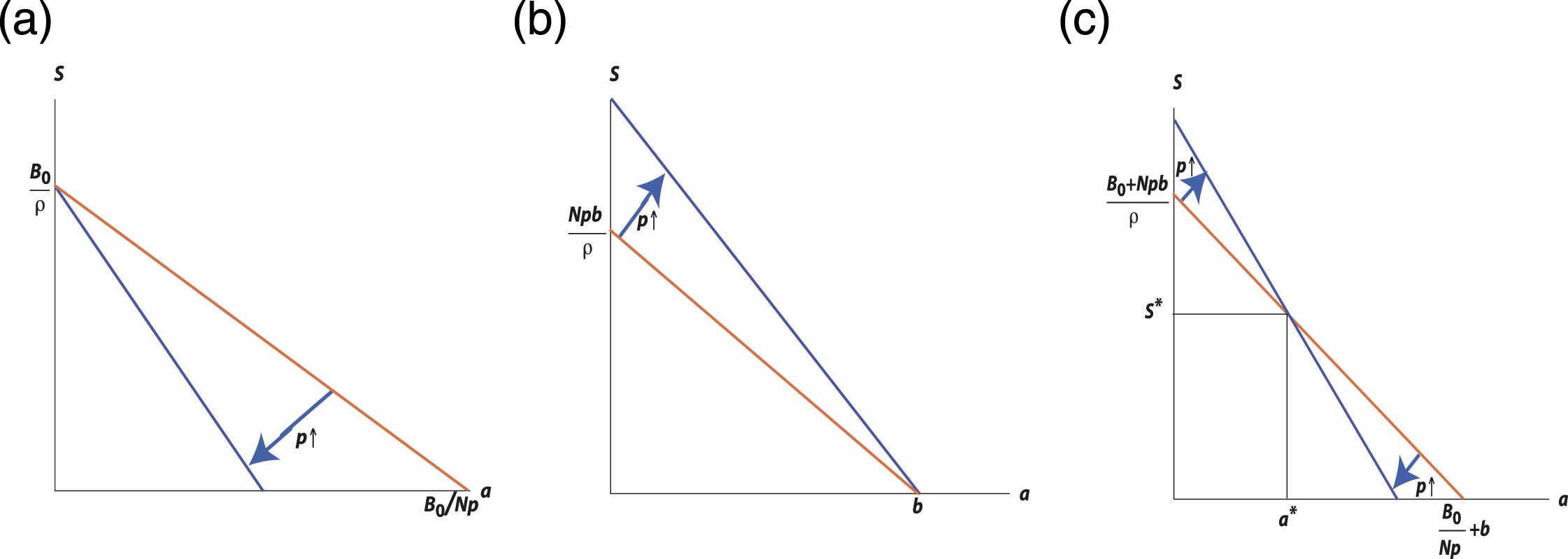
The optimization problem 14 of the planner now takes the form
The equation describing the dynamics of S, 14c, in the general formulation has been replaced by a non-dynamic constraint that has to be satisfied at each instant of time.
In the online appendix, we find the relevant conditions
Equations (16a) and (16b) are most conveniently analyzed in diagrams. The budget restriction 16b is readily presented. Two polar cases can be distinguished. With a fixed budget (b = 0), the budget set in a
Equation (16a) can also be pictured in the same diagram Under the assumption of homotheticity, it is very straight-forward, see Figure 2. In general, we only know that the implied constraint has a positive slope and that the curve moves upwards as p increases. In the case of a growing p and a homothetic function q it is clear that the ratio S/a will increase, since equation (16a) only depends on that ratio Constraint imposed by optimality condition 16a. (a) Homothetic q. (b) General q.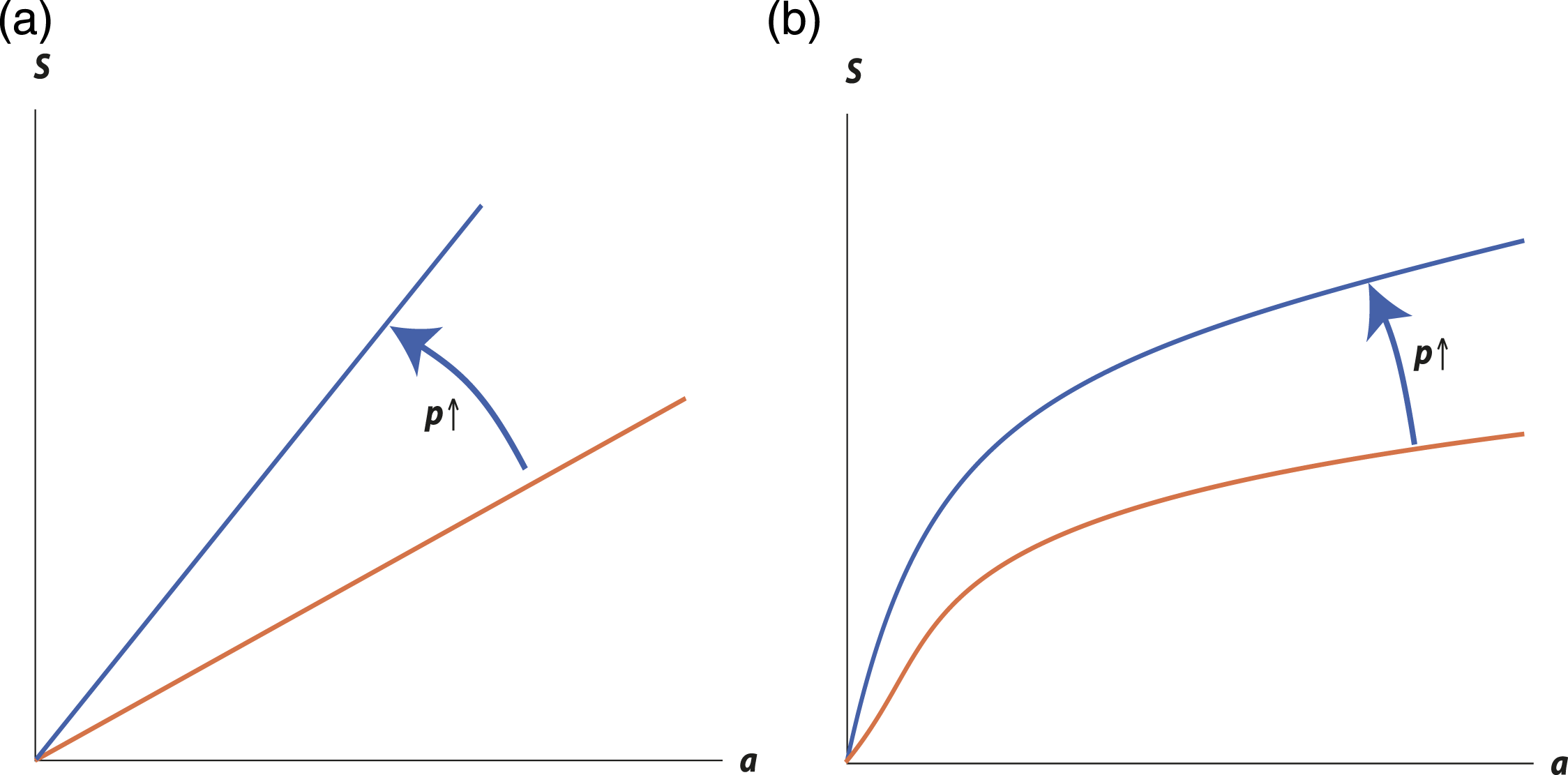
For a fixed budget, a will decrease, and for a proportional budget S will increase. See Figure 3. In general, however, we cannot conclude that the ratio S/a increases as p increases, see Figure 3(c). In Figure 3(c), the impact of the status variable strongly diminishes after reaching a certain level, whereas the impact of a continues to be strong.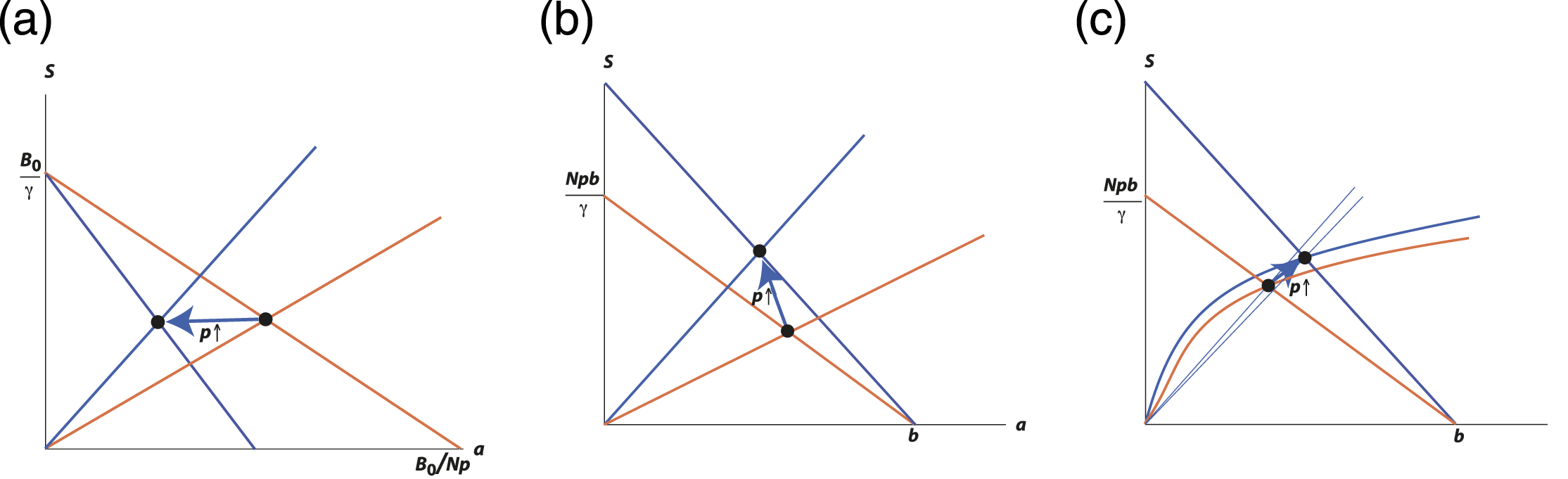
Limiting ourselves to the homothetic case, and writing the ratio of the budget shares as
allows us to write equation (16a) as
Using the definition of the elasticity of substitution between S and a
The sign of ∂Λ/∂p depends on the elasticity of substitution between S and a. If
The optimal vitalization policy for a minority language under the assumption of a homothetic influence of policy measures on linguistic behavior implies that policy measures leading to rival language-related goods should be partially or fully replaced by measures leading to non-rival language-related goods as the vitality of the language increases. The budget shares for the two types of measures, however, should move in the opposite direction if the language-related goods are complements in their impact on the vitality, that is, if the elasticity of substitution is less than one. If the two types of measures are substitutes, that is, the elasticity of substitution is greater than one, the budget share of the measure leading to a non-rival good should increase with an increase in the vitality. In the case of corner solutions, the budget shares and the ratio of the measures do not change as long as one measure is not used at all. We gave some intuition for which measures are complements and which measures are substitutes in the discussion above in the introductory section. We argued that compulsory teaching and general status increasing measures probably are complementary. Without making the language attractive to the young people they might not like to use it, or even pay attention in the class room; and without the teaching, a high general status might not lead to much use of the language. Hence, Proposition 3 suggests that in case the language policy consists of general status-building measures and acquisition planning, the budget share for teaching should increase as the policy shows success and that of general status-increasing measures, such as government publications in the language should decrease. These results are independent of the type of budget. However, the analysis in Figures 3(a) and (b) suggests that in case of a fixed budget restriction the costs per minority student should decrease, whereas the total budget for the status-building measures should stay more or less the same. On the other hand, if the budget is proportional to the size of the minority, the total budget for the status-building measures should increase and the budget per minority student stay more or less constant. If the relevant measures are instead general status building and the right to correspond with the government in one’s language of choice, we would argue that these measures are basically substitutes. That means that as vitality increases, the budget share of general status-building measures should increase and the share allocated to the rival good should decrease, again independently of the type of budget. The influence of the type of budget on the absolute expenditures would be the same as in the example above.
Perfect complements
The results from the previous subsection have to be modified if the non-rival good is also a protracted good. The problem of finding the optimal policy, however, is only interesting if the two policy variables a and S are not perfect complements. Therefore, we first look at the special case of perfect complementarity.
If the measures are perfect complements they will be employed in a given proportion and can be set equal without any loss of generality: a = S. Then, the constraints can be written
or, substituting the budget restriction into the equation of motion of S
This, of course, is a deterministic system, and the maximand is superfluous, like the non-negativity constraints on the expenditure variables. The expenditures a and e S will remain positive up to the time horizon (or in the steady state). If e S were to become equal to zero at any time, S (and a) as well as the vitality p would decrease, which contradicts the budget restriction:
If the status of a minority language and the instantaneous policy measure are perfect complements in contributing to the vitality of the language, a planner planning for a high vitality of the language, will always budget a positive amount of resources to both measures.
The general formulation
In the case of the two variables not being perfect complements, the general dynamic problem of the policy maker is given by equation (14).
Claim 2.2 in Section “Claims” is readily proven, since the equation of motion of S, equation 14c, is linear and additive; that is, each addition to S from the status-building measure can be treated separately from each other addition and then added to all the others in order to find the total value of S. Take any (small) interval
This gives us:
If the status of a minority language contributes to its vitality, the optimal size of the protracted status-building measure decreases (or remains equal to zero) at each point of time if the time horizon is shortened. In comparison to a situation with an infinite time horizon, a policy consisting of a sequence of optimal planning decisions, each with a finite time horizon, is sub-optimal.
In the online appendix, it is demonstrated that the status-building variable goes to zero as the time horizon approaches:
If the status of a minority language contributes to the vitality of the language, and the status is a protracted variable (state variable), a planner planning for a high vitality of the language, will let the budget share allocated to the measure increasing the status of the language become zero, as the time horizon approaches.
In other words, at the end of the planning period, the planner implements the rule « après nous le déluge ». This corresponds to the intuition expressed in the introductory claims.
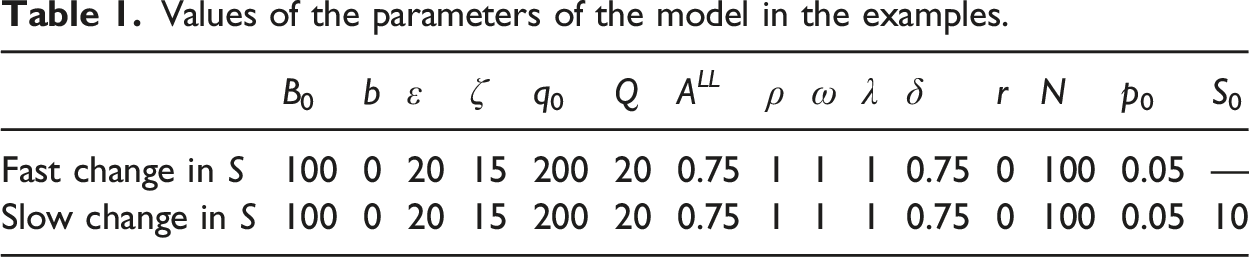
Values of the parameters of the model in the examples.
Examples
We illustrate the general results above in some simulations. In the first subsection, we assume that the status variable adjusts instantaneously and simulate the model with different elasticities of substitution between the policy measures. Then, in the second subsection, we let the status adjust more slowly and look at the effects of the time horizon on the optimal paths.
We specify the function q to be
That is, it is homothetic with a substitution elasticity between S and a given by
The realized value of the objective of the planner is written as
the model is calibrated using the parameters shown in Table 1, and solved in Excel using Solver.
Optimal proportions of policy measures
We simulate the vitality of the minority language for different values of the elasticity of substitution: Policy measures complements, status adjustment instantaneous ( Policy measures substitutes, status adjustment instantaneous (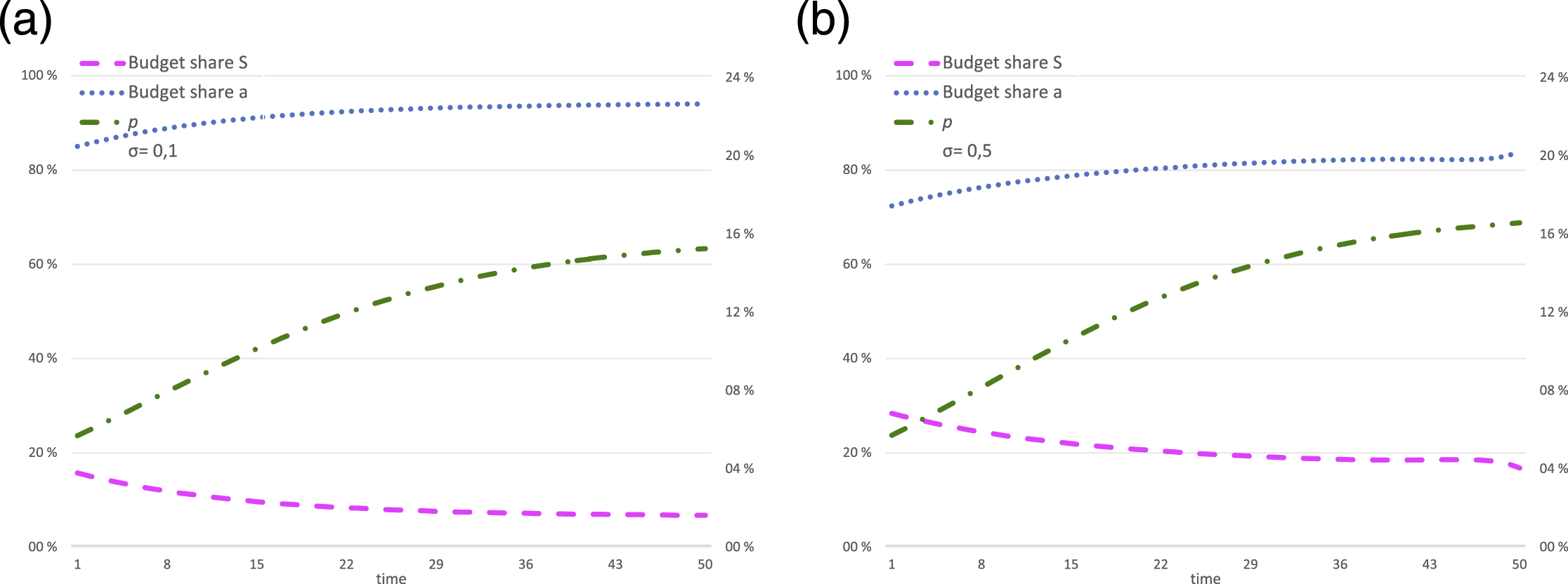
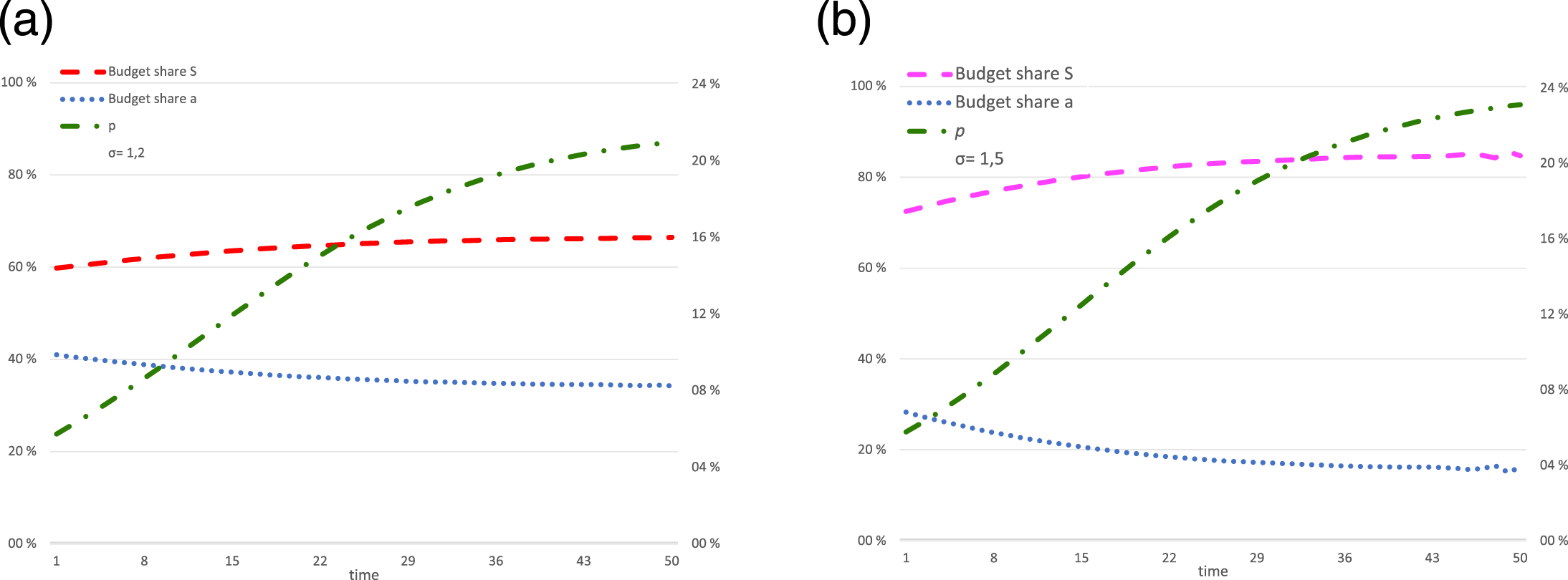
The efficiency gain due to the flexible policy compared to a policy with fixed budget shares given by the optimum values in period one varies strongly with the substitution elasticity, Measured as the change in W (T), it is, in the case of
Effects of slow adjustment of the status variable
We conjectured in our claims and proved in the previous section that the budget share of the status-building measure goes to zero at the time horizon. That way the optimal budget share first increases and then decreases when the two measures are substitutes. In Figure 6 this is illustrated in the case of a still fairly rapid adjustment of the status and an elasticity of substitution equal to 1.5. Policy measures substitutes (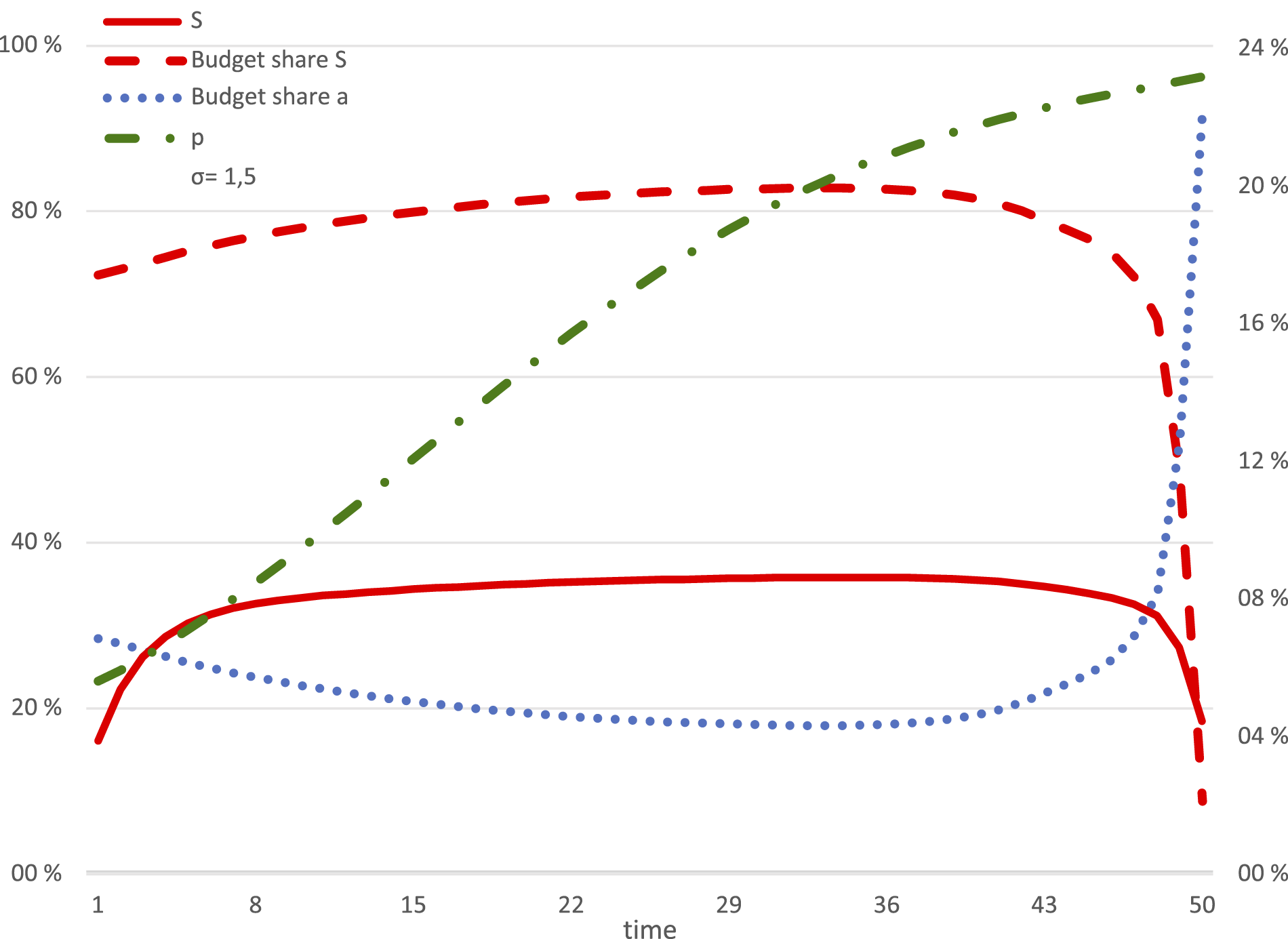
If the status adjustment is even slower, the increasing phase of the budget share might be dominated by the decreasing time-horizon effect. This is the case where the elasticity of substitution is the same as in Figure 6 but the status accumulation considerably slower by a factor of eight. In Figures 7 and 8, we also compare the optimal policy when the time horizon is T = 50 with the optimal policy when it is T = 25 and the optimization is repeated for a second planning regime of 25 periods. As expected, there is a trade-off between a gain in vitality after 25 periods and a loss after 50 periods in the case of two planning periods. For the myopic planner the vitality at the horizon at T = 25 outweighs the horizon at T = 50. The vitality can, in the short run, be increased by increasing the budget for the rival good at the costs of not maintaining the status. Since the decline in status reacts slowly to the budget decrease and the effect of a budget increase on the rival good is fast and direct, there is an increase in vitality at the end of the planning periods. During the last periods before the time horizon, vitality increases compared to a policy of maintaining the status. The costs of this increase comes in the next planning regime, since the status at the beginning of the next periods is lower than it would have been if the planner had continued keeping e
S
on a high level. This has to be built up again at the beginning of the next period. We have a short-term gain and a long-term loss. There are discontinuities at the end of every planning period with the control variables making jumps. The vitality p and the status S, of course, will be continuous but the path of especially the status will not be smooth. Policy measures complements ( Policy measures substitutes (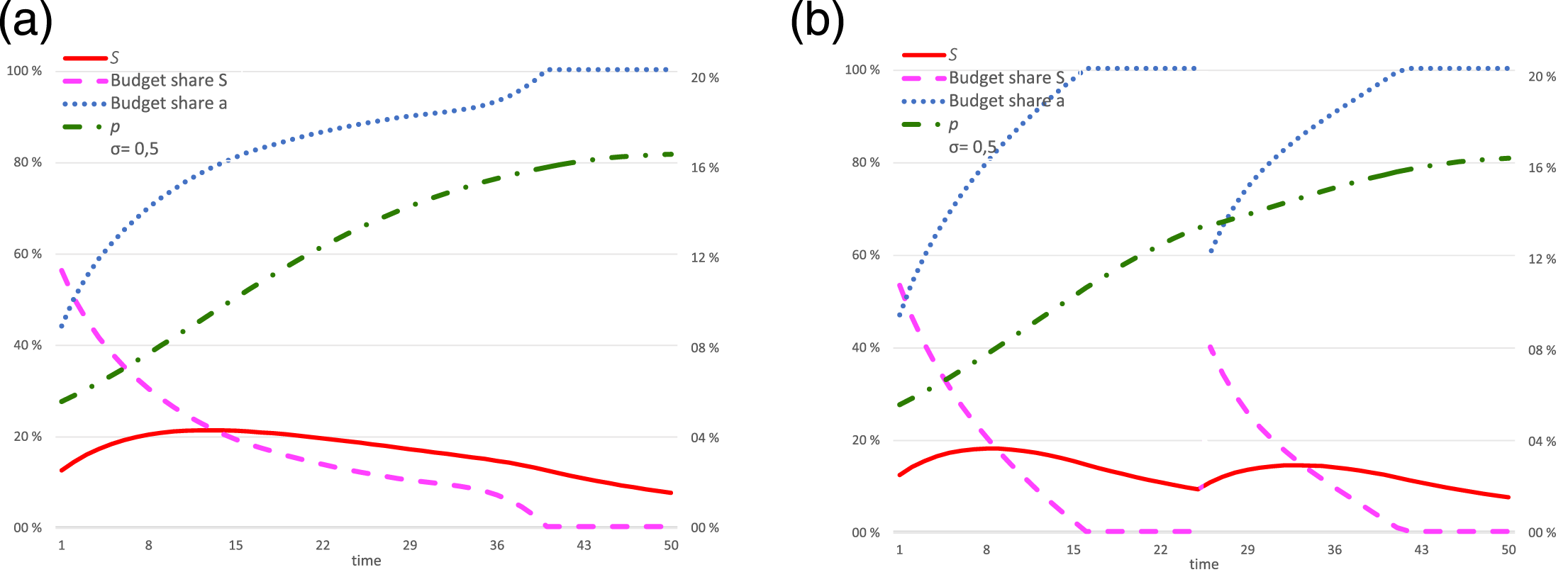
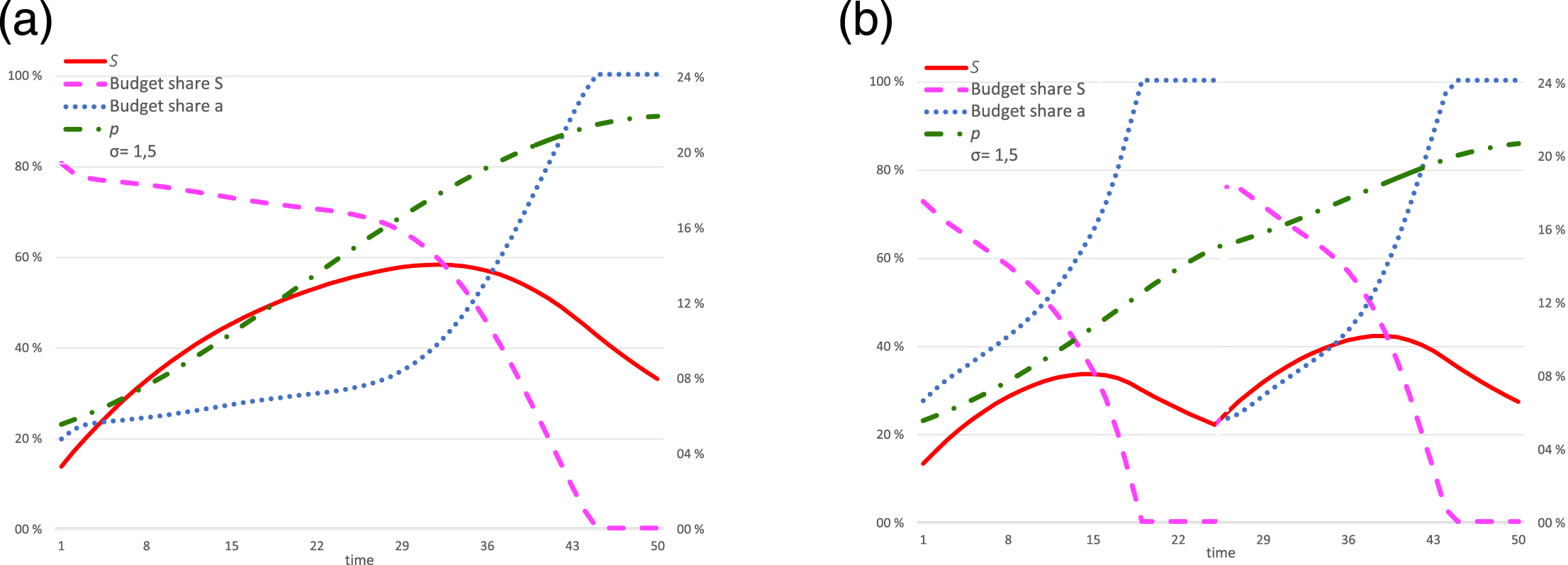
In the example, the value of the objective W (T) will be higher at T = 25 in the case of two consecutive planning regimes of 25 periods each than in the case of one planning regime of length 50 periods, but it will be lower at T = 50 with short consecutive planning regimes than with one longer one. This effect is the more pronounced the higher the elasticity of substitution between the planning measures. That is, it is higher for substitutes than for complements. In our example, the short-run gain in the case of complements is 1.01% and the long-run loss is 0.88%. In the case of substitutes, the short-run gain is 2.11% and the long-run loss 3.82%. Because of the flexibility in the planning “technology” the planner can move further away from the long-run optimum with the higher elasticity of substitution.
Also the overall lower budget for the status-building measure with a short time horizon in comparison to the case with a long one is clearly visible in the figures. Fewer resources are allocated to the protracted status variable S. This effect is also stronger in the case of the policy measures being substitutes.
Concluding remarks
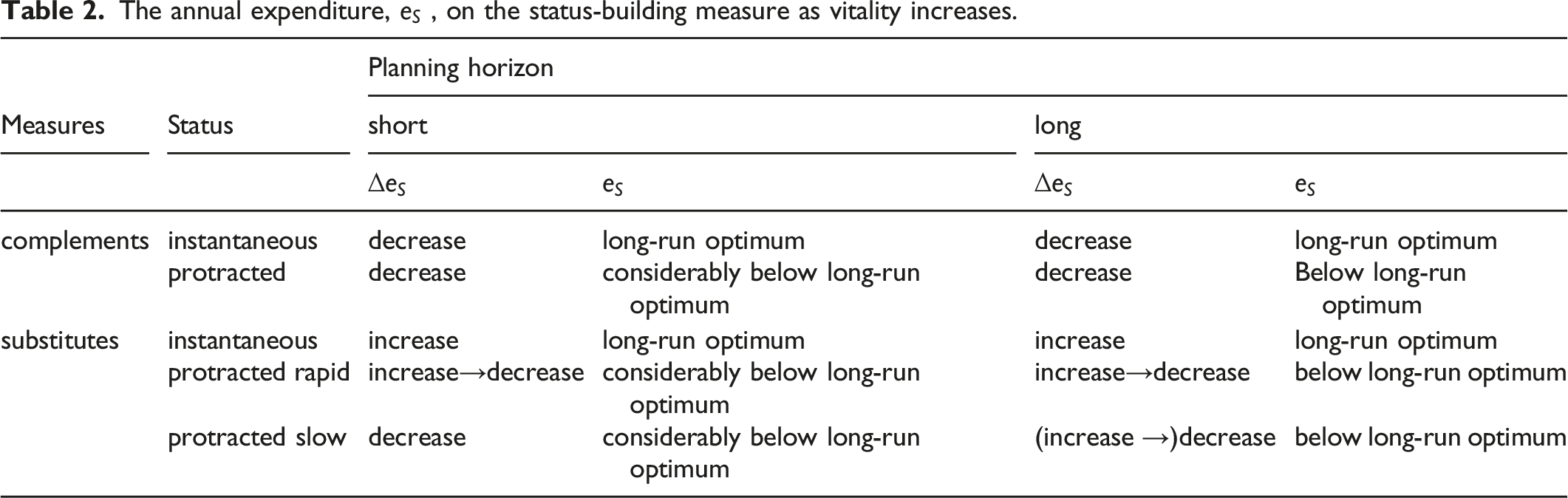
The annual expenditure,
The length of the time horizon as well as the structure of the budget are, in the model, exogenous. Through the parameter b the budget increases with the vitality of the language. This, however, has no influence on the qualitative results of the study. Quantitatively, of course, it has a certain influence on the paths of the various variables. The budget is politically decided upon, and if the language reaches a high vitality, the political support for further measures might diminish. For the policy maker, this is a source of uncertainty regarding the continued support of the language and as a consequence will influence the planning horizon.
There is enough anecdotal evidence that in many countries the support for small minorities is politically uncontested, whereas the support for larger minorities can be a very controversial issue. Some states see this as a nation-building matter and discriminate against too important groups, especially if the members of the group belong to a formerly dominating culture. The treatment of the many Russian minorities in former Soviet republics is a case in point, but also the dealings with the Hungarian speakers in countries such as Romania, Slovakia, or Ukraine are examples with at least partial roots in a dominating Hungarian culture and magyarization movements in the 19th century Habsburg empire. 20
If the planner has a probability distribution over the possible time horizons, this would affect the planning in the way we have analyzed the question of the time horizon in this essay. Changing time horizons, hence, can be the result of uncertainty over the commitment of the state to support the minority language. However, the time horizon can also be a result of political opportunism. If the members of a political regime face elections and the vote of the minority is important, it is opportune to see the date of the elections as a time horizon. That the optimal policy has to start again with a new direction after the elections is of little consequence if the electorate is sufficiently focused on the present. This, of course, opens up a discussion on the constitutional level if the language policy should not be made more long term and independent of everyday politics. What would be needed is an independent planning agency with a long-run mandate.
Supplemental Material
Supplemental Material - Optimal and politically opportune language policies for the vitality of minority languages
Supplemental Material for Optimal and politically opportune language policies for the vitality of minority languages by Bengt-Arne Wickström in Rationality and Society
Footnotes
Acknowledgements
I thank two anonymous referees and the editor of this journal for many constructive suggestions.
Declaration of conflicting interests
The author(s) declared no potential conflicts of interest with respect to the research, authorship, and/or publication of this article.
Funding
The author(s) disclosed receipt of the following financial support for the research, authorship, and/or publication of this article: This work was supported by the European Union's seventh framework program -- Project MIME (613344).

Supplemental Material
Supplemental material for this article is available online.
Notes
References
Supplementary Material
Please find the following supplemental material available below.
For Open Access articles published under a Creative Commons License, all supplemental material carries the same license as the article it is associated with.
For non-Open Access articles published, all supplemental material carries a non-exclusive license, and permission requests for re-use of supplemental material or any part of supplemental material shall be sent directly to the copyright owner as specified in the copyright notice associated with the article.
