







Abstract
Community currencies (CCs) are common social economy instruments for aligning market transactions with social commitments. They change incentives, encouraging trade within the CC network, but may also symbolize and thereby amplify users’ commitment to social values of solidarity and cooperation. The behavioral effect of the second channel, moreover, is clouded by endogenous use of the CC: commitment encourages use, but does use also trigger commitment? We disentangle the direction of causality with a lab-in-the-field ultimatum game experiment, which confronts participants with a choice between more or less competitive responses. By exogenously varying the currency in which the game is played (CC or euros), we isolate the causal effect of the CC on behavior. Self-declared regular users of the currency are less competitive when playing in the CC than when playing in euros. This is not due to unobserved differences in the individuals, because when playing in euros, their behavior is the same as non-users’. Nor is it due to non-convertibility of the CC, as non-users’ behavior is not affected by the currency. We therefore isolate the CC as a “trigger of cooperativeness” for those who have a base-level of commitment to it.
Keywords
Introduction
The social economy is generally described as a third sector situated between the private (market) and public (state) economies, emerging to address problems generated mostly by the private sector and for which the public sector has no suitable solutions. The mechanism of exchange characterizes both the market and social economy (as opposed to the state economy, which is based on the mechanism of redistribution), but there are important differences between the two sectors. While market exchange is taken to be driven by private motives of consumption or profit maximization, the social economy comprises organizations that also have strong social objectives. That is, where the market economy is taken to be individualistic and even competitive, the social economy uses a “multiple bottom line”, additionally motivated by solidarity and cooperation. Moulaert and Ailenei (2005: 2037) propose that “social innovation in the economy is mainly about the (re)introduction of social justice into production and allocation systems.” Social economy actors collectively intend to address socio-economic problems.
This notion of a collective intention opens interesting questions from a rational actor perspective. If the rational actor model places any concrete constraints on interpretations of behavior (in itself possibly an open question), then one seems to be that intentions should be inherently individual. Does a collective intention imply that social economy actors are in some way not rational? Controlled from without by some social force? If so, how does such a thing occur? Our main contribution in this paper is the empirical claim that something of the sort does in fact occur. We propose a very simple lab-in-the-field experiment providing strong evidence that salience of collective commitments affects behavior of those so committed. We also offer a somewhat detailed proposal for why and how the effect proceeds.
The specific social economy tool we focus on is a Community Currency (CC, also referred to as local currencies). CCs are widespread: there have been more than 4500 documented in the literature in the past 30 years (Bazzani, 2020), motivated by a wide array of social, environmental, economic and cultural missions, and based on a variety of different operating models (Blanc, 2011; Martignoni, 2012). Our central intuition is that while CCs may in large part support their social economy missions by facilitating trade within the social economy network, they may also have a symbolic role as carriers of the commitment to objectives that sustain and define the social economy itself.
Empirically identifying such a symbolic function presents challenges precisely because people normally choose whether to use the CC or not. Regardless of whether, as we hypothesize, use of the CC triggers commitment to social goals, it seems highly plausible that if people recognize the social goals of the CC, then those who are more committed to the goals will be more likely to use the CC. We do not have the counterfactuals of how those users would have behaved without the CC – or non-users with it – for a valid comparison. Our experiment addresses precisely this problem with an ultimatum game (UG, Güth et al., 1982), that exogenously varies the currency in which the game payoffs are received (euro or the CC).
The UG game asks a proposer to split a sum of money with a responder. The responder has a “kill option” to cancel the entire interaction if the proposed amount is unacceptable. It is well-suited to our research design for several reasons. First, it is quick and easy to understand, and can be run in the street at low time cost. Second, it is one of the standard workhorse paradigms of behavioral economics, and the fact that the game is so well known (at the time of writing there were 6604 citations of Güth et al. (1982) on Google Scholar, and a search of “Ultimatum Game experiment” yielded more than 50,000 hits) makes it a reliable instrument to apply to our setting. Third, and relatedly, behavioral variation in the game admits relatively straightforward interpretation, particularly for responders. Rejections have been robustly shown to be interpretable as negative reciprocity, reactions to “unfair” offers; in this way the game faces responders with a choice between a competitive, individualistic alternative (i.e., rejection of the proposal) and one that may require them to “swallow their pride” and abandon a logic of competitive comparison for a greater collective benefit (since both parties lose everything if the proposal is rejected). The responder’s dilemma, in other words, reflects the basic compete-or-cooperate duality of private versus social economy motivations. If CCs are somehow “carriers” of the cooperative motivations of the social economy – and we make this conjecture more explicit later on – then playing an ultimatum game denominated in the CC should correspond to a less competitive framing of the game and reduce the rate at which the kill option is activated.
Proposer behavior is in general somewhat more complex, as the rational offer depends both on preferences, and also on expectations of rejection propensity, both of which might change with the “cooperativeness” we conjecture the CC to trigger. A responder who is expected to be “conciliatory”, rejecting fewer offers, gives the proposer a greater scope to make “aggressive”, that is, low, offers to begin with. Overall, however, it also appears highly intuitive that if the CC reduces the importance of individual considerations in favor of the group, then it should increase offers as well as reducing rejection rates for any given offer received.
More generally, a lab-in-the-field design presents several advantages for our question. As mentioned, the experimental control of the currency in which the game is played allows us to isolate the symbolic function of the CC. Random assignment to one currency or the other implies that on average, the base-level commitment to the CC’s social goals should be equal in both the Euro and CC conditions. Differences in behavior can therefore be causally ascribed to the use of the CC itself, indicating the symbolic effect. On the other hand, commitments themselves cannot be experimentally manipulated, which makes them difficult to investigate in the necessarily abstract environment of an experimental laboratory. Running the experiment in the field allows us to tap into the contextual richness of the CC’s significance to actual users. In this line, it is worth mentioning explicitly that our hypothesis turns on triggering, or activating existing commitments, rather than creating new ones. Our interventions provide no information on the CC or its social mission: while we exogenously manipulate the currency – “pulling the trigger” on a random set of participants, but not others – the commitments themselves remain endogenous. Indeed, we expect that our treatments should not have any impact on those who do not have pre-existing commitments. For this reason, in the analysis below it will be important to control for commitments, which we do through the proxy of asking participants whether they are “regular users” of the currency or not. Our research therefore has two main contributions. First, it investigates one way in which CCs contribute to their social economy goals, providing evidence of their usefulness beyond the instrumental function of directly encouraging community involvement through commercial activity. Second, at the same time it also studies the mechanisms behind cooperative behavior, by testing the effects of commitment on the competitiveness of individuals’ posture towards each other’s choices.
We find that regular CC users exhibit significantly lower rejection rates – that is, they are more cooperative – when they play in the CC than when they play in euros. Those who do not regularly use the CC, by contrast, are insensitive to changes in the currency. Importantly, users behave like non-users when playing in euros, so the differences we find are not due to unobserved individual characteristics, and the finding that non-users’ choices are statistically identical across the currencies implies that differences are not due to problems of convertibility of the CC. On the other hand, no proposers of any kind, user or non-user, show any significant differences across treatments. We ascribe this to methodological issues. The lab-in-the field implementation results in low anonymity, and generates a strong social desirability for “fair” offers. And indeed, 65% of proposers overall offered exactly half of the available amount. This suggests a binding ceiling effect on offers, and reduces our confidence to interpret the treatment effects. If proposers are somehow maximally fair even in euros in our set-up, then the fact that they behave no differently in the CC cannot be ascribed to the currency.
For responders, however, these results are consistent with our conjecture of a symbolic effect of CC use on individual commitment. Translated into the language of methodological individualism, the effect corresponds to a triggering of social preferences. The explanation of the effect raises two kinds of question. First, what is the nature of these social preferences? And second, what is the mechanism by which they are triggered? Our explanation for the first comes from the literature of joint commitment as described by the philosopher Margaret Gilbert (Gilbert, 1990), and team reasoning, largely following Michael Bacharach (Bacharach, 1999). Roughly put, participation in institutions of the social economy can prime a specific collective reasoning process. The social preferences are therefore “social” in a more radical way than is ordinarily conceived. They do not just comprise social variables such as inequality or intentions as arguments; they are brought into being, or at least put in operation, by the salience of social relationships.
These processes help to understand why behavior changes in the way we find, squaring individual and collective motivations, but the theories that underlie them are generally light on how or under what circumstances the triggering occurs. We link this second process to goal-framing theory (GFT) 1 (Lindenberg, 2022), which complements the discussion with a theory more specifically targeting the selection of different kinds of reasoning. GFT posits that people have three different “frames” that determine the goals they rationally pursue. In this context, the interpretation of our results is that the CC suppresses the short-term emotional or “hedonic frame” that leads to rejection in the ultimatum game, in favor of “normative” or “gain” frames that focus on longer-term, more socially oriented goals.
The rest of the article is organized as follows: To fix ideas, the next section describes the experimental design and hypotheses, followed by the presentation of our results. We defer the theoretical exploration until after the empirical results are established, and end with some conclusions and directions for future research.
Experiment and hypotheses
The UG and behavioral predictions
We implemented a standard ultimatum game with a total endowment of 10 currency units. In this game the proposer (she, for simplicity of exposition) gets 10 currency units to split between herself and a responder (he). The split is implemented if the responder accepts it, otherwise both sides lose all money. Figure 1 illustrates. Structure of the UG. Note: Proposer P chooses x between zero and 10 inclusive, and responder R either accepts the offer (upper branch), in which case it is implemented, or rejects it (lower branch), in which case both p and R earn zero.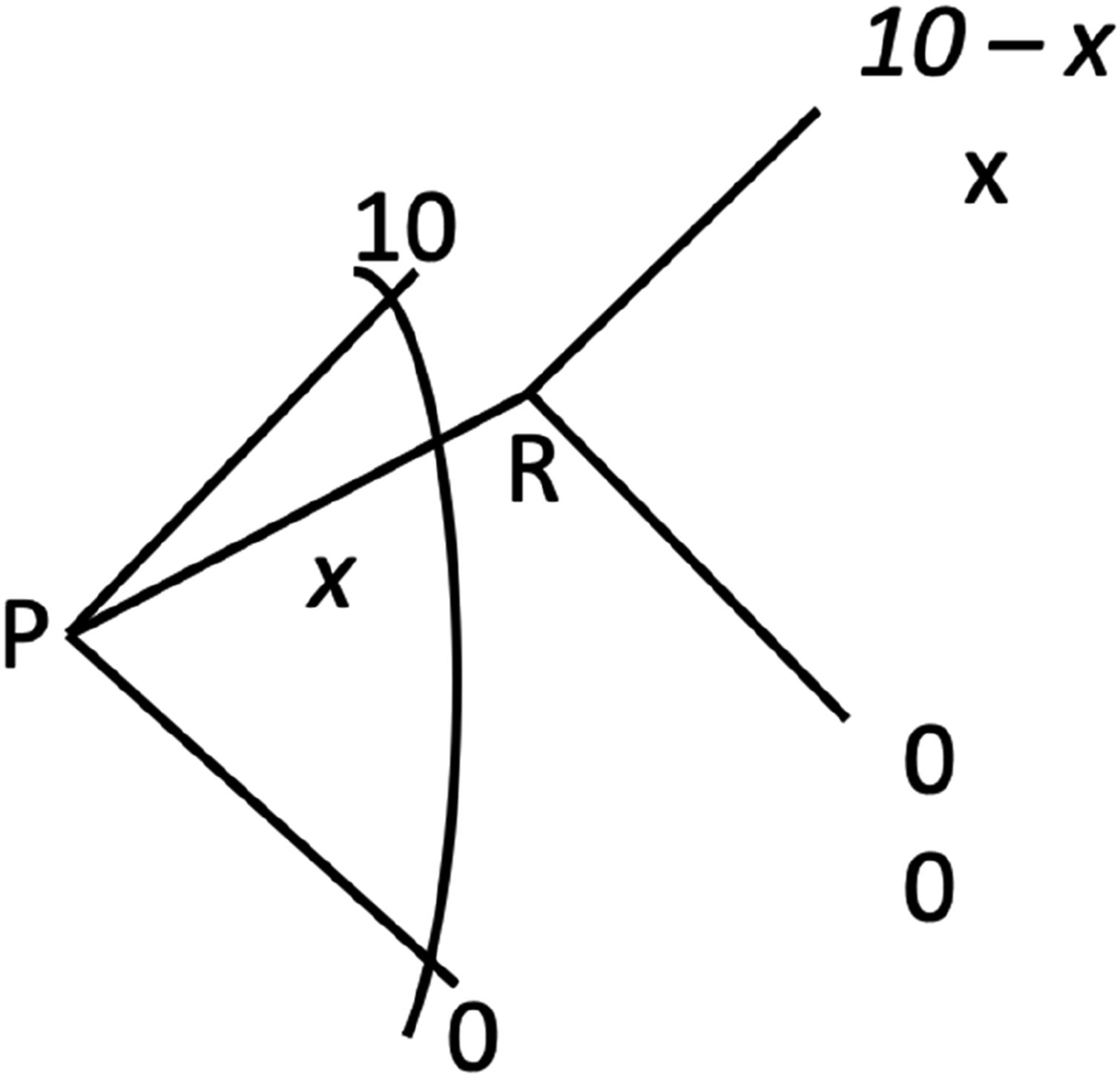
This game’s popularity is likely due in some part to the fact that its unequivocal game-theoretic predictions contrast so starkly with both intuition and observed behavior. As a baseline, consider the standard Nash equilibrium (NE) analysis, assuming that both proposer and responder are trying simply to earn as much money as they can. NE requires each player to choose a best response to (correct) beliefs about the opponent’s strategy. The proposer’s strategy space is identical to her action space; the responder’s strategy is a mapping from offers to binary accept/reject choices. We consider responder strategies that take the form of thresholds, called Minimum Acceptable Offers (MAOs). In other words, the responder strategy defined by a MAO of x takes the form “Accept any offer of at least x, and reject the rest.”
Clearly, given an MAO of x, the proposer’s best choice is to offer x. And given any positive offer x, the responder’s optimal response is to accept. Conditional on an offer of x, this is consistent with having a MAO of x. Thus, any pairing of Offer = MAO = x constitutes an equilibrium. On the other hand, there is only one subgame-perfect Nash equilibrium (SPNE). SPNE requires not just mutual optimality of strategies, but also robustness of those strategies to deviations by other players. In the UG, because rejection results in a payoff of zero, a responder who cares only about payoffs has an incentive to deviate from any positive MAO after seeing a lower (positive) offer. As a result, any MAO greater than the smallest possible positive amount constitutes a ‘non-credible threat’. For instance, suppose the MAO is equal to five, and that the proposer is considering an offer of five and an offer of three. The MAO can be interpreted to mean that the responder is ‘threatening’ to reject any offer lower than five. However, if faced with the choice between (a) accepting three and (b) rejecting three to get zero, a responder trying to maximize payoff should still choose to accept. A payoff-maximizing proposer, anticipating this, should not offer five. Clearly, this reasoning holds for any positive offer. Therefore, the unique strict SPNE has the proposer offering the smallest possible positive amount, and responder accepting. 2
Hundreds of replications of the UG in lab and field settings all around the world have uncovered ‘stylized facts’ of behavior that surprise only the purest of game theorists: far from the SPNE prediction, (a) proposers offer around 40% of the pie, (b) many offers are rejected, and (c) lower offers are rejected more often than higher ones are. In fact (d) offers less than 20% of the total are usually rejected (Oosterbeek et al., 2004). Two leading explanations for this are inequality aversion (e.g., Fehr and Schmidt, 1999) and reciprocity (e.g., Dufwenberg and Kirchsteiger, 2004). The former supposes that the responder in the UG objects to an unequal division of the final outcomes, and prefers to equalize payoffs, even to zero. The second, somewhat more subtly, supposes that players evaluate the ‘kindness' of each other’s actions, and prefer to reciprocate ‘unkind' actions (specifically low offers) on their opponent’s part, even at the cost of the offered amount.
Both inequality aversion and reciprocity are specifications of the self-interest model that rationalize rejections in the UG. They relax the assumption above that players are (only) trying to earn as much money as possible, generalizing the concept of ‘payoff’ to mean ‘money plus appreciation of the comparative earnings’ in the case of inequality aversion, and ‘money plus the reciprocal kindness of actions’ in the case of reciprocity. However, because both are based on calculations from monetary payoffs, so long as the CC and euro are both seen as ‘money’ they cannot explain any differences that may emerge from play in the two currencies. In fact, because the definition of the game is based on general ‘currency units’ that may be either CC or euros, there is no utility transformation of the game structure that can possibly generate different predictions in one from the other. The ‘utility function’ itself must depend on the currency of play for any prediction. To explain how this might work, note first that both the examples above of inequality aversion and kindness represent somehow individualistic or competitive motivations. The expected rejection of low offers indicates not just inequality aversion, but a specific ‘envious’ kind based on disadvantageous inequality. Similarly, the reciprocity that generates rejection of low offers is a ‘vengeful’ kind, called negative reciprocity. The fact that these relatively competitive facets of inequality aversion or reciprocity are highlighted comes from the structure of the UG. Offers of more than half the pie are in general vanishingly rare in experimental implementations, and not usually rejected when they occur. Therefore, the interpretation we maintain of rejections, whether based on envy or revenge, is that they are basically competitive in nature. Our conjecture mentioned in the Introduction, and which we explore in greater depth in the discussion section, was that the CC, as a “carrier of collective motivations of cooperation and solidarity”, will tend to trigger a wholesale reinterpretation of the game, a change in the utility function, that will reduce the effects of either or both of these mechanisms in generating rejections by affecting the goals that players are seeking. This is the process we describe in the Discussion. To understand it better, it is worth considering the specificity of the currencies we use.
The specific CC chosen: The Eusko and Basque identity
Our study focuses on the Eusko, the CC of the French Basque Country, and the most developed CC in Europe, with 5300 registered users (including 1300 professionals) and about four million Euskos in circulation in spring 2021 (Euskal Moneta Association, 2023). 3 The word Eusko means ‘Basque’ in the Basque language, and the CC has strong resonance with the region’s cultural identity. The Basque country comprises seven provinces, four in Spain and three in France. It is characterized by a distinct cultural and linguistic heritage expressed in longstanding nationalist movements. The greater part of previous research has focused on the southern, Spanish provinces, put into the international spotlight by the armed independence movement of the Basque Country and Freedom (ETA) group active there from 1959 until 2018. While the French Basque country also had a militarized branch in the 1970s, it was more politically fractured than its Spanish counterpart, and from the 1990s regional development initiatives from the French government contributed to a shifting of nationalist tendencies towards local and regional identity: from ‘Basque’ identity indicating a separatist tendency to ‘Pays Basque’ identity that upholds the cultural and linguistic specificity within a French national context (Gurrutxaga, 2005). However, the French Basque country has a long history of grassroots economic activism, and in particular of politicizing small-scale agriculture by linking it to wider social, environmental and economic concerns (Itçaina and Cadiou 2007; Itçaina and Gomez 2015).
Consistent with this background, the Eusko aims specifically to promote local, small-scale artisan, Basque economic activity. The justifications for the establishment of the currency listed on the association Web site are to support: ‘ecological transition’ (a common term in France for policies promoting ecological sustainability); the Basque language; small-scale agriculture; a reduction of financial speculation; local economic activity; the Euskal Moneta association itself (which engages in other sustainability-oriented activities); and local businesses (Euskal Moneta Association, 2023). Thus, the Eusko has a clear social mission tied to cooperation and solidarity, particularly within the Basque community. In this context, it appears plausible to suggest that not only is the social mission furthered instrumentally by using Eusko in local economic transactions; such transactions may also serve a self-signaling purpose, making the commitments to local social groups and shared heritage more salient. In the terms that we will make clearer in the discussion section, interacting in Eusko may highlight collective intentions of solidarity within the community, triggering norms of cooperativeness and suppressing individualistic, competitive urges; the empirical question we address is whether this is sufficient to alter the behavior that results.
Procedures and empirical predictions
Our experimental game was conducted with 304 inhabitants of the French Basque country. Subjects were approached individually in cafés and bookstores in the city of Bayonne, capital of the French Basque Country. Figure 2 visually represents the precise zone within the ‘Petit Bayonne’ neighborhood where the experiment took place. The experiment lasted around 15 min for each pair of participants. The neighborhood.
We implemented the game using the strategy method. First, we approached responders, explained the interaction including the currency in which the game was denominated, and elicited the MAO. Then, while the responder waited, we went to a different location and approached a proposer, explaining that if they proposed more than the MAO previously given, they would receive whatever was left; otherwise they receive nothing. Obviously, proposers were not informed of the value of the MAO prior to making their decisions. Proposers received the resulting amount immediately; in either case, we then went back to the responders and informed them of the outcome of the game. We recorded the gender of each participant, and also asked them whether or not they were ‘regular users’ of the Eusko currency. 4
We therefore have two central dependent variables, the amount offered by the proposer (offer), and the minimum offer accepted by the responder (MAO). The most important independent variables are the currency in which the experiment is run (Eusko or euro) and the user status of the player (User, Non-User). Gender is used mainly as a control variable. Under our conjecture that using the CC affects motivation through priming of collective intentions, it should work primarily on those who consider themselves to be a part of the collective. It is indeed something of a corollary to the claim that our treatments work because the commitments they trigger are real, that they should only work on those who have really made them. We note in this regard that different effects for users and non-users of the currency is consistent with prior research (e.g., Alia and Spiegelman, 2020).
Participants were drawn as a convenience sample 5 , with two central conditions for inclusion. First, responders had to be in a place they would stay long enough to find a Proposer and return to finish the game. Second, participants had to be in a location that accepted payments in Eusko to maximize commensurability of the currencies; the experimenter informed those participating in Eusko that they could, if they so desired, immediately spend any Euskos they might win on the spot. The experimenter additionally emphasized that the exchange rate with the euro was 1:1, and prices were the same in both currencies. Most participants were young individuals aged between 19 and 26 years old. Given these demographic and situational conditions, it is unsurprising that the rate of refusal to participate in the experiment was low: only around 2% people refused over the course of the entire experiment, about equally divided between euro and Eusko groups. The assignment of participants to one currency or the other was randomized through the order in which they were approached. Every 2 hours, the experimenter would allocate €40 in one pocket and 40 Euskos in another, aiming to involve eight pairs in this two-hour window before taking a break and preparing money for the subsequent period. Throughout each phase within the two-hour period, the experimenter spent €20 and then 20 Euskos. This process was repeated 38 times over the course of 5 days from October 22nd to 27th, 2018.
Before turning to the results, we make several remarks on our empirical design. First, the strategy method has several advantages over the so-called direct response, which begins with offers, and then gives responders an opportunity to accept or reject them. First, it yields a continuous variable in the MAO, facilitating analysis. The direct response method, by contrast, gives only a binary response of Accept or Reject. Second, this binary response is also confounded with the level of offers. If it occurred that the average offer was different in the two currencies, then even if the underlying preferences that generate the negative reciprocity were the same, different rejection rates could emerge. Our threshold MAO procedure imposes a monotonic strategy, and hence loses some generality, although non-monotonic strategies – at least for offers between zero and half the endowment – seem hard to justify, and indeed are usually interpreted as noise (Charness et al., 2013). Blount and Bazerman (1996) find that these advantages come at a cost: there are in general fewer rejections using the MAO technique.
Our procedure also changes the chronological order in which decisions take place relative to Figure 1 (responders make their choice before proposers). It is informationally equivalent in that the response, although temporally prior, is strategically conditional on the proposal. However, the temporal inversion of our design may also impact behavior. For instance, a responder who states an MAO knowing that the proposer has yet to make an offer may suffer from a kind of “illusion of control” (e.g., Yarritu, 2014) suggesting (wrongly) that their response might influence the offer made. A similar effect, indeed, might also reduce the proposers’ offer in the inverse ordering. Therefore, one would expect higher offers and higher MAO under this design.
Crucially, however, such biases are held constant in all our currency conditions. If they occur in euro, there is no reason to think they would not occur in Eusko as well. Nor is there any reason to think that either effect would be more prevalent in users or non-users of the CC. Therefore, our treatment effects (i.e., the differences between these latter variables) should not be affected. We seek only an index of cooperativeness; the magnitude of the offer or MAO in any condition is of little importance.
Finally, we mention that our user status variable is self-declared at the end of the experiment. Logistical concerns kept us from more objective observation of this variable, but as a result we cannot wholly exclude the possibility that the report is influenced either by the preceding choice elicitation in the game itself, or by the currency context. In particular, it is possible that playing the game in the CC might prime people to classify themselves as users. If this were the case, then the currency effects we measure would likely be biased downwards. 6 This effect could be attenuated by asking for user status before introducing the currency in which the game was played. However, doing this seems likely to introduce even stronger demand effects, encouraging participants to later behave in ways congruent with the status previously declared. Such demand effects, should they exist, are clearly quite similar to the currency effects we wish to study, and would therefore result in upward bias of the pure effect of the currency. A downward bias is preferable to an upward one for our purposes, as it will lead, if it has any effect at all, only to false negatives, and therefore implies that our tests are perhaps over-conservative.
The rationale for our overall sequencing is therefore to elicit our primary endogenous variables (offer and MAO) just after the experimental manipulation (exposure to the CC or euro), and before more plausibly exogenous background information (notably user status). Thus our outcomes of interest can depend only on the currency of play. We can check in the data for the self-report bias mentioned. It would suggest that more people should self-declare as users of the currency in the CC condition than in the Euro condition. It is worth recalling again, though, that even if such differences are found, they should result in downward biases of the results; any significant effect should remain valid, but null effects will be difficult to attribute.
Our main hypotheses are the following:
(Eusko encourages cooperativeness) MAOEusko < MAOEuro; OFFEREusko > OFFEREuro
(Eusko is particularly effective on users) MAONon-user, Euro – MAONon-user, Eusko < MAOUser, Euro – MAOUser, Eusko; OFFERNon-user, Euro – OFFERNon-user, Eusko < OFFERUser, Euro – OFFERUser, Eusko
Results
Descriptive results
description of the data.
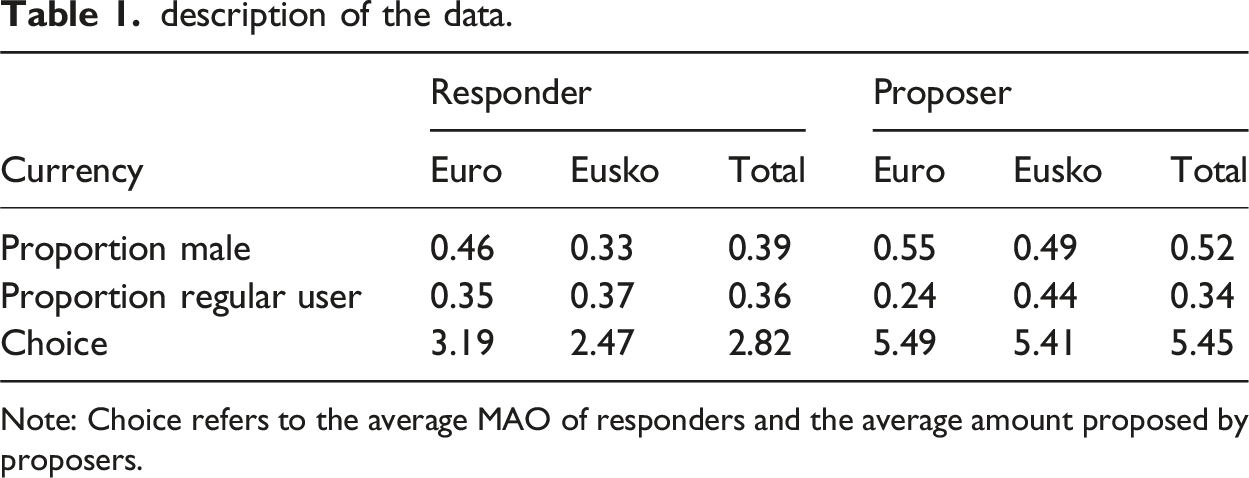
Note: Choice refers to the average MAO of responders and the average amount proposed by proposers.
While the difference in gender proportions across currencies for Responders seems substantial (46% male in Euro vs 33% in Eusko), it does not reach statistical significance (Chi-square (1) = 2.528; p = .112). Still, in light of the finding in the literature that men tend to be more competitive than women (e.g. Niederle and Vesterlund 2007), and given that rejection of unequal splits in the UG is arguably a competitive attitude, it will be useful to control econometrically for gender below. Somewhat more worrisome, the proportion of proposers in the Eusko condition who self-declared as “regular users” was significantly higher than in the Euro condition (44% in Eusko compared to 24% in Euro, Chi-square (1) = 6.2622; p = .012). This difference is, moreover, in the direction one would expect under the selection mechanism outlined in the previous section. Among responders, there was no evidence of this effect (0.35 and 0.37 are the respective proportions, Chi-square (1) = 0.0687; p = .793), and overall the difference is not statistically significant at conventional levels (Chi-square (1) = 3.7801, p = .056). Still, for proposers we must treat our test as particularly conservative, and interpret null results with caution.
And indeed, looking at the choice variables in Table 1, while the responders’ MAOs are not far from the standard ‘stylized fact’ of 20-30% of the endowment in the laboratory literature, with a difference that moves in the predicted direction (i.e., lower in the CC than in Euro), the offers are very similar across currencies, with a slight difference in the opposite direction. They are also quite high compared to the 40% often seen in the lab. (Zhang 2013). In fact, they are significantly above the “fair split” of five out of 10 currency units (95% confidence interval 5.10 to 5.72 in Eusko; 5.13 to 5.84 in Euro). We will return to this point later.
Tests of hypotheses
Mean minimal acceptable offers and number of observations, by currency and user category. Mann-Whitney p-values in parenthesis test equality of distributions for groups above or to the left.
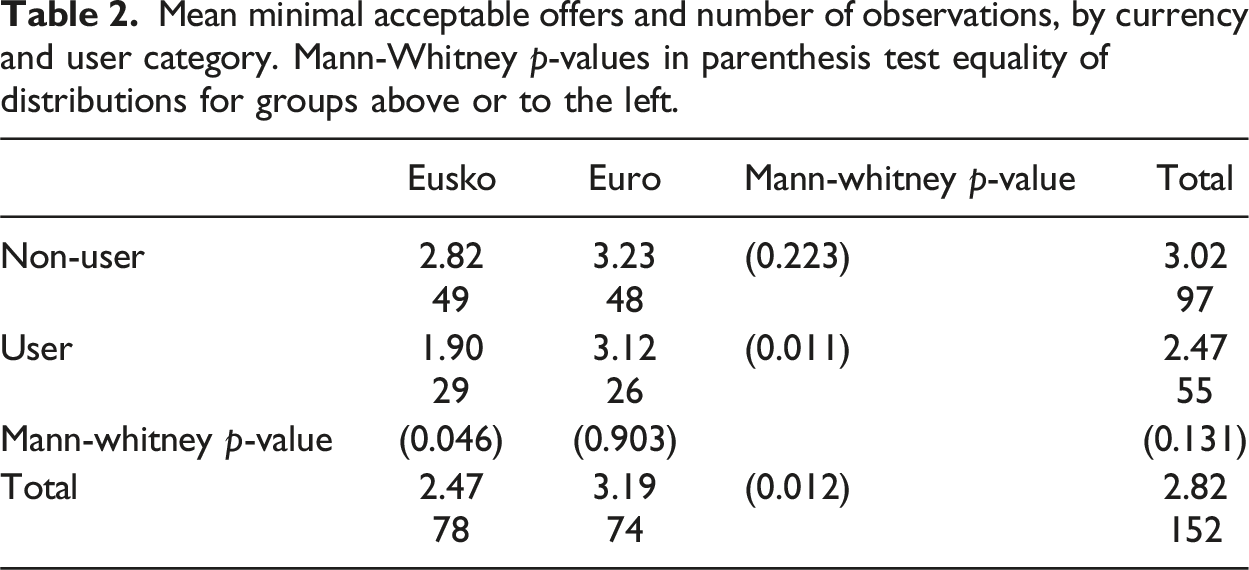
Table 2 shows that overall, negative reciprocity was reduced in the Eusko treatment relative to the Euro treatment. The MAO declined by nearly 20% (3.19 to 2.47), which is a significant difference (Mann-Whitney p = .012). 8 Therefore, our first result confirms hypothesis H1 with respect to the MAO:
In the context of this experiment, the Eusko encourages cooperativeness among responders.
Furthermore, all of this difference comes from regular users of the Eusko. For non-users, the difference across currencies is insignificant (3.23 vs 2.82, Mann-Whitney p = .223), while for users the difference is nearly 40% (3.12 vs 1.90, p = .011). Conversely, we see that while there is little difference in the average MAO between users and non-users overall (2.47 vs 3.02 respectively, Mann-Whitney p = .131), this obscures a difference between users and non-users when playing in Eusko (1.90 vs 2.82, p = .046) behind the insignificant change when playing in euro (3.12 vs 3.23, p = .903). This confirms the difference in differences hypothesized in H2:
Among responders, Eusko participation is particularly effective on users.
In summary, users of the currency react to an interaction in Eusko by significantly diminishing their MAO, which corresponds to less of either or both of envy in the sense of inequality aversion, or negative reciprocity, and was our prediction.
Mean offers and number of observations by currency and user category. Mann-Whitney p-values in parenthesis test equality of medians for groups above or to the left.

Proposers in this setting did not react to the currency of play.
Regression results.
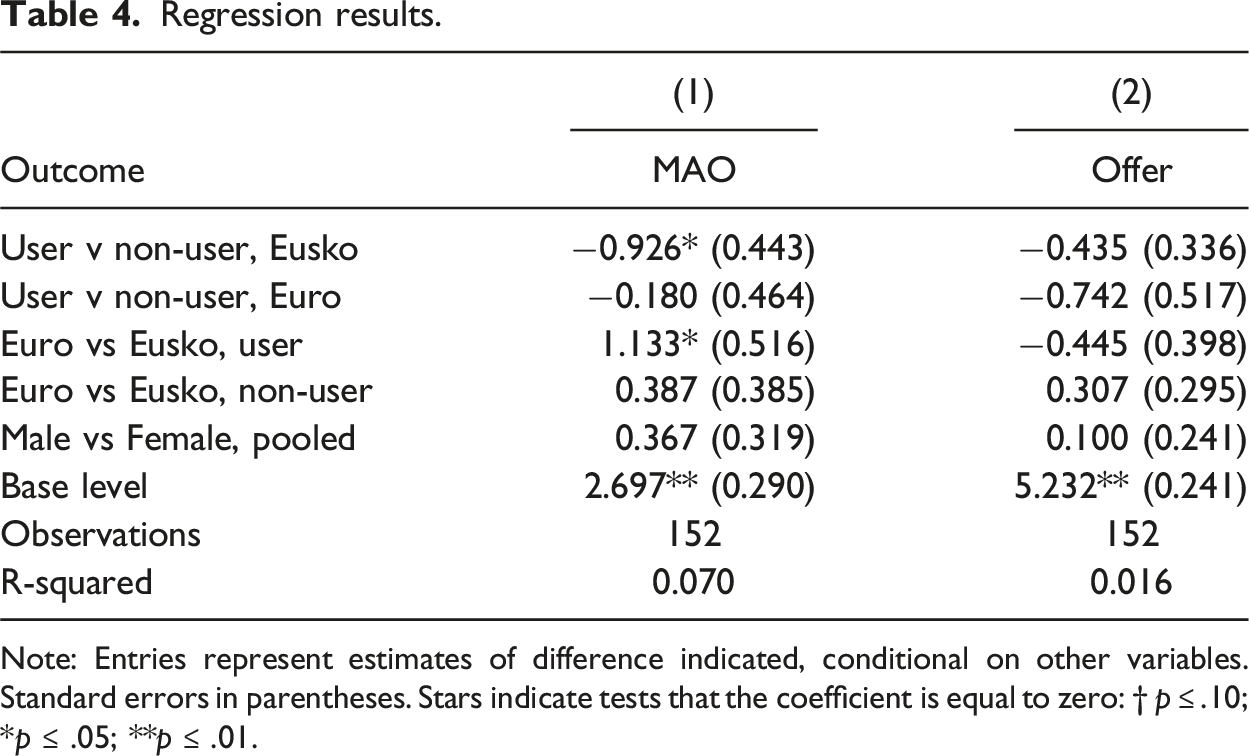
Note: Entries represent estimates of difference indicated, conditional on other variables. Standard errors in parentheses. Stars indicate tests that the coefficient is equal to zero: † p ≤ .10; *p ≤ .05; **p ≤ .01.
These results reconfirm the direct tests above. We see that when playing in Eusko, users of the currency demand 0.926 less on average than non-users do, which remains significant. However, when playing in euros, the difference falls to an insignificant 0.180. Following the table, we see that regular users of the currency demand 1.133 more when playing in euros than in Eusko, while the difference among non-users is 0.387; again, only the former is significant. Notice also that gender does not in itself have a significant effect on behavior. Once again none of the variables are significant in predicting the offer.
Why do we find an effect among Responders but not Proposers? We have no theoretically satisfying explanation for the discrepancy. We saw some evidence consistent with mismeasurement of user status (response error by which the currency of play influenced reported user status) among proposers, but not responders, and outlined an argument that this would bias the estimated effects downwards, in line with the null effects observed. This does not explain why the mismeasurement would occur primarily in one role, however. In our opinion, a more likely culprit may be the low level of experimenter anonymity in this study, which led to a ceiling effect on the offers that did not affect MAOs to the same degree. Participants were anonymous to each other, but were face to face with the experimenter when making their decisions. This could lead to unconscious demand effects if some choices are socially undesirable, and there are at least two reasons why such effects might be particularly salient for proposers. First, up to the even split level, social desirability is unequivocally rising in the offer. High offers are “generous”, and low ones are “selfish”. On the other hand, high MAOs might indicate a “tough bargainer” 9 , but low values, which might be described as “conciliatory” (or even “rational”), are arguably also socially desirable.
Second, and perhaps more significantly, the offer has a salient and easily accessible “social bliss point” at the even split. Since equal shares represent the ideally fair outcome, if social desirability alone could push offers to five, there would be no further margin for currency differences to influence them, making this a behavioral “ceiling”. There is also evidence that this ceiling was binding: as mentioned in the introduction, fully 65% of Proposers offered the even split of five currency units. Figure 3 shows cumulative distribution plots of the MAOs of responders and the offers of proposers, indicating both the substantial mass of proposers offering exactly 5, and the fact that there was not a correspondingly common MAO among responders. Although not uniform, the MAOs are relatively evenly split between values from one to five compared to the offers. Distribution plots of MAO (left) and offers (right).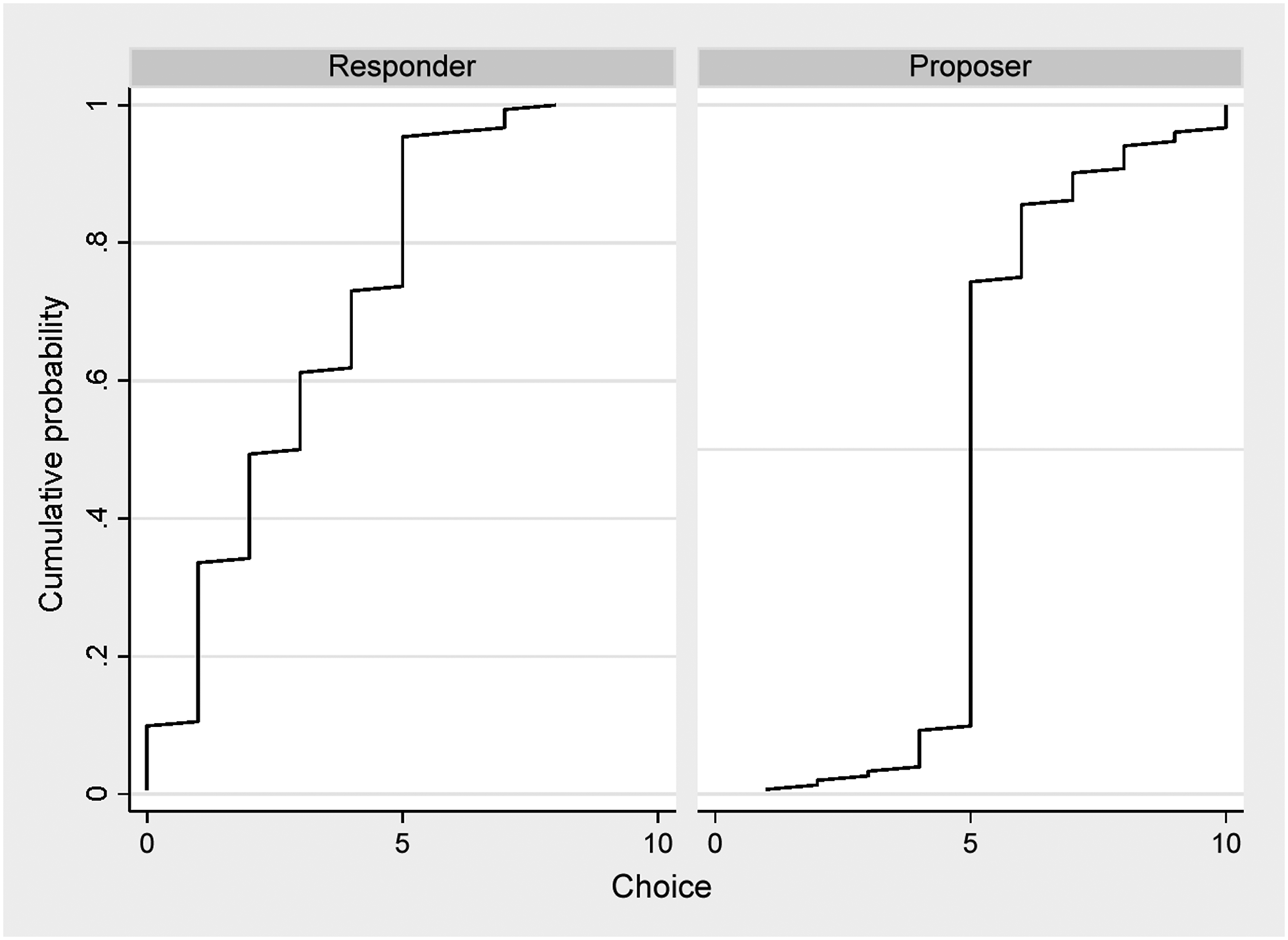
To the extent that these effects may be due to the methodology and not to the use of one currency or another, we are hesitant to draw too many conclusions from the proposer data, and will in the following focus on responders. We do note, however, that such methodological problems should not overly compromise the responder results. Had responder data been compromised, we might worry that proposers, anticipating these responses, would correspondingly distort their offers. MAOs, however, are not strategically dependent on the offer given. Responder payoffs are constant in the MAO for any value less than the offer, and zero for any value above. This implies that even if responders anticipated some demand effect on proposers, such expectations should not affect their own behavior.
Alternative explanations: Convertibility and selection
There are also two equally important null results in these data. First, non-users also have lower MAO when playing in Eusko than in Euro, but the difference is not significant. The slightly lower number is consistent with a story that those who do not use the CC have a lower opportunity cost of giving it up. To this extent, they are less ‘envious’ of a Proposer who gets more Eusko than they do because they don’t use, and therefore don’t care about having, Eusko to begin with. More generally, readers may be concerned with a comparison across the currencies if the Eusko are not fully convertible. The fact that the experiment took place in a natural setting where participants were already spending similar amounts of money on books or drinks reduces this worry: many establishments in the neighborhood of Bayonne where the experiment was run accept Eusko, so spending it was arguably unproblematic. But the observation in the data that non-users did not have significantly different MAO in the two currencies is further quantitative evidence that the differences we find are not due to non-convertibility.
The second crucial null result is that when users play in euro they behave exactly like non-users (mean MAO 3.23 v. 3.12; Mann-Whitney p = .903). This suggests that unconditional negative reciprocity is not different across the two groups. The effect of Eusko is not due to a selection of cooperative or non-envious people into the CC user group; the behavioral difference is ‘switched on’ by the currency. Figure 4 below shows this in a graphical form. We see in this figure that users of the currency, playing in Eusko, are the unusual group, significantly different from all others. Average MAO depending on whether the Responder was a user of the currency, and the currency in which the interaction played out.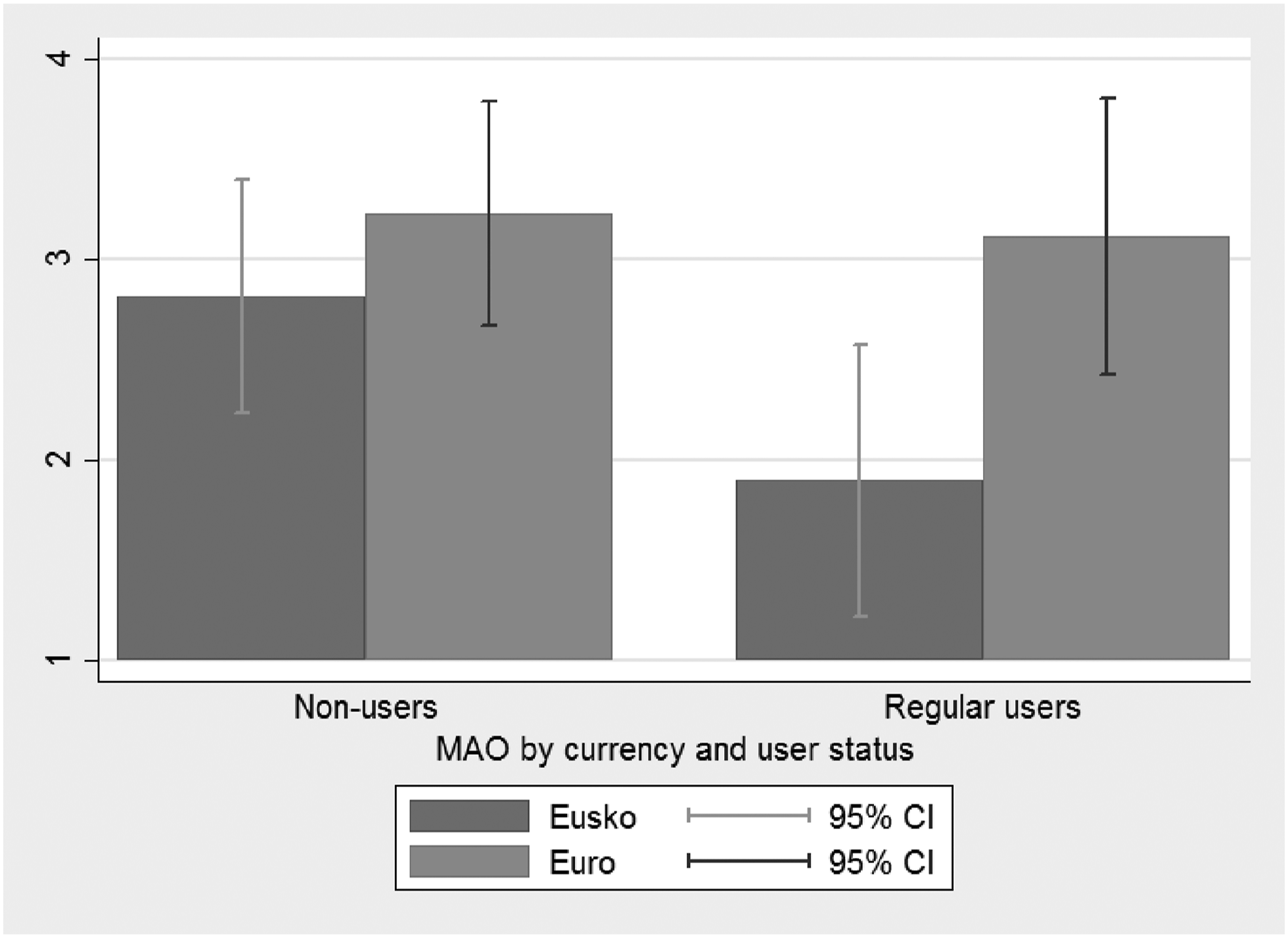
Discussion
Our main empirical finding in this study is a significant reduction in negative reciprocity when using the CC compared to the Euro, but only among regular users of the currency. Our design elicits a threshold offer, such that the responder rejects anything below that. There are two main explanatory variables, the currency in which the game is played, and whether the player is a (self-declared) ‘regular user’ of the Eusko. The threshold is significantly lower among users of the currency when playing in Eusko than when playing in euros: if they do feel envious, users of the CC do not let that lead them to antisocial punishment when they play in Eusko. Crucially, this difference disappears when playing in euros, which implies that the difference in the former case is due to the currency, not to other unobserved characteristics of the individuals. Just as important, there is also no difference in the choices of non-users across currencies. This means that the difference we do find is not due to uncontrolled differences in the value of the money itself, but is triggered by participation in the CC.
Goal-framing theory
Our interpretation of this result is that the CC is acting symbolically as a “carrier of the collective intentions” that constitute the motivation of social economy endeavors. In general terms, we described this as a change in the utility function, in the sense of a recalibration of the goals that players were seeking. As a first point in support of this interpretation, note that such a switching of utility ‘frames’ is consistent with a body of literature known as goal-framing theory (GFT). This theory delves into the specific ways in which social contexts influence the prominence of collective-oriented behavior over individualistic behavior, as seen, for instance, in the context of environmental behavior.
According to Lindenberg (2022), GFT explores how specific social contexts activate particular mental states referred to as ‘goals.’ Once a goal is activated, it frames individuals’ assessment of a situation, ultimately guiding their decision-making process. The theory identifies three distinct goals. Two are self-centred: the hedonic goal, associated with personal short-term well-being and emotional responses, and the gain goal, which pertains to long-term material advantages. The third goal is referred to as the normative goal and is oriented towards socially constructed rules and norms. The normative goal is often oriented around collective well-being and the welfare of the group as a whole. This theory has been extensively employed in the study of environmental behavior and sustainable cooperation.
One recurring element in discussion of GFT concerns the varying strength or power of the three goals in the sense of their relative weight as behavioral motivations. The hedonic goal generally holds the greatest power, while the normative goal is comparatively the least potent. The theory contends that the normative goal can effectively gain prominence and supersede the two more dominant goals when the social context incorporates specific elements, such as accepted rules advocated by political, cultural, and social institutions. This effectiveness is particularly pronounced when complemented by values shared within the group or community, collective behavior, and a shared belief in a common objective (Lindenberg, 2022).
The relevance of GFT to our hypotheses is clear. Not only does the theory describe precisely the kind of ‘shift in utility functions’ that we conjecture, but the description of what kind of circumstances lead to the different frames also appears consistent with an effect passing through the Eusko. “Political, cultural and social institutions complemented by shared values within the group or community” seems to describe very closely the social impact that transacting in a CC might make salient. Thus one can express the effect of playing in the Eusko as likely to enhance activation of the normative frame relative to the gain and hedonic frames.
Furthermore, the goal frames theorized have largely immediate implications in the UG. The common interpretation of rejection of any offer in the game is that of an immediate emotional reaction based on the ‘unfairness’ of the final income distribution or the ‘unkindness’ of the choice that led to it. Such reactions fit squarely with the hedonic frame. The gain frame, by contrast, would push responders not to reject any offer, since rejection reduces earnings. Thus players with an active hedonic frame should unequivocally reject more offers – that is, have a higher MAO – than players under the gain frame.
The predictions of the normative frame are somewhat more ambiguous, as they rely on what one “ought to do” in the context, which itself is socially determined and requires interpretation of the game (Lindenberg and Steg, 2007). It seems highly unlikely that there is a literal social norm concerning the UG in any real-world setting, but a recurring aspect of GFT is the elaboration of so-called smart norms (e.g. Lindenberg, 2009). In such cases, individuals with activated norm frames “search memory or the environment for cues to answer the question: what behavior would be appropriate in this situation?” (Lindenberg and Steg, 2007, p. 120). This leads to an indeterminacy of how activation of the normative frame might influence behavior in the UG. Consider, for instance, norms of fairness and reciprocity. Lindenberg and Steg (2013) list three elements of “oughtness”, which include (1) a sense of importance of the norm; (2) a disapproval of others’ transgressions; and (3) a feeling of obligation to conform. If the norm were for fairness and reciprocity overall, then this would also encourage people to reject unfair offers, in which case the activation might increase the MAOs. This is all the more likely given the inherent precariousness of the normative frame (Lindenberg and Steg, 2013), which leads people in ambiguous contexts to interpret “smart norms” in ways congruent with self-interest goals. In this case, if the norm can be brought in line with hedonic goal of “revenge”, that would further encourage responders with activated normative goals (i.e., community members playing in Eusko) to reject low offers, predicting higher MAOs. This goes directly contrary to our conjecture – and empirical results – that community members become less competitive when using the Eusko, and their MAOs drop.
Thus, while GFT provides a useful framework to understand how goals might be modified by context, it is not by itself enough to explain the behavior in our game. Our empirical findings suggest that the Eusko effectively diminishes the dominance of the hedonic goal within the context of the UG experiment. To understand what goals are promoted in its place, it is important to emphasize the highly specific setting of Basque identity in which the game is played. Participating with Eusko entails earning money that directly benefits the local community’s economy, as it circulates primarily among community members, many of whom have no option to convert it into euros. This situation is rooted in the broader context of Basque society, characterized by a strong regional identity fostering social cooperation, cohesion, and a commitment to local economic development. In other words, the specific goals of the Eusko in the Basque context are oriented around community, or collective benefits, rather than individual, private ones. Pursuit of these collective benefits constitutes the social economy mission of the Eusko, and these are therefore the kind of normative goals we would expect to be primed under the normative goal frame. The capacity of the CC to leverage people’s behavior in this line is the sense in which it acts as a carrier of collective intentions.
Collective intentions
But from a rational actor perspective, this capacity still requires some elucidation, as does even the concept of a “collective intention”. An intention in the standard rational actor model is completely reducible to beliefs and desires – or, in the economic parlance, preferences. To say someone rationally “intends” to do action A implies, in the sense of being explained by, a desire or preference for B, together with a belief that A is the lowest opportunity-cost method of getting said B. Intention is in this sense a kind of epiphenomenon, experienced by the actor as a direction of action towards a goal, but whose underlying causal source is belief and desire. But regardless of whether intention is reducible to preferences and beliefs, or has some irreducible nature (and a large philosophical literature starting with Anscombe (1963) argues the latter), the notion of collective intention raises a fundamental problem of the unit of agency. If intention is the experience of agency – doing A with an intention, after all, implies doing A “intentionally”, which is the defining characteristic of acting as opposed to simply behaving – that means it is a mental state of the actor. And clearly only entities with minds can be characterized by mental states. But the standard assumption of methodological individualism posits that minds exist at the individual level. Only individuals have minds, so intentions are individual by their very nature in the theory of the rational actor. Unless one posits a collective mind, ruled out by standard rational actor theory, it is hard to see how a collective mental state can occur, so a group cannot possibly have any collective intention. Even in the case where all the agents in a group have identical beliefs and desires, and even if it happened that the desire of each was that the desires of the others be fulfilled, to the extent that each is an independent actor, their intentions are still their own. What can a collective intention mean from this perspective?
The problem of collective mental states has received attention in the philosophy literature under the general term of collective intentionality. 10 This work seeks to harmonize the basic claim that there is something irreducibly collective in phrases such as We are doing X with the equally appealing, yet apparently incompatible claim that we have access only to our own minds, and can logically “intend” only that which we are capable of performing. That is, the experience of collective intentions undeniably exists distinct from aggregated individual ones. “We are going to Spain”, “we love bowling” or “we support Basque society” express fundamentally different mental states when they refer to collectives than when they refer to a simple aggregation or simultaneity of individuals. So what does “my” joint intention mean with respect to “yours” in the context of such a “we”? The philosophical debate turns in part on where this irreducible joint-ness resides.
Michael Bratman (1987, 1992) is the author perhaps most strongly associated with the idea that the irreducibly plural part of collective intentions consists in the object collectively intended. Consistent with his planning theory of intention more generally, he argues that collective intentions can be seen as individual intentions to effect a collective goal. The irreducibly collective component of the proposition We are doing X, in other words, is mainly located in the X. This does not imply that I intend your part of X or inversely; rather, it means that X, if it is collective, is constructed out of a complex web of meshing sub-plans that each of us adopts in accordance with and because of the subplans of the other. We (more or less individually), adopt (self-directed, individual) intentions to perform (irreducibly collective) actions X.
In the context of our experiment, this would imply that the nexus of sub-plans that participants intended when interacting in Eusko was different from that when the currency of transaction was euros. This would indeed represent a precise meaning for the phrase that transacting in Eusko is a “carrier of collective intentions”. The plans are a function of the currency, so changing currency results in a change of plans. But it also highlights a problem – which is a challenge for all theories of collective intention – of circularity. To invoke this “Bratmanian” explanation, we must suppose that the subplans in the CC are more cooperative than those in euros, which is what we also assume to be the result of the collective intention. Bratman’s theory may well describe how collective intentions play out in determining collective action, but they somehow presuppose the collective intentions that the meshing sub-plans instantiate. It is also worth pointing out that Bratman’s theory is perhaps more relevant to examples of collective intention in which the intended actions are specific tasks requiring interrelated behavior on the part of everyone in the collective; he uses examples such as painting a house or going to New York. In our case, the collective intention is not, for instance, the UG specifically, but rather a general cooperativeness compatible with the social mission of the Eusko to support and develop the local Basque community and economy. The actual behavior of different actors in this intention is relatively independent, so the importance of meshing sub-plans to constitute the collectivity appears weakened. The different scales or depths of collective action are emphasized by Tuomela (2000: 40) in which “shared intended collective goals […] may fall short of being a full-blown joint intention to perform a joint action.” Tuomela refers to the less-full-blown cases as aim-goals, as opposed to action-goals. Bratman’s meshing sub-plans appear to suggest the latter, while the collective intention behind the Eusko looks more like the former.
The characteristic of Bratman’s position that the intentions themselves remain individual firmly distances the theory from any requirement of collective minds, but still leaves open the possibility that actors fulfill all the requirements of meshing sub-plans and yet do not experience collective intentions. Searle (1990) was one of the first papers to directly commit collective intentions to the mode of intention itself. In terms of the general proposition We are doing X, the irreducible plurality in this context can be identified in the component are doing. There is something distinct about a joint intention (Tuomela (2007) calls it a we-mode intention) from an individual (I-mode) one, even if the concrete sub-plans are identical in each. And yet Searle is also careful not to assume any super-individual collective mind. For Searle, collective intentions are formed against a Background 11 in which others are potential candidates for cooperation – collective intenders have in mind the presence of others, and are aware that they are not acting alone – but this collective mode exists in isolated, individual minds. I could, in Searle’s (1990: 413) words, experience a collective intention “even if I am radically mistaken, even if the apparent presence and cooperation of other people is an illusion, even if I am suffering a total hallucination, even if I am a brain in a vat.”
A reading of Bratman suggests that collective intentions will be concretely cooperative, even if they feel individual. For Searle, something collective will be part of the experience, but the concrete actions may not be cooperative. This can be highlighted with examples concerning organized conflict. Bratman (1992) mentions soldiers on opposing sides, who are responsive to each other’s intentions in the way required by collective action, but are not an example of collective intentions, while Searle (1990) uses the example of a boxing match as a case where, although the actions of each are clearly uncooperative, the fact of participating in a boxing match itself is quite likely characterized by some collective intention. This second approach nevertheless appears somewhat more promising for the context of our experiment, as participation in the Eusko might operate by establishing a Background of cooperative activity. Indeed, the idea of the Background might be comparable to the kind of normative goal frame discussed in GFT. In this case, the Eusko is a “carrier of collective intentions” in the sense that it establishes a Background that shifts individuals into a different mode of mental state. The argument is still open to charges of circularity, in that the cooperative nature of the collective intentions is assumed to be part of the Background that supports those intentions, but it seems more plausible that the CC instills a general collective attitude of cooperativeness than that it supports a specific set of meshing sub-plans.
A third branch of theories concerning the nature of collective intentions, largely influenced by Margaret Gilbert (1990), puts their irreducibly collective nature in the intending subject. In other words, it is the We in We are doing X that distinguishes collective from individual intentions. This explanation is linked to the concept of commitment, itself a somewhat controversial notion from the point of view of the standard rational actor theory. Notice that the self-interest hypothesis is categorical about the location of preferences, but entirely general about their content. The “utility function” of standard economics is nothing more than a mapping of all the factors that the agent “cares about” to how “important” they are. It accommodates Homo economicus, who cares only about his own material outcomes, the inequality-averse actor who cares about his outcome relative to others’, and the reciprocal one who cares about his outcome relative to what would have obtained if another person had acted differently. It can also accommodate “committed” individuals who care both about their own outcome and other principles that may even go counter to their welfare. A failure to recognize this is the crux of what Amyarta Sen famously decried as the fault of the “rational fool” (Sen, 1977). Committing to an action gives people a “reason to do it”, and hence makes the action “reasoned”, or “rational”. Committing to a cause or a principle is therefore a blanket commitment to actions that further that cause or principle. The analyst may fold these into “preferences” in a way that reflects the resulting behavior. But for the actor committed to, for instance, volunteer at his children’s elementary school, the choice to spend Saturday at the school fair may also go counter to all the psychologically realistic “preferences” that he experiences.
Commitment helps link methodological individualism with collective motivations because commitment can be socially determined. Gilbert (1990) defines a collective intention as a joint commitment to some action. Joint in Gilbert’s sense describes a characteristic of being mutually constituted by the combined wills of several people. A joint commitment to an action, for instance, means a situation in which two or more people “emulate as far as is possible a single body (perhaps better, person) that intends to perform that action” (Gilbert, 2007: 264).
Joint intention entails an awareness among the acting individuals that they are collectively involved in the attempt to fill their roles in bringing the action into fruition. Gilbert (1990) uses the leading example of going for a walk, but other examples are easy to see: co-authoring a paper, for instance; marching in a demonstration; preparing dinner. These intentions are joint in that their very essence is constituted by the combination of the intentions of several people, and the experience of each participant would change qualitatively if the others withdrew. As such, Gilbert’s concept of a joint intention seems closer to Searle’s we-intention than it does to Bratman’s collective action. Indeed, the process of forming a joint intention appears to suppose some kind of we-mode intentionality as Searle or Tuomela understand it. This raises once again the threat of circularity or regress: joint commitment cannot be the source of all collective intention if it requires collective intention to put into place. Before jointly committing, must the participants not jointly commit to jointly committing, and so on?
Gilbert’s focus, though, is on this commitment as a mechanism or formal structure by which collective intention is created. Just as individual commitment leads to a reason to act in a way that conforms with that commitment (regardless of what one “wants”), joint commitment gives each person so committed a reason to act in conformity. More, Gilbert stresses that a joint commitment creates an obligation on the part of each committed individual to perform his or her part of the collectively intended action. The collective intention emerges through common awareness of it among the group. In this sense the motivation is truly collective because, although it still exists only in individual minds, it only does so because of the collective understanding of it. It is an example of an emergent phenomenon. While the process of joint commitment is made easier by explicit agreements on the part of all parties, moreover, it is also possible for people to “sign on” (Gilbert, 2017: 133) to existing joint commitments. In this way, Gilbert describes collective intention as the constitutive characteristic of any social group.
Joint commitment in this sense adds a potentially useful element to our understanding of how the Eusko might affect behavior in our experiment. If users of the CC feel by their participation that they jointly commit to principles of solidarity and cooperativeness, then this generates an obligation to behave accordingly. The Eusko then acts as a “carrier of collective intentions” in that it signals these joint commitments. This signaling could work in several complementary ways. First, simply using the currency could recall the commitments to mind, making them more salient to behavior. But additionally, and more directly, the CC is also a marker of the group who is jointly committed. Gilbert argues that joint commitments create rights and obligations among the committed parties. By suggesting that the experimental UG is being played within the community so committed, the currency might also increase the commitments’ normative force.
Team reasoning
A final, related explanation for the effect of the Eusko on experimental play may be related to team reasoning in the sense of Bacharach (1999) or Sugden (2003). In team reasoning, agents do not choose based on the answer to the question “what should I do?”, as is inherent in the interpretation of autonomous behavior. Rather, they ask “what should we do?”, and choose the action that best fits the action profile that maximizes some group goal. Such a reasoning process is clearly related to collective intentions. A “collective intention” amounts to a goal adopted and determining behavior because of a sense of shared belonging to a group of others who are also engaged in pursuing it. The deliberative process by which this behavior is then determined seems to be precisely the question team reasoning posits: “What should we do, and what is my role in that?”
As with intentions, team reasoning schemas can be reduced to more familiar objects of preferences and beliefs once they have been adopted by the group in question. In the language of standard economic theory, team reasoning amounts to a re-definition of the utility function. The mapping is transformed to be a function not of individual outcomes, but rather a shared understanding of the entire profile of outcomes. For this reason, a key question in theories of team reasoning is When do people reason in this way? Understanding what leads to the utility transformation is obviously necessary to give structure to any behavioral predictions one might make.
This is where the two branches of team reasoning theories take somewhat different paths. Bacharach (1999) treats a propensity to team reason as a non-rational probability. Some aspects of the decision context – including, for instance, the degree of interconnectedness of outcomes between agents – tend to prime team reasoning. The formal model of circumspect team reasoning then analyses how the behavior of a team reasoner might react to changes in the probability that others in the group are not themselves also team reasoning. In the context of our experiment, if a game denominated in Eusko cues a team reasoning schema with some probability, it does so observably for all potential actors. It is not necessary, from the perspective of Bacharach’s theory, that all others be so primed; there will be some threshold likelihood – whose value depends on details of the interaction – such that when the probability that the partner team reasons is above this threshold, the response will be for all to switch to team reasoning. This piece fits nicely as a psychological mechanism linking GFT’s normative goal-frame activation (which again, team reasoning might instantiate) to more specific hypotheses about the collective goals that are consequently adopted.
Rather than leaving the shift to team reasoning as a psychological postulate, theories that follow Sugden (2003) identify conditions under which people might find it rational to subscribe to team reasoning, leading to a focus on the problem of assurance. Gold and Sugden (2007) develop reasoning schemas that provide patterns of inference illustrating the function of team reasoning. So long as all individuals have a mutually assured reason to believe that each one is engaging in team reasoning, the team reasoning itself becomes a logically coherent schema for action. More specifically, a collective motivation can be generated if out of some group S of people there is a subgroup T such that (1) each member identifies with T, and (2) knows that all others also identify with T; (3) common knowledge that members of group T “endorse U”, that is, want the value of some function U of payoffs to be maximized, and that (4) U is maximized when each player chooses his or her component of the action profile A. These conditions support the choice of individual profile components by each individual, generating a collective intention. The problem then becomes one of coordinating expectations, which is the role of assurance mechanisms.
While the terminology of “team reasoning” suggests relatively specific circumstances, moreover, the interpretation is often larger. For instance, Sugden uses the example of traffic patterns at four-way stop intersections as a case in which each person has a reason to believe that all the others believe that everyone will follow certain, group-payoff-maximizing actions, for instance, to wait for one’s turn to enter the intersection rather than jump at the first possible opportunity. While these hypothetical drivers clearly do not constitute a “team” in any formal sense, their shared understanding of the common goal of keeping a smooth flow of traffic, embodied in accepted traffic conventions, causes them to reason in such a way as to lead to each filling his or her part of the overall plan. Assurance comes in this case from the accepted traffic rules and experience with other drivers’ behaviour. Further examples of the kind of mechanisms that might lead to this assurance include (a) statements by authority figures; (b) public commitment by individual actors; (c) experience in similar situations.
With this in mind, we return to the conjecture that the CC is a “carrier of collective intentions of cooperation and solidarity”. This suggestion can be made more precise in the light, for instance, of Gold and Sugden’s (2007) reasoning schemas, in the sense that using the CC generates assurance. Among users of the Eusko, it provides common knowledge of reciprocal endorsement of social economy goals. This common knowledge corresponds to a joint intention in the sense of Gilbert (1990), and creates an obligation on the part of each individual so jointly intending to act in an appropriate way. What might that “appropriate action” look like? If we turn back to utility remapping suggested in team reasoning, note that in the context of an UG, the group (dyad) payoff is always maximized by accepting any offer. Therefore, team reasoning mappings of outcomes seem plausibly to suggest a lower propensity to reject offers, or reduction of the MAO. A shared motivation for cooperation with the group, in other words, can plausibly explain why UG offers should be accepted more often. Interacting in Eusko is a “carrier of collective intentions” because it highlights the “team” for those who feel they belong to it. This therefore gives a very natural explanation as to why it is particularly regular users of the currency who are affected, transforming the interaction from a potentially competitive, adversarial relationship into one of cooperation and solidarity.
Conclusion, limitations and directions for future work
Our research objective was to examine whether the implementation of community currencies, as a social economy tool, fosters a cooperative mindset in contrast to the competitive logic of a market economy. To achieve this, we conducted a lab-in-the-field experiment that measures negative reciprocity. Our findings reveal that community currencies promote cooperation and reduce negative reciprocity, particularly among individuals involved in the community currency system. In the discussion section, we aimed to provide an explanation for the effectiveness of community currencies in achieving this goal. Our explanation revolves around community currencies serving as vehicles for collective intentions of cooperation and solidarity. This collective intention is an emergent re-mapping of preferences. Although our experiment was not designed to discriminate among the details of the different theories presented, a plausible interpretation is the following: the CC symbolizes a joint commitment (Gilbert, 1990) to social economy principles, and the assurance (Sugden, 2003) it provides for jointness triggers a cooperative reasoning process, rationalized as a change in the utility maximand or change in the goal frame, and experienced as an obligation to fulfil individual components of a more cooperative profile.
At least that is the theory. Empirically, the story is supported by the fact that non-users of the currency are not sensitive to it. In terms of Gold and Sugden’s (2007) reasoning schemas, non-users would not be part of the subgroup T, and therefore would not be predicted to team reason. Additionally, the empirical fact that removing the assurance (i.e., denominating the game in euros) eliminates the effect, supports the claim that the symbolic weight of the CC has behavioral impact. But there may well be other explanations of the observed patterns of behavior. Our research was intentionally a “light” intervention, requiring little time and engagement from participants. Further work, for instance attempting through qualitative methods to delve more explicitly into the sense of commitment and joint intention that comes with CC use, would be useful to complement our quantitative, behavioral measures.
It should also be recognized that experiments come with weaknesses. First, the problem of the “demand effect”: spurious correlations may be created by the protocol itself. In particular, it might be reasonable to worry that participants react to the CC in our study because they feel some social desirability pressure from the experimenter’s very use of it. We are reassured in this regard by the fact that non-users of the currency are not sensitive to the experimental manipulation. A signal that induces a demand effect only in the group it designates is functionally equivalent to one that “switches on” the effect under study. A potentially more powerful limitation concerns the experiment’s external validity. Our explicit goal in the experiment is to strip away all the complexity, but by the same token the richness, of actual interactions in daily life. While our results do identify some real forces, therefore, we obviously cannot say how they would interact with factors we experimentally eliminate: would the effect be the same in a fully natural setting? On the other hand, since this experiment took place in the field’s natural setting, and more importantly the Eusko itself is not an experimental artifact but an actual phenomenon used by the real group in question in natural settings, we would argue that among experimental projects, ours is rather on the strong side on that issue.
We note also that our study is of one specific CC, and we should be wary of extending the results out of sample to others. CCs by nature emerge to answer the needs of the specific local community that proposes them (Bazzani, 2020). Therefore comparisons across CC endeavors will likely often show as many differences as similarities between them. Furthermore, the specific character of the French Basque country is one of strong cultural ties based on a shared heritage. Such a group is quite plausibly ripe for the priming of commitments our experiment implements, as it leverages social identity in the sense of Brewer and Kramer (1986) as well as the commitments that we focus on. We note in this line that Simpson (2006) draws an explicit link between social identity and “we-feeling”, although not in the context of shared intentionality that we explore, and Chen and Li (2009) find that even minimal social groups show significantly lower negative reciprocity in ultimatum games. We cannot exclude the possibility that another, more cosmopolitan CC – the Bristol Pound, for instance – might yield different results.
Acknowledging this ‘experimental case study’ nature of the results, we still argue that we uncover an interesting characteristic of this case. While the problem of external validity may limit the claims we can make about CCs generally, they do not in themselves compromise the results on commitment and collective intentions. Any scientific result has to be extrapolated with care, and yet it may shed light on other situations even when it is one force among many. In our case, users of the Eusko appear to feel differently about a certain range of “unfair” outcomes when they are framed using the CC than when they are denominated in euros. This change in mindset or reasoning process may be attenuated by other factors, but may also attenuate them.
Footnotes
Acknowledgments
The authors gratefully acknowledge funding from The Burgundy School of Business (BSB, CEREN EA 7747). Superbly helpful comments came from Eleonora Montagner, the Editor and two anonymous reviewers for this journal, and participants at the 2019 AFSEE conference in Toulouse, France.
Declaration of conflicting interests
The authors declare no potential conflicts of interest with respect to the research, authorship, and/or publication of this article.
Funding
The authors disclose receipt of the following financial support for the research, authorship, and/or publication of this article: This work was supported by the general research budget from the Burgundy School of Business, CEREN EA 7477.
