Abstract
Applying insights from the theory of collective action in self-governance, this paper addresses how a city-sanctioned homeless camp has successfully self-governed for over two decades. Based on a club goods model and democratic practices, this tent city attains social order and provides numerous collective benefits to its residents, who initially bring very little capital to the camp. Our case study, which includes in-depth interviews with residents of a tent city at four time points between 2012-2025, as well as observations from their weekly organizational meeting, illustrates how the possibility of exclusion for rule violation, norms emphasizing voice and service, and democratic governance combine to make the community viable. In addition, the evidence shows, rather than merely enabling collective action, that collective identity, social capital and personal agency are emergent features of self-governance that enhance and reinforce its benefits for residents. Finally, we discuss the limitations of self-governance as a solution to homelessness.
Introduction
In January 2016 an unsanctioned tent encampment in Seattle made national news after five people were shot, two fatally, in a single night (Johnson, 2016; Shapiro, 2016). “The Jungle” occupied a three-mile swath of land beneath the confluence of Seattle’s north/south and east/west US highways. The encampment was regularly described by authorities as a public nuisance. In the wake of the shootings, however, news outlets highlighted the encampment’s violence, safety risks, illicit drug use, and unsanitary conditions, arguing that it represented a public health crisis and a danger to neighbors and its own inhabitants. The city estimated that 400 people were living in The Jungle and Seattle Fire Department Chief Harold Scoggins said his team “found blight, misery and filth beyond anything they had imagined” (Johnson, 2016). While the encampment had been a constant presence in the city for more than two decades (Clarridge, 1998; Keene, 1994), within 2 days of the shootings Seattle Mayor Ed Murray demanded the camp be “shut down” (Bush, 2016).
Not all unsanctioned encampments present dire conditions such as those in The Jungle. Nevertheless, tent encampments are associated with urban incivilities (e.g., noise, rubbish, public defecation), drug use, and violence. A 2021 Seattle report documented that more than 18% of all shots-fired incidents occur at or near tent encampments with 40% of the police’s homicide unit caseload related to encampments (Kim, 2022). Similar problems have blighted city-sponsored camps. Licton Springs, for example, a city-managed “village” of tents and shed-sized “tiny houses” began in 2017 as a “low barrier” housing model to address rapidly increasing homelessness in the city. Residents were free to drink and use drugs on site (Greenstone, 2018). Disorder soon prevailed. In the wake of public complaints, dramatic increases in calls for police services, and managerial failures, the city allowed the encampment’s 2-year permit to expire (Davila and Greenstone, 2018).
The problems at The Jungle and Licton Springs occurred in the context of a homelessness crisis that has been mounting for decades (Lowenstein, 2014; National Coalition for the Homeless, 2010; National Law Center on Homelessness and Poverty, 2017). 1 National data indicate a 7% increase in unsheltered homelessness between 2023 and 2024 alone (De Sousa et al., 2023). We argue that the conditions in The Jungle and Licton Springs speak to the general problem of social order. 2 In the most basic sense, social order obtains to the extent that people subject to it are secure in their persons and property (Hechter, 1987). Safety and security are among the most conspicuous problems confronting unsheltered people, who are at far greater risk of crime victimization than other urban residents (Donley and Wright, 2008; Jasinski et al., 2010). Minimally, so as not to pose a threat to other campers and the public, tent camps must ensure mutual security and habitable living conditions. In addition, to avoid police entanglements and the hostility of neighbors, camps must restrict incivilities and visible criminality in and around the camp. Achieving this requires significant coordination among camp residents, as well as an ability to deter or sanction residents (and visitors) who would exploit or endanger the camp.
In Seattle, as in other West Coast cities, most tent camps are unsanctioned (Snedker et al., 2025) and residents are often treated as illegal squatters subject to frequent police contact and “sweeps,” resulting in adverse outcomes for residents (Herring, 2019). 3 In recent years, the visible proliferation of tent camps has become symbolic of the linkages between the housing crisis and perceptions of public disorder. Tent encampments have received scholarly attention (Feldman, 2004; Herring, 2014; Herring and Lutz, 2015; Loftus-Farren, 2011; Mitchell, 2013) and there has been growing interest in sanctioned tent cities and self-organization among people who are homeless (Heben, 2014; Przybylinski, 2025; Sparks, 2024; Speer, 2018). Not all tent camps, however, are equal. 4 The increased visibility of tents in public spaces has often blurred the distinction between sanctioned and unsanctioned camps.
In this paper, we conduct a case study of Tent City 3 (hereafter, TC3) that evaluates propositions drawn from the theory of self-governing collective action. TC3 is a legally sanctioned tent city that provides an experiment in communal living that positively distinguishes itself from ungoverned tent encampments and government-sponsored tent camps. TC3 relies on a partnership model to succeed. While the tent city is democratically managed by residents, who abide by a strict code of conduct, it partners with the city, a local non-profit organization, and local host sites. Founded in 2000 and officially sanctioned in 2002, TC3 is Seattle’s oldest, continuously operating tent city, serving as an alternative to homeless shelters, unsanctioned tent camps, and life on the streets.
Our case study is based on extensive interviews with TC3 residents and observation of its weekly governing meetings conducted between 2012 and 2025. We use the resulting data to explore how a democratic self-governance model offers individual and collective benefits that set it apart as a model for independent, tent-based living. Case-studies can contribute to theory-building and empirical research by helping to identify causal mechanisms and pathways. Although our design does not allow us to test whether self-governance is more effective than other models of organizing tent cities generally, it does suggest social mechanisms that may make them so (Brady and Collier, 2010; Gerring, 2009). We argue that TC3 developed a form of direct democracy and self-management that establishes social order and achieves high levels of member engagement. The crucial mechanisms we identify are the possibility of exclusion from the group for rule violations, camp norms emphasizing agency through voice and service, and democratic governance that combine to make the community viable. Remarkably, rather than simply enabling collective action through existing community ties, collective identity and social capital were created through collective action itself. Feeling part of the TC3 community, in turn, enhanced and reinforced the benefits of collective action for residents. Whereas much of the literature on self-governance contends that feeling part of a community enables cooperation, we find that community can be produced through voluntary adoption of rules, participation in governance, and group processes that foster cooperation.
TC3 is a particularly valuable case for evaluating the mechanisms that foster self-governance on the club goods model. Indeed, from the perspective of the theory of self-governance, TC3 is a “least likely” case (Gerring, 2009: 115–122). This is because accounts of self-government generally argue that preexisting social capital enables people to overcome social dilemmas through credible commitments, normative consensus, and social incentives (Cook et al., 2005; Ellickson, 1991; Lichbach, 1996; Ostrom, 1990, 2005; Stringham, 2015; Taylor, 1987). The people who arrive at TC3, however, are transient, socially diverse, indigent, and generally are strangers to each other (see Appendix A). In short, the usual characteristics that are thought to enable a group’s self-governance are not strongly present, at least not at the outset. Although this makes TC3 a tough test case for existing collective action theory, many of the propositions we derive from it are at least partially supported by the evidence whereas others require qualification.
Methods and data
Our evidence is based on interviews with TC3 residents as well as field observations from the camp’s weekly camp meeting. 5 We conducted in-depth qualitative interviews with TC3 residents over four time periods across three sites between 2012 and 2023, resulting in 72 total interviews. Twelve interviews were conducted in 2012, 24 in 2015, and 29 in 2017–2018 when TC3 was in residence at Seattle Pacific University, with seven conducted in 2022–2023 while TC3 was in residence at two churches. We also collected follow-up observations of the tent community in 2025. We used a combination of convenience and referral sampling techniques to request interviews with residents and camp leaders (Abbott and McKinney, 2013; Mosley, 2013). Most interviews were conducted by undergraduate research assistants under the mentorship of the authors (McKinney and Snedker, 2017). The semi-structured interview protocol queried residents about their experiences with homelessness and living at TC3. Questions asked how residents had become homeless, how they found the tent city, and the organization and day-to-day operations of the camp. Interviews lasted an average of 45 minutes and took place in public locations including the camp’s common area, on campus, or at local coffee shops. Participants completed informed consent, as well as a short demographic survey (see Appendix A). Interviews were recorded and transcribed. Data were coded thematically, based on the project’s theoretical framework and on themes introduced by respondents in the interviews (Mosley, 2013).
We also observed weekly camp meetings between January and March of 2015 after receiving approval from the camp in a previous camp meeting. The weekly meeting is crucial to the running of the camp and is mandatory for residents. Meetings were held Monday evenings in the communal tent beginning at 7:00 p.m. and lasting approximately 2.5 hours. Meetings were led by the chair of the elected Executive Committee (EC) but included significant participation by residents who are assigned weekly duties. Data collection was approved by the authors’ institutional review board.
The case of TC3
Sanctioned tent cities offer residents distinct advantages over unsanctioned encampments, including the autonomy, security, and community to establish spaces that feel like home. Critics, however, argue that some factors complicate the governance of tent cities (Przybylinski 2022, 2024; Speer, 2018). Tent cities are “dependent on the authorization of local government to function,” are subject to regulations, and rely on certain services (e.g., basic sanitation) (Przybylinski, 2024: 123). Often, tent cities are expected to partner with local non-profits to gain access to space and services, but this means adherence to rules that regulate who can live and remain within the camp (Przybylinski, 2024; Speer, 2018).
Constraints on individual rights, along with a lack of property rights, can negatively impact residents living in tent cities (Przybylinski, 2022). The focus on boundary rules makes residents dependent on a “residency-by-majority consensus,” which can result in eviction for residents if they are voted out (Przybylinski, 2022: 1715, 1719). Speer (2018) describes tent cities as “tent wards” or “spaces of carcerality” due to the strict rule enforcement via codes of conduct required for residents to obtain contracted services. As such, the state or local government indirectly sets the parameters of service to the tent city and implicitly fosters the self-surveillance and isolation of residents. Although critical urban studies in this vein raise important criticisms of tent cities, they also acknowledge that self-governance structures can foster a sense of community, dignity, and agency among residents (Przybylinski, 2025; Sparks, 2017, 2024; Speer, 2018). While acknowledging the limitations of the tent-city model, our study focuses squarely on the theory and practice of self-governance and the promise and pitfalls that self-governance offers to people who are homeless.
By contrast, our theoretical framework draws on the pioneering research of Elinor Ostrom (1990). TC3 is an example of what Ostrom (1990: 57) terms “self-organized collective action.” Collective action theory contends with the notorious free-riding and coordination problems that can render self-governance ineffective and social order fragile. Nevertheless, people are not helpless in overcoming collective action problems and centralized authority, as through a state agency, is not the only just or effective way to produce collective goods (Ellickson, 1991; Hardin, 1997; Leeson, 2014; Lichbach, 1996; Ostrom, 1990, 2005; Stringham, 2015; Taylor, 1987). By applying theories about club goods and voluntary collective action, we seek to explain the mechanisms by which TC3 operates and how it has been able to govern itself for more than two decades.
Furthermore, TC3 is a fascinating case of collective action to create club-based collective goods because it proceeded through distinct phases of inception, institutionalization, and maintenance. The different phases of collective action of this kind implicate social dilemmas to different extents (Heckathorn, 1996). Whereas the chief barriers to cooperation in the inception of a club involve fostering coordination among interested people who recognize a common problem and seek a common solution, later, as a club is institutionalized and maintained, coordination problems remain while containing or deterring free riding becomes a prominent challenge.
Seattle’s Tent City movement arose among housing advocates and the unhoused opposing Seattle’s housing policies in the early 1990s. Many tent camps began as protests (Parker, 2020; Sparks, 2017; Speer, 2018). In preparation to host the international Goodwill Games, Seattle officials “swept” areas where people who were homeless slept. In the wake of this, a tent city was established in the city’s main sports stadium, marking the beginning of Seattle’s first Tent City. With increasing residents (from 25 to 160), Tent City moved to a transitional housing program, which effectively ended the first iteration of the camp but the beginning of a partnership with the local non-profit organization SHARE/WHEEL. Tent City 2 was erected in 1998 after a routine sweep of tents in The Jungle. After failed negotiations with the city of Seattle, residents vacated the space and moved back into the Jungle. Marking itself as a distinct camp within The Jungle, Tent City 2 residents instituted security patrols and rules for membership (e.g., expelling violent or drug-using residents). Even with these protocols in place, city officials bulldozed the camp effectively ending Tent City 2. The next and current iteration of TC3 was organized in 2000 and was legally sanctioned by the city of Seattle in 2002. Other tent city initiatives suffered similar fates to TC3’s, with previous iterations unsuccessful in attaining a city-approved agreement (Feldman, 2004; Mitchell, 2013). TC3 is thus an important case of institutional endurance.
TC3 is based on a partnership model, with residents working with the city via a charter, a local non-profit organization (SHARE/WHEEL), and local host organizations. The city charter allows TC3 to encamp on private property in the Seattle/King County metropolitan area for a maximum of 90 days. The camp is meant to house up to 100 residents, including families with children. 6 A privacy/border fence separates the camp from the host site (and often the street), however, inside the camp everything is accessible: there are no locks or special access required to enter communal spaces, and norms of privacy inhibit entry into someone else’s tent unless invited. Although residents in good standing can reside in the camp so long as they wish, in practice, the camp’s population is fluid, as residents move into more permanent housing or find other alternatives (voluntary or otherwise). The TC3 charter exempts faith-based organizations from parts of the city permitting process (such as imposing a time limit on how long a tent city can stay). Consequently, TC3 has generally resided on religious organizations’ properties. The city provides limited services to the tent camp, including sanitation (e.g., onsite visits to assess operation of toilet facilities, garbage, potable water, and food handling), occasional visits from public health nurses, as well as police and fire department check-ins (SHARE/WHEEL, 2018). The city, however, does not play an active role in TC3’s day-to-day operations. Any formal negotiations between TC3 and the city occur through the tent city’s non-profit partner, SHARE/WHEEL.
The inception of TC3 and the formation of its governing charter required extensive coordination. In effect, SHARE/WHEEL subsidized and helped organize the formation of the tent city, taking responsibility for maintaining and cultivating relationships with host sites. SHARE/WHEEL also manages the city’s permitting process, negotiates logistics between the camp and local hosts, and sets move-in and move-out dates while providing trucks for moving days. Additionally, SHARE/WHEEL provides a community organizer who acts as liaison between the tent city and the city authorities. The liaison works with the camp’s Chair and EC and serves as a bridge and primary communicator between TC3 residents and the host organization. The liaison attends and facilitates the mandatory weekly camp meeting but has no vote on camp affairs.
TC3 and SHARE/WHEEL jointly pioneered a program of educating neighbors about the tent camp via neighborhood meetings prior to moving into a host site, giving neighbors a better sense of who the residents are and what the tent city offers the neighborhood such as 24-hour security patrols on the site’s perimeter which includes the immediate surrounding neighborhood, largely alleviating NIMBY concerns. Together, TC3, SHARE/WHEEL, and host sites decide when the tent city arrives and departs with SHARE/WHEEL acting as liaison between parties. A “Promise to Our Neighbors” document describes TC3’s commitment to hosts and surrounding neighborhoods illustrating that if TC3, SHARE/WHEEL, or the hosting organization violated these terms the tent city would face a “credible commitment problem” (Shepsle, 1991) that would threaten its survival.
Despite the critical role SHARE/WHEEL played in the inception and institutionalization of TC3, fostering collaboration between different parties and stakeholders, it does not explain TC3’s institutionalization or its maintenance. Moreover, it is important to understand that whereas TC3 is sanctioned by the city, it is not run by the city. This differentiates TC3 from other city-sanctioned tent camps (Speer, 2018). Likewise, TC3 is sponsored by SHARE/WHEEL, but not run by SHARE/WHEEL. The residents of TC3 run the tent city through their own institutions of self-governance. Our paper analyzes the practices of self-government and to do so we develop propositions about what makes clubs effective and enduring. We then apply them to understand TC3 and the conditions under which institutional solutions to collective action problems work in tent cities and beyond.
Theory and practice of self-governance
In her seminal work on the longevity of 19th Century intentional communities, Kanter (1972) argued that the degree of personal commitment that communities could elicit from their members was the crucial factor in their success. Kanter found that social mechanisms that create clear in-group/out-group boundaries and reinforce group attachment enhance commitment. Empirically, religious communities strongly outperformed secular ones (also see Stark and Bainbridge, 1985). Subsequent research on contemporary intentional communities found that factors such as religious mission, financial sacrifice, and communal meals that Kanter argued are important are insignificant compared with material resources and group size (Bader et al., 2006). In the case of TC3, most of the factors that Kanter emphasized are absent or only partially applicable. This begs the question: Outside of religiously inspired communes, how do voluntary, self-governing communities achieve coordination and commitment?
Self-governance refers to the voluntary institutions and social mechanisms groups devise to attain social order, facilitate cooperation, and foster the exchange of collective resources (Stringham, 2015: 3-4). Mancur Olson (1965) describes “public goods” as goods that are non-excludable (non-contributors cannot be denied access). Such goods are especially vulnerable to the free rider problem. Whereas government agencies usually provide “public goods” that are available to everyone regardless of contribution, membership organizations can offer “club goods,” which can exclude nonmembers (as well as members violating the code of conduct) from consuming the benefits or crowding out the use of the good. It is the ability to exclude people who do not contribute or do not conform to group norms that distinguish club good organizations from public good organizations.
To be clear, by “club” we mean any group of people who come together voluntarily to participate in a shared activity in which membership or access to shared resources are restricted. Buchanan (1965) described club goods as typically arising from private associations that provide excludable goods and services, but clubs need not be private ventures. Communities organized around providing club goods are usually more efficient when they are modestly sized because sharing the costs of producing collective goods reduces each member’s cost; however, too many users can complicate coordination and result in crowding or congestion that reduces the good’s value. Moreover, size influences the costs of monitoring and sanctioning compliance with group norms (Hardin, 1997; Hechter, 1987). In practice, self-governance seems to thrive where efficiency and intimacy intersect, meaning groups whose modest size allows for face-to-face relations, effective monitoring of contributions and adherence to rules, and efficient division of tasks.
The logic of club-type goods makes exclusive membership and collective enforcement of rules the keys to successful collective action. As Stringham (2015: 22) states, “Clubs allow members to get into preferred governance structures, and they create incentives for cooperation within. The simple ability to screen or exclude unwanted members gives clubs a powerful tool to discourage bad behavior without relying on the use of force.” In TC3, once accepted as members, residents have access to collective goods, but their active participation is required to maintain these goods. The benefits of membership include access to the camp’s private and communal spaces, a shower, nightly meals and snacks, as well as security, protection, and a feeling of community. As Przybylinski (2025: 74) notes, self-governing camps that are “membership-based community” organize around the common good of “safer places to sleep.” Costs, however, are substantial and include adherence to a strict code of conduct and considerable service obligations to the community. On the cost side, as Przybylinski (2025) has argued, self-government through majority rule can be oppressive to dissenting members and, as Speer (2018) notes, tent city boundaries can be as restrictive as they are protective.
A pitfall of self-governance is that it requires coordination and extensive cooperation. The elementary factors influencing people’s willingness to cooperate in establishing self-governing communities and submitting to rules are the payoffs expected from cooperation. Absent the mutual dependence of group members for desired goods and reciprocal interest in providing them, the incentives to form a self-governing community are absent. The greater the potential gain from cooperation, the greater the natural incentives of group members to cooperate. Thus, once established, changes in the internal situation of the group, or exogenous changes in the environment in which the group operates, can change the costs and benefits, altering the attractions of self-governance. Commitment will be robust so long as group members perceive the commitment as general and the benefits of complying with the rules as exceeding the benefits of rule violation or community defection (Ostrom, 1990). Based on the theoretical framework we outline the following propositions.
Theoretical propositions
Comparative research on communities and their efforts to manage joint resources finds factors such as the reputation of leaders, trust and reciprocity (social capital), community stability, and shared norms as essential factors in making self-governance work (Ellickson, 1991; Leeson, 2014; Lichbach, 1996; Ostrom, 1990, 2005; Stringham, 2015; Taylor 1987). Social capital fostering reciprocity and trust enables groups to make normative adaptations (Ostrom, 1990), which tends to be greatest where group membership is stable and group size limited. Ideally, group size is small enough to lower the costs of control but large enough to make sharing of tasks efficient (Hechter, 1987). Our first proposition is thus demographic.
Moderate size and low member turnover enhance cooperation in self-governing tent cities.
A group’s desire to govern itself is the most important factor in self-governance, which requires establishing rules to which participants are willing to adhere. In self-governing communities, the rules most likely to succeed in regulating the group and its resources are those designed and enforced by the group members themselves. Compliance with the rules will be contingent upon members adopting community norms, participating in self-governance, and the credibility of sanctions applied to non-cooperators. A founding charter establishing group norms and explicitly committing members to collectively endorsed rules is a condition for fostering cooperation.
Self-governance in tent cities is enhanced by a founding charter explicitly endorsing the group’s values and establishing its basic norms.
In voluntary communities “boundary rules” are fundamental (Kanter, 1972; Ostrom, 2005; Stringham, 2015). Such rules, “define who has a right to enter and use a resource,” “affect the types of participants with whom other participants will be interacting,” and provide demarcation between the community and its surroundings (Ostrom, 2005: 243). If they cannot define boundaries and lack the ability to close-off outsiders from exploiting group benefits, self-governing communities jeopardize the common good (Ostrom, 1990). On the other hand, boundary rules can impose unwanted conformity on group members, impose majority rule at the expensive of individual rights, and separate the community from the surrounding society (Przybylinski, 2022, 2024; Speer, 2018). Nevertheless, it seems that practices screening potential members to ensure commitment to the group are important. Benefits can be made conditional on services or the payment of up-front costs to deter opportunistic membership and potential free riding (Iannaccone, 1994). If a voluntary community loses its ability to exclude non-members from collective goods, or fails to contain free riders, it is prone to collapse.
Boundary rules that clearly define conditions of group membership and screen potential residents enhance cooperation in self-governing tent cities.
Voluntary communities managing shared resources must establish practices that enhance mutual monitoring among group members to ensure proper use of resources (Cook et al., 2005; Ostrom, 2005: 228). Whereas smaller-scale groups can exploit informal exchange, and mutual dependence on collective goods tends to promote spontaneous monitoring of non-compliance, self-government also requires routine information sharing. Effective self-governance further requires collective assent to the use of group resources. Ostrom (2005: 234) writes, “If [members entitled to group benefits] do not view the requirements placed on them to provide funds, time, or materials to be equitable, they are much less willing to conform.” Rules and obligations attain the greatest compliance when they are decided upon by those subjected to them. Practically, information sharing and decision-making are best accomplished through regular meetings in which members assemble, collective issues are discussed, and group decisions are made.
Self-governance in tent cities is enhanced by democratic selection of leaders and the convening of regular meetings to share information and discuss governance issues.
That groups must impose negative sanctions on violators is an inevitable feature of self-governance based on living together under shared rules. The group must be able to define how and why penalties are applied to actions that break the rules or diminish and endanger the group. Because of the voluntary nature of self-governing communities, penalties typically involve temporary loss of rights or, more seriously, exclusion from the group. So long as the threat of exclusion is credible, “The simple ability to exclude gives clubs a powerful tool to influence behavior and eliminates the need to resort to the threat of physical punishment at every turn” Stringham (2015: 32). Ultimately, if exclusion is impossible, the group will struggle to sustain the production of club goods.
Self-governing tent cities must have the ability to control member compliance with rules and sanction violators with expulsion from the group.
Ostrom (1990) cautions that voluntary, self-governing communities must not rely heavily on negative sanctions or count on punishments to maintain social order and group cohesion. Penalties are costly and can endanger community spirit. Negative sanctions are most effective when they are gradually imposed and grow in strictness with repeated offenses. Moreover, if the rules being enforced are not generally regarded by community members as necessary, fair, or impartially applied, sanctions become damaging. Ostrom (2005: 234-5) observes that, “Since self-governed systems must rely more on willing consent as contrasted to coerced contributions, they need to pay more attention to the relationship between positive and negative payoffs than systems that can easily mobilize police to extract contributions from participants.” Ostrom’s concerns are in line with Przybylinski’s (2022) argument that eviction from tent cities is a sanction that may be oppressive and recognizes no right to occupy the site by the offending member. Hence, community members’ perceptions about fairness of enforcement—and the appropriateness of the rules—are linchpins of self-governance, rather than the stringent application of rules.
If the members of self-governing tent cities view the enforcement of rules as harsh or arbitrary, community attachment will decline.
A self-governing community can afford occasional failures to detect rule violations, and even to let some of them go without sanctions, but widespread occurrence of either destroys confidence in the mutual commitments undergirding self-governance. We now turn to empirical evidence to explore our six propositions.
Evaluating propositions
Population dynamics: Camp size and resident turnover (P1)
We found that in the management of TC3 population issues loom large, as we would expect from Proposition 1. TC3’s city charter limits the size of the camp to 100 members for reasons unrelated to collective action, but probably benefits self-governance. Several residents referred to the optimal size of the camp being around 100 as the “sweet spot.” During our first phases of data collection (2012–2023), camp size varied from 35 to about 100 residents, usually hovering around 75 residents. During our follow-up research in 2025, residents reported that SHARE/WHEEL was pressuring them to increase the camp size to 120, which residents thought strayed from the 100-person “sweet spot” and would undermine community feeling, create tensions through crowding, and complicate self-governance because residents would not know each other as well. If growing past the 100-person threshold was perceived as a threat by residents, they were also clear that shrinking as low as 35 residents is also a danger. When group size is too small, there are too few residents to do the work required to run the camp.
Screening mechanisms help limit the size of the tent city, but turnover is a major challenge. Over time, new residents are socialized into the norms of camp life, and turnover can undermine this process. Thomas told us it takes “weeks to, kind of, get inculcated in Tent City.” Another resident, Bubba, said, “I see a high turnover rate of people that come in and don’t stay very long, and they don’t know as much about the etiquette and how you’re supposed to be.” Danny explained, “I think of it as a village. . . and in this village, people come and go. Some people show up for 3 months, some people show up for only 3 days.” Whereas TC3’s model of self-governance based on voice and service has obvious strengths, it can also seem onerous to new residents. Furthermore, the camp having to move every 90 days is especially trying, and many residents regard it as burdensome. The costs associated with transitioning the camp’s location were expressed frequently in interviews and substantiated through field observations of multiple moving days.
Despite turnover issues, the camp and its self-governance have persisted, albeit with rotating residents. Alex, another resident, put it this way: “Would you rather have an organized, self-managed encampment, or would you rather have 100 camps around a neighborhood? With [TC3], we provide sanitation, we clean up after ourselves.” Residents are aware it is not just the number of tents that matters, but how they conduct themselves. In general, TC3 residents suggested that self-governance works best in a group in which face-to-face interactions prevail, no one can be anonymous, and there are enough members to efficiently and fairly divide tasks.
The effects of TC3’s founding charter (P2)
We found ample support for Proposition 2, that a founding charter establishing rules and expressing community values enhances self-governance in TC3, particularly during the inception phase of the collective action necessary to establish the club. The key feature of the charter is that decisions in TC3 are made by camp residents, who have equal say in deliberations, and are required to attend weekly meetings and vote on community practices. For long-time residents like Lantz, this aspect of self-governance is often misunderstood by outsiders, who think that TC3’s non-profit partner runs the camp. Lantz explained that SHARE/WHEEL representatives “are only facilitators. They’re not dictators. They’re not in charge. The camp sets its rules and then enforces its own rules. . . . The other thing is the priorities and the styles are what makes sense to the residents, not what makes sense to some third-party outside person.” Donald highlighted the democratic model of TC3 in comparison to shelters and housing programs saying, “You don’t have some faceless bureaucrat running the camp,” a sentiment noted by most residents we interviewed.
Our respondents made clear that TC3 residents see the camp as a community that lives by its foundational norms, which are crucial to the group’s character and credibility. For example, in their “Promise to Our Neighbors” document, TC3 commits to not staying longer than 90 days at any host site and that it will maintain order and cooperate with city authorities. Residents take their commitments seriously, sometimes at significant cost to the group. When TC3 was hosted at Seattle Pacific in 2018, the next host site withdrew its invitation just days before the scheduled move. The university offered to extend the camp’s stay, which residents considered. They chose, however, to honor the original move date, fearing that failing to do so would damage their reputation with future host sites and weaken the credibility of their commitment to the 90-day stipulation enshrined in the charter.
Nonetheless, we found that fidelity to a founding charter can be difficult to maintain over time. The maintenance of the club good model tends to become routinized such that the charter is not referred to in day-to-day governance. When visiting the camp in 2025, residents expressed frustration about what they saw as increasingly unclear boundaries between the tent city’s own authority and that of SHARE/WHEEL, with the feeling that the organization’s leadership was inaccessible. Wishing to clarify issues of governing authority, for example, EC members told us that they had repeatedly asked SHARE/WHEEL for a physical copy of the manual of TC3 governing practices but had not received one. By contrast with the earlier operation of the tent city closer to its time of inception, the charter was no longer playing the explicit guiding role that it once had.
“The rules”: TC3’s individual code of conduct (P3)
In the most elementary sense, TC3 elicits commitment from its residents because they are motivated by a “desired joint good” (Hechter, 1987), namely, a safe and inexpensive tent. 7 Although the benefits of residing in TC3 can be substantial—especially compared with the available alternatives—there are costs, and these are enforced by the rules. Many TC3 residents willingly pay these costs because of their need a “safe haven,” giving residents a secure place to store their belongings and a healthy and safe environment to sleep. It also offers flexibility, especially in terms of open hours for exit and entry, the lack of which is a common criticism of shelters.
Janet described this dynamic, saying TC3, “Gives you a safe environment [and] a home base, where I can keep my stuff. . . and when I do get tired in the daytime, I can go back and rest. The food is there. There is a shower there. And it’s safe and there are good people to talk to.” The limited supply and unattractiveness of substitutes—such as living in shelters or on the streets—were perceived as too costly, dangerous, or unhealthy. Studies highlight the autonomy and freedom to come and go as a benefit provided to people in tent cities, drawing them, in contrast to the shelter system (Herring and Lutz, 2015). In sum, Herring (2014: 306) argues that such places are “preferred safe grounds that offer various moral and material benefits denied in the shelter.”
To achieve social order, TC3 operates under a strict code of conduct, or what residents refer to as “the rules,” which “prohibits alcohol, drugs, weapons, fighting, abuse of any kind, littering or disturbing neighbors” (see Appendix B). The code of conduct obliges residents to participate in weekly camp meetings and perform work to aid the everyday running of the camp. Most residents did not know each other before joining the camp. Their commonality arose from the voluntary choice to adhere to the group’s rules. To be admitted to TC3, residents must sign an agreement to abide by the code of conduct, which screens members by erecting a barrier to entry and activates a self-selection mechanism, favoring residents who willingly consent to camp rules. 8
Residents described the necessity of boundary rules to define membership and screen out uncommitted residents. Strictness is one of the most effective ways for voluntary groups to screen out potential free riders and select highly committed members (Iannaccone, 1994). Tom, for example, described the “the rules” as establishing the foundations of the community saying, “This is a law-and-order camp. You know, we run a real tight ship.” TC3, with its strict code of conduct, is not for everyone. When asked why some residents choose to leave the tent city, Anthony told us, “Because our rules are too strict-like, they don’t like it.”
Furthermore, there is “gatekeeping” around goods and services designed to weed out people who might treat the camp opportunistically. For example, upon arrival at the camp, residents spend the first several days (and often weeks) in communal tents during a probationary period. So long as someone can follow the rules and expectations of the tent city through the probationary period, once an individual tent becomes available, a person becomes a full member of the community. Miguel had been in TC3 for about a month when we spoke with him. He expressed frustrations of being in a shared tent but was determined to endure and earn his own tent.
An important part of the rules is that TC3 residents fulfill required service activities. Residents must contribute service hours by performing tasks, including staffing the information/welcome desk, security and litter patrols, and fulfilling community credits. The camp has 24-hour security. Residents staff daily trash removal around the camp, as well as the adjacent streets and sidewalks as a part of their self-management model promoting neighborliness and protecting their reputation and image. Field observations confirm adherence to these expectations. Active participation in running the camp was positive for many residents. Lee told us the work was “something productive, something you can be proud of. . . helping the community.” Other residents were less enthusiastic, as Andrew described, saying the work was “forced volunteerism—because we live here, we have to run it.”
Community credits are earned through attending approved organizational events (e.g., homeless advocacy meetings), with a one-credit every 2 weeks requirement. While most residents approved of the requirement, fulfilling it can be “stressful” due to the time commitment. “It’s a lot of time,” Harry told us. Harry worked full-time, making it challenging to attend meetings and fulfill his community service hours. Others saw a moral component to the camp’s service expectations. Henry explained that residents “have to be willing to do something” because “you cannot be lazy.” In a democratically run tent city, everyone’s labor is important. Not doing the work leads to consequences; otherwise, the self-management model does not work. There are also benefits, as Josh stated, “If we don’t participate, then we don’t have anything. You get what you give.”
For many residents the code of conduct is critical to selecting the right residents and making the camp run smoothly. Luther explained, “you don’t have to deal with people disrespecting the place.” Reggie told us, “It is simple, as far as the rules go. Stick with the rules, and you’ll have no problems.” Candi said, “The rules make the structure.” For Lili, “You’re okay with the rules because they’re not making you feel like you’re ‘less than.’” Unlike rules that could seem arbitrary in the context of shelters, residents of TC3 recognized the utility of the rules. Alex highlighted his perspective of the differences between TC3’s orderliness with “The Jungle’s” lawlessness, saying: In the Jungle, they don’t have rules. So, you could literally go there, put up your tent and just shoot up, drink, do whatever. Here, we’re hosted by a church or the school or wherever, so we have to abide by their rules as well as our own. And as homeless people, we don't really have much to go on, so we really have to give you our word and abide by it.
Alex’s explanation illustrates the agency residents can claim because they know and choose to abide by the rules, separating them from those living in tent encampments without any form of governance.
While a majority of TC3 residents spoke about the rules positively, a few residents expressed dissent, seeing them as excessively strict. Bradley thought the rules threatened individual rights: “They [TC3] have a lot of rules that you kind of don’t have the same constitutional rights as regular citizens.” Even while characterizing the rules as “stifling” Michael conceded, “It’s what the camp needs to be able to survive.” Although complaints about the strictness of the rules were commonplace, residents understood them as a necessary tradeoff against personal freedom, outweighed by the benefits of safety and accountability and by the norms fostering of group commitment.
Selection of leaders and community meetings (P4)
Proposition 4 contends that the democratic selection of leaders empowers self-governance. TC3 is required by charter to have an elected Camp Advisor (the “Chair”) who presides over the weekly meetings and oversees a five-member Executive Committee (EC). Roger, who had served in this role, made clear that the chair is not the “prime leader” or the “top level of the camp,” saying, “We’re all on the same level, just some have different responsibilities. I get to train a bunch of people, and I’m recognized as one of the leaders of the camp.” Roger told us, “From the first 2 months that I was in camp, I was recognized as someone who could lead and was willing to.” Candi, another “Chair,” understood leadership as coming bottom-up: “We pretty much run our own camp. . . . It’s up to the camp that’s going to pick the people that get the things done.”
Although anyone can be nominated to run the weekly meeting, the standard practice favors continuity of leadership, resulting in longtime residents and former EC members being more likely to be nominated. Nevertheless, as Wade stated, “You know, it’s a democracy. Everyone’s vote counts and you know you can put people [into leadership].” Members of the EC are responsible for desk duty, site security, donation management, resident identification, and the process of enforcing the camp’s rules. At least one committee member must be on duty (awake and available) 24 hours per day at the front desk, which plays a vital role in the supervision of the camp. No one, including anyone representing the host organization, can enter the camp at will; everyone must check in at the front desk. By design, members of the leadership team (EC) monitor the front desk and serve as the outward face of the camp.
EC members are elected every 2 weeks by a full camp vote for a maximum of four continuous weeks; a process we saw repeated throughout our observations. Being on the EC requires significant time commitments, including a weekly six-hour shift managing the front desk—twice the usual commitment as other roles. Residents preferred that people rotate on and off the EC, fearing the emergence of a ruling clique. Andrew described the resulting challenges for self-governance: “Often those people work really hard and get burnt out and they’re not getting any sort of benefit from that outside of just the good work that we’re doing.” In explaining why he served on the EC, Sonny said, “The five people that are elected every week oversee the camp. . . . Those people are responsible for what goes on in this camp and how things are handled.”
A frequently mentioned challenge to TC3’s democratic model was tensions between long-time residents and newcomers. According to Hannah, camp political issues were largely about EC members “who abuse power,” because seniority can be used to secure privileges (see also Sparks, 2017). We found that some long-term residents did have greater voice than others; but they were also engaged in more service necessary for the running of the camp, resulting in greater influence. Proposition 4 further leads us to expect that regular community meetings enhance self-governance. In TC3, meetings offer residents an opportunity to express voice (e.g., complaints and concerns) and perform service in what they see as their community. Before each weekly meeting an agenda is created in collaboration with the SHARE/WHEEL liaison and the camp leadership team. Based on our field observations, the weekly meeting follows a loose version of Robert’s Rules of Order, whereby residents make motions, discuss issues from multiple perspectives, and then vote on a response or resolution. The first order of business is selecting a “Chair” to conduct the meeting. After the chair is agreed upon, the full meeting begins.
All residents are expected to attend the weekly meeting, with one unexcused absence allowed per month. Residents who miss meetings (with no prior approval) face a 3-day bar from the camp. The typical weekly meeting (running an average of 2.5 hours) was described as “too long” with several residents grumbling about the lack of efficiency, as well as the length, of meetings even if they were “good in theory.” Apart from camp residents, the SHARE/WHEEL liaison also attends the meetings but has no vote on camp affairs.
In addition to discussing and assigning service tasks and rule enforcement, weekly meetings made decisions about group resources. For example, at one meeting a central item on the agenda concerned donated cots: were these the property of TC3 or were they the property of individual camp residents? Some noted the benefit of cots as community property was that they belonged to the camp and could be circulated to new residents or allocated based on need. Others preferred cots to be claimed by individual residents and treated as personal property. Since space at TC3 is at a premium, especially during moves, cots as personal property would take up much of a resident’s limited allocation. After a complex and engaging discussion, camp residents voted on a compromise: residents could claim cots as a part of their personal property but unclaimed cots would become camp property. The swift and decisive way important issues concerning group resources and individual rights were introduced and resolved at weekly meetings impressed us and was typical of the day-to-day operations at TC3. Concerned with issues of efficiency and equity, residents addressed the cot issue in a way that allowed everyone to be heard, without letting debate crowd out other issues to be discussed at the meeting.
The cot debate stood out for another reason. During the discussion, the SHARE/WHEEL liaison contributed insightful questions, rather than forcing the issue. Residents seemed to listen to one another thoughtfully, with discussion reflecting residents’ concerns, rather than a leadership agenda. The broad participation in the debate might also account for the compromise reached. This was “democracy in action” over a matter of some importance that required a certain amount of trust, coordination, and social order to conduct. What struck us was that TC3 residents frequently grumbled about long meetings and the outcomes of decisions but not about the process. Equal participation and joint decision-making give TC3’s organization and leadership legitimacy in the eyes of its residents.
One weakness of the TC3 self-governance model is that even after the inception of the club goods model, residents still rely on SHARE/WHEEL to play a coordinating role in the ongoing operations of the camp and maintenance of its institutions. During our observations in 2025, some residents complained that inconsistent support from SHARE/WHEEL made them feel like they sometime had to “wing it” to keep the tent city running. When a SHARE/WHEEL liaison failed to arrive for the weekly meetings, there was no agenda. Despite having a clear group of leaders in the camp—one resident was introduced as acting “Chair” and several others as EC members—the all-resident weekly meetings were not consistently taking place. EC members were meeting regularly to keep the tent city running, but the community assembly that is so important to self-governance and the formation of collective identity among residents had become irregular occurrences. Residents’ responses and complaints indicate this key feature of TC3 is fraying, which presents a threat to sustaining the camp and its mission.
Rule enforcement: The barring process (P5)
Consistent with Proposition 5, we found that TC3 governance is strengthened by a set of policies and procedures that can exclude disruptive members. The most severe punishment for a rule violation is a “bar,” or exclusion from the tent city. “Barrings” can be for a short period of time (usually 3 days) or, in extreme cases, permanent. Most residents exiting the camp did so voluntarily, often over frustration with camp expectations and duties, or because they find other housing options. Consistent violation of norms embedded in “the rules,” however, can also result in expulsion, although not on the first offense. In rare cases, when an individual poses a threat to the community and refuses to leave, police are called to eject them.
It is the nature of TC3 that residents are both potential enforcers as well as potential receivers of sanctions. Bradley explained, “That’s what we do, we bar people when they break the rules.” Nevertheless, punitive sanctions are not easy to enforce. Bradley also noted the challenges: “It’s hard to make a judgement sometimes. The past few people I let back in got barred. Within a week [they] came back [and] another guy. . . did the same thing. They’re getting mad at me for getting too lax.”
Every resident must fulfill a certain number of service shifts such as security patrols. This means that everyone faces potential barring for failure to perform service obligations. Through the monitoring and sanctioning of norm violators, residents are constantly engaging in boundary maintenance. For example, Alonzo sanctioned himself when he broke the rules while serving on the EC, telling us, “So I made a rule: anybody caught smoking [in an alley near a childcare facility] was going to get a 3-day bar. And then I turned around and barred myself [for smoking there]. Lead by example.”
One significant burden on residents is the process of packing and unpacking an entire tent city every 90 days. Our observations and participation in multiple moves bears this out. The work is arduous, and the physical and emotional labor of the whole community is necessary to make the transition. During transition from host sites, peer monitoring to detect free riding is at its peak. TC3 residents who fail to show up for moving day are barred from living in the camp for a minimum of 3 days. For other violations, with a slightly less significant impact on the community—especially individual alcohol violations— some residents avoided bars through self-policing. Bubba explained that rather than coming back to TC3 drunk, residents choose to sleep outside (rarely in a shelter) rather than risk being barred. A few residents confessed to occasionally breaking the rules while managing to evade punishment.
Having been barred did not lead to a permanent loss of status in the camp. Many residents who had suffered a 3-day bar returned to TC3, reflecting both the limited housing alternatives available and some of the benefits of communal camp life. Some residents laughed in telling stories of being barred, such as Paul, “I’ve been barred twice!” The frequency of the barring process and how often it was talked about by residents was largely unexpected. 9 Sharing stories about being barred sometimes served as a badge-of-honor, illustrating residents’ willingness to commit to the community despite mistakes.
Severity undermines self-governance (P6)
As Proposition 6 would lead us to expect, despite the support many residents had for barring as the primary form of rule enforcement, for others the process revealed the politics and “drama” of camp life. The legitimacy of the camp’s rules arises from peer monitoring and the rules having been democratically instituted. Nevertheless, barring can strain relationships and undermine the feeling of community. As Tom explained, “Tent City is a very stressful place to live in because there’s so many rules. It’s so easy to get kicked out.” Some questioned the fairness of the barring process and suggested that political factors shaped decisions. John found the process of barring too strict: “If you don’t do your job, you get barred. . . . I had to step down. There’s too much politics in that place and I feel uncomfortable.” Vito expressed similar frustrations claiming that higher status residents were treated differently. When asked how to improve community life in TC3, Vito said, “There just needs to be room to compromise.” Bubba thought barring had become too “casual” and should be used as a “last resort,” with more built-in “safeguards” against unjust accusations.
Regardless, the rotating, non-hierarchical model by which people are empowered to enforce the rules increases the sense of fairness. Residents tended to want to avoid the perception of using the sanctioning process in a capricious way, given that they too could be on the receiving end of sanctions. The capacity of residents to be empathetic toward rule violators yet relatively strict in handling violations generated tensions at TC3. Overall, residents perceived themselves as consistent in dolling out punishments because they recognized the necessity of the rules and their credibility.
Whereas many residents raised concerns about the legitimacy of the barring process when applied for small code violations, there was a consensus on the necessity of barring for more serious infractions like alcohol and drug consumption in camp, drug possession, violence, and unsafe behavior. On the other hand, as Przybylinski (2024) argues, enforcement of rules by majority voting can foster grievances among those left feeling like a dissident minority. In his discussion of rules, Walter emphasized focusing on the good of the majority: “If [some people] come here and disrupt the camp with grumbles or slander, or they’re belligerent, I’m glad to see them leave. I don’t feel sorry for them.” But those on the other side of that process sometimes objected to the majoritarian focus and lack of personal rights. Jennifer felt that some expulsions were “less democratic,” leading to strife and numerous appeals. In her own case, she believed, “[there was] no truth behind it [and] nobody looked into it. . . . They can be really quick to kick you out. It’s like homeless people being mean to other homeless people.”
In follow-up observations in 2025, residents told us that SHARE/WHEEL wanted stricter enforcement of the rules, but they considered the barring process the proper domain of the EC. Residents told us that SHARE/WHEEL representatives wanted those missing security shifts to face barring. Whereas residents regard the 24/7 patrols as necessary for managing the day-to-day operations of the camp, it was clear EC members were unhappy with this pressure. Residents explained the need for greater flexibility in handling people that did not comply, especially in the cases of residents who were infirm or otherwise unable to perform the duty. Residents further complained that SHARE/WHEEL representatives did not want TC3 residents to associate with barred residents, even when outside the grounds of the tent city (e.g., at a local public library, upon penalty of barring). It was clear that if the EC had enforced this recommendation, confidence in the fairness of rule enforcement would be badly compromised. Not only would zealous enforcement of such a rule damage the feeling of community, but it would also eliminate that potential for reconciliation of previously barred residents that community members saw as making rule enforcement tolerable and legitimate. Furthermore, creating impermeable group boundaries of this kind threaten to segregate the camp and its residents (Speer, 2018). When it came to the enforcement of rules, residents preferred a bit more grace and argued that SHARE/WHEEL’s insistence on stricter enforcement could undermine self-governance. As one resident explained, “SHARE is telling us that we are self-governing but only if we do it their way.”
Unexpected findings: Community as an emergent feature of self-governance
We also found strength of community was an outcome of self-governance (not a prerequisite), something that our theoretical framework did not directly lead us to expect. Particularly since many did not know each other before living at TC3, residents described the feeling of community as an added benefit, which became evident throughout our observations. Jim described tent city life very simply: “Comfort, safety, community.” Stephen told us he liked TC3 because of “the togetherness, the camaraderie, everyone sticking up for each other.” Diane thought the tent city was a “good community” because members “share some problems” and empathize with one another.
Developing a sense of community took significant time and investment. Tom stated, “It takes you a long while your first month [of living in TC3] to realize, ‘Oh wait you are safe here. Everybody’s watching each other’s back.’ There’s a very strong sense of community.” Some, like Dominic, did not care about the community feeling but conceded that TC3 was better than the alternatives, “I can tolerate [TC3] more than I can tolerate other places.”
We think there are several reasons community results from self-governance at TC3. First, residents live in shared spaces including the communal tents for kitchen, recreation, and camp meetings. As Kanter (1972) observed, places of “communion” can generate collective identity and feelings of togetherness. James noted, “The food tent is especially really important to the social structure. Otherwise, people would hide in their tents all the time, especially in the cold. The food tent gets them out.” 10 Second, direct democracy and the shared code of conduct generated a feeling of community. Many residents said that the community flourished thanks to democratic participation, orderliness, and participation in service obligations. Roger commented, “[I] don’t mind rules. In order to have the community, you have to have them.”
Finally, residents developed attachments and shared values as well as interdependence in communal living. Paul reminded us of how hard and lonely it is to be homeless: “It’s community [here at TC3],” because otherwise, “When you’re out there homeless, you’re alone.” In contrasting the anonymity of many shelters, James noted that at TC3, “everyone [was] working together as a community and people know each other’s names.” For those who struggled with sobriety like Tracy, the community provided needed support, “Because it helps me get a handle on things, because I can’t if I am alone. . . . If I wasn’t staying at Tent City [3], I would probably be dead by now. Honestly, I would probably be dead.”
Many residents described TC3 as community of shared fate, something like what urban ethnographers have reported in studies of people in poor neighborhoods who spontaneously develop norms of resource sharing (see e.g., Stack 1983). Rhonda characterized TC3 as “a refuge” and described a “sense of togetherness” based on equity at TC3, telling us, “The way I see it, we’re all in the same situation. No one’s better than the next person and we’re there for each other to help each other, build each other up.” For some residents, living in TC3 meant throwing off the stigma and isolation of homelessness and reclaiming a sense of self-efficacy (see e.g., Snow and Anderson 1993). Steve stated, “We may be in a tent, but we’re not homeless, we’re houseless, that’s it.” Not being “homeless” gave residents of the camp a stronger sense of personal efficacy, bestowing on them the agency to define themselves and take control of their lives. “We are homeless—not helpless,” Roger declared.
Some residents went further, describing TC3 as a family. Jennifer stated, “Actually, this place is not really homeless. It’s family.” Henry agreed saying, “People care in tent cities. . . I got real good friends in TC3. So, TC3 is a family. I could say that is my family.” Tyler said, “We have formed our own community and our own family. . . a support system, a feeling like you’re loved and welcomed.” Candi described TC3 as being a “tight community. We’re more like a family.” The language of kinship is not uncommon in homelessness research (Liebow, 2003; Smith 2008). For many, the language around family extended to the notion of home or a “home-like” setting.
We also found that self-governance led residents to report greater personal agency and dignity. For many residents, self-management sets TC3 apart from other city-sanctioned tent cities. Sonny told us, “The thing with [city-run tent cities] is that you’ve got the city overlooking your shoulders. . . . This camp is run by the people in the camp. We are a democratic group. If we have a problem, we work on it ourselves, we deal with it ourselves.” Aaron described how the structure of the camp allows for individual agency saying, “Not letting other people dictate how your day is going to be. ‘Cause once we start letting other people dictate how our day is going to be, it’s all over.” Linking the self-governing process to the revival of a sense of dignity, Donald argued, “It is just basic chores that you are asked to do [that] gives you a sense of human dignity.” Likewise, in Danny’s account of fulfilling service activities he explained, “You’re doing something productive, something you can be proud of. You’re helping. . . you’re helping the community.”
Conclusion and implications
Our findings suggest that institutions of self-governance are crucial toTC3’s longevity and success, providing insight into the conditions under which self-governance may provide solutions to the problems confronting unhoused people. To be clear, we are not advocating that tent cities replace permanent housing options. Given the persistent crisis of homelessness, however, the lessons learned from a self-governing tent city are valuable. As one option for temporary or transitional housing, self-governed tent cities have advantages over other available options. Self-governing tent cities are no panacea, but the relevant comparison is to unhoused people in solitary tent living, unsanctioned tent encampments, or in typical homeless shelters.
TC3’s governance structure clearly and consistently meets three of the propositions: charters endorsing and establishing group norms (Proposition 2); rules clearly defining group membership (Proposition 3); and the monitoring and sanctioning of members’ behavior (Proposition 5). While TC3’s moderate size does enhance cooperation, self-governance is undermined by turnover (Proposition 1). The democratic selection of camp leaders facilitates self-governance; however, the politics and power differentials that arise can undermine legitimate democratic processes and lead some residents to withdraw from governance and harm the community (Proposition 4). Lastly, communal rule enforcement does create a sense of solidarity, but tensions over enforcement, or perceptions that the rules are harsh or arbitrary, undermine community (Proposition 6).
It is also evident that the factors that help to explain the inception of the self-governing community on the club goods model are not the same as those that explain its subsequent institutionalization and maintenance. Coordination and free riding are dilemmas throughout, but coordination played the biggest role in the inception of the self-governing tent city. That is why the role of SHARE/WHEEL as a coordinating organization was so important to establish TC3. Early on the charter (P2) and membership rules (P3) were of critical importance in the successful launch of the tent city. Subsequently, as the community institutionalized and maintained itself, free riding was the great threat and the factors that enhanced routine self-governance such as group size (P1) and rule enforcement (P5) were critical to the well-being of TC3. But over time, tensions between the necessity of rule enforcement and the damaging effects of over-stringent rules and their enforcement became a burden on TC3 (P6). Finally, continued reliance on SHARE/WHEEL to coordinate community meetings and self-governance (P4) made TC3 vulnerable to mission drift and democratic backsliding as the organization retreated from routine involvement in the tent city.
The self-governance literature that provides our theoretical framework tends to take community as a preexisting resource (an input) that enables collective action. That view may be too limited and underestimate additional benefits of self-governance. Community is a central feature of tent cities’ guiding philosophies (Evans, 2008; Sparks, 2017, 2024). In their discussion of community, some researchers see tent camps as places for political activism, identity, and citizenship (Feldman, 2004; Przybylinski, 2025; Sparks, 2024). The case of TC3 suggests that when people in a shared living environment achieve coordination, a by-product of their collective action can be feelings of community and personal efficacy that are additional to the collective goods generated by the club. At TC3, communal identity arises from practices of voice and service. The self-selection process at TC3 helps forestall some elements of the free-rider problem, and a positive commitment to the community in the spirit of, “if I don’t do it, nobody else will,” inspired some residents to take on the challenging EC roles despite the additional costs and the lack of selective incentives for serving (Oliver, 1984).
We acknowledge that the TC3 model has limitations. For one thing, TC3 is not fully independent and partially depends on organizational assistance and coordination provided by its non-profit partner and host sites. Self-governing tent cities are not a long-term policy solution for homelessness and may not work for all individuals. For example, people who are experiencing short-term housing insecurity might not have a clear incentive to adopt collective self-governance, which relies on residents who are willing and able to “buy-in” to the rules and mission of the tent city. Consequently, compared with the general homeless population, people experiencing severe mental illness and/or substance abuse are less present at TC3. The model is also not a solution for those who, for whatever reason, cannot or will not follow the rules and are permanently expelled or feel unfairly constrained by an enclosed community (Przybylinski, 2025; Speer, 2018). The club goods model is also clear that TC3 is not scalable to accommodate more residents. Even though our research suggests that self-governing tent cities may not work well beyond a hundred residents or so, that does not, however, preclude their wider use or replication. TC3’s self-governance institutions could be replicated in modular fashion, including in tiny house villages, supportive housing, and other arrangements.
Finally, whereas we have emphasized the endogenous institutional factors that explain the longevity and success of TC3, exogenous changes also affect self-governance. Because of the gradual proliferation of tent encampments in Seattle and limited city intervention in regulating or clearing them (Snedker et al., 2025), the benefits of residing in TC3 compared to its alternatives may have been reduced. Following a strict set of rules became less attractive once the city adopted a “hands-off” policy regarding unsanctioned tents. Furthermore, the city’s disinvestment in sanctioned tent cities (Davila and Coleman, 2018) and a move toward city-subsidized tiny house villages undercuts some of the attractions of self-governance through collective action. From its inception, TC3’s partnership model revolved around partnership with the short-term hosting site, necessitating a 90-day rotation. During the COVID-19 pandemic, however, moving became harder and SHARE/WHEEL endorsed longer stays on city-owned land. By 2025, the tent city is no longer as committed to the 90-day partnership model as it was before the pandemic.
Nevertheless, TC3 shows that self-governance may produce greater social cooperation and better welfare than individual action could and is also better than many government alternatives (Leeson, 2014). Whereas the growth in unsanctioned tents has been treated as a crisis, too little attention has been given to experiments in organized, democratic tent cities of the kind we document here. Contrary to the usual pessimism, TC3 shows that poor people can come together, attain social order, devise workable institutions that enhance cooperation, and produce community benefits. Club-type organizations tend to flourish where government involvement in providing collective goods is ineffective, overly costly, or where officials are unable or uninterested in a group or a situation (Stringham, 2015). In the case of TC3, government neglect of the security and welfare of the unhoused and its substandard provision of shelter services made self-governance more equitable and efficient in the minds of its residents than the prevailing government responses to homelessness. It may be that where governments appear to lack the capacity, knowledge and incentives to handle a problem well, the advantages of self-governance become especially conspicuous.
Footnotes
Acknowledgements
We would like to thank Chris Bader, Ed Day, Ashley Kranjac, Roberta Lessor, Joshua Liashenko, Pete Simi, David Snow, and anonymous reviewers for valuable comments and criticism, the assistance of the student researchers at Seattle Pacific University, and the generosity and candor of the residents of Tent City 3 for making the research possibles.

Ethical considerations
Data collection was approved by the Seatle Pacific University Institutional Review Board (#141501006 and #171801001).
Consent to participate
Every participant signed two written informed consent forms after a verbal explanation of the purpose of the study and its voluntary nature. One form was retained by participants and one by the principle investigators.
Funding
The authors disclosed receipt of the following financial support for the research, authorship, and/or publication of this article: This research was funded in part by several small grants from Seattle Pacific University’s Spiritual and Education Resources for Vocational Exploration (SERVE) Grant Program.
Declaration of conflicting interests
The authors declared no potential conflicts of interest with respect to the research, authorship, and/or publication of this article.
Data Availability Statement
The authors are continuing their work with the data for several other papers and a book project. At this time, they are not ready to make the data publicly available.
Notes
Appendix
Descriptive Statistics of Tent City 3 Residents Interviewed.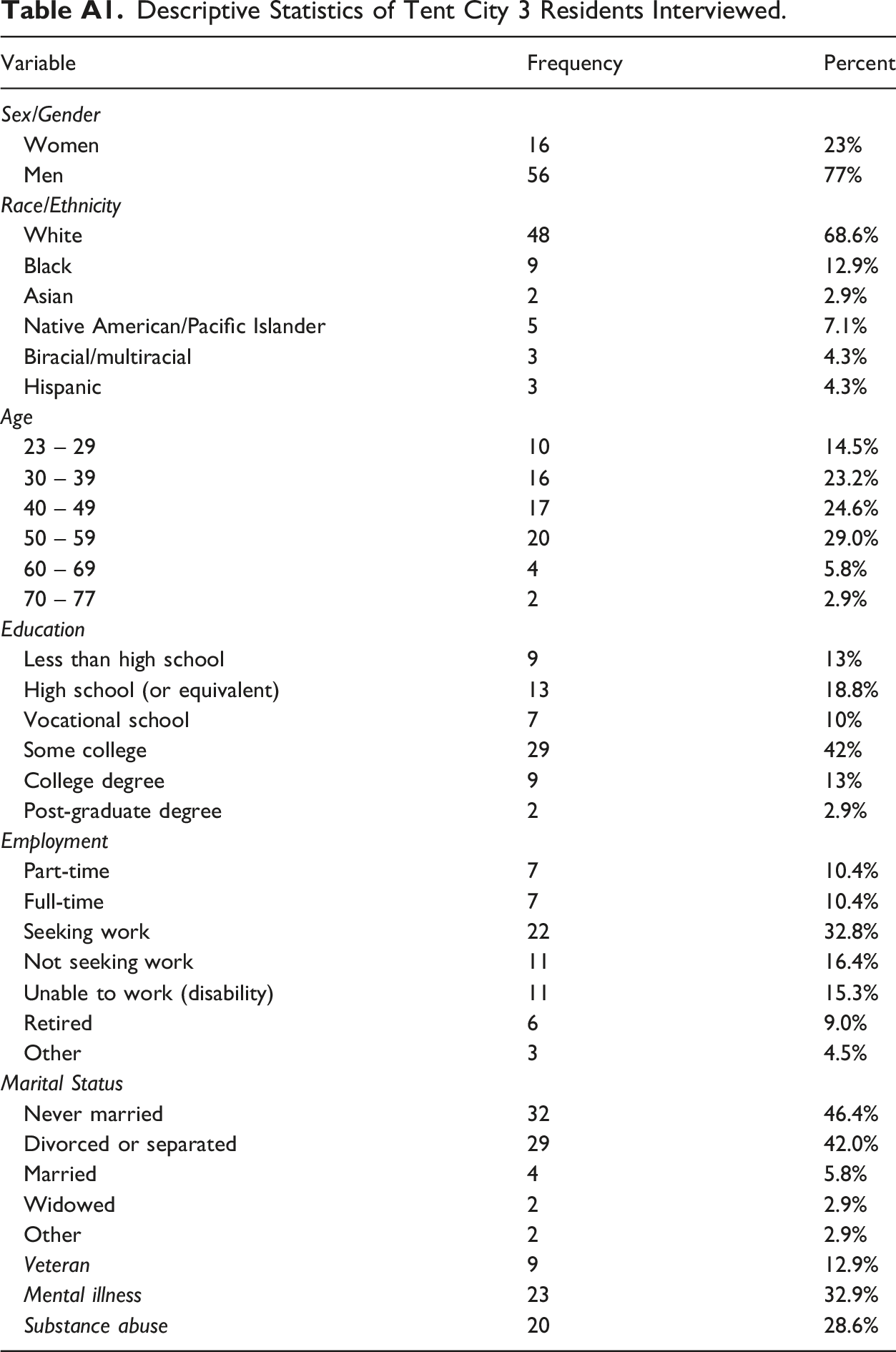
Variable
Frequency
Percent
Sex/Gender
Women
16
23%
Men
56
77%
Race/Ethnicity
White
48
68.6%
Black
9
12.9%
Asian
2
2.9%
Native American/Pacific Islander
5
7.1%
Biracial/multiracial
3
4.3%
Hispanic
3
4.3%
Age
23 – 29
10
14.5%
30 – 39
16
23.2%
40 – 49
17
24.6%
50 – 59
20
29.0%
60 – 69
4
5.8%
70 – 77
2
2.9%
Education
Less than high school
9
13%
High school (or equivalent)
13
18.8%
Vocational school
7
10%
Some college
29
42%
College degree
9
13%
Post-graduate degree
2
2.9%
Employment
Part-time
7
10.4%
Full-time
7
10.4%
Seeking work
22
32.8%
Not seeking work
11
16.4%
Unable to work (disability)
11
15.3%
Retired
6
9.0%
Other
3
4.5%
Marital Status
Never married
32
46.4%
Divorced or separated
29
42.0%
Married
4
5.8%
Widowed
2
2.9%
Other
2
2.9%
Veteran
9
12.9%
Mental illness
23
32.9%
Substance abuse
20
28.6%
Tent City 3 Code of Conduct.