






Abstract
We examine the existence of altruism budgets (AB), which imply fixed monetary allocations to prosocial behaviours (PSB), and benevolence constraints (BC), which refer to wider limits to benevolent behaviour, giving rise to a substitution between PSB's across domains and causes, including volunteering and biological donations. Using longitudinal data from the Netherlands from 2003 to 2019, we exploit two exogenous shocks to charitable behaviour: the introduction of a tax incentive that increased donations to culture and the arts, and a large-scale emergency fundraising campaign targeting Syrian refugees and victims of Typhoon Haiyan. Our results provide no evidence of AB but robust evidence of BC. We find a robust and precisely estimated decline in volunteering of approximately 4.5 hours per month after the emergency aid campaign among donors. This pattern suggests that individuals substitute across different forms of prosocial behaviour, reallocating effort from non-monetary activities such as volunteering toward monetary contributions during periods of heightened charitable demand.
Keywords
Introduction
The effective functioning of a society depends on the availability of prosocial behaviours across multiple domains, including volunteering, monetary and time contributions, and the donation of biological materials such as blood and organs, all of which remain in short supply . Hence, a central question in rational choice theory concerns how to increase the supply of prosocial behaviour (PSB) and the motivations underlying altruism. While Becker (1974) posited that charitable behaviour may reflect strategic considerations, subsequent research has highlighted the role of intangible returns, such as warm glow (Andreoni, 1989), as well as the potential for motivation crowding effects when individuals are incentivised to give. Consistently, Andreoni and Payne (2003, 2013) document crowding-out effects in charitable giving, while Null (2011) finds that donors respond only weakly to matching donations. Overall, the literature provides mixed evidence interactions between PSBs can exhibit both complementary and substitutive effects across domains.
A key feature in the literature on incentives for PSBs is the presence of a fixed “altruism budget” (AB) which reflects an individual’s limited capacity - or willingness- to engage in prosocial behaviours, in the monetary domain (Brown et al., 2012). In the presence of altruism budgets, incentivising one specific type of PSB could inadvertently reduce participation in others, given the income constraints individuals face, creating trade-offs across different forms of prosocial activity. 1 To date, evidence on altruism budgets outside of field experiments remains limited, especially, beyond monetary domains. We posit that individuals operate within broader “benevolence constraints” (BC) that extend beyond purely monetary giving, encompassing limits to both financial and non-financial forms of prosocial behaviour (PSB). Engagement in other non-monetary domains may therefore affect participation in other domains such as volunteering or blood donation (Costa-Font and Machado, 2021).
Given that individuals face binding constraints in both time and financial resources, decisions across different PSBs are likely to be interdependent. That is, an expansion in one form of PSB may lead to a reallocation of effort across domains, generating both substitution or complementarity effects. This perspective suggests that shocks affecting a specific type of giving can have broader, spillover effects on the overall supply and composition of prosocial behaviour. This paper contributes to this question.
To date, we have limited empirical evidence of altruism budgets and the extent to which they are restricted to monetary charitable donations alone or whether they might be defined beyond monetary domains and expand across several PSBs. Laboratory experiments indicate that successful incentives not only increase donations in the domain of interest but also donations to complementary causes (Filiz-Ozbay and Uler, 2019; Krieg and Samek, 2017; Truelove et al., 2014). However, we still lack a clear understanding of how individuals allocate time and resources across different PSBs in both monetary and other domains. Namely, whether there is a fixed supply of PSBs—a so-called “altruism supply constraint”—or if such supply can be expanded through incentives, such as tax deductions or the heightened motivation from urgent needs.
This paper empirically examines the hypothesis of “altruism budgets” (AB), namely the presence of strategic substitution between PSB across different monetary, and “benevolence constraints” (BC), which refer to interactions beyond monetary domains. We draw on data from the Netherlands, one of the largest donor countries worldwide. To test for the presence of AB and BC, we draw on the variation resulting from two different quasi-natural experiments exploiting exogenous variation in two specific PSBs between 2003 and 2019. Both interventions changed the incentives to engage PSB in one cause without directly depressing desirable behaviours in other causes. We aim to study whether an increase in monetary donations to one cause leads to substitution away from monetary donations to other causes consistently with the presence of AB, and whether it has an impact on other PSBs consistent with the presence of BC.
We specifically, draw from evidence of two interventions as follows. First, we study the effect of Geefwet, namely a tax reform introducing tax incentives for individual donations to culture and art among donors in 2012, which we expect to increase the ‘benevolent reward’ - or lowers the price of giving - to such charitable causes. Previous studies have already documented evidence of the responsiveness of charitable donations to tax incentives (Bakija and Heim, 2011). However, this paper examines whether there are any potential substitution effects between different PSBs across domains.
Second, we study the effect of the Giro555, a fundraising campaign established in 2007 in the Netherlands to raise funds for Syrian refugees after their crisis and the typhoon in the Philippines, on other monetary donations for other causes and other PSB’s. We hypothesise that the sudden demand for support for such a highly salient cause may heighten individuals' perceived empathic distress, which in turn, crowds out either time or monetary budgets allocated to other PSBs or non-pecuniary benevolent rewards (Costa-Fint and Machado, 2021) 2 . However, whether the Giro 555 appeal increased donations alongside—or at the expense of—other PSBs therefore remains an empirical question.
We use unique longitudinal individual-level data from the 2003–2019 sample of Giving in Netherlands Panel Study (GINPS), to study whether an incentivised change in one PSB changes other PSBs across domains. The importance of considering different domains lies in the fact that individual AB might not be restricted to the monetary domain alone. Instead, BC might emerge with “latent expectations of pro-sociality” guided to attain benevolent rewards and might be individual specific, and once achieved, might depress further altruistic behaviours, including donations for social causes. Such BC might well be influenced by reference points, which makes the use of longitudinal data and using individual fixed effect specification essential to be able to exploit within-individual variation in PSBs. Furthermore, the effects may not manifest immediately but might instead be subject to a time delay. Thus, the timeframe for observing such behaviours might need to span several years.
We contribute to the literature in the following way. First, we examine the effect of AB and BC using widely representative survey data. That is, we study the effect of a change in PSB’s within monetary and other domains and across different causes. We contribute to the literature of the micro-foundations of altruism by combining both monetary and, time and wider budgets constraining the individual engagement in PSBs. This is important considering that recent studies identify no negative spillover effects from humanitarian campaigns, and hence point to the presence of no altruism budgets (Gee et al., 2024, Harwell et al., 2015), which in turn we confirm in this paper, but in addition we find evidence of BC if we expand our focus to non-monetary domains and other causes. Second, we explore quasi-experimental evidence of two interventions that offer independent variation in one charitable cause in a unique survey setting from the Netherlands. We use a canonical differences-in-differences (DiD) design to estimate the average effect of such interventions; we examine its robustness and potential mechanisms. Third, we examine several mechanisms suggested by Bekkers and Wiepking (2011) as key determinants of PSBs, namely the role of awareness of need, solicitation, reputation, psychological benefits, costs and benefits, altruism, values, and efficacy.
We document the following set of findings. First, examining evidence from an intervention that lowered the cost of monetary donations—specifically, the tax reform (Geefwet), which significantly boosted donations to culture and the arts—we find that it also increased monetary donations to health, which does not suggest evidence of altruism budgets, but some complementary relationship between monetary donations. However, consistent with the notion of benevolence constraints, we find some evidence that it reduced the likelihood of individuals reporting a blood donation. Second, analysing an intervention that enhanced the benevolent rewards for monetary donations to two humanitarian crises, we find that an unanticipated, high-stakes humanitarian campaign such as Giro555 did not affect overall monetary donations to health. However, it did reduce the time spent on volunteering by 4.5 hours per month, again consistent with the presence of BC. We then discuss several potential drivers for this effect, including increased trust in philanthropic donations, which may have encouraged monetary contributions overall.
The rest of the paper is structured as follows. The next section summarises related literature. Section three summarises key institutional details. Section four reports the data and outlines the empirical strategy. Section five presents the results, which are discussed in Section six. Section seven concludes.
Related literature
Altruism budgets
The literature on substitution effects across PSBs remains mixed. Empirical studies document patterns consistent with the presence of substitution effects between donations to different causes, particularly between health and domains such as basic needs and education, with stronger effects among donors contributing to multiple organisations (Reinstein, 2011) 3 . Related evidence from laboratory experiments likewise points to substitution, suggesting that individuals reallocate prosocial effort across competing domains when incentives or opportunities change. For instance, Deck and Murphy (2019) find that raffle-based bonuses and all-pay auction incentives increase donations to eligible organizations while reducing contributions to non-eligible ones, consistent with the altruism budget hypothesis. One explanation lies in the fact that having too many options can crowd out donations or even reduce total contributions (Corazzini et al., 2015). However, some research reports no evidence of substitution, showing instead that donations to complementary causes can increase total contributions (Filiz-Ozbay and Uler, 2019; Krieg and Samek, 2017).
Studies on the effects of natural disasters report complementary spillover effects, where donations increase after the shocks (Brown et al., 2012; Scharf et al., 2017). Drawing on the variation in monetary donations induced by the effects of the 2004 Indian Ocean tsunami, Brown et al. (2012) document evidence of diverted donations away from other charitable causes consistently with an altruistic budget 4 . However, it remains unclear whether there were effects on non-monetary domains.
Donation across domains
Individuals face a trade-off between donations of time and money, leading them to weigh time and budget constraints jointly. This tension underlies the so-called “volunteering puzzle,” the observation that individuals continue to donate both time and money even when concentrating on monetary giving would be more efficient (Handy and Katz, 2008). One explanation is that time donations may yield a higher warm glow than monetary donations, weakening the expected substitution toward cash as the opportunity cost of time rises (Lilley, 2011). Such effects across domains and causes, including volunteering and blood donation, we label as “benevolent constraints”.
Early research on the relationship between time and monetary donations suggests that an increase in time contributions can lead to higher monetary donations, largely due to changes in the relative “price” of different donation behaviours (Brown and Lankford, 1992). More recent studies, however, indicate that time and monetary donations may act as substitutes, as individuals become acquainted with other forms of giving through engagement in prosocial activities (Feldman, 2010). Evidence from studies on blood donors supports this connection between different types of prosocial behaviour. Blood donors tend to be more engaged in other PSBs, such as monetary donations and volunteering, compared to non-donors (Costa-Font et al., 2013; Studte et al., 2018). Specifically, becoming a new blood donor increases an individual's participation in other prosocial activities, while ceasing to donate blood is associated with reduced volunteering and involvement in citizen initiatives. These findings point to the importance of donation motives: more altruistically motivated blood donors tend to volunteer more than those guided by less altruistic incentives (Alessandrini, 2007). In this study, we extend the substitution effect of monetary donations beyond the simple time and money donation framework to include donations of biological fluids, which entail higher costs rather than time.
Motivations for prosocial behaviours
Previous evidence suggests that prosocial behaviour can be driven by multiple motivations, including “moral licensing,” where a virtuous act compensates for less ethical behaviour (Laffan and Dolan, 2020; Tetlock et al., 2000). Benevolent rewards and the salience of recipient needs—arising from events such as natural disasters (e.g., typhoons) or humanitarian crises (e.g., the Syrian crisis)—can strongly enhance donations and provide quasi-experimental variation. In contrast, changes in tax incentives primarily lower the marginal cost of donating to certain causes. In this paper, we compare the effects of Giro555, driven by benevolent rewards, with donations to culture and arts, which are motivated by broader social concerns and support for local organizations. Media coverage and perceived urgency have also been shown to increase both the likelihood and size of donations (Simon, 1997; Wiepking et al., 2010), helping explain differences between humanitarian and other campaigns. This paper leverages highly publicised campaigns, such as aid for Syrian refugees, to examine how salient needs influence prosocial behaviour.
Several studies show that PSBs can enhance reputation (Blumkin and Sadka, 2007; Kumru and Vesterlund, 2010), and when donations are public, social pressure or shame for not contributing can strongly influence giving. Donations are also shaped by others’ giving behaviours (Gee and Schreck, 2018; Shang and Croson, 2009), making blood donation particularly sensitive to social visibility.
Individual differences in donation behaviour may reflect variations in altruistic values and beliefs (Farmer and Fedor, 2001), which can be crowded out by monetary incentives (Ariely et al., 2009) or perceptions of low impact (Lee and Farrell, 2003), but can be reinforced when donors receive information about their contributions (Wiepking, 2021; Jackson and Mathews, 1995). Altruism is also influenced by practical constraints, such as distance to donation centres or opening hours, and by incentives like tax deductions (Bekkers and Franssen, 2015). Acting pro-socially can provide a “benevolent reward,” including psychological benefits such as increased oxytocin levels (Gordon et al., 2011; Van Zuiden, 2013) and improved life satisfaction and mental health (Schacter and Margolin, 2019). Additional insights on changes in attitudes and values are discussed in the mechanisms section of the paper.
Finally, it’s worth mentioning that the demand for donations provides an opportunity for charities to increase the awareness of the activities of the charity with the donated funds, which plays an essential role, especially for monetary donations. A study in the Netherlands finds that 86% of all donations were typically in response to a solicitation (Bekkers, 2005). Similarly, solicitation influences blood donation as evidence reveals that people are more likely to become donors if there is a donor in the community and if they are introduced to blood donations by that individual (Bruhin et al., 2020). In our case, Giro555 was influenced by a significant solicitation campaign. In this paper, we examine the effect of Grio555, an aid campaign increasing the opportunity of individuals to build benevolent rewards, and hence to convey their altruism to a specific donation, such as monetary donations for a specific aid cause, or blood or organ donations more generally.
Institutional background
Giving in Netherlands
The Netherlands is the seventh-largest donor country in the world, spending US$5.3 billion on official development assistance (ODA) in 2019, which accounts for 0.59% of its gross national income (GNI). On average, charitable donations per household in 2015 amounted to €180 per year or 0,4% of household income (Bekkers and Franssen, 2015). The median gift is €50 (De Wit and Bekkers, 2017). In the past 15 years, the trend in generosity has been downward as the proportion of income has declined slowly but steadily since 1999. This is what is measured using the dataset of this study, namely the GINPS panel, detailed in Section 4, which contains data on donation and volunteering in the Netherlands. The average monetary donation in the Netherlands has been decreasing over time, 40% of this decline can be attributed to the drop in religiosity (Bekkers et al., (2018), which is heavily concentrated. About 20% of the households are responsible for 80% of total donations, whilst 12% of Dutch households do not donate to charitable causes. Most Dutch households donate to a health cause (>70%) followed by environment, nature, animals and international aid 5 . However, the generosity of Dutch households has been decreasing between 1999 and 2015.
Blood donations in the Netherlands are collected and organised by one central blood bank, Sanquin. Although there is no lack of blood supply currently in the Netherlands, the donor pool is declining, and it is overrepresented by older men, and few new young people are becoming donors (Atsma et al., 2011; Wevers et al., 2014). The Netherlands follows the European Union legislation concerning blood, tissues, and cells of human origin. Following the revision of the testing of blood donors by the European Commission in 2014, stricter requirements were recommended for some of the laboratory tests in the Netherlands (European Commission, 2015).
Finally, voluntary work is common in the Netherlands, about 49% of the Dutch population above 15 years of age has been engaged in voluntary work for an organisation at least once per year (van de Donk and Brandsen, 2009). Other estimates suggest that 37% of the population had performed unpaid volunteering activities for an organization 2014, and they spend 18hours per month performing managerial tasks (26%), doing chores (20%), doing office work and administration (18%), giving advice and training (17%) or offering transportation (14%). In the past 2 years, the average hours a volunteer spends volunteering per month decreased slightly, from 21 to 18 hours 6 .
Data and empirical strategy
The data
We draw on unique longitudinal data following individuals during 17 years in the Netherlands. More specifically, we use the Giving in the Netherlands Panel Survey (GINPS) collected by the Kantar Public Research Institute (Bekkers et al., 2015). Across 9 survey waves (2002 to 2019), the analytical dataset comprises an unbalanced panel of 1,707 individuals. In the sixth wave (2012), an additional set of 1,013 respondents from a previous study on giving to culture and arts, commissioned by the Dutch Ministry of Education, Culture and Science (OC&W), was added to the GINPS sample. 7
Summary statistics.
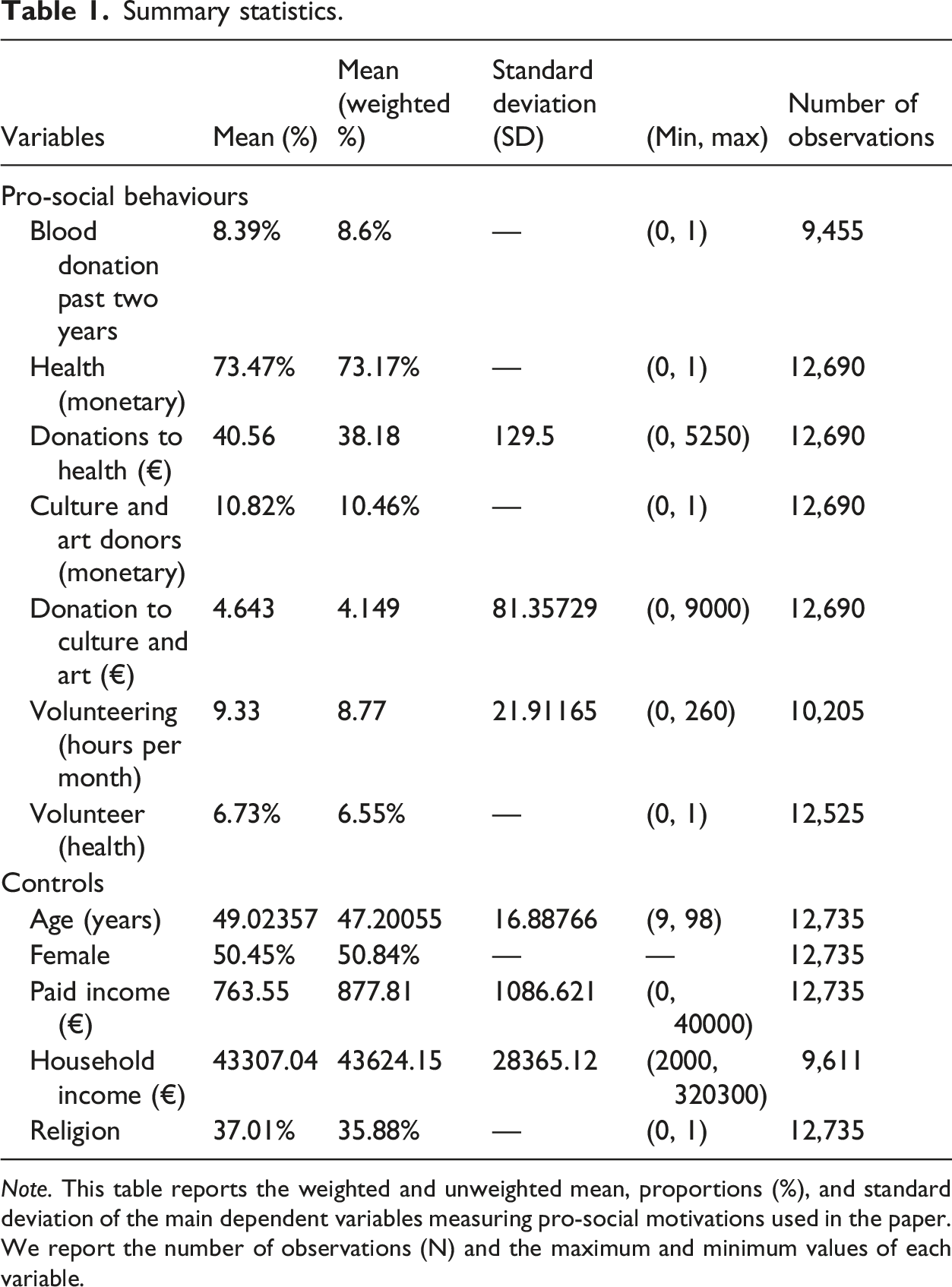
Note. This table reports the weighted and unweighted mean, proportions (%), and standard deviation of the main dependent variables measuring pro-social motivations used in the paper. We report the number of observations (N) and the maximum and minimum values of each variable.
Empirical strategy
Our analysis starts by examining trends in donation rates over time to establish the pre-intervention baseline. We then document these trends for the full sample and relevant subsamples and provide evidence on donation patterns following two exogenous interventions. Specifically, we exploit two plausibly exogenous shocks that occurred at different points in time: the 2012 tax reform “Law on Giving” (“Geefwet”) and the Giro555 campaign after 2013. The Giro555 campaign represents a newly introduced fundraising opportunity – which did not previously exist - and was therefore exogenously changes the individuals’ donation choice sets, creating an unanticipated change in the portfolio of donation options. In contrast, the 2012 tax reform was a policy change that primarily increased the tax incentives of individuals who were already donating to the arts – and were exposed to an incentive to increase their donations as a result. More specifically, the Geefwet introduced a fixed multiplier’ for donations to culture and the arts by households (1.25) and corporations (1.50) which was public knowledge well in advance of their actual implementation. That is, governments increase individual levels of donation by a fixed rate the donation incentive, namely a 25% increase in the amount donated. In the presence of altruism budget constraints, such changes are expected to affect the allocation of donations across different domains. Together, these two interventions allow us to identify the causal effect on total monetary donations and on donations to the health domain.
Given that the Geefwet effect did not increase the extensive margin (new donors to the arts), but only influence the intensive margin of existing donors, we use non-donors as a control group. Second, given that the Giro555 campaign did not exist before the typhoon event, our control group is made of the individual’s that did not donate after the campaign. We draw on a simple canonical difference-in-differences (DiD) model where we examine the effect of the two treatments on other domains and charitable causes to those of the treatment, namely a set of PSBs described in Table 1. More specifically, we distinguish monetary donations to health (€), monetary donations to culture and arts (€); blood donation in the past 2 years (yes/no), organ donation decision (yes/no), volunteer (yes/no), volunteer in health (yes/no), and time spent on volunteering activities in a month (hours).
One concern is that individuals exposed to the two treatments may differ from the control group along observable characteristics, such as income. To address this, we include a set of controls—gender, age, gross annual household income, highest education level, and province-specific unemployment rates—consistent with the approach adopted in the literature (Reinstein, 2011).Additionally, some specifications include religiosity as a control, given its demonstrated influence on prosocial behaviors in the Netherlands (Bekkers et al., 2018). Finally, for models of blood donation, we also control for highest education level and health status, consistent with previous research (Veldhuizen et al., 2011).
Finally, given that our events of interest are close in time to the recession in the Netherlands, we also examine the effect on household income, paid hours work and perceived financial security. To provide a more complete picture of the effect of the two treatments, we attempt to explain the main channels driving our results by examining several attitudes such as perception of other people’s pro-social activity, trust in philanthropic causes, altruism, and empathy. Exposure to the tax reform “Law on Giving” (Geefwet) is measured by individuals who were donors to the culture and the arts, which as we show in the paper respond by increasing their donations in response to the incentive introduced in 2012, which remained in place thereafter. While the reform could have affected all taxpayers, our control group consists of individuals who donated to this cause but were unaffected by the reform. Trends in the policy’s impact suggest that the reform did not have a long-lasting effect (Appendix C.2; Figures C.2.1 and C.2.2). Similarly, the Giro555 campaigns are organized by the Samenwerkende Hulporganisaties (SHO), a Dutch joint aid organization that provides a platform for coordinated fundraising for humanitarian aid in disaster areas. In addition to raising funds, the campaigns also aimed to increase public awareness about the causes supported. Although the program existed prior to the typhoon in the Philippines and the Syrian refugee crisis, our analysis focuses on the effect of exogenous claims for support that emerged after 2013.
Given the unique longitudinal nature of this dataset, we can identify individuals who specifically responded to the Giro555 appeal, which were identified in our data, and examine whether this unanticipated call influenced their prosocial behaviours over time. Examining the effect of the Giro555 case is important because it generates an exogenous increase in prosocial behaviour and could potentially affect the overall supply of altruism. While other potential PSBs could be explored, our focus is on documenting how individuals’ prosocial behaviour reacts to exogenous variation in one of the donation campaigns under study. Because these campaigns were triggered by exogenous events—such as the Syrian refugee crisis and the typhoon in the Philippines—we can estimate how responding to these specific causes affects other prosocial behaviours. This treatment captures the impact of a new and unexpected demand for help, which is effectively random with respect to the rest of individuals’ donations to charitable causes.
Difference in differences (DID) specification
To retrieve quasi-experimental variation on of the two treatment interventions identified in the survey questionnaire, namely the specific exposure to the Geefwet’ or Giro555 campaign. We estimate the following regression as follows:
Next, we compare the coefficient for and without individual fixed effects, the latter absorbs the influence of unobservable variables correlated with time-invariant characteristics such as personality dimensions that do not change over time and should be controlled for as they bias our estimates. Later in the text we describe the results of an analysis of trends in Figures 1 to 5 for individuals exposed to Giro555 and are suggestive of parallel pre-trends across groups. Analogous pre-trends are observed for individuals reacting to the Geenfwet Law. Figures in Appendix C provide evidence of trends in the different variables under analysis which are described in the section below.
Descriptive statistics
This section summarises the main trends in the variables of interest, focusing on mean levels of prosocial behaviours (PSBs) by category. These include monetary donations to health, monetary donations to culture and the arts, blood donations, organ donations, and hours spent volunteering, observed across nine survey waves. Trends for all PSB measures are presented in Appendix C, while summary statistics for the full sample and relevant subsamples are reported in Appendix A. Descriptive statistics report the average monetary donations for two charitable causes—health and culture/arts.
The mean donations to health-related causes ranged between €30 and €40 over the period 2001–2011. As shown in Figures C.1.1 and C.1.2 in the Appendix, average donations declined between 2009 and 2013, reaching a low of €26 in 2013, before increasing sharply to approximately €68 by 2018. In contrast, mean donations to culture and the arts remained relatively stable, fluctuating between €3 and €5 from 2001 to 2011 and peaking at around €7.7 in 2013 (Figures C.2.1 and C.2.2). The share of blood donors ranged between 8% and 9.5% from 2005 to 2014. After 2014, this share fell below 8%, indicating a declining trend in active donors (Figures C.3.1 and C.3.2). The data also reveals two notable spikes: in 2007–2008 and 2013–2014, when over 9% of individuals were blood donors.
Finally, the share of volunteers remained between 35% and 45% from 2004 to 2014 (Figures C.4.1 and C.4.2), with an overall declining trend. After dropping sharply from nearly 90% in 2002 to around 40% in 2004, volunteer participation rose to 45% by 2008, before gradually falling again to 38% in 2014. Mean hours spent volunteering followed a similar pattern over this period (Figures C.6.1 and C.6.2). Focusing on the health domain, the share of volunteers ranged between 5% and 8% from 2002 to 2014 (Figure C.7.1). Notably, there was a sharp decline from approximately 7% in 2010 to 5% in 2012, followed by a recovery to around 7% by 2016.
Results
2012 Geefwet’ tax reform
2012 Tax reform ‘law on giving’ (‘Geefwet’) effects on other pro-social behaviours.
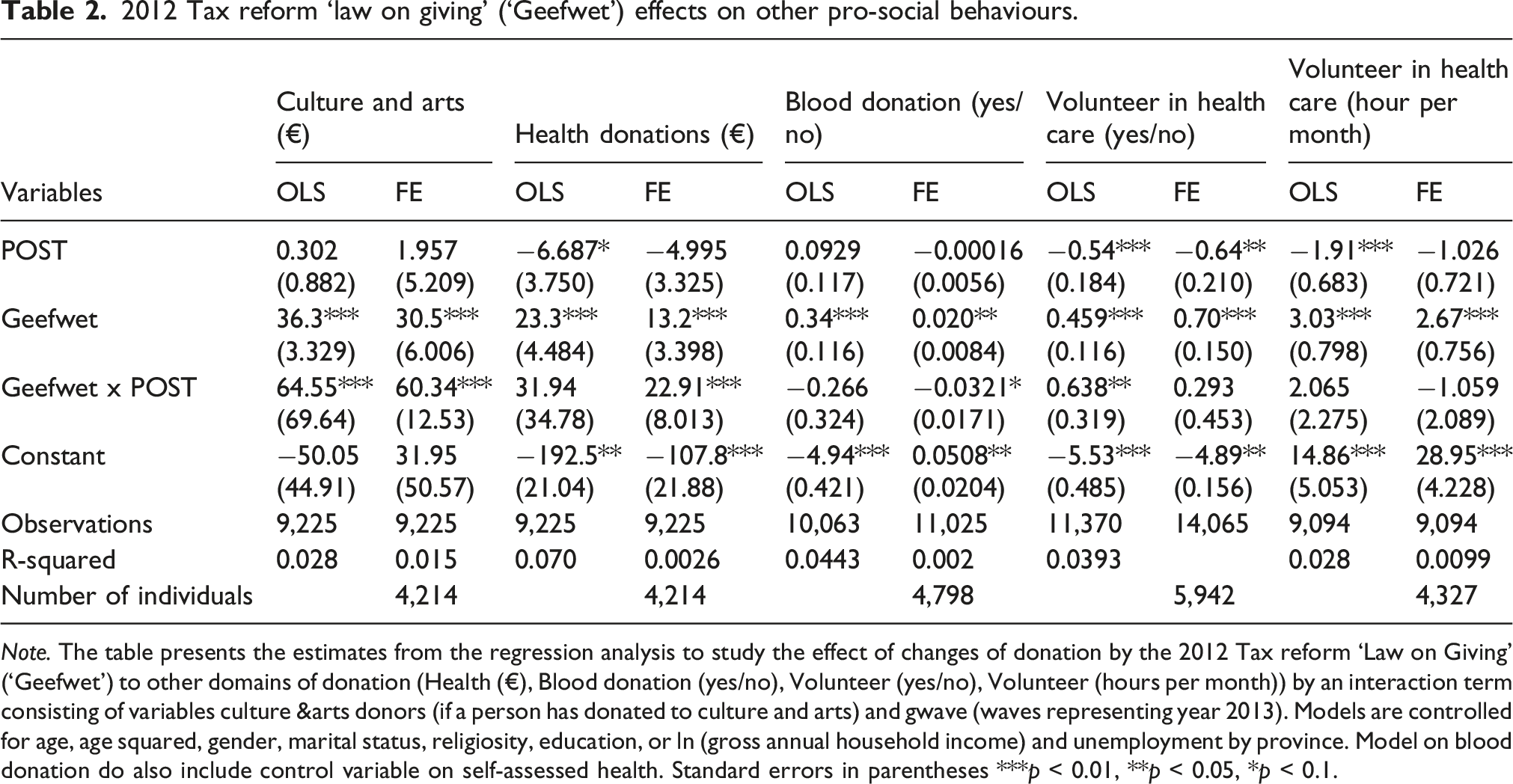
Note. The table presents the estimates from the regression analysis to study the effect of changes of donation by the 2012 Tax reform ‘Law on Giving’ (‘Geefwet’) to other domains of donation (Health (€), Blood donation (yes/no), Volunteer (yes/no), Volunteer (hours per month)) by an interaction term consisting of variables culture &arts donors (if a person has donated to culture and arts) and gwave (waves representing year 2013). Models are controlled for age, age squared, gender, marital status, religiosity, education, or ln (gross annual household income) and unemployment by province. Model on blood donation do also include control variable on self-assessed health. Standard errors in parentheses ***p < 0.01, **p < 0.05, *p < 0.1.
The DiD coefficient of interest is the interaction term
In contrast, when we examine the effect of Geefwet on non-monetary health domains, we find that Geefwet gave rise to a 3-percentage point (pp) reduction in blood donation points - a large effect that is plausible given the humanitarian need after a catastrophe – consistent with the presence of BC, even though this effect is not observed for all non-monetary PSBs. However, the estimate emerges once we control for fixed and is only significant at 10% significance level 12 . That is, Geefwet increased monetary donations to culture and health causes but at the expense of some other prosocial behaviours in non-monetary domains. Hence, these results are consistent with the presence of BC, which only emerge among non-monetary domains.
Giro555 campaign
Figures C0.1–4 in the Appendix C illustrate the trends in several PSB’s among individuals who donated to the Giro555 campaign. Overall, the figures suggest that mean monetary donations to health rose noticeably, and the share of individuals engaging in volunteering also increased, indicating that participation in Giro555 was associated with broader engagement in prosocial behaviours. In contrast, no clear effect is observed on blood donations, suggesting that not all types of prosocial behaviours responded in the same way. The difference in mean monetary donations to health between the Giro555 donor sample and the general population appear to widen over time. Our estimates suggest that by 2018, donors to Giro555 had contributed an average of €167.8 per person, more than double the €68.7 observed in the general sample. Similarly, the share of volunteers is estimated to be consistently higher among Giro555 donors, highlighting that against the backdrop of altruism budgets, engagement with a high-profile humanitarian campaign may reinforce participation in other forms of giving. Importantly, the figures show that both the Giro555 and general samples followed closely parallel pre-trends in prosocial behaviour, supporting the notion that the observed post-campaign differences are likely linked to the campaign rather than pre-existing trends. Next, the Figure C01.3 depicts trends in health-related volunteering among Giro555 donors. The estimates indicate that, although volunteering generally declined over time, there is a noticeable increase after 2013, particularly among Giro555 donors. Examining the intensive margin—hours spent volunteering—reveals a similar pattern: hours steadily declined since 2001 but appear to rebound toward 2001 levels after 2013. These trends suggest that the Giro555 campaign exerted a positive impact on prosocial behaviours.
Giro555 campaign for the Syrian refugee crisis and the typhoon in the Philippines.
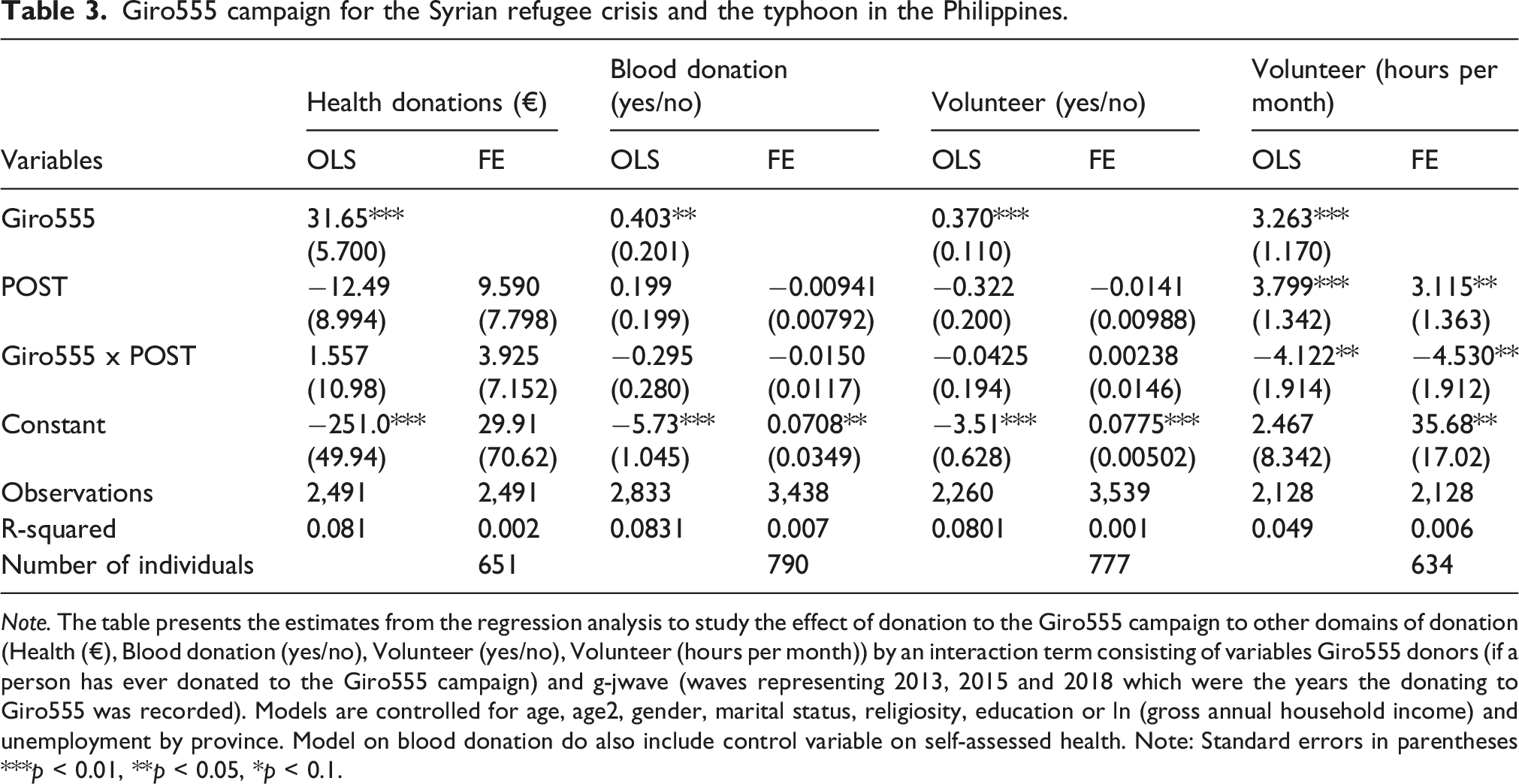
Note. The table presents the estimates from the regression analysis to study the effect of donation to the Giro555 campaign to other domains of donation (Health (€), Blood donation (yes/no), Volunteer (yes/no), Volunteer (hours per month)) by an interaction term consisting of variables Giro555 donors (if a person has ever donated to the Giro555 campaign) and g-jwave (waves representing 2013, 2015 and 2018 which were the years the donating to Giro555 was recorded). Models are controlled for age, age2, gender, marital status, religiosity, education or ln (gross annual household income) and unemployment by province. Model on blood donation do also include control variable on self-assessed health. Note: Standard errors in parentheses ***p < 0.01, **p < 0.05, *p < 0.1.
Placebo tests
Next, we examine whether our estimates could be driven by spurious correlations or confounding factors. To do so, we conduct a placebo test by examining the effect of the two treatments on an irrelevant outcome: knowledge of the CBT accreditation seal, a certification by the Dutch government indicating that a donor is legitimate and trustworthy. Tables F1 and F2 in the appendix report the results across all specifications. In both cases, we find no significant effect of either treatment on knowledge of the CBT accreditation seal, supporting the validity of our main estimates.
Mechanisms
Perception of philanthropic organizations after GEEFwet and Giro555.
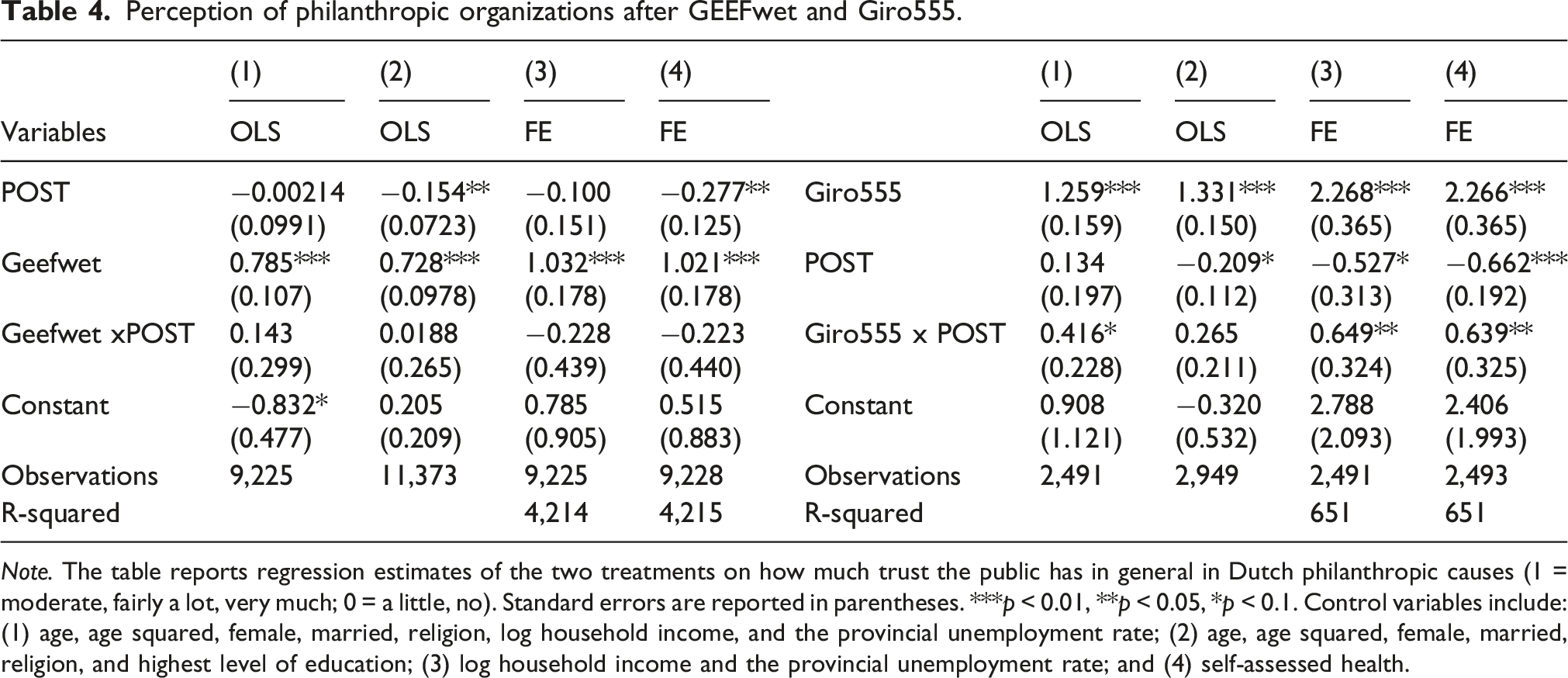
Note. The table reports regression estimates of the two treatments on how much trust the public has in general in Dutch philanthropic causes (1 = moderate, fairly a lot, very much; 0 = a little, no). Standard errors are reported in parentheses. ***p < 0.01, **p < 0.05, *p < 0.1. Control variables include: (1) age, age squared, female, married, religion, log household income, and the provincial unemployment rate; (2) age, age squared, female, married, religion, and highest level of education; (3) log household income and the provincial unemployment rate; and (4) self-assessed health.
Conclusion
This paper investigates the hypothesis of altruism budgets (AB) in prosocial behaviours (PSBs) across causes alongside the hypothesis of “benevolent constraints” (BC) which extend the notion of AB across non-monetary domains suggesting broader limits to PSBs. Drawing on the effect of new unexpected donation to different charitable causes, across monetary and non-monetary domains, we exploit two exogenous sources of variation in incentives for giving and we document increases in monetary donations and a reduction in non-monetary PSBs in the Netherlands, one of the world’s largest donor countries.
More specifically, we study the 2012 tax reform, the “Law on Giving” (“Geefwet”), which increased tax incentives for charitable donations, particularly among individuals who were already donating to the arts. Using a difference-in-differences framework, we compare individuals who responded to these incentives with those unaffected, analysing how increased monetary donations to the arts influenced PSBs across other domains. Next, we examine the effect of the Giro555 campaign, a major humanitarian fundraising effort in 2013 supporting Syrian refugees and typhoon victims in the Philippines. This campaign introduced an unanticipated opportunity to donate, generating an exogenous increase in donations to that domain. Together, these interventions allow us to assess whether increases in giving to one cause depress or complement PSBs in both monetary and non-monetary forms across other domains.
Our findings are consistent with the presence of BC, or substitutive effects in non-monetary domains, primarily on volunteering. Specifically, we document a precisely estimated reduction in volunteering. These patterns are consistent with the presence of substitution effects across prosocial domains or the presence of BC, whereby increases in monetary giving crowd out other time-intensive forms of engagement. Importantly, however, this reallocation does not appear to reduce aggregate monetary giving consistently with the absence of AB; if anything, we find that it may leave contributions to other causes unchanged or even incentivise donation to other charitable causes.
In line with attention-based mechanisms, the Geefwet campaign appears to have reallocated attention towards health-related giving, resulting in an increase—rather than a decrease—in monetary donations to such causes. However, consistent with BC, the same campaign is associated with a reduction in blood donations of approximately three percentage points, albeit only statistically significant at the 10% level, which aligns with prior evidence from the disaster-giving literature. Similarly, the Giro555 campaign induced a sizeable decline in volunteering, amounting to roughly 4.5 hours per month, an effect that is both statistically significant and robust across specifications.
Importantly, the presence of BC does not generate sharp ex ante predictions regarding which specific behaviours are displaced, and our findings indicate that several domains of prosocial activity remain unaffected which suggest that further research should map more precisely the conditions under which substitution occurs. The observed patterns may, in part, reflect a temporary increase in trust in philanthropic organisations among Giro555 donors during the campaign period, as well as perceptions that monetary donations yield higher marginal impact in the context of high-profile humanitarian appeals compared to volunteering time. Taken together, these results suggest that the supply of prosocial behaviours might encompass a wider range of domains rather than just focus on monetary domains.
Our findings carry important implications for policymakers and nonprofit organisations designing interventions to stimulate prosocial behaviour. While financial incentives, tax relief schemes, and high-profile fundraising campaigns can be effective in mobilising monetary donations, they may also generate unintended substitution effects across other prosocial domains. In particular, the evidence suggests that increased financial giving can crowd out time-intensive activities such as volunteering and, even biologically constrained contributions such as blood donation although such effect was only significant at 10% level. As a result, policy instruments that target a single margin of prosocial behaviour may need to consider the reallocate of engagement in PSBs, with potential efficiency losses if displaced activities generate larger social returns.
Supplemental material
Supplemental material - Altruism budgets or benevolence constraints? Pro-social behaviours across causes and domains
Supplemental material for Altruism budgets or benevolence constraints? Pro-social behaviours across causes and domains by Joan Costa-Font, Hana Salyga and Sara Machado in Rationality and Society.
Footnotes
Ethical considerations
Not applicable. The study relies exclusively on secondary data and did not require ethical approval.
Consent to participate
Not applicable. The analysis is based on publicly available, anonymised data.
Funding
The authors received no financial support for the research, authorship, and/or publication of this article.
Declaration of conflicting interests
The authors declared no potential conflicts of interest with respect to the research, authorship, and/or publication of this article.
Data Availability Statement
The data used in this study are publicly available. See below: CBS website: https://www.cbs.nl/en-gb/series/time/unemployment. Primary Data Source: Giving in Netherlands Panel Study (GINPS), the study documentation:  .
.
Supplemental material
Supplemental material for this article is available online.
Notes
References
Supplementary Material
Please find the following supplemental material available below.
For Open Access articles published under a Creative Commons License, all supplemental material carries the same license as the article it is associated with.
For non-Open Access articles published, all supplemental material carries a non-exclusive license, and permission requests for re-use of supplemental material or any part of supplemental material shall be sent directly to the copyright owner as specified in the copyright notice associated with the article.
