







Abstract
Background
Overview and Program Context
As the world becomes increasingly heterogeneous, educational institutions offer study abroad opportunities with courses designed to improve nursing students’ ability to provide culturally appropriate care to clients from different cultures. As an Israeli educational institution partnering with several Norwegian baccalaureate degree programs, our goal was to build a study abroad program on a strong theoretical foundation and create useful and interesting courses that would prepare international students to care for Israeli patients. At the same time, it would be very valuable to incorporate useful tools that would support international students, who may be anxious or puzzled by values, beliefs, and reference points of another culture, which was completely different from their own (Bayliss, 2012; Lindquist, 1990; Mkandawire-Valhmu & Doering, 2012; Tabi & Mukherjee, 2003). We wanted to promote intercultural learning between international students and Israeli culture.
Our first international students were undergraduate students from Norway. We planned to provide them a clinical experience on a psychiatric unit with an English-speaking mentor, who was a registered nurse with additional certification as a clinical instructor. Many Israelis, like Norwegians, speak English as a second language. Still, student nurses arriving to a different country with a different culture and language often worry about verbal communication, often ignoring an important form of communication, nonverbal expression and the emotion that underlies it.
The goals of our program were to build skills of observation in a different cultural context. Based on the principles of Constructivist and Transcultural theories, instruments were designed to enable students to (a) acquire a vocabulary and describe interactions, emotion, and emotional expression of individuals from a very different culture and (b) contemplate, reflect, and interpret one’s own values and beliefs on emotions and emotional expression, and consider how these values and beliefs influence one’s perceptions of individuals from a very different culture.
To provide a basis for intercultural learning, we proceeded in three stages: (a) find a strong theoretical framework to facilitate intercultural learning, (b) design tools that built understanding new cultures by starting at “common ground” for international visits to Israel, and (c) assess the utility of the tools as instruments of cultural learning.
Stage 1: Facilitating Intercultural Learning—The Theoretical Framework
Dr. Madeline Leininger’s Transcultural Model was among the first theories in nursing to suggest that values and attitudes not only influence the nurse–patient relationship but also affect health care use, services, and outcomes (Leininger, 1967, 1990). This model emphasizes the fundamental underlying principles that the nurse’s ability to provide culturally competent, ethical, and effective health care depends on the following: (a) the understanding that culture and experience have an impact on attitudes, beliefs, and values; (b) the realization that a person’s own culture, attitudes, and values are neither right nor wrong; and (c) the nurse’s willingness to accept the beliefs and values of different cultures will affect the nurse’s ability to provide culturally appropriate care (Leininger, 1991). The Transcultural Nursing model encourages self-exploration and reflection to gain insight on one’s own biases and perspectives and the influence of biases on nursing assessments and ability to provide nursing care (Hunter & Krantz, 2010; Jeffreys & O’Donnell, 1997).
These same precepts are incorporated in the Constructivist, Schema, and Personal Construct Psychological theories. Constructivist Learning theory, well known to faculty in transcultural nursing education, encourages students to explore their own culture and values, examine the influences that their culture has had on their perspectives and values, and realize that it is through this lens that students view other cultures (Hunter, 2008; Hunter & Krantz, 2010). It suggests that undergraduate nursing students are still developing their knowledge, and therefore, a conceptually sound curriculum in transcultural nursing must build on the knowledge that nursing students already possess. Moreover, it asserts that knowledge is based both on education and experience. Building on this paradigm is Schema Theory, which indicates that students need to assimilate and organize the information they obtain into units or schemas that enable the formation of a coherent structure on which they can build new knowledge (McVee, Dunsmore, & Gavelek, 2005). For example, new nursing students will have knowledge of a hospital—perhaps as a building containing various health professionals. As nursing students work in hospitals, they learn more about hospitals; and their original concept (a building containing various health professionals) becomes more elaborate and detailed, including the bed capacity, the various departments (e.g., blood laboratory, radiology, medical records), and the policies and procedures governing patient care. By organizing the information (i.e., Schema Theory), students develop a more contextualized view of the world and their role within it (Sarbin, 2000).
Schemas involve information on nontangible features such as emotion, behavior, and reactions to behaviors (Chang, 2009). They are dynamic and evolving as experience and knowledge are gained through interactions and experience (as suggested by Kelly’s Personal Construct Psychology [PCP]; Buckenham, 1998); and these interactions and experiences include listening to verbal exchanges, observing nonverbal behaviors such as emotion expression, and understanding the responses of others to these exchanges. Equally important to cultural learning is one’s own reactions to these interactions and experiences. Consequently, schemas for any two students, even students from the same culture and learning in the same classroom, may differ (McVee et al., 2005).
Traveling to a country with a completely different culture is an opportunity to build on existing schemas. Some theorists suggest that when very different information on a particular concept does not fit existing schemas, rather than adding to the complexity of existing schemas, individuals construct new ones that fit (Landau, Meier, & Keefer, 2010; Martinez, Sauleda, & Huber, 2001). It is possible that international students, entering completely new environments with very different approaches and values, construct new schemas rather than adjusting existing schemas where there are too few points of reference. The development of new schemas and building on existing ones to understand new cultures are a major principle of Constructivist Theory that is so important in transcultural nursing (Hunter, 2008; Hunter & Krantz, 2010).
Stage 2: Designing the Tools
Development of a Dictionary on Emotion
Nonverbal communication, including facial expression and body language, may vary even among individuals from different cultures residing in the same country (Weathers, Frank, & Spell, 2002). Emotional expression, a component of nonverbal communication, is a pivotal element in understanding culture, as it depicts the way individuals relate to one another and express their thoughts (Farnsworth & Sewell, 2012). When individuals from different cultures cross national boundaries, recognition of emotional expression decreases precipitously (Elfenbein & Ambady, 2002). Some emotions, such as anger, are considered nearly universal, but intensity, range, physiological reactions, and expression differs (Kövecses, 2010). Identifying and adding words to students’ vocabulary is a first step to aiding students to describe their observations, which facilitates the construction of new schemas on emotion with a different cultural context (Martinez et al., 2001).
From this idea, a dictionary of terms was constructed to describe emotion with the purpose of giving cues to verbalizing emotion and describing the observed emotion with the behavior. Although many patients spoke some English, this tool also helped students to engage in communication with patients who spoke a different primary language. By naming emotions, emotions can be brought to the surface. Only then can they be discussed. These elements are crucial in the process of making sense of one’s emotions and being able to communicate feelings.
To operationalize this process, the following guidelines were used in our creation of a dictionary of words describing emotions. This dictionary would not be exhaustive with the long detailed definitions. Instead, it would be a straightforward list of words arranged in a series to depict the progression of different emotions. The guiding principle used to construct this list was to place similar emotions in proximity to one another and to illustrate the intensity and spectrum of emotions. Second, it was important to include the students’ native language (i.e., Norwegian), the patients’ native language (i.e., Hebrew), and of course, the language that bridged the two languages (i.e., English), which was a second language to both the Norwegian students and the Israeli patients. The dictionary of emotions, organized on two lists and placed on cardboard so it would last the entire semester, followed the following guidelines (see Figure 1).
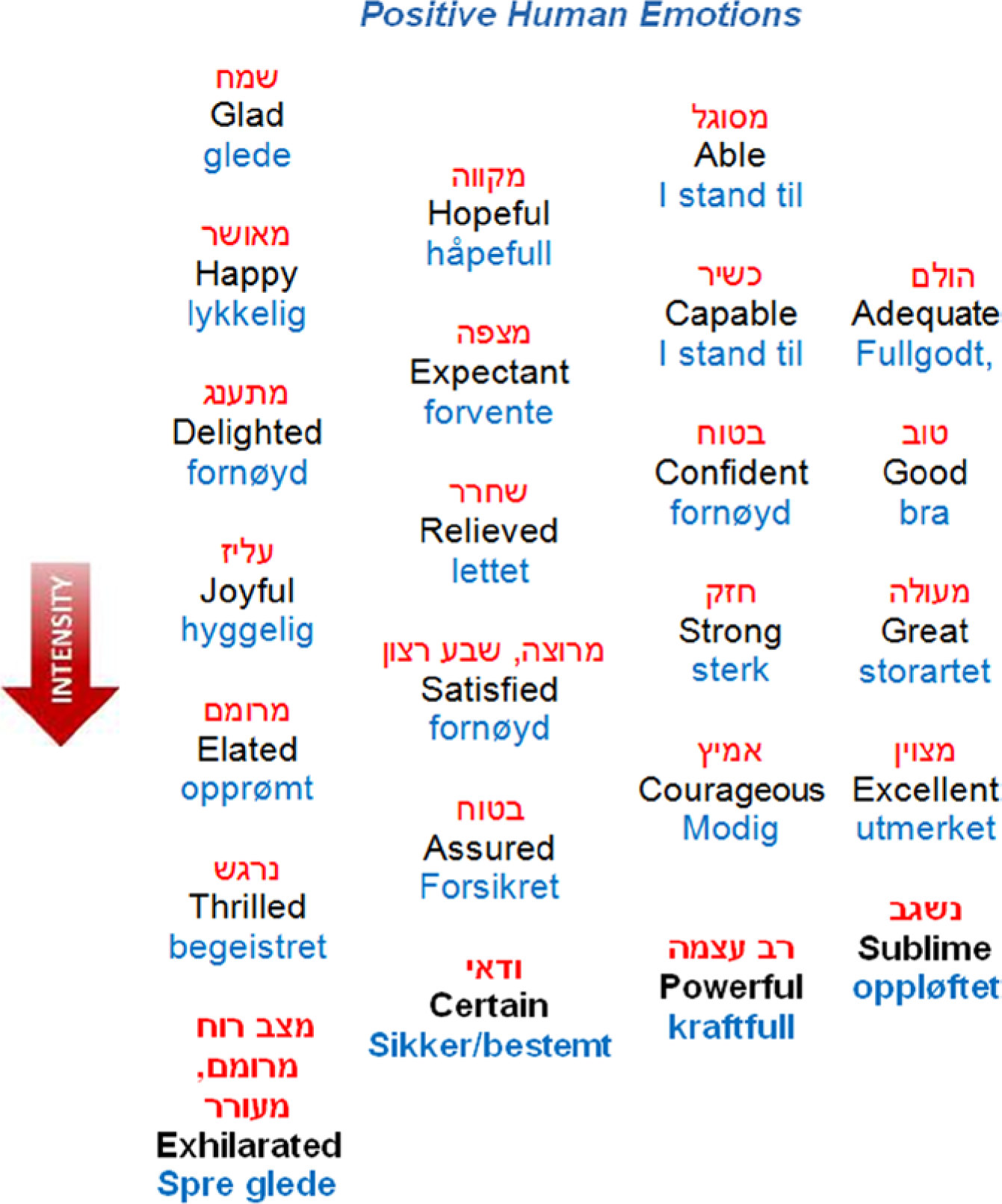
Dictionary of descriptions of emotion.
The western perspective of categorization so there was one list for “positive” and one list for “negative” emotions.
For each emotion on the list, there were three dimensions:
Type of emotion Spectrum or range of that emotion Intensity or power of the emotion
Color coding was used to distinguish the three languages.
The words of emotion were organized to illustrate the progression or intensity of emotion from mildest to strongest.
Development of a Slideshow to Aid With Reflection
There are many ways to stimulate and develop students’ ability to observe, consider, interpret, and reflect on what they see. One method is to use images, which encourages the observer to imagine interpersonal interactions, relationships, and the social milieu (Jonassen, 2000). Students can view pictures or images and describe what they see. They can imagine the intent of the image and practice using their words to delineate the content, intent, and even emotion that is depicted in or underlies the images. In this way, images and other abstractions can be used in a creative way to encourage students to consider different possibilities and interpretations of what they see, and practice verbalizing their beliefs, and relay them to understand broader concepts (Marshall, 2005).
A group exercise can be created to assist students to gain experience in describing emotional expression and behavior. First, a collection of at least 25 images are chosen to depict a specific theme such as emotions. The images are a mixture of items such as abstract art paintings, or icons (e.g., smiley faces), posed photographs (e.g., youth of different ethnicities with various facial expressions). The images should be mixed—some photographs, some icons, and some abstract paintings (not well-known). If the images are of paintings or other artwork, they should be new to the students to reduce the likelihood that students already possess a strong opinion or association with the artwork. Additionally, the visual representations should include a variety of colors, shapes, and items; some with singular figures and others with groups. Some should display real events, people, or situations, while others should depict artificial or posed events, environments, or interactions among people or animals. These images are combined into a slideshow, and each image is presented on a single, sequentially numbered slide. The slideshow is then presented to the group of students.
The procedure commences by telling the students to do the following:
Select as many images (using the numbers on the slides) as they want
Write down the number of each image
The slideshow is presented to the students. Each slide remains on the screen for at least 15 to 20 seconds before proceeding to the next so students can view, process, and decide whether to choose the slide or not. When the slideshow is completed, each student is asked to describe why the reason that they chose the image or slide that they choose, what it depicts to them, and to describe their feelings and emotions about the image.
Stage 3: Assess the Utility of the Tools as Instruments of Cultural Learning
The intent of these instruments and exercises was to increase the ability of international students to observe and understand the emotions of clients in another culture and to self-reflect on their own emotions and ways of emoting. To pilot these instruments, institutional ethics committee approval was sought and received (242/12); and informed consent was obtained from the students.
Results: Dictionary on Emotion
To practice using the dictionary, the instructor brought the students to an outdoor university café and asked the students to (a) observe people who were interacting and walking by the café and (b) point out the Norwegian word on the dictionary card that most accurately reflected the individual’s emotional as they perceived it. The instructor and the students discussed the choice, and then the interpretation of emotion based on the nonverbal expressions. This exercise was repeated several times, and in virtually every instance, students’ description of emotion was far more intense than the Israeli instructor.
For example, there were three male students talking with one another. One male student was hugging the other two and saying in Hebrew, “Don’t worry. I’ll take care of finishing the assignment.” The instructor whose first language was Hebrew understood the male student was being friendly and assertive; however, the Norwegian students, not understanding Hebrew and not familiar with Israeli nonverbal expression, interpreted the male student’s activity as being very excited and happy, and indicative that a really special and wonderful event had occurred. Their interpretation was much more intense on the range of positive emotions.
Results: Slideshow to Aid With Reflection
Students’ said participation in these types of self-reflection exercises was new for them as they had been used to writing reflections but not sharing them in a group. Their hesitance in participating was noticeable when the slideshow exercise was conducted. Although the instructor told them to select as many slides as they wanted for discussion, students chose either one or two slides only. No student chose more.
This reluctance also was noted in their reflections. For example, one slide chosen by a student was a painting by a local, lesser known Israeli artist. The painting was brightly colored, depicting an avenue lined by trees on either side. The student who selected this slide said she chose it because it reminded her of Norway; however, she said it was only the shapes of the trees that reminded her of Norway, not extremely bright colors. She started talking about the trees that drew her to the picture, but emphasized how different the colors were. She became nostalgic saying how it made her miss Norway. Then she hesitated saying she worried about being too emotional and was not sure if it was fitting to share her emotion in this way.
Consequently, 2 months after the end of the semester, a survey regarding the two exercises was sent to the students (see Table 1). Survey questions focused on use of games in general, the ability of games to assist with comparisons between Norwegian and Israeli culture, and expression of emotion.
Post–Study Abroad Program Questionnaire (n = 4).
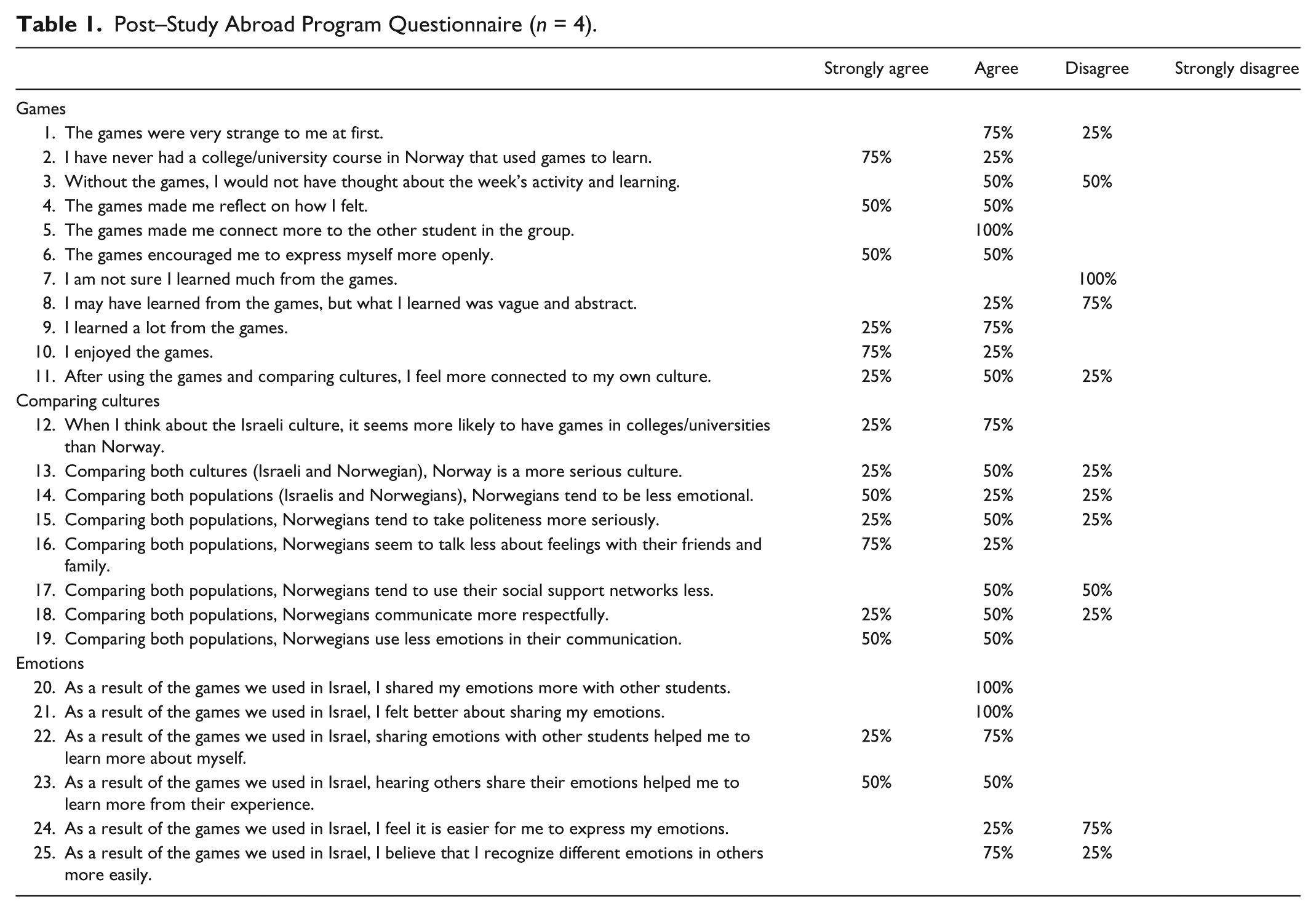
Although six students were in the course, responses were received only from 67% (n = 4). The use of verbal reflection exercises was unusual for the majority of students and not used in their colleges/universities. The students viewed these exercises as games; however, in the survey, they agreed that it helped them express themselves more openly, and reflect more about how they felt.
It was very interesting to be more aware of my own feelings, and also how the different cultures express themselves. For Norwegians, it is not so common to tell something personal when you meet a person for the first time, and it was hard to know how much it was okay to share. But I have learned that it is okay to show your emotions, and I think it is important to reflect upon the things you have experienced and how you feel about it.
Moreover, they enjoyed and learned from them. However, students differed on whether the games were needed to reflect on the week’s activities and learning.
I like the way we start every day in the university with playing cards, to reveal our thoughts and inner personality. The time we stayed outside observing people alone and in groups, to discover their place in the group “hierarchy” and also to uncover the interpretation was colored by our cultural background and context.
Often games were used to reflect on differences between Norwegian and Israeli cultures. Most students felt that Norwegians, compared with Israelis, were more serious, less emotional, more likely to take politeness seriously, more respectful, less likely to talk about emotions, and less likely to use emotions in their communication. Most students also reported that because of the games (i.e., exercises), they had shared more about their emotions than before, they felt more comfortable sharing emotions, and they believed it helped them recognize different emotions.
Comments from students reflected their appreciation for emotion and the impact of culture in the expression of emotion. One student wrote,
When I now look back at [the] process of the games, I understand more the purpose behind it and how it is important to reflect. . . . All people have emotions, and in Israel it looks to me like people give the emotions more space. You[r] emotions are a part of you whether you like it or not.
Conclusions and Future Development
Almost immediately, the Norwegian students realized that range and intensity of Israelis’ expression of emotion differed from theirs. Although some Norwegian students had traveled to other Scandinavian countries and a few other countries, none had ever traveled to Middle East Asia. Students who were acclimated to the restrained and less expressive emotions of Norwegians were confronted with very vibrant and sometimes very loud expressions of emotion that are more typical of Israelis. Students were taken aback by this expression of emotion—even though instructors described these differences to them before they entered the clinical area. When they witnessed strong emotions, they had to react in ways that they never had to before. The reactions were immediate and they had very little time to process the information or to comprehend what was happening. These reactions were to very different emotional stimuli; it appeared that they had lost their frame of reference (Chang, 2009).
Western cultures value self-control and even suppression of emotions (Farnsworth & Sewell, 2012). The students were surprised by the intensity of the emotional expressions that they witnessed; some they felt even threatened. It was overwhelming when contrasted to their culture where subdued emotional expression is more common. The jarring experience of entering a completely new environment with sometimes “too loud” expression of emotion may have interfered with the ability to gradually and systematically add to existing schemas, which occurs by organizing the information and making internal comparisons of likenesses and differences (McVee et al., 2005; Sarbin, 2000). New schemas are constructed to hold new and very different information that results from these jarring cross-cultural encounters (Chang, 2009). Consequently, it is possible that the Norwegian students developed an entirely new schema to posit information on Israelis’ emotional expression rather than to merely add to an existing schema that was based on emotional expression in their native culture.
International students initially may be thrilled to experience a new place, new culture, and new climate; however, emotions may change as students struggle to adapt and function in a new environment (Egenes, 2012). The choice of tools, the dictionary, and the visual representations were designed to aid students to bridge the gap between the very different ways of expressing emotion. The dictionary encouraged students to develop their ability to understand the breadth of emotion and help bridge the communication gap among three languages: their native language (i.e., Norwegian), the shared language (i.e., English), and the host country’s language (i.e., Hebrew). Yet it is important to note that this method is not perfect. Although the dictionary was designed to assist international students using the shared second language of English, words describing emotions in one language are not always directly translatable into another. An example is the English word “exhilarated,” which has no precise equivalent translation in Hebrew.
Another limitation that was identified during this project, which will be rectified in the forthcoming semester, is adding Hebrew transliteration. Hebrew has very different letters than Norwegian and English. Consequently, to help international students read the Hebrew word, English-language transliteration will be used.
Visual images helped students to build a new schema on emotion by encouraging students to associate these images with their own experiences and emotions. Reflection is a commonly used tool for helping students express their emotions. Often this practice in a written exercise called “reflective journaling.” By writing about experiences and fears, students can systematically review the situations that provoked negative or positive emotion, analyze their reactions, and consider what they learned from this experience (Mkandawire-Valhmu & Doering, 2012). By using the same tool and changing the modality to oral expression, students have the opportunity to practice using their English-language vocabulary to describe emotions and their reflections. Moreover, by conducting this process in a group, Norwegian students, who are less used to discussing emotions among themselves, have this opportunity to do so and felt better about sharing the emotions, while gaining awareness of the components comprising culture.
Although an individual can be taught to identify a cultural subgroup by ethnic clothing (e.g., a Hasidic man), interpreting emotions and their expression in another culture is much more challenging. Interpretation requires a process of observation, identification of the expression, and connecting the expression to an emotion within the environmental context. With the instructor’s prompts, the students began to realize differences between the emotional expression and behaviors among Israelis and people in Norway. With their increasing awareness of the differences, they became more comfortable naming the emotions, relating their reactions and behaviors, and conceptualizing the cultural context. With this process, their interpersonal skills became more and more automatic.
Using visual images or representations to aid in self-reflection is common among study abroad programs (Jeffreys & O’Donnell, 1997). Before international students can effectively observe emotions of individuals from other cultures, they must first be able to discuss their own emotions and the ways their emotions influence and are the result of interactions. Often, they use themselves as a reference point deciding that another’s behaviors is “wrong” or “odd.” This rather limited view gradually is replaced by a broader view as they learn to accept cultural differences (Mkandawire-Valhmu & Doering, 2012).
Study abroad programs are a wonderful way to learn about the beliefs and values of different cultures; and learning about other cultures, as Leininger’s Transcultural Model suggests, facilitates our ability to provide culturally appropriate care (Leininger, 1991). Emotional expression also differs by culture. Yet emotional expression has received less attention than many other aspects of culture. Faculty can assist students to better understand differences in emotional expression characterizing different cultures by using fun and creative exercises that are based in theory.
Among the growing numbers of study abroad programs are the subset of programs where the host country speaks a different language so the common language is English—a second language for both students and most faculty (Allen & Dupuy, 2013). The benefits are enormous but so are the stresses. This project has just begun, and like the students, the instructors also are learning ways of improving our ability to encourage students with a different language and culture to better understand our very different culture. As instructors, it is important to recognize that we too come with biases that may influence perceptions and presentation of information. The goals of this project are to continue amassing information to
Improve the quality of teaching in programs serving international students
Develop instruments and tools that encourage students to grasp the nuances of emotional expression in different cultures
Provide evidence that self-exploration is an evolving process that always will require checking out one’s assumptions and interpretations.
Footnotes
Declaration of Conflicting Interests
The author(s) declared no potential conflicts of interest with respect to the research, authorship, and/or publication of this article.
Funding
The author(s) disclosed receipt of the following financial support for the research, authorship, and/or publication of this article: Prof. Zlotnick was supported in part by the KAMEA grant of Israel.