







Abstract
Introduction
Globally, the population aged 60 years and older is growing faster than all younger age groups. In 2017, there is an estimate of 252 million people aged 60 years and older in China, comprising 16% of the total population (Department of Economic and Social Affairs Population Division, 2017). By 2030, this number is expected to increase to 358 million (United Nations, 2015). The population of older adults is characterized by suffering weakening physical health, declining economic and social support, which finally raises the proportion of older adults using health care (Deary et al., 2009). Thus, the aging population may require various health care, which leads to the growing demands placed on public health and social care. Therefore, it has raised questions related to the quality of gerontological nursing.
Literature Review
Research investigating nurses’ attitudes toward older adults revealed the existence of conflicting opinions. American and African nurses were revealed to show positive attitudes toward older adults in a study (Lookinland, Linton, & Lavender, 2002). Other studies further confirmed that the attitudes of nurses toward older adults were generally positive (Kang, Moyle, & Venturato, 2011; Matsui & Braun, 2010). However, recent research has revealed that the quality of health care provided for older adults has been endangered by the stereotyping of discrimination against people (Faronbi, Adebowale, Faronbi, Musa, & Ayamolowo, 2017). Health workers have been reported to be less desirable to take care of older adults in nursing practice (Heise, Johnsen, Himes, & Wing, 2012; Kydd, Wild, & Nelson, 2013). Some studies on the attitudes of nurses toward older adults have also pointed out that they hold negative attitudes toward providing health care for them (Courtney, Tong, & Walsh, 2000; Higgins, Van Der Riet, Slater, & Peek, 2007). Significantly, a recent systematic review further confirmed it (Liu, Norman, & While, 2013).
Some factors may affect the attitudes of nurses toward older adults, including close relationships with older relatives, experiences of caring for older adults, living with older families (Cheng, Cheng, Tian, & Fan, 2015), cultural context (Xiao, Shen, & Paterson, 2013), age (Shen & Xiao, 2012), gender (Söderhamn, Lindencrona, & Gustavsson, 2001), education level (Gallagher, Bennett, & Halford, 2006; Lee, Wong, & Loh, 2006), and knowledge of aging (Mellor, Chew, & Greenhill, 2007).
Negative views on old age stereotypes can block aging well and hinder older adults integrate into society (Jönson, 2013). Negative attitudes of nurses appear to affect the quality of care, such as reducing older adults’ independence and decision making (Courtney et al., 2000; Hanson, 2014). In addition, Doherty, Mitchell, and O’Neill (2011) found that 63% of older adults express an unmet health need due to the negative stereotypic attitudes toward them of nurses.
Literature that addresses attitudes toward older adults in China has focused more on nursing students than nurses. These findings are rather consistent in China. A previous study has found that Chinese students are more likely to care for older adults than Australian students (Xiao et al., 2013). Furthermore, Zhang, Liu, Zhang, Meng, and Liu (2016) found a medium degree attitude of nursing students toward older adults. This may be associated with the circumstances that young people in China have more opportunities to get along with older adults. It is a fact that stem family and nuclear family have always been a traditional and major family structure in China. It is very common for stem families to live under one same roof with three generations. Also, as young parents in the nuclear family have to devote much time and energy to their work, it is common for the young parents to ask their older parents to help take care of their grandchildren.
Although little study addressed registered nurses’ attitudes toward older adults in China, the role of registered nurses in the care of older adults is miscellaneous. As registered nurses offer direct, specialized care to hospitalized older adults, their attitudes toward older adults are vital concerns. In addition, it is necessary to identify the factors associated with positive attitudes toward older adults. Therefore, the aim of the study was to assess the attitudes of registered nurses toward aging and providing care for older adults; and to identify factors associated with their attitudes toward the care of older adults. There were two major research hypotheses in this study.
Method
Design
This was a descriptive, multicenter cross-sectional study.
Participants and Settings
Five tertiary hospitals located in Fuzhou were approached for participation. Only one hospital is a specialized hospital and the other four are general hospitals. These hospitals include clinical services, undergraduate and postgraduate teaching, and scientific research. The participants were selected based on the following criteria: (1) were registered nurses in hospitals, (2) were volunteered to participate, (3) provided complete information on the study measurement. There were no exclusion criteria. Convenience sampling was used in the study. Based on the results of the study by Zhang et al. (2016), with a statistical power of 0.80 in a two-tailed test (p < .05), a minimum of 959 participants was required. Anticipating a drop-out rate of 20%, we needed 1,199 in total. And the final sample comprises 1,367 registered nurses in this study.
Measurements
Personal Information Form
This form involved questions about age, gender, educational status, years of service, the experience of being cared for by older adults or taking care for older adults, living with older adults and the relationship with older adults.
Kogan’s Attitude towards Older People Scale
Attitudes were assessed using Kogan’s Attitude towards Older People scale (KAOP; Kogan, 1961). It has been widely used to examine attitudes toward older adults. The KAOP comprises 34 items on older adults, distributed between 17 positive and 17 negative views. Responses are graded using a 6-point Likert-type scale ranging from 1 (strongly disagree) to 7 (strongly agree). The points were scored 1, 2, 3, 5, 6, and 7, respectively, with a score of 4 assigned in the rare case of failure to respond to an item (Kogan, 1961). It has been translated into Chinese and has been confirmed to be with good content validity, structural validity, and internal consistency (Yen et al., 2009). For example, Zhao, Zhang, Liu, Li, and Li (2012) have revealed internal consistency reliability as 0.85 among nursing staff of nursing homes. The total score was between 34 and 238, and a score of 136 showing a neutral attitude (Zhang et al., 2016). Scores higher than 136 indicate a positive attitude, and scores lower than 136 is regarded as a negative attitude (Li, 2014). Cronbach’s alpha was .851 for the total scale in the current study.
Facts on Aging Quiz
Palmore’s Facts on Aging Quiz (FAQ) was adopted to assess the basic knowledge of older people by asking a set of factual statements about physical, psychological, social, and economic factors related to aging, as well as some common misconceptions (Palmore, 1977). It comprises 25 questions with answers of “true,” “false,” or “don’t know.” One point is assigned to a correct answer and no points to an incorrect answer or “don’t know.” Total scores range from 0 to 25, with higher scores reflecting greater knowledge about aging. And the scores under 15 were regarded as a low category (Li, 2014). A Chinese version of the assessment has been translated and validated with a Cronbach’s alpha as .68 and content validity as 0.82 (Wang et al., 2010). In the present study, Cronbach’s alpha was .718.
Data Collection
This study devised anonymous online questionnaires and created surveys in Sojump Survey. (It is a free survey platform, which can create surveys, forms, or quizzes.) The authors posted an invitation message with the link to the online questionnaire to online groups on WeChat (It is the all-in-one communications app for text, voice and video calls, moments, photo sharing, and games). The questionnaire was disseminated by the registered nurses in the groups.
Ethical Consideration
This study was approved by the Ethics Committee of Fujian Provincial Hospital. All participating hospitals provided formal approval for this study. The purpose of the research was explained, and the participants were invited to confidentially complete the survey.
Data Analysis
Data were analyzed with the use of IBM SPSS (v.19). A descriptive analysis was performed on the demographic and characteristic data, attitude scores, and knowledge scores by computing the means, standard deviation, and percentile. Independent t tests, one-way analysis of variance were used to measure associations between variables. Logistic regression was conducted to identify factors of registered nurses’ positive attitudes toward older adults. Specifically, registered nurses who scored below 136 were coded as 0 (negative attitude), and those who scored above it were coded as 1 (positive attitude).
Results
In this study, 1,367 nurses were studied. The age of the respondents ranges from 18 to 59 years with a mean of 30.92 years (±7.08). Table 1 presents the sociodemographic characteristics of the respondents. As reflected in the table, 97.5% of the respondents were female, 48.87% of registered nurses finished junior college, and 48.79% of them got a bachelor’s degree or above. About half of the registered nurses had been working for less than 5 years. The majority (62.25%) had the experience of being cared for by older adults and an overwhelming majority (81.5%) had the experience of taking care of older adults. A large majority (80.4%) of the respondents lived with older adults and most of them had a good relationship with older adults (60.2%).
Sociodemographic Data of Respondents.
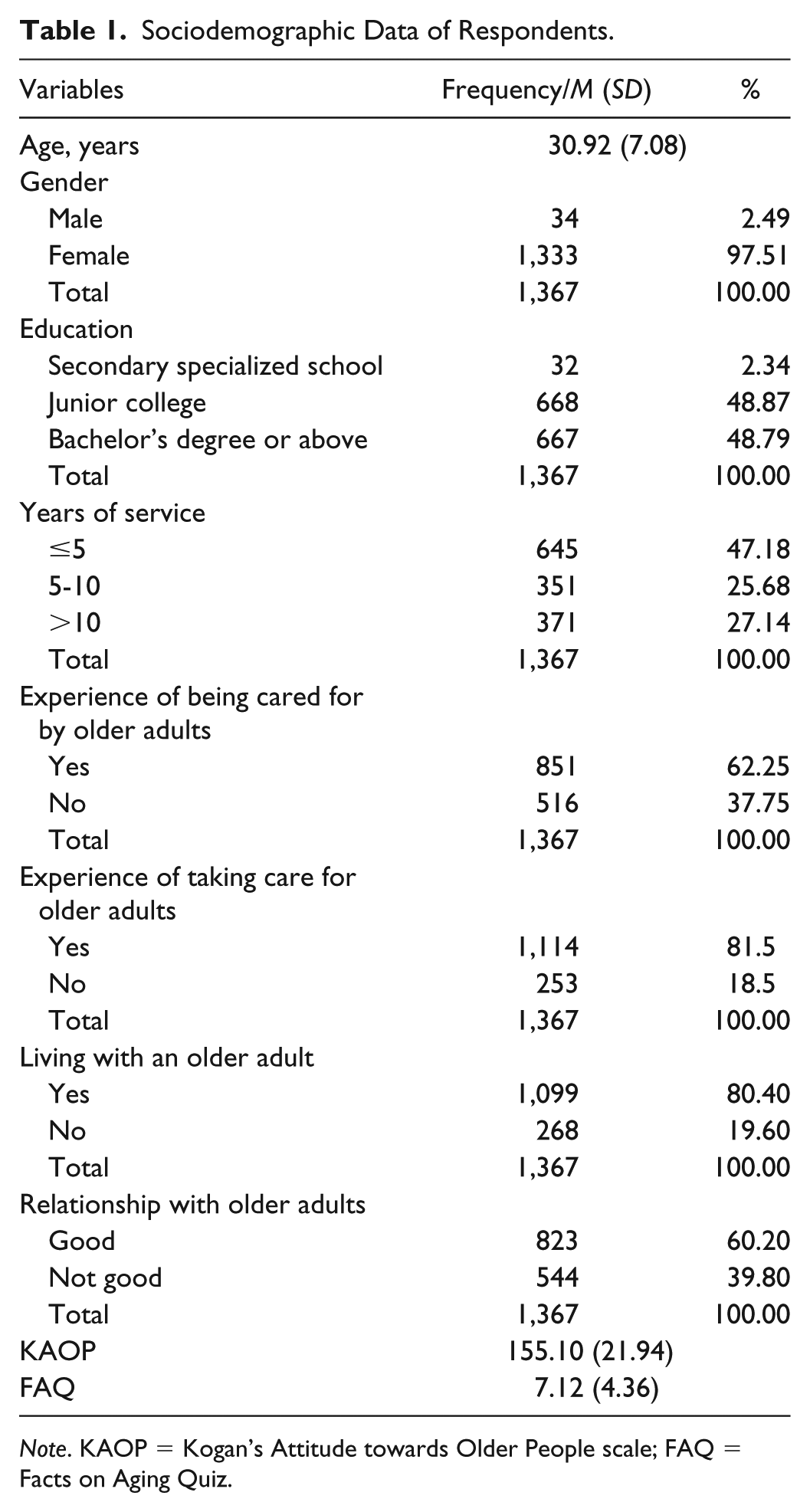
Note. KAOP = Kogan’s Attitude towards Older People scale; FAQ = Facts on Aging Quiz.
The results showed that KAOP scores were significantly higher in registered nurses who had the experience of being cared for by older adults (p < .001) and the experience of taking care for older adults (p < .05). Additionally, scores were higher in registered nurses who lived with older adults (p < .05). It also revealed that those who had more knowledge and good relationship with older adults had more positive attitudes toward them (p < .001 and p < .05, respectively) (Table 2).
Comparison of Nurses’ Demographic Variables and Attitude Toward Older Adults.
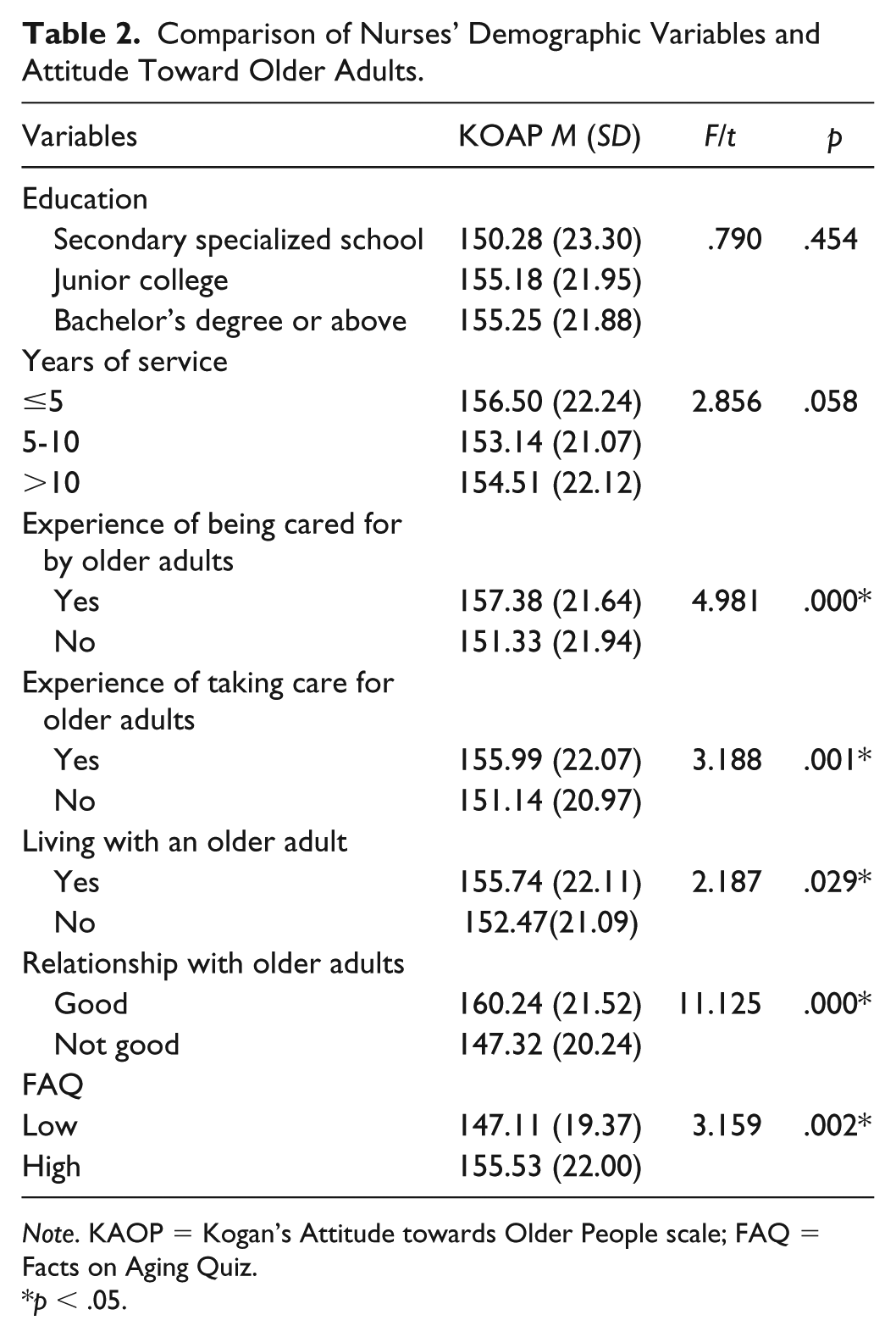
Note. KAOP = Kogan’s Attitude towards Older People scale; FAQ = Facts on Aging Quiz.
p < .05.
The logistic regression model was performed to assess which of the independent variables (experience of being cared for by older adults, the experience of taking care for older adults, relationship with them, living with older adults and knowledge) is likely to predict positive attitudes of respondents. Among the variables, only the experience of being cared for by older adults (odds ratio [OR] = 1.545; p = .007) and relationship with older adults (OR = 2.440; p = .000) were statistically significant (Table 3).
Logistic Regression Model Predicting the Attitudes of Respondents About Older Adults.
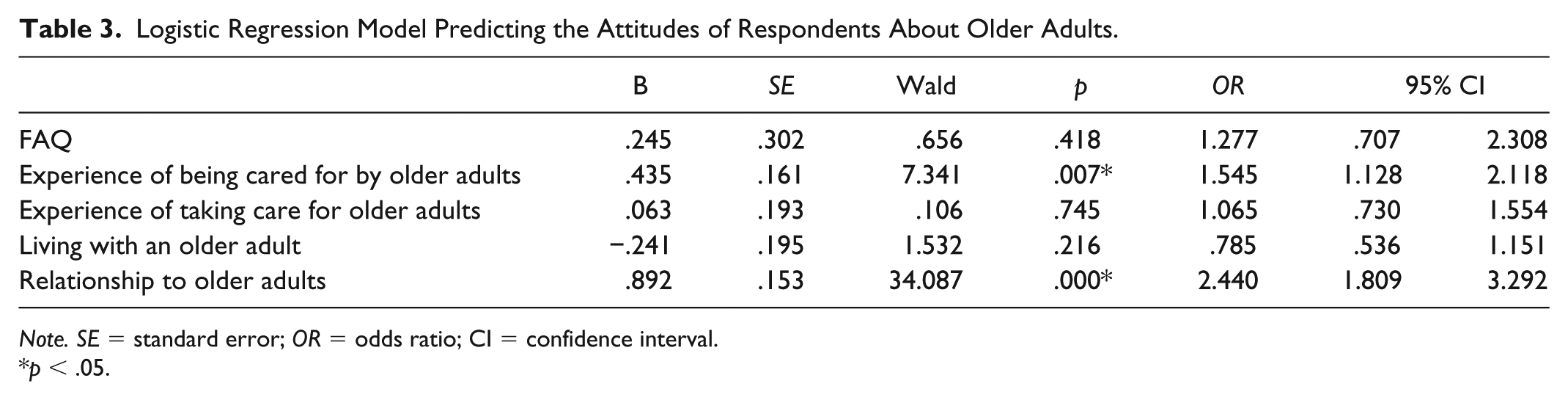
Note. SE = standard error; OR = odds ratio; CI = confidence interval.
p < .05.
Discussion
The purpose of this study was to investigate the attitudes of registered nurses toward older adults. Findings from this study showed that respondents have a slightly positive attitude toward older adults. This finding was similar to a previous study conducted by Myers, Nikoletti, and Hill (2001). However, it was contrary to findings in other studies (Celik, Kapucu, Tuna, & Akkus, 2010; Liu, Norman, & While, 2013). This study also revealed that the experience of being cared by older adults and relationship with older adults were associated with the attitudes of registered nurses. However, age, gender, education level, living with older families did not significantly affect the attitudes toward older adults in this study.
Generally, Confucianism and the cultural beliefs of filial piety may explain the results of this study. It is a tradition to respect, love, and support older adults in China. Everyone values and respects older adults in Chinese culture, which has been inculcated in their minds since birth (Yang, Xiao, Ullah, & Deng, 2015). Hence, registered nurses would show positive attitudes toward older adults. More positive attitudes toward older adults would cause favorable care for them. Thus, it showed that it is essential to examine any reasons behind the positive attitudes of registered nurses in the study.
Gerontological nursing requires specific knowledge and abilities (Ferreira & Ruiz, 2012). A deficit of gerontology skills or lack of understanding of the aging has a negative impact on the quality of the care. Also, the lack of knowledge about aging may block the use of evidence-based geriatric nursing protocols for best practice in clinical practice (Deschodt, de Casterle, & Milisen, 2010; Roethler, Adelman, & Parsons, 2011). Although the knowledge of aging was not high, the study revealed a significant relationship between attitude and high-score category of the FAQ. Knowledge of aging plays a part in more positive attitudes (Liu, Norman, & While, 2015). Registered nurses who know more about aging would value the importance of this specialized population and they had more effective communication skills with older adults.
Relationship with older adults is another important factor in their attitudes. Developing closer relationships with older adults assists them to feel more comfortable when working with older adults (Xiao et al., 2013). Being closer to older adults means they have positive personal experience with them and more frequent exposure to them. More frequent contact with older adults can enhance their positive attitudes too. However, having a poor experience with older adults often causes a negative influence and result in negative attitudes (Celik et al., 2010).
Registered nurses’ attitudes toward older adults also differ significantly in the experiences of being cared for by older adults and taking care for them. As deeply affected by traditional culture and Confucianism, Chinese think highly of co-residence and interdependence among generations. To have a harmony family, they can try their best to support each other. As young parents need to seek better job opportunities, they usually choose to migrate to urban areas and leave their children behind. To make sure that their young children pay more time and energy to their work, older parents are willing to support them by providing care to their grandchildren. Therefore, it is very common in China for grandparents to take care of their grandchildren. Being cared for by older adults gives a different experience to the younger ones. Registered nurses who were mainly cared for by older adults when they were young had significantly more positive attitudes toward them compared with those who were not. The actual contact with older adults can affect their impressions on them. Being cared for by older adults in the early age may contribute to full trust in older adults, which in turn helps establish a positive attitude and eliminate misunderstanding or stereotype of registered nurses. Additionally, as affected by filial piety, they would show their gratitude and express their thankfulness to older adults through being friendly to them and taking good care for them (Zhang et al., 2016). Also, the experience of caring for older adults helps establish positive attitudes toward older adults. Without the experience, the registered nurses will be less desirable to take care of them. However, the experience demonstrated a greater understanding of aging processes and issues specific to older adult care (Polat, Karadağ, Ülger, & Demir, 2014). And they would not be confused if they encounter a similar situation in the daily work. In addition, they hold a better understanding of their health and social needs. Thus, they are more confident to care for older adults and would show higher values toward gerontological nursing (Cheng et al., 2015).
The findings of this study suggest that everyone concerned should adopt effective strategies to improve nurses’ positive attitude toward older adults. Gerontological nursing education needs to be promoted. Nursing schools are obligated to prepare nursing students to meet the demands for geriatric care and encourage them to work with older adults after their graduation. Educators need to realize that nursing education can enhance professional knowledge and care intention in older adults. Courses on geriatric nursing should be considered on the school curriculum, either on school education or continuing education for nurses. Also, creating positive clinical environments in geriatric nursing in clinical practice is vital to ensure high quality of care provided to older adults. Additionally, compassionate care may be encouraged in nursing practice. Importantly, considerably more work is needed to be done by the public to improve the attitudes toward older adults. News, reports, TV program on older adults are encouraged to spread more objective views about them to the public. Importantly, the virtue of respect, love, and support older adults should be cultivated from an early age.
Limitations
The results of this study should be considered in light of several limitations. First, this study used a cross-sectional design. The study could not examine the relationship longitudinally. Second, as this study involved only five hospitals in southeastern China, the generalizability of the findings is limited. Finally, although the sample size is quite high, the fact that we cannot know the number of potential participants, and therefore cannot calculate a participation rate is also a limitation.
Conclusion
This study provides insights into the attitudes of registered nurses toward older adults in China. The results contribute to care practice for older adults who have great care needs that have been overlooked in hospitals. It is also recommended that future studies are needed to explore more factors influencing attitudes. And individual in-depth interview exploring the reason why they have a negative attitude is also recommended. Also, more focused interventions on attitudes toward older adults are needed.
Footnotes
Acknowledgements
The authors sincerely thank the participants in this study.
Declaration of Conflicting Interests
The author(s) declared no potential conflicts of interest with respect to the research, authorship, and/or publication of this article.
Funding
The author(s) received no financial support for the research, authorship, and/or publication of this article.
