







Abstract
Introduction:
The family plays a crucial role in shaping children’s identity and understanding of gender-based roles. This study aims to explore the experiences of Iranian transgender individuals with their families’ reactions to their transgender identity disclosure.
Methods:
In 2018, nurse researchers conducted this qualitative study on 11 transgender individuals in Iran using a phenomenological approach, targeted and snowball sampling, and Colaizzi’s seven-step method for data analysis. Rigor was ensured by adhering to Lincoln and Guba’s standards.
Results:
The study found varied reactions to transgender children among Iranian families, including abuse to avoid stigma. The study revealed two main themes, maladaptive and adaptive reactions, and identified six categories: denial of reality, mourning, coercion, deprivation, support out of necessity, and compromise of family reactions.
Discussion:
Education and support systems may help address the cultural challenges that face families with transgender children. The findings offer insights for enhancing public awareness of the transgender community in conservative cultures.
Keywords
Introduction
Communication between parents and children in a family is a continuous, two-way process that creates a comprehensive web of interactions. It plays a crucial role in shaping a child’s physical, mental, and social growth, and their perception of identity and comprehension of sexual and gender-based roles (Puckett et al., 2019).
When a child comes out as transgender in a family, in many traditional cultures, it can be a massive challenge for the transgender individual and their family. The family’s reaction to this revelation can significantly affect the situation (Priest, 2019). Negative responses such as shame, disappointment, and anger from the family can result in the expulsion of the transgender child from school, rejection by society, and potentially harmful or inappropriate behavior (Kcomt et al., 2020). Research shows that transgender individuals who do not receive support from their families may experience lower quality of life. (Matsuno et al., 2022; Reisner & Hughto, 2019).
According to the work by Kidd et al. (2020), transgender children who have support from their families tend to experience lower rates of suicide, depression, substance abuse, and conflicts related to unprotected sex than those who lack such support. Encouraging a positive and supportive response from the family can play a significant role in aiding progression (Turban et al., 2021). Based on the research conducted by Marshall et al. (2019), it has been found that receiving support from family members can positively affect the self-confidence and overall mental well-being of transgender children. According to the findings presented by Spivey and Edwards-Leeper (2019), how a family responds to an individual’s gender identity is a crucial factor in shaping transgender children’s self-perception. Horton (2023) stated that it is essential to emphasize the importance of family acceptance and understanding for members of the transgender community, as it can pave the way for improved support and care.
Many countries, such as the United States and the United Kingdom, have laws in place that provide identification to transgender individuals. Although these countries have taken steps toward accepting diverse identities, many transgender children living in conservative societies may feel compelled to conform to binary norms while grappling with their transgender identity (Wirtz et al., 2020). Transgender individuals and families in certain countries may struggle with understanding their emotions due to a lack of social awareness. They may also face familial pressures and abuse (Gamio Cuervo et al., 2023).
Context
In Iran, where cultural and religious norms are significant, being transgender is not widely recognized due to cultural taboos and immense social and political pressure (Saeidzadeh, 2023). Iran’s government adopts a conservative stance on transgender rights. Although homosexuality is prohibited in the country, gender reassignment surgery is permitted. The government even provides subsidies for hormone therapy and surgery for transgender individuals (Ayoub & Stoeckl, 2024). Despite advancements in transgender rights, societal attitudes toward homosexuality remain inflexible. Homosexual individuals face severe penalties, including the potential for capital punishment (Asadi Zeidabadi, 2023). Advocacy for homosexual rights is limited in the media, but occasional reports do highlight the grievances of transgender individuals and call for increased government support (Magni & Reynolds, 2023). Authorities in Iran advised transgender individuals to steer clear of crowded areas, highlighting the challenges faced by the lesbian, gay, bisexual, and transgender (LGBT) community in Iran (Sultan et al., 2023).
Aim
The purpose of this article is to explore and understand the experiences of Iranian transgender individuals with their families’ reactions to their transgender identity disclosure and identify the different categories of family reactions.
Method
Methodological Approach
The researchers used a qualitative research method with a phenomenological approach. To analyze the data gathered, the researchers employed the seven-step Claizian method, a systematic approach that involves identifying patterns and themes in the data.
Participants and Recruitment
The study centered around transgender people in Iran, Shiraz. The researchers used targeted and snowball sampling to choose participants who met specific inclusion criteria (Parker et al., 2019). The snowball sampling at the forensic center began, where the first participant was encountered. The criteria for inclusion in the study involved confirmation that the participant was a transgender person and their willingness and ability to share their experiences during face-to-face interviews. Before each interview, the interviewer (the first author) introduced themselves and informed the participants that they could withdraw from the study before the release of the results. Those who agreed to participate provided written consent, and the interview was scheduled at a time and location that was convenient for the participant. The Deputy of Research and Technology approved the project at Isfahan University of Medical Sciences and Islamic Azad University of Isfahan (Khorasgan) on September 11, 2014, (Ethical code: 492043).
Data Acquisition
Between November 2017 and November 2018, participants who agreed to take part in the study signed a consent form and were interviewed by the same person, who is the first author of this research. The interviews were scheduled at a time and place that was convenient for the participants. The interviewer conducted semi-structured interviews to gather data (Natow, 2020). A questionnaire was used to guide the original questions, ensuring some level of internal consistency. At the start of each interview, the interviewer asked for the participant’s preferred name or pronoun to ensure their comfort. The interview began with general topics and gradually delved into deeper conversations. For instance, the interviewer asked about the initial reactions of the participants’ families to their identity and which reaction had the most significant impact. When clarification was needed, the interviewer asked exploratory questions such as “Can you explain more?” or “Could you provide an example, please?” The participants permitted the interviewer to audio-record the sessions. Finally, each interview was concluded by asking, “Would you like to add anything?” and valuable feedback was received.
Data Analysis
The authors thoroughly analyzed the data gathered from each interviewee using Colaizzi’s method, which involved seven steps (Morrow et al., 2015). To ensure accuracy, the interviewer transcribed each conversation and assigned a secret numerical code based on the participant’s age. All personal information from the transcripts was removed to safeguard their identities. Our interviewer enhanced the manuscripts by including emotions and body movements, providing a more comprehensive understanding of the conversations. During the interviews, participants spoke in Farsi. The researchers subsequently provided English translations, which were reviewed and returned to Farsi to ensure no meaning was lost. The internal validity of the researchers who translated was controlled by ensuring the translators’ expertise, using back-translation and multiple translators, and revising based on feedback.
Our team meticulously read each manuscript and clarified any ambiguous points with the participants during a face-to-face interview. Three participants were interviewed twice to gather more data and clarify specific points. The authors coded each manuscript to ensure accuracy, using primary codes derived from the participants’ words and perceptions of the statements. These codes were then organized into clusters of themes and primary categories, validated by referring to the original protocols. Direct subcategories were formed by matching them based on their similarity in meaning and creating general categories and themes. The data collection process continued until saturation, indicating no new codes or categories were obtained.
Rigors
This research aimed to produce accurate and trustworthy results by following Lincoln and Guba’s standards rather than relying on conventional methods (Lincoln & Guba, 2016). The research team implemented several measures to ensure transparency and credibility during the interview and data analysis stages. The findings were validated by sharing the anonymized interpretation of results with the participants, which enabled the researchers to verify that their opinions were accurately reflected. The team also sought the input of an external researcher with extensive experience in qualitative research and specialized knowledge in transgender studies to review the anonymized transcripts. The research process was reported in detail to ensure transferability, enabling others to follow along easily. Authenticity was maintained by recounting the words of the participants. Ultimately, the research team focused on long-term engagement with the topic to record verbatim data and present information engagingly and excitingly.
Moral Imperatives
Access to raw data is restricted to authorized personnel, and an ethical code governs this. The interviewer explained the study’s purpose, the type of questions, and the interview duration and addressed any concerns. Written informed consent forms to participants, who willingly signed them with the understanding that they were contributing to the study were provided. During the research, psychiatrists were readily accessible to offer psychiatric consultations to participants if required. Also, the right to withdraw from the study at any time, the anonymity of the participants, the privacy of personal information, and our moral obligations during the interviews were explained. All procedures performed in this study involving human participants were conducted according to the ethical standards of the institutional and national research committee, the 2013 Helsinki Declaration, or comparable ethical standards.
Results
Descriptive Results
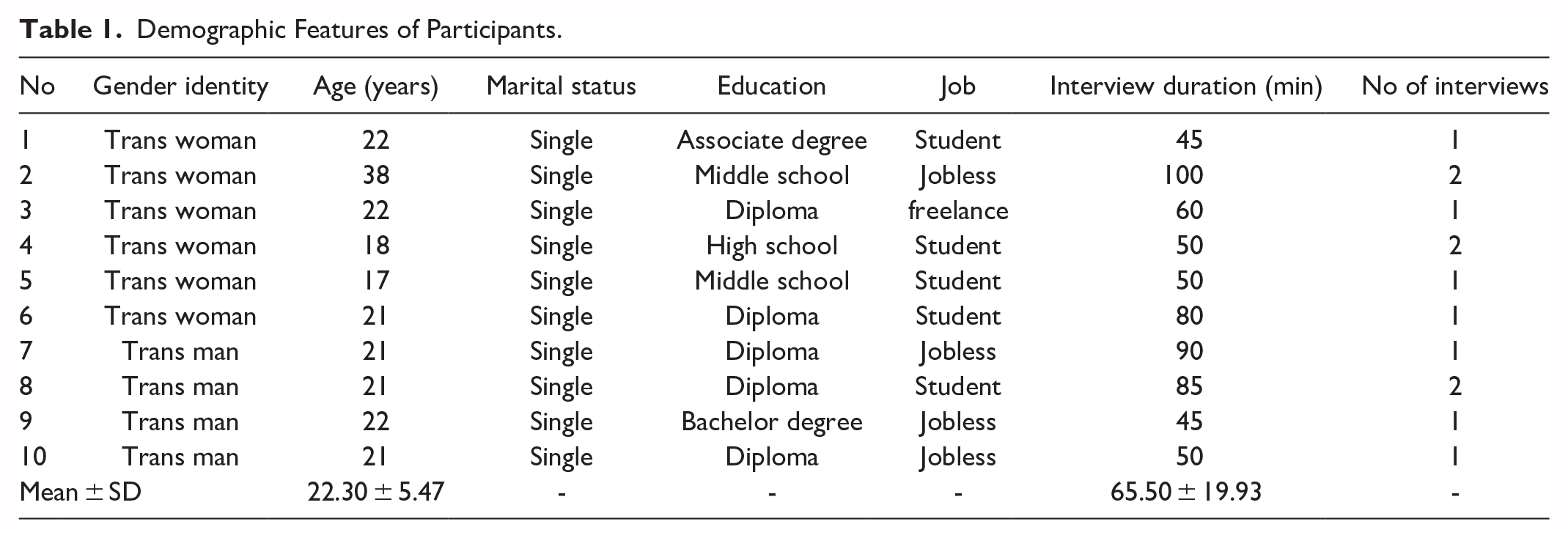
Overall, 13 interviews with 10 participants were conducted, lasting 45–100 min. Three participants were interviewed twice to clarify and gather additional data. For more information on the participants’ demographic characteristics, please refer to Table 1.
Demographic Features of Participants.
Qualitative Results
Through data analysis, our research has identified two primary themes and six categories of coping mechanisms. An abstract model has been developed, as shown in Figure 1 to provide a better understanding. In addition, direct quotes from transgender individuals who participated in the research have been included to explain these categories further.
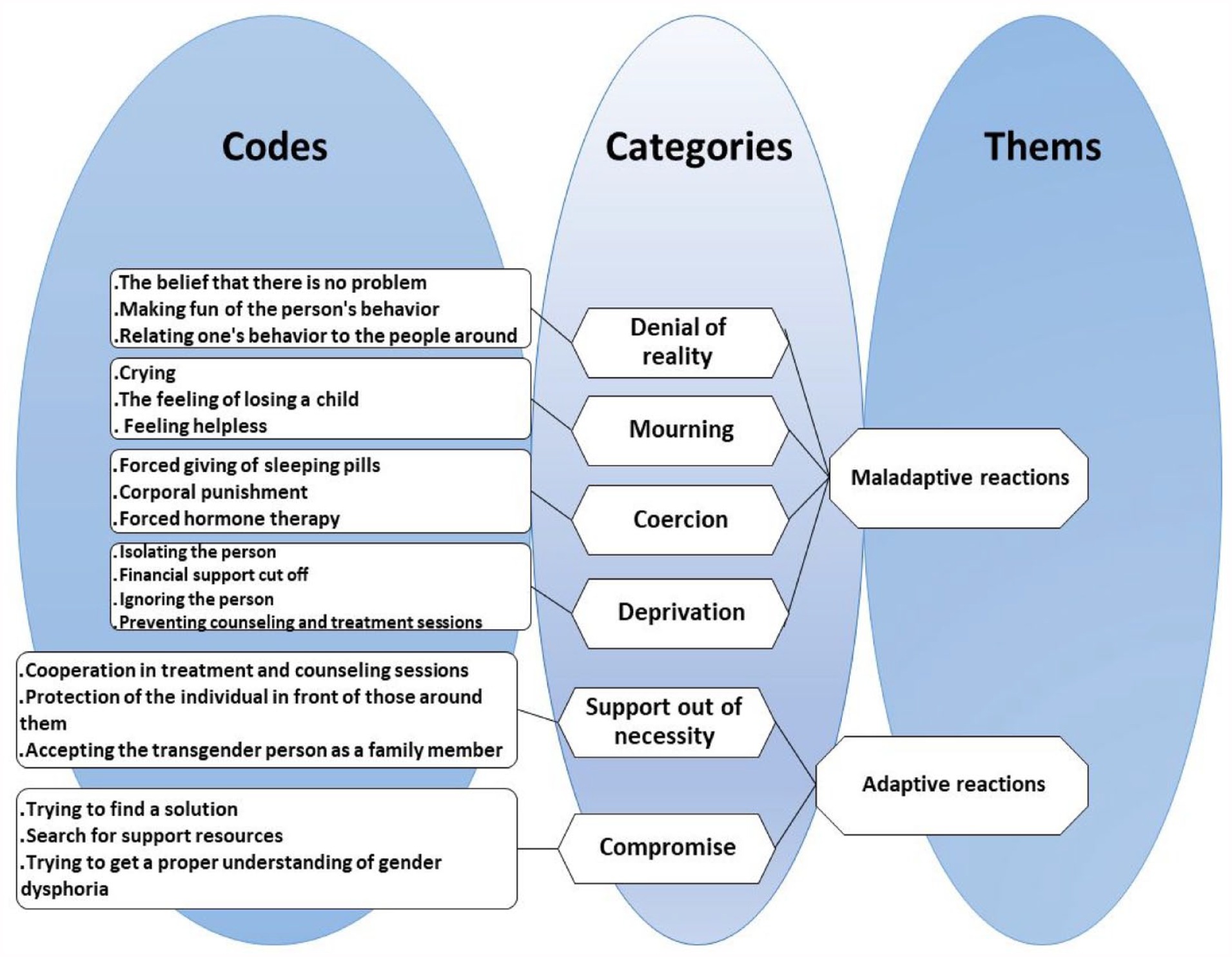
The Extracted Codes, Categories, and Themes From Qualitative Data.
Maladaptive Reaction
The research participants experienced specific responses from their families regarding the disclosure of being transgender as dysfunctional. These reactions were called maladaptive, as described in the following categories.
Denial of Reality
Participants have reported that their families have denied their disclosure of being transgender or attributed it to external influences. In addition, they have shared their experiences of being ignored, ridiculed, or mocked for the disclosure of being transgender: My mom laughed and made fun of me from the first time she saw that I was not like other boys and liked to wear girl’s clothes. He said you are kidding; you will forget everything when you grow up. (P3, 22 years, TW) My family used to say that we should change your school so that you will be correct; bad friends have misled you. (P9, 22 years, TM)
Mourning
Families dealing with the disclosure of having a transgender child may experience feelings of mourning and sadness, as reported by the participants. Some families see the transgender beloved as a test from God, a blessing, and a source of sorrow: My mom is constantly crying. She asks why God wants you like this. When she stopped crying, my sisters started crying. Let us say I am also crying with them. I wonder why my situation is like this. (P7, 22 years, TM) I had never seen my father’s tears, but since my problem appeared, there has not been a night without him crying and praying. P9 added: I tell my mom that this is a test that God has put in our way, and I have to come out of it proud, and my mom cries and says that I wish I did not have you or that I had the confidence you have. I feel guilty when everyone cries because I trust in God. (P4, 18 years, TW)
Coercion
Based on the experiences shared by participants, it has been observed that some families of transgender individuals have resorted to non-approved treatments, often using force, abuse, and coercion, to eliminate the disclosure of being transgender. Imprisonment, making a person feel guilty, physical coercion, and death threats were among the experiences that transgender people attributed to their family’s reaction to the disclosure of being transgender: Once a day, I was severely beaten by my elder brother, and my dad encouraged him to beat me as much as possible to become a man. (P6, 21 years, TW) My mother kept giving me sleeping pills so I would be asleep all the time; she said you should not go out; being awake is a source of torment and shame for me. (P10, 21 years, TM) I was forced to undergo hormone therapy by someone they called a doctor with no expertise in this work. It was as if they wanted to take revenge. (P2, 38 years, TW) Every day, my mom told me that you are the cause of my shame, you are a disgrace; I hope you die so I can get rid of you. (P7, 21 years, TM)
Deprivation
According to the participants in the research, the families of transgender people tried to eliminate their disclosure by depriving them and not supporting them, which, in the family’s opinion, were considered to be habits contrary to customs and dysfunctional. Limiting the relationships of the transgender individual, cutting off financial support, and not supporting the assessment process and counseling sessions were among the experiences that participants expressed about the family’s reaction to the disclosure of being transgender: When I attended counseling and therapy sessions, after a few sessions, my dad did not allow me to go. He said that session would make your habits sick rather than healthy. It would be best to stay home to be well. (P5, 17 years, TW) . . .I separated my house. My dad was looking for me until he had the address. He used to force me a lot. He threatened me. He said that he would not pay me. He said that he would come to my home now. He would put me on fire. I had gone from there to the dormitory without anyone knowing. I had taken a room. He (their father) said I should kick my habits; it would cause him shame. (P8, 21 years, TM)
Adaptive Reaction
The research transgender participants experienced specific responses from their families regarding the disclosure of being transgender as ambivalence. These reactions were called adaptive, as described in the following categories.
Support Out of Necessity
Based on the experiences recounted by the participants, some of the families of transgender individuals have tried to facilitate the assessment process by providing emotional support, financial assistance, cooperation in medical assessment sessions, and psychological counseling, and supporting the transgender person in the face of social adversities. According to the participants, their family was forced to support these people as family members: My mom was ashamed. Despite being religious, she supported and defended me in front of everyone out of necessity. (P8, 21 years, TM) . . .when my family saw that I would not change, my father and mother desisted, and although they were unhappy, they gave me money to go for counseling. . .they said that if I get better, at least, my family are not ashamed anymore. (P2, 38 years, TW)
Compromise
According to participants, when families witness the lack of success in their attempts to change the behavior of the transgender individual, along with the persistence of behaviors that go against social norms, they seek out supportive resources: . . .my dad had talked to several doctors, and I could see he was researching what to do with me on the Internet. He was embarrassed because of me in the neighborhood. (P1, 22 years, TW) I heard my brother telling my parents that he asked their psychology professor about me at the university, and he explained that they should take me for counseling and help. My family had got along with me. (P4, 18 years, TW)
Discussion
This qualitative research with a phenomenological approach was conducted to explain transgender people’s experiences of the family’s reaction to the disclosure of being transgender and provide insights for health care professionals and policymakers to improve support and care for the transgender community in conservative cultures, such as Iran. Research suggests that transgender individuals exhibit gender-related behaviors intrinsic to their identity. However, how society and families react to this departure from societal and cultural standards can significantly affect the intensity and extent of their challenges or sense of ease (Heidari et al., 2021).
Participants have reported that their families often disregarded the disclosure of being transgender or attributed it to external factors. In a study by Smith et al. (2020), participants shared their experiences of feeling unaccepted and neglected by their families regarding the disclosure of being transgender. According to the work by Logie et al. (2019), families of transgender individuals in some conservative societies may ignore their loved one’s exposure to being transgender or attribute it to external factors out of fear of social stigma. Bry et al. (2018) discovered that families might struggle to accept their transgender child due to feelings of shame. Families seem hesitant to take and comprehend their transgender loved ones due to the cultural stigma surrounding gender-nonconforming behavior.
Transgender individuals shared that their families often responded to the disclosure with mourning, viewing it as a tragic fate predetermined by a higher power. According to Testoni Pinducciu’s (2019) research, families may equate accepting the disclosure of being transgender with losing their loved one and reacting with sadness. Ghazzawi et al. (2020) found that cultural and religious beliefs can shape families’ interpretations of the disclosure of being transgender as a divine test or destiny. Abreu et al.’s (2019) research revealed that families’ responses to the disclosure of being transgender are influenced by their beliefs and cultural background, resulting in diverse reactions. Overall, the findings suggest that families’ reactions to the disclosure of being transgender are deeply rooted in their spirituality, beliefs, and sociocultural factors, often leading to expressions of sadness.
According to our participants, it has been observed that family members of transgender individuals often resort to coercion and restrictive measures. The study by Fabbre and Gaveras (2020) has shown that many transgender individuals have reported being punished by their families for not conforming to traditional gender roles and norms. Such reaction can be attributed to a lack of understanding of gender identity and the available social support systems, as outlined in the work by Gomes de Jesus et al., (2020). It can be said that insufficient knowledge about the disclosure of being transgender, along with societal and cultural factors, could lead families to use disciplinary measures to react to the gender identity of a transgender child.
According to the stories of transgender people, their family members often perceive their behavior as going against societal norms, which can lead to abuse, restrictions on their relationships, and financial support. As per Schneider et al.’s (2018) research, traditional families view transgender behavior as a mere habit rather than an identity, prompting them to attempt to address it through their methods. Furthermore, Dutta et al.’s (2019) research suggests that societal cultural beliefs can result in transgender individuals being deprived of family support. The families’ reaction appears to be influenced by a potential lack of comprehension regarding the disclosure of being transgender and societal norms.
Our research has revealed that some families have accepted and supported their transgender loved ones out of necessity, as reported by study participants. Weinhardt et al. (2019) research found that transgender individuals shared how their families recognized the need to support children. Golden and Oransky (2019) mention that certain societies’ specific cultural beliefs and structures encourage families to support transgender individuals, regardless of their disapproval. Many families have supported their transgender members due to their strong values and beliefs. Even if they are concerned about their behavior, the family’s moral principles and beliefs drive their support for transgender children.
Based on the experiences of transgender individuals in the research, families have reacted to the disclosure of being transgender by seeking support resources to help their loved ones. According to the work by Seibel et al. (2018), families may view a transgender person’s behavior as contrary to societal norms, prompting them to seek resources to support them. Per Hillier and Torg’s (2019) research, in specific communities, transgender individuals rely on their families for support. For families, seeking approved medical assessment is often viewed as a means to avoid societal shame, underscoring the importance of solid familial bonds. It appears that families with transgender children may seek professional help to avoid social stigmatization.
Limitations
The findings of this study cannot be applied to all transgender individuals due to the specific method used. Snowball sampling does not involve random selection, and participants are likely to refer to people similar to themselves. Therefore, the results may not fully represent the population. The cultural context of our country made it challenging to recruit a diverse group of participants, resulting in a sample from a forensic medical center in the south of Iran, which excluded individuals from other regions. In addition, it should be noted that this study may not represent the viewpoints and experiences of all transgender individuals, as some may be reluctant to speak with researchers or unable to contact research assistants due to social reasons.
Implications for Research, Policy, and Practice
Further research is needed to explore the experiences of transgender individuals in conservative societies to help identify the similarities and differences in their experiences with family reactions. Future studies can investigate the role of cultural norms in shaping family reactions to transgender children. Policymakers should develop programs and policies to promote awareness and understanding of transgender individuals in conservative societies. Governments should provide more support for families of transgender children to help them adjust to the news and provide better care and support for their children. Health care professionals should receive training on how to provide culturally sensitive care to transgender individuals in conservative societies. Educating families on how to provide support and care for their transgender children can help them overcome cultural obstacles and reduce the risk of abuse and rejection.
Conclusion
The study’s findings highlight the need for health care professionals and policymakers to develop culturally appropriate support systems and educational programs to promote acceptance and understanding of transgender individuals. By doing so, health care professionals can improve the quality of life and mental well-being of transgender individuals in conservative cultures, such as Iran. It is essential to emphasize the importance of family acceptance and understanding for members of the transgender community, and this study’s results can serve as a point for further research in this field.
Footnotes
Acknowledgements
The researchers thank the participants, Isfahan University of Medical Sciences, Islamic Azad University of Isfahan (Khorasgan), forensic center, and Dr. Arash Ghodoosi for advising them.
Data Availability
The datasets analyzed during the current study are available from the corresponding author on reasonable request.
Declaration of Conflicting Interests
The author(s) declared no potential conflicts of interest with respect to the research, authorship, and/or publication of this article.
Funding
The author(s) received no financial support for the research, authorship, and/or publication of this article.
Ethical Approval
The Deputy of Research and Technology approved the project at Isfahan University of Medical Sciences and Islamic Azad University of Isfahan (Khorasgan) on September 11, 2014, (Ethical code: 492043).
Informed Consent
Informed consent was obtained from all participants included in this study.
