






Abstract
Introduction:
Psychological well-being is widely studied, yet existing measures often reflect Eurocentric ideals that may not generalize across cultural backgrounds. Social norms and historical experiences shape the meaning of well-being and influence measurement among groups historically underrepresented in research, such as African American women. This study examines the factor structure of Ryff’s Scales of Psychological Well-Being (RSPWB) in this population.
Methods:
This cross-sectional survey study was conducted via an online platform. A convenience sample of 248 African American women completed the 84-item RSPWB. Exploratory factor analysis was used to assess the underlying structure.
Results:
Analysis revealed five distinct factors from the original six: (a) Environmental Mastery, Purpose in Life, Self-Acceptance (EPS); (b) Relational Satisfaction; (c) Autonomy; (d) Personal Growth; and (e) Helplessness.
Discussion:
This research supports the need for consideration of sociocultural perspectives and experiences in nursing research. Culturally congruent measurement of psychological well-being is needed to promote accurate assessment.
Keywords
Psychological well-being is an essential component of health. The term “well-being” is a multidimensional construct that captures how individuals live positively and intentionally (World Health Organization, 2021). Well-being has generally been understood as an evaluation of one’s experiences, encompassing happiness, life satisfaction, positive affect, and quality of life (Diener, 1984). Psychological well-being is distinct in its concern with the optimal functioning and capacity of individuals from a psychosocial perspective. Psychological well-being incorporates more than the absence of mental illness and recognizes positive mental states, purposeful living, and the realization of one’s potential (Ryff, 1989).
Drawing from developmental approaches, humanistic roots, and eudaimonic traditions, Ryff’s (1989) six-factor model of psychological well-being has been seemingly foundational for understanding how we conceptualize psychological well-being. Ryff and Keyes (1995) proposed that the six distinct components of self-acceptance, environmental mastery, purpose in life, positive relations with others, personal growth, and autonomy converge to illustrate the multifaceted nature of wellness. It should be noted that the sample for the development of the Ryff Scales of Psychological Well-Being (RSPWB) was relatively homogeneous, consisting of English-speaking, Caucasian (87%), married (70%), women (59%) over 25 years of age in the United States (Ryff & Keyes, 1995). The RSPWB is theoretically grounded in a six-factor model of psychological well-being (Ryff, 1989, 2013; Ryff & Keyes, 1995; Ryff & Singer, 1996). However, empirical research has documented variability in its factor structure across cultural groups, including fewer factors, alternative configurations of well-being, and the presence of wording-related method effects (Burns & Machin, 2009; Henn et al., 2016; Springer & Hauser, 2006; Zhou et al., 2025). Cultural values and experiences, such as individualism versus collectivism and exposure to racism and sexism, can shape how psychological well-being is expressed (Le et al., 2020; Zhou et al., 2025), underscoring the need for reevaluating the scale with more representative samples, across cultures, and within marginalized groups, such as African American women.
African American women remain underrepresented in psychological research, contributing to microaggressive professional interactions (Johnson et al., 2021; Mills, 2020; Williams, 2020), elevated risk for chronic diseases (Albert, 2019; Simons et al., 2021), and rising suicide rates (Joseph et al., 2023; Shim & Rodriguez, 2023; Vance et al., 2023). Applying Western-centric norms as universal standards (Thalmayer et al., 2021) risks reinforcing disparities and adverse outcomes for African American women (Berger & Ribeiro Miller, 2024). The nursing profession strives to promote inclusion of all people and the provision of high-quality and equitable care. Notably, nurse scientists often utilize theoretical frameworks such as transcultural nursing theory, which provides a framework for delivering culturally sensitive care (Leininger, 1996). Culturally sensitive, accurate measurement of well-being across diverse constructs could be highly valuable for advancing cultural competence in nursing research and could inform health interventions that aim to reduce health disparities by improving well-being.
Floyd and Widaman (1995) emphasized the use of exploratory approaches to uncover the dimensions of measurement tools. Although Zhou et al. (2025) examined the 42-item RSPWB in African American women, the 84-item version remains unvalidated for this group. Given the theoretical six-factor model (Ryff, 1989, 2013; Ryff & Keyes, 1995; Ryff & Singer, 1996) and inconsistent findings across studies, there is a clear need to assess the 84-item RSPWB in this population. Building on Zhou et al.’s work, this study explores its factor structure to advance culturally grounded measures of psychological well-being among African American women.
Method
Ethical Considerations
The Marquette University Institutional Review Board deemed this study exempt (#3857). Because a signed form would have been the only identifying link and confidentiality was the primary risk, the IRB approved a waiver of written consent. Participants received study-informed consent but did not provide signatures.
Study Design and Sample
The study sample comprises 248 women recruited in February 2022 through the online participant recruitment platform Prolific (2025). Inclusion criteria included individuals who self-identified as women, aged 18 years and older, and African American, and who resided in the United States. Participants were asked to respond to a demographic questionnaire and the 84-item RSPWB (Ryff, 1989). Participants received US$5.00 for completing the online questionnaire. Fifty participants who completed the full study were invited to take the RSPWB at two weeks’ follow-up. Participants who completed the follow-up received an additional US$5.00 for completing the online questionnaire.
Measure
The RSPWB (Ryff, 1989) is a questionnaire used to measure psychological well-being. It consists of six scales: Autonomy (e.g., “Being happy with myself is more important to me than having others approve of me”), Environmental Mastery (e.g., “The demands of everyday life often get me down”), Personal Growth (e.g., “I am the kind of person who likes to give new things a try”), Positive Relations With Others (e.g., “Most people see me as loving and affectionate”), Purpose In Life (e.g., “I don’t have a good sense of what it is I’m trying to accomplish in life”), and Self-Acceptance (e.g., “I like most aspects of my personality”). Although condensed versions of the tool are also available (e.g., 54-item, 42-item, and 18-item versions), this study utilized the complete 84-item instrument. Each scale in the 84-item instrument consists of 14 items. Items use a 6-point Likert-type scale from 1 (strongly disagree) to 6 (strongly agree). Of the 84 total items, 40 are reverse-scored (i.e., a response of 1 is translated to a score of 6). Once reverse-scored, scores are summed to get scale scores. Scale scores can range from 14 to 84. In general, higher scores indicate greater levels of psychological well-being. The internal reliability estimates for the RSPWB were good to excellent, with Cronbach’s alpha for the total scale for this study being
Data Analysis
The exploratory factor analysis (EFA) procedure is a standard statistical analysis technique for exploring the underlying factors that represent psychological constructs measured by an instrument (Floyd & Widaman, 1995). While EFAs are typically conducted because there are no a priori expectations of factor structure (Floyd & Widaman, 1995), these authors asserted that the conflicting evidence of factor structure warranted such exploratory procedures. Thus, consistent with Zhou et al.’s (2025) study, we conducted an EFA of the 84-item version of RSPWB. We began with data cleaning, followed by item screening, then the EFA, concluding with refinement and sensitivity analysis. Consistent with prior exploratory analyses of the RSPWB (e.g., Zhou et al., 2025), we used Pearson correlations to assess two-week test–retest reliabilities.
The statistical software RStudio (2024; Version 2024.12.0+467) was used for all statistical analyses. We used the fa() function from the R package psych with factor retention guided by scree plot and parallel analysis. Promax rotation was applied, given the assumed correlation between factors. Data was cleaned, and all reverse-scored items were appropriately scored. Missing data only accounted for 0.7% of the total responses for RSPWB. One respondent was missing observations on 10 items of RSPWB. Given that this respondent had only 11.9% missing, this missingness was addressed using multiple imputation by chained equations (White et al., 2011). Using this method enabled a more comprehensive analysis of the data and reduced the potential bias introduced by missing values or listwise deletion of respondents with minimal missingness. However, two participants were excluded entirely due to missing data on more than 50% of the RSPWB items. The final sample size was 248. Of the 248 who completed RSPWB at time one, 50 completed the 2-week follow-up. One of the 50 entered a Prolific identification number that had not appeared in the original sample, and, thus, a total of 49 observations were included in the test–retest reliability analyses. There was no missingness in the retest data. To address concerns regarding item removal, a sensitivity analysis was conducted. Namely, we ran a five-factor EFA on the full item set prior to correlation-based screening.
Results
Sociodemographic and General Characteristics of Participants
As shown in Table 1, African American women (N = 248) had the following characteristics: average age was about 36 years (ranging from 18 to 77 years), about 85% (n = 211) had at least some college education or beyond, nearly 65% (n = 160) were never married followed by nearly a quarter (n = 58) were married or living with a partner, 65% (n = 160) were in the paid workforce either full-time or part-time, about 51% (n = 127) reported a household income less than US$50,000, and about 79% (n = 196) reported being in good to excellent health.
Descriptive Statistics (N = 248), 2022.
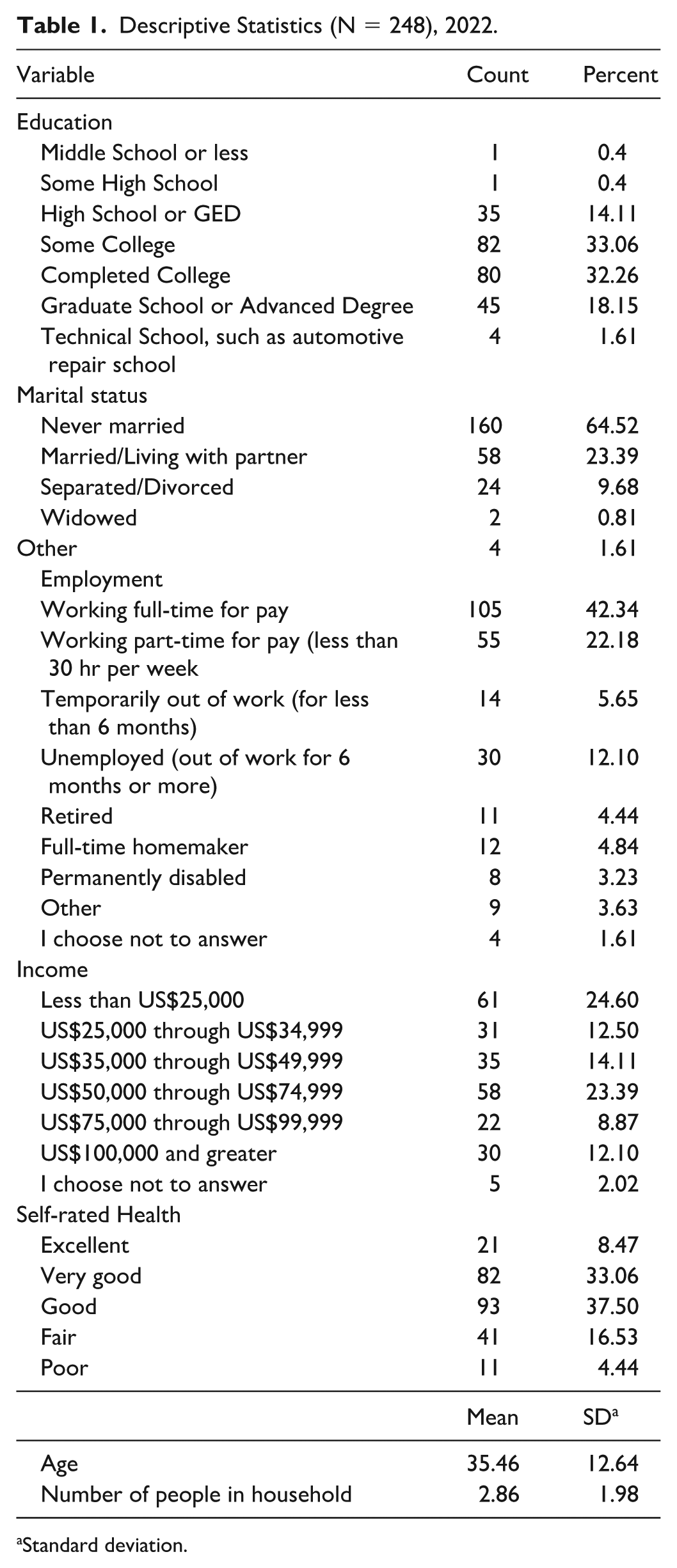
Standard deviation.
Item Characteristics
Item-level floor and ceiling effects were examined prior to the EFA. Several items demonstrated moderate ceiling effects, particularly among positively worded items, with some items exceeding the 20% threshold (see Supplemental Table 1). In contrast, a subset of reverse-worded items demonstrated modest floor effects. This pattern is consistent with prior research on the RSPWB and similar well-being measures and may reflect both generally positive levels of psychological functioning and wording effects (Abbott et al., 2006, 2010). Importantly, variability across items remained sufficient to support EFA, which is robust to departures from normality, and no items were excluded based on floor or ceiling effects alone.
Construct Validity – EFA
We conducted an EFA to examine the underlying factor structure and provide initial evidence of construct validity. Given the exploratory nature of the analysis, no assumptions were made regarding the preservation of the original RSPWB factor structure. Floyd and Widaman (1995) provided guidance on the need to assess the correlations between items, asserting that items that were intended to measure a familiar construct should be at least moderately correlated with each other when conducting factor analytic procedures. Consistent with procedures performed by Zhou et al. (2025), items were removed due to low correlations (<.30) with over 50% of other items in the scale and with at least one other scale. After performing initial bivariate correlation testing, 13 items were removed (item numbers 3, 7, 11, 15, 21, 25, 27, 28, 37, 39, 57, 65, and 81; see Supplemental Table 2 for a detailed description of these items and their content). After these items were removed from the dataset, the Kaiser–Meyer–Olkin (KMO) test and Bartlett’s test of sphericity were conducted to determine sampling adequacy and the appropriateness of EFA procedures. The KMO test indicated that sampling adequacy was achieved, with an overall measure of sampling adequacy (MSA) value of .95 and most item-level MSAs above .90. There were only six items with MSA values between 0.82 and 0.90, which are still considered acceptable (Kaiser & Rice, 1974). The Barlett test of sphericity results (χ2 = 13,241.8, df = 2,485, p < .001) also suggested the appropriateness of performing EFA (Bartlett, 1937). Together, results from the KMO and Bartlett’s test indicate the appropriateness of performing EFA procedures (Bartlett, 1937). Finally, both Cattell’s Scree test (Cattell, 1966) and the parallel analysis (Hayton et al., 2004) suggested a five-factor structure of the measurement tool. The first five observed eigenvalues from the unrotated factor analysis were 26.87, 3.23, 2.91, 2.22, and 1.33, each exceeding the corresponding eigenvalues generated from random data. Thus, a five-factor structure was subjected to oblique rotation (i.e., Promax) and estimated with the maximum likelihood estimate method (MLE).
To refine the model, highly cross-loaded items (factor loadings > .40) on more than one factor and too low factor loadings (<.40) on all factors were removed (Hair et al., 2019). Ultimately, from the 71 items used in the EFA, the final five-factor model consisted of 48 items. This model provided evidence of non-replication of the original structure and accounted for 53% of the total variance of RSPWB (Ryff, 1989) scores. The factors that emerged in this model were named Factor 1 – EPS (combination of Environmental Mastery, Purpose in Life, and Self-Acceptance), Factor 2 – Relational Satisfaction, Factor 3 – Autonomy, Factor 4 – Personal Growth, and Factor 5 – Helplessness, after a thorough review of item content. See Table 2 for the factor loadings, communality (h2), uniqueness (u2), and complexity (com) for each item.
Exploratory Factor Analysis Results for Ryff’s Scales of Psychological Well-Being (N = 248).
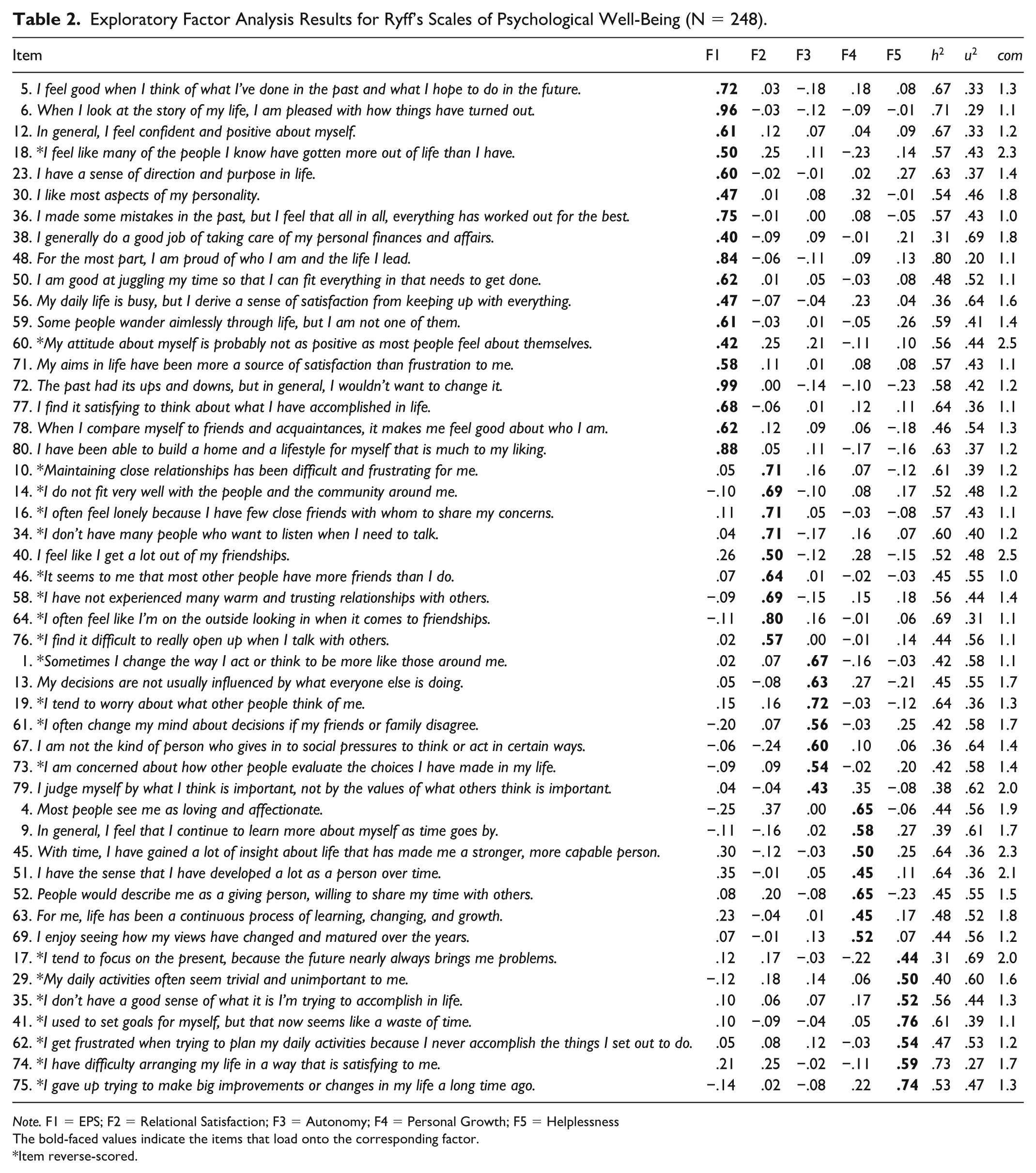
Note. F1 = EPS; F2 = Relational Satisfaction; F3 = Autonomy; F4 = Personal Growth; F5 = Helplessness
The bold-faced values indicate the items that load onto the corresponding factor.
Item reverse-scored.
Factor 1 – EPS
Factor 1 consisted of 18 items representing a composition of Environmental Mastery, Purpose in Life, and Self-Acceptance, or EPS (similar to interpretations from Burns & Machin, 2009), with sample items including “I feel like many of the people I know have gotten more out of life than I have”; “I have been able to build a home and a lifestyle for myself that is much to my liking”; and “Some people wander aimlessly through life, but I am not one of them.” This factor accounted for 19.94% of the total variance. Factor loadings for this factor ranged from .40 to .96, indicating acceptable to high factor loadings across items. The Cronbach’s alpha was .95, indicating excellent internal consistency (>.9) of items within said factor.
Factor 2 – Relational Satisfaction
Factor 2 consisted of nine items representing Relational Satisfaction (coined by Zhou et al., 2025), with sample items including “Maintaining close relationships has been difficult and frustrating for me” and “I do not fit very well with the people and the community around me.” This factor accounted for 11.08% of the total variance. Factor loadings for this factor ranged from .50 to .80, indicating moderate to high factor loadings across items. The Cronbach’s alpha was .91, indicating excellent internal consistency (>.9) of items within said factor.
Factor 3 – Autonomy
Factor 3 consisted of seven items representing Autonomy, with sample items including “Sometimes I change the way I act or think to be more like those around me” and “I am concerned about how other people evaluate the choices I have made in my life.” This factor accounted for 6.20% of the total variance. Factor loadings for this factor ranged from .43 to .72, indicating acceptable to high factor loadings across items. The Cronbach’s alpha was .81, indicating good internal consistency (>.8) of items within said factor.
Factor 4 – Personal Growth
Factor 4 consisted of seven items representing Personal Growth, with sample items including “For me, life has been a continuous process of learning, changing, and growth,” and “In general, I feel that I continue to learn more about myself as time goes by.” This factor accounted for 7.29% of the total variance. Factor loadings for this factor ranged from .45 to .65, indicating acceptable to moderate factor loadings across items. The Cronbach’s alpha was .84, indicating good internal consistency (>.8) of items within said factor.
Factor 5 – Helplessness
Factor 5 consisted of seven items representing Helplessness, with sample items including “I gave up trying to make big improvements or changes in my life a long time ago” and “I used to set goals for myself, but that now seems like a waste of time.” This factor accounted for 8.57% of the total variance. Factor loadings for this factor ranged from .44 to .76, indicating acceptable to high factor loadings across items. The Cronbach’s alpha was .86, indicating good internal consistency (>.8) of items within said factor.
Reliability Tests
Internal Consistency Estimates
We assessed internal consistency reliability estimates for the factors identified by the EFA using Cronbach’s alpha coefficient. Cronbach’s alphas ranged from good (
Reliability Ryff Psychological Well-Being Scale – African American Women (N = 248).
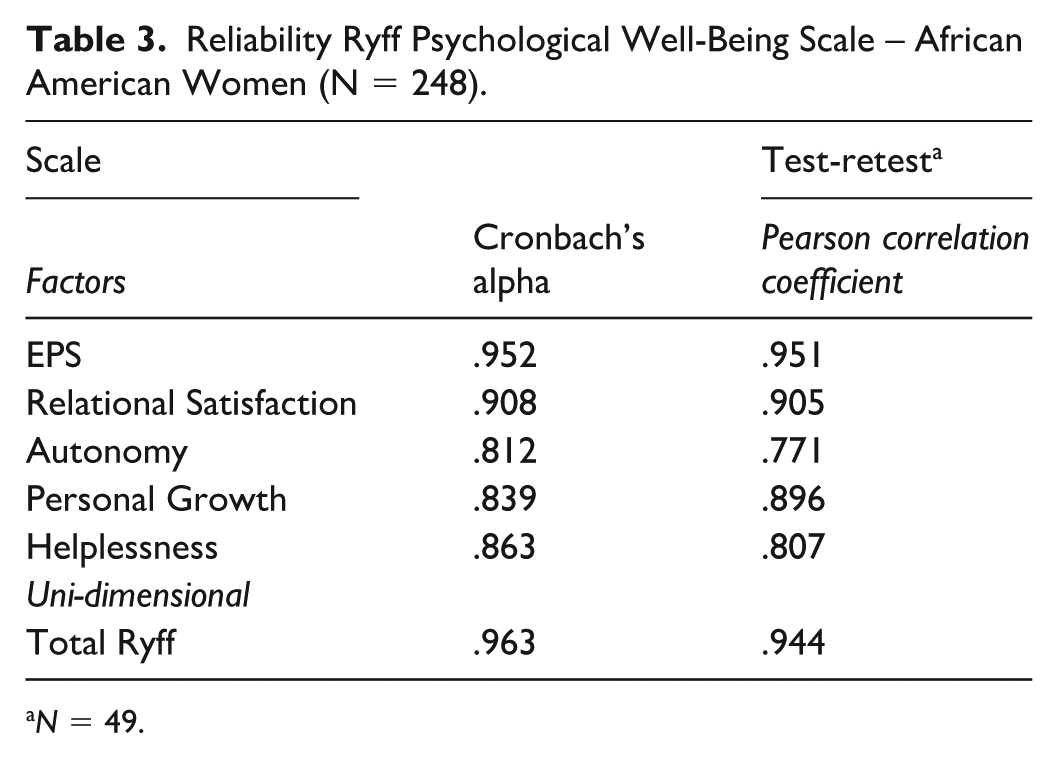
N = 49.
Test–Retest Reliability Estimates
Two-week test–retest reliabilities were assessed. The total score for RSPWB had a Pearson correlation coefficient of r = .94 across the two time points, indicating excellent test–retest reliability. Pearson correlation coefficients for each subscale ranged from good (r = .77) to excellent (r = .95), with the complete estimates found in Table 3.
Sensitivity Analysis
The five-factor structure was evident in both the full and reduced datasets. Model fit was comparable across solutions (full: RMSEA = .049; reduced: RMSEA = .048), and the substantive factor pattern remained consistent. Removal of low-correlation items reduced cross-loadings and item complexity (mean complexity reduced from 1.8 to 1.5) and improved incremental fit indices (Tucker–Lewis Index [TLI] =.82 to .90). However, the underlying five-factor structure was present in both before the item removal, suggesting that the screening procedure refined rather than artificially induced the factor structure.
Discussion
This exploratory study adds to the growing recognition in research and clinical practice that constructs such as well-being vary across cultures (Shambley-Ebron & Boyle, 2004). Importantly, the goal of EFA is not to preserve or test the original factor structure, but rather to identify latent factors that best characterize patterns of covariation within the present sample. This work supports the importance of applying a transcultural lens to measurement in health research, as the EFA revealed evidence of non-replication of the original structure; five distinct factors emerged, encompassing 48 of the original items. These factors exhibited good to excellent psychometric properties, and the reliability across time points indicated good stability and consistency of the subscales. The evidence of non-replication of the original RSPWB structure (Ryff, 1989) is consistent with findings from other studies that have explored its factor structure (Burns & Machin, 2009; Kafka & Kozma, 2002; Zhou et al., 2025). While exploratory, our findings suggest that as initially developed, the RSPWB 84-item may not adequately measure the latent construct of psychological well-being among African American women. These findings highlight the need for psychometric evaluation and subsequent cultural adaptations of instruments across diverse cultural contexts using rigorous, mixed-methods approaches.
The five factors identified in this study largely split into either positively or negatively worded items (F1 = 16/18 positive; F2 = 8/9 negative; F3 = 7/7 negative; F4 = 7/7 positive; F5 = 7/7 negative). Prior research has questioned mixing positive and negative wording within psychological scales, noting that exclusively positive wording can improve internal consistency and factor structure (Dodeen, 2023; Winefield et al., 2012) and that negatively worded items may add little value (Sliter & Zickar, 2014). This issue is relevant to the RSPWB. For example, Henn et al. (2016) proposed a five-factor structure for the 84-item RSPWB in South Africa in which one factor, named general psychological well-being, comprised primarily positively worded items, while the remaining four captured negative aspects of well-being (e.g., interpersonal dependence, obstinate, sense of loneliness, and low motivation) and consisted of exclusively negatively worded items. Other psychometric evaluations of the RSPWB (Abbott et al., 2006; Springer & Hauser, 2006) similarly found that the mixture of item valences benefited from method factors (i.e., a single latent variable that accounts for variance due to the method of measurement itself rather than the actual constructs of interest) to achieve acceptable model fit. Taken together with the present findings, these studies underscore the need for dedicated research evaluating whether combining positively and negatively worded items is appropriate when measuring psychological well-being.
In their work, Zhou et al. (2025) recommended the inclusion of culturally congruent items in subsequent versions of the RSPWB to ensure the accurate measurement of latent constructs within psychological well-being. Similarly, in this study, there appear to be items that may not be salient for this population, as evidenced by the low correlation (<.40) and subsequent removal of such items from the EFA. For example, the wording for Item 81 is as follows: “There is truth to the saying you cannot teach an old dog new tricks.” This saying may not have resonated with the participants in this sample and thus may need to be reconsidered. Method factor modeling was beyond the scope of this study; we recommend that future work evaluate the utility of exclusively positively worded items, or a bifactor confirmatory factor analysis (CFA) with wording/method factors as a next-step analysis. Consideration should also be given to the extent to which socially acceptable responses impact participants’ answers.
This study was an exploratory psychometric evaluation; as such, the following interpretations of the identified factor composition are exploratory and should be considered hypothesis-generating rather than definitive evidence. Our first factor, EPS, was comprised of items from Environmental Mastery, Purpose in Life, and Self-Acceptance and may suggest a higher-order factor reflecting general psychological well-being. While this merger is purely hypothesis-generating and not a definitive cultural restructuring, it is consistent with prior exploratory research using the RSPWB (Abbott et al., 2006; Burns & Machin, 2009; Henn et al., 2016). Springer and Hauser (2006) further noted that Environmental Mastery, Purpose in Life, and Self-Acceptance (and, in some cases, Personal Growth) consistently show high intercorrelations and frequently consolidate into a single factor in exploratory analyses. The conceptual coherence of EPS is particularly salient for African American women, for whom psychological well-being has long been theorized as an integrated self-concept shaped by resilience, collective identity, and empowerment. Prior literature emphasizes the centrality of community engagement, activism, and self-definition in fostering environmental mastery and purpose in life, alongside self-acceptance in the face of structural adversity (Shodiya-Zeumault et al., 2022; Woods-Giscombe et al., 2023). From this perspective, EPS may suggest a culturally and contextually grounded manifestation of psychological well-being, rather than a simple aggregation of original RSPWB subscales.
The second factor identified, Relational Satisfaction, may reflect the perceived quality and satisfaction African American women experience in their relationships and aligns with factors identified in prior research (Zhou et al., 2025). Relational Satisfaction is relevant to this group, as social support has been shown to play a critical role in coping with stressors (Holt-Lunstad, 2024). The third factor, Autonomy, may reflect a construct complicated by the intersection of race and gender. Merriam-Webster dictionary defines autonomy as “the quality of being independent, free, and self-directing” (Merriam-Webster, n.d., Definition 1). For African American women, the pursuit of autonomy is impeded by systems of oppression that have sought to control their bodies and economic activities (King, 1988). As policies and practices continue to challenge African American women’s ability to be self-directing (Dobbs v. Jackson Women’s Health Organization, 2022; Goldman Sachs, 2021), research tools measuring autonomy with attention to sociocultural experiences will be essential.
The fourth factor, Personal Growth, encompassed feelings of continued self-development and relational expansion. For African American women, personal growth holds a unique significance given the intersecting experiences of racism and sexism, or “double jeopardy” (Beal, 2008; Okoro et al., 2020). Claiming personal growth may therefore function as an act of resistance and affirmation, allowing African American women to define success and development on their own terms (Collins, 2022). The fifth factor, Helplessness, aligns with Wallston’s (2015) definition of helplessness as the belief that outcomes are uncontrollable. Prior research suggests that African American women may be particularly vulnerable to internalized hopelessness due to persistent exposure to systemic oppression and social marginalization (González-Prendes & Thomas, 2011; Lewis et al., 2016; Okoro et al., 2020; Thomas & González-Prendes, 2009). The construct of helplessness offers insight into the cumulative psychological burden faced by this population.
Given that this was an exploratory psychometric validation study, our goal was to assess how the RSPWB (Ryff, 1989) captures psychological well-being among African American women. Further refinement of this scale is needed to accurately document experiences of psychological well-being among different populations. African American women are at greater risk for poorer psychological well-being due to a myriad of factors, including the social climate and societal inequities in America (Elhabashy et al., 2025). The intersection of race and gender offers African American women distinct psychological stressors, such as greater vulnerability to economic hardship (Goldman Sachs, 2021), adult victimization (Erving et al., 2021; Jones et al., 2020), and harassment (Lewis et al., 2016) in comparison to their White and male counterparts. Omission of these unique risk factors and other markers of racial and sexual oppression from standard measures may limit their ability to comprehensively assess the construct of psychological well-being among African American women.
Just as the call for Black feminism emerged to address the failure of the broader feminist movement to address the intersectional needs of women of color (King, 1988; Oliphant et al., 2022; Woods-Giscombé & Lobel, 2008), so too must psychometric assessments address the specific needs and realities of African American women. Future studies should consider using supporting theoretical frameworks, such as Black feminist thought or Africana womanism (Shambley-Ebron & Boyle, 2004), to guide and shape revisions of the RSPWB.
Limitations
This exploratory study offers insight into the factor structure of the 84-item RSPWB, but several limitations must be acknowledged. First, the sample size (N = 248) was insufficient to split for both EFA and CFA, limiting validation efforts (Floyd & Widaman, 1995). As a result, the present analyses are exploratory in nature, and the proposed factor structure cannot be formally evaluated for model fit or compared against alternative structural models, such as the original six-factor model, second-order models, or bifactor models. Because EFA solutions are sample-dependent and sensitive to item retention decisions, the stability and replicability of the resulting structure in other samples remain uncertain. Future studies should employ CFA to test competing structural models, examine method effects, and evaluate measurement invariance across groups. Relatedly, although we examined internal consistency and composite reliability, convergent and divergent validity were not examined. Second, the sample was highly educated, which may limit generalizability. Third, the use of a Prolific convenience sample may have influenced who elected to participate. Fourth, participants could review study details (including compensation) before opting in, potentially creating self-selection bias based on familiarity with psychological well-being or differing incentive-related motives. Fifth, this is a stand-alone, exploratory psychometric validation study, not a validated cultural adaptation of the RSPWB. Future work should employ qualitative validation, cognitive interviews, and measurement invariance testing to guide cultural adaptation of this measure.
Sixth, although the sample size-to-item ratio was low, which may have affected item and factor loadings, the high KMO value (.95) supports the adequacy of the data for factor analysis. Regardless, replication with larger samples is recommended. In addition, several methodological decisions may have influenced the extracted factor structure. Items were screened using Pearson correlations prior to factor extraction, which does not account for the multivariate structure underlying latent factors and may have affected the emergence of the factor solution. Similarly, MLE with Pearson correlations assumes continuous and normally distributed indicators, whereas the RSPWB uses ordinal Likert-type items that demonstrated skewness and ceiling effects. Future studies may consider ordinal appropriate estimators such as Weighted Least Squares Mean and Variance adjusted (WLSMV) with polychoric correlations and conduct factor retention and item evaluation procedures within the factor analytic framework rather than relying on pre-EFA bivariate thresholds. In addition, although a total RSPWB score was reported with high internal consistency (α = .96), the present study did not test a higher-order or bifactor structure to justify the interpretation of a general well-being factor. Without such analyses, the validity of a composite total score remains uncertain, and the high alpha may reflect item redundancy or wording-related variance rather than true general factor saturation. Future research should explicitly test higher-order and bifactor models to determine whether a total score is psychometrically supported. Finally, race was operationalized dichotomously as self-identified African American, which may not capture the full spectrum of racial identity within the Black population (Tamir, 2021). Future research should examine the scale’s psychometric properties among African American women and explore the construct of psychological well-being in other marginalized groups.
Conclusion
In conclusion, the EFA provided evidence of non-replication of the original RSPWB structure, encompassing 48 of the original items among African American women. Well-being has an important connection to downstream mental and physical health conditions. Eliminating health disparities and advancing health equity requires a continued focus on the well-being of marginalized groups, including African American women. The holistic nature of the RSPWB scale aligns well with nursing’s prioritization of holistic, patient-centered care; however, the study findings suggest the need for more research and further refinement of the tool may be necessary to fully assess the construct of psychological well-being among African American women.
Supplemental Material
sj-docx-1-tcn-10.1177_10436596261459427 – Supplemental material for Investigating the Factor Structure of the 84-Item Version Ryff Scales of Psychological Well-Being for African American Women in the United States
Supplemental material, sj-docx-1-tcn-10.1177_10436596261459427 for Investigating the Factor Structure of the 84-Item Version Ryff Scales of Psychological Well-Being for African American Women in the United States by Hannah Fry, Marcus Weathers, Kaiqi Zhou, ShaRhonda Stevenson, Jessica L. Zemlak, Roger L. Brown and Abiola Keller in Journal of Transcultural Nursing
Supplemental Material
sj-docx-2-tcn-10.1177_10436596261459427 – Supplemental material for Investigating the Factor Structure of the 84-Item Version Ryff Scales of Psychological Well-Being for African American Women in the United States
Supplemental material, sj-docx-2-tcn-10.1177_10436596261459427 for Investigating the Factor Structure of the 84-Item Version Ryff Scales of Psychological Well-Being for African American Women in the United States by Hannah Fry, Marcus Weathers, Kaiqi Zhou, ShaRhonda Stevenson, Jessica L. Zemlak, Roger L. Brown and Abiola Keller in Journal of Transcultural Nursing
Footnotes

Ethical Considerations
All procedures performed in studies involving human participants were in accordance with the ethical standards of the institutional and/or national research committee and with the 1964 Helsinki declaration and its later amendments or comparable ethical standards. The present study was determined to be exempt from review by Marquette University’s Institutional Review Board.
Consent to Participate
Before completing the surveys, informed consent was obtained to ensure participants’ understanding of the research study, including the purpose of the research, participants’ rights, benefits/risks of participation, compensation, confidentiality, and contact information of study PIs and researchers involved in the project.
Author Contributions
Funding
The authors disclosed receipt of the following financial support for the research, authorship, and/or publication of this article: This work was supported by the Marquette University Summer Faculty Fellowship and Regular Research Grant programs, as well as the Marquette University College of Nursing Regnar Research Award. These funding sources had no involvement in the study design; collection, analysis and interpretation of data; in the writing of the report; and in the decision to submit the article for publication.
Declaration of Conflicting Interests
The authors declared no potential conflicts of interest with respect to the research, authorship, and/or publication of this article.
Data Availability Statement
The datasets generated and analyzed during the current study are not publicly available but are available from the corresponding author on reasonable request.
Supplemental Material
Supplemental material for this article is available online.
References
Supplementary Material
Please find the following supplemental material available below.
For Open Access articles published under a Creative Commons License, all supplemental material carries the same license as the article it is associated with.
For non-Open Access articles published, all supplemental material carries a non-exclusive license, and permission requests for re-use of supplemental material or any part of supplemental material shall be sent directly to the copyright owner as specified in the copyright notice associated with the article.
