






Abstract
Prior research has consistently demonstrated the salience of minority status in understanding racial and ethnic differences in perceptions of the police. This research has overwhelmingly shown that Blacks and Latinos hold lower levels of trust and confidence in the police than do Whites and other racial minorities. The increased skepticism of the police expressed by minority citizens is commonly associated with racial profiling and documented racial disparities in police behavior. Although policing research has empirically demonstrated the influence of race on perceptions of the police, few studies have explored the relevance of officer race in shaping citizens’ evaluations of police encounters. Using data from the BJS Police–Public Contact Survey, the purpose of this study is to examine whether racial variation in evaluations of police behavior is moderated by the race of the officer. The results suggest that officer race may be an important factor in shaping citizen perceptions of police stops, particularly when it comes to Black citizens. This finding is important as it provides some evidence that increasing the number of minority officers may be one viable option for improving citizen–officer relations.
Criminological research has long explored the salience of race and ethnicity in understanding citizens’ evaluations of the police (Black & Reiss, 1970; Brunson, 2007; Hurst, Frank, & Browning, 2000; Weitzer & Tuch, 1999, 2006). This growing body of research has demonstrated that Black and Hispanic citizens hold lower levels of trust and confidence in the police than do Whites and other racial minorities. These perceptions result in part from the disadvantages that racial and ethnic minorities experience across the justice system, along with any gratuitous treatment that they may have experienced during their encounters with police. In recent years, racial profiling has emerged as a major factor shaping minority citizens’ evaluations of the police (Warren, Tomaskovic-Devey, Zingraff, Smith, & Mason, 2006; Weitzer & Tuch, 2002). The term racial profiling describes the practice of targeting or stopping an individual based primarily on race, rather than on any individualized suspicion (Beckett, Nyrop, & Pfingst, 2006; Engel & Johnson, 2006; Weitzer, 2000a). As a result of these experiences, Black and Hispanic communities have raised questions about police legitimacy as well as the procedural fairness of police organizations more generally (Engel, 2005; Smith & Holmes, 2003; Tyler, 2001).
Although prior studies have demonstrated that racial minorities are more likely to perceive police as racially biased and unfair, there continues to be ongoing questions about the factors that underlie these perceptions. In particular, prior studies have overwhelmingly highlighted the salience of direct and vicarious experiences (e.g., Rosenbaum, Schuck, Costello, Hawkins, & Ring, 2005; Weitzer & Tuch, 2006), neighborhood context (e.g., Brunson, 2007; Brunson & Weitzer, 2009; Sampson & Bartusch, 1998; Schuck, Rosenbaum, & Hawkins, 2008; Stewart, Baumer, Brunson, & Simons, 2009), along with the outcome of the police encounter (e.g., Brown & Frank, 2006; Johnson & Kuhns, 2009; Warren & Tomaskovic-Devey, 2009) when evaluating racial/ethnic differences. However, to date, few studies have explored the relevance of officer race (for exceptions, see Engel, 2005; Gilliard-Matthews, Kowalski, & Lundman, 2008; Lersch & Mieczkowski, 2000). The lack of empirical attention to officer race is anomalous given the push from both policy makers and scholars to diversify U.S. police organizations in efforts to improve citizen–police relations and to dispel notions of racial profiling.
The debate surrounding the relevance of officer race began in the late 70s and early 80s when many police departments adopted diversification strategies to foster trust and improve police–minority community relations (Brown & Frank, 2006; Kuykendall & Burns, 1980; Skolnick & Fyfe, 1993; Smith & Holmes, 2003; Weitzer, 2000b; Zhao, Herbst, & Lovrich, 2001). Despite these efforts, there have been relatively few empirical studies to demonstrate that officer race significantly influences citizens’ evaluations of them (see also Engel, 2005; Kaker, 2003). In fact, the National Research Council (Skogan & Frydl, 2004) contends that there is little evidence to suggest that minority officers behave differently than their White counterparts.
Against this backdrop, the purpose of the current study is multifaceted. First, we explore the salience of officer race in understanding citizen perceptions of police behavior. We do so by examining how the combined effects of race, ethnicity, and gender influence evaluations of police encounters across the race and the ethnicity of the officer. By exploring the combined effects of race, ethnicity, and gender, we can capture how racial, ethnic, and gender groups evaluate White and minority officers’ behavior differentially. In addition, our analyses move beyond the Black–White divide by also empirically investigating Hispanic ethnicity. Prior studies have generally failed to incorporate Hispanic ethnicity (Brunson & Miller, 2005; Warren, 2010), which ignores the unique experiences that Hispanic citizens have with police and assumes that Hispanic citizens’ perceptions will be similar to those expressed by Black citizens. We also emphasize the salience of gender as prior studies have shown that males across racial and ethnic groups are more likely than are females to report negative encounters (Weitzer & Tuch, 2005). Ultimately, by examining these combined effects we can more specifically isolate the groups that are most vulnerable to negative encounters with and evaluations of the police.
Understanding how officer race influences racial variation in perceptions of the police is particularly relevant in contemporary society because police organizations have increasingly come under scrutiny for unfairly targeting minority drivers during traffic and pedestrian stops. It has been widely assumed by policy makers and citizens alike that allegations of racial profiling are mostly associated with the policing practices of White officers and their treatment of racial and ethnic minorities. This in part results from the tenuous historical relationship between police and minority communities coupled with police organizations traditionally limiting their employment to White citizens. Some commentators have suggested that this racial mismatch is a major cause of the ongoing allegations of racial profiling. Despite these claims, there is mixed evidence to suggest that enforcement practices vary across officer race. In addition, researchers know little as to how perceptions of officers vary, if at all, based on the race of an officer.
Using traffic stop data from the 2005 BJS Police-Public Contact Survey, we assess the following two research questions:
Research Question 1: Do evaluations of police encounters vary across officer race?
Research Question 2: Do the combined effects of race, ethnicity, and gender influence evaluations of police behavior differently for White and for minority officers?
In the next section, we provide a brief discussion of prior theory and research relevant to the discussion of race, biases, and perceptions of the police. Following this discussion, we empirically evaluate whether citizens’ evaluations of the police vary across officer race.
Background
Conflict theory and its subsidiaries (e.g., group position, group threat) have commonly been used as frameworks for understanding the relationship between race, class, and evaluations of the police (Hagan & Albonetti, 1982; Johnson & Kuhns, 2009; Matsueda & Drakulich, 2009; Shedd & Hagan, 2006; Weitzer & Tuch, 2006). Conflict theory and more formalized racial threat hypotheses (e.g. Blalock, 1967; Blumer, 1958; Liska, 1992) propose that perceptions of threat held by societal elites work to invoke reactions through social control, including disparate arrest practices (e.g., Parker, Stults, & Rice, 2005) and greater police force presence in areas where the perceived threat (i.e., minority population size) posed by minority groups is higher (e.g., Stults & Baumer, 2007). While conflict theory arguments speak to macro-level functions of race and ethnic relations, group threat hypotheses have provided a useful framework for scholars attempting to understand individual-level interactions between citizens and the police (Novak & Chamlin, 2008; Weitzer & Tuch, 2006; Weitzer, Tuch, & Skogan, 2008). These perspectives maintain that racial and ethnic differences in perceptions of police exist largely because Whites are more likely to view police actions as legitimate since the amount of crime control exercised against minorities is often viewed as necessary given the criminal threat that they pose to mainstream society. Racial minorities, on the other hand, “may construe their encounters with police less in terms of the immediate circumstances and more in terms of their group’s societal position” (Weitzer et al., 2008, pp. 400). In this case, it is plausible that minorities, relative to Whites, are more inclined to view the police as representatives of the state and thus see police misconduct as reprehensible and racially biased (Weitzer et al., 2008; Weitzer & Tuch, 2006). As a result, minority group members express higher levels of distrust and dissatisfaction with the police.
Within the conflict perspective, multiracial explanations have been incorporated because of the growing population of Hispanic citizens as well as their expanding influence on American society (Sampson & Lauritsen, 1997; Solis, Portillos, & Brunson, 2009; Weitzer & Tuch, 2006). This perspective explores the complex ways in which ethnic minorities interact with the criminal justice system (see Hagan, Shedd, & Payne, 2005; Spohn & Holleran, 2000; Steffensmeier & Demuth, 2000, 2001; Weitzer & Tuch, 2006). Broadly, this approach emphasizes a racial hierarchical pattern of citizen trust and dissatisfaction with the police, with Whites at the lower end, Hispanics in the middle, and Blacks expressing the highest levels of police dissatisfaction (Weitzer & Tuch, 2006). For example, Weitzer and Tuch (2006) note that although Hispanic citizens are more likely to report that they are distrustful of police organizations than are Whites, their levels of distrust never rise to those held by Black citizens.
There are also reasons to expect gender to play an important role in predicting citizens’ trust and evaluations of the police. Criminologists have consistently emphasized the differential treatment that males experience in comparison to females across the criminal justice system (Spohn & Beichner, 2000). Prior studies have found that minority males are more likely to express dissatisfaction with the police as well as report more discriminatory treatment by police in comparison to White and minority females (Weitzer & Tuch, 2006). This research provides some baseline evidence that future studies should continue to explore how their combined effects, in conjunction with officer race, provide a broader understanding of citizens’ evaluations of the police. We therefore, emphasize the importance of assessing the interplay of race/ethnicity and gender in defining citizens’ experiences and perceptions of police encounters.
The Interaction of Citizen and Officer Race
In light of these perspectives and prior research, we expect officer race to have an influence on racial, ethnic, and gender differences in perceptions of police behavior, based largely on the idea that individuals organize their perceptions based on their position in society. That is, citizens develop their perceptions of police based not only on perceptions of fairness but also on comparable social positions and circumstances between themselves and the contacting officer (see also Weitzer et al., 2008). For example, minority males and females are more likely to perceive improper behavior by a White officer because of feelings of exclusionary treatment and subordination by White-dominant society. On the other hand, minority citizens might view the actions and behavior of minority officers as favorable and more trustworthy because they feel minority officers will enforce the law more fairly and impartially.
Despite the commonly proposed influence of officer race on citizen perceptions, the effects of officer race on evaluations of the police have rarely been explored, and when they have the results have yielded mixed findings (Brown & Frank, 2006; Engel, 2005; Lersch & Mieczkowski, 2000). For example, some research finds that Black officers interact with Black citizens differently than their White counterparts (Brown & Frank, 2006; Mastrofski, Reisig, & McCluskey, 2002; Sun & Payne, 2004; Sun, Payne, & Wu, 2008). These studies acknowledge the importance of diversifying police forces to improve communication and minority citizen–police relations, as well as to quell accusations of racial bias on the part of officers (Sun, 2003; Weitzer & Tuch, 2006). Sun (2003) writes that increasing the number of Black officers will improve officer–citizen relations because Black officers develop better connections to citizens in disadvantaged areas. Brown and Frank (2006) note, however, that empirical evidence supporting this idea is relatively weak, and results from their study partly support the opposite position. That is, although White officers were more likely to make an arrest, Black officers were significantly more likely to arrest Black citizens in comparison to Whites.
It is generally believed that in areas with a greater minority presence, minority officers are better equipped to handle problems, and promote better relationships with local citizens (Decker & Smith 1980; Skogan, 1979; see also Weitzer et al., 2008; Weitzer & Tuch, 2006). Similarly, the presence of minority officers could help to limit the tensions that White officers may typically invoke among minority citizens. Policing behavior studies have shown that during police–citizen contacts, citizens who display negative behavior, such as disrespectfulness or rudeness, are more likely to receive sanctions or be arrested, than citizens who behave more positively (Mastrofski et al., 2002; Garner, Maxwell, & Heraux, 2002; Reisig, McCluskey, Mastrofski, & Terrill, 2004). Because minority citizens are more likely to perceive the behavior of White officers as inherently biased or illegitimate, they will be more likely to behave poorly during citizen–police contact, which will also increase their rate of receiving tickets and getting arrested. Police departments have a large stake then in not only appearing fair, but being trusted and perceived as a legitimate authority (Sunshine & Tyler 2003).
In prior studies there does appear to be a general belief that police force diversification and differential disbursement of minority officers to certain communities can improve perceptions of the police by partly limiting perceived biases that may be present when minorities come in contact with White officers. That is, a minority officer may be inherently less likely to appear racially biased, or more likely to appear legitimate to a minority citizen, than would a White police officer. It is possible that minority citizens are more likely to perceive racial profiling when stopped by a White officer than they would be if the officer were a minority. And in turn, police force diversification would then be an efficient solution for enhancing police officer legitimacy. However, the counter argument to police force diversification suggests that race and ethnicity of the officer has no effect on the officers’ treatment of citizens, and more importantly, citizens perceive any officer that wears the police uniform as untrustworthy and more likely to treat them unfairly (Weitzer, 2000b; Weitzer & Tuch, 2006); which would then raise questions regarding what policies would be effective to dispel notions of racially biased policing.
Racial Profiling and Perceptions of the Police
In recent years, researchers have devoted significant attention toward understanding how racial profiling influences citizens perceptions of the police (Reitzel & Piquero, 2006; Warren et al., 2006). Racial profiling has become a “hot topic” for researchers as well as for politicians and by now it is likely that most citizens are at least aware of the common accusations of racial bias pitted against law enforcement. Citizens, particularly minority citizens, who perceive that they have been stopped as a result of racial profiling, are more inclined to express dissatisfaction with the police (Weitzer & Tuch, 2006). The widespread cognizance of racial profiling, in our view, presents an additional challenge for researchers when exploring perceptions of the police, since the awareness that profiling occurs, regardless of whether or not someone feels that they have actually been stopped as a result of racial profiling, may be enough to influence perceptions of police behavior. In other words, minority citizens who hear about racial profiling practices, even if they themselves do not believe they have been racially profiled, may be more likely to view future experiences with the police skeptically (Rosenbaum et al., 2005).
The Current Study
The current study underscores the importance of prior research in examining racial variation in perceptions of the police, and in doing so we pay particular attention to how the interaction of citizen and officer race differentially influences citizens’ evaluations of their encounter with police officers. Using self-report data from the BJS Police–Public Contact Survey, we seek to answer the following research questions: (a) Does officer race influence perceptions of police encounters? (b) Do the combined effects of race, ethnicity and gender influence evaluations of police behavior differently for White and for minority officers?
Data and Method
Data for the analyses are taken from the 2005 Police Public Contact Survey (PPCS). The PPCS is conducted as a supplement to the National Crime Victimization Survey (NCVS) and pertains to all respondents aged 16 and older who were part of the NCVS during the last 6 months of 2005. As part of the NCVS, the PPCS utilizes a multimode, stratified multistage cluster design, and weighting procedures to create representative national estimates. The reported response rate for the 2005 PPCS was 80% for eligible NCVS interviewees. The PPCS survey data are an important source of information about citizen trust and confidence in the police as it provides information about citizen traffic stops including but not limited to the race of the officer, characteristics of the respondent’s traffic stop encounter, such as the reason for the stop, the outcome of the stop, the survey respondent perceptions of the stop, along with detailed demographic information.
The original sample included in the 2005 PPCS totals over 80,000 cases. However, for the purposes of this study we were interested in those citizens who reported a recent traffic stop (in the past 12 months), which delimited the sample to 10,317 cases. Respondents who did not report officer race or who did not answer the question item regarding the legitimacy of their most recent traffic stop (or if they answered “don’t know” to either of these questions) were subsequently removed from the analyses. The final sample only includes citizens who indicated the race of the officer who stopped them, either as White, Black, or “other” racial minority. For respondents in the sample, those who self-reported race as either non-Hispanic White, non-Hispanic Black or Hispanic were included in the analyses, and all other racial groups were dropped from the sample (as described below). The final sample size for the analyses was 3,439.
Dependent Variable
The dependent variable is a measure of perceived legitimacy of police behavior during the respondents’ most recent traffic stop. Respondents were specifically asked, “Would you say that the police officers had a legitimate reason for stopping you?” Respondents had a choice of yes or no, and the variable was recoded as a 0/1 dummy variable, with “0” indicating the respondent believes the police had a legitimate reason for stopping the respondent, and “1” if the respondent believes the police did not have a legitimate reason for the stop. 1
Independent Variables
Officer race
The primary focus of this study is to assess the importance of citizen and officer race as independent and interactive influences on evaluations of police encounters. Respondents were asked to report whether the contacting officer’s race was White, Black, or Other. 2 The officer race variable was recoded as a dichotomous measure indicating that respondents were stopped by a White officer (coded as 0) or by a Black or other racial minority officer (coded as 1). 3
Citizen race and gender
Prior research has found that minority citizens, particularly Blacks and Hispanics, are more likely to question the legitimacy of police encounters (Engel, 2005; Weitzer & Tuch, 2005). The survey used for this study includes detailed racial designations. The original racial categories include White non-Hispanic, Black non-Hispanic, Hispanic, Other non-Hispanic, and two or more races non-Hispanic. In the interest of theoretical and empirical parsimony, we limit our analyses to White, Black, and Hispanic drivers. 4
In addition, extant literature has discussed and assessed the combined influences of race and gender (Weitzer & Tuch, 2006). It is reasonable to expect minority group members to have gender-specific perceptions of police behavior since we know that both males and females, Whites and minorities, experience and receive substantially different treatment from the police. Thus the analyses presented here differentiate citizens by both race, ethnicity, and by gender using race/ethnicity-gender dummy variables (i.e., White-male, White-female, Black-male, etc.) in an effort to further explore how race–gender subgroups differ in their views of police encounters.
Outcome of the stop
Prior research has highlighted a variety of stop characteristics as important influences in citizens’ evaluations of their encounters with police. Citizen perceptions of the police following a traffic stop are likely to be contingent on many factors related to the contact, including whether or not a citation was issued, if a search was conducted, and the overall treatment perceived by citizens. Therefore, it is theoretically important to control for these influences. The empirical analyses that follow incorporate several of these variables including information on police searches, warnings, and citations as well as the reason given by the officer for the stop. Police searches of the respondent are included as a binary measure, with a 1 indicating the respondent was searched during the stop and 0 if no search was conducted. 5 There are two other outcomes of the police encounter captured here: (a) citation and (b) verbal/written warning. Each measure was coded as 0 if the outcome did not occur and 1 if it did. 6
Reason for the stop
To capture the motivation behind the stop, respondents were asked to report the reason for the stop provided to them by the officer. Response categories included speeding, roadside checkpoint, vehicle defect, record check, seatbelt violation, illegal turn or lane change, stop sign violation, other reason, or no reason. Responses were recoded into three possible categories: speeding, checkpoint, or other discretionary reason, which includes respondents who reported nonspeeding and all other related reasons for the stop, such as vehicle defect, driver records check, and seatbelt violations as well as respondents who reported being given no reason for the traffic stop. Respondents are limited to one reported reason for the stop, and in each model speeding is the reference category. It is reasonable to expect that citizens who report that they were stopped for discretionary reasons will be more likely to perceive the stop by the officer to be for an illegitimate reason. 7
Control Variables
Beyond the race and gender interactions described above, other self-reported demographic characteristics included in the analyses are age, income, and the area where the respondent primarily resides. Age is coded as a continuous variable. Theoretically, younger citizens are more likely to come in contact with police and, thus, may be more likely to perceive police behavior negatively.
Our measure of social class is divided into three binary categories: US$20,000 or less, US$20,000 to US$49,000, and US$50,000 or more. The highest income category (US$50,000 or more) serves as the reference category. Conflict theory leads us to expect that class differences will be strongly related to citizens’ attitudes toward the police. Income is included here as an attempt to control for the influence of social class. Similarly, we include the respondent’s area of residence, described as urban, suburban, or rural to control for residential context. These residential context measures are the only context measures provided in the 2005 PPCS, which largely describe the area where respondents lived based on the Metropolitan Statistical Area (MSA). Respondents were coded as residing in one of three types of areas: (a) central city of an MSA (urban), (b) in MSA but not in central city (suburban) and (c) not in MSA (rural). Urban serves as the reference category. 8
We do expect rural and suburban respondents to perceive police more favorably than their urban counterparts because of the negative effects of population density and lower socioeconomic status on police–citizen relationships in urban areas (Hagan & Albonetti, 1982; Sampson & Bartusch, 1998). Because minority citizens are more likely to reside in these areas, we expect that context is likely to be particularly influential on their perceptions of the police. This general classification of community type, while vague, is an initial step toward understanding the impact of neighborhood context in citizen perceptions of police while also examining the interaction of officer race within those contexts.
Our analyses also control for citizens’ prior contact with police. Respondents were specifically asked to report the number of contacts they have had with the police in the past 12 months. This measure is included in the analyses as a continuous variable. We expect that citizens with more prior contacts with the police will be more likely to report improper behavior by the police (Weitzer & Tuch, 2006) because of the increased likelihood of exposure to police misconduct.
Analytic Plan
Evaluations of police following a vehicular stop are measured as a dichotomous outcome and therefore logistic regression is the most appropriate statistical technique. To capture the influence of officer race on evaluations of the police we utilize conditional models, through the use of subsamples divided by officer race. Doing so allows us to observe the conditioning influence of officer race on racial variation in evaluations of the police. 9 In the first model, we present the full model analysis which assesses the direct influence of officer race and other independent variables and controls for specific measures of citizen perceptions of police following stops. Models 2 and 3 are the conditional models that explore the combined effects of officer and citizen racial/ethnic and gender variations in perceptions of police following police encounters.
Findings
Table 1 presents the descriptive statistics, including means and standard deviations for all dependent, independent, and control variables. It includes descriptive statistics for the full sample and then separately for those stopped by White and minority officers. Overall, citizens who were stopped by minority officers’ express higher beliefs that they were stopped for illegitimate reasons (19%) and they do so at a significantly higher rate than citizens stopped by White officers (12%). This is a particularly important finding as it potentially contradicts the idea that diversifying police organizations will automatically improve racial minorities’ evaluations of the police. In addition, minority officers stopped Black males (7% vs. 3%) and females (10% vs. 3%) at a rate that is 1.5 to 3 times that of White officers. A similar result is observed for both Hispanic males and females who were stopped substantially more by minority officers than by White officers.
Descriptive Statistics for Full Sample and by Officer Race

Note: *p < .05, **p < .01, for a difference of means test between those stopped by White or minority officers.
Contrastingly, White citizens, especially White females, were stopped 12% more by White officers than by minority officers (36% compared to 24%). These findings are potentially indicative of the idea that minority officers are more likely to patrol urban, impoverished, and heavily populated areas, which also have greater numbers of racial minorities—a finding highlighted in this sample judging by the disparities in Black and Hispanic citizen stops, as well as disparities in urban and rural citizen stops when comparing the officer race subsamples. This finding is also consistent with the idea that police departments have increased efforts to employ minority officers in communities with higher numbers of racial minorities, as an attempt to ease some of the racial tension that may exist between officers and citizens (Brown & Frank 2006).
Citizens’ direct experiences with police do not seem to vary by officer race, apart from percent differences in discretionary stops and speeding stops. Searches, citations, and warnings occurred at relatively similar rates for both White and minority officers, suggesting that officers may behave fairly similarly once a stop is made, regardless of their race.
Interestingly, minority officers stopped citizens for discretionary reasons significantly more than did White officers. Discretionary stops often lead citizens, especially racial minorities, to question whether police are using these stops as a pretext to investigate more serious criminal activities. These stops are often perceived as “fishing expeditions” and raise serious questions about the legitimacy of the police stop (Smith et al., 2003). We should also note that an increased number of discretionary stops may perhaps be inherent to urban policing styles (Sherman, Gartin, & Buerger, 1989). Traffic stops for suspicious behavior and other pretext stops may occur in higher volumes in these areas because of the higher incidences of crime and incivilities. While the data provided for this study do not include information on specific officer deployment patterns for officers, our results do demonstrate that Black officers stop more citizens in urban contexts (32% vs. 25%) and less citizen in rural contexts (7% vs. 13%), than do their White counterparts.
Multivariate Analyses
Table 2 presents the results for the multivariate analyses. Model 1 explores the direct and combined effects of the explanatory variables on evaluations of the police encounter. We specifically assess the combined effects of race, ethnicity, and gender along with other control variables. Models 2 and 3 separate the models by race of officer and more thoroughly assess how race, ethnicity, and gender along with characteristics of the police encounter influence variations in evaluations of the police encounter.
Logistic Regression, Combined Effects of Police Encounters Across Officer Race, Y = Illegitimate Reason For Stop
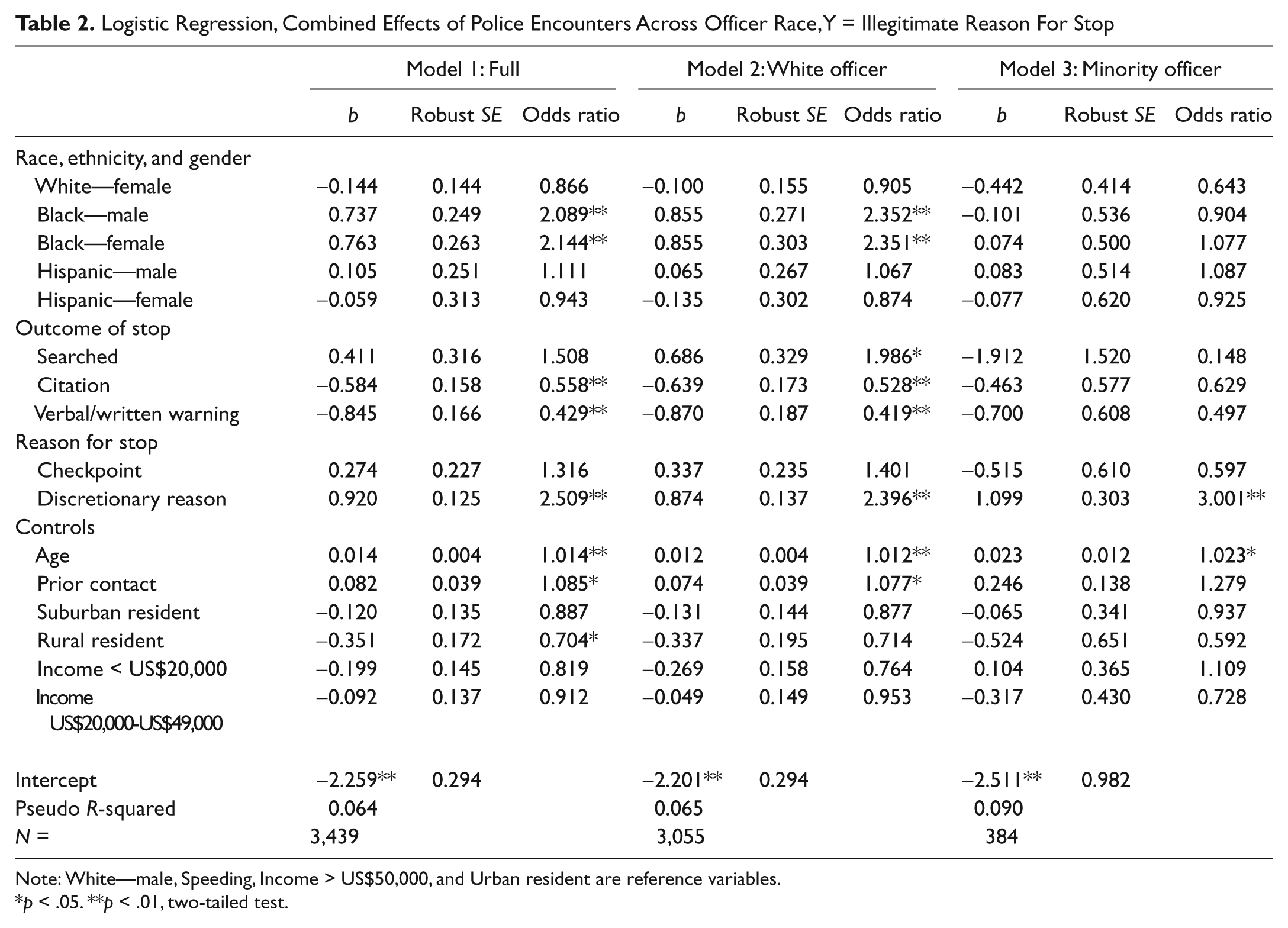
Note: White—male, Speeding, Income > US$50,000, and Urban resident are reference variables.
p < .05. **p < .01, two-tailed test.
In Model 1, as found in prior studies, Black citizens, both males and females, are more likely to report an illegitimate reason for the stop (OR = 2.089 and 2.144) during their last encounter with police, in comparison to White males. Interestingly, none of the other race-gender categories are statistically significant. Being searched does not seem to affect the perceived legitimacy of the traffic stop either. However, citizens who received a citation are significantly more likely to perceive the stop as having a legitimate reason (OR = 0.558), perhaps suggesting that respondents who were ticketed were commonly doing something illegal (e.g., speeding, running a red light) in the first place, and therefore perceive the stop as fair or justifiable. Citizens who received a warning are significantly less likely to perceive the stop as illegitimate (OR = 0.429), in line with the idea that those citizens who receive favorable outcomes will view the police overall more positively following a police encounter. We also theorized that citizens who are stopped for discretionary reasons are more likely to question the legitimacy of the police encounter. In fact, citizens who report being stopped for discretionary reasons are more than two times as likely to report that the officer stopped them illegitimately (OR = 2.509).
Of the control variables, age, prior contact with police in the past 12 months, and rural home neighborhood context yield significant effects. Citizens with more prior contact are slightly more likely to perceive the reason for the stop negatively (OR = 1.085). This effect is consistent with prior studies. Older citizens are also more likely to report the stop was illegitimate (OR = 1.014), while rural residents are less likely to report the stop was illegitimate (OR = 0.704).
Models 2 and 3 provide the conditional analyses based on officer race subsamples. In Model 2, among the race, ethnic, and gender groupings, we find that both Black males (OR = 2.352) and females (OR = 2.351) are significantly more likely to report that White officers stopped them for an illegitimate reason. There are no significant findings for White females, or Hispanic citizens of either gender. Also, similar to Model 1, receiving a citation decreases the likelihood of perceiving a stop as illegitimate as well as receiving a warning. Respondents who report a discretionary reason are two times as likely to perceive that they were not stopped for legitimate reasons. Moreover, citizens who were searched are two times as likely to report the stop as unjust when the officer was White.
Interestingly, the effects observed in Model 3 are quite different than those in Model 2. First, we find no significant effects for citizen race/ethnicity-gender categories. In addition, there are only two effects that yield a significant influence when the officer was a minority. Age displays a slight, positive influence on the likelihood to perceive an illegitimate stop (OR = 1.023). 10 Next, citizens stopped by a minority officer and who were given a discretionary reason for the stop (e.g., vehicular defect, seatbelt violation, no reason) are three times more likely than those who were stopped for speeding (OR = 3.001) to report they believe the stop was illegitimate. This is an important finding as it suggests that even Black officers are not protected against negative evaluations when the stop is perceived to be discretionary. 11 In the era of racial profiling, this finding highlights the idea that both minority and White officers are liable to be viewed negatively by citizens, when policing practices are perceived as less than justified. Overall, the effects reported in Model 3, particularly the null effects of race–gender variation, suggests that minority officers’ may be assessed more objectively by citizens than are White officers.
Discussion and Conclusions
Understanding citizen perceptions of police is an important concern for criminological scholars and policy makers alike (Engel, 2005; Smith et al., 2003; Weitzer & Tuch, 2005). Prior studies have consistently highlighted that racial and ethnic minorities are more likely to question the legitimacy of their encounters with police. However, despite this, few studies have explored the salience of officer race and how it influences citizens’ evaluations of police. The lack of consistent empirical attention in part results from limited availability of data sets that include officer race, a problem we avert by using the PPCS data set.
The main focus of the current study was to explore whether and how racial and ethnic variation in perceptions of police behavior varies across officer race. We specifically explored one primary research question: Do the combined effects of race, ethnicity, and gender influence evaluations of police behavior differently for White and for minority officers? Our results provide several important findings. First, we found that Black males and females are more likely to negatively evaluate police behavior when the stop is initiated by a White officer; even after controlling for the reported reason given for the stop. However, this is not the case when the officer is a minority. For minority officer stops, we found no citizen–race or ethnicity effects, and the primary predictor of citizens’ perceptions of the legitimacy of the stop was the “reason” given to the citizen by the officer. This finding suggests in part that citizens, particularly minority citizens, “rate” officer legitimately more objectively when they are stopped by minority officers. When minority citizens are stopped by White officers they seemingly viewed officer behavior more skeptically.
The findings presented here reiterate the findings from prior racial profiling and public opinion research which suggest that in general, minority group members, especially Black citizens, have a higher propensity for viewing police behavior and other parts of the criminal justice system as illegitimate. Interestingly, both Hispanic males and females yielded null findings in regard to skepticism of the police, suggesting that rifts between the police and citizens may be primarily focused in African American communities. Racial profiling in the United States has been traditionally geared toward the relationship between Black citizens and the police, and only until recently have Hispanic citizens been linked to biased experiences with and perceptions of the police (Engel, 2005; Weitzer & Tuch, 2006). However, this study’s findings suggest that Black citizens are still the most skeptical of police officers’ behavior and the most likely to perceive that they have been treated unfairly or perhaps racially profiled—especially when the officer is White.
Generally speaking, the results of this study appear to describe differential predictors of negative perceptions of the police, depending on the race of the officer. This differential effect is also suggestive of the idea that diversification practices of police forces may indeed be one viable option for improving citizens’ views of officer legitimacy for some racial groups. Despite this thinking, our results demonstrate that in some cases minority officers may tend not to incite the same type of initial skepticism that minority citizens seem to display when the officer is White.
Related to these findings, it is important to note that in a study by Engel (2005), using an earlier version of the Police–Public Contact Survey, the author found no significant effect of an interaction between officer and citizen race, which would suggest that perhaps minority groups’ hold lower perceptions of police irrespective of officer race. We believe the approach taken in this research effort builds on the work by Engel, by not only exploring the direct and interactive effects of officer race but also the combined effects of race, ethnicity, and gender. By assessing these combined effects we demonstrate that officer race may play a more substantial role in the development of citizens’ perceptions than previous findings would suggest.
The analyses employed here did not however reveal any significant influences of other relevant factors consistently considered in conflict theory literature; in particular, income and citizen area of residence (apart from the effect of rural residence in Model 1). These concepts touch on important underlying theoretical ties for understanding how race and gender effects may influence how citizens perceive police officers as well as other aspects of the criminal justice system. It is possible that the measures employed here that attempt to encompass class and neighborhood effects fail to fully capture how characteristics of a citizens’ neighborhood of residence and their socioeconomic status influence their views of and attitudes toward the police. Therefore, although the associated variables for neighborhood context and social class were not significant here, this does not suggest that these factors are not integral parts of how citizens perceive the police; future research should try to incorporate more sophisticated measures so to better understand how they interact with citizen and officer race.
Although this study does not directly assess officer diversification practices, the findings do provide some baseline support for the notion that some minority citizens tend to view minority officers less apprehensively or less critically than White citizens. Accordingly, the policy implications of this research are to push for better evaluative practices of diversification policies, and to try to better understand how different populations and communities react to a more racially diverse police force. Along these lines, police departments should be constantly aware of racial differences in citizens’ perceptions of officer behavior, and be sensitive to citizens’ judgments of procedural fairness in addition to fairness of stop outcomes (Engel, 2005; Tyler, 1990, 2001, 2004).
Furthermore, an important cautionary note is warranted in light of the current findings that are in part contrary to prior policing research suggesting that police forces with larger proportions of minority officers respond more harshly to minority citizens (e.g., Brown & Frank, 2006; Wilkins & Williams, 2008, 2009). These studies of officer behavior differ starkly from the current analysis of citizen perceptions, and it is quite possible that, if minority officers are significantly more punitive toward minority citizens, this trend is not the perceived norm, which would explain the seemingly counterintuitive finding here suggesting that minority citizens view minority officers more favorably. Regardless, if police force diversification works to improve public perceptions but to unnecessarily increase harsh treatment of certain groups, this raises concerns regarding the proper policy changes going forward and raises important implications for future research to examine possible disconnects between perceptions of the police and actual police behavior.
While the evidence presented here is important for planning and assessing future policy, there are certain limitations to this research that should be noted. First, there are other untheorized mechanisms not included in the models that might also influence racial and ethnic variations in perceptions of the police. These mechanisms include but are not limited to vicarious experience, the media, and more detailed community context measures. Past studies have highlighted vicarious experiences as an important influence on citizen perceptions of the police (Brunson, 2007; Reisig & Parks, 2000; Warren, 2011; Weitzer & Tuch, 2006), suggesting that citizen exposure to narratives from others regarding experiences with police misconduct and mistreatment will be as influential as one’s own personal experiences. Similarly, media and news reports can play a vital role in shaping citizens’ views of the police (Graziano, Schuck, & Martin, 2009; Warren, 2011; Weitzer & Tuch, 2006), particularly following exceptionally heinous accounts of police misconduct.
Last, although broad neighborhood context measures (urban, suburban, rural) are included in our analyses, prior studies have highlighted the important role neighborhood context, neighborhood crime rates, and community organizational factors play in the creation of opinions regarding the police (Hagan & Albonetti, 1982; Sampson & Bartusch, 1998), and it is likely that such factors have some degree of influence beyond the broad contextual measures included here. In addition, while we make significant mention of the relevance of racial profiling and biased policing research, we do not have a direct measure of racial profiling. Instead we contextualize the findings of the study within a broader framework of racial profiling, which presupposes that minority citizens will be skeptical of stops conducted by White officers because of the negative experiences that many Black citizens report with police along with the numerous investigations of racial profiling launched against U.S. law enforcement agencies.
Despite these limitations, our findings provide some evidence that understanding how officer race influences citizens’ evaluations of police will be crucial for the improvement of police–minority community relations. Toward this goal, data collection and survey strategies could gather more detailed information about traffic stops and more specifically, the race or ethnicity of the officer(s) that citizens encounter. Doing so allows researchers to better unpack the complex interaction between citizen and officer race, in attempts to improve racial and nonracial tension between officers and the citizens they serve.
Footnotes
Acknowledgements
The authors would like to thank Ryan Shields and the anonymous reviewers for their helpful comments.
An earlier version of this article was presented at the annual meeting of the American Society of Criminology, San Francisco, CA, 2010.
The author(s) declared no potential conflicts of interest with respect to the research, authorship, and/or publication of this article.
The author(s) received no financial support for the research, authorship, and/or publication of this article.