







Abstract
Although the impacts of the school context on victimization in adolescents are well researched in Western societies, empirical testing of the contextual impacts are lacking in China. The present study examines both violent and property victimization in adolescents in the Chinese setting from a lifestyle/routine activity perspective using a multilevel approach. These data are collected from a sample of 3,628 high school students in a southern city of China. The results of a hierarchical logistic regression model reveal that school contextual variables including school type, level of bonding to school, and school history are significant predictors of violent victimization while student-staff ratio is significant in predicting property victimization in adolescents. At the student level, a higher level of perceived school disorder and delinquency with friends is related with higher odds of both violent and property victimizations; bonding to parents and schools tends to reduce the odds of both violent and property victimizations, net of demographic factors. The results lend support to lifestyle/routine activity theories. Implications of the findings are highlighted in the section “Discussion and Conclusion.”
Introduction
The patterns and correlates of victimization have been well examined in relevant Western literature that identified important factors related to the victimization of adolescents, including both individual factors and contextual elements. For example, at the individual level, risky lifestyles and low self-control are found to increase the risks of victimization; conversely, bonding to family and school may reduce such risks (Lila, Herrero, & Gracia, 2008; Peguero, 2013; Ren, He, Zhao, & Zhang, 2017; Schreck, Miller, & Gibson, 2003). At the contextual level, exposure to both delinquency and crime in the school setting (Bouchard, Wang, & Beauregard, 2012; Lila et al., 2008; Peguero, 2013; Schreck et al., 2003), and neighborhood elements such as racial composition (Schreck et al., 2003), exert influence on the likelihood and rate of victimization. Particularly for adolescents, the school setting plays an especially important role in their victimization (Bouchard et al., 2012; Lila et al., 2008; Schreck et al., 2003).
There is a lack of relevant research on this topic in China. Although criminological research has drawn great attention from both Western scholars and criminologists in China (Zhang, 2008), it is believed that empirical work is lacking in this area (Hebenton & Jou, 2013), and remains nascent in its development (Zhuo, Messner, & Zhang, 2008). The limited empirical studies that are available focus on studying crime and delinquency patterns and related factors (e.g., Friday, Ren, Weitekamp, Kerner, & Taylor, 2005; Webb, Ren, Zhao, He, & Marshall, 2011; Z. Wei, Homel, Prichard, & Xu, 2004; Zhang, 2008). Studies on adolescent victimization are lacking (Ren et al., 2017; Zhuo et al., 2008).
The present study attempts to fill the void by examining victimization of adolescents from both student and school perspectives using a random sample of more than 3,600 students from mainland China. The study may contribute to much needed research on this subject in three ways.
First, current Western theories have received little empirical validation from other parts of the world distinctively different from the West, and China in particular (Ren et al., 2017). Factors unique to the Chinese setting that are strongly associated with adolescent victimization have not been well identified (Ren et al., 2017). This research will include variables developed in relevant Western studies and theories, and other important factors specific to the Chinese context to examine their impacts on adolescent victimization.
Second, Western studies have revealed that victimization of adolescents is closely associated with the school context, including incidents of violence in schools, school types, and security measures taken in schools (Crawford & Burns, 2015; Foster & Brooks-Gunn, 2013). Given the limited research in this specific area, it is imperative to use a multilevel approach to study adolescent victimization in China.
Third, adolescents are often considered crime-prone and are among the most vulnerable to victimization (Hamby & Finkelhor, 2001). In fact, early adolescence is a period of heightened bullying and violent victimization (Foster & Brooks-Gunn, 2013; Macmillan, 2000). Although China has arguably the world’s largest juvenile population, scholarly research using either official or self-reported delinquency data has found that delinquency rates in China are much lower than in many Western countries (Friday et al., 2005; Webb et al., 2011; Y. Wei, Xu, Lu, Kong, & Wang, 2014). Given the low delinquency rates and the relationship between delinquency and victimization in adolescents, the question remains as to whether victimization rates are as low as delinquency rates in China, and what the characteristics or patterns of victimization are among Chinese youth.
The aim of the study is threefold. First, it will explore the prevalence of violent and property victimization among Chinese adolescents. Second, it attempts to discover patterns of victimization (for example, when and where such incidents are most likely to occur). Third, it will analyze the correlates of victimization primarily from lifestyle and routine activity theoretical perspectives using a multilevel approach.
Literature Review
Theoretical Perspectives
Both lifestyle and routine activity theories have been examined and deemed effective in accounting for the variations in victimization of both the adult and adolescent population (Bouchard et al., 2012; Peguero, 2013). The main premise of the lifestyle theory is that an individual’s likelihood of personal victimization largely depends on his or her lifestyle; for example, people who live in unguarded areas are at the mercy of motivated offenders (Hindelang, 1976). Routine activity theory emphasizes the convergence of three factors in time and space: the presence of the motivated offender, the availability of a suitable target, and the lack of capable guardians. When these factors coexist at the same time and in the same place, crime victimization is likely to occur (Cohen & Felson, 1979).
Both theories assume that crime victimization is the result of opportunity; both rely on four basic concepts: proximity to criminals, time of exposure to criminals, target attractiveness, and guardianship (Cohen & Felson, 1979; Cohen, Kluegel, & Land, 1981). For instance, the length of time an individual spends away from their household increases exposure to motivated offenders; living in a neighborhood or on campus with high crime rates enhances one’s proximity to crime (Cho, 2017).
Lifestyle and routine activity theories have received empirical support through studies measuring adolescent and school-based victimizations. Garofalo, Siegel, and Laub (1987) conducted a pilot study on school-related victimization among adolescents using the interviewer narratives of the National Crime Survey in the United States. The study found that a large proportion of school-related victimizations stems from peer interactions in the course of routine daily activities. Students represent both potential offenders and victims who come in contact with each other and who lack capable guardians. Therefore, school victimization might be best understood as a function of opportunity.
Miethe and Meier (1990) proposed a “structure-choice” theoretical model emphasizing both macro-dynamic forces that contribute to a criminal opportunity structure and micro-level forces that foster the selection of particular crime targets (p. 245). Using data from 5,271 respondents in the British Crime Survey, Miethe and Meier found that structural components (namely, proximity and exposure to motivated offenders) are more consistently related to victimization experiences than micro-choice components (namely, attractiveness and guardianship; p. 243). They further suggested that a number of theories of criminal behavior may be compatible with theories of victimization. They noted that the social bonding theory of Hirschi (1969) is one of them (Miethe & Meier, 1990). Adolescents who had stronger social bonds are believed to be more likely to benefit from social guardianship, and seek protection when facing threats from people and institutions with whom they strongly bond (Bouchard et al., 2012; Schreck et al., 2003). In other words, prosocial attachments, such as positive school bonds, can foster guardianship (Schreck & Fisher, 2004; Wilcox, Tillyer, & Fisher, 2009).
Previous Research
Similar to crime patterns, victimization does not occur at random. For adolescents, in particular, a relatively high proportion of their victimization incidents occur at school. Several studies have documented both individual factors and contextual characteristics associated with adolescent victimization (Bouchard et al., 2012; Cho, 2017; Peguero, 2013; Schreck et al., 2003; Wilcox et al., 2009).
Individual factors
Research on adolescent victimization has identified major protective and risk factors in the study of adolescent victimization. Protective factors at the individual level include social guardianship (such as fellow students and teachers as potential guardians), strong social bonds (Felson, 1986, 1998; Schreck et al., 2003), positive attitudes toward or perception of school (George & Thomas, 2000; Wilcox et al., 2009), and social capital (Bouchard et al., 2012). Specifically, adolescents with strong bonds to their parents or schools are likely to receive a higher level of guardianship around themselves and their belongings and, therefore, experience less victimization (Felson, 1986, 1998; Schreck et al., 2003; Schreck, Wright, & Miller, 2002; Wilcox et al., 2009). Compared with students who have more social resources (including social bonds), those who are socially isolated from adults or friends may lack guardianship and may be perceived as more vulnerable targets by potential offenders (Bouchard et al., 2012). Furthermore, research indicates that control in the form of conventional social bonds or attachments may work better compared with control exercised by police or electronic security (Wilcox et al., 2009).
Individual risk factors include contact with delinquent peers (Sampson & Lauritsen, 1990; Schreck et al., 2003; Schreck et al., 2002), adolescents’ own delinquency or risky lifestyles (Augustine, Wilcox, Ousey, & Clayton, 2002; Wilcox et al., 2009), individual or target attractiveness (Fisher, Sloan, Cullen, & Lu, 1998; Miethe & Meier, 1990; Schreck et al., 2003; Wilcox et al., 2009), hostile attitudes toward school (Schreck et al., 2003), and low self-control (Ren et al., 2017). These risk factors tend to interact with demographic characteristics to exert an influence on victimization. Hindelang, Gottfredson, and Garofalo (1978) argued that demographic characteristics indirectly influence victimization through their impact on lifestyle. Cohen et al. (1981) also stressed that “socio-demographic characteristics are important, because the resulting lifestyle similarity is likely to bring potential victims into direct contact more often than when such characteristics are not shared” (p. 509).
U.S. crime and victimization statistics have consistently shown that individuals who are young, male, and African American are more likely to become victims of crime (Siegel, 2014). The higher level of victimization experienced among these groups is probably due to the fact that their lifestyles expose them to crime and criminals (Schreck et al., 2003). Wilcox et al. (2009) further contended that delinquency and risky lifestyles generate opportunity for victimization because they place individuals in peer groups with other offenders without capable guardians.
School contextual factors
At the school level, exposure and proximity to crime and criminal offenders help explain why some students studying in schools are more likely to be victimized (Bouchard et al., 2012; Miethe & Meier, 1990). For example, a certain percentage of delinquents can be a risk factor. Schools with a greater percentage of delinquents may expose students to a higher level of victimization; the presence of criminal gangs on campus indicates likely offenders, which increases the likelihood of victimization of other students (Schreck et al., 2003). However, the presence of teachers and school administrators increases the guardianship of students and their belongings; schools with which students have a strong bond are able to provide necessary help to the students when facing victimization or crime threat (Garofalo et al., 1987; Schreck et al., 2003). In addition, risk of crime victimization differs between different types of schools (Bouchard et al., 2012; Foster & Brooks-Gunn, 2013; Lila et al., 2008). Unlike similar Western victimization studies that often categorize schools into public and private (Lila et al., 2008; Schreck et al., 2003), the majority of high schools in China are run and supported by central or local government at various levels. Students completing junior high school decide whether to enter regular or vocational high school—which largely determines their future careers. Western studies on juvenile delinquency have found significant impact of educational tracking (regular academic track vs. vocational track) on adolescents’ self-reported delinquency or misconduct (Crosnoe, 2002; Houtte & Stevens, 2008; Savolainen, Hughes, Hurtig, Ebeling, & Taanila, 2013). Specifically, adolescents who attend vocational high schools or on vocational track are more likely to engage in crime and make friends with delinquent peers (Crosnoe, 2002; Houtte & Stevens, 2008; Savolainen et al., 2013). As a result, these adolescents are probably more likely to expose to crime and become victims of crime.
A review of relevant literature reveals a number of studies that explored victimization of adolescents in school from lifestyle and routine activity theoretical perspectives using a multilevel approach. For example, Schreck et al. (2003) examined risk factors of school victimization among 6,418 schoolchildren in Grades 6 through 12 using the 1993 National Household and Education Survey in the United States. The study considered three levels of variables (individual, school, and community) and their impacts on theft and violent victimizations. The findings suggest that although community variables exert some effect on adolescent victimization in the schoolyard, the most salient risk factors are the presence of likely offenders at school as well as individual students who have delinquent characteristics and criminal friends (Schreck et al., 2003).
Another study by Wilcox et al. (2009) examined gender differences in adolescent victimization using data collected between 2001 and 2004 from 10,522 students in 111 middle and high schools throughout Kentucky. The study aimed to test whether criminal opportunity-related indicators placed schoolgirls at heightened risk of theft and physical assault victimization. The results of hierarchical logistic regressions confirm that measures of criminal opportunity were significantly related to theft and assault for both sexes and that the effect of risk and protective factors for victimization were heightened for girls.
More recently, Cho (2017) applied self-control and opportunity perspectives to examine the effects of both individual factors (including juvenile offending, delinquent peer association, parental attachment, and low self-control) and a school-level factor (collective efficacy) on adolescent victimization in South Korea using a sample of 2,844 adolescents aged 11. The findings lend support to both self-control and lifestyle/routine activity theories. All these studies highlight the importance of studying the school context and its role in adolescent victimization. The lifestyle and routine activity approaches received strong empirical support at both individual and school levels.
Research on victimization in contemporary China
A thorough examination of relevant research resulted in only three large-scale studies that examined criminal victimization in China. Other research conducted in China is largely descriptive. The first large-scale study was the Beijing Survey conducted in 1994 as part of the International Crime Victim Survey (ICVS). The study was conducted in the four urban districts and one suburban district in Beijing, and found that the victimization rate was 12.6%, a rate much higher than the crime rate based on official statistics (Bakken, 2007). The survey, however, left out the vast “floating population”—people without Beijing residency and comprising several millions living in Beijing. This population group is probably more likely to be victimized by various types of crime (Bakken, 2007). In addition, the study was not specifically designed to study victimization in adolescents.
The second large-scale victimization survey was the Tianjin Survey conducted in collaboration with Western researchers and local scholars from the Tianjin Academy of Social Sciences. The study obtained 2,474 valid questionnaires from adult respondents aged 18 years or older. It identified a set of risk and protective factors determining crime victimization, including risky lifestyles (such as venturing away from home for leisure and work), neighborhood poverty, and level of neighborhood deviance and crime (Zhuo et al., 2008). The study focused on victimization of adults in Tianjin city. Adolescents’ victimization was not covered.
The third study by Ren et al. (2017) examined the relationship between self-control, risky lifestyles, and victimization among adolescents in a large sample of 2,961 high school students from a prefectural city of Guangxi, China. To the author’s best knowledge, this study is probably among the first of the large-scale empirical studies to explore victimization and its correlates among adolescents in China. The study reveals that low self-control is clearly associated with both violent and property victimizations. In addition, risky lifestyle factors partially mediate the effects of low self-control on victimization. The study, however, did not take into consideration school contextual factors and their impacts on victimization among the adolescents studied.
Method
The Sample
These data were collected from a prefecture city in the Guangxi Zhuang Autonomous Region in southern China. The city has a population of approximately 3.8 million residents and occupies 4,247 kilometers. It has a rich history spanning more than 1,000 years. Data were gathered from all 22 regular high schools (including the only private school) and five vocational high schools in the city using a “multistage cluster” sampling technique. In both regular and vocational high schools, one class was randomly selected from each grade (altogether, three classes from Grades 10 to 12). Four regular high schools selected through this process declined the request to allow Grade 12 students to participate in the survey due to preparation for the highly competitive National College Entrance Examination. Consequently, an extra class in either Grade 10 or 11 was randomly selected for the study. In vocational high schools, students in Grade 12 are generally required to do internships (mostly outside the city) in their third year of study. In only one of the five vocational schools, 12th graders were available to take part in the study. As a result, an extra Grade 10 or Grade 11 class from the other four schools was randomly selected. The survey instrument was pretested in a small group of students from Grades 10 to 12.
The self-administered survey was conducted in classrooms without the presence of teachers or school administrators. Students were informed of the purpose of the study and assured of anonymity and voluntary participation in the survey. The total sample size achieved was 3,628 respondents, with 2,961 from 22 regular high schools and 667 from five vocational high schools. The response rate attained was 96.9%—quite high by Western standards, but consistent with similar studies conducted in China (Webb et al., 2011; Zhuo et al., 2008).
Dependent Variables
The dependent variables are violent victimization and property victimization. As to violent victimization, respondents were asked if they had experienced any of the following violence during the 12 months prior to the survey: robbery, sexual harassment or assault, victimization by protection rackets, threatened with serious injury, beaten up with fists or kicks, and injured by weapons such as sticks or knives. This variable was dichotomous, as more than 80% of the respondents reported never being victims of any such violent victimization. Few students experienced combinations of these incidents. Similarly, property victimization measures if the respondents had experienced the following incidents during the 12 months prior to the survey: personal belongings being stolen or vandalized. For both violent and property victimization variables, respondents who answered affirmatively to any of the incidents were coded as “1,” with “0” denoting a negative response to an incident.
Independent Variables
There are two levels of independent variables, namely school contextual variables and student individual variables. These variables are designed and coded according to previous studies and lifestyle and routine activity theoretical perspectives.
School contextual variables
There are six school-level variables in the present study. Three of them are an aggregation based on the student sample, including delinquency rate, mean level of bonding to school, and mean economic condition. The remaining three variables, namely, school type, staff-student ratio, and school history, were constructed using information collected through interviews with school administrators. It has been a common procedure in multilevel analysis to aggregate individual-level variables to higher levels (Hox, 2010). In most cases, aggregation at a higher level is performed by using the mean value of a lower-level explanatory variable (Hox, 2010). The delinquency rate examines a school’s exposure to crime and potential offenders in general. It is measured as a percentage of adolescents who had engaged in delinquent acts with their friends. The mean level of school bonding is estimated as the average level of students’ bonding in each school. The mean economic condition is constructed using the mean scores of economic conditions of the adolescents’ families in each school. This variable explores target attractiveness at the school level. In addition, the staff-student ratio taps into guardianship at the school level, and these data were obtained through interviews with school administrators. Schreck et al. (2003) argued that although teachers and school administrators act as guardians, a large student body may interfere with guardianship to affect victimization. As a result, staff guardianship is probably better measured by the ratio of staff to students instead of the number of staff at a school. The variable measuring school type is binary, with “1” representing regular high schools and “0” representing vocational high schools. The model is also controlled for school history, gauged by the years of establishment of the schools.
Student individual variables
Four individual-level variables were included in the present analysis: perceived school disorder, delinquency with peers, bonding to parents or guardians, and bonding to schools. Students’ exposure to crime was measured through “perceived school disorder.” The respondents were asked if the school they attended had violent and property crime incidents such as thefts and fighting. Response categories ranged from 1 (“strongly disagree”) to 4 (“strongly agree”). The Cronbach’s alpha for this scale was .80.
Delinquency with peers taps into adolescents’ risky lifestyles. It was measured by asking respondents how frequently they had done the following during the 12 months prior to the survey: truancy, bus ride without paying for the tickets, smoking, drinking, vandalism, harassing others, gambling, taking illegal drugs, stealing the valuables, robbery, and group fighting. The response categories ranged from 1 to 4 (i.e., 1 = “never,” 2 = “sometimes,” 3 = “often/frequently,” and 4 = “always”). The Cronbach’s alpha for this variable was .88. As this variable was highly skewed and not many youths had committed two or more delinquent acts, it was recoded as dichotomous, with “1” representing students who had ever done any of the 11 delinquent acts and “0” representing students who had not done them at all.
The two social attachment variables, bonding to parents or guardians and bonding to school, are scales derived from social bonding theories. The former gauges a respondent’s relationship with parents or guardians, and respondents were asked how well they got along with their parents or guardians. Response categories ranged from 1 (“unable to get along”) to 4 (“get along very well”). The mean score of the two items was used to measure bonding to parents or guardians. The Cronbach’s alpha for this scale was .78. Similarly, school bonding is a scale consisting of four items, namely, “if I had to move I would miss my school”; “I like my school”; “when I behave well, my teachers will notice it and praise me for it”; and “my schools provide extracurricular activities.” This scale covers both students’ emotional attachment to school in general, and their attachment to teachers and after-school activities (Ren et al., 2017). The response categories ranged from 1 (“strongly disagree”) to 4 (“strongly agree”). The Cronbach’s alpha for this scale was .70.
Demographic Variables
Eight demographic variables were included in the analysis, namely, “gender,” “age,” “ethnicity,” “intact family,” “family economic status,” “only child,” “campus resident,” and “rural migrant worker family.” The latter three were specifically tailored to the Chinese setting. Gender was made a binary variable, with “1” being “male” and “0” being “female.” Age was an interval variable ranging from 13 to 28 years. For ethnicity, “1” represented “Han nationality” and “0” represented “Other ethnicity.” “Intact family” was expressed as a binary variable, with “1” representing families with both parents cohabiting, married, or living together, and “0” representing broken families. “Family economic status” was a subjective measure of family economic situations ranging from “1” being “poor” to “4” being “well-off.”
In consideration of the Chinese social setting, the variable “only child” was included in awareness of China’s one-child policy. A participant who was the only child in the family was coded as “1”; otherwise, she or he was coded as “0.” Unlike in the West, it is common for high school students in China to live on a residential campus, especially so in many developing cities where many students come from rural or relatively remote areas (Ren et al., 2017). The variable coded “1” denoted a “campus resident,” with “0” being an “off-campus resident.” The last variable, “rural migrant worker family” measured whether a rural respondent’s father or mother was doing labor work (typically construction) in cities. With rapid urbanization processes that are going on in China, it has become quite common for rural peasants to come to the cities to find a job, leaving their children in the rural villages. Research has shown that the peasants-turned “floating population” (namely, migrant workers) and the children they leave behind are more likely to commit crime and become victims of crime (W. Wang, 2016; Y. Wei et al., 2014).
Statistical Analysis
Hierarchical Linear Modeling 6 (HLM6) software was used to estimate parameters for both violent and property victimization among high school students. Because both dependent variables were dichotomous, hierarchical logistic or Bernoulli Hierarchical Generalized Linear Model (HGLM) analyses were applied. In the Bernoulli analysis, all estimates were based on Laplace and employed the full maximum likelihood estimate (Raudenbush, Yang, & Yosef, 2000). The percentages of missing values for variables in the analysis were rather small, ranging from “no missing” (for example, school type) to 6.6% “missing” (for example, delinquency with friends). The missing values were deleted while running the analysis.
A Bernoulli (binomial) model does not have a separate error-variance term in the first level of the model because the variance is a function of the population mean (Luke, 2004). As a result, both Tables 3 and 4 present only the variance components at the school level. In addition, to facilitate interpretation of results, binary variables were not centered, but interval variables were centered in the grand mean when running the analysis. Because the study was exploratory, it gauged mainly how school contextual variables affected the likelihood of individual victimization. No cross-level interaction terms were examined.
Results
Descriptive Statistics
Descriptive statistics of the sample are presented in Table 1. The results show that the percentage of regular high school students exposed to either violent crime (15.2% vs. 23.5%) or property crime (32.4% vs. 34%) is lower than that of vocational high school students. At the school level, the mean levels of both school bonding (2.84 vs. 3.13) and delinquency rates (7.18 vs. 12.7) are lower for regular high schools than vocational high schools. The staff-student ratio (0.07 vs. 0.06) and mean economic condition (2.38 vs. 2.26), however, are higher for regular high schools. In addition, regular high schools in general have longer histories compared with vocational high schools (59.77 vs. 44.80). At the student level, the mean scores of bonding to parents (or guardians) for both types of schools are similar and fairly high (about 3.45 out of 4). The mean level of perceived school disorder is 2.13 for regular high schools and 2.17 for vocational high schools (out of 4). More students from vocational high schools (45.4%) claimed to have conducted delinquent acts with their friends compared with those from regular high schools (40.6%).
Descriptive Statistics of All Variables in the Analysis.
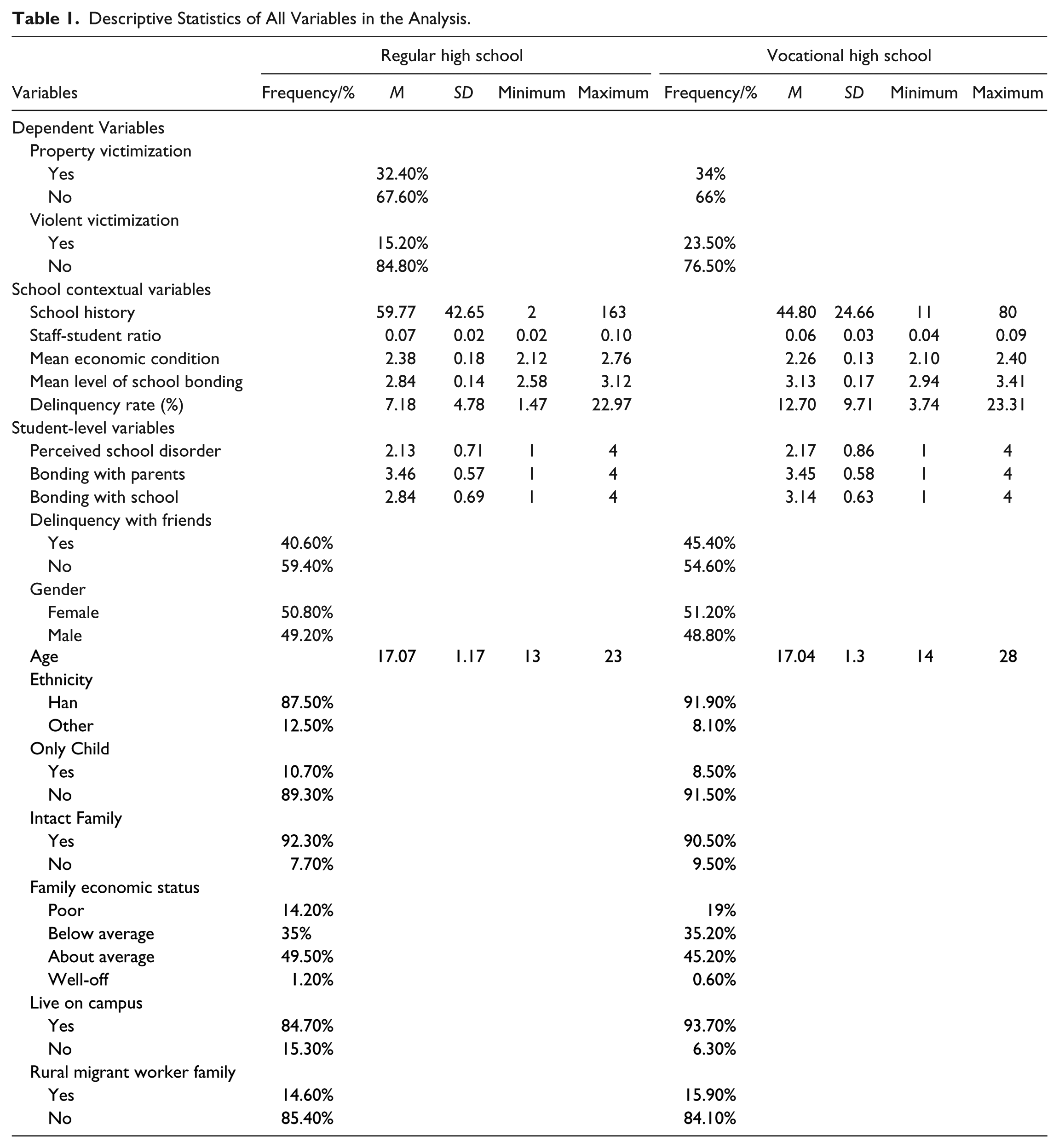
In general, demographic characteristics of regular high schools are similar to those of vocational high schools. For the overall sample, around 49% of the participants are male. The majority of students are of Han nationality (88%). Ethnic minority students account for about 12% of the students surveyed, which closely resembles the proportion of the city’s ethnic minority population (close to 11%). The mean age is 17 years, with the majority of students aged between 15 and 19 years (97.5%). Approximately 9.5% of students are the only child in their family, and around 15% of them come from rural migrant worker families. More than 90% of students are from intact families with both parents being married or living together. More than 80% of students claimed that their family economic conditions were about average or a little below average; more students from vocational high schools claimed to be from poor families. Unlike many Western countries, more than 80% of students live on campus, with the percentage higher for vocational high schools (93.7%) compared with regular high schools (84.7%; see Table 1).
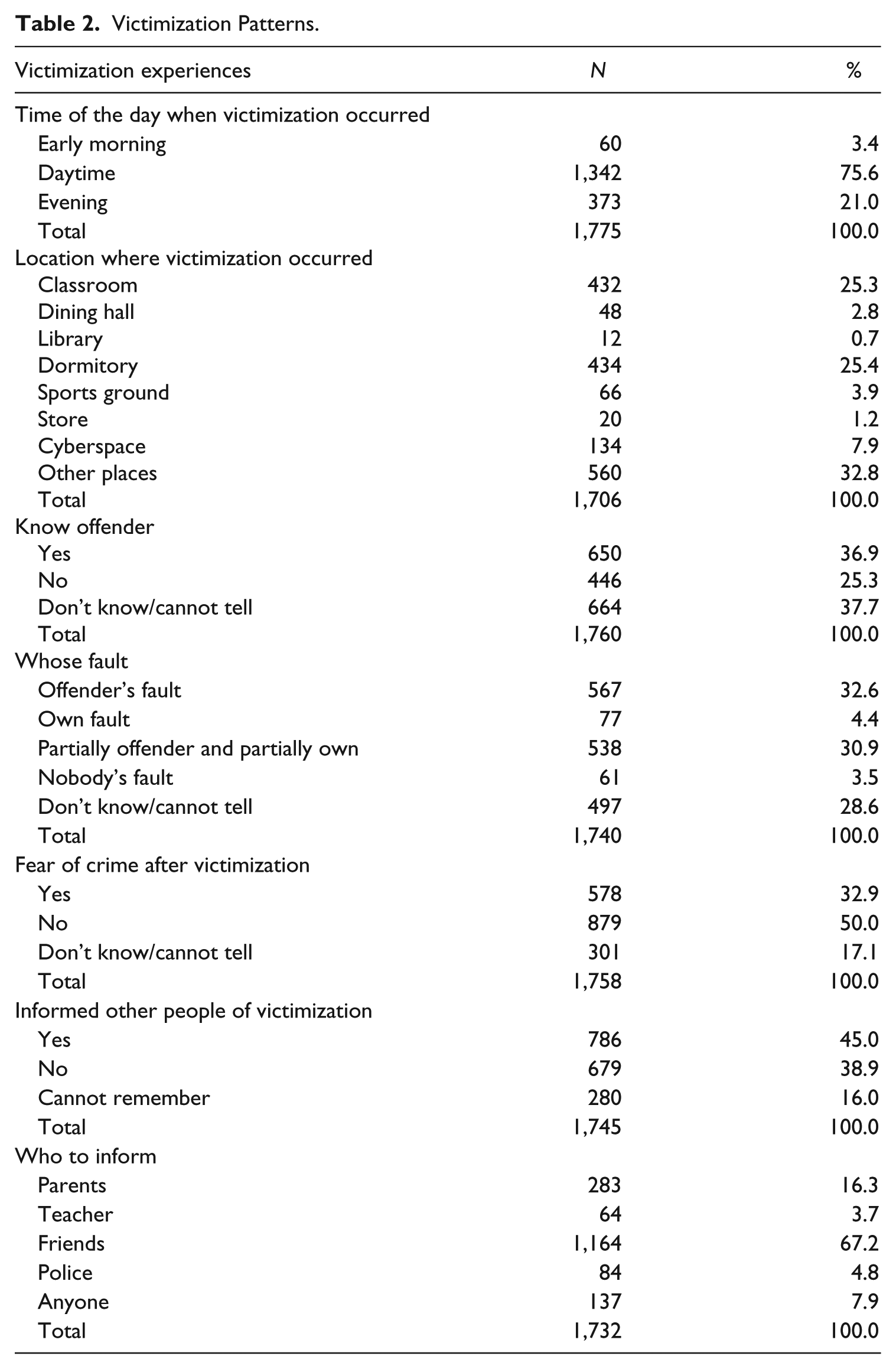
Table 2 presents victimization patterns for both regular and vocational high school students. Students were asked to answer the questions related to their most recent victimization experience. Results show that among respondents who experienced victimization, the majority (75.6%) of crimes occurred during the daytime and on campus (58.1%), including in classrooms, dining halls, libraries, dormitories, and sports grounds. About a quarter of respondents knew their offender, and a third (32.6%) believed it was completely the offender’s fault. Half (50%) of the victims believed their recent victimization experience had no impact on their fear of crime. Around 45% of the victims informed other people of their most recent victimization experience. Two thirds (67.2%) were more willing to tell their victimization incidents to friends, followed by parents (16.3%), police (4.8%), and teachers (3.7%).
Victimization Patterns.
Hierarchical Logistic Regression Results
Violent victimization
Table 3 presents results of hierarchical logistic models on violent victimization. Model 1 is an “intercept-only” model. The intraclass correlation coefficient (ICC) obtained from this model shows that approximately 15.14% of variance in violent victimization may be explained by school-level variables. Model 2 is a level-1 model consisting of all individual variables. Compared with model 1, it reduced prediction error by 67.44% at the school level. The hypothesis test result (model comparison test) shows that model 2 fits the data better than model 1 (χ2 = 1860.793, degrees of freedom [df] = 12, p < .001). The third model is the full model with both school contextual and individual variables. Compared with model 1, it reduced the prediction error by 96.51% at the school level. The model comparison test result confirms that model 3 fits the data better than model 2 (χ2 = 13.392, df = 6, p < .05). It indicates that multilevel analysis is appropriate and necessary.
Results of HGLM Logistic Regression Models on Violent Victimization (N = 3,555).
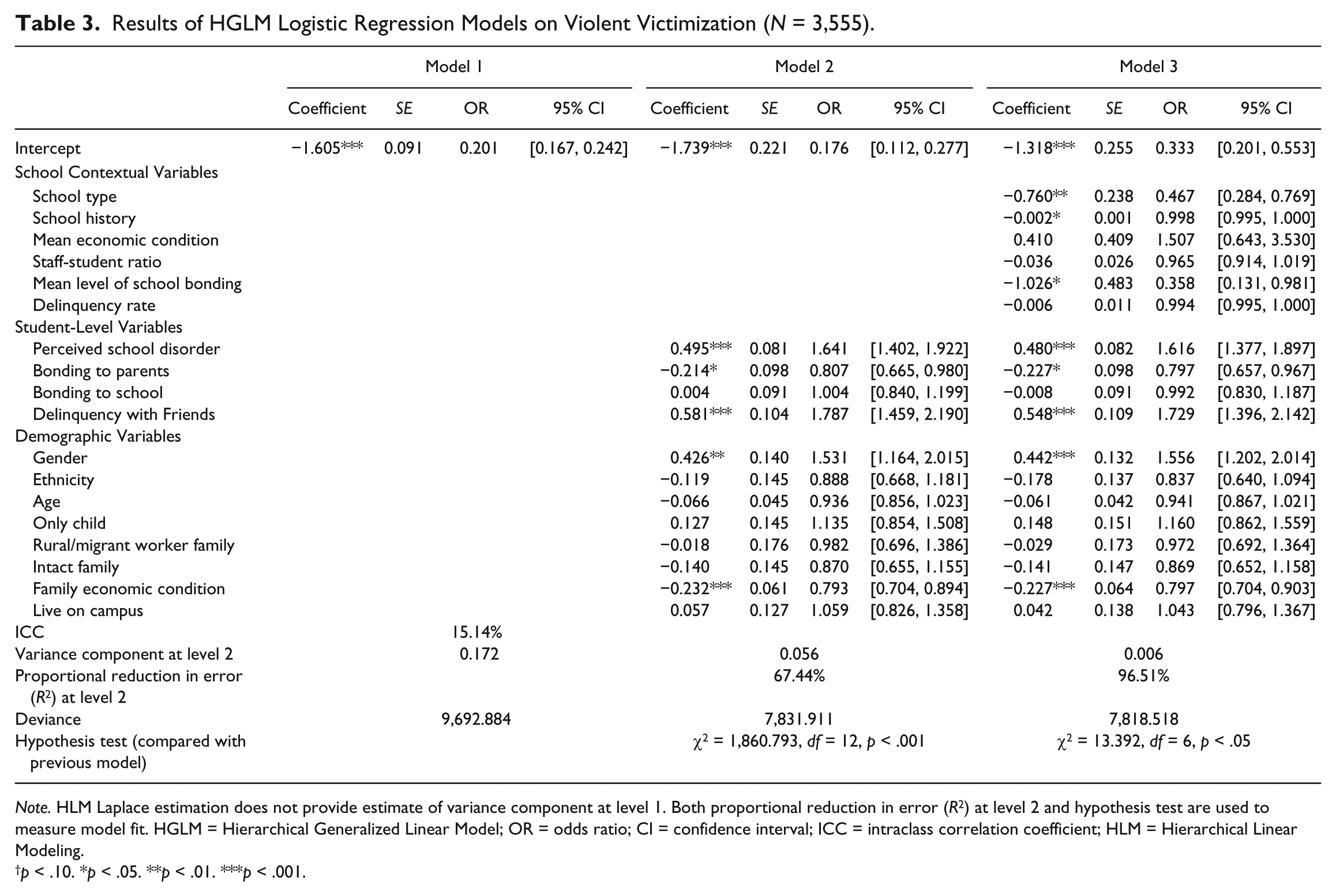
Note. HLM Laplace estimation does not provide estimate of variance component at level 1. Both proportional reduction in error (R2) at level 2 and hypothesis test are used to measure model fit. HGLM = Hierarchical Generalized Linear Model; OR = odds ratio; CI = confidence interval; ICC = intraclass correlation coefficient; HLM = Hierarchical Linear Modeling.
p < .10. *p < .05. **p < .01. ***p < .001.
Results of model 3 reveal that at the school level, students from regular high schools have lower odds of violent victimization compared with those from vocational high schools (odds ratio [OR] = 0.467, p < .01); students from schools with longer history have lower odds of violent victimization, but the effect size is small (OR = 0.998, p < .05); a higher mean level of school bonding tends to decrease the odds of student victimization (OR = 0.358, p < .05). At the student level, both perceived school disorder (OR = 1.616, p < .001) and delinquency with friends (OR = 1.729, p < .001) are positively related with violent victimization; bonding to parents is negatively related with victimization (OR = 0.797, p < .05). In addition, male students had higher odds of violent victimization (OR = 1.556, p < .001); students with better family economic conditions are less likely to be victimized (OR = 0.797, p < .001).
Property victimization
Table 4 presents results for property victimization. The ICC obtained from model 1 shows that a relatively small variance in property victimization (5.9%) may be explained by school-level variables. Model 2 reduced prediction error by 58.67% at the school level. The model comparison test result shows that model 2 fits the data better than model 1 (χ2 = 2147.292, df = 12, p < .001). The full model (model 3) with both school contextual and individual variables reduced prediction error by 96.51% at the school level. The model comparison test result, however, suggests that the full model is not significantly better than model 2 (χ2 = 5.974, df = 6, p > .05). It indicates that school-level variables fail to account for much of the variance in property victimization.
Results of HGLM Logistic Regression Models on Property Victimization (N = 3,579).
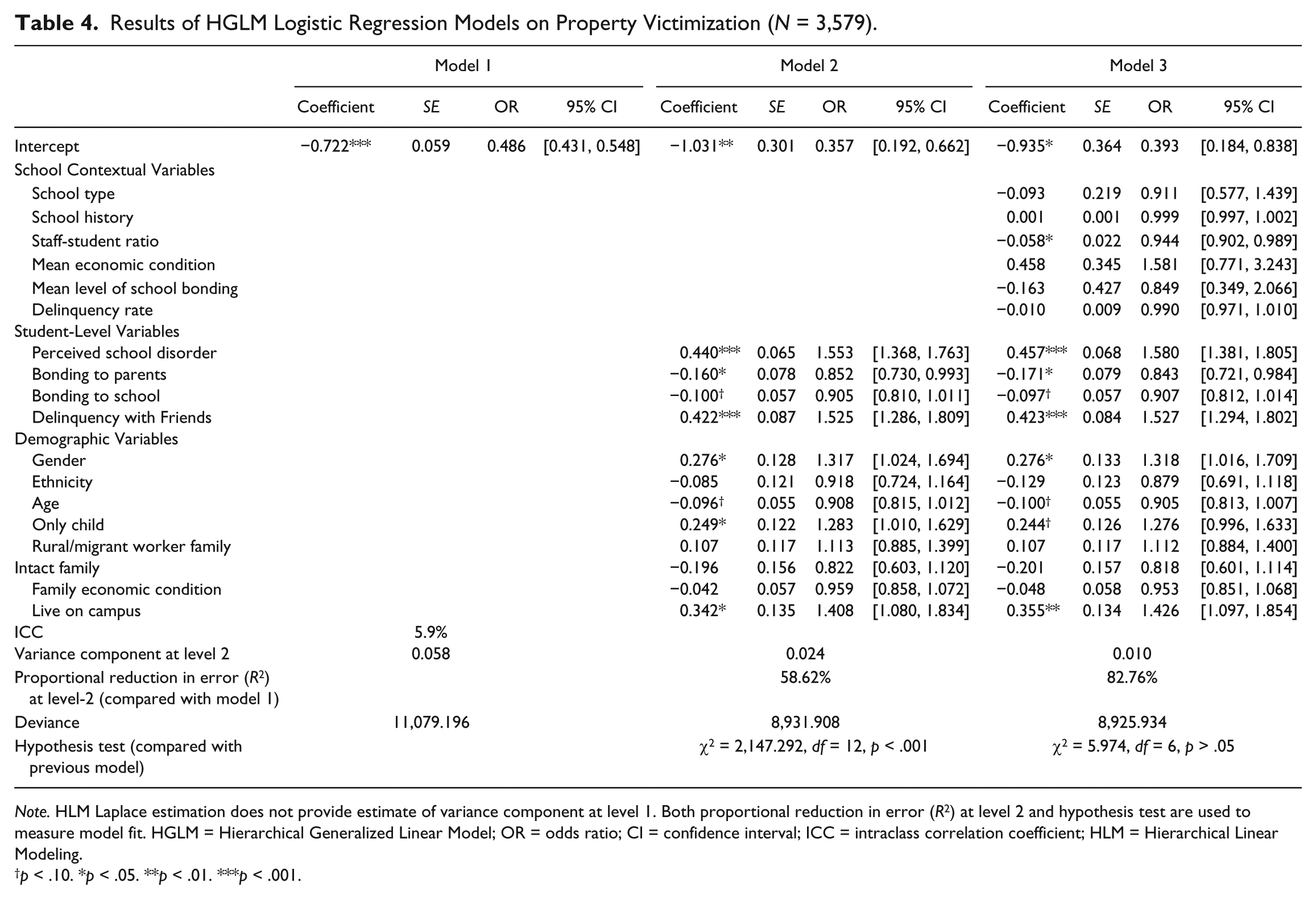
Note. HLM Laplace estimation does not provide estimate of variance component at level 1. Both proportional reduction in error (R2) at level 2 and hypothesis test are used to measure model fit. HGLM = Hierarchical Generalized Linear Model; OR = odds ratio; CI = confidence interval; ICC = intraclass correlation coefficient; HLM = Hierarchical Linear Modeling.
p < .10. *p < .05. **p < .01. ***p < .001.
Results of model 3 reveal that at the school level, only the staff-student ratio is a significant predictor of property victimization: Higher staff-student ratios tend to reduce the odds of property victimization in adolescents (OR = 0.944, p < .05). At the student level, both perceived school disorder (OR = 1.580, p < .001) and delinquency with friends (OR = 1.527, p < .001) are positively related with property victimization; both bonding to parents (OR = 0.843, p < .05) and school (OR = 0.907, p < .10) are negatively related with victimization. In addition, being a male student (OR = 1.318, p < .05) and living-on-campus (OR = 1.426, p < .01) increase the odds of property victimization. Older students had lower odds of victimization (OR = 0.905, p < .10), while students who are the only child in the family are more likely to experience property victimization (OR = 1.276, p < .10). It should be noted that the effects of the latter two demographic variables are rather small and marginal.
Discussion and Conclusion
Findings of the present study reveal that crime victimization is not rare among Chinese adolescents. Adolescents’ violent and property victimizations are 16.7% and 32.7%, respectively. Despite different measures employed, the violent victimization rate is much lower than that reported by studies conducted in the United States, and the rate of property victimization is similar to that in Western studies. For example, Finkelhor, Ormrod, Turner, and Hamby (2005) made use of a national representative sample in the United States and found that adolescents aged between 13 and 17 years had a high rate of violent victimization of 523 for every 1,000 students (or 52.3%). The rate for property victimization was 335 for every 1,000 students (or 33.5%). A slightly lower rate (30.8% for overall victimization) was found in Spain by Lila et al. (2008) using a representative sample of 1,980 students aged between 13 and 18 years.
The findings regarding victimization patterns are consistent with previous studies conducted in Western societies (Coombs, Paulson, & Richardson, 1991; Simons-Morton, Haynie, Crump, Eitel, & Saylor, 2001; Wilcox et al., 2009). First, the majority of victimization incidents took place during the daytime and on campus (in the classroom, dormitory, dining hall, library, and sports ground). A similar pattern was found in the United States (Wilcox et al., 2009). The finding highlights the importance of studying school contextual factors and their impacts on adolescents’ victimization. Second, two thirds of adolescents who had prior victimization experiences chose to inform their friends about their incidents, followed by parents. Only a small percentage of students chose to report their victimization to the police or to their teachers. This indicates that peer influence is likely greater than parental influence or control among these adolescents (Coombs et al., 1991; Simons-Morton et al., 2001). The fact that most of the students experienced no fear after their victimization helps explain why only a small percentage reported incidents to the police. It also indicates that conventional control, such as social bonds or attachments, may work better in reducing victimization in schools than formal police activities (Wilcox et al., 2009).
The findings of the HGLM analyses lend support to lifestyle and routine activity theories. The direction of all significant effects on violent victimization are consistent with findings in many previous studies conducted in Western societies (e.g., Schreck et al., 2003; Wilcox et al., 2009). Specifically, the findings indicate that social attachment or bonding are important protective factors, while exposure to potential offenders and risky lifestyles increases the risk of violent victimization in Chinese adolescents.
For property victimization, the only significant variable at the school level is the staff-student ratio measuring capable guardians. School personnel work as potential capable guardians of students’ properties. In China, most work related to campus security and student life is done by administrative staff. Given that more than 80% of high school students live in school dormitories, the role of administrative staff becomes crucially important. At the individual level, risk factors measuring students’ exposure to crime (perceived school disorder) and risky lifestyles (delinquency with friends) also show strong effects on property victimization. Bonding to parents and schools plays a protective role in reducing the odds of property victimization. Similar to demographic patterns of violent victimization, male students are more likely to experience property victimization, probably due to their risky lifestyles, which exposed them to crime and potential offenders. Living on campus exposes property of students to potential offenders, as many of the offenders are probably their peers (Garofalo et al., 1987; Wilcox et al., 2009). Adolescents who are the only child in the family had higher odds of property victimization likely because they own more valuable items, which make them suitable targets for property crime. Chinese newspapers and media often depict the only child in the family as being spoiled and overly provided with care and economic satisfaction (Y. Wang, 1998; Zhu, 2009). In addition, older students have lower odds of property victimization, possibly because they could better protect their property from being vandalized or stolen.
An interesting finding is associated with the “school type” variable. Compared with regular high schools, vocational schools were found to have a higher mean level of school bonding while a higher victimization rate as well. On one hand, the higher level of school bonding may be attributed to China’s recent reform on vocational education, which encourages vocational schools to revise their current policy to meet the needs of the students and provide financial aid of various kinds to the students. The China Secondary Vocational Education Student Financial Aid Policy of 2017 made a tuition waiver for all students receiving secondary vocational education as an ultimate goal. Currently, secondary vocational education is made tuition free for all rural students, students from low-income urban households, and students whose majors are related to agriculture. Almost all vocational high school students in the present study received a tuition waiver and/or monthly allowance of RMB2,000 (US$300). The coverage of financial aid, monthly allowance in particular, for regular high school students was only 30%, a rate that was much lower than vocational school students (Regular High School Student Financial Aid Policy, 2017). In addition, for many students, secondary vocational education becomes their terminal degree, and the students are well aware of this fact. To a certain extent, it helps explain the higher mean level of school bonding among vocational high school students as well.
On the other hand, vocational high schools had a significantly higher level of violent victimization, probably because the students there were more likely to engage in risky lifestyles. First, unlike regular high schools where students study hard to pass the highly competitive National College Entrance Examination, students of vocational high schools are normally required to take internships and work outside campus for a year. As a result, they are probably more likely to adopt a risky lifestyle, for example, going out late at night or leaving work late at night. Such risky lifestyles expose them to potential violent offenders. Second, consistent with studies conducted in both Western societies (e.g., Savolainen et al., 2013) and China (e.g., Feng et al., 2016), the present study found a higher delinquency rate in vocational high schools compared with regular high schools (12.7% vs. 7.8%). The greater delinquency rate indicates a higher level of exposure to violence/violent offenders and, therefore, more violent victimization in vocational schools.
Another interesting finding is associated with the variable, family economic condition, at the individual level. The HGLM results show that family economic condition is significantly related to violent victimization, but not property victimization. For violent victimization, previous studies conducted in China consistently show that a high percentage of delinquent adolescents come from families of low socioeconomic status failing to provide proper care and necessary financial resource to the children; parents of low-income families hold a more tolerable attitude toward violence (e.g., Chen & Shi, 2013; Zheng & Luo, 2009). As a result, a low family economic condition may lead to a higher level of exposure to both violence and violent victimization among adolescents. The effect of family economic condition was not found for property crime probably because the vast majority of the students (more than 98%) in the present study came from “poor” families or families with economic conditions being “average” or “a little below average.” Further descriptive analysis found a much higher property victimization rate for students from well-off families (47.5%) compared with the remaining three economic groups of students (about 32% for all three groups). Although the effect of family economic conditions was found insignificant in the HGLM analysis due to the extremely small number of students from well-off families, the result of the descriptive analysis seems to support the argument regarding target attractiveness for property victimization in the previous studies (e.g., “target attractiveness” was measured by socioeconomic status in Wilcox et al., 2009).
In summary, the present study highlights the importance of both school contextual variables and student characteristics in adolescent victimization. Relevant school-level policies may focus on enhancing student-to-school bonding and the number of capable school guardians. The study has several limitations. First, the full model in Table 4 failed to explain much of the variance in property victimization, indicating that some important school-level variables might have been omitted. Second, cross-sectional data could not produce strong evidence on the causal relationships between victimization experiences and their predictors. For example, a higher level of perceived school disorder may predict high odds of victimization; victimization experience, in turn, may lead a student to believe that the school is disorderly or has a high crime rate. Third, although these data were collected using a multistage cluster sampling technique, and all classes were selected randomly, the 12th graders were not well represented because several schools denied the researchers’ access to them. In addition, three school contextual variables were an aggregation based on the student sample, which may be inadequate. Despite the fact that aggregating individual-level variables to higher levels has become a common practice in multilevel research, this practice may suffer a loss of statistical power and aggregation bias such as the ecological fallacy (Hox, 2010). Therefore, the findings of the present study need to be interpreted with caution, and future studies should take all these into consideration.
Footnotes
Declaration of Conflicting Interests
The author(s) declared no potential conflicts of interest with respect to the research, authorship, and/or publication of this article.
Funding
The author(s) received no financial support for the research, authorship, and/or publication of this article.