







Abstract
Despite their ability to improve public safety, research has often prioritized the central role of the police in order maintenance, frequently overlooking the activities of non-state organizations. The current study examines the role of one such security program, Business Improvement Districts (BIDs). Specifically, it explores how BIDs’ security teams, also known as Public Safety Officers, enforce order within their local districts. Data were collected from 76 semi-structured interviews and 171 hr of participant observations within four different BIDs in the two American cities. Findings illustrate how study participants demonstrated their use of reporting, surveillance, and other behavioral strategies to establish order and themselves as guardians within their districts. Scholars’ disproportionate focus on the work of the police downplays the importance of private organizations. This study is an exploration into a piece of this larger order maintenance network.
Addressing visual and social disorder or “fixing broken windows” is a popular and well-researched policing strategy (Skogan, 1990). Generally, this approach calls for the police to focus on minor problems under the premise that these issues, if left unattended, will result in more serious crimes (Wilson & Kelling, 1982). However, policing scholars have recently devoted increased attention to the impact that private security personnel have on persistent crime and disorder problems (Johnston & Shearing, 2003). For example, private security forces have been shown to enhance citizen perceptions of safety and reduce fear of crime, while simultaneously “freeing up” the police to address more serious calls for service (Cook, 2009). Although police remain a key agency within the order maintenance framework, an exclusionary focus on this one set of actors, limits our understanding of the nuanced way that order is routinely managed within neighborhoods.
Business Improvement Districts (BIDs) represent one type of organization within this “ecosystem of social control” (Abbott, 1988). BIDs are defined geographical areas where local businesses pay “tax” to fund supplemental support services. Typically, these amenities include security, sanitation, infrastructure improvements, and social events. The nature and extent of programs are dependent on funding, district size and community needs (Gross, 2005). Over the last 50 years, the number of BIDs in downtown cores has grown exponentially all over the world (Symes & Steel, 2003). In the United States alone, there are 1,000 BIDs and more than 40 states have statutes permitting their creation (Symes & Steel, 2003). Historically, downtown cores have been negatively impacted by deindustrialization, the flight of the middle class into the suburbs, tax increment financing (TIF), fear of crime, and the construction of mass private properties (e.g., large-scale shopping malls, amusement parks, and university campuses) (Kempa et al., 1999). BIDs, in turn, have been argued to remedy and revitalize previously struggling downtown cores (Hochleutner, 2003, p. 376). Specifically, their popularity is largely due to their ability to target local problems in ways that are more efficient, cost-effective, and proactive than traditional municipal governments (Mitchell, 2008).
BIDs employ private security personnel, Public Safety Officers (PSOs), who patrol designated areas for issues that can adversely impact residents’ and visitors’ quality of life (e.g., homelessness, panhandling, and disorderly conduct). BIDs have been shown to reduce crime, while producing few displacement effects (Hoyt, 2005). They also have been found to increase public perceptions of safety (Crawford, 1998), while reducing criminal justice spending (Cook & MacDonald, 2010). Absent from these empirical studies, however, are direct examinations regarding how PSOs view their order maintenance role.
State-centered institutions comprise only one, albeit powerful, part of the social control puzzle. The goal of this current study is to advance the empirical literature by providing insight into how non-state centered agencies like BIDs enhance social control through an examination of the behavioral strategies of PSOs. As a result of historical and social changes, crime and its accompanying reactions have become more complex and multifaceted (Crawford, 1998). Both public and private organizations must now negotiate and manage their roles within an ever-evolving and interacting system of governance (Abbott, 1988).
The Evolving Roles of the Public and Private Police
During the 1970s and 1980s, researchers began to question the certainty and celerity of deterrence-based policing practices. Studies highlighted how tactics like preventive patrol (Kelling et al., 1974), rapid response (Reiss, 1971), and the investigative capacities of departments (Chaiken et al., 1977) were not as effective as previously believed. It was also during this period that researchers began to study fear of crime as a social problem. Scholars found that fear of crime was largely driven by individual-level perceptions of disorder and interactions within one’s community, rather than changes in neighborhood crime rates (Farrall et al., 1997). Together, these concerns lead to the development of Broken Windows policing.
Broken Windows is premised on the idea that unchecked disorder hampers informal social control. As signs of disorder and fear increase, law-abiding citizens, who might have been engaged within their community, slowly begin to retreat into their homes, decreasing involvement in community affairs (Wilson & Kelling, 1982). This lack of guardianship signals that the “area is vulnerable to criminal invasion” and subsequently increases the amount and intensity of criminal behaviors (Wilson & Kelling, 1982, p. 3). The major appeal of this approach is that officers must be proactive and diligent, “as they attempt to solve problems before they worsen” (Kelling & Coles, 1996, p. 156). Using this framework, officers must widen their focus to include not just criminal activities, but any issue that can increase public fear. Although studies have found mixed results (Bratton & Kelling, 2006; Skogan, 1990) and have questioned its theoretical underpinnings (Gau & Pratt, 2008), departments have claimed success and attributed meaningful crime reductions to this policing strategy, with the most notable example being New York City in the 1990s.
Police occupy a primary role within the broken windows framework (Wilson & Kelling, 1982). Not only do they have a legal onus to respond; however, it is arguably their uniform, weaponry, and ability to utilize enforcement powers, which place them in a commanding position within the law enforcement paradigm (Wilson & Kelling, 1982). Even when discussing the importance of community collaboration, police often remain central and critical members in this relationship: “Though citizens can do a great deal, the police are plainly the key to order maintenance” (Wilson & Kelling, 1982, p. 8). As a consequence, scholars have often given little attention to the ways in which the community and other actors may proactively engage and impact order maintenance policing.
Examining order maintenance solely through the actions of the police limits our understanding of how social control is managed and negotiated on a daily basis. This gap in knowledge is especially problematic given the growth of “third party policing”—a wide network of private security agencies, who actively operate under the umbrella of order maintenance, and who often use broken windows to frame their operations (Mitchell, 2008). Recent reports have shown that these groups now currently outnumber the amount of traditional law enforcement officers. For example, in 2014, there were more than 1 million security guards and other similar practitioners (Bureau of Labor Statistics, 2017), compared with approximately 800,000 state and local law enforcement officers (Bureau of Labor Statistics, 2018). Private security officers have daily interactions with the public, act as guardians over spaces, and are vital in shaping local norms and customs, but must achieve their goals without the coercive powers or the backing of the criminal justice apparatus.
Social control and policing have evolved, and these terms now refer to the activities and processes of a variety of professional third-party policing organizations, rather than simply relating to the direct work of the public police (Bayley & Shearing, 1996; Garland, 1996, 2001). Arguably, by limiting our focus to only one group, our understanding of how order maintenance is enforced and regulated is incomplete. As such, the goal of this article is to investigate one small piece of this puzzle—BIDs—and their specific role within this larger paradigm of order maintenance practitioners (Abbott, 1988).
BIDs
BIDs are territorial subdivisions within a municipality in which property and business owners agree to pay a district-specific tax to fund various social services like cleaning, security, and marketing (Hochleutner, 2003). BIDs largely operate using a “clean and safe” mandate, which borrows heavily from the Broken Windows Theory (Mitchell, 2008). In addition, they also use problem-oriented policing strategies to help them target and remove specific issues. Akin to Broken Windows, problem-oriented policing is largely centered on the role of the police, encouraging the targeting of both crime and disorder (Eck, 2006). It encourages officers to understand and evaluate problems and then implement tailor-made responses. Most importantly, it encourages individuals to “think outside the box” using nontraditional criminal justice responses to reduce troublesome circumstances (Eck, 2006). BIDs regularly emulate these two strategies. Broken Windows theory provides the theoretical underpinning for this organization’s work, whereas problem-oriented policing operationalizes their daily routines. Overall, the goal of these organizations is to bolster positive and safe perceptions, encouraging people to visit, conduct business, and perform other leisurely activities, ultimately making the area more profitable (Mitchell, 2008).
BIDs place high priority on their security programs because of their ability to directly and immediately respond to local problems (Hoyt, 2005). This service is largely completed by PSOs. In addition to assisting the public, PSOs patrol the district surveilling and reporting problematic or low-level criminal activities to the police or various social welfare agencies (Cook, 2009). Through their uniformed presence and high visibility, PSOs act as guardians within their districts, with the goal of providing stability and security to the neighborhood (Vindevogel, 2005).
Scholarly research is relatively limited on BIDs. However, studies on this topic suggest that these organizations have a successful, albeit complex, impact on communities. BIDs have been shown to reduce offending within their districts with little to no crime displacement in the surrounding neighborhoods (Hoyt, 2005). Studies have also shown that these organizations are significantly more economical in reducing the public costs associated with victimization, relative to traditional criminal justice responses (Cook & MacDonald, 2010). For example, the local security provided by BIDs in Los Angeles reduces crime and the number of people who are arrested and processed in the criminal justice system. These effects provide a social benefit that is a multiple [about 20 times] of the private expenditure. (Cook & MacDonald, 2010, p. 459)
This program has also been attributed to increased public reassurance and feelings of safety (Blair, 2007; Crawford et al., 2004). Finally, Crawford and colleagues’ (2004) evaluation found that PSOs in the United Kingdom were often more able to engage and increase dialogue with the homeless, youth, minorities, and drug users—groups that the police are often not able to reach due to their law enforcement position.
Despite their potential benefits, the BID structure and deployment can create serious problems for already disenfranchised groups and areas. For example, voting practices within BIDs have been argued to concentrate power within a narrow set of actors (Kennedy, 1996). For example, some BIDs in New York allow votes to be weighted based on the amount of property that a person or company owns, enabling some property owners to “form a powerful bloc effectively able to make any and all decisions,” often leaving residents with little or no say in community issues (Kennedy, 1996, p. 295). Finally, BIDs “brand” themselves and their districts, creating an image that defines who and what types of behaviors belong or do not belong within their borders, which can have implications for social equality (Bookman & Woolford, 2013; Lee, 2016; Meltzer, 2012; Ruddell et al., 2011).
Examinations of BIDs highlight their countervailing aspects, including their ability to reduce crime and reassure the public, while also their capacity to increase social hierarchies and ostracization. At a micro-level, PSOs must learn how to navigate their “hybrid status” as both civilian complainants and quasi-official guardians within a jurisdiction, traditionally controlled by the public police (Abbott, 1988). Most of the knowledge developed about BIDs stems from quantitative work. Although this work has been extremely valuable, little is known about the specific tactics and mechanisms used by PSOs to achieve their order maintenance goals. This is a meaningful gap within the current knowledge because these officers can have a large impact on both local crime and individual freedoms.
Method
The data for the current study include 76 semi-structured interviews and 171 hr of participant observations of PSOs. The PSOs worked within four BIDs. I observed PSOs at each location: 50 hr at the first, 38.5 hr at the second, 34.5 hr at the third, and 48 hr at the final BID. Each BID varied in geographical size, had their own distinctive problems and concerns and established somewhat different roles for their PSOs. While it was the original goal to spend 50 hr at each BID, the determination to end observations was made when no new analytical insights were observed (Ritchie et al., 2003).
Data were collected between the months of May to July in 2015 and 2016. This time frame was chosen because PSOs have more citizen contacts and report greater incidents of disorder in the summer. Interviews were voluntary and confidential. Study participants did not receive compensation and were fully informed of the project’s aim (Whyte, 1991). No identifying information was recorded. Finally, cities and BIDs were given pseudonyms, to reduce the likelihood that responses could be traced back to individual participants.
The interviews took place while the PSOs were on patrol, lasting between 1 and 2 hr. Participants were encouraged to conduct their patrols, calling in reports and interacting with the public, as they normally would. Questions were open-ended and semi-structured, to encourage conversation and provide respondents with a wide degree of freedom to describe their responsibilities and surrounding environment.
Data were recorded through extensive note taking. Audio-recordings were not used, as interviews were conducted in public space; as such, most locations were simply too noisy for recordings to be audible. All notes were recorded in my personal notebook, which was only in my possession. Respondents’ statements were written verbatim, if possible; otherwise key words and phrases were recorded and then expanded upon during breaks between or immediately after each shadowing session (Charmaz, 2006). Detailed observational notes were also taken about the district and the various interactions that PSOs had with pedestrians, police officers, and other security personnel.
Upon completion, all field notes and interviews were transcribed. NVivo was used to organize the data. NVivo is a software program used to help store and categorize qualitative data. Grounded theory methodology was then used to systematically structure and analyze the data. According to this methodology, grounded theories result from conceptual abstractions whereby events and behaviors are taken as potential indicators of the phenomena in question. Throughout both the data collection and the analysis, data were continuously collected and analyzed (Strauss and Corbin, 1998).
Line-by-line open coding was used to analyze the data (Charmaz, 1996; 2006). Themes emerged through an inductive process, which were then organized into smaller categories and subcategories; throughout this process, data and concepts were continuously refined and compared against one another (Strauss & Corbin, 1998). The themes drawn from the data directly corresponded with research questions. Examples of the codes include “behavioral strategies,” “disorder activities,” and “job objective/priorities”
Study Settings
The four BIDs were chosen because they dealt with different populations and had unique goals. Three of the four BIDs were located within the same city, Pleasantville, whereas Watertown, was located about 9 miles east in another major city on the Northeastern region of the United States. Pleasantville is a large city with a population more than 1 million, and Watertown is a midsize city with a population of approximately 250,000. Overall, Watertown has a higher Black and Hispanic population, a greater percentage of people living in poverty, and a lower percentage of people who have completed their bachelor’s degree compared with Pleasantville (U.S. Census Bureau, 2016).
BIDs
The 3rd Street BID is in Watertown, whereas the remaining BIDs are located in Pleasantville. The sizes of the BIDs, including number of city or face blocks covered, were not listed on company websites. The BIDs differed widely on multiple characteristics including residents’ average income, overall residential populations, and the types of businesses that predominated the area (see Table 1). For instance, based on observations and conversations with BID employees, tourism was a major business within the Showtime and Main Street BIDs, but was much less prevalent for the 3rd Street BID in Watertown.
Demographic Information by Business Improvement District.
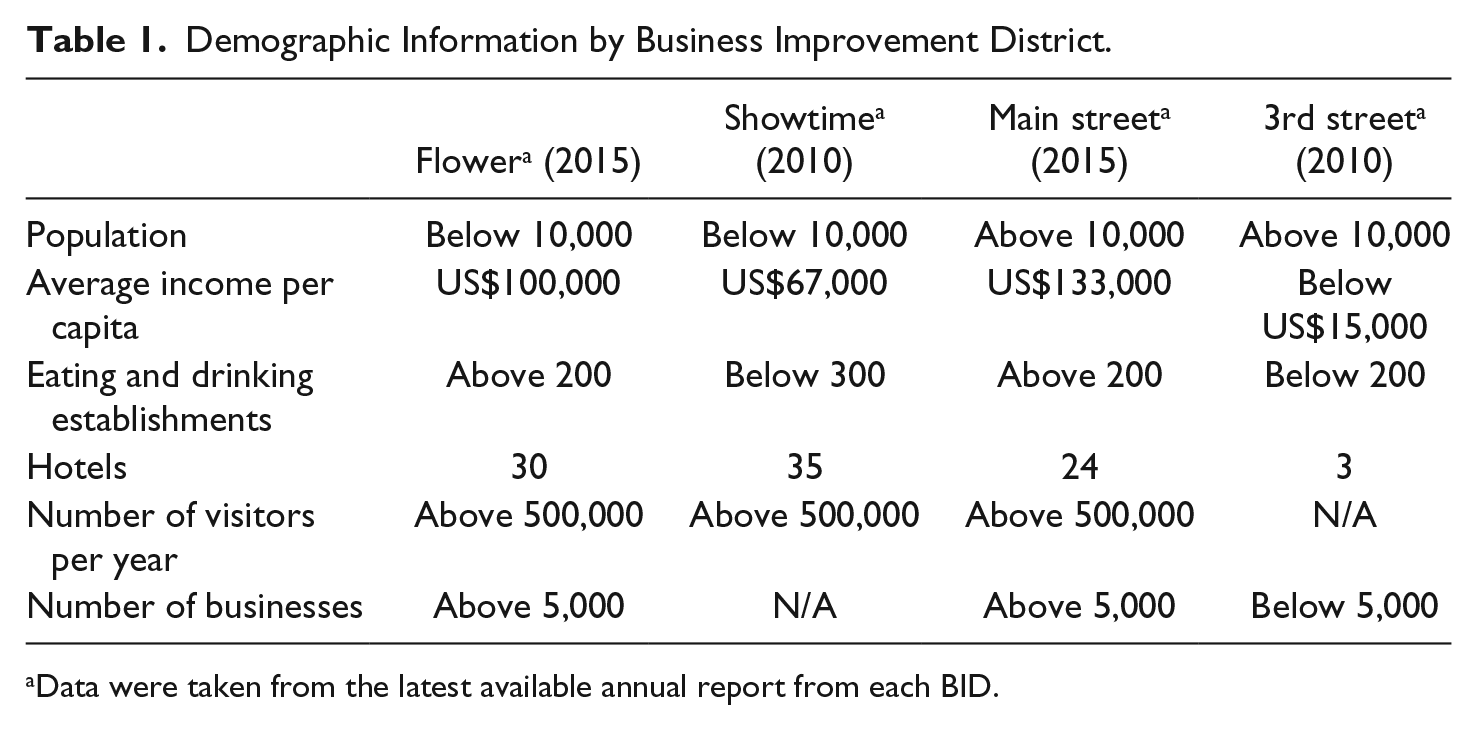
Data were taken from the latest available annual report from each BID.
Table 2 presents data from the sanitation and public safety teams and each BID’s yearly budget (data were collected from the annual reports of BIDs). It is clear from Table 2 that the 3rd Street BID is not as affluent as the others. While the other three BIDs—Flower, Showtime, and Main Street—range from US$1 to US$3 million, annually dedicated to their security program alone, the 3rd Street BID spent just below US$2 million across three different programs: public safety, sanitation, and horticulture. The total dollar amount for the assets within the 3rd Street BID is almost the same as the amount spent on security alone within the Showtime and Main Street BIDs, respectively. Finally, all BIDs had large sanitation teams, who focused primarily on cleaning up the area through the removal of trash, graffiti, and other physical signs of disorder.
Sanitation and Public Safety Information by Business Improvement District.
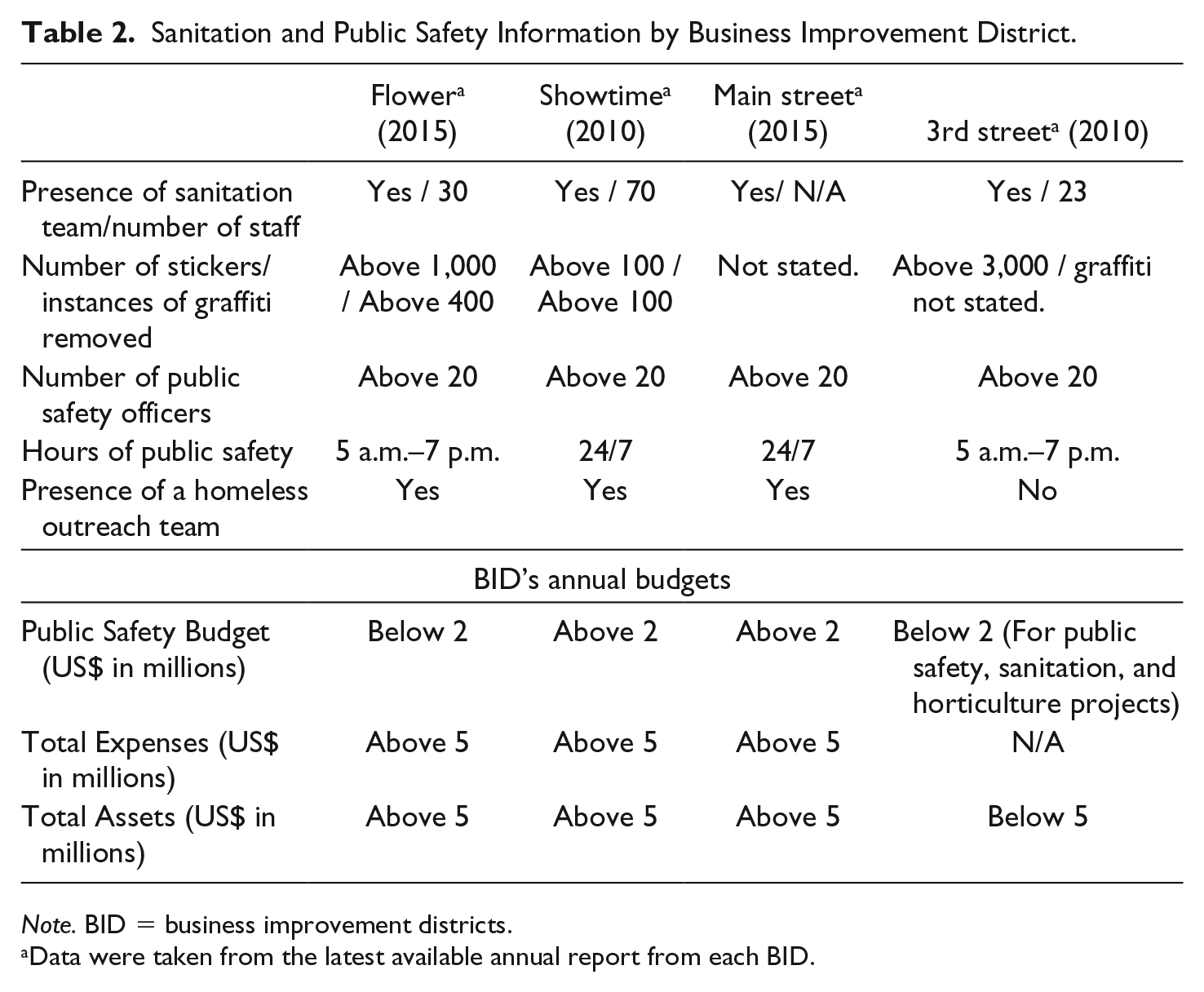
Note. BID = business improvement districts.
Data were taken from the latest available annual report from each BID.
Shift hours for PSOs were structured around peak times of pedestrian traffic. The Showtime and Main Street BIDs employed 24-hr patrols, whereas the remaining organizations had their PSOs work during peak foot traffic hours (5 a.m.–7 p.m.). BIDs divided districts into smaller, more manageable zones and assigned one PSO to patrol said zone for their entire shift. This reduced the likelihood that sections would be unmanned or that multiple PSOs would cover the same area. PSOs had both in-class and on-the-job training, where they shadowed senior PSOs on their patrols for a set number of hours, as defined by the individual BIDs. Training was primarily directed toward organizational expectations and protocols, including activities and behaviors that warranted attention, proper interactions with the public, and the reporting of problems. PSOs within the Flower District also had private security licenses, but this was not a requirement within the other BIDs.
Findings
Disorderly People and Activities
BIDs are designed to attract consumers in the hope of bolstering the local economies (Symes & Steel, 2003). Cultivating an image of enhanced security and safety was the main strategy used to accomplish this goal (Bookman & Woolford, 2013). Accordingly, PSOs often defined “disorder” with consumers and visitors in mind; individuals who did not fit “clean and safe” categories were deemed “out of place,” detracting from the area’s appeal. Although BIDs experienced many of the same problems, each district also had specific issues, which they targeted. For example, one of the main problems in the 3rd Street BID was drugs and drug paraphernalia. However, it should be noted that PSOs did not intervene or stop any drug dealers or users; their main role was just to collect and pass information to the local police for their response. PSOs in the Showtime BID were primarily focused on aggressive panhandlers. In comparison, PSOs in Flower District were focused on loitering issues, and those in the Main Street BID were more concerned with illegal street peddlers.
Homelessness was an issue that was consistently and regularly reported across all BIDs. “Homeless[ness] is the first issue—most of [our] time is spent on this issue” (Brian, The Flower District). Three out of the four BIDs worked very closely with local shelters and outreach programs. Given their daily interactions with this population, some of the PSOs discussed their role largely as mediators, trying to bridge the gap between the homeless and social services. As Simon from the Flower District advised, “you ask if they need outreach and [if they say ‘yes’] then you call the base and provide them with the services.” However, when discussing homeless placements into social services with a manager at the Main Street BID, she advised that in April 2015, only three people accepted any sort of assistance, whereas 658 individuals declined. Details were not provided from each BID, although based on observations and conversations with PSOs, it appeared that having a homeless person agree to any type of social service was an extremely rare occurrence. Most observed interactions between homeless people and respondents were extremely short, with homeless individuals simply moving without comment, refusing support, or simply ignoring questions from PSOs.
PSOs discussed issues of homelessness as it related to very complex social realities, including recent changes in city legislation, inadequate social support, mental health, and substance abuse issues; nevertheless, all generally agreed that homelessness was problematic, contributing to the public’s unease and fear. Pablo (Showtime BID) stated, “it is not illegal to be homeless; however, the beautification of the district is the most important.” While walking through his zone, Michael (Main Street BID) referred to his post and its people as “first class,” arguing that “there is a specific level of behavior here . . . and [people here] don’t want to see that [gesturing towards a homeless individual who was panhandling across the street].” In the Flower District, Matthew stated that “homeless [people] change your whole mood, they are a distraction.” Therefore, regardless of PSO’s personal opinions, homeless individuals were understood to increase people’s feelings of unpleasantness or fear and, as such, should be removed from the area.
Maintaining Order
Order was maintained through the surveillance and reporting of various physical and social disorders. When asked about their job and what it entails, PSOs routinely said, “we observe everything”; “[a]ll things related to public safety—anything we see, we report it” and “[w]e are on the ground, security cameras are eyes in the sky.” Participants reported a wide breadth of physical symptoms that they deemed disorderly, including “physical blemishes,” like cracks in the sidewalk, graffiti, and vandalism. In this way, the PSOs predominately operated and handled the issues that largely fell outside of the purview of the police, but still impacted the public’s feelings of disorder and unease.
PSOs reported and tracked all disorderly problems. Reports were used in two important ways. First, reports about graffiti, litter, and vandalism were forwarded to sanitation teams for immediate cleanup. The reports for larger structural problems, like cracks in the sidewalk or broken power lines, were sent to the municipal government for repairs. Gus (3rd Street BID) said, “People see the [PSOs] as a nuisance because [we] call things in 60–70 times . . . We’re on top of things, we’re always around.” Participants stated that they would checkup on incidents within 30 days of reporting and, if the situation was not resolved, it would be reported again and again until it was finally fixed. The main usage of these PSO-driven reports was to quickly repair any visual symbols of disorder.
Second, reports were used to spur legislative changes. Generally, BIDs advocated for changing or creating municipal laws to respond to various issues within the city. For example, at the time of data collection, the Main Street BID was monitoring vendors within their district. PSOs advised that these vendors often took advantage of tourists, selling tickets for attractions that did not exist. In response, twice daily, PSOs would check specific areas, counting the number of “ticket salesmen” to document the size of the problem. Reports were then used to lobby the city government about more stringent guidelines for vendor licenses. These reports were vital for legislative changes, as they provided detailed “real time” tracking and identification of problematic behaviors.
Public Reactions and Strategies Implemented to Encourage Compliance
As PSOs are civilians, not imbued with any traditional enforcement powers, personal security was a frequent discussion. Although extremely rare in occurrence, participants detailed troublesome direct or vicarious interactions with the public. Some participants also discussed how individuals would verbally pushback or belittle study participants, calling them “snitches,” “rent-a-cops,” or “rats.”
As a result, participants often discussed strategies that would help keep them safe. For example, when they stood in place, they often did so with their backs against walls, they routinely discussed the importance of being observant and continuously used their radios to keep in touch with one another. In addition, they also discussed different strategies that they regularly employed when dealing with the public. First, participants discussed the importance of professionalism in their interactions. They would constantly refer to individuals as “sir” or “ma’am” and fully explain the reason for their requests. In addition, respondents would use phrases like “can you do me a favor?,” “the manager has just called . . .” and “there have been complaints . . .” Participants stated that purposely framing appeals and making “reasonable” requests reduced the likelihood that individuals mistook these interactions as personal attacks and retaliated. It is interesting to note that these are the same behaviors outlined within the procedural fairness literature (Tyler, 2004). Being polite, fair, and providing rationales for requests was found to be a more effective strategy in increasing the likelihood that people will acquiesce to requests for both PSOs and the police alike (Tyler, 2004).
There was an overall understanding that homeless people, in particular, should be approached very cautiously, given the potential that they could have mental health or substance abuse issues. As Jayden (Flower District BID) stated, “you gotta talk to them nicely and be careful of aggressiveness, because they can fight you.” As such, maintaining one’s professionalism was of the utmost importance, not only to get others to comply, but for the respondents’ own personal safety as well.
PSOs also discussed the importance of building rapport with the homeless and local vendors as a way to encourage acquiesce. There were frequent observations of PSOs exchanging greetings and pleasantries with members of these groups. As Ethan (Main Street BID) advised, “after they see us around for a while, they respect us and then they move.” One PSO within the 3rd Street BID even remarked that relationships with the homeless could provide information about what is happening in the district. According to Reuben, “the homeless are out here more than us and they can tell us what is going on in the city.” Reuben was the only participant in all four BIDs to discuss the utility of relationships with the homeless in such a manner. There is an obvious paradox within this participant’s statement: Rueben saw homeless people both as a potential information source, while he saw them as an impediment to the “clean and safe” mandate. PSOs were well aware of their inability to enforce behaviors; as such, they discussed the primacy of professionalism and social networks to strategically manage interactions and reduce confrontation.
Other types of strategies were also observed. For example, many panhandlers stood in front of near business entrances or in the middle of the sidewalk. Although most moved with little to no pushback, during one interaction, a man with a large sign requesting change refused to move from a store entrance citing his “First Amendment rights.” In response, the PSO silently stood beside him; this largely deterred pedestrians from giving him money, forcing the panhandler to leave the area. PSOs frequently discussed how, due to their lack of traditional enforcement, they had to rely on other seemingly more creative strategies to garner the public’s compliance.
Finally, if these strategies failed, PSOs relied on the public police for assistance. Craig (Showtime District BID) advised, “They know that we get PD on the scene; so you pick your battle—us or the PD and get a ticket.” Pablo (Flower BID) echoed that sentiment: Homeless [people, you] approach them and explain [why you are asking them to move], but some of them are rowdy and rude. Eventually, everyone moves, otherwise we call the police and no one sticks around for the police.
However, during 171 hr of observation, I did not witness any interaction in which PSOs called the police for assistance. Interestingly, some participants noted that the simple act of using their radio was enough to get an individual to leave the premises. Using informal relationships with local police departments, PSOs were able to leverage their position within their districts. It is clear that for this strategy to be successful, the BIDs needed to have a good standing relationship with their local police departments. Although some participants remarked that they did not have their own personal relationships, they often attributed this relationship between organizations to their managers, who were all retired city police officers. This connection was believed to legitimatize the actions of both the BIDs and PSOs. In addition, two out of the four BIDs shared an office with a small police precinct, allowing both groups to increase familiarity between the two groups. Although calling the police for assistance was an extremely rare occurrence, PSOs argued that this possibility aided in ascertaining compliance, and more importantly, it was evident that respondents felt safer knowing that they could rely on them, if needed.
Discussion
Analysis and policies about crime reduction tend to center on initiatives by the criminal justice system. However, “[t]his conflation of policing with state police is now restricting our view of what is being done, and what can be done to govern security under other auspices” (Johnston & Shearing, 2003, p. 10). Thus, as responses to crime and disorder continue to evolve and grow in complexity, so should corresponding examinations. Using semi-structured interviews and ethnographic data with PSOs from four large BIDs in two Northeastern cities, this article has sought to address a gap in the literature regarding private organizations and their work within order maintenance.
The current study has provided further support for the inclusion of private organizations in the study of crime suppression and order maintenance. Traditionally, studies have outlined how the police are central to strategies like Broken Windows and Problem-Oriented Policing; however, as this study explored, civilians regularly implement these policing strategies to achieve their own organizational goals. Nevertheless, there are important distinctions between the work of the police and the respondents. Study respondents were mainly concerned with minor issues, like homelessness, graffiti, and littering; issues that largely fall out of the purview of the public police. In addition, while they may have been abreast to issues related to crime, they did not involve themselves or stop these behaviors. This was most evident in the 3rd Street BID, where information relating illegal drugs would simply be shared with the local police department. Finally, participants were primarily concerned with maintaining a “clean and safe” image within their districts. As such, problems, such as homelessness, illegal vendors, and panhandlers, were sometimes “fixed” by asking individuals to go other locations. This response would obviously not be suitable for the police, as it could present them with serious legal consequences. Despite working within different legal boundaries and objectives; findings have shown how PSOs regularly utilized Broken Windows to frame their goals and objectives, as well as Problem-Oriented Policing to help them target and respond to the specific problems within their districts.
The second contribution of this study highlights how respondents utilized aspects of procedural justice to increase the effectiveness in their role as civilian guardian. However, it should be noted that this study did not measure “successful” interactions or actual rates of public compliance. The reliance on these tactics is even more important when one considers that PSOs are primarily dealing with issues of low-level disorder—homelessness, graffiti, loitering. Unlike more serious crimes, these problems are often not associated with feelings of morality or responsibility; arguably making compliance more difficult to achieve (Tyler, 2004). This literature has often argued that cooperation is increased through procedurally just tactics, such as the use of effective communication and fairness. Findings showed that PSOs were well aware of their civilian status and their inability to rely on legal reinforcements should a problem arise. As a result, they developed and relied on their professionalism and informal social networks, to gain compliance from the public.
The present study has implications for local government policies. Critics have often pointed to the fact that the BID’s desire to increase the area’s economic success can disenfranchise and displace those who do not “fit” in the area (Bookman & Woolford, 2013). Unlike police officers, PSOs are private civilians who along with not having any law enforcement powers, are not bound by constitutional limitations. As a result, these groups are not interested in issues of guilt or innocence, but rather they seek to control potential offenders, including groups like the homeless, drug addicts, and the mentally ill (Ruddell et al., 2011). As such, in their desire to regulate the district, arguably a “new class of wrongdoer has been created; a group that merely threatens to disrupt order” (Ruddell et al., 2011, p. 56). Through their targeting of low-level disorder, BIDs increasingly bring these activities and individuals to the attention of local government and police, pressuring them to invoke legislation or officially penalize these groups. As such, city officials need to be aware of how disenfranchised groups might become targeted and the potential legal and social ramifications. While not a panacea, improving and tracking this information might allow for better regulatory or oversight restrictions placed on BIDs. In addition, city officials might want to utilize the reports collected by PSOs on issues of homelessness and panhandlers, helping to improve their own social services and better aid these groups.
This study is not without limitations. First, within participant-as-observer research, a common problem is that participants react to the presence of a researcher (Waddington, 2004). As such, some of the observations and interviews likely included guarded responses and behaviors. To counter this issue, participants were constantly reminded about the confidential nature and the goal of the project. In addition, considerable probing and follow-up questions were used. It was often following these probing questions that officers shared personal stories or provided more complex explanations, allowing for a more nuanced understanding of their roles and activities. Second, despite examining four different BIDs, areas were located within two major, urban cities in the Northeast, with two BIDs bordering each other. Therefore, these findings are not generalizable and might not be helpful in explaining behaviors in other locations.
This study also did not examine police officers and their opinions regarding the work and relationship, if any, between themselves and BIDs. Interestingly, these interactions may allude to an symbiotic relationship between the police and the PSOs. Supporters of this program argue that PSOs focus on low-level issues, conduct daily patrols and collect detailed daily reports, which can reduce opportunities for crime, as well as free up the police so they can focus on other larger criminal problems (Vindevogel, 2005). However, this project did not interview police officers. As such, it cannot speak to the opinions, if any, that the police have regarding the work of PSOs. Finally, this article cannot discuss actual effectiveness of this group, as this article was primarily concerned with examining how they understand and implement their roles within the order maintenance paradigm.
Conclusion
Private organizations and individuals are regularly and actively involved in deterrence, order maintenance, and crime suppression. However, scholars often tend to prioritize the role of state-based agencies, while ignoring the actions and contributions of other organizations. Future research concerning BIDs is needed, given its argued success and rapid proliferation throughout downtowns worldwide. While not an original goal of this project, this study has also highlighted how different organizations operate within the ever-changing jurisdictional boundaries of policing. Although both public and private policing organizations tend to share similar goals, the mechanisms, roles, and power of enforcement differ significantly.
BIDs are a key example of how crime prevention has been expanded into private organizations. It is because of their efficacy, as well as their more controversial aspects like criminalizing disorder, that they should be included in discussions about order maintenance. This study sheds light on the changing ways that communities are being regulated and monitored and offers further evidence of the need to produce a more nuanced understanding of how policing has expanded and evolved.
Footnotes
Declaration of Conflicting Interests
The author(s) declared no potential conflicts of interest with respect to the research, authorship, and/or publication of this article.
Funding
The author(s) received no financial support for the research, authorship, and/or publication of this article.