







Abstract
The current study sought to explore the experiences of college students who have experienced female-perpetrated sexual assault, and to compare their experiences to those of students assaulted by male perpetrators. A total of 11,165 college students across 11 years completed an online, anonymous survey measuring self-reports of sexual violence, context surrounding their victimization, help-seeking, and well-being. Of the students surveyed, 531 students reported experiencing sexual assault and identified both their own gender and the gender of their perpetrator, and 14% reported having experienced female-perpetrated sexual assault. Victims of female perpetrators were more likely to report their perpetrator being an (ex)intimate partner and less likely to be a stranger. Victims of female perpetrators were also more likely to report that their victimization involved their own drug use. Overall, victims of female-perpetrated sexual assault were less likely to tell anyone about their victimization, or to report to on- or off-campus resources. Finally, our findings suggest that victims of female perpetrators have comparable well-being to victims of male perpetrators. These finding contribute to the overall understanding of female-perpetrated sexual assault.
Introduction
The phenomenon of female-perpetrated sexual assault in college environments has generally been understudied and underrepresented in the literature on sexual violence. Despite recent increased interest in the topic, there is a limited understanding about who is victimized by female perpetrators and in what context they experience victimization.
Research on sexual assault has traditionally focused on the experiences of women as victims and men as perpetrators (e.g., Greathouse et al., 2015; Ullman, 2010). As such, less is known about the experiences of victims who are assaulted by women, and much of the research that does exist suggests low frequencies of female-perpetrated sexual assault against adults (N. L. Fisher & Pina, 2013; Groth & Birnbaum, 2013). For example, The National Intimate Partner and Sexual Violence survey reported that both women and men were infrequently sexually assaulted by women, although these rates were slightly higher for men (Smith et al., 2017). In fact, while studies on domestic violence have explored victimization and perpetration by women (Orcutt et al., 2005), most studies on sexual assault exclusively inquire about women’s experiences of victimization, neglecting any assessment of perpetration (Anderson & Struckman-Johnson, 1998). In addition, much of the research on sexual assault on college campuses has focused on examining men’s perpetration (Berkowitz, 1992; B. S. Fisher et al., 2000; Krebs et al., 2007).
Despite the historical trend of only studying male-perpetrated sexual assaults against women, accumulating research suggests that women can also be perpetrators of sexual assault. In a general population sample, women committed 28% of sexual assaults on men and 4% of assaults on women (Stemple et al., 2017). Thus, the public health significance of sexual violence has only been partially understood. Further research is essential to understand the rates of perpetration by women, the nature of the relationships between victims and female perpetrators, and the conditions in which these assaults are occurring.
Characteristics of Victims
In addition to highlighting the existence of female-perpetrated sexual assaults, it is also important to consider who is affected by female perpetrators. Research on women who perpetrate sexual assault has found patterns regarding the perpetrator’s relationship to their victim. One study found that over half of female-perpetrated sexual assaults against male victims occurred between friends and acquaintances, one third involved a girlfriend or fiancé, and less than 10% involved strangers (Struckman-Johnson & Struckman-Johnson, 1998). Other studies suggest that women perpetrate sexual assault against men within long-term intimate relationships (Hines & Douglas, 2016). More research is needed to explore the trends in the relationship between perpetrator and victim, particularly among college-age students due to their increased risk of sexual violence (Mellins et al., 2017).
Much of the limited research on female-perpetrated sexual violence has focused on women who perpetrate against men (Anderson & Struckman-Johnson, 1998), but even less attention has been given to women who perpetrate against other women. Some research has suggested that women are less likely to commit same-sex victimization (Gannon et al., 2014; Johansson-Love & Fremouw, 2009), while other research has suggested that same-sex perpetration committed by women may not be uncommon. For example, one study found that 45% of victims of female-perpetrated sexual assault were women with lesbian women, in particular, reporting a high prevalence of same-sex sexual assault (Williams & Bierie, 2015). Because of the mixed findings on this matter, the current study will explore the prevalence of same-sex and cross-sex perpetration of sexual violence committed by women.
Context of Victimization
In addition to understanding the characteristics of the victims, it is also important to understand the contexts of these assaults. Generally, research on sexual assault has demonstrated a connection between substance use and incidence of sexual assault by male perpetrators (Abbey et al., 2001; Mellins et al., 2017; Mohler-Kuo et al., 2004), and this may also be true of female perpetrators. Research has suggested that female perpetrators frequently utilize alcohol and drugs to incapacitate their victims (Anderson & Struckman-Johnson, 1998; Schatzel-Murphy et al., 2009). Substance use in sexual assault may be particularly prevalent on college campuses due to high frequency of alcohol use and binge drinking behavior (Johnston et al., 2017). In one study of college-aged women, half of respondents reported initiating sexual contact with a man while he was impaired by alcohol or drugs (Anderson & Aymami, 1993). As such, the current study will explore the substance use in female-perpetrated sexual assaults and compare the rates of substances involved in female and male-perpetrated cases.
Help-Seeking Behaviors of Victims
Another area requiring further exploration is help-seeking behaviors of victims of female-perpetrated sexual assault. While sexual assault is generally underreported, especially in college populations (Ameral et al., 2017; Sabina & Ho, 2014), there may be additional barriers associated with victimization by female perpetrators. The research on the help-seeking experiences of victims of female-perpetrated sexual assault is limited; however, we are able to explore challenges to help-seeking experienced by male and female victims separately.
Men may encounter some unique barriers to reporting their victimization. Men, generally, are less likely to admit having been victimized (Isely, 1998), to report victimization (Breiding et al., 2014; Walsh et al., 2010; Young et al., 2016), and to know how to access services (Bateman & Wathen, 2015). Several rape myths regarding men and sexual assault may contribute to this trend. For example, individuals are more likely to perceive male victims of a female perpetrator as having enjoyed their assault (Smith et al., 1988), and male victims may internalize this idea, reframing their victimization in a way that is more consistent with masculine ideals (e.g., the assault was consensual; Davies & Rogers, 2006). These societal attitudes are reflected when men who do report to law enforcement or other support services are not taken seriously (Walker et al., 2020). These negative attitudes from supports and resources may dissuade male victims of female perpetrators from seeking help following an assault.
Women who are victimized by women may also experience invalidation of their experience of assault. Because as a society we privilege penile–vaginal intercourse as “real sex” (Chalker, 1994), other types of sexual contact may be perceived as less legitimate. This cultural attitude may lead to the perception that incidents involving other types of sexual contact are less serious. In fact, this attitude may be so pervasive that some female perpetrators feel it is impossible for them to rape a female victim (Girshick, 2002). Female victims of female perpetrators may also subscribe to these and related attitudes which may, in turn, prevent them from reporting victimization. Sexual minority victims of female perpetrators may also experience further barriers regarding their sexual orientation. In addition to having their experience delegitimized, sexual minority women who are assaulted by female perpetrators may be reluctant to report their victimization for fear of contributing to negative stereotypes or further oppression of the LGBTQ (lesbian, gay, bisexual, transgender, and queer) community (Ollen et al., 2017).
These cultural attitudes that may discourage victims of female perpetrators from seeking help are reflected in how we think about sexual transgressions by women. As a society we tend to allow for greater violation of sexual boundaries from women and may take those violations less seriously. Women are socialized and expected to be sexually submissive (Hatfield, 1983) and as such, minor sexual violations may be considered less threatening than if a man enacted the same behavior (Margolin, 1989). In past research, violations, such as “stealing a kiss,” were perceived as playful, rather that sexually aggressive when coming from a woman (Semonsky & Rosenfeld, 1994). Downplaying sexually aggressive behaviors from women may make accessing support and services following an assault even more challenging for victims, who may feel that their concerns will not be taken seriously or that they will not be believed. Overall, there are many societal reasons why a victim of a female perpetrator may not seek help following a sexual assault. In the current study, we aim to explore the prevalence of help-seeking for victims of female perpetrators, as well as common reasons for not reporting.
Well-being and Victims of Female Perpetrators
Sexual assault is widely regarded as an impactful and traumatic event, which may lead to many negative outcomes such as substance use and negative physical and mental health (Kilpatrick et al., 2000; McFarlane et al., 2005). There are many reasons, however, that female-perpetrated sexual assault may be perceived as less serious or harmful by society. As discussed, sexual assaults by a woman may be considered less serious because the event does not follow the standard prototype of sexual assault (vaginal penetration by a male perpetrator), and women may be perceived as less capable of injuring victims than men. However, there is limited research that compares the well-being of victims of female and male perpetrators directly.
Overall, victimization by female perpetrators is an understudied phenomenon. Little is known about who is being victimized and the context surrounding these assaults. In addition, victims of female-perpetrated sexual assault may be reluctant to come forward about their assault due to stigma, limited social support, and a lack of awareness of how to access services. Using campus climate survey data on sexual assault victimization, we hope to expand the current literature on female-perpetrated sexual assault by providing descriptive information on this phenomenon. This study will explore who has been victimized, the situational context of these assaults, and victims’ help-seeking behaviors and well-being. This study will also draw comparisons between female-perpetrated and male-perpetrated sexual assaults. We focus specifically on female-perpetrated sexual assault in a college sample in the United States.
Method
Participants and Procedure
Participants included undergraduate and graduate students from four small northeastern universities. Data were collected at one university every November from 2008 to 2018 and in March 2010, and at three other universities, data were collected each November from 2013 to 2015. All students were invited by email to participate in an online, anonymous survey on safety and well-being at the university. Students were given 1 month to complete the survey and sent weekly reminder emails to encourage survey completion. Each year, raffle incentives, including one $100 gift card and 10 $20 gift cards to the university bookstore, were offered to increase participation. Anonymity was maintained by redirecting students to a separate survey to enter the raffle.
As the surveys were anonymous and all students were invited to participate every year, regardless of whether they had participated in the past, we have no way of linking students’ participation over multiple years. As such, the sample is likely non-independent. However, when asked about their experiences of sexual violence victimization, participants were asked to only report on instances that occurred during the previous 2 months. So, while it is possible that some students may have reported on older instances, it is more likely that participants are reporting on unique instances of victimization from that school year. The methods for this study were approved by the institution’s board of ethics. All students were apprised of their rights as study participants. At the completion of the survey, information on psychological resources and support services was provided.
The overall sample size was n = 11,165. To explore experiences of sexual assault victimization committed by female perpetrators, only students who reported one or more instances of sexual assault victimization were included in any analyses, with an initial sample size of n = 610 (5.4% of the full sample). For this study, we included only participants who identified their own gender as male or female and the gender of their perpetrator, leaving us with a sample size of n = 510. Transgender students (less than 1% of the sample) were recoded to be included with cisgender students of the same gender identity, and non-binary students were excluded (n = 6). The sample was majority female (87.5%) with an average age of 19.99 (SD = 2.77) years. In addition, 76.6% identified as heterosexual and 16.3% identified with a racial or ethnic minority group. Most of the sample indicated living on campus in a dormitory or apartment (59.8%). About one quarter of the sample reported being a first-year college student, one quarter reported being a second-year student, 22.8% were in their third year, 20.1% were in their fourth year, and 6.3% reported being in graduate school.
Measures
The measures for this study were a part of a larger annual survey that included questions about dating violence, stalking victimization, well-being, distress tolerance, and awareness of on- and off-campus resources. The measures used have been consistent over the 11 years of data collection, apart from questions about participant gender and sexual orientation. Additional options have been added to these questions to more accurately reflect the identities of our participants. Only measures used for this study are described below.
Demographics
Basic demographic information was collected including age, class year, gender, race/ethnicity, and sexual orientation.
Sexual assault victimization
Sexual assault victimization was assessed with six questions modified from a University of New Hampshire Survey (Banyard et al., 2004). Participants were given the following instructions “Since school began this past September, please indicate the number of times that anyone, regardless of gender (including people you know), has done the following things to you:.” The six items were “physically forced you to have sexual CONTACT against your wishes,” “threatened to harm you to have sexual CONTACT against your wishes,” “had sexual CONTACT with you when you were so intoxicated that you were unable to consent,” “physically forced you to have sexual INTERCOURSE against your wishes,” “threatened to harm you to have sexual INTERCOURSE against your wishes,” and “had sexual INTERCOURSE with you when you were so intoxicated that you were unable to consent.”
These questions asked participants how often (never, once, twice, 3–5 times, 6–10 times, 11–20 times, and more than 20 times) someone forced, threatened, and engaged in nonconsensual sexual contact or intercourse against the participant since the beginning of the semester. Participants were given clarifying definitions of these concepts, to ensure that participants understood what they were being asked. Definitions were as follows: “SEXUAL CONTACT—attempting or actually kissing, fondling, or touching someone in a sexually intimate way, EXCLUDING SEXUAL INTERCOURSE” and “SEXUAL INTERCOURSE—any form of sexual penetration including vaginal intercourse, oral sex, and anal intercourse.” Unwanted sexual contact and intercourse were further defined as those situations in which you were certain at the time that you did not want to engage in the sexual experience and you either communicated this in some way (e.g., you said no; you protested; you said you didn’t want to; you physically struggled; you cried; etc.), or you were intimidated or forced by someone or you were incapacitated (e.g., drunk, passed out, etc.).
Participants were coded as a sexual assault victim if they reported at least one of these behaviors at least once.
Context of sexual assault victimization
Participants who indicated any sexual victimization were asked a series of follow-up questions regarding the context of the most recent incidence of sexual assault. Questions included information regarding demographics of the perpetrator, relationship to the perpetrator, substance use by the victim and perpetrator during the incident, location of the assault, and whether the participant sustained any injuries.
Help-seeking behaviors
Participants who indicated they had experienced sexual assault were asked whether they sought help from on-campus services (e.g., campus police, counseling services), contacted off-campus services (e.g., city police, emergency room, rape crisis center), or if they told anyone in their life about the incident (e.g., friends, family). Participants who reported that they did not seek help from on- or off-campus services were asked why they did not use these services. Participants were able to indicate more than one reason from 20 commonly reported reasons for not seeking help and were also offered a sell-fill “other” option.
General Health Questionnaire
The General Health Questionnaire (GHQ-30; Goldberg & Hillier, 1979) is a screening device used for identifying minor psychiatric disorders in the general population. The GHQ-30 is a short form of the measure that excludes items relating to physical illness, focusing only on psychological experiences. Participants were asked whether they have felt or thought any of the items in the past month, and to answer “yes” or “no” to the items. Items included “I felt constantly under strain” and “I felt unhappy and depressed.” Higher scores on this measure indicate worse overall well-being.
Substance use (alcohol, marijuana, and drug)
Participants were asked about their frequency of alcohol and marijuana use: “How often do you drink alcohol?” and “How often do you use marijuana?” (response options were as follows: never, less than once per week, once per week, twice per week, 3–4 times per week, and 5 or more times per week). Drug use was measured with two questions. First, participants provided yes or no responses to each of the drug categories in the following question: “Since September of 2008/09/10 . . ., have you ever used any of the following drugs? Cocaine/crack; speed, ice, uppers; downers; hallucinogens (LSD, mushrooms, PCP); sniffing/huffing (glue, aerosols); heroin; ecstasy/Special K.” Second, they were asked, “How often do you use these other drugs?” (response options were as follows: never, less than once per week, once per week, twice per week, 3–4 times per week, and 5 or more times per week).
Results
Descriptive Characteristics of Victims
Demographic information of victims of sexual assault is presented separately for victims of male and female perpetrators separately in Table 1. A total of 72 participants in the sample (14.1% of victims) reported sexual victimization from a female perpetrator.
Demographics of Victims by Gender of Perpetrator.
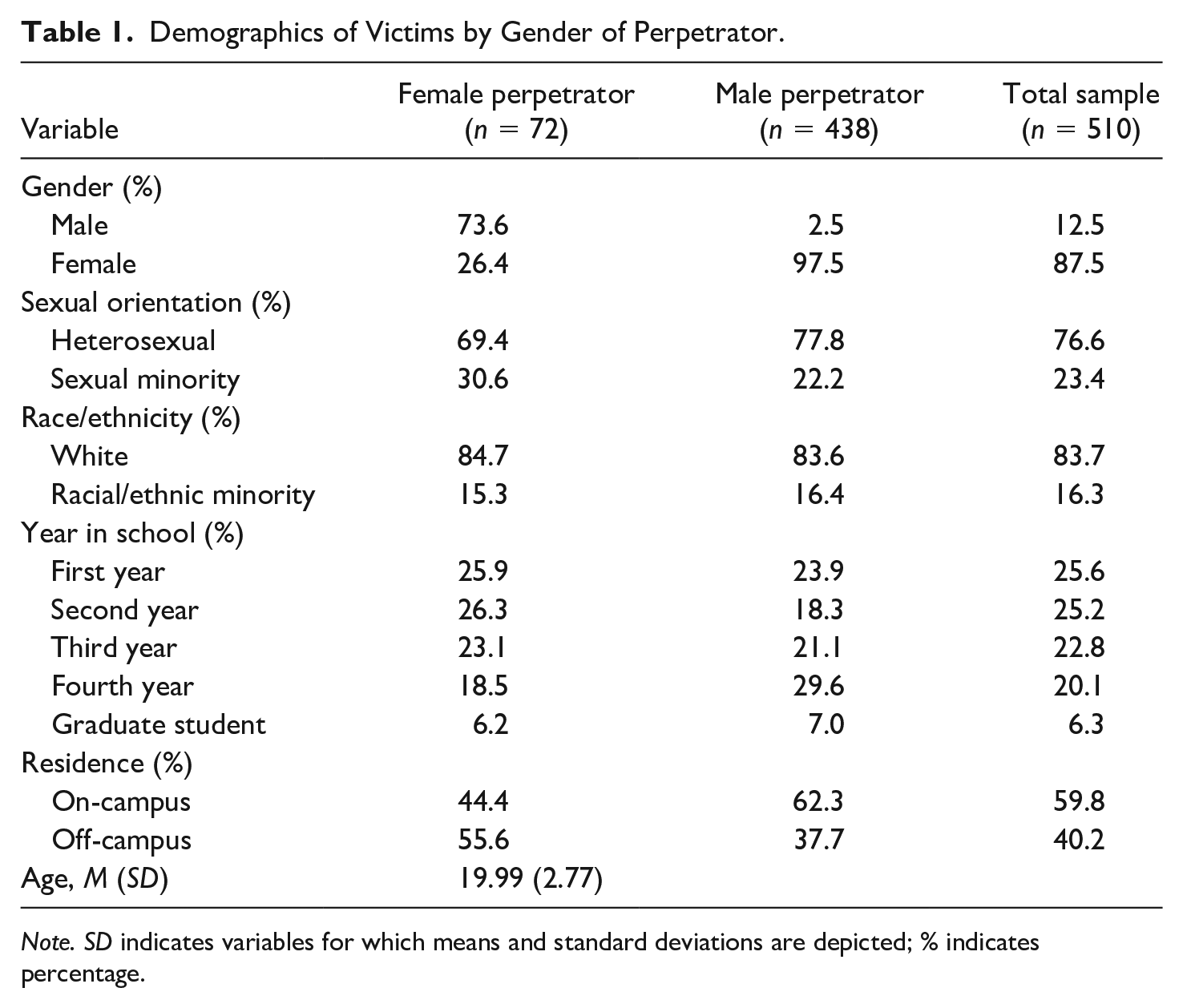
Note. SD indicates variables for which means and standard deviations are depicted; % indicates percentage.
Context of Victimization
To better contextualize these instances of sexual assault, we explored the gender of victims and perpetrators, the relationship between victim and perpetrator, and descriptive characteristics about the setting where the assault occurred. First, we examined the frequency of same-sex and cross-sex assaults by gender of perpetrator. Results indicated that, of victims who reported a female perpetrator, 73.6% were men and 26.4% were women. Women were more likely to report a same-sex perpetrator (26.4%) than men (2.5%), χ2(1, n =505) = 68.070, p < .001. No differences were found in the sexual orientation of victims by gender of perpetrator.
We also explored the victims’ reports of their relationships to the perpetrators. Victims of female perpetrators were most commonly friends (35.3%), (ex)romantic partners (28.6%), and acquaintances (25.7%) with their perpetrator. When examined further, we found that victims of female perpetrators were significantly more likely to be (ex)romantic partners compared with victims of male perpetrators (15.7%), χ2(1, n =503) = 6.912, p < .01. Victims of female perpetrators were also significantly less likely to report their perpetrator being a stranger (8.6%) compared with victims of male perpetrators (19.4%), χ2(1, n =503) = 4.809, p < .05. Finally, female perpetrators were significantly more likely to be members of the campus community (83.3%) compared with male perpetrators (67.0%), χ2(1, n =508) =7.774, p < .01.
Next, we explored the situation in which these assaults occurred. About 50% of assaults occurred on campus for both groups, and assaults were equally likely to occur during or after a party (65.4% for female perpetrators and 69.4% for male perpetrators). Victims of female and male perpetrators were both unlikely to sustain injuries due to their assault (2.9% for victims of female perpetrators and 5.9% for victims of male perpetrators).
Regarding substance use, a majority of victims of female perpetrators reported that their assaults involved their own use of alcohol (84.4%), and 30.2% of victims of female perpetrators reported assaults that involved their own drug use. While results showed no differences by gender of perpetrator in victim’s reported alcohol use at the time of their assault, victims of female perpetrators were significantly more likely than victims of male perpetrators (13.2%) to report their own drug use being a part of their assault, χ2(1, n = 293) = 8.042, p < .01. There were no significant differences found between male and female perpetrators’ use of alcohol or drugs during the assault. Percentages and results from all chi-square (χ2) tests are presented in Table 2.
Context of Sexual Assault Victimization by Gender of Perpetrator.
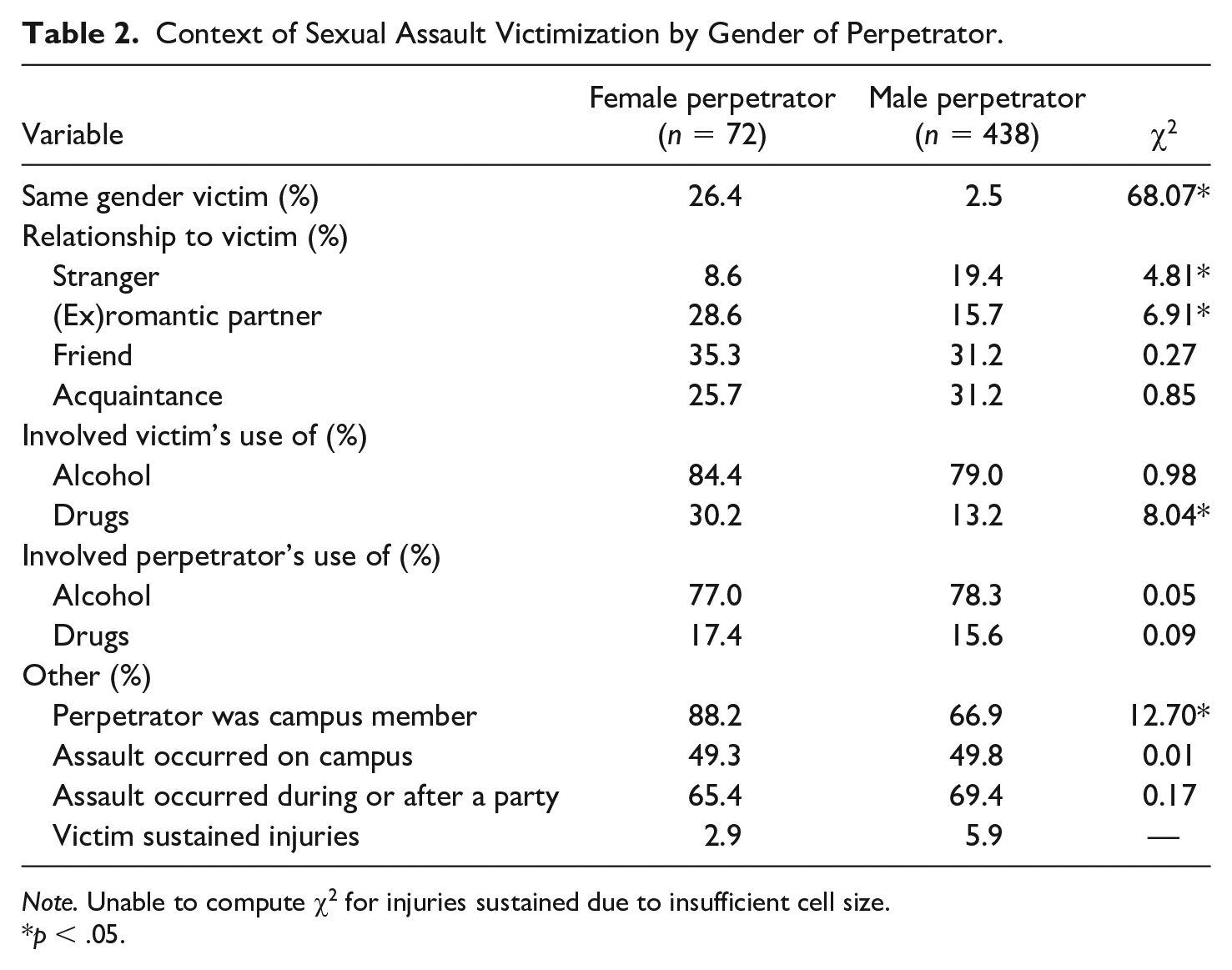
Note. Unable to compute χ2 for injuries sustained due to insufficient cell size.
p < .05.
Help-Seeking Behaviors
Overall, victims of female perpetrators were significantly less likely to report telling anyone about incident (39.7%), χ2(1, n = 506) = 12.38, p < .001, and significantly less likely to seek any formal (either on- or off-campus) help (2.7%), χ2(1, n =504) = 7.98, p = .005, when compared with victims of male sexual assault (61.6% and 14.8% for telling anyone and seeking formal help, respectively). Percentages and results from all χ2 tests are presented in Table 3.
Prevalence of Help-Seeking by Gender of Perpetrator.
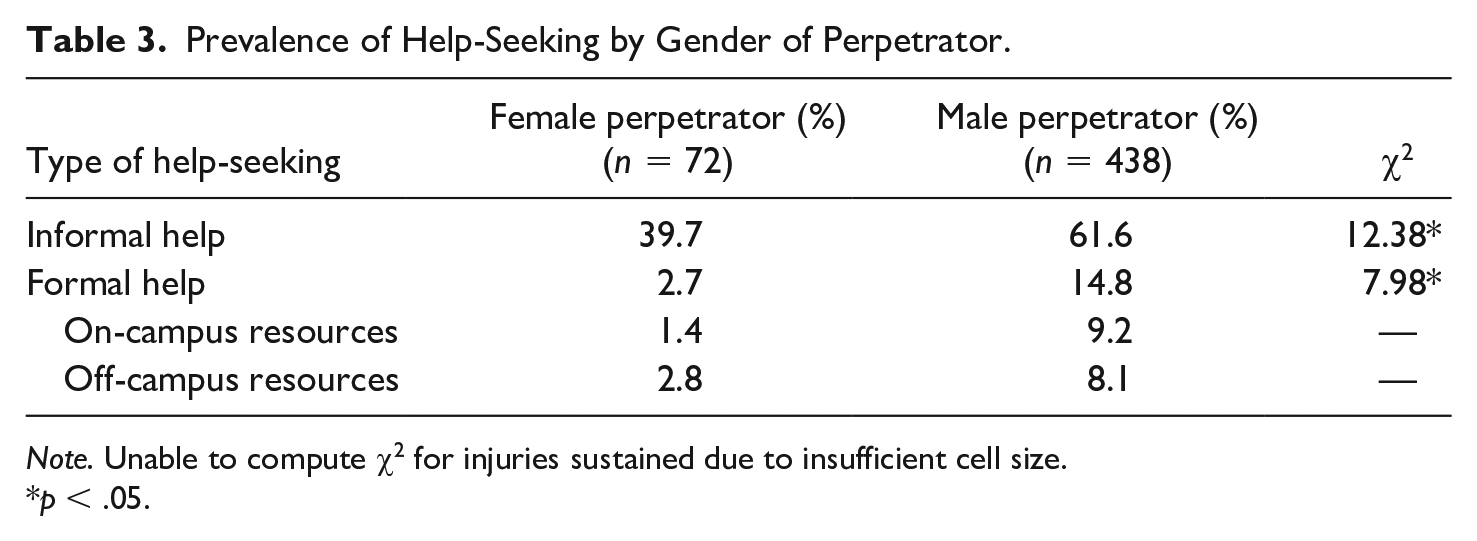
Note. Unable to compute χ2 for injuries sustained due to insufficient cell size.
p < .05.
Only one (1.4%) victim of a female perpetrator reported their victimization to on-campus resources, such as campus police, residence life, health services, counseling services, or the judicial board. Of those who did not report their victimization, the most common reasons for not seeking help were that the assault was not that serious, their assault was a private matter, and they felt the situation resolved itself. Of note, these were the most common reasons regardless of the gender of the perpetrator. The one significant difference in reasons for not reporting was that victims of female perpetrators were more likely to feel that campus services would not believe them (12.8%), compared with victims of male perpetrators (4.8%), χ2(1, n = 289) = 3.920, p < .05.
Reporting to off-campus resources was similarly low with only two victims of female perpetrators (2.8%) reporting their victimization to off-campus resources such as police, emergency room, or a rape crisis center. Of those who did not report their victimization, the most common reasons for not reporting were the same as those for not reporting to on-campus resources: the assault was not that serious, their assault was a private matter, and they felt the situation resolved itself, and did not differ by gender of perpetrator. One significant difference in reasons for reporting to off-campus resources was that victims of female perpetrators were significantly more likely to feel that these resources would not treat their situation seriously (25.0%), compared with victims of male perpetrators (8.6%), χ2(1, n =163) = 5.581, p < .05.
Of the 72 participants who experienced sexual assault victimization by a female perpetrator, only two sought help from either on-campus or off-campus resources. Given this low frequency, we further explored the data provided by these two participants to better understand barriers to help-seeking behavior. One participant who utilized both on-campus and off-campus resources was female and indicated that their assaults involved the perpetrator’s use of drugs. This participant did not report physical injuries as a result of their assault. On campus, they sought help from campus police, their residence advisor, and their school’s campus sexual assault office. This participant also sought off-campus help from an emergency room or doctor, local police, and a member of the clergy.
Another participant, who sought help from off-campus sources only, was also female and experienced sexual assault perpetrated by a stranger, who was a campus member. This participant’s assault did not involve alcohol or drug use by the victim or perpetrator, and the participant reported no physical injuries as a result of their assault. This participant reported seeking help from a private therapist only.
Well-Being
To understand the relative well-being of victims of female-perpetrated assaults compared with victims of male-perpetrated assault, we evaluated the victims’ well-being using the following indicators: The GHQ-30, alcohol use, marijuana use, and other drug use.
Results from the GHQ-30 indicated there were no significant differences in the overall psychological well-being of victims of female and male perpetrators (see Table 4 for means, standard deviations, and results of the t-tests). However, some differences were found in frequency of victim’s substance use. Overall, victims of female perpetrators reported consuming more drinks on average drinking days (M = 4.75 drinks, SD = 2.39) than victims of male perpetrators (M = 3.88 drinks, SD = 2.11), t(90.67) = −2.95, p = .004, and they also reported more marijuana use (M = 1.27 days per week, SD = 1.92) compared with victims of male perpetrators (M = .628 days per week, SD = 1.20), t(81.27) = −2.76, p = .007. There were no significant differences in the frequency of other drug use reported by victims of female perpetrators (M = 0.102, SD = 0.166) and male perpetrators (M = 0.094, SD = 0.365).
Differences in Well-being by Gender of Perpetrator.
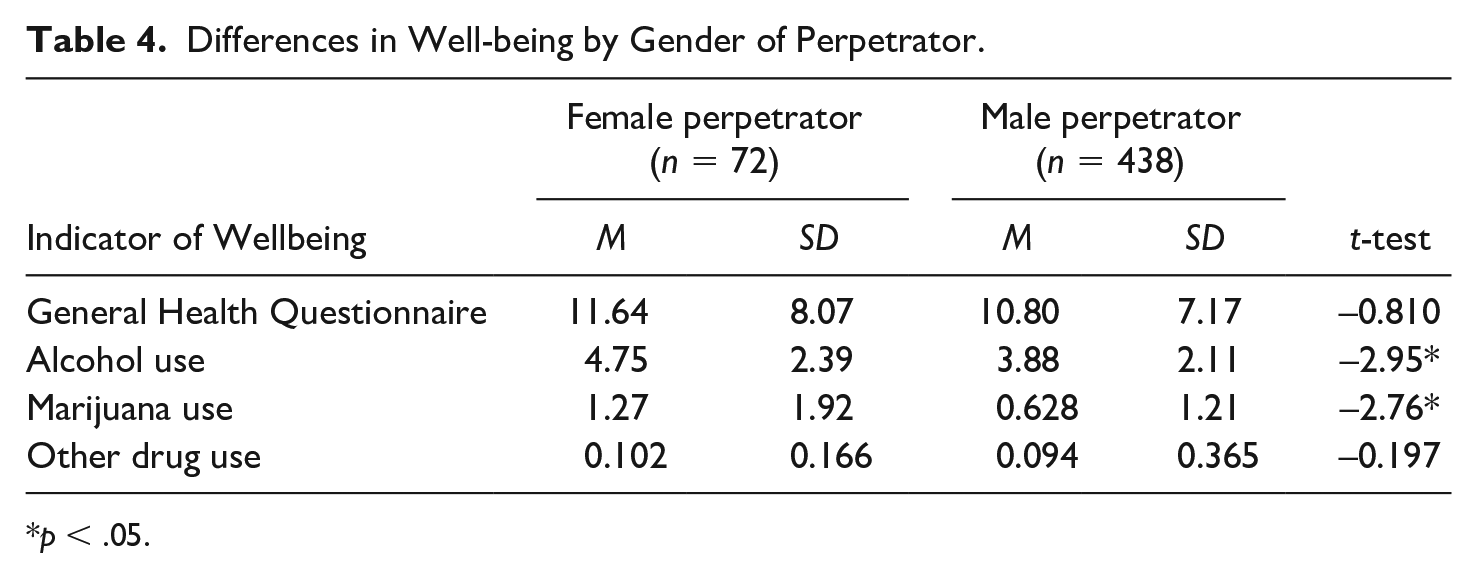
p < .05.
Discussion
The current study contributes to the understanding of female-perpetrated sexual assault and how it compares with male-perpetrated sexual assault. Accumulating data have illustrated that rates of female-perpetrated sexual assault are higher than previously believed, and the findings from this study suggest that these rates are similarly high in a college-age sample. Furthermore, these results help to clarify the nature of the relationships between female perpetrators and their victims, as well as victim well-being and help-seeking behaviors.
Several of these findings confirm trends in the existing literature. In our sample, female perpetrators were more likely than male perpetrators to assault same-sex victims, consistent with previous research (Williams & Bierie, 2015). The results were also consistent with research findings suggesting female perpetrators are more likely to assault acquaintances and partners, than strangers. We also found that female perpetrators were more likely to be campus members than male perpetrators. Research on crime reporting has demonstrated that the smaller the “relational distance” between victim and perpetrator, the less likely the victim will report to the police (Black, 1976), with acquaintance rapes being less likely to be reported (B. S. Fisher et al., 2003). This trend may also exist on a small college campus, where knowing one’s perpetrator as a member of the campus community may discourage victims from reporting their victimization.
There have been equivocal findings in the literature on sexual assault perpetration when victims have used alcohol, and the current study suggests similar rates of victim alcohol use during assaults for victims of male and female perpetrators. Importantly, the focus on victim substance use should not be misconstrued as victim-blaming. Research shows that in male-perpetrated sexual assault, more blame is attributed to women who consume alcohol prior to the assault, compared with victims who are not intoxicated (Grubb & Turner, 2012). This attribution of blame is problematic and stigmatizing, and it may prevent help-seeking behavior and increase psychological distress (Patterson et al., 2009). Rather, including these questions allows us to better understand the context in which these assaults occur, thus informing prevention and intervention efforts. As stated, past research has suggested that female perpetrators may frequently utilize alcohol to incapacitate victims (Struckman-Johnson & Struckman-Johnson, 1998). While we found this to be true in our sample, we also found that rates of victim alcohol use during assaults were similar for victims of male- and female-perpetrated assaults. Overall, victims of female perpetrators were more likely to report their assault involving the victims’ use of drugs. Future research should further explore how the use of various substances may affect female-perpetrated sexual assault on college campuses.
We must also consider how societal beliefs regarding sexual assault committed by strangers may affect help-seeking. Traditionally, sexual assault perpetrated by a stranger is considered more serious than sexual assault committed by ex and current romantic partners (Estrich, 1987; Pollard, 1992), which may affect victims’ willingness to label their experience as sexual assault and to report the assault. While some research (B. S. Fisher et al., 2003) has suggested this view has started to shift due to greater awareness of rape culture, this research only analyzed women’s experiences of sexual assault perpetrated by men. It is unclear if there has been similar increased awareness regarding female-perpetrated sexual assaults.
There is a preconception that women do not perpetrate sexual assault, and, as such, sexual coercion and assault have been framed in a largely heterocentric manner, with penile penetration of the vagina being considered the most severe or “real” form of sexual assault (Muehlenhard et al., 1992). As such, victims of female-perpetrated sexual assault may be reluctant to come forward about their assault due to stigma and erasure of their experience. Gender stereotypes may contribute to female perpetration of sexual assault receiving less attention in the literature, professional services, and public attention sectors. Gendered stereotypes of women as nurturing and sexually submissive run contrary to the idea that women can be sexually manipulative and perpetrate sexual assault (Pflugradt & Allen, 2012). All of these factors may discourage victims of female-perpetrated sexual assault from seeking help.
Importantly, we found that victims of female perpetrators were significantly less likely to tell anyone about their assault or seek formal help. When asked why they did not report their victimization, victims of female perpetrators were significantly more likely to identify fearing that on-campus resources would not believe them, and off-campus services would not treat their situation seriously. This finding is consistent with research suggesting that victims of female perpetrators may worry about experiencing stigma due to the gender of their perpetrator (Sleath & Bull, 2009). While research has found numerous factors may contribute to the decision to delay help-seeking following a sexual assault (Patterson et al., 2009), these findings emphasize the additional hurdle for victims of female-perpetrated sexual assault.
The well-being of victims of female-perpetrated sexual assault has not been adequately studied. While one might expect these victims to fare better, due to the perceived lesser severity of these assaults (White & Kowalski, 1994), we found some evidence to the contrary. General well-being was not significantly different for victims of female and male perpetrators. Furthermore, victims of female-perpetrated sexual assault reported significantly more alcohol and marijuana use than victims of male perpetrators, and equal amounts of other drug use. Prior research has shown victims of sexual assault may utilize alcohol and other drugs as a mechanism to cope with the traumatic event (Ullman et al., 2013). While in the current study we are not able to distinguish directionality, it is possible that victims of female perpetrators are using alcohol and marijuana more frequently following their victimization. Based on these findings, it is likely that female-perpetrated sexual assault is as impactful on victims as male-perpetrated assault. As such, additional research on the well-being and outcomes for victims of female-perpetrated sexual assault is needed.
Limitations
This study, while novel in its exploration of many qualities of female-perpetrated sexual assault, was not without limitations. Due to the nature of our data and analyses, the trends of female-perpetrated sexual assault identified are descriptive. However, we have identified trends that future research should continue to explore using longitudinal designs. In addition, as noted in the “Method” section, the campus climate survey asked participants about the 2 months immediately before the survey. It is likely that this phenomenon may be more prevalent if the survey asked about a more extended time window. These campus climate surveys generally take place every November, as the first 2 months of the school year are a time where sexual assault is more likely to occur (Kimble et al., 2008). However, these prior findings are reflective of male-perpetrated sexual assault, and it is possible that female-perpetrated assaults do not follow the same pattern.
In addition, due to the non-independence of the sample, it is likely that the same participants have completed the survey multiple years in a row. However, as the instructions of the survey asked participants to report only assaults experienced since the beginning of the semester, it is unlikely that participants are reporting on the same instance of sexual assault. It is important, however, to note that rather than prevalence among individuals, we are capturing incidences of sexual assault. Finally, the data for this survey were collected from four small colleges in the northeast United States. Because of this, we are not able to generalize to female-perpetrated sexual assault outside of the United States or at larger institutions.
Another limitation may be related to the types of assault. In the survey, we ask participants to report on all types of sexual assault experiences in the 2 months prior to taking the survey, but these assaults may have been perpetrated by any number of individuals. As such, exploring types of perpetration behaviors specifically used by women is outside the scope of the current study and should be explored in future research. In addition, in the campus climate data, we do not assess for use of seductive coercion or post-refusal persistence as a method of perpetration. However, current literature has identified a phenomenon of seductive coercion or persistence, including continued physical touch, persistent asking, or other forms of continued seduction, following a person’s refusal for sexual contact (Hughes et al., 2019; Shackelford & Goetz, 2004). This form of coercion also includes continued attempts to arouse a partner, a tactic reported by many women who perpetrate sexual assault (Anderson & Aymami, 1993). This type of perpetration may make it more difficult for individuals to view oneself as a victim after experiencing this type of perpetration (Shakelford & Goetz, 2004). Future research should include assessment of seductive coercion when evaluating sexual assault victimization.
Conclusion
Research on sexual assault has focused on men’s perpetration, leaving the experiences of victims assaulted by women understudied. The current study sought to explore several qualities of this phenomenon to describe what female-perpetrated sexual assault may look like, who is being victimized, and the well-being and help-seeking tendencies of victims. We found that female-perpetrated sexual assault frequently is characterized by many qualities that may discourage victims from seeking help such as victim’s use of alcohol and relationship to perpetrator. Supporting this, we also found that victims of female-perpetrated sexual assault were less likely to tell anyone of their assault and less likely to report to any formal resources. Victims of female-perpetrated sexual assault were more likely to report feeling that on-campus resources would not believe them and off-campus resources would not take them seriously. Finally, using measures of general psychological health and substance use, we found evidence that victims of female-perpetrated sexual assault reported well-being that is equal to or worse than victims of male perpetrators. These finding, overall, demonstrate a need to devote more attention to the issue of female-perpetrated sexual assault.
Footnotes
Declaration of Conflicting Interests
The author(s) declared no potential conflicts of interest with respect to the research, authorship, and/or publication of this article.
Funding
The author(s) disclosed receipt of the following financial support for the research, authorship, and/or publication of this article: The project described was supported by the U.S. Department of Education (Grant No. Q18H090012-10) and the U.S. Department of Justice, Office on Violence Against Women (Grant No. 2009-WA-AX-0012). Its contents are solely the responsibility of the authors and do not necessarily represent the official views of the U.S. Department of Education or the U.S. Department of Justice, Office on Violence Against Women.