







Abstract
Violence remains a long-standing wicked problem because political, institutional, and fiscal choices shape how violence is defined, measured, and addressed. This special issue synthesizes contributions and uses public health framing to reposition violence as a measurable outcome. We draw together work on deaths of despair, structural violence, firearm homicide, restorative justice, recidivism, institutional cycling, and interagency response to identify patterns across settings and outcomes. Violence emerges as a downstream product of political monopoly, fragmented governance, weak accountability, fiscal choices, and unstable institutional support. Violence is also a contested object of definition, measurement, and response, with political actors shaping visible, credible, punishable, or preventable harms. Public health framing does not remove politics; rather, it makes room for partisan reframing, anchoring policy discussion in measurable injury, exposure, and preventable risk. Symbolic policies become the safe political option without reducing underlying harm. Partisan politics rewards symbolic action, creating short policy horizons and selective policy attention, which then makes evolving violence difficult to resolve. Violence reduction requires more than episodic solutions; it requires better measurement of acute and chronic harms, and governance capable of sustaining prevention beyond a single election cycle. Future violence research should bridge public health, criminal justice, political science, jurisprudence, and administrative practices to identify who can act, under what conditions, and with what governing tools so violence problems can be resolved as they emerge.
Introduction
We end this special issue where Rittel and Webber, who coined the term, “wicked” (extraordinarily difficult and evolving) problems, begin: “Social problems are never solved. At best they are re-solved over and over again” (Rittel & Webber, 1973). Violence is a long-standing wicked problem. Therefore, policies to reduce violence cannot be a one-time technical fix (Abt et al., 2024). Social media, for example, is recognized for how it is changing the scope of violence, taking it from the streets to the virtual environment (Patton et al., 2013). Sustained governance designed to reduce violent harms, therefore, requires the addition of evolving forms of violence to its portfolio to maximize the prevention of avoidable injury, death, and exposure. The question is whether we can build institutions and measurement systems capable of re-solving violence problems as it evolves, including when political incentives and attention shifts between election cycles—not simply whether we can “solve” violence once and for all.
Crafting policy is a partisan political process. What must be understood, however, is that politics may too often seek to define policy problems, not solve them (Head, 2022). When this happens, policy making surrounding violence harm reduction becomes performance rather than resolution. The performance may include commissioned detailed studies, with the recommendations ignored and consultants advising, but only after the decisions have been made. Reports may be demanded, but potentially not read, and expert knowledge may be selectively cited to demonstrate appropriate action has occurred (Colebatch, 2018). In part, a key issue within partisan politics is the definition of problems within policy. These issues are particularly acute when elected officials define those problems to the public as being “solvable”, if only the other side would agree to the solution being proposed rather than opposing it or worse yet, preventing it from being implemented (Abt, 2019; Head, 2022).
Irrespective of partisan narratives, the policy process satisfices (Simon, 1955), rather than solve wicked problems; bounded rationality explains incremental policy solutions that do not solve problems (Lindblom, 1959), fragmented governance creates a context not condusive to solving problems (Pressman & Wildavsky, 1973), and symbolic politics effectively masks the problem (Edelman, 1985). But fragmented attention to the wicked problem of violence leads to short policy time horizons (Jones & Baumgartner, 2005), favoring enforcement over prevention policies. Harm reductions regarding violence outcomes rarely reach the policy agenda in meaningful ways (Abt, 2019; Kingdon & Stano, 1984). Rather, electoral incentives often favor blame-and control-policies over sustained violence prevention policies (especially when outcomes are chronic and diffuse, which does not make for effective election sound bites) (Abt, 2019).
Nonetheless, until we solve the problem of electoral victory being tantamount to incentivizing decision-makers not to solve problems (Beckett, 1999; Edelman, 1985), long-term, sustainable violence harm reduction solutions will remain elusive. As manuscripts in this special issue describe (i.e., Levine, et.al, Political Determinants of Health and Deaths of Despair; Patterson, et.al., Structural Violence and Political Competition; Levine, et.al, Local Politics and Teenage Firearm Homicide; Gittner, Dennis & Pitulua, County Budget Priorities and Institutional Cycling Between the Criminal Justice and Healthcare Systems; and Dennis, Gittner & Thoen, Lessons from an Interagency Coalition), electoral politics, especially local political monopolies, result in fragmented governance, weak accountability, maintaining political support and elective office. Together, these traits amplify division and represent major policy constraints to effective violence problem-solving/re-solving. Central to such political divisiveness is the long-standing debate over the role and capacity of government in solving wicked problems (Kingdon, 1995; Pressman & Wildavsky, 1973; Rittel & Webber, 1973).
In the modern era, narrow interests defending the status quo have also challenged the role of science and evidence in public problem definition and response (Head, 2022; Wildavsky, 2017). In 2025 and 2026, a surge of state-level “Sound Science” legislation (e.g., Alabama’s SB 71 and Utah’s Rulemaking Amendments, Utah S.B. 234) has sought to maintain the industrial status quo by legally mandating a “direct causal link” to “manifest bodily harm” before agencies can act, which opens the door to anecdotes being taken as conclusive rather than being placed within the context of higher quality evidence (Pillion, 2026). By barring agencies from acting on epidemiology prediction regarding the increased disease risk, these laws fragment public attention toward immediate, diagnosable injuries while ignoring the long-term, systemic, complex issues inherent in wicked problems. They have intentionally shrunk policy time horizons, forcing abandonment of proactive, evidence-based policy responses in favor of short-term political wins (Alabama’s SB 71 and Utah’s Rulemaking Amendments, Utah S.B. 234). More than 420 “anti-science” bills were introduced in U.S. state legislatures in a single year, 2025, targeting long-standing regulatory safeguards and prevention-oriented policy (Ungar & Smith, 2025). Recent patterns reflect more than ordinary policy disagreements. It signals a broader shift away from evidence-based policymaking and toward partisan, ideologically driven governance. For violence reduction policy, the implications are clear; once evidence loses authority, violence becomes easier to frame symbolically, minimize administratively, and politicize for electoral gain.
Empirical realities have been replaced by partisan realities and the politics of avoidance, denial, and minimization (Head, 2022). As a result of deep partisan divides, elections are won not by finding common ground to solve wicked problems such as violence but are instead won by not resolving them by using the politics of distraction or distancing (Head, 2022). Suffice to say, politics has replaced the science of policy (Wildavsky, 1987). “Politics is not the art of the possible. It consists in choosing between the disastrous and the unpalatable” (Galbraith, 1969, p. 312), and in non-contested elections, politics can ignore violence.
Because partisan politics contests definitions of violence (Beckett, 1999), we suggest using the public health lens to operationalize violence as injury and exposure with measurable indicators (D’Inverno et al., 2025). When violence is defined as a public health outcome shaped by political institutions within the context of criminal or social phenomena, it may reduce the partisan spin by blunting its political usefulness (Waltermaurer & Akers, 2014). Rather, politics rarely sustains prevention once the problem loses electoral utility, because if it is solvable (or resolvable), then it is no longer a political issue for electoral gamesmanship (Kingdon, 1977). Current public health frameworks under-recognize violence as a health outcome shaped by social, political, and structural factors (D’Inverno et al., 2025; Krug, 2002; Mercy et al., 1993). Where political determinants of health represent the upstream legal and policy decisions associated with health and exposure to risk, violence is similarly impacted by myriad political forces (Dawes & Gonzalez, 2023). Like other health outcomes (e.g., cardiovascular disease, diabetes, etc.), violence has risk factors, exposures, and protective determinants (D’Inverno et al., 2025; Krug, 2002; Mercy et al., 1993). Current systems (e.g., International Classification of Disease version 10 [ICD-10], National Health Interview Survey [NHIS], CrimeStats) capture acute outcomes (homicide, suicide, assault, mortality, trauma) but fail to represent chronic exposure to violence (Biderman & Reiss, 1967; Thompson & Tapp, 2023; Wheeler & Piquero, 2025). Thus, the policy consequence prioritizes control and punishment rather than prevention and healing (Abt, 2019; Beckett, 1999; Garland, 2001). Recognizing violence as a health outcome does not simplify the problem—but it provides an empirical definition to allow us to ask better questions, build shared responsibility, and engage political structures rather than working around them. This approach reduces the space for partisan reframing by anchoring the violence discussion in measurable harm and preventable risk, while still being clear that measurement choices carry values and have to be stated plainly.
Reframing Violence Across the Issue
Reframing violence shifts the narrative from political to empirical so research findings can be presented in policy-relevant formats (Abt et al., 2024). This special issue demonstrates that reframing creates more resolvable themes that coalesce into a larger picture of violence. The first theme treats violence, at least in part, as an outcome of political and institutional arrangements. Across the manuscripts (i.e., deaths of despair, structural violence, teen firearm homicide, local budget cycling, interagency coalitions, North Macedonia), violence appears not only as individual criminality or community pathology but also as the downstream products (unequal representation; preventable premature death; politically structured inequity) of political monopoly, governance failure, fragmented governance, fiscal choices, weak reintegration systems, and unstable political support. In this sense, violence is not accidental. It is patterned by power allocation, institutional organization, and which subpopulations are protected or neglected.
The second theme treats violence as a contested object of definition, measurement, and response (i.e., restorative justice, environmental activism, data for deaths of despair, structural violence, teen firearm homicide, budget cycling, North Macedonia). Violence is not merely experienced; it is also classified, recorded, and governed. The Upstream Determinants of Violence manuscript makes this explicit by showing that what counts as violence—who gets counted, which data are collected, and which harms become politically visible—is shaped by governmental, administrative, and partisan political choice. This same definitional struggle appears elsewhere in the issue when restorative justice challenges the reduction of violence to legal breach, and when the criminalization of dissent (Carnegie Endowment for International Peace, 2026) shows how states can expand the label of violence to justify repression.
The two themes suggest violence is best understood as politically organized harm. Some institutions produce violence through exclusion, neglect, coercion, and unequal exposure to injury, premature death, and institutional contact (e.g., Levine, et.al., Political Determinants of Health and Deaths of Despair; Patterson, et.al., Structural Violence and Political Competition; Levine, et.al., Local Politics and Teenage Firearm Homicide; Gittner, et.al., County Budget Priorities and Institutional Cycling Between the Criminal Justice and Healthcare Systems; Dennis, et.al., Lessons from an Interagency Coalition). Other manuscripts show that institutions also shape violence by defining it, criminalizing dissent, structuring weak reintegration systems, and selecting contested policy responses to violent harm (Trpevska & Lazetic, Socio-Political Determinants of Violence and Recidivism in North Macedonia and Stott, et.al., Restorative Alternatives: A panel data analysis of adult and juvenile policy choices on violent crime). Other institutions define violence in ways that make certain harms visible, invisible, punishable, or remediable (Beckett, 1999). Across the issue, violence moves beyond a narrow criminal event frame and is reframed into a broader public health and governance model. Violence harms emerge as a measurable outcome of politics, institutions, and contested systems of recognition. Collectively, the manuscripts call for a reframing of violence away from individual pathology and isolated criminal acts and toward political arrangement, governance failures, and definitional struggles that shape both harm and response (Table 1).
The Reframing of Violence Across the Special Issue.
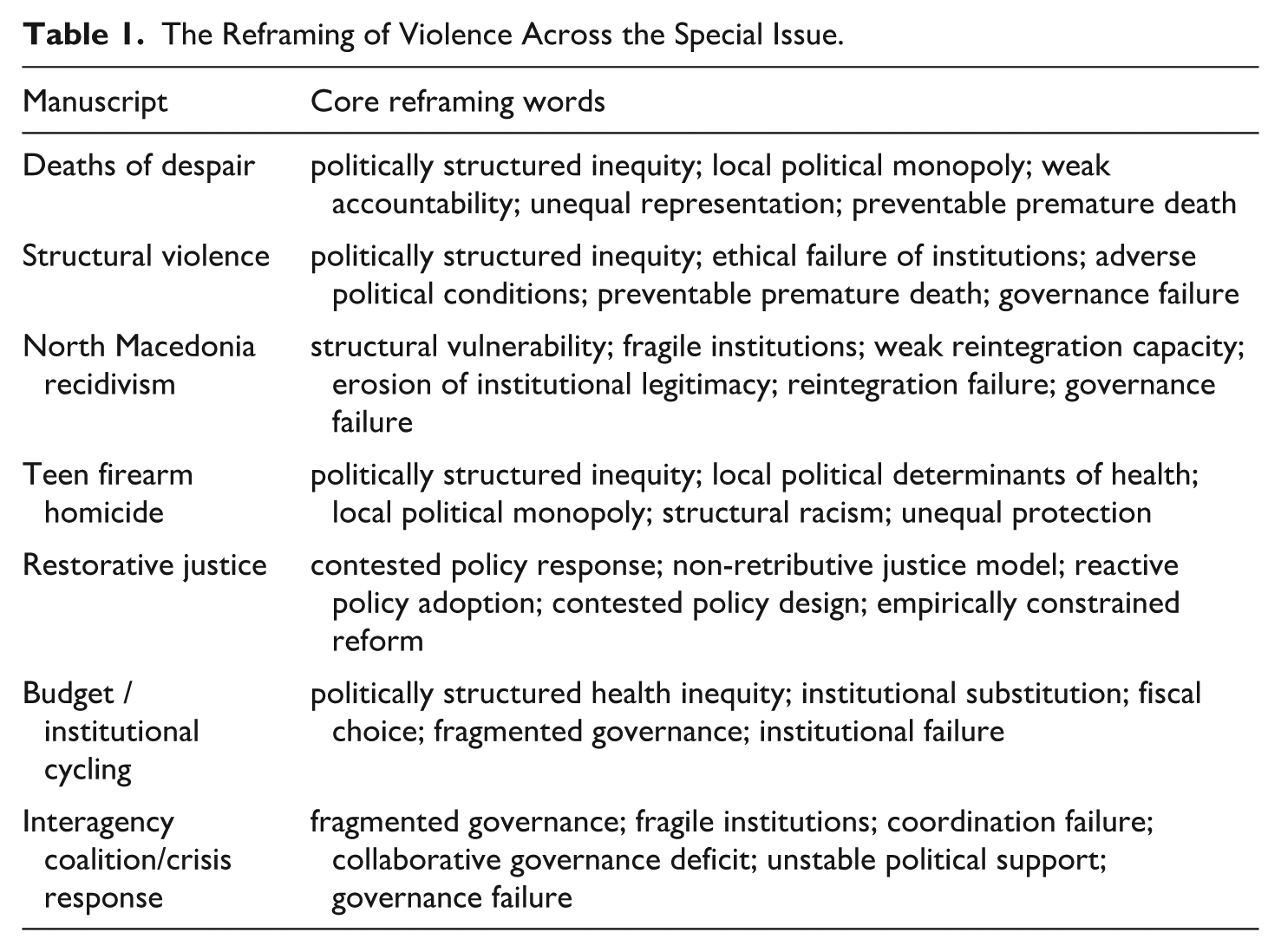
The themes show violence is a patterned, measurable health outcome produced, in part, by political and fiscal choices, creating poor health outcomes in specific sub-populations. This raises a question: Why does reframing violence matter now, in 2026? The timing of this issue is not incidental. The conditions underlying contemporary violence have been building for decades (Newman, 2025). At its worst, intense partisanship, weakened public institutional trust, routine government gridlock, and continued inequality, all occur alongside persistent high rates of interpersonal violence and expanding exposure to non-lethal and chronic forms of structural violence. Violence in the mid-2020s can be understood not simply as a criminal justice problem but as a manifestation of a broader polycrisis in which political fragmentation, institutional weakness, economic precarity, and unequal exposure to harm reinforce one another (Tooze, 2021). The resulting strain is visible not only in violent outcomes but also in affected government institutions and created fragmented governance, collaborative deficits, erosion of institutional legitimacy, and fragile institutions.
In this environment, violence has become a political symbol during elections (Beckett, 1999; Edelman, 1985) but is less likely to be treated as a modifiable policy stream amenable to sustained prevention, implementation, and evaluation (Abt, 2019; Head, 2022; Kingdon, 1995). Applying Tooze’s (2021) concept of polycrisis to violence helps explain why violence appears in multiple interacting forms across this special issue: deaths of despair; preventable premature death; teen firearm homicide; recidivism; institutional cycling; and coercive crisis response. Violence risks becoming a politically elastic, fuzzily defined buzzword rather than a stable object of policy (Edelman, 1985; Head, 2022). Policy churn follows with quick announcements, partial rollouts, reversals after the next election, and short implementation windows (Kingdon, 1995; Pressman & Wildavsky, 1973), pulling attention away from building prevention capacity and pushing systems back toward enforcement as the default response (Abt, 2019; Beckett, 1999; Garland, 2001).
Political debate thrives when outcomes are ambiguous and causal stories are contestable (Kingdon, 1995; Stone, 1989). Public health framing does not depoliticize violence; it makes violence harder to manipulate by anchoring the discussion in comparable indicators, identifiable exposures, and testable intervention pathways (D’Inverno et al., 2025; Krug, 2002; Mercy et al., 1993). The point is not to deny politics. The point is to reduce the space for purely partisan definitions of what counts as harm, who counts as a victim, and what constitutes a credible solution.
Why Reframing Matters Now
This is exactly the environment where wicked problems do not resolve (Head, 2022; Pressman & Wildavsky, 1973), even when policies/programs are nominally created. Claims about “priorities” are easy political rhetoric, but public finance becomes the operating constraint and the value signal of the politics surrounding the issue (Wildavsky, 1964). Political buzzwords do not create programs that re-solve, over and over, a violence problem because appropriations and procurement decisions reveal actual governing commitments that favor punishment or institutional shuffling. Appropriations and procurement decisions reveal government values, including commitments that fail to reduce violence, as several manuscripts in this special issue suggest (Dennis et al., in press; Gittner et al., in press; Levine et al., in press). If violence is a preventable health outcome, budgets are not background noise; they are a governing mechanism shaping the balance between prevention and punishment (Abt, 2019; Wildavsky, 1964).
Thus, non-competitive politics can make violence effectively “invisible” even when harm is plainly measurable, as manuscripts in this special issue suggest in analyses of deaths of despair, structural violence, and teen firearm homicide (Levine et al., in press; Patterson et al., in press; Levine et al., in press). When electoral competition is dampened, the incentive is eliminated to take on problems (e.g., violence) that are slow-moving, multi-causal, and unlikely to yield credit within a single term (Barrilleaux et al., 2002; Gamm & Kousser, 2021; Holbrook & Van Dunk, 1993; Rocco et al., 2020). Election incentives drive short horizon agenda selection of policy issues that can be “solved” or show results, which drive selective implementation, followed by symbolic maintenance, eventual policy drift, and weak follow-through over time (Edelman, 1985; Kingdon, 1995; Pressman & Wildavsky, 1973). So, elected politicians often prioritize policies that are rapidly visible single-shot solutions (Abt et al., 2024), enforcement-heavy, or individually targeted, while underinvesting in structural prevention whose value appears outside the electoral window (Beckett, 1999). Civic disengagement (lack of voter turnout, voter apathy) can deepen this pattern by locking in feedback loops of exclusion and weak leverage. Structural barriers such as poverty, low educational attainment, and neighborhood conditions raise the costs of participation while reducing the salience of electoral politics itself. However, civic disenfranchisement through voter apathy locks in a feedback loop. Structural barriers such as poverty, lack of education, and environment negatively influence one’s ability to participate in the electoral process by increasing costs associated with participation while decreasing the salience of the political process itself (Hansen & Tyner, 2021; Wolfinger & Rosenstone, 1980).
Closing Call to Action
If violence is endemic, it is because the conditions that sustain it are deeply embedded in how we structure community life, allocate resources, and govern one another. The question is whether we can reduce violence even when doing so is not electorally convenient—not whether violence will remain politically salient. It will. Violence is a form of politically organized harm, whose production and visibility, and is not merely a set of criminal acts or tragic outcomes. Measurement and response are structured by institutions, power, and governance. The next stage of research must bridge public health, criminal justice, jurisprudence, political science, and administrative practice to clarify not only what drives violence, but who is positioned to change it—and under what conditions they will choose to act.
Footnotes
Acknowledgements
None.
Funding
The authors received no financial support for the research, authorship, and/or publication of this article.
Declaration of Conflicting Interests
The authors declared no potential conflicts of interest with respect to the research, authorship, and/or publication of this article.
