







Abstract
Using data from the 2010–2012 American Community Survey (ACS), we estimate employment outcomes among persons with different combinations of sensory, functional, and activity limitations while controlling for individual characteristics. We consider activity limitations as indicators of barriers to independent living and of a need for support services. We find that the presence of an activity limitation is strongly associated with decreased odds of employment for persons with sensory or functional limitations. Results provide support for the targeted allocation of resources to increase independent living among persons with disabilities as a means to improve employment outcomes among persons with disabilities.
The term disability can be understood as a condition that results from the interaction between an individual-level impairment, activity limitation, or participation restriction with personal and environmental factors (Palmer & Harley, 2012). National surveys are commonly used to measure the prevalence of disability in the population and to track outcomes of interest for persons with disabilities. Within the United States, more than 38 million people, or 12% of the population, are living with disabilities (Houtenville, 2013). The prevalence of disability varies by individual characteristics, with older adults, females, Blacks, and Hispanics generally having higher rates of disability than their comparison groups (Brault, 2012). Persons with disabilities are less likely to be employed than persons without disabilities, leading to further disparities in economic security (Brucker, Mitra, Chaitoo, & Mauro, 2015).
Employment among persons with and without disabilities, for the nation as a whole, is routinely tracked using data from the Current Population Survey (Kessler Foundation, 2014). The American Community Survey (ACS) can be used to describe employment among people with disabilities in finer demographic or geographic detail (Houtenville, 2013). Each of these surveys includes the same federal standard set of six questions to identify persons with disabilities. The questions are not mutually exclusive and gather data on sensory (hearing and vision), functional (ambulatory and cognitive), and activity limitations (independent living and self-care). Traditionally, these questions are used either as a group or individually to identify persons who have any of the six listed types of limitations or one particular type of limitation. When initially designed, however, the four questions related to sensory and functional limitations were intended to provide a reasonable estimate of population level disability, while the two questions related to activity limitations were expected to help monitor independent living and the need for related services (Brault, Stern, & Raglin, 2007).
When examining employment outcomes for persons with disabilities, statistics are generally reported for persons with any limitation (Kessler Foundation, 2014) or with one particular type of limitation (Houtenville, 2013). To date, employment outcomes for persons with different combinations of limitations, as measured using this federal set of disability questions, have not been examined. This article will explore employment among different subpopulations of persons with disabilities, using the four functional and sensory limitation questions as the primary identifiers of disability, while considering the additive effect of reported activity limitations. By using the six sequence of questions in a novel way, researchers can not only identify the subpopulation of individuals with disabilities who are at the greatest risk of poor employment outcomes but can also determine the relative need for independent living and other support services. Individuals who report only one limitation may fare differently in terms of employment than individuals who report the presence of two or more limitations. The primary purpose of this study is to test the hypothesis that employment outcomes for individuals with disabilities varies as the number and particular combination of self-reported limitations varies, holding personal characteristics constant. More specifically, we are interested in examining how activity limitations (independent living and self-care) are associated with employment for different subpopulations, when controlling for other individual characteristics.
Literature Review
Overall, of working-age civilians living in the community during 2012, employment was 37% for individuals with a visual limitation, 49% for those with a hearing impairment, 23% for those with a cognitive limitation, and 24% for those with an ambulatory impairment (Houtenville, 2013). Although a growing share of federal and state resources is devoted to supporting the education, income support, medical, rehabilitation, and training needs of persons with disabilities, the proportion of overall spending dedicated to programs that are designed to foster self-sufficiency through employment for this population has remained low. In federal fiscal year 2008, for example, only US$4.3 billion of the total US$357.4 billion in federal and state funding allocated toward supporting persons with disabilities was targeted toward education, training, and employment (Livermore, O’Toole, & Stapleton, 2011). In addition, where targeted programs do exist, coordination among programs remained poor (U.S. Government Accountability Office [GAO], 2008, 2010, 2012). Given these findings, it is perhaps not surprising that large gaps in employment exist between persons with and without disabilities.
In July 2014, 26% of working-age persons with disabilities and 72% of persons without disabilities were employed (Kessler Foundation, 2014). Employment rates for persons with disabilities varied by demographics and by disability type. Employment rates for persons with disabilities were higher for individuals who were male, White, married, or had higher levels of educational attainment (Sevak, Houtenville, Brucker, & O’Neill, 2014). The type of disability can influence employment outcomes, with variations seen in employment for persons with limitations that were sensory (Appelman et al., 2012; Darensbourg, 2013; Giesen & Cavenaugh, 2013; Houston, Lammers, & Svorny, 2010; Kelly, 2013; McDonnall, Li, & Crudden, 2013) and functional (Andelic, Stevens, Sigurdardottir, Arango-Lasprilla, & Roe, 2012; Arango-Lasprilla et al., 2009; Artman & McMahon, 2013; Baune et al., 2010; Giugiario et al., 2012; Jones & Crews, 2013; J. S. Krause, 2010; I. Krause, Kern, Horntrich, & Ziemssen, 2013; Nord, Hewitt, & Nye-Lengerman, 2013; Ottomanelli, Sippel, Cipher, & Goetz, 2011).
Of course, great variation in employment outcomes exists among persons with disabilities, even among those who might fall within similar broad categories of types of disabilities. Some of this variation is due to differences in individual characteristics. Differences in educational attainment can influence the likelihood of employment across all types of disabilities, for example, as rates of employment increase with each level of education completed (Hollenbeck & Kimmel, 2008; Loprest & Maag, 2007; Newman, Wagner, & Knokey, 2011). Some of the variation in employment within broad disability categories, however, is due to differences in the severity of disability that may not be accurately captured using the standard sensory and functional limitation survey measures. As an example, the odds of competitive employment for Social Security Disability Insurance beneficiaries who are legally blind were 25% lower than for beneficiaries who are visually impaired but not legally blind (Giesen & Cavenaugh, 2013). Members of both groups, however, might report the presence of a visual limitation, as measured in the six-question sequence.
Any efforts to increase employment for persons with disabilities must consider individual-level characteristics, differences in disability, and organizational or institutional barriers that might affect the hiring and retaining of individuals with disabilities. Certain individual characteristics that might affect the employment equation can be mitigated through the provision of targeted policy responses. Individually modifiable attributes, such as educational attainment, can be improved by focusing public resources on increasing the adequacy of education for persons with disabilities. In the case of other, more fixed, individual characteristics such as age, gender, or race/ethnicity, policy solutions might need to focus on broader systemic issues, such as reducing discrimination among employers. Where limitations are related to the disabling condition, independent living and other support services combined with workplace accommodations can assist in addressing barriers to employment and in improving the probability of sustained employment (Freiman, 2005; Schur et al., 2014; Sundar, 2014). Understanding the relative effect of individual characteristics and differences in disability can help to identify where policy efforts should be focused to improve employment participation for persons with disabilities.
The primary purpose of this study was to test the hypothesis that employment outcomes for individuals with disabilities vary as the number and particular combination of self-reported limitations vary, holding personal characteristics constant. More specifically, we were first interested in examining how activity limitations (independent living and self-care), when considered as incremental measures of the severity of a sensory or functional limitation, influence employment for different subpopulations. Second, we were interested in examining whether there are individual characteristics that might mitigate the added effects of activity limitations on employment. Results can inform resource allocation for services that support the employment of persons with disabilities.
Method
Data
Data from pooled 2010–2012 samples of the American Community Survey, restricted to persons of working age (ages 25–61 years; unweighted N = 3,934,682) were used to examine the employment outcomes of each of the four functional limitation subpopulations identified in the ACS (i.e., people with hearing, vision, ambulatory, or cognitive limitations). The four subpopulations are stratified by the reporting of activity limitations (i.e., self-care and independent living limitations). The ACS is an annual, nationally representative survey administered by the U.S. Census Bureau. Data from the ACS are used to help determine how more than US$400 billion in federal and state funds are distributed each year (U.S. Census Bureau, 2014). Data were weighted using person weights determined by the survey set feature of Stata statistical software. For all analyses, replicate weights were used to adjust for the ACS sample design, per Census guidance, ensuring the appropriate calculation of standard errors.
Defined Variables
Demographic variables included age, gender, race, marital status, ethnicity, and educational attainment. Age was measured as a continuous variable. Gender, race, marital status, and ethnicity were coded as binary variables, with values of 1 assigned for attributes that are generally associated with high likelihoods of employment (male, White, married, non-Hispanic). Educational attainment was measured categorically, including categories for educational attainment of less than high school, high school completion, some college, and bachelor’s degree or higher. The outcome variable, employment, was defined as working in the past week.
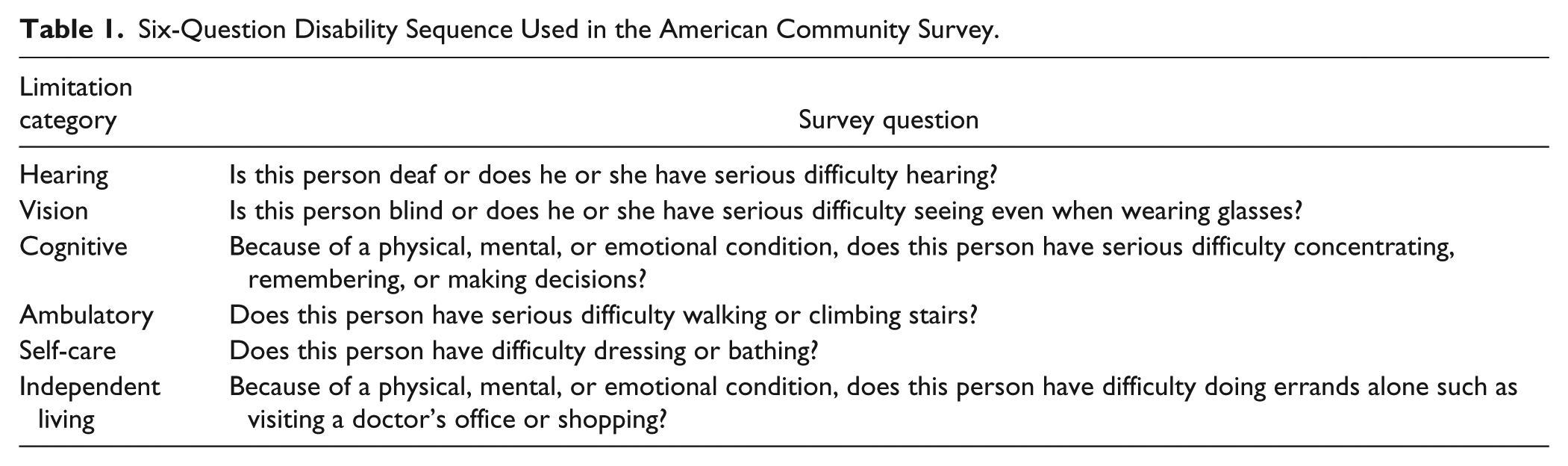
Sensory, functional, and activity limitations were measured using the six limitation questions included in the ACS. The specific survey questions are included in Table 1. The hearing and visual limitation questions capture sensory disability information. The functional limitation questions include the ambulatory and the cognitive limitation questions. The ambulatory limitation question captures people who may have a range of underlying health conditions, including diabetes, heart disease, musculoskeletal disorders, obesity, and spinal cord injury. The cognitive limitation question collects information on the presence of a range of conditions as well, including intellectual disabilities and psychiatric disabilities. The activity limitation questions were initially designed to monitor, on a national level, need for services and supports and gather information about independent living and self-care limitations.
Six-Question Disability Sequence Used in the American Community Survey.
Sample Description
Table 2 provides demographics for the sample. The sample was evenly split between genders. Most of the sample was between the ages of 35 and 54 years. A total of 61% of the sample was married. Nearly 75% of the sample was White, and 85% were non-Hispanic. Nearly 61% of the sample had at least some college education. Overall, 11% reported the presence of at least one limitation. Cognitive limitations were the most common type of functional limitation (approximately 5%). Among activity limitations, independent living limitations were more common than self-care limitations.
Demographics for Working-Age Adults.
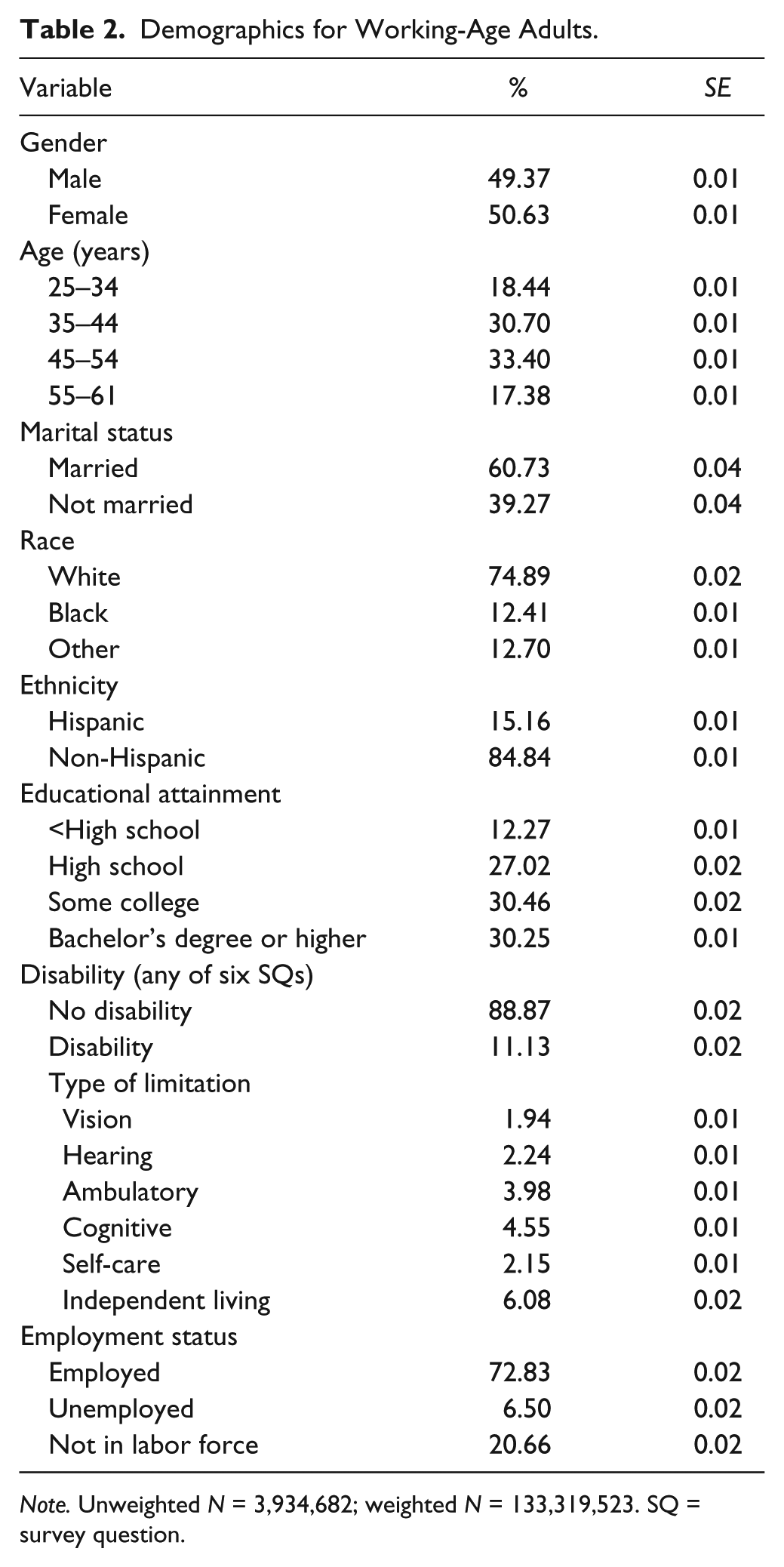
Note. Unweighted N = 3,934,682; weighted N = 133,319,523. SQ = survey question.
Analysis
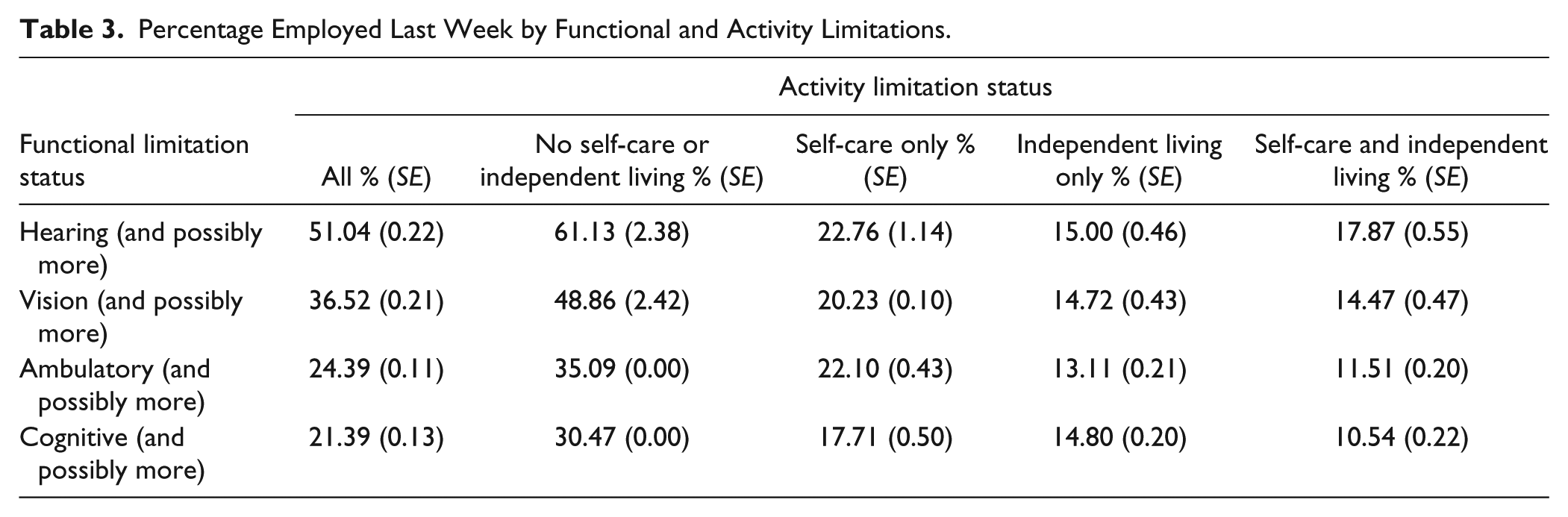
Descriptive statistics were first run to present the percentage of persons with functional limitations who were employed in the past week. Next, logistic regression was used to model the outcome of employment, while controlling for demographic variables. Standard errors were adjusted to account for the use of weighted data. The full sample of working-age persons with disabilities was used for this step of the analysis. Sixteen separate models were run, however, each including a differently defined focal disability variable, while controlling for the demographic variables. The focal disability variables were defined along the dimensions included in Table 3. This allowed us to examine employment for persons with different combinations of limitations compared with persons without those combinations of limitations.
Percentage Employed Last Week by Functional and Activity Limitations.
The models estimated an employment outcome, Ei, of individual i. Ei is a function of the particular combination of a sensory or functional limitation with the presence or absence of an activity limitation (

For example, the first set of four regressions included employment as the dependent variable, all of the demographic variables as control variables, and a focal variable defined as (a) hearing limitation without independent living or self-care limitation, (b) hearing limitation with only a self-care activity limitation, (c) hearing limitation with only an independent living activity limitation, and (d) hearing limitation with both activity limitations (independent living and self-care). Comparing the model that included hearing limitation with the model that included hearing, self-care, and independent limitations, for example, suggests the relative level of the effect that the interaction of activity limitations with a hearing limitation has on employment, controlling for other individual characteristics. Given that running 16 models increases the possibility of a Type I error, a Bonferroni correction was used to adjust the significance cutoffs to more conservative levels.
Results
Descriptive Statistics
Table 3 shows the percentage of people employed, by different combinations of limitations. The percentage of persons with self-reported limitations who were employed ranged from a low of 21%, for individuals with cognitive limitations, to a high of 51%, for individuals with hearing limitations. The presence of self-care or independent living limitations was associated with decreases in employment, within functional limitation categories. Sixty-one percent of persons with a hearing limitation but no self-care or independent living limitations were employed. In contrast, employment rates were lower for persons with hearing limitations who also reported self-care (23%), independent living (15%), or both types of activity limitations (18%). Similar patterns were seen across other functional limitations, with individuals who had a functional limitation but no self-care or independent living limitation having the highest rates of employment.
The gap in employment rates between persons who did and those who did not report activity limitations, however, was smaller among persons with ambulatory and cognitive limitations than among persons with sensory limitations. For example, employment rates for persons with cognitive limitations ranged from a high of 31% for persons without activity limitations to a low of 11% for persons with both activity limitations, a gap of 20 percentage points. For persons with hearing and visual impairments, the gap between individuals without activity limitations and those with both activity limitations was 46 and 35 percentage points, respectively.
Multivariate Statistics
Table 4 shows summary logistic regression results, allowing us to examine the influence of different combinations of limitations on employment while controlling for individual characteristics. For each model, all demographic variables, other than race, were significant at p < .001 in the expected directions. Even though the odds of employment were relatively low for persons with functional limitations on the whole, individual characteristics were associated with variations in employment. Gender was linked with employment, with males having significantly higher odds of employment. Gender had a stronger association than ethnicity or marital status with the odds of employment. Educational attainment was important as well: The odds of employment increased substantially as the level of education rose. Persons with at least a college education, for example, had odds of employment more than three times as high as the odds of employment for persons with less than a high school education.
Logistic Regressions of Employment in the Past Week.
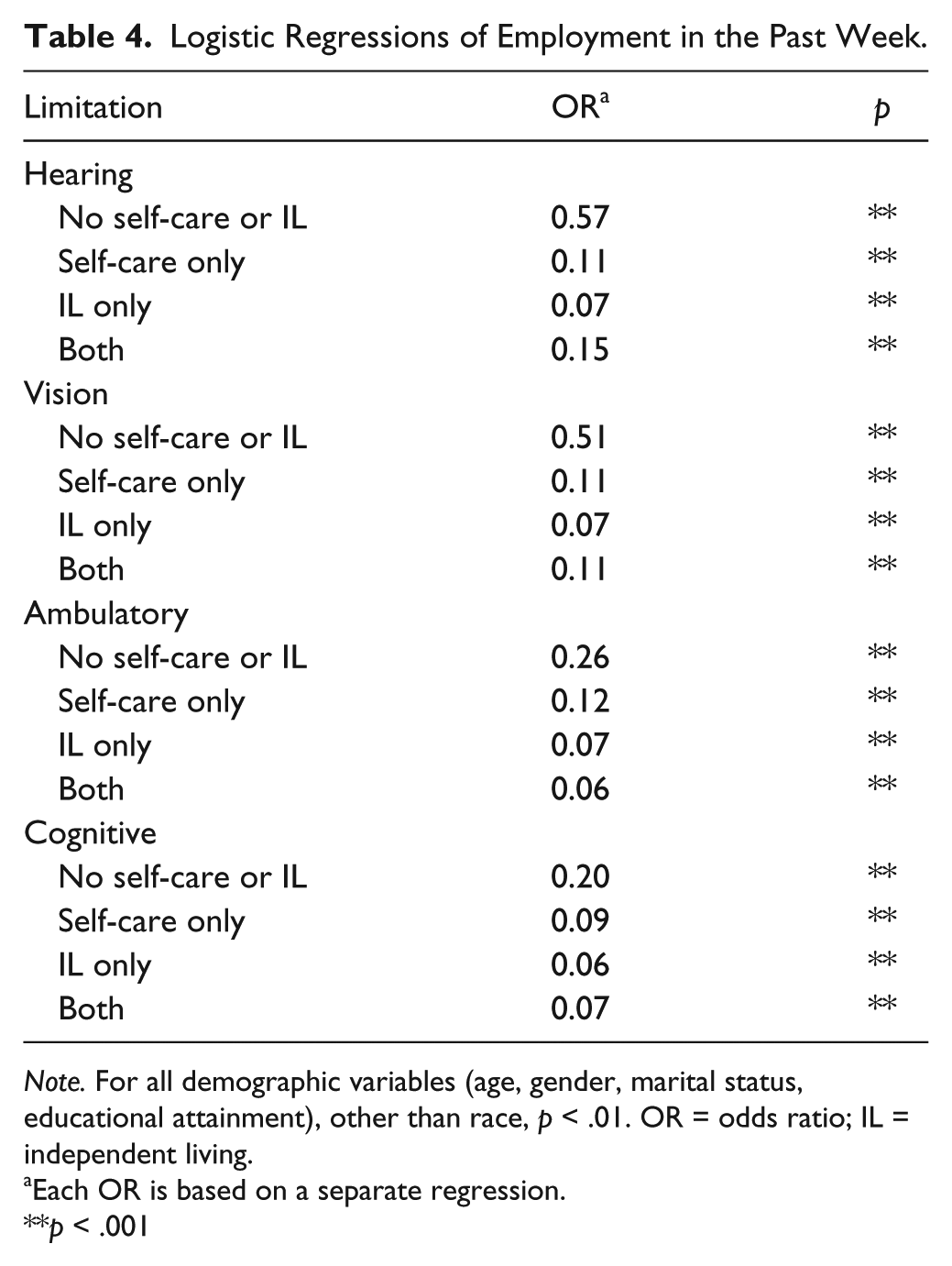
Note. For all demographic variables (age, gender, marital status, educational attainment), other than race, p < .01. OR = odds ratio; IL = independent living.
Each OR is based on a separate regression.
p < .001
Differences in self-reported limitations were connected with employment outcomes as well. Similar to the descriptive statistics presented earlier, the logistic regression results suggested gaps in the odds of employment within functional limitation categories. The odds of employment for persons with hearing limitations, for example, ranged from 0.57 (p < .001) for individuals without activity limitations to 0.07 (p < .001) for individuals with independent living limitations, even when controlling for individual characteristics. Results for persons with other types of functional limitations mirrored the results for persons with hearing limitations. The presence of any activity limitation greatly reduced the odds of employment. As an example, persons with cognitive limitations but no activity limitations had an odds ratio of 0.20 (p < .001). Persons with cognitive limitations and some type of activity limitation had odds of employment ranging from 0.06 to 0.09 (p < .001).
Discussion
As expected, our results showed large gaps in employment between persons with and without disabilities. These findings are in line with estimates using different data sources (Kessler Foundation, 2014) and provide further evidence of inequities in employment for persons with disabilities in the United States. In addition, we found that employment outcomes differed among disability categories. When considering employment outcomes among persons with disabilities, persons with sensory impairments fared better in terms of employment than persons with cognitive or ambulatory limitations. Policies and services designed to increase the employment of persons with disabilities must therefore be cognizant of the differences that exist across persons with different types of disabilities. One policy or practice does not fit all. Disparities in employment outcomes among persons with different disability types are likely due to a complex interaction of individual and labor market characteristics. Although the research discussed here focused on individual-level differences, further research is needed to examine differences from an employer perspective because certain industries, occupations, or organizations may provide work environments that are more favorable toward persons with particular types of limitations.
Employment outcomes also varied within broad disability categories. For persons with either a sensory or functional limitation, the presence of an additional activity limitation was associated with a much lower probability of employment. Recall that the original intent of including the activity limitation questions with the federal standard set of disability questions was to monitor independent living and need for services. Our results provide evidence that limitations in independent living and assistive service delivery may be preventing a portion of persons with disabilities who want to work from working. In addition to providing necessary employment supports, adequately funding a well-coordinated set of services that can promote long-term independence might therefore provide a way to increase the employment of persons with disabilities. Investments in services to promote long-term independence can be viewed as investments in human capital as such supports can facilitate increased opportunities for employment.
The primary limitation of this study was using cross-sectional data that provide limited detail about disability. Given this limitation, results should be interpreted as correlational rather than causal. Longitudinal data, or data that capture the age of onset of disability, would provide better information that can inform disability and employment advocacy, policy development, and service delivery efforts. In addition, as measures of disability are based on self-report, the usual concerns about reliability and validity apply. Still, the results presented here are useful in describing how data that are currently collected, analyzed, and reported at a national level can be used to illuminate opportunities for expanding employment outcomes for persons with disabilities. Further qualitative research, such as interviews with key stakeholder groups or follow-up surveys, can explore whether improvements in independent living services do translate into improve employability.
Conclusion
Activity limitations, as measured in the ACS, can be considered as indicators of barriers to independent living and as a lack of access to necessary support services. Data from the 2010–2012 American Community Survey suggest that the presence of an activity limitation is strongly associated with decreased odds of employment for persons with sensory or functional limitations. Results provide support for the targeted allocation of resources toward improving independent living and increasing access to necessary supports for persons with disabilities as a means to increase employment among persons with disabilities.
Footnotes
Acknowledgements
The authors would like to thank Joshua Santauro for research assistance. Purvi Sevak provided helpful comments and suggestions.
Authors’ Note
The findings and conclusions are those of the authors and do not represent the policy of the Department of Education. The authors retain sole responsibility for any errors or omissions.
Declaration of Conflicting Interests
The author(s) declared no potential conflicts of interest with respect to the research, authorship, and/or publication of this article.
Funding
The author(s) disclosed receipt of the following financial support for the research, authorship, and/or publication of this article: This project was funded by the U.S. Department of Education, National Institute on Disability and Rehabilitation Research, Individual-Level Characteristics Related to Employment Among Individuals With Disabilities Rehabilitation and Research Training Center, under cooperative agreement H133B100011.