







Abstract
We use administrative data to examine the various milestones achieved and pathways followed by new Social Security Disability Insurance (DI) and Supplemental Security Income (SSI) awardees. Our findings show that 80% of DI-first awardees and 53% of SSI-first awardees either achieved none of the milestones we tracked in the 10 years after their initial award or their only milestone was death or attainment of full retirement age. Furthermore, many DI and SSI awardees who achieved work- or program-related milestones during the analysis period did not make additional progress toward exiting the program. For example, one third of DI-first and one fifth of SSI-first awardees who enrolled in employment services had no other milestones and one quarter of DI-first awardees who completed a trial work period either had no other milestones or their only additional milestone was enrolling in employment services. We also found that approximately one quarter of SSI-beneficiaries who later received DI had their SSI benefits suspended and terminated due to excess income that included DI payments as the only additional milestones. Finally, our analysis reveals great diversity in the paths taken to achieve work- and program-related milestones, which policy makers should consider when designing interventions to help awardees return to work.
Keywords
Social Security Disability Insurance (DI) and Supplemental Security Income (SSI) are two federal assistance programs that together served nearly 13 million working-age people with disabilities in 2014 (Social Security Administration [SSA] 2015a). That same year, 8.2% of DI beneficiaries and 10.5% of SSI recipients exited their respective programs due to death, attainment of full retirement age (FRA), excess income, medical improvement, or other reason (SSA, 2015a, 2015b). However, little is known about the many possible pathways that beneficiaries follow after their initial award that could lead to program exit. Better knowledge of the long-term experiences and characteristics of awardees who take different paths could help policy makers develop programs tailored to the needs and circumstances of various subgroups. In this article, we use SSA administrative data to identify the most common paths followed by new DI and SSI awardees over a 10-year period after first award and show the characteristics of awardees who have been most likely to follow these DI and SSI paths.
Previous research has tracked work-related milestones achieved by cohorts of DI and SSI awardees and also explored longitudinal patterns of participation in DI and SSI. Liu and Stapleton (2011) examined the percentage of new DI beneficiaries who followed predefined paths of work-related milestones, whereas Ben-Shalom and Mamun (2015) identified awardee characteristics associated with the completion of a similar set of milestones. Ben-Shalom and Stapleton (2015) conducted a study similar to that of Liu and Stapleton (2011), but examined new SSI-beneficiaries and tracked a somewhat different set of milestones, including entry into DI. Rupp and Riley (2011) focused specifically on the interactions in program eligibility between DI and SSI within the first 5 years after award, but did not track any work-related milestones other than program eligibility.
Our article contributes to this literature in several ways. First, we examine pathways that consist of both work-related and nonwork-related milestones for a cohort of first-time DI and SSI awardees. Past work has focused on either work-related milestones or program-related milestones but never both together, and has not typically included milestones such as death and incarceration. Second, we identify all possible sequences of 19 milestones over a 10-year period that were achieved by individuals who received their first DI or SSI award in 2001, as opposed to prespecifying the pathways of interest, and present a graphical model of the most common paths. This allows the data to speak for themselves in terms of the most frequent paths completed within 10 years. We are also able to compare the percentage of awardees who ever achieved a work- or program-related milestone with the percentage of awardees who followed specific pathways that include these milestones, to gauge the diversity of paths taken to reach each milestone. Finally, we generate descriptive statistics about the characteristics of new awardees who completed the most frequently followed DI-first and SSI-first paths.
DI and SSI Eligibility and Benefits
DI is a social insurance program designed to partially replace the loss of wages of adult workers following the onset of a long-term disability. To qualify for DI, beneficiaries typically must be “disability insured” (i.e., have a sufficient work history to qualify), have a medically determinable impairment that has lasted or is expected to last for at least 12 months or result in death, and be unable to engage in substantial gainful activity (SGA). In 2016, SSA considered SGA to be the equivalent of the work required to have unsubsidized earnings above US$1,130 per month for nonblind applicants and US$1,820 for blind applicants. A small minority of DI beneficiaries qualify as the disabled adult child (DAC; see Note 1) or the disabled widow(er) of a Social Security beneficiary. Technically, most DACs and disabled widow(er)s are not DI beneficiaries, because the primary beneficiary (parent or deceased spouse) qualifies under Old-Age and Survivors Insurance. Following common practice, however, we include all DACs and disabled widow(er)s when we refer to DI beneficiaries.
The DI benefit amount is based on past earnings: the higher the lifetime earnings of the beneficiary (or other relevant individual), the higher the benefit. Eligibility for DI benefits begins after a 5-month waiting period that starts with the first month for which SSA determines the DI beneficiary was unable to engage in SGA (the “disability onset” month). In the 30th month after the month of disability onset, DI beneficiaries are automatically eligible for Medicare. DI beneficiaries with sufficiently low assets and income (including their DI benefits) also are eligible for SSI payments.
SSI’s medical eligibility criteria for applicants age 18 or older are identical to those for DI. In contrast to the DI work history requirement, SSI is means-tested, with federally set limits on income and assets. To receive any federal SSI payments, countable income and assets must be below those limits. In 2016, the countable monthly income limits were US$733 for an individual and US$1,100 for a couple. Countable income includes all monthly income above US$20 from sources other than work, plus half of earnings in excess of US$65 or any other earnings disregards, such as allowed impairment-related work expenses. Countable asset limits, which have not changed since 1989, are US$2,000 for an individual and US$3,000 for a couple. The federal SSI payment is the difference between countable income and an annually adjusted amount called the federal payment rate. Most SSI recipients also qualify for Medicaid coverage (see Note 2). SSI-only recipients may eventually become eligible for DI if they earn enough to become disability insured. Disability insured status is attained after an individual earns a required number of Social Security quarters of coverage by working and paying Social Security payroll taxes. If earnings are low enough, these individuals could potentially continue working while receiving both SSI and their newly acquired DI income.
The DI program offers several work incentives to encourage current beneficiaries to return to work. The trial work period (TWP) is the primary work incentive offered to DI beneficiaries. During the TWP, beneficiaries can work and earn at any level without loss of benefits, as long as they continue to meet medical eligibility requirements. The TWP consists of 9 months, which need not be consecutive, in a 60-month rolling window. In 2016, a beneficiary was considered to be in a “TWP month” if he or she had monthly earnings of at least US$810 or was working at least 80 self-employed hours. After completing the TWP, beneficiaries enter a 36-month extended period of eligibility (EPE). Except for a 3-month grace period, individuals who engage in SGA in any month during the EPE lose their entire cash benefit for that month, but remain eligible for Medicare. On the flip side, the beneficiary is entitled to full benefits in any month in which he or she is not engaged in SGA, provided that benefits have not been terminated for medical recovery or some other reason. After the EPE ends, DI cash benefits are terminated in the first month of SGA. In general, DI benefit entitlement continues indefinitely unless the beneficiary dies, reaches FRA, experiences medical improvement, or engages in SGA after the EPE ends.
The SSI program offers a different set of work incentives to its recipients. For example, the earned-income exclusion removes the first US$65 of earned-income plus half of all additional earnings from countable income, which is subtracted from the monthly SSI cash benefit. The fact that only US$1 of every US$2 earned by SSI recipients counts against their monthly cash benefit is a potentially strong work incentive. SGA is a less relevant earnings threshold for SSI than for DI given that Section 1619(a) of the 1987 Social Security Act allows SSI recipients to receive some cash payments even when their earned-income is at or above the SGA level; furthermore, Section 1619(b) of that act extends SSI eligibility (including Medicaid coverage) indefinitely—even if recipients’ labor earnings are so high that their SSI cash payment is zero—as long as their earnings remain below a state-determined threshold. The 1619(b) maximum income threshold is determined annually and depends on the state’s Medicaid expenditures for SSI recipients, which in 2016 ranged from US$27,075 in Alabama to US$66,520 in Connecticut. These provisions encourage work by reducing the risk of losing cash assistance and medical coverage when earnings increase.
Through the Ticket to Work program, both DI beneficiaries and SSI recipients can enroll for employment services (ES), for which SSA will pay the service provider if the beneficiary achieves sufficient earnings over a specified period. Under Ticket to Work, beneficiaries and recipients can obtain services by presenting a “ticket” to any qualified provider in an employment network. Employment networks include all state vocational rehabilitation agencies and other private and public vocational service providers that meet criteria set by SSA. Beneficiaries who assign a ticket to an employment network typically complete an Individual Work Plan that outlines the services and supports needed to help them ultimately gain and sustain full financial independence.
SSA periodically reviews both DI beneficiaries’ and SSI recipients’ disability status through its medical Continuing Disability Review (CDR) process, and terminates benefits for those whose medical condition has improved to the point where SSA no longer considers them unable to engage in SGA. The law requires SSA to perform a medical CDR every 3 years or so unless medical improvement is expected in less than 3 years or the condition is not expected to improve. In those cases, the CDR occurs less frequently. For DI beneficiaries, SSA also conducts work CDRs based on information received about beneficiary earnings, and suspends DI benefits for those determined to be engaging in SGA during the 36 months after TWP completion (with the exception of 3 grace months) and terminates benefits for continued engagement in SGA thereafter. SSA also conducts periodic reviews of the income, resources, and living arrangements of SSI-beneficiaries to verify that they satisfy the means test, and makes any necessary adjustments to their benefit amounts.
Data and Method
We use the 2012 version of the DAF, which contains administrative data on individuals who participated in the DI and SSI programs from March 1996 through December 2012. We supplemented this with matched data on cases closed by state vocational rehabilitation agencies, as reported in the Rehabilitation Services Administration case service reports (known as RSA-911) data for the 2001–2012 fiscal years. The RSA-911 data contain information about each person who exited a vocational rehabilitation agency during the year, also known as a “case closure,” but do not include information on those still receiving services. We restricted the sample to awardees who received their first DI or SSI benefit payment as an adult in 2001 and were ages 18 to 64 at the time of award (see Note 3). The final analytic sample includes 837,109 individuals.
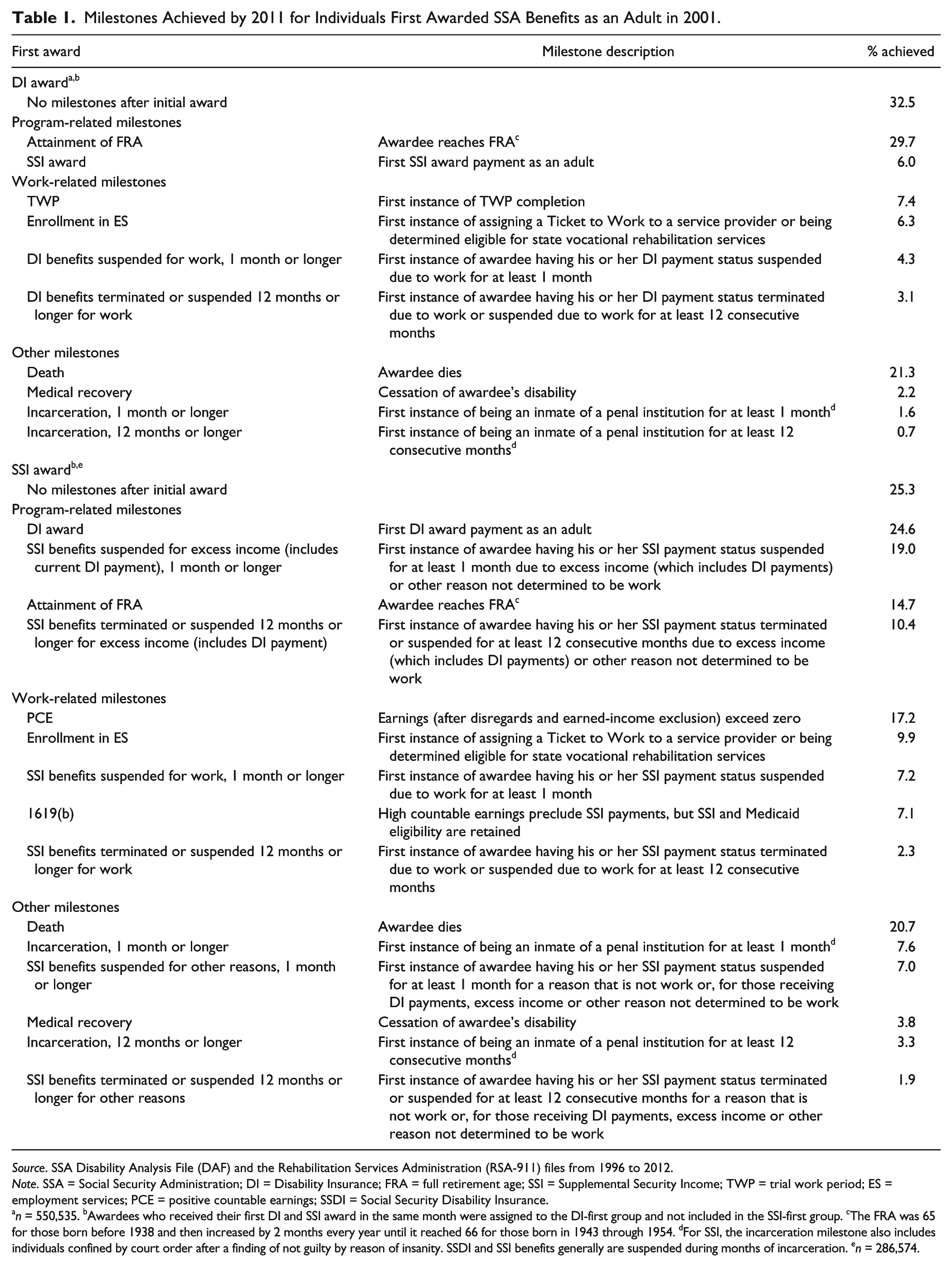
Together, the DAF and RSA-911 data include information on important milestones that occur after the first DI or SSI award. We identified 19 milestones in the data and categorized them into three groups: work-related milestones (such as receipt of enrollment services or benefit suspension due to work), program-related milestones (such as a subsequent DI or SSI award following the initial award), and “other” milestones that are not work- or program-related (such as death and incarceration). Because we have longitudinal data, we are able to follow the milestones that the 2001 award cohort achieved over a 10-year period through 2011. Table 1 provides a complete list of the milestones we consider in this article, along with a short description of each milestone and the percentage of awardees who achieved each milestone in the 10-year period.
Milestones Achieved by 2011 for Individuals First Awarded SSA Benefits as an Adult in 2001.
Source. SSA Disability Analysis File (DAF) and the Rehabilitation Services Administration (RSA-911) files from 1996 to 2012.
Note. SSA = Social Security Administration; DI = Disability Insurance; FRA = full retirement age; SSI = Supplemental Security Income; TWP = trial work period; ES = employment services; PCE = positive countable earnings; SSDI = Social Security Disability Insurance.
n = 550,535. bAwardees who received their first DI and SSI award in the same month were assigned to the DI-first group and not included in the SSI-first group. cThe FRA was 65 for those born before 1938 and then increased by 2 months every year until it reached 66 for those born in 1943 through 1954. dFor SSI, the incarceration milestone also includes individuals confined by court order after a finding of not guilty by reason of insanity. SSDI and SSI benefits generally are suspended during months of incarceration. en = 286,574.
We divided the sample of 2001 awardees into two groups: those whose first award was DI and those whose first award was SSI. We assigned the small minority who received both awards in the same month of 2001 to the DI-first group. The first step of our analysis is to show how often each of the observed milestones was achieved over a 10-year period for each group. We then present a visual depiction of the most frequent milestone paths followed by each group, to provide a sense of which milestones tend to occur in succession. We do not follow milestones that occur after program exit.
The last step of our analysis is to describe the characteristics of awardees who follow the most frequent milestone paths for each program and examine whether awardees with certain characteristics or program measures are overrepresented or underrepresented in certain paths relative to the average characteristics of all program awardees. The characteristics we consider are sex, age, impairment type, race/ethnicity, and years of education at the time of award. We categorize age into five groups: 18 to 24, 25 to 34, 35 to 44, 45 to 54, and 55 to 64. Almost all awardees in the oldest age group reached FRA within the 10-year follow-up period applied in our analysis. We also construct seven primary impairment groups: affective disorders, other psychiatric disorders, intellectual disability, sensory impairments, back disorders, other musculoskeletal disorders, and other physical disorders. Finally, we consider the following program measures for each awardee: DI and/or SSI benefit amount at award, receipt of both SSI and DI in the first award month, eligibility for Medicare at the time of first award, number of dependent beneficiaries, DAC status, disabled widow(er) status, and adjudicative level for the award decision (initial review at the disability determination services office, reconsideration at the disability determination services level, and after appeal at the administrative law judge level).
Results
Milestones Achieved During the 10 Years After Initial Award
Table 1 shows how often each of the observed milestones was achieved over a 10-year period for each group. About one third (32.5%) of DI-first awardees reached no additional milestones in the first 10 years after their initial award, 29.7% reached FRA during this period, and 21.3% died. In terms of program-related milestones, 6% of DI-first awardees were also awarded SSI at some point during the 10-year period. Among the work-related milestones, 7.4% of DI-first awardees completed a TWP, 6.3% enrolled in ES, 4.3% had their DI benefits suspended for at least 1 month due to work, and 3.1% had their suspension for work last at least 12 consecutive months or result in termination. For comparison, Liu and Stapleton (2011) found that 6.5% of all DI beneficiaries who began receiving benefits in 1996 had their benefits suspended due to work in at least 1 month and 3.7% had their benefits terminated during a 10-year period; however, we would expect these estimates to differ from ours because they include all individuals who were awarded DI in 1996—including those who were earlier awarded SSI—and follow a different cohort of beneficiaries. Finally, we find that 2.2% of DI-first awardees had a medical recovery, 1.6% were incarcerated for at least 1 month, and 0.7% were incarcerated for at least 12 consecutive months.
About one quarter (25.3%) of SSI-first awardees achieved no additional milestones in the first 10 years after their initial award, 20.7% died, and 14.7% reached FRA. Among the program-related milestones, about one quarter (24.6%) of SSI-first awardees also received a DI award at a later date. This, in part, reflects the fact that some beneficiaries applied for both awards at the same time but began receiving DI a few months later than SSI due to the DI 5-month waiting period (such beneficiaries are also known as “serial beneficiaries” or “joint SSI/DI beneficiaries,” depending on whether they continue to receive SSI payments after they begin receiving DI, per Rupp & Riley, 2011). It is also possible that some of these beneficiaries acquired a sufficient work history to apply for DI months or years after they were awarded SSI. Upon receiving DI benefits, 10.4% of SSI-first awardees had their SSI benefits terminated or suspended for at least 1 year due to excess income that included a DI payment, indicating that a substantial share of beneficiaries who received DI income lost their SSI payments as a result.
In terms of work-related milestones, 9.9% of SSI-first awardees enrolled in ES, 17.2% had positive countable earnings (PCE), 7.1% achieved 1619(b) status, 7.2% had their SSI benefits suspended for at least 1 month due to work, and 2.3% had a suspension due to work that lasted at least 12 consecutive months or resulted in termination. In comparison, Ben-Shalom and Stapleton (2015) found that 9.8% of all SSI-beneficiaries who began receiving benefits in 2001 had their benefits suspended or terminated due to work in at least 1 month; however, we would expect their estimates to differ from ours because they included all individuals who were awarded SSI in 2001 (including those who were earlier awarded SSDI), excluded serial beneficiaries, and followed beneficiaries for 6 years. Finally, we find that a large percentage of SSI-first awardees (7.6%) were incarcerated for at least 1 month and 3.3% were incarcerated for at least 12 consecutive months, and 3.8% of SSI-first awardees were determined to have recovered medically.
Pathways Followed During the 10 Years After Initial Awards
Figure 1 presents the milestone paths that were frequently taken by DI-first awardees; it includes 15 of the top 20 most frequent paths with the remaining five paths listed in a footnote. Eighty percent of DI-first awardees either achieved no milestones at all in 10 years (32.5%), or their only milestone was reaching FRA (27.6%) or death (19.7%). Each of the remaining DI paths was followed by less than 4% of DI-first awardees. However, some of the paths that were less frequent among the entire DI-first population were very common among the subset of DI-first awardees who ever achieved a work- or program-related milestone somewhere along their path. For example, Table 1 showed that 6.3% of DI-first awardees enrolled in ES at some point during the 10 years following their initial award, and among this group, more than one third (or 2.8% of all DI-first awardees) had no additional milestones. Similarly, among the 7.4% of DI-first awardees who completed a TWP during this same time period, about one quarter had no additional milestones besides the TWP or enrolling in ES was their only additional milestone (2% of all DI-first awardees). Another quarter of DI-first awardees who completed a TWP (or 2.2% of all DI-first awardees) had their benefits suspended and then terminated due to work after the TWP completion as the only additional milestones, either with or without having enrolled in ES before completing the TWP. In terms of program-related milestones, we find that among the 6% of DI-first awardees that later received SSI, more than one fifth (or 1.3% of all DI-first awardees) had their SSI benefits suspended and terminated as the only additional milestones, but continued to receive DI benefits.
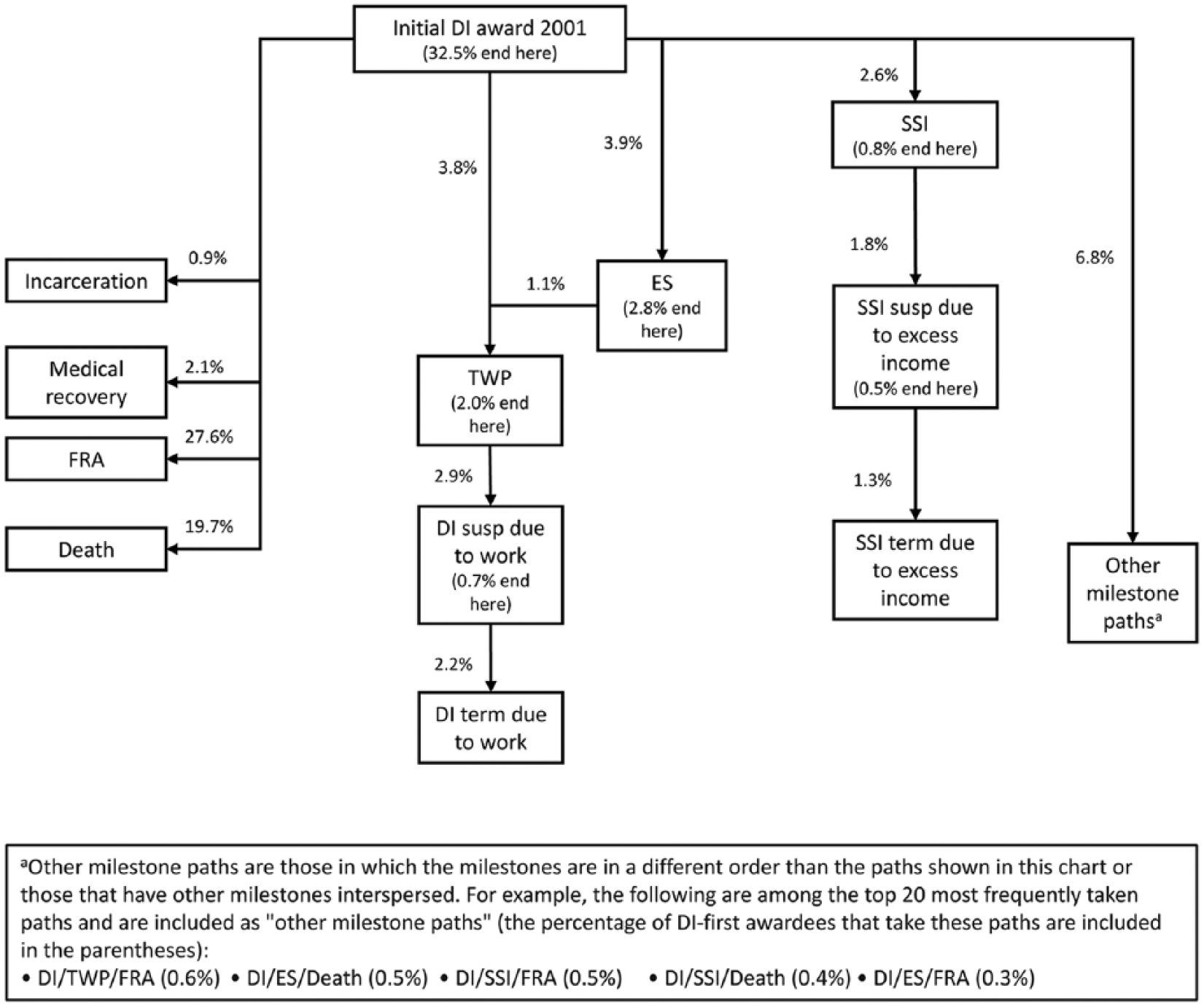
Frequently taken DI-first milestone paths.
When analyzing the frequency of these paths, it is important to note that the “other milestone” paths may include milestones similar to the paths highlighted in Figure 1 but in a different order and/or with other milestones interspersed. For example, 2.4% of DI-first awardees followed an “other milestone” path that includes ES as one of the milestones, which is slightly more than one third of DI-first awardees who enrolled in ES during the 10-year analysis period. This suggests that there is large diversity in the paths taken by DI-first awardees.
Figure 2 presents the milestone paths frequently taken by SSI-first awardees; it includes 14 of the top 20 most frequent paths with the remaining six listed in a footnote. Slightly more than one half of SSI-first awardees either achieved no milestones at all in 10 years (25.3%) or their only milestone was death (14.7%) or reaching FRA (12.5%). However, similar to DI-first awardees, many of the paths that were taken by a small percentage of the overall SSI-first population were more frequent among the subset of SSI-first awardees who achieved work- and program-related milestones. For example, Table 1 showed that almost a quarter (24.6%) of SSI-first awardees received a subsequent DI award, and approximately one quarter of these awardees (or 6% of all SSI-first awardees) had their SSI benefits suspended and then terminated due to excess income that included DI payments as the only additional milestones; these awardees continued to receive DI benefits. Almost one sixth of SSI-first awardees who received a subsequent DI award either had no additional milestones (1.9% of all SSI-first awardees) or the only additional milestone was a brief SSI suspension of less than a year without termination (1.8% of all SSI-first awardees). In terms of work-related milestones, 17.2% of SSI-first awardees had PCE and 9.9% of SSI-first awardees received ES (see Table 1), but one fifth of each of these groups had no additional milestones.
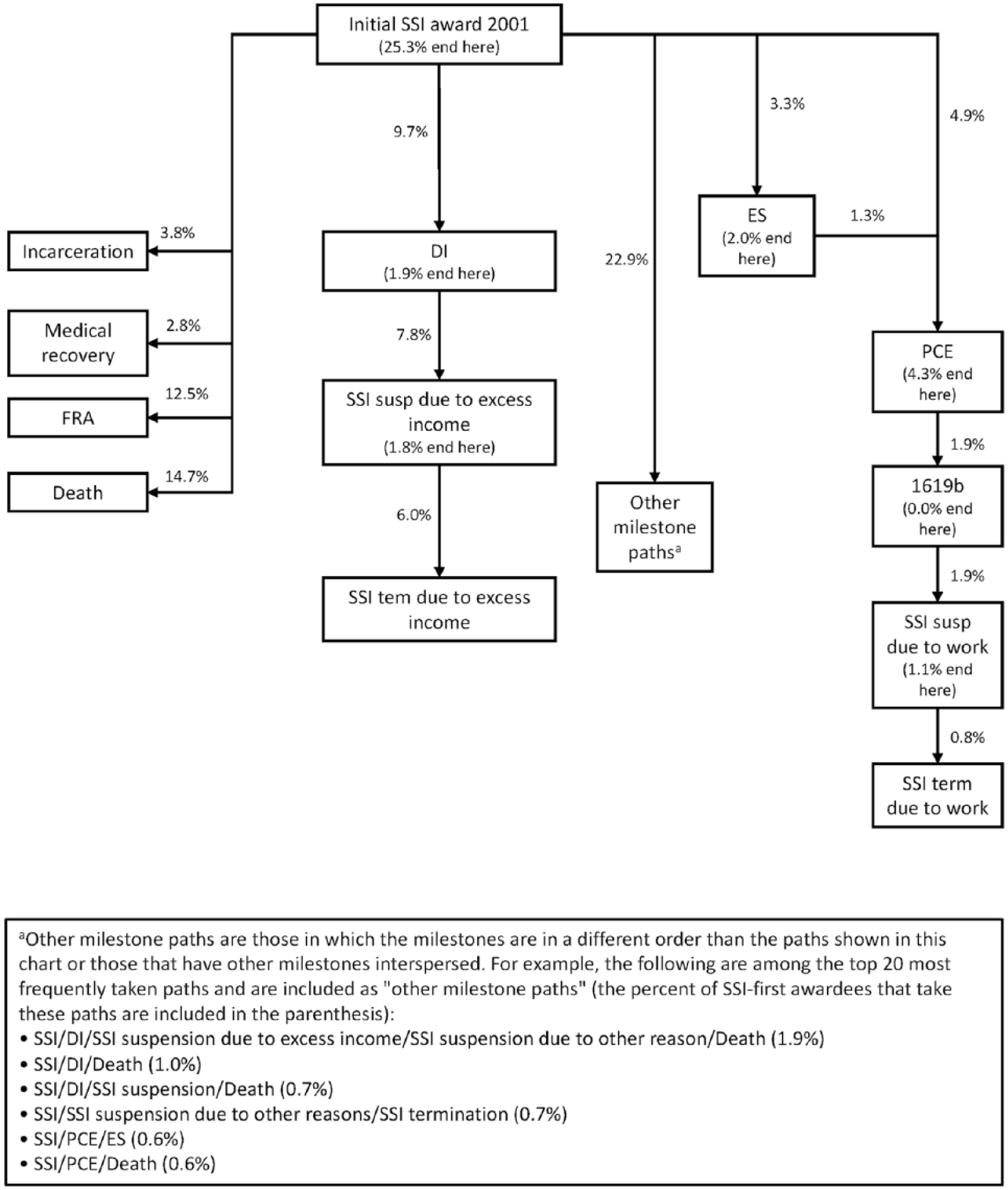
Frequently taken SSI-first milestone paths.
Overall, 22.9% of SSI-first awardees took an “other milestone” path, which indicates that SSI-first awardees have an even more diverse set of experiences over the 10 years following their initial awards than what we observe for DI-first awardees. Once again, it is important to note that these paths may include milestones similar to the more frequent paths that are highlighted in Figure 2 but in different order and/or with other milestones interspersed. For example, 6.6% of SSI-first awardees followed an “other milestone” path that includes ES as a milestone.
Characteristics of Awardees Who Take the Most Frequent Paths
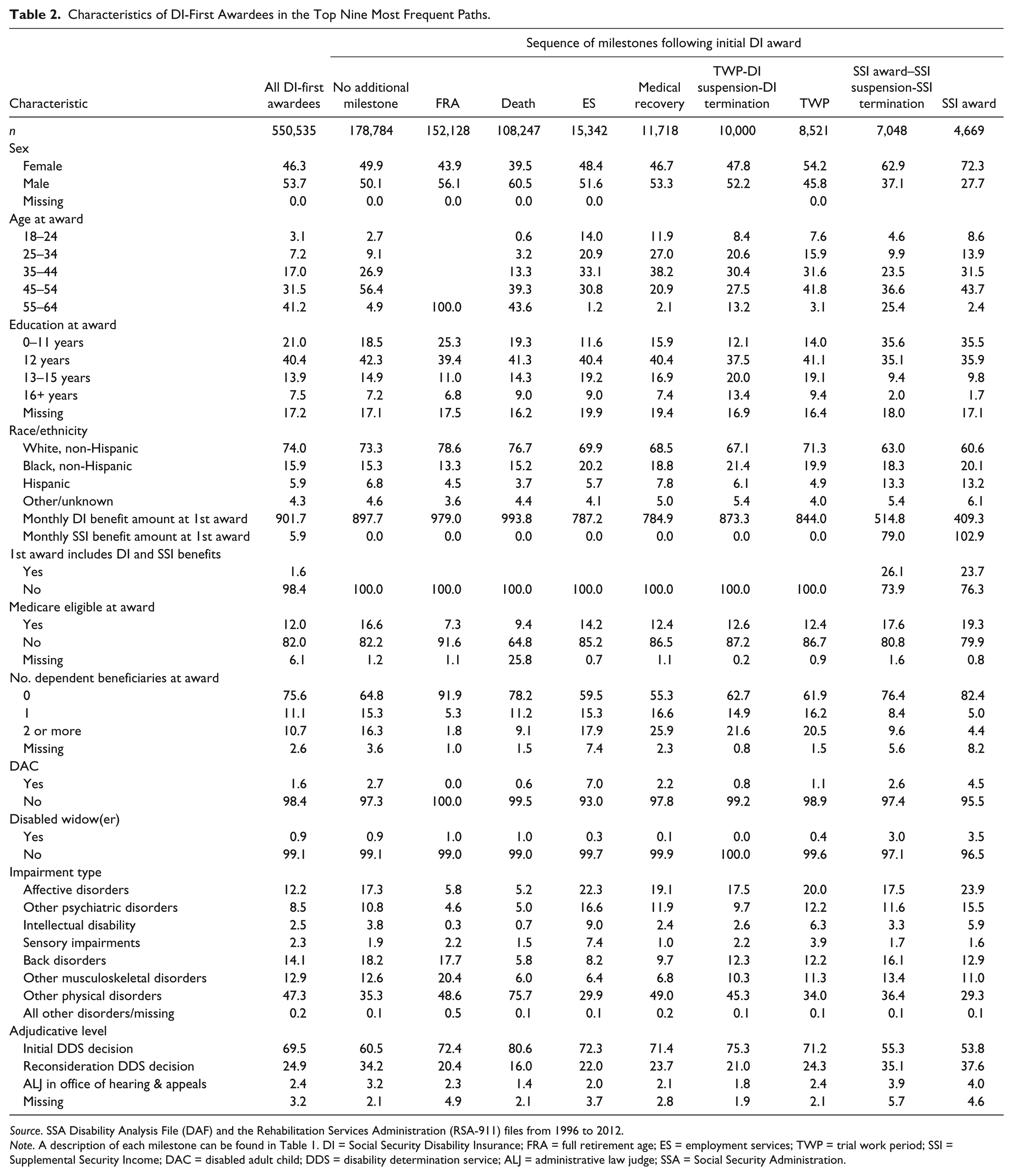
Tables 2 and 3 summarize the characteristics of all DI-first and SSI-first awardees, respectively, as well as those who follow the top nine most frequent paths. DI-first awardees are most likely to be over 45 years old, have less than a high school education, and not have any dependent beneficiaries. However, relative to all DI-first awardees, those who are younger than age 45, those with more than a high school education, and those with dependents are particularly overrepresented in DI-first paths where the only additional milestone is enrolling in ES or TWP completion with or without benefit termination. These findings are similar to those in Ben-Shalom and Mamun (2015), who found that DI beneficiaries who are younger and more educated are more likely to achieve work-related milestones. Similarly, relative to all SSI-first awardees, those who are ages 18 to 24 are overrepresented in SSI-first paths where the only milestone is having PCE or enrolling in ES, and those who have more than a high school education are overrepresented in SSI-first paths where receiving ES is the only milestone. In terms of paths that include program-related milestones, we find that awardees who have more than a high school education are overrepresented in the SSI-first path where DI benefits are awarded causing the subsequent termination of SSI benefits relative to all SSI-first awardees.
Characteristics of DI-First Awardees in the Top Nine Most Frequent Paths.
Source. SSA Disability Analysis File (DAF) and the Rehabilitation Services Administration (RSA-911) files from 1996 to 2012.
Note. A description of each milestone can be found in Table 1. DI = Social Security Disability Insurance; FRA = full retirement age; ES = employment services; TWP = trial work period; SSI = Supplemental Security Income; DAC = disabled adult child; DDS = disability determination service; ALJ = administrative law judge; SSA = Social Security Administration.
Characteristics of SSI-First Awardees in the Top Nine Most Frequent Paths.
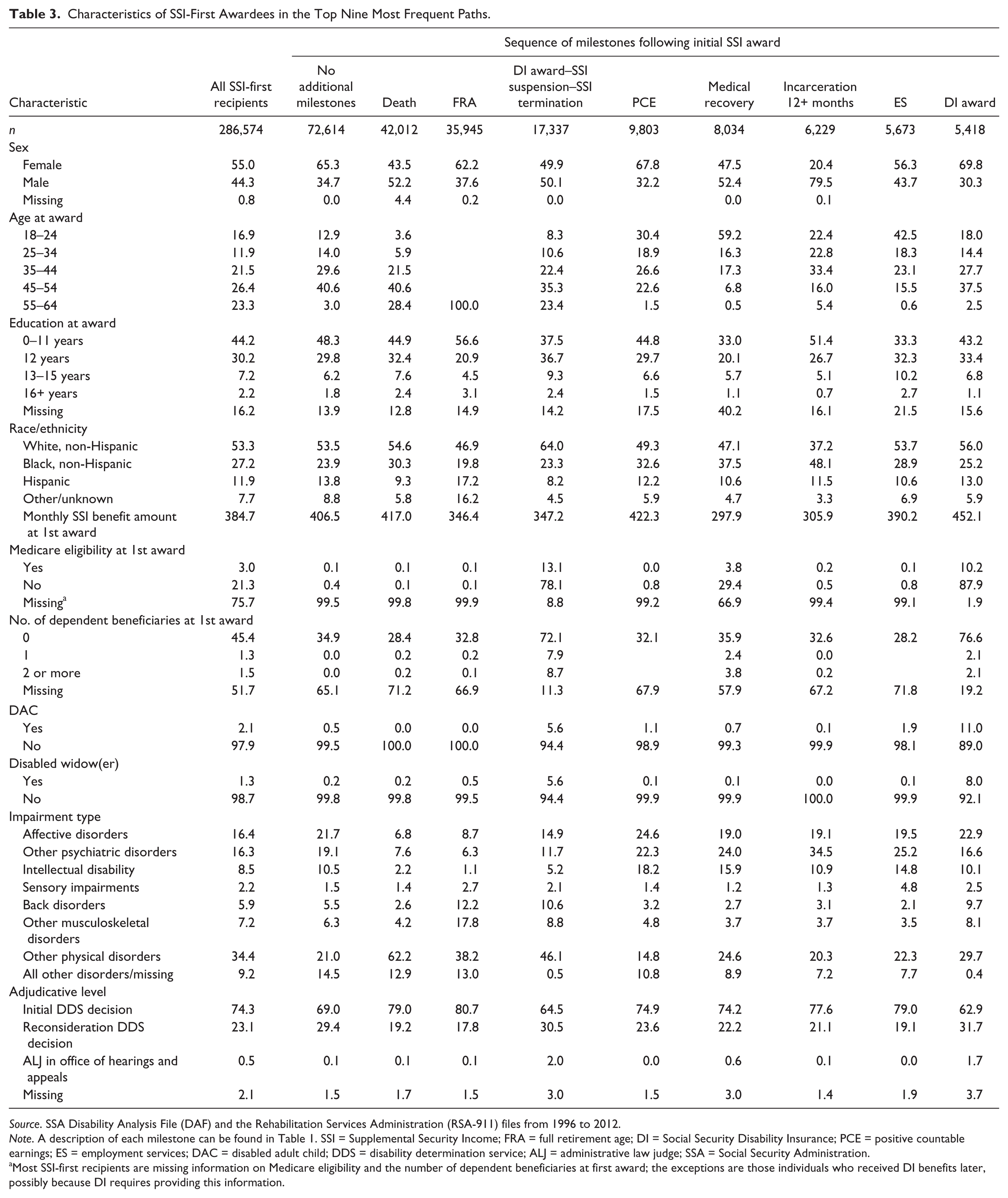
Source. SSA Disability Analysis File (DAF) and the Rehabilitation Services Administration (RSA-911) files from 1996 to 2012.
Note. A description of each milestone can be found in Table 1. SSI = Supplemental Security Income; FRA = full retirement age; DI = Social Security Disability Insurance; PCE = positive countable earnings; ES = employment services; DAC = disabled adult child; DDS = disability determination service; ALJ = administrative law judge; SSA = Social Security Administration.
Most SSI-first recipients are missing information on Medicare eligibility and the number of dependent beneficiaries at first award; the exceptions are those individuals who received DI benefits later, possibly because DI requires providing this information.
Conclusion and Discussion
We find that most DI and SSI awardees achieved few (if any) milestones in the first 10 years after their first award: 80% of DI-first beneficiaries and 53% of SSI-first recipients either achieved none of the milestones we track in that period or their only milestone was death or FRA attainment. Furthermore, a significant number of DI- and SSI-first awardees who achieved work- or program-related milestones during our analysis period did not achieve additional milestones toward exiting the programs. For example, approximately one third of DI-first and one fifth of SSI-first awardees who enrolled in ES had no additional milestones, and one quarter of DI-first awardees who completed a TWP either had no additional milestones or their only milestone was enrolling in ES. We also found that around one quarter of SSI-beneficiaries who later received DI had their SSI benefits suspended and then terminated due to excess income that included DI payments as the only additional milestones, which means they continued to receive DI. Furthermore, we observe great diversity in the long-term experiences of SSI and DI awardees, which should be an important consideration for policy makers designing interventions to help awardees return to work.
These findings bring to light some interesting subgroups that policy makers may want to consider for interventions designed to encourage awardees to return to work. First, the awardees who enroll in ES but do not achieve other employment-related outcomes (such as TWP for DI awardees or PCE for SSI awardees) have made an important step toward work-oriented goals, but ultimately have not achieved such goals. Some may be concerned about losing their benefits if they work “too much,” despite the work incentives put in place to protect the benefits of working beneficiaries. Others may need additional, ongoing supports to maintain their initial work efforts. Our findings suggest that more can be done by employment networks, including state vocational rehabilitation agencies, to help work-oriented awardees achieve their employment goals after enrolling in ES. Second, SSI-first awardees with subsequent DI awards who are not initially disability insured and instead accumulate enough work experience to become disability insured over time may be especially good candidates for outreach programs that encourage them to work above SGA and maintain their attachment to the labor force instead of applying for DI. Such interventions, if successful, could result in large savings to the DI program, and by extension to Medicare.
This study has some limitations that should be considered when interpreting our findings. First, we consider only the paths defined by the 19 milestones that we identified for this study. There could be other milestones of interest that we were unable to identify in our data or simply overlooked. Second, the characteristics we identify as being overrepresented or underrepresented in particular paths are associations and do not represent causal relationships. Finally, our findings are specific to the economic conditions faced by the particular cohort we followed in this analysis, as well as any other features that are unique to this group of awardees; in particular, a major recession occurred in 2009, which is during the time period we examined.
Our study provides important insight into the paths followed by DI and SSI awardees during a 10-year period. Still, there is room for future work in this area. Given the large number of SSI-first beneficiaries who later enter DI, a fruitful area of further exploration would be to better understand the determinants of this phenomenon as well as its implications for the DI program. Our article already shows preliminary evidence of awardee characteristics that are correlated with subsequent DI award, and there are likely other features that we were not able to look into such as the type of work activity that lead to the DI award and whether this work activity was sustained after the award. One could also explore the role of the 2007 to 2009 recession on the paths taken or how paths taken vary by geographic location. One hypothesis to pursue would be that DI and SSI awardees are more likely to achieve work-related milestones in the states that offer the most extensive work transition and support programs.
Another interesting area of future research is reentry into DI or SSI after program exit. Our article follows the paths of DI and SSI awardees up to program exit but does not follow them beyond to see how many returned to the program. Hemmeter and Stegman (2013) began exploring this issue by looking at reentry of just those who exited due to a medical recovery; it would be interesting to expand this analysis by looking at reentry for all who exit the programs. One could also examine employment and earnings outcomes after program exit to see how former awardees fare in the long run.
Footnotes
Acknowledgements
The authors are grateful for the programming support of Svetlana Bronnikov, Miaomiao Shen, and Francoise Becker; for the research assistance of Neil McCray; and for the helpful comments of David Stapleton, Paul Davies, Matthew Rutledge and participants of the Disability Research Consortium 2016 meeting and the Association for Public Policy Analysis and Management fall 2016 meeting.
Authors’ Note
The opinions and conclusions expressed are solely those of the authors and do not represent the opinions or policy of SSA or any agency of the Federal Government. Neither the U.S. government nor any agency thereof, nor any of their employees, make any warranty, expressed or implied, or assume any legal liability or responsibility for the accuracy, completeness, or usefulness of the contents of this article. Reference herein to any specific commercial product, process, or service by trade name, trademark, manufacturer, or otherwise does not necessarily constitute or imply endorsement, recommendation, or favoring by the U.S. Government or any agency thereof.
Declaration of Conflicting Interests
The author(s) declared no potential conflicts of interest with respect to the research, authorship, and/or publication of this article.
Funding
The author(s) disclosed receipt of the following financial support for the research, authorship, and/or publication of this article: The research reported herein was performed pursuant to a grant from SSA funded as part of the Disability Research Consortium (Grant DRC 12000001).
