







Abstract
The purpose of this phenomenological study was to investigate parents’ perceptions of service access for their adult children with autism spectrum disorder (ASD). Access includes accommodation, acceptability, availability, and affordability (4 As) of services. This study examined which of the 4 As presented the biggest challenges across multiple types of services needed. Fifty-one parents of adult children with ASD participated in semistructured interviews sharing perceptions of support services available for their adult children. Parents discussed eight types of services (case management, educational programs, employment and employment supports, physical/mental health care, housing, day program or respite care, social life and recreation, and transportation). Based on parent perceptions, services were inconsistently accessible, difficult to obtain, and inadequate. Trained social workers and health care professionals are needed to provide and coordinate services for adults with ASD.
Keywords
According to the Centers for Disease Control and Prevention (2018), approximately 1 in 59 children in 2014 was diagnosed with autism spectrum disorder (ASD). Nightingale (2012) estimated the prevalence of ASD worldwide, indicating approximately 6.6 million individuals, including 5.3 million adults and 1.3 million children and adolescents, with an ASD diagnosis worldwide. For individuals with ASD, their need for support services typically remains across their lifespan, but the types, frequency, and extent of services may change as they age (Turcotte, Mathew, Shea, Brusilovskiy, & Nonnemacher, 2016). This study investigates parents’ perceptions of access (availability, affordability, accommodation, and acceptability) to services for their adult children with ASD.
Accessing appropriate services for individuals with ASD can be challenging (Marsack-Topolewski & Graves, 2019; Taylor & Henninger, 2015; Vohra, Madhavan, Sambamoorthi, & St Peter, 2014), and many parents have few formal support services to aid in caring for their adult children with ASD when they age out of public school services (Shattuck, Wagner, Narendorf, Sterzing, & Hensley, 2011). Adults with ASD often reach a “services cliff,” with services available for children decreasing substantially in young adulthood (Roux, Rast, Anderson, & Shattuck, 2017). Because of the diminishment of services, parents often face multiple challenges, such as inadequate respite care options and structured activities or employment for young adults (Dillenburger & McKerr, 2011; Vohra et al., 2014).
Parents of adult children with ASD share challenges associated with navigating the service delivery system, especially service seeking and coordination (Lee, Burke, Arnold, & Owen, 2019; Marsack & Perry, 2018; Nicholas et al., 2016). Many parents report feeling that professionals, including social workers and other health care providers, lack training and/or understanding about ASD, and the formal service system is unsupportive regarding their adult child’s needs. Parents often believe that they have to advocate vigorously for their adult child with ASD to receive services in an uncoordinated and cumbersome service delivery system.
Many parents of adult children with ASD attribute their increased challenges to society’s general misunderstanding of their child’s condition (Marsack & Perry, 2018; Nicholas et al., 2016). Although research has focused on the efficacy and benefits of formal support services for populations with disabilities, these benefits are available only in limited instances for parents and their adult children with ASD (Caldwell & Heller, 2007; Esbensen & Seltzer, 2011). For example, adults with ASD with no intellectual deficits (IDs) were reported to receive fewer services than adults with ASD and IDs (Roux et al., 2017). Most research has been on access to services for parents and young children with ASD or IDs, with few asking parents of adults with ASD to share their experiences in accessing needed services. The gap that the present study is seeking to fill is focused on research regarding services available for parents of adults with ASD. The outcomes of this study can help social workers and other health care providers who interface with parents and their adult children with ASD in accessing needed services.
The 4 As
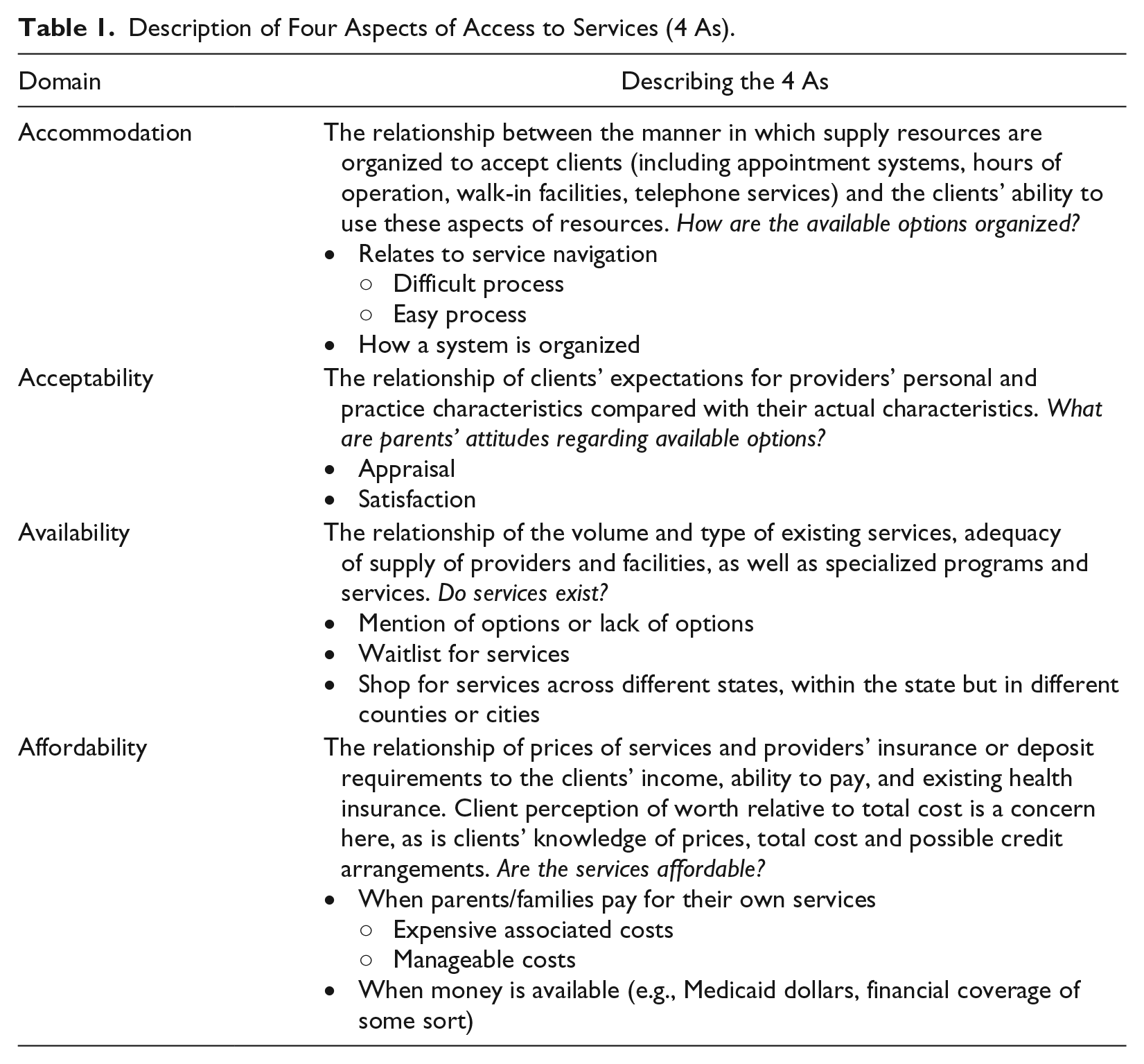
Many factors influence the access to services, including policy, characteristics of the population at risk, characteristics of service delivery systems, and consumer satisfaction (Aday & Andersen, 1974; Antezana, Scarpa, Valdespino, Albright, & Richey, 2017). Penchansky and Thomas (1981) expanded the work by Aday and Andersen (1974) in the medical realm to define access to support services conceptually. Penchansky and Thomas (1981) provided definitions of accommodation, acceptability, availability, and affordability of services as they relate to health services. They defined access as a concept representing the degree of “fit” between clients and the system. Accommodation is the relationship between the manner in which supply resources are organized to accept clients (including appointment systems, hours of operation, walk-in facilities, telephone services) and the clients’ ability to use these aspects of resources. Acceptability is the relationship of clients’ expectations for providers’ personal and practice characteristics compared with their actual characteristics. Availability refers to the relationship of the volume and type of existing services, adequacy of supply of providers and facilities, as well as specialized programs and services. Affordability is the relationship of service prices and or providers’ insurance requirements to the clients’ income and ability to pay. Clients’ perception of worth relative to the total cost, including their knowledge of prices and possible credit arrangements, are concerns here. For purposes of this study, access includes four domains: accommodation, acceptability, availability, and affordability. (See Table 1 for a description of the 4 As.)
Description of Four Aspects of Access to Services (4 As).
Autism Services
Social services may be available for adults with ASD through informal or formal networks. Informal supports are unpaid supports (e.g., personal networks, such as family and friends). Formal support services are offered in the community and are provided through government, nonprofit agencies, or community groups (Roux et al., 2017). Formal support services for adults with ASD could include case management, educational programs, employment and employment supports, physical/mental health care, housing (e.g., shared living arrangements), day program or respite care, social life and recreation, and transportation (Roux et al., 2017). Services may require the family to pay some or all costs, while subsidies from government or nonprofit agencies may reduce costs for other services. Service availability may differ by geographic area and the state in which the adult with ASD resides (Antezana et al., 2017).
The National Autism Indicators report collected data from 4,089 adults with ASD (ages 18-64 years old) using the Adult Consumer Survey (ACS; Roux et al., 2017). Respondents reported that health care and dental care were the most commonly used services. Adults with ASD often received information about benefits or insurance (54%) and services to support social relationships and meeting new people (49%; Roux et al., 2017). Many adults with ASD (49%) used six or more services that were funded by a state developmental disabilities (DD) agency.
Gerhardt and Lainer (2011) conducted a review of the literature on services and outcomes of adolescents and adults diagnosed with ASD. They found that many of these individuals were unemployed or underemployed and often lacked access to appropriate services. Specifically, the authors reported inadequate transition programming and problems related to hiring, training, and retaining people to work with adults with ASD.
Challenges With Services
A commentary by Newsom, Weitlauf, Taylor, and Warren (2012) provided stories regarding the struggles and challenges of parents of adult children with ASD. This commentary described challenges that parents encountered when their child became an adult, including the need to oversee multiple aspects of care and dealing with struggles to obtain medical and mental health care. In addition, many parents recounted difficulties finding a supportive work environment or postsecondary education where their adult child could be successful. Because of these challenges, parents often assumed multiple roles, including “case manager, teacher, therapist, community educator, advocate, job coach, housing specialist, financial planner, and often, lifelong caregiver” (p. 199).
A qualitative study by Anderson and Butt (2018) examined perceptions of 35 parents regarding challenges associated with obtaining publicly funded services for their adult child with ASD. Participants were recruited through the mid-Atlantic autism advocacy organizations. Several important themes emerged, focusing on the necessity for parents to fight for services for their adult child. The parents had difficulty in navigating the bureaucratic service system to obtain the needed services. Many parents were sent from agency to agency only to find a needed service was not available or their adult child with ASD did not meet eligibility criteria. Parents discussed several staffing issues, including poor wages, insufficient training, and high worker turnover. Many parents also indicated that programs were not suitable for their adult child, requiring them to develop specialized activities and hire staff on their own. Anderson and Butt (2018) indicated that some parents shared that available services were not a good fit, of poor quality, or too far from the family home. Another important factor described by Anderson and Butt was the standardization of services that could not accommodate the unique needs of each adult with ASD.
Anderson, Lupfer, and Shattuck (2018) conducted a qualitative study using 20 parents, recruited from autism organizations in Maryland and the District of Columbia, to understand factors that could have contributed to poor outcomes among their adult children with ASD who had completed high school within the last 15 years. Many young adults with ASD who were considered cognitively able encountered profound difficulty at community and 4-year colleges. Reasons for these poor outcomes included challenges associated with anxiety after leaving the public school system, social-emotional immaturity, executive functioning deficits, and suicidal ideation (Anderson et al., 2018). Despite positive or negative perceptions of services offered through public school systems, many parents were unprepared when these services abruptly ended. Ultimately, the literature indicated a need for research because of gaps, challenges, and limitations associated with the service delivery system for adults with ASD (Anderson et al., 2018; Graetz, 2010; Newsom et al., 2012).
Study Rationale and Research Questions
The purpose of this qualitative study is to investigate parents’ perceptions of access (accommodation, acceptability, availability, and affordability) to services for their adult children diagnosed with ASD. This study also investigates which of the 4 As presented the biggest challenges across multiple types of services needed. The specific research questions that are addressed in this study are:
Method
The present study uses a qualitative phenomenological research design to examine perceptions of parental caregivers regarding services for their adult children with ASD. Each of the parents included in the study had experienced caregiving for an adult with ASD. The study is a follow-up (using a subsample) to a study that examined the effects of caring for an adult child with ASD on parents’ quality of life (Marsack, 2016). The follow-up study also investigated contributing factors to quality of life, such as formal and informal social support, health, finances, and caregiver burden. To be eligible to participate in the study, individuals needed to be at least 50 years of age, have an adult child (at least 18 years old) diagnosed with ASD, and read English. The quantitative survey that examined caregiver burden and quality of life was completed by 320 participants.
Recruitment
Wayne State University Institutional Review Board (IRB) provided approval prior to the start of the study. Local, state, and national agencies and organizations helped recruit eligible participants by disseminating study information via websites, newsletters, email, flyers, and/or word of mouth. The organizations included national autism support groups and organizations such as (a) Autism Alliance of Michigan, (b) Autism Society of Macomb/St. Clair, Michigan, (c) Autism Society of Oakland County, Michigan, (d) Autism Society of Wisconsin, (e) Judson Center, Michigan, (f) Milestones Autism Resources, Ohio, (g) Shelby County Regional Special Education PTA, Tennessee, (h) SRVS Tennessee, and (i) the Autism Program of Illinois. In addition, practitioners—including public school teachers, teacher consultants, transition coordinators, school administrators, social workers, vocational specialists, and psychologists—who were employed in school districts and in private practice and interfaced with adults with ASD and/or their parental caregivers helped distribute study information. The principal investigator (PI) also recruited participants using face-to-face strategies by distributing study information at various places, such as local support groups. Additional participants were recruited by other participants (i.e., snowball sampling).
A total of 353 parents of adults with ASD completed the self-administered survey on the Qualtrics website. Twenty-three parents were eliminated due to incomplete responses, with an additional 10 eliminated because either the parent or the child with ASD did not meet the inclusion criteria. The final sample in the larger study included 320 parents who met the inclusion criteria. The last question on the survey asked these parents whether they were willing to participate in a telephone interview. A total of 186 participants who submitted a completed survey agreed to participate. The parents who volunteered were sent an introductory email to determine a mutually agreeable time for the telephone interview. Fifty-one participants were interviewed over a 2-month period.
Sample
At the end of the web-based survey, parents were asked whether they would like to participate in one-on-one follow-up interviews. Because many parents (186 out of 320) indicated interest in participating, the researcher selected a random sample of 51 (27.4%) parents for the follow-up interview. The purpose of the relatively large sample for a qualitative study was to obtain a broader perspective on the range of services needed, as well as types of services accessed either by the caregiver or the adult child with ASD. The PI scheduled and conducted telephone interviews that were audio recorded with participants’ permission. After completing 51 interviews, the researchers closed the qualitative aspect of the study, because they were confident that data saturation was achieved and that it included a broad picture of the families’ issues.
To increase respondents’ confidence in confidentiality for the qualitative interviews, the interview did not include demographic questions, and respondents were not matched with their surveys. Fifty-one parents, ages 50 to 74, participated in the follow-up study. Most parents in the survey stage of the study were between 50 and 59 years old and were mothers (88.2%). Study participants lived throughout the United States in geographically diverse areas, including suburban, urban, and rural areas. Most parents had at least one other child, with some reporting another child diagnosed with ASD or other chronic conditions. The participants in the study indicated relatively high educational and income levels, with most completing either baccalaureate or graduate degrees and having income levels more than US$60,000 per year. For this study, all identifying information was redacted from the transcripts to protect the confidentiality and anonymity of respondents and their families.
In the survey sample, adult children with ASD ranged from 18 to 44 years of age, with the majority in their 20s. Most parents reported having sons with ASD (n = 41), which was consistent with current demographic trends (Christensen et al., 2018). The majority of adult children with ASD had been in the public education system or recently had transitioned out of public schooling at the time of this study. Parents indicated their adult children varied in functional statuses, such as completing activities of daily living, maintaining employment, and engaging socially and communicatively. During the semistructured interviews, each parent discussed his or her experiences obtaining services for their adult children with ASD (Marsack & Perry, 2018).
Procedures
Prior to conducting the present study, the researcher consulted professionals working with individuals with disabilities about the relevance of the interview questions. The final interview protocol used the experts’ feedback to maximize the usefulness of the questions. (See Supplemental Appendix for interview questions.)
The PI conducted 51 interviews, using an interview script with nine open-ended questions. Each interview lasted approximately one hour and parents received US$20 gift cards in appreciation for time spent in the interview. The interviewer obtained information on parents’ quality of life, use of and satisfaction with formal and informal social support networks, and rewards and challenges associated with caregiving. The present article focuses primarily on responses to the question about challenges associated with accessing services for their adult child with ASD.
A professional transcriptionist transcribed the interviews, and the PI verified the accuracy of the transcriptions. To develop the most meaningful analysis, complete sentences or short paragraphs that focused on a single topic or incident were coded rather than coding line by line. The four As (accommodation, acceptability, availability, and affordability) from Penchansky and Thomas (1981) were used to distinguish different aspects of respondents’ experiences with services. The first 10 interviews were coded by both authors separately using Atlas.ti7 software. The authors met to compare their findings and discuss the results, reaching consensus when differences were noted. Using the codes that were developed in the first stage, the authors followed recommendations from Saldaña (2016) in coding the remainder of the interviews, adding codes where necessary and merging others when appropriate.
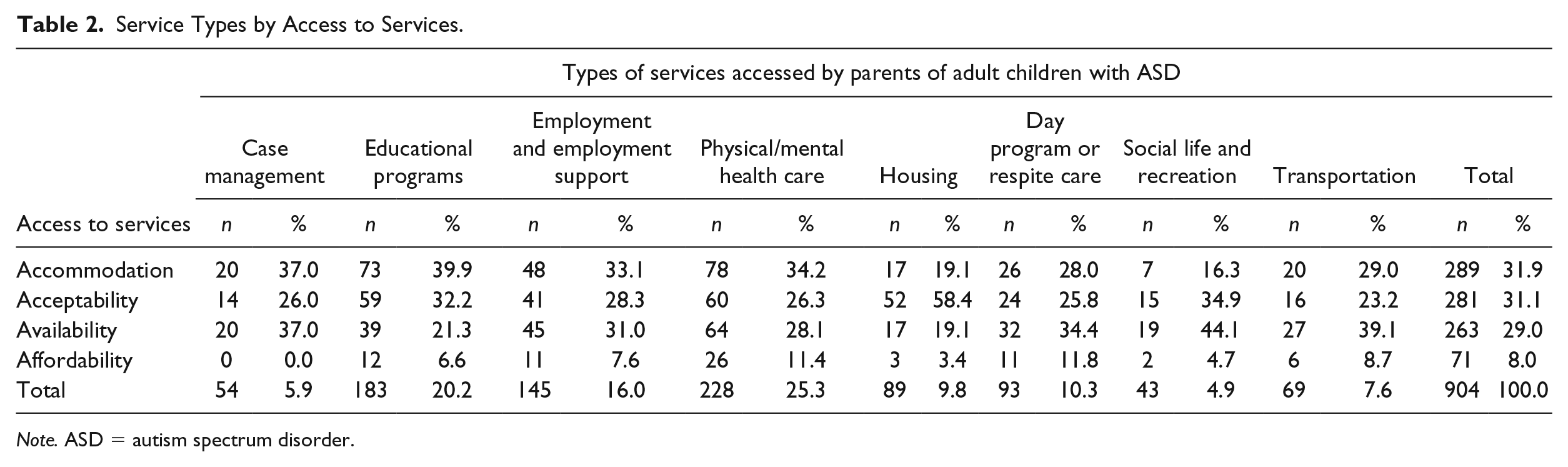
The researchers grouped comments discussed in each coded segment according to the types of services that were most important to parents and where they encountered the greatest challenges. As some comments met the criteria for inclusion in more than one of the four As, the number of coded services exceeded the number of participants. This coding produced a matrix that grouped type of service by the four As (Table 2). The service areas covered included case management, education, employment, health/mental health care, housing, day program or respite, social life and recreation, as well as transportation. We included comments about services received during the adolescence of the adult with ASD when those comments affected the continued use of services through adulthood, such as when the cost of earlier service affected the family’s budget for adult services. Within each cell of the matrix, a percentage of the codes was calculated by dividing the total codes of responses for each of the four As by the total number of codes for that type of service.
Service Types by Access to Services.
Note. ASD = autism spectrum disorder.
Results
The authors used the 4 As (accommodation, acceptability, availability, and affordability) to categorize and present the most relevant aspect of service accessibility. The analysis proceeds to a discussion of the 4 As, concluding with analysis of parents’ comments about differences in accessibility across eight types of services (case management, educational programs, employment and employment supports, physical/mental health care, housing, day program or respite care, social life and recreation, and transportation).
Table 2 presents a matrix of the types of services mentioned in the parents’ comments and categorization of these services by the authors into the 4 As. The 51 parents provided a total of 904 comments related to services that parents or adult children accessed or attempted to access. These 904 comments were separated into the eight types of services and further categorized by the 4 As. The percentages presented in the table reflect the frequency of the type of service by 4 As divided by the total number of comments regarding that specific service discussed in the interviews. For example, 54 comments were made regarding case management services. Of these 54 comments, 20 alluded to accommodation. By dividing the 20 by 54, a percentage of 37.0% was obtained. This process was used throughout Table 2.
Parent Comments on the 4 As
Accommodation
The domain of accommodation had the highest percentage of comments (31.9%), reflecting frequent difficulties with the organization of service systems. Accommodation refers to the difficulty or ease of the service navigation process, and it encompasses how a system is organized. Parents shared multiple stories detailing challenging experiences with service navigation and burdensome processes. They often had to advocate for services and use extraordinary measures to work through red tape, bureaucracy, and inept service providers to obtain needed services for their adult children with ASD. Sometimes the services that were provided during childhood and adolescence were suddenly eliminated, leaving the caregivers in untenable positions. Some parents experienced challenges navigating psychiatric services when their adult children were experiencing an active crisis, raising concerns that they could be a threat to themselves and others. For example, Martha [pseudonyms used], a mother of a son with ASD from the Midwest shared, “. . . I threatened them [the insurance company] because they didn’t know their stuff. And it took me being a Doberman with lipstick and so he ended up being hospitalized in the inpatient unit in town . . .”
Several parents reported challenges when trying to find competent individuals to provide respite care for their adult child with ASD because they were exhausted from giving 24/7 care. They found that providers often ignored their concerns or needs, because the agency was swamped with demands for services, lacked personnel to provide services, or did not understand the needs of the individual with ASD or their parents. MaryJane, a mother of a son with ASD discussed the challenges of acquiring appropriate staff to provide respite care for her son. Her son was known to try to run away, and the first staff member assigned had a pacemaker that compromised her ability to run after anyone, let alone an adult with ASD: There was a setback there, but the process is long, because it takes time to set the budget, get approved for the hours, find an agency, interview an agency, and then once you think you have found an agency, then you have to start interviewing staff members. So the process is long.
She indicated finding appropriate caregivers took at least one year.
On rare occasions, parents mentioned a service request process that was not difficult, such as an excellent case manager or a school system that provided appropriate services. Sally, a mother of a son with ASD, from the East Coast discussed her feelings about gaining services for her son. She related a conversation with her mother: I [Sally] said, “Do you know what just happened in there?” and she [Sally’s mother] said, “No, what happened? You look so sad” and I said, “Well, I’m not sad.” I said, “He got the money. He got what he needed [services]” and we both just started crying. I mean we were standing there in the parking lot and we were crying because I don’t know if it was relief or what kind of emotions we were going through. I just wanted to fall to my knees and kiss the ground . . .
A parent reported, “Yes, I am frustrated, but I think that as advocates for a child on the spectrum, you spend your life in utter frustration pushing against the system.” These parents indicated their concerns about what was going to happen in 4 years when their daughter reaches 26 years of age and transitions out of the public school system.
People usually view obtaining employment or attending college after high school as major parts of the natural progression for young adults. One respondent, Mary Lou, described how her son sought services from a statewide vocational assistance program. She asserted that “the people at the state vocational assistance program are wonderful, and my son has a wonderful case manager. Unfortunately, they are not able to deliver the needed services in terms of employment.” She explained that her son had extensive graduate-level education, and the options through this program were not relevant for his background and abilities. Other parents asserted that while statewide vocational assistance programs were able to provide training and job referrals for individuals with disabilities, they did not provide transportation. Without consistent transportation, adult children with ASD often cannot be employed, as most do not qualify for a driver’s license and bus service is not dependable.
A mother, Alice, described frustration with the state vocational programs’ lack of accommodation to her adult daughter’s needs. She stated, You guys [state vocational system] are the ones that are supposed to be finding her the job and, even though, I wasn’t really happy with them [job opportunities], I knew where they were, I know it wasn’t a very long drive to get there. She [her daughter] knew how to drive there. She drives, but there are a lot of places that she can’t drive. So you feel like you’re always fighting to make sure that your child gets the best services. . . . So, I really felt like I fought well, and I got her what she needed. And so I would say, “Well, can you guys drive her?” [They responded] “Well no because she can drive herself.”
Acceptability
Acceptability reflects the parents’ appraisal and satisfaction with services and service options used by the adult child with ASD. Parents discussed acceptability almost as often as accommodation (31.1%). They reported both positive and negative perceptions of the type and extent of services available to their adult children. This category was reserved for families’ views of services that families actually used or considered using.
Fred, a father, described some services that he considered to be quite acceptable: We can take him to . . . school. They will manage transportation between the school and community college. When he is done with his classes, they [the school] will bring him back and he can do some homework, whatever, in community college. . . . [the school] will help him if he needs it, and then we [parents] can pick him up at the end of the day.
Another mother, Ellen, shared concerns about the acceptability of services, stating “he [her adult son with autism] attends a support group, and he is really functioning at a much higher level than most of the other people, so the issues they talk about are really not issues for him.”
Joe expressed satisfaction with services for his adult daughter, who lived independently and worked with an organization to receive services, including housing. The local mental health organization contracts with local agencies to deliver 24-hour supervision in the apartment complex where she lives.
Edith also discussed acceptability of services. Her daughter was in a program at a school that provides educational services for students through 26 years of age. She described bus rides to and from the school that lasted 3.5 hour, due to snowstorms. While a program was available for students with ASD at this school, Edith and her daughter were generally unhappy and decided to withdraw. At the start of the next school year, her daughter was enrolled in a new program in her area. She indicated that she and her daughter were satisfied with the new services.
Availability
When discussing access to services, parents often mentioned availability (29%). Availability refers to the volume and the types of existing services, adequacy of supply of providers and facilities, and public funding for services. Some type of funding had to be present for the services to be coded as available (e.g., Medicaid dollars, financial coverage of some sort). The count included discussions of wait lists for services, along with responses from parents who believed they should relocate to find the best services.
Several parents felt that it was difficult to obtain services from professionals who had experience working with children with ASD, and these difficulties increased when their children became adults. For example, Roseanna asserted that “in almost any given community, the number of people who had expertise in autism is limited, and the number who treats adults was more limited. In general, in mental health the most [well] trained professionals do not accept insurance.”
Many parents found that their state lacked options for their children, and they had to shop for services when public education ended. Some parents relocated to obtain necessary services for their adult child with ASD. For example, Blanche stated, We relocated after being in [one town] to a community that was on the other side of the state. The services in [the previous] County were completely abysmal, and we had absolutely no confidence in them [services and service providers].
Other parents discussed similar problems with state-supported agencies, asserting that they had no confidence in these services, often seeking services out of the state when necessary.
Caroline, a mother living in the South, discussed housing needs for her daughter with ASD, stating, “I’m gonna have to cobble together services. We always thought we’d go to North Carolina, but their waitlist is 10,000 [for housing].” Joyce, a mother of two daughters with ASD (living on the East Coast), shared: And then once you’re eligible [for services] and you get a rating scale number, the services that are available are not real great. . . . They don’t have any solutions for housing. . . . They’re getting away from group homes, so they want individuals to stay at home with their families I guess till we die . . . or they have what’s called group living arrangements, which to me looks like a fancy name for adult foster care. . . . Our kids are getting close to 21, and there’s really nothing there.
A parent, Sally, living in Illinois, said that she does not try to get anything from Illinois. Instead, she and her husband send their son to a university program in Kentucky that provides services for students diagnosed with ASD. This program has mandatory study sessions for all students, special tutors, and student “buddies” to take the participants to social events. The program has staff who help with employment preparation, including writing resumes and learning interviewing skills.
Another mother, Edith, discussed the difference in services, not between states, but within states, where services vary in different counties and cities. Services that are available in established cities may not be available in newer cities that are still creating their infrastructure.
Marion, a mother of an adult with high functioning ASD, raised concerns about availability. She said, What my experience has been is that most of the supports that are available are really geared toward adults on the spectrum who have a lower functional level, so I feel that I am on my own because she does work and is capable of functioning, but there are still issues.
Affordability
Affordability, mentioned the least frequently (8%), refers to the prices of services and the manageability of costs when public funding is not available. Affordability includes times when families were able to pay for their own services or had insurance coverage. Some parents described exorbitant costs, but a few mentioned manageable costs for some services.
Several parents talked about costs during their child’s earlier years and the continuing effects of these costs on family finances. Several parents mentioned bankruptcy, and one mother indicated that it virtually bankrupted us when he was younger, with speech therapies and occupational therapies . . . because you had to pay for it yourself and as far as planning for his future, we’ve got nothing. I mean we live from month-to-month.
In addition, many of the therapy programs, both when he was younger and continuing to the present, were not covered by insurance, which required out-of-pocket payments. These costs included families’ needs to self-pay for various types of therapy, including sensory integration and occupational or speech therapy.
Taylor, a mother of an adult son with ASD, discussed earlier problems with their local mental health organization that affected the family’s ongoing financial situation. Her son experienced extreme adverse behaviors requiring police interventions, but the family could not get publicly funded services for him. The local mental health agency was not receptive in providing needed mental health services, and the school could not accommodate their needs. Therefore, the family chose to place him in a private facility “to keep him safe,” and keep him out of the criminal justice system until they could arrange treatment in a state hospital. The facility cost about US$800 a day for 3 months, and the family paid for an attorney for their son.
Sally discussed the costs associated with obtaining services for her adult son with ASD. His special program at college cost US$6,000 a year beyond out-of-state tuition for 5 years. Another mother described many costs associated with caregiving, such as short-term respite care to allow her to attend community functions and personal appointments.
Types of Services
In terms of frequency, physical/mental health care (25.3%) was the most frequent type of service discussed, followed by education (20.2%). Case management (5.9%) and social life and recreation (4.9%) were the least mentioned categories. Within types of services, for case management, the most frequent challenges were accommodation and availability. For education, accommodation was the most commonly discussed topic. Parents rated accommodation, availability, and acceptability as important for employment, physical/mental health care, day program or respite care, and transportation. When considering housing services, parents most frequently discussed the acceptability of these services, with both positive and negative responses. Accommodation was the most common issue when education was discussed. For social life/recreation, availability and acceptability of services were most commonly mentioned. Regarding availability, the biggest area of need was employment, followed by housing, and case management services.
Discussion
The present study sought to fill a gap regarding access to available services for adults with ASD as reported by their parents. Parents discussed their challenges with the 4 As in obtaining the needed services. The categories of accommodation, acceptability, availability, and affordability (4As) were used to explore the challenges and successes that parents experienced in accessing services for their adult children with ASD. In addition, the analysis examined the variation of parents’ assessment of the 4As across eight types of services.
Individuals with ASD are on a continuum, with signs and symptoms ranging from mild to severe, affecting multiple domains of functioning across the lifespan (DaWalt, Usher, Greenberg, & Mailick, 2017; Kanne & Mazurek, 2011; Leung, Pang, Anagnostou, & Taylor, 2018). Some adults with ASD can live almost typical lives as adults, while others need 24-hour assistance and care, generally from parental caregivers. Service planners and providers often fail to consider the uniqueness of each adult with ASD.
Consistent with Bowen’s (2014) findings, parents in the present study described an initial lack of familiarity with adult support services. Once parents became familiar with these services, they found few were tailored for adults with ASD. Anderson and Butt (2018) provided support for Bowen’s findings, indicating that services generally were standardized without regard to the individualized needs of adults with ASD. Some parents were dissatisfied with the available services, because they may not have been a good fit, were of poor quality, or were located too far from the family home.
Supporting the work of Nicholas et al. (2016), parents in the present study had difficulty navigating the service delivery system, and they discussed the need to advocate for services and use extraordinary measures to work through red tape, bureaucracy, and inept service providers to obtain needed services. According to Anderson and Butt (2018), parents often encountered challenges when attempting to navigate the bureaucratic service system and procure services needed for their adult children. Many parents went from agency to agency before finding a service was unavailable. In other cases, parents were told their adult children did not meet the eligibility requirements to use the service.
Parents reported both positive and negative perceptions of the type and extent of services available to their adult children and themselves, and their views of acceptability were often influenced by their adult children’s perceptions of what was acceptable. An important issue included perceptions of unacceptable supports for independent living, either in group homes or apartments. Housing for individuals with disabilities can be expensive and labor-intensive for communities, limiting acceptable options (Shaw, Cartwright, & Craig, 2011).
Parents described difficulties associated with finding comprehensive services that fit their adult child’s level of functioning, frequently recounting painful stories of services delivered by inadequately trained staff (e.g., home care assistants, respite care staff, educators). Some parents indicated that obtaining services from professionals who had experience working with adults with ASD was difficult and expensive. Many parents explained that insurance covered some services for their young children, but as their children approached adulthood, insurance no longer reimbursed the service. Accommodation and availability were important for employment and physical/mental health care. Acceptability was also important, reflecting parents’ frequent stories of poor matches between their adult children’s needs and desires and what was available.
Implications for Practice
This study indicates that there is a shortage of professionals and staff who are trained to provide support for adults with ASD and their caregivers. Social workers and other health care professionals could help caregivers to coordinate services and train care providers to understand the behavior and needs of adults with ASD. Working with well-trained health care professionals would enable parents to experience fewer challenges when navigating support services. Working together, parents, adults with ASD, and health care professionals could collaborate to develop a more holistic system for accessing services that can accommodate the needs of this vulnerable and growing population.
Study Limitations
Some limitations to the present study should be noted. Participants were recruited from the larger, quantitative study that included a relatively homogeneous group that was mainly female, European American, highly educated, and of higher socioeconomic status. Because the respondents were similar in terms of age, ethnicity, education, and income levels, the study could not determine how parents with different demographics experienced challenges in accessing services for their adult children. For the qualitative aspect of this study, parents needed to have time and willingness to discuss potentially painful issues over the phone with the researcher. As a result, multiple interviews would have been difficult, so the researcher was unable to follow changes in families’ knowledge about services or their access to services over time.
Directions for Further Research
Further research on this population is needed to include service providers’ views about obstacles that affect accommodation, acceptability, availability, and affordability across different types of services. Our knowledge would be deepened by investigations of service providers’ and diverse parents’ perspectives on the types of services available. When possible, adults with ASD should have an opportunity to share their views of services available to them.
Conclusion
Parental caregivers’ perceptions indicate that accessible services for adults with ASD are often inconsistent, difficult to obtain, expensive, and inadequate. More information from caregivers and adults with ASD can add valuable information for the development of social policies to support increased development of comprehensive services that are available, affordable, accommodating, and acceptable.
Supplemental Material
Appendix_Interview_Questions_9.16 – Supplemental material for Parents’ Perceptions of Access to Services for Their Adult Children Diagnosed With Autism Spectrum Disorder
Supplemental material, Appendix_Interview_Questions_9.16 for Parents’ Perceptions of Access to Services for Their Adult Children Diagnosed With Autism Spectrum Disorder by Christina N. Marsack-Topolewski and Arlene N. Weisz in Families in Society: The Journal of Contemporary Social Services
Footnotes
Disposition editor: Sondra J. Fogel
Declaration of Conflicting Interests
The author(s) declared no potential conflicts of interest with respect to the research, authorship, and/or publication of this article.
Funding
The author(s) disclosed receipt of the following financial support for the research, authorship, and/or publication of this article: This research was supported in part by funding from Eastern Michigan University’s Summer Research Award.
Ethical Approval
All procedures performed in studies involving human participants were in accordance with the ethical standards of the institutional and/or national research committee and with the 1964 Helsinki declaration and its later amendments or comparable ethical standards. All procedures performed in this study involving human participants were in accordance with the ethical standards of Wayne State University’s Institutional Review Board.
Informed Consent
For the web-based study, the use of an electronic survey program precluded the use of an informed consent form. In its place an information sheet that required the participant to indicate that he or she agreed to participate was used. At the end of this web-based survey, participants were informed that a follow-up interview would be conducted with interested participants. Participants could indicate whether they would be interested in sharing more information regarding their experiences. For participants interested in sharing more information, they were asked to select “yes” and leave their name and contact information. An email was sent to participants who indicated interest in participating in the follow-up interview. In the email sent and in the interview script read at the beginning of the interviews, participants were notified that interviews could be recorded and that the recorder could be stopped at any time.

Supplemental Material
Supplemental material for this article is available online.
References
Supplementary Material
Please find the following supplemental material available below.
For Open Access articles published under a Creative Commons License, all supplemental material carries the same license as the article it is associated with.
For non-Open Access articles published, all supplemental material carries a non-exclusive license, and permission requests for re-use of supplemental material or any part of supplemental material shall be sent directly to the copyright owner as specified in the copyright notice associated with the article.
