







Abstract
Social workers in a wide range of settings collaborate with clients’ collaterals to plan and implement services. A collateral in social work is a spouse, partner, family member, friend, or other individual who participates in counseling and casework services to meet clients’ needs. Social workers who meet with collaterals can encounter complex ethical issues, especially related to confidentiality, conflicts of interest, and documentation. The purpose of this article is to identify ethical issues that arise in social work with collaterals; provide an overview of pertinent ethical standards; and discuss practical steps social workers can take to protect collaterals, clients, third-parties, and social workers themselves when complex ethics challenges emerge.
Social workers in a wide range of settings collaborate with clients’ collaterals to plan and implement services. A collateral in social work is a spouse, partner, family member, friend, or other individual who participates in counseling and casework services to meet clients’ needs (Bogo, 2018; Ellis, 2012). Typically, the assumption is that collaterals may have useful information and insights to share with the social worker to inform service delivery. This information may pertain to the client’s challenges, the client’s relationship with collaterals, or the client’s relationship with third-parties (Doverspike, 2008; Hepworth et al., 2023; Sperling, 1997). Some meetings with collaterals may be with the client present and some may not; meetings with collaterals without the client present would occur with the client’s consent, unless there is an emergency or crisis that warrants meeting with collaterals.
Social workers use collaterals in multiple settings and in a variety of ways. Common settings where collaterals are important to consult include private or independent practice, family service agencies, community mental health centers, crisis intervention programs, substance use disorder treatment programs, hospitals (medical and psychiatric), hospice programs, military bases, programs for veterans, programs for refugees and immigrants, employee assistance programs, rehabilitation facilities, nursing homes, child welfare programs, probation and parole offices, housing shelters, and community action programs, among others. In some instances, social workers meet with collaterals once; in other instances, social worker meet with collaterals multiple times, either regularly scheduled or sporadically.
Collaterals typically share sensitive information within the context of a confidential session or meeting with a social worker (Petrik et al., 2015). Collaterals may choose to share with social workers sensitive and private information about themselves, particularly when it is relevant to the social worker’s client. For example, a collateral may choose to share information about her or his trauma history, relationship struggles, mental health challenges, substance use, and family dynamics. Collaterals may be able to share critically important information about cultural, religious, and other diversity issues related to a client’s care (Mogro-Wilson & Cifuentes, 2021; Sue et al., 2016). These disclosures may have an important bearing on the social worker’s assessment, treatment planning, and intervention.
Social workers who meet with collaterals can encounter complex ethical issues, especially related to confidentiality, conflicts of interest, and documentation. Collaterals may assume that information they share when meeting with a social worker will have the same confidentiality protections governing social workers’ relationships with clients. In fact, collaterals’ right to confidentiality differs significantly from clients’ confidentiality rights (Ellis, 2012).
Furthermore, conflicts of interest may emerge when social workers meet with clients’ collaterals, especially when the interests of these parties diverge or clash (Margolin, 2008). Finally, social workers must be vigilant with regard to documentation of meetings with collaterals and management of these records (Kagle & Kopels, 2008; Sidell, 2015).
It is critically important for social workers to fully grasp ethical issues that arise when they meet and collaborate with clients’ collaterals. A comprehensive search of social work’s literature indicates that these issues have not been addressed in depth. The purpose of this article is to identify ethical issues that arise in social work with collaterals; provide an overview of pertinent ethical standards; and discuss practical steps social workers can take to protect collaterals, clients, third-parties, and social workers themselves when complex ethics challenges emerge.
Ethical Challenges: Case Examples
Social workers who develop relationships with clients’ collaterals may encounter complex ethical challenges related to management of confidential information, conflicts of interest, and documentation. Social workers’ skillful management of these challenges is essential to protect clients, collaterals, third-parties, and to prevent licensing board complaints and lawsuits filed against social workers. Here are several real-life examples, drawn from the author’s experience as an expert witness in social work malpractice cases and licensing board cases that raise complex and diverse ethical issues involving clients and collaterals. In Case A, the social worker’s client and his lawyer used information provided to the social worker by the collateral in a manner contrary to the collateral’s interests. In Case B, the collaterals (parents of the minor client) sought confidential information about the client because of their concern about the client’s well-being. In Case C, the social worker encountered an ethical dilemma involving a client and collateral who did not have conflicting interests.
The child’s mother agreed to meet with the social worker and the child’s father. The social worker did not discuss confidentiality guidelines with the collateral or the collateral’s unique role. During their meetings, the collateral shared information about her struggles with depression allegedly caused by the ongoing child custody dispute, her psychotropic medication, and trauma history. The social worker documented this information in her session notes.
Three weeks after the social worker’s final meeting with the collateral, the client’s lawyer asked for a copy of the social worker’s clinical record. The lawyer explained that it is important for her to know about documented clinical information in advance of any subpoena the social worker might receive in conjunction with the child custody dispute. The client signed a release and the social worker shared a copy of the record with the client’s lawyer. The client’s lawyer reviewed the record and noticed the social worker’s documentation about the collateral’s behavioral health struggles. The lawyer used that information when arguing in court on behalf of the client concerning the mother’s ability to parent.
The collateral was incensed that the social worker released sensitive information that the collateral shared during their meetings without the collateral’s consent. The collateral filed a licensing board complaint against the social worker alleging unauthorized disclosure of confidential information. The lawyer retained by the social worker to defend the licensing board complaint argued that the collateral was not a client and, therefore, was not governed by client confidentiality protections. Privately, the lawyer told the social worker she should have explained to the collateral, at the beginning of their first meeting, that the collateral is not a client and does not have a client’s confidentiality protections. The lawyer advised the social worker to develop a comprehensive collateral agreement addressing these issues and to use it in the future.
During the course of individual counseling with the adolescent, the social worker discovered that he was using substances to help him cope. According to the adolescent, he was drinking some of his parents’ alcohol and occasionally using “pills” he got from various friends to help him cope with the distress he was experiencing.
The social worker assessed the adolescent for risk and focused some of their counseling sessions on the adolescent’s co-occurring issues (i.e., mood and substance use issues). The adolescent told the social worker he was eager to address his substance use challenges but refused to give the social worker permission to share information about his substance use with his parents. The adolescent told the social worker that he was “very scared” about how his parents would react. The social worker concluded that the adolescent was earnest about addressing his substance use and did not pose an imminent risk of harm.
The parents were very concerned about their son. One afternoon, the father called the social worker and asked for a copy of her clinical notes: “My wife and I are really worried about him. We feel the need to know what is going on in his life.” The social worker quickly realized that she faced a conflict of interest, in that the adolescent client’s rights clashed with the parents (collaterals) rights. With limited exceptions, parents have a right to inspect the clinical records associated with their minor children (McCurdy & Murray, 2003).
Several weeks later, a local prosecutor learned from an anonymous tip that the social worker was allegedly facilitating an out-of-state abortion. The tip was shared by a workplace colleague of the social worker who opposes abortion. The prosecutor requested a copy of the social worker’s records, including information concerning the collateral. The social worker realized that his clinical notes could be used against the client, the collateral, and the social worker, given current state law prohibiting any effort to seek or facilitate an abortion.
Confidentiality Issues
Social workers have always understood the critical importance of client confidentiality (Dickson, 1998; Reamer, 2018a, 2018b). Confidentiality is an essential element in the development of trust between social worker and client (Banks, 2020; Barsky, 2019). The concept is a centerpiece of the National Association of Social Workers (NASW) Code of Ethics: “Social workers should protect the confidentiality of all information obtained in the course of professional service, except for compelling professional reasons” (standard 1.07[c]). Social work’s ethical standards make it clear that practitioners’ duty is primarily to the client. As such, social workers are not dutybound to protect collaterals’ confidentiality comparable to practitioners’ duty to clients (Ellis, 2012). That said, social workers certainly tend to be respectful of collaterals’ privacy and, ordinarily, protect their confidentiality.
Ethical challenges arise when social workers are privy to sensitive information disclosed by collaterals that is formally requested by third-parties, for example, when attorneys subpoena social workers’ records that include information about collaterals or law enforcement officials request information about collaterals. On occasion, social workers may conclude that they have a duty to disclose information about collaterals to protect collaterals or third-parties from harm.
In these circumstances, social workers must understand the differences between their obligations to clients and to collaterals with respect to management of confidential information. At the beginning of their relationships, social workers must share with collaterals their policies governing confidential information collaterals may choose to disclose (Ellis, 2012). This should include a clear explanation of circumstances when social workers may not be able to protect information shared by collaterals. In Case A, the social worker should explain to the mother (the collateral) that the practitioner may be obligated to disclose her records, which may include information shared by the collateral, during legal proceedings (for example, the child custody dispute). In Case B, the social worker should clarify with the adolescent client’s parents (the collaterals) the nature of the client’s privacy and confidentiality rights and the social worker’s policies governing disclosure of confidential information to the parents (for example, when there is a health or safety risk or a court order). In Case C, the social worker should explain to the client’s pregnant partner (the collateral) how he will manage sensitive information the collateral chooses to share during their meetings and potential risks in light of the state’s abortion-related laws.
Furthermore, social workers should fully understand the concept of privileged communication and its relevance to work with collaterals. Confidentiality and privileged communication are related but distinct concepts. Confidentiality guidelines impose a duty on social workers to protect private information clients have chosen to share (or that social workers have acquired from other sources). Once clients decide to share otherwise private information with social workers, practitioners must then apply relevant confidentiality standards. According to the NASW Code of Ethics, “Social workers should respect clients’ right to privacy. Social workers should not solicit private information from clients unless it is essential to providing services or conducting social work evaluation or research. Once private information is shared, standards of confidentiality apply” (standard 1.07[a]).
Social workers understand that confidentiality is not absolute; there are many exceptions to clients’ confidentiality rights. Widely accepted exceptions pertain to protection of third-parties (for example, mandatory reporting of child or elder abuse or neglect) and clients’ threats to harm themselves or others. Thus, clients have a right to relative (as opposed to absolute) confidentiality. However, collaterals do not have these same confidentiality rights, since they are not a designated client.
Privileged communication is a narrower concept than confidentiality (Dickson, 1998). Under the law, clients, not social workers, hold the privilege. The right of privileged communication—which assumes that a professional cannot disclose confidential information without the client’s consent—originated in British common law, under which no “gentleman” could be required to testify against another individual in court. Among professionals, the attorney–client relationship was the first to gain the right of privileged communication. Over time, other groups of professionals, such as social workers, physicians, psychiatrists, psychologists, and clergy, sought legislation to protect their clients’ and patients’ right to privileged communication. However, collaterals do not have a right to privileged communication, since they are not a designated client.
One practical option social workers can consider using to protect sensitive information shared by collaterals is to include it in what HIPAA defines as “psychotherapy notes,” which are different from routine progress notes (Herold & Beaver, 2021). HIPAA regulations define psychotherapy notes as notes recorded (in any medium) by a health-care provider who is a mental health professional documenting or analyzing the contents of conversation during a private counseling session or a group, joint, or family counseling session and that are separated (physically or electronically) from the rest of the individual’s medical record. Excluded from the definition of psychotherapy notes are prescriptions for and monitoring of medication, counseling session start and stop times, modalities and frequencies of treatment furnished, results of clinical tests, and any summary of client diagnosis, functional status, treatment plan, symptoms, prognosis, and progress to date.
That is, including information shared by collaterals in psychotherapy notes may be appropriate in some circumstances, specifically if social workers include this information in their segregated psychotherapy notes to record or analyze the contents of conversation during a private counseling session or a group, joint, or family counseling session. Information collaterals share, and that social workers document, that is relevant to service delivery but is not for the purpose of documenting or analyzing the contents of conversation during a private counseling session or a group, joint, or family counseling session that includes the collateral would not likely be considered a protected psychotherapy note. This might occur if, for example, a collateral shares information with a social worker outside of a private counseling session.
When appropriate, psychotherapy notes that include information shared by a client may offer an extra layer of protection. Even clients do not have a right of access to psychotherapy under HIPAA, although the practitioner may decide in her discretion to permit access. Social workers should be aware that attorneys may subpoena psychotherapy notes and a judge may order their disclosure, even if social workers or attorneys representing them object (for example, by filing a motion to quash or a motion for a protective order, consistent with NASW Code of Ethics standard 1.07[j]). This is a particular risk if the subpoena seeks information specifically related to the collateral and not the client; the HIPAA psychotherapy note protection may apply only to the client.
Conflicts of Interest
Circumstances can arise when the interests of clients and collaterals conflict. For example, if the social worker in Case A is ordered by the court to testify in her client’s child custody dispute with his estranged wife (the collateral), the social worker may be obligated to share information that the collateral shared with her in a counseling session that would support her client’s child custody petition. In Case B, the adolescent client’s privacy interests may conflict with his parents’ (the collaterals) interest in accessing clinical information about their child.
Social work’s ethics standards clearly address practitioners’ duty when they anticipate encountering or encounter a conflict of interest (Reamer, 2018a). According to the NASW Code of Ethics, Social workers should be alert to and avoid conflicts of interest that interfere with the exercise of professional discretion and impartial judgment. Social workers should inform clients when a real or potential conflict of interest arises and take reasonable steps to resolve the issue in a manner that makes the clients’ interests primary and protects clients’ interests to the greatest extent possible. (standard 1.06[a])
Importantly, the code specifically addresses instances when social workers provide services to two or more people who have a relationship with each other, for example, client and collateral.
When social workers provide services to two or more people who have a relationship with each other (for example, couples, family members), social workers should clarify with all parties which individuals will be considered clients and the nature of social workers’ professional obligations to the various individuals who are receiving services. Social workers who anticipate a conflict of interest among the individuals receiving services or who anticipate having to perform in potentially conflicting roles (for example, when a social worker is asked to testify in a child custody dispute or divorce proceedings involving clients) should clarify their role with the parties involved and take appropriate action to minimize any conflict of interest. (standard 1.07[d])
Thus, social workers who meet with clients’ collaterals should be sure to explore whether a potential conflict of interest may emerge and explain social workers’ policies on management of such conflicts, consistent with prevailing ethical standards.
Documentation Challenges
Complex documentation challenges can arise when social workers meet with and obtain information from clients’ collaterals. To comply with social work’s well-established documentation protocols (Kagle & Kopels, 2008; Sidell, 2015), social workers must document their discussions with collaterals. Two NASW Code of Ethics standards are particularly relevant: Social workers should take reasonable steps to ensure that documentation in electronic and paper records is accurate and reflects the services provided. (standard 3.04[a]) Social workers should include sufficient and timely documentation in records to facilitate the delivery of services and to ensure continuity of services provided to clients in the future. (standard 3.04[b])
Social workers who comply with these standards regarding information they obtain from collaterals have considerable discretion about how detailed, explicit, and vague their documentation is. One advantage of vague documentation is that records disclosed in response to a subpoena or court order may reveal no or little sensitive information about collaterals. For example, in Case A the social worker may write “Collateral XXX shared information about her personal history and concerns about family issues.” rather than “Collateral XXX reported that she has been clinically depressed, takes psychotropic medication, and has a trauma history.” Similarly, in Case C a social worker may write “Collateral XXX commented on client’s health issues.” rather than “Collateral XXX disclosed that she would like to terminate the pregnancy and asked this writer to help her and the client locate an out-of-state abortion provider.” In the unique challenge posed in Case B, where the adolescent client’s parent (the collateral) requested a copy of the clinical record, the social worker could protect her adolescent client’s privacy by writing “Client shared information about health concerns. We developed a plan to address them.”
In some instances, social workers should not be vague in their clinical notes that refer to collaterals, particularly when safety issues are involved. For example, if a parent (collateral) in Case B shares suicidal thoughts with the social worker because of his distress about the adolescent client and the parenting challenges he poses, the social worker should not be vague in documentation (Ellis, 2009; Sidell, 2015). If the adolescent client’s substance use featured in Case B poses a serious health risk, the social worker’s notes should not be vague. If the mother (collateral) in Case A makes threats against the client (the father who is party to the child custody dispute) in the social worker’s presence, the practitioner should not be vague. It is certainly possible that this specificity may be used against the collateral (or the client whose clinical record the collateral may access) if the record is disclosed during legal or other proceedings, but that is the risk the social worker must face to comply with prevailing standards of care regarding documentation.
Judicial Guidance
There is very little case law on the rights of collaterals (Ellis, 2012; Reamer, 2015). One prominent case is Mrozinski v. Pogue (1992). According to the opinion handed down by the Court of Appeals of Georgia, Anthony Mrozinski’s 14-year-old daughter was in residential treatment, where she was treated by psychiatrist Robert Pogue for drug addiction and other behavioral health challenges. The daughter reportedly began using drugs while she was in her mother’s custody. The court then placed the adolescent in the father’s custody. The father participated in family therapy sessions while the daughter was hospitalized.
The child’s mother obtained the discharge summary when the child was released from residential treatment. Dr. Pogue also provided the mother with an affidavit that included critical and negative remarks about the father’s relationship with his daughter; the psychiatrist recommended that custody be transferred to the mother. The father sued the psychiatrist alleging that he received treatment from the psychiatrist, and therefore was a patient entitled to confidentiality protections, given that he attended family therapy sessions. The father argued that the psychiatrist breached his confidentiality rights. The psychiatrist claimed that only the child was his patient and that he had no doctor–patient relationship with the father, who was a collateral.
The lower court found in favor of the psychiatrist and granted summary judgment (a judgment entered by a court for one party and against another party summarily, i.e., without a full trial). The father appealed the ruling. The appellate court found evidence that the father sought assurance from the psychiatrist that the therapy sessions would be confidential and that the father relied on these assurances when he participated in counseling sessions along with his daughter. The court rejected the psychiatrist’s argument that the father’s communications during counseling lost their privileged status because he treated the daughter and father jointly. Significantly, the court stated: The strongest public policy considerations militate against allowing a psychiatrist to encourage a person to participate in joint therapy, to obtain his trust and extract all his confidences and place him the most vulnerable position, and then abandon him on the trash heap of lost privilege. (“Confidentiality,” 1993: 186)
Implications for Practice
Standards of care applied to social workers’ use of collaterals in their work with clients have evolved. Earlier in social work’s history, practitioners did not typically develop or use collateral agreements. Today, however, it is widely accepted that social workers should use collateral agreements to protect all parties—the collateral, client, and social worker (Ellis, 2012).
Collateral agreements typically include several key elements. These agreements explain that the collateral is not considered a client, is not the focus of the services and that the collateral has less privacy protection than the client. Furthermore, practitioners inform the collateral that the practitioner will not maintain a formal record in the collateral’s name, and that notes about the collateral may be included in the client’s record. The client has a right to access that record, with limited exceptions; the collateral does not (See Figure 1 for a collateral agreement template).
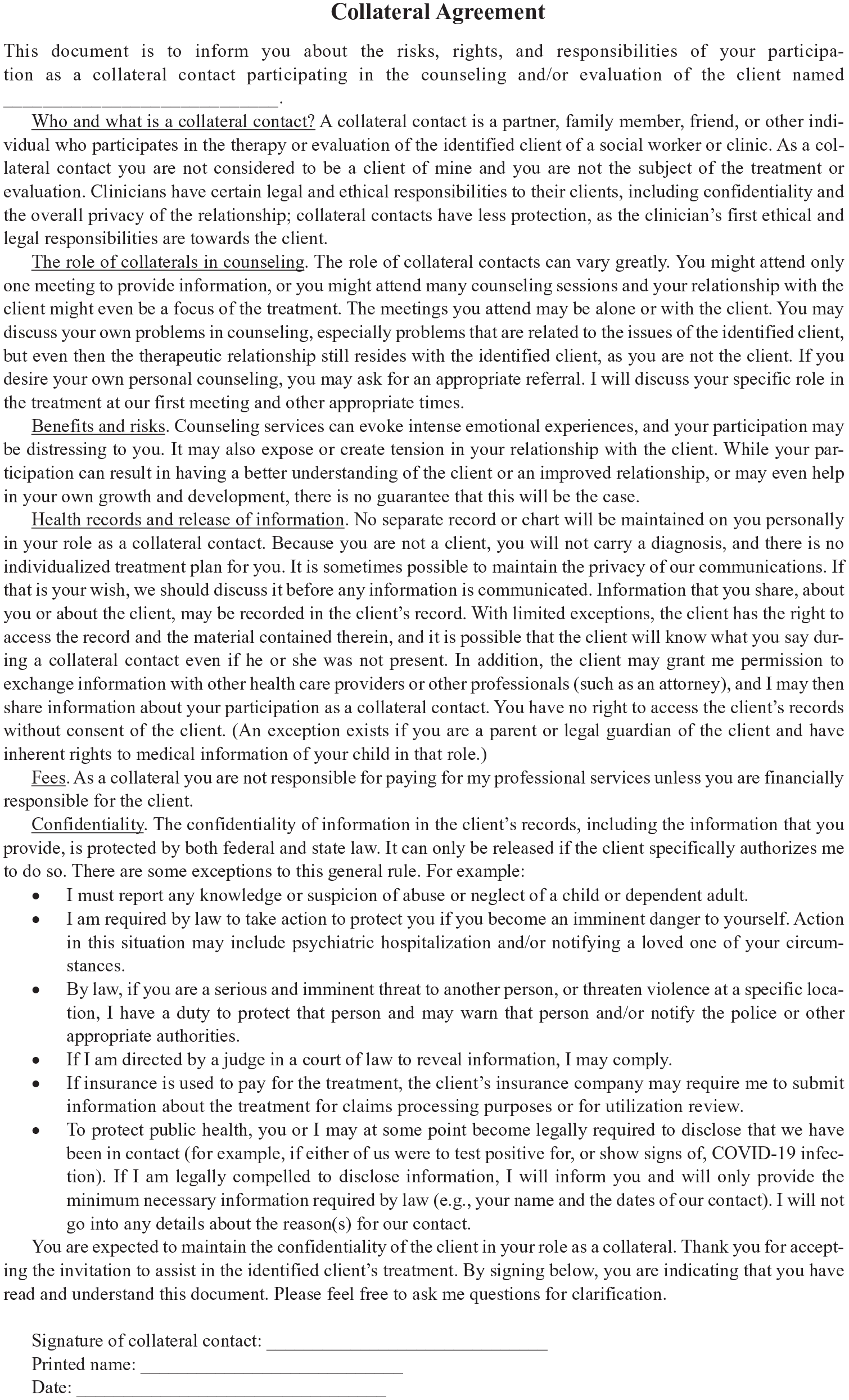
Sample collateral agreement.
Conclusion
In many instances, social workers’ collaboration with clients’ collaterals is essential to practitioners’ assessment, treatment planning, and service delivery. Collaterals are often in a position to provide social workers with critically important information pertaining to the client’s needs and challenges.
Social workers’ contacts with clients’ collaterals can introduce complex ethical challenges, especially related to confidentiality, conflicts of interest, and documentation. To protect clients, collaterals, third-parties, and social workers themselves, practitioners should take assertive steps to fully and clearly explain to collaterals the nature of their role, the fact that they are not clients, and confidentiality and documentation guidelines. Social workers should also inform collaterals about any potential conflicts of interest and how they may be managed.
Out of an abundance of caution, social workers should develop collateral agreements, explain them to collaterals, and have collaterals sign them. This comprehensive risk management protocol is consistent with prevailing ethics standards in social work and greatly increases the likelihood that social workers will be able to protect all parties involved in their efforts to serve clients competently.
The social work profession can take several steps to enhance practitioners’ management of ethical issues that arise when they collaborate with collaterals. First, undergraduate and graduate social work education curricula can include this topic in their courses on direct practice with individuals, couples, and families. Second, continuing education sponsors can offer sessions focused explicitly on ethical issues that arise when social workers use collaterals. Finally, behavioral health and human service agencies can provide in-service training on these issues to social workers and their colleagues.
Collaboration with collaterals is an essential component of sound social work practice. It is essential that social workers engage with collaterals ethically, using protocols that protect clients’ and collaterals’ interests and adhere to the profession’s ethical standards.
Footnotes
Disposition editor: Cristina Mogro-Wilson
Declaration of Conflicting Interests
The author(s) declared no potential conflicts of interest with respect to the research, authorship, and/or publication of this article.
Funding
The author(s) received no financial support for the research, authorship, and/or publication of this article.
