







Abstract
Research demonstrates that Black American men are significantly less likely to seek help for mental distress than other gendered or racial groups. Yet, Afrocentric theorists propose that African cultural norms of interdependence may serve as important facilitators in promoting mental health in Black populations. This study explored how Ubuntu—an African construct expressing adherence to principles of compassion, interdependence, and humanism—is associated with help-seeking perceptions among Black men. Results from surveying 300 participants recruited using social media, showed that Black men with higher acceptance toward African cultural norms reported higher inclination to seek mental health services for emotional distress. Implications for future research and practice to improve uptake of mental health services of Black men are provided.
Worldwide, mental health challenges that disrupt optimal functioning have become increasingly common, with high prevalence of clinical levels of depression and anxiety (Cloitre et al., 2019; Vahratian et al., 2021). Evidence suggests that both depression and anxiety develop through an interplay of individual, family, community, and structural factors (Blacker et al., 2019; Jones et al., 2019; Schiele & Domschke, 2018; Usher et al., 2020), with specific risk factors including genetic susceptibility and experiencing stressful events (Arango et al., 2018). Ongoing research to understand causality and mechanisms behind the varying degrees of depression and anxiety have established that psychological treatment can help persons during distress regain normal functioning. Indeed, the benefits of seeking assistance for emotional distress are clear; however, at a population level, Black men residing in the United States have been found to be significantly less likely to seek help for mental health concerns compared with other racial or gender profiles within the United States (Hammond, 2012; Rochlen & Hoyer, 2005). Systemic barriers are an important factor, but as services championing racial justice and equity across health care systems become increasingly available, Black males—adolescent and adult—are still among the least likely to use them. The role of African cultural norms in mitigating emotional distress has long been theorized and progressively tested among this population; however, direct evaluation of how these norms affect perceptions of seeking professional mental health services in times of distress has not been well explored and is virtually absent within social work literature. Thus, the present study aims to provide insight into mental health help-seeking attitudes among Black American men, specifically the influence of African cultural norms on these perceptions.
Cultural Norms and Help Seeking in Black Men
In the United States, Black men are disproportionately represented among those experiencing disabling and persistent episodes of emotional distress that, when left untreated, correlate with higher incidences of morbidity and premature mortality (Jones-Eversley et al., 2020). Yet, increasing attention has been given to mental health issues among Black men only recently, a phenomenon that Thorpe (2022) describes as a health disparity, decades in the making and hidden in plain sight. The cognitive barriers precluding them from seeking mental health services are complex, with new knowledge required from Black men themselves, to better inform a comprehensive explanatory model. However, past literature suggests that, particularly for men, gender norms of western masculinity, specifically of self-reliance, may also be an underlying factor. Black men, like other male populations in the United States, are highly influenced by traditional western norms of independence, individual strength, and self-control (Goodwill et al., 2021). Past scholarship supports the association of these traditional western masculinity norms with a myriad of detrimental outcomes for U.S. men, including (a) a reduced likelihood of acknowledging that one is experiencing a mental health problem, (b) greater expression of externalizing symptoms such as aggressiveness, which places themselves and others at risk of violence, and (c) a lower likelihood of seeking help (Williams et al., 2022).
In fact, many masculinity norms, which may hinder Black men from seeking help for mental health problems, are linked to maladaptive coping mechanisms. Data suggest that Black men who do not receive help for emotional problems often cope through the use of alcohol and other substances (Turner et al., 2018). Hong et al. (2019) also demonstrated that among a sample of Black Americans that included men, substance use was partly mediated by the practice of internalizing problems. These findings also align with studies demonstrating that Black men, although less likely to use alcohol and other substances than white men, show more problematic consumption (i.e., heavy use, dependency, intoxication), perhaps for the purpose of addressing untreated mental health burdens (Amaro et al., 2021). The theory of substance use being a maladaptive coping mechanism for mental ill health was also supported by a 15-year longitudinal study by Cooper et al. (2008) with participants who were adolescents at baseline—findings showed that whereas white participants’ alcohol use was mostly driven by enhancement motives (fun, pleasurable feelings), Black participants more often reported coping motives (e.g., to forget worries). A more recent study that placed substance use in the context of the COVID-19 pandemic found that more Black than white Americans increased their substance use to deal with the stress and negative emotions they experienced, and this maladaptive coping strategy was more often used by Black men than women (Czeisler et al., 2020).
Moreover, untreated mental illness among Black men can further escalate (especially if accompanied by substance abuse) and cause other problems, such as loss of relationships, employment, and increased risk of homelessness (Nascimbeni, 2021; Olivet et al., 2018). Relevant in this respect, is the finding that Black men may express their mental health problems in externalizing ways leading to violence or other unacceptable social behavior (Maldonado et al., 2022; Unnever & Chouhy, 2022). Thus, untreated mental health could increase the risk of police contact and incarceration (Unnever & Chouhy, 2022). The most extreme consequence of the accumulation and escalation of mental health-related problems in Black men, already disadvantaged by structural racism, is premature death with the increased risk of community victimization, and suicide (Goodwill et al., 2021; Kyriopoulos et al., 2022).
African-Centered Norms and Help-Seeking Behavior
Theoretical contributions to the field of Black/African American psychology and advancing social work practice with populations of African descent are in agreement that understanding the attitudes, behavior, and promotion of Black people is interconnected to the study of derived African cultural norms (e.g., Kambon & Bowen-Reid, 2010; See, 2007). African centeredness, or Afrocentrism, as it is interchangeably referred to in the context of mental health, is a reference to the centering of thought, behavior, and approaches to practices that honor the cultural strengths, and humanity of Black people (Obasi & Smith, 2009). An Afrocentric worldview, discussed in great depths within psychological literature, is thematically an actualization of how persons of African descent embrace attitudes and norms in response to life occurrences in the context of cultural heritage and philosophies ascribed to their ethnic group (Nobles, 2006). With regard to mental health, an Afrocentric worldview among Black Americans has been demonstrated to have an important buffering effect on emotional distress, including depression and suicide ideation (Wang et al., 2013).
Although inadequate literature is available to firmly establish how Afrocentric norms affect help seeking, pan-African constructions may be too broad to explain African cultural norms and help seeking among Black Americans. For example, Meniru and Schwartz (2017) found that among Nigerian Americans, help-seeking intentions were positively associated with Afrocentric values. However, Wallace and Constantine (2005) showed that among Black American college students, Afrocentric values were associated with more negative attitudes toward seeking help for mental health. With initiatives seeking to improve culturally sensitive mental health care being very recent (Woods-Giscombe et al., 2022), this situation may have changed as the study was carried out >15 years ago. Moreover, Afrocentric value confirmation might be too broad, measuring not (just) Ubuntu but African self-consciousness, which Duncan (2003), in an even earlier study, showed to be related to cultural mistrust and negative attitudes toward seeking help for mental health problems. These findings also align with calls for constructs that have clear linkages to the philosophies derived from the African continent (Utsey et al., 2009).
The construct Ubuntu, derived from Bantu-linguistic communities of western, eastern, and southern Africa, represents the axiom Ukuba Ngumuntu Ngubnatu—a person is a person because of others—and has been well discussed as an important cultural connecter between the African diaspora and continental Africans that may provide important mental health buffering effects. As also argued by Chigangaidze (2021), Ubuntu, that is embraced by many Black Americans, may have particular value in mental health help seeking. Ubuntu is a multidimensional construct, still nascent in literature, that is involved in an ongoing dispute on how best to define it in the context of mental health. Nevertheless, a largely accepted notion of what an Ubuntu worldview comprises is humanness, compassion, and interdependence, all contributing to peaceful coexistence with oneself and others. In the past, scholars have argued that to embrace Ubuntu is to acknowledge the normative need for others to assist with your life, and in return, you are interdependently needed in the lives of others (e.g., Battle, 2009; Wilson & Williams, 2013). If this theory is accepted, then a person who acknowledges and incorporates Ubuntu into their life schema would not hesitate to seek help for mental health issues. In addition, it can facilitate trust in others’ willingness and ability to help alleviate distress. However, this assumption is mostly based on theory and has not been previously tested in direct studies. Nevertheless, previous research in South Africa found Ubuntu to be a reason behind the willingness to help depressed men (Masemola et al., 2022). Although this is a culturally different setting, it supports the potential application of Ubuntu theory in this way.
Purpose of the Study
This study represents the first documented effort within mental health, particularly social work, scholarship to explore the link between Ubuntu and help-seeking behavior in Black Americans. This study also advances proof of concept research that links African cultural norms, which African-centered theorists propose as underlying the mental health behavior of Black Americans. Thus, the study, (a) investigates the invariance of Mutsonziwa’s (2020) Ubuntu measure developed to measure African humanism and (b) determines how Ubuntu is associated with the perceptions of Black American men toward seeking mental health services for emotional distress. Aligned with previous cultural congruence arguments by African-centered theorists, the author theorizes that Mutsonziwa’s (2020) measure of Ubuntu will show similar factorial structuring in a population of Black American men and have a direct positive association with help seeking. That is, Black American men with higher degrees of Ubuntu will report higher likelihood of seeking help during emotional distress.
Method
Participants and Procedure
Upon approval by a university institutional review board (IRB), participants were recruited via Qualtrics Panel (Qualtrics, Provo, UT). Qualtrics is an online survey design and data collection resource that allows participants to enroll in research studies upon invitation in exchange for monetary renumeration. The use of Qualtrics, like other online survey-based platforms (e.g., Amazon’s Mechanical Turk), has been increasingly supporting researchers as a viable data collection tool for population samples of participants from diverse backgrounds. Upon acceptance of an invitation, only participants who answered a set number of screening questions including (a) self-identification as male, (b) Black or African American, and (c) aged between 18 and 25 (approved age range for data collection as per the IRB), were prompted to continue voluntary filling in of the survey instrument.
The final sample included 300 self-identifying Black men. With regards to ethnicity, most participants identified as African American (95%), while 4% identified as Caribbean (e.g., Jamaican, Haitian), and 1% as Continental African (e.g., Nigerian, Ghanaian). The ages of participants ranged between 18 and 25 (M = 21.76, SD = 2.16). Geographically, 34% resided within Midwestern states, 33.3% in North-Eastern states, and 32.7% in the Southern states within the United States. The highest levels of education reported by the participants were high school diploma or equivalent (42%), some college but no degree (21%), associate degree (9%), bachelor’s degree (8%) and a master’s degree (3.3%). Median household income was between US$30,000 and US$39,000 per year.
Instruments
Ubuntu
Ubuntu was measured with the scale developed by Mutsonziwa (2020), by generating potential items based on the literature, that were subsequently ascribed to specific Ubuntu values by focus group Q-sorting. Subsequently, three studies were conducted to establish a valid and reliable scale (Mutsonziwa, 2020). An example of an item is: “You value other people.” The items were answered on a 6-point Likert-type-scale anchored from 1 = strongly disagree to 6 = strongly agree. Validity was supported by positive correlations between the Ubuntu values of humanism, compassion, and interconnectedness (Mutsonziwa, 2020). Mutsonziwa (2020) found excellent internal consistency, Cronbach’s α = .91.
Help Seeking
Help seeking was assessed with the Attitudes Toward Seeking Professional Psychological Help-Short Form (ATSPPH-SF; Elhai et al., 2008), that is based on the original ATSPPH Scale of Fischer and Turner (1970). An example of an item is: “The idea of talking about problems with a psychologist strikes me as a poor way to get rid of emotional conflicts.” The items were answered on a 6-point Likert-type-scale anchored from 1 = strongly disagree to 6 = strongly agree, but then subsequently recoded in order for higher scores to reflect more help-seeking values and need. The validity of the ATSPPH-SF was supported by positive correlations with intentions to seek future treatment and current treatment (Elhai et al., 2008). The ATSPPH-SF is also known to have good internal consistency (Elhai et al., 2008).
Data Analysis
There were no missing data. Descriptive statistics (mean, standard deviation, range, and correlation) were first calculated using IBM SPSS Statistics for Windows, Version 26.0 (Armonk, NY: IBM Corp). These were calculated based on the mean scores of the associated items on the questionnaires. Subsequently, to determine if the original factor structure of Ubuntu as developed by Mutsonziwa (2020), with samples of South Africans of African descent, applied to a sample of Black American men, the Ubuntu measure was evaluated in two stages, using AMOS version 28. In the first stage, confirmatory factor analysis (CFA; maximum likelihood) was used to verify the factor structure of the two previously published questionnaires. Three latent factors were specified as reflecting Ubuntu: humanness, interdependence, and compassion and one as reflecting openness to seeking treatment for emotional problems. Estimated factor variances were fixed to 1 and item loadings were freely estimated. Once it was confirmed that the separate measurement models showed appropriate fit, a full measurement model comprising all latent variables was tested. Thereafter, structural equation modeling (also using AMOS) was used to test the unique relationships between the Ubuntu norms and openness to seek professional psychological help. The chi-square test result is reported for sake of completeness, yet was found to result in rejection of the null hypothesis, even when the model is only trivially false (MacCallum, 2003; West et al., 2012). Instead, the following combination of indices was used as an indication of good fit: CFI > .95 (Hu & Bentler, 1999; West et al., 2012), TLI ≥ .95; RMSEA ≤ .06 (Hu & Bentler, 1999), and SRMR < .09 (Hu & Bentler, 1999).
Results
Descriptive statistics of the key variables are presented in Table 1. The Ubuntu norms of humanness, interdependence, and compassion showed moderately strong positive correlations and were also positively correlated with openness to seeking treatment. To establish the measurement model for the Ubuntu norms, CFA was carried out using a model with three latent constructs of humanness, interdependence, and compassion. Modification indices were used to identify shared error between three sets of items on the humanness factor. The results showed that the model fit the data well, χ2(113) = 239.463, p < .001, RMSEA = .051, CFA = .960, TLI =.952, SRMR = .045. Second, the CFA carried out for the openness to seeking treatment showed that the unidimensional structure fit the data well. Modification indices were used to identify shared error between two items. The fit indices were excellent, χ2(4) = 4.17, p = .383, RMSEA = .010, CFA = 1.000, TLI =.999, SRMR = .015. Third, the full measurement model was tested, which resulted in an adequate model fit, χ2(199) = 379.22, p < .001, RMSEA = .046, CFA = .955 TLI =.947, SRMR = .049. The standardized factor loadings are shown in Table 2. The standardized factor loadings were strong, ranging from .57 for “You treat other people with dignity” (Humanness) to “You are thoughtful of other people” (Compassion). The four latent factors were all significantly, positively correlated with one another. It was concluded that the original factor structures of the scales formulated by Mutsonziwa (2020) for the Ubuntu norms and by Elhai et al. (2008) for the openness to seeking treatment items were appropriate representations of the underlying constructs in the current sample of Black men.
Descriptive Statistics.
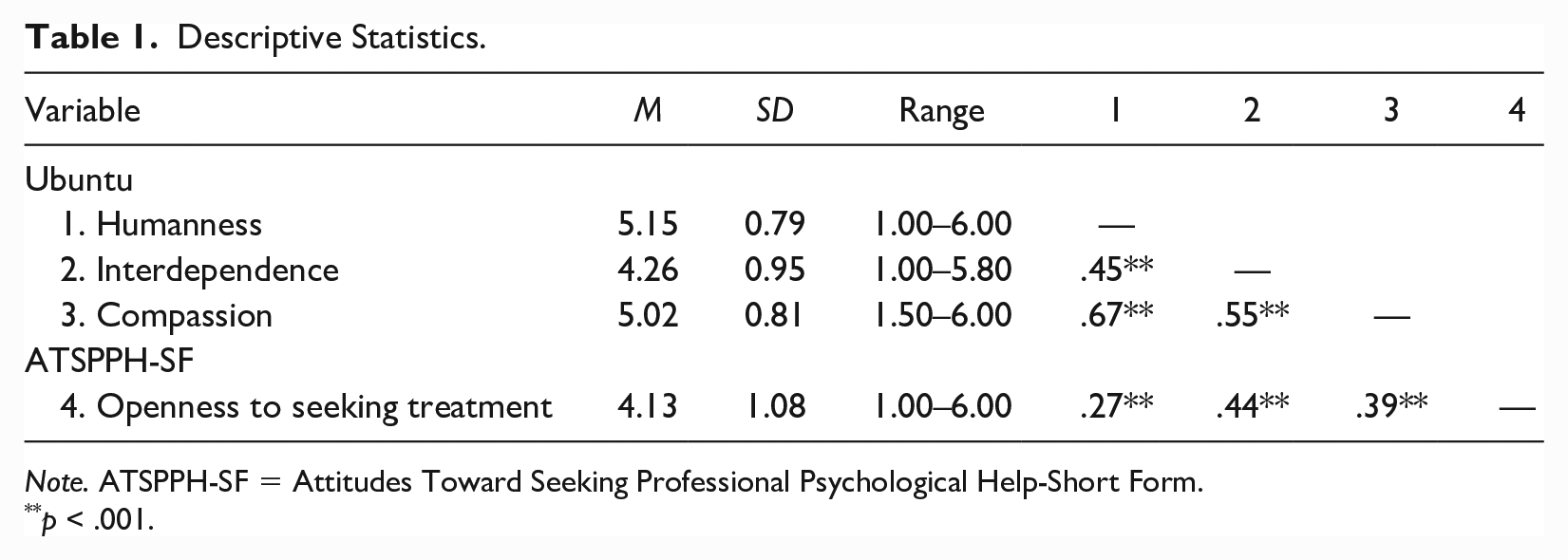
Note. ATSPPH-SF = Attitudes Toward Seeking Professional Psychological Help-Short Form.
p < .001.
Results From the Full Measurement Model: Factor Loadings for Latent Variables.
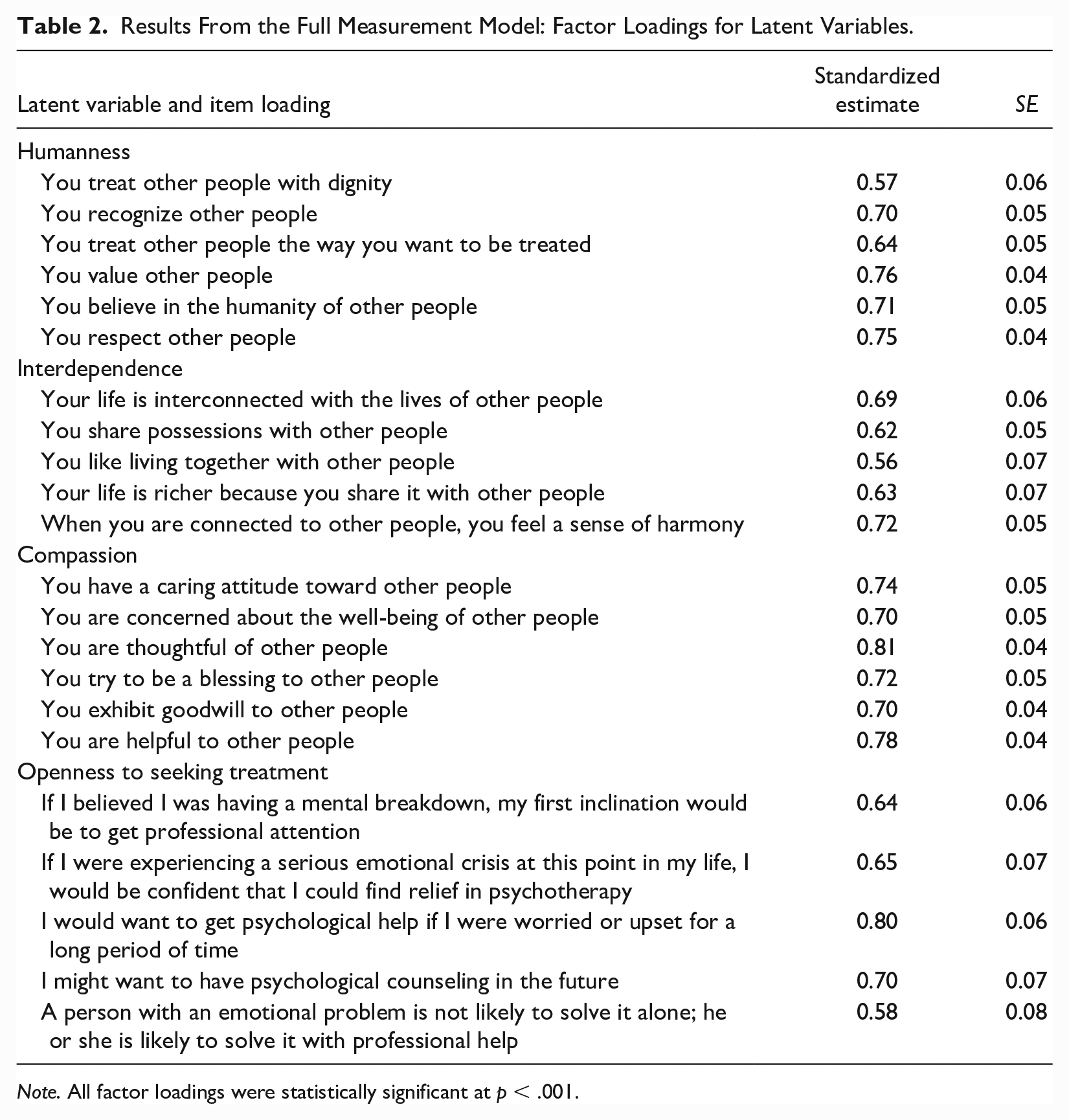
Note. All factor loadings were statistically significant at p < .001.
In the structural equation model, paths were defined from all three Ubuntu norms toward openness to seeking treatment. Allowing for correlations between the Ubuntu norms, the model fit stayed the same, χ2(199) = 379.22, p < .001, RMSEA = .046, CFA = .955 TLI =.947, SRMR = .049. The model, illustrated in Figure 1, shows that interdependence had a unique, direct effect on openness to seeking treatment for emotional problems (β = .467, p < .001). In other words: those participants who confirmed the value of interconnections with others, were more accepting toward treatment for emotional problems. The effects of humanness (β = −.091, p = .340). and compassion (β = .199, p = .066) did not reach statistical significance.
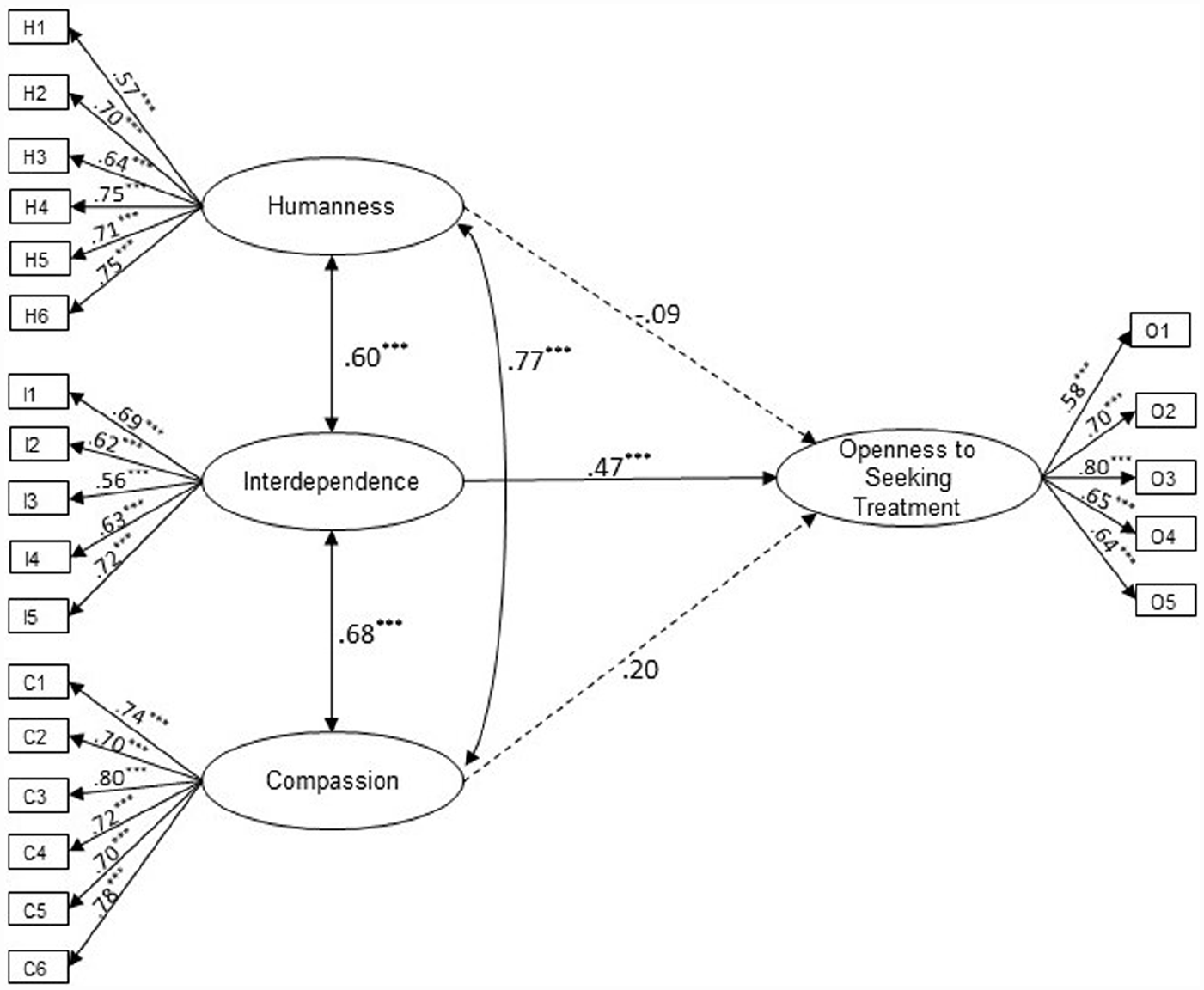
Structural Equation Model Predicting Openness to Seeking Treatment From Ubuntu.
Discussion
Black American men are as likely as anyone else to experience mental health challenges but are among those least likely to seek help (Anderson, 2018; Duncan, 2003). The purpose of the present study was to determine if adherence to the African derived cultural norm of Ubuntu among Black men was associated with openness toward seeking professional mental health services. To this end, the author first examined the psychometric invariance properties of an existing measure of Ubuntu, developed with samples of South Africans of African descent, to determine if the original factor structure applied to a sample of Black American men. This is the first known study to empirically test the cultural continuity of Ubuntu with a sample of the African diaspora. Results from CFA indicated that Ubuntu, as measured by Mutsonziwa’s (2020) Ubuntu scale, along with its subscales of interdependence, humanness, and compassion is an appropriate measure to use with Black American men. These findings build on previous Afrocentric theory work that there are shared cultural norms between populations of African descent who continue to live in their native countries and the diaspora (Namisango et al., 2021). Principally, the study evaluated how Ubuntu was associated with help-seeking norms and found that it did indeed influence norms of seeking professional help. Black men reporting higher levels of Ubuntu had a greater likelihood of seeking professional mental health services. In this section, findings are discussed in the context of previous research, and implication for future Afrocentric research and social work practice.
Mental Health and African Cultural Norms
This study also advances understanding of the relationship between Afrocentric cultural norms and mental health among Black men. Findings from the SEM model demonstrated that all three dimensions were correlated, with humanness and compassion positively correlated with interdependence. However, interdependence was the only directly positively associated aspect with help-seeking attitudes for emotional distress. In part, this may be explained by the fact that interdependence is about valuing interconnectedness, such as interacting and sharing with others (Mutsonziwa, 2020). This phenomenon may be an underlying component needed to seek mental health support, as the process of diagnosing and treating mental health problems relies heavily on talking and self-disclosure. Thus, it is possible that Black men who express Ubuntu, embrace a sense of shared burden for life stressors, seeing the value and importance of others’ help as meaningful in addressing emotionally distressing situations. It is also noteworthy that given the indirect potential relationship of humanness and compassion, these two aspects of Ubuntu may bolster Black men’s compassion for themselves, help them to recognize the value that others may be able to provide, thereby increasing their likelihood of seeking help. Therefore, providing interventions that improve Black men’s sense of Ubuntu, may be a relevant and culturally appropriate way to increase help-seeking behavior. Furthermore, as argued by Di Bianca and Mahalik (2022), these values might also be a means to disrupt problematic western masculinity norms of self-reliance, using interdependence to define “real men,” such that help seeking is seen as empowering.
These results are also relevant considering the broader connection that previous studies have found between Ubuntu and mental health. Mental health is typically associated with well-being, which refers to feeling well (Topp et al., 2015). Yet, the meaning of well-being is highly subjective and determined by the cultural self-concept a person adheres to (Wilson & Williams, 2013). The African notions of self-concept associated with well-being, however, is connectedness, social competency, and consciousness, which are in turn connected to Ubuntu (Wilson & Williams, 2013). As such, Ubuntu appears to provide an excellent framework for psychotherapy and other interventions for Black Americans. Prior research also shows that African-centered interventions are particularly effective for Black youth with respect to academic achievement, self-image, and behavior (Lateef et al., 2022). Combined with the current results, this culminates in a tripartite model for Ubuntu and mental health, where Ubuntu is positively associated with mental health, seeking support for mental health problems, and the results that can be obtained from interventions.
Alongside the interesting findings of the study, some limitations should be considered. Although studies on the attitudes toward seeking professional mental health services were reviewed, one could argue that this is too broad a formulation for the current study. As culturally sensitive treatments have only recently received attention, this study cannot answer the question of whether the respondent’s answers were influenced by the availability of these alternatives. It is possible that attitudes toward seeking help will be more positive if Black men know of places where they can receive help that fits their needs and desires more adequately. Another limitation is that data on whether the participants had a previously diagnosed mental health condition was not collected. Of course, it would be even more important for Black men to have a positive attitude to seeking help if they experienced mental health problems that affected their daily life. An existing mental disorder could also affect their responses, either in the positive direction as they might feel the necessity to seek help (e.g., because they experience negative effects without treatment), or the negative direction, e.g., from increased levels of embarrassment and fear. A third limitation is that the study was cross-sectional, and collected data using self-report, thereby being unable to fully answer questions of causality. Although it seems less likely that attitudes toward mental health would increase Ubuntu compared with Ubuntu influencing these attitudes, there is the problem of common method bias (Baumgartner & Weijters, 2012). This can mean that the associations found in the current study were somewhat inflated. Moreover, with respect to causality, the author cannot be certain if interdependence directly predicts more openness toward seeking help, or if this is partly explained by people who value interdependence interacting with others more often, and hearing about their positive experiences with mental health care. Furthermore, the study does not provide context to what extent openness to mental health care predicts actual help-seeking behavior.
Implications for Practice
Despite these limitations, the findings have important implications for practice and future research. The most obvious implication is that it is worthwhile to use Ubuntu, especially interdependence, to help young Black men find help for mental distress if needed. This could be done through communication about mental health care, especially programs specifically developed to help Black Americans. Furthermore, given the interrelationships between the Ubuntu aspects, it may be useful if humanness and compassion are emphasized in therapy and actually provided. A second implication of the current study is that the Ubuntu measure can be used in practice, now that it is found to be appropriate for use with young Black males. This is applicable not only for researchers but also practitioners who wish to increase Ubuntu and evaluate the success of their intervention, and to select youth for preventive programs that foster these principles. Moreover, social work education should improve the robustness of the curricular such that it allows students to appreciate the value of Afrocentric cultural strengths, such as Ubuntu, as mechanisms buffering mental health among diverse and often marginalized populations.
Future studies could then focus on the impact of these implications, including whether interconnectedness can indeed help Black men access mental health care, as well as incorporating humanness and compassion in culturally appropriate therapy. This could be done by comparing the new ways of information sharing to commonly used methods. Furthermore, qualitative research might extract the full meaning of the relationship between interdependence and openness to seeking help, by asking Black men how Ubuntu affects the way in which they think about mental health problems and help seeking. In these studies, it will be important to also investigate the presence of actual mental health problems. As it might be difficult for young men to acknowledge their problems, it could be useful to approach this using multiple sources of data, including, for example, reports from parents or significant others.
Conclusion
Literature suggests that the lack of knowledge on the association between mental health and cultural identity in populations of African descent, is attributable to the variations in pace of Afrocentric measures development and theory of mental health practice. Notably, a great majority of the measures were developed between the 1990s and early 2000s, when the empirical assessment of these constructs was still nascent. The present study helps in addressing the two recommendations of Utsey et al. (2009), to (a) identify theoretical measurements with valid links to authentic African reality structures and (b) extend invariance studies of constructs with underlying connections between continental African and African diaspora communities. The excellent psychometric properties of the recent Ubuntu scale developed by Mutsonziwa’s (2020) suggest its use in future study on Afrocentric norms and mental health. In doing so, the study also provides an opportunity for social workers to disrupt the normative whiteness in the study of mental health with data from Black populations. More often than not, studies that advance measurement for mental health center on the experiences of white populations, using these findings as baseline for measurement, conceptualization, and testing, disregarding the cultural contexts of diverse populations. Moreover, measurement studies are not often conducted by social work scholars but are particularly important to actualizing the advancement of research and practice in the field, in a way that aligns with anti-racist approaches and honors worldviews that may be relevant to the diverse populations with whom the profession seeks to ally. Furthermore, the help-seeking attitudes of Black American men toward mental ill health should be understood within the historical context of marginalization, gender norms, where racism in seeking help is common, and interwoven with cultural norms as well. This made the study of Ubuntu, as a specific Afrocentric cultural value, especially relevant. The fact that the measure was found to be appropriate for the use among Black American men can be helpful for future studies and more centered explorations of Afrocentric cultural norms and mental health.
Footnotes
Declaration of Conflicting Interests
The author(s) declared no potential conflicts of interest with respect to the research, authorship, and/or publication of this article.
Funding
The author(s) received no financial support for the research, authorship, and/or publication of this article.
Disposition editor: Cristina Mogro-Wilson
