







Abstract
China’s fertility policy and population aging have produced many “4-2-2”–structured sandwich families, placing the sandwich generation under dual caregiving stress. Through reflective lifeworld research and multilevel interviews with 14 “4-2-2” families, we confirmed that the essence of “dual stress” was the competing responsibilities of caring for older adults and children. This essence can be further illustrated by the vulnerability of the cared-for, lack of emotional resources, socio-educational anxiety, and family livelihood pressure. In addition, the dual stress can jeopardize the well-being of the sandwich generation as family caregivers. However, this dilemma can be alleviated by intergenerational support-balancing, alternative digital-technology, and complementary social-care strategies. Understanding the lifeworld of sandwich families presents practical approaches and policy implications for caregiving-support systems.
Introduction
The sandwich generation comprises those who simultaneously care for their children and elderly parents (Chisholm, 1999). Several studies referred to them as the generation caught in the middle, middle generation (Neugarten, 1979), or squeezed generation (DeRigne & Ferrante, 2012). In 2023, China’s first generation (approximately 30 million people born between 1976 and 1985) of only children would have assumed or be approaching the “sandwich” position (Zang, 2022). Among them, families with spouses who are only children are estimated to reach the highest rate (34.2%) in 2030. The data from China’s seventh census indicates that the “4-2-2” families account for the most representative sandwich-type families in China (Cameron et al., 2013), and this is because of the changes in China’s fertility policy (from the one-child to two-child policies) and demographic structure (increased life expectancy for older adults) (Tu et al., 2022). The “4-2-2” family comprises one adult couple, four elderly individuals, and two children (Dong et al., 2020). Adult couples are their parents’ only children owing to the one-child policy, and this makes them the sole caregivers in the intergenerational ladder (Xie et al., 2022). Moreover, with the increasing popularity and incentive accompanying China’s two-child policy in 2015, the same adult couple may decide to bear two children. Thus, combining both conditions would subject the sandwich generation of “4-2-2” families to dual caregiving commitments to their aging parent and younger child(ren) (J. Chen & Zhou, 2022).
A report on “4-2-2” families revealed that the stress of the sandwich generation is “like extinguishing a fire every day, having to put out one end and then the other” (Shuangxing & Hao, 2019). This dual stress can result in negative consequences, resulting in caregiver burnout and depression (Brenna, 2021). This dilemma was particularly prominent during the coronavirus (COVID-19) epidemic starting in 2019 (Leahy, 2022). In that period, the sandwich generations of numerous “4-2-2” families experienced financial anxiety and depressive symptoms; they could not balance their work and family-caregiving responsibilities (C. Liu et al., 2021). In response, some Chinese local governments began providing one-child pensions and family-planning subsidies to older adults of these families in 2022 (X. Feng, 2023). However, the existing social-care system primarily focuses on the cared-for rather than caregivers, and this results in the neglect of the family caregivers’ well-being and health (Acton, 2002; Morelli et al., 2019; Zang, 2022). Although numerous extant studies highlighted the efforts and outcomes of the sandwich generation in overcoming family-caregiving stress (Albertini et al., 2022; Brenna, 2021; DeRigne & Ferrante, 2012; Hämäläinen & Tanskanen, 2021; Manor, 2021), the family-life contexts of their caregiving-stress have not been explored (Jarling et al., 2020).
Furthermore, previous studies demonstrated how gaining insights into the lifeworld of family caregivers would contribute to grasping their perceptions and opinions regarding caregiving stress (Andersen et al., 2020, 2021; Jarling et al., 2020). Thus, adopting a phenomenologically oriented attitude is crucial to fully gaining insights into the dual stressors of the sandwich generation of “4-2-2” families. Furthermore, capturing and stimulating reflection can contribute additional knowledge to the field of family caregiving, enabling social workers and policymakers to appropriately design and implement caregiving interventions (Andersen et al., 2021). This study was conducted to explore the essence and meaningful structure of dual caregiving stress in “4-2-2” families via a reflective lifeworld research (RLR) approach. In addition, we conducted multilevel interviews, which facilitated shared reflection among family members, thus generating richer data and more detailed multidimensional stories regarding “dual stress.” Finally, we summarized the various balancing, alternative, and complementary strategies, which “4-2-2” families can adopt to cope with dual stressors, and offered valuable insights for social-work agencies and public-welfare organizations.
Literature Review
Sandwich Generation and Family Caregiving
In recent decades, the sandwich generation with aging parents and young children has faced alternating family-caregiving demands (Hämäläinen & Tanskanen, 2021) attributed to delayed childbearing and increased life expectancy (Patrick et al., 2023). The sandwich generation is saddled with multiple overlapping caregiver responsibilities (Marsack-Topolewski, 2021) and faces a dilemma between family caregiving and work (Brenna, 2021; Gates et al., 2020). Despite facing multiple conflicts with limited time and energy (Huang et al., 2004), studies reveal that most couples that belong to the sandwich generation opt to maintain their caregiver roles and work obligations (Jarling et al., 2020; Rubin & White-Means, 2009). The motivations for this informal family care include family solidarity, obligation norms, altruism, and reciprocity (Andersen et al., 2020). However, family caregiving can also jeopardize the well-being, including the health, economic resources, and social participation, of the sandwich generation (Hämäläinen & Tanskanen, 2021).
Compared with the sandwich families in other countries, China’s “4-2-2” families have been profoundly influenced by fertility policies (Jiang & Sánchez-Barricarte, 2011), including “late marriage, birth spacing, and having fewer children” in the 1960s, the one-child policy in 1979, and the two-child policy in 2015, respectively (Hesketh et al., 2015; Tan & Liu, 2020). Owing to China’s 50-year-long one-child policy, the country’s childbearing restriction has altered traditional fertility intentions (Fu et al., 2023) while creating many “4-2-2” sandwich families. The earliest generation of only children reported that they did not realize the plight of family caregiving until they became adults (X. Feng, 2023). Caregiving in “4-2-2” families is a nonoptional “silent obligation” (Løgstrup, 2020), which makes it challenging for the sandwich generation to fulfill the caregiver role. In the subsequent decade (2023–2032), the first generation of one-child parents (80% were born between 1949 and 1958) will be between 74 and 84 years old (X. Feng, 2023). They would have been retired, and their ability to care for themselves would have been reduced significantly. As the number of second children in Chinese families has increased recently (B.-B. Chen & Tan, 2021), the sandwich generation in “4-2-2” families faces severe dual caregiving stress.
Dual Caregiving Stress of the Sandwich Generation
Caregiver stress is generally defined as a mismatch between the caregiver’s perceived needs and the perceived capacity generated during caregiving (Leahy, 2022). Caregiver stress can be more accurately expressed in caregivers’ self-reports. The sandwich generation exhibits higher depression levels than the general caregiving population. This psychological stress positively correlates with the time spent caring for older adults and children (Brenna, 2021; Huang et al., 2004). For example, a survey by the Centers for Disease Control and Prevention revealed 51.5% severe suicidal ideation among the sandwich generation during the COVID-19 pandemic (Lei et al., 2023). Studies have also revealed that caregiving stress among the sandwich generation negatively affects their employment and physical well-beings (Alburez-Gutierrez et al., 2021; Coe & Van Houtven, 2009; Samuel et al., 2021), with insufficient sleep resulting in reduced concentration and work outcomes (Gates et al., 2020; Rubin & White-Means, 2009). In addition, the coexistence of older adults and children affects household income and expenditures, as well as squeezes the consumption of the sandwich generation (Huo et al., 2021). Caregiver stress among the sandwich generation is more significant in countries lacking adequate health care and social security systems (Mba, 2010). Alburez-Gutierrez (2021) confirmed that national welfare systems with formal social support systems could alleviate the caregiving stress of the sandwich generation (Alburez-Gutierrez et al., 2021).
Caregiving for the Elderly and Children in Chinese “4-2-2” Families
The sandwich generation of “4-2-2” families becomes the primary caregivers of the older generation owing to their lack of siblings (Hesketh et al., 2015; Marinelli et al., 2022). In China, intergenerational caregiving between children and parents is a traditional culture, and adult children are usually responsible for providing for the family (Schwarz & Trommsdorff, 2010). It is an intergenerational solidarity with attributes of mutual benefit, affection, and responsibility (J. Chen & Zhou, 2022; Hareven, 1978; Wu, 2022). Parents invest much time and energy to care for their children in exchange for their children’s financial support and social care as they age (Becker, 1994; Wu, 2022). Several studies have revealed that the older adults in this family structure are very willing to move into nursing homes to reduce the pressure on their children (H. Liu et al., 2020; Ni et al., 2014). However, children are socially condemned for being ungrateful if they are perceived as refusing to care for older members of their families (Dang & Zhang, 2022; Zhang & Goza, 2006). This extreme phenomenon is reflected by the fact that some older adults opt to end their old age by committing suicide because of their children’s unwillingness to continue offering care (Nie, 2016). Therefore, most sandwich generations consider care for their older family members a necessary responsibility (J. Chen & Zhou, 2022; Falkingham et al., 2020).
The Chinese government enacted the two-child policy in 2015 to address the resulting demographic crisis (low birth rate and aging population) (Su-Russell & Sanner, 2023; Zeng & Hesketh, 2016) caused by the one-child policy, and the births of most of the second children in “4-2-2” families were influenced by the policy (Bossard, 1945; Hong & Liu, 2021). Consequently, women of childbearing age in the sandwich generation must devote additional time and energy to meet the needs of two children and assume additional childcare responsibilities (Kwete et al., 2021). Moreover, having a second child can increase household expenses and place financial pressure on the family (Hong & Zhu, 2017; Tan & Liu, 2020). The “4-2-2” family is unique regarding child caregiving. First, the sandwich generation lacks experience with siblings because of their role as their parents’ only children, and this may result in the lack of norms, knowledge, and methods for properly managing parent–child relationships with two children (B.-B. Chen & Tan, 2021; Qian et al., 2021). Second, the differences in siblings’ gender mix and age in “4-2-2” families may produce different parenting stress (Tong et al., 2022). Particularly, the dramatic change in China’s fertility policy significantly altered the age difference between the two children in many “4-2-2” families. Parents’ second-child birth decisions can create psychological discomfort for first children who had perceived themselves as the only children (Q. Feng et al., 2022).
Research Objectives and Questions
The extant studies examined the adverse effects of caregiving stress on the sandwich generation (Fu et al., 2023), indicating that this dilemma will worsen in the coming decades (X. Feng, 2023). First, social-care-system designs often neglect caregivers; services are generally structured around the “cared for” rather than the “caregiver” (Zang, 2022). This role positioning affects the delivery and evaluation of social-care services. Second, only a few studies have considered the caregiving stress of the sandwich generation in China (J. Chen & Zhou, 2022), particularly “4-2-2” families, owing to fertility-policy incentives and demographic factors (Wang & Luo, 2022). Finally, there is a lack of research on caregiving stress from the family-based perspective. This research orientation has also resulted in a lack of understanding of the integration of social work with the family lifeworld, as stress occurs in families’ daily life and action interactions.
Thus, the literature on the understanding of the sandwich generation regarding family caregiving stress, particularly the effect of dual stress on sandwich generations, is limited. This study gives insights into the lifeworld of the sandwich generation in “4-2-2” families and examines their perception of the family-caregiving dilemma and coping strategies based on their sandwich status and dual stress. Therefore, the following research questions:
Method
Here, we employed the RLR method, which is an emerging qualitative research approach in social-work research; RLR is guided by phenomenological, as well as hermeneutic ontological and epistemological principles (K. Dahlberg et al., 2008; Grunwald & Thiersch, 2009). The method comprises two main components (H. Dahlberg & Dahlberg, 2020): (1) the processing of empirical data to elucidate the structure of meaning and (2) the input of external resources (theories, structures, etc.) to analyze and reveal the conditional structure of phenomena. Rooted in Husserl and Merleau-Ponty’s lifeworld theory (Lundvall et al., 2020), the RLR approach offers an open, bridled, and reflective approach to revealing and elucidating complex social phenomena (Eskilsson et al., 2015). An openness to the phenomenon can guide data collection and analysis, as well as describe the study object. Being bridled requires the researcher’s awareness and inhibition of preconceived assumptions with focus. Combining both components helps researchers to adopt a rigorous, reflective attitude toward identifying and elucidating the research phenomenon (H. Dahlberg & Dahlberg, 2003). Here, we focused on the social phenomenon of the dual stress of the sandwich generation of “4-2-2” families regarding caring for older adults and children in their families. The RLR approach facilitates the distillation of the essence and meaning structure of the dual stress and coping strategies of the sandwich generation with variety and nuance using the “4-2-2” family members’ descriptions of their daily experiences.
Participants
It is potentially challenging to recruit a sample of families who meet the criteria and are willing to share the stress of caring for their older adults and younger children. The recruitment process was divided into three main stages. First, most household registrations (Hukou system) in China are family-based and include information on the compositions of families (Chan & Zhang, 1999). Therefore, we employed the assistance of local government officers in Wuhan to screen eligible families based on their residence registration information, as well as to enquire by phone if they would be willing to be interviewed. Second, we contacted social workers in the Wuhan community who helped with the recommendation of eligible families. Both phases were conducted in the first round of interviews in 2020 and 2021: 24 interviewees from eight “4-2-2” families were interviewed face-to-face in Wuhan. Third, we also employed snowball sampling to encourage families who had already been interviewed to recruit other eligible “4-2-2” families they knew. This method facilitated the recruitment of six “4-2-2” families from Beijing and Shanghai from which the researchers interviewed eight respondents from six “4-2-2” families in Shanghai and Beijing via video call in 2022 (see Table 1). Following Blake’s et al. (2021) study, these families were intimated about their involvement and how their data would be used (Blake et al., 2021). The inclusion of older adults in the multilevel and individual interviews further enrich the content and details of the lifeworld experiences of the sandwich generations in family caregiving, particularly the embodiment of family relationships and cross-generational findings in caregiving stress. The older adults’ perceptions and opinions also facilitated shared reflection on meaning structures and coping strategies.
Demographic Characteristics of the Participants.

Data Collection
The data were mainly collected via a multilevel interview design, including joint and individual interviews (see Figure 1) (Blake et al., 2021). During the first round of the joint-interview phase, the interviewed families were briefly informed of the purpose of the study and asked the following initial question: “How do you perceive caregiving stress in your family?” to elicit the respondents’ descriptions of their family experiences. During the individual-interview phase, the confidentiality of the one-on-one setting encouraged the members of the 4-2-2 families to discuss sensitive topics, thus offering opportunities for self-reflection (Blake et al., 2021). We asked couples to separately describe their family-caregiving schedules and asked older adults to tell their daily schedules at home. Their descriptions and reflections were further deepened with prompts incorporating events that were collected in the joint interview. For example, “How do you perceive this experience?” “Why do you understand in this manner?” The researcher clarified the shared lifeworld caregiving framework by comparing the dynamic differences between the individual and joint interviews (e.g., comparing the differences between “I” and “we” in the representations of the caregiving experiences in the interviews). In the final round of joint interviews, the “4-2-2” family members validated their mutual insights into family-life experiences by confirming one another’s responses (Racher, 2003), thus coconstructing couple- and family-based responses to the essence and meaning of dual caregiving stress.
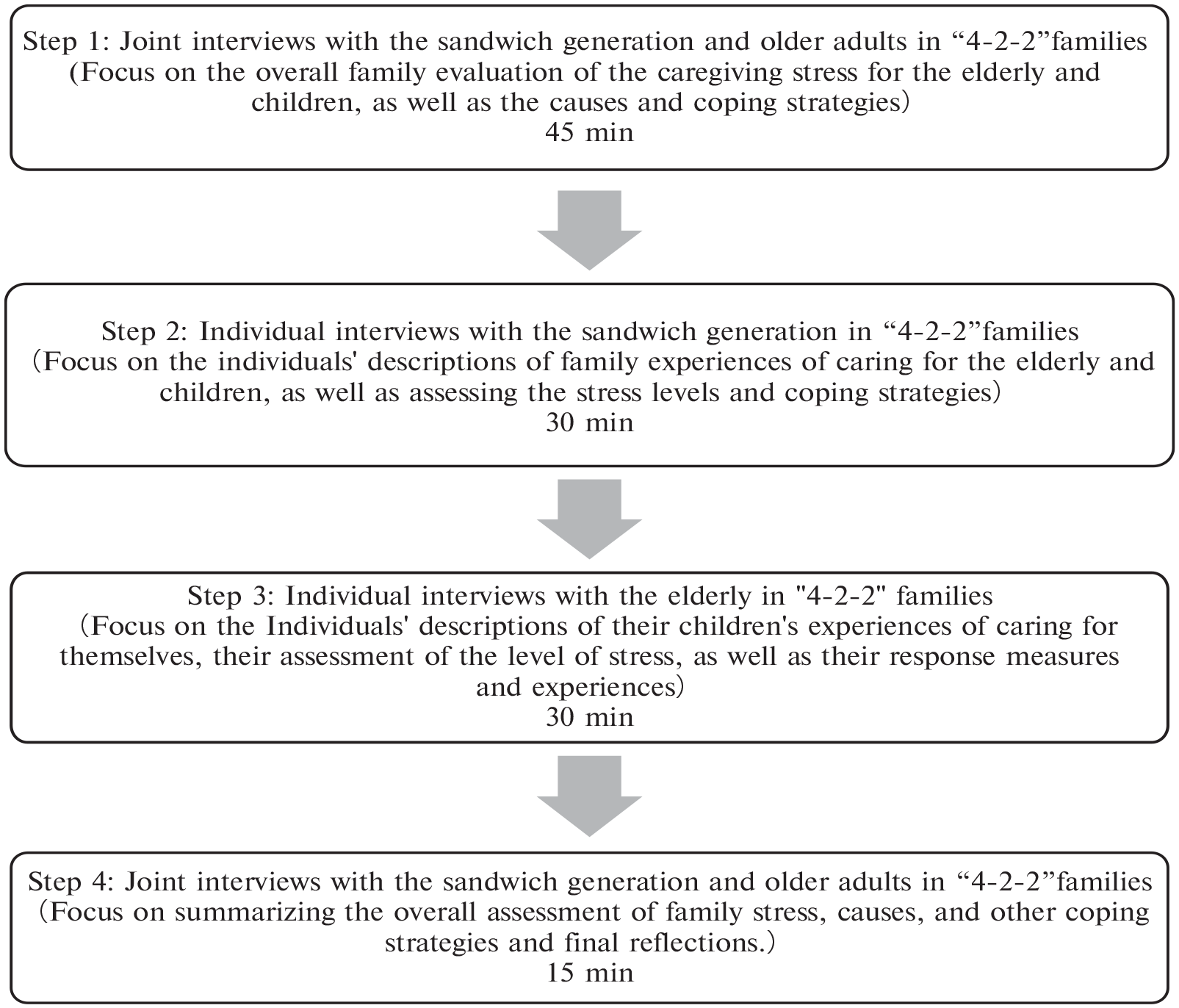
Multilevel Interview Design.
The data collected for this study included verbatim transcripts from semistructured interviews with 14 “4-2-2” families. The joint interviews facilitated the intervention of family-relationship elements (Velardo & Elliott, 2021). They demonstrated the social-meaning process of the dual stress of aging and parenting, allowing us to bridge and understand the meaning structure of the lifeworld. The individual interviews allowed the respondents to think deeply about and respond comprehensively to the content of the topics discussed in the joint interviews (Bjørnholt & Farstad, 2012). This multilevel interviewing approach ensured the construction of a reflection space, generating two separate scripts and one-to-one scripts that facilitated the formation of individual- and family-level triangulations (Tracy, 2010). These phases produced very accurate and comparable data for elucidating the essence of “dual stress” in this study.
Data Analysis
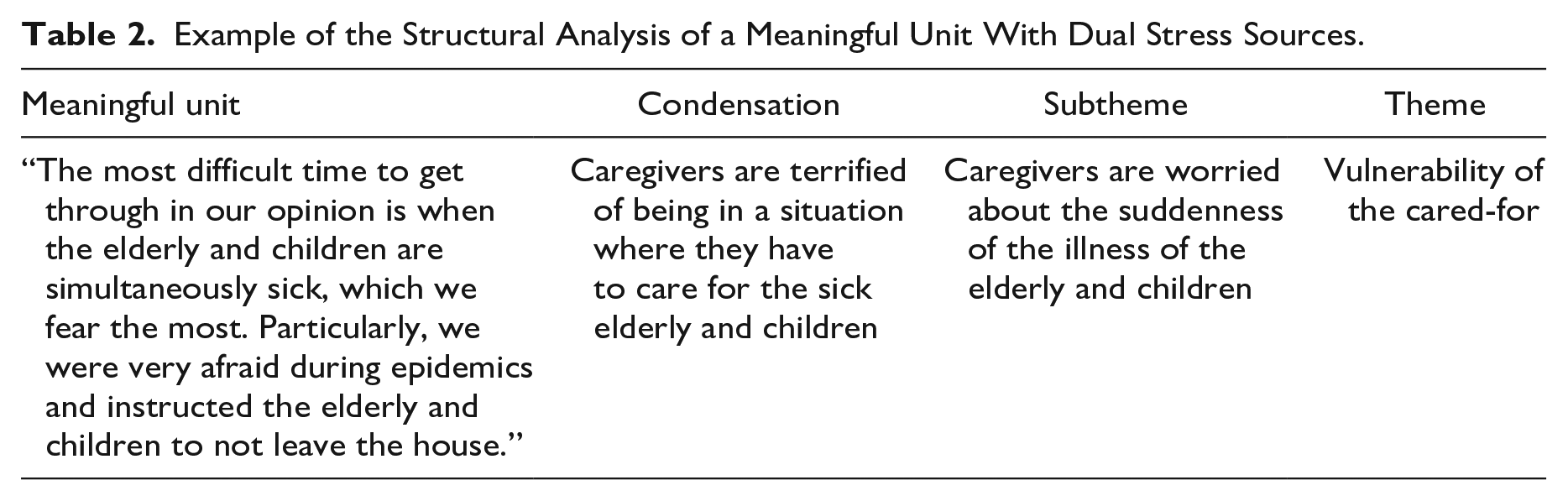
The RLR process of induction and meaningful analysis of the verbatim interview transcripts was followed by data analysis (K. Dahlberg et al., 2008); Table 2 presents an example of the employed structural analysis. First, the researcher was assisted to make sense of the data by reading and familiarizing with the interview text, thereby linking the researcher’s experience to understanding this particular phenomenon (K. Dahlberg, 2006). Therefore, a series of questions emerged. For example, “How does the text explain the dual stress?” “How does the sandwich generation of ‘4-2-2’ families understand and express stress?” Second, the texts were divided into clusters of similar meaningful units (a word, a sentence, or a longer text). We achieved this by creating several clusters that revealed the structure and nature of the phenomenon under study. The different meaningful units were grouped into subthemes, which were subsequently formulated and abstracted into themes (Lindseth & Norberg, 2022). Finally, the analysis results were iteratively browsed and analyzed by all the authors before the final version of meaningful units was generated, followed by a comparison of the results. The nuances and variations of the phenomena were identified based on structure and nature until the differences were within 5%.
Example of the Structural Analysis of a Meaningful Unit With Dual Stress Sources.
Results
Essence
Regarding the sandwich generation of the “4-2-2” families, the essential meaning of dual stress was the competing family-caregiving responsibilities for older persons and children. As composite caregivers are caught in the dilemma, they struggle to allocate their already limited time, energy, emotional, and financial resources to older adults, children, and work. Thus, a resource-competition effect emerges for the family care of older adults and children. The increasing cost and refinement of childrearing have gradually crowded the sandwich generation’s ability to care for their older adults, thus generating a great tension between the dispositional cascade of caring for older adults and children in the family life cycle. The sandwich generation exhibits a significant overlap in the timing of multigenerational caregiving.
Competing caregiving responsibilities represent filial and altruistic obligations, as well as ethical norms. The insight of the sandwich generation into this responsibility is often ambivalent as they consider it deserved and unquestionable while also feeling compelled to undertake them. This intricate feeling often causes them a great deal of negative emotion. This complicated feeling generally leaves them feeling neglected, constrained, and uncertain.
Meaning Structure of the Competing Responsibilities
We further elaborated on the four components of the essential meaning structure of the competing responsibilities.
Vulnerability of the Cared-for
Older persons and children are vulnerable, as reflected by their physical and psychological characteristics of being more dependent on their caregivers. Owing to the scarcity of caregivers, the vulnerability of care recipients increases the unpredictability of “4-2-2” family life in the event of illness and increases the dependence of older persons and children on the sandwich generation. As described by Family H’s caregiver from Shanghai, CC used to fall sick a lot when he was in kindergarten. At the same time, my mom was admitted to the hospital with multiple intestinal polyps, and I was anxious at that time. The child had a fever, and my wife had to care for her; for another, my mother had surgery. My father was too old to sleep in a hospital recliner at night, so I was the only one who could go there. (I22)
Family C from Wuhan reported the same experience. Family C’s caregiver said that My child had mumps, and as a result, my mom found a cervical tumor in the hospital. At that time, my mom said she would go to the hospital after AZ’s mumps had improved, but I also felt really uneasy and wanted to treat it earlier. Therefore, we went to the hospital and local maternity home to reserve a bed. It was quite a hassle at the time, and our families always encountered such problems. (I6)
The death of a family member presents the most significant risk of disintegration and deformation of the family structure at any period. The sandwich generation often experiences tremendous anxiety because of the simultaneous illness of the cared-for person, stemming from the fear of death and exhaustion of caregiving.
Lack of Emotional Resources
The fulfillment of caregiving responsibilities also requires an input of emotional resources. When only one aspect of caregiving responsibilities can be fulfilled, the sandwich generation may feel guilty for not caring for the other. The older person in Family D in Wuhan said that “We are still very lonely. I only have one daughter, and sometimes I worry I may disturb her and her husband (I8).” Family D’s caregiver expressed the following frustration: “I owe a lot to my parents, who always tell me to put my children first.” As the only family caregivers for older adults, the sandwich generation cannot offer extra emotional resources to their parents. Although they know it is not their fault, they still feel the inevitable helplessness and pain.
Traditional Chinese culture places great importance on offspring. Many older adults believe that an excellent later life requires enjoying communication and interaction with their offspring. Emotional connection with grandchildren is a crucial family emotional resource that benefits older adults’ psychological well-being. The older members of “4-2-2” families wish to deepen their emotional cohesion with their grandchildren, and this competition sometimes generates family conflicts. Among the respondents, regardless of their education level, the older adults were strongly attached to their grandchildren. The older adults from Family J in Shanghai stated the following: “We all want to take care of our grandchildren. Ah! We miss them when we don’t see them for a little while (I21).” The interviewed sandwich generation often had to deal with the older adults’ competition for intergenerational emotional resources, and this caused them great distress.
Socio-Educational Anxiety
Socio-educational anxiety emerged as the most prominent aspect of parenting stress. The hypersensitivities of couples toward the academic performances and employment prospects of their two children were widespread among the interviewed families. As Family A from Wuhan commented, Nowadays, elementary and junior high school students have a lot of remedial classes. Usually, teachers assign homework that parents have to check and do together. Elementary and junior high schools are quite stressful. Now I think that even with two children, the quality of education still needs to be guaranteed. (I1)
The excessive need for parental involvement in school routines and educational models has dramatically increased the educational burden on sandwich families.
Furthermore, out-of-school tutoring classes add directly to parents’ educational investment. Family D in Wuhan spent up to 60% of their household expenses on monthly training. This educational anxiety relates closely to high competition in Chinese education and inappropriate social expectations. Moreover, this educational anxiety greatly contributes to mothers’ negative emotions in 4-2-2 families as they must work to provide for their parents. As one mother from Family J in Shanghai described, Nowadays, teachers still ask mothers to do more than fathers in the children’s education. I’m busy at work and have limited time and energy with two kids. However, I also feel guilty when they don’t do well in exams and wonder if it’s my fault. (I20)
Family Livelihood Pressure
The income of a “4-2-2” family must be spent wisely on the daily needs of different family members, such as food, education, and health care. The sandwich generation must also reserve a certain amount of money for unexpected family events. As described by the husband in Family D’s caregiver from Wuhan: In 2010, my father was paralyzed and in bed because of a brain attack and needed a companion during his hospitalization. Hiring a caregiver required half of the monthly salary of both of us as a couple every month. We could not afford this and had to take turns taking time off work to care for him. However, my wife and I lost our full-time awards. (I9)
When the couple’s financial situation in a “4-2-2” family becomes problematic, it can significantly increase the burden of support. This can result in financial hardship, particularly when some couples are burdened with mortgages and car loans.
Some “4-2-2” families have described the stress of preparing their children for real estate. As the wife of Family A’s caregiver in Wuhan said, “I have two sons, so I need a house for each of them. Otherwise, if they don’t have a house now, they won’t be able to get married (I1).” This financial pressure is caused by the Chinese social convention of “six wallets,” which states that high housing prices in China require young couples to cofinance the purchase of a house with their parents and grandparents. Property is also closely associated with social-status markers, such as the right to choose a spouse and marry. It is an essential source of economic anxiety for “4-2-2” families.
Coping Strategies for Stress
The “4-2-2” families have also adopted coping strategies in the face of dual pressures. First, intergenerational support can promote family solidarity (Albertini & Tosi, 2022). Mutual support between older adults and children can alleviate caregiving stress through the family division of labor. Second, digital technologies and services offer alternative solutions to family caregiving. Technology-enabled home care can help the sandwich generation offer care through intelligent, portable, and remote approaches. Finally, government and social-care agencies can provide formal and respite care for the sandwich generation by designing family-support systems for “4-2-2” families.
Balance Strategies for Intergenerational Support
The stresses associated with family caregiving also offer opportunities to strengthen family unity. Following the principle of reciprocal balance, “4-2-2” families can balance daily caregiving responsibilities by developing an intergenerational division of labor to provide time off for the sandwich generation. Intergenerational care can present mutual emotional comfort for older people and children. The elders can reduce the pressure of the sandwich generation by taking care of each other and helping to raise their grandchildren. As described by the husband of Family L’s caregiver from Beijing, We are a very warm and united family. No matter what happens, our family will work together to solve problems. When my mother was sick, my mother-in-law also helped to take care of her. There may have been arguments, but we all work together for the family’s sake. (J31)
Balance strategies also facilitate a dynamic flow of intergenerational resources, with older adults providing financial, chore, and social-network support to the sandwich generation. In a “4-2-2” family, some older adults even opt to work to subsidize the household. For example, the older people in Shanghai’s Family M opted to work as a janitor: “My father now works on our community’s property daily as a security guard and can maintain his and my mother’s monthly living expenses. He is pleased and feels useful in our family.” (J36)
Digital Technology Services as Alternative Strategies
Digital services can present an alternative solution to traditional family-care services by offering a more flexible and convenient option that is accessible from anywhere at any time. For example, many respondent families have installed webcams to remotely monitor and manage the health conditions of their loved ones, thereby reducing the need for frequent hospital visits. Devices, such as floor-cleaning robots, can help alleviate the stress of household chores, presenting a more human alternative to traditional home care. Family E’s caregiver from Wuhan responded, as follows: When you need to purchase anything in the hospital but can’t leave, you can book delivery guys on the phone to help bring it over. You can also book a cab directly from your phone to take the older person out of the hospital. I also often use automated cleaning machines at home to clean. All these have significantly saved our time. (I14)
Many interviewed families gradually opted to enroll their children in online classes. Features, such as online communication with teachers and checking educational progress, can also help them keep track of their children’s education and advancement. Family M’s caregiver stated that “Online classes are very convenient since we don’t need to take our children to tutorials (J36).”
Complementary Strategies via Social Care
Policy and legal measures include providing financial support, such as subsidies and flexible work arrangements, that can help working caregivers complement and balance their caregiving responsibilities and work obligations. In April 2022, the Chinese government released a plan to develop an aging program and service system, vigorously promoting a social security system that integrates home and community care (Ministry of Civil Affairs of the People’s Republic of China, 2023). Thereafter, in November 2022, several local governments in China established a child care subsidy system to incentivize childbearing, offering allowances to families with a second child. Furthermore, social support measures, such as counseling services and community-based care programs, can provide much-needed emotional and social support for caregivers and care recipients. The elderly in Beijing Family L expressed the following: “I like to go to the community to play mahjong. My wife often dances with older adults in the public square. We seniors care for each other, and we are all intimate friends (J33).” In November 2022, the Chinese government introduced regulatory and accountability measures for senior care institutions to improve the quality of institutional care. Compared with most Chinese elderly who prefer family care, those in “4-2-2” families would more likely choose nursing homes, given the pressure from their children. As the elderly from Family B in Wuhan expressed, I am very willing to go to a nursing home. After all, the children have their own lives. During my retirement years, I spent much time looking at nursing homes. Going to a nursing home is still perfect if the pension is sufficient. Of course, my partner and I are still willing to help if they need us. (I3)
These social-care measures can improve the resilience of “4-2-2” families. However, most of these policies still need to be implemented. Thus, Chinese social-security support for 4-2-2 families still has a long way to go.
Discussion
Theoretical Implications
The lifeworld insight refers to the person’s reflective view of their situation and what it means to them regarding their life experiences (K. Dahlberg et al., 2008). The findings of this study indicate that the dual stressors of the sandwich generation comprise competing family caregiving responsibilities. The results of the multilevel interviews confirmed the previous findings (Chisholm, 1999; DeRigne & Ferrante, 2012; Rubin & White-Means, 2009). In addition, it is challenging for the sandwich generation to balance the great conflict between both responsibilities (caring for the older people and children in the family) (Luichies et al., 2021). The dilemma between caring for older persons or children contributes to the sandwich generation’s lack of confidence in their caregiving abilities (Jarling et al., 2020).
Dual stress is a voluntary but forced moral commitment that jeopardizes the well-being of the sandwich generation (Zang, 2021). First, the vulnerability of the care recipient increases the uncertainty of the family life of the sandwich generation (C. Liu et al., 2021), with illness and death becoming sources of anxiety and fear. Second, the scarcity of emotional resources forces the sandwich generation to bear the guilt of only offering inadequate care (Lin et al., 2011; Wu, 2022). Third, the refinement and high cost of caring for children owing to social and educational anxieties (G. Chen et al., 2022) squeeze out the resources for caring for older people. In addition, the stress of maintaining a livelihood is a reality that all families must face, and providing quality home care requires adequate funding (Tanskanen, 2015). The continuity of caregiving responsibilities also ensures the presence of dual stress in all aspects of the “4-2-2” family-life situation (Andersen et al., 2021).
Our research summarizes the coping strategies that “4-2-2” families can employ to mitigate dual stress. Competing responsibilities can be balanced by shared understanding and reciprocal intergenerational support (Rosenburg et al., 2022). Family solidarity can facilitate the convergence of family resources to further promote efficient family caregiving among the sandwich generation (Lin et al., 2011). Digital technologies potentially replace the repetitive procedure of family caregiving through scientific, intelligent, and remote means (C. Liu et al., 2021). The social-care system can represent a complementary function to home care by offering professional guidance and financial support to the sandwich generation (Andersen et al., 2021).
Practical Implications
This research offers practical implications for government and social-work organizations at the practice and policy levels. First, family structural stresses and the resulting risk of jeopardizing the well-being of China’s sandwich generation have shifted from theoreti-cal predictions to real issues that must be addressed (C. Liu et al., 2021). The “4-2-2” families require urgent policy support from the caregiver perspective, particularly a sound medical preventive health care system, formal respite-care support, and financial subsidies (Tu et al., 2022). China presently lacks approximately one million professional social workers for the care of the elderly (China Development Research Foundation, 2020), and child care is among the most underemployed professions (Wang & Luo, 2022). In the “9073” pension scheme (90% home care, 7% community care, and 3% institutional care) proposed by China’s civil affairs authorities, family care remains the primary responsibility of the sandwich generation (Guangdong Provincial Government, 2021). Furthermore, community care has not been widely adopted (Li et al., 2022). Therefore, integrating family care with social care (Jiang et al., 2021) by shifting care from the private to the social spheres represents the future direction of a caregiving policy design.
Second, a combination of balancing, alternative, and complementary strategies to cope with the dual stressors can be considered. Integrating balancing and alternative strategies can facilitate home care, thus achieving a wide range of life benefits through technology (Wang & Luo, 2022). Furthermore balancing and complementary strategies can result in a home–social “partnership” care through improved family and community collaboration (H. Liu et al., 2020). As a complementary strategy, aging care services in the community can be combined with alternative strategies via innovative technologies. Formal social care can be achieved by deploying flexible and intelligent devices (Marinelli et al., 2022).
Third, we recommend social-work agencies and practitioners implement lifeworld-oriented care and grasp the essence of dual stress in 4-2-2 families. The lifeworld perspective requires the presence of significant others and points to the framework of social networks in social care. It can help social workers and related practitioners to further explore the essential components of stress, which can be readily neglected if interventions focus on stressful situations (Grunwald & Thiersch, 2009). It helps relevant practitioners to develop a deep, trusting connection with these families requiring help.
Limitations and Implications for Future Research
This study was accompanied by the following limitations. First, changes in the external environment can affect the meaningful structure of dual caregiving stress; for example, China’s fertility policy and the Confucian filial culture profoundly affected the “4-2-2” families. Therefore, cross-cultural and cross-national studies are required in the future. Second, large samples of dual-stress experiences can offer richer insights into the lifeworld. Thus, we recommend that future studies employ larger samples representative of sandwich families to generate empirical data for policy designs. Finally, examining the role of different coping strategies represents a fertile ground for further research because combining the various strategies may be more effective in alleviating caregiving stress than employing the single one.
Conclusion
This study offers essential knowledge from an RLR perspective regarding the dual caregiving stresses that the sandwich generation of “4-2-2” families face. The competing responsibilities of caregiving account for the essence of the dual pressure. The vulnerability of the cared-for, lack of emotional resources, socio-educational anxiety, and family livelihood pressures were combined to form the meaning structure. In the face of dual stress, the sandwich generation in “4-2-2” families can adopt a balancing str-ategy through intergenerational support, an alternative strategy based on digital technology, and a complementary strategy by the government and social-care institutions. As family caregiving stress is closely related to intergenerational relationships, this study complemented the family-structure perspective, contributing to social work research and practice regarding the adoption of an RLR approach for tackling the challenges of demographic changes.
Footnotes
Disposition editor: Cristina Mogro-Wilson
Declaration of Conflicting Interests
The author(s) declared no potential conflicts of interest with respect to the research, authorship, and/or publication of this article.
Funding
The author(s) disclosed receipt of the following financial support for the research, authorship, and/or publication of this article: This work was supported by the Fundamental Research Funds for the Central Universities (Hust) (grant number: YCJJ202204004) and the Fundamental Research Funds for the Central Universities (grant number: 2662021JC007), and J.W. was sponsored by the China Scholarship Council.
