







Abstract
Hostility is a key dimension of parenting for adolescent outcomes. This study purposed to examine the predictive effect of maternal and paternal hostility on adolescents’ emotional problems and whether adolescent gender and age moderated this relationship. These aims were examined in a sample of 1,408 adolescents aged 11 to 18 years and their cohabiting mothers and fathers, with a total of 4224 Turkish participants. The findings demonstrated that maternal and paternal hostility were linked to adolescents’ emotional problems regardless of gender and age. In addition, girl adolescents exposed to maternal hostility reported more emotional problems than boys exposed to maternal hostility. Overall, adolescents’ age and gender did not moderate the relationship between parental hostility and adolescents’ emotional problems. As a result, parental hostility seemed to be an important risk factor for adolescents’ emotional problems.
Introduction
With the transition to adolescence, parent–child relationships are reformulated (Laursen & Collins, 2009). During this time, the relationships with parents are less supportive. The conflict parent–child relationship, which becomes more egalitarian in adolescence, decreases parental warmth and increases hostility (Marceau et al., 2015). During this developmental period, hostile parenting remains an essential influence on adolescent outcomes despite the growing developmental importance of peers and romantic partners (Miranda et al., 2016). It is possible to see the effects of such a parenting attitude on the emotional reactions of adolescents (Ali et al., 2023; Khaleque, 2017). That is because emotions are one of the best ways for adolescents to express themselves. Adolescents tend to experience more extreme emotions, both negative and positive, than children and adults in response to the events around them. Also, adolescence is a vital stage susceptible to the development of emotional problems (Rosenblum & Lewis, 2003; Steinberg, 2005). Therefore, this study focused on observing the effects of hostile parenting practices on the emotional responses of adolescents and whether these effects differed according to adolescents’ gender and age.
Parental Hostility and Adolescents’ Emotional Problems
Hostility is considered one of two crucial aspects of parenting, the other being warmth (Rohner, 1980). Hostile behaviors in parenthood are over-controlling and parent-centered parenting, which includes coercive processes such as arguing, threats, yelling, ineffective discipline, harshness, and irritability. As expected, research has demonstrated that hostile parenting practices predict increases in adolescent outcomes, including risky behaviors (Lippold et al., 2018), suicidality (Connor & Rueter, 2006), substance use (Robillard et al., 2022), delinquency (Hoeve et al., 2009), maladaptive symptoms and behaviors (Miranda et al., 2016), psychological disorders (Dwairy, 2010), and psychopathic behaviors (Backman et al., 2021). For example, two meta-analytical studies by Pinquart (2017a, 2017b) found that more increases in harsh control, psychological control, and authoritarian parenting were found to be linked to adolescents’ more internalizing and externalizing symptoms, respectively.
The contexts in which children are raised shape and influence their behavior. When adolescents perceive their parents as more hostile, they tend to have more emotionally dysfunctional responses. There have been many theories proposing possible mechanisms through which hostile parenting can lead adolescents to develop emotional maladjustment. For example, one of these is social interactional theory. According to the social interactional theoretical perspective, emotional and behavioral problems are transmitted from one generation to the next through hostile, angry, and coercive family interactions, at least in part (Keenan & Shaw, 1995; Patterson, 1982). Emotionally negative parent–child interactions may promote coercive interaction cycles through a process of mutual reinforcement (Keenan & Shaw, 1995; Patterson, 1982). Adolescents exposed to such hostile socializing in the family would display similar manners (e.g., throwing a temper tantrum) as a primary style of interacting with their peers and in school over time. Likewise, interpersonal acceptance and rejection theory (IPARTheory), which is a socialization and lifespan development theory that attempts to explain the correlates of parental acceptance and rejection universally, can also shed light on this relationship. IPARTheory suggests that human beings have the phylogenetically acquired need for positive responses or acceptance from people most important to them (Rohner, 1986, 1999) The personality sub-theory of IPARTheory assumes that children who perceive themselves to be rejected by their parents or other attachment figures are likely to develop maladaptive emotional outcomes, including anger, hostility/aggression, emotional instability, and emotional unresponsiveness (Rohner, 1980).
Consistent with theoretical speculations, empirical evidence has also demonstrated that hostile parenting increases the risk of emotional problems in adolescents. For example, one of these was conducted on South Korean adolescents (Han & Grogan-Kaylor, 2013). The study found that hostile parenting was significantly associated with depressive symptoms and aggressive behaviors. In another study, parental low levels of emotional warmth and high levels of rejection, control, and inconsistency were accompanied by high levels of anger/hostility responses in adolescents (Muris et al., 2004). A meta-analysis study with 35 studies from 16 countries on four continents including 13,406 individuals whose ages ranged from 9 to 18 found that both maternal and paternal hostility/aggression were associated significantly with seven psychological maladjustments, including emotional unresponsiveness, hostility/aggression, emotional instability, negative self-esteem, dependence or defensive independence, negative self-adequacy, and negative worldview (Khaleque, 2017).
The Gender and Age Context
In the relationship between parental hostility and adolescent emotional problems, we aimed to examine the effect of parental and adolescent gender and adolescent maturation level (age). Studies have highlighted that parenting behaviors adopted by mothers and fathers can be drastically varied according to children’s gender. For example, gender socialization theories underscore greater motivation in teaching sex-typed behaviors, which suggests that mothers have a stronger influence on and greater involvement with their daughters than their sons or vice versa fathers on their sons (Harris & Morgan, 1991). On the contrary, evidence has indicated that parents tend to be more punitive and psychologically controlling or less supportive of their children over time (Brand & Klimes-Dougan, 2010; Rogers et al., 2020; Soenens et al., 2008). For example, a study demonstrated enduring associations between experiencing psychologically controlling parenting and more problematic growth in depressive and anxiety symptoms from early to late adolescence (Rogers et al., 2020). These findings underscore the importance of focusing on parent gender and adolescent gender and age when studying the influence of parental hostility on adolescent emotional well-being.
Given the literature, findings on the relationship between hostile parenting and adolescent emotional outcomes in the gender and age context have been inconsistent. Nevertheless, a few observations are especially more prominent than others. First, mothers and fathers are known to differ in the degree of their display of hostile behaviors. Studies have documented that mothers are warmer to their children than fathers, and fathers are more hostile than mothers globally. For example, a cross-cultural study including nine countries found that mothers were less rejecting and more accepting than fathers (Dwairy, 2010). Second, perceived maternal hostility is more strongly associated with children’s emotional maladjustment than paternal hostility (Ali et al., 2023; Khaleque, 2017). Third, research has found that boys perceive more rejection, hostility, and excessive interference from their parents than girls (Ortega et al., 2023; Su & Liu, 2021), whereas evidence also indicates that girls emotionally seem more negatively affected by negative parental attitudes and family relationships than boys (Davies & Lindsay, 2004; Ramírez-Uclés et al., 2018). A meta-analytic evidence indicated that the negative effects of conflict and hostility in parent–adolescent relationships on adolescent development were stronger in girls than boys (Weymouth et al., 2016). Fourth, previous studies have documented that the negative impact of hostile parenting approaches on emotional well-being is stronger in early adolescents, meaning that as age drops, individuals become more vulnerable (Ramírez-Uclés et al., 2018).
Apart from all these, two crucial findings underlined by the literature are noteworthy in the context of this study. First, girls compared with boys show greater vulnerability to emotional problems, including depression, anxiety, and internalizing problems (Leadbeater et al., 1999; Lewinsohn et al., 1998; Shorey et al., 2022). Second, whatever the underlying processes, individuals show marked improvements throughout adolescence in resisting parental hostility. Maybe, although there is an increase in parents’ rejection behaviors across adolescence, adolescents get the developmental gains to overcome these over time. For example, one of these strengths may be emotional awareness. A meta-analytic review study on youth assumed that more difficulties in emotional awareness were associated with higher levels of depressive and/or anxiety symptoms, with younger samples showing a stronger association (Sendzik et al., 2017). In general, the greatest risk group for low emotional well-being appears to be younger female adolescents exposed to greater maternal hostility. The hypothesis of the research is in parallel with this result evaluation.
The Present Study
Adolescents encounter declines in emotional well-being at this stage of development, such as a rise in emotional problems, mood swings, and increased emotionality (Rosenblum & Lewis, 2003). Adolescents with low emotional well-being, on one hand, are also at increased risk for experiencing maladaptive outcomes such as substance use and suicidal ideation, on the other hand, they appear to be a sensitive population to the onset of more severe mental disorders, including depression and generalized anxiety disorder (Ling et al., 2023; Rapee et al., 2019; Trujillo et al., 2016). This picture makes adolescence a critical time for protecting and promoting current and future emotional well-being. Parents’ hostile behaviors, which increase in this period, are recognized as one of the most highly salient determinants of adolescents’ poor emotional well-being (Khaleque, 2017; Pinquart, 2017a, 2017b). In this context, adolescence appears to be a time of improved connectivity between increased parental hostility and adolescent vulnerability to emotional challenges (Rosenblum & Lewis, 2003; Steinberg, 2005). This research is designed to guide future programs and policies, which aim to eliminate the adverse effects of parental hostility on adolescent emotional well-being, and is critical as they are likely to improve both adolescent emotional well-being and communal well-being.
Parental approaches, more specifically hostility or rejection, are among the most-investigated mechanisms to explain the direct impact of parents on their children’s emotional well-being (Khaleque, 2017; Rohner, 1986, 1999) Given the literature, very little is still known about this relationship despite many studies. One of the most important reasons for this result is that to what extent the existing relationship differs according to adolescents’ maturation in both parent and adolescent gender contexts is accurately not known. The current research aimed to at least contribute to this blind spot in the literature. Accordingly, the overarching purpose of this study was to assess to what extent mothers’ and fathers’ hostility was related to adolescents’ emotional problems. Concerning this overall purpose, the specific purpose of this study was to address the following three questions:
Clarifying the trajectory of the predictive effect of mothers’ and fathers’ hostile approaches to their children’s emotional problems across adolescence in the gender context not only contributes to both the accuracy of the theoretical and the consistency of empirical evidence; such observations may also improve prevention and intervention efforts by shaping short-term and long-term treatment objectives.
Method
Participants
The present study was conducted using cross-sectional data. This study adopted convenience sampling and criterion sampling. The present research adopted two criteria. (a) Mother, father, and child should live in the same house, and (b) children included in the study should be between the ages of 11 to 18. Therefore, all participants in the study were from intact families in Turkey. The sample included 4224 participants. The participants of the study included 1408 adolescents aged 11 to 18 years (M = 14.56; SD = 2.26), their mothers aged 29 to 60 years (M = 41.85; SD = 5.66), and their fathers aged 30 to 67 years (M = 45.74; SD = 6.01). Of 1,408 adolescent participants, 176 (12.5%) were 11 years of age, 154 (10.9%) were 12, 181 (12.9%) were 13, 165 (11.7%) were 14, 165 (11.7%) were 15, 209 (14.8%) were 16, 212 (15.1%) were 17, and 146 (10.4%) were 18. Regarding parents’ education status, 468 mothers and 310 fathers had an elementary school degree, 224 mothers and 230 fathers completed a secondary school degree, 462 mothers and 449 fathers completed a high school degree, and 254 mothers and 419 fathers had a university or above degree. In all, 284 families perceived the income level as very low, 542 families as low, 375 families as moderate, 130 families as high, and 77 families as very high. Concerning residential areas, 666 families lived in the province, 562 families district, and 180 families village/town.
Measures
Hostile Parenting
The hostile sub-dimension of the Multidimensional Assessment of Parenting Scale (MAPS; Karababa, 2019, adapted from the original version by Parent & Forehand, 2017) was used to measure mothers’ and fathers’ hostile approaches. The scale was administered to only parents. The MAPS contains a total of 34 items forming seven stylistic patterns of parenting. The MAPS is rated on a 5-point Likert-type scale (1 = “never” to 5 = “always”). Higher scale scores indicate a higher level of parental hostility. The hostility subscale consists of seven items (e.g., “When I am upset or under stress, I am picky and on my child’s back”). Concerning the hostility sub-dimension, Cronbach’s alpha was calculated as .85 in the development study and .86 in the adaptation study. Cronbach’s α was .82 for mothers and .84 for fathers in the present study.
Emotional Problems
Adolescents reported their emotional problem levels by completing the Strength and Difficulties Questionnaire (SDQ; Güvenir et al., 2008, adapted from the original version by Goodman, 1997). The SDQ contains 25 items divided into 5 subscales: prosocial behavior, emotional symptoms, peer relationships, conduct problems, and hyperactivity. In the present study, the emotional symptoms sub-dimension was used. The subscale consisted of five items, an example item is “I am often unhappy, depressed, or tearful . . .” Participants reply to the statements on a three-point Likert-type scale: “not true,” “somewhat true” and “certainly true.” A higher score shows a higher level of emotional problems. Cronbach’s α was .68 in the present study.
Procedure
The participants were involved in the study with the help of undergraduate students in the first quarter of 2023. Volunteer students were given online training on the content of the instrument by the researchers. They connected to families in their neighborhoods and relatives. Adolescents were the participants residing with cohabiting parents. Both parents and adolescents were required to complete a series of questionnaires through an online questionnaire system (Google Forms). Adolescents completed the Strength and Difficulties Questionnaire individually, and mothers and fathers independently completed the Multidimensional Assessment of Parenting Scale. Electronic informed consent was obtained from all parents for both themselves and their children. Participation was voluntary, and anonymity was assured. Parents and adolescents were provided with a brief description of the study before obtaining their consent electronically. For families with more than one child, parents were asked to only report on one child who was within the study’s age range (i.e., 11-18 years). The families did not receive feedback on parenting and children’s outcomes based on their responses to questionnaires. The participants did not receive a gift for participation.
Statistical Analysis
Data from the study were run using SPSS 23 and PROCESS version 4.2. First, Pearson correlation coefficients between the investigated variables and gender and age differences concerning these variables were calculated. Second, the PROCESS Macro for SPSS (Model 3) was used to test the moderated-moderation role of gender and age in the investigated model. Parental hostility as the independent variable and emotional problems as the dependent variable were included in the research model. Gender and age were included in the model as covariate variables. The gender was coded Dummy variables (female = 0, male = 1). Both the PROCESS Macro analyses were conducted using the bias-corrected percentile bootstrap method (5000 samples).
Results
Descriptive Statistics and Correlations
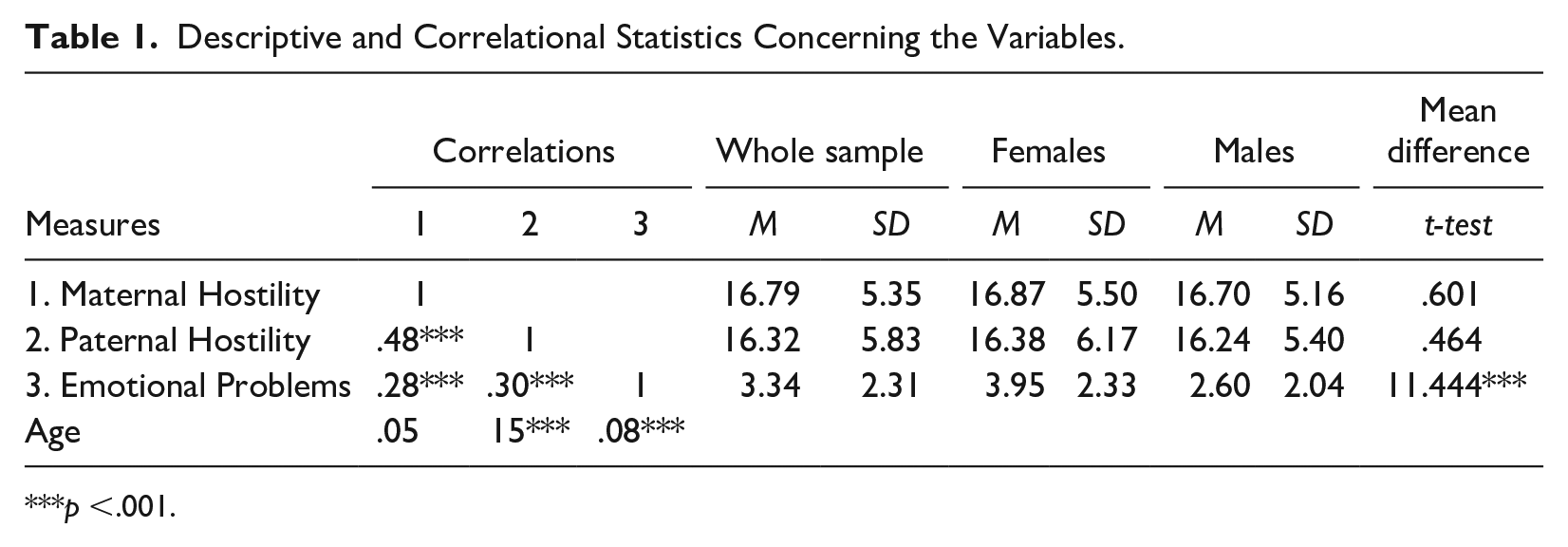
Table 1 in Appendix A displayed means, standard deviations, and correlations between the investigated variables. The comparisons according to gender and age were also presented. Both maternal hostility and paternal hostility were associated significantly and positively with emotional problems (r = .28, p < .001; r = .30, p < .001, respectively). There was also a positive and significant relationship between maternal hostility and paternal hostility (r = .48, p < .001). Paternal hostility and emotional problems were associated positively with adolescents’ age (r = .15, p <.001; r = .08, p < .001, respectively). Maternal hostility was not associated with age (r = .05, p > .05). There were no differences between females and males in maternal hostility and paternal hostility (t = .601, p >.05; t = 464, p > .05, respectively). However, girls significantly reported higher levels of emotional problems than boys (t = 11.444, p < .001).
The Moderated-Moderation Model
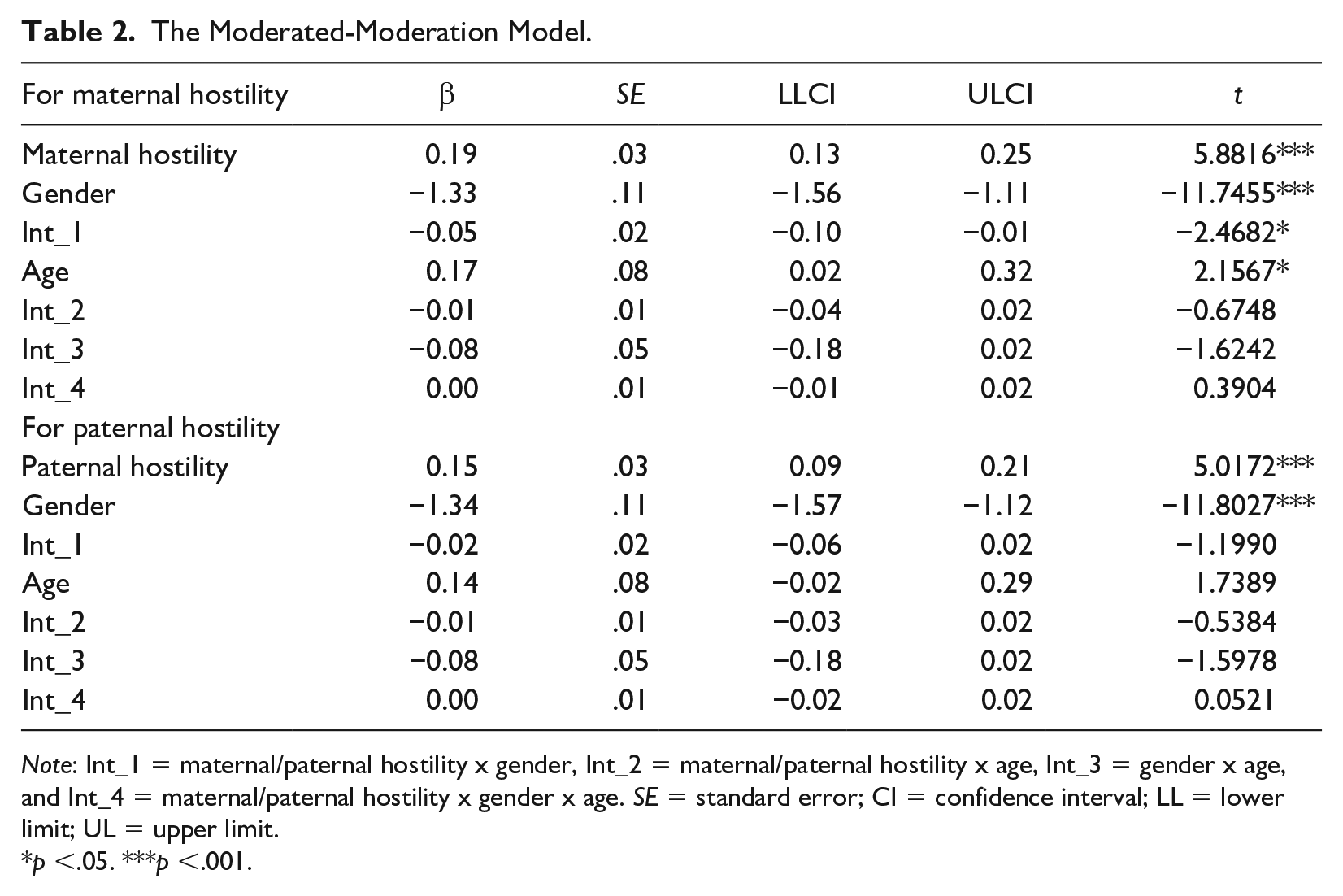
First, the findings indicated that both maternal (β = .19, p < .001) and paternal hostility (β = .15, p < .001) positively predicted emotional problems regardless of gender and age. Second, gender as moderator was included in the model, the interaction of maternal hostility and gender was significant (t = −2.4933, p <.05), meaning that the predictive effect of maternal hostility on emotional problems among girls was stronger than boys (β = .14, p < .001; β = .08, p < .001, respectively; according to Macro Model 1). The interaction of paternal hostility and gender was not significant (t = −1.2339, p >.05), meaning that the predictive effect of paternal hostility on emotional problems did not vary in girls and boys. Third, the positive relationship between maternal and paternal hostility and emotional problems did not significantly differ by the age of adolescents (t = −1.0050, p > .05; t = −.5746, p > .05, respectively). Finally, the moderated-moderation model of the relationship between both maternal and paternal hostility and emotional problems in gender and age context was not significant (t = .6915, p > .05; t = −.0075, p >.05, respectively). Overall, the stronger positive relationship between maternal hostility and emotional problems among girls did not vary according to adolescents’ age, while the predictive effect of paternal hostility on emotional problems did not differ in adolescents’ gender and age (see Table 2 in Appendix B and Figure 1 in Appendix C).
Discussion
In this research, we aimed to examine the predictive effect of parental hostility on adolescents’ emotional problems from early to late adolescence in the gender context. We found evidence that maternal and paternal hostility were linked to adolescents’ emotional problems regardless of gender and age. The present findings uncovered the key role that both mothers’ and fathers’ hostile practices may play in adolescents’ emotional problems.
Our basic finding was congruent with propositions from several theoretical perspectives. The first of these is interpersonal acceptance and rejection theory (IPARTheory). According to IPARTheory, the human being has the phylogenetically acquired need for positive responses or acceptance from people most important to them, when this need is not met, people tend to have emotionally maladaptive responses (Rohner, 1980). Parents are still one of the most important sources of this need for their children in adolescence period (Mattanah et al., 2011). Meeting this need is also an indication that adolescents have developed a secure emotional attachment with their parents. The security of attachment to parents could provide an important emotional resource against emotional problems (Papini & Roggman, 1992). Parental hostility is a risk for developing a secure attachment to parents (the attachment theory, Bowlby, 1969). Accordingly, increases in parental hostility can reduce adolescents’ feelings of safety, thus increasing the risk of emotional problems. Armsden and Greenberg (1987) suggested that sadness, depression, anxiety, and anger might be produced by the threatened or actual loss of attachment relationships or by unpredictable and unresponsive attachment relationships. Social learning theory can also contribute to the logical process underlying this relationship. Social learning theory suggests that parents model maladaptive emotional reactions for their children by behaving in rejecting and hostile ways toward them and others (Bandura & Walters, 1977). The present findings confirmed previous studies that consistently suggested that maternal and paternal hostility predicted adolescents’ emotional problems. For example, a meta-analysis study with 35 studies from 16 countries found that both maternal and paternal hostility were associated significantly with psychological maladjustments, including emotional unresponsiveness, hostility/aggression, emotional instability, negative self-esteem, dependence or defensive independence, negative self-adequacy, and negative worldview (Khaleque, 2017).
Based on previous findings, we expected that mothers’ hostile practices compared with fathers would have a greater effect on girls than boys in younger adolescents. The findings supported our predictions except for the moderator role of adolescent age. Girl adolescents exposed to maternal hostility reported more emotional problems than boy adolescents exposed to maternal hostility. This conclusion may be linked to the relational context. Namely, girls, compared with boys, are socialized to be more relationship-oriented (Leaper, 2002), adolescents, especially daughters, are emotionally closer to their mothers (McHale et al., 2003), and girls are more attuned to family relationships and tend to be more harmony-maintenance, closeness, and appeasement compared with boys (Davies & Lindsay, 2004). Accordingly, being exposed to maternal hostility, especially for girls, appears a consequence that does not comply with our gender socialization codes (Harris & Morgan, 1991). Therefore, girls compared with boys may have greater maladaptive emotional responses to maternal hostility rather than paternal hostility. The present finding was congruent with gender socialization theories that speculated that mothers had a stronger influence on their daughters than their sons in teaching sex-typed behaviors context (Harris & Morgan, 1991). Conversely, boys compared with girls are more assertive in relationships (Rosenfield et al., 2000). This way that boy adolescents handle their relations may buffer the maladaptive effects of parental hostility on their emotional well-being. Recent evidence in the literature has demonstrated that parental hostility is associated with more emotional problems, especially in girls. For example, a meta-analytic study indicated that the adverse effects of conflict and hostility in parent–adolescent relationships on adolescent development were stronger in girls than boys (Weymouth et al., 2016).
The findings suggested that the maladaptive effects of mothers’ and fathers’ hostile behaviors were similar for adolescent girls and boys across adolescence, supporting the fact that even as adolescents mature, parents still have an important and significant influence on adolescent development (Armsden & Greenberg, 1987). The current result was consistent with the IPARTheory, which speculated that gender and age did not influence the relationship between children’s perception of rejection by their parents and their psychological maladjustment (Khaleque & Rohner, 2002). Conversely, the current finding was not consistent with previous research indicating that the hostile behaviors of both parents on adolescent psychological adjustment and emotional well-being differed according to adolescent gender and age (Hale et al., 2005; Ramírez-Uclés et al., 2018). We here hoped that younger girl adolescents might emotionally be more vulnerable to parental hostility because of both early adolescents’ experiences, including pubertal changes, poorer emotion regulation skills, and reduced access to alternative support figures (Silvers, 2022; Steinberg & Morris, 2001), and girls’ greater vulnerability to emotional problems and sensitivity to negative interpersonal interactions in comparison with boys (Davies & Lindsay, 2004; Harris & Morgan, 1991). This result in contrast to our expectation can be evaluated from two aspects. On one hand, early adolescents and younger female adolescents may be having psycho-social gains that can overcome parental hostility and the vulnerability brought by the period. For example, one of these may be social relationship satisfaction. Early adolescents, in comparison with later adolescents, generate distinct peer groups, interact with a wider range of peers, and spend more time with them (Csikszentmihalyi & Larson, 1984; Fuligni & Eccles, 1993). For early adolescents, establishing satisfying relations with peers may promote their emotional well-being, which in turn may help decrease the negative influence of parental hostility. Consistent with this explanation, a study indicated that adolescents high on peer but low on parent attachment were better adjusted than those high on parents but low on peer attachment (Laible et al., 2000). Furthermore, a meta-analysis study demonstrated that females were significantly more attached to their peers than males (Gorrese & Ruggieri, 2012). On the other hand, the expected disadvantage for younger adolescents can be balanced due to increased maladaptive experiences outside their parents as adolescents maturate, such as personal adjustment difficulty, peer and romantic partner relation problems, and pressure on identity formation and academic achievement (e.g., like Turkey where parents are typically highly invested in their children’s educational success (Steinberg & Morris, 2001). As a result, given that there are several factors that are thought to influence age and gender described above in tandem with the relation between parental hostility and adolescent emotional well-being, this relationship context merits further research.
Limitations of the Present Study
As with all studies, this study has some limitations. This study, which was based on a single measurement in only one group, was cross-sectional and descriptive. Therefore, it is not significant that we make any directional or causal implications about the findings among the investigated variables. However, it was likely that a transactional process also existed between parental hostility and adolescent emotional well-being that was not explored in this research (Sameroff, 2009). We also need to be cautious about generalizing the findings. Our sample comprised Turkish parents and their adolescent children cohabiting in Turkey. These findings may not be generalizable to other familial (e.g., single-parent families), cultural (e.g., Western culture), and developmental groups (e.g., children under 11 age or emerging adults). More studies are needed to understand the developmental and transactional effects of parental hostility on adolescent emotional problems as well as how the findings might differ in different populations. This study brought together only gender with age to test the moderator effect in the predictive role of parental hostility in adolescents’ emotional well-being. Limited demographic variables make it difficult to draw comprehensive conclusions. To reach overall results, future studies are needed to understand the trajectory of parental hostility and the variables that predict it and moderate the relationship between it and adolescent emotional problems. The study investigated effects separately for mothers and fathers but did not focus on statistical differences in effects by parental gender. Changes in maternal and paternal hostility might affect adolescents’ emotional well-being via several mechanisms, such as self-esteem, and emotion regulation. This study did not consider these mechanisms. Future studies may fill these gaps.
Implications for Practice
Higher both maternal and paternal hostility was linked to more emotional problems for adolescents. Our findings suggest that linear differences in maternal and paternal hostility across adolescence have similar implications for adolescent emotional well-being depending on adolescent gender and age. Maternal hostility was particularly relevant for adolescent emotional problems, especially among girls, regardless of age. It would seem that knowing that gender and age did not moderate the negative emotional outcomes for adolescents would not only help with targeting services and supports but also suggested that services and supports for families (both parents and adolescents) should be available across adolescence rather than specific period-targeted, such as early adolescence.
Like motherhood, fatherhood is an important aspect of adolescent development (Shulman & Seiffge-Krenke, 1997 ). Because the time spent by fathers with their children has increased over the past half-century, the literature has recommended that studies should independently examine maternal and paternal influences on female and male adolescents (McKinney & Renk, 2008; Phares et al., 2009; Ramírez-Uclés et al., 2018). The current study has documented the role that fathers play in adolescents’ emotional well-being throughout adolescence, as much as mothers do, emphasizing the importance of including fathers in parenting interventions. In contrast, the majority of parenting interventions focus on mothers than fathers (Alfredsson et al., 2018; Panter-Brick et al., 2014). Understanding both mothers’ and fathers’ hostile behaviors did not differ for girl and boy adolescents is crucial to developing preventive and interventive attempts that yield positive outcomes for both parents across adolescence. Empirical evidence has generally shown that the goals of interventions are more likely to be maintained in the long term when both parents participate (Panter-Brick et al., 2014). In addition, not including both parents in parenting intervention efforts would not only reduce the productivity of the intervention but also unnecessarily waste resources.
Adolescents feel much better emotionally when they can rely on their parents. Parents’ hostile behaviors threaten trust formation (McElhaney et al., 2009). Conflicts in the parent-adolescent relationship are normative, and adolescents feel secure in their relationship with their parents despite conflict. In response to the developmental needs of adolescents, the more emotional variability between parent and adolescent dyads during conflict interactions leads to them reorganizing their relations and adapting effectively (Branje, 2018). However, parents’ hostile approaches both damage adolescents’ emotional well-being and predispose them to unhealthy move toward early adulthood (Kavanaugh et al., 2018; Weymouth et al., 2016). Adolescents exposed to parental hostility can also struggle to find support. School mental health professionals and social work experts can identify those exposed to parental hostility without ignoring adolescents of all age groups and establish the needed intervention services for both parents and adolescents, based on individual or group-focused.
Most parenting interventions target high-risk youth. The current findings could yield opportunities for preventive attempts before the hostile practices of parents toward adolescents escalate to risky levels for emotional well-being. The findings suggest that there is a need to encourage both mothers and fathers to be more involved in the positive interactions in their children’s lives for greater emotional well-being rather than acting primarily as hostile parental figures. One potential suggestion is that mental health professionals should take into consideration how adolescent clients with emotional problems perceive their mothers’ and fathers’ parenting practices, maternal parenting for girls in particular.
Footnotes
Appendix A
Descriptive and Correlational Statistics Concerning the Variables.
| Measures | Correlations | Whole sample | Females | Males | Mean difference | |||||
|---|---|---|---|---|---|---|---|---|---|---|
| 1 | 2 | 3 | M | SD | M | SD | M | SD | t-test | |
| 1. Maternal Hostility | 1 | 16.79 | 5.35 | 16.87 | 5.50 | 16.70 | 5.16 | .601 | ||
| 2. Paternal Hostility | .48*** | 1 | 16.32 | 5.83 | 16.38 | 6.17 | 16.24 | 5.40 | .464 | |
| 3. Emotional Problems | .28*** | .30*** | 1 | 3.34 | 2.31 | 3.95 | 2.33 | 2.60 | 2.04 | 11.444*** |
| Age | .05 | 15*** | .08*** | |||||||
***p <.001.
Appendix B
The Moderated-Moderation Model.
| For maternal hostility | β | SE | LLCI | ULCI | t |
|---|---|---|---|---|---|
| Maternal hostility | 0.19 | .03 | 0.13 | 0.25 | 5.8816*** |
| Gender | −1.33 | .11 | −1.56 | −1.11 | −11.7455*** |
| Int_1 | −0.05 | .02 | −0.10 | −0.01 | −2.4682* |
| Age | 0.17 | .08 | 0.02 | 0.32 | 2.1567* |
| Int_2 | −0.01 | .01 | −0.04 | 0.02 | −0.6748 |
| Int_3 | −0.08 | .05 | −0.18 | 0.02 | −1.6242 |
| Int_4 | 0.00 | .01 | −0.01 | 0.02 | 0.3904 |
| For paternal hostility | |||||
| Paternal hostility | 0.15 | .03 | 0.09 | 0.21 | 5.0172*** |
| Gender | −1.34 | .11 | −1.57 | −1.12 | −11.8027*** |
| Int_1 | −0.02 | .02 | −0.06 | 0.02 | −1.1990 |
| Age | 0.14 | .08 | −0.02 | 0.29 | 1.7389 |
| Int_2 | −0.01 | .01 | −0.03 | 0.02 | −0.5384 |
| Int_3 | −0.08 | .05 | −0.18 | 0.02 | −1.5978 |
| Int_4 | 0.00 | .01 | −0.02 | 0.02 | 0.0521 |
Note: Int_1 = maternal/paternal hostility x gender, Int_2 = maternal/paternal hostility x age, Int_3 = gender x age, and Int_4 = maternal/paternal hostility x gender x age. SE = standard error; CI = confidence interval; LL = lower limit; UL = upper limit.
p <.05. ***p <.001.
Appendix C
Declaration of Conflicting Interests
The author(s) declared no potential conflicts of interest with respect to the research, authorship, and/or publication of this article.
Funding
The author(s) received no financial support for the research, authorship, and/or publication of this article.
