







Abstract
Although street-based prostitution is a rapidly growing social phenomenon in Ethiopian cities, there is little scholarly attention given to address the issue. This qualitative study aimed to understand the lived experiences of women who attempted to exit street prostitution in Gondar city. Thirteen study participants were chosen using the snowball sampling technique. In-depth interviews were used to gather qualitative data, which were then analyzed thematically. The study revealed formal support services, family support, spirituality, and saving money as important factors leading women to successfully exit from prostitution. However, some participants reported that structural problems, drug addiction, and societal attitudes led them to return to street prostitution. This study suggests that to help women successfully leave prostitution, interventions for exiting strategies should focus on economic strengthening activities as well as rehabilitation services including substance abuse treatment.
Prostitution is the practice of individuals engaging in sexual activities for payment (Harcourt & Donovan, 2005; Moen, 2014). Although prostitution has many forms and social settings, street-based prostitution is widespread in developing countries (Harcourt & Donovan, 2005). In street prostitution, a female prostitute solicits customers to earn money from public settings such as streets, street corners, and bar yards. Initial transactions in street prostitution occur in public settings, while sex acts happen in hotels, cars, pensions, or customers’ private homes (Dalla, 2006; Monroe, 2005; Rongsheng, 1997; Weitzer, 2009).
In Ethiopia, prostitution has been entrenched despite the nation’s ardent devotion to tradition, religion, and conservatism. Prostitution dates back to the middle ages when the Ethiopian imperial regime established its capital in Gondar City in 1636 (Pankhurst, 1974). The founding of the city of Gondar as the capital of the Ethiopian realm gave a way to a more permanent settlement. The beginning of sex work was particularly linked to the establishment of military camps around the royal palaces in the city, which attracted a large number of women dancers and courtesans from the various provinces of the country (Pankhurst, 1974). The growth of military settlements in the new capital increased the opportunities for women to engage in prostitution. The late 19th and early 20th centuries saw a significant increase in modern-style prostitution after Addis Ababa was established as the new capital in 1886. Prostitution experienced exponential growth during and after the Italian occupation of Ethiopia from 1936 to 1941 (Pankhurst, 1974). Currently, prostitution is growing in both urban and rural areas of the country because of urbanization, extreme poverty, a lack of employment options, family conflicts, and the death of parents (Tekola, 2017).
Prostitution is not legally recognized in Ethiopia. According to Articles 634–638 of the 2005 criminal code of the Federal Democratic Republic of Ethiopia, the trafficking of women and minors for sexual purposes and regularly exploiting people for financial gain and similar activities is unlawful. Despite this legal prohibition, women who engage in prostitution either on a regular or sporadic basis exchange sexual services for money at bars, clubs, neighborhood drink shops, Khat and Shisha houses, on streets, in and around military and refugee camps, construction sites, trade routes, redlight districts, and at their residences (Ethiopian Ministry of Health, 2011).
Evidence shows that when individuals first enter prostitution, they see it as a means to cope with financial difficulties (Williamson & Folaron, 2003). Street prostitution is associated with violence, poverty, trauma, health, and psychological effects related to depression and suicide (Burnette et al., 2008; Cimino, 2019; Raphael & Shapiro, 2004; Seib et al., 2009). Exit from prostitution is advocated as a crucial step in reducing risks faced by women who are involved in this business.
Exiting prostitution, whereby steps are taken to disengage individuals from prostitution, is a complex process. Women often encounter multidimensional and complex difficulties when they intend to exit and resume prostitution. Scholars categorize these difficulties into four major barriers: personal, interpersonal, structural, and societal barriers (Baker et al., 2010; Menezes, 2019; Williamson & Folaron, 2003). The Integrated Model for exiting street-level prostitution developed by Baker et al. (2010) also classified barriers to exiting prostitution into four. The first includes individual factors related to self-destructive behavior and substance abuse, mental health problems, effects of trauma from adverse childhood, psychological injury from violence, self-esteem, guilt, physical health problems, and a lack of knowledge of services. The second barrier includes relational factors, such as limited formal and informal support, strained family relations, drug dealers, and social isolation. The third barrier is concerned with structural factors, such as restricted employment options, lack of job skills, and the lack of basic needs such as housing, education, criminal records, and inadequate services. Fourth, societal factors are related to stigma and discrimination in communities (Menezes, 2019; Williamson & Folaron, 2003). This comprehensive theory points out that a woman may act on her own personal desire to exit prostitution, or may be forced by others, such as families, criminal justice systems, and children’s services, to start planning the exit. The availability of formal and informal support resources play crucial roles in facilitating the exiting process and making individuals re-enter street-level prostitution (Baker et al., 2010).
A stable financially supportive relationship, assistance in starting a business, obtaining a bank loan, and finding a friend or relative to help with expenses are all crucial factors that might make leaving prostitution easier (Menezes, 2019). According to Mazeingia and Negesse (2020), women can successfully exit prostitution when they obtain financial support to run small private businesses to meet their basic needs. Success often hinges on sustained access, comprehensive support, and resources (Sanders, 2007). Women must also have a desire to change (Mànsson & Hedin, 1999); in other words, they must plan to stop becoming prostitutes. However, some empirical evidence shows that the final exit of a woman from prostitution cannot be guaranteed. Baker et al. (2010) argue that women’s re-entry into street-based prostitution is always possible, despite their attainment of legal employment, safe residence, or length of time away from streets. Baker et al. (2010) further described life challenges associated with the successful final exit of women returning to prostitution. Menezes (2019) claimed that interventions to help women leave prostitution mostly focused on law enforcement and protection, with little focus on the welfare and development of women who are exiting.
Prostitution in Ethiopia, as in other countries, is not accepted by society as a legitimate occupation. Rather, it is viewed as morally reprehensible. Stigma and discrimination against women in prostitution dehumanize their psychosocial well-being (Mazeingia & Negesse, 2020). The dehumanizing nature of the sex trade, combined with the associated violence, disempowerment, and reproductive health risks, strongly suggests that selling sex is inherently harmful. In Ethiopia, several factors influence sex workers’ attempt to exit prostitution. Mazeingia and Negesse (2020) found that individual barriers (e.g., lack of skills, poor educational status, and substance abuse), financial barriers (e.g., poor savings), and psychosocial barriers (e.g., stigma and discrimination) affect women’s decisions to exit, and return to, prostitution.
Existing studies on women engaged in prostitution in Ethiopia primarily focus on HIV prevention and pregnancy experiences (Yam et al., 2008; Yimer, 2022), the prevalence and predictors of violence (Alemayehu et al., 2015), entry factors and risks of sex work (Picock et al., 2023), and, to a lesser extent, exiting prostitution (Mazeingia & Negesse, 2020). There is little empirical evidence regarding the exit experiences of women in prostitution in Ethiopia in general, and in Gondar in particular. This qualitative study aimed to understand the lived experiences of women who attempted to exit prostitution in Gondar. Using a qualitative approach, the following research questions were asked to guide the inquiry process:
Method
Study Site
Gondar city is located in northwestern Ethiopia and is known for its iconic fortress and palaces, once the seat of Ethiopian emperors. The establishment of the historical city in 1636 signaled the end of the medieval tradition of roving capitals in Ethiopia. For nearly three centuries, Gondar has served as the political, commercial, and cultural center of the nation (Samuel, 2023). Prostitution was practiced and prevalent in the vicinity of royal palaces, commercial centers, and military camps in the capital Gondar (Pankhurst, 1974). Nowadays, prostitution is widespread in the historic city of Gondar, taking many different forms—from indoors to the streets. This is the reason this study aimed to explore street-level prostitution in Gondar.
Research Design
Qualitative research was chosen because there is little knowledge regarding women’s exiting or returning to prostitution in Gondar, Ethiopia, from their perspective. Qualitative research allows researchers to explore and understand the lived experiences of individuals regarding an understudied phenomenon (Creswell & Creswell, 2018; Padgett, 2017). Qualitative research is a reasonable approach when a researcher pursues a topic of sensitivity, such as sex work (Padgett, 2017).
In this qualitative research, we acknowledge our position as male social work researchers. Considering the impact of researchers’ identity, prior experiences, and assumptions on the trustworthiness of qualitative research, we located our positions on the topic under study, the experiences of study participants, research contexts, and processes (Holmes, 2020; Parahoo, 2006). Disclosing positionality, pursuing a reflexive approach in interactions with study participants, data collection, and interpretation throughout this study enhanced the rigor and trustworthiness of the findings.
Sampling and Study Participants
In this qualitative study, snowball sampling was used to select participants with lived experiences of exiting and re-entering street-based prostitution. Neuman (2007) argued that snowball sampling is an especially useful strategy when a researcher wishes to study a stigmatized group or behavior. Besides, snowball sampling is helpful when finding the target group may be difficult (Kogan et al., 2011). This sampling strategy allowed us to recruit a chain of potential participants through a referral system. Participants in the study were recruited based on three eligibility criteria: women being at least 18 years old, having had successfully exited street prostitution for 1 year, and having returned to street prostitution after the initial exit. In this snowball sampling procedure, the first author gained access to the initial participants with the help of a gatekeeper who worked at a nongovernmental organization with a special program for commercial sex workers.
An effective sample size in qualitative research is determined by whether the data can explain the phenomenon under study in detail; that is, data saturation affects the sample size (Hennink & Kaiser, 2022). Based on this principle, data saturation was achieved in the qualitative study after 13 interviews. Hennink and Kaiser (2022) argued that qualitative research often reached data saturation between the 9th and 17th interviews. This implies that, on average, saturation is reached in the 13th interview.
Data Collection
In-depth interviews were conducted with a sample of 13 individuals who volunteered to participate and provided informed consent. In qualitative research, the optimum method for data collection is one-on-one interviews (van Teijlingen & Ireland, 2003). The interviews were conducted to elicit women’s stories regarding the exiting and re-entering of prostitution. The first author conducted in-depth interviews with each participant between April and June 2022. Nine participants were interviewed at their home because they preferred and felt comfortable there, whereas four participants chose public park as their preferred interview location. The duration of the interviews ranged from 45 min to 1 hr and 6 min, and each interview was tape-recorded. The first author took field notes for each participant. An interview guide was used to elicit relevant information. Significantly, the qualitative data collected through interviews provided us with a vivid picture of each interviewee’s experience, which in turn helped us understand the shared meaning.
Data Analysis
The interviews were transcribed and analyzed for recurrent themes using thematic analysis, which is an appropriate method for understanding participants’ experiences, thoughts, or behaviors across a dataset (Kiger & Varpio, 2020). While the analysis was concurrent with data collection in qualitative research, the analysis of interview transcripts was based on Saldana’s (2013) qualitative data analysis process. We transcribed the taped interviews and field notes as they proceeded with the analysis. This initial process helped us familiarize ourselves with the data. Next, we entered the transcripts into first cycle coding and followed the process with the second cycle (pattern) coding. The coding, recoding, categorizing, and re-categorizing of themes were performed continuously throughout the inquiry until the main themes appeared. The authors independently reviewed the transcripts to maintain the credibility of the data analysis. The two authors compared the codes and major categories of the transcripts and reached a final agreement after discussing minor differences in coding and categorization. The authors created common themes by merging similar statements from each category. Next, the major themes were integrated into a description of the experience (Saldana, 2013). Finally, two major themes emerged from the analysis of the transcripts that mirrored the typical exiting and re-entry experiences of women engaged in street-based prostitution. The two major themes were (a) reasons for women to exit prostitution and (b) factors leading to their re-entry.
Ethical Considerations
Ethical principles of confidentiality and anonymity were ensured by informing the study participants that their identities would not be revealed and pseudonyms would be used. All participants were informed about the purpose of the study, and the first author adequately explained to them that they had the right to choose whether to participate in the study and to withdraw at any time. These pieces of information are provided to the participants and their informed consent was obtained before the initiation of the study. Ethical approval was obtained before the fieldwork.
Results
Background Information of Study Participants
Thirteen participants ranged in age from 20 to 24 years. Five participants dropped out from Grade 5, four from Grade 4, two from Grade 7, one from Grade 9, and one from Grade 3. The years the participants spent in sex work varied from 2 to 5 years. Table 1 shows the details of the participants.
Sociodemographic Profiles of Study Participants.
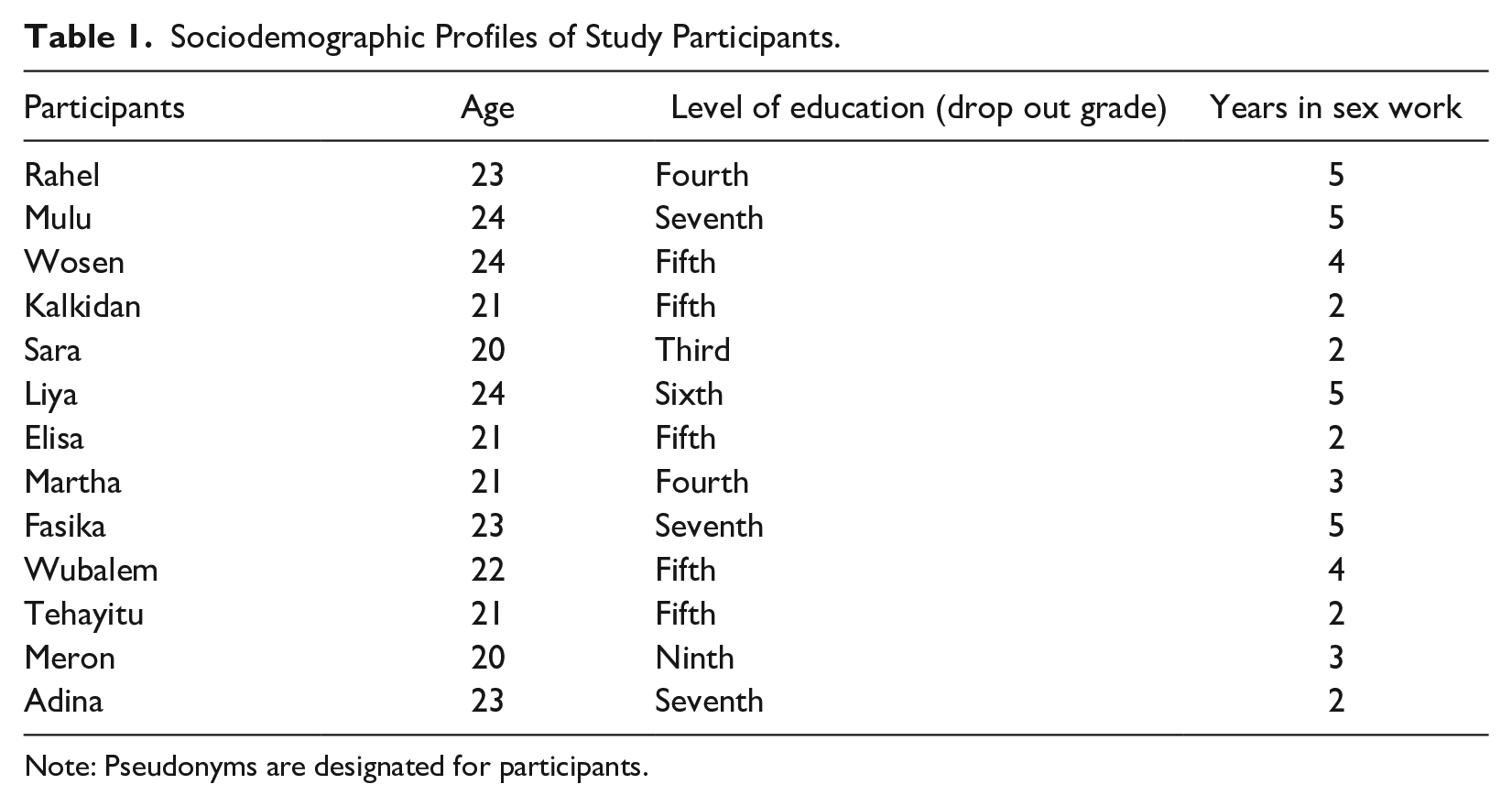
Note: Pseudonyms are designated for participants.
Themes
In the following sections, two major themes that were most influential in shaping young women’s experiences of exiting and re-entering street-level prostitution are described.
Theme 1: Reasons for Exiting Prostitution
The participants were asked to list the factors that motivated their decision to exit prostitution. Four subthemes emerged as significant. First, the participants mentioned formal support services provided by nongovernment organizations through counseling, life-skills training, and job-skills training. The second theme is related to informal support from family and kinship. The third factor is related to the spiritual factor behind the participants’ decision to leave prostitution. The last theme is related to saving money.
Formal Support Service
Formal support services delivered by various organizations, such as life-skills training, counseling, job-skills training, and start-up capital, were critical in the initial exit stage of prostitution. Some participants reported that they received individual counseling and life-skills training through Mahibere Hiwot for Social Development, a nongovernment local organization. Liya observed: Two years ago, counselors from Mahibere Hiwot came in and saw us. At various points, she provided me with current information, education, and counseling regarding sexual health. I attended subsequent counseling sessions. In each session, I learned to think of myself. Eventually, I became motivated to leave sex work.
Liya’s story reflects the fact that counseling services gave her an opportunity to think for her and become aware of the risk of prostitution to reproductive health. This self-understanding gave her courage to exit prostitution. Similarly, Mulu described how counseling taught her to initiate the process of exiting prostitution as follows: Counseling and life-skills development are essential for escaping such risky life roles. Such things open a new door for thinking for me. When I was given proper support and counseling in a confidential and non-judgmental manner, I learned to feel hopeful and made the choice to change my role in life. You see, Mahibere Hiwot gave me job-skills training for a couple of weeks and connected me with a local microfinance organization, so I could get startup money. I utilized this opportunity to exit the prostitution and began my own business.
These narratives demonstrate that formal support services, including counseling, life-skills and job-skills training, and access to microfinance, are particularly crucial in triggering the initial phase of exiting prostitution.
Family/Kinship Support
Two participants who exited prostitution highlighted informal support from family and/or relatives as a significant motivator. Rahel revealed: My uncle advised me to discontinue this risky role. At times, he invited me to his home and told me to stop playing this role. It was like . . . feeling good, but I was indecisive. It was quite difficult to abruptly end my five-year role . . . . He gave me some money so that I could launch my traditional coffee. After a couple of days, I decided to leave and started working in a traditional coffee business. You see that my business is expanding, and I am happy with the course that my life is taking. My uncle helped me to adopt positive lifestyle. He frequently gave me business-related advice . . . . His care and advice inspired me to make extra effort into my business. I have no words to thank him.
Rahel’s narrative serves as an example of how informal support—both financial and emotional—plays a crucial role in the exit process. Informal support promotes not only women’s economic empowerment but also their psychosocial well-being.
Spirituality
Participants reported the role of spirituality in leaving prostitution. Fasika explained how her faith eventually became the primary motivator for quitting sex work: You know, I grew up in a strict Orthodox Christian family. My father and mother were religious people, who went to church every day. I grew up religiously and I went to church with my parents. . . . it was strange to enter prostitution . . . because my family was very poor. I started working as a prostitute when I was 19 to earn money. I used to attend church and sermons every Sunday. I was always praying; God guided me and gave me the strength to leave this sinful act. I feel like I am safe. My God is my strength and protection. I experienced spiritual healing.
Wosen also thought of her faith as a motivator for her to leave prostitution: I learned more that God loved me throughout the chaos around me. Why do I continue doing so? I wanted to get the right to God. I called on God to help me leave prostitution. I prayed to live a respectful life. My God listened to me and answered me. God was not ashamed of me. You know, it is God who gives me strength to make the choice . . . My faith gives me peace and purpose in my life.
Most importantly, a higher spiritual connection helped the participants find their inner strengths and understand the meaning and purpose of life.
Saving Money
One participant reported that she started doing sex work to make and save money, but after working there for a while, she stopped doing so. Elsa said, I started prostitution as I had no other options. You know, I had to survive. When I started it, I told myself that I needed to collect and save money over a couple of years and leave it. I felt that sex work is risky. I know that it is a lucrative business. Every day, I saved 40% of the money I earned from sex work. After three years, I quit and opened my business. The money I saved became useful for me.
This story illustrates how Elsa perceived the risks of sex work, even when she engaged in it as an instrument to save money. The savings earned from sex work incited the participants to quit permanently and start another business.
Theme 2: Factors Leading to Re-Entry
Some participants give explanation as to why they returned to prostitution after leaving it. Three subthemes emerged: structural factors, drug addiction, and societal factors (stigma and discrimination).
Structural Factors
The participants reported that reliable financial support is required for women to successfully exit prostitution. They mentioned their difficulty finding trustworthy economic activities that could support them in stabilizing their income and increasing their economic self-sufficiency. They returned to prostitution because of these structural problems. Fasika cited low income as a prominent reason for returning to prostitution. She said, “Yes, money is everything. . . . Because I did not make enough money in my new career to match what I made from sex work, I returned.” This shows that participants returned to sex work when they realized that the money they earned from the job was not equivalent to the money they earned through sex work. Sex workers re-enter the prostitution industry because they do not have enough money for housing rentals or other living expenses. Kalkidan said; The money was insufficient to cover my living costs. To obtain affordable housing was a challenge for me. Right after I quit sex work, I applied for Kebele (public) houses, as they have low rental prices. Unfortunately, I have not heard this back. I was worried, like I would become homeless if I did not pay housing rent. Faced with this challenge, I could not continue living like this. I returned to my former roles in life and sex work.
This story demonstrates how the absence of cheap housing forces participants to resume sex work. This has implications for social service programs in creating a well-organized strategy for producing successful exits to maintain stability in women’s life styles after they quit prostitution.
Drug Addiction
Few participants highlighted drug addiction as an impetus to return to sex work. They reported that they experienced drug-addiction problems during sex work. Tehayitu revealed; I became an active drug addict once I began sex work. You know, prostitution and drug use go hand-in-hand. It’s hard to sleep with many men on various days unless you use drugs. Fortunately, I left sex work through Mahibere Hiwot organization. It gave me counseling for a few days during the initial exit period. I also received job-skills training and was paid a small amount each day during the training . . . Yet, there was no follow-up counseling. Things gradually started to go against my expectations . . . Within a couple of weeks, I began using drugs again and turned to sex work.
Successful exit from prostitution depends on women’s ability to legally earn a living income and continuously provide psychosocial treatment for drug addiction. If these women do not receive frequent psychosocial counseling, they are likely to relapse and return to sex work for drug money. The story of Kalkidan shows this: I am addicted. You know, I was frequently on drugs to handle the inhuman working situation to apparently protect my inner self . . . It’s our coping strategy to maintain our self-esteem . . . like most us do in prostitution. I had no one to help me quit my addiction. Drug use is a deep-rooted problem for prostitutes. There is no rehabilitation center or lasting treatment to permanently exit this risky life role. I cannot leave on my own and I feel stuck in this lifestyle, as I have formerly failed exit attempts.
This story demonstrates how drug abuse motivates the participants to re-enter prostitution after they feel they are trapped in this dangerous lifestyle. An ongoing cycle of prostitution and addiction has been introduced. This suggests that to help people successfully leave prostitution, mental health and psychosocial support, such as counseling programs, are crucial for addressing psychological suffering, restoring self-esteem, and enhancing social functioning.
Societal Factors
In Ethiopia’s traditional society, engaging in a role that deviates from norms entails a social cost. The participants stated that they decided to return to prostitution because they experienced labeling and stigma. Wubalem said; Sadly, when I exited it . . . I felt unwelcomed by my community. I do not feel part of the community . . . everyone labeled you as ሸርሙጣ (the whore/ promiscuous), due to the nature of my chosen ex- career. You know, I thought I had sex just for money. I did not see this as promiscuity. That’s the reason; I volunteered to exit when Mahiber Hiowt contacted me. It was what I was doing for money . . . I wanted to live a normal life after exiting. But people avoided me. I felt that they negatively perceived me. Every day, I encountered disparaging and discriminatory remarks. I felt isolated. This disrespect pushed me to return to my former role.
The derogatory terms such as ሸርሙጣ (the whore) are used to label women who did sex work. High degree of stigma that is associated with their former role because of their violation of cultural norms has severely damaged these women’s self-esteem and self-confidence. Despite their strong desire to successfully exit prostitution, social stigma and labeling make them re-enter their prostitution careers. Meron described, However, this is not a matter of choice. You know that (sex work) has a risky role. This made me stop doing so. I thought I would have friendly relations in my neighborhood once I stopped doing sex work. That was it. I was done. However, my neighbors continue to perceive that I am selling sex. It was strange not to be invited to drink coffee—the social norm here (neighborhood). Despite stopping sex work, my relatives continued to view me as an outcast from the norm. I felt devalued . . . I was not invited to participate in family social events. I feel worthless when people gossip about me. I am tired of being discriminated against. I was too ashamed and uncomfortable to keep in touch with them. Therefore, I went back to prostitution. . . . Here, you have a similar identity; no one isolates you.
The experiences described by Wubalem and Meron show how social stigma and feelings of shame have a detrimental effect on the self-concept of women who once exited prostitution and drive them back into sex work. This suggests that prostitution related to social stigma has detrimental effects on the participants’ well-being. This has implications for both human rights and social justice.
Discussion
This study aimed to investigate the exit experiences of women attempting to leave street-based prostitution. This study focused on identifying the factors that facilitated the exit process and prompted women to return to street-level prostitution. Based on these two factors, qualitative information was gathered from 13 women who had attempted to exit prostitution. Despite its rapid expansion in Ethiopian cities, research on street-based prostitution is rare. This study has two benefits. First, the findings provide a foundation for new lines of inquiry into groups of similarly vulnerable females. Second, it provides a comparative understanding of the important situations of women who successfully exited prostitution and those who returned to it.
Two major themes emerged from the data analysis. Reasons for leaving prostitution were the first major theme, which further consisted of four subthemes (formal support services, family/kinship support, Spirituality, money saving). Participants in this study reported the relevance of formal support services in making decisions and facilitating their exit from prostitution. To confirm this finding, existing literature highlights the importance of formal support in increasing women’s ability to leave prostitution (Baker et al., 2010; Cimino, 2019). Arranging of formal services such as drug treatment, job-skills training, and welfare support helps women organize their transitions and ensures their successful exit (Sanders, 2007). Some participants described family/kinship support as the major reason for their decision to quit prostitution. Similarly, Menezes (2019) and Dalla (2006) highlighted that informal support from significant others helps women leave prostitution.
However, a few participants reported the role of spirituality in their lives, helping them successfully leave the miserable job of prostitution. Hickle (2017) and Rand (2014) noted that spirituality was a factor that contributed to the exit process and helped sex workers survive during the period of sex work. Unexpectedly, one participant in the current study mentioned the importance of saving money from sex work to enhance her ability to successfully leave prostitution and start her own business.
The second major theme was factors leading to re-entry, which further comprised three subthemes (structural factors, drug addiction, and societal factors). As for structural factors, the participants claimed that after initially quitting prostitution, they returned because of the lack of money or other financial concerns. Consistent with this finding, previous studies have mentioned that financial reasons, the low levels of education (Mazeingia & Negesse, 2020; Menezes, 2019), and limited employment options (Baker et al., 2010) lead women to return to prostitution. Women who are engaged in prostitution encounter difficulties obtaining employment opportunities because of their low educational status. Poverty and financial pressures push women to re-enter prostitution. This suggests that the nation’s poor social welfare system and weak economic strengthening mechanisms have compelled women to switch to prostitution.
The participants also identified drug addiction as a compelling factor in returning to the risky role in life. Dalla (2006) and Hester and Westmarland (2004) highlighted that active substance abuse can result in women’s return to prostitution. This implies a need to provide continuous rehabilitation services and/or psychosocial support for women engaged in prostitution to successfully become socially functioning citizens. The last subtheme was related to societal factors. The participants reported that stigma and discrimination forced them to return to prostitution. The social perception of women engaged in prostitution profoundly affects their decisions to exit and return to prostitution (Baker et al., 2010; Butter & Erickson, 2003). This suggests that society views prostitution as a spoiled identity and deviant behavior compared with the conventional way of life. The result of this societal perception of women in prostitution is social isolation.
Implication for Practice
The study found that women cited a variety of reasons for exiting prostitution. First, formal services they received from nongovernmental organizations, such as life-skills training, start-up capital, job-skills training, and counseling services, helped women leave prostitution. These formal support services help women build their self-esteem and engage in income-generating activities, which foster their personal development and economic empowerment. This suggests that leveraging formal organizations to support women involved in prostitution helps them exit the industry more easily. Another finding showed that informal support such as family support is significant for women to leave prostitution. This suggests that to help women engaged in street prostitution leave their risky roles, they should be helped to foster developmental relationships within their family networks. The study also found that spirituality was a factor that contributed to women’s exit from street prostitution. This finding implies that social work practitioners and other helping professionals who assist women in prostitution should know the importance of women’s spiritual beliefs in influencing their decision not only to leave prostitution but also to overcome the traumatic experiences of prostitution.
Furthermore, this study identified the factors that led women who initially exit prostitution to re-enter it. Some participants claimed that structural factors, such as the lack of affordable housing and job skills and limited job opportunities, caused them to return to street prostitution. This implies that structural-level interventions are required to establish sufficient services to help women successfully leave prostitution and achieve economic independence. The study also revealed that some women resorted to prostitution to finance their drug addiction. This finding implies the need for rehabilitation services to help women who initially exited prostitution to cope with substance abuse problems. We found that women who re-enter prostitution were motivated to do so because of unfavorable societal perceptions. This implies that establishing intervention plans to help women leave prostitution and engage in continuous community awareness campaigns is crucial for their reintegration process.
Limitations
However, the results of this study should be interpreted with caution. This study was restricted to the exit and re-entry experiences of women in street-based prostitution. Because street-level prostitution is qualitatively different from other forms of prostitutions such as employment in bars, call women’s services, and massage parlors, the results of this study do not address the needs and experiences of women in these prostitution avenues. Further research on all women in prostitution is required to gain a better understanding of the strategies they use to quit. Furthermore, this study did not investigate the experiences of women who did not make first-exit efforts toward street-level prostitution. Accordingly, the possibility for further research on the experiences of women engaged in street-based prostitution remains open.
Footnotes
Disposition editor: Cristina Mogro-Wilson
Declaration of Conflicting Interests
The author(s) declared no potential conflicts of interest with respect to the research, authorship, and/or publication of this article.
Funding
The author(s) received no financial support for the research, authorship, and/or publication of this article.
Ethical Approval
The Ethical Review Board of College of Social Sciences and the Humanities, University of Gondar approved the study procedures.
