







Abstract
This study explored parental motivations to adopt and associations between motivations and family well-being. Multivariate OLS regression was used to examine responses from Young Adult Adoptee (n = 206; average 24 years old) and Adoptive Parent (n = 295) samples. When adoptees perceived that their parents were motivated by love for them, or helping a child in need, they reported higher levels of family functioning. Adoptive parents who endorsed the motivation that the child was already part of the family reported lower family functioning. While the motivation of loving the child was endorsed universally by both groups, the other motivations were less consistent. Open discussions about adoption, from the motivation to adopt through current family functioning, are important conversations for adoptive families.
Introduction
Adoption from foster care impacts a growing number of children and families in the United States. The most recent federal data show that between 60,000 and 67,000 children exited foster care through adoption in the United States each year between 2017 and 2021 (U.S. Department of Health and Human Services, Administration for Children and Families, Administration on Children, Youth and Families, Children’s Bureau, 2022). Once a child or youth exits foster care through adoption, most are eligible to receive adoption assistance (or adoption subsidy) through the age of majority. The cumulative number of children and youth receiving adoption assistance in the United States is approximately 500,000 each year. In Federal Fiscal Year [FFY] 2018, 488,875 children received adoption assistance, and this number rose to 547,685 in FFY 2022 (U.S. Department of Health and Human Services, Administration for Children and Families, Administration on Children, Youth and Families, Children’s Bureau, 2023).
The adoption assistance programs in the United States vary by state but generally offer financial support and access to mental health services (Child Welfare Information Gateway [CWIG], 2013). These programs acknowledge that challenges experienced within an adoptive family may result in diminished family well-being, a finding that is well-supported by research (Palacios et al., 2019; Reilly & Platz, 2003; Selwyn et al., 2014; White et al., 2021). Children who have been removed from their birth families, spent time in foster care, and are then adopted often face trauma, grief, and loss (Palacios et al., 2019; Selwyn et al., 2014). They need additional support to heal and to help ensure their well-being, and the well-being of their families. When unaddressed, challenging family dynamics may result in strained familial relationships, and in rare cases, foster care re-entry after the adoption has occurred. However, the source of strained familial relationships is often unclear. This study explores one possible source of familial strain, the impact of the adoptive parents’ motivation to adopt on adoptive family relations. This study explores how perceptions of parental motivations to adopt impacted adoptive family functioning. This is explored from the perspective of young adult adoptees and from the adoptive parents’ perspective. The motivation to adopt a child from foster care may come from a variety of internal and external sources. Extant research has explored these motivations but has not explored how these motivations impact adoptive family well-being during childhood. This study seeks to fill that gap. Based on the literature, we hypothesized that externally motivated reasons to adopt (e.g., wanting a sibling for a child) would result in lower ratings of adoptive family well-being and that more intrinsically motivated reasons (e.g., love for a particular child) would be associated with higher ratings of family well-being.
Literature Review
The motivations for an adult to initiate an adoption are complex. Conceptually, social relationships are organized around the intrinsic and extrinsic motivations that precede a decision to initiate the relationship (Fiske, 1991; Fiske & Haslam, 1996; Pinker, 2011; Testa & Poertner, 2010). Motivations around caregiving relationships are often theoretical and do not fully take into consideration the complex nature of human relationships that cannot easily fall into intrinsic or extrinsic motivations, such as doing things for “love” or for “money” (England et al., 2012), yet these are the categories that are often used to describe motivations. Intrinsic motivation refers to the internal drive or desire to embrace something because it is inherently interesting, enjoyable, or satisfying, and may come from a desire to help others. This type of motivation is self-driven and comes from within the individual, without any external rewards or pressures (Deci & Ryan, 1985). In the context of adoption, intrinsic motivation might be driven by personal values, beliefs, religious or spiritual motivations, or a genuine interest in a specific child. On the contrary, extrinsic motivation pertains to the external factors or rewards that drive an individual to do something. These can include tangible rewards (a weekly paycheck or other financial reward), social recognition, avoiding negative consequences, or the hope for reciprocity. In the adoption context, extrinsic motivation might be influenced by societal pressures, financial incentives, or other external rewards or punishments (R. M. Ryan & Deci, 2000).
In addition, people may be influenced by existing relationships, such as a sense of affinity or bond, family duty, a sense of calling, and exchange or rewards (N. Haslam, 1994; N. Haslam & Fiske, 1992). For example, an adult who feels love for a particular child may be willing to overlook difficult behaviors within their relationship and move forward with the adoption. On the contrary, children who feel that they are a commodity (i.e., believe that they were adopted because their caregiver receives a monthly stipend) may not feel the same relational bond. Recognizing that relationships shift over time and that different motivations may be at play at the time of adoption versus many years later when familial relationships are challenged (e.g., during the teen years), this study focuses on perceptions of adoption motivations at the time of adoption. While most of the extant literature focuses on the adoptive parent’s motivation to initiate an adoption, this study will explore parental motivations from both the perspectives of the adoptive parents and the young adult adoptees’ perspectives on their parents’ motivations to adopt.
Intrinsic Motivations
Intrinsic motivations to adopt can come from a variety of sources. In interviews with 200 caregivers who adopted a child through the child welfare system, AdoptUsKids (2007) found that the most common motivation for caregivers to adopt was to help a child in need, specifically one who was disadvantaged, had special needs, and/or had spent time in foster care. Another intrinsic motivation is a religious calling, or faith-based motivation. This “calling” to hospitality has served as a moral foundation undergirding the motivations of some adults to welcome foster and adopted children into their homes (Melton & Anderson, 2008). However, understanding how these motivations impacted adoptive family well-being was not explored.
Motivation to adopt may be rooted in a sense of familial obligation. For instance, a relative may adopt because they feel a sense of family duty, even though they may not have a particularly close relationship with the child. Testa et al. (2015) found that absent other motivations, or adequate financial assistance, an adoption motivated by this sense of obligation may be vulnerable to dissolution. Testa and Shook (2002) also explored this cultural aspect of family duty; they observed a stronger sense of duty among kinship care providers from Southern states and among those who frequently attended religious services. A sense of obligation may also impact the adoptive relationship from the child’s perspective. A child may feel anxiety about failing to live up to the expectations of an adoptive parent, and this may result in maladaptive behaviors such as self-mutilation, truancy, and other child behavior problems that can jeopardize the stability of the relationship (A. E. Schwartz et al., 2014). In families, a mix of motivations are often at play; a caregiver may be motivated by a blend of care or love for a specific child and motivated by external factors, such as societal role expectations of women and men in a family (England et al., 2012).
Extrinsic Motivations
Extrinsic motivations to adopt may be understood in terms of social exchange theory (SET). SET is a widely used conceptual framework that helps understand social interactions based on the exchange of resources. According to this theory, individuals engage in social interactions with the expectation of receiving rewards or benefits and minimizing costs or negative outcomes (Cropanzano & Mitchell, 2005). In the context of adoption, SET suggests that adoptive parents may enter the adoption process with an implicit or explicit expectation of receiving emotional fulfillment, a sense of purpose, and the opportunity to build a family (Byrd, 2006), or in anticipation of future payback, such as care when the caregiver has aged (England et al., 2012).
Financial Motivations
In adoptive families, extrinsic motivations can be understood as the balance between what is given within the parent–child relationship and what is received. Consider the balance between parental burden and the financial assistance parents receive through adoption assistance programs. Adoption assistance provides extrinsic support to adoptive families. The subsidies can be used to meet daily living expenses and privately pay for services if needed, for example, family counseling (Bramlett et al., 2017; CWIG, 2013; Mariscal et al., 2015). Studies have shown that nearly 90% of adoptions from foster care involve state or federal financial assistance, though the amount and type of subsidies vary by state (CWIG, 2013). Subsidies are a form of exchange, in that, a caregiver’s assessment of the adequacy of the subsidy can both directly and indirectly affect post adoption and guardianship instability (Testa et al., 2015). Adoptive parents who received subsidies they considered adequate experienced better post adoption outcomes and lower risk for post adoption instability (Hartinger-Saunders et al., 2015; Jones & LaLiberte, 2010; Mariscal et al., 2015; Testa et al., 2015). One study found that an adoptive parent may assess their caregiving burden as tolerable if they perceive that the adoption subsidy is adequate or may be less tolerate of the same burden if they feel the subsidy is inadequate (Testa et al., 2015). They also found that caregivers who reported that their subsidy was adequate reported fewer unmet needs. Similarly, caregivers who received medical insurance through adoption subsidies reported fewer unmet needs and fewer behavior problems (Liao & White, 2014).
Kinship Bonds as a Motivation
Adoption by relatives is a common occurrence; in FFY 2021, 34% of the children adopted through the U.S. Child Welfare system were adopted by relatives (U.S. Department of Health and Human Services, Administration for Children and Families, Administration on Children, Youth and Families, Children’s Bureau, 2022). Research on adoption by relatives has generally found a positive impact on post adoption stability, but results are mixed. For example, S. D. Ryan and colleagues (2010) found that kinship adoptive caregivers were more willing to adopt again and had higher satisfaction, but also slightly less positive family functioning, than nonrelative adoptive parents. One study of kinship versus nonkinship adoptive parents over age 59 concluded that kinship adoption was associated with poorer family functioning; the findings also indicated kinship caregivers may be more likely to adopt again (Hinterlong & Ryan, 2008). These findings need to be understood in conjunction with findings that kin adoptive parents may maintain closer ties to the child’s birth family long after the permanent placement is finalized (Koh & Testa, 2011; Testa, 2004), a feature that may provide additional benefits for children and their parents.
These contradictory findings are due, at least in part, to confounding characteristics, such as the age of the caregivers, and the closeness of the relationship between the child and caregiver prior to adoption (Hinterlong & Ryan, 2008; Testa et al., 2015), but may also be related to social reciprocity. Social reciprocity occurs when both parties in a relationship receive in-kind benefits (Testa & Shook, 2002; Titmuss, 1971). People are motivated by reciprocity when they get something emotional or socially valued in return for carrying out an act of beneficence. An example is a grandparent who receives emotional support from a child or the promise of future tangible support (someone to care for them as they age). Kinship relationships are inherently a mix of altruism and reciprocity and are vulnerable to dissolution if the “gift relationship” flows in only one direction (Testa & Shook, 2002).
Sibling Bonds as a Motivation
Malm et al. (2011) reported that 24% of adoptive parents in their sample adopted because the caregivers wanted a sibling for another child in the home. Adoptive parents may be motivated to adopt a sibling of a child they have already adopted, to adopt a sibling group to keep the biological siblings together, or motivated to adopt so that their other child (biological or adoptive) has a sibling. Research related to sibling adoption is mixed, reflecting the complicated nature of families and family formation. One study using a large population of adoptive and guardianship families found that when children were adopted with at least one of their siblings, they had 15% lower risk of postpermanency discontinuity compared to children adopted with no siblings or other sibling arrangements (Rolock & White, 2016). In other studies, postadoption adjustment challenges were observed, particularly if siblings were treated differently (Mariscal et al., 2015). Lower levels of family functioning were observed (Leung & Erich, 2002; Leung et al., 2005), and less nurturing attitudes toward parenting (Reilly & Platz, 2003) were also observed among families adopting siblings. Given these mixed results, these relationships are challenging to understand, and do not speak to the underlying motivations to adopt. Sibling adoption could be an indicator that the parent had an altruistic motivation for caring for their children, because the financial and caregiving burdens increase with more children, or an extrinsic motivation, such as a financial incentive or social pressure, could be contributing to their decision-making.
Family Well-Being
Family well-being is a broad topic that has been defined in multiple and complex ways. For example, Crowley and Kazdin (1998) discussed family well-being as a subjective measure that examines life satisfaction, how well one feels their important needs and desires are being met. Others have measured familial well-being in terms of levels of parental stress, family burden associated with caregiving, satisfaction in parent–child relationships, and levels of social support (Armstrong et al., 2005; Judge, 2003; Rueter et al., 2009). Adoptive family well-being is a subset of this literature and has been operationalized in various ways. Research has focused on unique aspects of adoptive family well-being, such as family communication around adoption-specific issues (Barbosa-Ducharne & Soares, 2016; Barroso & Barbosa-Ducharne, 2019; Murray et al., 2023) or parent–child compatibility (Grotevant et al., 2001). Other studies employ similar measures for adoptive and nonadoptive families, such as the level of parent–child conflict, levels of parental stress, or ratings of parent–child attachment (Judge, 2003; Rueter et al., 2009) For example, Rueter and colleagues (2009) found higher levels of parent–child conflict in adoptive families with adolescents than in their nonadoptive counterparts.
The protective factors survey (PFS) has been employed in research on adoptive family well-being as a proximal outcome for family well-being. When used with adoptive parents, the PFS has shown increases in both the Family Functioning or Resilience and Nurturing and Attachment subscales, on pretest to posttest scores in programs working with adoptive parents (Burke et al., 2018; Murray et al., 2023). To our knowledge, the PFS has not been used with adoptees to understand adoptive family functioning from their perspective.
Extant research has focused on how motivations may impact adoptive family relationships, but based on our review of the literature, there are no studies that examine how an adoptive parents’ motivations to initiate an adoption, or their child’s perception of their motivation to adopt, impact adoptive family well-being. This exploratory study seeks to understand these motivations and their impact on adoptive family well-being.
Current Study
The National Survey of Child and Adolescent Well-Being (NSCAW) is a nationally representative, longitudinal study of children involved in the U.S. child welfare system. The current study, the NSCAW Adoption Study, is a follow-up study to the original study (Ringeisen et al., 2022). The follow-up study selected NSCAW study participants who were adopted through the child welfare system and were over the age of 15 at the time of the survey. Adoptees and their parents were surveyed separately. The NSCAW Adoption Study examined the well-being of adoptees and their parents, asking similar questions of both respondents. This study examines parental motivations to adopt, from the perspective of the adoptees and their parents, and how parental motivations impact adoptive family well-being. Adoptive family well-being is measured through two of the PFS subscales, Family Functioning and Nurturing and Attachment (Counts et al., 2010). Adoptees were, on average, 24 years old at the time of the survey. We refer to that sample as the Young Adult Adoptee sample, and the parent sample as the Adoptive Parent sample.
Research Questions
This exploratory study seeks to understand the following three primary research questions. These questions will be explored through two distinct data sets, Young Adult Adoptee dataset and the Adoptive Parent sample. The project reached out to adoptees and adoptive parents in the same family, yet the number of families where both adoptees and their parents participated was too small to conduct multivariate analysis (n = 118). As such, we treat each respondent group separately, allowing us to explore the perspectives from both groups.
What motivates parents to adopt children in foster care?
Do the most endorsed motivations impact how Young Adult Adoptee and Adoptive Parents experienced Family Functioning during the adoptee’s childhood?
Do the most endorsed motivations impact how Young Adult Adoptees and Adoptive Parents experienced Nurturing and Attachment during the adoptee’s childhood?
Methods
Data and Participants
Over the course of an 8-month period (June 2021 through March 2022), the NSCAW Adoption Study adoptees and Adoptive Parents completed online or telephone surveys. This study provides a unique opportunity to hear from both adoptees and their parents about the adoption process. The NSCAW Adoption Study occurred 10 to 15 years after the adoption, when the adoptees were, on average, 24 years old (between 15 and 36 years old at the time of the survey).
The RTI International Institutional Review Board and the Office of Budget and Management (OMB) approved the study (OMB Control Number: 0970-0555). The study also received a federal Certificate of Confidentiality (authorized by the Public Health Service Act Section 301[d], 42 U.S.C Section 241 (d), 1988) which authorized the study team to protect the privacy of participants.
Eligibility for the NSCAW Adoption study was based on the following criteria. The adoptee: (1) Had a history of foster care placement (prior to adoption); (2) Achieved adoption status prior to the end of the original NSCAW studies, and (3) Were at least 15 years or older as of 4/1/2020. Eligible respondents where the adoptee or adoptive parent who, during the original NSCAW data collection, asked not to be recontacted for future research were excluded from the study. Adoptees with cognitive disabilities were also excluded from the study. The NSCAW Adoption study team identified a sample of eligible adoptees and conducted tracing and locating efforts to obtain current contact information for the adoptees and their adoptive parent. Those with valid contact information were offered an opportunity to complete either a web or telephone survey. A total of 803 young adult adoptees and 706 adoptive parents met the eligibility criteria and 206 young adult adoptees (26%) and 295 adoptive parents (42%) completed the survey.
As detailed in the technical report bivariate analysis of those who participated in the survey versus those who did not respond to the survey was conducted. This analysis was based on all eligible cases, where contact was attempted (Ringeisen et al., 2022). Using variables matched at the case level from the parent study (NSCAW I or II), this analysis examined differences between the two groups in terms of risk for post adoption instability and found the groups to be very similar. Of the 15 characteristics compared, only two showed a statistically significant difference: (1) adoptive parent age shortly after adoption and (2) maltreatment level of harm to child. Specifically, those who responded tended to involve adoptive parents who were younger at the time of their child’s adoption than the parents who did not respond to the survey (X2 = 9.60; p = .02). In addition, those who responded were described by caseworkers as more likely to have had moderate/severe harm associated with the child’s maltreatment report than nonresponders (X2 = 5.35; p = .01).
Measures
Motivations
Young adult adoptees were asked, “Thinking about why you were adopted, do you think that any of these reasons were part of your parent(s)’ decision to adopt you?” Nine motivations were listed as responses and respondents were asked to respond yes or no (yes = 1, no = 0) to each. For this study, a summary name developed by the study team is provided at the end of each response category in italics and is used in tables throughout this article:
My adoptive parent(s) loved me; Love the child
My adoptive parent(s) wanted to help a child in need of a permanent family; Help a child in need
I was already part of our family as a relative or foster child; Already part of the family (relative or foster child)
My adoptive parent(s) knew me before the adoption and wanted to help me; Knew the child and wanted to help
My adoptive parent(s) wanted to expand their family; Expand the family
My adoptive parent(s) were unable to have a birth or biological child; Infertility
My adoptive parent(s) wanted siblings for their other child(ren); Wanted a sibling
My adoptive parent(s) had already adopted my sibling(s); Already adopted a sibling
My adoptive parent(s), or someone close to them, had previously been adopted; You or close one had adopted
For the Adoptive Parent sample, in addition to the nine motivations in the Young Adult Adoptee sample, two additional motivations were added (religious or spiritual calling and to be aided financially). The Adoptive Parent question was, “There are many reasons why people decide to adopt a child. What are some reasons why you chose adoption?” Respondents were asked to respond yes or no to each. For this study a summary name developed by the study team is provided at the end of each response category in italics and is used in tables throughout this article:
You loved [child’s name]; Love the child
You wanted to help a child in need of a permanent family; Help a child in need
[Child’s name] was already part of your family as a relative or foster child; Already part of the family (relative or foster child)
You knew [child’s name] and wanted to help [him or her/them]; Knew the child and wanted to help
You wanted to expand your family; Expand the family
You felt called to adopt [child’s name] for religious or spiritual reasons; Religious or spiritual calling
Your spouse, romantic partner, or significant other and you were unable to have a birth or biological child; Infertility
You wanted a sibling for your birth or biological child or children; Wanted a sibling
You already adopted [child’s name]’s sibling(s); Already adopted a sibling
You, or someone close to you, had previously been adopted; You or close one had adopted
Your family would be aided financially by an adoption subsidy; Aided financially
Protective Factors Survey
The FRIENDS National Center for Community-Based Child Abuse Prevention (FRIENDS), in collaboration with the University of Kansas Center for Public Partnerships and Research, developed the PFS (Counts et al., 2010). The PFS has two subscales, Family Functioning or Resilience and Nurturing and Attachment (Counts et al., 2010). The Family Functioning or Resilience measures open communication within the family and a greater ability to persevere or manage problems in times of crisis. The Nurturing and Attachment Subscale measures perception and frequency of emotional bonding and positive interaction between the parent and child. The PFS was developed for use with caregivers receiving prevention and family support services (e.g., parent education or home visiting). For this study the PFS was adapted for use with adoptive parents and young adult adoptees. The instrument was pilot tested with 5 adult adoptees and 5 adoptive parents to ensure clarity of the revised scale. The respondents reported that the questions were easily understood, and only minor edits were made (Ringeisen et al., 2022).
Family Functioning or Resilience is measured with five items that represent open communication within the family and a greater ability to persevere or manage problems in times of crisis (e.g., “How often did your adoptive family pull together when things are stressful?” or “My family pulls/pulled together when things were stressful.”) (Counts et al., 2010). The answers were on a 7-point scale, from 1 (never) to 7 (always). Five items were summed up and divided by the total number of items completed, a higher score indicating higher family functioning and resilience.
The Nurturing and Attachment Subscale has five items representing the perception of frequency of emotional bonding and positive interaction between the parent and child (Counts et al., 2010). Example questions are: “How often do you feel that you and your adoptive parent were very close to each other?” Or “My child and I were very close to each other.” Items were also summed and divided by the number of items responded to represent the average score of nurturing and attachment. A higher score indicates more nurturing and attachment.
Age at Adoption
Child age at adoption was dichotomized as less than 5 years of age (coded as 1) and 5 and older (coded as 0). This decision was based on prior research that found a protective factor associated with distal adoptive family outcomes (adoption stability) for children adopted under the age of 5 (Rolock et al., 2019; Wijedasa & Selwyn, 2017).
Score in the Clinical Range on the Child Behavior Check List (CBCL)
Challenging behavioral issues can strain familial relationships and may result in diminished well-being (AdoptUsKids, 2007; Egbert, 2015; Mariscal et al., 2015; Sattler & Font, 2021; A. E. Schwartz et al., 2014; Simmel et al., 2007; White, 2016). For this study a variable was used that approximates the level of behavioral issues at or around the time of adoption. These data were derived from the NSCAW I and II surveys. The CBCL score that was recorded at or around the time of the adoption was used. Scores of 64 or higher, indicating a behavior problem in the clinical range, were coded as 1, less than clinical range were coded as 0.
Data Analysis
Data analyses were conducted using SAS version 9. The research questions were examined using descriptive analyses and four regression models, two per data set.
Sample Characteristics
Two distinct data sets were used in this study: (1) the Young Adult Adoptee sample (n = 206) and (2) the Adoptive Parent sample (n = 295). Sample characteristics for each data set are reported in Table 1. The majority of respondents were white (51% of the Young Adult Adoptee and 65% of the Adoptive Parent sample), 30% of the Young Adult Adoptee and 25% of the Adoptive Parent sample were Black or African American, 11% of the Young Adult Adoptee and 3% of the Adoptive Parent sample identified as more than one race, and 8% of the Young Adult Adoptee and 7% of the Adoptive Parent sample were other races (see the note in Table 1 for more details). Within the Young Adult Adoptee sample, 36% were kinship families (where the adoptive parent and child had a biological relationship) and 31% of the Adoptive Parent sample were kin families. At or near the time of adoption, 22% of the Young Adult Adoptee and 24% of the Adoptive Parent sample were identified as scoring in the clinical range for child behavioral issues, as measured by the CBCL. The Young Adult Adoptee sample was, on average, 24 years of age at the time of the interview (range 15 to 36 years), and their parents were, on average, 59 years old (range 19 to 86). At the time of adoption, the Young Adult Adoptee sample was, on average, 5 years old (range 0 to 17). The study asked respondents to complete two PFS subscales, Family Functioning or Resilience and Nurturing and Attachment. These subscales asked respondents to reflect upon the time of the child’s childhood when responding to these questions. Based on a 7-point Likert-type scale, where higher scores on the Family Functioning or Resilience subscale indicate more open communication and a greater ability to manage issues, the Young Adult Adoptee sample reported an average of 4.49 (SD = 1.61) and the Adoptive Parent sample reported a higher, on average, score of 5.54 (SD = 0.98). A similar pattern emerged on responses to the Nurturing and Attachment subscale, where the Young Adult Adoptee sample reported on average a score of 5.09 (SD = 1.55) and the Adoptive Parent sample reported a higher average score of 5.84 (SD = 0.98).
Sample Characteristics.
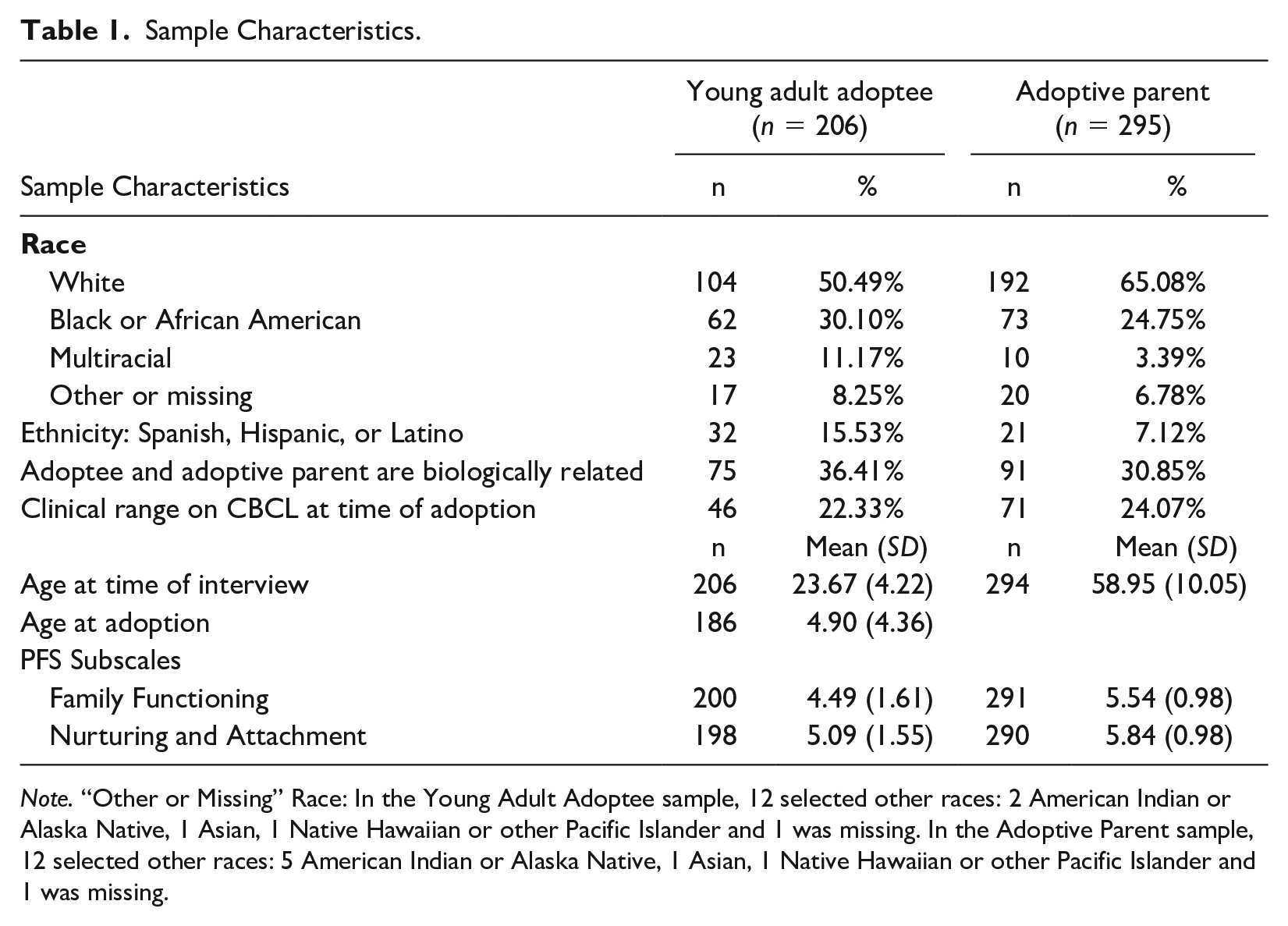
Note. “Other or Missing” Race: In the Young Adult Adoptee sample, 12 selected other races: 2 American Indian or Alaska Native, 1 Asian, 1 Native Hawaiian or other Pacific Islander and 1 was missing. In the Adoptive Parent sample, 12 selected other races: 5 American Indian or Alaska Native, 1 Asian, 1 Native Hawaiian or other Pacific Islander and 1 was missing.
Missing Data
Listwise deletion was used to eliminate participants with missing data from the regression models. Data were missing for 24 respondents in the model examining Family Functioning in the Young Adult Adoptee sample and 17 in the Adoptive Parent sample, resulting in a data set of 182 and 278 respectively for the Family Functioning regression models. Data were missing for 26 respondents in the model examining Nurturing and Attachment in the Young Adult Adoptee sample and 18 in the Adoptive Parent sample, resulting in a data set of 180 and 277 respectively for the Family Functioning regression models.
Regression Models
Using two regression models, the Family Functioning subscale outcome was examined, from the Young Adult Adoptee sample and from the Adoptive parent sample. An additional two regression models examined the Nurturing and Attachment outcome, from the Young Adult Adoptee sample and from the Adoptive parent sample. For each initial model, the focal predictors were the motivations to adopt that were most likely to be endorsed by respondents and additional respondent characteristics (race, ethnicity, and kinship relationship) were included as covariates. However, in subsequent models, covariates were omitted for parsimony; as when included in the models, these additional characteristics did not improve model fit, or add significantly to our understanding of the findings. Child’s age at the time of adoption was included in the final model with the Young Adult Adoptee sample.
Results
As detailed in Table 2, there was variation in how frequently respondents endorsed each specific motivation. For example, while almost all Adoptive Parents endorsed the “love the child” motivation (n = 271; 92%), only 161 (78%) of Young Adult Adoptees endorsed this motivation. A similar pattern was observed for the “help a child in need” motivation (n = 122, 59% of the Young Adult Adoptee sample and n = 217, 74% of the Adoptive Parent sample) and “already part of the family” motivation (n = 108, 52% of the Young Adult Adoptee sample and n = 233, 79% of the Adoptive Parent sample).
Motivations to Adopt.
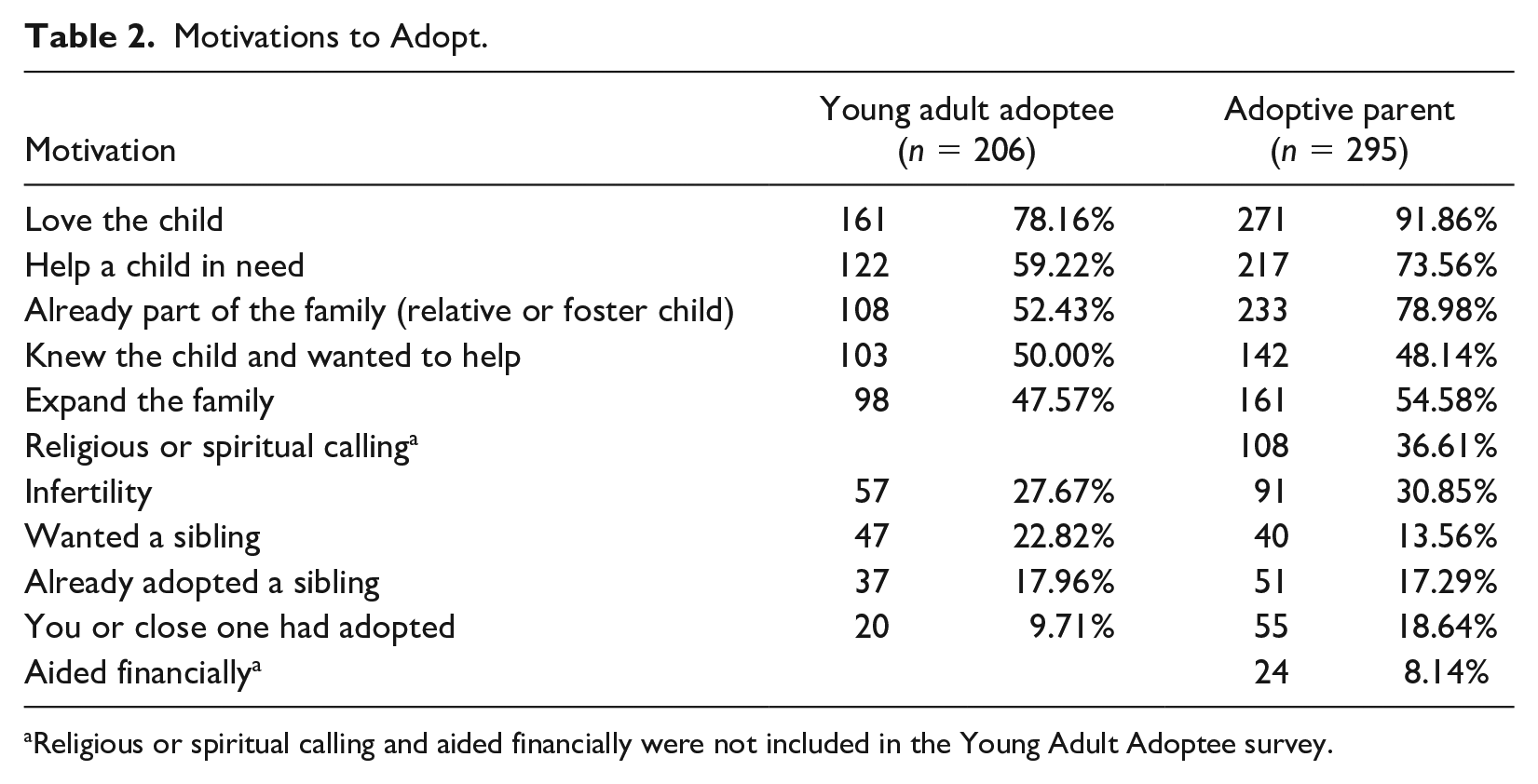
Religious or spiritual calling and aided financially were not included in the Young Adult Adoptee survey.
For the multivariate models, the motivations listed in Table 2 that were most often selected (over 25% of both respondents) were retained for inclusion as independent variables in the models. Including only the most common motivations in this way avoided sparse categories (i.e., low numbers of cases; Nahhas, 2024) in the motivation variables and allowed for more parsimonious models.
Multivariate Models
The first set of multivariate models sought to answer the following research question: Do the most endorsed motivations impact how Young Adult Adoptee and Adoptive Parents experienced Family Functioning during the adoptee’s childhood?
Young adults’ perception of motivations (reported in Table 3), controlling for child behavior problems and age at adoption, explained 17% of variance of family functioning, Adjusted R2 = 0.17, F (8, 173) = 5.66, p ≤ .001, while adoptive parents’ perception of same motivations explained just 2% of family functioning, Adjusted R2 = 0.02, F (9, 268) = 1.73, p = .083. In the Young Adult Adoptee sample, their perceptions of parental motivations were statistically significant, controlling for covariates, including love the child and helped a child in need. When adoptees perceived parents’ love for them motivated their parents to adopt, adoptees perceived 0.81 points higher score in family functioning. Also, when adoptees endorsed the motivation of help a child in need, they perceived a 0.56 higher score in family functioning. Infertility was marginally significant (p = .06), associated with 0.47 lower score in family functioning.
Regression Model Output: Dependent Variable Family Functioning.
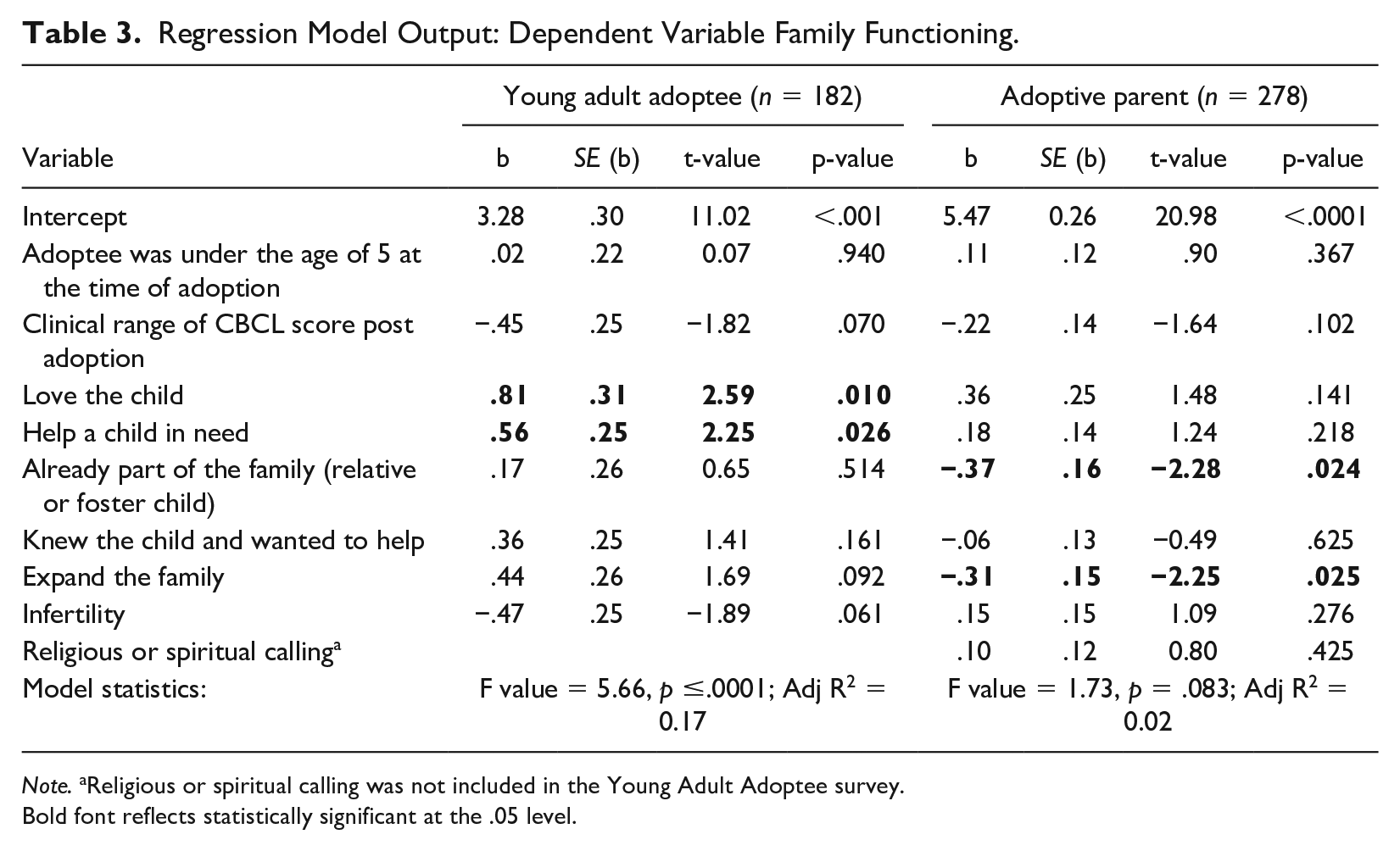
Note. aReligious or spiritual calling was not included in the Young Adult Adoptee survey.
Bold font reflects statistically significant at the .05 level.
In the Adoptive Parents’ model (reported in Table 3), the motivations of already part of the family and expand the family were negatively associated with parents’ perception of family functioning. When they endorsed the motivation that the child was already part of the family, parents had a .37 points lower score in family functioning, controlling for other covariates. Also, the motivation to expand the family was associated with a .31 points lower score of family functioning.
The second set of multivariate models sought to answer the following research question: Do the most endorsed motivations impact how Young Adult Adoptees and Adoptive Parents experienced Nurturing and Attachment during the adoptee’s childhood?
Both models examining the Nurturing and Attachment were statistically significant (see Tabel 4): the Young Adult Adoptee sample, Adjusted R2 = 0.28, F (8, 171) = 9.52, p = <.0001, and the Adoptive Parent sample, Adjusted R2 = 0.18, F (9, 267) = 7.89, p ≤ .0001. In the Young Adult Adoptee sample, age under 5 at the time of adoption, and the following parental motivations were all statistically significant: love for them, help a child, and infertility. When the Young Adults Adoptee perceived that their parents’ motivation to adopt was from a sense of loving them, and to help a child in need, adoptees reported 1.27 points, and 0.53 points higher nurturing and attachment score, respectively. On the contrary, when adoptees perceived parental motivation was due to infertility, adoptees reported 0.46 points lower nurturing and attachment score, holding other variables constant. Similarly, in the Adoptive Parent sample, child age at adoption and parental motivation due to their love for the child were statistically significant. When parents reported that they were motivated to adopt due to their love for the child, parents reported 1.11 points higher nurturing and attachment. Also, when the child had a child’s behavioral problem at clinical range, parents reported, on average, 0.59 points lower score on the nurturing and attachment scale.
Regression Model Output: Dependent Variable Nurturing and Attachment.
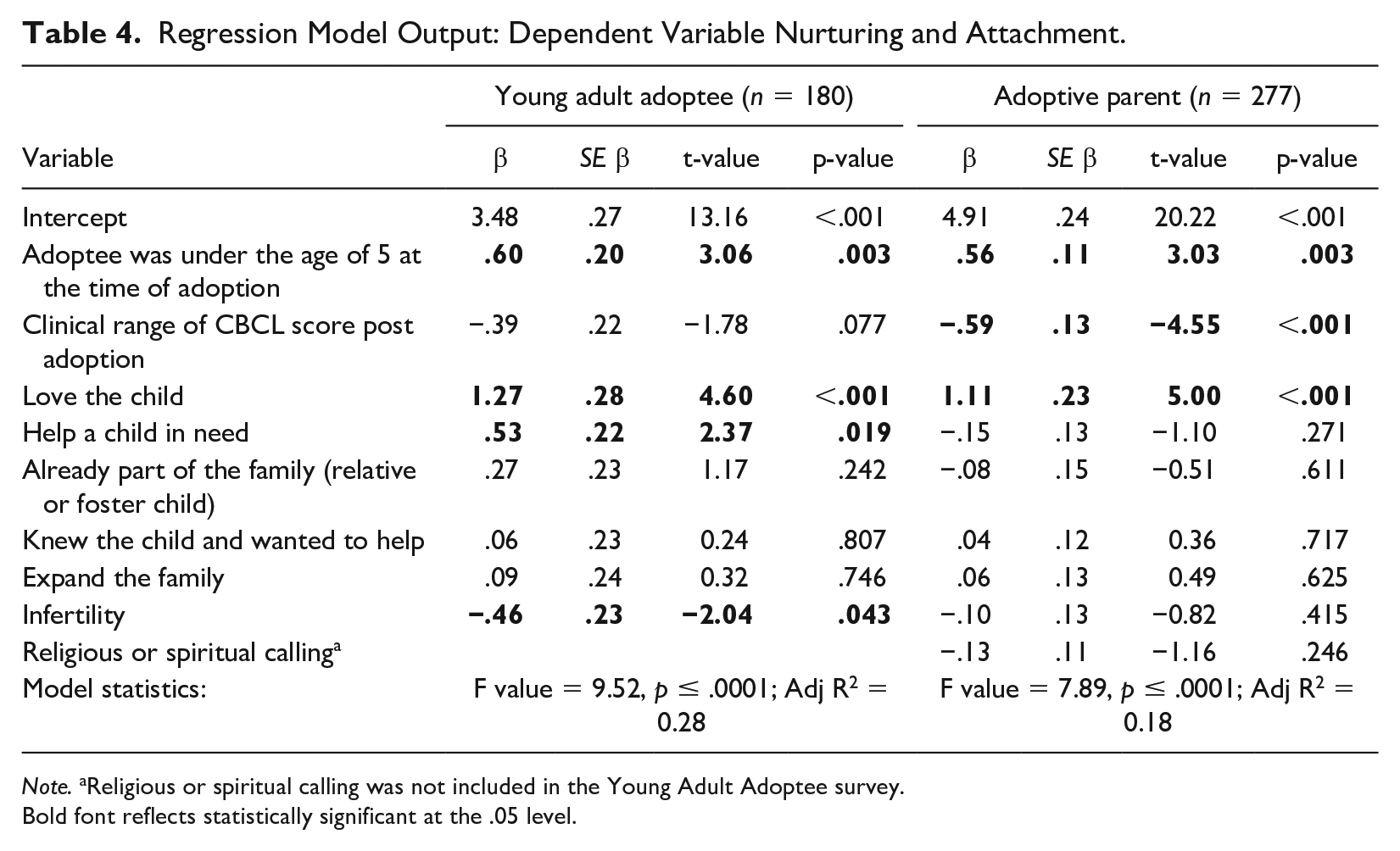
Note. aReligious or spiritual calling was not included in the Young Adult Adoptee survey.
Bold font reflects statistically significant at the .05 level.
Discussion
This exploratory study examined the relationship between parental motivations to adopt and two measures of adoptive family well-being: family functioning and resilience and nurturing and attachment. This was examined separately for the young adult adoptee sample and the adoptive parent sample. extant theoretical literature on motivations is often presented as two broad categories of motivations, intrinsic and extrinsic and often lacks the nuances associated with caregiving relationships (Fiske, 1991; Fiske & Haslam, 1996; Pinker, 2011). However, these broad categories provide a framework to discuss these complex relationships. Based on existing literature on motivations, we hypothesized that when the adoption was internally motivated, such as by love for a specific child, this motivation would result in higher levels of adoptive family well-being as compared to parents who were externally motivated to adopt. We hypothesized that this would be true for both young adults and adoptive parents.
First, we discuss family functioning from the perspective of young adult adoptee respondents. As hypothesized, young adult adoptees reported higher levels of family functioning when they perceived that their adoptive parents were intrinsically motivated by their love for them. Yet, contrary to our hypothesis, when adoptees endorsed the more extrinsic motivation of helping a child in need, they also perceived a higher level of family functioning. When adoptees reported infertility as a motivation, this was marginally significantly associated with a lower family functioning. This is a good example of the complex nature of caregiving relationships and how intrinsic and extrinsic motivations may be different based on who is responding. For the young adult respondents, “helping a child in need” may be considered an intrinsic motivation, and for the adoptive parents it may be an extrinsic motivation.
In the adoptive parent sample, an unexpected finding was that when parents endorsed the intrinsic motivation that the child was already part of the family, they also reported lower levels of family functioning. Also, the extrinsic motivation to expand the family was also in the opposite direction as expected based on the theoretical literature; the motivation to expand the family was associated with a lower level of family functioning.
Next, the results for the nurturing and attachment outcome are discussed. Findings are similar for both groups but may have different meanings for young adults compared to adoptive parents. Among the young adults adoptee respondents, those who perceived that their parents’ motivation to adopt was the intrinsic motivation of a sense of loving them, they reported higher levels of nurturing and attachment. Yet they also reported higher levels of nurturing and attachment associated with the extrinsic motivation of helping a child in need. When adoptees perceived that parental infertility, an extrinsic motivation, they reported lower levels of nurturing and attachment.
Among the Adoptive Parent sample, when parents reported that they were intrinsically motivated to adopt due to their love for the child, they also reported higher levels of nurturing and attachment. Adoptive parents may be motivated by a combination of intrinsic and extrinsic motivations. For example, they may be motivated by both a sense of love for a child and external factors, such as societal expectations (England et al., 2012). Our study findings suggest that the broad categories of intrinsic and extrinsic motivations may not capture the nuanced motivations associated with care work. In addition, the way the questions were asked, we cannot be sure that respondents had intrinsic or extrinsic motivations in mind when they indicated their answers. For example, some parents may have interpreted “expand the family” (defined as extrinsic) in light of their love for the child (defined as intrinsic).”
Comparing the motivations reported by adoptive parents and by young adult adoptees suggests an additional interpretation. In both samples, motivations to adopt that appeared related to a specific child or that specific child’s needs (love the child; help a child in need) were associated more strongly with one form of positive outcome. On the contrary, although the specific motivation differed, motivations that were more centered on the needs of the family (infertility, expand the family, child was already part of the family) appeared to be associated with more negative outcomes. The perceptions from the two sources need to be better understood. While it is important to note that the motivation of loving the child was endorsed universally by both adoptive parents and young adult adoptees, the other motivations were less consistent. Open discussions about adoption, from the motivation to adopt through current family functioning, are important conversations for adoptive families to engage with, and for those engaging with adoptive families to be aware of.
This study examined two family well-being outcomes—family functioning and nurturing and attachment. Based on model fit statistics, it may be that motivations are more closely associated with nurturing and attachment than family functioning (the R2 is 0.02 for adoptive parents on family functioning). In addition, adoption of young children (under the age 5) was associated with higher levels of nurturing and attachment, but the child’s age at adoption was not a statically significant predictor in the family functioning models. Future work should explore the motivations associated with adopting a younger child compared to adopting an older child.
The intrinsic or extrinsic motivations of adoptive parents have been explored in prior research. However, the impact of those motivations on family well-being during childhood has not been explored. This exploratory study contributes to our understanding of how the retrospective reflections of young adult adoptees and their parents, of parental motivations to adopt, may help to understand adoptive family well-being.
Limitations
This exploratory study examined retrospective reports of parental motivations to adopt. Retrospective reporting can be challenging to understand. In this study we asked young adult adoptees to consider what motivated their parents to adopt them. In families where the adoption was frequently discussed and there was an openness to discussing these motivations, the young adult adoptee may have an easier time responding to these questions than in families where the adoption was rarely, or never discussed, or where there was not an openness to deeper conversations. In addition, retrospective reporting is biased by the respondents’ experiences between the event and the reporting of the event. In other words, if there were significant familial challenges, or parental or adoptee expectations that were unmet, these feelings of disappointment may cloud how a respondent thinks about their adoption experience. On the contrary, knowing how young adults perceive their childhood is also an important consideration, as it may drive current interactions among family members. For example, if a young person believes that their adoptive parent was motivated by a strong sense of love for them, they may feel supported during challenging times. Whereas a young person who does not feel a strong sense of belonging in the family may believe their adoption occurred for financial gain, or other extrinsic motivations.
This study did not allow for the observation of motivations or intentions over time. Testa and colleagues (2015) found that, while intentions may be strong at the time of adoption or guardianship finalization, if those commitments weaken over time, postadoption and guardianship instability may increase. Study authors suggest that understanding the underlying motivations behind caregiver commitment and motivations may help to better understand when and how postadoption and guardianship instability occurs. The same could be said for this study. Longitudinal observations, from the time of adoption, through adulthood, would provide a more robust understanding of adoptive family relationships and well-being.
Another limitation is that this analysis was limited to what was asked in the survey and did not allow for follow-up questions. A phenomenological or grounded theory study that explored these ideas more directly would improve our understanding of the impact of adoptive parent motivations on current, or prior, relationships. Such an approach may also allow for more nuanced responses from parents about how they interpret the different motivations, which can become conflated in the minds and experiences of participants over time (e.g., a parent may initially be motivated by infertility but subsequently develop love and attachment for a child). Finally, two characteristics were statistically significantly different between those who completed a survey and those who did not respond to, or did not complete, the survey. Adoptive parents who completed the survey were, on average, younger at the time of their child’s adoption than the parents associated with not completing the survey. Thus, caregivers who were older at the time of adoption were under-represented in this study. In addition, completed cases were more likely to be rated by caseworkers as experiencing moderate or severe harm associated with the child’s maltreatment report than not completed cases. Thus, this perspective is somewhat over-represented.
Implications for Practice and Policy
This study explores how young adult adoptees and adoptive parents make sense of parental motivations to adopt, and how that might be related to family dynamics during the adoptee’s childhood. This study found that certain motivations were more often associated with positive outcomes and that the motivation that was most frequently endorsed by both the adoptive family and the adopted person was that of “love for the child.” In addition, the study found that certain motivations endorsed by the adoptive parent (child was already part of the family and expand the family) or perceived by the adopted person (infertility) were negatively associated with adoptive family well-being outcomes. Assessing motivation to adopt is strongly emphasized in the home study process, yet motivation is also described as some of the most difficult information to obtain and understand (Crea et al., 2011). When motivation is explored, the question is often phrased in a basic manner, “why do you want to adopt?” or “what is motivating you to adopt this child?” The questions seem to suggest that the family may have a singular motivation, “I/we want to adopt because . . .” Home Study Assessors may record the reason(s) but are ill equipped to help the prospective parent understand the implications of a stated motivation and how that motivation translates into expectations which can ultimately impact adoption outcome. Even more rarely is the adopted person’s perception of why their family may want to, or did want to, adopt them explored explicitly. Service providers working with adoptive families (e.g., social work practitioners, psychologists, school, and medical professionals) may benefit from understanding how various motivations may differentially impact the experience of both the adoptive parent and the adopted person over the family life cycle. Those working with adoptive families may also benefit from additional training on assessing motivations to adopt and on helping the adoptive family understand the relationship between their motivation to adopt and their expectations of the outcome of the adoption. Because motivations have been found to change over time, adoptive families may also benefit from working with the adoption- informed helping professionals to develop more realistic expectations.
While not directly discussing this, one of the factors that may influence how familial relationships are perceived is how often there are open discussions about adoption within the family (Brodzinsky, 2006). In this study the research team built into the survey language that allowed for the fact that the respondent might not know that they are adopted. The importance of talking to adoptees about their adoption has been stressed in preadoption training and in practice that is adoption-informed, but it is unclear how often this occurs in practice. The topics surrounding adoption discussions should be age and developmentally appropriate and should consider what adoptees want to know. In the absence of knowledge, the imagination will fill the void and may result in harmful assumptions about why the adoption occurred and what the motivations for adoption, from the adoptive and birth family perspectives, were. Open, honest conversations with adoptees and adoptive parents needs to occur prior to adoption, and after adoption finalization, to help facilitate problem-solving and address issues before they become overwhelming. Social workers and other adoption-informed helping professionals can positively impact adoption outcome by educating families on the importance of open communication about adoption at all stages of the child’s development and by teaching strategies for facilitating this type of openness.
From a policy perspective, the study suggests that greater emphasis should be placed on understanding motivations to adopt and on preparing adoptive families to engage in greater communicative openness. It also suggests that families may benefit from the involvement of adoption-informed helping professionals past the point of legal finalization.
Conclusion
This study adds to the literature by examining motivations to adopt as perceived by both adoptive parents and young adult adoptees and by discussing some of the implications for practice. Further research should focus on understanding these motivations more deeply including whether certain types of motivations may positively or negatively influence adoption outcomes. Additional study of perceived differences between motivation to adopt in kinship adoptions versus nonrelative adoption while not studied here, may also prove fruitful. Findings suggest however that both adoptive parents and the adopted person would benefit from a more thorough exploration of expectations prior to the adoption, as well as efforts to possibly help adjust those expectations over the life course of the family. In that way, child welfare adoptions can be more sharply focused on “finding children for families” and building permanence for children and youth, and the families in which they exist.
Footnotes
Acknowledgements
The authors would like to thank the young adult adoptees and adoptive parents who participated in this survey.
Disposition editor: Cristina Mogro-Wilson
Declaration of Conflicting Interests
The author(s) declared no potential conflicts of interest with respect to the research, authorship, and/or publication of this article.
Funding
The author(s) disclosed receipt of the following financial support for the research, authorship, and/or publication of this article: This current study is based on data collected as part of the Understanding Post Adoption and Guardianship Instability for Children and Youth who Exit Foster Care (PAGI) project, funded by the Office of Planning, Research, and Evaluation, Administration for Children and Families, U.S. Department of Health and Human Services, Contract Number: HHS P233201500039I. Data used in this paper is from the National Survey of Child and Adolescent Well-Being (NSCAW) Adoption Study, a key component of the PAGI project (Ringeisen et al., 2022). The data were archived and made available by the National Data Archive on Child Abuse and Neglect, Cornell University, Ithaca, NY, and have been used with permission. The analysis for this paper was completed after the project period and did not receive any funding. The project funders, NDACAN, Cornell University and their agents or employees bear no responsibility for the analyses or interpretations presented here.
