







Abstract
Older adults are facing complex, multifaceted psychosocial issues, such as loneliness, social isolation, financial stress, and cognitive decline, which crucially impact their mental health and quality of life. Group-based psychosocial interventions have gained recognition as valuable tools for strengthening peer interaction and collective healing. The review aims to map the important literature on psychosocial group interventions for older adults. Six electronic databases were searched from March to June 2025. Inclusion criteria are: psychosocial interventions within the last 10 years and group interventions in English research papers only. Review papers, conference proceedings, medical interventions, and individual interventions have been excluded. After the screening process, eight articles were identified as psychosocial group interventions for older adults from eight different countries. Each intervention is unique, and 90% of them effectively address the psychosocial needs of older people. The results are explained and grouped under three themes that have emerged from the research questions underlying the review. They are: (a) the efficacy of psychosocial group interventions on cognitive and mental well-being; (b) addressing social isolation, loneliness, and enhancing social connection; and (c) impact of environmental and socio-cultural contexts on older adults’ psychosocial interventions. A significant observation is the need for a structured intervention model to promote the well-being of older adults. This review provides a foundation for developing new insights into psychosocial interventions for older adults.
Introduction
The global population of seniors aged 60 and above was just over 1 billion in 2020, representing 13.5% of the world’s 7.8 billion people. It was 2.5 times larger than that in 1980 (382 million) but is projected to reach nearly 2.1 billion by 2050 (World Health Organization, 2021).
But during the transition phase, older adults will experience five universal crises, including loss of social status and significant acquaintances, internal and external body changes reflecting biological decline, confrontation with death, and modification of available roles and activities (Brieland et al., 1975). These crises should be addressed to improve their quality of life. Recently, there have been several intervention research studies evaluating their physical, mental, and social aspects to enhance their physical health, to get outcomes on depression, anxiety, resilience, and social engagement (Haslam et al., 2014).
In older persons, health outcomes, such as worsening disability and death, are influenced not just by biomedical factors but also by psychosocial distress (Mehta et al., 2002), such as feelings of loneliness, lack of connectedness with others, and depressive symptoms. Social isolation and loneliness affect approximately one third to one half of the older population and harm their physical and mental health (Landeiro et al., 2017). Efforts to alleviate them are crucial, as these feelings can significantly impact longevity, physical health, and mental well-being (Donovan & Blazer, 2020).
Geriatric research has witnessed a growing number of psychosocial interventions in recent years. They capitalize on psychological or social actions to transform psychological, social, biological, and/or functional outcomes. The term is generally applied to a broad range of interventions, which include psychotherapies (e.g., psychodynamic therapy, cognitive-behavioral therapy, interpersonal psychotherapy, problem-solving therapy), community-based treatment (e.g., assertive community treatment, first episode psychosis interventions), vocational rehabilitation, peer-support services, and integrated care interventions (Butler et al., 2015). In addition, mindfulness training (Lindsay et al., 2019), intergenerational programs (Teater, 2016), dance therapy (Iyengar, 2024), family meetings (Metze et al., 2019), online interventions (Shah et al., 2021), yoga therapy (Panigrahi et al., 2023), musical reminiscence (Mahendran et al., 2017), and a variety of activities are emerging as psychosocial interventions.
According to Walter et al. (2020), it is the right time to address the psychosocial issues of older adults and significantly enhance their mental health and cognitive power. The group intervention modality of service provision is well-suited, as it provides cost-effective opportunities for focused treatment, social interaction, and support (Toseland, 1990; Zimpfer, 1987). Rosendahl et al. (2021) state that recent reviews demonstrate how group treatments achieve large effects compared to inactive treatment conditions, and why fallouts from other treatments, such as individual therapy, are negligible in terms of effect size.
According to Chan et al. (2006), research has shown that psychosocial group interventions appear to be effective for reducing loneliness, anxiety, and depression. Strong social relationships are crucial for the well-being of older adults, as they provide support and connection (Van Orden et al., 2021). Promoting interactions within families, creating community communication platforms, and organizing social activities can help older adults build and maintain meaningful connections (Liddle et al., 2020). It fosters a sense of belonging and enhances overall life satisfaction (Guo et al., 2024). In response, psychosocial interventions, particularly group interventions, have emerged as a promising approach to enhance the mental well-being of older adults. Against this background, we aim to systematically review studies that have conducted psychosocial group interventions among older people.
Methods
This systematic review aims to identify and examine research articles on psychosocial group interventions that have been previously conducted and published on activities that highlight the role of social engagement for mental health and overall well-being (Lökk et al., 1991). They might include walking interventions, behavioral activation, art, dance and exercise therapies, skill enhancement, social and community engagement, and social group work. The review has been conducted in accordance with predefined inclusion and exclusion criteria, and the strategy is informed by the PRISMA 2020 principles. The electronic data search is conducted across six data sources: SCOPUS, PubMed, ProQuest, EBSCOhost, JSTOR, and Google Scholar from March to June 2025. The first search is limited to titles and abstracts, quoting the basic words or phrases using double quotes (“ ”).
Research Question
What are the emerging psychosocial group intervention studies for older adults?
Sub Questions
How effective are psychosocial group interventions in improving cognitive function and mental well-being outcomes among older adults?
To what extent do existing psychosocial group interventions specifically target and reduce psychosocial issues such as social isolation and loneliness in older adults?
How do environmental settings and socio-cultural contexts influence the implementation and outcomes of psychosocial interventions for older adults?
Eligibility Criteria
The articles for the systematic review are identified using the following, clearly defined inclusion and exclusion criteria.
Inclusion Criteria
Literature that has addressed psychosocial interventions for older people.
Studies published from January 2015 to June 2025.
Studies that focus on group interventions for older people.
Full-text articles in English
Exclusion Criteria
Any type of review papers.
Conference abstracts or proceedings.
Medical interventions.
Data-Extraction Process
Initially, we identified the six data sources and the following combination of search terms:
Psychosocial
Intervention or Experiment
Older people or the Elderly
The search for appropriate titles and abstracts was carried out using “AND” and “OR” options between the search terms, including “Psychosocial” AND “intervention” OR “Experiment” AND “older people” OR “the elderly.” The screening of articles was conducted manually, and articles were selected based on the inclusion and exclusion criteria. Initially, the search strategy was applied, and articles identified by their titles were matched. Their names and DOIs were then collected and saved. After that, the abstracts of the screened articles were studied.
Again, the articles suitable for abstracts were collected in a Microsoft Word file. The abstract-screened articles were subjected to full-text screening using the same procedure. The retrieved articles were stored in a folder. We contacted the corresponding authors of the studies to request full-text articles that were not available for download. The downloaded articles were screened according to the already defined inclusion and exclusion criteria. Articles that did not match the criteria were excluded, and the remaining articles were selected and stored for final evaluation.
The articles were extracted and analyzed by the first author under the guidance of the second author. The authors frequently discussed review-related matters, clarified doubts, and solved all queries in a timely manner.
The data items comprise general information about the selected studies, including author, publication year, and country, as well as the study’s aim, methodology, activity, and outcome.
Rigorous Appraisal
To ensure the trustworthiness of the findings, a rigorous appraisal was conducted through a critical examination of each study’s methodology and relevance. Rather than applying a formal scoring checklist, quality was prioritized by strictly adhering to inclusion criteria that restricted the review to peer-reviewed, empirical research. Each study was evaluated for its methodological coherence, specifically to ensure that the intervention design clearly aligned with the reported outcomes and that the synthesized results were drawn from credible, scientifically sound sources.
Explicit Synthesis
The analysis of the articles and classification into the final three themes was achieved through an explicit narrative synthesis. Following a clear inductive approach, findings from diverse study designs were extracted and thematically organized based on recurring patterns and the research questions underlying the systematic literature review.
Limiting Bias
To minimize selection and reporting bias, this review followed a systematic and transparent search strategy guided by PRISMA 2020 principles. Bias was minimized by establishing and documenting strict inclusion and exclusion criteria prior to the search, ensuring that studies were selected based on their relevance to the research question rather than the author’s personal preference or the positivity of the study’s results.
Results
Study Selection
The reviewer screened the articles according to the pre-defined inclusion and exclusion criteria. The selection process of the included articles is represented in detail in Figure 1, the PRISMA flow diagram (Tricco et al., 2018). A total of 2,976 articles were yielded in the initial search. After removing duplicate articles and screening titles, 57 articles remained. During the abstract screening process, 32 articles were excluded, and 25 articles remained; 24 of these could be retrieved for further review. After the in-depth screening, 16 articles did not meet the inclusion and exclusion criteria. Finally, eight articles were identified and taken up for the study.
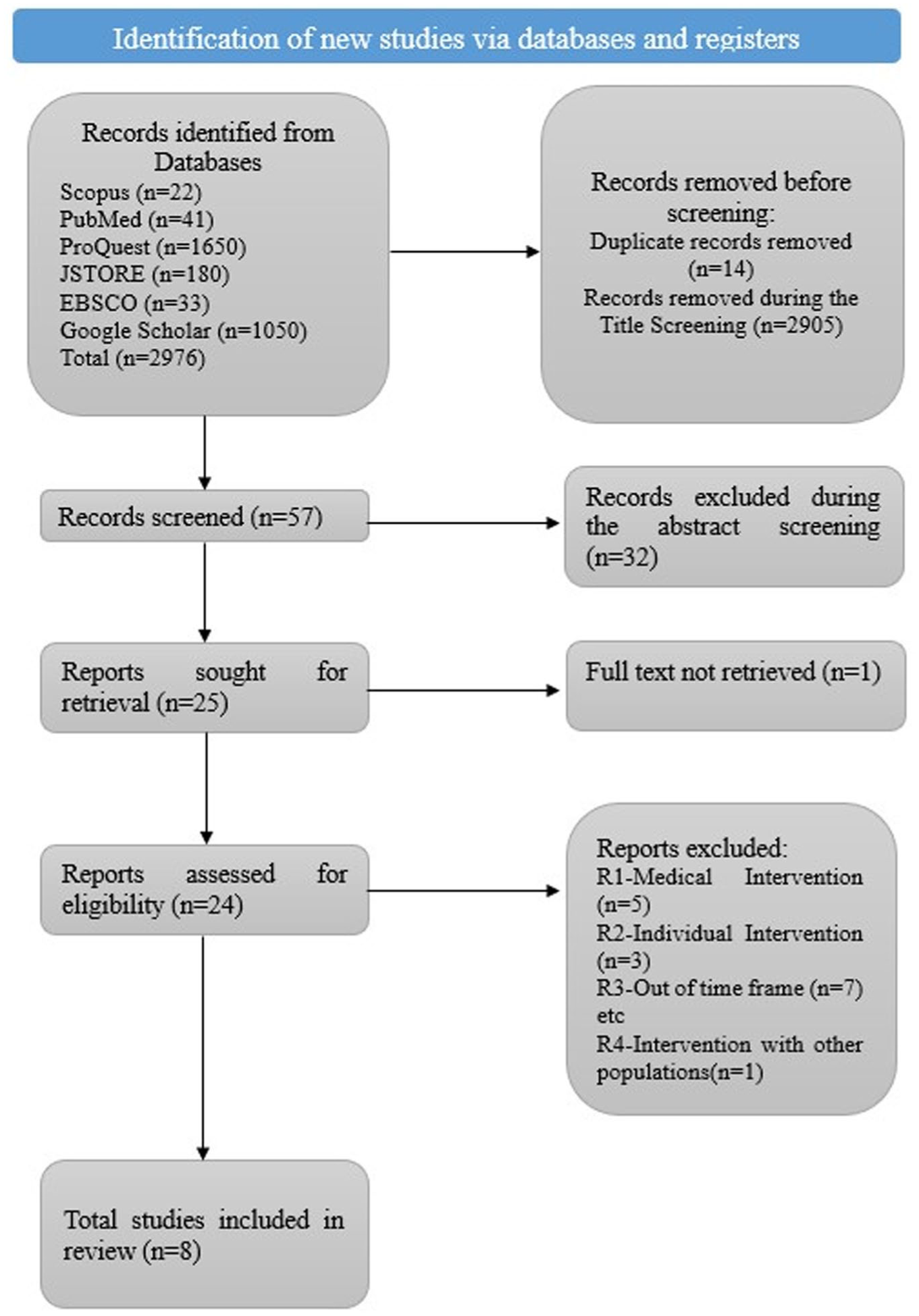
PRISMA Flowchart of the Identified and Screened Studies (Tricco et al., 2018).
Study Characteristics
The eight studies were from eight different countries, including Finland, the USA, Spain, Sweden, Canada, Colombia, Australia, and Singapore. All the interventional studies assessing the relationships between particular variables used randomized, controlled trials.
The cause-and-effect mechanism was explained through the use of the pre- and post-test method, along with its analysis in each intervention study. The timeframe for including studies was 2015–2025. The studies employed various methodologies, aiming for socially impactful outcomes that empowered older adults through psychosocial group interventions, which were considered because all medical and individual interventions for older adults were excluded. Among the psychosocial interventions, each study differs from the others, even though they involved interventions within the same population. Web-based group interventions were also included in this study, very relevant in the technological era.
The details of the selected studies are represented in Table 1.
Characteristics of the Included Psychosocial Group Intervention Studies.
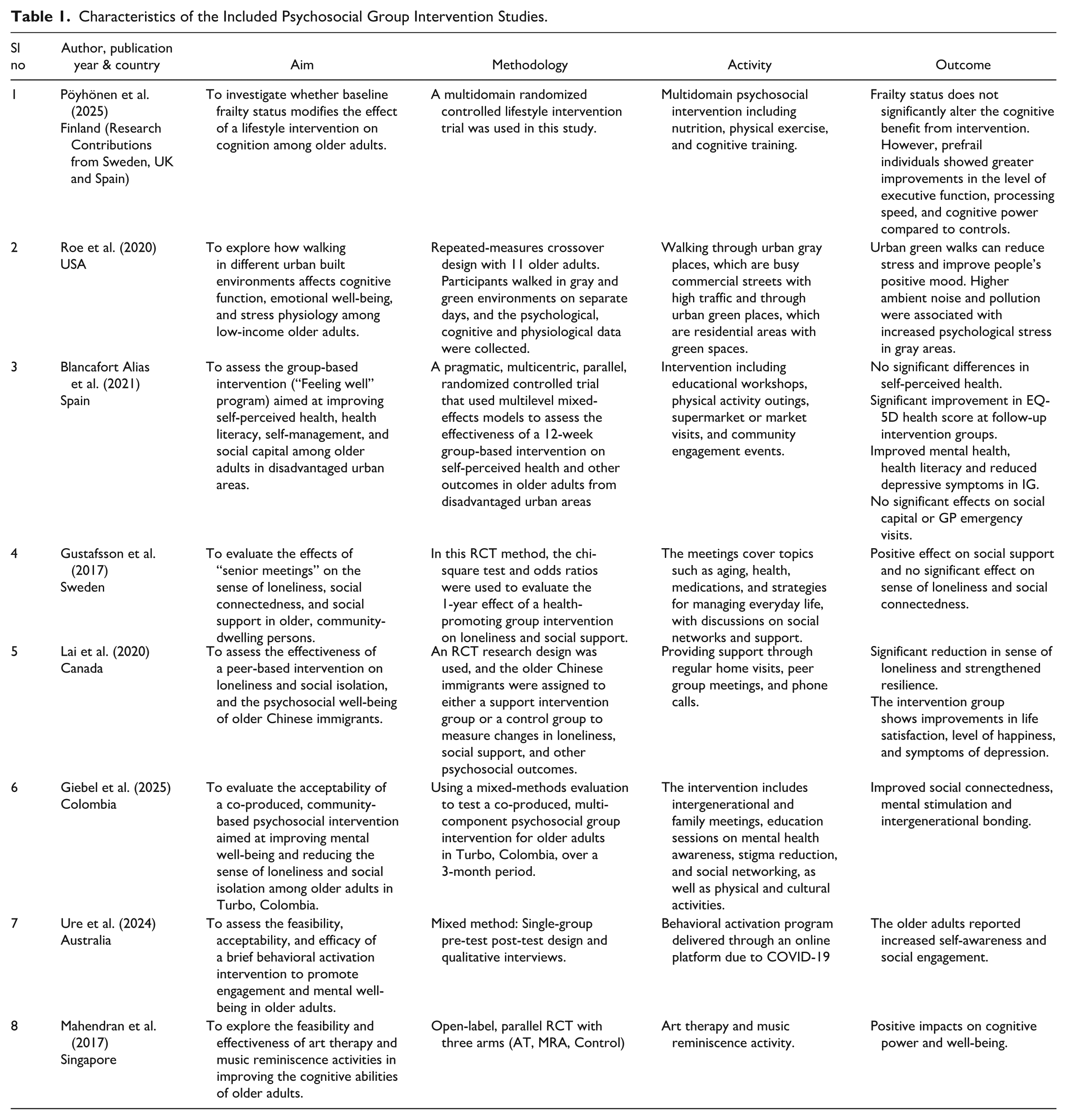
In this study, the extracted data are analyzed and grouped into three major themes based on the research questions behind the systematic literature review. They are (a) the efficacy of psychosocial group interventions on cognitive and mental well-being; (b) addressing social isolation, loneliness, and enhancing social connection; and (c) impact of environmental and socio-cultural contexts on older adults’ psychosocial interventions.
The Efficacy of Psychosocial Group Interventions on the Cognitive and Mental Well-Being of Older Adults
Psychosocial group interventions are evolving beyond single-domain approaches to integrate various aspects of mental well-being, including cognitive function, mood, and overall mental health in older adults, underscoring the importance of multidimensional interventions.
In the Finnish Geriatric Intervention Study to Prevent Cognitive Impairment and Disability (FINGER), researchers conducted a 2-year, large, randomized controlled trial. The intervention included diet management, exercise, and cognitive training. The participants received satisfactory results from this study and increased the level of executive function, processing speed, and cognitive power (Pöyhönen et al., 2025). Physical activity intervention, such as walking, has a crucial role in reducing the risk of cognitive decline. Walking in urban green districts had a positive impact on the mental well-being of the older adults, particularly in terms of their happiness level (Roe et al., 2020).
A group intervention (AEQUALIS) among older adults in low-income urban areas aimed to improve their mental health, resulting in enhanced well-being, as measured by the mental component of the SF-12 questionnaire, and an observed reduction in depressive symptoms. The results showed that a stable use of antidepressants among the participants of the intervention group contrasted with an increase in the control group (Blancafort Alias et al., 2021).
A peer-based intervention designed for Chinese immigrants led to a significant positive effect on loneliness and resilience. The participants received emotional support, companionship, and informational resources, which resulted in fewer depressive symptoms, greater life happiness, and increased life satisfaction (Lai et al., 2020). A study exploring the benefits of art therapy (AT) and music reminiscence activity found that it was effective in preventing further cognitive decline among older adults (Mahendran et al., 2017).
The study focused on behavioral activation therapy for non-clinical older adults, enhancing participants’ self-awareness, planning, and sense of self-efficacy in leading a valued life (Ure et al., 2024). A psychosocial intervention conducted in Turbo, Colombia, was highly valued by participants. The participants achieved positive outcomes, including reduced distraction from worries, improved stress management, and increased alertness (Giebel et al., 2025).
Addressing Social Isolation and Loneliness and Enhancing Social Connections Among Older Adults
Psychosocial intervention studies among older adults are specifically designed to reduce their level of loneliness and social isolation, while also increasing their social connections.
The AEQUALIS group-based intervention showed a decrease in loneliness within the intervention group, which was sustained in a 1-year follow-up, an intervention that actively sought to promote social capital, facilitating social support and participation within the target population (Blancafort Alias et al., 2021). The health-promoting group intervention, “senior meetings,” demonstrated a minor positive impact on social support; however, these meetings did not yield a significant positive result on overall loneliness or social connectedness in the aggregated analysis. Senior meetings are framed to address loneliness, social networks and social support. Participants benefit through learning from each other and socializing during these meetings (Gustafsson et al., 2017).
A study among older adults, which employed a peer-based intervention, addressed loneliness and social isolation among Chinese immigrant older adults, resulting in a reduction in loneliness and an increase in willingness to participate socially. These are effective in strengthening support relationships and facilitating their re-entry into the community. The intervention comprised regular peer-support group meetings, which helped them build strong and sustainable social connections (Lai et al., 2020).
An intervention conducted in Colombia was a multi-component psychosocial intervention focusing on reducing the sense of loneliness and social isolation to promote community integration. The findings highlighted “forging friendship” as a crucial benefit that enabled the participants to reduce their loneliness and create a comfortable environment for sharing negative life events, leading to lasting social connectedness (Giebel et al., 2025).
In the urban green space-built environmental intervention, walking through peaceful and calm areas yields significant results among older adults, reducing their loneliness and increasing social connections by creating opportunities for social interaction. Green spaces can provide a peaceful atmosphere and mental relaxation for older people (Roe et al., 2020). The behavioral activation program is considered an appropriate approach for increasing social connectedness in lonely older adults (Ure et al., 2024).
The participants reported increased social engagement and suggested that it played a role in strengthening existing social networks. The intervention included intergenerational and family meetings, designed to foster connections and encourage participation in family life. These activities contributed to solving the generation gap issues, leading to improved respect. It was an opportunity for older people to learn new skills from younger participants (Giebel et al., 2025). Peer support plays a crucial role in fostering understanding and emotional support among participants.
The Impact of Environmental and Socio-Cultural Contexts on Older Adults’ Psychosocial Interventions
Environmental and socio-cultural contexts influence the development and implementation of psychosocial interventions for older adults. They are a remedial approach to reduce psychosocial issues among older adults. Studies, such as the Finnish Geriatric Intervention Study, to Prevent Cognitive Impairment and Disability (FINGER), the physical activity exercise intervention, the group intervention (AEQUALIS) among older adults in low-income urban areas, peer-based intervention therapy, art therapy and behavioral activation therapy are found to be effective to reduce or balance the cognitive decline and improve the mental well-being of older adults.
Interventions in low-income urban areas (AEQUALIS) demonstrated a positive effect on the mental health of older people; at the same time, they faced challenges in participant recruitment and retention due to socio-cultural barriers. Financial instability and low socio-economic status were identified as other barriers to effective self-management (Blancafort Alias et al., 2021).
Older immigrants are facing many issues, such as differences in language and culture and discrimination in evolving caregiving dynamics. Some people are not ready to seek formal mental health services because of the stigma associated with mental health and specific cultural beliefs. Peer-based interventions are truly effective in these situations due to shared cultural, age, ethnic, and linguistic backgrounds. The collectivist and independent social norms often found in Chinese culture can then enhance the effectiveness of such peer-based interventions (Lai et al., 2020).
In the case of conflict-affected countries like Colombia, older adults are living in stressful environments, and mental health services are not affordable for low- and middle-income families, who are facing a scarcity of mental health professionals. Social stigma is also a reason for not seeking professional help. Therefore, community-based and culturally adapted interventions are needed for overcoming barriers to professional care (Giebel et al., 2025).
For quality of life, exercise interventions have been shown to improve older adults’ well-being (Telenius et al., 2015). In the walking-focused intervention, Roe et al. (2020) reveal that walking through urban built environments significantly affects the mental health of older adults, as factors such as traffic, noise, air pollution, and poorly maintained sidewalks can discourage physical activity. The irritations arising from these disturbances also negatively impact their mental well-being. At the same time, walking exercises through urban green spaces have a positive impact on the mental health of older adults, acting as an equalizer in health disparities, improving cardiovascular health, reducing obesity, enhancing psychological well-being, and regulating stress. Walking through green spaces creates an environment that fosters peaceful behavior with oneself and others, enhancing their social connections and allowing them to achieve a higher quality of social health. It reveals that urban planning, encompassing both physical and mental health, plays a critical role in promoting healthy aging, including the regulation and reduction of air and noise pollution to enhance walkability.
Discussion
The core objective of this systematic literature review is to evaluate the effectiveness of psychosocial group interventions for older adults. The synthesis of the included studies suggests that group-based interventions are highly effective in promoting healthy aging, distinct from medical or other interventions. The findings are grouped into three major themes: efficacy of the intervention on cognitive and mental well-being, addressing social isolation and loneliness among older adults, and the moderating role of environmental and socio-cultural contexts.
Older adults often face numerous challenges, particularly when neglected by their family members, lacking social security, and experiencing low emotional, physical, and financial support (Parab et al., 2023). For all countries, the health and well-being of their aging population are a major concern, especially at their stage of development (Salomoni et al., 2018). China’s most populous provinces have great concern about increasing pressure on their older adults’ care services due to a rapidly aging population. Home-Based Elderly Care (HBEC) has emerged as a potential solution to alleviate this pressure (Cao et al., 2024).
The review indicates that psychosocial group interventions not only significantly improve and help to sustain the cognitive function of older people and enhance their mental well-being but also reduce symptoms of depression and anxiety. These findings support the previous studies, particularly review papers, which suggest that the efficacy of such interventions lies in the synergy between cognitive stimulation and social interaction (Lawrence et al., 2012). These interventions are designed as an integrated model that appears to activate social cognition and can be applied to individuals in need.
The review examines whether these interventions address social isolation and loneliness and enhance social connections among older adults. In cities without proper public transportation, connections among older adults tend to weaken. The migration from other countries and urban living without mingling with others also leads to loneliness or a disconnect from one’s history and tradition (Iyengar, 2024).
As people enter old age, many negative thoughts arise, particularly during the retirement years. It is natural but would initially appear like a minor mood fluctuation and then would develop into a state of mind that becomes a serious mental illness, like depression, anxiety disorder, and social isolation, which is termed as loneliness and low self-esteem (Panigrahi et al., 2023). The senior population often experiences a sense of being marginalized within society (Zhang et al., 2023). Loneliness is a multifaceted public health problem (Lindsay et al., 2019).
Intergenerational programs could serve as a tool for increasing physical activity among older adults and, thus, potentially preventing physical ill health (Teater, 2016). This interaction would greatly reduce the isolation and loneliness among older adults (Aroonsrimorakot et al., 2022).
The findings strongly suggest that group interventions are more effective than individual interventions in addressing social isolation and loneliness. According to Dickens et al. (2011), group-based activities appear to be more effective across a wider range of outcome domains than those offered on a one-to-one basis.
Perhaps the most significant finding of this review is the critical role of environmental and socio-cultural contexts in determining its effectiveness. This aligns with the ecological systems theory; according to this, individual development is closely linked to environmental systems. Interventions are more effective in age-friendly cities and communities, with effective transportation and housing, followed by increased participation as a lifestyle-related behavioral change (Sánchez-González et al., 2020). Walking through the urban built environment intervention is a real example of how the environment can impact our mental well-being.
Limitations of the Study
The review advocates the need for integrating psychosocial interventions into geriatric care and community health policies. Despite these strengths, the review also has certain limitations. First, the heterogeneity between the included studies is considerable, especially in terms of the content, length, and intensity of the interventions. They range from short-term, 8-week peer-support interventions to long-term, 2-year multi-domain lifestyle interventions. This heterogeneity makes it challenging to draw strong conclusions regarding the components of an intervention, thus limiting direct comparisons of their efficiencies. While some studies have moderately sized and sufficiently powered samples, pilot studies with small numbers of participants reduced the generalizability of the observations.
However, it calls for improved methodologies to keep participants engaged, with potential modification of training requirements (Nahum et al., 2021). Another important limitation is that the review excludes studies in languages other than English, interventions involving medical treatments, conference proceedings, review papers, dissertations, and studies published prior to 2015.
Implications for Practice
Among the psychosocial group interventions, the systematic literature review includes a wide range of diverse interventions, such as peer support, environmental exposures, creative therapies like art and musical works, and behavioral activation (Cattan et al., 2005). This reveals that psychosocial interventions have great coverage in the field of research. The likelihood of interventions producing beneficial effects may vary depending on their characteristics. For example, those offered at a group level are more likely to be beneficial compared with one-to-one interventions, and those defined as being theoretically-based tend to be more beneficial than those that are not (Dickens et al., 2011). The review also brings together a variety of study types, including large-scale, rigorously conducted RCTs and pilot studies, in a balanced approach that covers both high-level evidence on efficacy and insightful commentary on the practicality and acceptability of implementation.
The study emphasizes various vulnerable populations of older adults. The studies include individuals who are facing frailty, inhabitants of low-income urban regions, ethnic minority immigrants, and survivors of armed conflict. This emphasis enhances the applicability of the results to a global aging demographic distinguished by increasing diversity and a range of life experiences. Moreover, this review provides a foundation for developing new insights into psychosocial interventions for older adults.
Conclusion
This systematic literature review provides clear evidence that community-oriented, psychosocial interventions can enhance the mental well-being, social connections, and cognitive abilities of older adults. Lifestyle interventions, including physical activity, nutrition, and training in cognitive skills, have been shown to have a significant impact on the cognition and mental health of older adults. Group-based and peer-facilitated interventions are effective for loneliness, social isolation, and depression. These interventions help in developing social networks and improving resilience among vulnerable populations, such as ethnic minority immigrants and people living in urban areas without proper socialization opportunities.
Furthermore, the review emphasizes the importance of accessible green spaces in the city, which can help reduce stress and enhance cognitive vigilance. This demonstrates that planning and designing the city are integral components of a public health approach to healthy aging. The interventions, such as art therapy, music reminiscence, and behavioral activation, give clear evidence for enhancing cognition as well as mental health (Balki et al., 2022). These interventions not only demonstrate their effectiveness but also help to empower older adults by strengthening their social connections and training them to be adaptable in diverse, cultural environments.
Moreover, this review would provide a foundation for developing new insights into psychosocial interventions for older adults, enabling communities to effectively support them by adopting these strategies to enhance their overall well-being.
Footnotes
Disposition editor: Cristina Mogro-Wilson
Declaration of Conflicting Interests
The authors declared no potential conflicts of interest with respect to the research, authorship, and/or publication of this article.
Funding
The authors received no financial support for the research, authorship, and/or publication of this article.
Ethical Considerations
This article does not contain any studies with human or animal participants, and informed consent is not required.
Consent to Participate
Not applicable.
Consent for Publication
Not applicable.
