






Abstract
This article discusses the findings of a pilot study engaging Ghanaian college students about the relevance of the legacies of the race-based transatlantic slave trade and enslavement to understanding mass incarceration. Participants (N = 11; mean age: 22.3; 55% male, 45% female) explored parallels between captured Africans’s conditions at the slave dungeons in Ghana, and the mass incarceration of Blacks in the United States. Dialogues were recorded, transcribed, and analyzed using the Sort and Sift, Think and Shift (SSTS) analytic approach. Findings suggest that critical engagement of the enslaved Africans’s incarcerated conditions reveals that (a) mass incarceration mirrors the race-based slavery, (b) white innocence and Black criminality is historically and structurally predefined, and (c) structural racism drives justice construction. Social workers can extend the use of genogram to access historical knowledge toward racism’s disruption and structural repair.
Keywords
Introduction
In her book, The New Jim Crow: Mass Incarceration in the Age of Colorblindness, Michelle Alexander (2012) argues that the institution of racialized slavery was never abolished but renamed. The prison institution within the justice system is the new name, and the various aspects of the legal justice system interact with other institutions and organizations (e.g., education, housing, employment, and market) of the racial state to sustain racial subordination through mass incarceration of racialized groups, especially Blacks (Hinton & Cook, 2021). She expresses that “we use our criminal justice system to label people of color criminals and then engage in all the practices [slavery] we supposedly left behind” (p. 8). Currently, the United States has the highest incarceration rates when compared with other countries. Blacks/African Americans represent only 13% of the U.S. population but constitute 38% of the incarcerated population (see Figure 1, which was produced by the Prison Policy Initiative). Mass incarceration affects individuals, families, communities, and the well-being of society (Beckett & Francis, 2020; Tietjen, 2019). Given that social work focuses on the well-being of individuals and the general society (NASW, 2021), mass incarceration has critical implication for the profession.
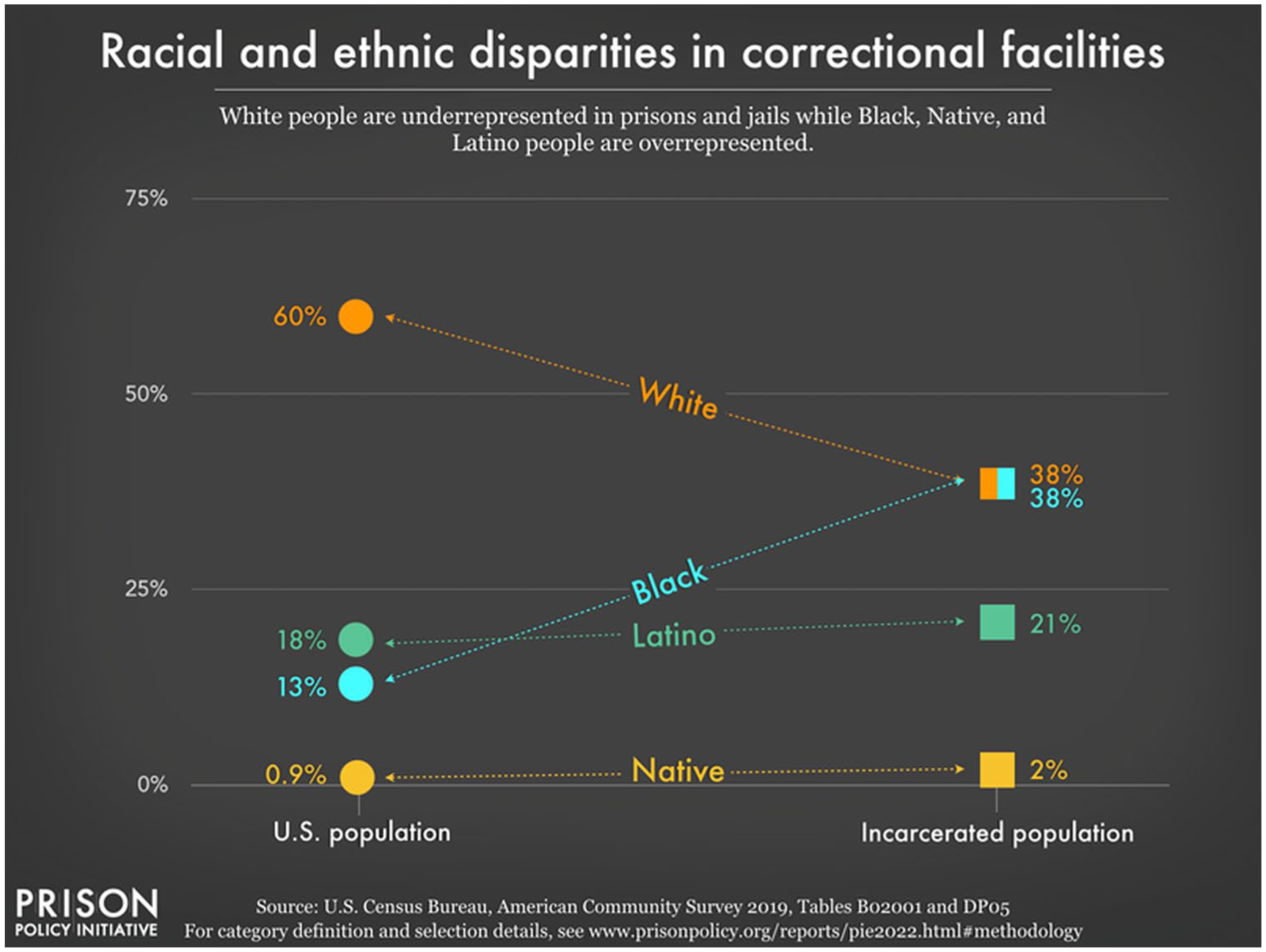
Percentage of US Population in Prisons and Jail Facilities by Race.
Although America’s racialized slavery is linked with global white supremacy and empire-building processes in sub-Saharan Africa (Andrew, 2021; Ani, 1994; Asare, 2019; Nantambu, 1998), the scholarship on racism related to mass incarceration in the United States has paid limited attention to this understanding. This disconnection is not an aberration from the way racial thinking has been intricately linked to state formation process to reproduce racialized violence via national identity, national population, and labor (Battalora, 2013; Goldberg, 2002; Mills, 2022). That is, while structural construction of whiteness is connected to the transatlantic slave trade (TST) and settler colonialism to control and exploit those structurally and legally constructed as non-white (Kyere, 2024; Beliso-De Jesus et al., 2023; Mills, 2022; Virdee, 2019), its modern evolution operates to deny and reduce the transatlantic nature of racial marginalization to national boundaries (Goldberg, 2002). But as argued by Goldberg (2002), there is no “singular modern state, and there is no singular racial state” because the “modern states are racial in their modernity, and modern in their racial quality, raciality” (p. 7).
Modernity as conceived through Western imperialism is racial and intimately linked to the emergence, development, and the evolving dynamism of the state, which is philosophically, conceptually, and materially racial in character (Beliso-De Jesus et al., 2023; Goldberg, 2002). From this understanding, social work, at the state or private practice, is grounded within contexts that articulate and normalize racial thinking, racialized conditions, and racialized culture. According to Snowden et al. (2021), the root of social work in the United States is at the interface between the Abolitionist movement (1783–1888) and the Women’s Suffrage Movement (1848–1920). However, the profession abandoned Black communities during the early period of the Settlement Movement (1880s–1910s). Prospect of a united front of the enslaved Africans, the poor, and free Europeans grew among the ruling elites’ ability to maintain the social order needed to protect the political and economic interests especially in the aftermath of the Bacon Rebellion in 1676 (Battalora, 2021; Gregory, 2021). The European ruling class invented whiteness—ideological and structural forces that legitimate assorted norms, values, and culture as the acceptable standard of behavior, especially for persons structurally constructed and labeled as White to separate European descent from enslaved Africans and members of the Native tribes (Battalora, 2021; Fritz & Lewis, 2025; Virdee, 2019). Historian Edmond Morgan (1975, cited in Gregory, 2021, p. 8) contends that the ruling class’s solution to their perceived impending threat was to separate “dangerous free whites from dangerous slave blacks by a screen of racial contempt” (p. 8). Within this context, early social workers, mostly Euro-American women who had become white, saw social work as an extension of their role as mothers, focused on the maintenance of social order as opposed to justice and liberation from an oppressive system (Bussey, 2020; Snowden et al., 2021).
From the social work person-in-environment perspective (PIE; Cornell, 2006; Kondrat, 2013; Weiss-Gal, 2008), social work needs to attend to this history that continue to shape it and the racial ordering of the world and the relationship between the individual and multiple subsystems of the racialized state that fester institutionalized violence and conflict social work justice orientation (Bussey, 2020; Watson & Collins, 2023). Racial slavery from a transnational perspective is important to understand the root causes and mechanisms of structural violence like mass incarceration and the linked behavioral responses that social workers are called upon to address (e.g., mental health disparities, poverty, educational disparities, and human dignity) (Kyere et al., 2022; Farmer, 1996; Mullaly & West, 2018).
Heritage sites such as the slave dungeons in the coastlines of many West African countries where enslaved Africans were marketed and incarcerated enroute to their final destinations in the New World are embedded with data that can generate new insights to broaden our understandings of racial violence through prisons (Asare, 2021). Experiential observations of the conditions and the violence captured Africans endured at the European forts along the coast of Africa (see Figure 2) during the race-based TST suggest that mass incarceration is an accumulation of unjust structures and practices institutionalized through racial slavery. This insight calls for an interdisciplinary approach to research, integrating social science methods with historical approaches to data collection. Such integration can provide critical data required to effectively tackle mass incarceration and the injustices it inflicts on communities and society. 1
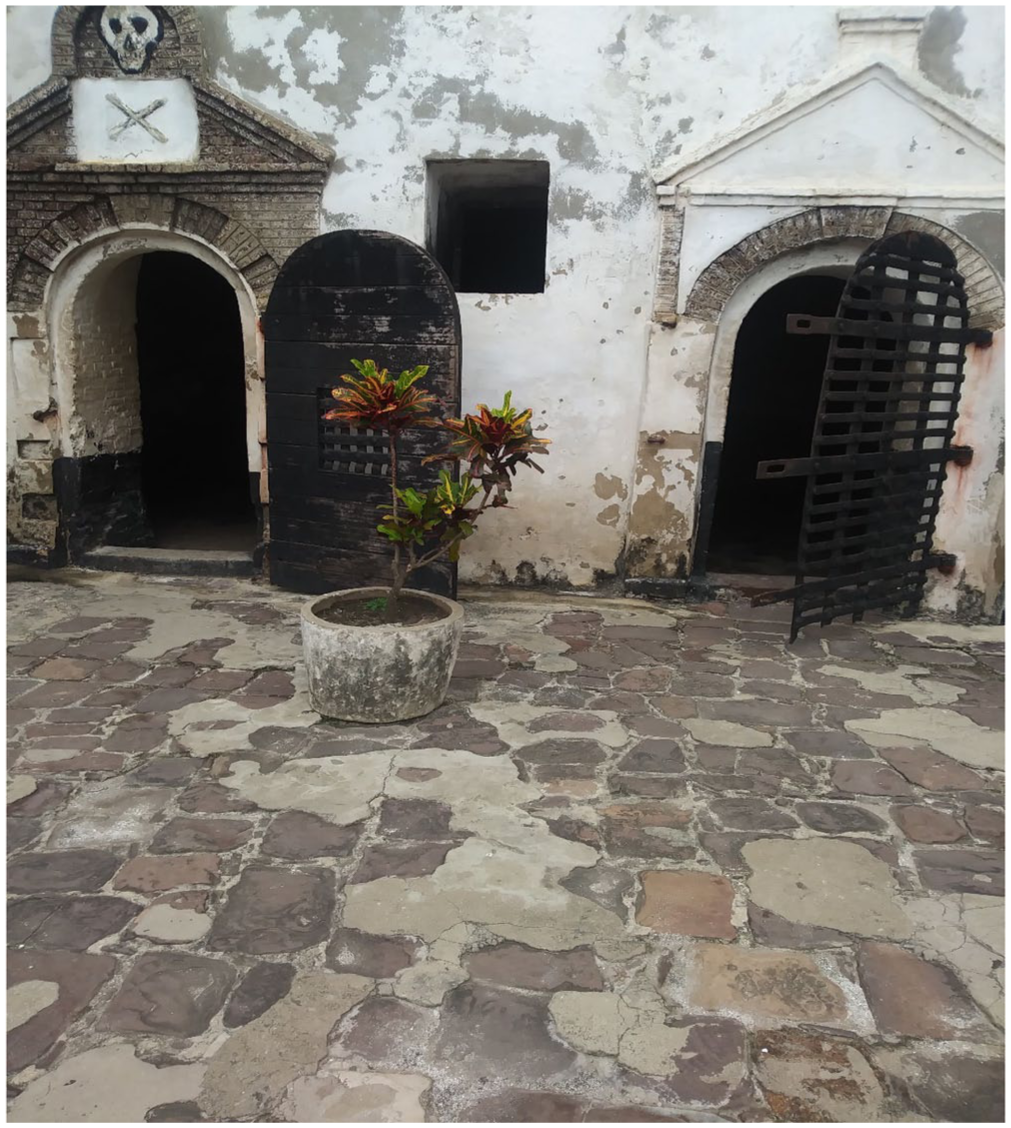
Cells for Enslaved Africans Who Resisted Their Enslavement/Subordination (the left side), and for White Soldiers on Punishment in the Elmina Castle.
This article discusses a pilot project that critically observed and analyzed the condemned cells—spaces where enslaved men labeled disobedient were sent—within the enslaved dungeons in the Elmina Castle in tandem with a focus group discussion with college students in Ghana (see Figure 2 for detail description). The article explores whether parallels exist between the role that the condemned cells played in the subordination of enslaved Africans in Ghana during the TST and the role of prisons in the United States today in the racialized mass incarceration. Condemned cells were built into the Elmina Castle over a century before the first enslaved Africans were brought to colonial North America, and over two centuries before the founding of the United States, making the Gold Coast a strategic context to understand how the American racial hierarchy was experimented. Indeed, Africa has been regarded the laboratory for the development of the methods and racialized theories that cemented structural construction of whiteness and the violence that whiteness animates including mass incarceration (Beliso-De Jesus et al., 2023). Our work is inspired by the social work of museums (Silverman, 2010) and critical heritage studies (Apaydin, 2020; Johnston & Marwood, 2017; Wellington, 2011) that view heritage sites, including slavery heritage sites, as context for interrogating how historically unjust conditions have accumulated into the present to envision structural intervention. We explore the significance of heritage and historical sites of slavery in Ghana to understanding and addressing the problem of racialized state sanctioned control in the service of white supremacy.
In the section that follows, we first provide literature linking racialized slavery to mass incarceration. Second, we present the theoretical framework, collective cultural trauma, to shed insights on racialized mass incarceration in the United States. Third, we discuss the methodology for data collection, which is followed by the results and analysis. Finally, we discuss the results, drawing implications for transdisciplinary research within a transnational context to disrupt the patterns of continuity that reproduce the racialized carceral states.
Literature Review
When compared with other countries, the United States has the highest incarceration rates (Beckett & Francis, 2020). Although incarceration rates differ by state, nearly every single state constituting the United States incarcerates more people per capita than any independent democratic state across the globe (Widra & Herring, 2021). African Americans represent only 13% of the population but constitute 37.9% of the incarcerated population (Blackett & Duquesnoy, 2020). In 2016, Black Americans comprised 27% of all individuals arrested in the United States—double their share of the total population. Black youth accounted for 15% of all U.S. children yet made up 35% of juvenile arrests in that year (Sentencing Project, 2018). Black people’s interactions with police, judges, and other officers in the legal system are informed by racialized perception of Blacks. This perception assumes Blacks are inherently criminals who need to be managed through controlled mechanisms by the justice system (M. Alexander, 2020; Armour, 1997; Hicken et al., 2021; Martinez et al., 2023). Racialized perception of Blacks accumulates over multiple stages, through case processing, prosecution, and court disposition and contributes to disproportionately negative outcomes for Black Americans (Hinton et al., 2018; Martinez et al., 2023). It is negatively associated with access to a host of life-enhancing resources such as housing, education, health, and employment, credit market, and wealth-building opportunities (M. Alexander, 2020; Beckett & Francis, 2020).
The Link Between Mass Incarceration and Slavery
Research that has investigated the association between the legal justice system in the United States and the history of racialized slavery suggests that mass incarceration of Blacks is a continuation of the racial control mechanism, necessitated by slavery and built into the various processes of the legal system: policing, procedural justice, courts, and prison (M. Alexander, 2020; Gilmore, 2000; Hinton & Cook, 2021; Martinez et al., 2023; Rigby & Seguin, 2021; G. Ward et al., 2021). Rigby and Seguine (2021) explored the association among lynching, slavery, and capital punishment in 48 states. They first examined a county-level relationship between slavery and lynching on contemporary capital punishment. This analysis significantly associated past lynching of Blacks to Blacks’s execution from 1977 to 2017. When slavery was accounted for in their model, lynching’s association with contemporary execution of Blacks became insignificant. Furthermore, upon accounting for state-level slavery, county-level slavery was no longer significantly relative to Blacks’s execution. These authors concluded that the use of capital punishment against Blacks, a form of racialized legal control and subordination, in the United States today is possibly driven by the legacy of slavery, mainly through ways by which slavery has perverted or distorted state-level institutions and culture into one of violence and anti-Black racism.
C. M. Bailey (2023) used census data of 1860 and 2000, and 2000 to 2016 Crime Report data to investigate the association among anti-Black hate crimes and slavery, and racial segregation. Using negative binomial regressions, she observed a significant relationship among anti-Black hate crimes and both slavery and racial segregation. She concluded that contemporary forms of anti-Black hate crimes are rooted in slavery and mechanized through racial segregation. In addition, her findings suggest that the opportunity for meaningful interracial group relationships that could deconstruct the notion of Black inferiority fostered by slavery is undermined by racial segregation. In a qualitative interview, Black adults involved in the criminal legal system provide a comprehensive account of the various ways that they experience subordination and abuses (Martinez et al., 2023) in ways reflective of the experiences that enslaved Africans went through during slavery.
Participants describe various ways that they were disrespected and manhandled in an inhumane condition, through a broader context, of misunderstanding, silencing, perceived bias by the police, the court, and correction officers while in jail or prison in ways that were racially motivated. Such forms of dehumanization actualize the social control function of the state over Blacks. Research on the prison boom and the persistent racial differences whereby Blacks continue to be overly represented among those serving longer sentences for nonviolent drug offenses has highlighted the link between slavery and mass incarceration (M. Alexander, 2012). Furthermore, abolitionists have used the link between mass incarceration and slavery to provide historical explanations to current imprisonment practices and to question feasibility of reform relative to mass incarceration. According to Wacquant (2002), there is a strong genealogical link between slavery and mass incarceration and that without understanding slavery, one cannot understand the timing, form, and smooth emergence of mass incarceration.
Racial slavery created a climate that promoted economic and psychological advantage linked to whiteness (although unattainable by masses of people labeled Whites). At the same time, a culture of violence grounded in perceived inferiority or inhumanity of non-whites especially Blacks was promoted (M. Alexander, 2012; C. M. Bailey, 2023; Beliso-De Jesus et al., 2023; Mills, 2022; M. Ward, 2022). In the United States, although the legal structure legitimizing institutionalization of slavery was abolished at the end of the American Civil War, leading to the emancipation of over 4 million enslaved Blacks, the political, social, cultural, and economic hierarchies generated by slavery persist (M. Alexander, 2020; C. M. Bailey, 2023; Posey, 2023; M. Ward, 2022). For over a century after slavery was abolished, Black Americans continued to serve as source of cheap labor while also enduring social, political, economic, and cultural subjugation (Posey, 2023). Through mechanisms such as the Black codes, convict leasing, Jim Crow laws, the rise of Ku Klux Klan, and de jure and de facto segregations that violently targeted Blacks continued just as they did under slavery (M. Alexander, 2020; M. Ward, 2022).
Today, Blacks are disproportionately incarcerated in slavery-like conditions in jails, prisons, or under a digital surveillance system (M. Alexander, 2020; M. Ward, 2022). This can be seen as a “reproduction of material resource and cultural conditions from a social institution despite the fact that the institution has been formally dismantled” (Ruef & Fletcher, 2003, p. 447). Related work corroborates this contention and draws on inequalities in several outcomes including poverty, occupational stratification, legal execution, police brutalities, health disparities, and many others to suggest that the legacy of slavery persists today (Gottlieb & Flynn, 2021; Levin, 2002; Posey, 2023; Virdee, 2019). While these understandings are important to highlight the continued effects of slavery in contemporary times, there is a general silence about slavery in both the public and academia in the discourse around racial inequality. There is the perceived unwillingness or hesitancy to entertain slavery as a critical context for understanding the racial hierarchy and the consequential negative impacts on racialized groups such as Blacks. Even more, in the context of nation state, TST is less entertained as an important geohistorical context for understanding the ongoing state-sanctioned carceral system and the impact on our shared humanity.
Theoretical Framework
The current study is informed by collective cultural trauma. Collective cultural trauma is a disruption in the meaning-making process accompanying phenomena such as war, genocide, and slavery. It generates an indelible mark on group identity and collective memory over time (J. C. Alexander, 2013; Hirschberger, 2018). Collective cultural trauma emerges from collective interpretations, discursive practices, memory, and identity formation (J. C. Alexander, 2013; Wang, 2008). It signifies a tear in the social fabric of that enables social life. Collective cultural trauma impairs communal bonds and requires re-narration to repair altered social relations and identities (Hübl & Shridhare, 2022; Eyerman, 2022). Within the U.S. context, the racialization of humans through the invention of whiteness is a collective cultural trauma because it altered the communal bond that existed between and among persons of African and European descents and members of Native tribe prior to the Bacon rebellion in 1676 (Battalora, 2021). Similarly, across sub-Saharan Africa, it altered the dynamic of human relationships through the TST (Shumway, 2018). The TST obstructed and distorted Ghanaians’s (and Africans’s) ability to develop their own education, economic, social, and political system by the introduction of a system that was oriented toward capture and export of human beings and dependency on Europeans (Obikili, 2016; Shumway, 2021; Shumway & Getz, 2017; Whatley & Gillezeau, 2011).
Collective memory generation relative to TST can reveal the operation and continuity of white supremacy in the racialization process (Genovese, 1976; Gill, 2021). In this way, analyzing mass incarceration today through the lens of collective cultural trauma, we can visualize the dehumanizing relationships between and among post-slavery generations. This form of critical analysis can also expose the violent racialized structures built to sustain white supremacy through the assignment of racialized incentives to masses of individuals (both non-whites and whites) within a hierarchy-based system (Battalora, 2013; Harris, 1993; Mills, 2022). One critical pathway by which the application of collective trauma reveals the patterning of white supremacy through slavery to mass incarceration of Blacks today is the law (Armour, 1997). In a racialized society, law is constitutive of the structures, processes, and strategies by which the network of the racial state’s institutions functions to uphold white supremacy across time and generations (Z. D. Bailey et al., 2021; Gee & Hicken, 2021; Ray, 2019). In this regard, by applying collective cultural trauma as a theoretical framework, we argue that there is a need for critical exploration and reinterpretation of historical racial meanings archived in social structures and institutions. Such reinterpretation has been proposed to decrease the empathy gap, fostering solidarity and responsibility toward reparative structures and practices (J. C. Alexander, 2016).
Current Study
With the contention that sub-Saharan Africa was foundation to the design and strengthening of racialized ideas, the current study uses Ghana as a pilot context to explore European fortification structures established in Ghana during the TST. The current study analyzes focus group discussion data generated through critical observations and analyses of the condemned cells (see Figure 2) within the enslaved dungeons in the Elmina Castle. We explored whether parallels exist between the role that the condemned cells played in the subordination of the enslaved Africans in Ghana during the TST and the role of prisons in the United States today in the racialized mass incarceration. The study’s design was informed by social work of museum (Silverman, 2010) and critical heritage framework (Apaydin, 2020; Johnston & Marwood, 2017) with a focus on the process over outcomes, in shaping participants’ perception about a social phenomenon (e.g., mass incarceration).
By informing the methodology with these perspectives, the article is with the understanding that the slave dungeons in Ghana as heritage sites are embedded with stories or data that are critical for understanding issues of social injustice, such as mass incarceration, and theorizing solution (Apaydin, 2020; Johnston & Marwood, 2017; Silverman, 2010). The objects, symbols, and architectural designs that characterize slavery heritage sites (e.g., Figure 2) are data that can help us enter the imaginative space of historical figures to understand ideas such as racism with which they envisioned society over time (Wilkerson, 2020). Heritage sites thus can be a site for conceptualizing social action through an interpretative process grounded in consciousness that produces praxis.
Method
Participants (N = 11; mean age: 22.3; 55% male, 45% female) were undergraduate students at a public university in Ghana. All but two students were enrolled in the Humanities. The other two were tourism and management students. Two of the participants were in their freshman year (Level 100), two were in their sophomore year (Level 200), four were in their junior year (Level 300), and three were in their senior year (Level 400). Participants were recruited with the help of two faculty members at the local university in Ghana. The first author shared the flyers and study information with the two faculty members, who then shared them with students during student organization meetings. Interested participants later contacted the faculty members to register their interest. Participants’ names are replaced with Ps (e.g., P1) to protect their confidentiality.
Data Collection
In the summer of 2019, the first author engaged participants, for 2 weeks, in a series of activities that connect the history of the TST and slavery, through engagement with the slavery heritage sites, to contemporary forms of white supremacy. First, the first author together with the participants toured two slave dungeons in Cape Coast, Ghana, that are known as World Heritage Centers—Elmina and Cape Coast Slave Castles. Second, to generate the critical dialogue, participants were engaged in a weeklong series of activities that included lectures on TST and the relationships to the present racialization experiences in the United States and Africa especially Ghana including how the Atlantic slave trade set the stage for colonialism.
Participants further engaged in viewing documentaries and movies (e.g., the 13th Documentary, and Hidden Figure movie), and discussions of themes including (a) the middle passage and slavery in the United States; (b) Jim Crow, and Civil Rights movement in the United States and the implications for Africans; (c) the contributions of African Americans to development first, in the United States, and across the globe including Ghana; and (d) the implications for Pan-African identity formation and subsequent empowerment of the people of African descent. Each participant read The New Jim Crow: Mass Incarceration in the Age of Colorblindness by Michelle Alexander (2012). Following these activities, a second visit to the slave dungeons was organized. During this visit, participants critically reflected on the connections between the design of the slave dungeons and the surrounding narratives, and racialized experiences from the discussions they had through the lectures, the readings, and documentaries, mostly from the American experience. These activities and readings were designed based on the first author’s observations about Ghanaians’s reactions to the slave dungeons, his own experience growing up in Ghana, and later schooling and doing research in the United States (see Kyere, 2024, for review). It was the exploration of a historical consciousness-raising method toward memory re-exploration and reinterpretation given memory suppression and limited understanding of Ghanaian students related to the TST (Kyere, 2024; Stabler & Owusu, 2013).
The critical dialogues generated from the activities as well as the focus group discussions were video/audio-recorded and transcribed for analysis. 2 In this article, the data are drawn mainly from the discussion generated through an experiential critical observation of Figure 2 (the condemned cell) relative to mass incarceration of Blacks in the United States that was introduced to them through the reading of the New Jim Crow and the watching of the 13th Documentary. The protocol guiding the focus group discussion was informed by the questionnaire by Savenije et al. (2014) on the heritage project with youth in Amsterdam related to reasons for preserving objects and stories of slavery. The questionnaire by Savenije et al. asked participants to show the extent to which they agree to statements related to why the history of slavery is important. Drawing from this questionnaire, participants shared their views on the relevance of the TST and slavery to persons of African descent globally, and in relation to the degree to which TST can teach us lessons toward a just future. The current article presents the findings of the observations and the critical dialogues that the participants had involving the condemned cells in relation to mass incarceration in the United States.
The study was approved by the first author’s Institutional Review Board. Before data collection, participants provided written, signed, and verbal consent. Participants were informed of the voluntary nature of the study, and their right to stop at any time during the study without any penalty. To ensure participants’ confidentiality and anonymity, all the identifying information was removed from the transcripts.
Analysis
The Sort and Sift, Think and Shift (SSTS) analytic approach guided the analysis (Maietta et al., 2021). This approach to qualitative data analysis draws on elements of several qualitative approaches including grounded theory, phenomenology, case studies, and narrative research. SSTS guides the researcher to develop an initial learning approach to data engagement in ways that suspend the researcher’s own judgment and allow data to guide the analysis process. It allows the researcher to be fully attuned to data in an iterative process (e.g., reading the transcripts and listening to the video/audio recording). For the current investigation, the first, second, and third authors first read the transcripts and did initial coding, then met to compare the codes and agreed on the larger codes. We then applied the first codes to do more close reading of the transcripts, generating subthemes, which were further compared with both the observations and notes made by the first author during the data collection. After establishing coding agreement, we individually read the transcripts applying the six strategies of the SSTS: (a) seeing the data by reading and observing the dimensions of the data; (b) thinking about the data through memoing and writing, and connecting them to the research purpose; (c) organizing the data through quote inventories; (d) comparing the data; (e) saying the data by establishing relationships; and (f) detailing the data, where emerging patterns are connected to generate narratives that capture the nuanced relationships (Maietta et al., 2021). We met again via Zoom to compare and organize the data. We then invited the fourth, fifth, and sixth authors to a Zoom meeting, describing the coding process, and gave them the data to code individually. After their individual coding, we all met via Zoom to compare and agree on the identified themes.
Findings
The findings revealed that critical engagement of historical sites such as the slave dungeons in Ghana indicates that prisons were designed to persist the racialization project that aims at intergenerational subordination of persons of African descent. More specifically, the themes generated through critical analysis of the architectural design of the cells for persons of African descent and those of European descent (see Figure 2) reveal that (a) mass incarceration mirrors racial-slavery; (b) white innocence and Black criminality that shape contemporary notions of policing and mass incarceration of Blacks in the United States are historically and structurally predefined; and (c) racism drives how justice is conceptualized and implemented.
Mass Incarceration Mirrors Racialized Slavery to Advance Intergenerational Trauma of Racism
Participants conceptualized the edifice of the slave dungeons and the various compartments as the laboratory to understand racial hierarchy. They discussed that the condemned cells visualize racialized ideas that shaped the design and structure of the conditions endured by enslaved Africans during the TST. These ideas, they conversed, drive mass incarceration of Blacks in the United States today. The quote below illustrates the discussion:
There are a lot of Black men, Black women who are arrested for dealing in drugs than the whites . . . if you look at this place [a cell for white soldiers who were on punishment, see Figure 2], there is hope because theirs have light and ventilation but this thing [referring to the condemned cell for the enslaved] you won’t go there and come back. So, there is no difference, it is their system that they practiced here. Let’s assume that this whole castle is America on its own. It is America that they have drawn here. Comparing the New Jim Crow, for example whatever that happens to the blacks in America means that whatever that we experienced here in the castle is not different from what is happening in America and Ghana. It is the same. (P1)
Similarly, another participant, in collaborating Participant 1, connected racial segregation as discussed in the activities, to argue that the slave dungeons represent laboratory for understanding the racial hierarchy that drives mass incarceration in the United States. Particularly instructive is white privilege that sometimes makes even the oppressed whites to feel like they can save racialized minorities. The quote below captures the argument:
When you look at the system in America, you see the way the Black Americans live, it is more uncomfortable for them to live there. It is just like this place [the condemned cell for the enslaved Africans], there is no light, ventilation is not there and even the ventilation you take it from the next person place but if you look at even the poor whites, at least they are comfortable, they know that they will also get to a place where they will be more comfortable but here we are, we have no hope but for them there is hope. (P3)
Relatedly, Participant 5 described the various ways by which the condemned cells were designed to dehumanize Blacks, revealing the historicity of structural racism through mass incarceration, with the following quotes:
If you look at the way and manner the condemned prisoners were allowed to die in here, it is the same as the American system, it introduces you to slow painful death, psychologically, emotional, mentally, everything and not necessarily that you die physically but you don’t count and it is the same system the condemned prisoners went through, a slow painful death and that is the same thing the American society is offering the Black Americans. (P5)
White Innocence and Mass Incarceration of Blacks in the United States Is Historically and Structurally Predefined
The next theme that emerged from participants’ critical observations and discussion of the condemned cells was that the concept of white innocence and Black criminality as seen in the overrepresentation of Blacks in the U.S. criminal systems. They argued that Black overrepresentation in the criminal justice system is more of a racial project than actual crime committed. They conversed that Blacks’s overrepresentation in the system (see Figure 1) suggests the enactment and continuity of the racial logics aimed at control with the following quote:
With this cell [condemned cell for the captured Africans], Africans are left there to die but with the white, they have the opportunity to survive. So, if you are to look at the U.S. setting you will realize that they suppressed the Blacks to the extent that they don’t have their freedom. But the whites have their freedom though they may also go through some challenges. (P2) If this structure [the condemned cells] was there before America got its independence and then after its independence you have the same parallel existing, it means that for all intents and purposes they needed to maintain what they were doing here over there but in another form . . . you could see a police or a white man shoot a Black person and when the case is sent to court the accused person says he is acting in self-defence even when the victim is 17 years old but when a black person does the same thing it is declared as murder and the person may be jailed forever . . . If it is drugs and the black person is caught taking drugs, he is taken to prison, but when a white person gets there, the story is different. (P6)
As participants discussed how the criminalization of Blacks is historically and structurally predefined, they expressed that the purpose of such practices is exploitation. It was captured by Participant 8 with others nodding in agreement:
You see the way they arrest and send us to their farms. You see the way they exploit. They take us possibly to work for them. And when they finish, they have no use of us, they either kill us or throw us away. (P8)
As the group continued their dialogue, critically revealing the historical context for understanding the overrepresentation of Blacks in the criminal system, and the sentencing disparities disproportionately experienced by Blacks, Participant 6 further demonstrated the way the condemn cells capture the realities of mass incarceration as historically and structurally defined with the following quote:
Like you have all said, when the whites misbehaved this is where they are kept. When the slaves also misbehaved this is also where they are kept, but you realize that the conditions are different but the same act of disobedience, let’s put it this way. When you go to the state and a Black American is catch doing something, the treatments are quite different, but the impression is that when both commits crimes they are punished. (P6)
Racism Drives How Justice Is Defined and Administered to Persist Racial Disparities in the Criminal Legal System
Another theme that emerged from the observations and the critical dialogue is the way racism deploys racialized meanings to define and direct the administration of justice both in historical and contemporary times. Participants connected the experiences of Blacks captured in the New Jim Crow to the design of the condemned cells to highlight the durability of racism and how it continues to restrict or deny the administration of justice toward Blacks. The following are quotes that capture the discussion:
If both commit the same crime the sentence they give to the Black is more than what they give to the white person which even proves some acts of discrimination. (P4) That even proves how Justice is administered to the Black and white in America. When a Black person does something, they will make sure they sentence that person to [more] years in prison, but when a white does the same thing, they just sentence him to [few] years and he is free. Sometimes they don’t even arrest the person because they say the person is not guilty of what he has done. (P2)
As the dialogue continued with the participants discussing how structural racism created and justified unequal conditions between the enslaved Africans and the white soldiers, in relation to the mass incarceration of Blacks in the United States, Participant 1 further stated that:
The in-depth of the punishment that will be given to one person, that is what we are considering, we are considering the fact that if Blacks committed the same offense just as the whites. . . . Right now I’m sure there will be an instance that they will catch a Black person and a white person of crime but the way of treating the Black person will be different from the white. (P1)
Furthermore, participants argued that the way racism continues to undermine equal treatment before the law based on race is a violation of human rights. They dialogued that it takes a critical scrutiny to connect the history of racialized structures and practices around policing and sentencing decisions to uncover the workings of structural racism within the institutions designed to uphold and administer just practices that respect the humanity of everyone regardless of race. The following quotes capture participants’ thoughts:
There are several issues on the surface that without deeper scrutiny and analysis you may be convinced that yes there is equality, there is equal access and all opportunity, America respect human rights, America is not racist but when you look critically at the system that they are practicing, and the system that they have erected for themselves, it doesn’t exist. America’s record of human race versus the Black race shows it all. (P5) America is claiming to be a champion of liberty, I think we should try and find out their understanding of liberty because they may have a different definition for liberty . . . you virtually created a system with legal backing that made a particular group of people subjected to certain inhumane treatment as if they were in the slave dungeons. They use the criminal justice system where a particular group of people are constantly subjected to court actions without any proper representation because when they go to court the white’s majority still takes the ultimate decision and those decisions go to enforce the charges of the police. (P6)
Discussion
Previous research has linked mass incarceration of Black/African Americans to racialized slavery (M. Alexander, 2020; Gilmore, 2000; Martinez et al., 2023; Rigby & Seguin, 2021; G. Ward et al., 2021). While the current study supports existing literature, it highlights the role of heritage sites of slavery as a critical source of data to visualize the historicity and evolution of structural racism (white supremacy) and its continuing consequences. As noted by collective cultural trauma framework (J. C. Alexander, 2013; Eyerman, 2022; Eyerman et al., 2017), the invented racial hierarchy during the 1600s to justify slavery in the service of white supremacy that demanded persons of European descent to relate to persons of African descent as sub-humans altered the social and communal bonds among masses of Europeans, enslaved Africans, and members of the Native tribe (M. Alexander, 2012; Battalora, 2013). The fact that mass incarceration mirrors the historical racialized ideas today indicates collective cultural trauma. Sub-Saharan Africa was a central context in the design and institutionalization of the race-based hierarchy that has entrenched white supremacy to drive mass incarceration of Blacks/African Americans in the United States today (Asare, 2019). Slavery heritage sites, such as the slave dungeons in Ghana, serving as sites of memory, power, and control can illuminate our understanding of how the racialized ideas can be visualized and how it has evolved into today’s mass incarceration as well as ways to disrupt it continuity.
As participants noted, the structure and conditions of the cell where the enslaved Africans were imprisoned dictated that one is permanently cut off from life (denied ventilation, light, food, relationship, freedom, etc.) which led to their premature death. Although the exact conditions that characterized the enslaved may not be imposed on the many of the Black individuals incarcerated today, the policies, practices, and structures that shape the experiences of many individuals within the carceral system, majority of whom are Blacks, lead to permanent exclusion from society. This slow painful death that the current study highlights as embedded in the experiences of the enslaved Africans at the dungeons is what M. Alexander (2012) captures to describe Blacks with felony records in terms of their exclusion from mainstream society today. These experiences can be indicated by denial of jobs, housing, education, voting rights, and, especially, the social stigma that strips many incarcerated individuals their humanity:
If you were not allowed to participate in the political system, if you were not even eligible for food stamp or welfare and could be denied housing assistance. Yet, as bad as these forms of discrimination are, many ex-offenders will tell you that the formal mechanisms of exclusion are not the worst of it. The shame and stigma that follows you for the rest of your life. That is the worst. It is not the denial of the job but the look that flashes across the face of a potential employer when he notices “the box” has been checked—the way he suddenly refuses to look you in the eye. It is not merely the denial of the housing application but the shame of being a grown man who has to beg his grandmother for a place to sleep at night. (pp. 161–162)
The narrative is that all the enslaved Africans who were thrown into the condemned cell (left side of Figure 2) died there. While today incarcerated people may not physically die while in jail, upon release, because of the felony label, they are likely to experience social and psychological isolation. Even the debt bondage that released individuals are expected to pay when they are working a low paying job, as described in the New Jim Crow by M. Alexander (2012), are forms of suffering that keep these individuals in bondage, which can deepen their isolation to increase their premature death. Furthermore, without a critical exploration of the historical and structural context, mass incarceration of Black individuals could mean that Black individuals are predisposed to committing crimes compared to white individuals. However, as revealed by a participant “If this structure[the condemned cells] was there before America got its independence and then after its independence you have the same parallel existing, it means that for all intents and purposes they needed to maintain what they were doing here over there,” White innocence and mass incarceration of Blacks have a historical and structural undercurrent.
From the perspective of collective cultural memories/trauma (J. C. Alexander, 2013), this understanding suggests that the contemporary understanding of Blacks’s disposition to criminal behavior as opposed to that of whites is a structural and cultural stigma built into our psych through racial slavery. Our ability to critically explore the history of racial slavery and reinterpret it is key to deconstructing the way Blacks have been culturally viewed as synonymous with crime. As contended, “if traumas can be re-imagined and re-presented, the collective identity will shift. There will be a searching re-remembering of the collective past, solidarity can be expanded, and much needed civil repairs can be made” (J. C. Alexander, 2016, p. 95).
The current study also suggests that structural racism that is built into the foundation of society, operates through its institutions (e.g., housing, education, prison, and police), and are mechanized through individual actors who inhabit these institutions (Feagin, 2020; Young, 2011). Racialized institutions, although they function to orient the individual actors who inhabit them to exert the effects of racism, also operate outside of individual actors (Rosa & Díaz, 2020). Therefore, without structural reconfiguration of our institutions from the template modeled after racial slavery, the criminal justice system and its various institutions will continue to operate in ways that disproportionately disadvantage Blacks. While individuals who inhabit institutions such as the police, the court, and the legal system need to be aware of the cultural and racial biases, it is more important for them to understand the historical and structural roots of such biases and the pathways these individuals come to embody and transmit these racial biases on their historically designed targets (who tend to be mostly racialized minorities, especially Blacks). Our findings thus provide a context for understanding the present by showing that the present is the continuity of history (we cannot understand today without history, and without a better understanding of today, we miss the opportunity to reimagine the future).
Furthermore, the current findings suggest that heritage sites of slavery such as the slave dungeons in Ghana (and sub-Saharan Africa) are constitutive of data that can help us understand mass incarceration and other forms of racialized violence to imagine a just future (Samuels, 2019). In discussing the potential link between the reasons (resistance to enslavement, and deterrents to more forms of resistance) by which enslaved Africans were sent to the condemned cell compared to the reasons for the white soldiers, participants argued that in a racialized system, how justice is defined and administered upholds white supremacy: When Whites misbehaved this is where they are kept. When the slaves also misbehaved this is also where they are kept but you realize that the conditions are different but the same act of disobedience. Our participants suggest that mass incarceration through the prison system is an important mechanism to understand how racial slavery has been modified to achieve the political and economic interest of the racial state (M. Alexander, 2012; Armour, 1997; Mills, 2017). Contemporary social and political structures, grounded in liberalism, that we may view as the causes of social problems such as mass incarceration may therefore be evolving consequences of the historically designed structures (Mills, 2017; Ndlovu-Gatsheni, 2014) like racial slavery (M. Alexander, 2012).
To excavate the dynamics and the operation of such structures as well as the pathways they evolve and disrupt them, heritage sites that contain edifices and narrative of history of racial slavery need to be engaged (Reid, 2022; Wellington, 2006, 2011). Heritage sites reflect a mirror by which society “holds up to itself, to understand itself, but especially to understand and manage social change” (pp. 123–124). Collective cultural framework through heritage sites can foster the mobilization of the forces (e.g., collective understanding, solidarities, motivation, and consciousness) that drive social change (J. C. Alexander, 2016). As the current findings reveal, heritage sites help to visualize and conceptualize power dynamics, conflict, and structures of dehumanization. They can also help us imagine and develop potential models and pathways to heal from past trauma that characterize society (Johnston & Marwood, 2017; Samuels, 2019). As depicted in Figure 2, and consistent with the literature, exploration of how the violence of white supremacy has evolved through slavery, lynching, Jim Crow, and ongoing racism highlights processes by which racial hierarchization fosters racial group identity and establish group boundary that continue to shape the racialization project today (Smångs, 2016; G. Ward et al., 2021). One example is segregation in both residential and occupational settings, which render Black people as well as other marginalized racialized groups highly vulnerable to police brutality, harassment, economic and political subordination, impoverished health, and imprisonment (M. Alexander, 2012; C. M. Bailey, 2023; M. Ward, 2022; Wildeman & Wang, 2017; Williams et al., 2019).
Implications
The current findings suggest that critical consciousness around slavery from an Atlantic perspective is urgently needed to prepare current and future generations of our society to disrupt the persistence of structural and social violence rooted in the past. Most of our conversation around the impact of white supremacy in contemporary times has not paid adequate attention to the critical role of Africa as an important context not only to understand the historical and structural root and processes to it entrenchment, but also to theorize social justice-oriented action toward a transformative society. In particular, the role of the TST in altering indigenous institutions and practices and setting the stage for colonial racial project (Asare, 2019; Pierre, 2012; Shumway, 2018) which resulted in epistemic invasion and the embodiment of harmful colonial ideas, structures, and practices that are self-destructive (Fanon, 1963; Ndlovu-Gatsheni, 2018). The condemned cells (Figure 2), from which the current study was conceptualized, are part of the forts and castles used to incarcerate captive Africans prior to transport across the Atlantic. They are part of the collective memory of forced migration, detainment, enslavement, and resistance (Engmann, 2022). Approximately, 80 to 100 of such lodges, forts, and castles were constructed along the Guinea/Gold Coast in present-day Ghana dating as far back as the 15th century (Engmann, 2022). They offer visual display of how racial slavery practices uphold human hierarchization and are rooted in historical and structural construction of social conditions and how they endure across generations (Simko, 2021). Additionally, they offer opportunity for a deeper understanding of mass incarceration and with such understanding, potentially for generating ideas toward structural changes.
Social work practice is grounded in the person-in-environment context and suggests that human behavior must be assessed and intervened with an appropriate understanding of the context and the contextual forces that are critical to the persistence or disruption of the problem (Cornell, 2006; Kondrat, 2013; Weiss-Gal, 2008). In the case of mass incarceration, because it is networked with other systems of the racial state (e.g., education, housing, employment, and welfare benefits; M. Alexander, 2012), it impacts families and communities that social workers are most likely to work with.
In practice with families, practitioners have applied genogram as an assessment and fact-finding tool, and as a process in making meanings of the current pattern of reality through knowledge of historical and intergenerational processes (McCullough-Chavis & Waites, 2004; McGoldrick & Carter, 2005; Walton & Smith, 1999). Scholarship on intergeneration trauma suggests that the use of genogram from an ecosystemic framework may provide a comprehensive assessment of patterns of historical oppression and the intersection with contemporary manifestations of oppression (Goodman, 2013). We argue that social workers can apply the rationale behind the genogram to inform macro-level practice by excavating historical knowledge and data related to structural racism to develop a diagnostic mechanism that can position social workers to be effective in disrupting and dismantling mass incarceration. To be effective in assessing and designing prevention and intervention models that engender the needed changes, social workers need to understand the structural and historical roots. With such understanding, and informed by historical thinking, heritage practices like the social work of museum, and frameworks like collective cultural trauma, social work can creatively design intervention and prevention strategies such as trauma-drama, documentaries, storytelling, and reflective practices to engender collective compassion, empathy, moral responsibility, and solidarity for justice (J. C. Alexander, 2016; Silverman, 2010). Critical engagement with heritage sites such as the slave dungeons in sub-Saharan Africa or plantation sites can help us identify concealed data for effective assessment of structural racism such as mass incarceration to develop effective macro-level intervention. One of the ways to help social workers to do that is to experientially expose them to such historical and heritage sites to help them visualize the workings of structural forces in the construction of racial conditions and engage them to critically re-envision conditions and structures that uphold human dignity and advance social and racial justice.
Limitations
There are some limitations that must be noted. First, this study is part of a pilot project that sampled 11 participants from Ghana to explore the relevance of the history of TST to understanding contemporary inequalities (Kyere, 2024). The current findings must therefore be interpreted within this context. Second, the participants are Ghanaian college students. The perspectives of the sample participants may not directly relate to the experiences of African Americans in the United States today. However, upon introduction to the narratives surrounding mass incarceration today and experiential exposure to the form and structure of racial violence that has provided the template for understanding mass incarceration, participants were able to establish such striking parallels. The implication is that context that facilitates collective trauma construction related to TST and slavery can engender critical view of structural and historical roots of racism. Such consciousness can generate collective agency and solidarity toward the effective disruption of structural injustices including mass incarceration.
Furthermore, although the current ethnicization process in Ghana, blanketed by local customary practices, is grounded in the European racialization project (Pierre, 2008, 2012), the overt racialized violence that shaped the relationship between Europeans and Africans in Ghana during TST and the colonial era no longer exists in Ghana compared to the United States. Therefore, the data must be interpreted with caution when compared with individuals with proximity to mass incarceration in the United States. However, our findings suggest that people do not necessarily have to have direct experience to be able to conceptualize the reality of racial slavery and how it has been morphed into the current. Rather, our ability to creatively integrate historical data and memory processes into social science methodology can enhance our efforts to generate relevant data that can deepen our understanding of the mechanisms by which the unjust institutional structures and practices such as racial slavery continue to drive racial inequalities in the carceral system.
Footnotes
Disposition editor: Cristina Mogro-Wilson

Funding
The authors disclosed receipt of the following financial support for the research, authorship, and/or publication of this article: The research from which the manuscript was developed was supported by the IU School of Social Work Center for Social Health and Well-being.
Declaration of Conflicting Interests
The authors declared no potential conflicts of interest with respect to the research, authorship, and/or publication of this article.