







Abstract
The association between frequent bullying victimization and delinquency during preadolescence, a critical period for future violence prevention, is understudied for children facing cumulative risks. Single-parent household structure and poverty are established contributors to delinquency. Guided by General Strain Theory and using secondary data from the Future of Families and Child Wellbeing Study, this study examined whether child-reported peer bullying victimization (4-item index) was associated with early delinquency, controlling for key covariates, among 1,414 children (age ≈ 9–10) living in disadvantaged, single-mother households. Findings from the path analysis revealed that as bullying victimization intensified, early delinquency increased (β = .291, p < .001). These findings suggest that school-based trauma-informed policies and practices, such as teaching immediate emotional regulation skills for victims in disadvantaged households, are crucial for mitigating the transition from victimization to delinquency, especially during preadolescence.
Keywords
Introduction
Peer bullying victimization is a serious global health problem that affects millions of children annually (Centers for Disease Control and Prevention [CDC], 2021). Peer bullying victimization is characterized by a youth’s repeated exposure to physical, verbal, and/or relational aggression by one or more perpetrators who possess a power advantage over the victim (CDC, 2021). The consequences of bullying victimization can be short- or long-term (Wolke & Lereya, 2015); adverse outcomes include poor mental health (Hong et al., 2019), dysregulation of the stress response (Vaillancourt et al., 2013), unhealthy social relations (C. B. Evans et al., 2014), engagement in risk behaviors (Smalley et al., 2017), and suicide (Lardier et al., 2016), which is a leading cause of death among children 5 to 14 years of age (Wonder, 2017).
Parenting and familial characteristics, including poor parenting behavior, family structure (i.e., single-parent home), and low SES (e.g., poverty), are associated with children’s increased risk of being bullied and engaging in delinquent behavior (D’Urso et al., 2021; Kroese et al., 2021; Lereya et al., 2013; Tippett & Wolke, 2014; Zhang et al., 2020). While the increasing prevalence of bullying and its consequences carries a significant societal impact, research specific to this problem among disadvantaged single mothers is lacking. Of the estimated 11 million single-parent households, 80% were headed by mothers, with nearly one in three single female-headed homes living in poverty (National Women’s Law Center [NWLC], 2021; U.S. Census Bureau, 2019). Moreover, approximately three in five poor children lived in a home headed by a single mother in 2019 (NWLC, 2021), with a disproportionate number of racial/ethnic minority children represented in these economically disadvantaged family structures. Unfortunately, this pattern of concentrated poverty in single-mother households has remained relatively stable for a decade (between 55% and 60% from 2009 to 2019; NWLC, 2021). Compared to other family structures, single mothers face unique challenges, including lower household incomes, increased economic hardships, food insecurity, fewer resources for child educational expenses, insufficient child care and health care, and fewer embedded social support networks (Barnhart et al., 2020; Lino et al., 2017; Middlemiss, 2003; US Census Bureau, 2018). Children raised in these homes have higher risks of negative consequences, including poor health, psychological problems, externalizing behaviors, child maltreatment, and victimization compared to peers living in homes with married parents (Berger, 2004; Dodge et al., 1994; Scharte et al., 2013; Turner et al., 2007). These cumulative disadvantages may heighten vulnerability to interpersonal violence, including bullying, among single-parent families.
Extant literature suggests that bullying victimization is associated with delinquency (Cullen et al., 2008; Moore et al., 2017; Reijntjes et al., 2011). However, most research on bullying victimization has focused on behavioral outcomes in late adolescence, despite evidence that bullying is most prevalent during earlier grade levels and declines with age (Ladd et al., 2017; Zhang et al., 2020). Preadolescence, generally defined as ages 9 through 12, is a period of substanial developmental change, including shifting peer relationships and evolving family dynamics (Gilmore & Meersand, 2013; McNeely & Blanchard, 2009), making it an important but understudied window for bullying behavior links.
Among the few studies examining the relationship between the frequency of bullying victimization and early delinquency (ED) in this developmental stage, a significant association between the two has been reported (Rusby et al., 2005; Sapouna & Wolke, 2013; Zhang et al., 2020). These studies suggest that a stress-response pattern may exist, wherein preadolescents adopt ED—conceptualized here as a constellation of antisocial behaviors including property damage, interpersonal violence, and substance use—as a maladaptive coping mechanism to alleviate the strain of frequent peer victimization (Rusby et al., 2005; Sapouna & Wolke, 2013; Zhang et al., 2020). While these associations are documented, extant research has frequently limited the measurement of bullying victimization to binary categories, comparing frequent victimization to little or none (Rusby et al., 2005; Zhang et al., 2020). Consequently, research specific to the association between the frequency of peer bullying victimization (FPBV) and delinquency during the earliest years of adolescence remains limited.
General Strain Theory (GST) provides a unique framework for understanding the relationship between childhood stressors, such as bullying, and poor child adjustment. Strains are adverse conditions or experiences that are disliked, such as the presence of negative stimuli (e.g., peer mistreatment/abuse). GST posits that strains, especially those that are frequent, incite negative feelings (e.g., anger, frustration) to which victims cope via delinquent behaviors to alleviate such stressors (Agnew, 1992, 2001). Agnew (2001) highlighted that peer abuse, such as being bullied, is a major source of strain for children, affecting their ability to cope positively, and is an area that warrants further exploration. Childhood disadvantages, such as growing up in poverty and in a single-parent household, also contribute to maladaptive coping (G. W. Evans & Kim, 2013). Thus, experiencing bullying alongside family adversities, such as poverty and single-mother household structure, may increase children’s stress and risk of coping negatively by responding in disruptive and harmful ways.
The Current Study
Despite growing attention to the influence of parental risk factors on child behavior, no study to date has investigated the association between FPBV and delinquency during the earliest years of adolescence among U.S. children residing in disadvantaged, single-mother households. Further, because more recent bullying studies conclude that experiences of bullying victimization tend to decline as grade level increases (Ladd et al., 2017; Zhang et al., 2020), the current study aims to add to the literature by focusing on preadolescent bullying victimization among economically vulnerable families. By developing a better understanding of the relationship between bullying victimization and delinquency in preadolescence, this study can potentially identify youth at risk for early delinquent behavior within high-risk social contexts. Within the context of a direct effect model based on GST, we hypothesize that increased exposure to frequent peer bullying victimization is associated with greater ED among children residing in impoverished single-mother homes.
Method
Participants and Procedures
Data were derived from the Future of Families and Child Wellbeing Study (FFCWS), a birth-cohort study of approximately 5,000 children born to unmarried parents in 20 large U.S. cities with populations of 200,000 or more. Non-marital births were oversampled to better understand the condition of parents, the well-being of children, and how these families fared over time. Using stratified random sampling, strata consisted of (a) cities, (b) hospitals within cities, and (c) births within identified hospitals. Mothers and fathers were recruited in hospitals between 1998 and 2000 following the birth of the study’s focal child, from whom consent was obtained at baseline. Parent(s) and focal children were followed up at children ages 1 (Wave 2), 3 (Wave 3), 5 (Wave 4), 9 (Wave 5), and 15 (Wave 6). For the first time in the FFCWS, child interviews were conducted at Wave 5, with assent obtained at subsequent waves. Mothers and children were compensated for their participation (for study design details, see Reichman et al., 2001). FFCWS received IRB approval and consent from all hospital sites.
The current study used publicly available de-identified data from the fifth wave of the FFCWS, when the focal child was 9 years of age, following an approved written request to the FFCWS Office of Population Research. These data are suitable for examining the study’s research questions because of its design and oversampling of unmarried parental births from large cities, historically characterized as having highly concentrated poverty (Kneebone, 2014). Given the current study’s focus, we selected an analytic sample of 1,414 focal children (Mage in months = 112.95, SD = 4.73, equivalent to a mean age of 9.41 years) residing with single (unmarried) mothers whose household incomes were between 0 and 199% of the federal poverty level.
Measures
Frequency of Peer Bullying Victimization
Frequency of Peer Bullying Victimization (FPBV) was assessed by gauging the extent to which children experienced peer aggression. Four items assessed peer bullying victimization and were adapted from the Panel Study of Income Dynamics Child Development Supplement (PSID-CDS-III). Item response choices were slightly altered from a 6-point Likert-type scale (not in the last month (0), one or two times in the last month (1), about once a week (2), about 2 or 3 days per week (3), almost every day (4), or every day in the past month (5)) to a 5-point Likert-type scale in FFCWS (Bendheim-Thoman Center for Research on Child Wellbeing, 2018). Children self-reported how often in the past month school or neighborhood peers had (a) taken their things, (b) hit them, (c) teased them, and (d) excluded them from activities using a 5-point Likert-type scale. Responses included “not once in the past month = 0,” “1–2 times in the past month = 1,” “about once a week = 2,” “several times per week = 3,” and “every day = 4.” Items were summed to create an index of FPBV ranging from 0 to 16. The scale had adequate internal consistency (α = .69; see Table 1), with higher scores indicating greater victimization.
Descriptive Statistics and Bivariate Correlation Matrix.
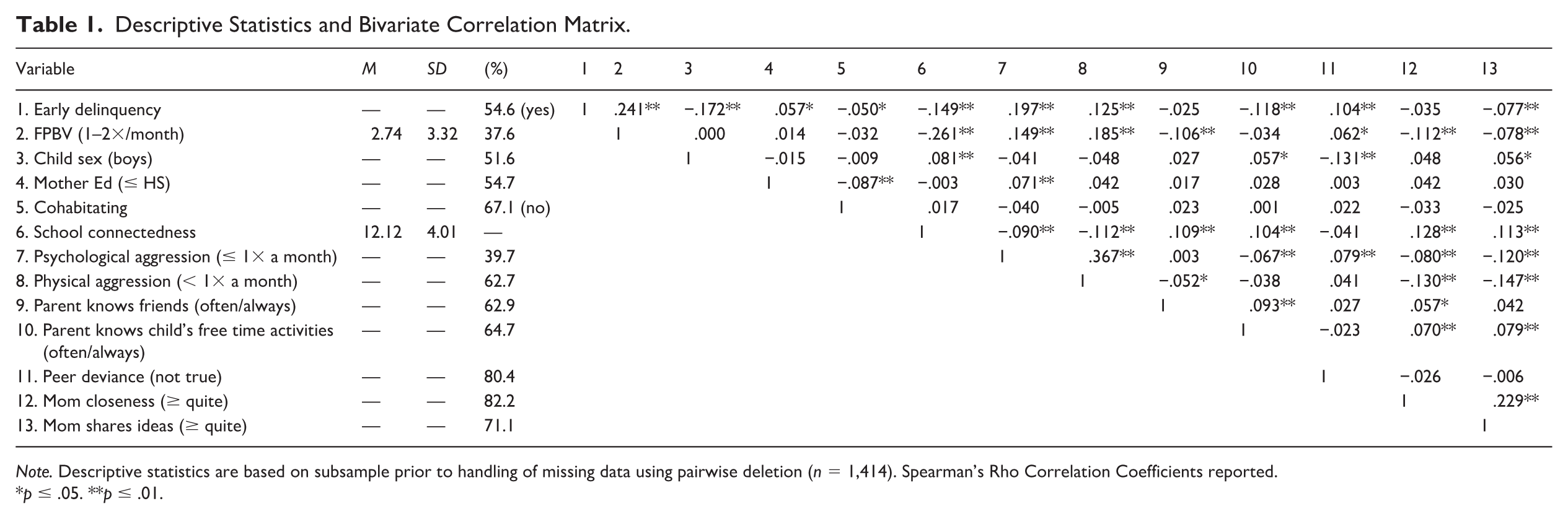
Note. Descriptive statistics are based on subsample prior to handling of missing data using pairwise deletion (n = 1,414). Spearman’s Rho Correlation Coefficients reported.
p ≤ .05. **p ≤ .01.
Early Delinquency
Early Delinquency (ED) was assessed using 17 items modeled after the validated Things That You Have Done scale (TTYHD). The TTYHD scale, derived from the National Longitudinal Survey of Youth, measures general delinquency and subcategories of delinquent behavior in childhood, including physical aggression and substance use (Maumary-Gremaud, 2000). General delinquency was used in the current study, rather than the subscales, because of their zero-inflated and extremely positively skewed distributions (Maumary-Gremaud, 2000). Children answered questions regarding their delinquent behavior in the past 12 months using a binary response of yes (1) or no (0). Sample items included “taken or stolen something,” “had a fistfight with another person,” “smoked marijuana, grass, pot, weed,” and “been suspended or expelled from school.” Items were first summed to create a continous score (α = .70), and then dichotomized into those who did not (0) and did engage in at least one delinquent act (1). As recommended for analyses (Maumary-Gremaud, 2000), this dichotomized scoring was utilized as it was deemed appropriate for children in this age range and is consistent with other studies using FFCWS data measuring ED (Park et al., 2020; Zhang et al., 2020).
Covariates
Research suggests that several other factors across individual, familial, and school contexts are associated with delinquency. For example, studies have found that peer deviance (Piquero et al., 2005), aggressive parental discipline (e.g., physical and verbal abuse/aggression, S. Z. Evans et al., 2012; see meta-analysis by Gershoff & Grogan-Kaylor, 2016; Won et al., 2025), and poor parent-child bonds/relationships (see meta-analyses by Hoeve et al., 2009, 2012) are key predictors of child delinquent and externalizing behavior, whereas parental monitoring is a key protective factor for delinquency (see meta-analysis by Hoeve et al., 2009). While research concludes school connectedness decreases delinquency (Bolland et al., 2016; Bond et al., 2007; Chen et al., 2016; Wilkins et al., 2023), studies also suggest a strong school connection is protective against bullying victimization (Eugene et al., 2021; McCabe et al., 2025), even during the early years of adolescence (7–12 years of age; Eisenberg et al., 2003). Moreover, bullying research concludes that maladaptive parenting increases the risks of bullying victimization (see meta-analysis by Lereya et al., 2013), while the quality of the relationship between children and their mothers (see meta-analysis by Lereya et al., 2013), as well as parental monitoring (Lereya et al., 2013; see meta-analysis by Grama et al., 2024), may function as significant protective factors in safeguarding children from such experiences.
Other key factors that have been associated with both delinquency and bullying victimization include parental educational attainment (Jansen et al., 2012) and children’s biological sex, with boys more likely to engage in ED (Lucero et al., 2015) and to be victims of bullying (Nansel et al., 2001) when compared to girls. However, emerging research suggests that these prevalence rates may vary depending on the specific type of bullying victimization experienced (Carbone-Lopez et al., 2010; Thomsen et al., 2024; Wang et al., 2009). Accordingly, the model regressed child sex, maternal education, maternal cohabitation status, parental monitoring, maternal disciplinary practices, mother-child relationship quality, and school connectedness on both ED and FPBV. Peer deviance was specified as a predictor of ED only, consistent with literature supporting its role in delinquency but not in victimization risk.
Maternal disciplinary practices were assessed with two items measuring (a) maternal psychological aggression (frequency mom shouted, yelled, screamed, cursed, or swore at focal child) and (b) physical aggression (frequency mom spanked/hit focal child), with focal child self-reported response options of (0) never, (1) less than once/month, (2) once or a few times/month, (3) few times/week, and (4) every/almost every day. Responses for both items were collapsed into a binary measure of “no, never” (0) and “yes, less than once a month to every/almost every day” (1). Mother-child relationship was assessed via focal child self-reports on two items: (a) how close the focal child is to their mother, and (b) whether they communicated/shared ideas well using a scale with responses for both items including (1) extremely close/well, (2) quite close/well, (3) fairly close/well, and (4) not very close/well, which were then dichotomized into two binary items consisting of quite to extremely close/well (1) and fairly to not very close/well (0). Parental monitoring was assessed using two items gauging (a) children’s knowledge of whether their primary caregiver knew the friends they spent their free time with, and (b) what they did with their free time, with focal child responses to both items including (0) never, (1) sometimes, (2) often, and (3) always. These responses were collapsed into two binary items consisting of never to sometimes (0) and often to always (1). Peer deviance was assessed using a binary measure asking mothers if “focal child hangs out with others who get into trouble,” with responses of (1) not true, (2) somewhat or sometimes true, and (3) very true or often true being collapsed into a binary measure of (0) not true and (1) somewhat/sometimes to very/often true. Connectedness at school assessed the degree to which focal children felt connected to their school environment using a 5-point Likert-type scale ranging from 0 (not once in the past month) to 4 (every day). The four items consisted of “how often did you feel like you were part of your school?”, “how often did you feel close to people at your school?”, “how often did you feel happy to be at your school?”, and “how often did you feel safe at your school?”, with higher scores indicating greater connectedness to school (α = .69). Sociodemographic covariates included child biological sex (0 = Boy, 1 = Girl), maternal educational attainment (0 = ≤HS, 1 = some college or more), and maternal cohabitating status (0 = non-cohabitating, 1 = cohabitating).
Analytical Strategy
Missing Data
Frequencies and descriptive statistics were first examined in SPSS 28 to screen for missing data for each variable. Less than 10% of cases had missing information across all variables, with child self-reported data accounting for almost all missing cases (missing ranged from 6.1% to 10%). Next, missing data were handled in Mplus 8.6 using pairwise deletion, the default when using the weighted least squares mean- and variance-adjusted estimator (WLSMV), which is most appropriate when modeling categorical outcome data. Covariance coverage of data was then examined in Mplus 8.6 to evaluate the proportion of missingness to ensure unbiased model parameter estimates. The proportion of data present for pairwise combinations ranged from .982 to .996, indicating the proportion of missingness among the retained sample was relatively small. A total of 310 cases were eliminated, leaving a final analytical sample of N = 1,414.
Statistical Analysis
Pre-analysis screening was conducted in SPSS 28 to test the analytical assumptions of multicollinearity. Multicollinearity was not evident among the predictor variables (tolerance statistics ≥ .95 and VIFs ≤ 1.06; Craney & Surles, 2002). Next, descriptive statistics were conducted, followed by a bivariate correlation analysis in SPSS 28 to determine whether FPBV and ED were statistically significantly correlated. Finally, a multivariate path analysis was performed in Mplus 8.6 to examine the association between FPBV and ED among children living in impoverished single-mother homes. To ensure a rigorous test of this association and to address potential omitted variable bias, the model controlled for several factors across various contexts, including school connectedness, maternal psychological and physical aggression, parental monitoring, mother-child relationship quality, and peer deviance. In addition to controlling for key confounding variables on the endogenous variable, we also regressed the child’s sex, mother’s educational attainment, cohabitating status, maternal psychological and physical aggression, parental monitoring, and mother-child relationship quality on FPBV, the exogenous variable.
Results
Table 1 displays descriptive statistics and bivariate correlations for all study variables. Descriptive data indicated there were 51.6% boys in the sample, 37.6% of the sample reported experiencing at least one, and 54.6% of the sample reported engaging in at least one delinquent behavior. Most children (67.1%) lived with mothers who were not cohabitating, and had mothers who reported lower educational attainment (54.7% had ≤ high school or equivalent education).
The bivariate correlation analysis indicated a statistically significant positive correlation between FPBV and ED (r = .241, p < .001). Being a girl was negatively correlated with ED compared with being a boy (r = −.172, p < .001), though no significant sex differences were found for frequency of bullying victimization (p > .05). Cohabitating with a partner or child’s father (r = −.050, p = .05), school connectedness (r = −.149, p < .001), parental monitoring in which mothers knew what their children did during their free time (r = −.118, p < .001), and maternal–child relationship quality of the focal child sharing ideas with their mom quite to extremely well (r = −.077, p = .002), all were negatively correlated with ED, though all the correlations were weak. Higher maternal educational attainment (r = .057, p = .021), maternal psychological (r = .197, p < .001) and physical aggression (r = .125, p < .001), and peer deviance (r = .104, p < .001) were positively correlated with ED, although weak correlations exist. Maternal–child relationship quality of the focal child feeling quite to extremely close to their mother (r = −.035, p = .169) and parental monitoring of which friends their children hung out with (r = −.025, p = .320) were not statistically significantly correlated with ED.
The path model yielded an excellent fit (χ2(2) = 0.686, CFI = 1.000, TLI = 1.000, RMSEA = 0.000 [90% CI = [0.000, 0.066], SRMR = 0.005). All the parameter estimates are interpreted using regression estimates (see Figure 1). Supporting the hypothesis and GST, a 1-point increase in FPBV was associated with a .291-unit increase in ED (p < .001), controlling for individual, family, and school factors. Regarding controlled variables regressed on ED, maternal psychological aggression (β = .170, p < .001) and peer deviance (β = .147, p < .001) were associated with an increase in ED. Conversely, a 1-point unit increase in connectedness at school was associated with a .079 unit decrease in ED (β = −.079, p = .020) and mothers who were aware of their child’s activities during free time (β = −.114, p = .002) and mother-child relationships characterized by communication ranging from quite to extremely well (β = −.070, p = .047) were associated with a decrease in ED. Consistent with the bivariate correlation analysis results, girls reported significantly lower levels of ED than boys (β = –.061, p = .048). Mother-child closeness, maternal cohabitating status, maternal education, and maternal psychological aggression were not significantly associated with ED (p > .05).
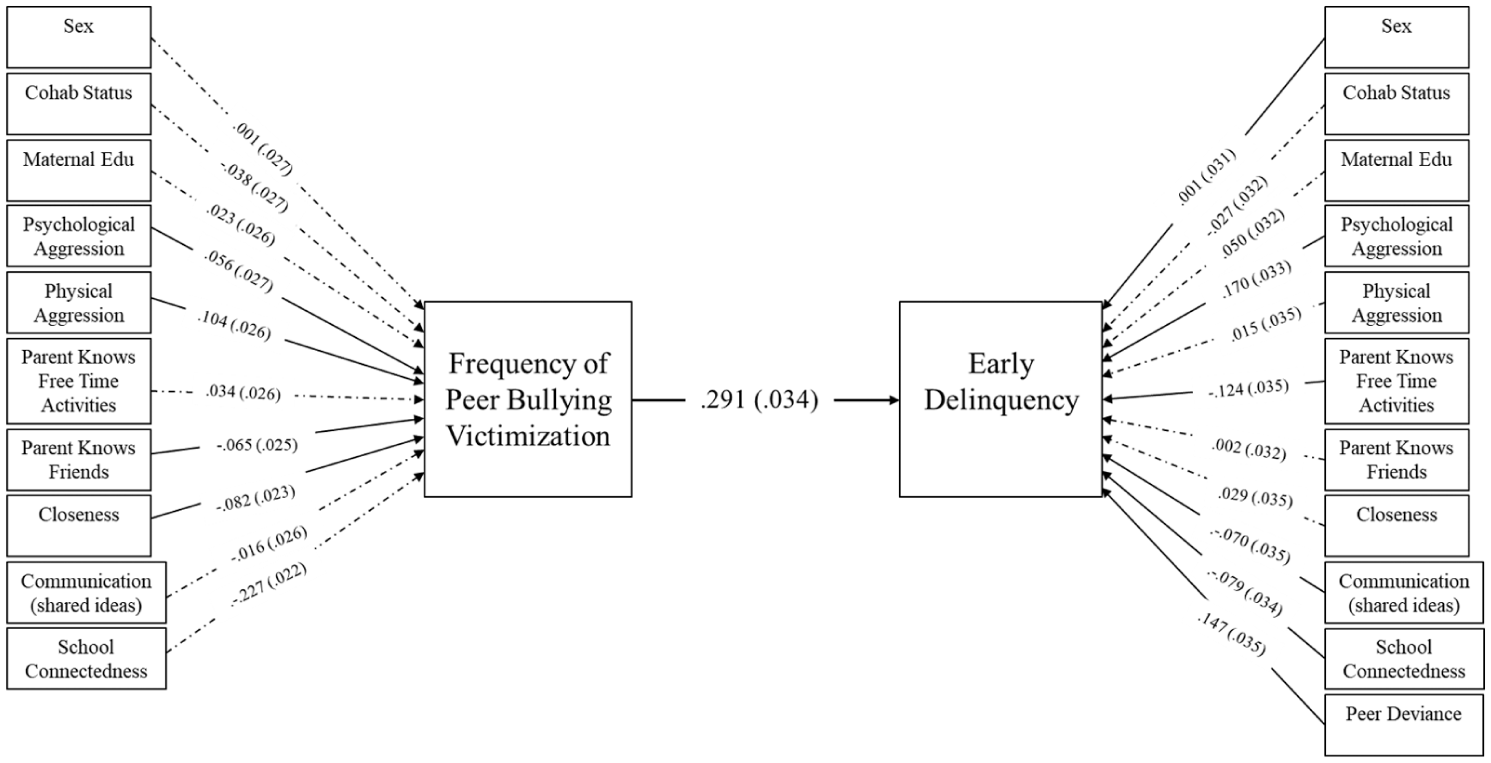
Frequency of Peer Bullying Victimization and Early Delinquency
Regarding controlled variables regressed on FPBV, maternal psychological aggression (β = .056, p = .040) and physical aggression (β = .104, p < .001) were associated with an increase in FPBV, whereas a 1-point unit increase in connectedness at school was associated with a .227 unit decrease in FPBV (β = −.227, p < .001). Parental monitoring of knowing focal child’s friends they hang out with during their free time (β = −.065, p = .009) and mother-child closeness (β = −.082, p < .001) decreased FPBV. Child sex, mother-child communication, and maternal cohabitating status and education were not significantly associated with FPBV (p > .05).
Discussion
Our findings suggest that as FPBV intensified, the magnitude of ED among children living in disadvantaged single-mother households also increased. Consistent with earlier U.S. findings on the frequency of child peer bullying victimization and early adolescent delinquency in this age group (Zhang et al., 2020), this study further emphasizes that such unique social contexts likely facilitate undesirable outcomes among children in high-risk families (G. W. Evans et al., 2013). Delinquent coping may be especially common among these children because they tend to have less positive coping strategies and the inability to escape their stressful environments (Brown, 2004). Viewed through the theoretical lens of GST, these findings illustrate how chronic exposure to negative stimuli, such as frequent peer bullying victimization, operates as a profound strain that overwhelms a child’s threshold for adversity (Agnew, 1992, 2001). Because children in socioeconomically vulnerable single-parent homes often face systemic and familial stressors that constrain their access to conventional, prosocial coping mechanisms, they may adopt early delinquent behaviors as a maladaptive strategy to mitigate the distress and frustration generated by frequent victimization (Agnew, 1992, 2001; Brown, 2004; G. W. Evans & Kim, 2013; G. W. Evans et al., 2013). Moreover, single mothers who experience multiple social and financial hardships may have more challenges providing supportive parent-child interactions and fewer available resources to address bullying victimization and any resulting traumatic experiences.
Consistent with prior literature on delinquency in early adolescence, we found that girls exhibited a significantly lower level of ED compared to boys (Lucero et al., 2015). However, sex differences in FPBV did not emerge, suggesting that boys and girls in this sample experience bullying at similar rates. Moreover, it is also plausible that disparities in the types of bullying victimization between boys and girls, rather than the frequency of exposure, may offer more insightful information concerning sex variation in victimization (Carbone-Lopez et al., 2010; Thomsen et al., 2024; Wang et al., 2009).
In accordance with previous research, school connectedness acted as a protective factor for both FPBV and ED (Bolland et al., 2016; Bond et al., 2007; Chen et al., 2016; Eisenberg et al., 2003; Eugene et al., 2021; McCabe et al., 2025; Wilkins et al., 2023). Within the GST framework, social bonds and reliable support systems function as critical conditioning factors that buffer the detrimental impact of strain (Agnew, 1992). Thus, possessing strong attachments to caregivers or feeling well integrated into the school environment supplies the essential emotional resources needed to manage the strain of bullying, thereby diminishing the likelihood of preadolescents utilizing ED as a compensatory coping mechanism. Although maternal psychological and physical aggression were linked to higher instances of FPBV, only maternal psychological aggression was associated with greater ED. This may suggest that while both forms of harsh parenting increase risks for victimization, psychological abuse may have a more profound and likely unique impact on delinquent behavior, especially among younger, developing children. Furthermore, research indicates that psychological aggression presents a greater risk for adverse psychological outcomes compared to physical aggression (Miller-Perrin et al., 2009). Considering this, it could also be that psychological aggression may operate indirectly through emotional distress or adverse psychological outcomes, thereby increasing the risk of ED.
Specific types of parental monitoring were differentially associated with FPBV and ED: Knowing which friends children hang out with was associated with lower FPBV but not with ED, whereas knowing what children do in their free time was associated with lower ED but not with FPBV. These findings point to specific parental monitoring strategies that may differentially decrease risks for youth perpetration and victimization. Maternal relationship factors were also differentially associated with the two outcomes: closeness was associated with lower FPBV but not ED, whereas communication characterized by sharing ideas was associated with lower ED but not FPBV. These asymmetric patterns may reflect the different mechanisms through which each relational dimension operates. Closeness likely fosters emotional competence that is observable to peers, reducing a child’s vulnerability to targeting regardless of whether bullying is ever discussed at home. Communication, by contrast, depends on active dialogue to exert its protective influence – parents shape children’s decisions through ongoing conversation about behavior and norms, which plausibly reduces delinquency. However, because children often do not disclose bullying to their parents (Fekkes et al., 2004), communication may have limited reach as a protective factor for victimization specifically. Closeness, which does not require disclosure to operate, remains protective in this context.
Implications for Practice and Prevention
Prevention and intervention efforts seeking to reduce victimization and offending behaviors among children must consider intersectional dynamics regarding families’ structure and socioeconomic status in their design. Since single-mother households are disproportionately disadvantaged by poverty (Duncan et al., 2012; NWLC, 2021), prevention measures such as family needs and risk assessments are needed. School nurses, counselors, and social workers can play a vital role in identifying these subgroups of youth at risk of being bullied. These clinicians and helping professionals are valuable assets in providing immediate interventions, including individual therapy, behavioral health services, and family-based services, to ensure healthy child development and support for these families.
Specifically, multidisciplinary teams including school nurses, counselors, and social workers can utilize systematic assessments to identify students showing signs of mental distress, such as isolation or low mood, to mitigate risks before they escalate. These professionals can provide short-term counseling and emotional regulation skills to help victims regain confidence, and that address peer dynamics and relevant forms of bullying, such as identity-based victimization, which future research should examine in this population. Since schools are the primary hub where children interact and socialize, they must ensure that anti-bullying strategies, inclusive policies, and trauma-informed interventions are implemented to support bullied children and reduce the deleterious effects of such experiences of victimization. Doing so can also help prevent bullying and violence and promote a positive school climate conducive to learning. Further, health practitioners, researchers, and policymakers should also consider the additional resources these families may need, given their economic barriers, such as specialized counseling services.
Limitations and Future Studies
This study has several limitations that should be considered. First, we did not compare these homes to two-parent households because we intentionally sought to explore the problem within this specific group, given the few studies that examine bullying victimization among children with single mothers. Future studies could examine preadolescent bullying victimization among different family structures to determine whether differences or similarities exist. Second, since family structure and economic disadvantage contribute to child development and wellbeing, understanding the processes that may mediate and moderate the victimization-delinquency relationship for children in these homes is warranted. Third, although sex differences in ED did emerge, sex differences in FPBV did not. Further research is necessary to investigate whether sex moderates the association between bullying victimization, including specific types of bullying victimization, and early delinquent behavior.
Fourth, we used cross-sectional data for the current study due to concerns that the time between data collection for the fifth and sixth waves may introduce serious threats to internal validity, including history and maturation among this sample of youth who are in the process of rapid human development. Future studies should employ longitudinal data with closer data collection intervals, including the use of cross-lagged analysis. Given that research suggests delinquency increases victimization at school (Schreck et al., 2003), victim outcomes persist (Wolke & Lereya, 2015), and parents increase the risks of child bullying victimization and problem behaviors (Georgiou, 2008), a longitudinal reciprocal relationship may exist. Such a strategy can determine reciprocal relationships, directionality, and stability among study variables over time.
Fifth, the current model tests the direct relationship of strain on delinquency, representing only a partial application of GST. Because GST centralizes the role of negative emotions in the strain-delinquency relationship, future research must assess the mediating role of negative affect, such as anger, frustration, and depression, which the theory posits is the critical internal mechanism linking the external experience of strain, such as bullying, to outward delinquent coping strategies (Agnew, 1992, 2001). Furthermore, recent research has indicated that the frequency of bullying victimization is associated with specific types of deviant behavior (Thrasher et al., 2025). Therefore, future investigations examining the relationship between victimization and delinquency across various subtypes of delinquency are warranted. Finally, studies qualitatively examining why and how bullying experiences for children residing in impoverished single-mother homes increase early delinquent behaviors are needed. Despite these limitations, this study enhances the literature on bullying consequences by examining peer bullying victimization on delinquency during the earliest years of adolescence and focusing on an important, less-studied population.
Footnotes
Disposition editor: Cristina Mogro-Wilson

Funding
The authors received no financial support for the research, authorship, and/or publication of this article.
Declaration of Conflicting Interests
The authors declared no potential conflicts of interest with respect to the research, authorship, and/or publication of this article.