






Abstract
The proliferation of postsecondary programs for working adults is not surprising, given the importance of a bachelor’s degree to employment and higher earnings. However, the demographics of adult learners have changed significantly over the past 30 years, when degrees for adults targeted a middle-class population. Adults now return to college after years away from school, and many are first-generation college students whose families may be unable to advise or support them in their educational endeavors. Nevertheless, adults bring deep experiential and workplace-related learning to the classroom, which should be validated in educational settings. Increasingly, advanced reading skills are essential to college success, particularly in online courses, which, although convenient for working adults, are heavily text based. This article offers a conceptual framework for incorporating experiential learning into the teaching of critical reading skills to adult college students.
Introduction
The proliferation of postsecondary programs for working adults is not surprising, given “a Bachelor’s degree is one of the best weapons a job seeker can wield in the fight for employment and earning” (Carnevale, Cheah, & Strohl, 2012, p. 3). However, the demographics of adult learners have changed significantly over the past 30 years, when degrees for adults targeted a middle-class population. According to Brookfield (1986), up until the 1980s, the typical adult learner was “a relatively affluent, well-educated, white, middle-class individual” (p. 5). In contrast to that homogeneous population, today’s adult students come from culturally and socially diverse urban and rural communities (Hawkins, 2003). Adults return to college after years away from school, and many are first-generation college students whose families may be unable to advise or support them in their educational endeavors. In general, as Terenzini, Springer, Yaeger, Pascarella, and Nora (1996) note, “first-generation college students complete fewer credit hours, take fewer humanities and fine arts courses, are less likely to participate in honors programs, and make smaller gains on standardized reading tests” (as cited in Pascarella, Pierson, Wolniak, & Terenzini, 2004, p. 251). Increasingly, advanced reading skills are essential to college success, particularly in online courses, which, although convenient for working adults, are heavily text based. Despite these challenges, adults bring deep experiential and workplace-related learning to the classroom; they “possess life histories rich with diverse experiences, sophisticated problem-solving techniques, and coping skills” (Hawkins, 2003, p. 25). This article offers a conceptual framework for incorporating experiential learning into the teaching of critical reading skills to adult college students.
“When we summarize information during reading, we pull out the most important information and put it in our own words to remember it.”
Critical Reading and College Success
Critical reading is a process through which students elicit meaning from a text. The student who possesses good critical reading skills is able to go “beyond the information given . . . by asking questions, making hypotheses, seeking evidence, and validating assumptions” (Langer, 1990, p. 815). Critical reading is a dynamic process, since a student’s final understanding of a text is “subject to change with time, as a result of conversations with others, the reading of other works, pondering and reflection” (p. 812). Poor critical reading skills contribute to the many cognitive, personal, and social challenges that prevent degree completion. Kennedy-Manzo (2006) claims that a major problem for all college students is that they are often unable to read the required textbooks, while Culver (2011) observes “for many college instructors, getting students to read their textbooks is a continuous struggle. Not only are students unmotivated to read, but even when students do read they . . . lack the necessary skills to fully comprehend the material” (p. 1). The findings of an informal survey of 50 adult students enrolled in Orientation and English courses at the University of Maryland University College and Barry University School of Adult and Continuing Education (Miami Shores, Florida) support the observations of Kennedy-Manzo and Culver. The open-ended questions of the survey elicited comments such as “I dislike reading,” “I never did well in English,” “I sometimes have difficulty reading course texts,” and “I do not have a strong vocabulary.” Only 10% of the respondents indicated no difficulties with reading college texts (Marschall & Davis, 2010). The remaining students appear to see little connection between their lived experience and course texts. Furthermore, as individuals whose personal histories and cultural identities may not “fit the script of the dominant culture’s narrative,” nontraditional and adult students can sometimes feel “silenced . . . misunderstood, devalued or ignored” by teachers who do not integrate students’ experiential learning with academic content (Williams, 2004, p. 179).
Andragogy—The Teaching of Adults
An instructor’s lack of understanding of students’ prior knowledge and lived experiences can have a negative impact on the development of their critical reading skills. For example, an instructor’s exclusive reliance on print-based texts full of unfamiliar vocabulary, complicated syntax, complex sentences, and obscure references—a situation particularly prevalent in text-based online classes—“risks disenfranchising groups for whom printed [English] texts are not paramount because of [language and] different social and cultural values” (Hinchman, Alvermann, Boyd, Brozo, & Vacca., 2004, p. 306). In contrast, a teacher who addresses these issues effectively is one who “affirms and reinforces her students’ cultural identities while she simultaneously teaches them [all] forms of English” (Alvermann, Phelps, & Gillis, 2010, p. 50). Langer (1994) encourages teachers to help students engage with the text “by using prior knowledge to . . . to get sufficient information to begin [reading]” (p. 211). For example, instructors of adults might begin Shakespeare’s Romeo and Juliet by asking students to go through the first act, circling word repetitions to deduce the theme of the play, before actually attacking the challenging vocabulary and syntax. This could be followed by a discussion of generational differences or parent–adolescent conflicts about social life, to help students relate the text to their own lives.
By virtue of their personal histories, adult learners possess a rich store of experiential knowledge and understanding that should be validated in the classroom. Some instructors are unfamiliar with the special motivators of adult learning and do not have the skills to facilitate these connections for their students. Sometimes faculty are simply not trained to address the needs of adult students. For example, many institutions of workplace-oriented adult and continuing education select large numbers of adjunct faculty on the basis of their expertise in field rather than for their knowledge of andragogy or teaching methods. With respect to reading, when instructors fail to link the lived experience and motivation of adult learners to the text, learners find the reading process much more difficult. Of course, as McShane (2005) points out, even in conventional colleges, “teachers often have only fragmentary knowledge about reading instruction. Many have not had specific preparation in this area” (p. viii). As a result, Langer (2000) points out the impact of professional development for teachers of reading and writing on student achievement.
In addressing the teaching of critical reading, Wlodkowski’s (1998) research on the motivation of adult learners is useful. Wlodkowski points out that “there appear to be at least six major factors . . . that have a substantial impact on learner motivation—attitude, need, stimulation, affect, competence, and reinforcement” (p. 95). Similarly, McShane’s observations, although focused on the teaching of basic literacy skills for adults, are also applicable to adult college students: As McShane (2005) notes,
Adult learners . . . have practical goals in mind. What they do in class should directly relate to those goals because if they do not see the instruction as relevant, they may stop coming to class. To achieve their goals adults must be able to transfer their reading skills to out-of-class contexts and tasks. (p. 19)
Reading is even affected by psychosocial variables in the classroom. Brookfield (1986) maintains, “the existence of some kind of participatory and collaborative element is perhaps the most frequently cited difference between school education and the education of adults” (p. 14). Most adults prefer interactive and group activities that validate their lived experiences to the sage on the stage methodology typical of conventional college instruction; thus, collaborative discussions in which adults can share their expertise, knowledge, and experience on a particular subject can set the tone for discussions of challenging texts. For example, in a class led by the authors on Virginia Woolf’s novel To the Lighthouse, 10 women, all of whom were from low-income backgrounds and two of whom were on subsidized assistance, engaged this difficult text through empathy with the main character, a woman overwhelmed by domestic duties, six children, and a self-centered husband. The text became relevant to them as they shared common experiences with the characters in the text.
A Framework for Teaching Critical Reading to Adult College Students
In building a framework for teaching critical reading to adult students, one must consider cognitive, linguistic, personal, and social issues. Historically, conceptual frameworks for teaching reading skills have been developed for children and adolescents. Nevertheless, certain elements of these frameworks, when combined with adult learning theory, can provide a useful structure for teaching critical reading to adult learners. For example, Kolb’s (2001) four-stage cycle of adult learning theory is particularly useful in conceptualizing critical reading strategies. The educational theorist David Kolb, in conjunction with Roger Fry, developed a four-stage model of experiential learning that has informed research in adult and lifelong education (see Figure 1). The Kolb (2001) model goes beyond basic experiential learning, in the sense of on-the-job training or observation, to a cyclical process in which experience is integrated with reflection, abstract conceptualization, and original experimentation. In terms of critical reading, Kolb’s model can be linked to strategies developed by reading and literacy specialists Stephanie Harvey and Anne Goudvis (2007), Judith Langer (1990, 1994, 1995, 2000), and Applebee and Langer (2009).
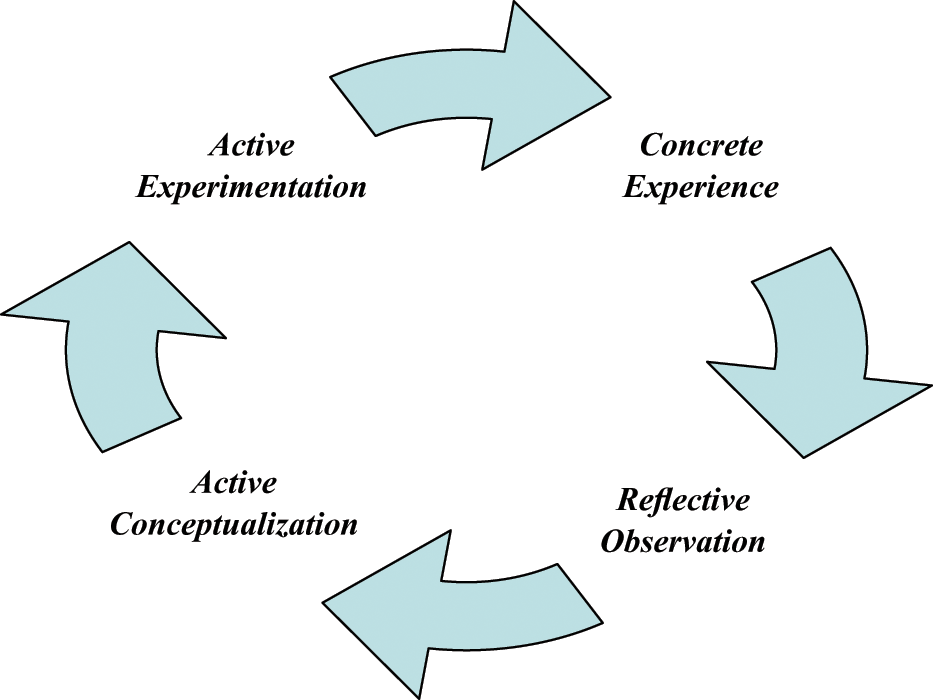
An adaptation of Kolb’s four-stage learning cycle.
Reading specialists Harvey and Goudvis (2007) maintain that reading implies thinking and understanding, thus students can develop strategies for comprehension, and their framework includes the following:
Activating and Connecting: When students’ background knowledge and experience are similar to those of a character in a story, they are more likely to understand and connect to a character’s motives, thoughts, and feelings.
Questioning: When readers have questions, they are less likely to abandon the text. Proficient readers ask questions before, during, and after reading.
Visualizing and Inferring: Readers visualize when they create a mental image; they infer when they merge prior knowledge with text clues. Visualization strengthens inferential thinking.
Summarizing and Synthesizing: Summarizing is the ability to sift and sort through large amounts of information to extract essential ideas. Synthesizing occurs when readers merge summarized information with intellectual inquiry to develop new ideas .
Langer (1990, 1994, 1995), an internationally known scholar of literacy learning, focuses on helping the student to connect his or her experiential knowledge with the text in what Langer calls envisionment building. Langer points out that although composition teachers use process-oriented instruction in writing classes, they are still confined by text-based approaches to teaching reading skills. Thus, reading lessons focus on rote learning, memorization, vocabulary quizzes, and objective tests with predetermined answers. Such an approach is particularly inappropriate for adult learners since it devalues their prior knowledge. In Langer’s (1994, 1995) three-step envisionment building model, teachers help students see parallels between lived experience and the text. The authors describe the following, and, in this process, adult learners engage a text in the following ways:
Envision: Use prior knowledge and surface features to begin reading or “envisioning.”
Extend: Expand the meaning of the text through discussion and writing; reflect on the text in connection with their own lives, the lives of others, and the human condition
Develop: Objectify the reading and relate it to new ideas outside the text
Intersection of Kolb, Harvey and Goudvis, and Langer Critical Reading Concepts
The intersection of these three approaches suggests a three-stage framework that consists of prereading, experiential reading, and postreading. The Harvey and Goudvis (2007) strategy of activating and connecting, and Langer’s (1994, 1995) first step, envisioning, correspond to Kolb’s (2001) stage of concrete experience; all three approaches presuppose prereading and are grounded in the student’s prior knowledge. Swinehart (2009) reinforces the models of Harvey and Goudvis and Langer, asserting that “proficient readers identify connections (and) access schema” (p. 27) to make sense of a text. Thus, instructors of adult college students might assign a prereading activity in which they are encouraged to engage with a text before reading it. Students could examine physical properties such as cover design, preface, introduction, footnotes and endnotes, illustrations, graphics, and table of contents. Students should also be encouraged to skim the text and identify unfamiliar vocabulary and concepts. Finally, students should draw on and articulate their prior knowledge and experience to predict the focus or thesis of the text. In this way, according to Langer (1994, 1995) and Harvey and Goudvis (2007), students establish a comfort level with the text before reading even begins.
The second stage, experiential reading, which corresponds to Kolb’s (2001) stage of reflective observation, is addressed by Langer’s (1990, 1995) stage of extending and Harvey and Goudvis’ (2007) strategies of questioning and visualizing and inferring. According to Harvey and Goudvis, “the background knowledge that students bring to reading influences every facet of their learning and understanding. When students are able to make personal connections to their readings, they are better able to construct meaning and increase understanding” (p. 92).
The third stage is postreading in which students move beyond a solid grounding in the text to new knowledge. Here, the strategy of summarizing is particularly effective (Harvey & Goudvis, 2007). Thus, instructors might assign summaries, abstracts, and annotated bibliographies to enhance and maximize students’ ability to fully grasp the meaning of the text. In other words,
“when we summarize information during reading, we pull out the most important information and put it in our own words to remember it. Each bit of information we encounter adds a piece to the construction of meaning. Our thinking evolves as we add information from the text.” (Harvey & Goudvis, 2007, p. 179)
Once students thoroughly understood the text through summarization, they are ready for the final stages of synthesis and objectification in which they critically analyze the text to develop new meanings. This stage relates to Kolb’s (2001) stages of abstract conceptualization and active experimentation. According to Harvey and Goudvis (2007), “when readers synthesize . . . they connect the new to the known, they ask questions, they take out the most important information—all of these strategies intersect to allow us to synthesize information and actively use it” (p. 180). Thus, according to Langer (1990, 1995), adult readers critically interrogate and objectify the text to conceptualize new information and to incorporate it into their lived experience.
As Table 1 shows, these strategies correspond to a sequence of events in the critical reading process and to Kolb’s (2001) four stages of experiential learning. In other words, during prereading, instructors might encourage the student to “predict” the content of the text. In the experiential phase, students work on activating/connecting strategies and the first elements of envisionment building. In the final, postreading phase, students complete the envisionment building through objectification and focus on summarizing and synthesizing.
A Conceptual Framework for Teaching Critical Reading Skills to Adult Students
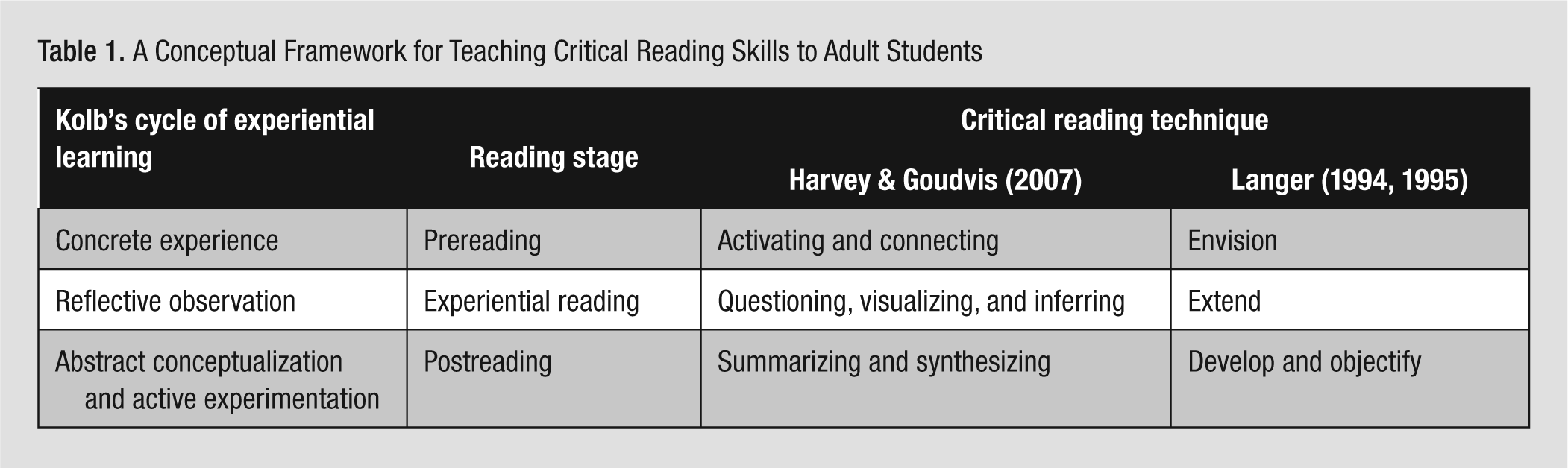
Based on the work of Kolb (2001), Harvey and Goudvis (2007), and Langer (1994, 1995), one can develop a conceptual framework for enhancing critical reading skills of adult college students. With the increase of culturally diverse adult undergraduates, some of whom do not speak English as a primary language, creative and inclusive critical reading models should be developed and implemented.
Conclusion
The many adult or nontraditional students who are beginning or returning to postsecondary education are undoubtedly fueled by the recognition that “post-secondary education has become the threshold requirement for a middle-class family income” (Carnevale, Smith, & Strohl, 2010, p. 13). In fact, “by 2018, 63 per cent of job openings will require workers with at least some college education” (Carnevale, Smith, & Strohl, 2010, p. 23). In institutions dedicated to adult college students, careful attention must be paid to ways to enhance student success and enable students to graduate. Critical reading is essential to these goals. Thus, program planners, administrators, and faculty should work together to develop methodologies for teaching reading skills to adults. By linking theories of adult learning with strategies for teaching reading, institutions can support adult learners and facilitate the teaching of college level texts. As adults enhance their critical reading skills, they can not only obtain postsecondary degrees but also enhance their professional opportunities in the workplace and their ability to participate fully in civic life.
Footnotes
The author(s) declare no potential conflicts of interest with respect to the authorship and/or publication of this article.
Bios
Sabrina Marschall, PhD, is the director of the Learning Center and assistant professor at Shippensburg University in Pennsylvania. Her research interests and publications include student success, retention, student transitions, and curriculum development.
Cynthia Davis, PhD, is the interim associate dean of Academic and Student Affairs in the School of Adult and Continuing Education at Barry University in Miami Shore, Florida. Her research interests and publications include women writers of the Harlem Renaissance, assessment, and curriculum development.