







Abstract
This article examines policy reports that advocate for new green jobs career pathways to help grow the green economy and create new opportunity structures in the green labor market. The reports are based on a series of propositions about the nature of green jobs and the existence of the political will to invest in new green education programs to support the green economy. The purpose of this article is to introduce educators and practitioners to the policy frameworks and propositions that shape their work to deliver effective green education and certification programs. It offers practical advice on how to understand and influence the basic premises on which green education policies and training resources are based.
In response to mounting pressures to mitigate carbon footprint of nations and stimulate economic recovery, recent worldwide government investment in the development and dissemination of clean technologies has been unprecedented. Indeed, when the 2007 recession hit, the U.S. government looked to the green economy as a source of innovation, economic growth, and skilled job creation.
Around the same time, the career pathway model emerged as an innovation in career and technical education. Career pathways systematically link a series of education programs and certifications to the occupational structures in industries. This allows workers to move in and out of education and work to advance their knowledge as well as their career. For the model to work, educational reforms must be accompanied by a new opportunity structure in industry that provides workers with access to higher skilled, more secure, and better-paying jobs.
“Educational reforms must be accompanied by a new opportunity structure in industry that provides workers with access to higher skilled, more secure, and better-paying jobs.”
The timing of these two events gave rise to a flurry of advocacy reports calling for new investment in green jobs career pathways to qualify workers for emerging green jobs. This article presents the results of an analysis of these policy reports (Scully-Russ, 2011). The analysis found these reports share a series of propositions about the trajectory of green industries, the nature of green jobs, the needs and motivations of green employers, the individual workers who may qualify for green jobs or benefit from education and certification in green knowledge and skill, and the existence of the political will to invest in green technology, fund new green education and training programs, and make structural reforms.
Taken together, these propositions put forth the argument that green pathways result in structural change to education and the labor market and support green economic growth. Education will become more demand driven and student focused, while new career structures will emerge to provide workers with advancement opportunities. These changes will result in a flexible labor market that is more aligned with the way people work and learn today.
The purpose of this article is to introduce educators and practitioners to the broader policy frameworks and propositions that shape their work to deliver effective green education and certification programs. Although green jobs promise to support economic growth and career pathways appear as an effective education reform methodology, there is little empirical evidence to support these claims (Anderberg, 2008; Lewis, 2008). Yet, government and educational leaders are allocating resources to green programs based in part on these and other untested assumptions. Given that educators and practitioners will be held accountable for the success of these programs, it is imperative they understand and seek to influence the basic premises on which green education policies and resources are based.
Career Pathways Policy Trajectory
It was nearly 30 years ago when the economy began to demand higher expectations for learning among non-college-bound youth and incumbent workers, moving the relationship between U.S. education and the economy to the center of public policy. It was 1985 when Dale Parnell examined the experience of the majority of U.S. youth whom he called ordinary students. In his book, The Neglected Majority, Parnell (1985) argued these students were being shortchanged by a focus on the needs of high- and low-performing students. In fact, 80% of people with an associate’s degree or some college degree earned as much as those with a bachelor’s degree (Beebel & Walleri, 2005). Parnell envisioned a new system of education to provide pathways to success for the middle 80% of students who did not aspire to a bachelor’s degree.
Although A Nation at Risk (Gardener et al., 1983), The Neglected Majority (Parnell, 1985), and The Forgotten Half (Halperin, 1988) set forth an education reform agenda, the Labor Department began to examine the relevancy of the nation’s labor market policies and programs. A seminal report, “Workforce 2000” (Johnston & Packer, 1987), predicted that by the year 2000, the U.S. economy would be more reliant on the service sector than manufacturing for new jobs and for economic growth. Success in this transition would require at least two things: increased productivity in this service sector and a workforce with medium to high levels of education and skills to fill the growing number of technical and professional jobs in these industries (Benner, 2002).
Gradually, the policy debate shifted to include a focus on what was needed to help employers, workers, and communities compete in a new economic model, dubbed high performance. Although the model demanded fewer workers, it required a new kind of worker, one who was more skilled and willing and able to continuously learn.
By the mid-to-late 1990s, the U.S. economy was growing and creating new jobs. At the same time, new work-first welfare reforms were being put into place that limited access of the poor to the postsecondary education that had become increasingly important to accessing the higher paying, more secure jobs (Jacobs & Winslow, 2003; Mazzeo, Roberts, Spence, & Strawn, 2006). The workforce development system was challenged to develop new strategies to help the poor secure good jobs in the changing political economy.
Dresser and Rogers (1999), however, observed deep structural flaws in the U.S. labor market that made it difficult to bridge this gap. On the supply side, the workforce development system consisted of a confusing maze of decentralized training programs that had “grown into being over more than a century of political conflict over the appropriate role of government in human capital formation” (Dresser & Rogers, 1999, p. 276). The demand side was equally disorganized because employers lacked a coordinated workforce strategy.
A new sector-based model for workforce development emerged to address these gaps. Harper-Anderson (2008) described the model as a partnership between public agencies and the economic stakeholders in a targeted industry, cluster of industries, or occupations. The partnership plans and implements customized programs to upgrade the skills of the workforce and improve the economic performance of the region. This model represented an innovation to the workforce development system because it provided a new infrastructure to connect the supply and demand sides of the labor market (Giloth, 2004).
Career Pathways Model
Today, sector partnerships serve as the platform for the development of career pathways. Career pathways is a framework that links education and training with work experience and credentialing to provide work-based stepping stones that allow individuals to move in and out of education and work to build higher level skills and careers. Each specific model develops as diverse and often disconnected public programs come together with industry stakeholders to contribute resources to create a new education, training, and certification framework that reflect the hierarchical nature of work within an occupation. Industries, particularly emerging industries like those in the green economy, can use the process to develop a labor market with built-in structural opportunities that help workers advance as they engage in higher levels of education. According to policy advocates (Jenkins, 2006; Stephens, 2009; White, Dresser, & Rogers, 2010), the model results in a new demand-driven education and workforce development system that is more responsive to the needs of employers and more accommodating of the wide variation in the ways adults sequence their education and careers today.
Three types of career pathways were found in the literature: the education pathway, the adult pathway, and the workforce development pathway (see Table 1). Although each of these models share a common vision for a sequenced, articulated series of education/credentials and work experience that provides a coherent pathway from education to a rewarding career (Lewis, 2008), each emphasizes different interests (Jenkins, 2006). These interests make a difference for which activity is emphasized (education vs. job placement) and which stakeholders have greater influence over the emerging system.
Types of Career Pathways

Green Jobs
Around the same time the sector model had gained in prominence, climate change and other ecological threats created new economic pressures to minimize the environmental impacts of economic activity (Stead & Stead, 2009). As the demands to green the economy grew, new technologies and new markets emerged to change the requirements and conditions for some jobs. For example, many skilled trades now require new specialty skills in the use of new equipment, tools, and materials associated with green construction (U.S. Department of Labor, Employment and Training Administration, 2009). Some argue these new green jobs provide new career opportunity to low- to mid-skilled workers because they have low barriers to entry and provide access to training programs and career ladders lacking in other industries (Anderberg, 2008; Pinderhughes, 2007; van Lier, Woodrum, & Gordon, 2010).
When the 2007 recession hit, the U.S. government looked to the green economy as a source of innovation, economic growth, and job creation. This resulted in an unprecedented U.S. investment of US$500 million in the Green Jobs Training Act of 2007. Yet, the labor market trajectory of green jobs is highly contested. Although it is commonly understood that green jobs are in some way related to improving, protecting, and maintaining the environment (Dierdoff et al., 2009), there is still no agreed-on framework that can delineate the basic characteristics of green jobs, determine the nature of the work, and establish methods for capturing this information and for counting green jobs (Anderberg, 2008).
Despite the challenges in defining and counting green jobs, the literature presents three definitions of green jobs, including the industrial, occupational, and normative definitions (see Table 2).
Green Jobs Definitions
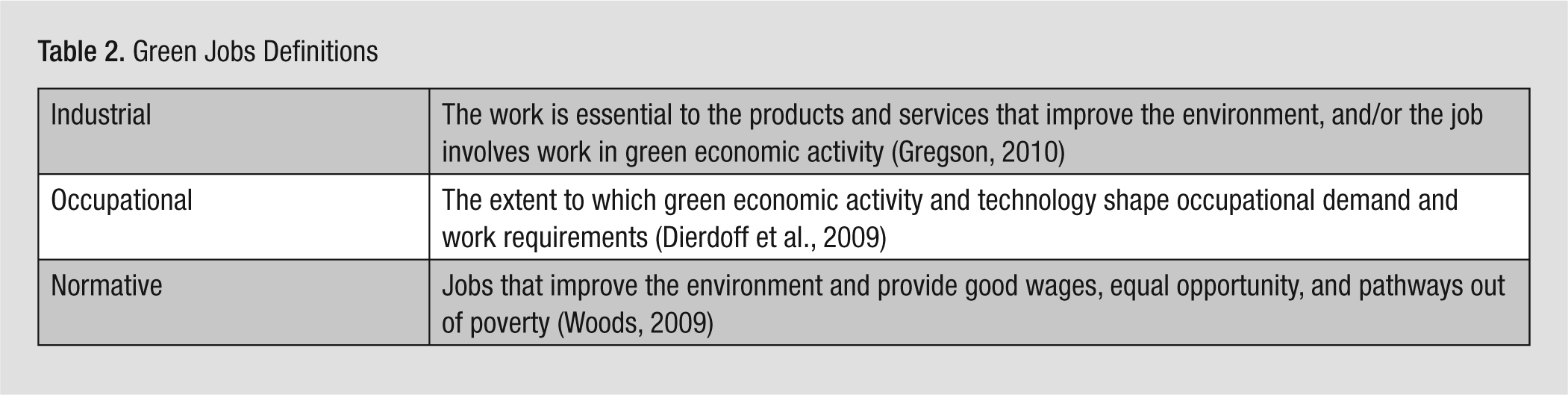
Reconciling these definitions is complicated by a lack of common nomenclature (Anderberg, 2008), difficulty in separating green from nongreen jobs in green industries (Anderberg, 2008; White & Walsh, 2008), the nascent and emerging nature of green technologies and practices (Dierdoff et al., 2009), and the lack of a conceptual framework to organize various green concepts and activities (Woods, 2009).
The inability to measure or identify green jobs is not just a conceptual challenge. Workforce development practitioners who have received public funds for green programs are under enormous pressure to identify and place workers in green jobs. Indeed, the inspector general of the U.S. Department of Labor recommended the Employment and Training Administration shut down the 25 federally funded Green Jobs Training Partnerships for lack of performance on the program’s job placement goals (U.S. Department of Labor, Office of Inspector General, Office of Audit, 2011).
Although placing workers in green jobs is made more difficult by a lack of common understanding of what counts as a green job in the first place, the pressure on workforce development practitioners to deliver jobs is exacerbated by a myriad of challenges related to the emerging nature of the green jobs labor market. These challenges (see Table 3) include evolving nature and emerging structure of green industries and jobs that make the industry hard to serve, challenges related to a lack of synchronization between supply and demand in the labor market, and workforce development strategies and policies that make it difficult to develop and deliver programs that support long-term, yet slow, economic growth in emerging industries.
Types of Career Pathways
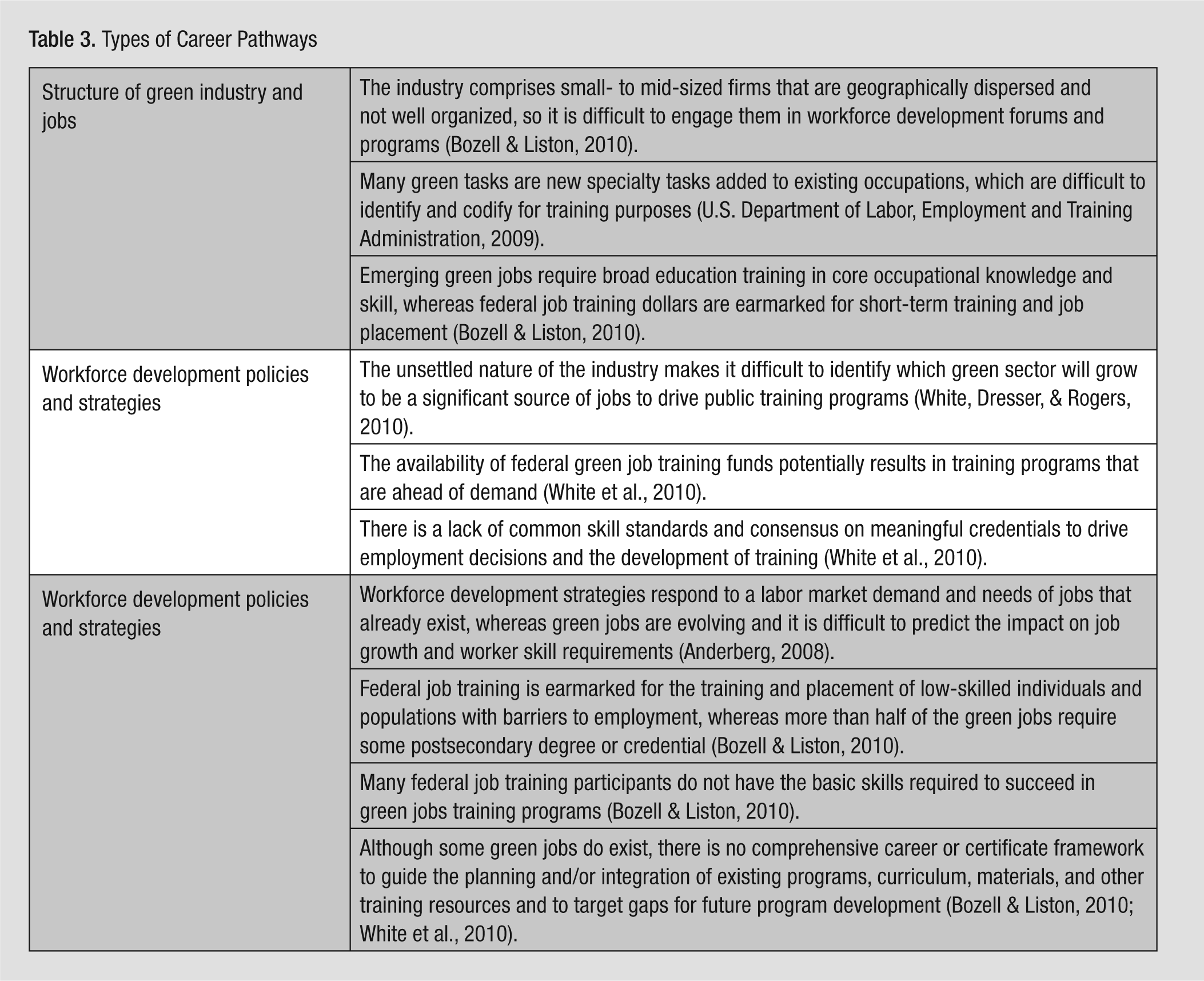
These programmatic challenges suggest that workforce development practitioners who run green programs must be prepared to grapple with deep structural flaws in the training and development system, and the labor market to develop a robust green jobs career pathways model and programs (Goerner, Dyck, & Langerroos, 2008; White et al., 2010).
Findings
Advocates for green career pathways argue the pathways framework can be used to leverage the needed changes on both the supply and demand side of the green labor market. On the supply side, educators and workforce development practitioners are required to reform career and technical education and align it with the needs of green employers and working learners. The new standards and assessments will help to systematize the skills of the green workforce, and this will gradually lead individual employers to align the organization of work with other firms across the industry. The new industry-wide occupational structure will provide workers with new career opportunities, which will attract more skilled workers to the industry, which will in turn help green industries to grow.
However, this basic argument is itself built on a series of propositions (see Table 4), found throughout the policy and advocacy literature about the social and political-economic benefits of green jobs career pathways. Given the nascent nature of the pathways framework and the green jobs labor market, there is no way to know whether these propositions will hold true. Meanwhile, educators and practitioners are pressured to get ahead of the anticipated demands of projected growth in green industries and develop new programs. A thoughtful response to these demands requires educators and practitioners become aware of and critically question the propositions on which the demands are based. If these propositions do not prove to be valid in the particular locations where green jobs training programs are being developed, the effectiveness of these programs may be significantly compromised.
Propositions of Green Jobs Career Pathways

Implications for Practice and Research
It is suggested here that the career pathways agenda continues the 30-year policy drive to create a seamless relationship between education and the economy. Anderson (2008) and others are highly critical of this move because they argue education for the economy, in general, has led to a narrowing of the curriculum to support economic activity while ignoring education required for meaningful and sustainable human development.
Although it is very important for researchers and practitioners to look critically on the vocationalist agenda of the career pathways model, it is equally important to understand, that in the 21st century, there is little daylight between social and economic justice. Creating new structures that provide all people with access to quality, broad, and continuous education and to labor market opportunities is an imperative in a postindustrial, democratic society. For this reason, it is important that adult education practitioners and researchers focus on the implications of the career pathways model for their work.
Practice
Although it is assumed that adult educators and workforce development practitioners know how to address the needs of adult learners and deliver quality education programs, practitioners do not often engage in the broader strategies and systems that shape the programs within which they work. The career pathway model will benefit from the engagement and influence of adult educators who understand and value a broad and critical education.
As a first step, practitioners should become knowledgeable of career pathways models and resources that are available on the federal, state, and local levels. There are a myriad of technical guides and resources available to help educators align their curriculum and programs with the credentials required for good jobs in their regions. In addition, there are a number of resources that can help connect practitioners to broader reform efforts in their region. A good place to start looking for these resources and connections is the U.S. Department of Labor, Employment and Training Administration’s sponsored website, Workforce3 One (https://www.workforce3one.org/). Here, practitioners can find links to communities of practices in career pathways and green jobs and other resources.
Second, practitioners should become knowledgeable of and engage in local sector partnerships and career pathways reform efforts and in their regions. Engagement of educators who value a broad education will help to mitigate the vocationalist pull of the career pathways model. Two resources to help locate sector partnership in your region or for the occupations you serve are the National Network of Sector Partnerships (http://www.insightcced.org/index.php?page=nnsp) and the National Fund for Workforce Solutions (http://www.nfwsolutions.org/).
Finally, educators must help stakeholders surface and question the basic propositions that have led to the demand for green training in the first place. Educators are ultimately responsible for program outcomes and are accountable to their students who invest in education for green jobs. It is important that educators take steps to ensure that the analysis of the projected demands and needs is accurate.
Research
In 2008, Lewis (2008) conducted a search of the ERIC database for studies on the performance of career pathway programs published between 1990 and 2008 and found 6 studies. A 2010 update of Lewis’ ERIC search conducted for this review identified an additional 7 studies. The results of these 13 studies point to one overarching conclusion: More statistical and analytical data, including labor market data, are needed to understand how well pathway programs are serving the needs of participants and local employers.
In addition, each of the propositions above, as well as the overarching assumptions that green jobs career pathways will lead to structural change on both the supply and demand side of the green labor market, needs to be thoroughly interrogated. Absent an understanding of the efficacy of the policy precepts that drive the development of new green programs, educators and practitioners open themselves to criticism for lack of performance on programs that may have been ill conceived in the first place.
Footnotes
Author’s Note
The contents of this publication neither necessarily reflect the views or policies of the department nor does mention of trade names, commercial products, or organizations imply endorsement of the same by the U.S. Government.
Conflict of Interest
The author(s) declare no potential conflicts of interest with respect to the authorship and/or publication of this article.
Funding
The author(s) disclosed receipt of the following financial support for the research, authorship, and/or publication of this article: Research supporting this article was funded with federal funds from the U.S. Department of Labor, Employment and Training Administration under contract number DOL101RP20279.
Bio
Ellen Scully-Russ, EdD, is an assistant professor of human and organizational learning at The Graduate School of Education and Human Development, The George Washington University. Her research interests are in adult learning and role of adult education in the 21st century economy.