







Abstract
Adult learners regularly confront complex and dynamic challenges in moments of crisis that require self-efficacy of intuition and immediate decision. Such “snap decision-making” requires highly developed critical thinking skills to effectively operate in the midst of chaos. This decisiveness is particularly challenging in the military profession of arms and professions such as emergency management and health care. Lifelong learning demands creative thinking to shape experiences, develop expertise, and demonstrate personal confidence. This case study encourages continued research of intuition in decision-making by professional practitioners who regularly make decisions in moments of crisis. An after-action review process can elicit perceptions of tacit prompts that compel action. What would happen if the adult learner could apply wisdom of personal intuition—tacit knowing-in-action—to make improved decisions in moments of crisis? The potential for improved professional competence in crisis incidents is profound. This article promotes a concept for continued exploration of tacit knowing-in-action wisdom and research-to-practice of intuition in adult education.
“Complex and dynamic challenges in living are a recurring opportunity to influence self-efficacy for improved tacit knowing-in-action and effective intuitive decision-making.”
We can know more than we can tell and we can tell nothing without relying on our awareness of things we may not be able to tell.
Adult learners confront complex and dynamic challenges in moments of crisis that require self-efficacy and the ability to make immediate intuitive decisions. Such “snap decision-making” (Odierno as cited in Vergun, 2014, para. 8) requires highly developed critical thinking skills to effectively operate in the midst of chaos. This decisiveness is particularly challenging in the military profession of arms and professions such as emergency management and health care (Benner & Tanner, 1987; Klein, Calderwood, & Clinton-Cirocco, 1986). The U.S. Army expects soldiers to be curious, creative, and decisive, grounded in philosophy and doctrinal principles as shaped by experiences. “It’s rooted in the habits of the mind. Patterns of thought are something you can work to rewire, to reinforce . . . habits that you can change and cultivate” (Dempsey, 2013, para. 42).
This article promotes continued exploration of tacit knowing-in-action wisdom and research-to-practice of intuition in adult education. The case study encourages continued research of intuition in decision-making by professional practitioners who regularly make decisions in moments of crisis. Decision-making is a fine balance between the art of command and the science of control. A fundamental intent is to trust and empower adaptive leaders in decisions for successful conduct of Army missions. Decisions occur in two ways—analytic and intuitive (Headquarters, U.S. Department of the Army [HQDA], 2012c).
Mission command emphasizes honing leaders’ lifelong learning competence by continually developing expertise with Army training and education to develop effective leadership. By common description, intuition is an enigma of direct cognition without evident rational thought (Intuition, 2014). As Goldberg (2005) stated, “Intuition is the condensation of vast prior analytic experience; it is analysis compressed and crystallized. . . . Intuitive decision-making is post-analytic, rather than pre-analytic or non-analytic” (p. 150). Furthermore, Myers (2002) posed, “If intuition is immediate knowing, without reasoned analysis, then perceiving is intuition par excellence” (p. 5). Nonetheless, the how to of shared understanding and practice of intuitive decision-making is more difficult to acquire than demonstrating a standardized analytic process. What would happen if the adult learner could be as effective in acting on the wisdom of personal intuition as when applying a deliberate analytic decision-making process? This qualitative exploration of intuition included studying relevant literature, conducting a bounded case study, identifying implications, and making recommendations.
Relevant Literature
This study situates in four areas of the adult education literature: (a) modern psychological exploration of metacognition with particular attention to Gestalt psychology developed by Wertheimer (1905, 1945), (b) modern philosophical underpinnings on intuition and a theory of tacit knowing promoted by Polanyi (1958, 1964, 1966), (c) professional assessments of intuition and an art of decision-making in social science praxis (Schön, 1987), and (d) contemporary U.S. Army principles of tacit knowledge and intuitive decision-making (HQDA, 2003, 2011a, 2011b, 2012a, 2012b, 2012c, 2012d, 2013a, 2013b, 2013c).
First, in Productive Thinking, Wertheimer (1945) sought to comprehend relationships among discrete elements of a phenomenon as well as interactive effects of a summative whole in that environment. For Wertheimer, critical thinking analyzes believed-to-be facts and verifies knowledge while perceptive thought creatively postures possible and even improbable alternatives. This multidimensional dynamic relationship of thinking about thinking merges critical and creative assessments that might illuminate previous unimaginable meaning.
Second, Polanyi (1958) suggested a contextual richness: “We keep modifying, subsidiarily, our interpretation of sensory clues by striving for clear and coherent perceptions, or enlarging our skill without focally knowing how by practicing them in ever new situations” (p. 112). Thus, a quest to better understand intuition may require an interpersonal assessment of what we can tell in explicit experience (Polanyi, 1958), rigorous self reflection-in-action and reflection-on-action (Schön, 1987), and practical analysis of contextual conditions and interrelationships in praxis (Wertheimer, 1945).
According to Polanyi (1966), Gestalt experimentation on insight and sense-making inspired other related forms of social science exploration. Grounded in his extensive scientific expertise, Gestalt’s philosophy labels personal knowledge as knowing that cannot be entirely explicit. Influenced by Gestalt, Polanyi (1964) based his theory of personal knowledge on “things of which we are focally aware can be explicitly identified; but no knowledge can be made wholly explicit” (p. x). He posed a form of knowledge—tacit—more fundamental than a clearly quantifiable and explainable knowing. He progressed from analytical investigation to profound philosophy grounded in principles of science and amplified by aesthetics of an art.
Furthermore, Polanyi (1958) suggested a practical aspect to learning skills in a particular domain and development of expertise, and described this connoisseurship as a long course of “experience under the guidance of a master” (p. 54). Patterns emerge; multiple experiences in a domain and critical postaction analyses appear to be a way to an intuitive decision. However, no expectation exists for an absolute explanation of a tacit sensation and its public action.
Third, Schön (1987) described an educational concept of “thinking what they [learners] are doing while they are doing it” in a quest to appreciate and understand practice in “situations of uncertainty, uniqueness, and conflict” (p. xi). He used knowing-in-action as “the sorts of know-how we reveal in our intelligent action–publicly observable, physical performance. . . . We reveal it by our spontaneous skillful execution of the performance; and we are characteristically unable to make it verbally explicit” (p. 25). Simply stated, “This knowing-in-action is tacit, spontaneously delivered without conscious deliberation” (p. 28, emphasis added). He presents an elegant model for the adult education practitioner.
Fourth, the Army removed intuitive decision-making from its doctrinal lexicon in 2011, thus muddling the inherent value of tacit knowing-in-action (HQDA, 2011b). Fortunately, the Army reinstated intuitive decision-making in its mission command doctrine in 2012 (HQDA, 2012c). The Army describes tacit knowledge as a “unique, personal store of knowledge gained from life experiences, training, and formal and informal networks. . . . It includes learned nuances, subtleties, and work-arounds. Intuition, mental agility, effective responses to crises, and the ability to adapt” are forms of tacit knowledge (HQDA, 2012a, para. 1-9). Similarly, Army doctrine defines the art of command as “the creative and skillful exercise of authority through timely decision-making and leadership” (HQDA, 2012b, Glossary-1). “As an art, command requires exercising judgment,” and “judgment is based on experience, expertise, and intuition” (HQDA, 2012c, pp. 2-5, 2-7). “Decision-making requires knowing if, when, and what to decide and understanding the consequences of any decision” (HQDA, 2012b, p. 6). “The approach is not new; its use in the Army is well established. [Leaders] develop this capability through training and practice. . . . Leaders combine their experience and intuition [emphasis added] to quickly reach situational understanding” (HQDA, 2012d, pp. 4-6). But how?
The U.S. Army emphasizes pattern recognition as a prompt to intuitive decision-making (HQDA, 2012c). Recognition-type decisions are critical when decision must be immediate. Such intuition requires experience and expertise reinforced—when time is available—by formalized deliberate military decisions. “It [emotional hardiness and mental flexibility] takes an acceptance of uncertainty, of adversity, and even failure—recognizing that these things are where wisdom and progress are born” (Dempsey, 2013, p. 3). Effective decision-making in moments of crisis relies “even more than normal on [a leader’s] own expertise, intuition [emphasis added], and creativity as well as on their understanding of the environment and of the art and science of warfare” (HQDA, 2011a, para. 4-190). Nonetheless, the Army does not have a definition of intuitive decision-making that resonates in its leaders. I explored this issue of intuition as a personal experience using qualitative research.
Qualitative Exploration
Qualitative research philosophically assumes “reality is constructed by individuals interacting with their social worlds . . . [and] how they make sense of their world and experiences” (Merriam, 1998, p. 6). Furthermore, an individual’s self-efficacy, self-reflection, and self-influence contribute to understanding and action (Bandura, 1997). In 2012, I used a case study to explore the nature of intuitive decision-making in crisis situations as perceived by U.S. Armed Forces officers. Seventeen participants shared recollections, perceptions, and insights of their intuitive decision-making and tacit knowing through a naturalistic inquiry in individual interviews. Although I considered participants to be experts of their deliberate and intuitive experiences, one participant acknowledged, “We sometimes get it wrong.” Tacit knowledge appeared to be integral to apprehension and sense-making of intuitive decisions.
I further sought to discern how commissioned military officers perceived conditions that triggered their intuitive decision-making or understood contextual effects of personal or vicarious intuitive experiences (Moilanen, 2012). After assessing focus group and pilot interview group responses, I asked participants’ modified open-ended interview questions. Based on inductive analysis and constant comparison, findings included that intuition was difficult to describe and might be relegated, at times, to “I just knew.” No responses were similar to a verbose Army description of intuitive decision-making, such as “reaching a conclusion through pattern recognition based on knowledge, judgment, experience, education, intelligence, boldness, perception, and character” (HQDA, 2012c, para. 2-47). Participant responses lacked a common description of tacit knowledge and intuitive decision-making that inferred a requirement to improve understanding and definition of tacit knowing-in-action and intuitive decision-making.
In 2014, I continued this qualitative exploration with a random sampling of 28 midcareer leaders. Data collection included two questions posed during an Army graduate-level adult education course. Asked to describe tacit knowledge and intuitive decision-making, participants provided similarly vague responses, such as “gut feeling,” “street smarts,” or “know without thinking,” which suggested an inability to define the phrases with precise language. Recurring aspects included the importance of personal experiences and the difficulty in transferring meaning of these personal experiences in explicit description.
Implications for Adult Learning
The U.S. Army Learning Concept for 2015 (U.S. Army Training and Doctrine Command, 2011) describes an adult learning model to develop adaptive, thinking leaders. Leaders must be “comfortable with ambiguity and quickly adapt to the dynamics of framing complex, ill-defined problems” and making decisions with imperfect information (U.S. Army Training and Doctrine Command, 2011, p. 10). Frequent feedback on ideas and performance enhance a spiral effect toward improved understanding and creative thinking.
The after-action review (AAR) is a way to engender professional discussion with guided analysis and feedback and enables self-discovery of what occurs to improve or sustain performance (Headquarters, U.S. Army Combined Arms Center-Training, 2013; Headquarters, U.S. Department of the Army, 2013b). Typically focused on assessing skills and competencies, the AAR can seek to understand how intuitive decision-making occurs as emotive responses to psychological and physiological cues that reside within the individual subconscious. Probing tacit knowledge and personal intuition cues can enhance trust to act with decisiveness. An AAR process focused on deliberate and intuitive decisions can elicit perceptions of tacit prompts that compel effective action.
Table 1 presents a concept of how to apply key steps in an AAR model. Discussion elicits a participant’s voice of how an event relates to previous personal experiences and might affect future performance. Appreciating not all knowing can be articulated, an AAR encourages self-efficacy to understand and trust intuitions based on experience, expertise, and demonstrated competence. Candid dialogue in an AAR promotes assessment of knowledge, judgment, decisions, and actions among adults as a learning experience. Leaders are inquisitive and seek to understand how tacit knowing-in-action functions. Intuitive decision-making is clearly a complement to deliberate analysis.
Assessing Tacit Knowing-in-Action (Intuitive Decision-Making)
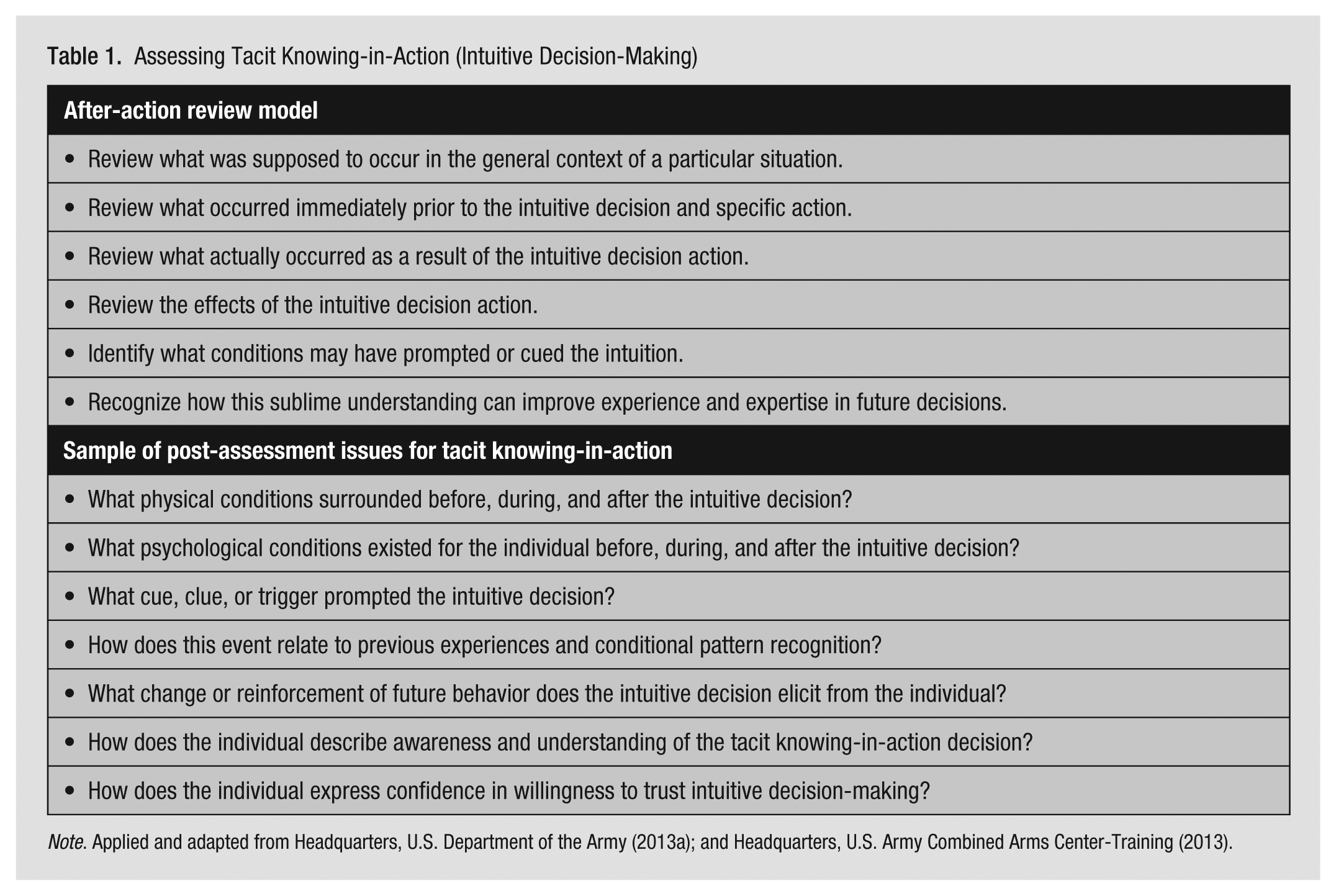
Note. Applied and adapted from Headquarters, U.S. Department of the Army (2013a); and Headquarters, U.S. Army Combined Arms Center-Training (2013).
Whether philosophical, scientific, or educational in exploration, one aspect of intuition seemed universal: A form of knowledge exists beyond the realm of absolute empirical proof. Rather than distinctly separate from explicit knowing, this implicit form of knowing appears to complement processes of practical knowledge, reasoning, and decision.
The professional world demands responsible leadership and self-efficacy that includes principles of understanding, visualizing, describing, directing, leading, and assessing successful operations (Bandura, 1997). This charter applies to adult learners across the professional spectrum of practitioners, program developers, administrators, instructors, and students. Kahneman (2011) conditionally supports such a supposition when self-efficacy of intuition is grounded in familiar conditions, based on the ability to practice often with rapid and accurate feedback on action outcomes, and applies developed skill sets for a particular domain of experience and progressive expertise. “Intuitive answers come to mind quickly and confidently, whether they originate from skills or from heuristics. . . . And sometimes they are quite wrong” (Kahneman, 2011, p. 416). Kahneman is quick to note that there is no guarantor of certainty.
Evidence from this qualitative exploration indicates that intuitive learning can remain implicit, be explicit in ready-recall of conditions in a crisis, or seem emergent as an instantaneous awareness and situational understanding (Moilanen, 2012). Subliminal cues associated with an individual can prompt pattern recognition in particular—contextual—situations. Prior experiences prestage effective intuitive decisions “to elicit the cues and contextual considerations influencing judgments and decisions” (Kahneman & Klein, 2009, p. 517). Klein (1998) accents experiences are important in the formation of expertise and “expertise depends on perceptual skills” (p. 287).
Implications indicate that pattern recognition is important in the ability to appreciate intuition and decision-making. In addition, the values and ethics of a profession are fundamental to how an ideal supports making a “decision to decide” instantaneously in a crisis. Mentorship by experts is the underpinning of ideals in thought and action that can be masked as self-discovery. Notwithstanding, self-efficacy in the art of intuitive decision-making is fundamentally an individual action of confidence, competence, and decisiveness to act.
Recommendations
U.S. Army leaders use analysis and intuition for decision-making in leadership responsibilities. Two primary recommendations for tacit knowing-in-action follow. First, the U.S. Army must refine the description of intuitive decision-making. Define this form of tacit knowing-in-action as intuitive decision-making, an action prompted by tacit knowledge that apprehends implicit cues within a particular situational context and instantly visualizes cause–effect conditions and probable outcomes.
Second, the U.S. Army must emphasize intuitive decision-making as integral to holistic understanding of how leaders decide and act. Army leaders acknowledge value in tacit knowledge, empowered with personal confidence and competence to act on intuition, when action requires decisive immediate. Analyzing intuitive decision-making in detail during training, educational venues, and leader self-development—reinforced with effective coaching, mentoring, and formal evaluations—is a practical technique but may not produce desired outcomes until an unexpected crisis arises.
All practitioners can assess their vocational area of expertise and embed appreciation of intuitive decision-making when immediate decision and action are required (Dowding, Spilsbury, Thompson, Brownlow, & Pattenden, 2009). Disciplined initiative and prudent risk-taking are fundamental companions to credible judgment in making decisions (Patel, Gutnik, Karlin, & Pusic, 2008). In moments of crisis when decision must be immediate, intuition is an intellectual attribute supporting the agility and adaptability of effective leadership. When analytic processes are incapable of discerning certainty, intellectual curiosity and creativity can encourage the empowerment and personal confidence to trust professional expertise and intuition for action (HQDA, 2013a).
Adult education is a continuum of lifelong learning. Embracing tacit knowledge recognizes that all knowledge cannot be completely explicit. A domain of implicit knowledge must always remain on the edge of what is known practically in daily life. Otherwise, adult learners would be neither tantalized with the idea of discovery nor compelled to pursue a satisfying answer to something as vague as a disorienting dilemma (Mezirow, 1991).
Future Research
Facilitating inquisitiveness and questioning intuitive decisions in praxis through intensive AAR processes may indicate how successful leaders eventually master expertise and excel to a higher level of artistry in leadership and decision-making. These leaders understand intuition and demonstrate the wisdom of tacit knowing-in-action.
Qualitative research complements the professional body of knowledge in adult education and U.S. Army doctrinal literature on intuition and decision-making. A quest to nurture the understanding and practice of tacit knowing-in-action suggests additional reflection by Army leaders of what “we can [emphasis added] tell” through
explicit intellectual focus and thoughtful dialogue on intuitive experiences (Polanyi, 1958, 1966);
practical analysis of situational conditions in praxis that compare and contrast a whole as a composite entity, its individual components, and contextual or meaningful configurations within which a whole exists (Wertheimer, 1945); and
rigorous self reflection-on-action to elicit cues that trigger an intuition as meant in Schön’s tacit “knowing-in-action” (intuitive meaning-making while doing; Schön, 1987).
Ongoing longitudinal sampling of U.S. midcareer officers may provide additional evidence that authentic rigor of using intuition can be accepted as trustworthy. Responses in this research suggest that passionate adult inquisitiveness enhances personal and professional self-efficacy in making credible intuitive decisions. Nonetheless, lack of a common description by respondents of tacit knowledge and intuitive decision-making infers a requirement for a succinct definition of intuitive decision-making in U.S. Army mission command philosophy.
Rather than distinctly separate from explicit knowing, implicit knowing-in-action suggests an integral relationship to deliberate critical thinking and creative problem-solving. Knowledge, practical reasoning, and deliberate action sometimes respond to “undefinable powers of thought” (Polanyi, 1958, p. ix). Kahneman (2011) stated his conviction that intuition exists with elegant simplicity. The wonderful capacity for intuition is within each individual and “the mystery of knowing without knowing is not a distinctive feature of intuition; it is the norm of mental life” (p. 237, emphasis added).
The adult learner has the responsibility to develop and enhance personal intuition in the wisdom of lifelong learning (Kunzmann & Baltes, 2005). U.S. Army leaders must nurture their intuitive decision-making, be able to define and describe the effective use of intuition, and recognize that tacit knowledge enhances their day-to-day living and decision-making in an uncertain world. Complex and dynamic challenges in living are a recurring opportunity to influence self-efficacy for improved tacit knowing-in-action and effective intuitive decision-making. In conclusion, we may readily embrace Polanyi’s (1964) premise that “we can know more than we can tell” (p. x).
Footnotes
Conflict of Interest
The author(s) declared no potential conflicts of interest with respect to the authorship and/or publication of this article.
Funding
The author(s) received no financial support for the research, authorship, and/or publication of this article.
Author Biography
Jon H. Moilanen, EdD, is an adult educator in training, education, and leader development support to the U.S. Army. He contributes to programs such as Army leadership curricula, train-the-trainer courseware, and topics of interest for intergovernmental and multinational communities. He is a published author, illustrator, and contributor in U.S. military periodicals and adult education forums. Experiences during a 30-year army career include teaching at the university undergraduate level and military college graduate level. Senior academic positions included chief of staff for an army-wide leadership study; director, Army School for Command Preparation; and prior to retirement from active duty, dean of students and administration at the U.S. Army Command and General Staff College. He earned his doctorate in adult education from Kansas State University.