







Abstract
Practitioners use an expansive array of instructional design models. Although many of these models acknowledge the need for analyzing occupational roles, they do not define steps for conducting these analyses. This article reviews prominent models and provides prescriptive guidance for selecting appropriate models given a project’s (a) Product Requirements, (b) Resource Availability, and (c) Philosophical Compatibility with DACUM (Developing a CurriculUM) procedures.
“The instructional models are capable of supporting/facilitating large-scale curriculum efforts and are good matches for adult learning projects requiring DACUMs to establish occupational validity.”
As developers of instruction for adult learners, instructional designers, educators, and learning and development professionals in general utilize a wide range of instructional design models. Most of these models touch upon the need for analyzing occupational roles and defining primary duties, tasks, and so on; however, rarely do they break down the strategies and details for defining and developing occupational profiles for use with the larger instructional design model.
To tackle the challenge of defining occupational profiles, many professionals turn to the DACUM (Developing A CurriculUM) process. The DACUM process was initiated by Robert Adams at Nova Scotia NewStart in the late 1960s (Adams, Hogan, & Steinke, 2015) and to this day, DACUM continues to be actively used throughout corporate and higher education institutions (Eastern Kentucky University, 2015).
DACUM uses the use of expert panels to identify and validate the individual tasks, knowledge, skills, and traits necessary for success performing a given job or occupational role. The process is informed and guided by key facets such as facilitation, consensus building, and competency-based education (Norton & Moser, 2008). Upon its completion, a DACUM session generates an occupational profile identifying what individuals in a given occupation need to learn and be able to do (Dennison, 1995).
The problem for many practitioners, however, is the marrying of the DACUM process with a larger instructional design model. Case in point: A key step in any curriculum development effort is the analysis phase, including needs analysis (Witkin & Altschuld, 1995), learner analysis (Brown & Green, 2011), and task or occupational analysis (Norton & Moser, 2008). Unfortunately, not all instructional design models are created equal when it comes to conducting instructional analyses. As a result, designers must know which instructional models are appropriate for use when developing curriculum targeting defined occupational roles (Richey, Klien, & Tracey, 2011).
The purpose of this article is to examine prominent instructional models and provide prescriptive guidance regarding each model’s ability to incorporate DACUM-based occupational analyses into the instructional design process. In doing so, it is hoped that practitioners will make better design decisions on future projects as well as learn about new models with which they have not previously worked.
DACUM Requirements
To better understand the compatibility issues associated in using DACUM in a larger instructional process, a review of DACUM, itself, is necessary.
DACUMs are grounded in a philosophy that can be encapsulated in the following three statements (Norton, 1997, Appendix A):
Expert workers can describe and define their job more accurately than anyone else;
An effective way to define a job is to precisely describe the tasks that expert workers perform; and,
All tasks, to be performed correctly, demand certain knowledge, skills, tools, and worker behaviors.
Based on these principles, DACUMs are used to prescribe occupational profiles suitable for use in a variety of curriculum development efforts.
With regard to the process, DACUMs typically are comprised of 1- to 2-day workshops in which a facilitator encourages and documents discussions of occupational experts. The panelists typically are current or former workers of the occupation being profiled. Once an occupational profile is drafted by the initial committee, it is validated by one or more committees to ensure the profile is accurate and balanced (Norton & Moser, 2008). Curriculum developers, in turn, can utilize the profile to analyze the needs of workers engaged in the target role or occupation.
Analysis of Models
Six criteria are used as waypoints in the decision-making process of selecting an instructional design model for use by a curriculum developer for a given performance improvement problem. These criteria are based on key elements and specifications defined by Adams et al. (2015) and Norton (1997)—the leading authorities on DACUM-based instructional development. The key considerations in selecting instructional design models that are compatible with DACUM processes are presented in Table 1. They are grouped into three categories: (a) Curriculum Product Requirements, (b) Resource Availability, and (c) Philosophical Compatibility.
Key Compatibility Considerations for DACUM (Developing a CurriculUM)
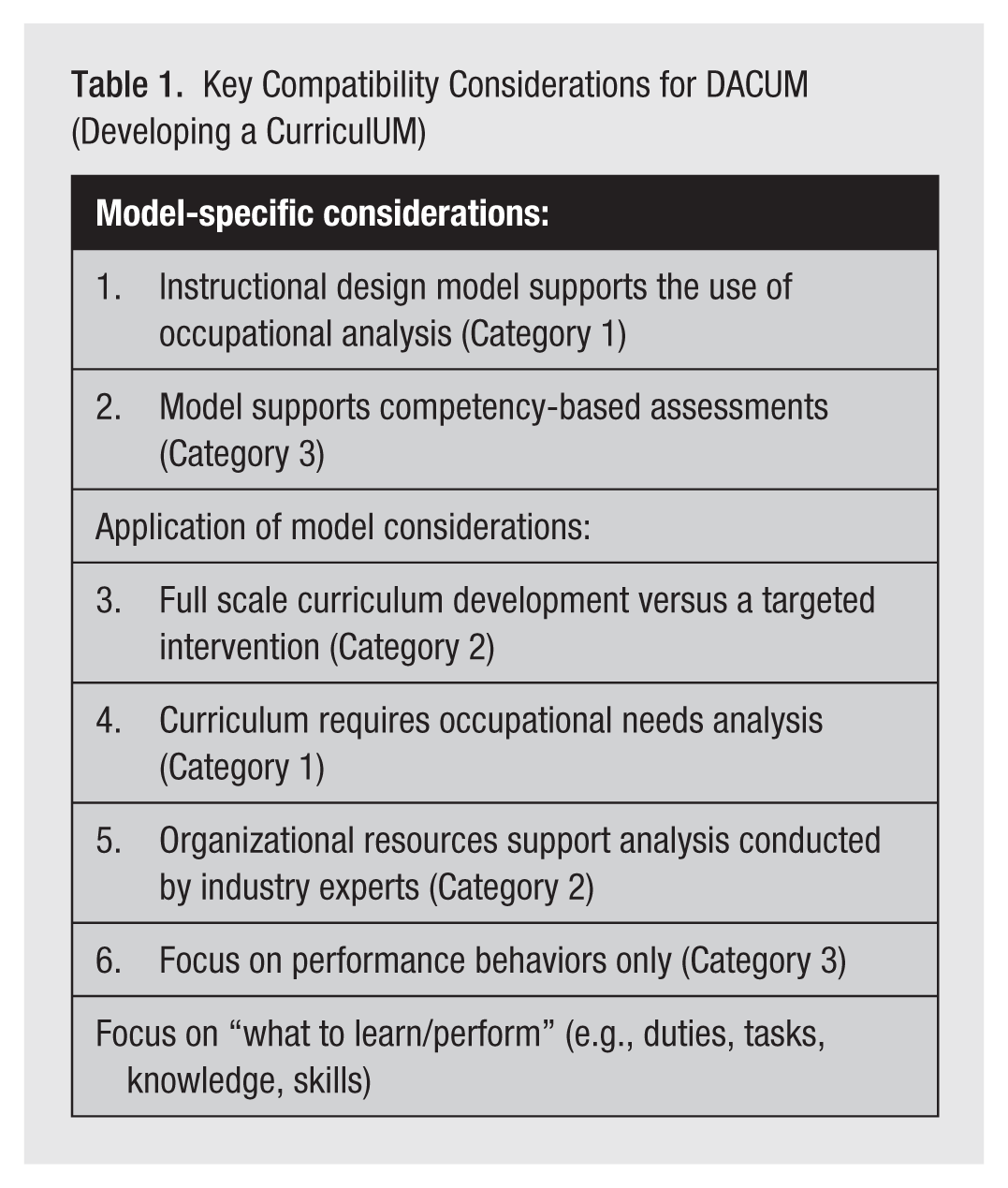
Curriculum Product Requirements focuses on the project’s ultimate needs. For example, developing materials for a small module targeting specific safety procedures would not require a comprehensive DACUM process. Conversely, developing curriculum for a newly created job most would certainly necessitate a comprehensive DACUM operation.
Resource Availability considers logistical factors. First, does the model being considered support the use of an occupational analysis? Not all models support an occupational analysis. If a project necessitates a DACUM, Consideration 3 mandates only those models supporting a DACUM should be considered for use. The next factor is whether institutional resources support the cost, time, and logistical resources necessary for carrying out a DACUM.
Philosophical Compatibility, as its name indicates, is focused on philosophical underpinning of the instructional design process. Not every instructional design model supports or endorses competency-based education, which is a principle orientation of the DACUM process. In addition, DACUM principles impose the added expectation that the curriculum is being focused on performance behaviors only while ignoring instructional strategies.
Six instructional design models are reviewed to examine the degree and manner in which they support the use of DACUM in the instructional design process. Models were purposefully selected based on prominence of use, that is, they are models that appear frequently in literature and/or commonly taught in university-level instructional design courses. To identify these models, more than 330 publications were screened to ensure the greatest utility and coverage.
For each of the models reviewed, an assessment table was generated, see Table 2. Most of the items were evaluated using a “No/Low/Partial/High” scale. The lone exception was Item 3 for which models were categorized as “Targeted/Full” scale denoting which type of instructional development project they were best suited. The resulting assessments were aggregated and the summary findings presented in this article.
Compatibility Assessment Table
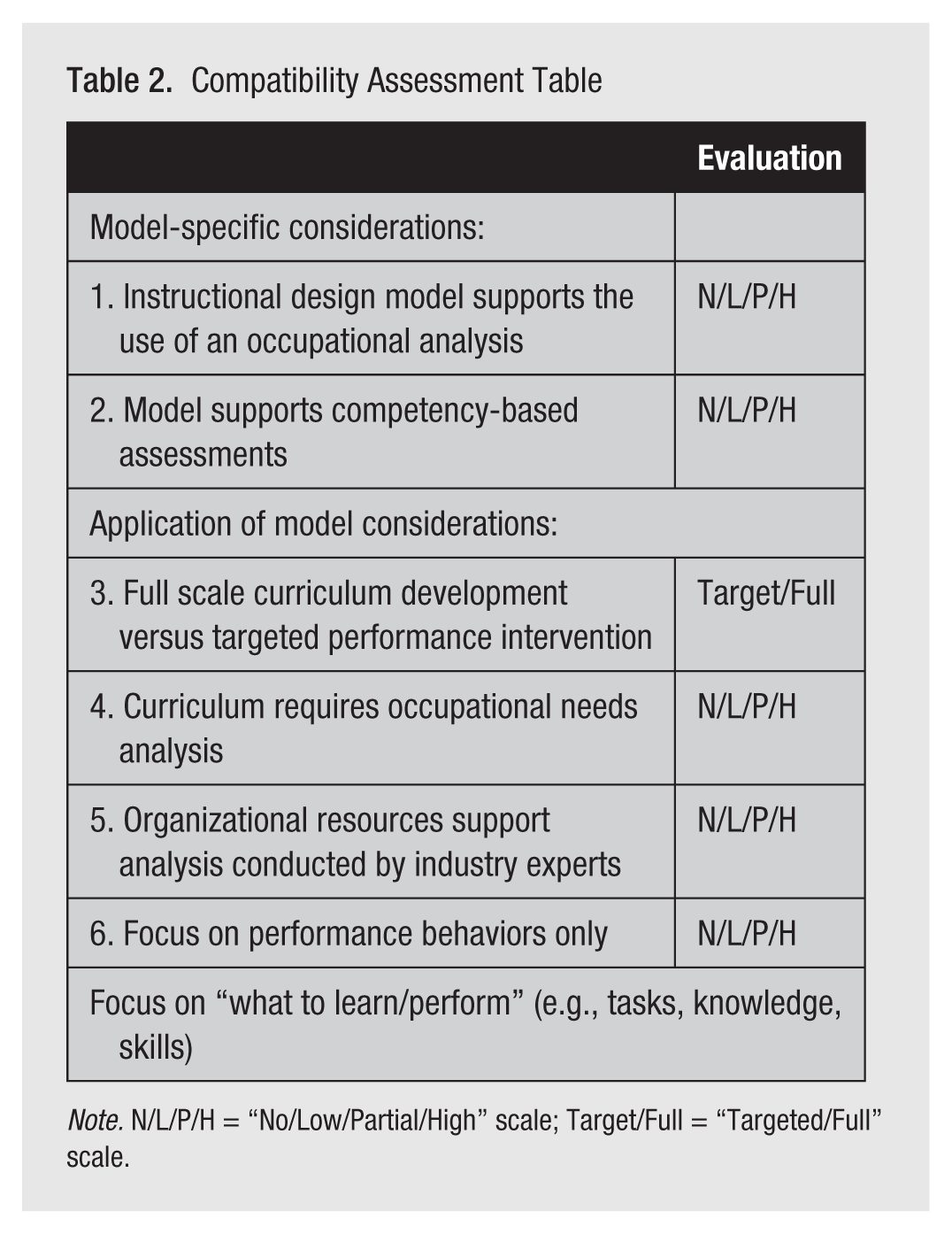
Note. N/L/P/H = “No/Low/Partial/High” scale; Target/Full = “Targeted/Full” scale.
Discussion
Each of the models included in this review is presented in alphabetic order with a description of the model provided first, followed by a summary of the DACUM compatibility analysis.
ADDIE
Model overview
ADDIE is a generic systems process for the creation of instructional content. The acronym ADDIE represents the five steps in the process:
No matter which position one takes, ADDIE begins with the analysis process, the step that helps an instructional designer define what is needed in systematically designed training (Roberts, 2006). Roberts continues that the methods used to collect data in the analysis phase of ADDIE include interviews, questionnaires, observations, literature, group discussions, or leveraging a panel of experts such as a DACUM panel. When a DACUM is conducted and completed, “the profile is used as a foundation for accessing specific developing instructional content” (Roberts, 2006, p. 481). Because ADDIE is a high-level model without a specific step for occupational analysis, based on the instructional goal(s), an occupational analysis may be incorporated as part of the analysis process so that the content is applicable to the target audience.
Model compatibility
Because of its generic nature, ADDIE is highly flexible. As such it supports the DACUM process very well and is well matched to facilitate competency-based approaches. ADDIE is better suited for full scale development versus targeted projects; but that is not to say it cannot be used for smaller, more focused endeavors. In terms of its compatibility with DACUM, ADDIE is one of the few models that specifically calls for a job or occupational analysis. As such, it is ideally matched for integrating the two procedures into a seamless process. Developers of adult learning curriculum have, and will continue to, rely upon ADDIE as a valuable model for occupationally based instruction for their adult learners.
ARCS
Model overview
Keller’s four category model for motivational design of instruction called ARCS (Gagne et al., 2005; Keller, 2009). It is designed to assist trainers and instructional designers in comprehending the factors that influence learner motivation and the kinds of motivational strategies that could be used in an instructional intervention. “The objective of the ARCS model is to make the theory and research in the field of motivation more easily applied in actual instruction” (Gagne et al., 2005, p. 114).
Keller’s (2009) model is made up of four categories which describe motivational variables and strategies, and a systematic motivational design process. The four categories which align with the ARCS acronym are (a)
Keller’s (2009) systematic motivational design process is formulated to be non-prescriptive, but primarily an experiential process used for problem solving. Systematic motivational design usually is leveraged to enhance an existing instructional intervention. It is not designed to provide boiler-plate prescriptions for motivating learners. The systematic motivational design process has 10 steps or activities. The 10 are as follows: (a) gather course information, (b) gather audience information, (c) conduct an audience analysis and develop a motivational profile, (d) evaluate existing course materials, (e) identify objectives and assessment methods, (f) identify motivational tactics that are applicable, (g) choose appropriate design tactics, (h) Join motivational and instructional plans, (i) choose and develop instructional materials, and (j) gather student feedback and revise as needed.
Model compatibility
Initially designed to increase student engagement at the K-12 level, ARCS has been adopted and applied to adult learning programs as well. It is still far less common in its usage than ADDIE but it is a useful tool for programs where the learner’s motivation and engagement is critical to their overall success.
In addition, because Keller’s model is used to enhance existing learning products, it would seem that an occupational analysis might not be needed in this model. However, in Step (c) where an audience analysis is conducted in conjunction with a motivational profile, an occupational analysis may tangentially contribute, to develop role-based training that was not only simply didactic but also motivational. That being said, it is not a required element and as such makes ARCS a less than ideal model for adult learning curriculum where a DACUM is necessary to secure the content’s occupational validity. In addition, ARCS is not necessarily focused on performance behaviors, and consequently it does not always transfer well to workplace utilization.
Dick, Carey, and Carey
Model overview
The 10-step systems approach model for designing instruction developed by Dick, Carey, and Carey (2009) has a long history of development and adoption by instructional designers at the K-12 and adult learning arenas. In its current iteration, this iterative model has 10 steps. The 10 steps are as follows: (a) instructional goals are identified, (b) instructional analysis is conducted, (c) learners and their contexts are analyzed, (d) performance objectives are created, (e) assessment instruments are created, (f) the instructional strategy is created, (g) instructional materials are either selected or developed, (h) a formative evaluation of instruction is designed and executed, (i) instruction is revised, and (j) a summative evaluation of instruction is designed and executed.
Model compatibility
From an adult learning practitioner’s perspective, this model is quite practical and flexible. It does not follow the historical ADDIE framework but there is a systematic flavor to it that is quite easy to digest. During Step (b), where an instructional analysis is conducted, “you determine step-by-step what people are doing when they perform that goal and also look at the subskills that are needed for complete mastery of the goal” (Dick et al., 2009, p. 6). Also, in this step, you determine the knowledge, skills, and attitudes that learners need to be successful. Without explicitly saying so, they call for an occupational analysis grounded in a DACUM process. As with ADDIE, this model is better suited to full scale efforts. It can be used with smaller, targeted projects but it is better with the big adult learning curriculum projects.
SAM
Model overview
Michael Allen’s (2003) alternative to ADDIE, SAM, was developed with the adult learner in mind and was promoted as a model for organizations seeking an integrated design and development methodology. In this format, SAM is a simple, three-step, iterative process starting and ending with the evaluate step followed by design and develop. The evaluate step starts the process by asking who the adult learners are and what in their performance needs to be modified. Implicitly, this asks the question, “What do the learners do in their occupation?” For larger projects where an organization’s methodology does not integrate the design and development processes for instructional development, Allen (2012) proposes a three-phase approach, SAM 2, which includes a preparation phase, an iterative three-step design phase, and an iterative three-step development phase. The preparation phase explores an organization’s background, prior instructional attempts, and current programs that are being leveraged. The design phase is composed of three steps: evaluate, prototype, and design. The development phase is composed of three steps also: evaluate, develop, and implement. Allen’s primary criteria for both models are as follows: they must be iterative, support collaboration, be efficient and effective, and, finally, be manageable.
Model compatibility
No matter which SAM approach is examined, a background or evaluative analysis is required. Despite not explicitly defining a phase for occupational analysis, it is possible to incorporate and justify an occupational analysis in either the preparation phase of SAM 2 or the evaluate step of the original SAM design. However, that does not mean the two frameworks, that is, SAM and DACUM, always work together smoothly. SAM often is used by organizations that do not have a lot of resources or are trying to minimize the resources utilized in curriculum projects. As such, these agencies do not always have the organizational resources for conducting comprehensive occupational analyses, that is, bringing in industry/occupational experts, conducting workshops, and so on. For the same reasons, SAM is better suited for smaller, narrowly defined projects versus large-scale curriculum endeavors.
Systematic Curriculum Instructional Development (SCID) Model
Model overview
Another derivative of ADDIE is the model developed by Norton and Moser (2007), the SCID model. SCID has five phases, similar to ADDIE, with each phase broken out into detailed components. When totaled up, there are 23 components in SCID. The five major phases are curriculum analysis, curriculum design, instructional development, training implementation, and program evaluation. Program evaluation provides ongoing feedback to each of the other four phases. The purpose of the curriculum analysis phase is to discover a job’s makeup by dissecting it into its elements. The curriculum analysis phase is composed of six major components. These six are (a) conduct a needs analysis, (b) conduct a job analysis with a preference being the DACUM process, (c) conduct a task verification, (d) select the tasks for training, (e) perform a task analysis, and (f) develop a competency profile.
Model compatibility
It would be hard to argue that a model created by two of the leading proponents of the DACUM process, that is, Norton and Moser, does not support the DACUM process. If anything, it may focus a little too much on the curriculum analysis phase and not enough on other phases. All in all, it can be summed up as ADDIE with a healthy dose of steroidal analyses. As such, it requires the same amount of time and resources as ADDIE plus additional time and resources for conducting the in-depth analyses. Consequently, adult learning practitioners would be well served to use SCID for projects that have large budgets and high visibility within an organization; for smaller curriculum projects, the traditional ADDIE approach should serve them better.
Smith and Ragan
Model overview
The three-phase instructional design process model offered by Smith and Ragan (2005) is one of the simplest and most flexible instructional design models. It is both depicted as a sequential series of phases and steps and an interwoven, non-linear set of processes. The three major phases of the model, also “termed a common model of instructional design” (p. 10), are as follows: Analysis, Strategy, and Evaluation. The four major steps of the analysis phase are (a) analyzing the learning contexts, (b) analyzing the similarities and differences between learners, (c) analyzing the tasks performed by learners, and (d) developing assessment items. The strategy phase has two primary steps, which are (a) determine organizational, management, and delivery strategies; and (b) create and deliver instructional content. The two primary steps of the evaluation phase are (a) conduct formative evaluation and (b) revise instruction. In the analysis phase, during the learner task analysis, it would be an easy assumption that an occupational analysis may precede the task analysis to identify the tasks performed by the future learners.
Model compatibility
Although it does not explicitly require it, during the third stage of the Analysis phase, that is, analyzing the tasks performed by learners, a DACUM could be integrated into the analysis process. Like ADDIE and Dick, Carey, and Carey before it, the Smith and Ragan model is better suited to full scale projects. Similar to the aforementioned models, the Smith and Ragan model also carries the same resource burdens as the two larger models. That is to say, although it is very flexible to the needs of the instructional designer, it requires a lot of organizational resources and time to be carried out as intended by its creators—a problem that is compounded when you include the additional expense of carrying out a DACUM as part of overall project.
The ADDIE; Dick, Carey, and Carey; SCID; and Smith and Ragan models are highly adaptable general frameworks capable of supporting and facilitating large-scale curriculum efforts. As such, they are good matches for adult learning projects requiring one or more DACUMs to establish occupational validity for the curriculum. For smaller scale projects, the SAM or possibly the ARCS model may be choices. Their focus on learner motivation and transfer of knowledge make them good choices for projects where the curriculum is targeting a niche behavior or skill set.
Whatever the ultimate choice for a given project, adult learning practitioners should consider each of the factors outlined in Table 1. Collectively, they can help guide the decision-making process and aid in selection of the right instructional model for your adult learning curriculum project.
Footnotes
Conflict of Interest
The author(s) declared no potential conflicts of interest with respect to the authorship and/or publication of this article.
Funding
The author(s) received no financial support for the research, authorship, and/or publication of this article.
Author Biographies
Warren Wyrostek holds a master’s degree in vocational-technical education as well as a master’s degree in divinity. In 2012, after publishing his third book, he became a DACUM (Developing a CurriculUM) facilitator primarily focusing on its use in curriculum and organizational development in corporate settings.
Steven Downey, PhD, is a professor of education at Valdosta State University. Prior to his current post, he was a research scientist at the National Center for Supercomputing Applications where he designed innovative online environments for learning and scientific collaboration.