







Abstract
“Yes, sir!” is the immediate response of a student in a military training school, where I am a product of such a setting. In a traditional military classroom, the instructor is the authority and transmitter of knowledge to their students, who engage in low-agency and compliance-driven responses to activities and questions during class. This approach may be constraining and disengaging to non-military students and instructors but typifies the structure and followership through structural organization or hierarchy in instruction. However, with the new generation of instructors and students influenced by changes in the environment, such as technological advancement, I have observed and practiced changes in instructional delivery. Here’s my never-ending attempt to make a difference in a structured military learning environment.
Shaping Learning in the Military: Discipline, Reflection, and Development
For years, I have served the armed forces as a military officer, in charge of personnel management, budget, logistics, and as an instructor in various major services’ education and training units. As a staff member handling multiple roles, I realized that learning organizational functions requires an adaptive and reflective process rather than a straightforward understanding of instructions.
A complicated process with auxiliary steps, I as staff and instructor, I must adjust depending on structural requirements—for example, who requested compliance, which major service, and the student composition or profile. Initially influenced by my profession, I equate this viewpoint of learning with compliance, repetition, and mastery.
Based on the lessons learned from my profession and the concepts and realizations from academic pursuit, my teaching philosophy is founded on three interconnected learning goals, especially in the military: (a) Education should teach how to do things well and how to make moral decisions; (b) Metacognition and mindfulness are necessary components of leadership; and (c) Students perform optimally when feeling control over their learning. More than learning goals, these ideas serve as guiding principles in translating my philosophy into practice through instructional design, active engagement, and authentic assessment in a highly structured learning environment. When teaching is approached this way, the teaching and learning process becomes about empowering rather than controlling future leaders, evolving into a partnership founded on reflection, purpose, and respect.
Learning With Purpose: A Critical Realist Perspective on Education and Growth
To me, learning is a thoughtful and planned way to grow, focusing on changing how students think and molding them to become the citizens the society needs, rather than just sharing information. Consistent with critical realism, I view education as an open system where structure and culture set possibilities, but individual agencies have the power to make things happen (Archer, 1995). As a student and instructor, I have observed that learners are motivated more effectively by purpose than command, requiring knowledge of why something is important before learning how it functions. Education must go beyond procedural requirements and credential attainment to reflect on the purpose of learning in developing critical judgment and moral decision-making competencies among future leaders.
Setting an administrative or operational purpose based on a task or directive is a necessity in the military. This is where we “follow orders.” As an instructor of military professionalism and a student, I realized that clarifying the orders is not a violation of insubordination but simply a way to process the purpose where students deeply learn.
This perception aligns with Langer’s (2000) concept of mindful learning, where students are receptive to new ideas and experiences, which differs from being passive. Sometimes new concepts may contradict the students’ beliefs or traditions, the management of thoughts and feelings, as introduced in Drigas et al.’s (2023) metacognitive awareness as an important to learning and making decisions. Leading through learning begins within oneself, requiring self-awareness of what is known, how it is known, how it can be validated, why it matters, and how it can be improved so that one can live and serve others with purpose. Metacognition and mindful learning are essential in developing leadership among students.
As I envision students as future leaders, they must take an active role in their learning journey by transforming the rigid classroom into an active learning space without compromising the discipline and core values of the organization. My transformation from sole authority to instructor-facilitator provides opportunities for students to ask questions, investigate, integrate knowledge into daily lives, and reflect on challenges or failures as part of their learning journey. This shift from teacher-centered instruction to active learning creates conditions where students develop a sense of ownership over their learning, encouraging them to actively engage in the learning process.
Translating Philosophy into Practice: Guiding Principles for Military Teaching
My Guiding Principles in Translating Teaching Philosophy Into Practice in Military Education
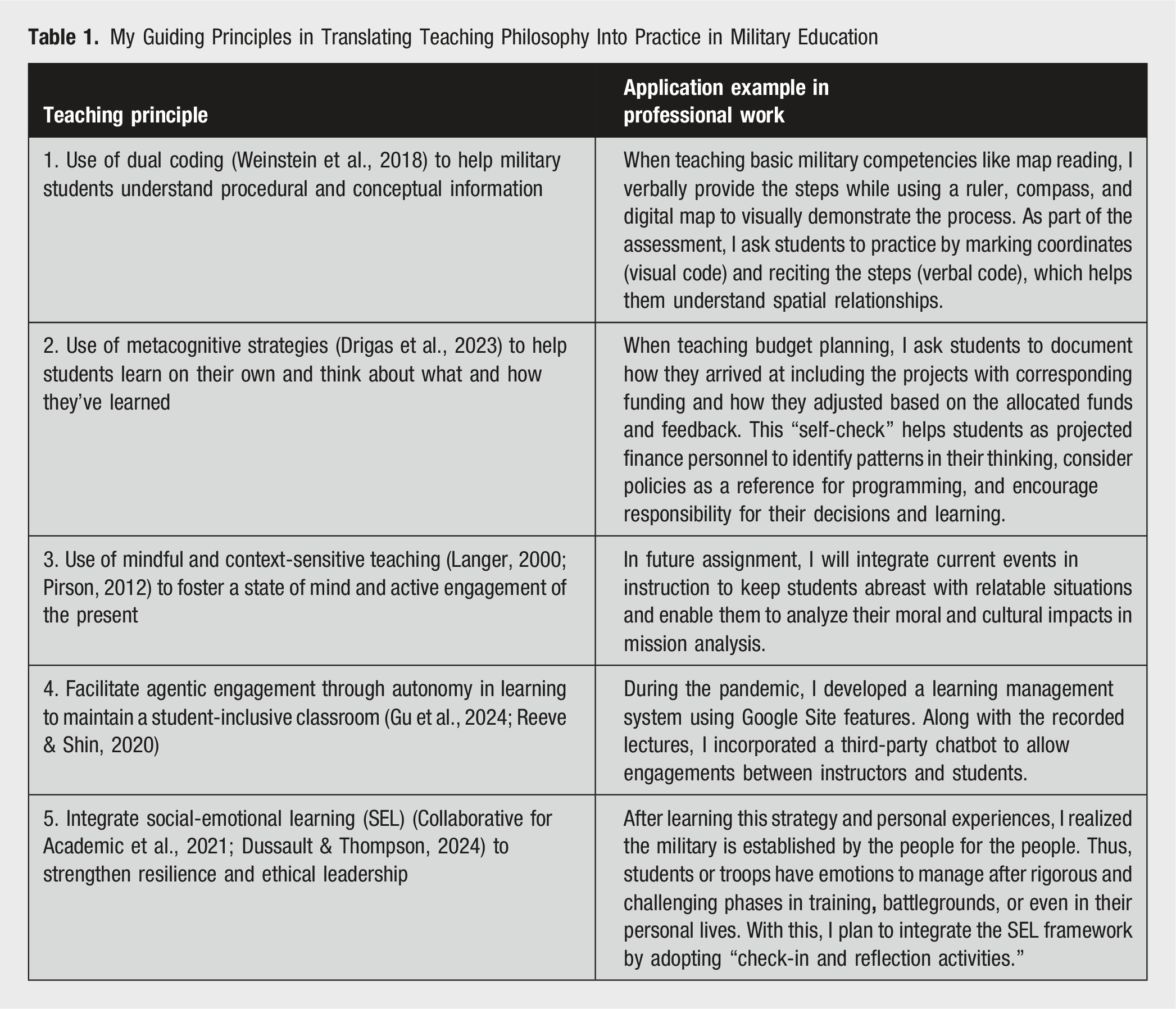
These principles will continually evolve based on experience and specific situations. While military discipline and structure guide the educational process, my discernment as an instructor will give purpose and direction. I strive to achieve this crucial balance through reflection, clarity of purpose, and intentional learner engagement, in every field exercise, class, and leadership experience.
Over time, I have realized that learning is not limited to following written and unwritten rules but comprises our understanding of what we do, why we do, and how we impact others. Learning is changing, continuously evolving, and so is teaching. As I shift from the sole authority over knowledge to a co-participant in learning with students, I seek to transform the “Yes, sir!” associated with low-agentic, compliance-driven responses into reflective, purpose-driven, and respect-anchored engagement that empowers the next generation of military leaders and professionals outside the training walls.
My guiding principles in teaching are not limited to military education but could also be translated to adult education, aiming to transform structure- and hierarchy-driven instruction into a collaborative partnership that balances institutional discipline with individual learning agency. Educators in any field can create an inclusive learning space where students are encouraged to investigate and integrate knowledge into their daily lives rather than merely follow procedural commands. This is achieved by providing them with an opportunity to understand the “why” behind tasks and employ evidence-based strategies such as dual-coding and metacognitive “self-checks.” Guided by these principles, designing a collaborative learning space for adult learners helps them reflect on the purpose of learning for themselves and the community.
Footnotes

Funding
The author received no financial support for the research, authorship, and/or publication of this article.
Declaration of Conflicting Interests
The author declared no potential conflicts of interest with respect to the research, authorship, and/or publication of this article.