






Abstract
The number of Neurodivergent students and students with disabilities has been growing within higher education institutions. There still exists a disparity in admission and graduation rates between students with diverse learning needs and those in the neuromajority. This paper examines the main barriers that contribute to this disparity and, through the lens of Universal Design (UD) and the social model of disability, offers recommendations to prevent and overcome those barriers. Particularly relevant to online higher education contexts that tend to be favored by students with diverse learning needs, UD-aligned considerations are discussed. Those include environmental design (e.g., setting clear expectations and outcomes, embedding bidirectional feedback systems, among others) and social connectedness and support (e.g., building community, fostering supportive relationships, valuing diversity of communication, and creating a sense of belonging) that focus on promoting student well-being and increase their likelihood of completing their educational programs successfully.
Keywords
“Diverse learners in distance education have reported that it can be more difficult to have such sense of belonging in higher education environments.”
Distance higher education is growing rapidly and increasingly attracting learners from diverse backgrounds (Briggs et al., 2024; Coleman & Berge, 2018; Horlin et al., 2024; Kara et al., 2019), which underscores the need to rethink a “one-size-fits-all approach” within higher education institutions (HEIs). Historically, many higher in-person and distance HEIs, have placed the onus for learning and belonging on students who differ from the neuromajority (i.e., Neurodivergent students, adult learners, and students with disabilities; Dwyer et al., 2023; Lestremau Allen et al., 2025; Lomellini et al., 2025; Syed et al., 2024). Universal Design (UD), which focuses more on the social model of disability, can play a pivotal role in creating more equitable and inclusive learning experiences for students who differ from the neuromajority, particularly in online environments. In this paper, we outline UD-based recommendations and resources for HEIs offering distance learning.
Supporting Diverse Learners in Higher Education
Research across cultural, educational, and geographical contexts indicates that Neurodivergent individuals and individuals with disabilities are increasingly seeking higher education and advanced learning opportunities (Barrera Ciurana & Moliner García, 2023; Bartolo et al., 2025; Cox et al., 2017; Lomellini et al., 2025; Sarrett, 2018). These students commonly enroll in higher education at more advanced ages than those without disabilities (U.S. Dept. of Ed., National Center for Educational Statistics, 2016). Accordingly, they can often be dually described as adult learners, defined as students over the age of 25 and/or those returning for further learning (Gardner et al., 2022; Owusu-Agyeman, 2019). Research suggests that individuals who hold these identities enroll and graduate at considerably lower rates than their peers (Bakker et al., 2023), highlighting inequities present within HEIs. Although resources such as Disability Services are generally available in United States-based HEIs, medical diagnoses and disclosure and registration within the institution is often required to access supports (Lomellini et al., 2025; Syed et al., 2024). Disclosure requirements have been reported by students in HEIs as a major barrier to accessing support, with many students indicating fear of stigmatization or ostracization (Barrera Ciurana & Moliner García, 2023; Bartolo et al., 2025; Briggs et al., 2024; Hamilton & Petty, 2023; Lomellini et al., 2025). Moreover, adults with disabilities, learning support needs, and Neurodivergent identities, including Autism, 1 often encounter difficulties obtaining a diagnosis later in life due to high costs, long wait times, difficulty accessing providers who are qualified to diagnose adults, and general lack of healthcare access (de Broize et al., 2022; Malik-Soni et al., 2022). Therefore, it becomes even more critical to provide resources that would enable learners with and without diagnosed disabilities to thrive in a higher education environment.
Distance education, which generally consists of flexible, online learning, is defined as planned learning activities that occur without physical time and place requirements (Akpen et al., 2024; Lestremau Allen et al., 2024). Often described as online learning, online education, or remote education, distance education has grown increasingly popular following the COVID-19 pandemic (Afshan & Ahmed, 2020; Akpen et al., 2024; Johnson et al., 2023) and is often preferred by Neurodivergent students and students with disabilities (Verdinelli & Kutner, 2016). Adult learners, who may have responsibilities younger learners do not have, such as being full-time caregivers (Gullo, 2022), are currently the largest audience for online distance education and may face unique challenges within this environment (Kara et al., 2019). In a global literature review, Kara and colleagues (2019) found that adult learners in distance education environments may have difficulty creating a balance between education and work, family, and social life, experience challenges in time management, and have lower confidence. They may also experience scheduling conflicts, have limited time and environments in which to study, and feel general work overload. Adult learners with disabilities or those who identify as Neurodivergent can be doubly impacted in distance education (Bryson et al., 2025; Le Cunff et al., 2024). Accordingly, universal and inclusive support is paramount for equitable access so all students, including diverse learners, are not forced to obtain or disclose a diagnosis. The next section provides background on UD and the social model of disability, tying this into guidance on the implementation of UD within an online HEI to promote greater access, equity, and inclusion for all students, including diverse learners.
Universal Design and the Social Model of Disability
UD originated as an architectural framework that emphasized the need to proactively design environments to prevent barriers users may experience, thus, allowing the environment to be used by all people to the maximum extent possible (Center for an Accessible Society, n.d; Center for Universal Design, 1997). It was developed by Ron Mace, an architect and wheelchair user since childhood whose first-hand experience of the “disabling” impact of inaccessible environments led him to create more inclusive environments and advocate for accessible housing standards in the United States (Centre for Excellence in Universal Design, n.d, Lestremau Allen et al., 2025). UD has since been extended to a variety of contexts due to its utility in promoting equity and access for all by not requiring “adaptation or specialized design” (The Universal Design Project, n.d).
One such extension of UD, Universal Design for Learning (UDL), is commonly discussed in the context of education and higher education (Fornauf & Erickson, 2020). UDL’s focus is to promote access and autonomy for all learners via the proactive design of instructional goals, assessments, methods, and materials (CAST, 2025). Its guidelines are organized into the principles of (a) engagement (i.e., designing in a manner that acknowledges learner differences in sources of motivation and enthusiasm for learning), (b) representation (i.e., designing in a manner that accounts for the variety of ways that learners perceive and understand information), and (c) action and expression (i.e., designing to account for differences in how learners demonstrate what they know) (CAST, 2025). Although UDL offers countless benefits for all learners, the broader framework of UD has much to contribute to efforts to promote HEI-wide equity, access, and inclusion (Lestremau Allen & Syed, 2025).
The UDL framework aligns with the social model of disability, which “locates disability… in an excluding and oppressive social environment” (Marks, 1997, p. 88) as opposed to the disabled person, which aligns with the historical medical model (Zaks, 2023). This broad application of UD to a variety of contexts, including HEIs, emphasizes the need to proactively identify barriers and design in a manner that removes or mitigates them from the physical spaces, materials, policies, procedures, interactions, and instruction in which the user will engage (Lestremau Allen et al., 2025; Lestremau Allen & Syed, 2025). For example, curb cuts/ramps enable wheelchair users access while enhancing the experience for others, such as people pushing strollers, travelers rolling suitcases, and delivery workers using carts. Examples of UD within HEIs include closed captioning, transcripts for video content or live video calls, use of plain language, and supportive relationships with advisors and instructors (Lestremau Allen & Syed, 2024). As such, UD is inherently inclusive, as it enables more students to access features of an instructional environment without the need for specific accommodations.
Universal Design in Distance Education
In HEI, the onus may be placed on diverse learners to change their behavior or otherwise adapt to fit social and expected norms (Collins et al., 2018; Rahajeng et al., 2024; Tcherdakoff et al., 2025). Drawing from the social model of disability (Oliver, 2013; Shakespeare, 2006), a UD approach promotes embedding resources throughout the environment (beyond the “classroom”) that would benefit all students (Edwards et al., 2022), while equipping HEI employees to understand and support students in an inclusive and universal manner. In this section, we will provide guidance on the implementation of UD throughout multiple aspects of distance education environments, so that all students may benefit without the need for a diagnosis or disclosure (see Appendix A for a summary of recommendations).
Environmental Design: Clear Expectations and Outcomes
Enhanced clarity is essential within online HEIs and with diverse learners, where fewer in-the-moment opportunities may exist for students to obtain clarification from instructors or personnel. The implementation of backward-planning processes, or backward design, can be highly supportive for all learners and can be applied in student-facing offices, as well as in academic coursework. Backward design generally consists of identifying the desired outcomes, which are used to shape content development towards achievement of a terminal goal (Cartagena & Pike, 2020; Davis et al., 2021; Dell et al., 2015).
Academic Examples
In academic coursework, a faculty member may establish learning objectives (LOs) and outcomes, followed by the development of instructional content, course materials, assignments, and course sequence, ensuring sufficient time for each objective to be met. Another evidenced-based UD strategy in online higher education is embedding scaffolding within coursework (Doo et al., 2020). Scaffolding consists of creating a final project that has affiliated subtask deadlines throughout the course to allow ample time for the student to receive instructor feedback, process, and, if needed, respond before working on the next project task (Coleman & Berge, 2018; Doo et al., 2020; Lestremau Allen & Syed, 2024; Syed et al., 2024).
Administrative Examples
In student-facing offices, such as those that directly serve students (i.e., Financial Aid, Bursar, and Registrar), employees may determine a deadline for paperwork submission and work backwards to create sub-deadlines in which portions of the paperwork are submitted, giving feedback to students throughout the process. The office may create task analyses, flowcharts, templates, models, and checklists (Lestremau Allen et al., 2025; Lestremau Allen & Syed, 2024; Lowenthal et al., 2020) which can clarify processes, provide step-by-step directions, and give a model students may use or adapt.
Bidirectional Feedback
Research has also suggested that intentional, frequent, and meaningful feedback can be critical for student success throughout the HEI (Brown et al., 2019). It is recommended to provide feedback regularly on strengths and areas for growth in both academic assignments and other responsibilities. Feedback should be presented in multiple modalities (written, audio, video), aligned with targeted outcomes, and offered to the student with time for reflection and response (Brown et al., 2019; Gibson et al., 2022; Houston, 2018; Lowenthal et al., 2020). Bidirectional feedback opportunities, in which learners provide the HEI with information on what is working well for them and how they might have a better learning experience, can have significant impact by enabling instructors to make changes in real-time while empowering student self-advocacy (Houston, 2018; Lestremau Allen et al., 2025; Syed et al., 2024).
Additional UD Considerations
Creating online resources with consistent structure, embedded choices, and opportunities for practice are additional UD recommendations (Syed et al., 2024). Courses should be organized logically and consistently so that students have a clear understanding of how to engage with and complete coursework; student-facing offices, particularly in online education settings, may make particular use of online databases and resources (Lestremau Allen et al., 2025). Within each section of the courses and throughout all online platforms, faculty are encouraged to ensure content is clearly organized and labeled in addition to being accessible (Baguma & Wolters, 2021; Brady et al., 2022; Dell et al., 2015; Houston, 2018). Such consistency may also be supportive for students who struggle with executive functioning skills (Serpell & Esposito, 2016). Strength-based choices, a core component of UD, may support students to demonstrate their knowledge in various ways (e.g., choice between a written report, podcast, and webinar-style presentation) and provide stronger learning experiences, as might practice assignments, self-assessments, and opportunities for reflection throughout the course (Houston, 2018; Rao, et al., 2021).
Social Connectedness and Support: Building Community
A sense of belonging, or students’ feelings of acceptance, inclusion, and connectedness to their HEI, can play a significant role in their academic achievement, self-confidence, and motivation; this, in turn, affects success, retention, and overall well-being (Ahn & Davis, 2019; Pedler et al., 2022). Importantly, diverse learners in distance education have reported that it can be more difficult to have such sense of belonging in higher education environments (Bartolo et al., 2025; Cox et al., 2017; DiGiacomo et al., 2023; Dumais et al., 2013; Fong et al., 2024). Given these reported challenges, it is critical for HEIs to embed strategies that may enhance connectedness for all students in online learning environments. Amongst these are expanded opportunities for quality online interactions, which can consist of virtual opportunities to connect with peers, interactions with other students that further one’s own knowledge, increased opportunities for connecting with instructors, and genuine, supportive interactions (Coleman & Berge, 2018; Diep et al., 2017; Lestremau Allen & Syed, 2024; Lowenthal et al., 2020). Providing employees with training on UD and supporting diverse learners may also augment community building (Syed et al., 2024). Examples of this training may include learning from the lived experiences of students and alumni, including barriers they have encountered and strategies/resources that were helpful for them; asynchronous online offerings and webinars on UD, neurodiversity, and neurodiversity-affirming strategies; and case-study discussions. Additional resources might include downloadable documents or other media that offer suggestions, models, and templates focused on universally inclusive support.
Supportive Relationships
HEIs can encourage employees to engage in quality, empathic interactions with students through a variety of ways. For example, instructors, tutors, and other support personnel may distribute an optional survey at the beginning of courses, advisement, and/or at the onset of their working relationship. This survey may include questions centered around understanding student learning preferences, preferred methods of communication, how the student may wish to be supported (e.g., regular check-ins, brief meetings), challenges they are experiencing, and additional relevant information (Houston, 2018; Lestremau Allen & Syed, 2024; Syed et al., 2024). The beginning of an employee-student relationship may also be ideal for sharing and clarifying expectations, identifying specific objectives, how these will be measured, and can be met, and providing clear ways support can be obtained in the HEI (Lestremau Allen & Syed, 2024, 2025).
Valuing diversity of communication. Welcoming different communication styles is a critical component of quality, empathic interactions that supports all students, including diverse learners. The “double empathy problem” (Janse van Rensburg & Liang, 2025; Milton, 2012; Milton et al., 2022), often discussed in autism literature, refers to a breakdown in understanding that can occur between any two individuals in which the communication challenges are perceived to lie mainly with the individual who communicates “differently.” Within a UD approach, it is acknowledged and accepted that individuals of varying backgrounds, identities, and learning histories communicate differently; therefore, each party in any given interaction endeavors to approach communication from “a position of humility in the face of indifference, the need to build rapport and understanding, and not assume a lack of capacity for understanding” (Milton et al., 2022, p. 2).
Given the nature of asynchronous interactions, online learning may specifically support Neurodivergent students by affording students more time to review and reflect on course content (i.e., watching lectures at their own pace versus listening in real-time), which can help mitigate communication challenges associated with double empathy (Walsh et al., 2025). UD oral communication recommendations may include speaking directly and clearly, allowing processing and response time, and having an awareness of environmental distractions that may impact an individual’s comprehension (Lestremau Allen et al., 2025; Syed et al., 2024). UD written recommendations include presenting concise, well-organized, and explicit directions, along with models, templates (e.g., email templates) and a Frequently Asked Questions resource for courses, programs, and assignments (Lestremau Allen & Syed, 2024; Syed et al., 2024).
Creating a sense of belonging. Research has shown that safe spaces are essential for supporting diverse learners in higher education (Beck Wells, 2024). Characterized by non-judgment and the freedom to express oneself without fear of discrimination or harassment, safe spaces are designated areas, groups, or other environments in which students feel supported regardless of and inclusive to their identities and backgrounds (Harpalani, 2017; Sam, 2021). The intentional creation of safe spaces within distance education settings may also play a role in increasing students’ sense of belonging (Bartolo et al., 2025). Such spaces may particularly support well-being and connectedness for students who have been historically marginalized or underrepresented, including diverse learners (Harless, 2018; Suad Nasir & Al-Amin, 2006). In a remote education context, these groups can help students “gain a presence in the institution as a specific group, to feel their voices are recognized and heard, [and] to be received proactively” (Melián & Meneses, 2022, p. 6). While Melián and Meneses (2022) focused on students with disabilities, we suggest that the creation of online safe space for students in distance education is a UD support that may promote student well-being for all students, increasing the likelihood they will successfully complete their higher education experience.
Conclusion
In summary, literature suggests that diverse learners who are increasingly seeking distance learning may experience considerable challenges with enrollment and graduation in HEI and encounter barriers to accessing support in HEI, such as the need for a medical diagnosis that must be disclosed. Adult learners who self-identify with disabilities may experience these challenges in a more impactful manner (i.e., difficulty obtaining diagnoses). Further, adult learners are most frequently served through distance education environments and experience their own unique challenges as a result of various competing demands for their time and resources. Together, this information suggests a growing number of adult Neurodivergent learners are enrolled in distance learning environments; failing to enhance universal supports can be detrimental to online HEIs, given the growth of diverse learners in HEI in distance, online settings (Gardner et al., 2022). The UD-aligned recommendations provided here are informed by the existing literature regarding the inclusion of diverse learners with particular emphasis on distance HEIs. Categories of guidance span environmental design and social connectedness and support, reflecting the breadth of areas within HEIs that can either facilitate the success of diverse learners or promote societal inequities. Although it takes intentionality, time, and buy-in, efforts to incorporate these UD recommendations reflect sustainable systems-change that promotes far-reaching benefits for all students and employees (Lestremau Allen et al., 2025; Syed et al., 2024).
Footnotes
Acknowledgments
The authors wish to thank Emanuella Simoni for their extensive support in the collection and review of relevant literature.

Funding
The authors received no financial support for the research, authorship, and/or publication of this article.
Declaration of conflicting interests
The authors declared no potential conflicts of interest with respect to the research, authorship, and/or publication of this article.
Note
Author Biographies
Appendix
Recommendations for Universal Design within a distance higher education environment.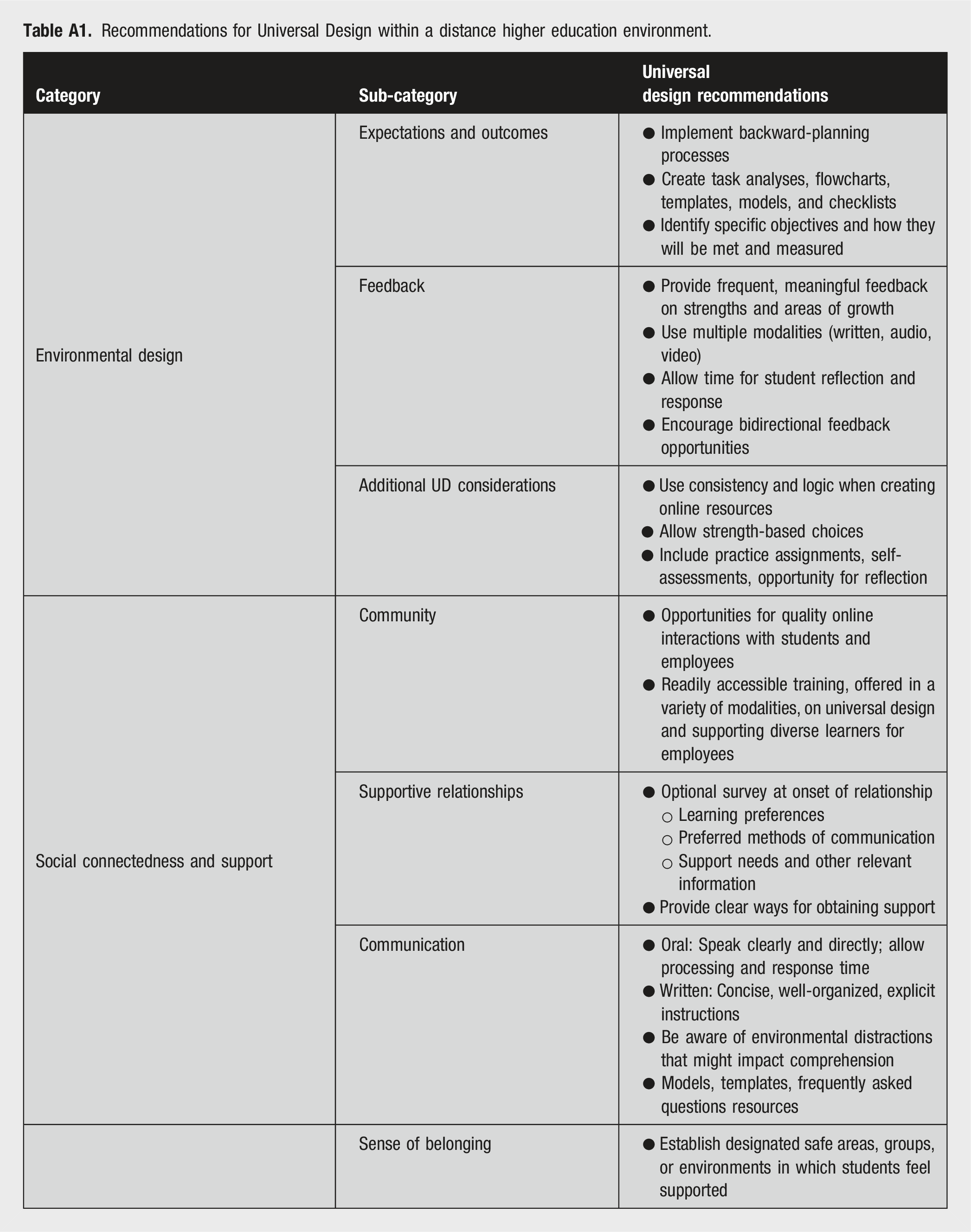
Category
Sub-category
Universal design recommendations
Environmental design
Expectations and outcomes
● Implement backward-planning processes
● Create task analyses, flowcharts, templates, models, and checklists
● Identify specific objectives and how they will be met and measured
Feedback
● Provide frequent, meaningful feedback on strengths and areas of growth
● Use multiple modalities (written, audio, video)
● Allow time for student reflection and response
● Encourage bidirectional feedback opportunities
Additional UD considerations
● Use consistency and logic when creating online resources
● Allow strength-based choices
● Include practice assignments, self-assessments, opportunity for reflection
Social connectedness and support
Community
● Opportunities for quality online interactions with students and employees
● Readily accessible training, offered in a variety of modalities, on universal design and supporting diverse learners for employees
Supportive relationships
● Optional survey at onset of relationship
○ Learning preferences
○ Preferred methods of communication
○ Support needs and other relevant information
● Provide clear ways for obtaining support
Communication
● Oral: Speak clearly and directly; allow processing and response time
● Written: Concise, well-organized, explicit instructions
● Be aware of environmental distractions that might impact comprehension
● Models, templates, frequently asked questions resources
Sense of belonging
● Establish designated safe areas, groups, or environments in which students feel supported