






Abstract
Practices in higher education do not always translate the rigor and applied nature of military training into meaningful academic credit for prior learning (CPL). Drawing on a secondary analysis of qualitative interviews with 10 student veterans, the purpose of the current study was to examine where and why recognition gaps occur, connect those gaps to established adult-learning frameworks that explain veterans’ strengths and needs, and identify design-level implications for faculty practice and institutional processes to move beyond symbolic “veteran-friendly” efforts toward systematic, evidence-based recognition of prior learning. Major findings included three systemic challenges—undervaluation of military training and experience, cultural disconnects between veterans and their faculty members and peers, and the need for coordinated centralized support for veterans. The findings offer implications for instructional practice, institutional policy, higher education reform, and future research to serve veterans as adult learners.
Keywords
“Universities without integrated services risk leaving veterans underserved despite substantial federal funding for their education.”
Veterans are an experienced yet underrecognized student population in U.S. higher education. Policy expansions have increased access, and many veterans bring substantial technical expertise, leadership, and resilience to campus (ACE, 2024; Kilgore, 2024). Nevertheless, persistent barriers remain. Recent work highlights recurring problems in how institutions recognize prior learning and align programs to demonstrate competencies, particularly for veterans (Welsh & Ruda, 2024). These concerns underscore the need for more systematic approaches to competency recognition.
Institutional practices do not always translate the rigor and applied nature of military training into meaningful academic credit. Training pipelines, such as U.S. Navy “A” schools or U.S. Army officer courses, integrate technical depth with extended field application and sustained assessment; these experiences can meet or exceed associate- and bachelor-level outcomes (ACE, 2024). Contemporary discussions of skillification and credit for prior learning (CPL) suggest that mapping service-based competencies to program learning outcomes, rather than relying solely on course-to-course equivalence, can yield more valid and equitable recognition (Welsh & Ruda, 2024). When such mapping is weak, veterans may repeat content already mastered, signaling limited recognition of prior competence and extending time to degree. At the same time, workforce demand remains high in areas such as cybersecurity and related technical fields, underscoring the relevance of more accurate translation of prior learning (Carnevale et al., 2020; CyberSeek, 2024; Klein-Collins et al., 2020). These workforce trends reinforce the urgency of improving the translation of military-acquired competencies into academic pathways.
Veterans’ prior experiential learning goes unrecognized during transition into higher education. Drawing on a secondary analysis of qualitative interviews with student veterans, the purpose of the current study was to examine where and why recognition gaps occur, connect those gaps to established adult-learning frameworks that explain veterans’ strengths and needs, and identify design-level implications for faculty practice and institutional processes that move beyond symbolic “veteran-friendly” efforts toward systematic, evidence-based recognition of prior learning.
Veterans as Adult Learners in Higher Education
Research consistently positions military veterans as adult learners whose trajectories differ from those of traditional undergraduates. Many arrive with substantial applied technical training and leadership experience from formal military schooling and operational practice (Vacchi & Berger, 2014). These characteristics align with andragogy’s emphasis on self-direction, goal orientation, and immediate application to real-world problems (Knowles et al., 2023). Prior work also documents recurring challenges in higher education—translating military experience into academic credit, adapting to civilian classroom norms, and navigating campus systems (DiRamio et al., 2008; Jenner, 2017). These challenges highlight the need to align instructional and institutional design with adult-learning principles. What remains less developed is an explicit connection between veteran experiences and the instructional and institutional design choices predicted by adult-learning theory.
CPL, earlier referred to as prior learning assessment, is associated with higher persistence, faster completion, and lower costs for adult students (Klein-Collins, 2010; Klein-Collins et al., 2020). For veterans, CPL commonly relies on American Council on Education (ACE, 2024) credit recommendations derived from Joint Services Transcript evaluations. While these provide national consistency, scholars note that discipline-specific faculty assessment can surface competencies not fully captured by generic recommendations, particularly for advanced training (Cate et al., 2017; Kilgore, 2024). When decisions solely rely on automated or non-disciplinary processes, veterans may repeat content already mastered, thereby extending the time-to-degree completion.
Adult-learning scholarship emphasizes that institutional navigation, including program structures, service integration, and decision points, shape learner success, especially for students balancing work, family, and finances (Ford & Vignare, 2015). Veterans encounter these general adult-learner frictions alongside veteran-specific processes (e.g., benefits certification, JST/ACE mapping, enrollment verification tied to federal timelines), which can amplify handoff failures across offices (Vacchi & Berger, 2014; Zoli et al., 2015). Framing these issues through adult-learning principles focuses attention on designable features—clarity, coordination, and recognition mechanisms—rather than on individual deficits. Together, these factors illustrate how institutional complexity compounds transition instability at the point of entry.
Conceptual Adult-Learning Framework
This study used a conceptual, integrated adult-learning framework of andragogy, experiential learning, and multimodal design as a design heuristic to interpret veterans’ reported experiences.
Knowles’ andragogy positions adults as self-directed, goal-oriented learners who expect recognition of existing competence and opportunities to apply learning immediately (Knowles et al., 2023). Military schooling is explicitly competency-based and performance-evaluated, thus repeated coursework by veterans in higher education represents a misalignment between adult-learner expectations and institutional credit practices. Andragogy predicts dissatisfaction when previously mastered competencies are not recognized through advanced standing.
Kolb’s (2014) experiential learning cycle (concrete experience → reflection → abstraction → experimentation) closely maps to military training and routine after-action reviews. While portions of military learning are necessarily directive for safety or standardization, complex tasks are taught via scenarios that require diagnosis and iteration, resolving the apparent “directive vs. problem-based” tension. Classroom norms that privilege discussion or abstraction without anchoring in authentic experience may obscure veterans’ established experiential cycle rather than indicate disengagement. Kolb’s experiential cycle helps explain muted participation when courses emphasize abstraction or unanchored discussion.
Felder–Silverman’s (1988) multimodal design is used to guide redundant, coordinated representations of information (active/reflective, visual/verbal, sequential/global). Adult-learning research cautions against matching claims (Pashler et al., 2008) but supports designing multiple, accessible pathways. Veterans’ accounts of benefits certification, JST/ACE translation, and verification timelines indicate that fragmented navigation (Spencer, 2024) is a design problem: Information and support are distributed across offices and modes without coordination, undermining self-direction and predictability for adult learners.
Method
The current study used a secondary analysis of qualitative interview data collected for a phenomenological doctoral dissertation study approved by the institutional review board at a university in the southeastern United States. The original study (Spencer, 2024) examined how U.S. military veterans navigated the transition from service to higher education, with specific attention to credit transfer, classroom culture, and access to campus services. The current study builds on that work by reanalyzing the interview data to specifically examine how faculty-led recognition of prior military learning and institutional design choices shape veterans’ academic progression. While the original study broadly examined transition, the current study narrowed the focus to recognition processes and instructional implications grounded in adult-learning theory.
Participant Characteristics.
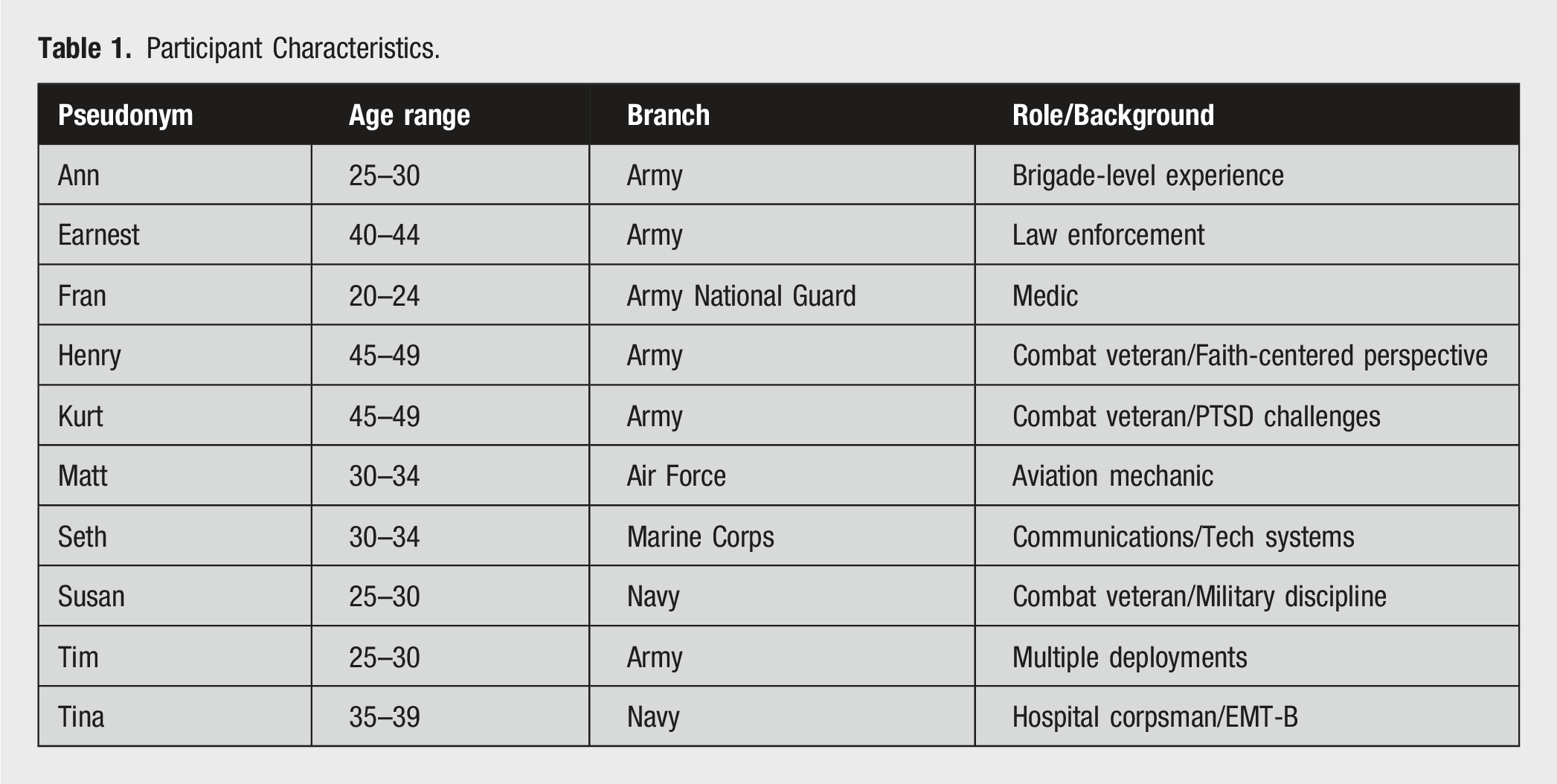
For the current study, transcripts were reanalyzed using reflexive thematic analysis (Braun & Clarke, 2006). Coding proceeded iteratively with constant comparison across cases to refine codes and candidate themes (Corbin & Strauss, 2015; Glaser & Strauss, 1967). Credibility and dependability procedures included maintaining an audit trail of code decisions and theme development, reflexive journaling, selective member checks, and peer debriefing (Lincoln & Guba, 1985; Nowell et al., 2017). Reporting followed the standards for qualitative transparency (O’Brien et al., 2014), offered as analytic generalizations appropriate to qualitative inquiry, rather than statistical generalizations.
Findings
The current study examined where and why recognition gaps occur, connected those gaps to established adult-learning frameworks that explain veterans’ strengths and needs, and identified design-level implications for faculty practice and institutional processes that move beyond symbolic “veteran-friendly” efforts toward systematic, evidence-based recognition of prior learning. Major findings included the systemic challenges veterans face—undervaluation of military training and experience, cultural disconnects between veterans and their faculty members and peers, and the need for coordinated centralized support for veterans (Figure 1). Conceptual Framework for Faculty-Led Recognition of Prior Military Learning in Higher Education. This framework illustrates how military training and experience intersect with theories of adult learning, including andragogy, experiential learning, and multimodal learning, to explain common barriers faced by student veterans, including credit transfer inequities, cultural disconnects, and fragmented support systems. The model identifies institutional strategies for addressing these barriers and highlights anticipated outcomes, including accelerated degree completion, workforce readiness, and the development of inclusive, veteran-centered academic environments.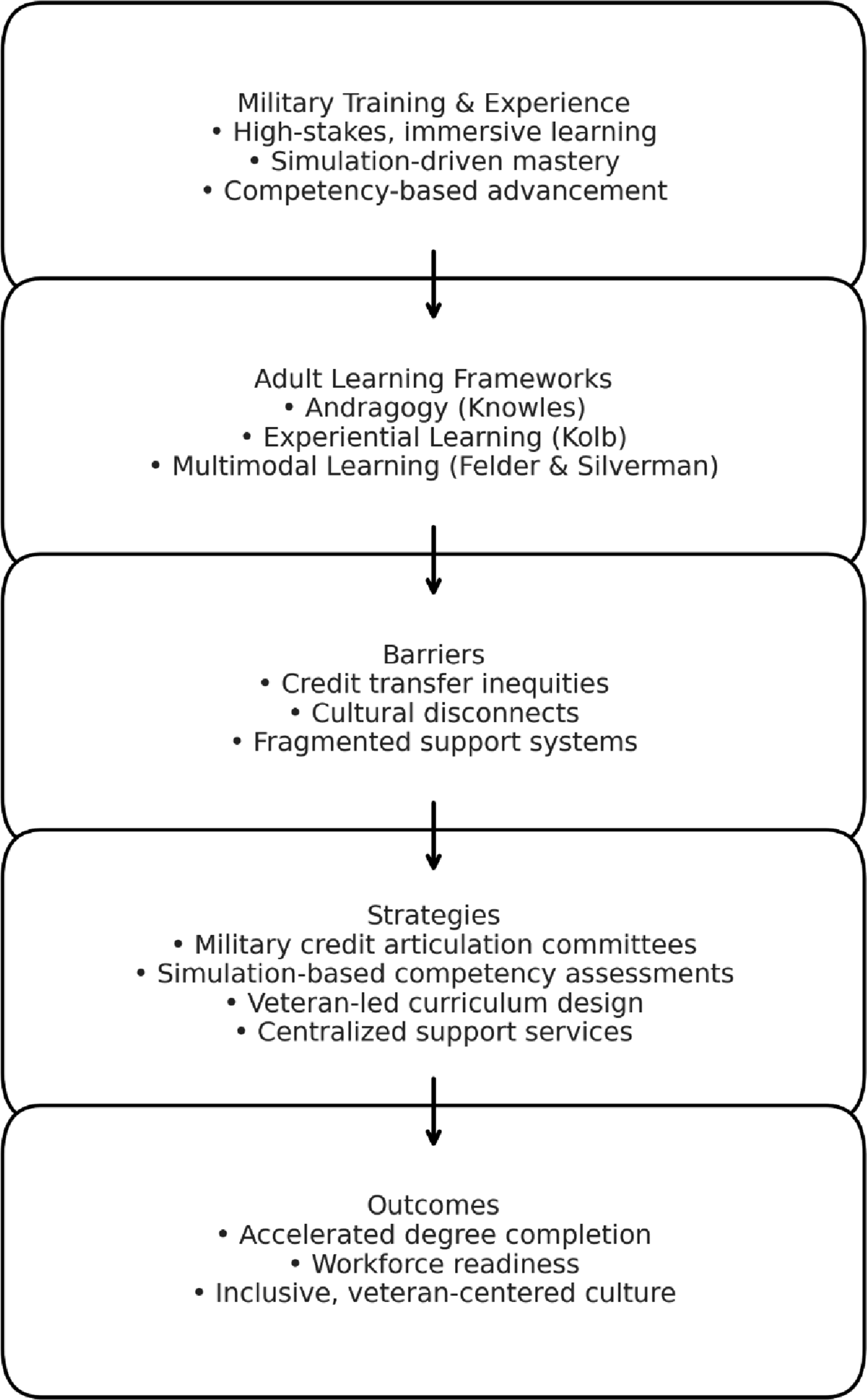
The first major finding comprised the undervaluation of military training and experience. Participants consistently described receiving little or no academic credit for extensive military training and being required to repeat basic coursework. As Tina, a Navy veteran who completed Hospital Corpsman “A” school, recalled, “We trained for months, longer than some associate programs, but when I got here, none of it counted. They told me to start from scratch.” Matt described a similar experience: “It felt like everything I did before didn’t matter. I wasn’t asking for special treatment—I just didn’t want to sit through material I’d already mastered.” Tim reflected this frustration, explaining, “It wasn’t about getting ahead—it was about not repeating what I had already proven I could do.” These narratives reflect persistent recognition gaps between demonstrated competence and institutional policy. As Kurt explained, “It felt like starting over, even though I knew I already had the skills.” Henry similarly stated, “Repeating what I already knew felt unnecessary and frustrating.” Fran, a National Guard medic, reinforced this pattern, noting, “I had medical training already, but I still had to repeat basic courses that didn’t add to what I knew.” These accounts indicate a consistent disconnect between demonstrated competence and institutional recognition practices, rather than isolated credit evaluation decisions.
The second major finding comprised a cultural disconnect between veterans and their faculty members and peers. Participants reported difficulty adjusting to informal, discussion-heavy classroom norms compared with the structured training they experienced in the military. Several veterans described instructors misreading direct communication or a reserved demeanor as disengagement. As Seth, a Marine veteran, explained, “When I don’t talk much, it’s not because I don’t care. It’s because I was trained to listen and act.” Susan elaborated, “In the military, you speak when you have something clear and useful to add. In class, it seemed like talking more was rewarded, even if it wasn’t always productive.” Ann described the adjustment more directly: “I had to learn how to communicate differently here, even when I knew what I was talking about.” Earnest added, “The way I communicated didn’t always fit what professors expected, even when I understood the material.” Such reflections suggest that perceived disengagement may instead reflect differing norms of professionalism and communication. These patterns suggest that differences in communication norms are frequently misinterpreted as disengagement, rather than recognized as products of prior professional training.
The third major finding comprised fragmented navigation across veteran-specific systems, for example, Post-9/11 GI Bill certification with the School Certifying Official, aligning Joint Services Transcript/ACE credit with degree maps, reconciling VA payment timelines with campus billing, and verifying enrollment changes tied to benefits. Several reported “running in circles” among financial aid, the registrar, advising, and the certifying official. In this sample, 80% of participants offered at least one example of a handoff failure, such as delayed housing allowance due to late verification or unapplied JST credits. Earnest, an Army veteran, succinctly summarized the experience: “Every office told me to talk to someone else. It was like the system wasn’t built for someone using military benefits.” This pattern was not isolated. Fran shared, “I kept getting sent from one office to another, and nobody really knew how it all connected.” These accounts underscore how navigation breakdowns are experienced as systemic design failures rather than isolated administrative mistakes. Collectively, these experiences point to coordination failures across institutional units.
Discussion of Findings
Interpreted through adult-learning theory and prior scholarship on veteran transitions, the major findings suggest gaps in credit transfer and CPL, cultural disconnects and classroom misinterpretations, and fragmented veteran support services.
Gaps in Credit Transfer and CPL
Credit transfer policies remain a major barrier to veterans’ success. Many universities rely on ACE recommendations for awarding military credit, yet ACE evaluations often underestimate the rigor of military coursework (Cate et al., 2017). When credit decisions rest with the registrar or automated systems without faculty input, veterans repeat coursework, wasting GI Bill benefits and extending the time to degree. Effective CPL programs raise graduation rates and lower costs (ACE, 2024; Kilgore, 2024), but implementation is uneven, and veteran-specific pathways are scarce. Using an andragogical lens, such repetition indicates a misalignment between adult learners’ demonstrated competence and institutional recognition practices (Knowles et al., 2023). Institutions should prioritize faculty-led assessment, competency testing, and partnerships with military training programs.
Cultural Disconnects and Classroom Misinterpretations
The transition from military to civilian higher education involves more than administrative hurdles to include a cultural shift. Faculty members unfamiliar with military norms may misinterpret veterans’ communication styles or classroom demeanor. Traits such as direct communication, adherence to hierarchy, punctuality, and reserved behavior are often viewed as disengagement rather than professionalism (DiRamio et al., 2008). Some veterans may also face stigma related to invisible disabilities such as post-traumatic stress disorder (PTSD) or traumatic brain injury (TBI), which can lead to misperceptions among peers and instructors (Barry et al., 2014). These cultural gaps can create isolation, reduce participation, and undermine faculty confidence in veterans’ abilities.
Faculty development programs that include cultural-competency training improve understanding of veteran learners and foster inclusive classroom environments (Vacchi, 2012). Training should introduce military culture and structure, highlight the strengths veterans bring, including discipline, teamwork, and leadership, address challenges related to service-connected injuries or mental health, and offer strategies that promote inclusive dialogue and engagement.
Fragmented Veteran Support Services
Many universities have siloed veteran support services, within student affairs or financial aid departments and primarily focusing on benefits processing rather than holistic support (Zoli et al., 2015). Research suggests that a fragmented approach—where students must navigate multiple offices for academic advising, career counseling, mental health, and disability accommodations—creates unnecessary barriers and increases attrition risk (Vacchi & Berger, 2014). Some institutions have addressed this need by establishing “one-stop” veteran education centers that integrate academic advising, career planning, and health services under one roof, reflecting best practices in retention and persistence for nontraditional students (Ford & Vignare, 2015). For example, Arizona State University’s Pat Tillman Veterans Center and Syracuse University’s Institute for Veterans and Military Families have become national models, showing that centralized services improve outcomes and strengthen veteran engagement.
Universities without integrated services risk leaving veterans underserved despite substantial federal funding for their education. This not only affects veterans but also limits the institution’s ability to harness their leadership and expertise as valuable members of the student body. The findings point to actionable reforms at both the instructional and institutional levels. Rather than framing veteran success as a matter of individual adaptation, the evidence suggests that policy design, faculty decision-making, and structural coordination are decisive factors. The implications below translate these findings into implementable strategies grounded in adult-learning theory and competency-based practice.
Implications for Practice, Policy, Reform, and Future Research
Collectively, the findings offer implications for instructional practice, institutional policy, higher education reform, and future research to serve veterans as adult learners.
Instructional Practice
Military training routinely integrates authentic, high-stakes practice with structured reflection. Consistent with evidence on simulation and deliberate practice (Cook et al., 2011), programs can adopt simulation with performance checklists and time benchmarks; couple applied tasks with concise, graded debriefs that require learners to articulate decision points; and use spiral curricula to revisit core skills under increasing complexity. Within this structure, recognition should be performance-based where appropriate: place-out exams, OSCE-style assessments, or validated projects can verify competence and reduce unnecessary repetition. These moves align with the broader evidence base on active and inductive learning and with veterans’ established learning rhythms, while preserving rigor through explicit objectives and immediate feedback (Freeman et al., 2014; Kolb, 2014; Theobald et al., 2020). These moves also align with high-impact practices (Kuh, 2008) and principles from universal design for learning and multimedia learning (Mayer, 2021), alongside evidence for problem- and case-based learning (Hmelo-Silver, 2004). In practice, this alignment supports rigorous instruction while reducing unnecessary repetition and disengagement.
Institutional Policy
Implications for institutional policy included instructional design for standards and flexibility as well as addressing systemic misalignment in recognition and support. For the first, veterans represent a diverse student population, differing in branch, specialty, deployment, and educational background. Institutional design should therefore emphasize transparent standards (to honor rigor) coupled with flexible demonstrations of competence (to honor varied prior learning). What unites many veterans is a culture of accountability, performance under pressure, and advancement based on demonstrated competency. Higher education can honor this culture by aligning course design and assessment with clearly articulated competencies while allowing flexible pathways for varied experiences and transition needs.
For the second, the barriers veterans face are not reflections of ability or motivation but of systemic misalignment between military training and academic recognition. The undervaluation of military coursework, cultural misunderstandings, and fragmented support systems combine to create unnecessary obstacles to degree completion. Addressing these challenges requires faculty-driven credit articulation processes that recognize military training equivalencies, veteran cultural-competency development for faculty and staff to ensure inclusivity, and centralized, holistic support centers to streamline services and enhance retention. These barriers reflect structural and cultural gaps that hinder degree completion and require coordinated, faculty-led, institution-wide strategies.
Higher Education Reform
Innovative, veteran-centered strategies offer opportunities for higher education reform.
Faculty-Led Military Credit Articulation Committees
Credit transfer inequities remain a primary obstacle where institutions rely solely on minimally interpreted ACE credit recommendations that can under-credit rigorous military training (Cate et al., 2017; Klein-Collins, 2010). Faculty-led committees, including subject-matter experts, registrars, and veteran representatives, enable discipline-specific mapping of military competencies to program learning outcomes, awarding block credit toward requirements rather than excess electives. Research shows that PLA reduces time-to-degree and improves completion rates for adult learners (Klein-Collins, 2010). Programs report shorter time-to-degree under discipline-specific agreements, with reduced excess credits. Scaling these models would save GI Bill funds and accelerate veterans’ entry into critical sectors.
Performance-Based and Simulation-Based Assessments
Simulation is a cornerstone of military education and directly maps to Kolb’s (2014) experiential learning cycle, moving from concrete experience to reflection, abstraction, and re-testing. Simulation improves skill acquisition and long-term retention, especially when paired with explicit objectives, immediate feedback, and deliberate practice (Cook et al., 2011). Virtual and augmented reality can extend these effects by approximating military training environments and increasing opportunities for transfer (Radianti et al., 2020). Building on veterans’ familiarity with scenario-based training, universities can replace redundant coursework with performance-based assessments that award credit for demonstrated competence. These substitutions accelerate degree progress while raising rigor, and they directly address veterans’ reports of repeating content they have already mastered.
Faculty Cultural-Competency Development
Faculty are central to veterans’ success but often lack familiarity with military culture, communication norms, and service-related challenges (Barry et al., 2014; Vacchi, 2012). Targeted professional development can close this gap by introducing rank structure, chain of command, and service culture; providing evidence-informed guidance on supporting students with PTSD, TBI, and other invisible injuries; and outlining concrete ways to recognize leadership, teamwork, and prior learning in coursework and assessment. Structured opportunities for faculty to directly hear from veterans (e.g., panels, guest visits) further surface misunderstandings about “reserved” or highly directive communication and help instructors more accurately interpret participation (Jenner, 2017). These efforts foster inclusivity, improve classroom engagement, and reduce avoidable barriers to learning.
Veteran-Informed Curriculum Co-Design
Veterans bring applied expertise that can directly strengthen curriculum design and make coursework more authentic for all students. Involving veterans in the co-design of simulations, labs, and case studies operationalizes adult-learning principles that emphasize relevance and real-world application (Knowles et al., 2023). For example, combat medics can help craft mass-casualty scenarios for nursing and emergency management; engineering veterans can advise on logistical constraints and site-assessment protocols drawn from military construction; and veterans with cybersecurity or intelligence backgrounds can shape threat-modeling exercises that mirror operational decision cycles. When structured as ongoing partnerships, not token consultations, these collaborations affirm veterans’ expertise, foster belonging, and measurably enhance the quality and authenticity of course activities.
Targeted Recruitment and Structured Transition Pathways
Despite their potential, many veterans are under-recruited. Partnering with DoD’s Transition Assistance Program (TAP) creates structured pipelines for separating service members by placing admissions and advising staff directly into TAP briefings and offering pre-separation consultations that map military competencies to degree pathways (Cate et al., 2017). Given documented changes in veterans’ social networks and career trajectories during transition, coordinated, pre-separation advising helps stabilize pathways before enrollment (Xie & Benbow, 2023). Early coordination therefore functions as a structural buffer during a period of heightened instability.
Marketing that explicitly features accelerated, credit-for-experience pathways signals respect for prior learning and reduces perceived risk of wasted time or benefits. Effective models also move beyond messaging to concrete, front-loaded services: pre-admission credit audits based on the Joint Services Transcript; conditional offers that specify block credit toward program outcomes; cohort start dates aligned to common separation windows; and early coordination with school certifying officials so VA timelines and billing do not derail enrollment. Syracuse University’s Institute for Veterans and Military Families demonstrates how recruitment linked to wraparound transition supports, such as financial counseling, mental-health services, and career placement, can convert interest into persistence and placement in high-demand fields (Zoli et al., 2015). This model illustrates how coordinated design translates institutional commitment into measurable veteran outcomes.
Institutional Models of Coordinated Veteran Support
Institutional models of coordinated veteran support include Purdue Polytechnic’s discipline-specific articulation agreements that reduce time-to-degree, Cleveland State’s peer mentoring and leadership pathways, the University of South Florida’s structured credit-by-exam options, and Arizona State University’s Pat Tillman Veterans Center; these approaches operationalize faculty-led credit decisions and coordinate support infrastructures (Zoli et al., 2015). Purdue Polytechnic uses discipline-specific mappings from military construction and logistics training to program blocks that reduce excess electives, while Cleveland State formalizes veteran peer leadership tied to gateway courses and structured career planning. ASU’s Pat Tillman Veterans Center centralizes school certifying official (SCO) functions with advising, tutoring, and career services, and conducts pre-admission Joint Services Transcript (JST) degree-map audits. USF’s credit-by-exam pathways align place-out options to program outcomes, including performance-based validations in health fields. Together, these models illustrate how coordinated credit recognition and centralized veteran infrastructure translate institutional intent into measurable outcomes.
Call to Action
Veterans’ voices confirm that systemic barriers, such as undervaluation of military training, cultural disconnects, and fragmented support services, are embedded challenges that hinder success. As a call to action, faculty-led credit articulation, simulation-based assessments, veteran-informed curriculum design, and centralized support centers emerge as possible interventions for future research, respecting military-acquired expertise, saving resources, and honoring prior learning. Furthermore, we can move from symbolic support to systemic change, implementing strategies to accelerate degree completion, improve workforce readiness, and foster inclusive, veteran-centered academic cultures. Ultimately, higher education has a moral and strategic obligation to recognize veterans as expert learners. When veterans’ experiences are treated as assets, institutions benefit from their leadership, discipline, and resilience, while fulfilling the responsibility to those who have served.
Footnotes

Funding
The author received no financial support for the research, authorship, and/or publication of this article.
Declaration of Conflicting Interests
The author declared no potential conflicts of interest with respect to the research, authorship, and/or publication of this article.