






Abstract
Traditional approaches to teaching technology often emphasize procedural knowledge and fixed pathways, overlooking the need for flexibility, autonomy, and real-world relevance. This innovation report presents a graduate-level course designed around the principles of heutagogy or self-determined learning, which positions adult learners as active designers of their own digital learning experiences. The six-week, online, project-based course supported learners in identifying authentic instructional challenges and developing multimedia solutions using tools of their choice. Assignments were scaffolded through peer feedback and iterative reflection, and learners created products such as infographics, instructional videos, and podcasts tailored to their professional contexts. The course emphasized capability over competency, allowing learners to build confidence and agency while applying their skills in real-world settings. Analysis of over 100 learner reflections revealed five dominant outcomes: increased confidence in using unfamiliar tools, greater autonomy and motivation, high transfer of learning into professional practice, a sense of empowerment as digital creators, and strong appreciation for the relevance of real-world projects. The findings demonstrate that heutagogical design fosters not only skill acquisition but transformation in learners’ attitudes, identities, and instructional practices. This model offers an accessible, scalable approach to teaching digital technologies to adult learners that aligns with how adults learn best in an evolving digital age, and it can be readily adapted to professional development, workplace learning, and continuing education contexts.
“Learners frequently commented on how self-selection of content, tools, and pacing enhanced both their intrinsic motivation and engagement.”
Technology is integral to higher education, and faculty are increasingly expected to create digital content, deliver hybrid instruction, and assess learning in virtual environments. Yet, many educators report discomfort and a lack of preparation in using educational technologies (Alamai et al., 2022; Fernández-Batanero et al., 2021). Traditional approaches to teaching technology often rely on structured tutorials, tool-specific workshops, or rigid curricular sequences that prioritize procedural knowledge over adaptive use (Belt & Lowenthal, 2020). These methods may expose learners to platforms and features, but frequently fail to develop the deeper capabilities that are required for learners to transfer skills across contexts (Belt & Lowenthal, 2020). These methods assume a linear progression of skill acquisition and often ignore the diverse entry points, motivations, and experiences that adult learners bring.
The pace and breadth of technological change compound the problem. Digital tools evolve rapidly, and new tools emerge constantly. In such an environment, teaching a single tool or platform is not sustainable. Learners do not need to master a tool; they need to build the capability to evaluate, select, and use tools effectively based on their goals and contexts (Moore, 2020). This requires more than memorizing features or workflows. It demands flexible, resilient thinking: the capacity to experiment, adapt, and problem-solve in unfamiliar digital environments.
This innovation report presents the design and outcomes of a graduate-level course that applied heutagogical principles to teaching with technology. While heutagogy has been widely theorized, it is less often described in concrete instructional models. This innovation report illustrates how learner choice, authentic projects, and reflective practice can be operationalized in a six-week online course, highlighting both design features and learner outcomes.
Innovation Description
Heutagogy, or self-determined learning, originally proposed by Hase and Kenyon (2001), extends beyond traditional adult learning theory by emphasizing learner agency, capability development, and non-linear learning pathways. While andragogy assumes that adult learners benefit from relevance and self-direction (Knowles, 1978), heutagogy expands on this by positioning the learner as the primary driver of content, process, and evaluation. In heutagogical learning environments, learners identify their own goals, select the tools and strategies that fit those goals, and engage in reflection as a central mechanism of growth (Moore, 2020).
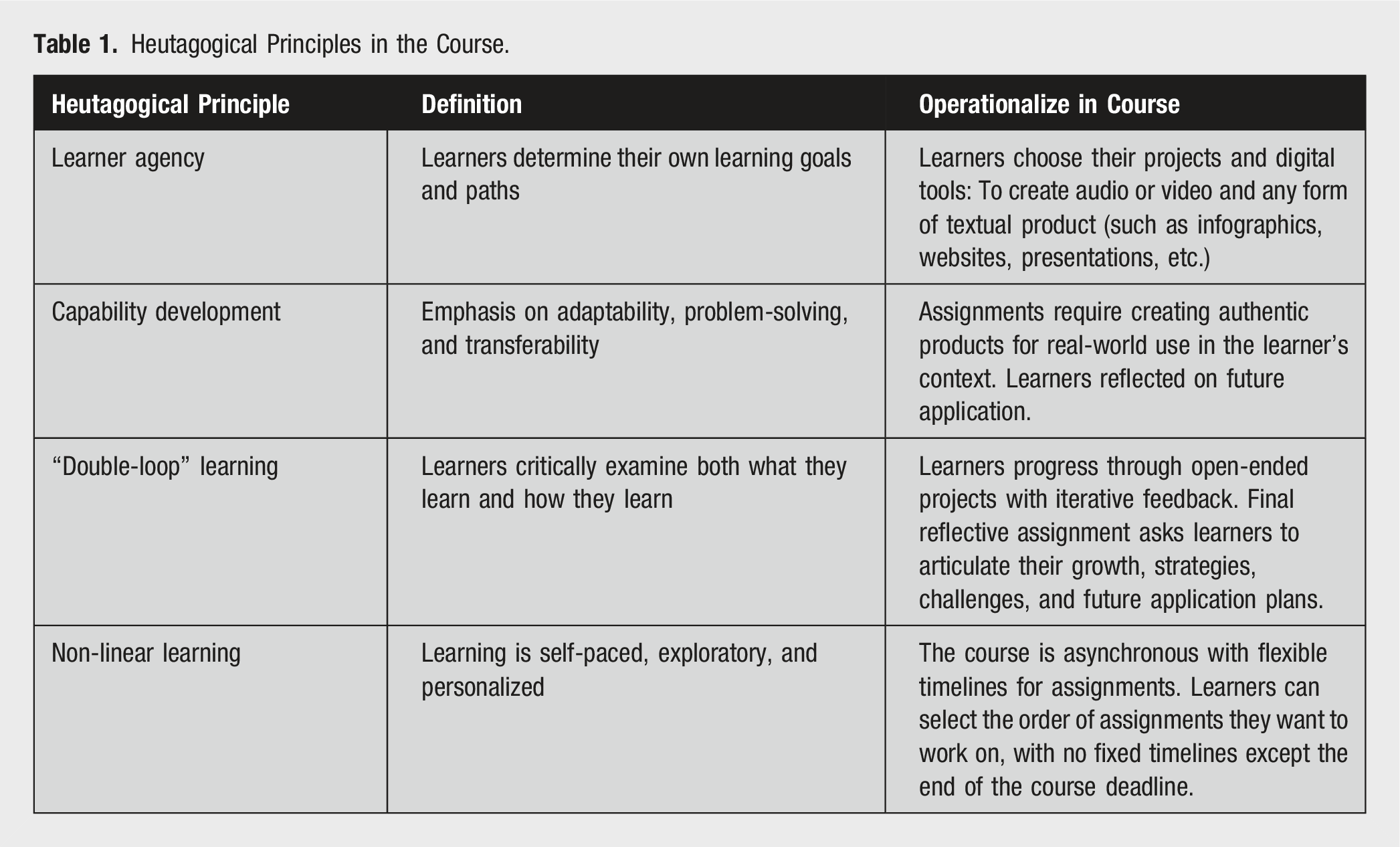
Heutagogy is built upon the core principles of learner agency, capability development, double loop learning, and non-linear learning (Hase & Kenyon, 2007). Learner agency emphasizes the learner’s capacity to direct and determine their own learning paths. It empowers learners to decide not just what they learn, but also how they learn it, and even how their learning should be assessed. Heutagogy emphasizes capability development, which is the ability to adapt and apply acquired skills and knowledge to new, unfamiliar, and future situations. Developing capability is fostered through opportunities for experimentation, allowing learners to make mistakes and build resilience (Duchek, 2020). Heutagogy also centers on a “double-loop” learning process (Argyris, 2002), where learners are encouraged to reflect not only on what they have learned (single-loop learning) but also to critically examine how they learned it, and how this new knowledge influences their beliefs, actions, and values. Heutagogy does not follow the concept of a fixed curriculum (Agonács & Matos, 2019). Instead, learners define and choose their own diverse paths to achieve their learning goals, taking full responsibility for what and how they learn (Marie Blaschke, 2012).
Course Description
Heutagogy informed the design of a graduate-level, online course for health professions educators titled Teaching with Technology. Unlike more stable domains of knowledge, technology instruction requires learners to continuously engage with new tools, interfaces, and workflows. Heutagogy directly addresses this need by fostering learners’ confidence in experimentation, their ability to self-direct when encountering unfamiliar tools, and their resilience in adapting to digital change. While heutagogical principles can be applied to any discipline, they are especially relevant to the context of technology training, where the pace of innovation makes adaptability and self-determination essential outcomes.
The six-week Teaching with Technology course was delivered fully online in a blended, asynchronous format with optional synchronous check-ins. The course was framed not as a tool-training workshop but as a project-based learning environment, in which learners were positioned as designers of their own digital teaching materials. Although framed around a project, the heutagogical orientation distinguished the course. Rather than working on instructor-assigned projects, learners defined their own instructional challenges, selected tools that aligned with their goals, and determined the format of their final reflections. This level of choice, combined with iterative peer feedback and an emphasis on double-loop learning, positioned the course as more than project-based—it was self-determined in both process and outcome.
From the start of the course, learners were invited to identify a real instructional challenge from their professional or academic context—something they genuinely wanted to improve or communicate more effectively using digital media. This could range from creating a patient education video, redesigning a lecture, or building a visual resource to support flipped classroom instruction. Once they had articulated a specific need, they chose the digital tools and formats they wished to explore. The course provided resources and tutorials on a wide range of platforms (e.g., Canva, iMovie, Audacity, Screencast-O-Matic), but learners were free to use any tool that suited their goals. Each learner completed two major assignments: 1 A digital document or presentation (e.g., infographic, visual handout, multimedia slide deck) applying principles of aesthetic design, clarity, and interactivity. 2 An audio or video teaching product, integrating media elements such as voiceover, animation, music, or talking-head video, based on learner preference.
Both assignments were scaffolded through iterative feedback cycles. Learners posted their drafts in a discussion forum and provided structured peer feedback using prompts focused on clarity, design, engagement, and educational effectiveness. This not only enriched each learner’s own work but also fostered peer-based learning, exposing learners to a wide range of tools, styles, and teaching ideas.
The final assignment was a critical reflection, submitted in a format of the learner’s choice (written, audio, video, or infographic). Reflections were written in direct connection to learners’ completed projects (e.g., infographics, videos, podcasts). The reflection asked learners to articulate their key takeaways, describe how their understanding of technology in education had evolved, and outline how they planned to apply their new skills in future contexts. It also asked them to discuss challenges they faced, how they overcame them, and what strategies supported their growth—operationalizing the double-loop learning central to heutagogy. Grounding the reflection in concrete artifacts provides evidence not only of perceived growth but also of the processes behind the products.
While the reflection incorporated elements of self-evaluation, it was graded using a rubric that emphasized depth of insight, clarity of communication, and articulation of future plans. More broadly, course grading followed a competency-with-choice model: learners earned credit through completion of authentic products (document/presentation, audio/video project), peer feedback, and the final reflection. This approach satisfied institutional requirements for summative assessment while maintaining alignment with heutagogical principles of learner autonomy and reflective capability-building.
Importantly, the course maintained flexibility in pacing, with suggested deadlines for feedback and revision but a single firm due date at the end of the term. This allowed learners to accommodate personal schedules, adapt to their own learning curves, and revise their work multiple times based on feedback. Rather than positioning the instructor as a content expert, the course facilitators functioned as learning coaches, offering individualized feedback, curating tool-specific resources, and supporting learners in translating abstract goals into concrete, creative outputs. The result was a learning environment in which adult learners developed not just technical skills, but confidence, capability, and a greater sense of agency in their ability to teach using digital tools.
Heutagogical Principles in the Course.
Outcomes
Themes and Exemplar Quotations.
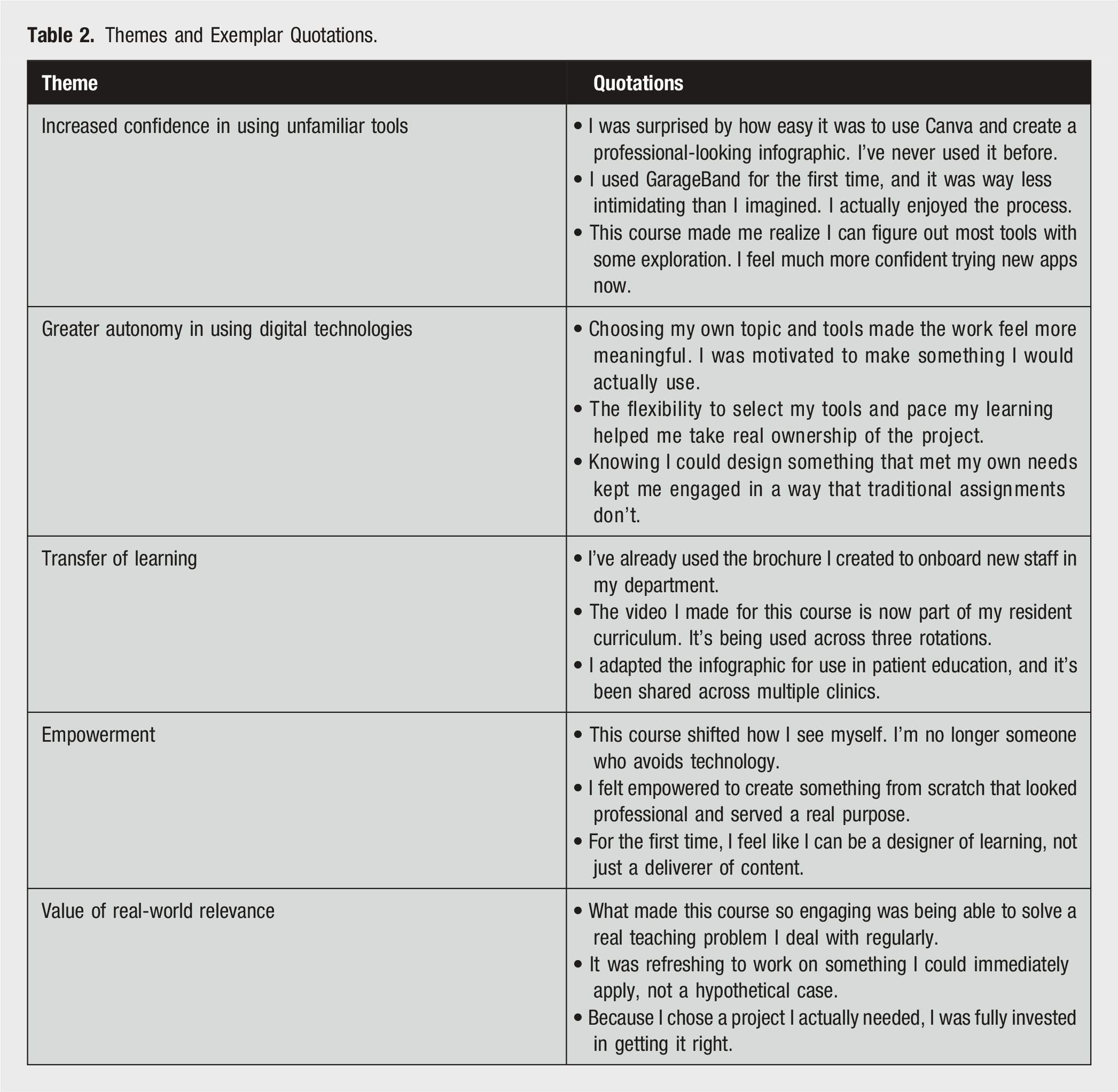
While many participants initially identified as “not tech-savvy” or hesitant to try new platforms, they grew in confidence through the course of the six weeks ending with significantly elevated self-efficacy. Learners noted that they found digital tools “way less intimidating than I imagined. I actually enjoyed the process,” and they felt “more confident experimenting.” Confidence developed not only from technical success but from overcoming internalized doubts and preconceived limitations about one’s capacity to work with multimedia tools.
Learners frequently commented on how self-selection of content, tools, and pacing enhanced both their intrinsic motivation and engagement. “Being able to choose my own tools and topics made the learning feel more meaningful. I wasn’t just completing a task—I was building something I cared about.” They experienced greater autonomy and “no longer wait for permission to try new tools—I just start playing with them now.” Rather than following pre-defined steps, learners charted their own paths, experimented freely, and revised iteratively, exhibiting ownership and sustained motivation.
Many reflections detailed how projects were not merely academic exercises but resulted in products that were already being implemented in real instructional contexts. Some course products were “distributed to psychologists in the Mental Health Service line” and were “now part of the resident onboarding curriculum.” There were high levels of transfer since they were working on authentic tasks relevant to their contexts.
Learners who had previously viewed digital content creation outside their domain of expertise felt empowered after the course. Learners moved from being “intimidated by video editing. Now I’m planning a podcast series for medical students.” They now felt more “like a creative professional” capable of producing “something professional-looking on my own.” Empowerment also manifested in learners’ decisions to train others, extend learning initiatives within their institutions, and delegate and coordinate larger-scale projects. As one learner summed it up: “Now that I’ve learned these tools, I plan to share them with my program directors and encourage them to integrate games and multimedia into their curricula. I’ll help support that transition.”
Finally, many learners highlighted how working on projects grounded in their actual teaching or professional needs increased both relevance and motivation. Learners saw themselves “applying these skills in ways that matter, not just passing a class,” where they were “making something that would actually get used, not just submitted.” This alignment of course content with authentic professional tasks enhanced perceived value, deepened learning, and increased the likelihood of sustained use.
Collectively, these outcomes suggest that when graduate adult learners are given control, relevance, and the opportunity to reflect, they do not merely acquire skills—they are transformed in their approach to digital learning and teaching. They emerge not only more competent, but also more confident, creative, and capable of sustaining innovation in their own instructional settings.
Implications for Practice
Embedding heutagogical practice into institutional structures presents a persistent tension. Even when courses are intentionally designed to support autonomy and creative exploration, the presence of institutional constraints such as required deliverables and fixed schedules can dilute or counteract these aims (Hase & Kenyon, 2013). This tension between self-directed learning and structural accountability is particularly pronounced in higher education, where accreditation standards and programmatic requirements shape what is possible. In this course, institutional requirements mandated alignment with specific programmatic objectives, time limitations (a six-week format), and summative assessments for credit-bearing purposes. While these constraints ensured a level of consistency and academic rigor, they also placed natural boundaries around learner freedom.
Nevertheless, the course attempted to preserve the spirit of self-determination within these parameters. Learners were given a broad choice in what technologies to use, which problems to solve, how to demonstrate their learning, and when to engage with feedback. Assignments were framed as scaffolded opportunities for creation, not checkboxes for compliance. Yet, it is important to recognize that true heutagogy demands a flexibility that institutional systems often resist (Hase & Kenyon, 2013). This course represents an effort to balance structural accountability with pedagogical freedom, and the reflections suggest that many learners experienced this balance as empowering rather than limiting.
This course demonstrates that heutagogical principles of learner autonomy, reflection, and authentic application can be meaningfully integrated into graduate-level instruction, even within the constraints of institutional structures. Educators should prioritize project-based, choice-rich environments that frame technology learning as capability development rather than tool mastery. Allowing learners to define their own challenges, select tools, and iterate on real-world solutions enhances motivation and confidence (Moore, 2020). Reflection and peer feedback further support metacognition and deepen engagement. Supporting heutagogical design requires a cultural shift: empowering facilitators to act as coaches, loosening rigid standardization, and aligning learning environments with how adults actually learn in a fast-evolving digital world (Hase & Kenyon, 2013).
This course model offers an accessible, scalable approach for educators seeking to teach digital skills to adult learners through self-directed, project-based learning. Because learners select their own tools, timelines, and formats, the model is inherently adaptable across contexts. Importantly, it requires no institutional purchases or proprietary software. Learners used freely available tools like Canva, GarageBand, Screencast-O-Matic, and Google Suite. Educators interested in adopting this approach can begin by offering structured choice: allowing learners to define a relevant problem, choose from a curated set of tools, and create an authentic product with clear real-world utility.
The flexibility in the course supported diverse learners, including those with accessibility needs or resource constraints. Flexibility in pacing and multimodal options for assignments and reflections, allowing learners to demonstrate outcomes in formats that aligned with their strengths and accommodations, directly supported diverse learners. In addition, the choice of tools was intentionally open: learners were encouraged to use freely available platforms or technologies already accessible within their contexts, reducing economic barriers.
This model works best with mature learners who are capable of setting goals, managing time, and engaging in critical reflection (Moore, 2020). It is not recommended for novice learners without adequate support scaffolds. When implemented thoughtfully, this approach can empower learners to build lasting digital capabilities while increasing their autonomy, confidence, and instructional creativity.
While this model was implemented in a graduate-level course focusing on technology, its principles extend beyond formal higher education (Moore, 2020). Because learners define their own problems, select accessible tools, and reflect on authentic outputs, the approach translates readily to professional development programs, workplace learning initiatives, and community education contexts. In these settings, heutagogy can serve as a framework for capability-building that addresses real challenges and empowers learners to generate usable solutions (Moore, 2020). The flexibility of tool and format choice makes the model particularly suited to environments where resources and technological access vary.
Conclusion
Heutagogy is an effective and necessary strategy for teaching adult learners. In a rapidly evolving digital landscape, adult learners must become adaptive, reflective, and capable of learning how to learn. This course demonstrates that when learners are given autonomy, real-world relevance, and space for reflection, they are not only more engaged—they are transformed. Heutagogical design fosters agency, metacognition, and authentic transfer, turning hesitant users into confident creators. As educational institutions strive to cultivate digitally fluent graduates, embedding heutagogical practice into course and curriculum design is innovative and essential.
Footnotes
Acknowledgments
The authors acknowledge the use of OpenAI’s ChatGPT-4o in the ideation, structural organization, and editorial refinement of this manuscript. ChatGPT-4o was employed via an institutional account, and all interactions were conducted in a secure, non-training environment in which data are not used to improve the model. ChatGPT-4o was employed as a cognitive partner to support outlining, language optimization, and critical reflection. Throughout the process, the authors’ critical judgment and scholarly voice were preserved, and all content was independently reviewed and revised to ensure scholarly integrity and intellectual authorship.

Ethical Clearance
The study was granted an Exempt study status by the institutions IRB.
Funding
The author received no financial support for the research, authorship, and/or publication of this article.
Declaration of Conflicting Interests
The author declared no potential conflicts of interest with respect to the research, authorship, and/or publication of this article.
Disclaimer
The opinions and assertions expressed herein are those of the author(s) and do not necessarily reflect the official policy or position of the Uniformed Services University or the Department of War.