






Abstract
Impostor phenomenon undermines doctoral student success, yet its internal architecture remains undertheorized for nontraditional adult learners. This qualitative case study examined how impostor phenomenon manifests behaviorally and what self-schemas underlie those behaviors among 20 nontraditional doctoral students at a U.S. research university. Using two-phase reflexive thematic analysis, the researcher identified behavioral patterns aligned with Young’s (2011) five-type typology, then conducted inductive analysis to uncover deeper cognitive structures. Guided by andragogy, transformative learning, and self-authorship theories, findings revealed two overarching self-schemas: the Superiority Impostor, defined by compulsive performance of effortless competence, and the Inferiority Impostor, defined by persistent conviction of intellectual inadequacy. These developmentally situated meaning structures require differentiated educational responses. The study contributes to adult education scholarship by conceptualizing impostor phenomenon as a distorted meaning scheme that intercepts doctoral students’ transformative learning, with implications for schema-sensitive mentoring and program design.
Keywords
“Faculty working with Inferiority Impostors should build internal competence awareness through structured reflection such as portfolios, and foster community belonging through cohort-based peer learning.”
Introduction
Doctoral education demands that students reconstruct professional and personal identities, the hallmark of adult development (Mezirow, 1991; Taylor & Cranton, 2012). For nontraditional doctoral students entering after established careers, this reconstruction is especially complicated. They must honor accumulated expertise while submitting to destabilizing academic norms (Kasworm, 2010; Ross-Gordon, 2011). At this intersection of prior competence and novice status, the impostor phenomenon (IP) finds fertile ground.
First described by Clance and Imes (1978), the IP involves persistent intellectual fraudulence and inability to internalize achievement despite objective competence. It pervades graduate education, with prevalence exceeding 50 percent (Bravata et al., 2020), and is associated with anxiety, diminished self-efficacy, and attrition risk, consequences carrying heightened stakes for adult learners facing significant sacrifice (Rockinson-Szapkiw et al., 2017; Sverdlik et al., 2018).
Despite this prevalence, the field lacks a theoretically grounded account of why IP takes specific forms in adult doctoral learners. Young’s (2011) five-type taxonomy provides behavioral descriptions but not the internal self-schemas generating those behaviors. For adult education, committed to understanding how self-concept shapes learning (Merriam & Baumgartner, 2020), this gap is significant. This study asks: (1) How do Young’s impostor types manifest in nontraditional doctoral students? and (2) What core self-schemas underlie these behaviors?
Literature Review
Impostor Phenomenon in Graduate Education
The impostor phenomenon (IP), also known as imposter syndrome, was first identified by Clance and Imes (1978) through research with high-achieving women who maintained persistent beliefs that they were not intelligent despite objective evidence of success. Subsequent research established that the phenomenon affects individuals across genders, professions, and academic levels (Bravata et al., 2020; Hutchins, 2015). Within graduate education, IP is fueled by cultures of perfectionism, hyper-competitiveness, and the equation of struggle with inadequacy (Cokley et al., 2013; Kheang, 2026; Thomas & Bigatti, 2020). Rockinson-Szapkiw et al. (2017) found impostor-related psychological distress among the strongest predictors of doctoral non-completion.
Recent scholarship has examined impostor experiences through developmental and contextual lenses. Wilkinson (2020) demonstrated through autoethnography that reflective inquiry into academic struggles supports identity formation among emerging scholars. Rogers-Shaw et al. (2022) found that impostor feelings among online doctoral students link to isolation, and that cultivating classroom community through open communication and inclusive environments helps mitigate these experiences, highlighting the role of supportive academic cultures in fostering doctoral student confidence and identity development.
Young’s Typology of Impostor Experiences
Young (2011) identified five distinct impostor types based on behavioral patterns. The Perfectionist sets excessively high standards and views any imperfection as failure. The Natural Genius believes competence should be innate and effortless, interpreting struggle as evidence of inadequacy. The Soloist insists on accomplishing tasks independently, viewing help-seeking as failure. The Expert measures competence by knowledge accumulation and feels inadequate for not knowing everything. The Superwoman/man compensates for perceived inadequacy through relentless overwork across multiple roles.
While Young’s typology seems to be useful in naming impostor experiences (Hutchins, 2015; Parkman, 2016), as a descriptive taxonomy it does not explain the underlying cognitive structures that generate and sustain these behavioral patterns. For adult education, with its foundational interest in meaning-making and self-concept (Merriam & Bierema, 2013), this explanatory gap represents an opportunity for theoretical development.
Nontraditional Adult Learners in Doctoral Education
Nontraditional doctoral students, typically those over 30 entering after established careers or some work experiences (Choi et al., 2021; Jinkens, 2009), represent a growing population in graduate education. Andragogy positions accumulated experience as adults’ primary learning resource (Knowles et al., 2015), yet these students remain psychologically vulnerable to identity threats that challenge their professional competence (Remenick, 2019). The transition from acknowledged expert to novice scholar demands significant identity renegotiation (Ross-Gordon, 2011). High opportunity costs lead students to interpret academic struggle as personal failure rather than normative learning (Jinkens, 2009). Social isolation, misalignment with implicit academic norms, and the absence of institutional recognition compound these vulnerabilities, creating conditions where the IP thrives (Baker & Pifer, 2011; Sweitzer, 2009).
Self-Schemas and Meaning-Making in Adult Learning
The concept of self-schemas, cognitive generalizations about the self that organize self-relevant information processing (Markus, 1977), provides a foundation for understanding how impostor beliefs become entrenched. Self-schemas align with what Mezirow (1991) termed meaning schemes: deeply held beliefs that constitute the learner’s frame of reference. When meaning schemes become distorted, they filter new experience to confirm the distortion rather than challenge it. This insight positions impostor experiences not merely as psychological symptoms but as adult learning problems requiring educational intervention.
Theoretical Framework
This study integrates three interlocking theoretical traditions that collectively illuminate the impostor phenomenon (IP) in nontraditional doctoral students.
Andragogy: Establishing the Learner’s Position
Knowles et al. (2015) identified six core assumptions about adult learners: self-direction; accumulated experience as primary learning resource; readiness tied to social roles; problem-centered orientation; internal motivation; and need to understand learning’s purpose. These describe an idealized learner whose integrated identity the IP disrupts. Andragogy establishes the population logic: nontraditional doctoral students’ defining features are precisely the targets of impostor distortions. When institutions fail to honor prior experience, identity disruption predictably follows (Kasworm, 2010).
Transformative Learning Theory: Explaining the Dysfunctional Process
Mezirow (1991) posited that deep adult learning requires revising frames of reference through which experience is interpreted. Transformation begins with a disorienting dilemma that demands revision of existing frames. For nontraditional doctoral students, entry into academic culture constitutes such a dilemma, destabilizing prior professional identity. Within this framework, IP represents a maladaptive response: learners become trapped in distorted meaning schemes that filter new experience to confirm rather than challenge underlying assumptions (Clance & Imes, 1978; Parkman, 2016).
Self-Authorship Theory: Mapping the Developmental Terrain
Self-authorship theory, originating in Kegan’s (1982, 1998) constructive-developmental psychology and contextualized for higher education by Baxter Magolda (2001, 2009, 2014), describes the capacity to define beliefs, identity, and relationships through internal rather than external frames. Baxter Magolda charted the trajectory from following external formulas, through the crossroads, toward internal authorship. This developmental map differentiates the study’s two schemas: the Inferiority Impostor maps onto following external formulas, where lacking internal anchor confirms fraudulence; the Superiority Impostor maps onto the crossroads, where awareness of unsustainability without internal foundation yields compulsive performance as defensive substitute.
Framework Integration
Conceptual Integration of Andragogy, Transformative Learning, and Self-Authorship.
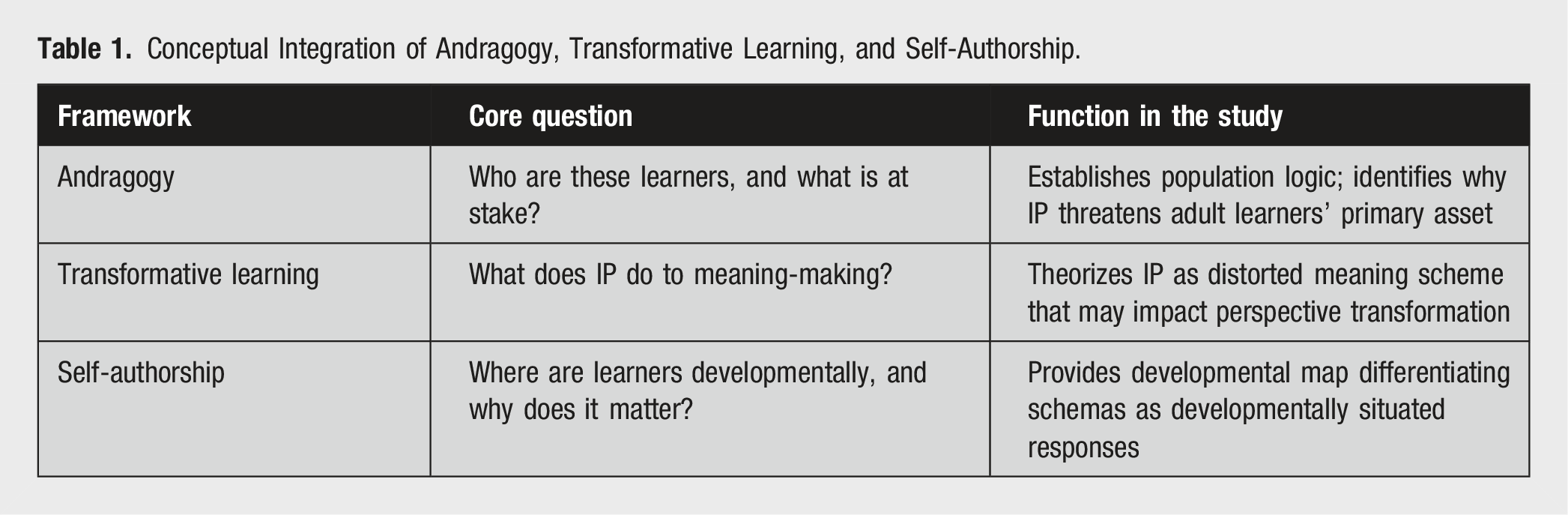
This framework actively shaped study design: the focus on nontraditional students derives from andragogical assumptions; the two-phase analysis is justified by transformative learning’s distinction between behavior and frames of reference; the interpretive move from behavioral types to dual-schema model is made possible by self-authorship’s developmental vocabulary.
Methodology
Research Design
This study employed a qualitative instrumental case study design (Stake, 1995), chosen for its ability to provide a thick, contextualized understanding of a complex phenomenon within its real-life setting. The case was bounded by the lived experiences of IP among nontraditional doctoral students at a public R1 university in the southern United States.
Participant Selection and Context
Following Institutional Review Board (IRB) approval, the researcher utilized a criterion-based purposive sampling method to recruit 20 participants. Eligibility criteria were strictly defined to capture the “nontraditional” experience: (a) current enrollment in a non-education doctoral program, (b) age 30 or older at program entry, (c) a minimum of five years of full-time professional experience prior to matriculation, (d) completion of at least two semesters of doctoral study, and (e) self-identification as having experienced the IP. The final sample consisted of 14 men and six women, with 16 from STEM fields and four from non-STEM (humanities and social sciences) fields.
Despite recruitment efforts over one month through university-wide graduate student listservs, doctoral student affinity groups, and snowball sampling, no Black doctoral students volunteered to participate. This may reflect the racialized context of impostor phenomenon (IP) research, concerns about how lived experiences are interpreted or represented, and competing demands on minoritized doctoral students’ time. This absence is acknowledged as a limitation and further addressed in the Limitations section.
Research Positionality
I conducted this study as a doctoral student (now faculty member). Although not a nontraditional student myself, my nontraditional peers’ impostor experiences motivated this inquiry. I recognize my own doctoral stressors, including deadlines, productivity pressure, and self-doubt, could bias my interpretation. For example, I might overidentify with Inferiority narratives or dismiss Superiority behaviors as mere confidence. To mitigate this, I kept a reflective journal throughout data collection and analysis.
Data Collection
The researcher collected primary data via semi-structured Zoom interviews (approximately 60 min each). The protocol covered background, scholarly self-doubt (e.g., “Tell me about a time you felt you did not belong”), behavioral responses to impostor feelings, and advisor/peer relationships. Probes included “What runs through your mind?” All interviews were audio-recorded and transcribed verbatim to preserve the authenticity and nuance of participants’ language, pauses, and emotional expressions.
Data Analysis
Data analysis followed Braun and Clarke’s (2006, 2019) reflexive thematic analysis in two phases. Phase 1 (Research Question 1) used deductive analysis with Young’s (2011) typology. Initial codes included “sets unrealistically high standard” (Perfectionist), “believes struggle indicates lack of innate ability” (Natural Genius), “refuses to ask for help” (Soloist), “needs exhaustive knowledge” (Expert), and “overworks across roles” (Superwoman/man).
Phase 2 (Research Question 2) used inductive analysis to explore deeper meaning structures. Inductive codes (e.g., “praise feels good but is easily shattered,” “prior expertise feels like a fraud”) were grouped into candidate themes, then coalesced into two overarching self-schemas: the Superiority Impostor (compulsive performance of effortless competence) and the Inferiority Impostor (persistent conviction of intellectual inadequacy). Guiding analytic questions included: “What core belief motivates this pattern?”
To enhance trustworthiness, the researcher engaged in prolonged engagement with the data through repeated readings and iterative coding cycles. Peer debriefing with colleagues familiar with IP literature supported reflexive questioning and strengthened analytic credibility. Member checking was conducted only for Phase 1 (descriptive application of Young’s typology), where participants could verify behavioral fit. This aligns with reflexive thematic analysis, which does not require member checking for interpretive theme generation (Braun & Clarke, 2019).
Findings
Summary of Participants’ (Pseudonyms) Profiles.
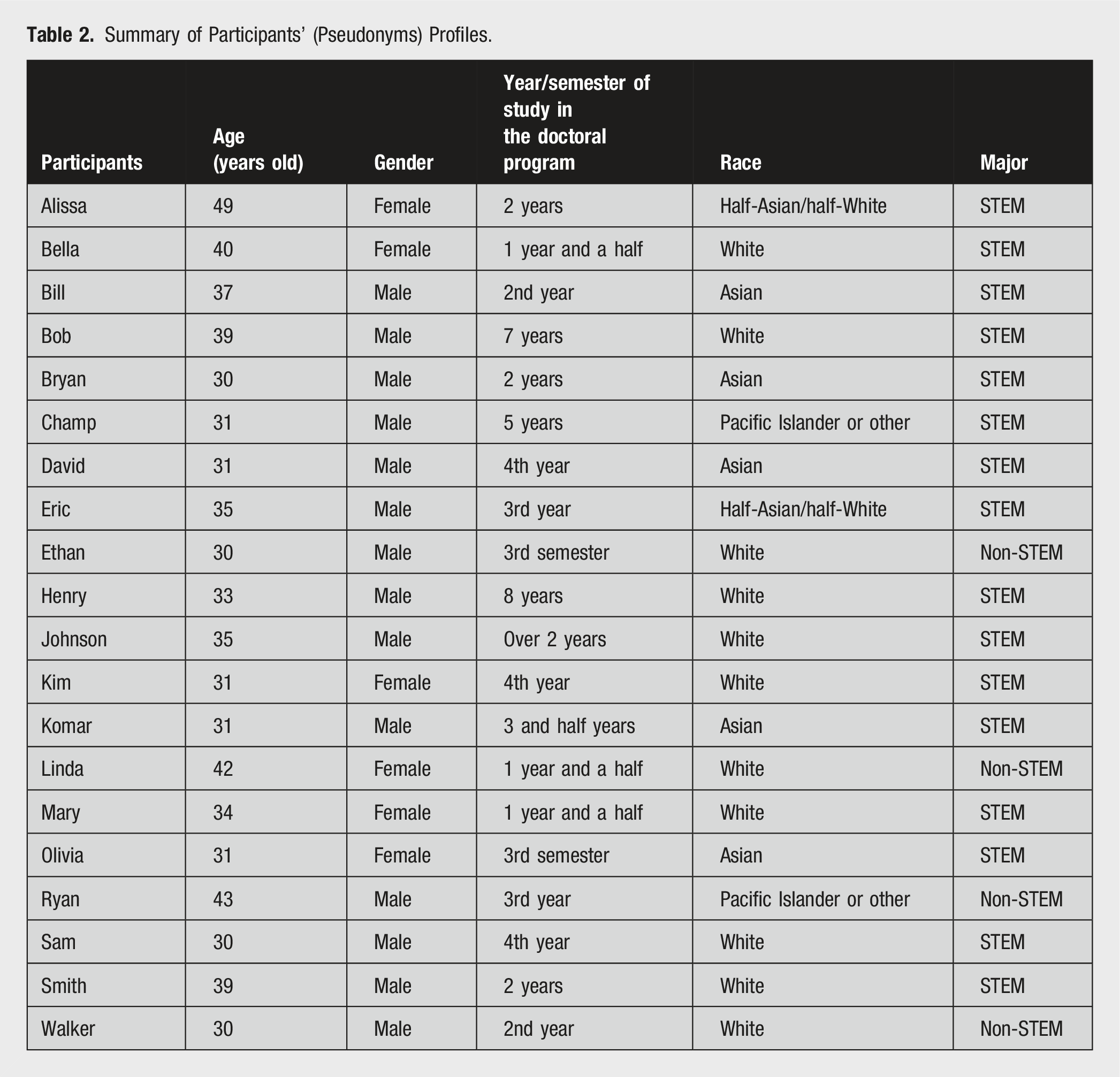
The analysis revealed a rich landscape of impostor experiences, illustrating the relevance of Young’s (2011) framework while uncovering deeper, explanatory structures underlying participants’ behaviors. Findings are organized around two themes: the behavioral manifestations of impostorism and the dual-schema model of core self-beliefs.
Theme 1: Behavioral Manifestations of Impostorism
Participants’ narratives provided clear illustrations of Young’s five impostor types, demonstrating how these behaviors emerged in the daily lives of nontraditional doctoral students.
The Perfectionist
Characterized by an all-or-nothing mindset, participants viewed any imperfection as catastrophic. Walker, for example, described the relentless internal critique: “Everyone else telling you you’re doing a pretty good job, but then, like a voice in the back of my head that says, you know that wasn’t good enough. It wasn’t perfect.” Mary reflected on this tendency, stating, “I think my perfectionism and the way that I think that things have to be 100% correct all the time…my doctoral journey has shifted.”
The Natural Genius
Believing competence should be innate and effortless, participants experienced shame when learning new skills. Bella explained, “I’ve taken all of the courses, and I’ve gotten A’s. I did get one A minus, but I got an A in all of the courses, even though the material was, you know, very unfamiliar,” but she tended to develop self-doubt when she couldn’t perform well in her research, asking, “How am I doing this without more experience, more information and thing like this?”
The Soloist
Self-worth was tied to independent achievement, and seeking help was perceived as failure. David reflected on his childhood conditioning, “My parents and other family members compare me with other people… I decided to prove myself and every person in my life… I would take the time to complete it by myself.” Ryan noted the isolating nature of doctoral work, “A lot of the work that you are doing is with yourself, so you feel a little more isolated. And that is why sometimes I think it is a good idea that I should just do it my own.”
The Expert
Haunted by the belief of never knowing enough, participants over-prepared to avoid being exposed. Linda shared, “I always feel that I don’t read enough literature review… I feel like I have to read 30 papers before I write two paragraphs, which is kind of like silly.” Olivia described how this tendency slowed her progress, “I need to know everything to succeed in the exam, so I spent time going through every detail in all class materials, and that resulted in a slow progress when it comes to getting other necessary tasks done.”
The Superwoman/man
Participants engaged in relentless overwork to compensate for perceived deficits, often at great personal cost. Bryan described sacrificing his social life, “Sometimes I couldn’t go to parties and stuff like that just because I have this constant competition in the lab. I used to be like a very social person… No time for all that now.” Alissa explained her inability to rest, “I’m in my down time, and there is something that I’m anxious about. I would start pacing… I need to be more productive, and I would want to work on my research.”
These behavioral types were not discrete; rather, they represented patterned responses to underlying self-beliefs, which are captured in the second theme.
Theme 2: Dual-Schema Model of Core Self-Beliefs
Mapping Impostor Types Onto Core Self-Belief Schemas.
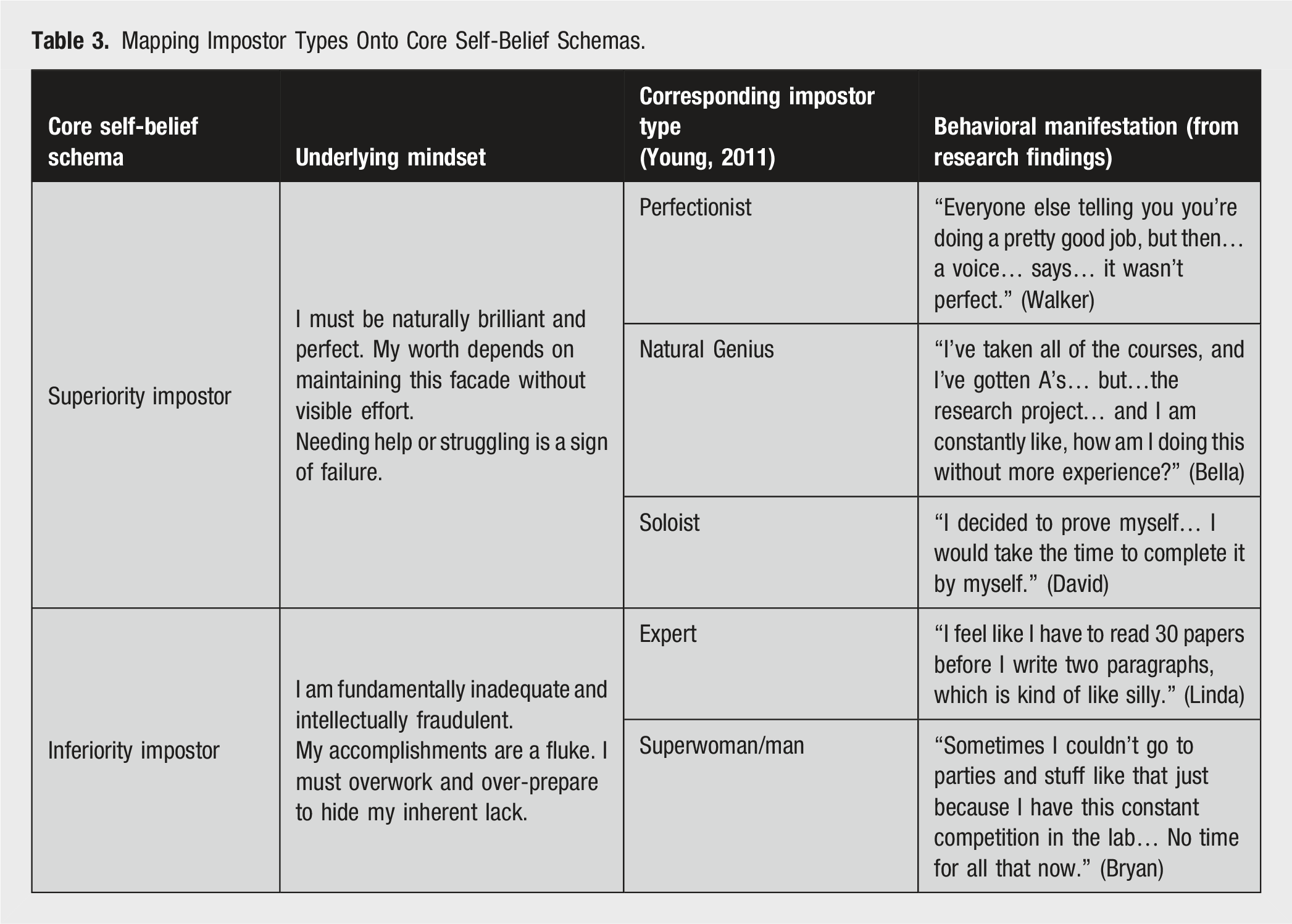
As illustrated in Table 3, the behavioral types represent surface-level expressions of two underlying psychological schemas: the Superiority Impostor and the Inferiority Impostor.
Superiority Impostor: The Facade of Effortless Perfection
This schema encompassed the Perfectionist, the Natural Genius, and the Soloist. Participants operating under this schema aimed to maintain a facade of innate competence and perfection to secure external validation and conceal any vulnerability. Their self-worth was contingent on being perceived as exceptionally capable without visible effort.
Sam reflected this performative pressure, explaining why he needed to be perceived as a successful person: “I was afraid of not succeeding…. I feel like I have to prove it to myself and the other people if I am good at anything.” Champ also described the profound fragility of this external validation. While praise felt good, “If someone praised me and said I did great, I felt good…. Oh, it feels amazing!” this validation was easily shattered, leading to crisis: “One of my peers published a paper, and my advisor kept talking about it. It wrecked me so hard that week. I got sick… It was absolutely devastating feeling.”
Inferiority Impostor: The Conviction of Fundamental Lack
This schema encompassed The Expert and The Superwoman/man and was characterized by a deep-seated, persistent sense of intellectual inadequacy. Participants felt their accomplishments were fraudulent and engaged in exhausting compensatory behaviors not to excel, but simply to avoid being “found out.”
Alissa expressed this belief directly and painfully: “I feel like I’m surrounded by these mental giants, and I’m just an idiot. They are just tolerating me.” Kim described a hierarchical self-perception in her relationship with her advisor, placing herself at the bottom: I’m always like oh, well, he is the expert…he’s so knowledgeable…he’s doing me a favor by like sitting down with me…taking precious time out of his day to talk to me…if I don’t understand something he said, I should figure out on my own because I’m a lowly graduate student, and he’s like way up there, and I’m way down here.
The Expert and the Superwoman/man behaviors, such as exhaustive over-preparation or the sacrifice of social life and hobbies, were thus understood not as strategies for success, but as desperate attempts to bridge a perceived unbridgeable gap between their own perceived inadequacy and the competence they believed was required of them.
Discussion
The dual-schema model, as emerging from this specific sample of 20 nontraditional doctoral students at a single public R1 university, reframes impostor phenomenon (IP) as a problem of adult identity development rather than individual psychological deficit.
The Inferiority Impostor: When Expertise Becomes a Liability
The Inferiority Impostor aligns with classical impostor conceptualization (Clance & Imes, 1978). Within this sample, the adult education lens reveals its particular toxicity for nontraditional learners. Andragogy identifies accumulated experience as adult learners’ primary learning resource (Knowles et al., 2015). These data suggest that the Inferiority schema inverts this entirely: prior expertise is experienced as a fraudulent ledger requiring concealment. Ross-Gordon (2011) identified this dynamic as among the most consequential challenges facing adult learners.
Through Baxter Magolda’s (2014) self-authorship lens, the Inferiority Impostor appears developmentally situated at following external formulas: competence is real only when externally validated. For participants exhibiting this schema, every unfamiliar task confirmed fraudulence.
The Superiority Impostor: The Invisible Crisis of Effortless Performance
The Superiority Impostor represents this study’s most distinctive contribution. Less visible in impostor literature and frequently misread as high functioning, this schema describes learners responding to impostor anxiety through compulsive performance of effortless competence. They appear ideal, but internal reality is anxiety-driven compulsion.
Superiority Impostors are developmentally situated at the crossroads (Baxter Magolda, 2009): aware that external-validation-seeking is unsustainable yet lacking internal foundation.
Compulsive performance may function as a defensive response to perceived inadequacy. Research links IP with perfectionism (Pannhausen et al., 2022), and perfectionistic traits among academics are associated with workaholism (Çimşir & Tümlü, 2022). Such displays of competence can operate as protective strategies among adult learners navigating academic expectations (Brookfield, 1995). The practical danger is institutional invisibility. Faculty may inadvertently reinforce the Superiority pattern by rewarding performances sustaining internal distress.
Theoretical Contributions to Adult Education
The dual-schema model makes four interlocking contributions. First, it advances understanding of the IP by moving from behavioral taxonomy to schema-level explanation, consonant with adult education’s foundational interest in meaning-making (Merriam & Baumgartner, 2020). Second, the model extends transformative learning theory by empirically grounding the concept that impostor schemas function as distorted meaning schemes (Mezirow, 1991) blocking perspective transformation. This positions impostor intervention as transformative learning facilitation (Taylor & Cranton, 2012).
Third, the model responds to calls from Kasworm (2010) and Ross-Gordon (2011) for theoretically rigorous accounts of how adult learners negotiate institutional identity demands. The self-authorship developmental map suggests the two schemas are developmental positions addressable through intentional design. Finally, the model refines and extends andragogy itself. Knowles et al. (2015) posited that accumulated experience is adults’ richest learning resource. Findings reveal experience is only a resource when the learner can internally claim it as such. Andragogy’s core assumption must be understood as developmentally conditional.
Implications for Practice
Faculty working with Inferiority Impostors should build internal competence awareness through structured reflection such as portfolios, and foster community belonging through cohort-based peer learning. Students themselves can counter this schema by documenting their accomplishments, reframing help-seeking as a sign of competence, and asking peers about their struggles to normalize uncertainty.
For Superiority Impostors, faculty should model intellectual uncertainty and create safe conditions for productive failure. Students, in turn, can practice strategic vulnerability by sharing a small struggle with a peer, set “good enough” goals rather than waiting for perfection, and separate performance from self-worth by asking whether they would judge another person as harshly for the same struggle.
At the program level, faculty development should include schema-sensitive advising training. These self-directed actions do not replace mentoring but help students begin to interrupt the distorted meaning schemes that sustain impostor distress.
Limitations
This study has limitations. First, the sample of 20 nontraditional doctoral students from a single public R1 university limits transferability. Second, self-reported data may be subject to memory and social desirability biases. Third, no Black students participated in the study. Because this study focused on identity development, this absence is significant: the dual-schema model may not capture racialized impostor experiences, limiting transferability to diverse contexts. Future research should recruit Black doctoral students. Finally, the dual-schema model is an interpretive finding from this context and invites further validation.
Recommendations for Future Research
Future research should examine the proposed dual-schema model using larger and more diverse samples to assess its applicability across doctoral contexts. Longitudinal studies would be particularly valuable for tracing how individuals move between schemas across different stages of doctoral study. In addition, intervention-based research exploring schema-sensitive mentoring approaches may provide practical insights for supporting doctoral students experiencing IP. Such work could draw on principles of transformative learning facilitation and self-authorship development. Finally, research that centers race, gender, and other intersecting identities is essential for understanding how impostor experiences may vary across social and institutional contexts.
Conclusion
Impostor phenomenon (IP) manifests differently across individuals. Among nontraditional doctoral students, this study identified two structurally distinct self-schemas, the Superiority Impostor and the Inferiority Impostor, each rooted in different developmental positions, sustaining different distorted meaning schemes, and demanding different educational responses. By conceptualizing the phenomenon through andragogy, transformative learning, and self-authorship, this study moves beyond behavioral description toward explanatory depth. IP in adult doctoral learners is fundamentally an adult learning problem: produced by the collision of established professional identities with disorienting academic environments, sustained by meaning schemes blocking perspective transformation, and situated developmentally. Addressing it requires theoretically grounded, developmentally attuned, identity-affirming mentorship.
Footnotes

Funding
The author received no financial support for the research, authorship, and/or publication of this article.
Declaration of Conflicting Interests
The author declared no potential conflicts of interest with respect to the research, authorship, and/or publication of this article.