







Abstract
A generic homogenization modeling framework which incorporates crystallographic domain features is introduced and computationally implemented for magnetoelectric multiferroics of all symmetries. The homogenization, mathematically applicable to heterogeneous media with contrasts in physical properties, replaces the heterogeneity of the multiferroics by an equivalent effective medium with uniform physical characteristics. A statistically representative unit-cell is proposed to encompass all forms of multiferroics and their composites in bulk. The variational formulation of the coupled magneto-electromechanical problem reveals the nature of interaction between mechanical, electrical, and magnetic fields of a multiferroic at a microscopic scale with high resolution. Furthermore, the mathematical homogenization theory of the multiferroic is implemented in finite element method by solving the coupled equilibrium electrical, magnetic, and mechanical fields. A “multiferroic finite element” is conceived for this purpose. The model is applied to a two-phase multiferroic magnetoelectric composite to demonstrate its validity by characterizing the equivalent physical properties.
Keywords
Introduction
Materials simultaneously possessing two or more of the ferroic order parameters—ferromagnetism, ferroelectricity, ferroelasticity, and ferrotorroidicity—in the same phase (Schmid, 1994, 2008) are referred to as multiferroics. Recently, the term multiferroics is meant predominantly for the coexistence of magnetism and ferroelectricity and has shown great potential for information storage and sensor technologies (Eerenstein et al., 2006; Gajek et al., 2007; Martin et al., 2010). There are 31 point groups that allow a spontaneous magnetization
A key feature of ferroic materials is the formation of domains consequent to the appearance of a ferroic order at the phase transition. The lesser the symmetry of the ferroic phase, the more the number of possible domain states. For instance, the less symmetric monoclinic multiferroic crystal with space group m and having
Theoretical treatment of equivalent or effective properties of complex material systems would often be sought as a means for material characterization where experiments would be difficult to be accomplished. The costly and delicate process of synthesis of crystals of fairly large size and associated deleterious effects such as depoling and twinning affects the accuracy of the measurement of physical properties (Ahart et al., 2008). Recently, continuum models incorporating domain-scale information such as orientation and its distribution have been used to describe the macroscopic features of coupled crystalline materials (Jayachandran et al., 2010; Li et al., 2010). An efficient and convenient way with affordable computational times is the use of homogenization technique. It has been demonstrated that the figures of merit of multiferroic thin films, where the electrical, magnetic, and mechanical fields are coupled, can be tuned by the design of crystal morphology at the microstructure level (Martin et al., 2010).
Here, we have developed a generic homogenization method theoretically for multiferroics irrespective of its crystallographic symmetry. A two-scale asymptotic analysis combined with a variational formulation of the underlying mechanical, electrical, and magnetic fields is carried out to unveil their interaction in the microscopic scale. Furthermore, the numerical solution of the coupled magneto-electromechanical problem is sought using the finite element method (FEM) to eventually compute the homogenized (effective) properties of multiferroics. FEM is a feasible computational approach and a natural choice of numerical approximation in the homogenization procedure. Subsequently, an example is shown by applying the method to a two-phase multiferroic composite of a piezoelectric and a piezomagnetic material. The variational asymptotic homogenization used in this study provides no direct simulation of magnetic or electric domains. This framework instead models the piezoelectric and magnetoelectric (ME) coupling in a continuum setting (where piezomagnetism is treated analogous to piezoelectricity), where the scales involved are of the order of micrometers.
Since there are very few single-phase multiferroic materials (Hill, 2000; Khomskii, 2009), and most of them show very weak ME coupling at room temperature, ME composites present an alternative for engineering ME coupling (Eerenstein et al., 2006). Most of the theoretical developments (Benveniste, 1995; Benveniste and Milton, 2003; Li and Dunn, 1998; Nan et al., 2001, 2005; Srinivasan et al., 2001) are based on the strain-mediated two-phase multilayer composites of magnetostrictive and piezoelectric phases proposed by Harshe et al. (Avellaneda and Harshe, 1994; Harshe et al., 1993). Experimental and theoretical developments in these classes of materials are compiled in recent reviews (Bichurin et al., 2010; Nan et al., 2008; Srinivasan, 2010). FEMs (Blackburn et al., 2008; Galopin et al., 2008) and micromechanical methods (Bravo-Castillero et al., 2008; Corcolle et al., 2008; Tang and Yu, 2008) have been used separately to model the heterogeneity of the ME composites. Nonetheless, most of the theoretical developments are limited to two-phase ME composites which form only a subset of the multiferroics that encompasses a very diverse class of materials. The homogenization framework implemented in this article provides a unique platform to treat linear interactions of all forms of multiferroics, namely, single-phase multiferroic, single crystals, polycrystals, as well as multiferroic composites. The representative microstructure (Figure 1) is composed of domains in single crystals, while crystallites with subgranular domain structure make the polycrystal microstructure. For composites, the microstructure is formed by single or polycrystalline magnetic and ferroelectric materials. The accompanying FEM implementation can encompass all these features by proper choice of finite elements.
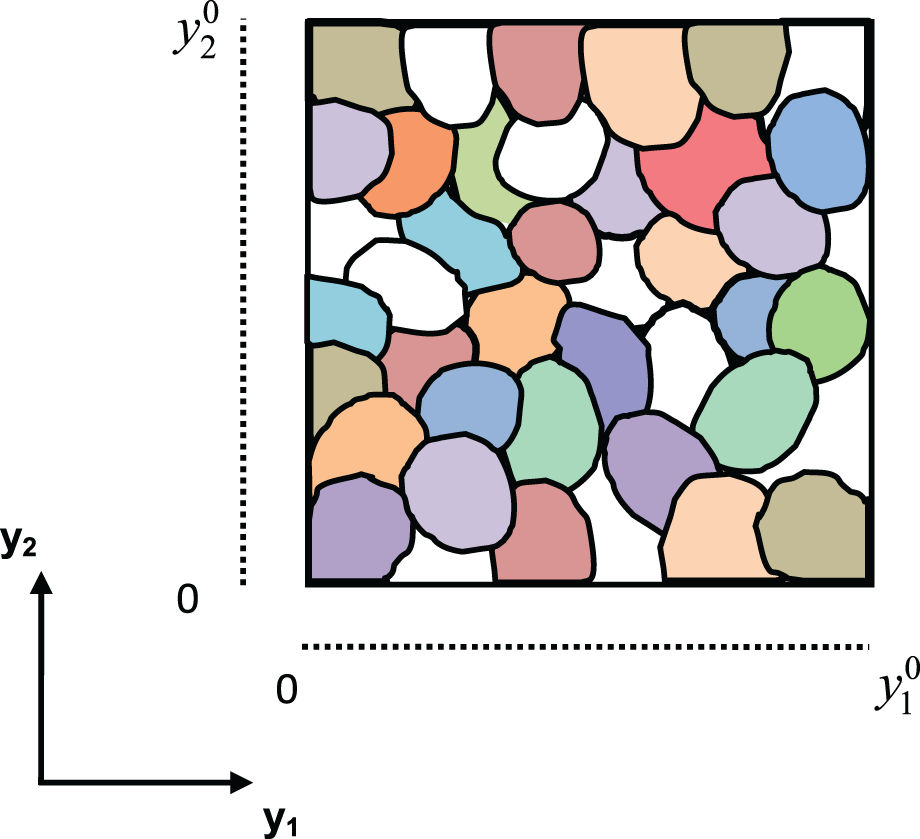
A schematic picture of the microstructure (representative unit-cell) of a multiferroic material.
Constitutive laws
We consider a multiferroic body occupying a volume
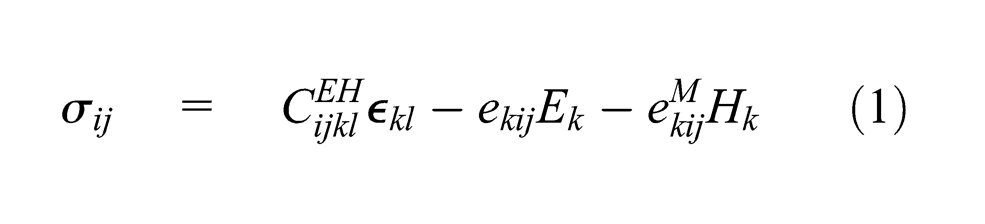
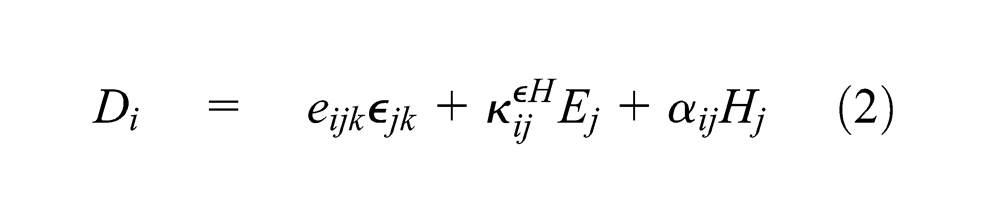
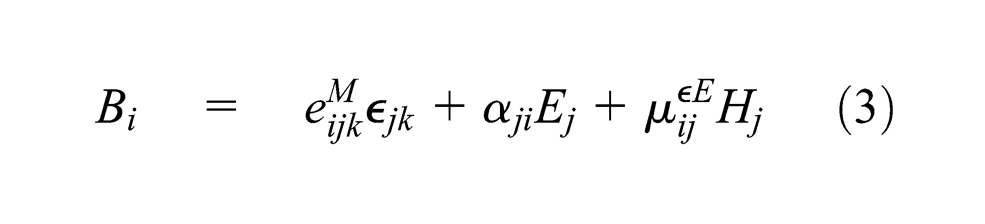
and the field equations are given by
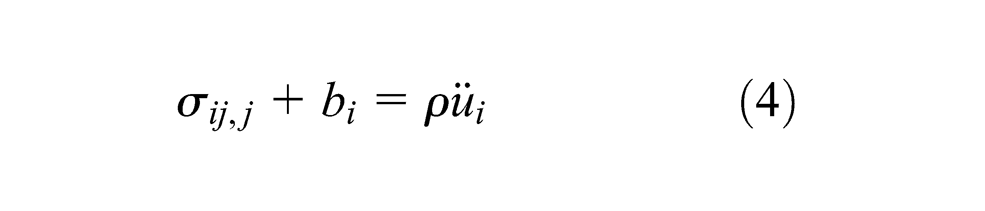
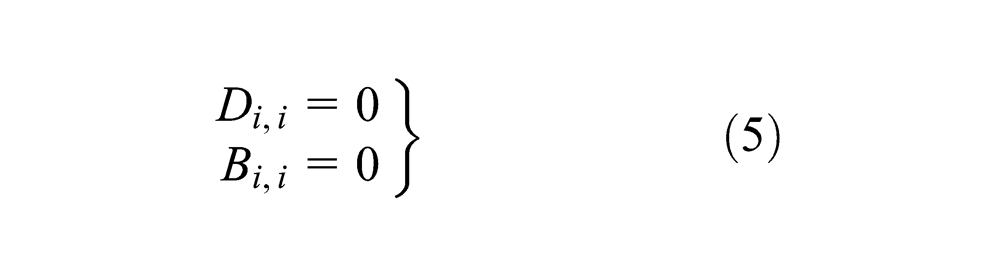
Here,
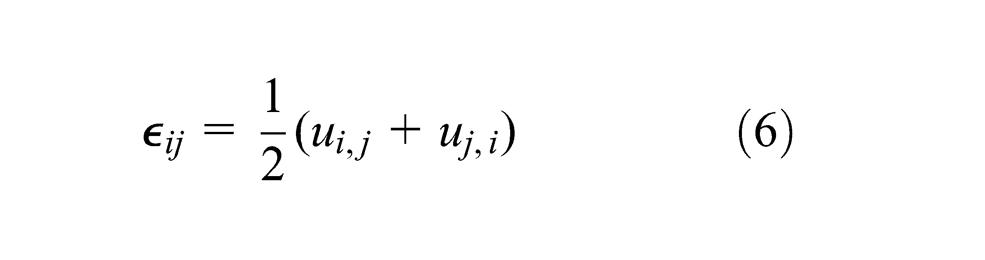
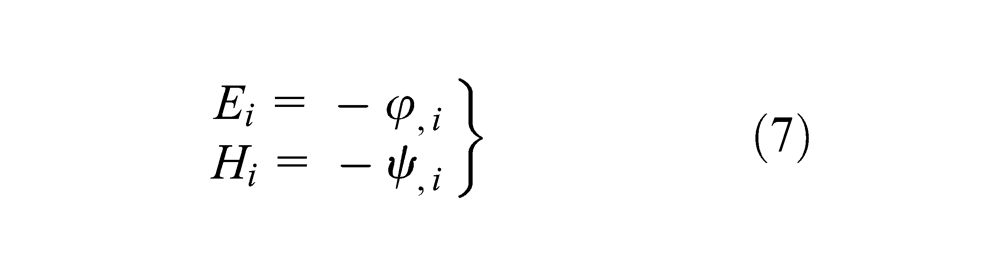
where
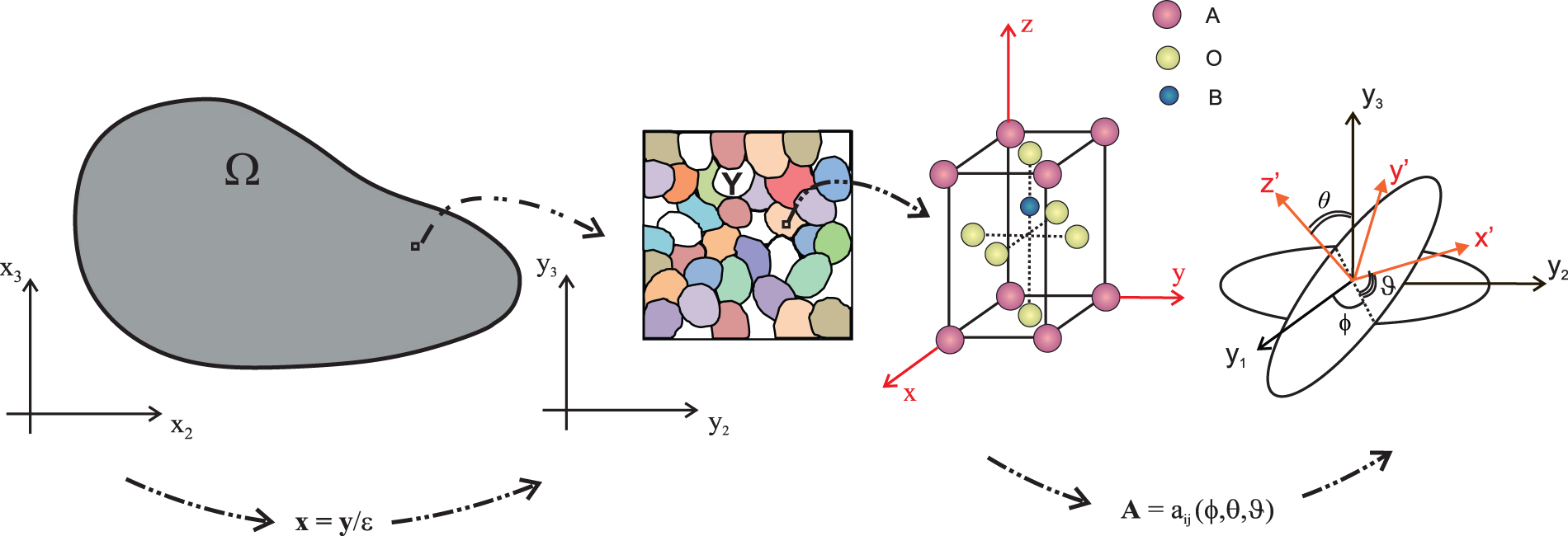
A schematic picture showing the progression of different coordinate transformations involved in the homogenization of multiferroics.
In homogenization theory, it is assumed that the material is locally formed by the spatial repetition of very small microstructure (representative volume element (RVE) or unit-cell) when compared with the overall macroscopic dimensions. The homogenization, mathematically applicable to heterogeneous media with reasonable contrasts in physical properties, replaces the heterogeneity by an equivalent effective medium with uniform physical characteristics (Sanchez-Palencia, 1980). The constitutive laws in equations (1) to (3), therefore, can be rewritten with the effective properties and average fields as
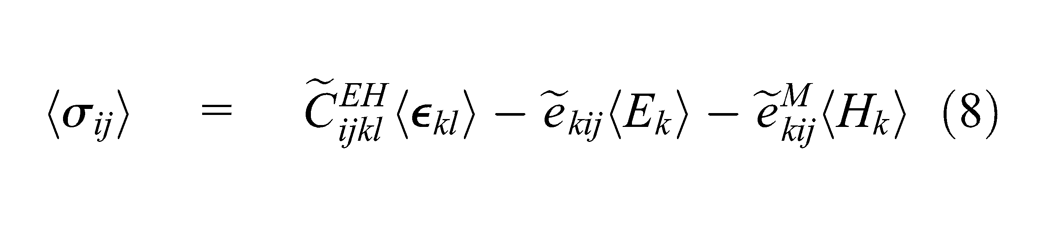
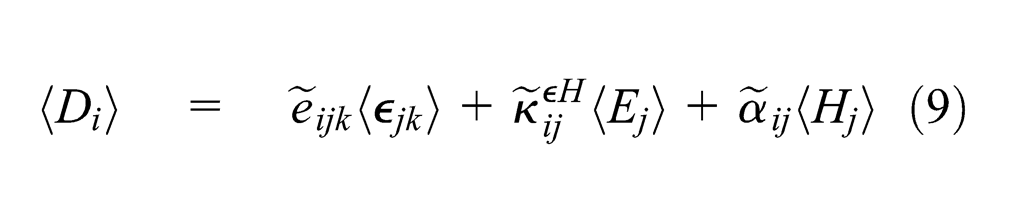
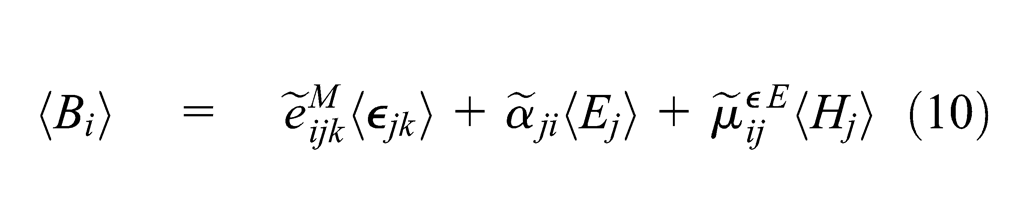
where
Homogenization theory of multiferroics
Magneto-electromechanical problem of multiferroics
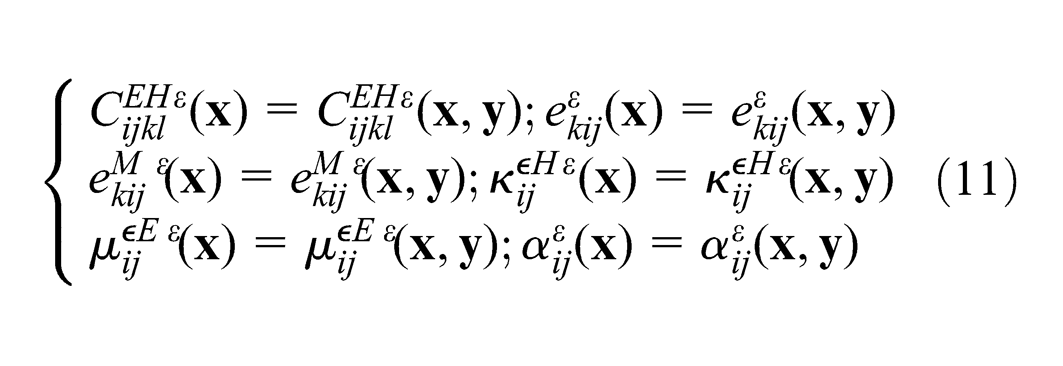
Let
We shall consider
with
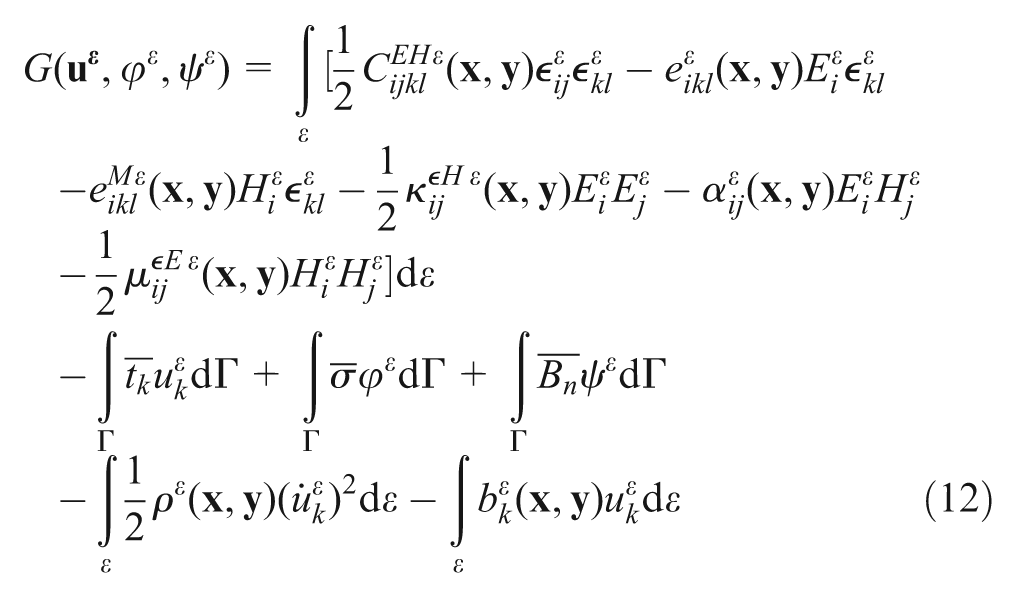
Let the surface
Here,
Homogenization of multiferroics
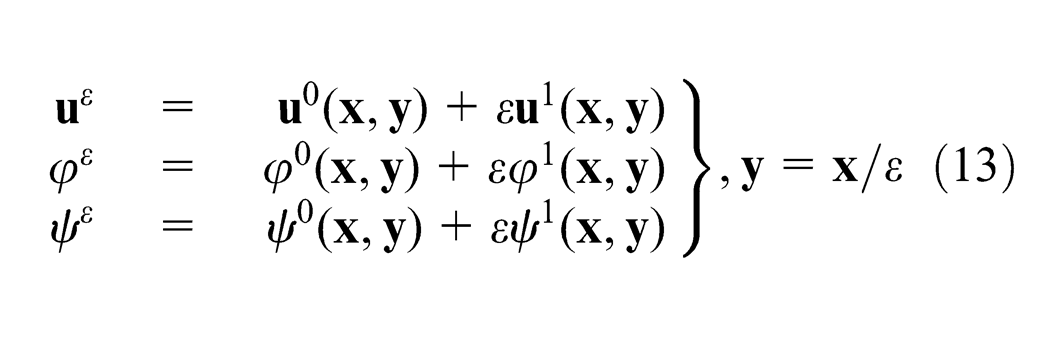
We describe in this section the formal asymptotic procedure for solving equation (12), as
where
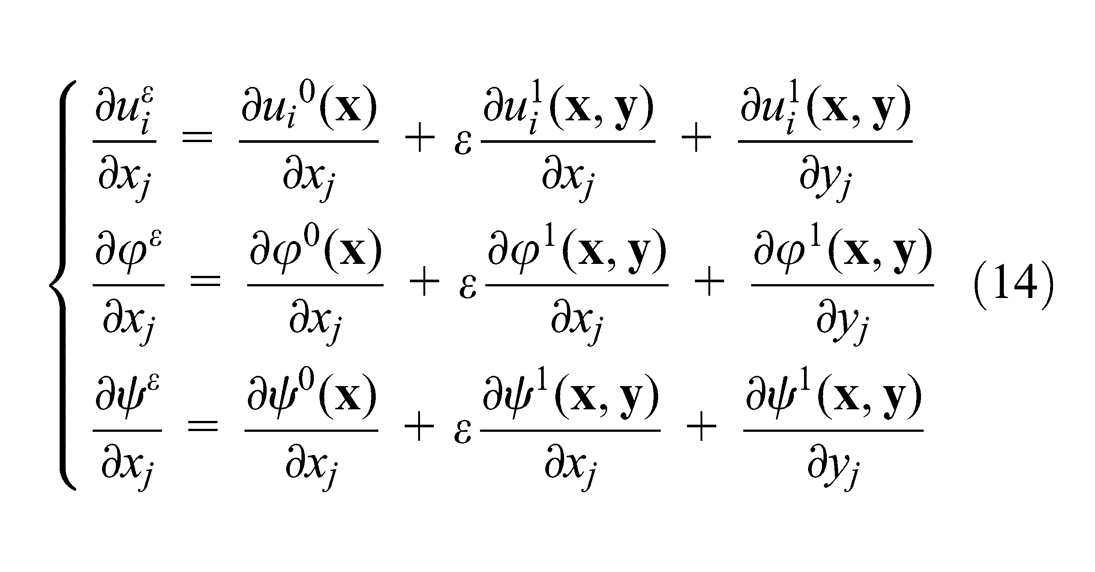
when
Collecting coefficients of
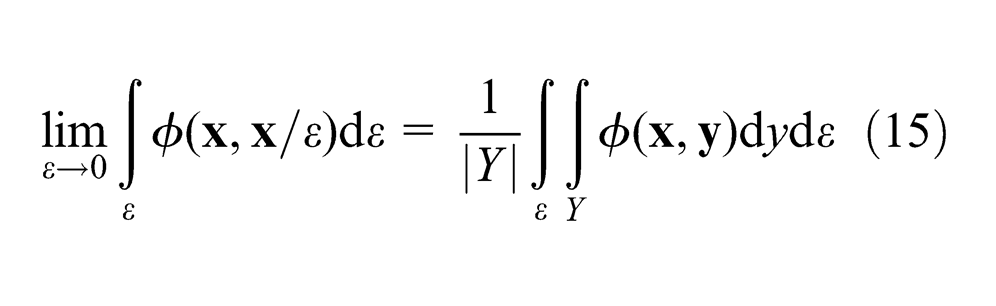
will lead to a set of macroscopic (equations involving the variables
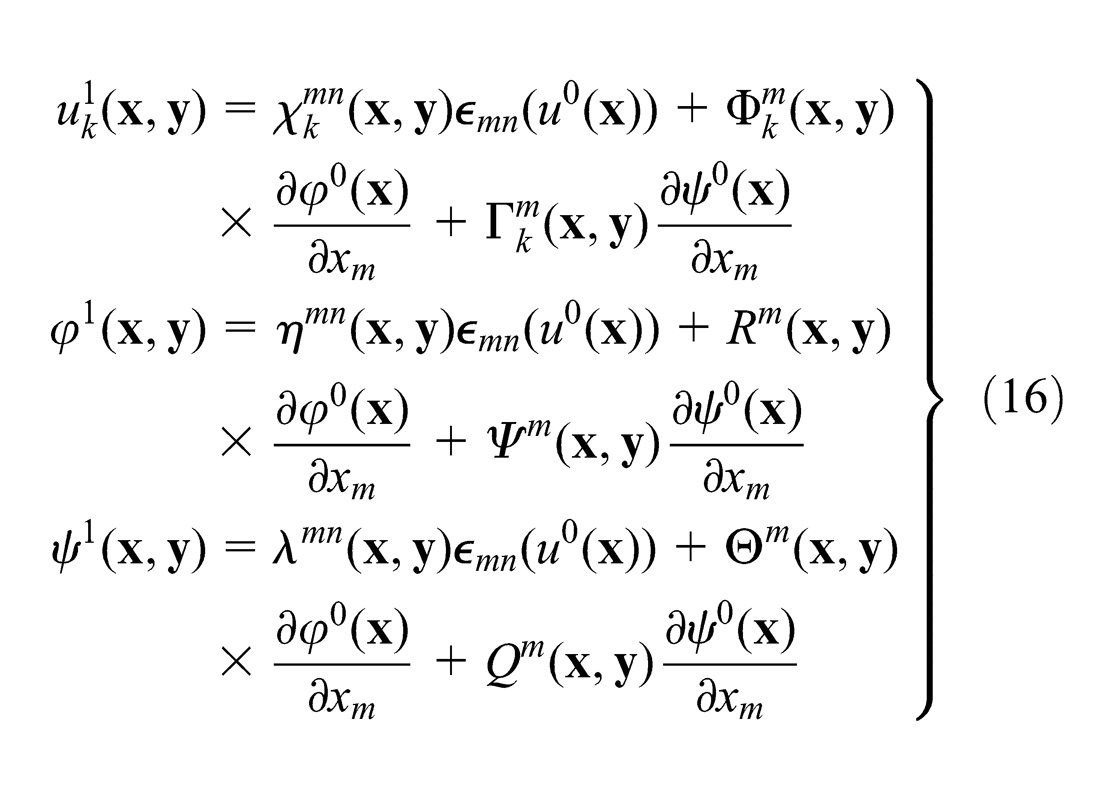
Here,
Taking the spatial derivatives of the functions in equation (16) with respect to the microscopic coordinate
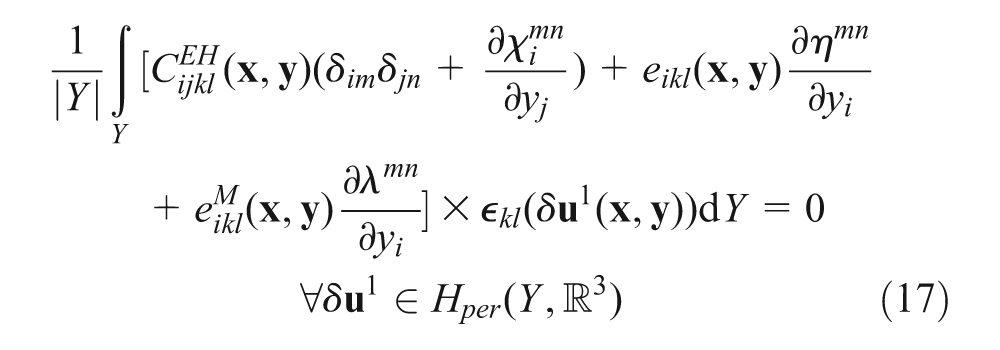

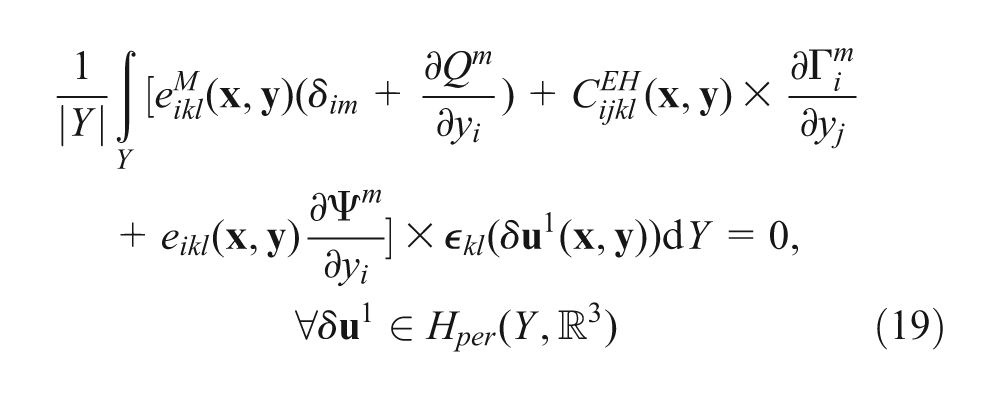
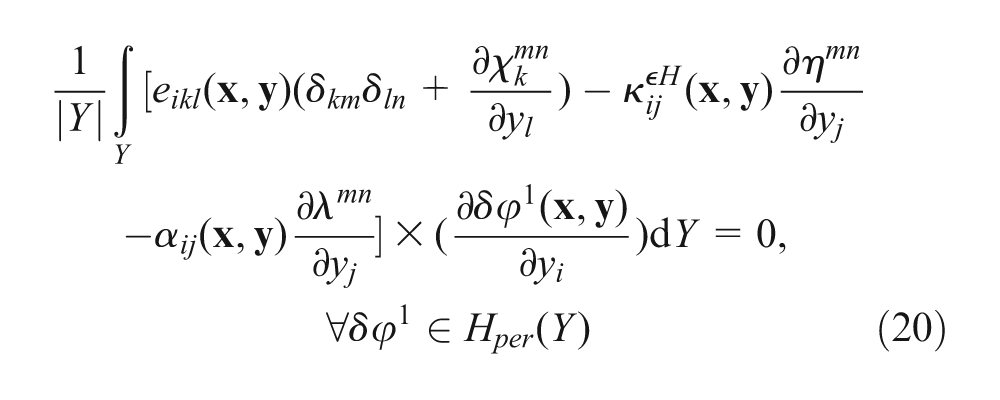
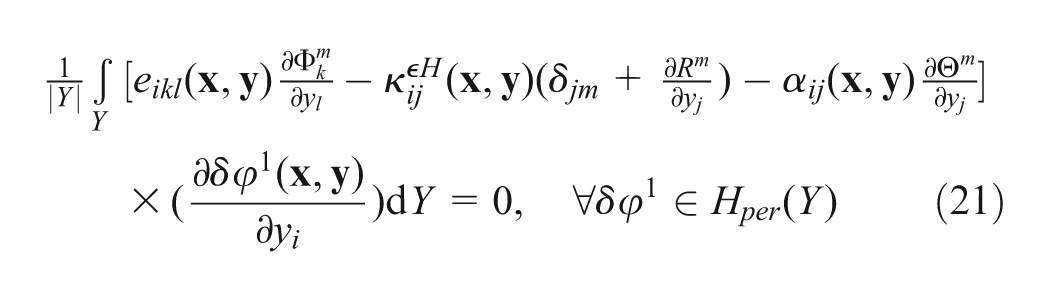
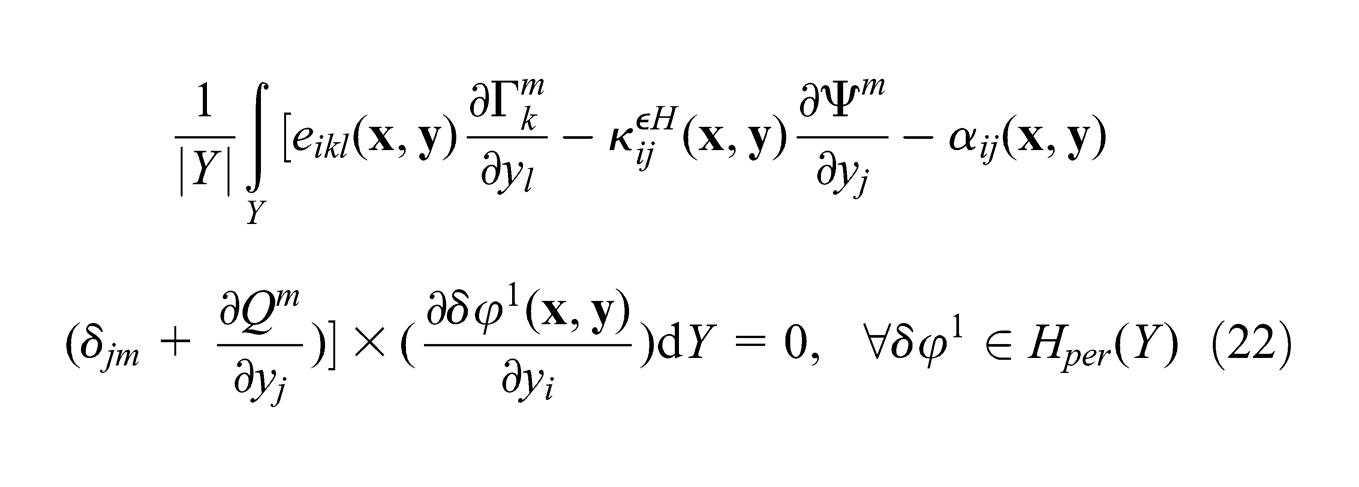

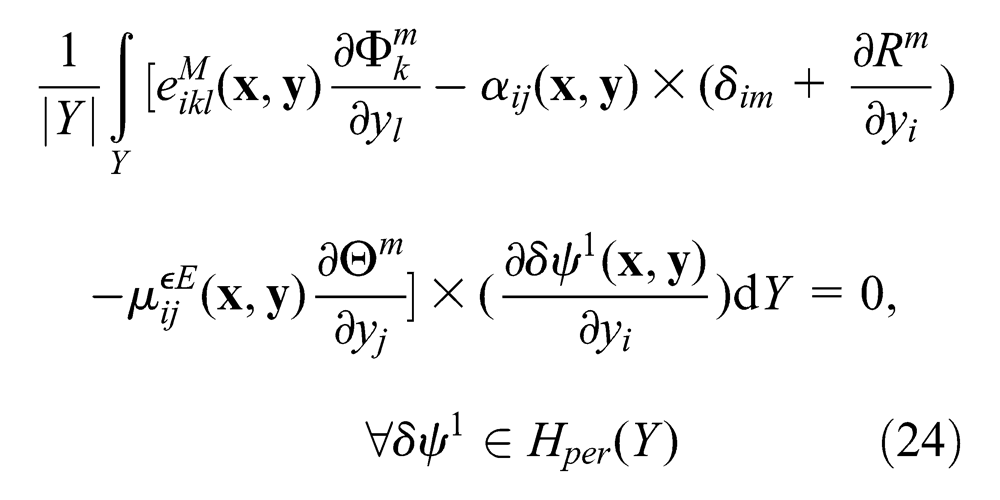
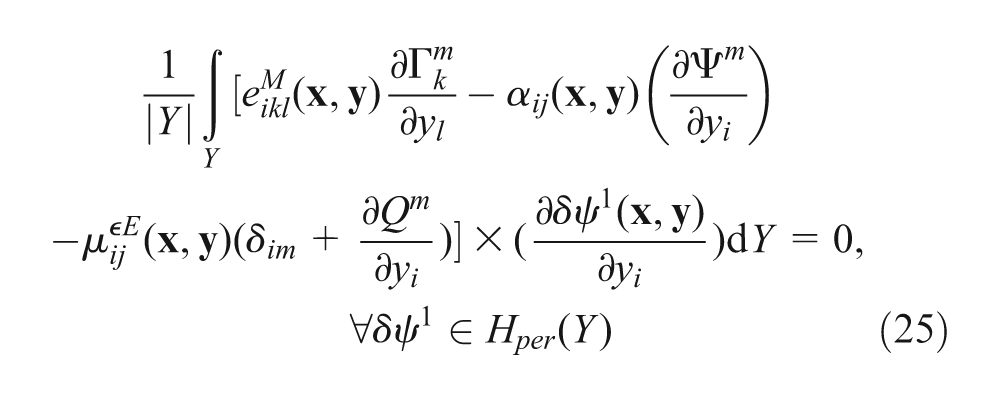
where
After performing analogous mathematical operations, as did for obtaining the microscopic equations (Equations (17) to (25)), one can arrive at the set of macroscopic equations. Having solved the local problems, we can arrive at the homogenized (effective) moduli as
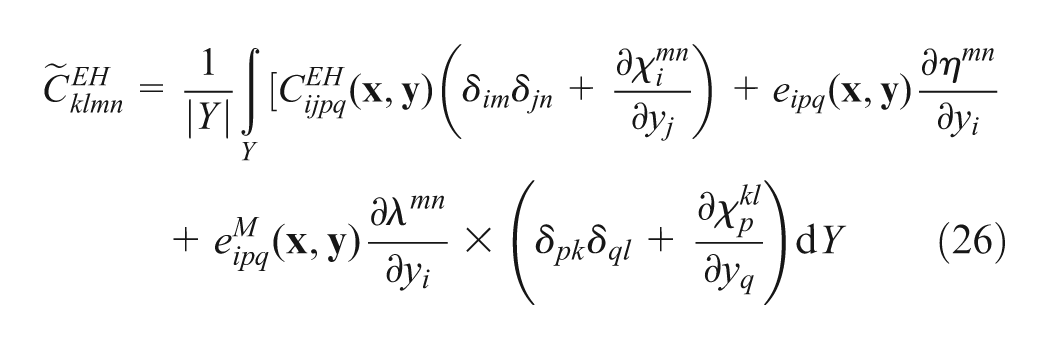
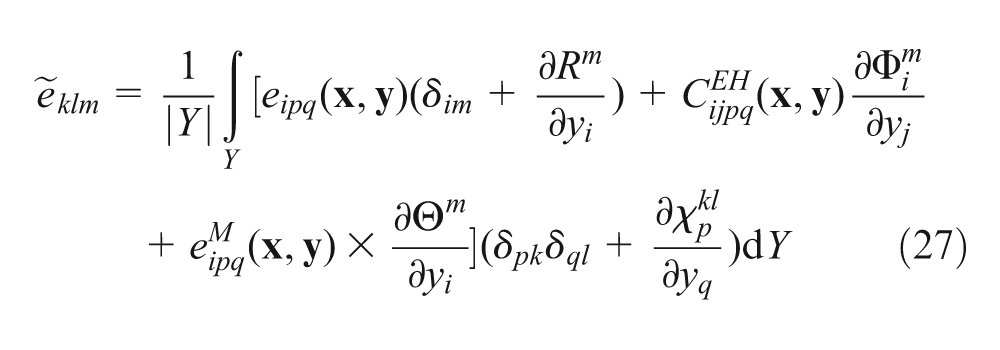
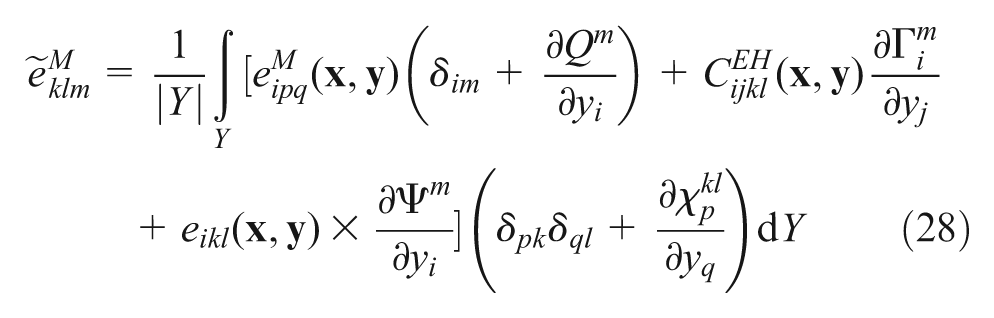
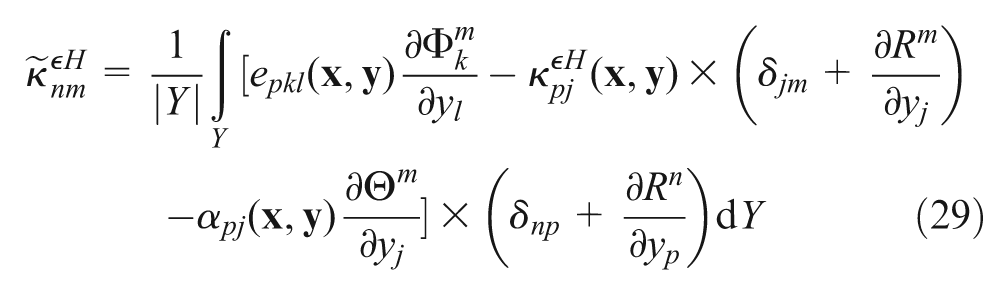
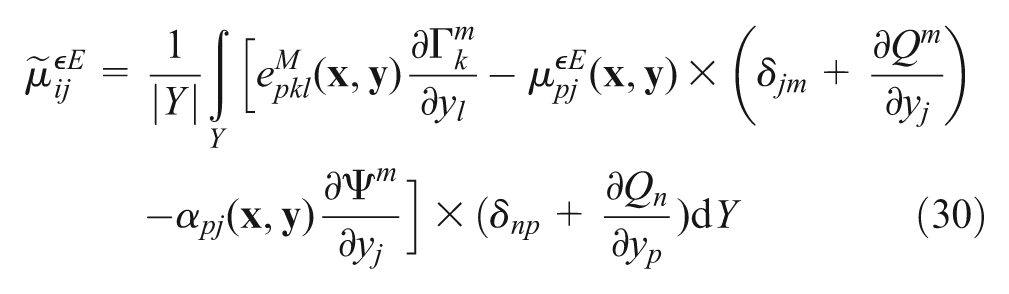
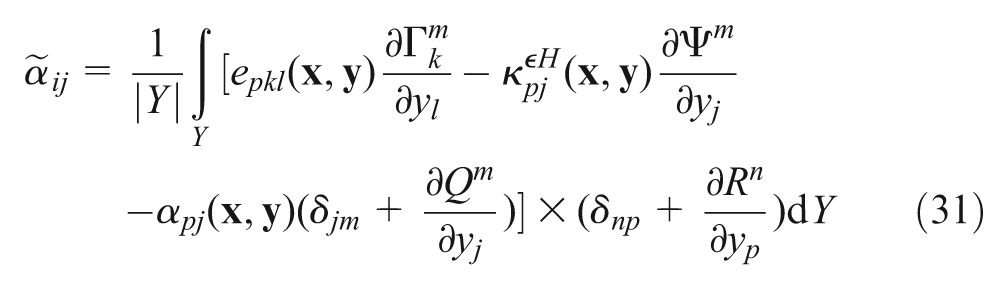
Rigorously, the two-scale asymptotic analysis leads directly to the strong formulation of the local problems depicted in equations (17) to (25). Consequently, the material functions that appear in those equations must be more regular (Glaka et al., 1992). Nevertheless, the point of departure is the variational (weak) formulation of the problem shown in Appendix 2, which would lead to the local problems shown above. This would essentially map the underlying magneto-electromechanical fields of a multiferroic material from a macroscopic coordinates into a local coordinate system possessing more resolutions.
Rotation of multiferroics
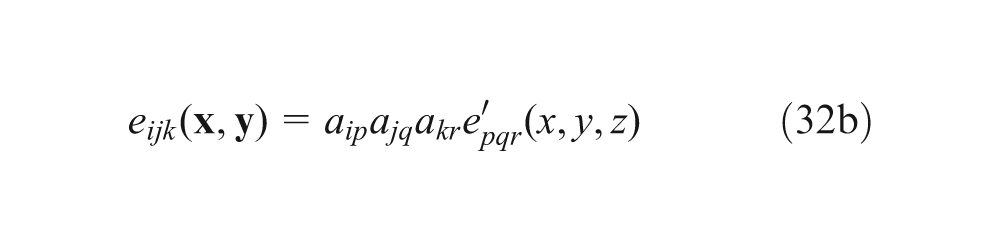
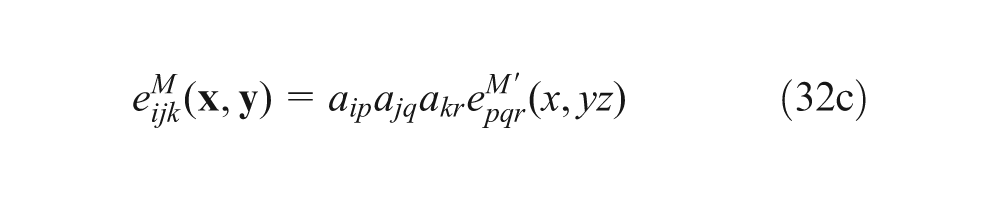
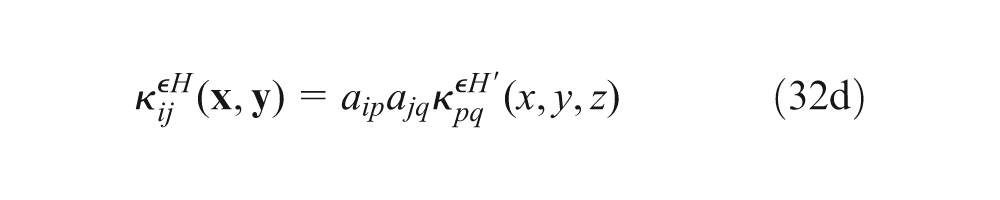
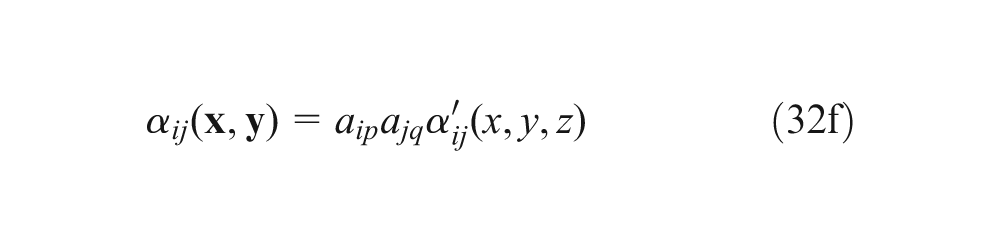
The expressions for homogenized material coefficients that appear in section “Homogenization of multiferroics” could be used for finding out the effective properties of polycrystalline and composite multiferroics. While dealing with both cases, we must take into account the significant impact of the orientation effect of the underlying constituent domains (or crystals). In fact, multiferroic domains are volume elements with uniform orientation of constituent crystallographic unit-cells (see Figure 2 in order to distinguish between the representative unit-cell or the microstructure used for sampling the macroscopic multiferroic material and the crystallographic unit-cell).
The physical quantities that appear in the homogenization equations, namely,
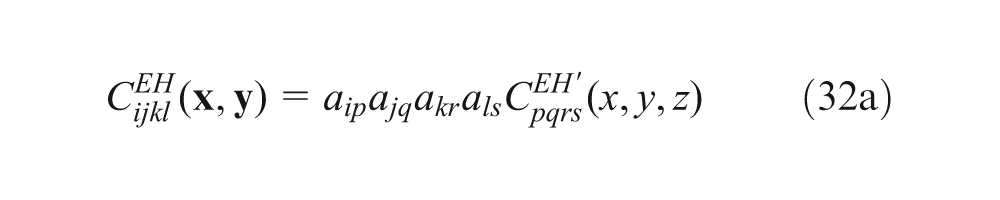

where
The transformation matrix from the crystallographic coordinate system
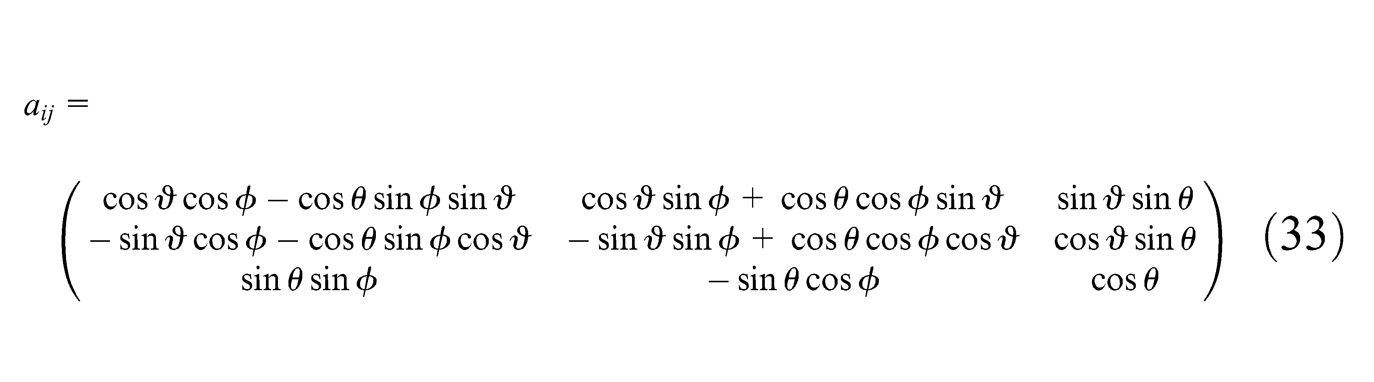
Before being used in the homogenization of polycrystals and composites of multiferroics, the transformation equations (32) and (33) could well be used for characterizing the transformed magneto-electromechanical moduli of rotated multiferroic single crystals. Here, we assume that the multiferroic single crystal to be monodomain. Nevertheless, it is possible to model the rotation of real poly-domain single crystals using the methodology described in the following section but with the knowledge of the proper domain orientation distribution function. Symmetric reduction should be applied according to the single-crystal symmetry. Knowledge of the full set of magneto-electromechanical moduli along the spontaneous polarization/magnetization direction of a multiferroic single crystal is necessary to have a complete picture of the orientational effect. Nonetheless, due to the paucity of the full set of measured data of the multiferroics, single-crystal orientation analysis is not possible.
Polycrystalline multiferroics
Polycrystalline ceramics present ease in manufacture and in compositional modifications compared to single crystals. As-grown polycrystalline multiferroic material is an aggregate of single crystalline grains (or crystallites) with randomly oriented (spontaneous) electric (or magnetic) polarizations. Each grain in a polycrystalline material is assumed to be made of a single, pinned, chemically homogeneous domain. External magnetic or electrical loading can reorient either the polarization axis or the magnetization easy axis or both of most of the domains. Figure 3 shows the schematics of domain switching in a multiferroic polycrystal due to electrical poling. However, electric and magnetic states can be reversibly controlled by an electrical field alone, which simultaneously switches the electrical polarization inside a ferroelectric domain and controls the equivalent magnetic domains (Lee et al., 2008). Hence, the material could be transformed from a randomly oriented sample into a mostly oriented (textured) one. In a randomly oriented multiferroic polycrystal, the orientations of domains with reference to a fixed coordinate system (in this study, it is the microscopic coordinates
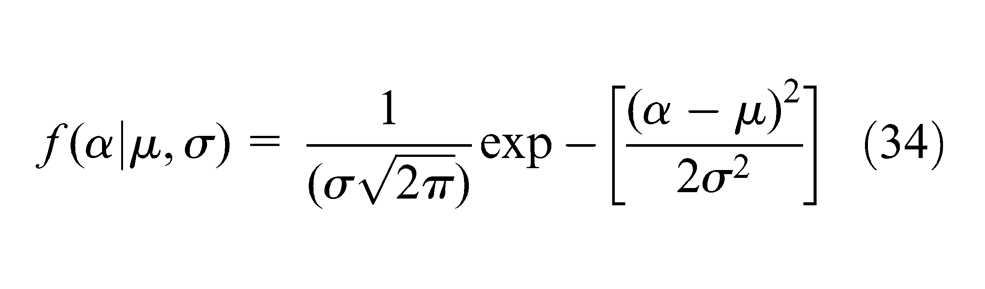
where
Here, the Gaussian distribution can encompass both extremes of the polycrystal configuration: the perfectly textured as well as the random sample. It can be explained in the following way: as the standard deviation
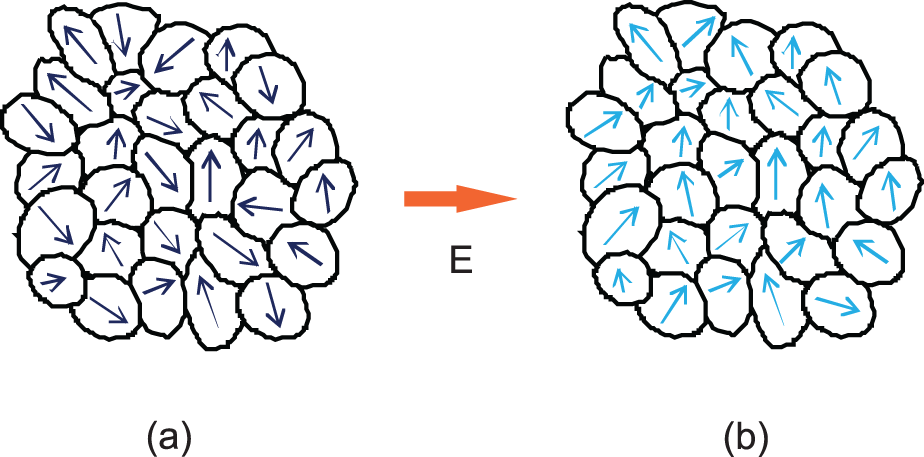
Possible switching of domains that reorient the polarization vectors (arrows) from unpoled (a) to poled (b) configuration due to electrical field (E) loading in polycrystal multiferroic material. We have not shown the equivalent magnetic domains or the corresponding magnetization here.
Numerical results and discussion
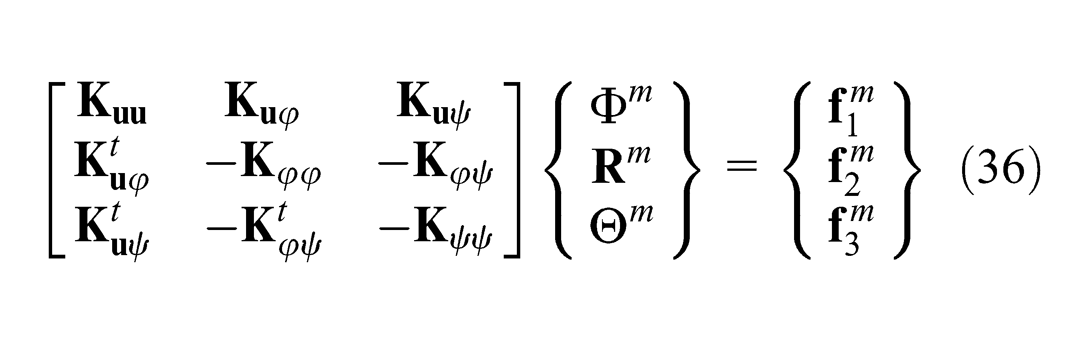
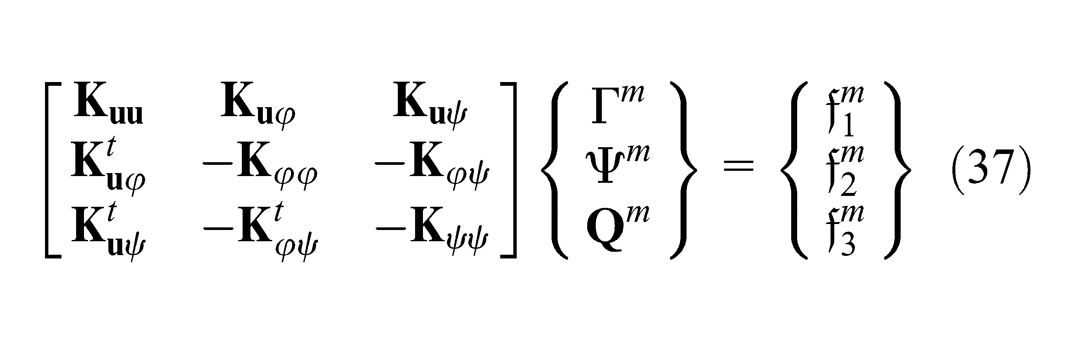
In order to solve the microscopic system of equations given through equations (17) to (25) in section “Homogenization of multiferroics,” we developed a finite element formulation. (Further details of finite element formulation are given in Appendix 3.) A simple, three-dimensional (3D) “multiferroic finite element” is conceived with the simplest nodal arrangement for a brick element employing the vertices with 5 degrees of freedom (DOFs) (three spatial and one each for magnetic and electrical potentials). In the present context, 8-noded isoparametric elements with
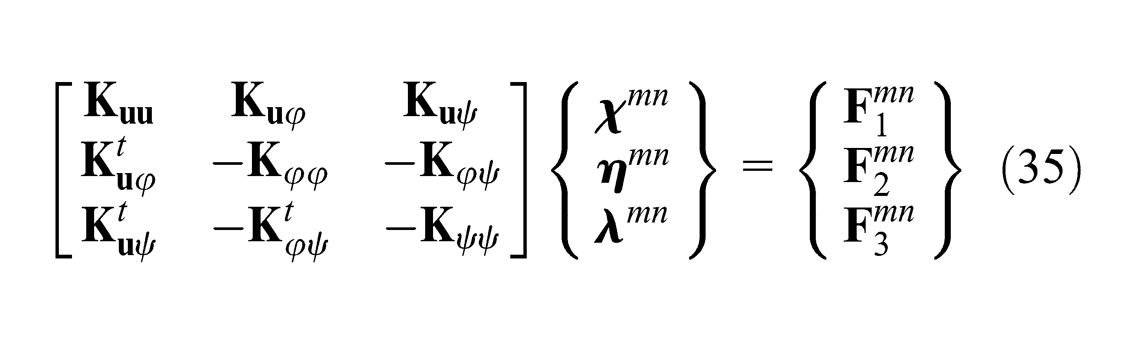
where the superscript
As the representative unit-cell is expected to capture the response of the entire multiferroic system where the macroscopic material is constructed by adding, contiguously to the representative unit-cell, a large number of other identical unit-cells, particular care is taken to ensure that the deformation across the boundaries of the representative unit-cell is compatible with the deformation of adjacent unit-cells. This requirement is applicable to the electrical and magnetic potentials as well. Hence, all the load cases are solved by enforcing periodic boundary conditions in the unit-cell for the displacements, electrical, and magnetic potentials.
The multiferroics offer the possibility of fast low-power electrical write operation and nondestructive magnetic read operation. One of the order parameters, either electronic or magnetic, is, in general, a weak property resulting from a complex phase transformation, orbital ordering, geometric frustration, and so on in materials (Martin et al., 2010). Nevertheless, composite multiferroics offer extraordinary coupling at room temperature and above. Here, we apply the methodology to a simple two-phase multiferroic ME composite due to the rarity of single-phase single-crystal data (Eerenstein et al., 2006) to model an ideal multiferroic. Laminated two-phase composites of a magnetostrictive (or piezomagnetic) and electrostrictive (piezoelectric) material (Figure 4) introduce indirect ME coupling mediated through strain (Eerenstein et al., 2006; Ryu et al., 2001). The system used here is a composite of cobalt ferrite (magnetostrictive) and barium titanate (electrostrictive). We have estimated the effective magneto-electromechanical properties of the laminate as a function of the volume fraction of the electrostrictive (barium titanate, BaTiO3) medium, with the magnetostrictive (cobalt ferrite, CoFe2O4) medium as the base material.

Schematic diagram of a composite two-phase multiferroic magnetoelectric laminate.
The set of linear equations in equations (35) to (37) is coupled by the matrices

for the former case and magnetic permeability

for the latter case. The ME coupling
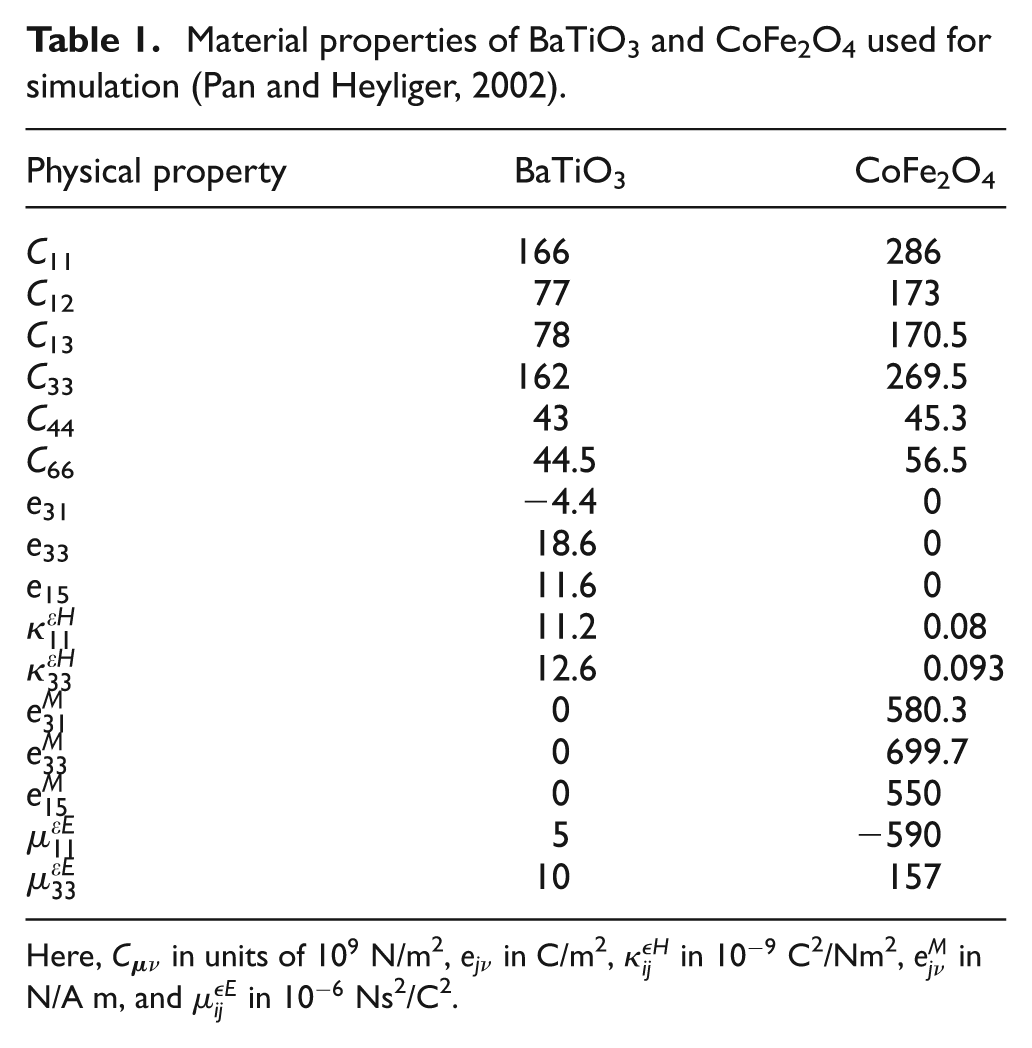
The material properties of the individual phases of the composite used for the simulation taken from the Pan and Heyliger (2002) are listed in Table 1. The homogenized magneto-electromechanical properties calculated using the present model are shown in Figures 5 to 9. The results compare well with the micromechanical calculation on laminated BaTiO3−CoFe2O4 composite by Li and Dunn (1998). This is a proof of the validity of the present model. Experiments on the particular geometry, that is, the 2-2 laminar ME composite using materials CoFe2O4 and BaTiO3 are scant in the literature for direct comparison (Nan et al., 2008). Thus, a quantitative comparison is difficult due to lack of information regarding the ME coupling tensor pertaining to the CoFe2O4−BaTiO3 laminate. However, geometries such as particulates, powder composites, and 1-3 fiber nanocomposites, heterostructure consisting of nanopillars of the ferro/ferrimagnetic phase (CoFe2O4) embedded in a ferroelectric matrix (BaTiO3) are reported (Zheng et al., 2004). Nevertheless, laminate composites are potentially useful because of the large coupling between electrical and magnetic properties due to large area of contact between phases. Yet the self-assembly of the nanocomposite occurs at volume fractions (0.35CoFe2O4−0.65BaTiO3) (Zheng et al., 2004) close to the volume fraction (≈ 0.7BaTiO3) in our model at which the laminate exhibits maximum longitudinal ME coupling (see Figure 9).
Material properties of BaTiO3 and CoFe2O4 used for simulation (Pan and Heyliger, 2002).
Here,
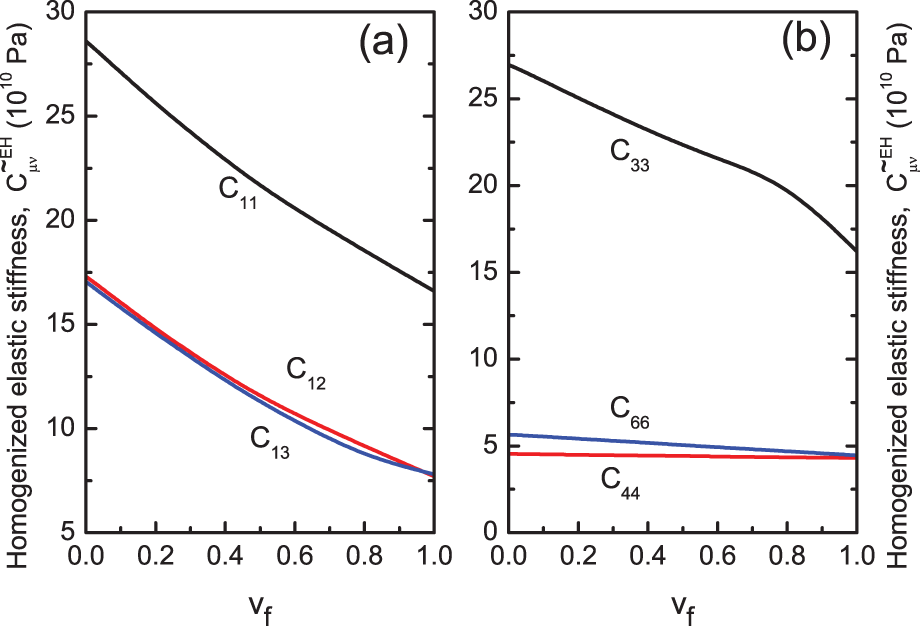
The homogenized elastic stiffnesses
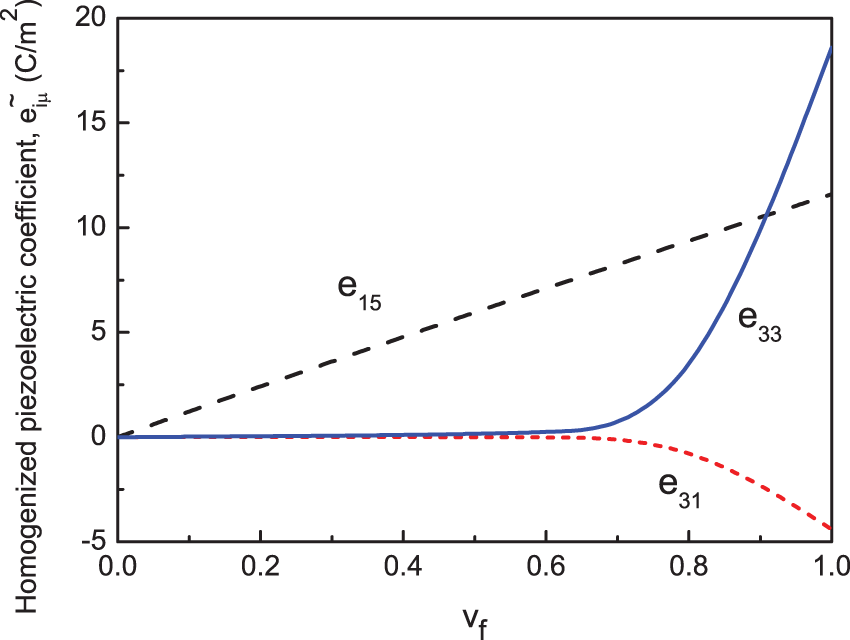
The homogenized piezoelectric stress coefficients
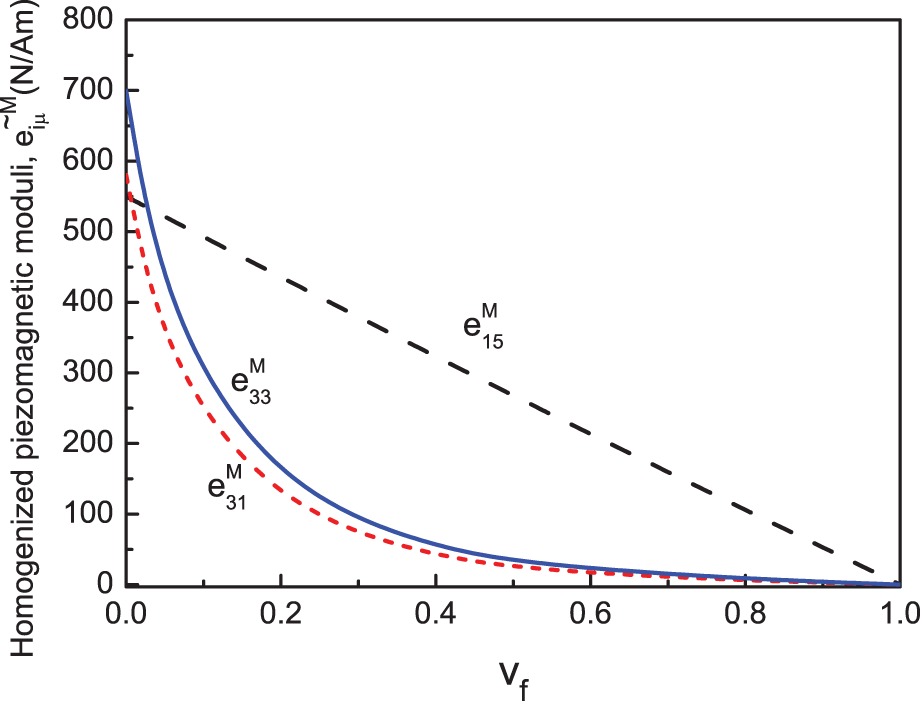
The homogenized piezomagnetic coefficients
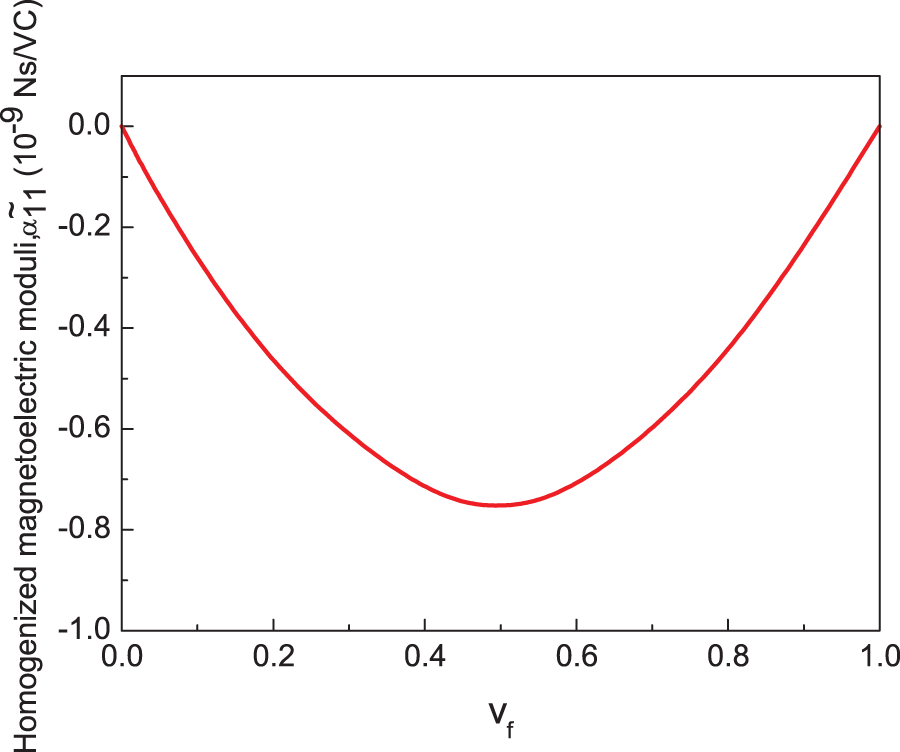
The homogenized magnetoelectric coefficient
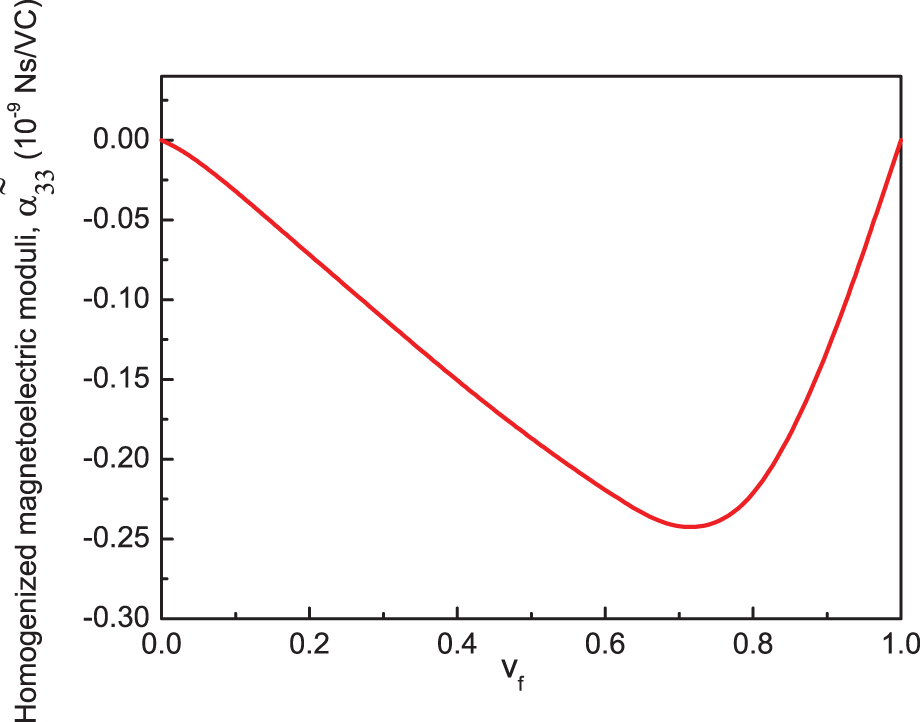
The homogenized magnetoelectric coefficient
Another important aspect to be noted in this study is that neither the piezoelectric nor the magnetostrictive phase exhibits the ME effect manifested by the ME coupling
Conclusion
A rigorous theoretical model, in a generic setting, is developed for the homogenization of multiferroics for treating single-phase multiferroic single crystals as well as polycrystals and for multiferroic composites. The microstructural features such as orientation and texture are incorporated fully into the modeling framework. A multiferroic microstructure (or representative unit-cell) is conceived in the local scale. This unit-cell could encompass the features of single crystals possessing domain structure, polycrystals possessing crystallites with subgranular domain structure, and composites formed by single or polycrystalline magnetic and ferroelectric materials. The homogenization expressions for entire magneto-electromechanical properties are derived assuming the macroscopic body is build by the contiguous juxtaposition of the representative unit-cell in 3D space. The proposed modeling approach can treat multiferroics irrespective of their crystallographic symmetry, multiferroic polycrystals, and multiphase ME composites of any geometry and configuration, sandwich structures, and so on.
The variational formulation of the magneto-electromechanical problem enables us to derive a set of local problems which essentially unravel the relationships among the underlying microscopic fields. Homogenization is implemented in FEM by solving these local coupled equilibrium electrical, magnetic, and mechanical fields to enable computation of the effective properties. A “multiferroic finite element” is conceived with 5 DOFs (three for the spatial coordinates and one each for the electrical and magnetic potential) per node.
The transformation of the multiferroic’s physical properties due to the crystal rotation is characterized through Euler angles (
The size-effect and the nonlinear behavior of the “responses” (i.e. the magnetization
Footnotes
Appendix 1
Appendix 2
Appendix 3
Acknowledgements
We would like to acknowledge G. Srinivasan and K.P. Surendran for insightful discussions. K.P.J. acknowledges the award of Ciência 2007 from Fundação para a Ciência e a Tecnologia (FCT), Portugal.
Declaration of conflicting interests
The authors declared no potential conflicts of interest with respect to the research, authorship, and/or publication of this article.
Funding
This research project is partially funded by FCT (Fundação para a Ciência e a Tecnologia, Portugal) through project PTDC/EME-PME/120630/2010.