Response of moving load over a surface is an intriguing problem of mechanics to determine the stability and strength of a structure. Owing to this the present theoretical framework is devoted to find the stresses and electrical displacements of an irregular visco-porous piezoelectric half-space originated due to a uniformly moving line load. Expressions for normal stress, shear stress and electrical displacements have been derived in closed form. Effect of irregularity depth, irregularity factors and frictional coefficient on the stresses and electrical displacements are delineated graphically. Numerical demonstration of procured results is interpreted by means of graphs for two different materials, namely PZT-5A and PZT-7. A comparative study emphasising various irregularity (parabolic, rectangular and no irregularity) is among the salient features of the study.
Piezoelectric materials exhibit distinctive electromechanical coupling property which generates electric field when mechanical load is applied and elastic deformation when undergo electrical load. These smart materials are extensively used in sensors, sonar, microphones, energy harvesting devices, transducers and actuators. Recently piezoelectric materials are added with the structural system to build a class of smart structure and embedded as layers or fibres into multifunctional composites (Bae and Lee, 2016; Honein et al., 1991). Despite of having wide application, electromechanical devices made up of single-phase piezoelectric substrate have some limitations as they show high density and high specific acoustic impedance which affect the work performance of electromechanical devices. Also, these materials show brittleness which include failure of the device under mechanical and electrical loading. Some important properties of materials viz. elastic constants, porosity, dielectric constants, density and viscosity, controls the piezoelectric responses. The mismatching of acoustic impedance can be overcome by reducing material density through variation of porosity. With the aid of tailored porosity, the emerging porous piezoelectric material find its implementation in vibratory sensors, contact microphones and under water devices. Also, because of occurrence of polymer matrix the flexibility is higher and fabrication is easier than single phase porous piezoceramics. Presence of passive polymer in porous piezoceramics causes viscoelasticity (Li and Dunn, 2001). In such type of composites, the complex elastic, piezoelectric and dielectric constants are influenced by both mechanical, electrical losses and their coupling through the piezoelectric effect.
Very high levels of displacement are recognized in some soft ground phenomenon which may comprises viscoelastic property. Viscoelastic materials exhibit both ‘viscous’ and ‘elastic’ characteristics when undergoing deformation. The property ‘Elastic’ indicates the ability of a material to resist a distorting influence and to return to its actual configuration when the influence is removed. The property ‘viscous’ suggest the material deforms slowly under the influence of an external force. When subjected to a step constant stress, viscoelastic materials experience a time-dependent increase in strain. This phenomenon is known as viscoelastic creep. Due to creep a solid material moves slowly or deforms permanently with certain stresses. Creep is very severe when the materials are exposed to heat for long time. While designing long-term structures viscoelastic creep plays a crucial role under certain loading and temperature conditions.
In 1847 after the collapse of the Stephenson’s bridge across river Dee at Chester in England much attention was given into moving load problems (Ouyang, 2011). Exploration of the responses of elastic solid due to moving load on the boundary are of continuing engineering interest for the last several decades. Some of the illustration of moving load problem are the vibrations that occurs in bridges, aircraft carriers, underground railways, tunnels and railway tracks induced by moving vehicles. Stresses produced over the surface of a body in the response of moving load has practical necessity in Mechanics to determine the durability of a structure. Because of time varying behaviour of vehicles, it is very burdensome to directly calculate the interacting forces between vehicles and a structure. To overcome these shortcomings measured response data of a structure is effectively used. Moreover, in practical phenomenon, surface irregularity arises in roads, bridges etc. These irregularities consist of large span but small depth. Till now numerous investigations associated with moving load has been made. Few are mentioned here: Achenbach et al. (1967) investigated the effect of moving load on a plate resting on elastic half-space. Cole and Huth (1958) investigated a two-dimensional problem of a line load also derives solutions for uniform subsonic, supersonic and transonic velocity over the surface of a homogeneous elastic half-space. Eason (1965) analysed a three-dimensional problem of steady state motion of a Point load in an unbounded structure. A new method is introduced by Museros and Martinez-Rodrigo (2007) for reducing the resonant vibration of simply supported beams under moving load by the use of fluid viscous dampers. Different factors that affect the performance of moving force by taking identification methods and analytical verification is studied by Yu and Chan (2007). A new model has been developed by Koh et al. (2007) named moving element method and examined the dynamic analysis of half-space continuum under moving load. Payton (1967) analysed the transient motion of an elastic half-space subjected to a moving line load. Luo et al. (2016) investigated the dynamic response of the Timoshenko beam lying over viscoelastic foundation under the influence of a harmonic line load. Olsson (1991) discussed the dynamic response of a uniform simply supported Euler-Bernoulli beam under the influence of a constant vertical load moving with constant velocity. Transient plain strain problem for an elastic half-space subject to a line force moving with uniform speed along the surface is examined by Kaplunov et al. (2010). Alekseyeva (2007) established fundamental solutions for a half-space under the action of a load moving at constant velocity which does not change with time in a moving system of coordinates. Other than this, some authors also considered irregular surface for a moving load problem (Chattopadhyay et al., 2011; Mistri et al., 2017; Selim, 2007; Singh et al., 2017a).
A material having symmetric physical properties about an axis that is normal to a plane of symmetry is termed as transversely isotropic material. This transverse plane has infinite planes of symmetry and thus, within this plane, the material properties are the same in all directions. This type of material property can be observed in sedimentary rocks at long wavelengths. Also, on axis unidirectional fibre composite lamina where the fibres are circular in cross section, geological layers of rocks, graphite fibres, some piezoelectric materials (PZT-5A, PZT-7 etc.) and biological membrane are good example of transversely isotropic materials. The effect of properties of transversely isotropic material on a structure is quite appreciable. Kumari et al. (2018) investigated the dynamic response of normal moving load in a piezoelectric transversely isotropic half-space with parabolic irregularity. Some recent work on composites structures may also be cited (Al-Furjan et al., 2020, 2021; Askarinejad et al., 2021; Azizkhani et al., 2020; Hadi Hajmohammad et al., 2021; Keshtegar et al., 2020a, 2020b, 2020c; Kolahchi and Kolahdouzan, 2021; Kolahchi et al., 2020, 2021; Kumhar et al., 2020; Malikan and Eremeyev, 2020a, 2020b, 2021a, 2021b; Malikan et al., 2019, 2020a, 2020b; Motezaker et al., 2021; Taherifar et al., 2021; Dastjerdi et al., 2020; Saadatfar, 2020). Singh et al. (2017b) examined the effect of different factors (initial stress, irregularity depth, irregularity factor and magneto-elastic coupling parameter) on the dynamic response due to a normal moving load with constant velocity on the free surface of an irregular magneto-elastic transversely isotropic half-space under the state of hydrostatic initial stress. Stresses produced due to a moving load over the plane rough surface of a semi-infinite transversely isotropic medium have been calculated by Mukherjee (2017).
To date, no analysis concerning the dynamic response of visco-porous piezoelectric materials under a moving load with irregular surface has not been done. The main focus of the present paper is to explore the impact of irregularity factor, irregularity depth and frictional coefficient on dynamic response of a transversely isotropic viscous porous piezoelectric material subject to a moving load. The expressions for stresses and electrical displacements are derived analytically for both electrically open and short conditions. Graphical illustration of the obtained analytical results has been implemented for two types of materials viz. PZT-5A, PZT-7. The influence of various effective parameters such as depth of irregularity, different types of surface irregularity (viz. rectangular irregularity, parabolic irregularity and no irregularity) and frictional coefficient on the stresses and electrical displacements are illustrated graphically. The expressions for stresses and electrical displacements for certain particular cases have been derived for the purpose of matching the obtained results with some pre-established results.
2. Mathematical model of the problem
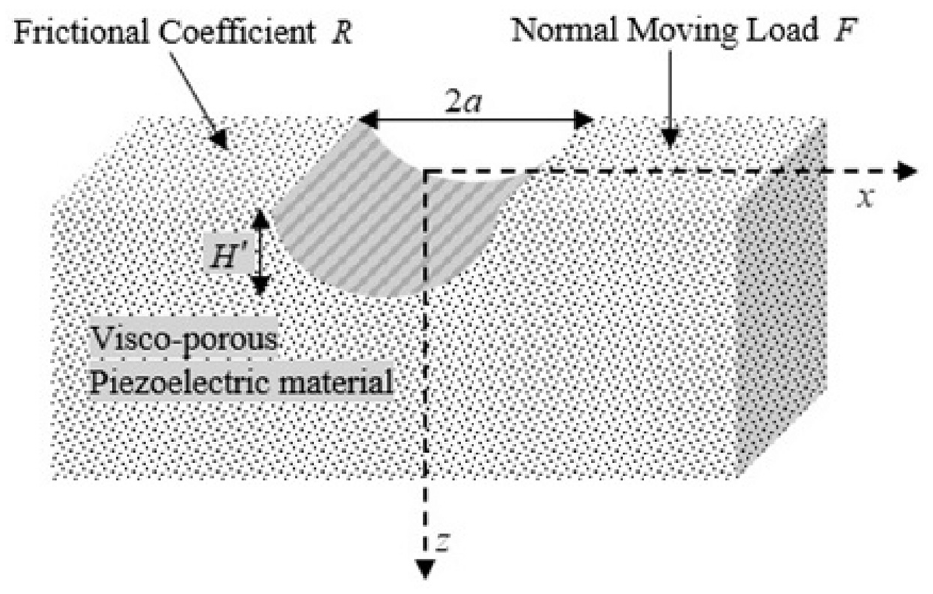
Here the proposed model is associated with a moving line load with constant velocity on an irregular transversely isotropic, incompressible, uniform porous, viscoelastic, piezoelectric material structure. For viscosity Kelvin-Voigt model is considered which indicates the creep behaviour of the material. The frictional coefficient of the irregular upper surface of the given model is assumed to be . A rectangular Cartesian coordinate system is introduced in such a way that the -axis is oriented vertically downwards indicating the direction of vertical depth and -axis is along the direction of line load. The origin is at the middle point of the span of the irregularity as shown in Figure 1.
Schematic diagram of the proposed model.
Now, an irregularity of parabolic shape is taken in the proposed model. Therefore, the equation of the parabolic irregularity may be defined as
Here, is the span of irregularity and is the perturbation parameter due to surface irregularity. is the depth of the irregularity.
3. Governing equations and boundary conditions
Let and represents the densities of the solid and fluid phase per unit volume of the porous material. The dynamical mass coefficients can be expressed in terms of densities by the relation
. Here denotes the dynamical coupling coefficient.
The density of the porous aggregate is given by .
The expression for kinetic energy develops (Youssef, 2007)
By Lagrange’s equation, the following equations establishes
where are the body forces.
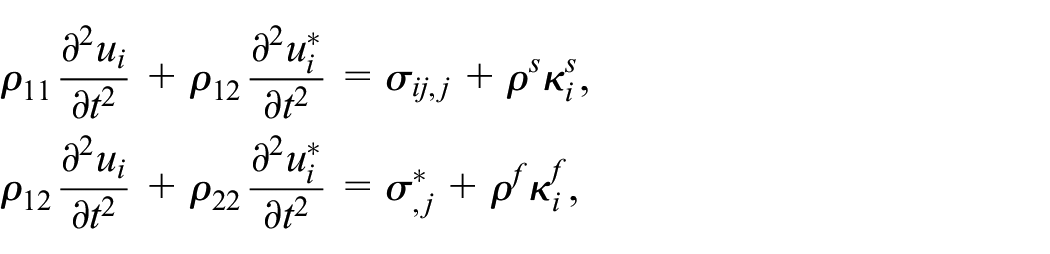
The equations of motion for a fluid saturated visco-porous piezoelectric material, in the absence of body forces and dissipation, are (Gupta and Vashishth, 2014)
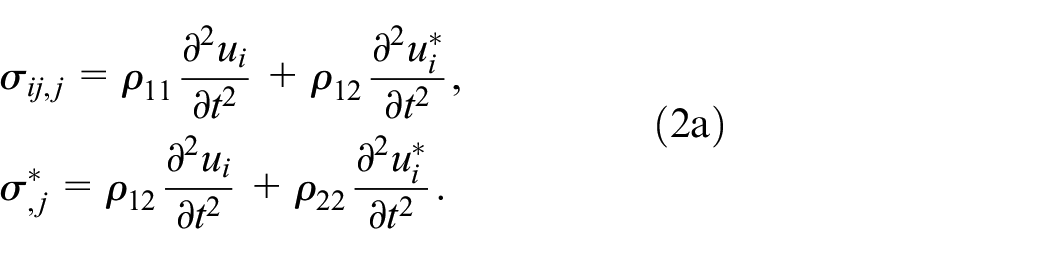
Omitting the displacement electric current, the governing electro-dynamic Maxwell equations for a porous piezoelectric elastic material are given by (Gupta and Vashishth, 2014).
Here, , are, respectively, the stress components acting on solid and phase of porous aggregate; mechanical displacement for solid (fluid) phase of porous aggregate; denotes Electric displacement components for solid and fluid phase respectively.
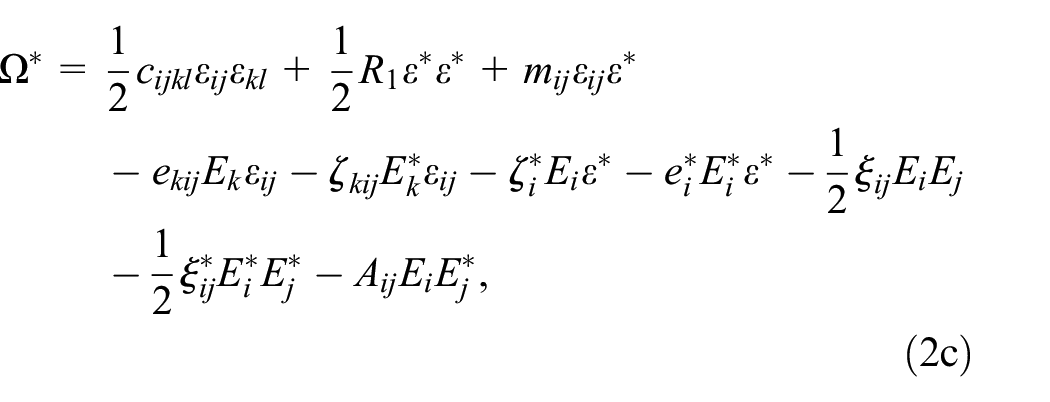
The electric enthalpy density function for porous piezoelectric material is defined as (Vashishth and Gupta, 2009)
which is a quadratic function of .
where are respectively tensor of order 4/3/2/1 and zero.
By the definition of electric enthalpy density function, it follows that
From (2c) and (2d), it constitutes
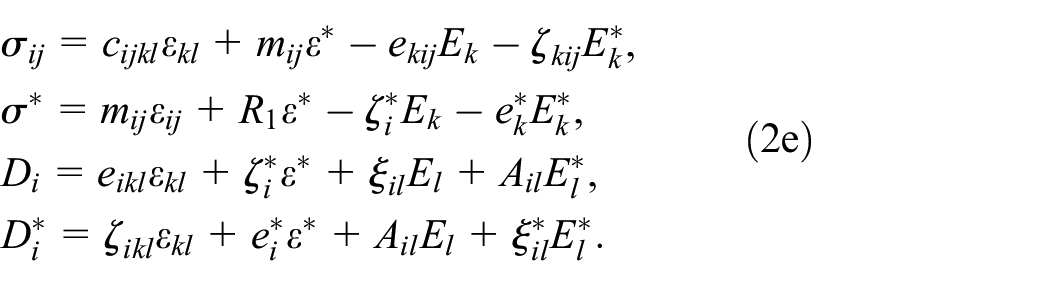
Here (2e) gives the constitutive equations for anisotropic porous piezoelectric material. The notations is the strain component for solid (fluid) phase; are electrical field components for solid (fluid) phase respectively. are the elastic moduli, is elastic constants that measures the pressure to be exerted on fluid to push its unit volume into the porous matrix. and are piezoelectric moduli and dielectric moduli for solid (fluid) phase, respectively. denotes the elastic, piezoelectric, dielectric coupling between the two phases of the porous aggregate.
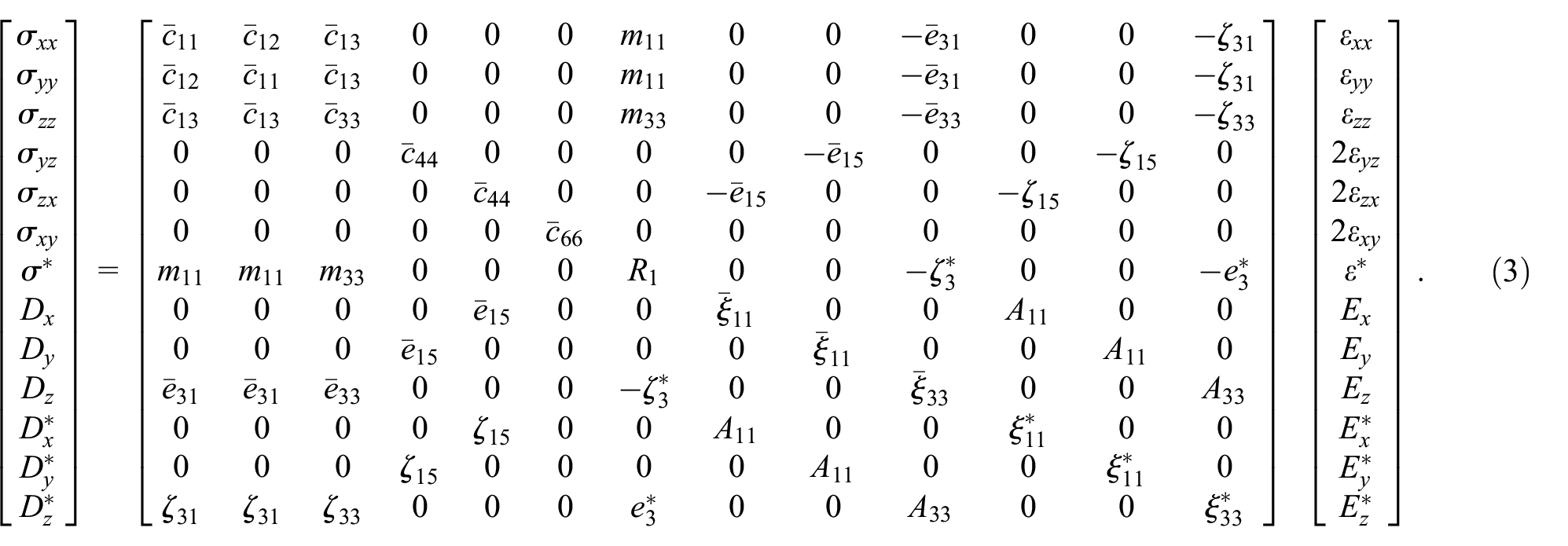
The constitutive equations for transversely isotropic visco-porous piezoelectric materials can be written as (Gupta and Vashishth, 2014):
Exerting Kelvin-Voigt model of viscoelasticity, the material properties has been considered as,
where and are the elastic loss moduli, piezoelectric loss moduli and dielectric loss moduli, respectively, of the visco-porous piezoelectric material. Superimposed dot denotes partial derivative with respect to t. defines derivative with respect to .
The relation between strain components and mechanical displacements along with electric intensity and electrical potential function for solid and fluid phase can be written as
Here is electric potential functions for solid (fluid) phase of the porous aggregate and is components of mechanical displacement for solid (fluid) phase of porous aggregate.
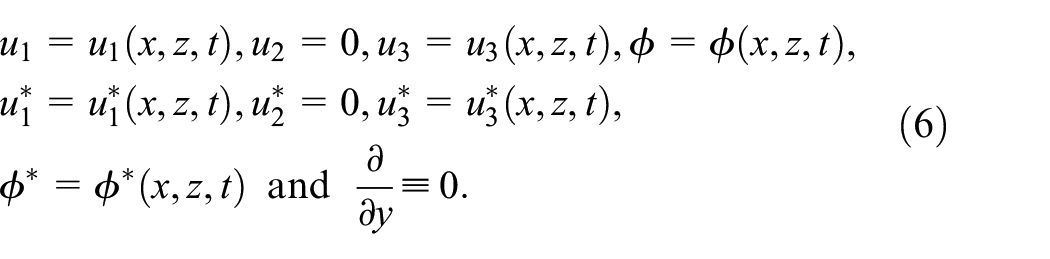
Further, for the plain strain deformation parallel to -plane, the components of displacement vector are taken as
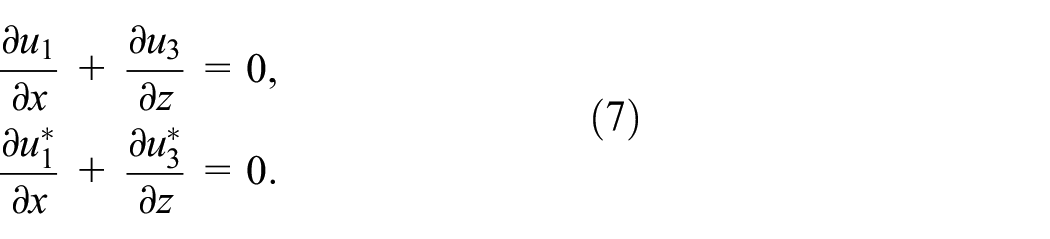
In the present problem, the material layer is considered incompressible, which implies that it must satisfy the conditions given by
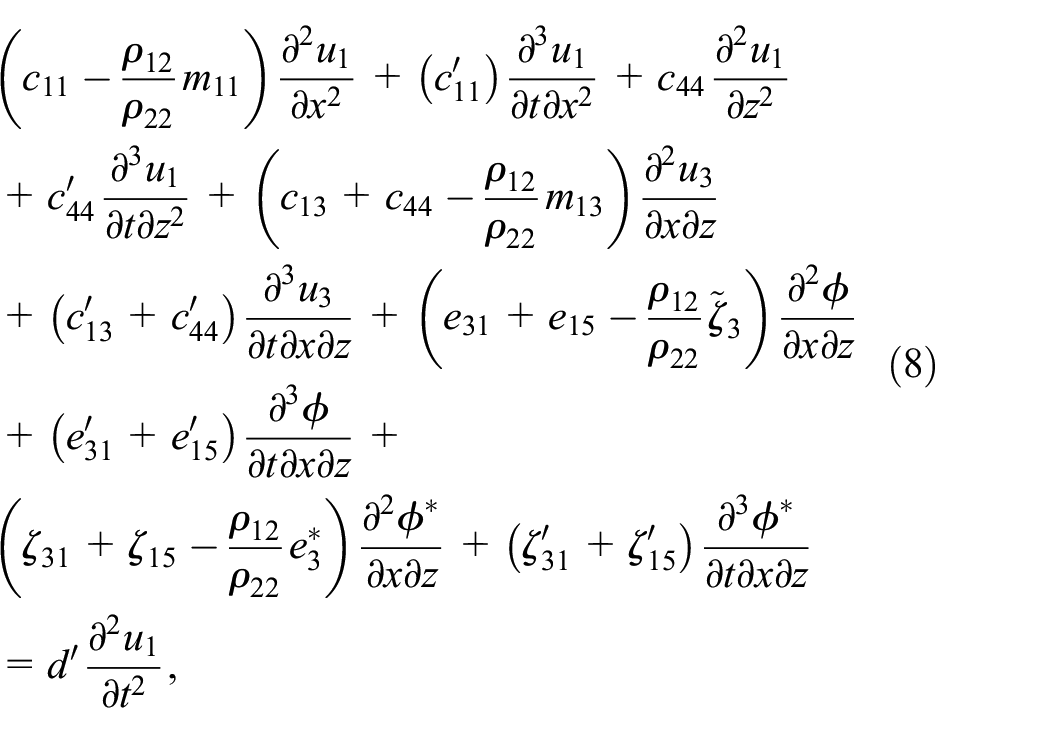
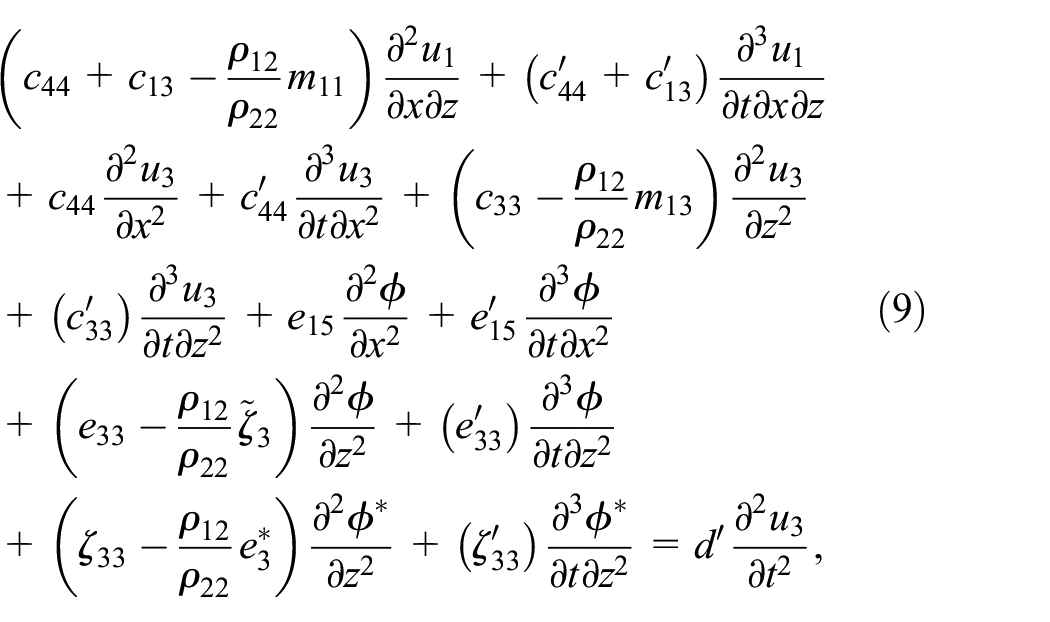
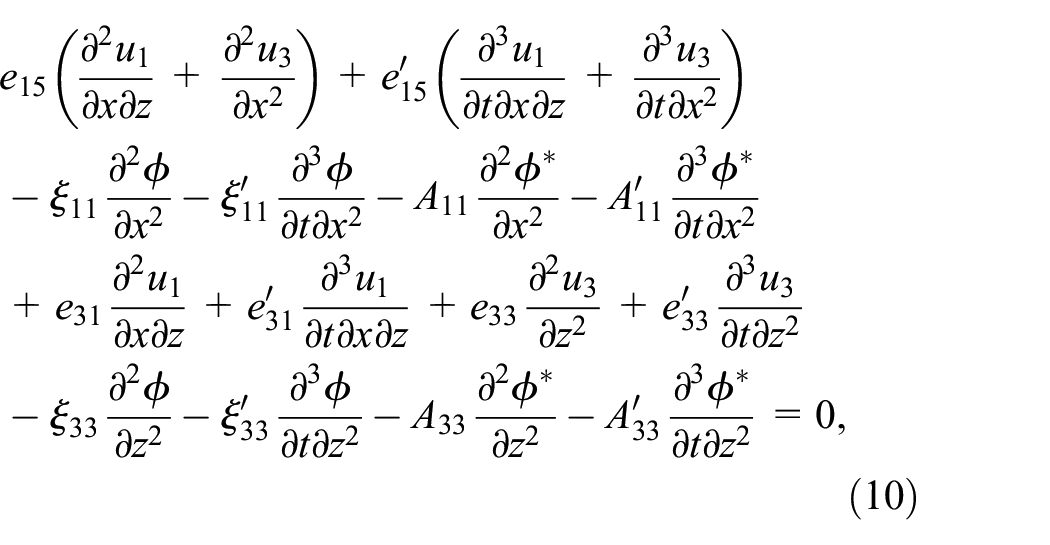
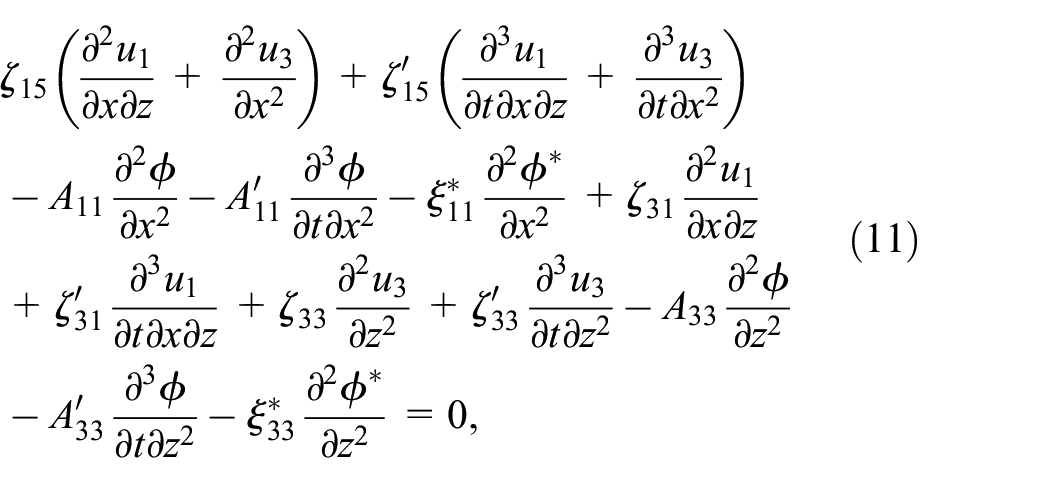
Now, in view of equations (3) to (7), the equations of motion (2a) and (2b) get transformed into the following four equations:
where .
4. Boundary conditions and solution of the problem
The suitable boundary conditions for the said model under the influence of line load with uniform velocity in the positive direction of the -axis are as follows:
(1) Mechanical boundary conditions at are
(2) Electrical boundary conditions at are
where,
Here, denotes the wave number, time and Dirac-delta function of the argument respectively.
Now, the solutions of the equations (8)–(11) may be assumed as
where and are unknown arbitrary parameters to be determined and is a unknown real and positive dimensionless parameter independent of , so that the mechanical displacements and electrical potential functions are bounded as .
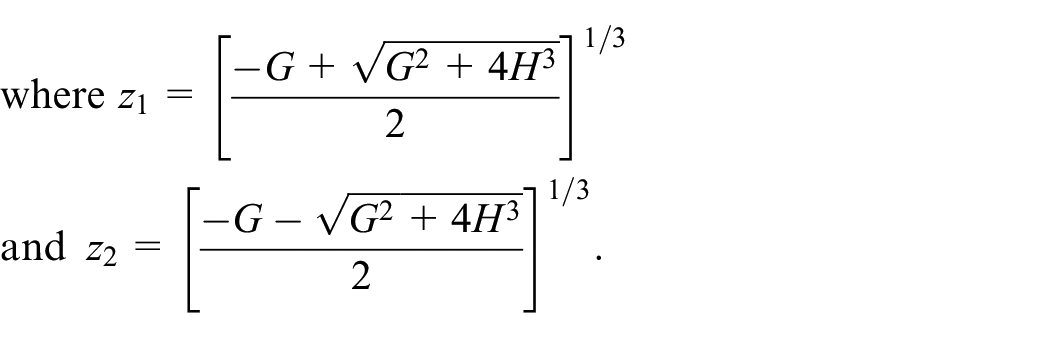
where are the two values of obtained by considering its positive roots only.
In view of (32), it may be procured from equations (17)–(20) that
where and are two values of corresponding to and .
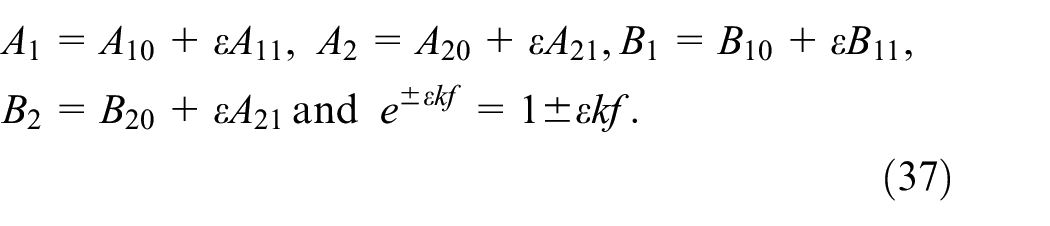
Due to non-uniformity of the surface, under the assumption that the perturbation parameter ε is very small, the terms and can be expressed as functions of ε. Expanding the terms upto first order of ε (i.e. neglecting the higher powers of ε), we get
4.1. Case I: Electrically open case
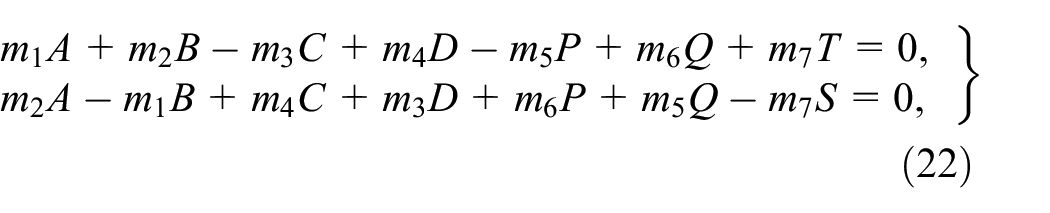
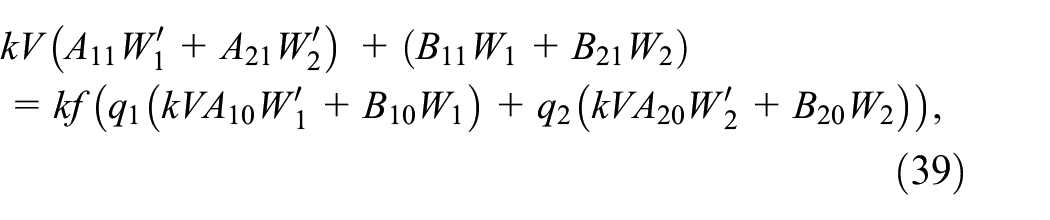
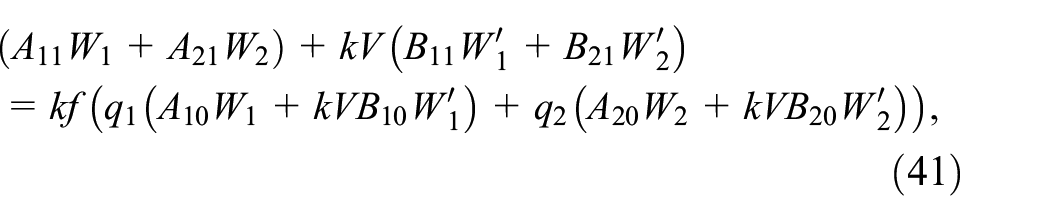
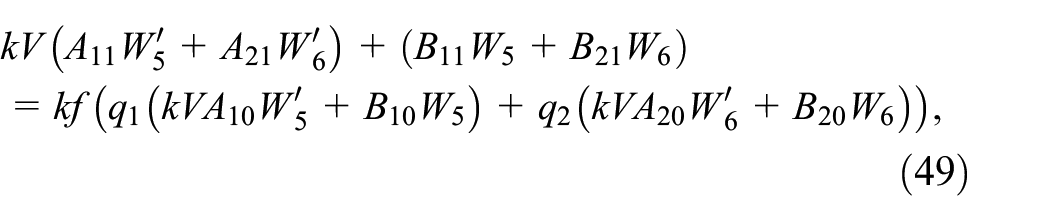
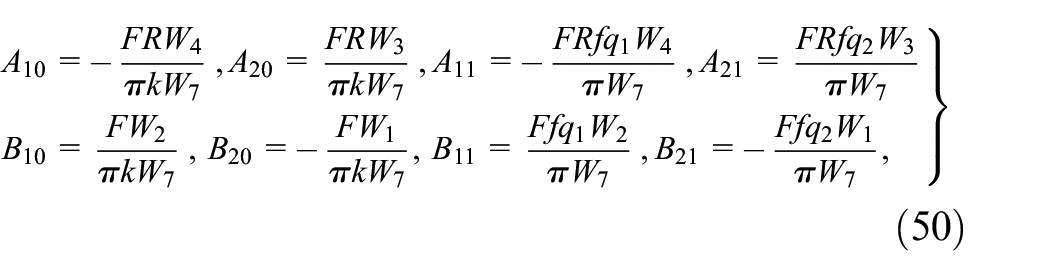
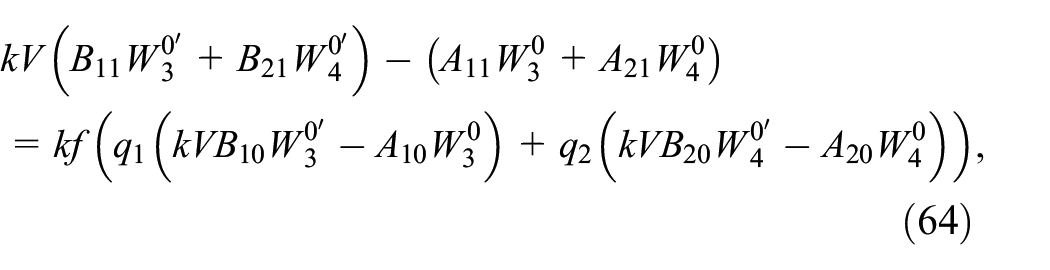
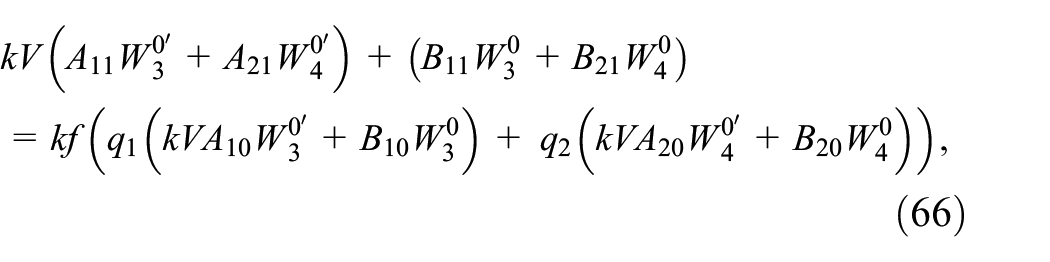
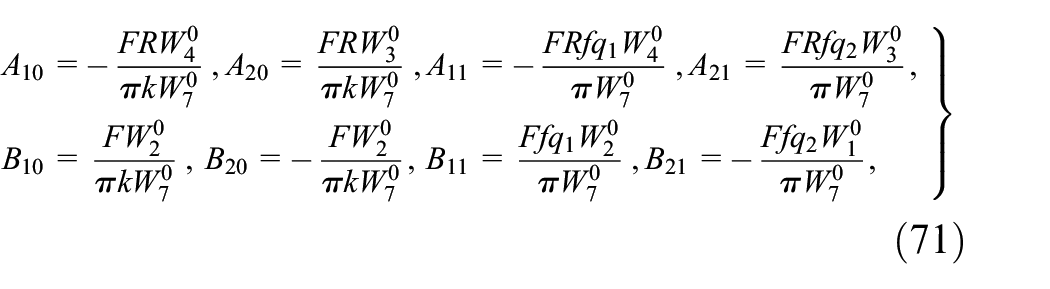
With the aid of equations (33)–(37), boundary conditions (12)–(14) and (16), and then equating the coefficients of and the system of equations may be obtained as
where the expressions of are provided in Appendix B.
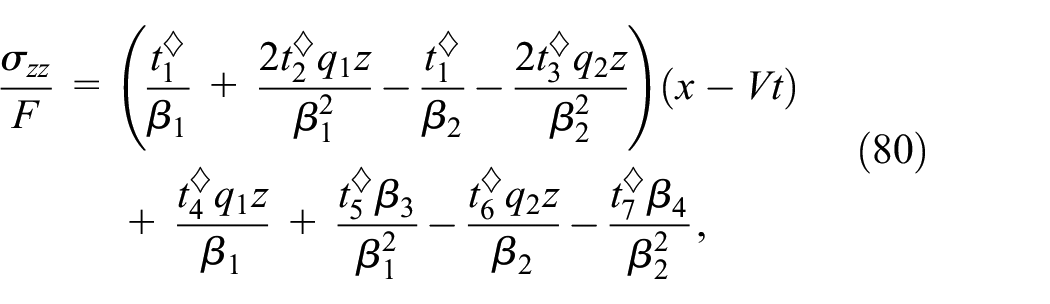
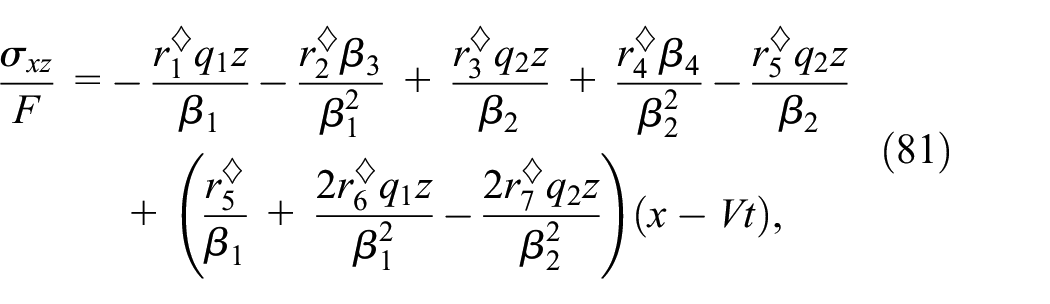
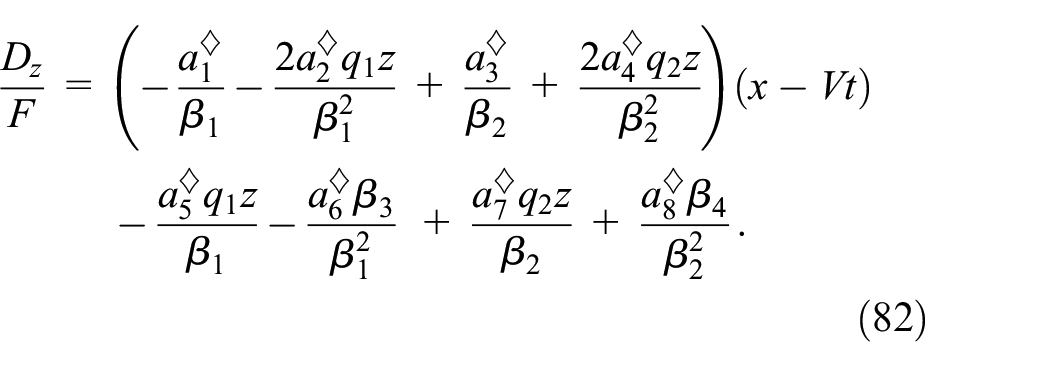
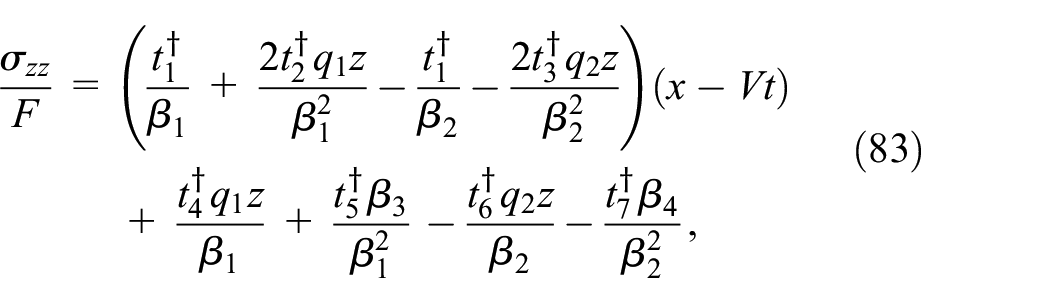
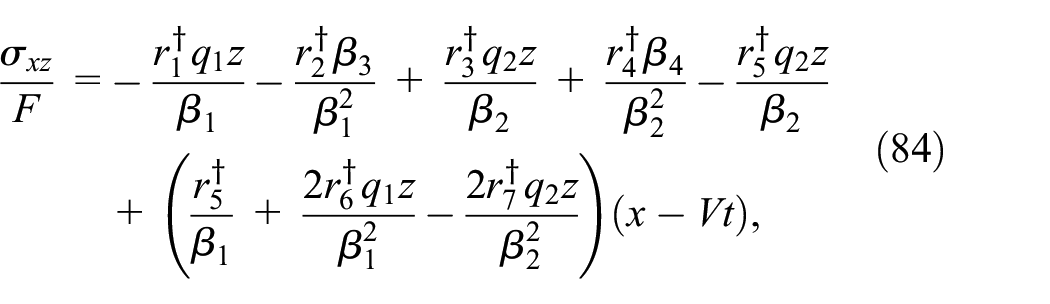
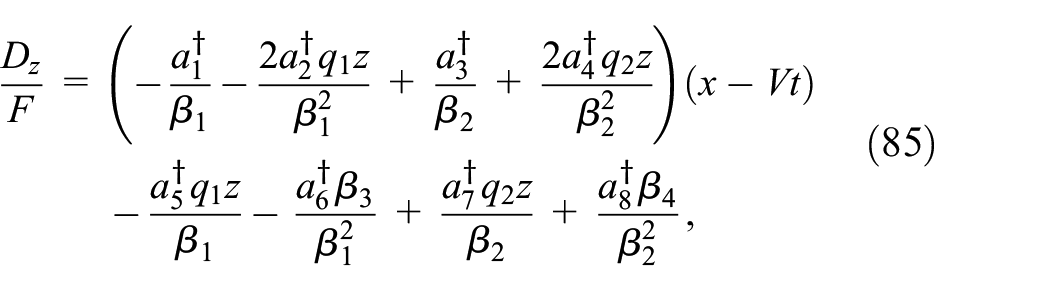
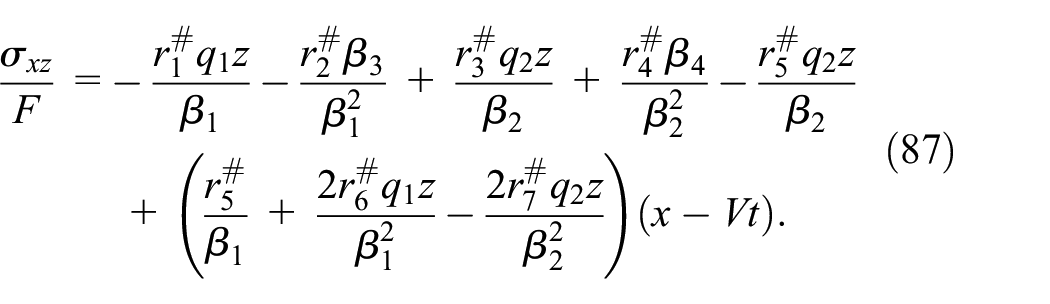
Performing integration for the above expressions and in view of equation (3) and with the help of equations (4) and (5), the following form for the normal stress, shear stress and dielectric displacement is obtained:
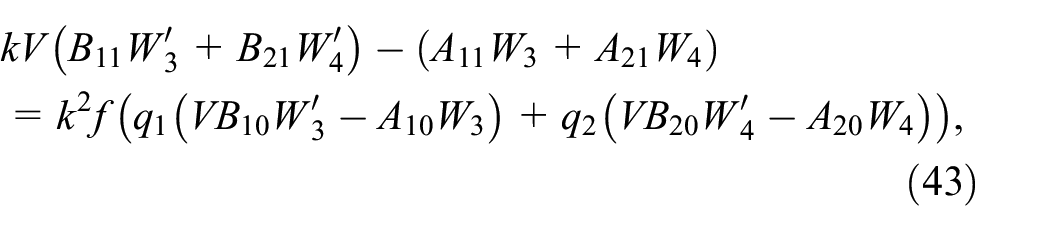
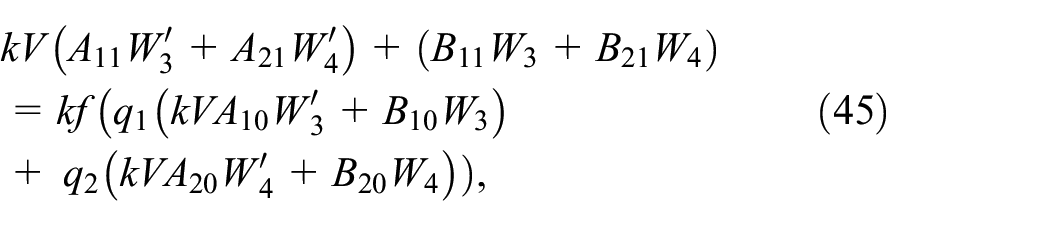
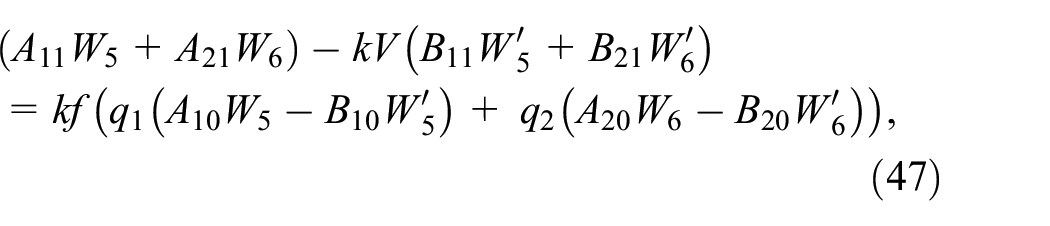
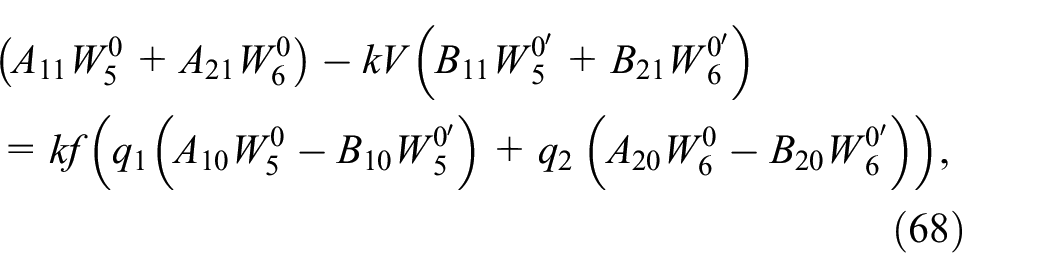
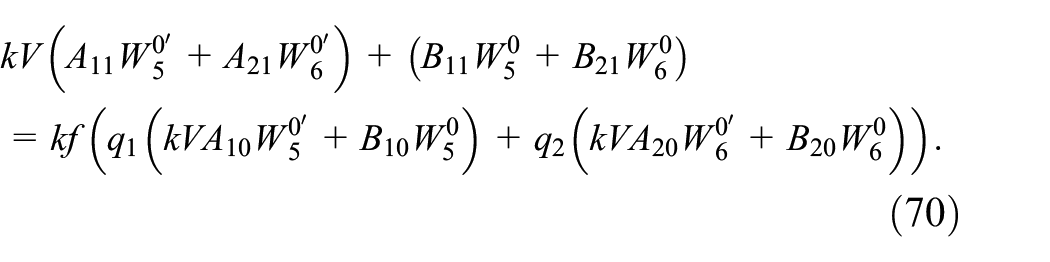
Using the equations (33)–(37), and boundary conditions (12), (13), (15) and (16) and equating the coefficients of and , the following system of equations are procured:
where . Substituting the values of (74) expressions for becomes
Performing integration for the above expressions (72)–(75) and in view of that equation (3) with the help of (4) and (5), we obtain the following form for the normal stress, shear stress and dielectric displacement
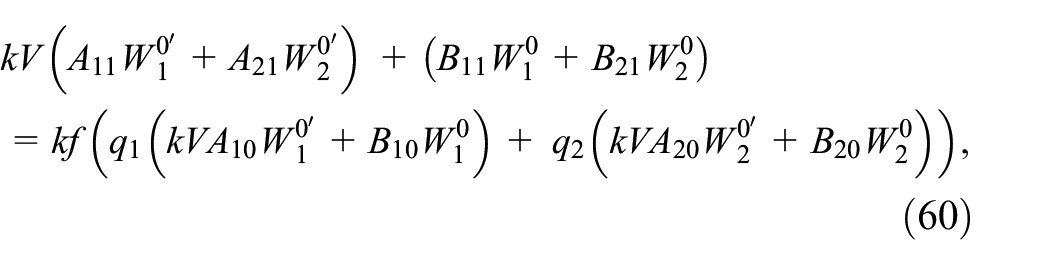
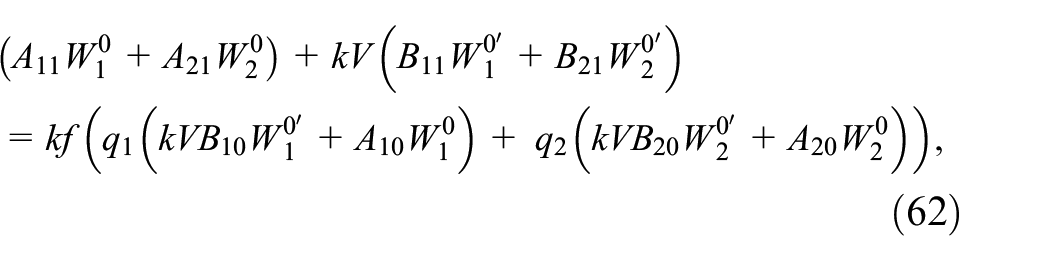
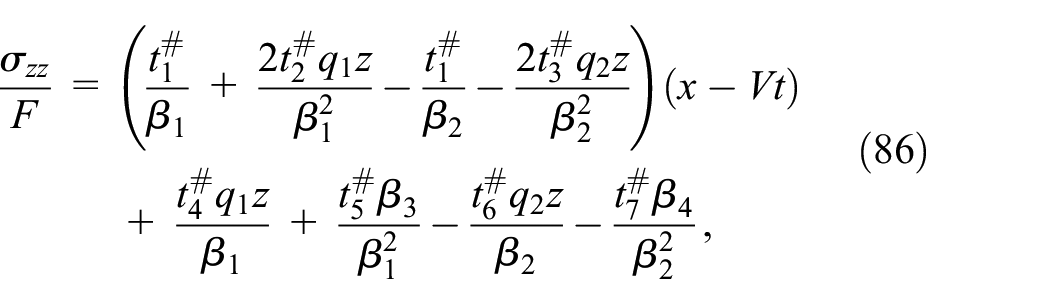
For the electrically short conditions the expressions for stresses and electrical displacement are
which is the expression for stresses produced by a line load moving on the boundary of transversely isotropic piezoelectric half-space under the state of irregularity.
Case-II: When and other constants zero, then porous-piezoelectric half-space reduces to irregular transversely isotropic half-space and the expressions for normal and shear stress becomes
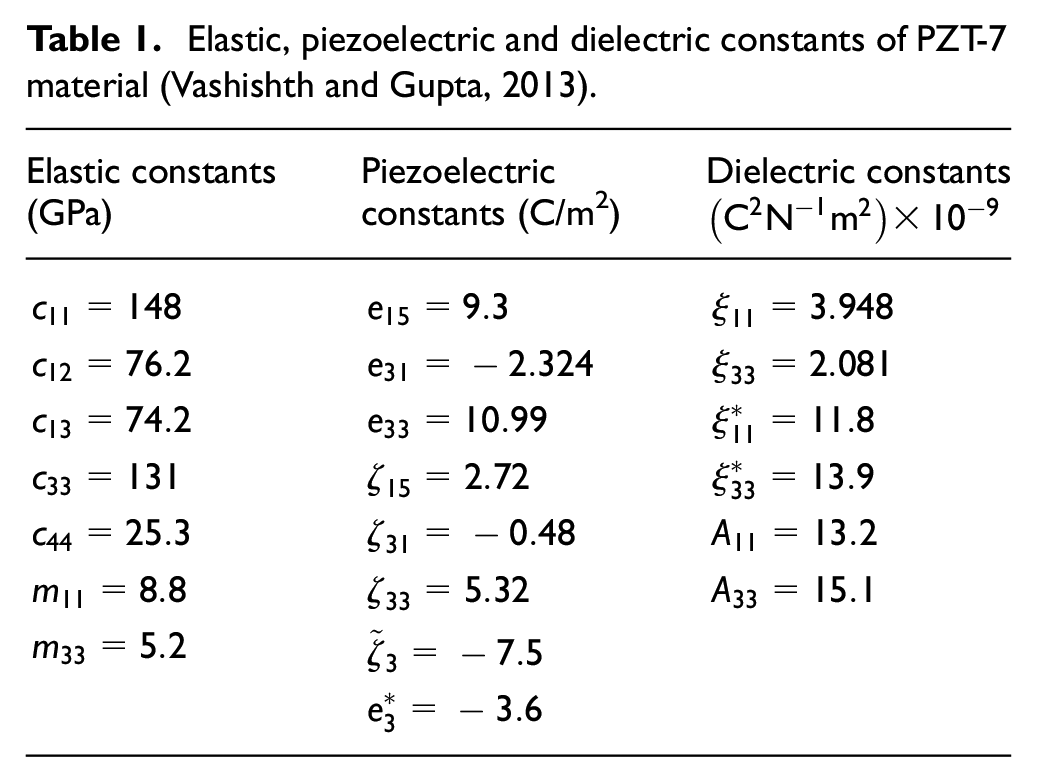
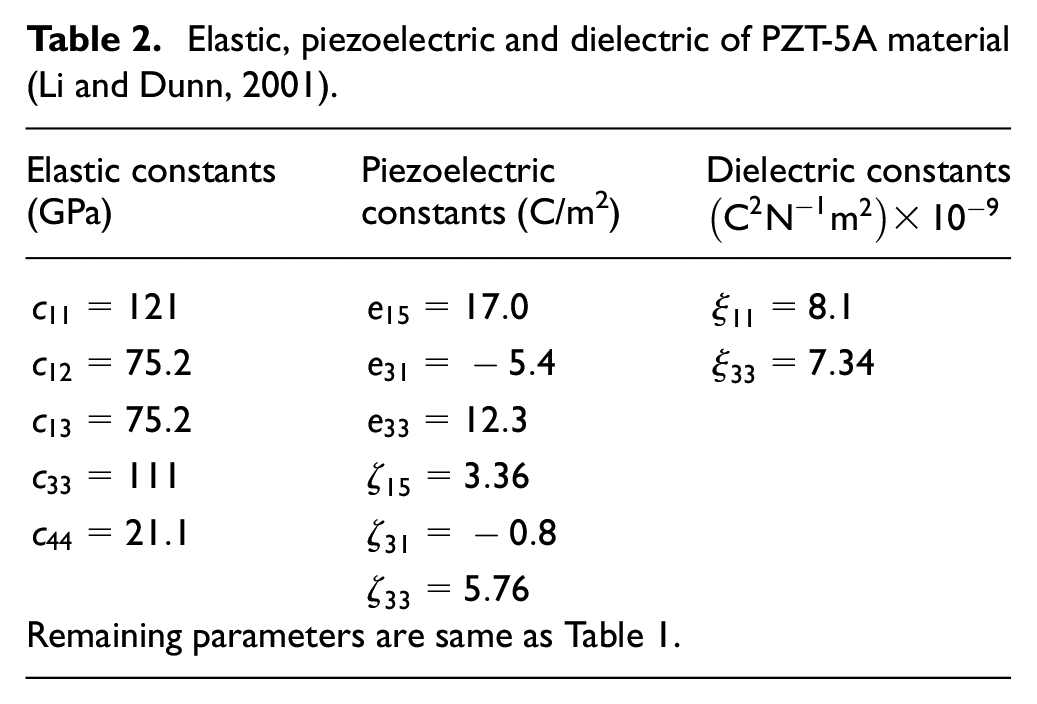
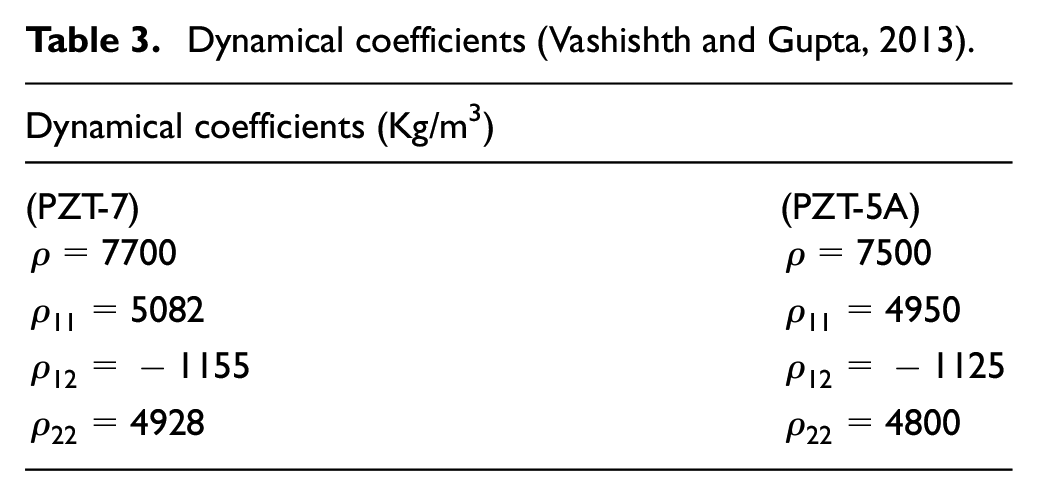
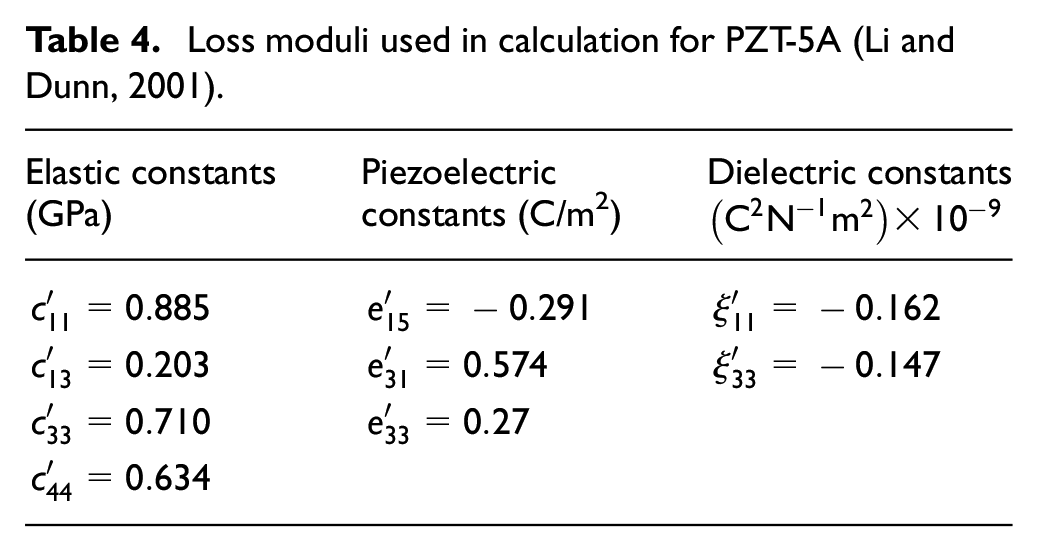
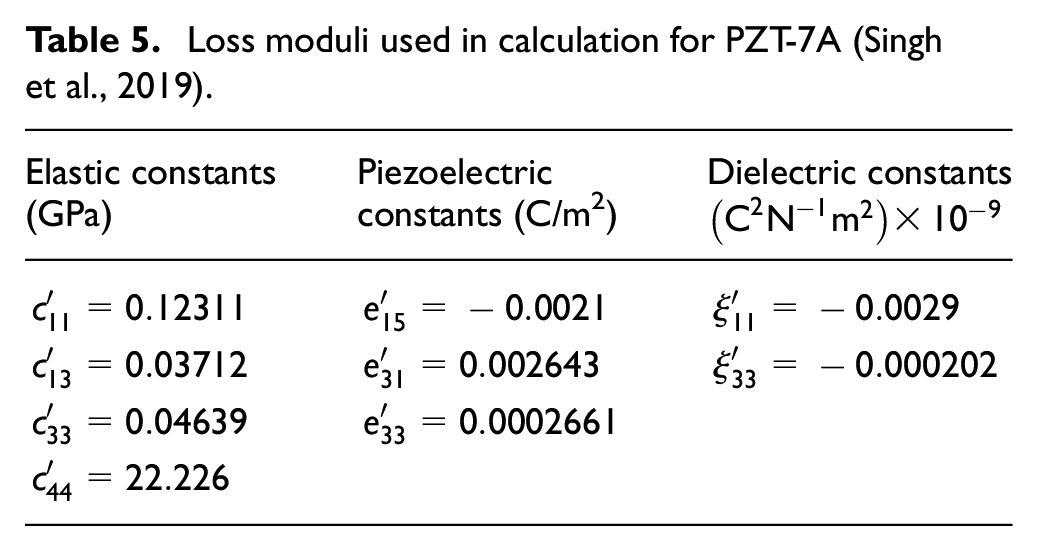
For numerical simulation to find the effect of irregularity parameters, irregularity depth and frictional coefficients on the magnitude of resultant normal stress, shear stress and dielectric displacement, PZT-7 and PZT-5A material has been considered by taking account of the parameters provided in Table 1–5:
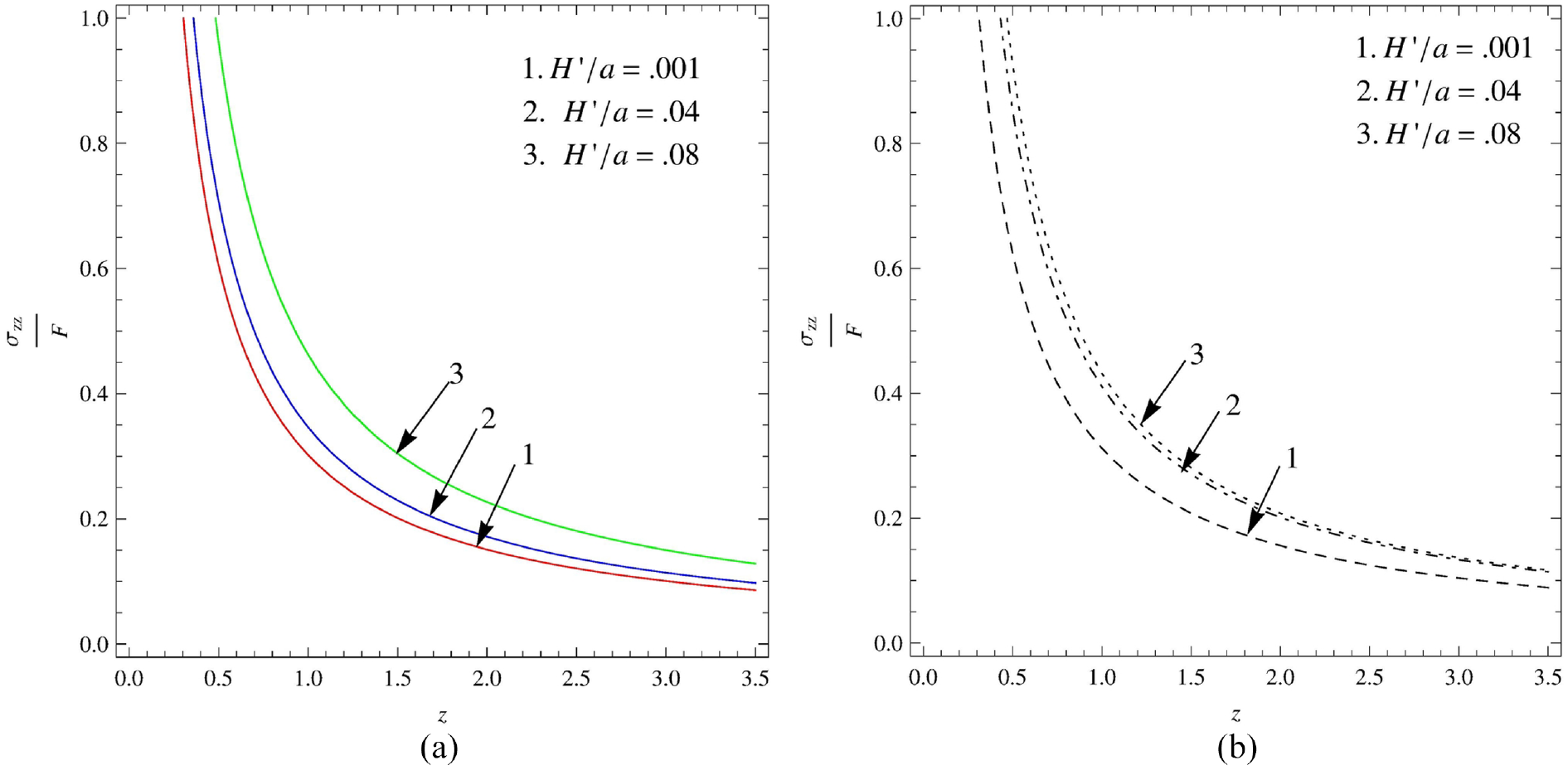
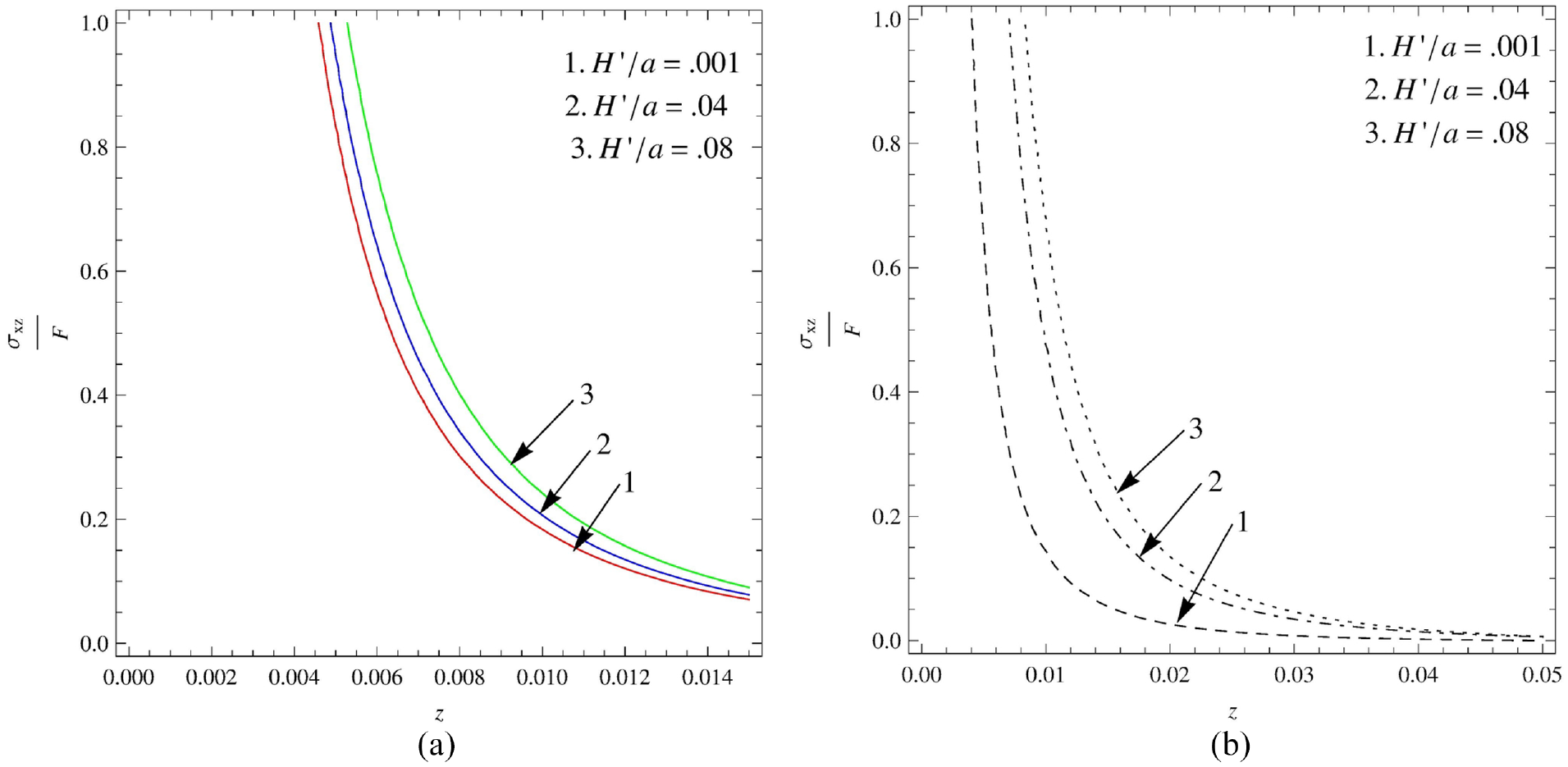
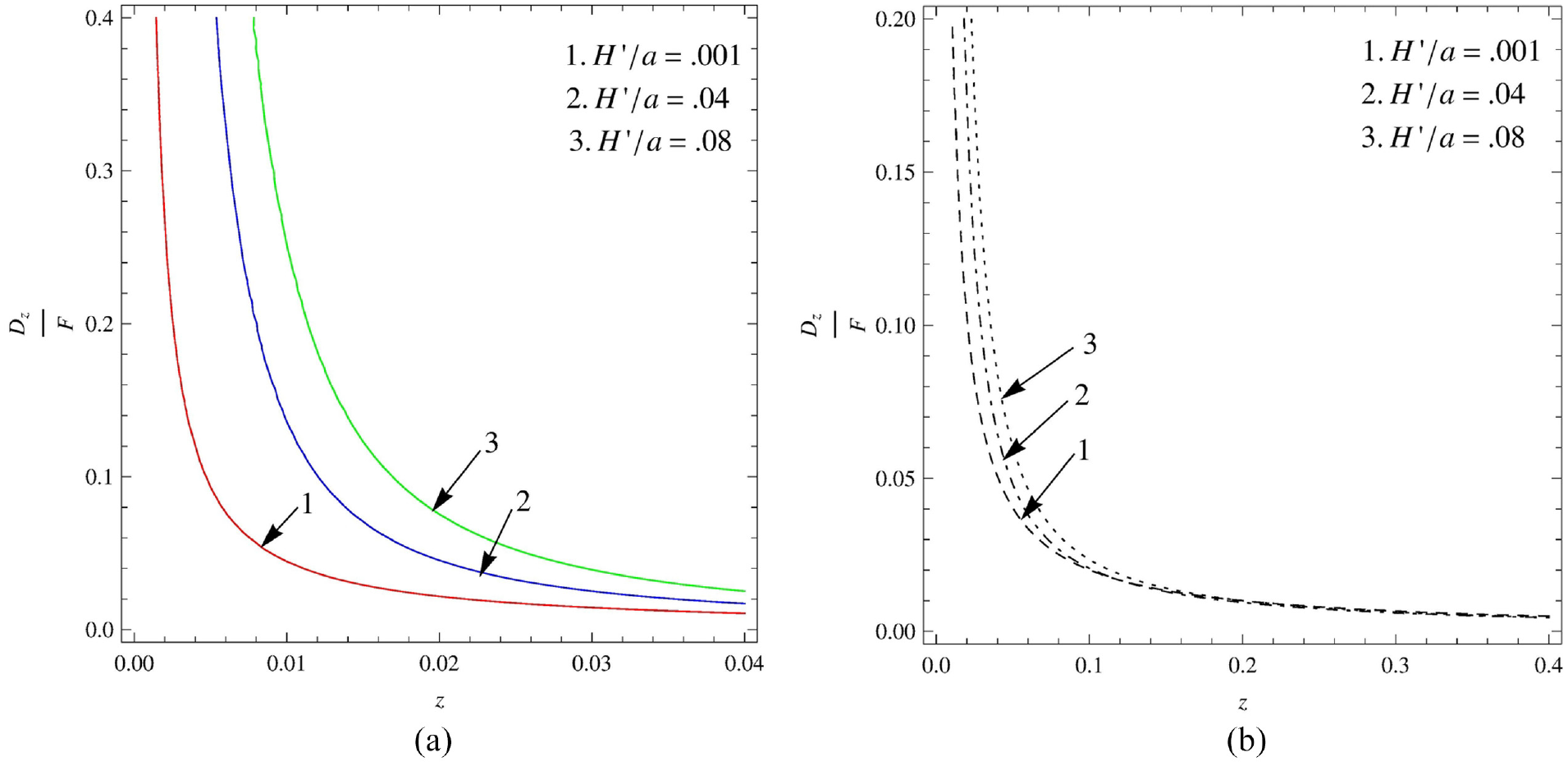
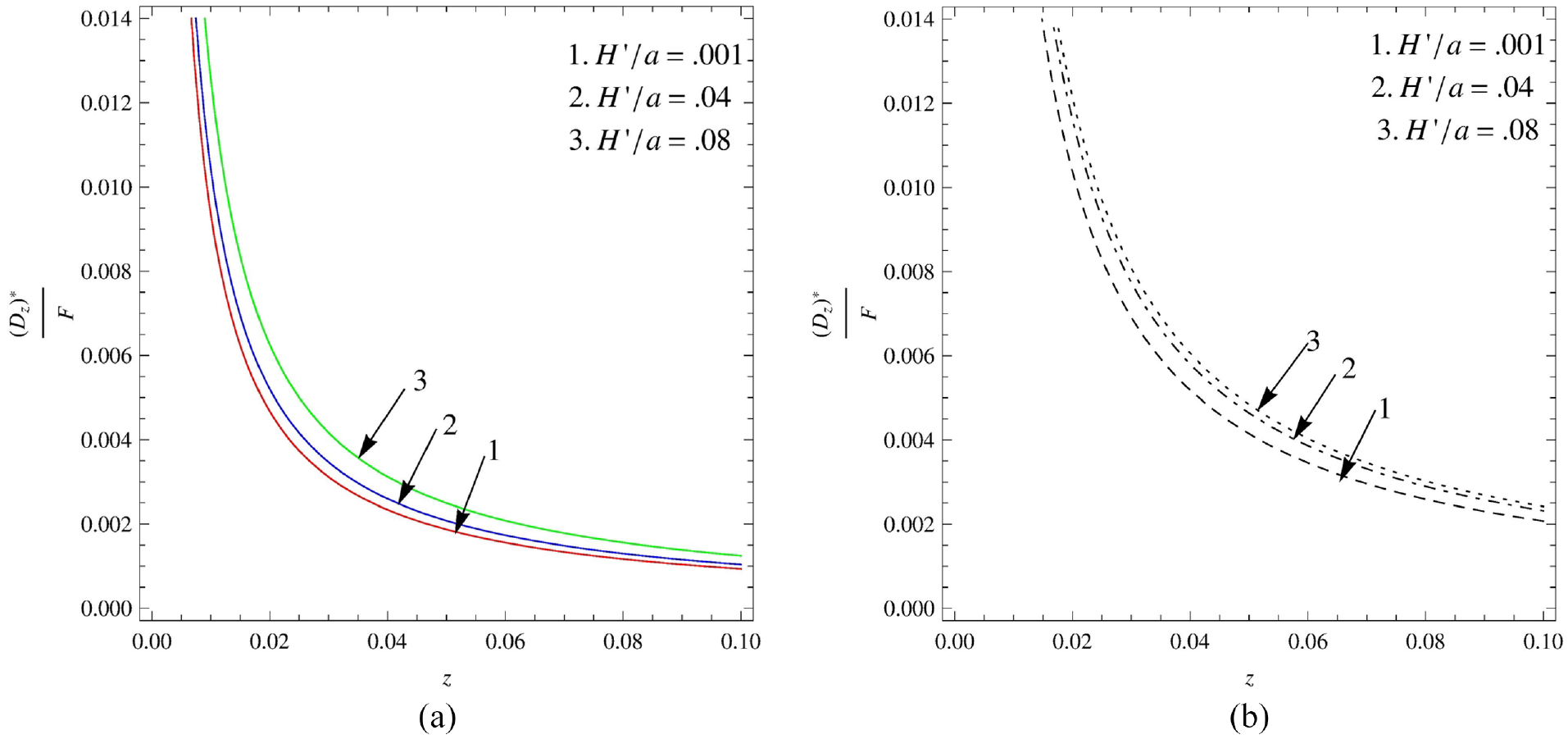
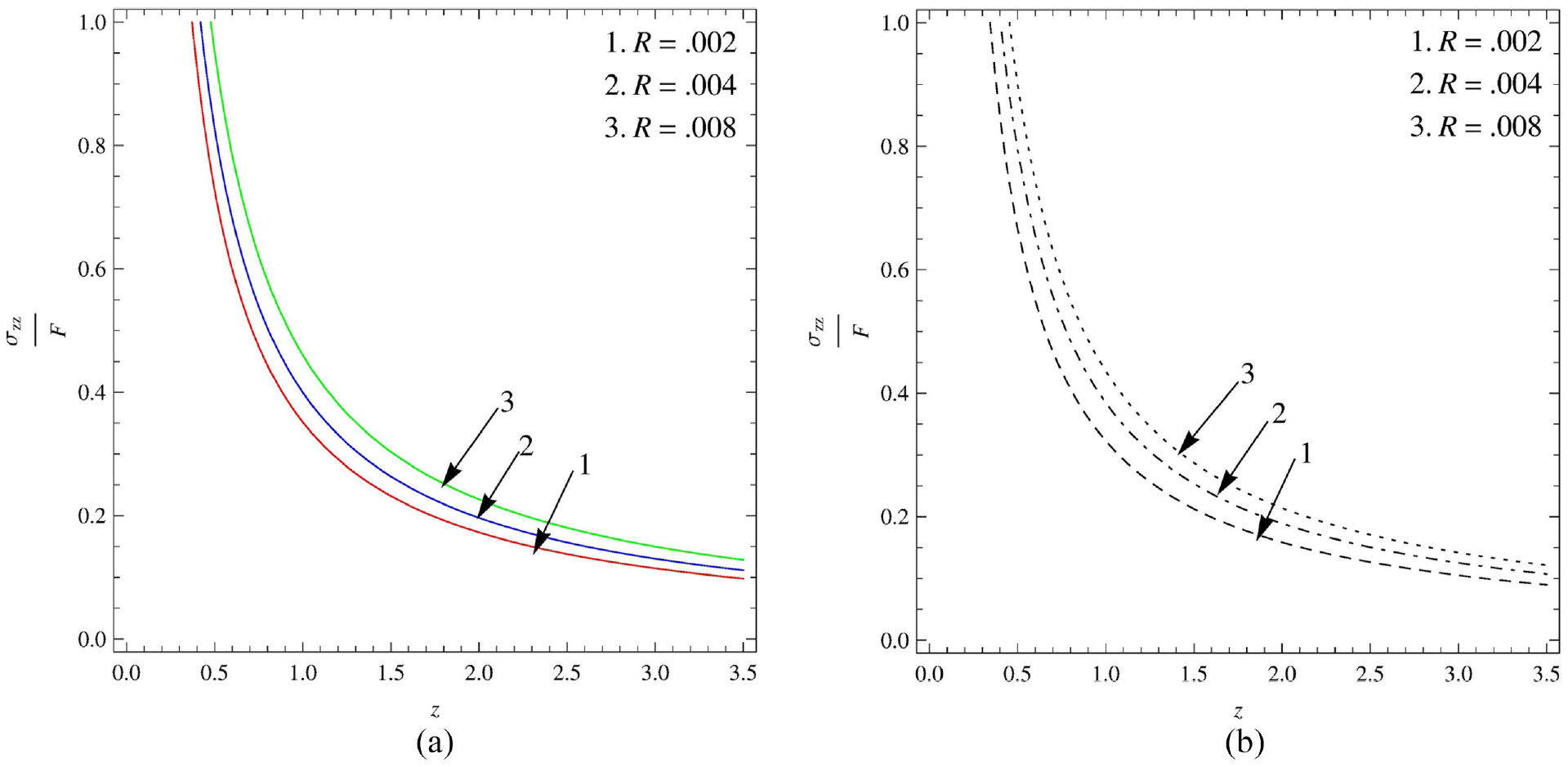
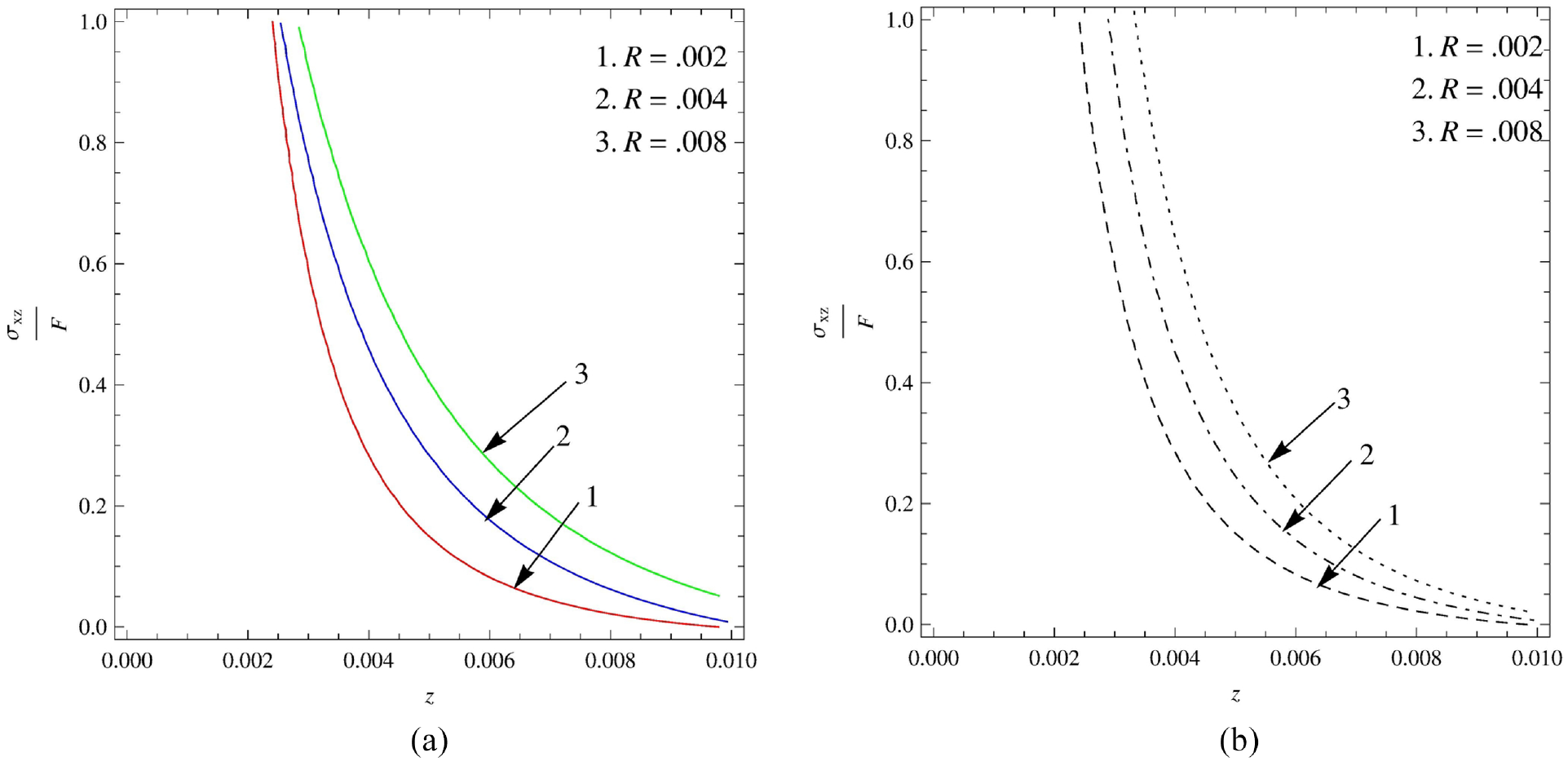
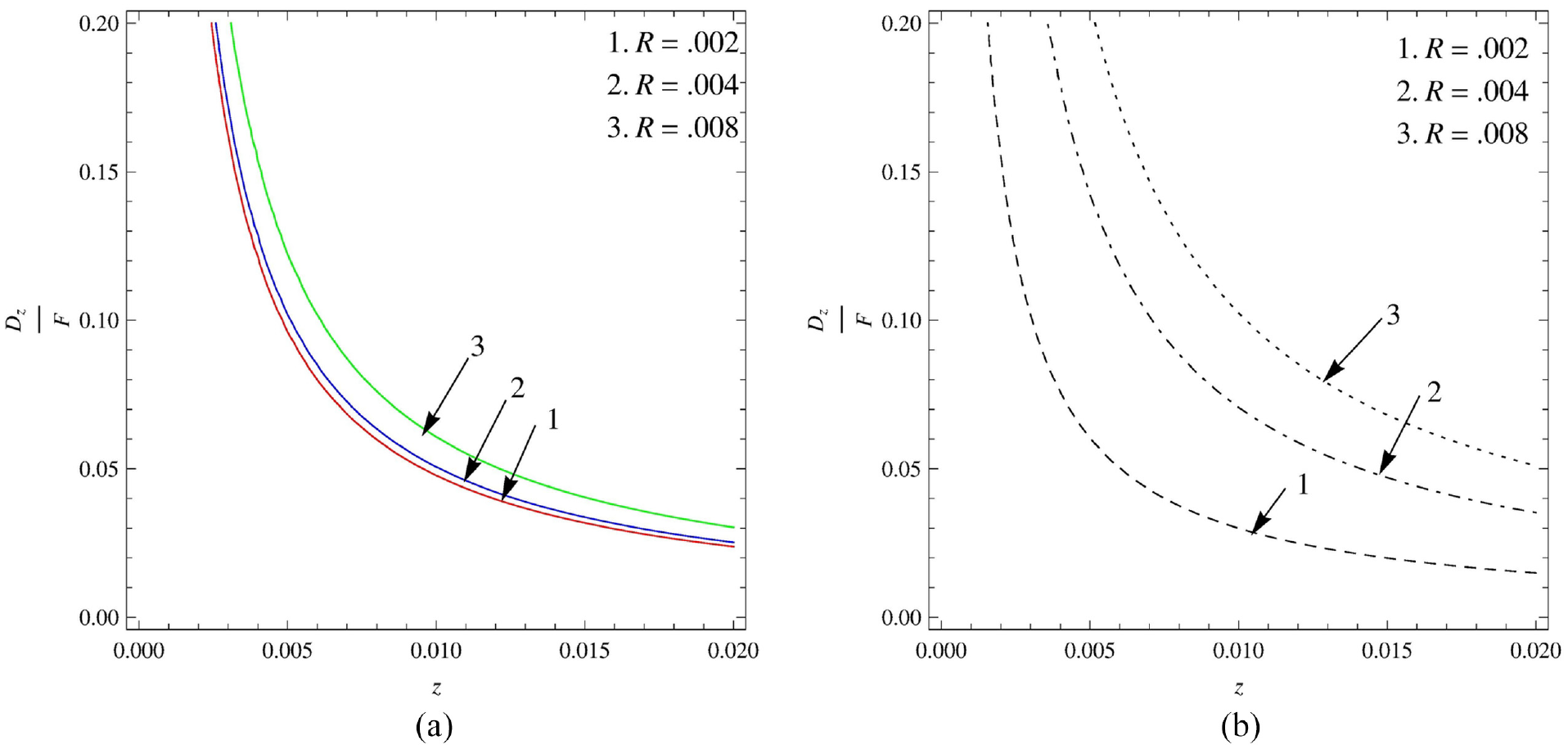
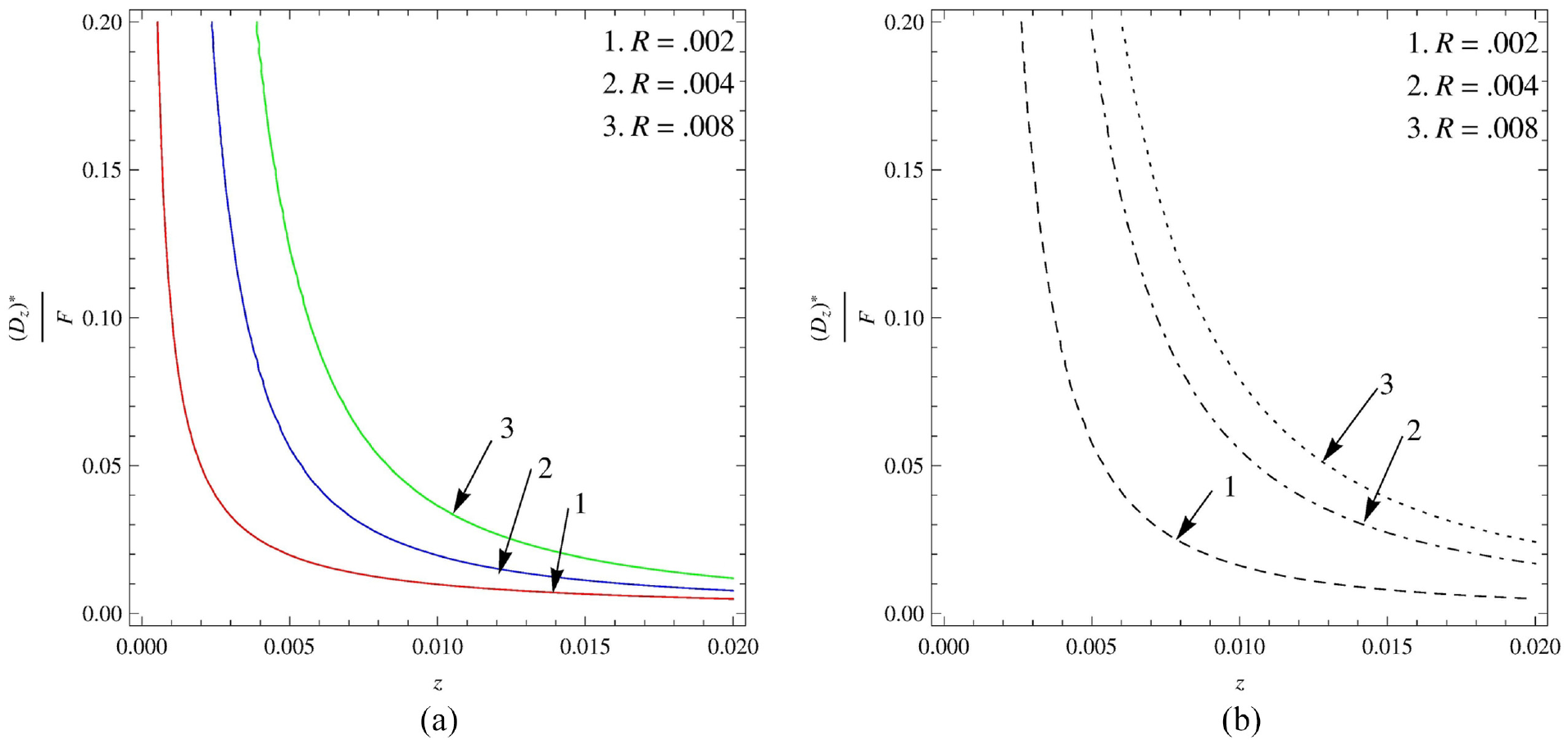
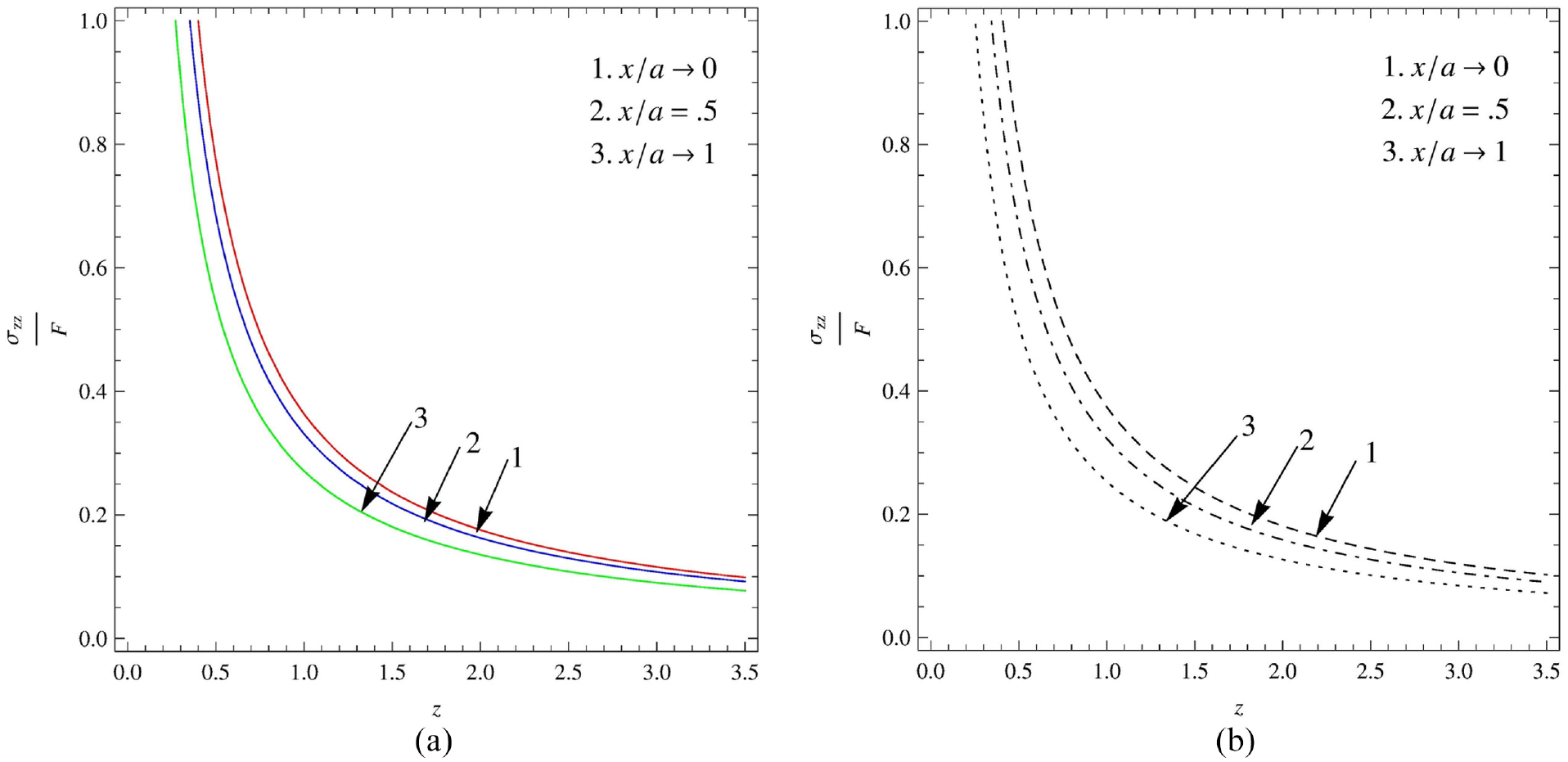
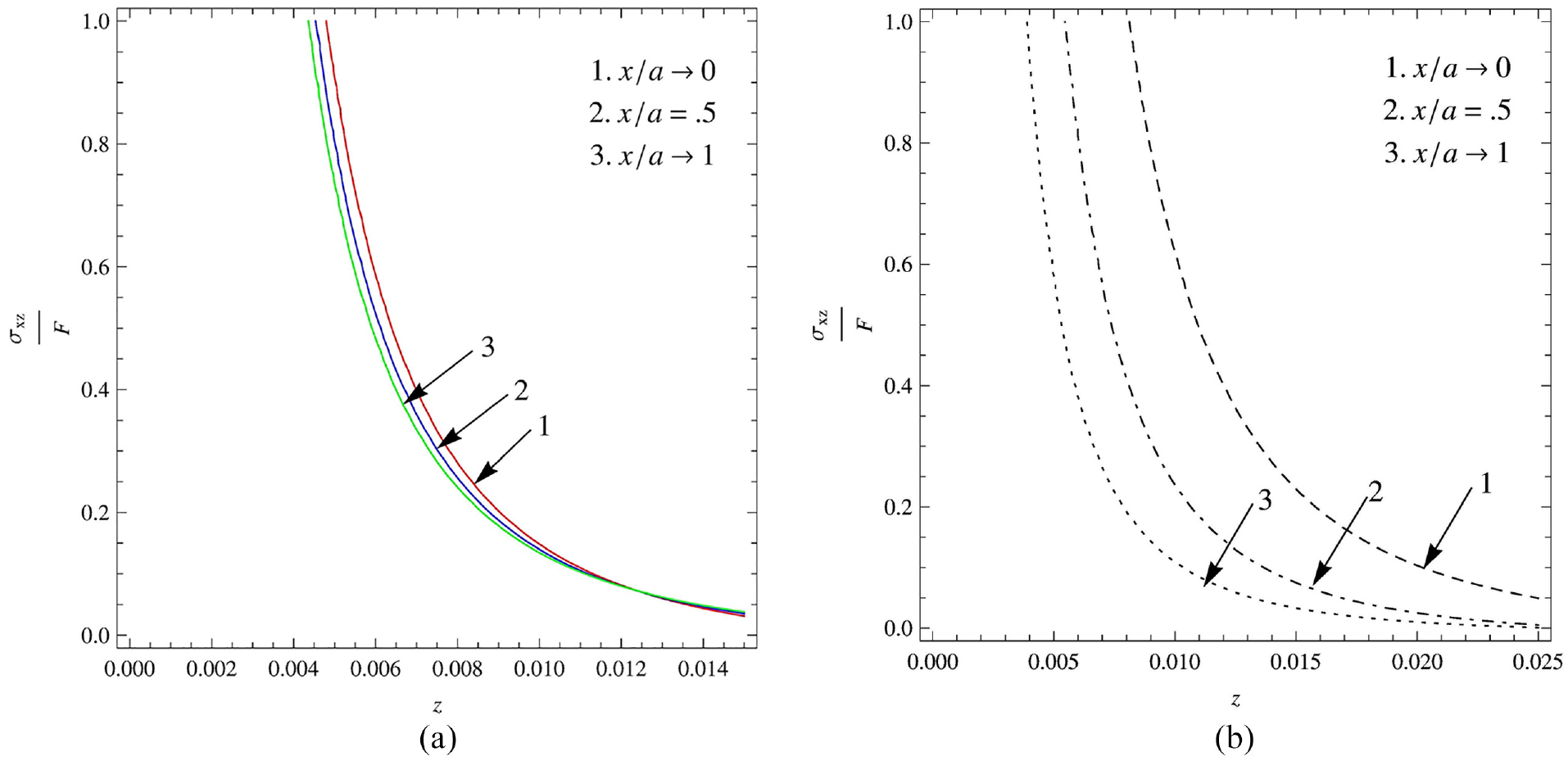
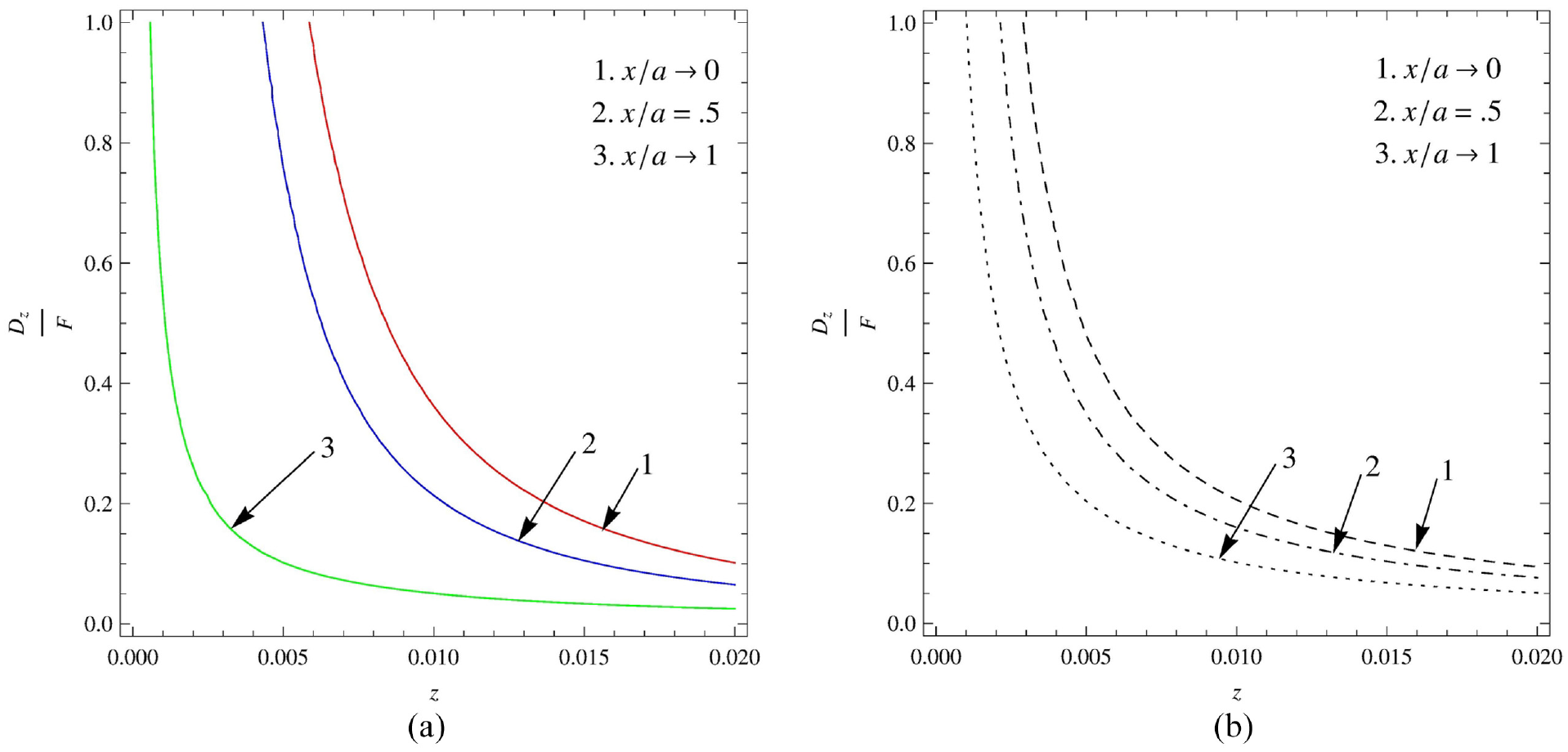
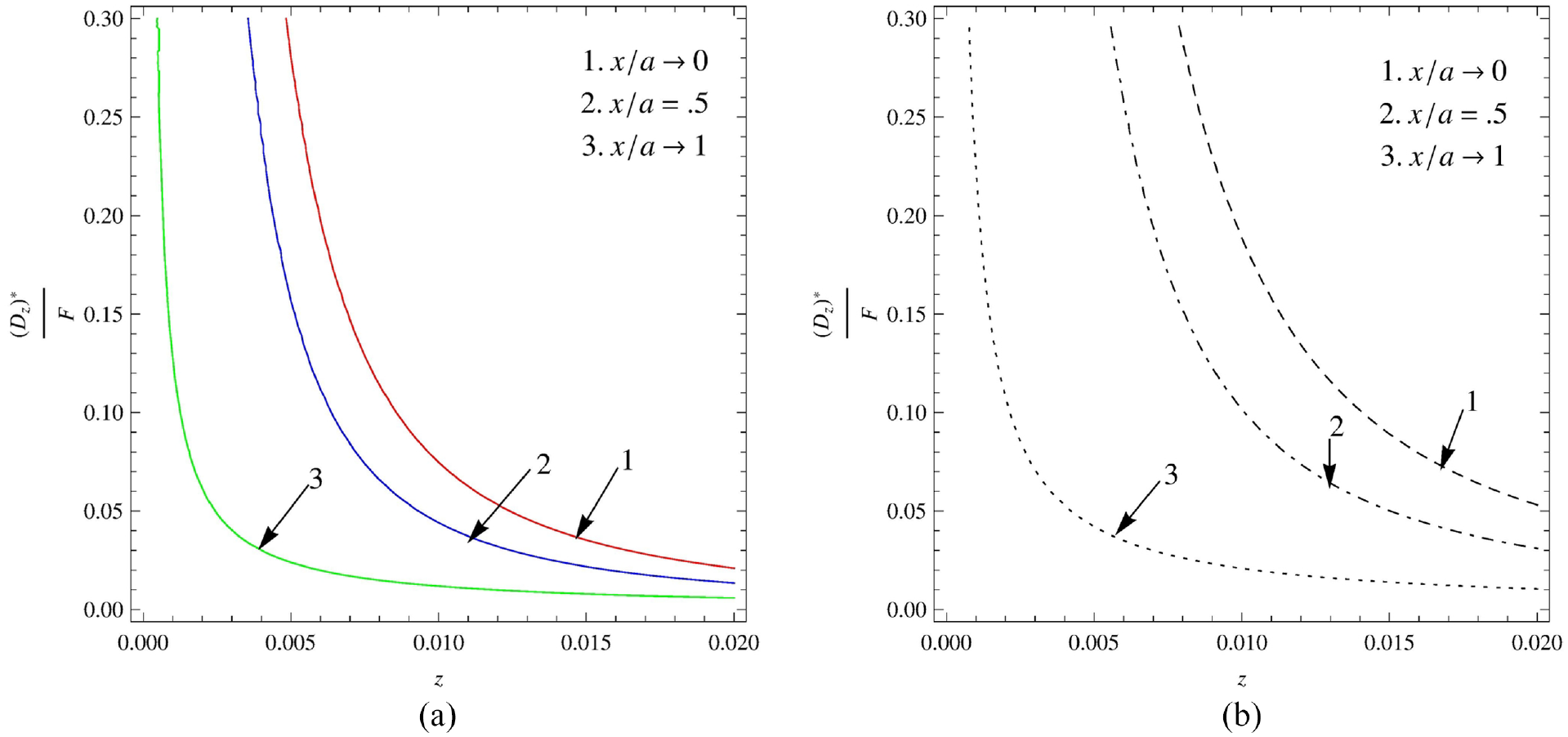
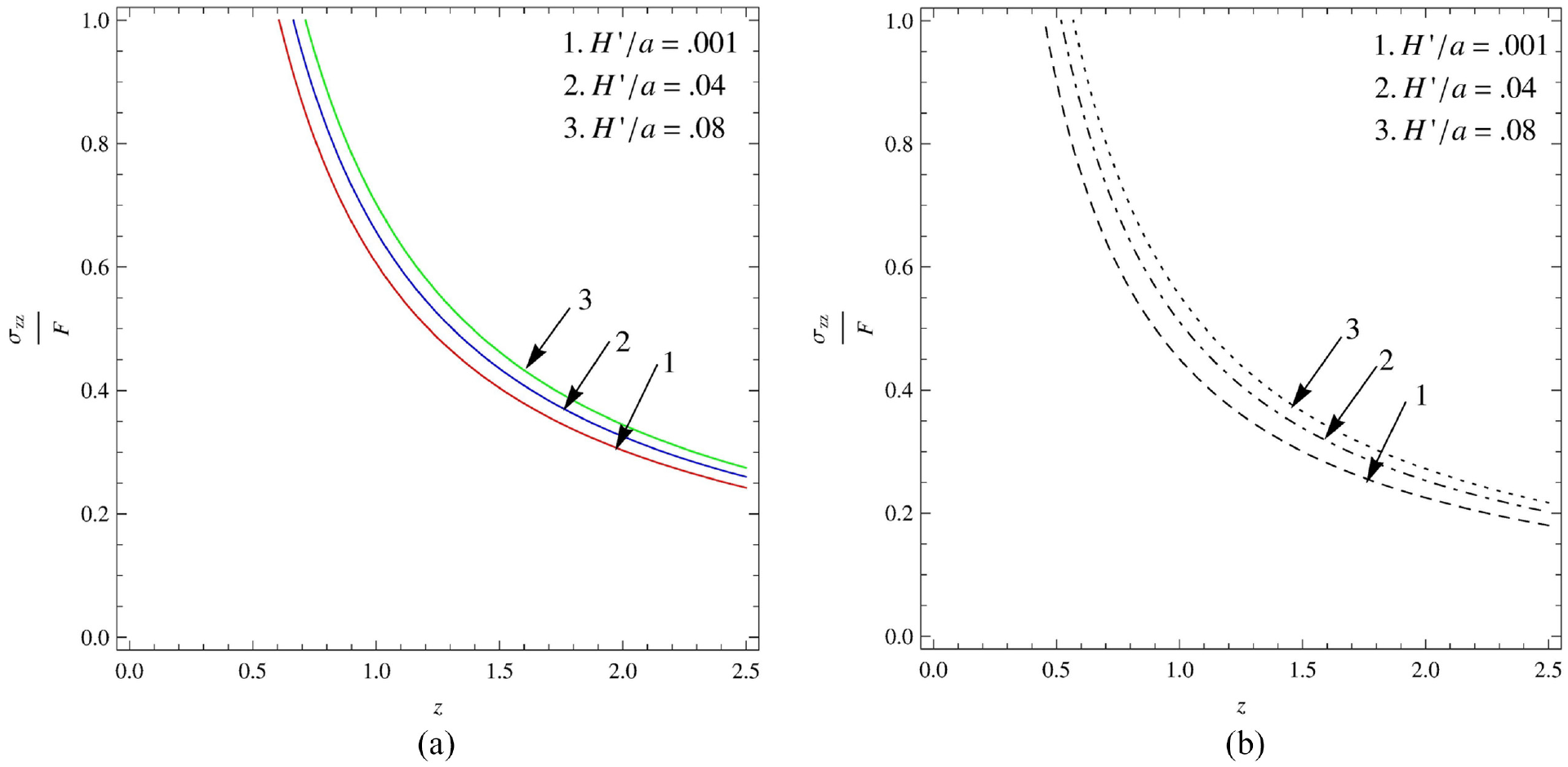
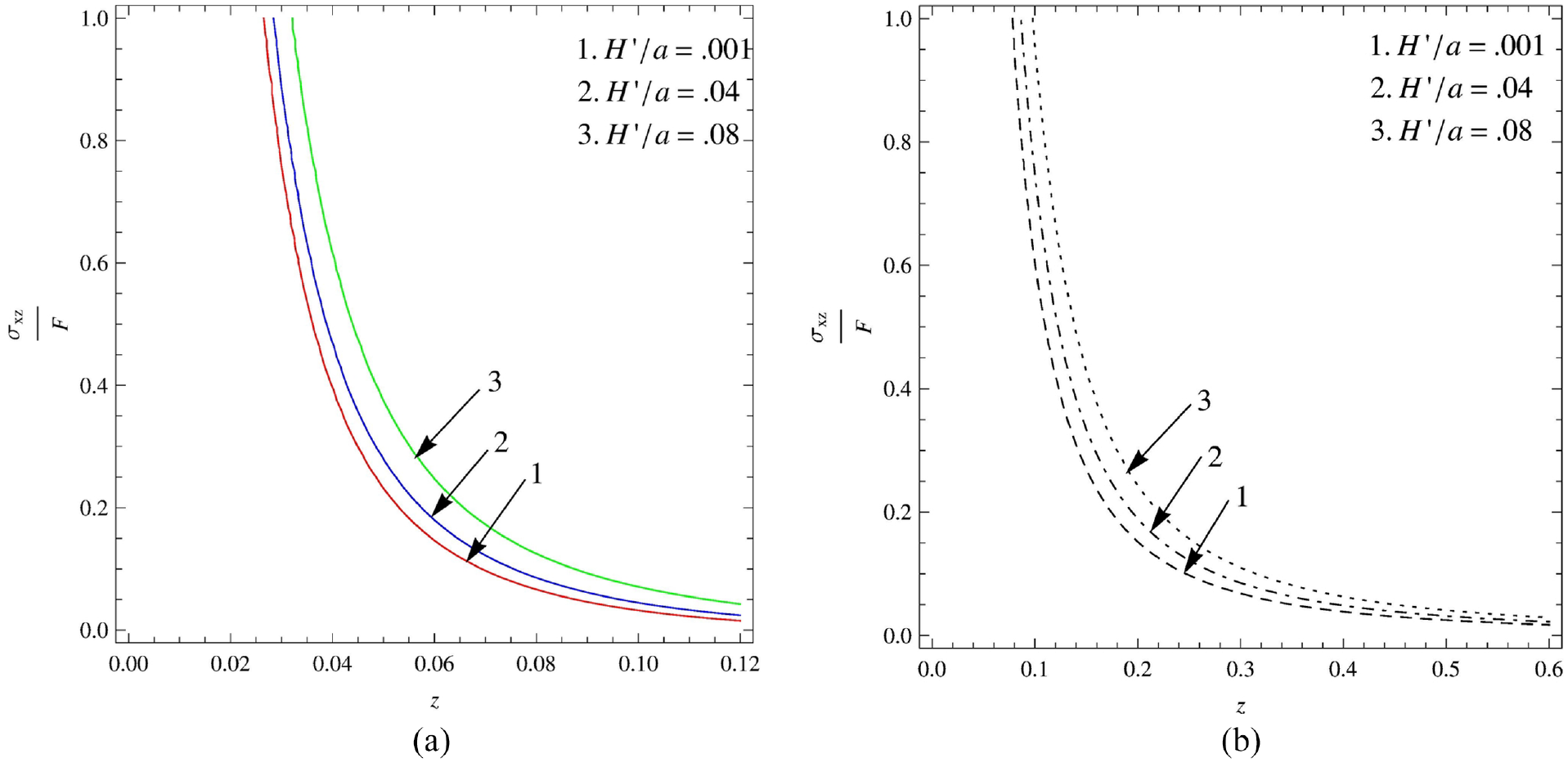
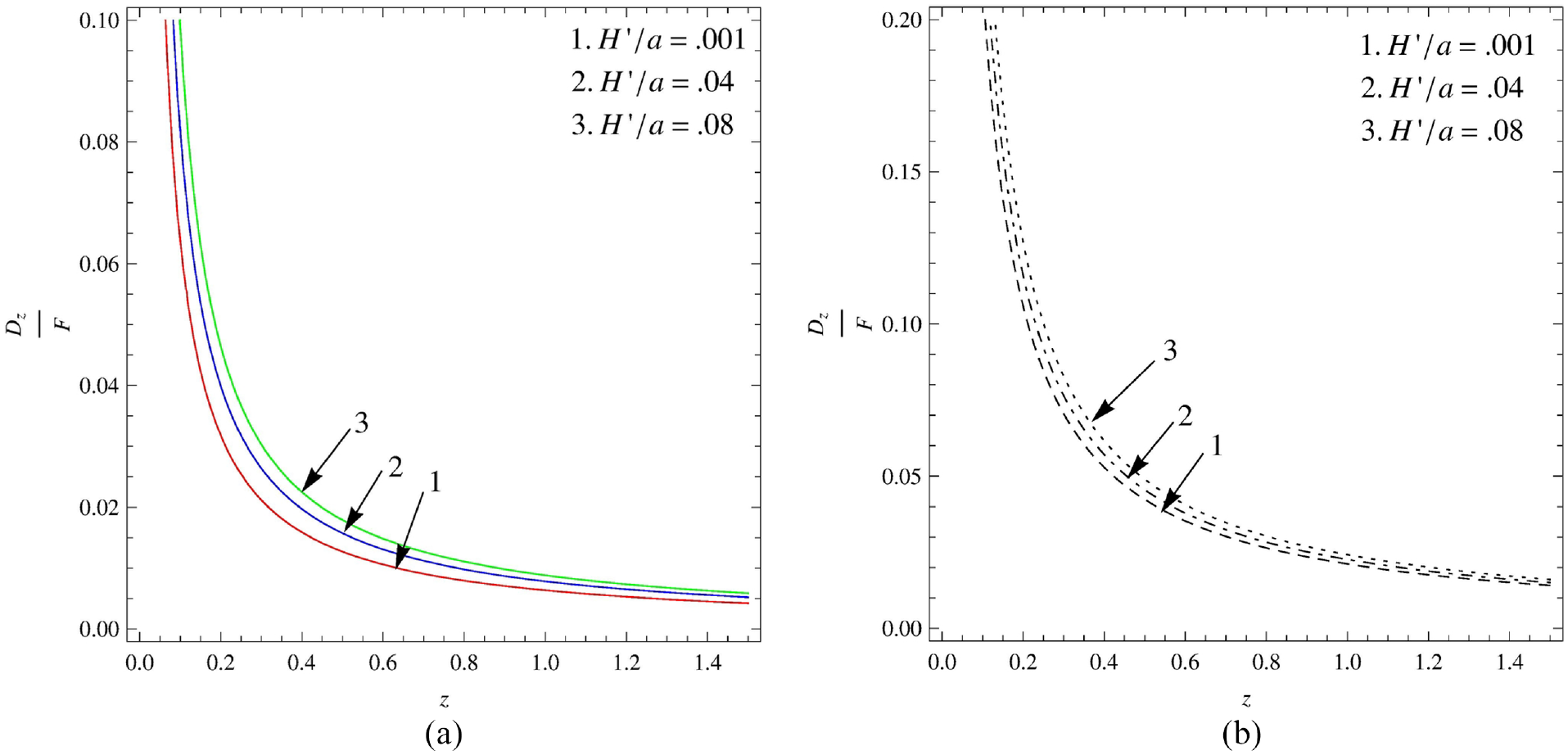
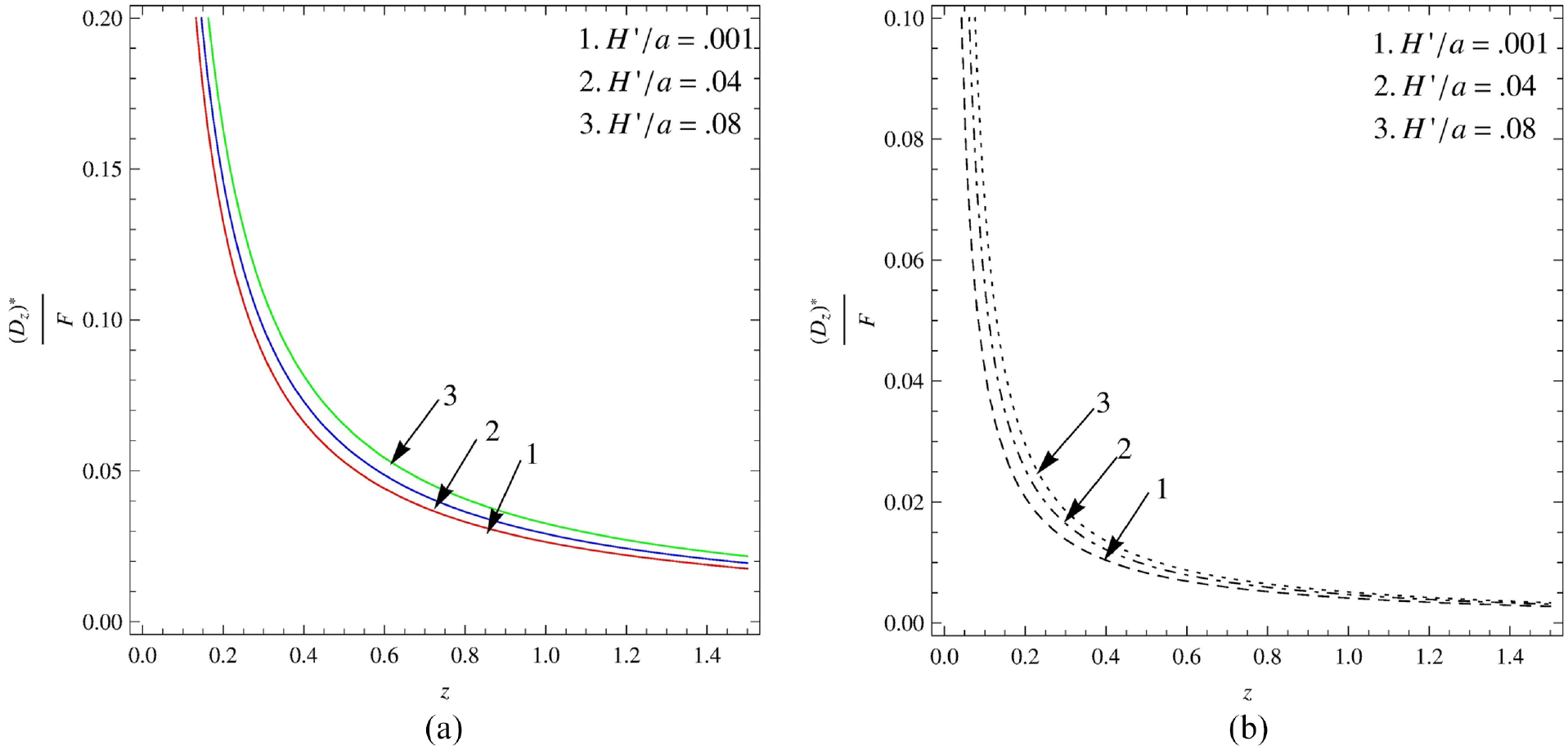
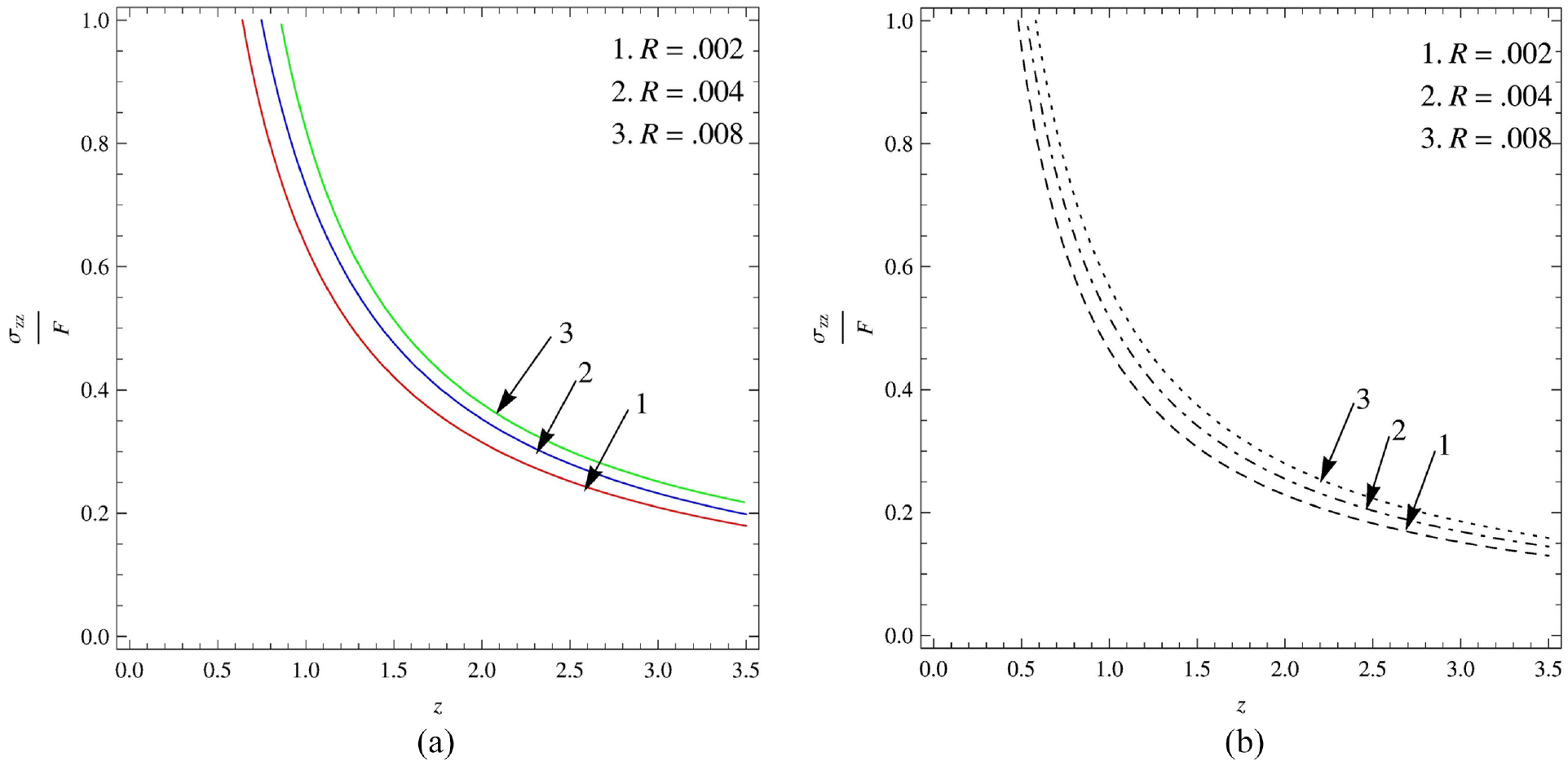
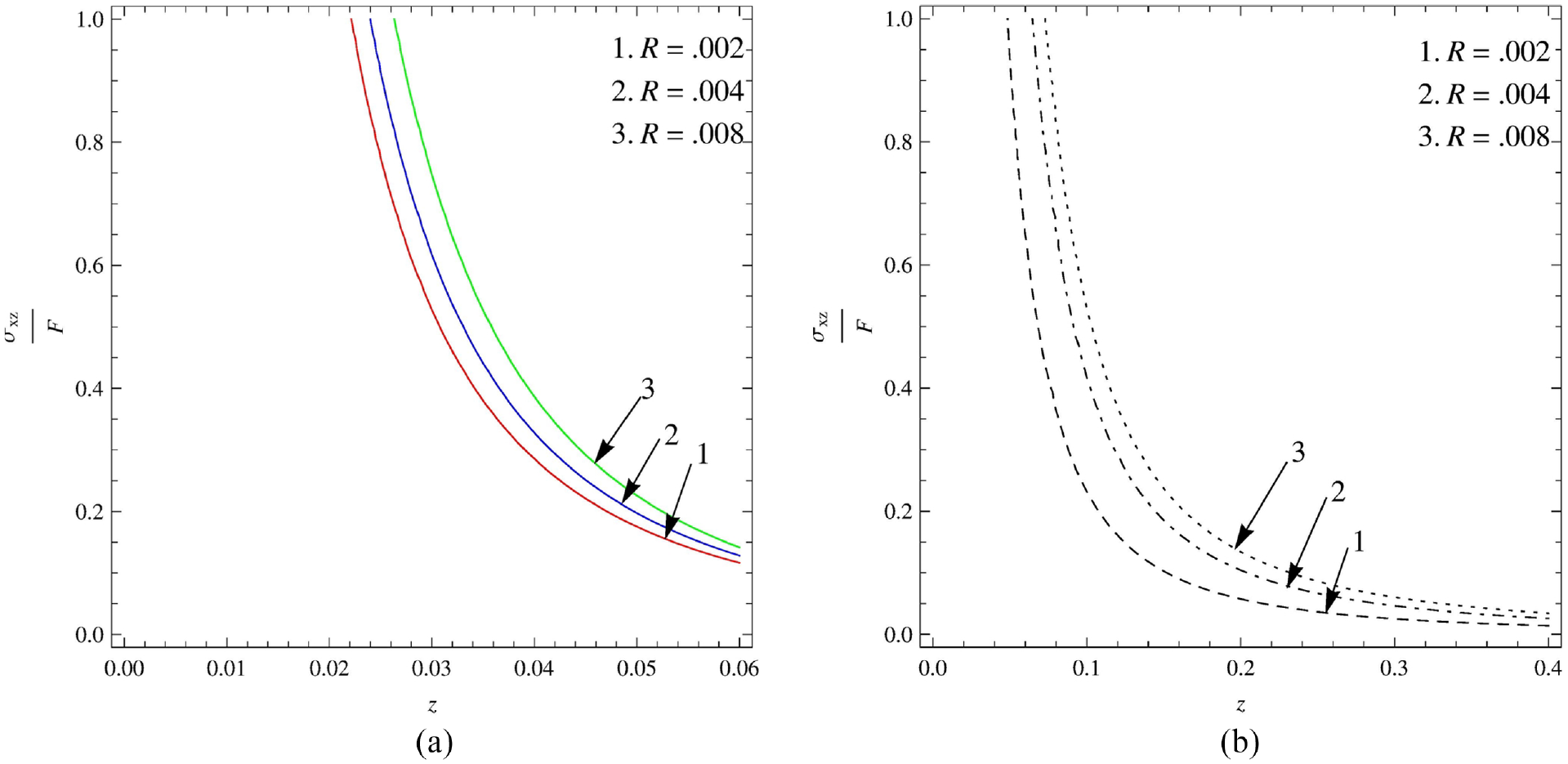
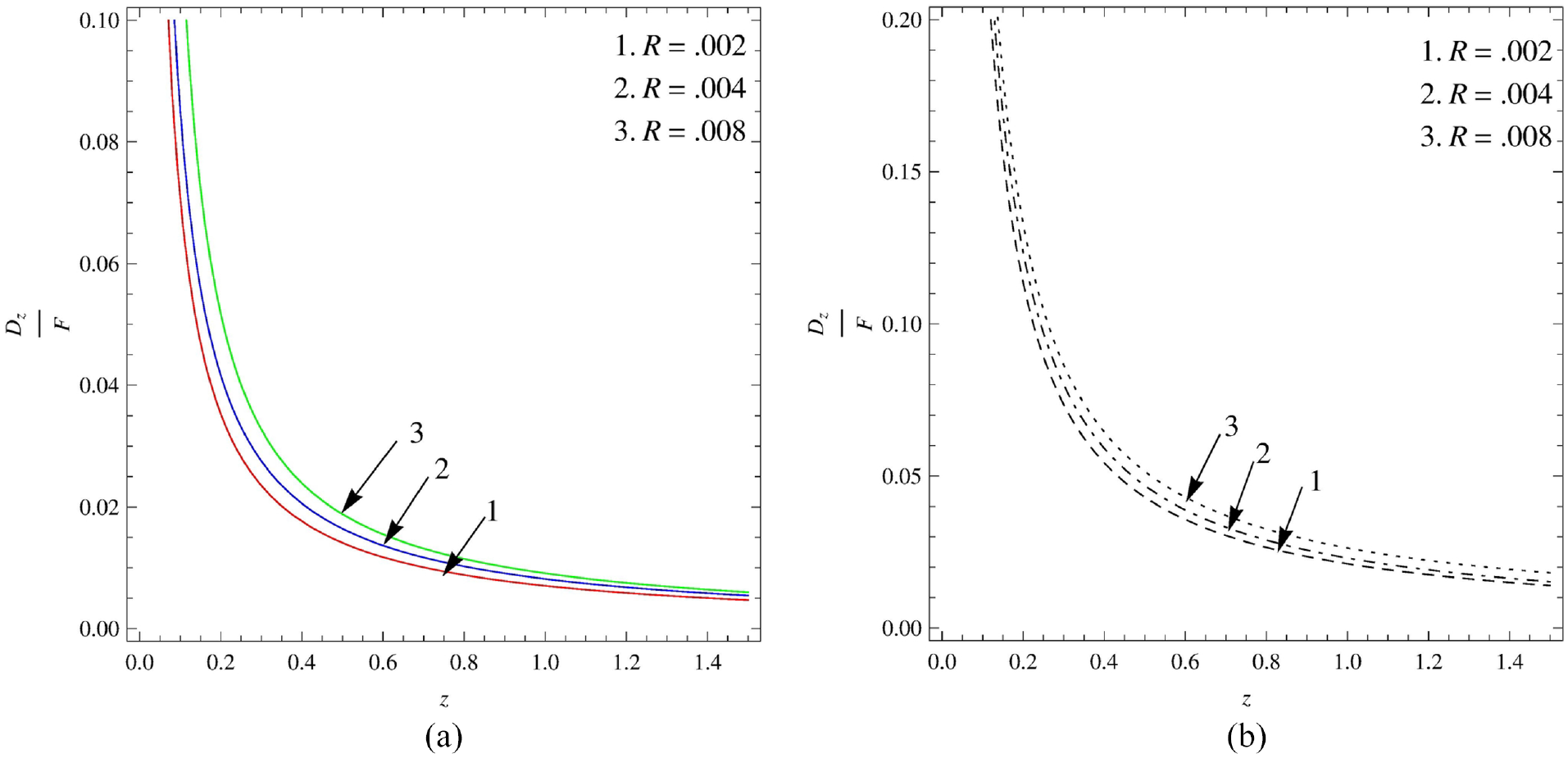
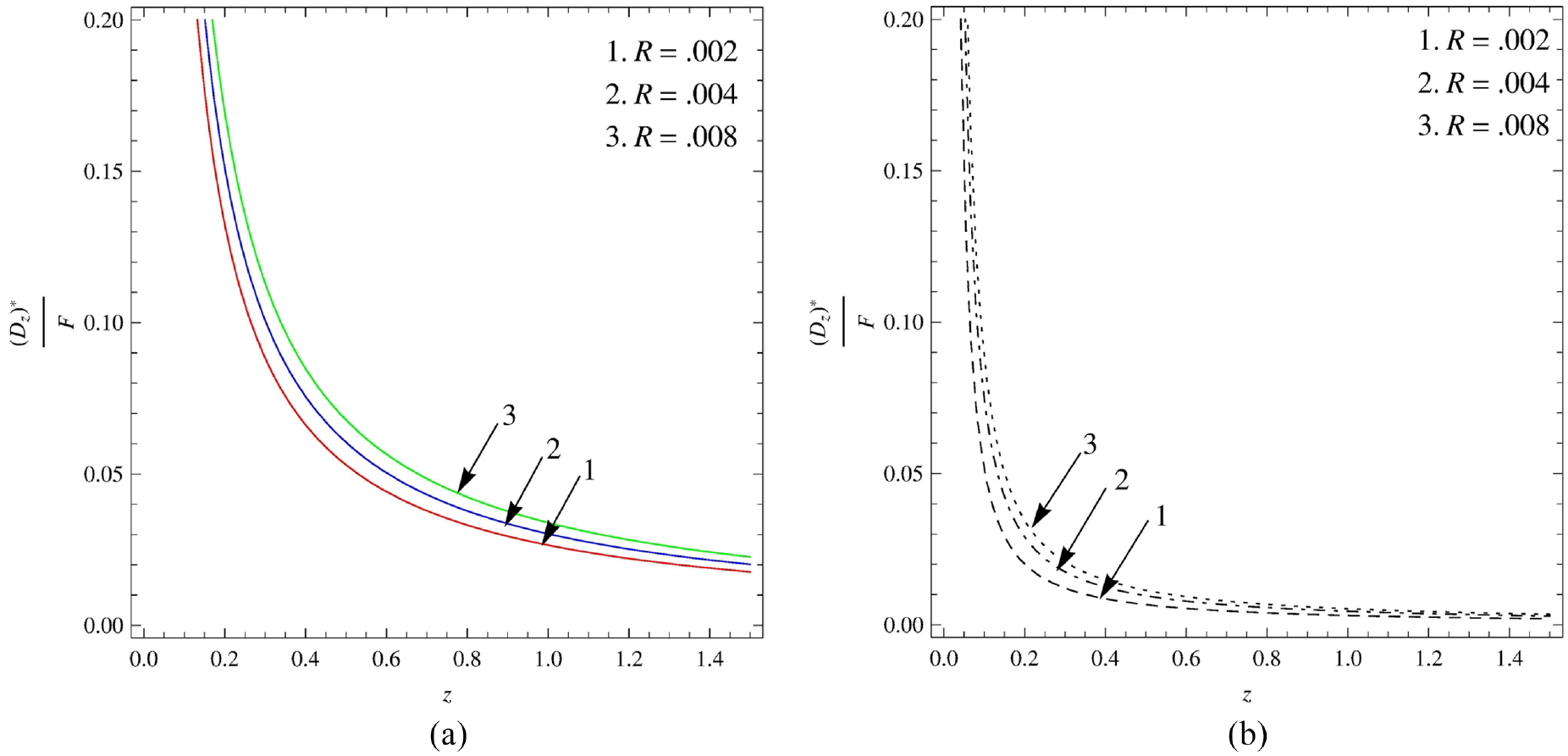
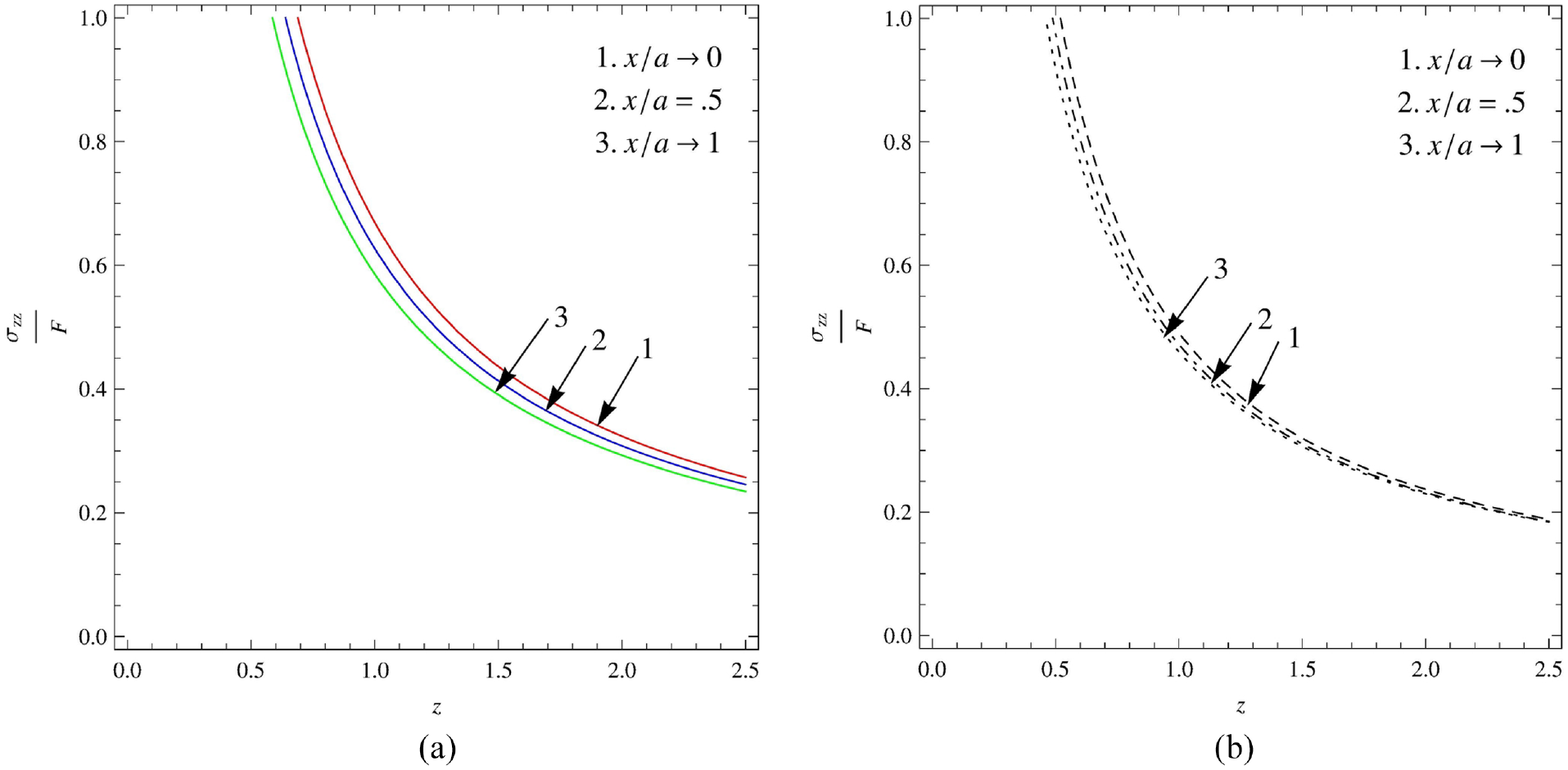
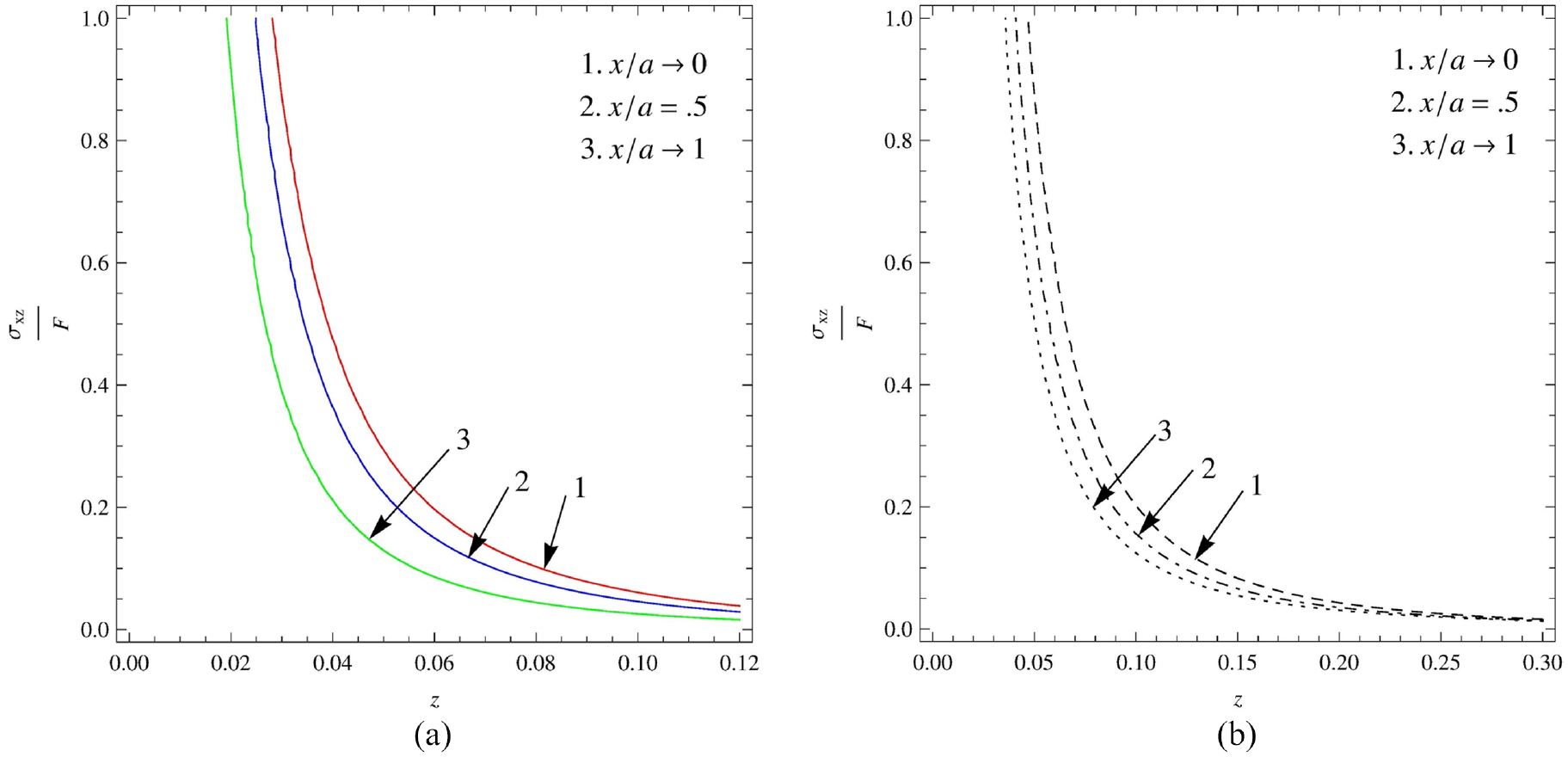
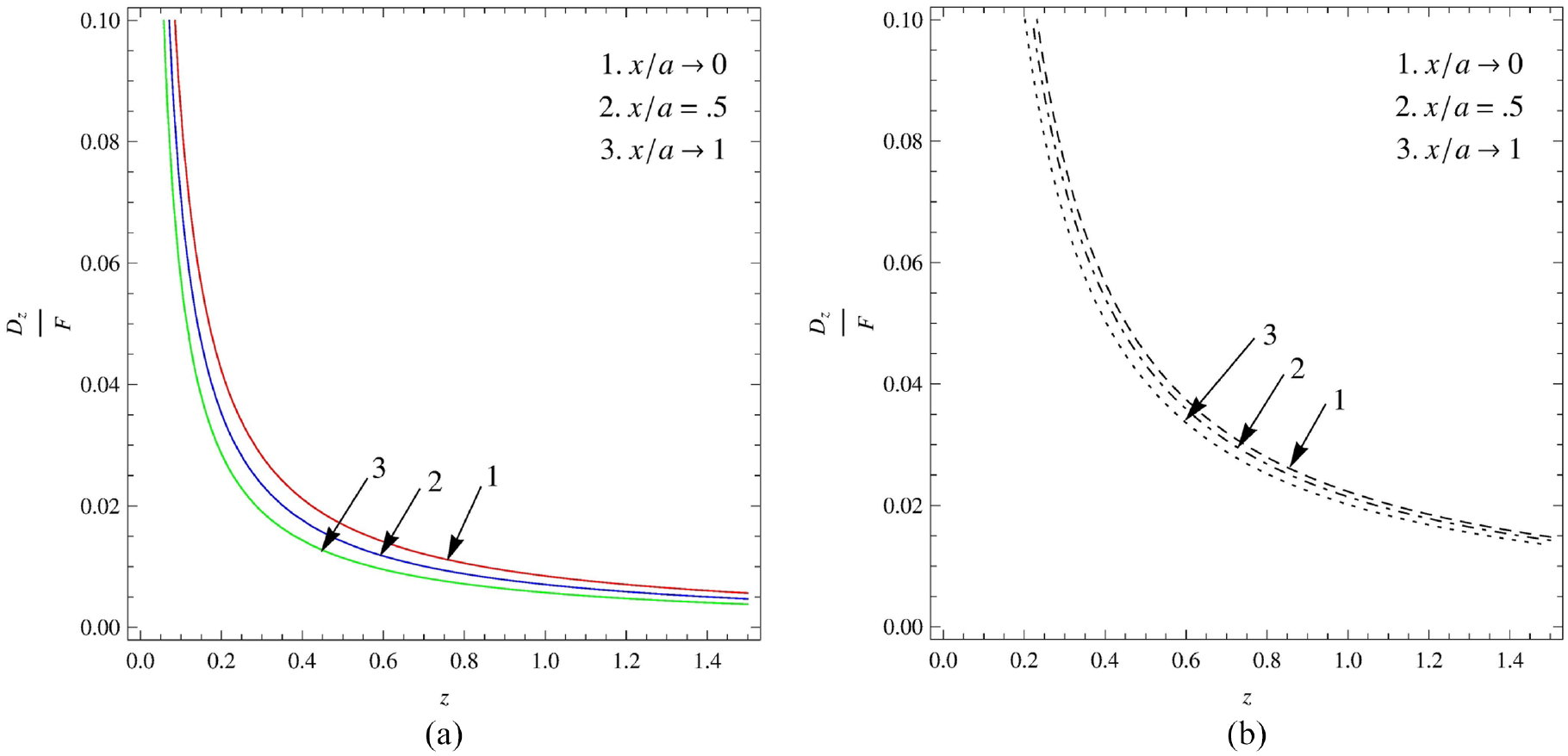
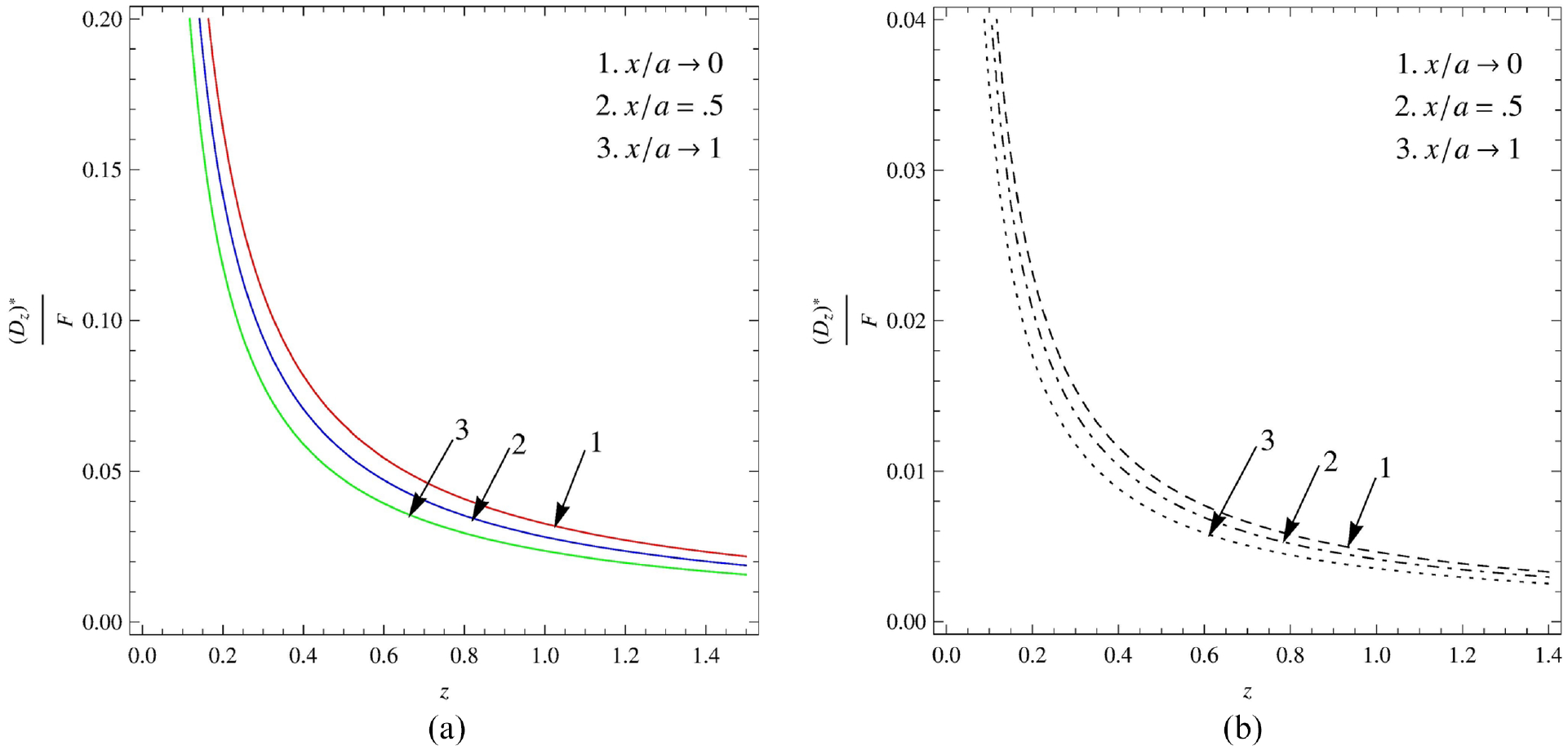
From the expressions acquired in equations (55)–(58) and (76)–(79) it can be distinguished that the stresses and electrical displacements accomplishes maximum value at for both electrical open and short conditions. Thus, in further numerical calculation unless otherwise stated. Numerical computations are executed to analyse the effect of irregularity factor, irregularity depth and frictional coefficient. The results have been graphically demonstrated for stresses (normal and shear) and electrical displacements against vertical depth through Figures 2 to 13 for electrically open case. The same analysis has been done for electrically short case as shown in Figures 14 to 25. A precis of all graphical figures reveals that with increment of magnitude of depth, both the stresses (shear and normal) as well as electrical displacements decreases.
Variation of normal stress against vertical depth for different values of irregularity depth when the material medium is (a) PZT-7; (b) PZT-5A for electrically open case.
Variation of shear stress against vertical depth for different values of irregularity depth when the material medium is (a) PZT-7; (b) PZT-5A for electrically open case.
Variation of electrical displacement for solid phase against vertical depth for different values of irregularity depth when the material medium is (a) PZT-7; (b) PZT-5A for electrically open case.
Variation of electrical displacement for fluid phase against vertical depth for different values of irregularity depth when the material medium is (a) PZT-7; (b) PZT-5A for electrically open case.
Variation of normal stress against vertical depth for different values of irregularity depth when the material medium is (a) PZT-7; (b) PZT-5A for electrically short case.
Variation of shear stress against vertical depth for different values of irregularity depth when the material medium is (a) PZT-7; (b) PZT-5A for electrically short case.
Variation of electrical displacements for solid phase against vertical depth for different values of irregularity depth when the material medium is (a) PZT-7; (b) PZT-5A for electrically short case.
Variation of electrical displacements for fluid phase against vertical depth for different values of irregularity depth when the material medium is (a) PZT-7; (b) PZT-5A for electrically short case.
Variation of normal stress against vertical depth for different values of frictional coefficient when the material medium is (a) PZT-7; (b) PZT-5A for electrically open case.
Variation of shear stress against vertical depth for different values of frictional coefficient when the material medium is (a) PZT-7; (b) PZT-5A for electrically open case.
Variation of electrical displacement for solid phase against vertical depth for different values of frictional coefficient when the material medium is (a) PZT-7; (b) PZT-5A for electrically open case.
Variation of electrical displacement for fluid phase against vertical depth for different values of frictional coefficient when the material medium is (a) PZT-7; (b) PZT-5A for electrically open case.
Variation of normal stress against vertical depth for different values of frictional coefficient when the material medium is (a) PZT-7; (b) PZT-5A for electrically short case.
Variation of shear stress against vertical depth for different values of frictional coefficient when the material medium is (a) PZT-7; (b) PZT-5A for electrically short case.
Variation of electrical displacement for solid phase against vertical depth for different values of frictional coefficient when the material medium is (a) PZT-7; (b) PZT-5A for electrically short case.
Variation of electrical displacement for fluid phase against vertical depth for different values of frictional coefficient when the material medium is (a) PZT-7; (b) PZT-5A for electrically short case.
Variation of normal stress against vertical depth for different values of irregularity factor when the material medium is (a) PZT-7; (b) PZT-5A for electrically open case.
Variation of shear stress against vertical depth for different values of irregularity factor when the material medium is (a) PZT-7; (b) PZT-5A for electrically open case.
Variation of electrical displacement for solid phase against vertical depth for different values of irregularity factor when the material medium is (a) PZT-7; (b) PZT-5A for electrically open case.
Variation of electrical displacement for fluid phase against vertical depth for different values of irregularity factor when the material medium is (a) PZT-7; (b) PZT-5A for electrically open case.
Variation of normal stress against vertical depth for different values of irregularity factor when the material medium is (a) PZT-7; (b) PZT-5A for electrically short case.
Variation of shear stress against vertical depth for different values of irregularity factor when the material medium is (a) PZT-7; (b) PZT-5A for electrically short case.
Variation of electrical displacement for solid phase against vertical depth for different values of irregularity factor when the material medium is (a) PZT-7; (b) PZT-5A for electrically short case.
Variation of electrical displacement for fluid phase against vertical depth for different values of irregularity factor when the material medium is (a) PZT-7; (b) PZT-5A for electrically short case.
6.1. Effect of irregularity depth on stresses and electrical displacements
Figures 2 to 5 and 14 to 17 portray the impact of irregularity depth for both the materials namely PZT-5A and PZT-7 for electrically open and short case respectively. Precisely, curve 1 is associated with scanty irregularity depth at the upper surface while curves 2 and 3 are related with small but considerable depth of the irregularity. Figures 2 to 5 depicts that with increase in depth of irregularity, both the stresses (normal and shear) and electrical displacements monotonically increases, for both the materials PZT-7 and PZT-5A when electrically open case is considered. Figures 14 to 17 reveal the same trend as aforementioned for electrically short case. The observation may be justified by the fact that with the elevation of the depth of surface irregularity, the distance between the stressed point and observation point diminishes incessantly. Consequently, the mechanical stresses escalated constantly when surface irregularity increases in the concerned medium. Also, the more the stresses, greater is the electrical energy in the medium. Owing to this, electrical displacements (for solid and fluid phase) effectively increase as shown in Figures 4, 5, 16 and 17. Meticulous observation leads to the fact that irregularity depth has less effect on normal stress for electrically open case than electrically short case for both the materials. Furthermore, the Figures 2, 3, 14 and 15 reveal normal stress is more affected unlike the shear stress by varying magnitude of irregularity depth for both electrical conditions considering PZT-7 as well as PZT-5A material. Moreover, it is notable that the irregularity depth has more prominent effect on normal stress for the case when the material medium is PZT-7 than the case when it is PZT-5A for comparatively higher magnitude of irregularity depth, for both the electrical conditions.
6.2. Effect of frictional coefficient on stresses and electrical displacements
In Figures 6 to 9 and 18 to 21, the influence of frictional coefficient due to the rough upper surface for both electrical conditions respectively. For both the electrical conditions, all the stresses and electrical displacements seem to be increasing for with increasing magnitude of vertical depth. Figures 6 and 18 manifests that normal stress is more influenced for electrically open case with increment of frictional coefficient and less influenced for electrically short case. The effect of higher magnitude of frictional coefficient on both the stresses seems to be greater for PZT-7 material while for PZT-5A material the effect is more for lower values of frictional coefficient for electrically open case. For PZT-5Amaterial much pronounced effect of frictional coefficient is observed on normal as well as shear stress; while the effect seems to be less on normal stress and more on shear stress when the material is PZT-7, for electrically open condition.
6.3. Effect of irregularity factors on stresses and electrical displacements
In Figures 10 to 13 and 22 to 25, reveal the impact of different types of surface irregularity (viz. parabolic irregularity, rectangular irregularity and insignificant irregularity) on the stresses and electrical displacements considering both electrical conditions. Specifically, curve 1 in each figure signifies the case when the irregularity becomes rectangular, that is, , at the upper surface of the considered material. However, curve 2 in each figure shows the situation of parabolic type surface irregularity, that is, , whereas curve 3 displays the state of insignificant surface irregularity, that is, . From the curves it is evident that stresses (normal and shear) and electrical displacement attains its maximum value when surface irregularity is of rectangular shaped for both electrically open and short cases. This occurs as rectangular shaped surface irregularity contains maximum number of intense corners as compared to the parabolic shaped irregularity. Henceforth, the mechanical stresses and electrical displacements are least for insignificant irregularity for both electrical conditions. Figures 10 and 22 demonstrate surface irregularity impact little on normal stress for electrically open case and seems more prominent impact for electrically short case irrespective of the material. For both the electrical conditions, it is marked that the influence of irregularity factor is more on the shear stress for the case when the material medium is comprised of PZT-7, but the normal stress experiences much effect for PZT-5A material. Electrical displacements show more noticeable effect for electrically short condition unlike the open case, for both materials.
7. Concluding remarks
The main focus of the current study is to analyse the effect of irregularity depth, irregularity factor and frictional coefficient on the stresses (normal and shear) as well as electrical displacements (solid and fluid phase) due to a uniformly moving load on an irregular viscous porous piezoelectric half-space. Closed form expressions for induced mechanical stresses and electrical displacements have been deduced analytically for both electrical conditions. Also, some special cases are derived in order to validate the obtained results with some pre-established results. Comparative evaluations have been done for two different materials (viz. PZT-7, PZT-5A) which are depicted graphically. The below mentioned major characteristics may be encapsulated as the consequences of the present study:
Vertical depth of the considered medium has significant impact on stresses and electrical displacements. Both the mechanical stresses and electrical displacements dwindle with upsurging magnitude of vertical depth for both electrical conditions when the half-space is composed of either of the two materials.
Induced mechanical stresses and electrical displacements are favourably affected by irregularity depth and irregularity factor for either of two mentioned materials.
When the irregularity depth is elevated induced mechanical stresses and electrical displacements increase irrespective of the constituent material of the half-space.
For both of the mentioned materials, changing magnitude of irregularity depth impacts prominently on normal stress and less for shear stress for electrically open as well as short conditions.
Noteworthily, for both electrical conditions, induced mechanical stresses and electrical displacements have larger value when the considered half-space endures a rectangular type of surface irregularity as compare to the parabolic type of surface irregularity. When the irregularity is insignificant at the surface, the mechanical stresses and electrical displacements are less favoured.
The impression of frictional coefficient, because of rough upper surface, on induced mechanical stresses and electrical displacements is notable. Moreover, friction due to rough surface supports the mechanical stresses and electrical displacements.
The findings of the present study may serve as an efficient mathematical framework for many researchers to explore in the field concerning the effect of moving loads on various structures. Moreover, the practical application of the study may be found in real scenario to enhance the competence of bridges, suspension bridges, tunnels, railway bridges, airport runways, etc. subject to high-speed moving vehicles and machines.
Footnotes
Appendices
Declaration of conflicting interests
The authors declared no potential conflicts of interest with respect to the research, authorship, and/or publication of this article.
Funding
The authors disclosed receipt of the following financial support for the research, authorship, and/or publication of this article: The authors convey their sincere thanks to the Science and Engineering Research Board (SERB), DST, India, for their financial support to carry out this research work through Project no. EEQ/2018/000978, entitled ‘Investigation on the behaviour of elastic wave propagation in double porous and porous-piezoelectric media’.
ORCID iDs
Sharmistha Rakshit
Amrita Das
Anirban Lakshman
References
1.
AchenbachJDKeshavaSPHerrmannG (1967) Moving load on a plate resting on an elastic half space. Journal of Applied Mechanics34: 910–914.
2.
AlekseyevaLA (2007) The dynamics of an elastic half-space under the action of a moving load. Journal of Applied Mathematics and Mechanics71(4): 511–518.
3.
Al-FurjanMSFarrokhianAKeshtegarB, et al. (2020) Higher order nonlocal viscoelastic strain gradient theory for dynamic buckling analysis of carbon nanocones. Aerospace Science and Technology107: 106259.
4.
Al-FurjanMSFarrokhianAMahmoudSR, et al. (2021) Dynamic deflection and contact force histories of graphene platelets reinforced conical shell integrated with magnetostrictive layers subjected to low-velocity impact. Thin-Walled Structures163: 107706.
5.
AskarinejadSMartínez-PañedaECuestaII, et al. (2021) Mode II fracture of an MMA adhesive layer: Theory versus experiment. European Journal of Mechanics-A/Solids86: 104133.
6.
AzizkhaniMKadkhodapourJAnarakiAP, et al. (2020) Study of body movement monitoring utilizing nano-composite strain sensors containing carbon nanotubes and silicone rubber. Steel and Composite Structures35(6): 779–788.
7.
BaeDYLeeJR (2016) Development of single channeled serial-connected piezoelectric sensor array and damage visualization based on multi-source wave propagation imaging. Journal of Intelligent Material Systems and Structures27(13): 1861–1870.
8.
ChattopadhyayAGuptaSSharmaVK, et al. (2011) Stresses produced on a rough irregular half-space by a moving load. Acta Mechanica221(3–4): 271–280.
9.
ColeJHuthJ (1958) Stresses produced in a Half plane by moving loads. Journal of Applied Mechanics25: 433–436.
10.
DastjerdiSAkgözBCivalek (2020) On the effect of viscoelasticity on behavior of gyroscopes. International Journal of Engineering Science149: 103236.
11.
EasonG (1965) The stresses produced in a semi-infinite solid by a moving surface force. International Journal of Engineering Science2(6): 581–609.
12.
GuptaVVashishthAK (2014) The effects of piezoelectricity on the interaction of waves in fluid-loaded poroelastic half-space. Smart Materials Research2014: 1–9.
13.
Hadi HajmohammadMFarrokhianAKolahchiR (2021) Dynamic analysis in beam element of wave-piercing catamarans undergoing slamming load based on mathematical modelling. Ocean Engineering234: 109269.
14.
HoneinBBragaAMBarboneP, et al. (1991) Wave propagation in piezoelectric layered media with some applications. Journal of Intelligent Material Systems and Structures2(4): 542–557.
15.
KaplunovJNoldeEPrikazchikovDA (2010) A revisit to the moving load problem using an asymptotic model for the Rayleigh wave. Wave Motion47(7): 440–451.
16.
KeshtegarBBagheriMMengD, et al. (2020a) Fuzzy reliability analysis of nanocomposite ZnO beams using hybrid analytical-intelligent method. Engineering with Computers. Epub ahead of print February2020. DOI: 10.1007/s00366-020-00965-5
17.
KeshtegarBMotezakerMKolahchiR, et al. (2020b) Wave propagation and vibration responses in porous smart nanocomposite sandwich beam resting on Kerr foundation considering structural damping. Thin-Walled Structures154: 106820.
18.
KeshtegarBXiaoMKolahchiR, et al. (2020c) Reliability analysis of stiffened aircraft panels using adjusting mean value method. AIAA Journal58(12): 5448–5458.
19.
KohCGChiewGHLimCC (2007) A numerical method for moving load on continuum. Journal of Sound and Vibration300(1–2): 126–138.
20.
KolahchiRKeshtegarBTrungNT (2021) Optimization of dynamic properties for laminated multiphase nanocomposite sandwich conical shell in thermal and magnetic conditions. Journal of Sandwich Structures and Materials.
21.
KolahchiRKolahdouzanF (2021) A numerical method for magneto-hygro-thermal dynamic stability analysis of defective quadrilateral graphene sheets using higher order nonlocal strain gradient theory with different movable boundary conditions. Applied Mathematical Modelling91: 458–475.
22.
KolahchiRTianKKeshtegarB, et al. (2020) AK-GWO: A novel hybrid optimization method for accurate optimum hierarchical stiffened shells. Engineering with Computers. Epub ahead of print 9August2020. DOI: 10.1007/s00366-020-01124-6
23.
KumariPModiCSharmaVK (2018) Dynamic response of normal moving load on a transversely isotropic piezoelectric half-space with parabolic irregularity. Waves in Random and Complex Media28(4): 601–623.
24.
KumharRKunduSGuptaS (2020) Modelling of love waves in fluid saturated porous viscoelastic medium resting over an exponentially graded inhomogeneous half-space influenced by gravity. Journal of Applied and Computational Mechanics6(3): 517–530.
25.
LiJDunnML (2001) Viscoelectroelastic behavior of heterogeneous piezoelectric solids. Journal of Applied Physics89(5): 2893–2903.
26.
LuoWLXiaYZhouXQ (2016) A closed-form solution to a viscoelastically supported Timoshenko beam under harmonic line load. Journal of Sound and Vibration369: 109–118.
27.
MalikanMDimitriRTornabeneF (2019) Transient response of oscillated carbon nanotubes with an internal and external damping. Composites Part B Engineering158: 198–205.
28.
MalikanMEremeyevVA (2020a) On nonlinear bending study of a piezo-flexomagnetic nanobeam based on an analytical-numerical solution. Nanomaterials10(9): 1762.
29.
MalikanMEremeyevVA (2020b) On the dynamics of a visco–piezo–flexoelectric nanobeam. Symmetry12(4): 643.
30.
MalikanMEremeyevVA (2021a) Effect of surface on the flexomagnetic response of ferroic composite nanostructures; nonlinear bending analysis. Composite Structures271: 114179.
MalikanMEremeyevVŻurK (2020a) Effect of axial porosities on flexomagnetic response of in-plane compressed piezomagnetic nanobeams. Symmetry12(12): 1935.
33.
MalikanMUglovNSEremeyevVA (2020b) On instabilities and post-buckling of piezomagnetic and flexomagnetic nanostructures. International Journal of Engineering Science157: 103395.
34.
MistriKCSinghAKYadavRP, et al. (2017) Stresses due to moving load on the surface of an irregular magneto-elastic monoclinic half-space under hydrostatic initial stress. Mechanics of Advanced Materials and Structures24(13): 1094–1108.
35.
MotezakerMKolahchiRRajakDK, et al. (2021) Influences of fiber reinforced polymer layer on the dynamic deflection of concrete pipes containing nanoparticle subjected to earthquake load. Polymer Composites42(8): 4073–4081.
36.
MukherjeeS (2017) Review on symmetric structures in ductile shear zones. International Journal of Earth Sciences106(5): 1453–1468.
37.
MuserosPMartinez-RodrigoMD (2007) Vibration control of simply supported beams under moving loads using fluid viscous dampers. Journal of Sound and Vibration300(1-2): 292–315.
38.
OlssonM (1991) On the fundamental moving load problem. Journal of Sound and Vibration145(2): 299–307.
39.
OuyangH (2011) Moving-load dynamic problems: A tutorial (with a brief overview). Mechanical Systems and Signal Processing25(6): 2039–2060.
40.
PaytonRG (1967) Transient motion of an elastic half-space due to a moving surface line load. International Journal of Engineering Science5(1): 49–79.
41.
SaadatfarM (2020) Stress redistribution analysis of piezomagnetic rotating thick-walled cylinder with temperature-and moisture-dependent material properties. Journal of Applied and Computational Mechanics6(1): 90–104.
42.
SelimMM (2007) Static deformation of an irregular initially stressed medium. Applied Mathematics and Computation188(2): 1274–1284.
43.
SinghAKDasALakshmanA, et al. (2017a) Effects of irregularity and initial stresses on the dynamic response of viscoelastic half-space due to a moving load. Acta Mechanica Solida Sinica30(3): 306–317.
44.
SinghAKKoleySNegiA, et al. (2019) On the dynamic behavior of a functionally graded viscoelastic-piezoelectric composite substrate subjected to a moving line load. The European Physical Journal Plus134(3): 1–22.
45.
SinghAMistriKChattopadhyayA (2017b) Normal load moving on magneto-elastic transversely isotropic half-space with irregular and hydrostatic initial stress. Journal of Vibration and Control23(8): 1354–1373.
46.
TaherifarRZareeiSABidgoliMR, et al. (2021) Application of differential quadrature and newmark methods for dynamic response in pad concrete foundation covered by piezoelectric layer. Journal of Computational and Applied Mathematics382: 113075.
47.
UspenskyJV (1948) Theory of Equations. Tata McGraw-Hill EducationUSA.
48.
VashishthAKGuptaV (2009) Wave propagation in transversely isotropic porous piezoelectric materials. International Journal of Solids and Structures46(20): 3620–3632.