






Abstract
This study focuses on the electromechanical analysis of functionally graded graphene reinforced piezoelectric composite (FG-GRPC) structures in order to identify circuit metrics such as voltage and power. The graphene platelets (GPLs) scatter evenly and parallelly in each graphene platelets reinforced piezoelectric composite (GRPC) tile. The effective modulus of elasticity for the GRPC tile is calculated by the Halpin-Tsai (HT) parallel model. The rule of the mixture (ROM) is employed to estimate the effective mass density, poisson’s ratio, and piezoelectric properties of GRPC structure. A simple power law distribution is responsible for the spatial disparity in composition over the thickness to generate FG-GRPC structural tiles. The first-order shear deformation theory and Hamilton’s principle are used to derive the governing finite element equations for the FG-GRPC plates. The impact of external resistance, frequency, volume fraction, piezoelectric characteristics, and geometry of the tile on the circuit metrics of FG-GRPC structures are thoroughly examined. Our results reveal that the circuit metrics of FG-GRPC plates are significantly enhanced due to consideration of material grading exponent and a small quantity of GPLs. This article will provide the necessary physical insights for modeling the electromechanical coupling in multipurpose piezoelectric materials, devices, and large-scale systems, allowing them to be used in industrial applications such as pressure sensors, miniature ultrasonic motors, fuel injectors, active controllers, and robotic systems.
Keywords
1. Introduction
1.1. State of art review
As we advance toward the next industrial revolution, big data, Internet of Things, and artificial intelligence have increased our reliance on wireless communication and technological devices (Shi et al., 2020; Tien, 2017). These burgeoning sectors are reshaping virtually every area of our lives. Energy storage research is becoming increasingly vital as the majority of the current gadgets are battery-powered. While each electronic gadget consumes a little amount of energy, the aggregate number of devices is enormous (Agnolucci, 2007). These devices are powered by batteries, and it is highly improbable that all of these gadgets will be powered by batteries, as each battery must be identified, examined, and replaced on a regular basis (Shirvanimoghaddam et al., 2019). In this circumstance, one possibility is to harvest energy from the environment where devices are positioned. Numerous strategies for effective environment energy harvesting have been thoroughly explored, particularly triboelectricity (Kumar et al., 2022) and piezoelectricity. Because of the widespread availability of ambient mechanical energy in the form of vibrations, motions, and noises, energy harvesting through piezoelectric materials has sparked considerable interest (Singh et al., 2021). However, the fragile nature of piezoceramic material prohibits its usage in various electronic devices (Adhikari et al., 2022). In this scenario, piezoelectric composites with improved performance based on graphene nano platelet reinforcement may be the best option. Graphene is a single-atom thick carbon sheet with exceptional electronic, mechanical, and thermal properties, made up of a honeycomb crystal arrangement of strong carbon bonds (Lu et al., 2006). Since Novoselov reported their lab research on graphene in 2004, the material has been attracting a lot of attention from engineers and researchers (Geim and Novoselov, 2010). Furthermore, graphene has an elastic modulus of 1 TPa and an intrinsic strength of up to 130 GPa (Zaman et al., 2011), both of which are substantially greater than those of traditional materials and fiber composites. Because the low filler content improves the characteristics of metals, ceramics, and polymers, GPL reinforced composites are being used in a variety of scientific applications (Layek et al., 2010; Rafiee et al., 2009). This is accomplished by the selective incorporation of GPLs into the material matrix, which dramatically improves the composite’s performance. This has been demonstrated experimentally by Rafiee et al. (2009), who discovered that adding 0.1% weight fraction of GPLs raises the effective elastic modulus of graphene reinforced epoxy nanocomposites by 131%. Likewise, the electrical conductivity of the epoxy resin/graphite nanocomposites is substantially increased by a factor of 12 (Lu et al., 2006). Numerous theoretical and experimental research indicated that graphene-polymer nanocomposites might be used to improve the mechanical capabilities of equipment in the automotive, aerospace, and civil engineering domains.
On the other hand, functionally graded material (FGM) is a kind of non-uniform composite material that may be made to fulfill a variety of engineering needs by continually modifying the material composition. Various approaches for evaluating the vibrational behavior of functionally graded (FG) plates have been devised in the past. Instances include a three-dimensional (3D) elastic solution proposed by Vel and Batra (2000) to analyze multi-layered piezoelectric plates under random constraints by using Eshelby-Stroh formulation. Next, Sankar (2001) introduced 3D exact solutions for functionally graded beams under mechanical pressure.. The dynamic properties of FGM plates in a thermal environment were studied by Sundararajan et al. (2005) using a variety of parameters such as the gradient index, temperature, thickness and aspect ratios, and skew angle. According to Roque et al. (2007), the free vibration of FGM sheets with numerous boundary conditions can be studied using the radial basis function method. Following that, Malekzadeh and Alibeygi Beni (2010) used the FSDT to investigate the free vibration of a FGM plate with a certain boundary condition under a thermal environment. Using thin plate theory, He and his colleagues developed the finite element framework to control the shape and vibration of FGM plates with integrated piezoelectric sensors and actuators under mechanical loads (He et al., 2001).
Numerous research groups have concentrated on the buckling, linear and nonlinear vibration, bending, and dynamic behaviors of beams and plates. For instance, Zhu et al. (2018) examined the nonlinear dynamical behavioral responses of the viscoelastic sandwich beam. Using a mechanical degradation model, Wang and Wang (2018) performed the buckling and vibration simulation on natural fiber reinforced composites. Now for the case of graphene platelets, Yang Kitipornchai and their group (Feng et al., 2017; Song et al., 2017; Wu et al., 2018) examined the vibration behavior of graphene platelet reinforced structures. GPL-reinforced micro-beams, micro-plates, and micro-shells were explored by Sahmani and Aghdam (2017) using nonlocal strain gradient theory. Using cylindrical panels or plates as models, Zhang et al. (2020) examined the buckling and vibration properties of GPL-reinforced pretwisted blades. Later, Gholami and Ansari (2018) investigated the geometrically nonlinear harmonically stimulated vibration of GPL reinforced composite plates with varying edge conditions using third-order shear deformation theory. Song et al. (2020) studied the nonlinear dynamic instability in FG-GRC beams with edge fractured conditions made up of completely bonded layers. Results indicate that as geometric nonlinearity rises, the principle unstable zones become more constrained and shift to higher excitation frequencies. Another recent study by his group (Song et al., 2022) looks into the nonlinear vibration response of hybrid edge-cracked beams strengthened by GPLs, which were arranged on a two-parameter elastic basis with thermal settings. Wu et al. (2022) provides an FSDT-based free vibration analysis of partially submerged beams made of FG-GRC. The findings shows that the first order vibration mode is barely affected by the beam-fluid interaction, whereas the fundamental frequency is reduced significantly. By using the finite element approach, Rout et al. (2019) investigated GPL reinforced single and double curved composite panels in thermal conditions. Wang et al. (2019) analyzed the free vibration properties of metal foam cylindrical shells and microshells strengthened by GPLs using Donnell nonlinear shell theory. Next, Zhao and colleagues used the finite element technique to investigate trapezoidal structures strengthened with GPLs’ linear and nonlinear bending performance (Zhao et al., 2017). Recently, Yang and co-workers (Yang et al., 2017, 2018) established the notion of functionally graded materials into the concept design of graphene-based composites. They proposed multilayer FG-GPRC, inside which GPLs are completely random and evenly dispersed in each layer, while the weight fraction of each GPL varies layer-by-layer. Additionally, they conducted a number of illuminating investigations on the dynamic behaviors of FG-GRPC structures utilizing analytical methods, finite element analysis, and molecular dynamics modeling. Further, Shen and his teammates (Shen et al., 2018) showed improved dynamic behaviors of FG-GRPC when thermal conditions were taken into account.
1.2. Novelty of the article
Based on a thorough assessment of the literature, it is clear that the majority of current studies have used analytical methods and numerical approaches to examine mechanical and thermal loads for buckling and bending analysis. Some papers, such as Wu et al. (2018) documented the linearity of FG-GRPC structures, whereas others, such as Yang et al. (2018) and Shen et al. (2018) investigated the non-linearity of FG-GRPC structures. However, to the best of the authors’ knowledge, the electro mechanical investigation of FG-GRPC tile employing circuit analysis remains an untapped field of research. Additionally, almost all of the mentioned research refers to the U-O-X-V distribution patterns of GPLs in a single material as FG-GRPC. On the other hand, we established FG-GRPC in our current study using two different GRPC materials whose properties vary via a simple power law distribution. In the current study, two lead free piezoelectric materials namely Barium Titanate (BaTiO3) and -(C2H2F2)n- (PVDF) are reinforced with graphene and their mechanical and electrical characteristics are determined using HT and ROM. The implications of the GPLs volume fraction in a piezoelectric plate acting as an energy harvester are explored for both lead free materials. Following that, the properties of both reinforced composites are functionally graded using power law to create the lead-free FG-GRPC tile. The present work employs first-order shear deformation theory and Hamilton’s principle to obtain the governing finite element equations for the FG-GRPC tile. An exhaustive parametric analysis of the effect of frequency, external resistance, material grading exponent, side to thickness ratio, and piezoelectric thickness on the circuit metrics, namely voltage and power, is also explored. Figure 1 displays the overall structure and flowchart of our study to obtain the electromechanical behavior of the FG-GRPC structure.

The detailed flowchart describing electromechanical study of FG-GPRC structure.
2. Theoretical formulation
2.1. Graphene reinforced piezoelectric composite (GRPC)
Graphene additions have the potential to significantly improve the piezoelectric, mechanical, and stiffness characteristics of piezoelectric matrix composite materials. The GPL nanofillers are distributed evenly across each GRPC surface and exhibit layer-wise diversity throughout the material’s thickness. The HT and Mori-Tanaka models are adequate to estimate the modulus and stiffness of the composites containing 2D nanofillers of GPLs (Layek et al., 2010; Mao and Zhang, 2018). However, when the volume fraction of graphene reinforcement in the piezoelectric matrix is less than 1%, the HT parallel method is appropriate for calculating the modulus of elasticity (Layek et al., 2010). As a result, we use the HT model in our research to perform an electromechanical investigation of a GRPC with a volume fraction of graphene less than 1%.
The effective modulus of elasticity for the GRPC layer is (Layek et al., 2010)
Where
The Poisson’s ratio
2.2. Functionally graded graphene reinforced piezoelectric composite (FG-GRPC) material
FG-GRPC is a kind of GRPC material which can be designed to meet various engineering requirements by changing the properties continuously throughout the height. These chemical, physical, or mechanical properties include density, piezoelectric coefficient, poisson’s ratio, dielectric coefficient, and modulus of elasticity.
The FG-GRPC’s features vary uniformly from bottom to top surface, as per the simple power law distribution (He et al., 2002).
where
The effective properties of FG-GRPC patch along the thickness is given as (He et al., 2002).
where
Where
2.3. Finite element formulation
The Finite Element Method is a computational method for analyzing the piezolaminated composite shell in order to design the structure’s static and dynamic response. Finite element formulations facilitate the modeling of complicated geometries, resulting in a broad range of applications. Many studies employed finite element analysis to investigate the static and dynamic behaviors of piezolaminated shell structures (Adhikari et al., 2021; Bathe, 1996; Kumar et al., 2008). For structural modeling in this work, a four-noded isoparametric degenerated shell element with five degrees of freedom per node is utilized. The finite element approach is based on first order shear deformation theory and piezoelectric theory. The structure is supposed to move in a linear range. The piezoelectric layer is completely adhered to the tile, and the adhesive used has no effect on the structural characteristics. The tile’s top plate is constructed from metal or composite material, while the piezoelectric patch is composed of functionally graded material or ceramics. For the energy harvesting application, the tile’s upper surface and piezoelectric patch are linked to an external resistance as shown in Figure 2(a).

(a) Illustration of piezoelectric tile for energy harvesting application and (b) schematic diagram of four noded degenerated shell element.
2.3.1. Geometry and displacement field
A degenerated shell element is used to convert a three-dimensional solid element to a two-dimensional element. The assumption is that the first two dimensions are substantially larger than the third, therefore the change in characteristics in the third direction may be ignored. Degenerated shell elements need far less computing time than solid elements, making them more cost efficient. Any arbitrary location (refer Figure 2(b)) in the structure can be described using nodal coordinates and thickness as (Kumar et al., 2008).
where
The displacement field is specified in terms of five degrees of freedom, namely three translational components of displacements (
where
2.3.2. Constitutive equations
Electromechanical equations of linear piezoelectric material are mentioned as follows (Bathe, 1996; Mao and Zhang, 2018)
Where
Where
Elastic constitutive law or stress strain relationship is used to characterize mechanical behavior under the effect of external stimulus. The stress-strain correlation is described in the local coordinate system by
Where
In equation (20), the stress and strain in the local coordinate system are translated into a global system as
Where
Using the Hamilton’s principle, governing equation of degenerated shell element can be given by
where
where
According to circuit theory, the current flow through the resistance in terms of charge
Differentiating equation (24) and then using equation (25) and (26) to solve further, we get
Power of the piezoelectric energy harvesting tile across the resistance
3. Results and discussion
3.1. Validation studies
Validation studies are carried out to assess the dependability, reliability, and accuracy of research results. The dependability of the formulation provided in the previous section is evaluated by replicating Nestorovic’s results (Nestorović et al., 2012). The dimensions of a clamped bimorph beam are 100 mm in length, 5 mm in width, and 1 mm in thickness. Figure 3(a) illustrates the discretization of the piezoelectric bimorph made of PVDF into five elements. The tip is deflected by 0.01 m to acquire sensor voltage at various segment lengths, as specified in Table 1. The geometric and material properties features are retained in the way stated in the reference. For the actuation validation, a voltage of 1 V is provided throughout the length of the beam. Table 2 compares the collected data to previously reported data.
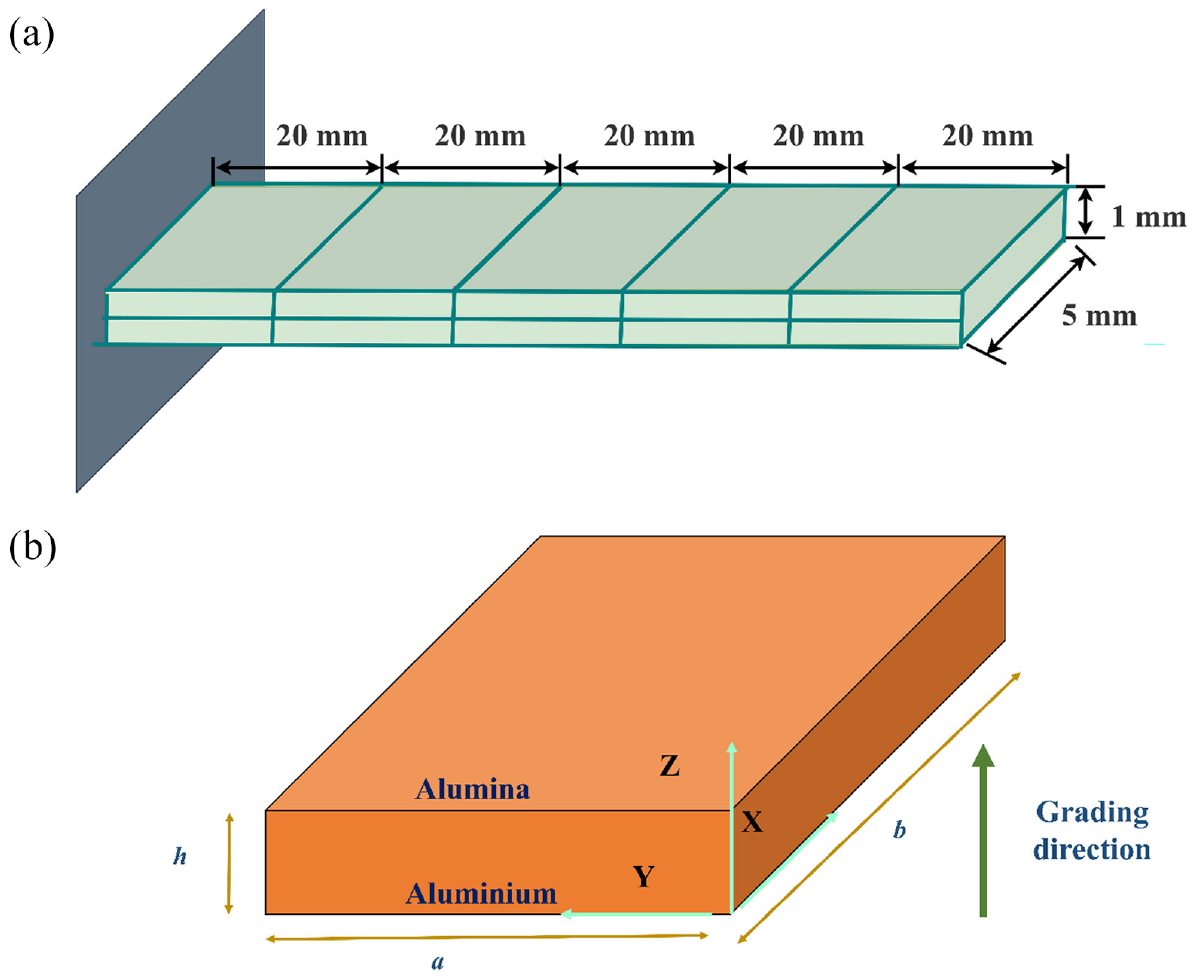
(a) Geometry of the cantilevered beam used for the validation and (b) simply supported functionally graded plate taken from Thai and Choi to be used in validation (Thai and Choi, 2013).
Sensor voltage generated at various segments in PVDF bimorph beam.

Deflection (×10–7 m) attained at various distances from fixed end for PVDF bimorph beam.

Another validation is carried out by repeating Thai and Choi’s findings (Thai and Choi, 2013). Figure 3(b) shows a functionally graded material plate of aluminum and aluminum oxide (alumina) with squared sides of 1 mm. Aluminum and alumina have moduli of elasticity of 70 and 380 GPa, respectively. A sinusoidally varying force of 1 N/m2 is applied to the FGM layer to achieve the necessary mechanical validation. The numerical results are obtained using simply supported boundary conditions, with a length-to-thickness ratio of 10. Other material and geometric factors are kept consistent with the reference. Table 3 details the contrast between the reference and the current research.
Comparison of the present research to that of Thai and Choi (2013).

3.2. Numerical studies
This section will examine the interaction of graphene platelets with piezoelectric materials, namely BaTiO3 and PVDF; functionally grade both materials; and finally, evaluate the consolidated circuit performance owing to coalescence of material grading and graphene platelets. In order to accomplish this, a MATLAB algorithm based on finite element formulation is created for harvesting energy from FG-GRPC tiles. The energy harvesting of FG-GRPC tile when exposed to electromechanical loading is investigated in this section. This FG-GRPC tile is made of two GRPC materials that have been functionally graded along thickness direction. The first GRPC material in our analysis is GRPC-BT, which is constituted of GPLs nanofillers reinforced in a BaTiO3 piezoelectric matrix. The second GRPC material, identified as GRPC-PV, is composed of GPLs nanofillers reinforced in a PVDF piezoelectric matrix. Table 4 shows the electromechanical characteristics of both piezoelectric materials. The HT and ROM are used to compute the effective electromechanical characteristics of both GRPC materials. According to the experimental investigations in literature, the volume percentage of GPLs is maintained below or equal to 1% due to the possibility of agglomeration (Mao and Zhang, 2018). The rectangular GPLs utilized in the study had a length
Specification of the materials used in the current analysis.

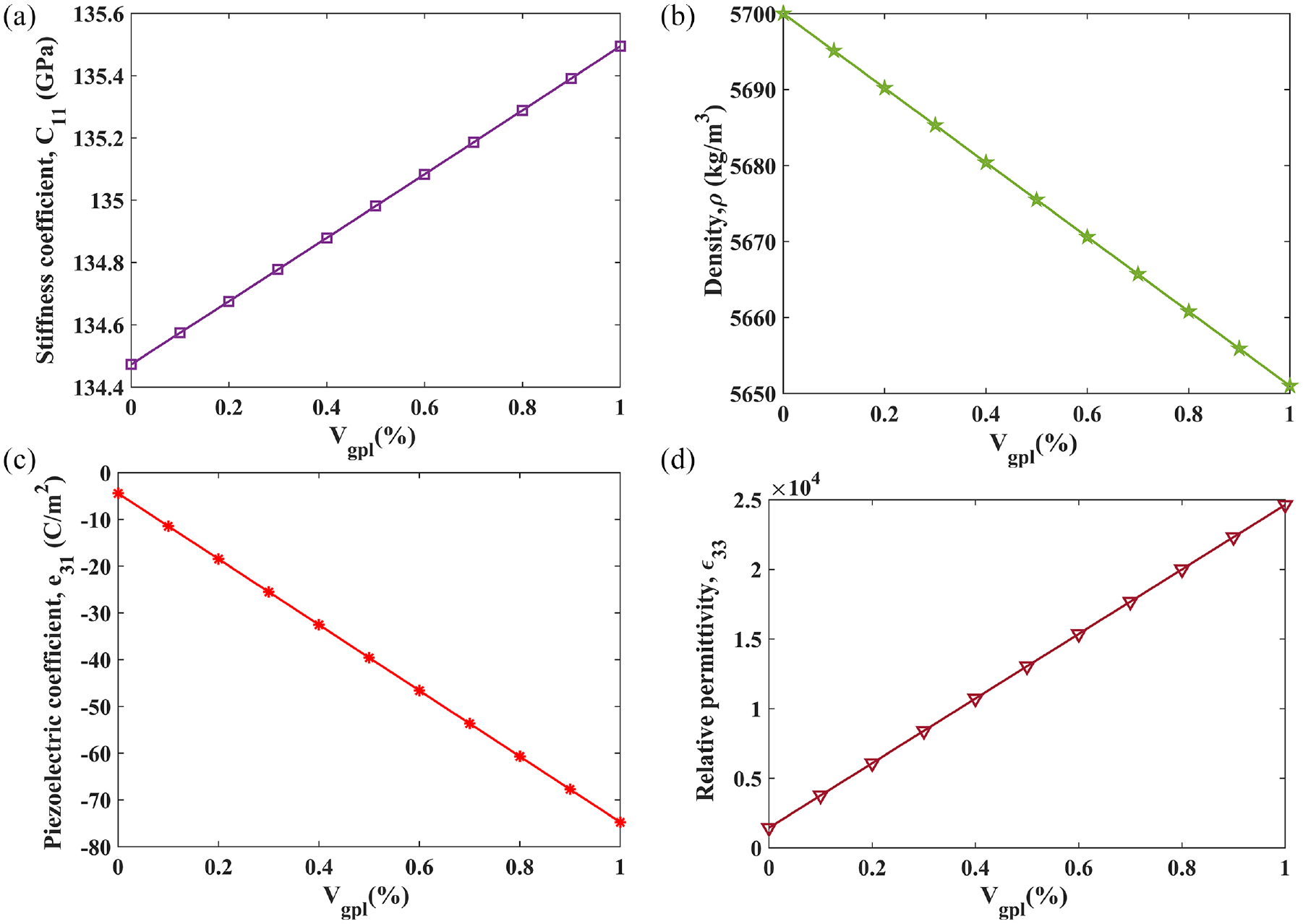
Influence of GPL volume fraction
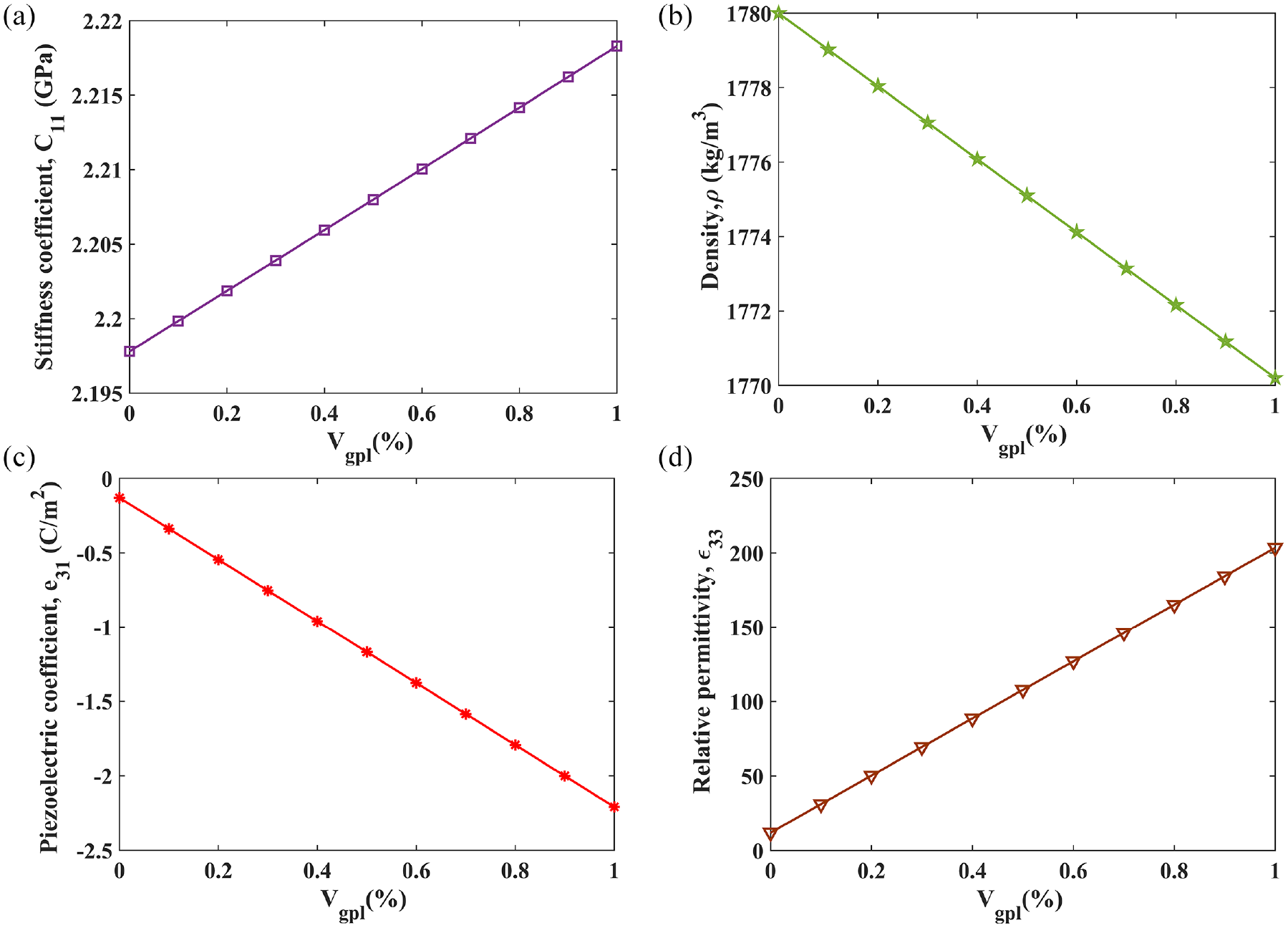
Influence of GPL volume fraction
As previously stated, the FG-GRPC is comprised of two GRPC materials whose properties vary according to the simple power distribution law provided by equations (10)–(13). In the present work, two GRPC materials with BaTiO3 and PVDF as matrix composites are developed, and these two are functionally graded along the thickness to form FG-GRPC tile. The FG-GRPC is constructed such that the bottom surface is GRPC-BT and the top surface is GRPC-PV. Figure 6 depicts the variation of density and relative permittivity for various values of grading index m to highlight this power-law variation in FG-GRPC. It can be seen that at m = 0, the material is completely infused with GRPC-PV properties, with a density of 1778 kg/m3 and a piezoelectric coefficient (e31) of −0.5457 C/m2, whereas at m = ∞, the material is completely infused with GRPC-BT properties, with a density of 5690 kg/m3 and a piezoelectric coefficient (e31) of −18.47 C/m2. The GRPC-PV and GRPC-BT property values mentioned above are obtained at GPL volume fraction,

Spatial variation of (a) density and (b) relative permittivity across height of the piezoelectric material for various values of grading index m at
After the FG-GRPC material is developed, an electromechanical analysis is conducted to determine the circuit metrics, namely voltage and power. This is accomplished by using a simply supported tile (SSSS), which is comprised of platinum (modulus of rigidity, E = 154 GPa, density
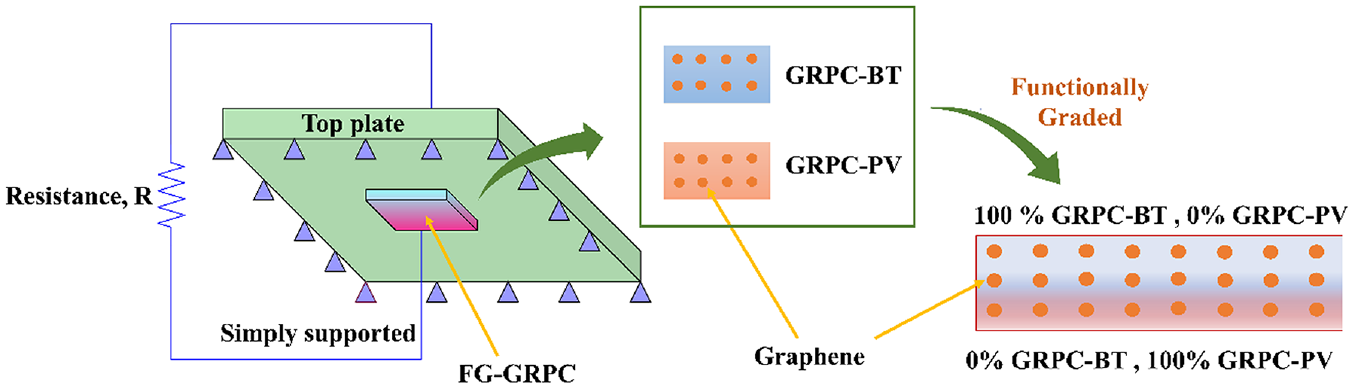
Illustration of simply supported tile with attached FG-GRPC patch.
The patch position, on the other hand, must be established for maximum piezoelectric efficiency. Four cases are examined using FG-GRPC placed on platinum using a variety of patch centers, as illustrated in Figure 8(a). The circuit performance of each of the four scenarios is determined in terms of voltage, as seen in Figure 8(b). It is obvious that the highest performance efficiency is obtained when the patch is mounted in the tile’s center. This is because the SSSS boundary condition generates a large strain energy density at the center point. As a result, the FG-GRPC patch will be placed in the center for any further simulation studies in the current research.

(a) Location of piezoelectric patch for different cases along with patch centers (xc mm, yc mm): Case 1- Top Mid (75, 150), Case 2- Mid left (37.5, 75), Case 3- Center (75, 75), Case 4- Diagonal (37.5, 37.5) and (b) line graph depicting the relationship between material grading index and voltage for the four cases.
Next, interaction between various parameters is assessed to ascertain their influence on the tile’s efficiency. The impact of external resistance on circuit metrics at various frequency levels under electromechanical loading is shown in Figure 9. It is worth noting that the same

Influence of external resistance on output (a) voltage (b) power at discrete frequency values.
Following that, the frequency response of the FG-GRPC tile is evaluated utilizing thickness values ranging from 0.05 to 1.5 mm as described in Figure 10. It is apparent that increasing the frequency has a beneficial influence on both parameters’ performance. The noteworthy conclusion is the output voltage and power’s non-uniform response to changes in piezoelectric thickness. The circuit metrics first rise as the piezoelectric height rises, then plateau at hp = 1 mm and subsequently decrease till the end. The initial gain is related to an increase in the volume of piezoelectric material, but excessive thickness enables stiffness to grow, leading in a subsequent fall.

Frequency response curves for (a) voltage and (b) power at various values of piezoelectric thickness using platinum substrate.
The influence of variation in the piezoelectric side (ap) and external resistance, R on circuit metrics is then investigated at a frequency of 1 Hz. For practically any value of external resistance, the voltage and power increase as the magnitude of the piezoelectric side increases, as illustrated in the Figure 11. This is because increasing the piezoelectric side increases the overall volume of piezoelectric material. For instance, at resistance of 200 kΩ, the voltage and power increases from 4.019 V and 0.0769 mW to 5.298 V and 0.1357 mW, resulting in 31.82% and 76.46% rise in performance enhancement as ap changes from 8 mm to 13 mm.

(a) Output voltage and (b) power as a function of external resistance at different values of piezoelectric side.
Next, the change in voltage response may be interpreted by analyzing the volume fraction distribution of the elements across the height in Figure 12(a). At m = 0 and f = 6 Hz, the piezoelectric material is completely enriched with GRPC-PV properties having PVDF matrix, generating a voltage of 9.989 V. Consequently, voltage increases to 15.84 V at grading index m = 0.05. This is due to the patch’s piezoelectric properties from GRPC-BT, which contains BaTiO3. The maximum voltage of 16.29 V is achieved at grading index, m = 0.1. This is owing to the fact that the piezoelectric layer has maximal strain and low piezoelectric magnitude at m = 0, as it only contains PVDF matrix. However, as the grading index increases, the patch loses its strain property and acquires BaTiO3 piezoelectric contribution from GRPC-BT. The piezoelectric layer stiffens as m increases (m ≥ 0.1), resulting in a reduced output voltage owing to decreased strains. Because of the highest voltage values at m = 0.1, it can be referred to as the optimized grading index for frequency of 6 Hz. For grading index, m ≥ 1.2, the results stay the same and may therefore be considered as values of fully GRPC-BT material. The output voltage for FG- GRPC at this grading index of 1.2 is 13.44 V. Thus, the voltage at optimized grading index for a frequency of 6 Hz represents a ∼17.5% increase over the voltage at pure GRPC-BT piezoelectric material. However, the maximum voltage and power are 23.79 V and 0.566 mW which are attained at a frequency of 12 Hz. It is worth mentioning that the highest percentage gains in performance for voltage and power are 44.30%, and ∼105.25%, respectively, achieved at frequency of 8 Hz. Additionally, as illustrated in Figure 12, the optimized grading index differs according to the frequency value. The synergetic impact of the piezoelectric, dielectric, and mechanical characteristics of both phases of FG-GRPC is responsible for this astonishing improvement in piezoelectric performance.

Effect of material grading exponent on (a) voltage and (b) power at different values of frequency.
Figure 13 depicts the effect of side to thickness ratio (STR) on the circuit metrics. The frequency curves are plotted in range of 0–15 Hz under the external resistance of 1 MΩ. The STR variation is taken in such a way that the area between them remains constant. Voltage and power output increases with rise in STR for any frequency value. At frequency of 15 Hz, the voltage increases from 9.025 to 17.1 V resulting in 90% increase as STR changes from 110 to 180. In similar STR variation, power increases from 0.081 to 0.2923 mW mounting to 260% increment. This is due to the fact that with increase in STR value, the thickness keeps on decreasing with respect to side as the area remains constant. The reduced thickness helps in better mechanical energy transmission ratio mounting to better performance results.

Influence of side to thickness ratio of substrate layer for different frequency response curves of (a) voltage and (b) power.
Figure 14 plots the influence of the piezoelectric multiple α on the (a) voltage and (b) power change with external resistance at Vgpl = 0.50%. Initially, up till 2.25 MΩ the voltage remains almost the same for different α values ranging from 800 to 1600. However, after that every α shows the deviation and an inversely proportional relationship is maintained. Contrarily, the power interaction with piezoelectric multiple (α) is an interesting one as maximum peak value of power is achieved at maximum α = 1600. However, after 4 MΩ resistance, a similar pattern as that of voltage is observed that is a negative relation of power with α increase. However, owing to an overreliance on other variables such as resistance, a tangible relationship between them cannot be drawn.

Influence of external resistance on (a) voltage and (b) power at different values of piezoelectric multiple, α.
4. Conclusion
This article comprehensively presents the electromechanical response of a smart composite functionally graded tile reinforced by GPLs utilizing first order shear deformation theory and Hamilton’s principle. The HT approach is used to determine the effective characteristics of the modulus of elasticity and stiffness matrices of two-lead free graphene induced materials, namely BaTiO3 and PVDF. The additional mechanical and electrical characteristics of graphene induced BaTiO3 (GRPC-BT) and PVDF (GRPC-PV) are calculated using the ROM model. It was discovered that the effective characteristics of GPLs, such as elastic modulus, piezoelectric coefficient, and electrical permittivity increase as the volume percentage of GPLs rises. It is owing to the strong electromechanical properties of GPLs. Following that, both reinforced composites are functionally graded using a simple power law distribution to vary the characteristics, resulting in the lead-free FG-GRPC tile. A parametric analysis is used to evaluate the influence of piezoelectric side and height, STR, frequency, external resistance, material grading index, and piezoelectric multiple α on the circuit metrics, namely voltage and power. It has been observed that increasing the piezoelectric side, frequency, and STR improves circuit metrics. However, piezoelectric height has an initial beneficial impact on performance until it reaches a peak and then gradually decreases till the end. Additionally, a tangible relationship between piezoelectric multiple and circuit metrics cannot be established owing to their reliance on other external characteristics. Besides, the material grading index parameter contributes to performance enhancement and its optimal value is frequency sensitive. At a frequency of 8 Hz, the maximum performance enhancements for voltage and power are 44.30% and 105.25%, respectively. The synergetic impact of the piezoelectric, dielectric, and mechanical characteristics of both GRPC-BT and GRPC-PV portions is responsible for this remarkable increase in piezoelectric structure performance. The findings clearly demonstrate the enormous potential for developing future smart structures via the use of GPLs and material compositional grading.
Footnotes
Declaration of conflicting interests
The authors declared no potential conflicts of interest with respect to the research, authorship, and/or publication of this article.
Funding
The authors received no financial support for the research, authorship, and/or publication of this article.

Data availability
The datasets generated during and/or analyzed during the current study are available from the corresponding author on reasonable request.