The phenomena of damping enhancement and higher decay coefficient are obtained by introducing a piezoelectric transducer at the resonating unit of the metamaterial. The difference between the damping ratio of the piezo-transducer controlled and that of the equivalent uncontrolled metamaterial is termed metadamping, and thereby it is used to indicate the enhancement of energy dissipation characteristics. The optimum inductance and resistance of the impregnated piezo-transducer are computed to minimize the response of the outer mass of a unit cell by implementing optimization technique. A parametric study is conducted after applying Bloch’s theorem, and the enhancement of damping over the complete Brillouin zone is determined to get a comprehension of the metadamping phenomenon. Impregnation of the piezo-transducer at the resonating unit not only enhances the normalized bandwidth more than twice but also significantly increases the damping emergence when compared to the equivalent uncontrolled metamaterial. This envisioned the promise of high-stiff, high-damped metamaterial for enhanced transient vibration control as well as wider attenuation bandgap.
In the mitigation of transient vibration arising in vehicle dynamics, impact, and other fields of structural dynamics, enhancement of energy dissipation is the most deserving trait. First, in 2013, the concept of metadamping is theorized by elucidating the enhanced dissipation of an acoustic metamaterial over a statically equivalent phononic crystal (Hussein and Frazier, 2013). Followed by that metadamping was investigated for various design strategies, for example, negative-stiffness (Antoniadis et al., 2015), non-local resonance (DePauw et al., 2018), multi-degree of freedom (Abbasi and Zheng, 2020; Chen et al., 2016; Li et al., 2019), inertial amplifier (Hussein et al., 2022a), active feedback control (Bera and Banerjee, 2023), and electrically activated local resonances (Al Ba’ba’a et al., 2021). Recently, the robustness of the active metadamping has been estimated using machine-learning-enabled stochastic simulation (Chatterjee et al., 2023). Further, simultaneous energy harvesting and vibration control using piezo-electric material (Date et al., 2000; Dwivedi et al., 2020, 2021; Hu et al., 2017) and negative capacitance (Chen et al., 2014; Yaw et al., 2022; Yi and Collet, 2021) were considered to broaden the attenuation bandgap for the mass-in-mass metamaterial. A general theory of electro-mechanical band merging and experimental realization was also provided. (Sugino and Erturk, 2018; Sugino et al., 2017, 2018). The location and width of the flexural bandgap in a beam-type acoustic metamaterials was actively controlled using shunted piezo-electric patches (Zhou et al., 2019). However, the primary aim of these studies is limited to the realization of the spatial attenuation, and therefore, a driven wave approach was adopted.
There exist several studies on piezoelectric material for vibration control (Aramaki et al., 2019; Chandiramani, 2010; Chatziathanasiou et al., 2022; Dhote et al., 2015; Kerboua et al., 2015; Li et al., 2012; Sharma et al., 2020) and wave propagation (spatial attenuation) (Banerjee and Bera, 2022), however, a comprehensive study on metadamping using shunted piezoelectric transducer is not reported in the literature so far. Hence, the metadamping phenomenon in an acoustic metamaterial equipped with a piezoelectric transducer is investigated in this study. To this end, a mass-in-mass unit cell comprising a piezo-transducer and its associated electric circuit installed between the outer and the inner mass is considered. The resistance and inductance of the circuit are optimized using optimization technique (Roberts and Spanos, 2003). Considering the periodicity of an infinitely long chain of metamaterial, Bloch’s theorem is applied to the representative unit cell, and the wave number dependent damping ratios are acquired for the system with a piezo-transducer and without a piezo-transducer. The wave number-dependent metadamping is defined as the difference between the damping ratio of the piezo-transducer controlled and that of the statically equivalent uncontrolled metamaterial. Further, the damping enhancement factor and decay coefficient are defined, and their variations with the long-wave speed of sound are obtained. Free vibration analysis of the single representative cell elucidates the rate of vibration decay over time and provides a comprehensive perception of the metadamping phenomenon arising due to the introduction of an optimized shunted piezo transducer at the unit-cell level.
The key contribution of this study is the abstraction of metadamping for an acoustic metamaterial impregnated with an optimized shunted piezoelectric transducer and its demonstration through numerical simulation. Further, the novel aspects of the paper include the adaptation of the free-wave approach in exploring temporal attenuation, optimization of circuit parameters, and proposition of the dissipation coefficient, and the damping enhancement factor to quantify overall performance. The proposed metamaterial system could potentially be applied in the field of vibrations and acoustics, impact mitigation, shock absorption, and vehicle dynamics.
Unit-cell system
Mathematical model of the unit-cell system with piezoelectric transducer
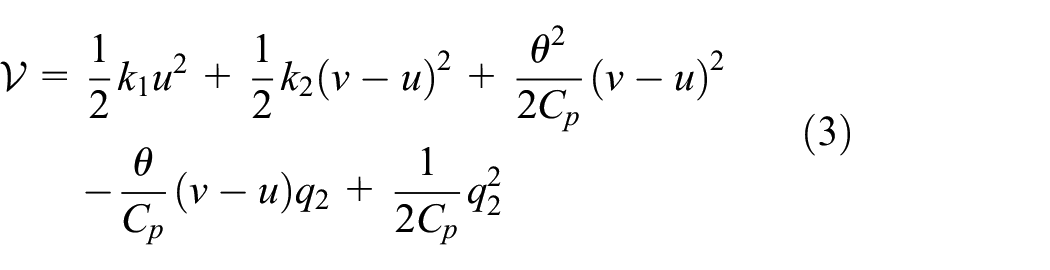
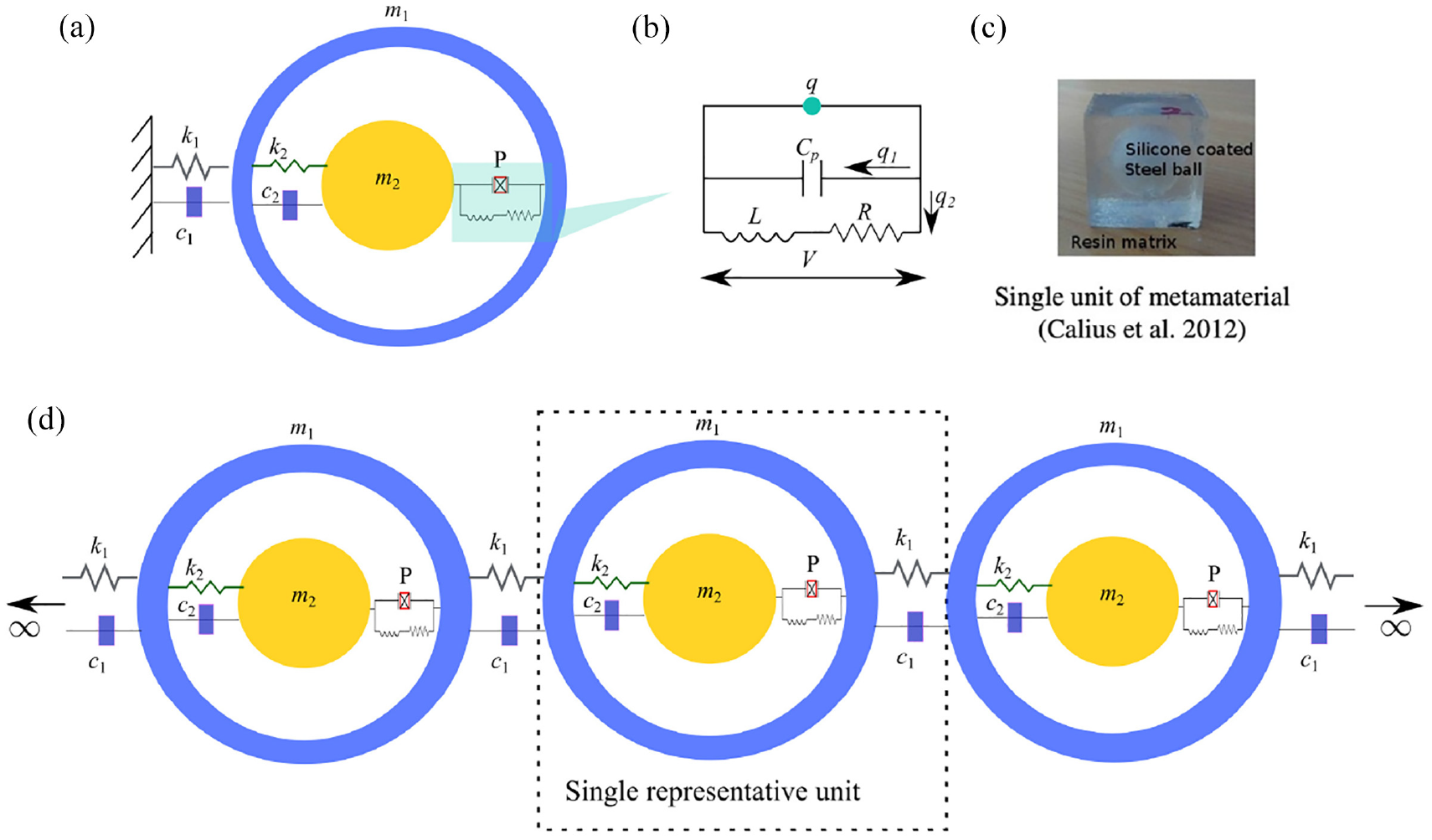
The mass-in-mass unit-cell system comprises an outer mass and an inner mass , along with the corresponding stiffness and , and damping and . Additionally, a piezoelectric transducer, placed between the two masses, provides electromechanical energy conversion and coupling between the motion of the mechanical and electrical systems. The piezoelectric transducer is further connected to a shunt circuit comprising resistive and inductive impedances. The internal force provided by the piezoelectric transducer depends on the deformation and the applied electric potential difference/voltage at its edges. An external force is applied to the outer mass, which is attached to the fixed base. Figure 1(a) shows a schematic representation of the unit-cell, while Figure 1(b) shows the associated electric circuit. The total potential energy, comprising the strain energy of the mechanical system and the electric potential energy, is given by
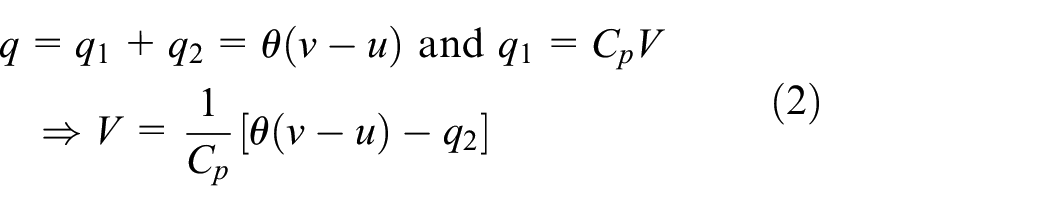
where and are the displacements of the outer mass and inner mass, respectively. The electric charge , generated from the relative movement of the outer and the inner mass, is partly stored in the piezoelectric capacitance (i.e., ), and the remaining flow through the shunt circuit (i.e., ) in the form of electric current, is expressed as:
Here, and are the electromechanical coupling coefficient and the capacitance of the piezoelectric transducer, respectively. Substituting equations (2) in (1) leads to
Schematic diagram of an acoustic metamaterial chain (and a single representative unit) with shunted piezo-transducer mechanism installed in each mass-in-mass unit. (a) single unit cell fixed at one end, (b) a detailed electric circuit diagram, (c) a representative photo of the single unit of a real acoustic metamaterial prototype, and (d) an infinitely long chain of the metamaterial.
The total kinetic energy, comprising the kinetic energy of the mechanical system and energy stored in the inductor, is written as
The dissipation function associated with viscous dampers and the electrical resistance is given by
Now, the equations of motion can be derived using Lagrange’s approach
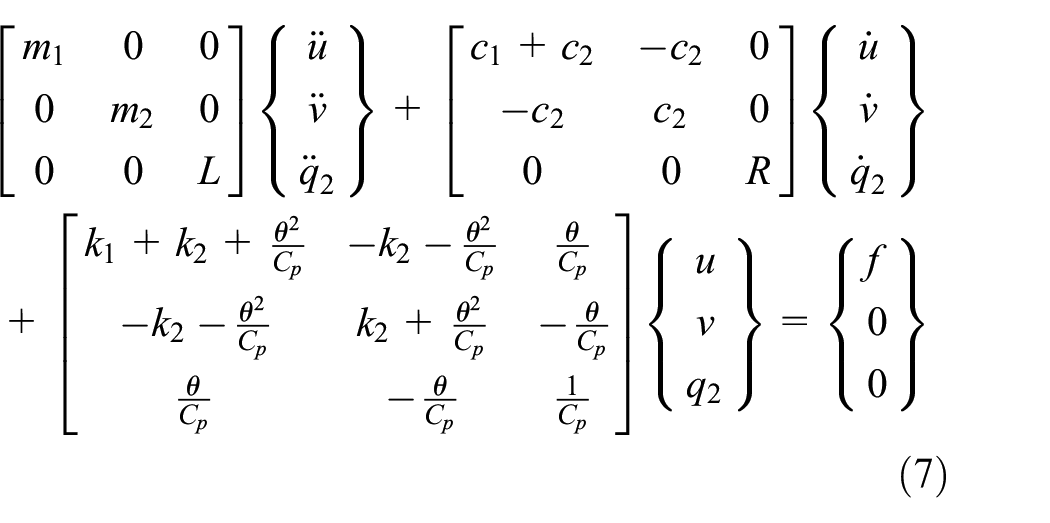
where , is the Lagrangian function and are the generalized forces associated with the generalized coordinates . Here, , , , , and . Thus, the equation of motion of the system can be expressed as:
It is evident from equation (7) that the term alters the system elastic characteristics, and can be considered as the effective stiffness between the outer mass and the inner mass due to the introduction of the piezo-transducer. On the other hand, is responsible for the electromechanical coupling through the charge, , in the shunt circuit.
optimization for optimized circuit parameters for broadband vibration control
The resistive and inductive impedances of the shunt circuit are the two important parameters for vibration control of the outer mass subjected to random excitation. Thus, it is important to determine their optimal values corresponding to a set of system parameters. To this end, the optimization technique is used to estimate the optimum values of resistive and inductive impedances. The optimization is quite commonly used for obtaining optimum parameters of the dynamic vibration absorber or the tuned mass damper (Asami et al., 2002; Cheung and Wong, 2011; Crandall and Mark, 2014; Patro et al., 2022; Warburton, 1982), as well as for the base isolation system (Chowdhury et al., 2022; Chowdhury and Banerjee, 2022). The derivation of the objective function and the optimization procedure are briefly presented as follows.
Considering harmonic solutions in the form , , and , for the system subjected to harmonic excitation , equation (7) is written as
where , , and are the amplitudes of the response of the outer mass, inner mass, and the charge through the shunt circuit, respectively, and . The coefficients of equation (8) can be defined as follows
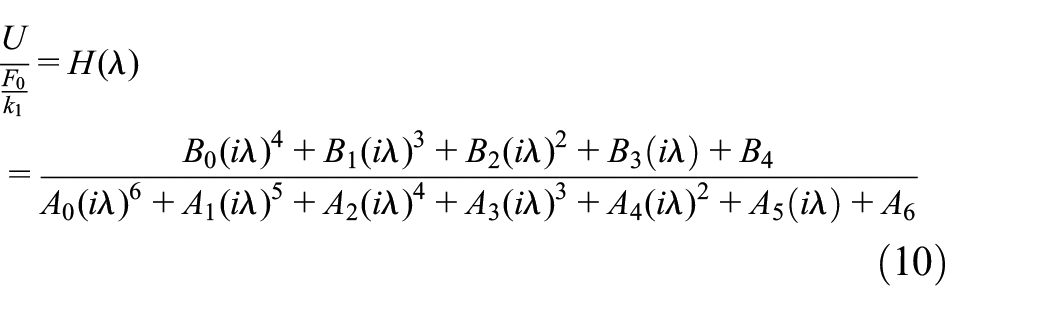
where represents the i-th row and j-th column of the inverted coefficient matrix of equation (8). The displacement response of main mass is related to the forcing function through the Frequency Response Function (FRF) or the Amplification Ratio (AR) as follows:
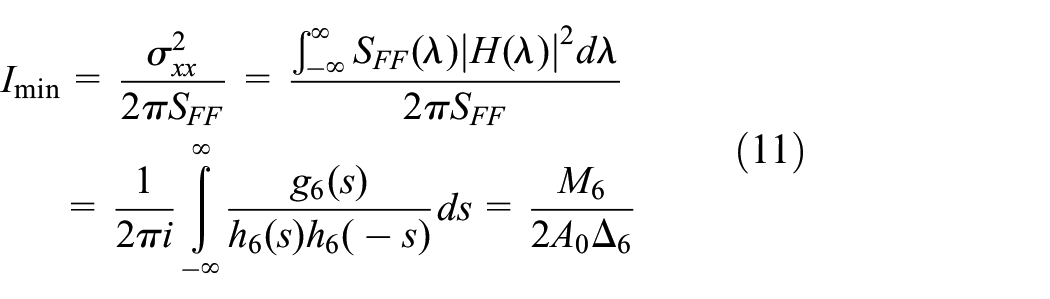
In optimization, the standard deviation of the response is considered as the objective function, which is to be minimized. Herein, the objective function is defined as the normalized variance of the outer mass response, and it is written in terms of the frequency response function as (Adhikari et al., 2016; James et al., 1947; Patro et al., 2022):
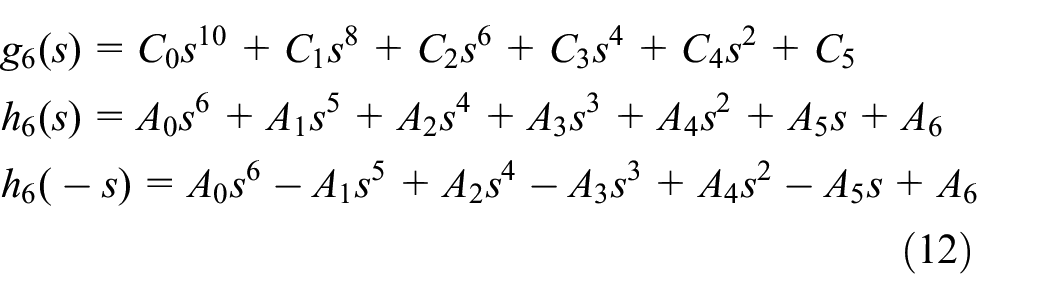
where and are the variance and the power spectral density function (PSDF), respectively. is constant with respect to when the system is subjected to Gaussian White Noise. Further, the parameters in the integrand are defined as:
Metadamping in metamaterial chain with piezoelectric transducer
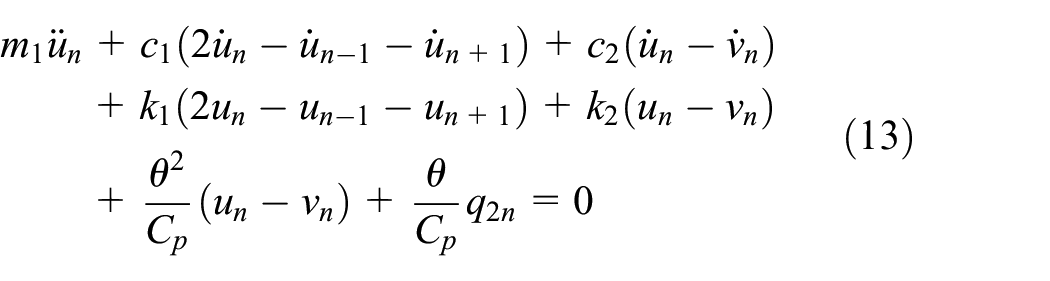
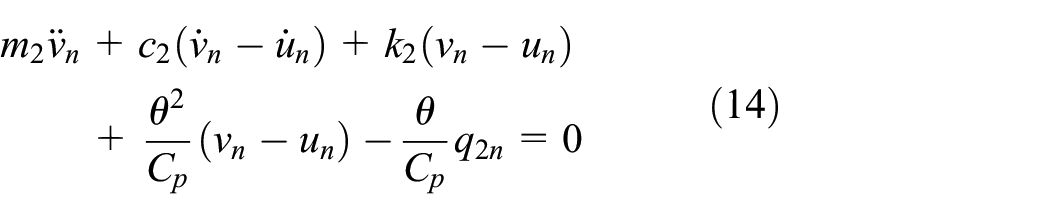
The unit-cell model is extended to the multicell model, such as the one shown in Figure 1(d), representing a metamaterial chain with the piezoelectric transducer placed in each mass-in-mass unit. The long chain of metamaterial consists of an infinite number of identical unit-cell. Considering the periodic nature of a typical unit cell, the governing equations for outer mass, inner mass, and electric charge in the shunt circuit are written as:
As the system repeats itself periodically, using Bloch’s theorem
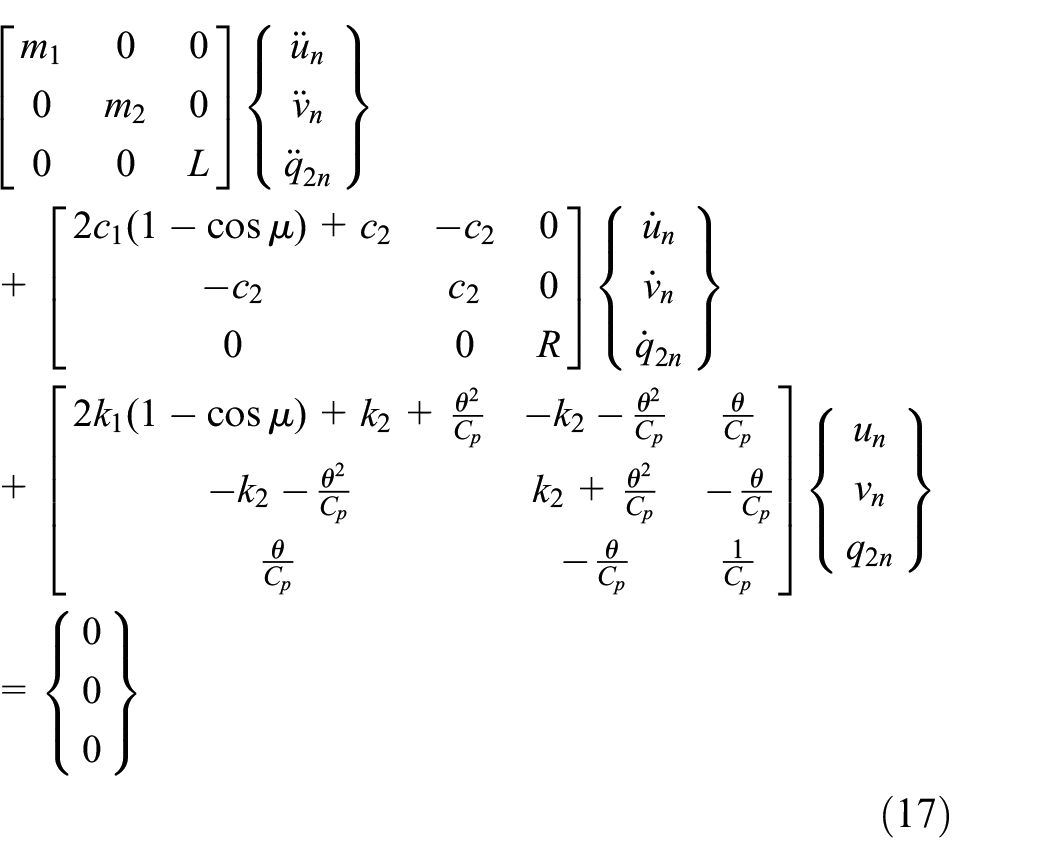
where the non-dimensional wave number, , is the product of the Bloch’s wave number and length of the lattice unit . Introducing Bloch’s theorem (i.e., equation (16)), equations (13–15) are written as:
In this study, the free wave approach is persuaded to explore the temporal dissipation of the system. To this end, the dispersion relation is obtained by considering the Bloch-transformed equation (i.e., equation (17)) and varying the propagation constant in the range of 0 to . The solution to the ensuing eigenvalue problem yields the complex eigenvalues from which the damped wave frequency and damping ratio for the acoustic and optical branches are obtained. The solution of the eigenvalue problem yields
Here, and 2 implies to the acoustic and optical dispersion branches, respectively. For each dispersion branch, is the damped wave frequency, is the resonant wave frequency, and is the damping ratio, for a specified wave-propagation constant . Note that, for the uncontrolled system (i.e., for the system without piezoelectric transducer), equation (17) needs to be modified by eliminating the third row and the third column, and also by setting .
The metadamping is described as the difference between the damping ratio of the piezoelectric transducer controlled and that of the uncontrolled (i.e., without the piezoelectric transducer) mass-in-mass metamaterial. Hence, metadamping represents an improvement in energy dissipation as a result of the piezoelectric transducer incorporated in the lattice. The wave number dependent damping-emergence metric Z, which is used to quantify the metadamping, is defined as (Hussein and Frazier, 2013).
The subscript PTC and UC indicate the piezoelectric transducer-controlled system and the uncontrolled system, respectively. The index indicates the acoustic branch, indicates the optical branch, and the summation of the two branches is denoted by q = sum. Thus, represents an enhancement in the damping ratio when compared to the uncontrolled system and thereby provides a measure of the effectiveness of the piezoelectric transducer in temporal attenuation. Note that the summation of the damping ratio values for the acoustic and optical branches is given by , where r = PTC or UC. Further, the cumulative and the total value of are defined as (Hussein and Frazier, 2013; Hussein et al., 2022b)
Here, represents the integrated value of for wave number, , ranging from zero to a particular value in the Brillouin zone (BZ), while indicates the total (integrated) measure of obtained by integrating it over the entire BZ. This provides an overall quantification of the damping enhancement of the piezo-transducer-controlled metamaterial with respect to the reference uncontrolled metamaterial. Similarly, the total damping ratio over both branches (for PTC or UC, as the case may be) is obtained by integration over the entire wave number domain, that is,
Thus, represents the mean value of the damping ratio and thereby quantifies the energy dissipation capability of the metamaterial.
Results and discussion
Optimized parameters of the shunt circuit
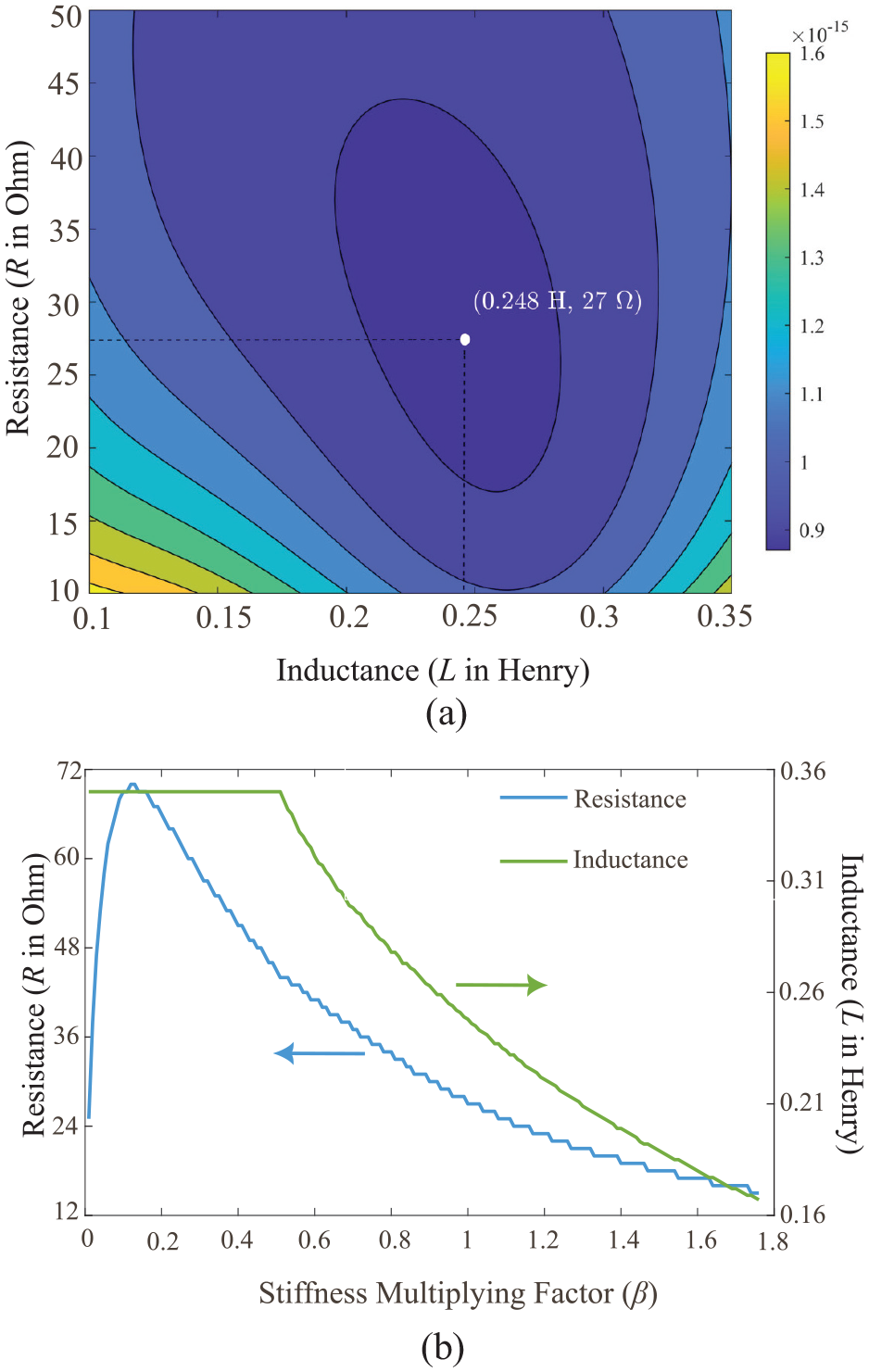
The first objective of the study is to determine the optimized parameters for the LR circuit so that the vibration of the outer mass can be reduced while it is subjected to a wide-band excitation. optimization is implemented to obtain the circuit parameters, namely the resistive and inductive impedances. For numerical study, the system parameters are chosen as (Chatziathanasiou et al., 2021): , , , , , , , and . The objective function defined in equation (11) is plotted for a range of L and R to identify the global minima. Figure 2(a) shows the corresponding contour plot from which the optimum values of resistance (R) and inductance (L) are obtained as and 248 mH, respectively. As discussed later, with reference to Figure 2(b), the system stiffness parameters ( and ) are altered by using a multiplication factor , to obtain the optimal L and R for different values of . Note that, for the basic case as depicted in Figure 2(a), the stiffness multiplying factor, .
(a) Contour of the standard deviation of the norm of the response of the system subjected to random white Gaussian noise for different values of resistance (R) and inductance (L). The minimum of the objective function appears at and for a constant value of the stiffness multiplying factor, . (b) Optimal resistance and inductance for different . For each set of system parameters, optimization is performed to obtain the corresponding optimum values of R and L. The y-axis for inductance is shown on the right side of the figure.
Dispersion diagram and associated damping
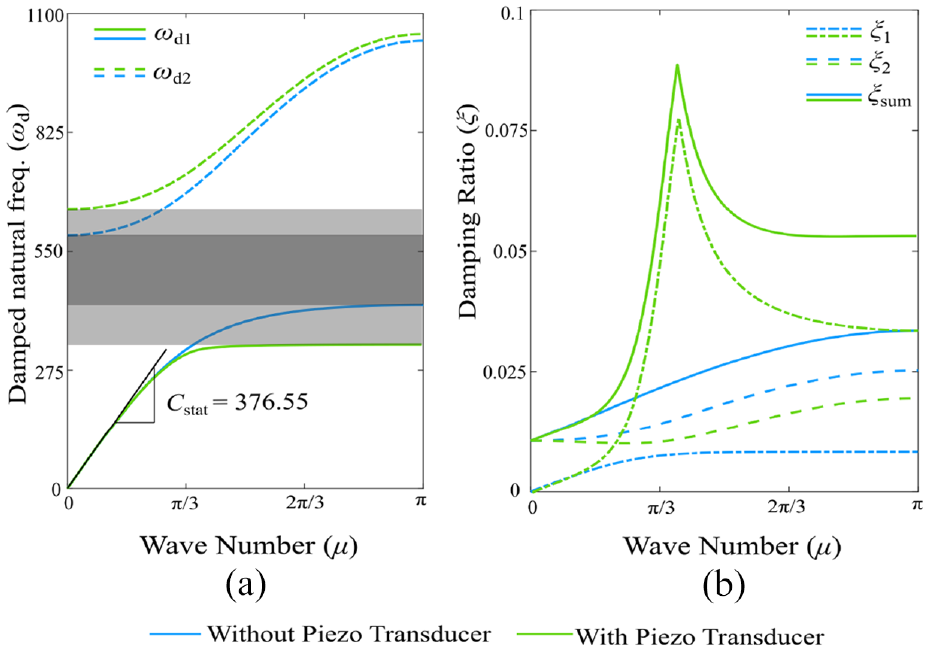
We first investigate the variation of the dispersion relations for the uncontrolled and the piezo-transducer controlled damped acoustic metamaterial. Here, the uncontrolled system implies the mass-in-mass metamaterial without the shunted piezo-transducer, and henceforth, these two terms are used interchangeably. The long-wave sound speed is defined as the slope of the acoustic branch of the dispersion diagram for the limiting value of wavenumber as zero. Here, as shown in Figure 3(a). This can also be verified from the analytical expression, that is, (refer to Appendix B for the detailed derivation). Note that is independent of the inner stiffness, , and hence the long-wave sound speed remains unchanged for the piezo-transducer controlled system because the introduction of piezo-transducer alters the inner stiffness from to , without affecting the outer stiffness . It can be noticed that the attenuation bandwidth of 426.36–587.28 rad/sec, for the system without the piezo-transducer, is extended to 335.2–647.5 rad/sec after the attachment of the piezo-transducer. This yields a shift of central frequency of the bandgap from 506.82 to 491.35 rad/sec and the overall normalized bandwidth index (NBI) increases from 31.75% to 63.35%. This is a substantial increase in bandgap due to the introduction of the optimized shunted piezo-transducer at the resonating unit.
(a) Dispersion relationship of the metamaterial system. The horizontal color shadings indicate the corresponding bandgap. The introduction of a piezo-transducer increases the bandwidth. (b) Damping ratio band structure of the metamaterial system. Results are for for system with piezo-transducer (having mH and ) as well as for system without piezo-transducer.
For each value of the wavenumber, the corresponding damping ratio and their summation for the acoustic and optical branches are extracted from the eigenvalues (i.e., equation (18)), and this is depicted in Figure 3(b). For the system without a piezo-transducer, is always less than throughout the wave number domain, whereas a significant alteration can be perceived in when the piezo-transducer is introduced. For the system with a piezo-transducer, the peak value of is obtained in the vicinity of . This is expected as the optimized parameters for the shunt circuit are obtained by considering equation (7), which is the same as equation (17) for , that is, the equations of motion of the system after incorporating the Bloch theorem for . Note that a higher value of is desired to achieve a substantial reduction of the outer mass response. However, the value of damping at a particular wavenumber is a mathematical quantity needed to calculate the overall dissipation and does not have any direct physical interpretation. The area under the curve between 0 to , that is, , is the governing parameter for identifying the damping enhancement.
The damping emergence metric is the difference in damping between the piezo-transducer controlled and the corresponding uncontrolled system. Due to the inclusion of an optimized shunted piezo-transducer, the damping emergence metric for the acoustic branch contributes a majority of the total damping emergence, and this is also consistent with that of the Figure 3(b). Damping emergence for the optical branch is marginal. Here, , , and the summation of the two branches . Note that the cumulative total of for the entire Brillouin zone is denoted as , which indicates a comprehensive quantification of the enhancement of damping for the system with optimized shunted piezo-transducer.
Variation of metadamping with long-wave sound speed (Cstat)
Metamaterial systems having identical stiffness and mass result in the same long-wave sound speed . Herein, the potentiality of a piezo-transducer in designing a metamaterial system having simultaneously high damping and high stiffness is investigated. The value of the system is altered by introducing a stiffness multiplying factor, , such that and . As discussed earlier, the introduction of the piezo-transducer does not alter of the medium. The optimum values of the resistance and inductance for each (i.e., for each set of system parameters) are obtained using the optimization technique, and their variation is shown in Figure 2(b). It is evident that the optimum inductance remains constant for and then decreases exponentially, whereas optimum resistance sharply increases up to and then exponentially decreases.
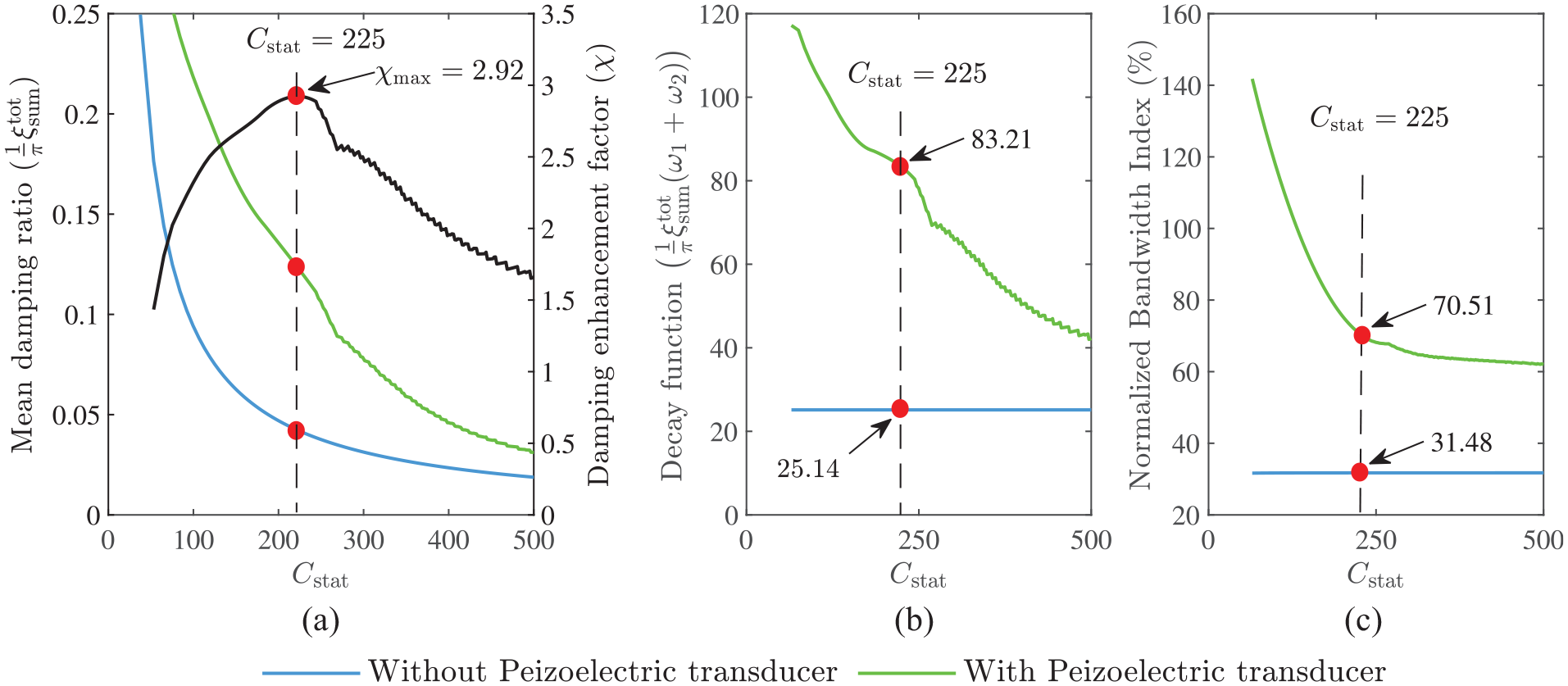
The profile of the average damping ratio of the acoustic and optical branches with is shown in Figure 4(a) for the uncontrolled and the piezo-transducer controlled metamaterials. It is evident that the average damping ratio for metamaterial with impregnated piezo-transducer is much higher compared to uncontrolled metamaterial having the same . Note that represents the integrated value of the damping of the two branches for the complete wavenumber domain, that is, . Thus, represents the average damping that quantifies the energy dissipation of the system subjected to impact/shock excitation. Obtaining a higher damping level for a relatively stiff metamaterial is the most challenging scenario. It has enormous potential towards the design of dampers and shock absorbers needed in relevant industries. The long wave speed of sound increases proportionally with the stiffness of the system having constant mass. Generally, an increase in the stiffness is associated with a decrease in the damping, as depicted by the rectangular hyperbolic profile of the damping curve for the uncontrolled metamaterial. The piezo-transducer controlled metamaterial results in enhanced damping, and therefore, the overall curve moves upward, indicating the positive metadamping phenomenon. Note that an enhancement in metadamping represents higher dissipation of the energy and faster attenuation of vibration in the time domain (Bera and Banerjee, 2023). Hence, metadamping is the fundamental aspect related to the control of transient vibration resulting from short-duration events such as blasts, earthquakes, etc. On the other hand, the sub-wavelength bandgap, being a characteristic of the spatial domain, is suitable for wave attenuation in the field of acoustics and waveguides, which are primarily longer-duration events.
(a) Variation of mean damping ratio over the two branches and damping enhancement factor, , with the long-wave speed of sound in the periodic chain. Here, UC and PTC stand for the uncontrolled and the piezo-transducer controlled metamaterial, respectively. (b) Variation of decay function , and (c) normalized bandwidth index - with . Optimized values of L and R corresponding to each are used for the system with piezo-transducer.
Further, to assess the rate of energy dissipation, a parameter named decay function is defined as for a single unit cell with and being the two natural frequencies. Figure 4 (b) shows the variation of with . Interestingly, the decay function is independent of the long-wave speed of sound for the system without the piezo-transducer. On the other hand, started from around four and a half times higher value and decreases gradually with increasing , while the optimized shunted piezo-transducer is attached to the metamaterial unit cell. The damping enhancement factor is defined as the ratio of the average damping of the piezo-transducer controlled metamaterial to that of the uncontrolled metamaterial, and its variation with the long-wave speed of sound is shown in Figure 4(a). The damping enhancement factor increases gradually from its minimum value of around 1.5 till the peak value of 2.92 for , and then gradually decreases with increasing . A significant improvement in the damping is achieved, especially for the long-wave sound speed range of 150–300. The maximum value of the damping enhancement factor represents the high-stiff high-damped metamaterial. This yields a metamaterial with sufficiently high stiffness and rapid energy dissipation characteristics, which is very contrasting. As expected, metamaterial with piezo-transducer yields higher energy dissipation as compared to the uncontrolled metamaterial for the entire range of considered. Figure 4(c) shows the variation of the normalized bandwidth index (NBI) with , which has a similar trend as that of the versus plot (Figure 4(b)). It is evident that the introduction of piezo-transducer yields significantly higher NBI for the lower values of , and it gradually decreases with increasing . Therefore, we can conclude that the metamaterial system with an optimized piezo-transducer improves both the overall damping and the bandgap. This shows a significant advancement because the majority of the previous literature on metadamping reported a trade-off between attenuation bandwidth and temporal decay.
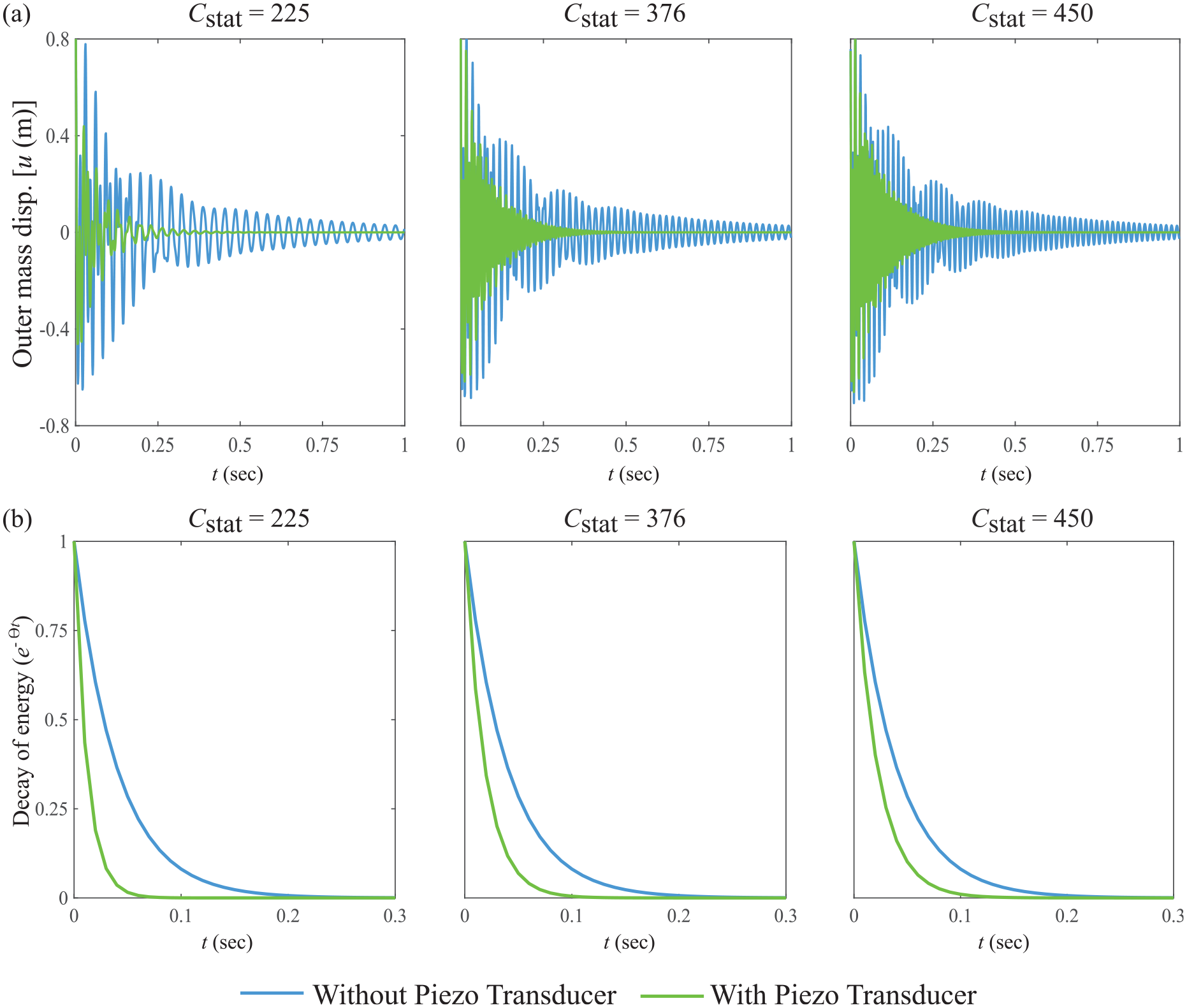
Finally, the time domain response of a single unit cell is studied to better visualize the temporal attenuation phenomenon due to metadamping. The responses are obtained by numerically solving the equation of motion using the ode45 in MATLAB, with a time step of 0.01 s. This is presented in Figure 5(a), which shows the comparison of the time history of the outer mass of a unit cell without the piezo-transducer and with the piezo-transducer. Three different values of are considered, and for each case, the outer mass is initially subjected to a unit displacement. Note that is chosen as the damping enhancement factor, , is found to be maximum. Further, two different values of (376 and 450) are considered to show the effectiveness of the piezo-transducer without the loss in generality. For a system without a piezo-transducer, the settling time of the outer mass for different values of are almost the same. This is expected, as already seen from Figure 4(b), that the decay function remains the same for different values of . On the other hand, a faster decay is observed, especially for the lower value of , when a piezo-transducer is incorporated within the metamaterial. The decay profile, as shown in Figure 5(b), further verifies the above results. Note that the function portrays the envelope, which represents the rate of energy dissipation in a unit cell while the outer mass is subjected to an initial displacement.
(a) Comparison of the displacement response of the outer mass of a single unit cell without piezo-transducer and with piezo-transducer. For each case, the outer mass is initially subjected to a unit displacement. (b) Envelope of energy dissipation for the system without piezo-transducer and with piezo-transducer. Results are for (LHS), 376 (middle), and 450 (RHS).
In the context of the present study, there are two possible scenarios regarding the design of metamaterial. For a given metamaterial, in which all the mechanical parameters are predefined, one may perform optimization to obtain optimal values of the resistance (R) and inductance (L). On the other hand, one may be looking for a metamaterial with simultaneously high damping and high stiffness. In that case, the optimal design of the metamaterial would be the one having a specific value of the long-wave sound speed for which the damping enhancement factor is maximum.
Conclusion
The phenomenon of metadamping is investigated for the piezo-transducer-impregnated mass-in-mass metamaterial. The impedance and the resistance of the LR circuit associated with the piezo-transducer are optimized using the optimization technique by reducing the standard deviation of the response of the outer mass subjected to Gaussian white noise. A metamaterial with piezo-transducer results in around two times wider bandwidth compared to an equivalent uncontrolled metamaterial, having the same long wave sound speed . It is observed that piezo-transducer-controlled metamaterial yields a higher damping ratio as compared to the equivalent uncontrolled metamaterial throughout the entire wavenumber domain. A significant enhancement, up to three times the total damping, is achieved via the insertion of a piezo transducer in the mass-in-mass unit. The decay coefficient , which represents how fast the impacting energy decays, remains constant with varying long wave sound speeds for the uncontrolled metamaterial. However, the decay coefficient started from around five times higher value vis-a-vis the uncontrolled metamaterial and decreased gradually with increasing long wave sound speed while the optimized shunted piezo-transducer is attached to the metamaterial unit cell. The target is to obtain the maximum damping enhancement factor to achieve a relatively high-stiff, high-damped metamaterial. As expected, metamaterial with piezo-transducer yields higher energy dissipation as compared to the uncontrolled metamaterial for the entire range of long-wave sound speed. It is also evidenced that the introduction of piezo-transducer not only increases the rate of dissipation but also widens the attenuation bandwidth. Note that the results presented in this study are for the optimized circuit parameters corresponding to a mass-in-mass system having specific sets of mass, stiffness, and damping and for a constant value of electromechanical coupling coefficient and capacitance of the piezoelectric transducer. This work does not address the optimization problem for the general case. Further, the limitation of the model is that it does not go into the intricate detail of constitutive modeling of the piezo transducer; however, it provides the electromechanical coupling in a condensed manner. This representation is useful in capturing the overall system dynamics, ignoring the minute details. Additionally, this electromechanical model is capable enough to incorporate the circuit parameters. Finally it can be concluded that the amalgamation of the two contrasting physical properties, that is, high stiffness and high damping, in a piezo-shunted metamaterial provides a remarkable potential as a shock and impact absorber for vehicle and structural dynamics and many other relevant applications.
Footnotes
Appendix A
Expression of coefficients , , and as appeared in equations (10) and (12):
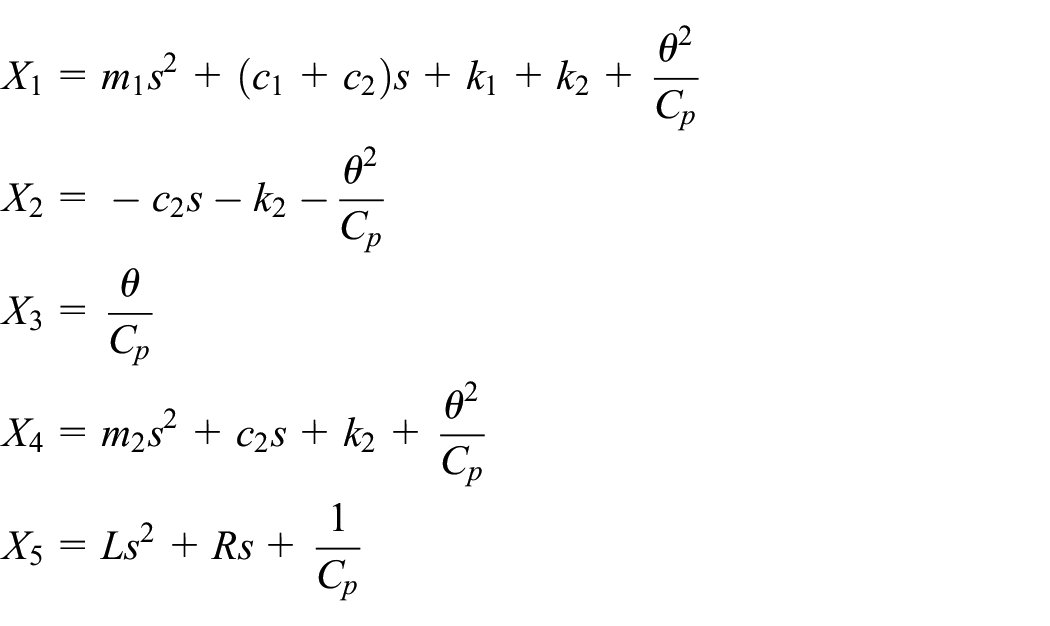
The expressions for and as appeared in equation (11):
Appendix B
The equations of motion for the n th-cell of the uncontrolled (i.e., without piezo-transducer) acoustic metamaterial are given by
The dispersion relations can be obtained by assuming a generalized Bloch solution of the form and similarly for . Here, is the complex wave amplitude, and the frequency function is complex for damped systems and equivalent to for undamped ones, is the dimensionless wavenumber, and . Substituting the Bloch solution in equations (B1) and (B2) yields a characteristic equation of the form
where
and . For the undamped case, the characteristic equation is written as
where
The acoustic branch of the dispersion curve is given by
where , , and . Now, the Taylor series approximation of equation (B7) around yields
For small value of (as ), only the first term of equation (B8) is retained, and . Thus, substituting and in equation (B8) leads to
Finally, the derivative with respect to the wavenumber can be used to determine the initial slope of the acoustic dispersion band, and hence the long wave speed of sound as:
Declaration of conflicting interests
The authors declared no potential conflicts of interest with respect to the research, authorship, and/or publication of this article.
Funding
The authors disclosed receipt of the following financial support for the research, authorship, and/or publication of this article: Arnab Banerjee acknowledges Inspire faculty grant, grant number: DST/INSPIRE/04/2018/000052, for partially supporting the research.
ORCID iDs
Kamal K Bera
Arnab Banerjee
Data availability statement
Data sharing not applicable to this article as no datasets were generated or analyzed during the current study.
References
1.
AbbasiTURZhengH (2020) Wave dispersion and dissipation performance of locally resonant acoustic metamaterials using an internal variable model. Wave Motion93: 102483.
2.
AdhikariSFriswellMLitakG, et al. (2016) Design and analysis of vibration energy harvesters based on peak response statistics. Smart Materials and Structures25: 065009.
3.
Al Ba’ba’aHLinZTolS (2021) Metadamping enhancement and tunability via scissor-like electromechanical metamaterials. Journal of Applied Physics130: 184901.
4.
AladwaniANouhM (2020). Mechanics of metadamping in flexural dissipative metamaterials: analysis and design in frequency and time domains. International Journal of Mechanical Sciences173: 105459.
5.
AladwaniANouhM (2021) Strategic damping placement in viscoelastic bandgap structures: Dissecting the metadamping phenomenon in multiresonator metamaterials. Journal of Applied Mechanics88: 021003.
6.
AladwaniAMohammedANouhM (2022) Tunable dissipation in elastic metamaterials via methodic reconeuration of inertant mechanical networks. Meccanica57: 1337–1352.
7.
AndreassenEJensenJS (2013) Analysis of phononic bandgap structures with dissipation. Journal of Vibration and Acoustics135(4): 041015.
8.
AntoniadisIChronopoulosDSpitasV, et al. (2015) Hyper-damping properties of a stiff and stable linear oscillator with a negative stiffness element. Journal of Sound and Vibration346: 37–52.
9.
AramakiMYoshimuraTMurakamiS, et al. (2019) Electromechanical characteristics of piezoelectric vibration energy harvester with 2-degree-of-freedom system. Applied Physics Letters114: 133902.
10.
ArenaABacigalupoALepidiM (2022) Wave propagation in viscoelastic metamaterials via added-state formulation. International Journal of Mechanical Sciences228: 107461.
11.
AsamiTNishiharaOBazAM (2002) Analytical solutions to H∞ and H2 optimization of dynamic vibration absorbers attached to damped linear systems. Journal of Vibration and Acoustics124: 284–295.
12.
BacquetCLAl Ba’ba’aHFrazierMJ, et al. (2018) Metadamping: dissipation emergence in elastic metamaterials. Advances in Applied Mechanics51: 115–164.
13.
BanerjeeABeraKK (2022) Emergence of non-reciprocity in metabeam exploiting piezoelectric sensing and actuation. International Journal of Mechanical Sciences236: 107765.
14.
BanerjeeADasRCaliusEP (2019) Waves in structured mediums or metamaterials: A review. Archives of Computational Methods in Engineering26: 1029–1058.
15.
BaravelliERuzzeneM (2013) Internally resonating lattices for bandgap generation and low-frequency vibration control. Journal of Sound and Vibration332: 6562–6579.
16.
BeraKKBanerjeeA (2021) Ultra-wide bandgap in active metamaterial from feedback control. Journal of Vibration and Control28: 23–24.
17.
BeraKKBanerjeeA (2023) Active metadamping: A phenomenon of damping enhancement in metamaterial via feedback control. Journal of Sound and Vibration546: 117452.
18.
ChandiramaniNK (2010) Active control of a piezo-composite rotating beam using coupled plant dynamics. Journal of Sound and Vibration329: 2716–2737.
19.
ChatterjeeTBeraKKBanerjeeA (2023) Machine learning enabled quantification of stochastic active metadamping in acoustic metamaterials. Journal of Sound and Vibration567: 117938.
20.
ChatziathanasiouGMChrysochoidisNASaravanosDA (2021) A semi-active shunted piezoelectric tuned mass damper for robust vibration control. Journal of Vibration and Control28: 21–22.
21.
ChatziathanasiouGMChrysochoidisNARekatsinasCS, et al. (2022) A semi-active shunted piezoelectric tuned-mass-damper for multi-modal vibration control of large flexible structures. Journal of Sound and Vibration537: 117222.
22.
ChenHLiXPChenYY, et al. (2017) Wave propagation and absorption of sandwich beams containing interior dissipative multi-resonators. Ultrasonics76: 99–108.
23.
ChenYBarnhartMVChenJ, et al. (2016) Dissipative elastic metamaterials for broadband wave mitigation at subwavelength scale. Composite Structures136: 358–371.
24.
ChenYHuangGSunC (2014) Band gap control in an active elastic metamaterial with negative capacitance piezoelectric shunting. Journal of Vibration and Acoustics136: 061008.
25.
CheungYWongWO (2011) H2 optimization of a nontraditional dynamic vibration absorber for vibration control of structures under random force excitation. Journal of Sound and Vibration330: 1039–1044.
26.
ChowdhurySBanerjeeA (2022) The exact closed-form expressions for optimal design parameters of resonating base isolators. International Journal of Mechanical Sciences224: 107284.
27.
ChowdhurySBanerjeeAAdhikariS (2022) Optimal negative stiffness inertial-amplifier-base-isolators: Exact closed-form expressions. International Journal of Mechanical Sciences218: 107044.
28.
ClaeysCCVergoteKSasP, et al. (2013) On the potential of tuned resonators to obtain low-frequency vibrational stop bands in periodic panels. Journal of Sound and Vibration332: 1418–1436.
29.
CrandallSHMarkWD (2014) Random Vibration in Mechanical Systems. Cambridge, MA: Academic Press.
DePauwDAl Ba’ba’aHNouhM (2018) Metadamping and energy dissipation enhancement via hybrid phononic resonators. Extreme Mechanics Letters18: 36–44.
32.
DhoteSZuJZhuY (2015) A nonlinear multi-mode wideband piezoelectric vibration-based energy harvester using compliant orthoplanar spring. Applied Physics Letters106: 163903.
33.
DuC-YYuD-LLiuJ-W, et al. (2017) Flexural vibration band gaps for a phononic crystal beam with x-shaped local resonance metadamping structure. Acta Physica Sinica66: 140701.
34.
DwivediABanerjeeABhattacharyaB (2020) Simultaneous energy harvesting and vibration attenuation in piezoembedded negative stiffness metamaterial. Journal of Intelligent Material Systems and Structures31: 1076–1090.
35.
DwivediABanerjeeAAdhikariS, et al. (2021) Optimal electromechanical bandgaps in piezo-embedded mechanical metamaterials. International Journal of Mechanics and Materials in Design17: 419–439.
36.
FrazierMJHusseinMI (2016) Generalized Bloch’s theorem for viscous metamaterials: Dispersion and effective properties based on frequencies and wavenumbers that are simultaneously complex. Comptes Rendus Physique17(5): 565–577.
37.
HuGTangLBanerjeeA, et al. (2017) Metastructure with piezoelectric element for simultaneous vibration suppression and energy harvesting. Journal of Vibration and Acoustics139: 011012.
38.
HusseinMIPatrickIBanerjeeA, et al. (2022a) Metadamping in inertially amplified metamaterials: Trade-off between spatial attenuation and temporal attenuation. Journal of Sound and Vibration531: 116977.
39.
HusseinMPatrickIBanerjeeA, et al. (2022b) Metadamping in inertially amplified metamaterials: Trade-off between spatial attenuation and temporal attenuation. Journal of Sound and Vibration531: 116977.
40.
HusseinMIFrazierMJ (2010) Band structure of phononic crystals with general damping. Journal of Applied Physics108: 093506.
41.
HusseinMIFrazierMJ (2013) Metadamping: An emergent phenomenon in dissipative metamaterials. Journal of Sound and Vibration332: 4767–4774.
42.
HusseinMILeamyMJRuzzeneM (2014) Dynamics of phononic materials and structures: Historical origins, recent progress, and future outlook. Applied Mechanics Reviews66: 040802.
43.
JamesHMNicholsNBPhillipsRS, et al. (1947) Theory of Servomechanisms, Vol. 25. New York, NY: McGraw-Hill.
44.
KerbouaMMegnounifABenguediabMeta. (2015) Vibration control beam using piezoelectric-based smart materials. Composite Structures123: 430–442.
45.
LiF-MSongZ-GChenZ-B (2012) Active vibration control of conical shells using piezoelectric materials. Journal of Vibration and Control18: 2234–2256.
46.
LiQHeZLiE (2019) Dissipative multi-resonator acoustic metamaterials for impact force mitigation and collision energy absorption. Acta Mechanica230: 2905–2935.
47.
ManconiEMaceBR (2010) Estimation of the loss factor of viscoelastic laminated panels from finite element analysis. Journal of Sound and Vibration329: 3928–3939.
48.
ManimalaJMSunC (2014) Microstructural design studies for locally dissipative acoustic metamaterials. Journal of Applied Physics115: 023518.
49.
NouhMAAldraihemOJBazA (2016) Periodic metamaterial plates with smart tunable local resonators. Journal of Intelligent Material Systems and Structures27: 1829–1845.
50.
PatroSRBanerjeeAAdhikariS, et al. (2022) Kaimal spectrum based H2 optimization of tuned mass dampers for wind turbines. Journal of Vibration and Control29: 13–14.
51.
RobertsJBSpanosPD (2003) Random Vibration and Statistical Linearization. Chelmsford, MA: Courier Corporation.
52.
SharmaSKumarAKumarR, et al. (2020) Active vibration control of smart structure using poling tuned piezoelectric material. Journal of Intelligent Material Systems and Structures31: 1298–1313.
53.
SuginoCErturkA (2018) Analysis of multifunctional piezoelectric metastructures for low-frequency bandgap formation and energy harvesting. Journal of Physics D: Applied Physics51: 215103.
54.
SuginoCRuzzeneMErturkA (2018) Merging mechanical and electromechanical bandgaps in locally resonant metamaterials and metastructures. Journal of the Mechanics and Physics of Solids116: 323–333.
55.
SuginoCXiaYLeadenhamS, et al. (2017) A general theory for bandgap estimation in locally resonant metastructures. Journal of Sound and Vibration406: 104–123.
56.
Van BelleLClaeysCDeckersE, et al. (2017) On the impact of damping on the dispersion curves of a locally resonant metamaterial: Modelling and experimental validation. Journal of Sound and Vibration409: 1–23.
57.
WarburtonGB (1982) Optimum absorber parameters for various combinations of response and excitation parameters. Earthquake Engineering & Structural Dynamics10: 381–401.
58.
XiaoLBursiOSLiH, et al. (2022) Energy dissipation enhancement of flexural metamaterial beams with inerter and rotational deformation. International Journal of Mechanical Sciences237: 107770.
59.
YawZZhouWLimC (2022) Anomalous wave control by an adaptive elastic metasurface shunted with negative capacitance circuit. Journal of Sound and Vibration525: 116782.
60.
YiKColletM (2021) Broadening low-frequency bandgaps in locally resonant piezoelectric metamaterials by negative capacitance. Journal of Sound and Vibration493: 115837.
61.
ZhouWMuhammad ChenW, et al. (2019) Actively controllable flexural wave band gaps in beam-type acoustic metamaterials with shunted piezoelectric patches. European Journal of Mechanics-A/Solids77: 103807.