







Abstract
Biological materials self-regulate throughout their lifetime, controlling cellular proliferation and mitigating damage for greater longevity through a coordinated effort of sensing and self-repair. In contrast, synthetic materials generally serve a predetermined purpose and lack the autonomic control necessary for environmental adaptability. Polymeric materials can greatly benefit from bioinspired attributes to last longer and offset their negative environmental impacts from petroleum precursors and end-of-life waste accumulation. Fiber-reinforced polymer (FRP) composites, in particular, which are increasingly used in large structures (e.g., aircraft, wind turbines) and inherently difficult to recycle given their heterogeneous makeup, are well poised to further global sustainability efforts. However, to date, intelligent material systems with integrated damage sensing and self-healing functionality are largely limited to soft polymers. In this article, we examine sensing/healing attributes in living materials and compare them with synthetic strategies that have evolved over the past 20+years. We highlight fundamental features to attain autonomous mechanical stasis and provide key insights that reveal immediate opportunities for overcoming outstanding challenges.
1. Principles for sensing/healing autonomy
Living organisms have evolved sophisticated mechanisms for damage detection and self-repair, enabling them to maintain structural function throughout their lifespan. Inspired by these natural systems, researchers have sought to develop synthetic materials with similar capabilities (Diesendruck et al., 2015)—of particular focus here are polymers and composites (Blaiszik et al., 2010; Patrick et al., 2016). We refer to self-sensing as the ability of a material to report its own health status, where in this article, we mean mechanical integrity. Thus, sensing entails not only detecting damage (injury) but also being able to assess self-repair (healing). Self-sensing encompasses both temporal (when) and spatial (where) discernment, but also differentiating between successful mechanical repair versus apparent recovery (i.e., solely crack closure from unloading). Self-healing differs from manual repair, whereby a material can restore mechanical integrity without specifically locating damage, that is, self-repair commences wherever damage occurs. Note that external healing agents and activation energy sources satisfy such criteria provided the damage does not need to be identified or located a priori.
With these fundamental definitions in place and from a comprehensive survey of biological sensing/healing principles, we have identified the following tenets for engineered materials that we believe must be simultaneously met to achieve biomimetic mechanical stasis (e.g., adaptive resilience and longevity).
While significant advancements have been made in every aspect, simultaneously achieving all these sensing/healing attributes in any material–not just polymeric–has remained elusive. Marked progress has been made in soft polymers, whereas achieving autonomic and repeatable in situ self-sensing/healing in structural materials (e.g., fiber-composites) continues to pose a considerable challenge. We highlight notable milestones toward this ideal multi-functional material and provide insight on potential pathways to hopefully soon realize.
2. Self-healing for injury repair
Figure 1 presents several examples of biological healing that have inspired the development of self-repairing synthetic materials. In soft tissue repair, such as human skin (Figure 1(a)), the healing process begins with an immediate injury response to stop bleeding and defend against infection. Cellular proliferation follows to restore tissue homogeneity and function, often completing within a number of days (Garg et al., 2017). Structural repair (e.g., healing an internal fracture in bone depicted in Figure 1(b)) is more time-consuming. It begins with hematoma formation and progresses to the deposition of collagen fiber scaffolding to provide initial mechanical stability. Over time, the body remodels these interwoven fibers into lamellar structures and finally cortical bone, restoring form and function (Komatsu et al., 2009). The ability to restore not only structure, but also other functional elements is a hallmark of biological self-repair. Some plants (e.g., the Canary Island pine tree shown in Figure 1(c)) rebuild vascular tissues (xylem/phloem) using limited nutrient reserves in foliage or radial/axial parenchyma (cellular tissue) reestablishing nutrient and water transport, which are critical for maintaining health (Chano et al., 2015). Certain organisms, notably amphibians such as the fire-bellied newt featured in Figure 1(d), even possess the remarkable ability to regenerate entire limbs—muscles, cartilage, and bone—via pluripotent stem cells that reactivate developmental pathways guiding new tissue growth and differentiation (Chiba et al., 2012).
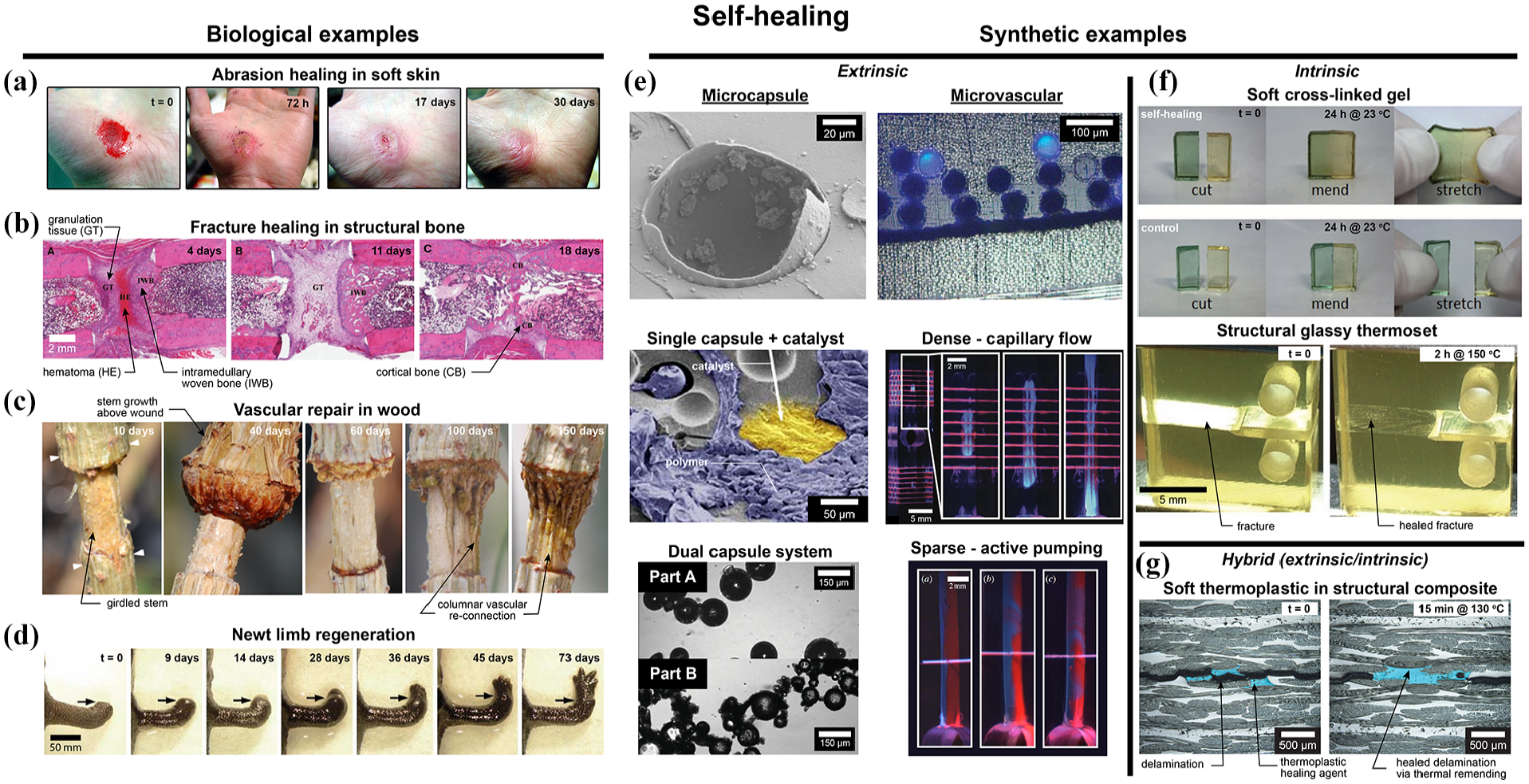
Self-healing Strategies. Biological examples: (a) healing of a skin abrasion on a human hand (Garg et al., 2017); (b) micrographs of internal fracture repair in rat cortical bone (Komatsu et al., 2009); (c) healing process of a girdled pine tree (pinus canariensis) stem and eventual restoration of the vascular connections for nutrient transport (Chano et al., 2015); (d) limb regeneration of an adult newt (cynops pyrrhogaster; Chiba et al., 2012). Synthetic examples: (e) extrinsic strategies include—(LEFT) micro-capsules dispersed within the host that (top) release polymerizable liquid healing agents upon fracture (White et al., 2001) and comprising either (middle) a one-part capsule system with a catalyst (Brown et al., 2005) or (bottom) a two-part healing agent system in segregated capsules (Cho et al., 2009); and—(RIGHT) vascular networks releasing reactive liquid agents upon rupture from (top) hollow-glass fibers (Trask et al., 2007) or (middle) dense microvasculature for passive capillary delivery (Hamilton et al., 2010) or (bottom) sparse micro-channels for active pumping to enhance mixing and self-healing (Hamilton et al., 2011); (f) intrinsic systems that leverage inherent reversible bonding include (top) polymer gels that heal at room temperature (Imato et al., 2012) and (middle) structural polymers that remend with added heat (Chen et al., 2002); and (g) hybrid intrinsic/extrinsic approach with thermoplastic healing agent (blue) in a fiber-composite to repair delamination (Turicek et al., 2025).
Although self-healing in synthetic materials has not yet reached the elegant complexity of biological systems, significant accomplishments have been made that are broadly categorized into extrinsic and intrinsic strategies. Extrinsic self-healing (Figure 1(e)) involves embedding external, often liquid, healing agents within a host material (Blaiszik et al., 2010; Cohades et al., 2018). Microcapsules or vascular networks typically sequester these agents and release their functional payload to fill damage (i.e., cracks), initiating a physical process (e.g., solvent evaporation) or chemical reaction (e.g., polymerization) for self-repair. Microcapsule-based strategies were among the first self-healing technologies (White et al., 2001) incorporating healing agents either in single (Brown et al., 2005) or dual (Cho et al., 2009) capsule schemes. While autonomous and effective at in situ filling/repair of micron-scale fractures, capsule systems are generally not repeatable, that is, they only heal damage once due to depletion of capsule contents. To address this shortcoming, researchers have developed microvascular networks that mimic biological vasculature (e.g., blood vessels) comprising single- and multi-dimensional channels/capillaries filled with liquid healing agent(s) (Hamilton et al., 2010, 2011; Hart et al., 2017; Pang and Bond, 2005; Patrick et al., 2014; Toohey et al., 2007; Trask et al., 2007). Vascular networks enable the repair of larger (up to mm-scale) damage (White et al., 2014) and can achieve multiple healing cycles, either by passive (autonomous) delivery (Hamilton et al., 2010; Patrick et al., 2014)—relying on capillary action—or via active pumping protocols to enhance in situ mixing and healing agent efficacy (Hamilton et al., 2011; Patrick et al., 2014). Researchers are exploring new strategies to overcome vascular blockages that can occur from cross-contamination of two-part agents and accumulation of healed polymer over repeated cycles (i.e., “scarring”). For example, creating branched networks akin to those found in natural materials, where redundant flow paths can circumvent damaged or blocked locations (Katifori et al., 2010). Furthermore, the need to self-repair fluidic conduits has been posed (Diesendruck et al., 2015; Qamar et al., 2020), but remains an outstanding challenge.
In contrast to these extrinsic approaches, intrinsic healing (Figure 1(f)) leverages reversible chemical bonds inherent to a material and thus, do not require external healing agents. In soft polymers (e.g., gels; Wei et al., 2014) and supramolecular rubbers (Cordier et al., 2008), healing is readily achieved at ambient conditions to rebond fractured surfaces that are placed in direct contact via dynamic covalent and non-covalent interactions (e.g., hydrogen and ionic bonding). However, structural (often cross-linked) polymers (Chen et al., 2002; Cohades et al., 2018) and vitrimers (Montarnal et al., 2011; Sharma et al., 2022) containing covalent adaptable networks typically require external energy input (e.g., heat) to overcome thermodynamic thresholds for damage repair, but can do so repeatedly with limited scarring. Hybrid (extrinsic/intrinsic) approaches have also been developed, which involve embedding external healing agents with intrinsic self-repair capabilities into a structural host. For example, incorporating phase-separated thermoplastic domains (Hayes et al., 2007; Jones et al., 2015) or particles (Meure et al., 2009; Pingkarawat et al., 2016), etc. into thermoset hosts (e.g., epoxy) have been shown to repair fractures via thermal remending. Promising recent work using remendable poly(ethylene-co-methacrylic acid) (EMAA) interlayers in epoxy-matrix fiber-composites has demonstrated the most reliable and repeatable in situ self-healing of interlaminar fracture to date with 100 successive cycles above 80% fracture recovery (Snyder et al., 2022).
While these various self-healing strategies can enhance material resilience, many of these systems alone lack autonomy (Aubin et al., 2024; Patrick et al., 2016). For example, in situ vascular healing with active pumping or thermal remending via heat require external energy input, and by themselves, are not autonomous since knowing that damage has occurred is necessary to trigger the repair response; note these strategies are still considered “self-healing” since locating the damage is not required. For these and other similar scenarios, autonomy can only be realized by integrating self-sensing capabilities (Aubin et al., 2024), enabling the material itself to activate repair (and ideally deactivate after healing).
3. Self-sensing damage
Nature accomplishes damage sensing via various techniques. For example, bruises (Figure 2(a)) serve as visual indicators of injury when trauma causes blood vessels to rupture followed by pooling beneath the skin’s surface (Lecomte et al., 2013). Plants, in addition to bruising, also incorporate other visual indications such as leaves changing color in autumn (Figure 2(b)) due to degradation of chlorophyll, revealing other pigments like anthocyanins (Lev-Yadun, 2022). Plants also exhibit chemical responses such as increased intracellular calcium ion concentration when damaged by feasting herbivores (Figure 2(c)). Similar to a central nervous system, the propagation of calcium serves as a long-range signaling mechanism, allowing unaffected parts of the plant to prepare and activate defense responses (Toyota et al., 2018), thereby enhancing overall resilience. Electrical signaling of damage is another technique exploited in biological systems, such as the brain responding to harmful stimuli by activating pain-specific perception regions as shown in the functional magnetic resonance imaging (fMRI) scans in Figure 2(d), which help organisms detect and react to harmful stimuli (De Ridder et al., 2021). Neurons communicate these electrical impulses along axons/dendrites and across synaptic connections (Figure 2(e)) to rapidly transmit damage-related information throughout the nervous system (O’Connor, 2012).
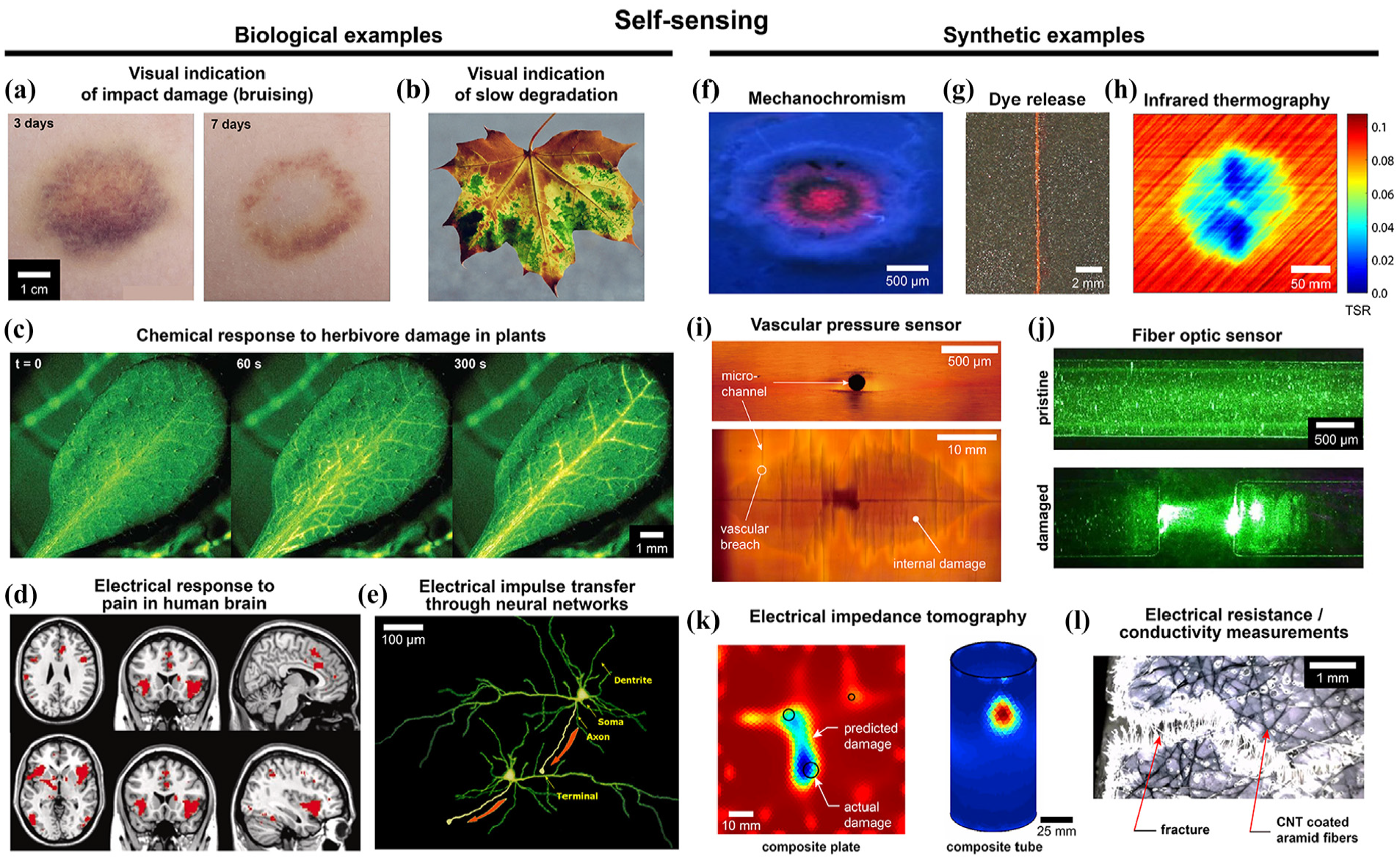
Self-sensing Strategies. Biological examples: (a) visual damage indication from skin bruising (Lecomte et al., 2013); (b) leaves changing color in autumn partly due to chlorophyll degradation (Lev-Yadun, 2022); (c) long-range signaling in plant leaves after herbivore attack by increasing intracellular calcium ion transport to mount a systemic defense response (Toyota et al., 2018); (d) functional magnetic resonance imaging (fMRI) scans showing the cerebral response to a pain stimulus (De Ridder et al., 2021); (e) neurons transferring electrical impulses to one another along axons and across synaptic terminals (O’Connor, 2012). Synthetic examples: (f) fluorescence in a mechanochromic coating after impact (Toivola et al., 2017); (g) scratch in a coating (vertical line) revealed by ruptured microcapsules releasing dye (Li et al., 2016); (h) thermal signal reconstruction (TSR) of impact damage in a carbon-fiber composite (Moradi et al., 2024); (i) comparative vacuum monitoring (CVM) signaling damage from pressure changes due to breached vasculature from internal damage (Minakuchi et al., 2014); (j) optical fiber sensing from light transmission changes after fracture (Wang et al., 2023); (k) electrical impedance tomography (EIT) spatial maps of internal damage in flat and curved composites (Hassan and Tallman, 2023; Thomas et al., 2019); (l) electrical resistance-based sensing from changes in conductive pathways due to fracture of carbon nanotube (CNT)-coated aramid fibers (Ahmed et al., 2018).
Just as with bioinspired self-healing techniques (Diesendruck et al., 2015), researchers have successfully adapted sensing strategies (Rifaie-Graham et al., 2018; Worden et al., 2007) into synthetic polymeric materials through: visual-based methods, pressure monitoring, optical fiber interrogation, acoustic-ultrasound techniques, and electrical impedance/resistance measurements (Chang et al., 2019; Güemes et al., 2020). Akin to bruising, mechanochromic coatings (Toivola et al., 2017) have been developed to reveal impact damage through color changes (e.g., fluorescence in Figure 2(f)). Along similar lines, microcapsules in a surface coating rupture upon scratching (Li et al., 2016), thereby releasing liquid dye (i.e., bleeding) resulting in color-change (Figure 2(g)) that intensifies with deeper damage, and offering a visual cue for assessing injury severity. Infrared (IR) thermography (Figure 2(h)) is another image-based sensing technique that exploits differential heat absorption/dissipation and is able to discern both surface and internal damage (Moradi et al., 2024). However, these visual-based methods require surface access and manual inspection/observation that may be difficult for certain structures, particularly those in extreme environments. Thus, more adept “remote sensing” methods have been developed.
Remote sensing strategies can be broadly divided into those that utilize embedded/attached sensors and those which leverage the material’s inherent properties for damage detection. Vascular-based comparative vacuum monitoring (CVM) is an established approach for damage detection (Chang et al., 2019; Güemes et al., 2020; Minakuchi et al., 2014) by measuring relative pressure drops across adjacent channels upon interconnected cracking (Figure 2(i)). Similar to pressure changes, optical fiber-based sensing (Figure 2(j)) can detect damage through changes in light transmission upon fracture of embedded waveguides (Garcia et al., 2010; Minakuchi and Takeda, 2013; Song and Peters, 2011; Wang et al., 2023). Other acoustic-based methods, instead, use surface mounted actuators/sensors (e.g., piezoelectrics) to generate and monitor ultrasonic waves, though scattering in anisotropic materials can complicate signal interpretation (Yadav et al., 2021). Electrical impedance tomography (EIT; Figure 2(k)) utilizes inherent electrical properties of a material (conductivity, impedance) to enable spatial mapping of damage (Hassan and Tallman, 2023; Thomas et al., 2019). Resistance-based measurements (Figure 2(l)) can also provide real-time health-assessment from changes in the flow of electrical current due to pathway disturbances from damaged conductive matrix, films, fillers, and fibers (Li et al., 2012; Ahmed et al., 2018; Zhang et al., 2015).
The assortment of successful sensing strategies demonstrates steady progress in developing damage detection schemes for engineered materials, but most approaches lack the integrated self-repair capability to track repeated damage and healing events. Addressing the key integration challenge of sensor repeatability is necessary to reach the level of sophistication found in advanced lifeforms.
4. Integrated self-sensing/healing
Achieving resilience and autonomy requires not only self-repair of the host material to restore mechanical integrity, but also self-repair of the sensor function to (a) enable repeatable damage detection and (b) to signal when sufficient healing has been accomplished (Song et al., 2020). Sensor repair alone has been achieved with both optical and electrical sensing modalities. For instance, optical fiber Bragg gratings (FBGs) for strain sensing have been shown to reconnect and restore light transmission after being severed (Figure 3(a)) by “self-writing” a new polymer waveguide in photo-active liquid monomer upon ultraviolet (UV) light exposure (Song and Peters, 2011). Figure 3(b) demonstrates another sensor repair route using magnetic-assisted wound closure to self-heal a yarn-based supercapacitor and restore the electrical circuit for future damage probing (Huang et al., 2015). Furthermore, optical and electrical sensing pathways have been realized in soft material hosts, where damage detection, self-healing, and sensor repair have all been accomplished. For example, elastomeric polyurethane urea (sPUU) optical fibers (Figure 3(c)) used for motion control sensing in a soft robot also exhibit repeated damage detection and self-healing at room-temperature (Bai et al., 2022). Other supramolecular polymers with embedded nickel microparticles (Figure 3(d); Tee et al., 2012) or biopolymers doped with conductive nanomaterials (e.g., chitosan/carbon nanotubes; Wu et al., 2018) produce soft composite systems with electrical sensing and intrinsic healing capacity. Each of these impressive examples in soft materials can accomplish repeated cycles of self-healing and self-sensing (both damage and repair) due to the concurrent ability to repair the host material and onboard sensing element.
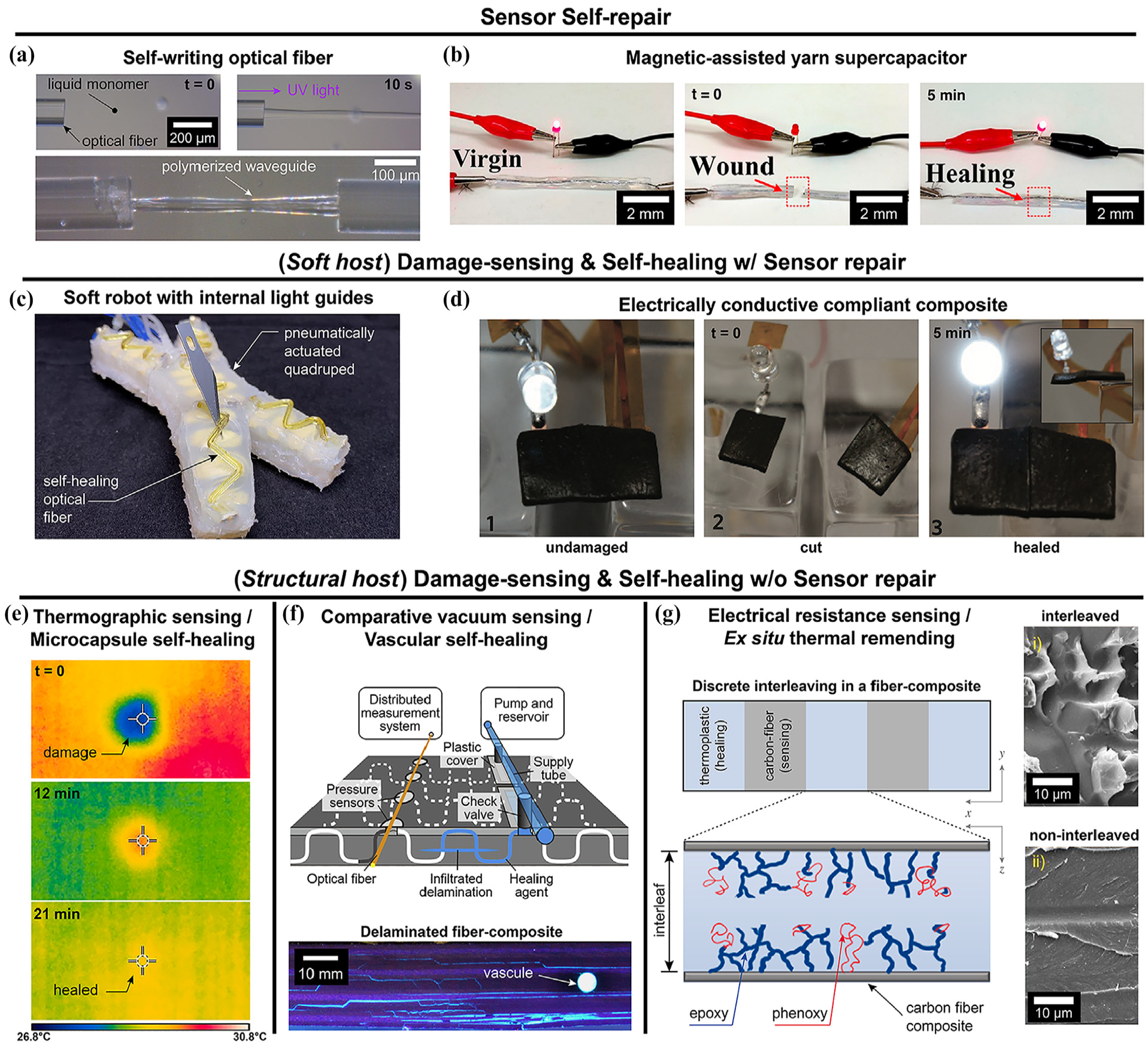
Integrated Self-sensing and Self-healing. Sensor repair (no host): (a) restoring a cleaved optical fiber via UV-light polymerization of photo-active monomer (Song and Peters, 2011); (b) magnetic-assisted healing of a severed yarn supercapacitor (Huang et al., 2015). Damage-sensing and self-healing with sensor-repair (soft host): (c) elastomeric optical waveguides that self-repair at room temperature upon surface contact for continued motion sensing/control of a soft robot (Bai et al., 2022); (d) supramolecular self-healing polymer with embedded nickel microparticles for electrical resistance sensing and conductivity restoration (Tee et al., 2012). Damage-sensing and self-healing without sensor repair (structural host): (e) time-lapse infrared (IR) thermography showing the exothermic chemical reaction from released microcapsule contents during self-healing of internal damage (Yuan et al., 2024); (f) (top) schematic of a vascular-based pressure sensing system to automatically trigger active pumping of healing agent and repair composite delamination (Sakurayama et al., 2015), and (bottom) cross-section of self-healed fiber-composite under a similar sensing/delivery scheme (Norris et al., 2012); (g) in situ electrical resistance sensing of a conductive carbon-fiber composite and ex situ thermal remending of a discretely patterned thermoplastic interleaf (Thorn et al., 2024).
However, the integration of in situ self-sensing and self-healing in structural materials has been limited to a single damage/repair cycle either from lacking the ability to repair the sensor, or healing being achieved ex situ with human intervention (non-autonomic). Though, a few notable studies have made progress toward this sought-after sensing/healing synchrony. One example in a fiber-composite combines dual epoxy and mercaptan microcapsules for autonomous matrix/interface repair along with IR thermography to track healing-induced exothermic reactions (Yuan et al., 2024), providing damage localization and real-time repair monitoring (Figure 3(e)). Another sensing/healing approach leveraged by several research groups in structural composites integrates comparative vacuum monitoring (CVM) with vascular self-healing (Figure 3(f)), where fracture-induced pressure changes automatically trigger active delivery of pre-mixed healing agents through the micro-channels into the damage zone, thereby being autonomous (Minakuchi et al., 2014; Norris et al., 2012; Sakurayama et al., 2015). However, after the first self-healing event, the vasculature is blocked by polymerized healing agent, preventing future functionality. Vascular-based electrical sensing has also been accomplished in a carbon-fiber composite by injecting a conductive liquid healing agent doped with multi-walled carbon nanotubes into micro-cracks to sense damage and the delivery of healing agent for a single cycle (Wu et al., 2012). Along a similar path, sensing via the inherent electrically conductive nature of carbon-fiber composites has been combined with thermoplastic interleaves to enable ex situ healing of interlaminar delamination by thermal remending. In a first study (Thorn et al., 2023), despite the dielectric interleaves prohibiting damage sensing in the first test cycle, healing via hot-press compaction (50 bar at 180°C) established new conductive pathways between entangled carbon-fibers that were frayed during fracture. In a subsequent study (Thorn et al., 2024), by only discretely patterning carbon-fiber reinforcement with the thermoplastic healing agent (Figure 3(g)), crack propagation on the virgin cycle could be correlated to electrical resistance changes. However, in this case, conductivity restoration was not restored after remending, and neither approach distinguished between apparent recovery (i.e., fiber contact from crack closure) and actual fracture repair. This again highlights an important, but often overlooked aspect of integrated sensing/healing.
Thus, despite many of these noteworthy advancements, achieving autonomous in situ damage sensing and self-healing along with sensor restoration to confirm mechanical self-repair, both repeatably and reliably within a structural material remains a significant challenge to the multifunctional materials community, underscoring the need for further research and development.
5. Challenges and opportunities
Steady progress toward autonomous and repeatable self-sensing/healing in structural polymeric materials has created newfound opportunities to overcome longstanding challenges. One requisite for fiber-reinforced composites is advancing current self-healing approaches, which primarily address matrix damage and interlaminar delamination, to also repair fiber breakage, which in many cases governs load-bearing capacity (Cantwell and Morton, 1992). Engendering the ability to self-heal not only in the service environment (i.e., in situ), but also while under load will provide a clear pathway to real-world translation where further technology refinement can occur. Concurrently, innovative techniques that–like biology–can repair vascular conduits (Chano et al., 2015; Diesendruck et al., 2015) will be necessary to achieve higher levels of repeatability in micro-channel based systems (Qamar et al., 2020). Circumventing synthetic “scarring” from residual damage or healing agent accumulation over multiple repair cycles is also necessary for repeated sensing and repair functionality. Thermally activated intrinsic repair of thermoplastics (Snyder et al., 2022) and dynamic covalent adaptable networks (e.g., vitrimers (Sharma et al., 2022)) are a promising pathway to overcome such scarring and enable repeatable—perhaps perpetual—repair in structural composites. Creating such self-healing mechanisms that function with minimal external energy input for target applications without increased complexity is essential for broadening their practical use (Diesendruck et al., 2015; Patrick et al., 2016). Furthermore, repairing both the mechanical integrity of the material and the sensor functionality is necessary to ensure autonomy over multiple damage/heal cycles. One possible strategy is to employ sensors that have similar healing requirements to the host material such that restoring sensing is indicative that self-healing has also been accomplished. The durability and effectiveness of self-healing systems, particularly in harsh environments (e.g., space), remain largely unexplored. This necessitates research into the long-term behavior of healing agents and their interaction with host materials outside the laboratory. Integrating sensing/healing capability into existing and new manufacturing processes (e.g., frontal polymerization; Robertson et al., 2018) will help close the gap to industrially transferable solutions. Researchers and practitioners must also work to develop standardized testing methods and validation protocols that reliably compare different self-healing approaches across soft and structural materials systems. Moreover, developing multi-physics forward models to accurately capture damage, healing, and reliable inversion methods to relate sensing to mechanical behavior is essential and will accelerate development by alleviating bulk reliance on experiments. Furthermore, integrated decision-making (either via material-level logic or onboard computations) is needed to fully realize structural autonomy, where the extent of damage and self-repair can be quantitatively assessed in situ without requiring any human input.
Despite numerous research challenges remaining, fervent efforts over the past two decades have led to significant progress toward envisioned biomimetic materials. Leveraging longevity lessons from nature, such interdisciplinary engineering signifies a paradigm shift toward more sustainable and smart polymeric materials that can: (1) self-heal mechanical damage, (2) sense both damage and self-repair, (3) do so reliably and repeatably in situ, and (4) autonomously without human intervention. There is a promising outlook for even further multi-functionality (e.g., thermal regulation, electromagnetic reconfiguration) by adapting existing strategies, e.g., vascular transport (Devi et al., 2021). Ultimately, these intelligent materials and structures have the potential to revolutionize related industries by providing safer, more resilient, and sustainable products that embody the elegance, efficiency, and adaptability of nature’s designs.
Footnotes
Declaration of conflicting interests
The authors declared no potential conflicts of interest with respect to the research, authorship, and/or publication of this article.
Funding
The authors disclosed receipt of the following financial support for the research, authorship, and/or publication of this article. The authors express their sincere thanks to Dr. Byung-Lip (“Les”) Lee, the US Air Force Office of Scientific Research (AFOSR) program manager for his futuristic vision and financial sponsorship through grant FA9550-23-1-0480.

Data availability statement
Data sharing not applicable to this article as no datasets were generated or analyzed during the current study.