







Abstract
Magnetorheological fluids and greases are intelligent materials capable of reversibly changing their rheology under a magnetic field. This study evaluated six formulations containing 25 vol.% carbonyl iron particles, HS grade (BASF, Germany), dispersed in: purified lanolin; a pre-formulated mineral oil–based semisolid matrix structured with polyethylene wax and added with 4 wt.% PTFE; three commercial greases (with molybdenum disulfide, or PTFE, or lithium soap); and a perfluoropolyether oil. Four-ball tests (ASTM D- 4172/D-2266) were performed with and without magnetic field application (H ≈ 120 kA·m−1). The commercial greases exhibited catastrophic wear, whereas the semisolid matrices successfully completed the test. The formulation based on the mineral oil–polyethylene (PE) wax semisolid matrix with PTFE addition (field on) showed the lowest coefficient of friction (≈0.083 ± 0.004) and a wear scar diameter of 773 µm, attributed to the alignment of ferromagnetic particles and the formation of a protective film. The formulation with lanolin (field off) displayed the lowest surface roughness (Ra < 6 µm) and a wear scar of 796 µm, due to the high cohesiveness and adhesive nature of lanolin, which keeps the iron particles suspended and maintains the lubricating film. The tribological performance results from distinct mechanisms: lanolin iron grease favors film stability, whereas mineral oil-PE-PTFE iron grease promotes particle organization under magnetic field.
Keywords
Introduction
Magnetorheological (MR) fluids are suspensions composed of ferromagnetic particles dispersed in a fluid matrix, whose shear resistance varies reversibly under the influence of an external magnetic field. Since the original formulation proposed by Jacob Rabinow (1948), these materials have been extensively studied for their fast and controllable response, characteristics that make them suitable for use in vibration control systems, actuators, and automotive devices. They are classified as intelligent materials, as they exhibit a rheological transition from liquid to semisolid state within milliseconds (<10 ms) in a fully reversible manner—a phenomenon attributed to the formation of aligned particle chains and structures under the applied magnetic field (Roupec et al., 2021).
According to Dong et al. (2024), the rheological behavior of MR fluids can be described by constitutive models of the Bingham or Herschel–Bulkley type, characterized by the existence of an initial yield stress (τ0) required to initiate flow. Structurally, these fluids are colloidal suspensions composed of ferromagnetic particles such as iron (Fe) or cobalt (Co), or ferrimagnetic particles such as mixed iron oxides (Fe3O4) and/or nickel ferrites (NiFe2O4), dispersed in a nonmagnetic matrix, generally oily or semisolid.
The viscoplastic behavior of these systems is of great relevance in applications that require dynamic control of motion and damping, as it allows immediate variation of stiffness and energy dissipation according to the intensity of the applied magnetic field. According to the Bingham model, the material remains rigid while (τ < τ0) and begins to flow only when the applied stress exceeds this limit, thereafter, exhibiting linear behavior, as expressed in equation (1):

Where (
Physically, the yield stress reflects the formation of aligned structures of ferromagnetic particles that resist shear until the applied energy is sufficient to break the field-induced network. Thus, the magnetorheological fluid reversibly alternates between fluid and semisolid states depending on the magnetic field, characterizing a viscoplastic material with controllable response.
In engineering applications, magnetorheological fluids and greases do not operate exclusively under ideal rheological conditions, such as uniform shear fields, homogeneous magnetic-field distribution, and absence of direct solid–solid contact. Devices such as brakes, clutches, dampers, and vibration-control systems are subjected to continuous mechanical contact, high contact pressures, and continuous or variable shear regimes. Under these conditions, tribological behavior becomes a critical factor, since excessive friction levels, lubricating-film instability, or accelerated wear may compromise surface integrity, operational reliability, and the service life of systems based on magnetorheological technology.
Therefore, an integrated analysis of magnetically induced particle structuring, the physicochemical properties of the lubricating matrix, and the wear mechanisms involved is essential for the effective application of these materials.
Current scientific interest is not limited to the rheological behavior of these systems but increasingly extends to the tribological effects resulting from the presence of metallic particles in relative motion. When carbonyl iron is incorporated into the matrix, an increase in stiffness and yield stress is observed under the applied magnetic field; however, wear mechanisms associated with abrasion, surface fatigue, and the formation of discontinuous tribofilms also emerge. Investigation of these interactions is therefore essential to understanding the functional durability of MR fluids in applications involving continuous mechanical contact and high cyclic loads.
With respect to the tribological behavior of magnetorheological (MR) fluids, the scientific literature has consistently identified the wear of carbonyl iron particles and contacting interfaces as one of the primary factors associated with in-use thickening (IUT) and the progressive degradation of performance under high shear and load conditions. In conventional oil-based MR fluid formulations, metal–metal contact between magnetic particles intensifies abrasive and adhesive wear mechanisms, leading to persistent alterations in rheological behavior and a gradual loss of functional stability during operation.
In this context, carbon-based solid additives have been extensively investigated as an effective strategy for wear mitigation. Lv et al. (2022) demonstrated that the incorporation of nonpolar oil-soluble graphene significantly enhances the tribological performance of MR fluids, achieving wear volume reductions of up to 90%. This improvement was primarily attributed to the increased load-bearing capacity of the carrier fluid, as well as to the formation of protective carbonaceous films that reduce direct contact between magnetic particles. The authors further reported a reduction in off-state viscosity and a mitigation of the IUT phenomenon, associated with particle isolation and gap filling within the fluid microstructure.
In a complementary study, Thakur and Sarkar (2021) investigated the use of graphite flakes as additives in MR fluids applied to clutch systems operating under shear mode. Their results indicated that the lamellar structure of graphite promotes solid lubrication, reduces friction-induced heating, and contributes to improved torque transmission stability under continuous mechanical contact, as evidenced by reduced surface damage and enhanced worn-surface topography.
Despite these advances, existing studies predominantly focus on liquid-phase-based systems, in which tribological performance remains strongly dependent on the dispersion stability of solid additives and the persistence of interfacial films under severe shear regimes. In contrast, investigations dedicated to magnetorheological systems structured by complex viscoplastic matrices such as those based on lanolin or polyethylene waxes combined with PTFE remain limited. In such systems, load-bearing capacity, lubrication behavior, and wear mitigation mechanisms are intrinsically governed by the structural characteristics of the continuous matrix itself.
Accordingly, the present study is justified by the need to systematically evaluate how structured semisolid matrices influence surface protection mechanisms, tribological stability, and the functional durability of magnetorheological systems under conditions of mechanical contact and severe shear, thereby expanding the scope of approaches predominantly based on the incorporation of solid additives into liquid phases.
Regarding the composition of the carrier phase, the structural and chemical nature of the continuous medium is a decisive factor in determining both tribological and rheological performance. Jonsdottir et al. (2010) investigated MR fluids based on perfluorinated polyether (PFPE) oils, emphasizing their chemical stability and suitability for prosthetic applications; however, these systems function primarily as high-viscosity liquid carriers. In contrast, the use of semisolid matrices has been explored to address stability challenges. Sun et al. (2019) demonstrated that magnetorheological greases (MRGs) formulated with lithium soap provide excellent resistance to sedimentation, although their analysis focused on Bingham rheological parameters rather than interfacial wear mechanisms. Furthermore, Raj et al. (2021) examined PTFE-based greases fortified with MoS2 additives, observing that the synergy between solid lubricants and the grease matrix enhances yield stress and thermal stability under varying temperatures. Therefore, a gap can be identified in the literature concerning the systematic comparison of the tribological efficiency of perfluorinated oils and complex viscoplastic matrices under high-load and severe shear conditions.
Classical magnetorheological fluid formulations employ mineral or synthetic oils as the continuous phase and frequently rely on stabilizing additives such as fumed silica, metallic soaps, and surfactants to suppress sedimentation and maintain suspension homogeneity. Although such additives are widely recognized as effective agents for improving colloidal stability under static or low-shear conditions, they are also associated with an increase in static viscosity and the development of more rigid microstructural networks, which may adversely affect performance under severe shear regimes and continuous mechanical contact.
Accordingly, replacing the liquid phase with semisolid matrices, such as greases, has emerged as a technically viable alternative (Dong et al., 2024; Li et al., 2023; Mohamad et al., 2016) since the three-dimensional network structure of these matrices provides morphological stability and can mitigate the wear induced by the presence of metallic particles.
In this context, the present study aims to analyze the tribological behavior of magnetorheological systems formulated by the addition of HS-grade carbonyl iron powder (BASF; mean diameter ∼2 µm; purity > 99.5%) with high magnetic permeability (Bedi and Singh, 2019) to different continuous media. A total of six formulations were evaluated: three commercial greases—(a) a white polyalphaolefin-based grease thickened with aluminum soap and PTFE (FOODLUBE® UNIVERSAL 2, ROCOL; hereafter designated WG); (b) a red mineral-oil-based grease thickened with lithium soap (W-CL, Würth; designated RG); and (c) a black mineral-oil-based grease thickened with lithium soap and containing graphite and molybdenum disulfide additives (GBM-2, Würth; designated BG). In addition to these three commercial greases, two distinct semisolid matrices were also investigated: (d) purified lanolin Pharmalan™ USP, of natural organic origin; and (e) a synthetic semisolid lubricating base Crodabase™ SQ-SS-(BR) CB60040, composed of mineral oil and polyethylene; as well as (f) a perfluoropolyether oil (Krytox VPF 1525, Chemours; designated KX).
The samples were tested without and with the application of a magnetic field (H ≈ 120 kA·m−1), while maintaining a fixed carbonyl iron volumetric fraction of 25% v/v, a value established based on previous results related to stability and magnetic responsiveness (Barbosa, 2025).The formulation based on purified lanolin (Pharmalan™ USP; Barbosa and Bombard, 2025a) and the formulation composed of Crodabase™ SQ-SS-(BR) CB60040 added with 4 wt.% of micronized polytetrafluoroethylene (PTFE, Zonyl™ MP 1100, Chemours; Barbosa and Bombard, 2025b) are the subject of corresponding patent applications, both associated with the present research. The analyses reported in the respective technical dossiers demonstrated reversible behavior under magnetic field and structural stability without the use of conventional stabilizing additives. Standardized tribological tests (ASTM International, 2017, 2018), conducted under the conditions described in the methodology, indicated that employing semisolid matrices as the continuous phase reduce both the coefficient of friction and the wear-scar diameter, promoting homogeneous dissipation of shear energy and mitigating the abrasive wear characteristic of conventional magnetorheological fluids.
Accordingly, the present investigation focuses on the analysis of wear and tribological performance of magnetorheological suspensions formulated with semisolid matrices and a perfluoropolyether oil. The objective is to demonstrate that combining these matrices with HS- grade carbonyl iron powder can reduce the inherent abrasiveness of such systems, balancing the magnetorheological response with the need for surface protection and stability under boundary lubrication conditions.
Methodology
Materials and formulation
The weighing of components was carried out using a PB 3002 semi-analytical balance (Mettler Toledo, Brazil). HS-grade carbonyl iron powder (BASF, Germany), with spherical morphology, mean particle diameter of approximately 2 µm, and purity higher than 99.5%, was incorporated into the formulations at a volumetric fraction of 25% (v/v), corresponding to approximately 58% or 75% by mass (m/m), considering the densities of iron (7.87 g·cm−3) and the lubricating matrices (0.87 or 1.90 g·cm−3; Barbosa and Bombard, 2025b). This proportion was adopted based on previous studies of stability and magnetorheological response, ensuring good particle dispersion and consistent rheological behavior under the applied magnetic field.
Twelve formulations were evaluated, coded as BG, RG, WG, CZ, NP, and KX, as well as their counterparts containing HS-grade carbonyl iron, designated BGHS, RGHS, WGHS, CZHS, NPHS, and KXHS. The first three correspond to commercial greases (BG, RG, WG), two to semisolid matrices (NP, CZ), and one to a perfluorinated oil (KX). The samples were tested both in their pure states (Figure 1) and with HS iron addition (Figure 2).
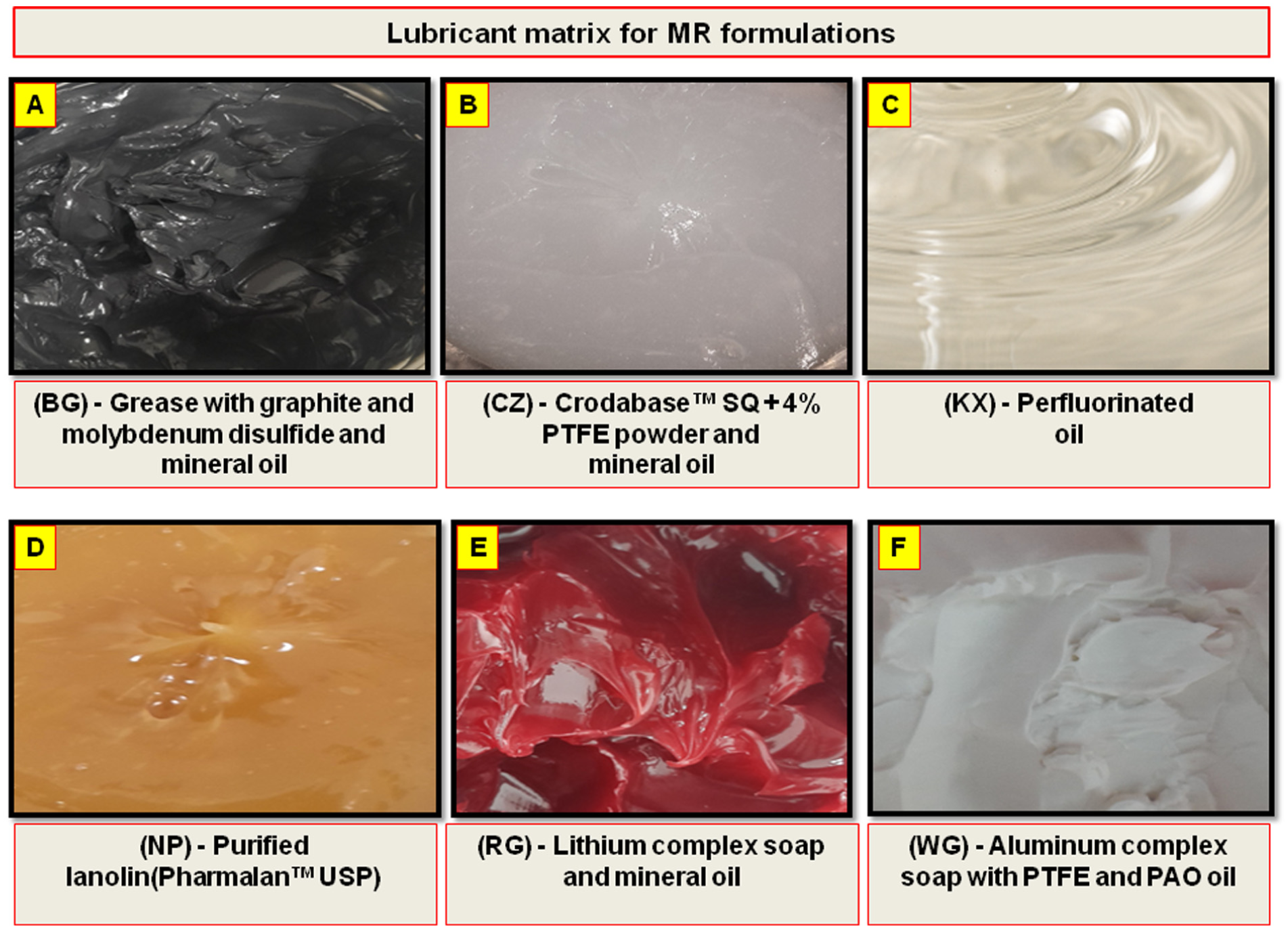
Lubricating matrices employed in the magnetorheological (MR) formulations. (a) BG (graphite and MoS2 grease), (b) CZ (Crodabase™ SQ+4% PTFE), (c) KX (perfluorinated oil), (d) NP (purified lanolin, Pharmalan™ USP), (e) RG (lithium soap grease), and (f) WG (aluminum complex grease with PTFE and PAO oil).
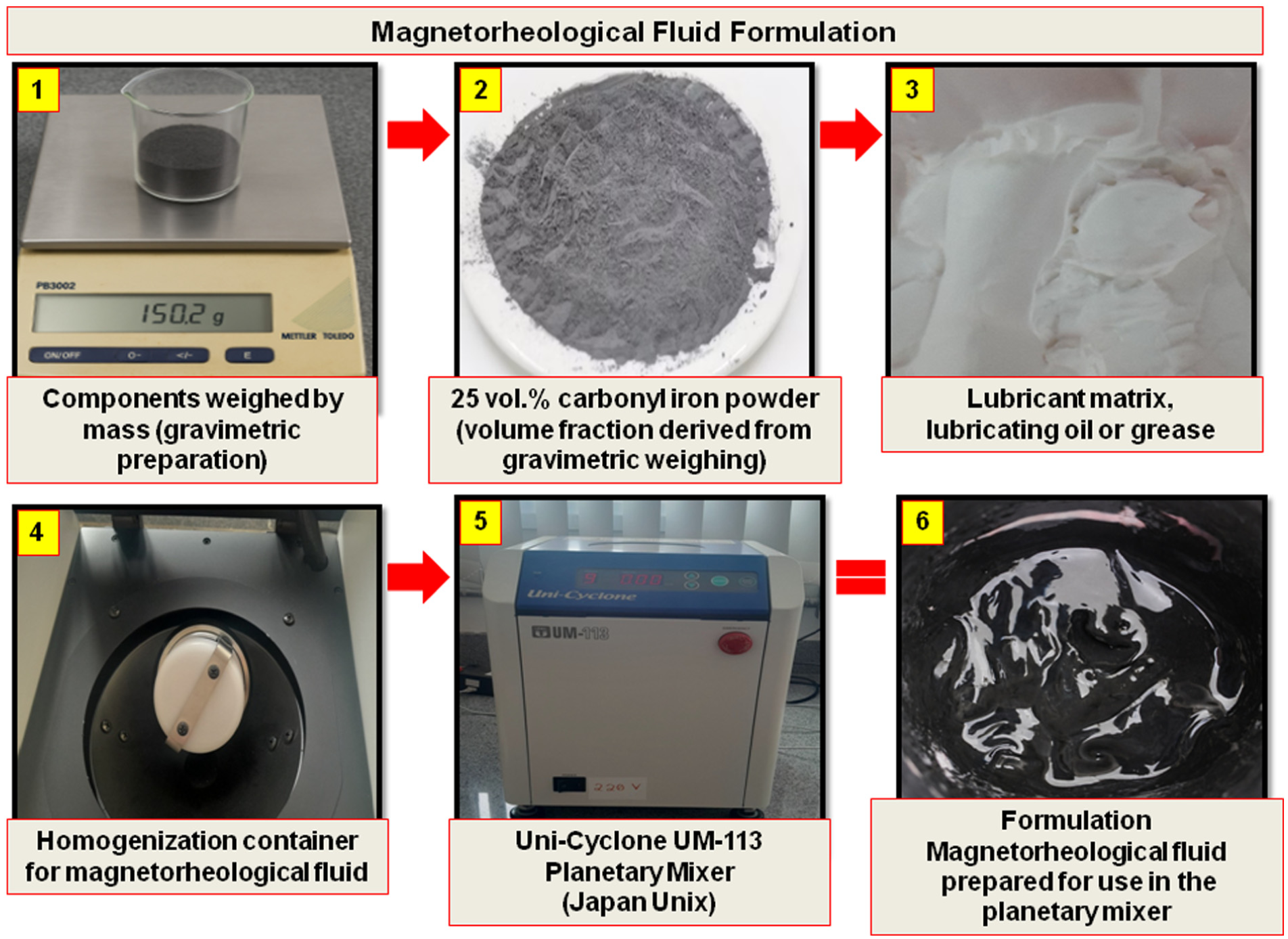
Stages of preparation of the magnetorheological (MR) formulations: (1) weighing of components, (2) addition of 25 vol.% carbonyl iron powder (volume fraction derived from gravimetric weighing), (3) selection of the lubricant matrix (oil or grease), (4) preliminary mixing, (5) placement in the homogenization container, and (6) mixing in the Uni-Cyclone UM-113 planetary mixer (Japan UNIX, Japan), yielding a homogeneous magnetorheological formulation.
The semisolid matrices purified lanolin (Pharmalan™ USP) and Crodabase™ SQ-SS-(BR) CB60040 exhibit consistency and viscoelastic behavior comparable to those of greases but differ from them by the absence of structural thickeners. While conventional greases are ternary systems composed of base oil, thickener, and additives, the semisolid matrices used here are homogeneous lubricating materials. Lanolin is a natural mixture of esters of long-chain alcohols and fatty acids, whereas Crodabase™ is a synthetic base consisting of mineral oil and polyethylene. The CZ formulation additionally received 4 wt.% of micronized polytetrafluoroethylene (PTFE; Zonyl™ MP 1100), used as a surface modifier and friction reducer.
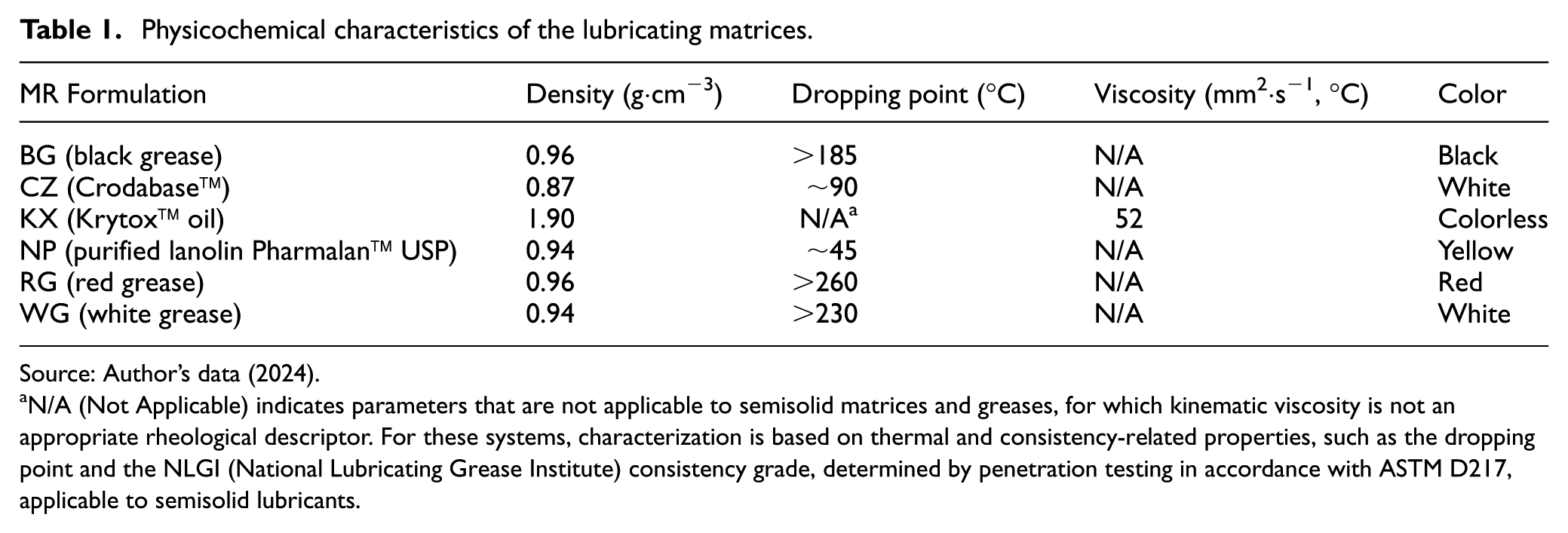
Table 1 presents the main physicochemical properties of the greases and the perfluorinated oil used as lubricating matrices parameters relevant to the analysis of thermal stability and tribological performance.
Physicochemical characteristics of the lubricating matrices.
Source: Author’s data (2024).
N/A (Not Applicable) indicates parameters that are not applicable to semisolid matrices and greases, for which kinematic viscosity is not an appropriate rheological descriptor. For these systems, characterization is based on thermal and consistency-related properties, such as the dropping point and the NLGI (National Lubricating Grease Institute) consistency grade, determined by penetration testing in accordance with ASTM D217, applicable to semisolid lubricants.
It should be noted that kinematic viscosity is a parameter applicable exclusively to homogeneous fluids and is therefore reported only for the perfluorinated oil (KX). In contrast, greases and semisolid matrices are characterized by different thermal and rheological parameters, such as the dropping point, which are more appropriate descriptors of their physicochemical behavior.
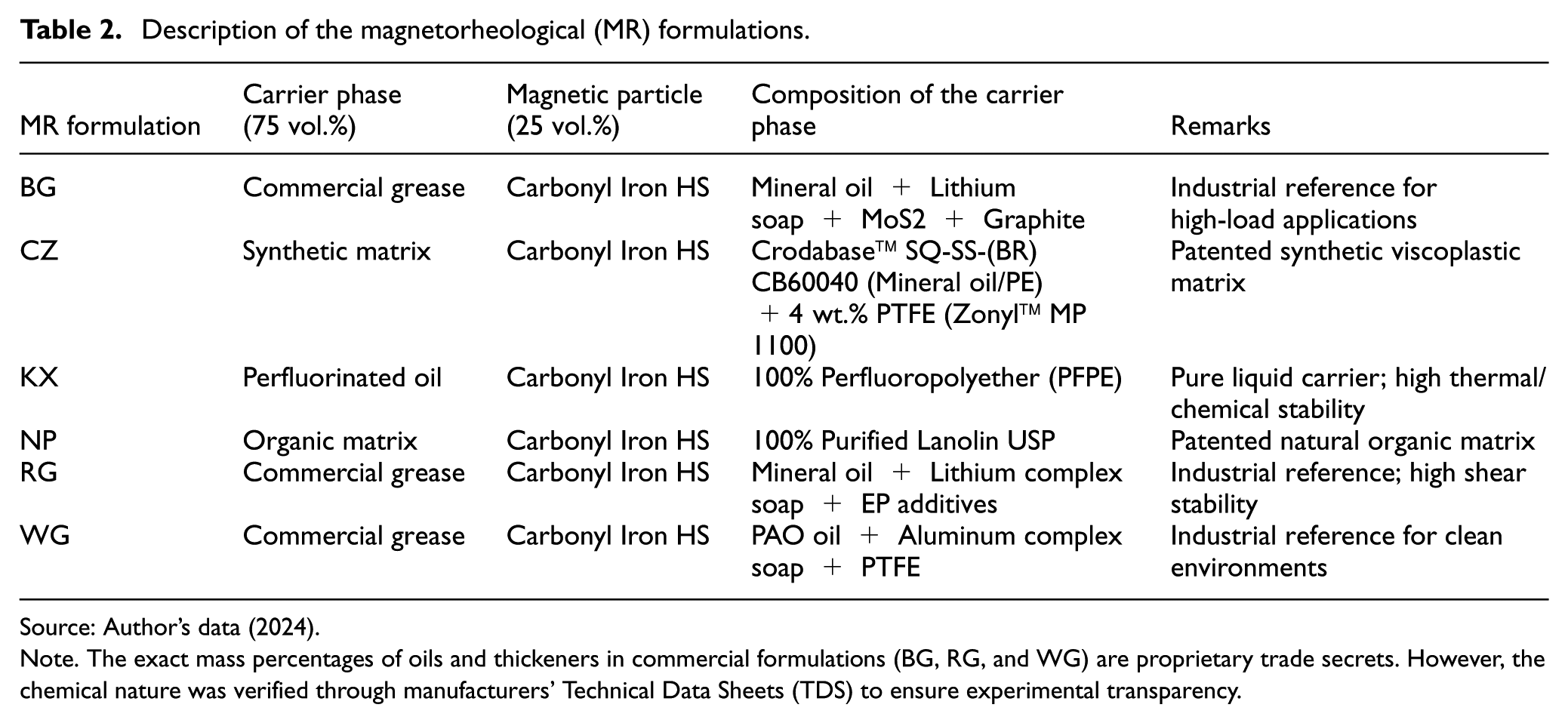
These characteristics confirm the rheological and thermal diversity of the selected bases, which directly influence carbonyl iron dispersion and the stability of lubricating films. Based on these physicochemical properties, six magnetorheological (MR) formulations were prepared for tribological testing. Table 2 describes their compositions, specifying the nature of each lubricating matrix and the role of structural components and additives. This distinction among greases, semisolid matrices, and perfluorinated oil is essential for comparative analysis of tribological behavior and stability under an applied magnetic field.
Description of the magnetorheological (MR) formulations.
Source: Author’s data (2024).
Note. The exact mass percentages of oils and thickeners in commercial formulations (BG, RG, and WG) are proprietary trade secrets. However, the chemical nature was verified through manufacturers’ Technical Data Sheets (TDS) to ensure experimental transparency.
The mixtures were homogenized using a Uni-Cyclone UM-113 planetary mixer (Japan Unix, Japan) operating at 1200 rpm for three successive 10-min cycles at room temperature (25°C–30°C; Figure 2(5)). For the CZ formulation, PTFE was pre-dispersed in the semisolid base prior to incorporation of carbonyl iron to ensure uniform particle distribution.
No external dispersing, thixotropic, or emulsifying additives were used, to assess the intrinsic behavior of the matrices upon iron addition.
After homogenization, the samples were allowed to rest until thermal equilibrium was reached and were then stored in hermetically sealed containers for 24 h to allow initial stabilization. At the end of this period, a qualitative visual inspection was performed, and no phase separation or macroscopic sedimentation was observed, indicating initial compatibility between the carrier phase and the carbonyl iron prior to tribological testing.
Tribological test (4-ball)
The tribological tests were performed using a TE92-HS (High Speed) tribometer (Phoenix Tribology Ltd., United Kingdom), Figure 3(a), in accordance with ASTM International (2017, 2018) standards. The method employed was the 4-Ball test, in which three stationary balls are arranged in an equilateral triangle, while a fourth ball, positioned above them, rotates under a controlled load. The system is equipped with a load cell and a torque sensor, enabling continuous monitoring of the coefficient of friction (COF) and torque (T) throughout the test.
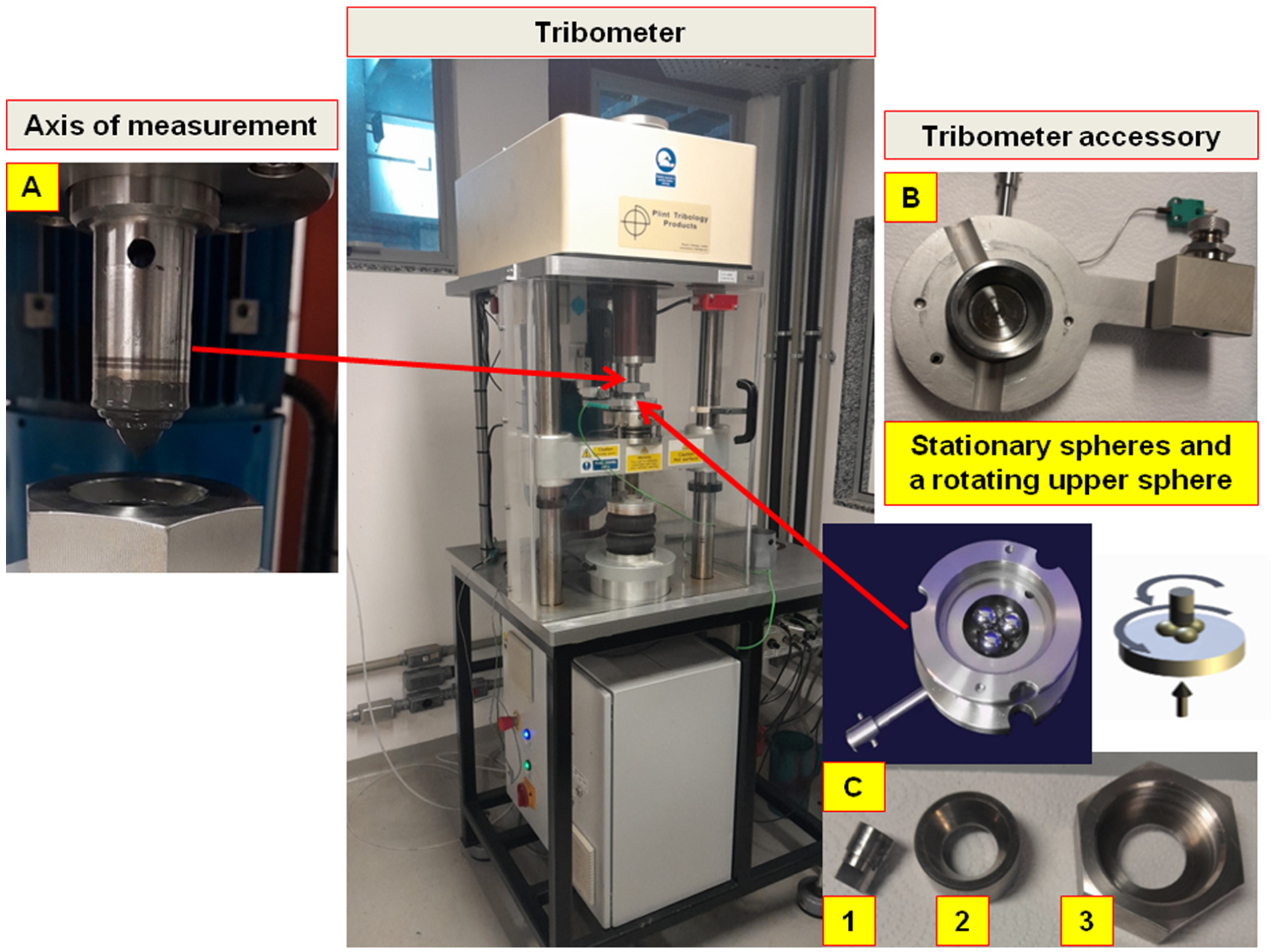
TE92-HS tribometer (Phoenix Tribology Ltd., United Kingdom) used in the 4-ball tests. The figure shows the main equipment, the mounting accessories, and the Ball assembly: (a) view of the tribometer during testing, highlighting the load-application axis, (b) ball holder for the three stationary balls, and (c) fastening components—(1) chuck for mounting the upper Ball, (2) locking mechanism for the sample holder, and (3) threaded adapter.
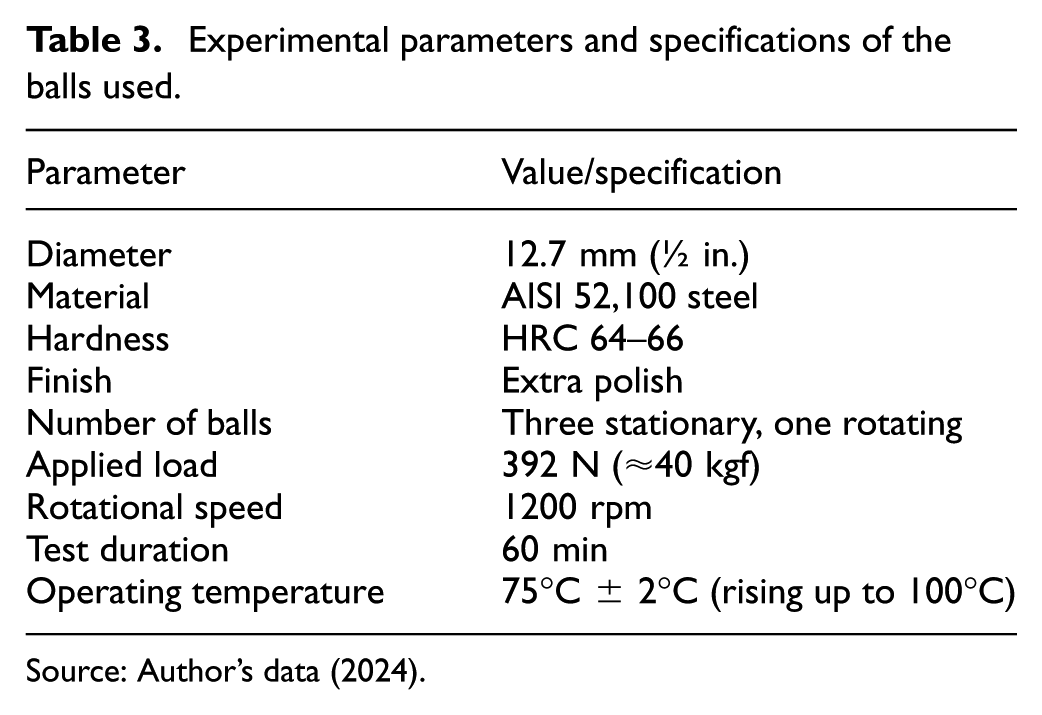
After assembly, the system is activated and the temperature stabilizes within approximately 20 min, reaching 75°C ± 2°C. A load of 392 N (≈40 kgf) is then applied at a rotational speed of 1200 rpm for 60 min. The experimental parameters and the specifications of the balls used are presented in Table 3, which summarizes the main operating conditions of the 4-Ball test. Experimental data are acquired and processed using the Compend 2000 software, which continuously records the coefficient of friction (μ) and torque (T). After each test, the four balls are removed, cleaned in an ultrasonic solvent bath, labeled, and stored in hermetically sealed zip-lock bags for subsequent microscopic analysis.
Experimental parameters and specifications of the balls used.
Source: Author’s data (2024).
In the tests conducted under a magnetic field, two neodymium (NdFeB) magnets were applied symmetrically with respect to the axis of the ball holder one on each side of the threaded fixture—at an approximate distance of 60 mm (Figure 4).
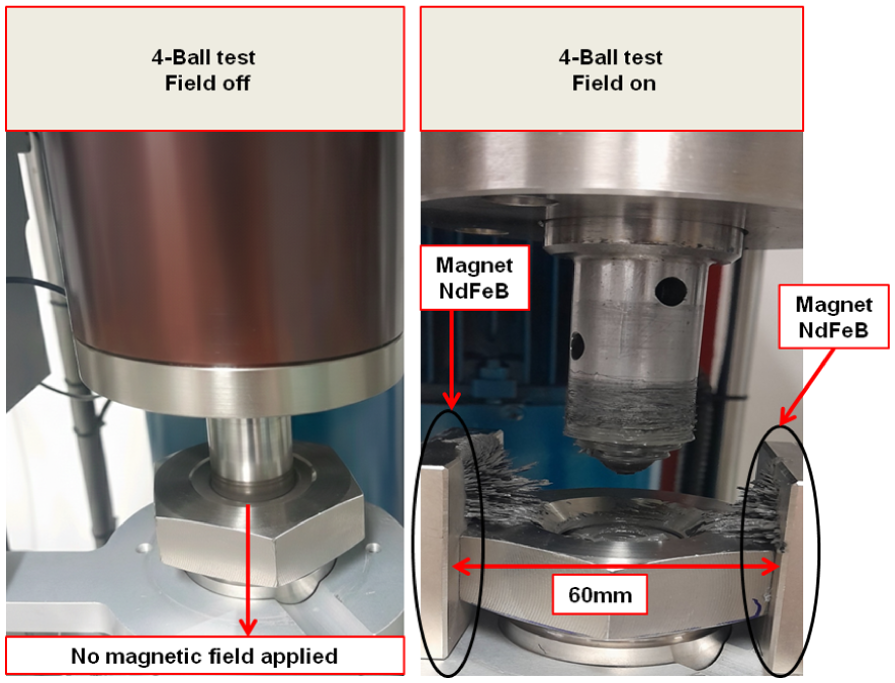
4-Ball test setup under different magnetic field conditions. Left: system operating without magnetic field (field off). Right: system with magnetic field applied (field on), generated by two neodymium–iron–boron (NdFeB) permanent magnets positioned symmetrically relative to the ball holder, separated by approximately 60 mm.
The intensity of the applied magnetic field was determined by measurement using a previously calibrated digital gaussmeter. As illustrated in the experimental scheme presented in Figure 5, the probe of the instrument was positioned in the contact region between the balls, corresponding to the effective region of action of the magnetic field (B) during the tribological test.
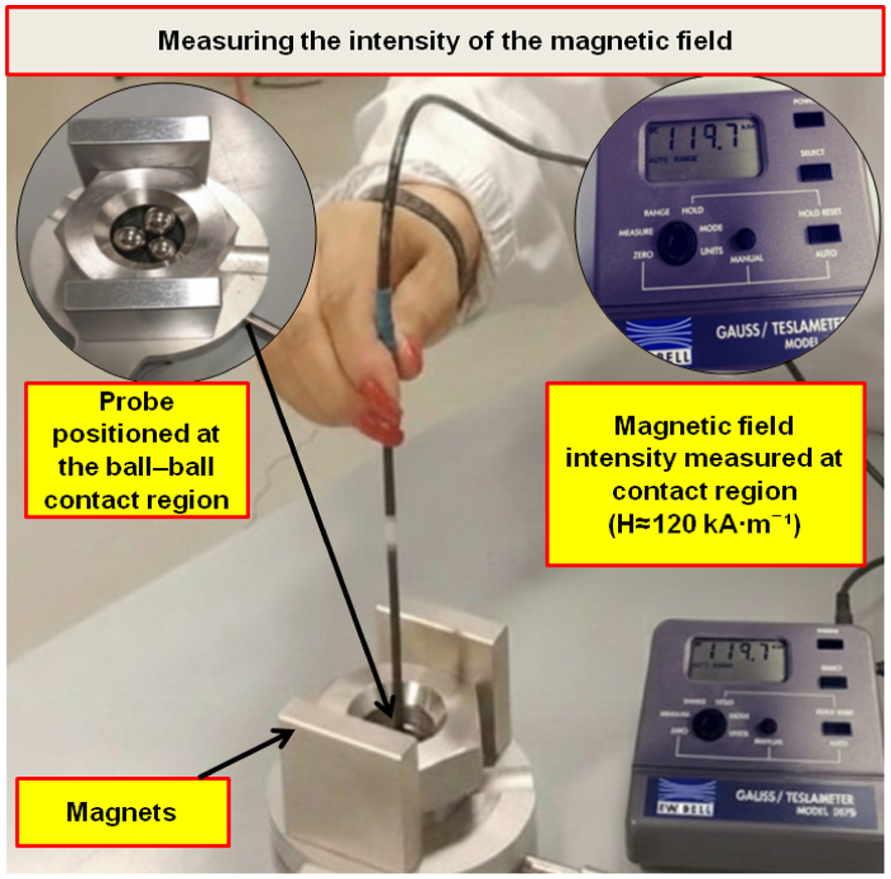
Experimental procedure for measuring the applied magnetic field during the 4-ball test, with the gaussmeter probe positioned at the contact region between the balls. Experimental procedure for measuring the magnetic field intensity applied during the 4-ball test. The gaussmeter probe is positioned at the contact region between the balls, allowing direct determination of the applied magnetic field, on the order of ∼120 kA·m−1.
The measurements were carried out before the beginning of the tests, with the system fully assembled, including the fixation of the lower balls by means of the appropriate mechanical assembly and the definitive installation of the permanent magnets. This approach ensures that the measured magnetic field value faithfully represents the actual configuration adopted during the tests.
During the experiments, the lower balls remained stationary and mechanically locked, and the magnets remained fixed, with no displacements or adjustments occurring throughout the experiment. Under these conditions, the applied magnetic field can be considered static and is adequately characterized by the point measurement performed in the contact region. The measured value was H = 119.7 kA·m−1, rounded to ≈120 kA·m−1 (≈0.15 T), ensuring reproducibility among the tests conducted under an applied magnetic field.
The interpretation of the results considered the geometric and dimensionless parameters characteristic of the 4-Ball system, which are essential for understanding the lubrication regime and the contact conditions between the metallic surfaces. Among these parameters, the Gumbel number (NG; Piekoszewski et al., 2001; Shizhu and Ping, 2012) stands out as a theoretical indicator of the lubrication regime, defined by equation (2), in which (η) is the viscosity (Pa·s), (u) is the relative velocity between the surfaces (m/s), and (Pγ) is the linear load (N/m), obtained from the ratio between the applied normal load and the effective diameter of the contact area.

Although the numerical values of NG were not experimentally determined, the concept was considered in the qualitative analysis, allowing correlation of the tribological behavior with the lubrication regime under magnetic field conditions.
Coefficient of friction (COF) calculation
The coefficient of friction (µ) in the 4-ball tribometer is determined from the direct relationship between the measured frictional force and the applied normal load. The Compend 2000 software functions as the data acquisition and control system, continuously recording these quantities throughout the test and automatically calculating the instantaneous coefficient of friction or, alternatively, providing the raw data for subsequent analysis.
Calculation principle
The coefficient of friction is a dimensionless parameter, defined according to Coulomb’s classical friction law, equation (3):

Where µ is the coefficient of friction (–), Ff is the frictional force (N) measured by the tribometer load cell, and Fn is the normal load (N) applied to the three stationary balls, a known parameter that is strictly controlled during the test.
Data acquisition and processing
During the tests, the Compend 2000 software continuously records friction force values, associating them with operational test parameters such as normal load (N), rotational speed (rpm), temperature (°C), and time (s). The instantaneous coefficient of friction is calculated by the system itself from the ratio of the measured forces.
Upon completion of the tests, the coefficient of friction data as a function of time are exported and processed in Origin®, where statistical analysis is performed. The reported mean coefficient of friction corresponds to the arithmetic average of the instantaneous µ values obtained exclusively during the steady-state period of the test (typically from minute 10 to 60), to ensure higher precision and mitigate initial running-in fluctuations.
The standard deviation is calculated from the complete dataset, reflecting the natural fluctuations of the tribological contact regime, associated with temporary variations in shear, temperature, and lubricant film stability.
This approach enables a statistically consistent representation of tribological behavior, without arbitrary exclusion of data, ensuring that both the mean and the dispersion of friction coefficient values accurately reflect the system response throughout the test.
Microscopic analyses
Stereoscopic optical microscopy
The surfaces of the stationary balls were analyzed by stereoscopic optical microscopy (model SZ61, Olympus, Japan) equipped with a high-resolution digital camera. Images of the wear scars were obtained at magnifications ranging from 6.7× to 45×. The wear scar diameter (D) was determined directly on the captured images by tracing a contour line around the scar using the Analysis software.
Confocal optical microscopy
Confocal optical microscopy was performed using a DCM 3D system (Leica, Germany) with a 10× objective lens and a 405 nm blue LED light source. This technique enabled three-dimensional analysis of the scar topography and determination of roughness parameters (Ra, Rp, Rv, and Rz) according to International Organization for Standardization (ISO) (2010, 2021) standards. The images were processed using the Gwyddion software, employed for 3D surface reconstruction and analysis, and the Fiji software, used for quantification and statistical evaluation of the roughness parameters. This integrated approach made it possible to correlate the effects of the applied magnetic field, the composition of the lubricating matrix, and the resulting surface morphology.
Scanning electron microscopy (SEM/EDS)
Microstructural analyses of the wear regions were performed using scanning electron microscopy (SEM) on an EVO MA15 system (Carl Zeiss AG, Germany), operating at magnifications from 100× to 2000×. The micrographs obtained allowed identification of the predominant wear mechanisms adhesion, abrasion, and tribofilm formation and their correlation with variations in the coefficient of friction observed during testing.
Complementary spot analyses by energy-dispersive X-ray spectroscopy (EDS) were conducted to identify chemical elements, confirming the integrity of PTFE and the interactions between metallic particles and semisolid matrices.
The characterization techniques described provided complementary insights into wear and surface morphology, enabling correlation of the tribological properties with the structural transformations occurring in the formulations after the 4-Ball test.
Results
Tribological behavior
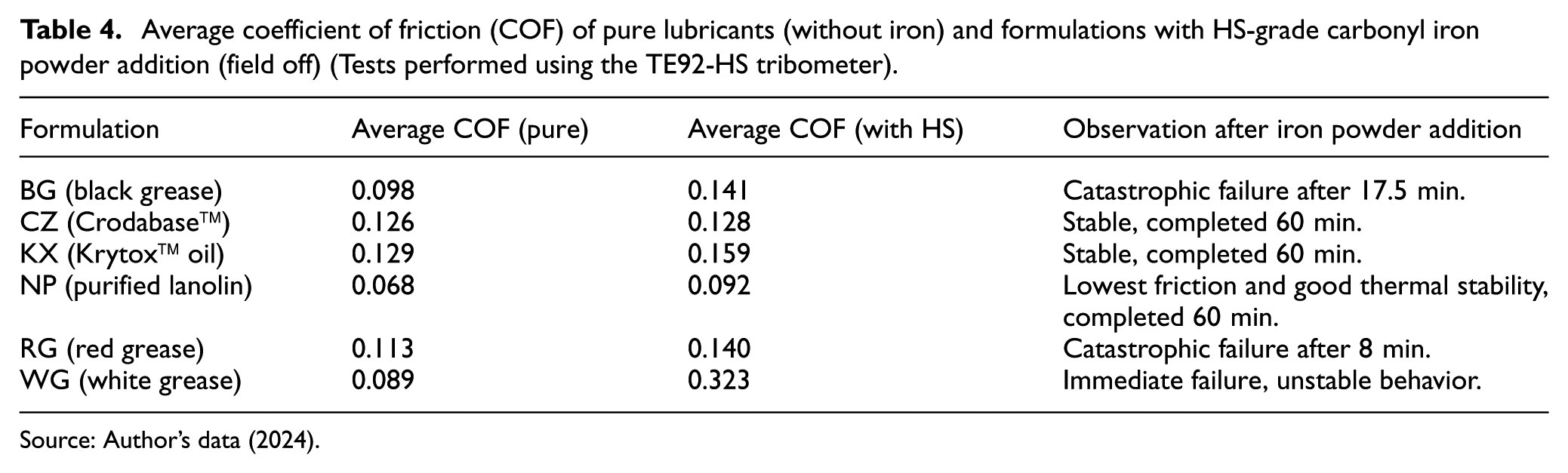
The tests performed using the TE92-HS tribometer (Phoenix Tribology Ltd., United Kingdom), in accordance with ASTM International (2017, 2018) standards, indicated significant differences among the tested formulations. The comparative analysis demonstrated that the tribological performance is strongly dependent on the nature of the lubricating matrix and on the presence of HS-grade carbonyl iron particles (Table 4).
Average coefficient of friction (COF) of pure lubricants (without iron) and formulations with HS-grade carbonyl iron powder addition (field off) (Tests performed using the TE92-HS tribometer).
Source: Author’s data (2024).
In the absence of an applied magnetic field, the formulation based on purified lanolin (Pharmalan™ USP) presented the lowest mean coefficient of friction (COF) and the smallest wear scar diameters, indicating stable boundary lubrication behavior (Table 4 and Figure 11(d-d1-d2)). This behavior can be attributed to the chemical structure of lanolin—a natural mixture of fatty acid esters and long-chain alcohols—which favors the formation of adsorbed films on the steel surface, thereby reducing metal-to-metal contact.
Under magnetic field application, the formulation composed of Crodabase™ SQ-SS-(BR) and 4 wt.% micronized PTFE (Zonyl™ MP 1100) displayed the best performance, with a significant reduction in wear scar diameter and greater frictional stability (Table 4 and Figure 12(a-a1)).The alignment of ferromagnetic particles under the magnetic field promotes the formation of chain-like microstructures, which increase the apparent stiffness of the magnetorheological fluid and enable more uniform shear distribution across the tribological contact, reducing localized stress concentrations.
Overall, the conventional greases (BG—Figure 11(a-a1-a2); RG—Figure 11(e-e1-e2); WG—Figure 11(f-f1-f2)) exhibited greater COF variation and more severe wear, dominated by abrasive mechanisms (Table 4). In contrast, the semisolid matrices (NP—Figure 11(d-d1-d2) and CZ—Figure 11(b-b1-b2)) demonstrated enhanced ability to dissipate shear energy, mitigating the typical abrasiveness observed in magnetorheological fluids (Figures 11–13).
Friction coefficient analysis (COF)
The average coefficients of friction obtained from the 4-Ball tests performed using the TE92-HS tribometer (Phoenix Tribology Ltd., United Kingdom), in accordance with ASTM International (2017, 2018) standards, are summarized in Table 4. The tests covered six pure lubricants and their corresponding magnetorheological formulations containing 25% v/v of HS-grade carbonyl iron powder.
The average coefficients of friction correspond to the arithmetic mean of the instantaneous COF values continuously recorded during the entire test duration, as described in the Experimental Procedures section.
Under the condition without magnetic field application (field off), the lubricants exhibited average coefficients of friction ranging from 0.068 to 0.129. The lanolin-based formulation (NP) showed the lowest average value (0.068), reflecting high lubricating efficiency and thermal stability. In contrast, the CZ and KX formulations presented the highest values (0.126 and 0.129, respectively), indicating higher viscous resistance and the formation of less persistent films.
From a chemical–structural standpoint, the higher coefficients of friction observed for the CZ and KX formulations can be attributed to the nature of their carrier fluids. The KX formulation, based exclusively on perfluoropolyether (PFPE), exhibits high thermal and chemical stability; however, its low polarity and limited affinity for metallic surfaces restrict the formation of adsorbed films under boundary lubrication conditions typical of the 4-Ball test configuration, resulting in higher friction coefficients. Similarly, although the CZ synthetic matrix presents high structural viscosity and contains PTFE as a friction-reducing additive, its lower chemical interaction with steel surfaces, when compared to polar organic matrices, contributes to the formation of less persistent lubricating films. In contrast, the NP formulation, composed of purified lanolin rich in long-chain esters, promotes molecular adsorption onto the metallic surface, enhancing asperity separation and, consequently, leading to lower coefficients of friction. These results indicate that differences in the chemical–structural characteristics of the carrier fluids are directly associated with tribological performance under boundary lubrication conditions.
The very small variation in the coefficient of friction observed for the CZ formulation after the addition of carbonyl iron powder (Table 4) is associated not only with the composition of the synthetic matrix, but also with its rheological transition during the tribological test. Under the test conditions (75°C, with moderate fluctuations to higher values), the Crodabase™ SQ-SS-based matrix exhibits a significant reduction in apparent viscosity, behaving predominantly as a liquid, with oil-like characteristics.
Under these conditions, the tribological contact occurs in the presence of a continuous fluid film, in which both PTFE and the carbonyl iron particles remain dispersed and exhibit limited direct interaction with the metallic surfaces. As a consequence, the introduction of iron does not significantly modify the dominant lubrication mechanism, nor does it result in a relevant increase in interfacial shear contributions or abrasive effects (Figure 11(b-b1-b2)).
Therefore, the coefficient of friction of the CZ formulation remains practically unchanged after the addition of iron powder, representing the smallest COF variation among all evaluated matrices. This behavior suggests that, under the thermal conditions of the test, the synthetic matrix is able to maintain a continuous lubricating film after the incorporation of the solid phase, limiting the effective participation of iron particles in the tribological contact. Thus, the addition of iron powder does not result in a measurable and significant alteration of the dominant friction mechanism, leading to only a minimal variation in the coefficient of friction.
The addition of carbonyl iron resulted in an increase in friction for most formulations, a behavior attributed to the action of the particles as micro-abrasives under boundary lubrication conditions. The exceptions were the NP and CZ matrices, which maintained stability and completed the test, demonstrating good particle dispersion and preservation of the lubricating film. The superior performance of NP is explained by the chemical structure of lanolin, composed of long-chain esters capable of forming adsorbed layers on the steel surface, thereby reducing metal-to-metal contact. CZ, with the addition of PTFE, exhibited an almost invariant behavior, confirming the action of the polymer as a friction reducer and as a filler of surface micro-defects. During testing, the BGHS, RGHS, and WGHS formulations exhibited a sudden and unstable increase in the coefficient of friction, followed by a pronounced rise in temperature, reaching values close to 100°C (Figure 6(a)–(c)). This instability, along with the friction and temperature, reflects the rapid expansion of the actual contact area, the loss of lubricant film integrity, and the predominance of adhesive interactions at the asperity junctions, characterizing catastrophic wear according to ASTM International (2022).
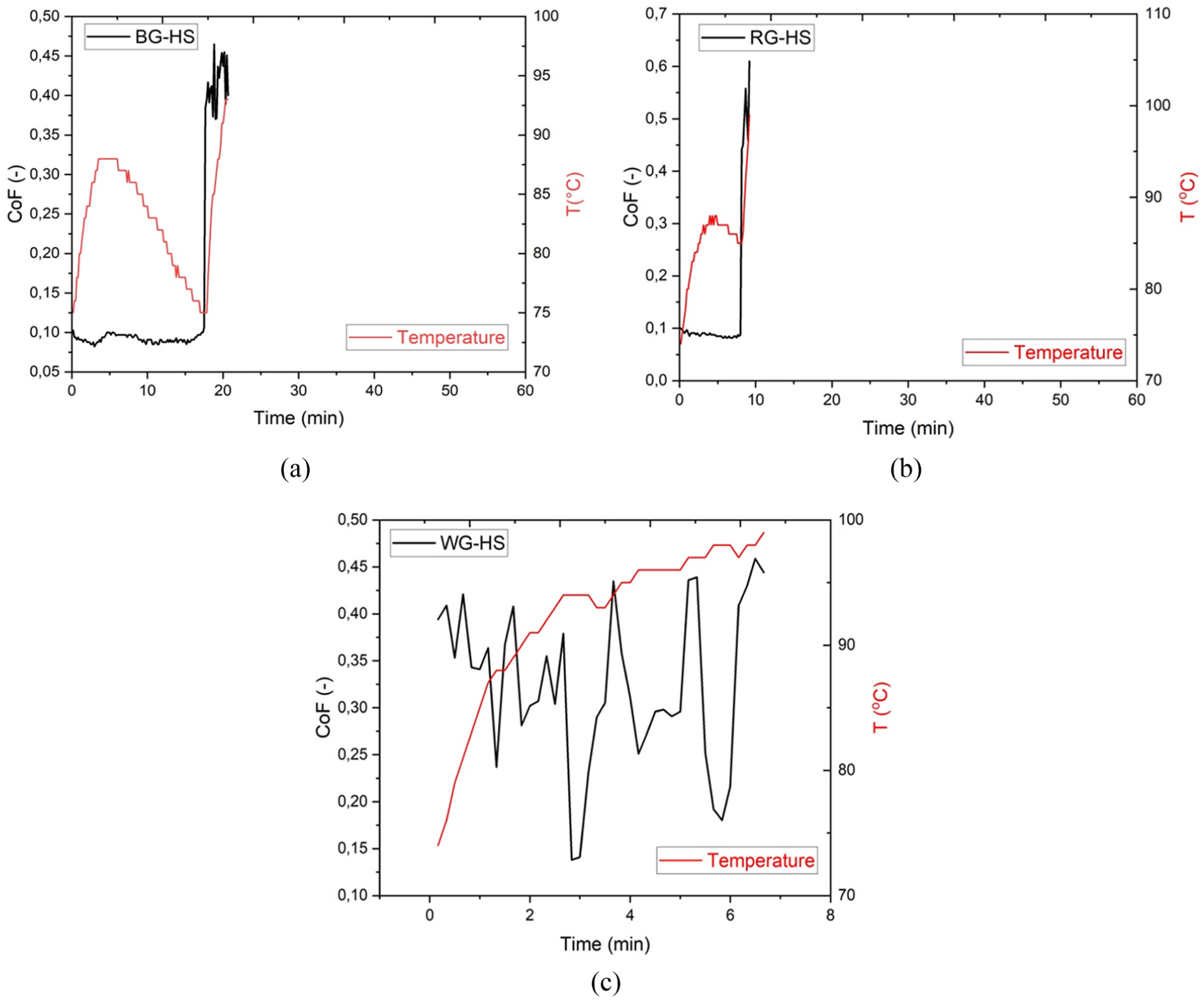
Evolution of coefficient of friction (COF) and temperature as a function of time for formulations under non-magnetic conditions: (a) BGHS OFF, (b) RGHS OFF, and (c) WGHS OFF. The addition of carbonyl iron led to unstable boundary lubrication, with rapid increases in COF and temperature, indicating inability to sustain PV conditions and resulting in catastrophic wear (CW).
The drying and sand-like appearance observed after testing confirmed the rupture of the lubricating film and the predominance of exposed iron acting as an abrasive solid phase. In the CZHS, KXHS, and NPHS systems, the tests were completed without interruption, although temperature peaks (“overshoots”) were recorded attributed to temporary increases in shear rate. Among these, NPHS exhibited the lowest average COF (0.092), while CZHS maintained an intermediate value (0.128), and KXHS showed the highest friction (0.159) due to the lower interaction of the perfluorinated fluid with the metallic particles.
These results confirm that the tribological response of magnetorheological formulations depends on the compatibility between the lubricating matrix and the carbonyl iron. The addition of iron powder tends to increase friction when the matrix lacks the ability to retain and redistribute the fluid under shear, as observed in conventional greases. Conversely, semisolid matrices and bases with high molecular viscosity (NP and CZ) demonstrate resistance to lubricating film collapse and better accommodation of ferromagnetic particles.
In summary, NPHS exhibited the lowest coefficient of friction and the greatest thermal stability, while CZHS maintained stable performance with lower variation under load. Both formulations are suitable for magnetorheological applications, particularly under boundary lubrication and variable-field conditions.
The evolution of friction and temperature observed in the 4-Ball tests indicates a progressive transition from an initial elastohydrodynamic (EHL) regime—where the lubricating film partially supports the load to a boundary regime in which contact between metallic asperities becomes dominant. In conventional greases (BGHS, RGHS, and WGHS), this condition rapidly evolved into catastrophic wear (CW; Figures 6(a)–(c) and 7(a) and (b)), as described by Wojciechowski and Mathia (2015) and defined by ASTM International (2022), characterized by functional breakdown of the lubricating film, abrupt temperature rise, and structural failure of the tribological system. In contrast, NPHS and CZHS formulations preserved film integrity, indicating stability in the boundary regime and delaying the transition to CW evidence that the chemical nature and rheology of the lubricating matrix are decisive for tribological resistance under extreme conditions.
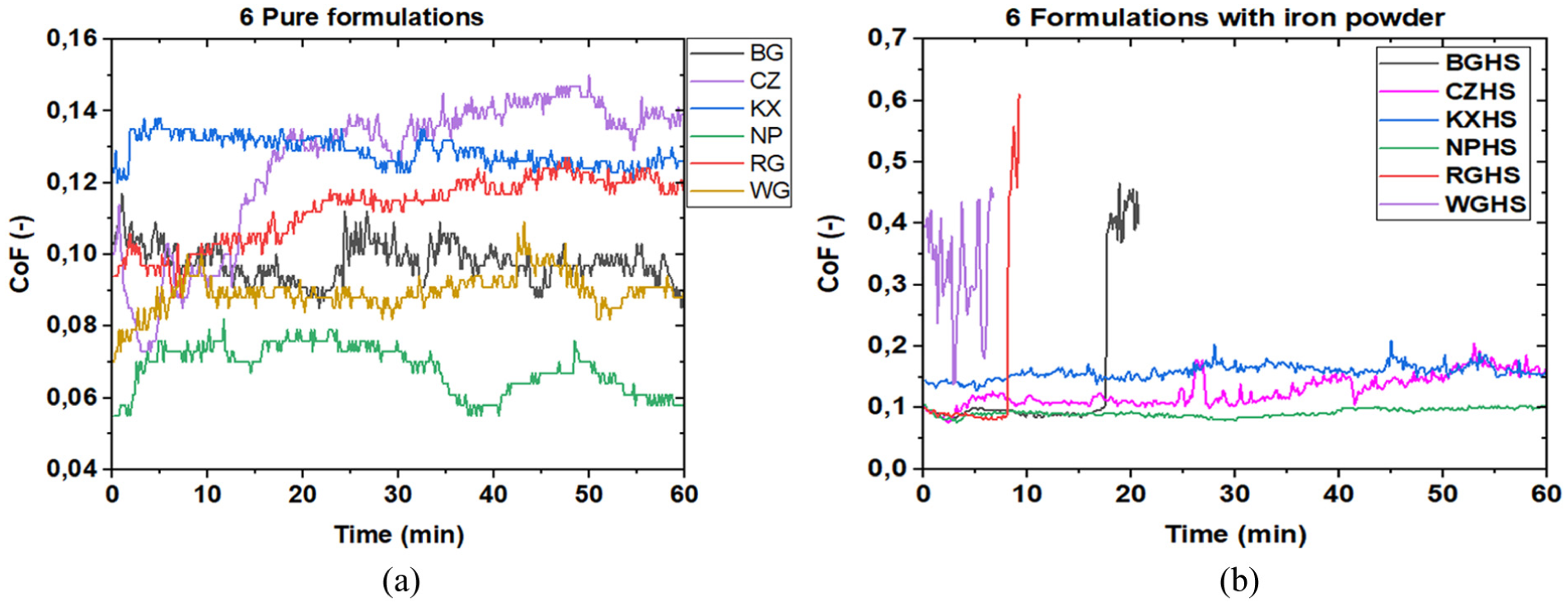
Variation of the coefficient of friction (COF): (a) pure formulations and (b) formulations containing HS carbonyl iron powder, illustrating the influence of metallic particles on the tribological response under 4-ball test conditions (392 N, 1200 rpm, 75°C ± 2°C, field off).
Influence of the magnetic field on friction
From a physical standpoint, the application of a magnetic field H (A·m−1) to suspensions containing ferromagnetic particles induces a magnetization M (A·m−1) through the statistical alignment of dipole moments along the field lines. Under this condition, the magnetic flux density B (T) follows the constitutive relation B = μ0 (H + M), where μ0 = 4π × 10−7 H.m−1 is the magnetic permeability of free space. As a consequence of dipole–dipole interactions overcoming thermal agitation, the particles self-organize into chain-like or columnar microstructures within the lubricating matrix, giving rise to a field-dependent yield stress (τ y ) and an increase in the storage shear modulus (G′), which characterizes the magnetorheological effect (Kumar et al., 2021).
From a tribological perspective, this microstructural transition alters the effective rheology of the lubricating film, promoting a shift from a dispersed suspension toward a viscoplastic, field-structured system. Such a transition directly affects friction by modifying the load-bearing capacity, shear response, and stability of the lubricating film at the contact interface, particularly under boundary lubrication conditions (Zhuang et al., 2024). Importantly, this effect is reversible upon field removal, as the particle network collapses and the suspension returns to its initial dispersed state, as illustrated in Figure 7(a) and (b).
The application of the magnetic field during the 4-ball tests was intended to evaluate the magnetorheological response of the formulations and its influence on tribological stability. Only the CZHS, NPHS, and KXHS formulations (Figures 7(a) and (b) and 8) were subjected to this stage, as the BGHS, RGHS, and WGHS (Figure 6(a)–(c)) systems experienced catastrophic wear under non-magnetic conditions, which prevented test continuation.
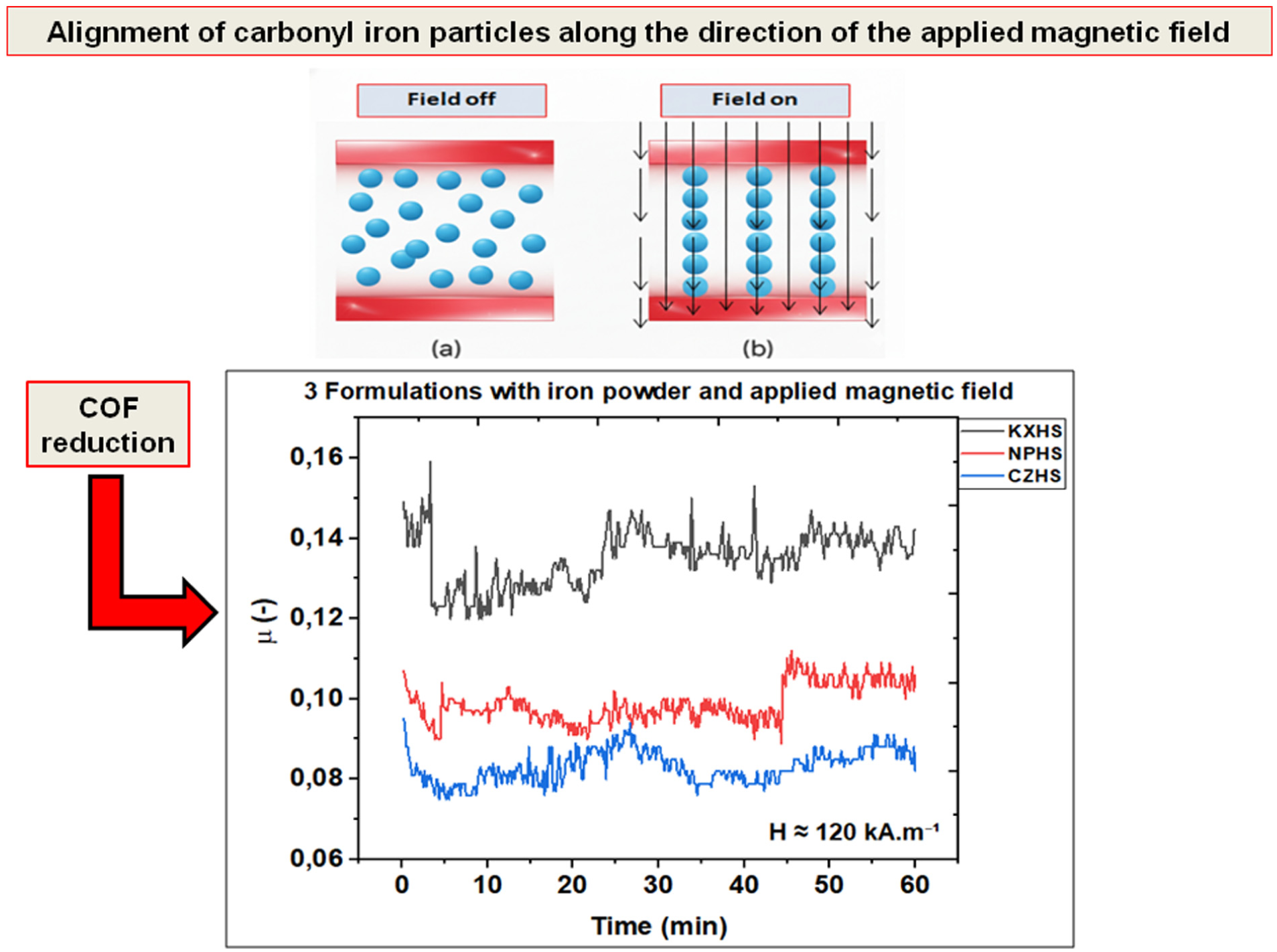
Chain formation of carbonyl iron particles under an applied magnetic field (H ≈ 120 kA·m−1), showing structural alignment and friction reduction in the CZHS, NPHS, and KXHS formulations: (a) condition without magnetic field (field off) and (b) alignment of particles under the applied field (field on), resulting in increased apparent stiffness and reduced coefficient of friction (COF).
The evolution of friction and temperature indicated a progressive transition from the initial elastohydrodynamic lubrication (EHL) regime to boundary lubrication, culminating in catastrophic wear (CW) in the BGHS, RGHS, and WGHS formulations (Figures 6(a)–(c) and 7(b)).
According to Wojciechowski and Mathia (2015) and the definition provided by ASTM International (2022), catastrophic wear is characterized by abrupt degradation of the lubricating film, accelerated temperature rise, and functional failure of the tribological system due to dominant metal-to-metal contact.
In the present study, carbonyl iron particles acted as surface-modifying agents; however, in matrices with limited structural stability (BG, RG, and WG), their presence intensified abrasive interactions and promoted film rupture, accelerating the transition toward catastrophic wear.
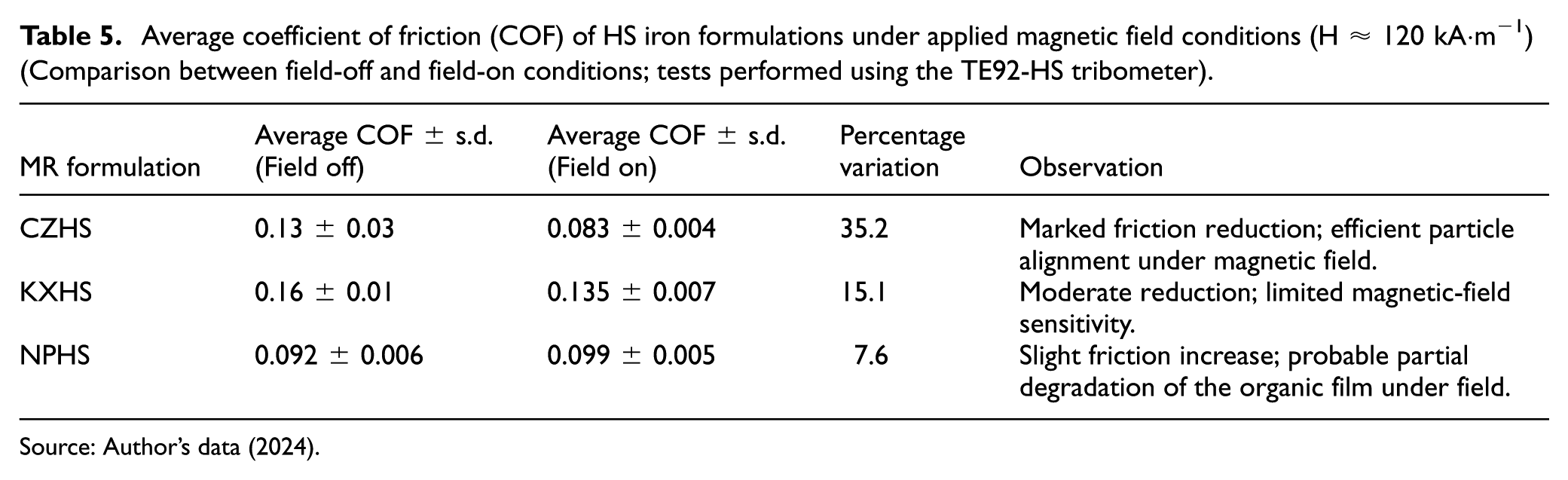
Consequently, only formulations exhibiting sufficient rheological integrity were selected for magnetic-field-assisted testing. Within this context, CZ and NP represent synthetic and organic semisolid matrices, respectively, while KX serves as a perfluorinated liquid comparator. The average coefficient of friction values under field-off and field-on conditions are summarized in Table 5.
Average coefficient of friction (COF) of HS iron formulations under applied magnetic field conditions (H ≈ 120 kA·m−1) (Comparison between field-off and field-on conditions; tests performed using the TE92-HS tribometer).
Source: Author’s data (2024).
A marked reduction in friction (≈35%) was observed for the CZHS formulation under an applied magnetic field. This behavior is attributed to the formation of stable chain-like particle structures within the synthetic semisolid matrix, which increase the apparent stiffness of the lubricating film and enhance its load-bearing capacity. The combined presence of PTFE and the synthetic base oil contributes to the formation of a continuous, low-surface-energy film, allowing the magnetically structured particle network to mitigate abrasive interactions and promote a more stable shear response (Kumar et al., 2021; Zhuang et al., 2024).
The results indicate that the application of a magnetic field modifies the frictional behavior of magnetorheological fluids through the formation of a field-induced particulate network whose effectiveness depends on the rheological and interfacial compatibility between the carbonyl iron particles and the lubricating matrix. In the CZHS formulation, the synthetic semisolid matrix exhibits sufficient resistance to flow and structural cohesion to sustain the particle chains formed under the magnetic field, enabling these structures to contribute to load support and to the reduction of direct metal–metal contact. This interpretation is consistent with the pronounced decrease in the coefficient of friction observed experimentally.
In contrast, for the KXHS formulation, the high molecular mobility of the perfluorinated matrix limits the mechanical stability of the particle chains under shear, reducing the persistence of the magnetically induced microstructure and resulting in only a moderate friction reduction. For the NPHS system, the intrinsically structured and polar organic matrix promotes strong physicochemical interactions between the continuous phase and the ferromagnetic particles; under magnetic field application, these interactions increase the local shear resistance of the lubricating film, which explains the slight increase in the coefficient of friction.
Accordingly, the differences in frictional behavior under magnetic field conditions arise from the extent to which the magnetically induced particulate microstructure is stabilized or destabilized by the lubricating matrix during shear, in agreement with fundamental magnetorheological principles and with observations reported in the literature (Kumar et al., 2021; Raj et al., 2021; Zhuang et al., 2024).
Table 5 presents the average coefficient of friction (μ) values obtained for the CZHS, KXHS, and NPHS formulations under conditions with and without magnetic field application. It is observed that the magnetic field affects each system differently, depending on the chemical nature of the lubricating matrix and its interaction with the iron particles (Figure 9(a)–(c)).
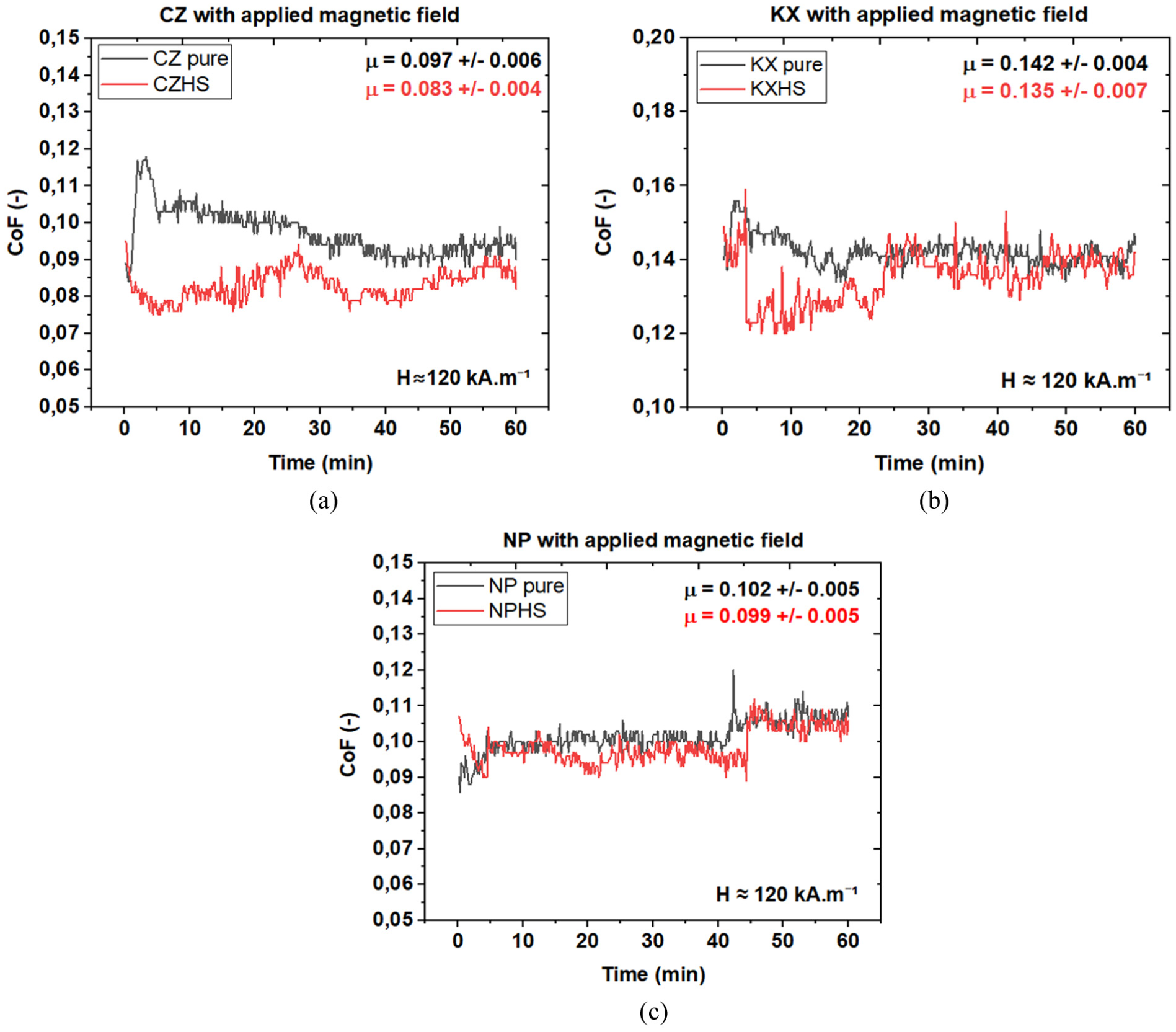
Variation of the coefficient of friction (COF) under an applied magnetic field (H ≈ 120 kA·m−1) for the pure magnetorheological formulations CZ, KX, and NP, and their corresponding HS carbonyl iron versions (CZHS, KXHS, and NPHS): (a) CZ and CZHS—significant reduction in friction under magnetic field, (b) KX and KXHS moderate decrease, indicating low magnetic sensitivity, and (c) NP and NPHS stable friction with a slight increase, attributed to chemical interaction between lanolin and ferromagnetic particles.
In the case of CZHS, Figure 9(a), a significant reduction in average friction approximately 35% was observed, attributed to the alignment of ferromagnetic particles within the synthetic semisolid matrix based on Crodabase™ and PTFE. Under a magnetic field of H ≈ 120 kA·m−1, magnetic dipoles tend to orient along the field lines, forming chain-like structures that increase the apparent stiffness and stabilize the shear response. The combined action of PTFE and the synthetic base contribute to the formation of a continuous, low-surface-energy film, resulting in lower friction and uniform wear.
KXHS, Figure 9(b), whose perfluorinated matrix exhibits low polarity and limited interfacial affinity with the iron particles, showed a moderate decrease in the coefficient of friction (approximately 15%). This behavior indicates that, although the ferromagnetic particles respond to the applied magnetic field, the high rheological mobility of the perfluoroether phase and the weak particle–matrix interaction limit the stability and persistence of chain-like structures under shear. Although the lower viscosity of the perfluoroether matrix facilitates the initial formation of magnetic chains under field application, the high mobility of the continuous phase leads to frequent reconfiguration of these structures during shear. This behavior reduces the mechanical persistence of the magnetically induced chains within the contact region, while promoting a more homogeneous redistribution of normal and tangential stresses, thereby limiting the lateral propagation of damage and reducing the average wear scar diameter. Nevertheless, the observed reduction confirms a partial contribution of the magnetic field to lubricating film stability under boundary lubrication conditions.
In contrast, NPHS, Figure 9(c), based on purified lanolin, exhibited a slight increase in the coefficient of friction (around 7%). This behavior may be associated with the reorientation of polar molecular chains in lanolin under magnetic field variations, resulting in local perturbations of the adsorbed film and higher resistance to sliding. The presence of hydroxyl and ester functional groups may favor chemical interactions with metallic particles, making the system sensitive to changes in both magnetic field and temperature.
These results indicate that the tribological performance of magnetorheological fluids strongly depends on the interaction between the magnetic response of the particles and the physicochemical nature of the lubricating matrix. When such compatibility is achieved as observed in the CZHS formulation the magnetic field acts synergistically with the matrix, leading to structural ordering of the particles, effective friction reduction, and lower surface irregularity at the contact interface, while preserving the integrity of the lubricating film during shear, Figure 9(c).
Comparative analysis of wear scars (OM and SEM)
The analysis of wear scars on the stationary balls after the 4-Ball tests was carried out using stereoscopic optical microscopy (OM) and scanning electron microscopy (SEM), with the purpose of correlating the coefficient of friction (COF) values with the morphological characteristics of the surfaces subjected to contact under conditions with and without applied magnetic field.
These complementary techniques allowed identification of differences in wear morphology and severity, distinguishing predominantly adhesive and abrasive mechanisms, and in some cases revealing the presence of a continuous tribofilm associated with the lubricating behavior of the semisolid matrices.
Stereoscopic optical microscopy (OM)
Stereoscopic optical microscopy (OM) was employed to characterize the wear scars formed on the stationary balls after the tribological tests. The observations aimed to correlate the scar dimensions with the tribological behavior of the formulations under different magnetic field conditions. Figure 8 presents representative micrographs obtained for the CZHS, KXHS, and NPHS formulations, comparing the states without magnetic field application (field off) and with magnetic field applied (field on).
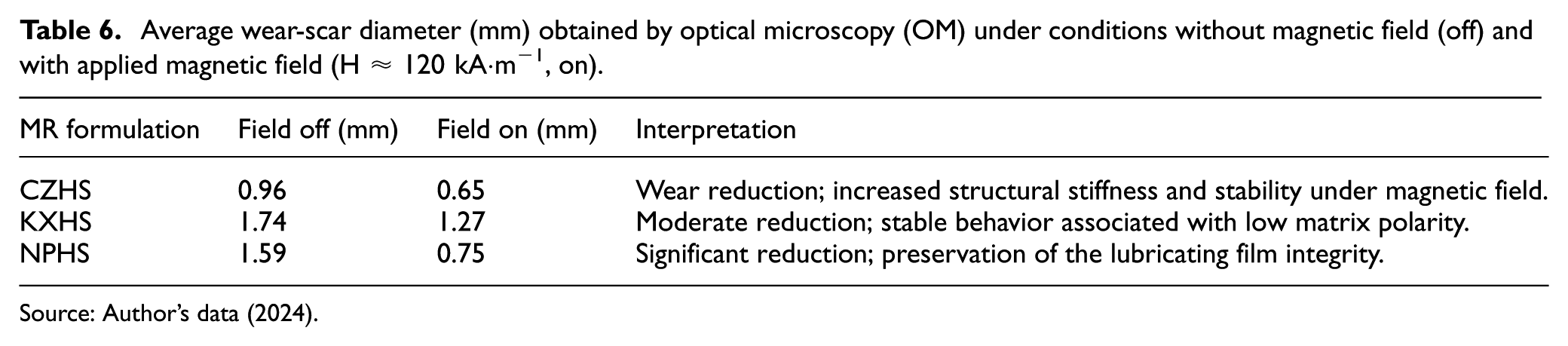
The average wear scar diameters measured by OM are presented in Table 6. It was observed that the CZHS and NPHS formulations both semisolid in nature exhibited smaller scar dimensions when subjected to the magnetic field (Song et al., 2011), whereas KXHS, based on a perfluorinated matrix, showed a moderate reduction.
Average wear-scar diameter (mm) obtained by optical microscopy (OM) under conditions without magnetic field (off) and with applied magnetic field (H ≈ 120 kA·m−1, on).
Source: Author’s data (2024).
The OM results indicate that the application of the magnetic field contributed to the redistribution of ferromagnetic particles within the matrices, resulting in smaller and morphologically more regular wear scars. The reduction observed suggests that the magnetic field shifted the system from a severe boundary-lubrication regime to an intermediate condition of controlled contact, consistent with a partial elastohydrodynamic (EHL) regime.
For CZHS, the alignment of iron particles under the field favored an increase in local stiffness and the formation of a surface film stabilized by the presence of PTFE, thereby reducing the wear-scar diameter.
The NPHS formulation, based on organic purified lanolin, exhibited similar behavior, maintaining a continuous lubricating film even under high shear stress, demonstrating good compatibility between the matrix and the magnetic particles.
Although the KXHS formulation also showed a reduction in the average wear-scar diameter, it exhibited low sensitivity to the applied magnetic field. This behavior indicates that the properties of the perfluorinated Krytox™ oil its chemically inert nature, low surface energy, and relatively low viscosity do not favor the formation or stability of magnetic-particle chains under field application. Furthermore, the absence of a viscoelastic network and the weak interfacial interaction between PFPE and carbonyl iron reduce the cohesion of the self-organized structures, which quickly disintegrate under shear. Consequently, the fluid displays a limited magnetorheological response, resulting from the fragility of the magnetic chains formed within the perfluorinated medium. Nevertheless, the system retains stable tribological behavior, supported by the high thermal and chemical stability of PFPE and by the formation of a continuous, chemically inert friction interface during testing.
The comparative analysis between the micrographs (Figure 10(a)–(c)) and the average values presented in Table 6 confirms that the magnetic field acts as a stabilizing element, reducing wear severity in formulations that exhibit good compatibility between the lubricating matrix and the ferromagnetic particles.
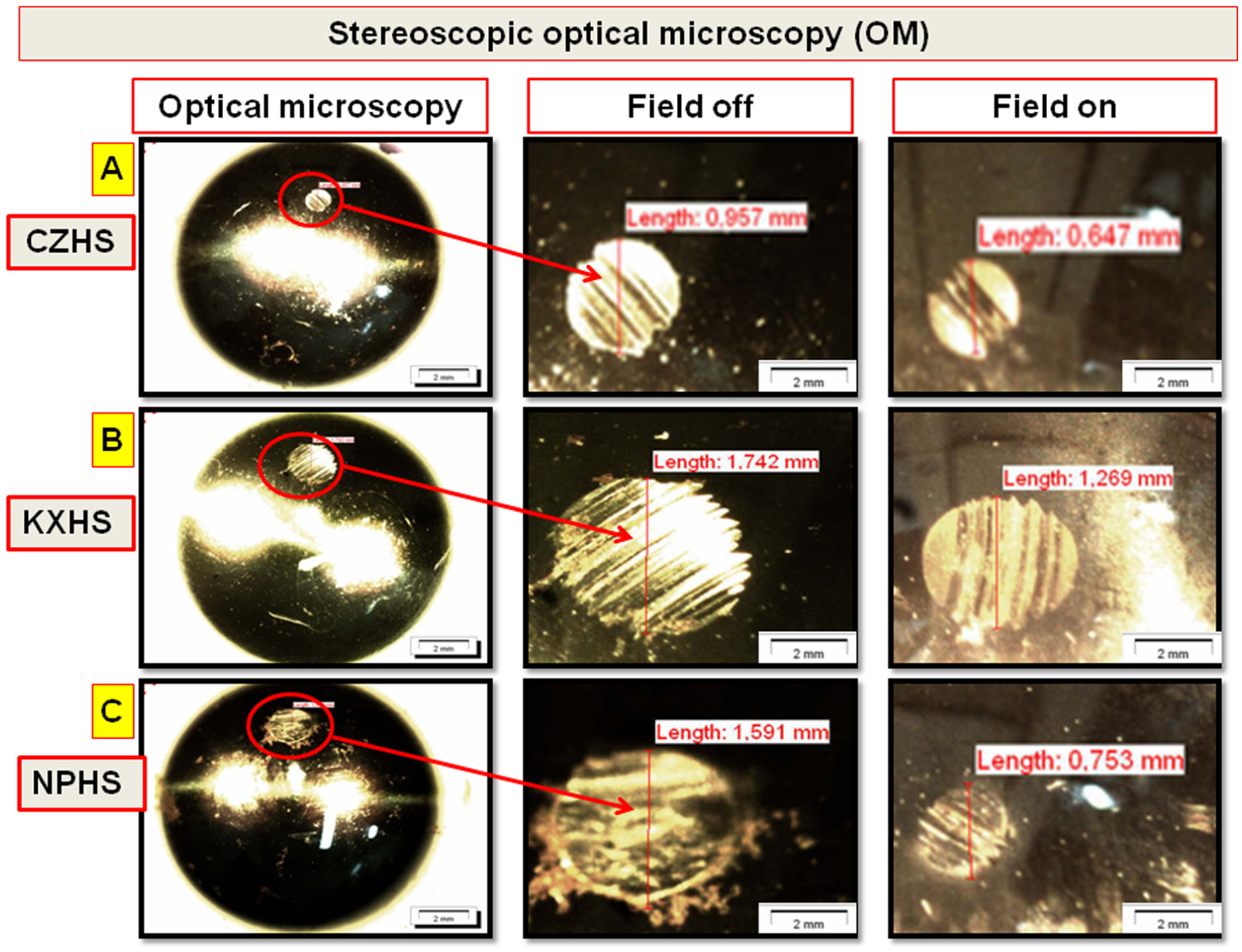
Wear-scar images obtained by stereoscopic optical microscopy (OM) for the CZHS, KXHS, and NPHS formulations under field-off and applied magnetic field conditions (H ≈ 120 kA·m−1): (a) CZHS—reduced wear-scar diameter under magnetic field, (b) KXHS—moderate reduction, and (c) NPHS—pronounced reduction, indicating improved lubricating-film cohesion.
Scanning electron microscopy (SEM/EDS)
The scanning electron microscopy (SEM) analyses were performed on the same balls previously examined by stereoscopic optical microscopy (OM), with the objective of examining the morphology and tribological mechanisms operating under conditions without magnetic field application (field off) and with magnetic field applied (field on).
Figure 11 presents the six magnetorheological formulations containing iron powder (BGHS, CZHS, KXHS, NPHS, RGHS, and WGHS), organized in three observation levels: (a–f) top balls representing the regions subjected to direct friction; (a1–f1) 2000× magnifications of the same top balls, allowing the observation of micro-scratches, grooves, and agglomerates of ferromagnetic particles; and (a2–f2) stationary or lower balls magnified 100×, where the average wear-scar diameters were measured.
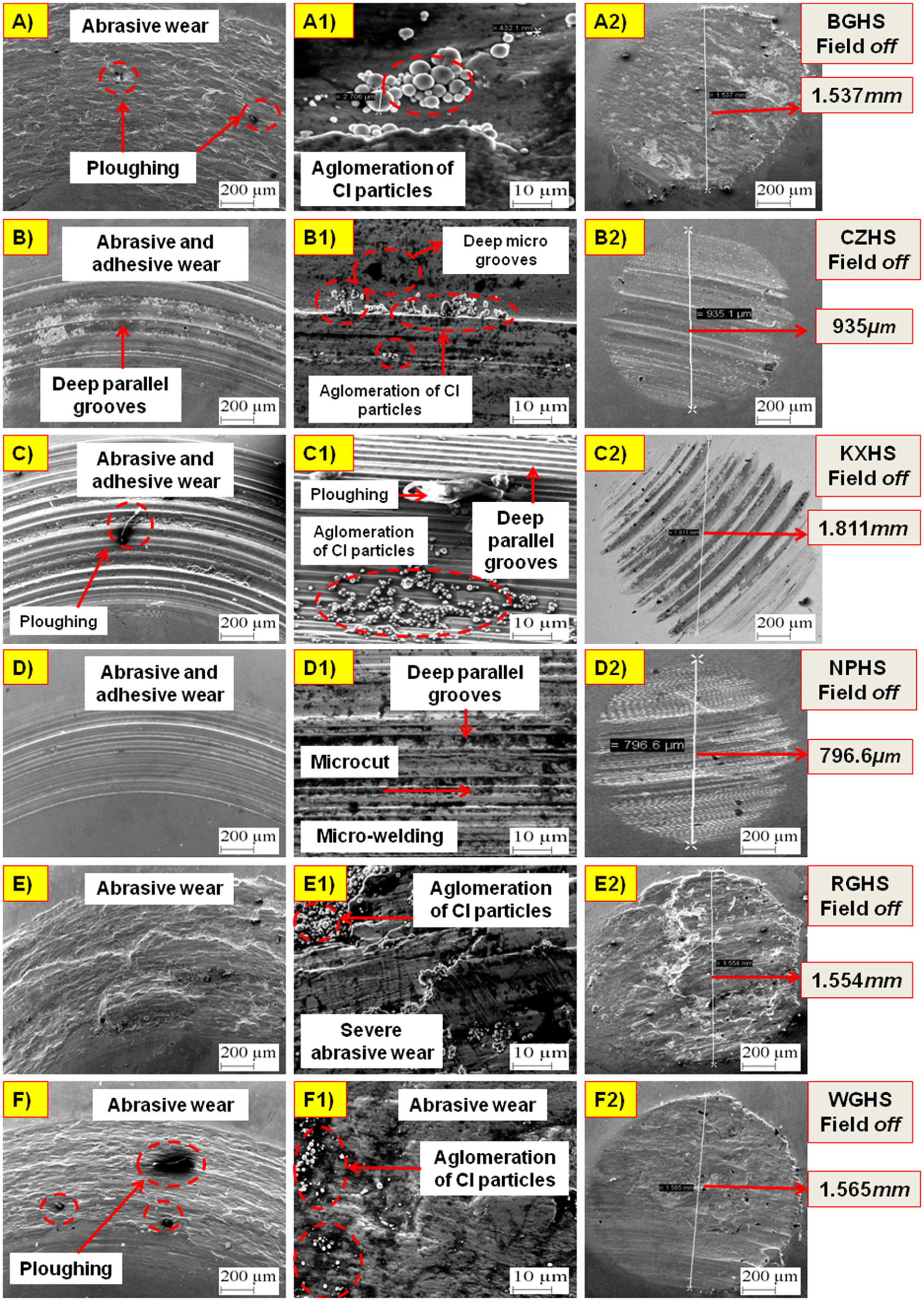
Scanning electron microscopy (SEM) of the six iron-containing formulations under non-magnetic field condition (field off): (a–f) upper ball (100×), (a1–f1) high-magnification views of selected regions (2000×), and (a2–f2) lower ball, showing the wear scar diameters.
The morphological results reveal the coexistence of abrasive and adhesive wear mechanisms, the intensity of which depends on the lubricating matrix. The semisolid formulations CZHS (935 μm) and NPHS (796 μm) exhibited the smallest wear scars, indicating a higher capacityfor controlled dissipation of mechanical energy through internal deformation of the semisolidmatrix and redistribution of shear at the contact interface, which contributes to increased lubricating-film stability.
The commercial greases (BGHS, RGHS, and WGHS) showed more severe wear, with scars between 1.53 and 1.56 mm, and evidence of plowing, deep parallel grooves, and localized micro-welding. The perfluorinated formulation KXHS (1.81 mm) exhibited predominantly abrasive morphology, with little interaction between the iron particles and the perfluoroether matrix, which limits the formation of coherent structures under shear.
The micrographs show (Figure 11(a)–(f)) the upper balls (direct friction region), (Figure 11(a-a1–f1)) 2000× magnifications highlighting micro-scratches, grooves, and agglomerates of ferromagnetic particles, and (Figure 11(a2–f2)) lower balls (100×) used to measure the average wear-scar diameter.
The CZHS (935 µm) and NPHS (796 µm) formulations exhibited the smallest scars and greater film stability. The commercial greases (BGHS, RGHS, and WGHS) showed severe wear with adhesive and abrasive failures, while KXHS (1.81 mm) displayed an abrasive morphology consistent with the low interaction between carbonyl iron and the perfluoroether matrix.
Figure 12 compares the CZHS, KXHS, and NPHS formulations under an applied magnetic field (H ≈ 120 kA·m−1), highlighting the structural reorganization induced by the alignment of ferromagnetic particles.
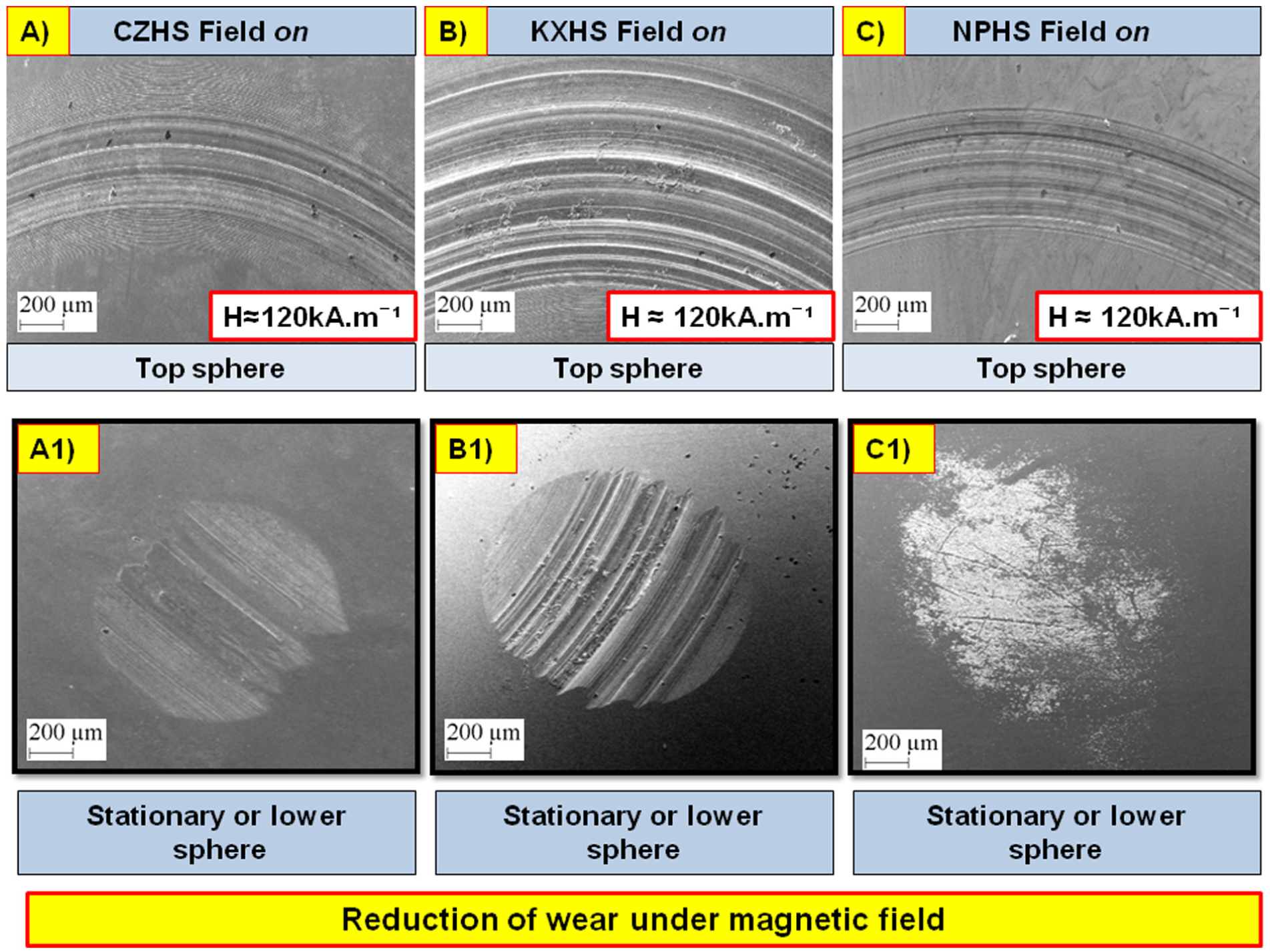
Scanning electron microscopy (SEM) micrographs of the CZHS, KXHS, and NPHS formulations under applied magnetic field (H ≈ 120 kA·m−1): (a–c) show the upper balls (“top spheres”) with the wear tracks formed during the test and (a1–c1) correspond to the stationary or lower balls, where the wear scars were observed. A reduction in wear under magnetic field is evident, particularly for CZHS and NPHS formulations, indicating enhanced lubricant-film stability and alignment of ferromagnetic particles.
The micrographs of the upper balls (Figure 12(a)–(c)) show a reduction in the severity and depth of wear tracks, particularly in the semisolid matrices. The corresponding images of the stationary balls (Figure 12(a1)–(c1)) demonstrated more regular and continuous wear scars, with an average diameter reduction of 25%–50%, confirming the stabilizing effect of the magnetic field on the tribological structure of the system.
Physically, the applied magnetic field promotes the alignment of iron particles along the magnetic flux lines, forming structured chains that increase the shear resistance of the lubricating medium. Under these conditions, the contact becomes mediated by a magnetically organized structure, which redistributes normal and tangential stresses within the contact zone. This behavior is analogous to the magnetorheological polishing (Lu et al., 2024) mechanism, in which material removal occurs in a progressive and controlled manner, resulting in more regular wear scars with reduced depth and limited lateral propagation of abrasive damage.
Wear mechanisms under magnetic field
Figure 13 presents 100× and 2000× magnifications of the worn surfaces from the three formulations (CZHS, KXHS, and NPHS) that completed the 4-ball test without catastrophic wear (CW; see Figure 6).
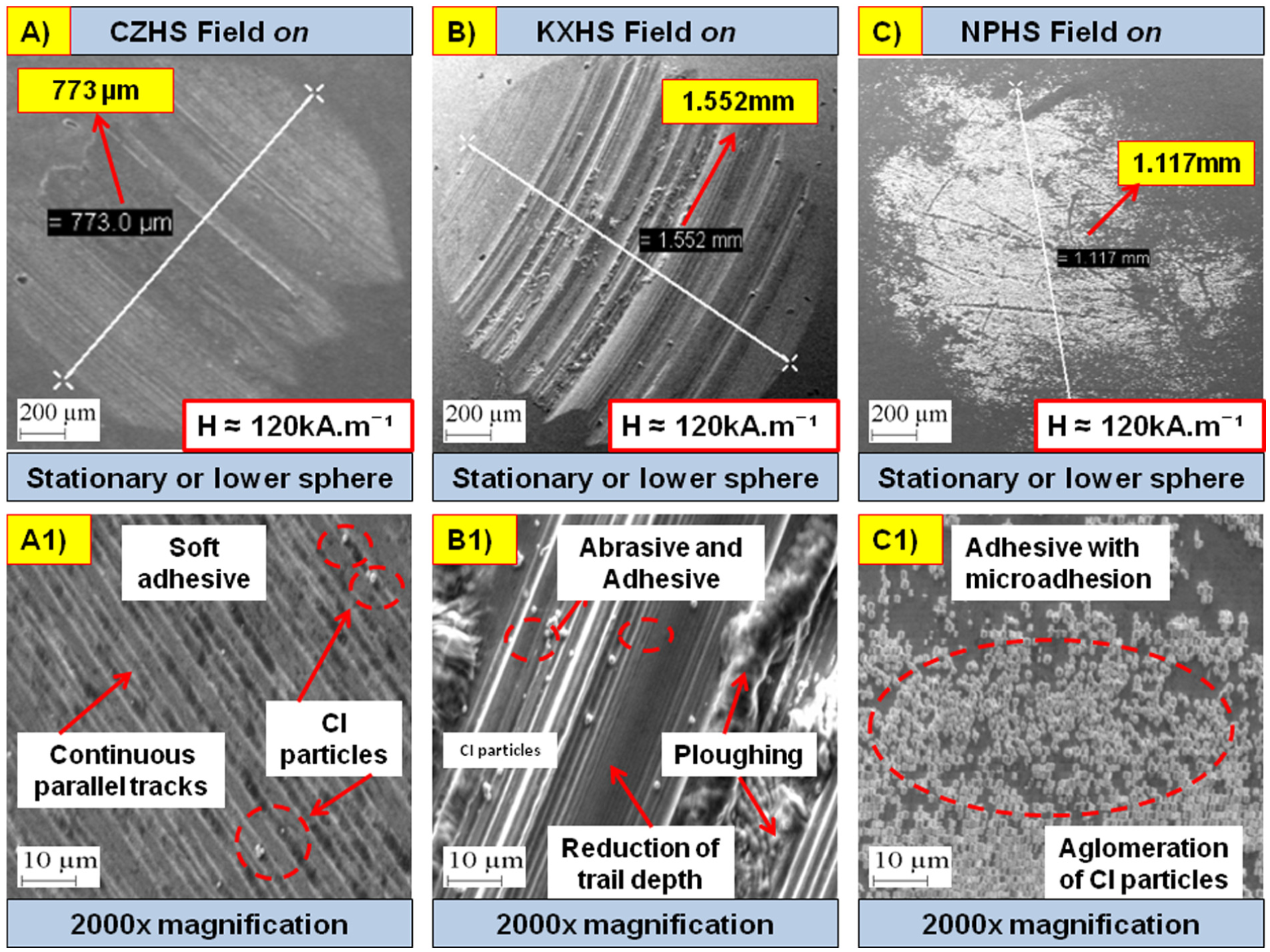
Scanning electron microscopy (SEM) micrographs of the CZHS, KXHS, and NPHS formulations under applied magnetic field (H ≈ 120 kA·m−1). (a–c) show the stationary or lower spheres with their respective wear-scar diameters. (a1 and c1) display surface morphology at 2000× magnification, highlighting differences in wear mechanisms: (a1) soft adhesive wear with continuous parallel tracks in CZHS; (b1) mixed abrasive and adhesive wear with reduced groove depth in KXHS; and (c1) adhesive wear with localized micro-adhesion and agglomeration of carbonyl iron particles in NPHS.
For CZHS, a mild adhesive wear behavior was observed, with continuous and parallel wear tracks, indicating the combined action of PTFE and the aligned ferromagnetic particles.
For KXHS, mixed adhesive/abrasive wear was observed, with a noticeable reduction in groove depth and the presence of dispersed iron particles along the wear tracks. This indicates mechanical interaction but limited contribution from the perfluoroether matrix to the formation of a protective film.
For NPHS, adhesive wear predominated, with localized micro-adhesion accompanied by superficial agglomeration of iron particles. This resulted from the trapping of metallic particles in regions rich in the fatty compounds of lanolin, which favors the formation of a cohesive tribological film.
The physicochemical basis for this behavior is directly associated with the waxy and highly structured nature of lanolin as a carrier matrix. As described in patent BR 10 2025 014144 2 and in the corresponding technical documentation, lanolin is a refined wool wax composed predominantly of long-chain esters, including a significant fraction of hydroxy esters, which confer high internal cohesion, intrinsic adhesiveness, and pronounced film-forming ability.
These characteristics promote strong retention of carbonyl iron particles within the semisolid organic phase, limiting their relative mobility under shear and preventing their action as free abrasive bodies. Instead, the particles remain embedded within a continuous fatty matrix that preserves mechanical integrity during sliding.
Under magnetic field application, this retained particulate phase reorganizes locally along the magnetic flux lines without disrupting the continuity of the lubricant film. As a result, the contact is mediated by a cohesive tribological layer, explaining the prevalence of adhesive wear with localized micro-adhesion and the formation of regular wear scars with reduced average diameter observed for the NPHS formulation.
Elemental analysis (EDS)
Energy-Dispersive X-ray Spectroscopy (EDS), associated with SEM, was performed to determine the elemental composition of the surfaces after the 4-Ball test. The EDS data were obtained only for the samples tested under applied magnetic field (field on), since in the other cases the results showed compositional redundancy.
The spectra and elemental maps (Figures 14–16) confirm the predominance of iron (Fe) as the major element, accompanied by carbon (C) and small fractions of chromium (Cr) and silicon (Si).
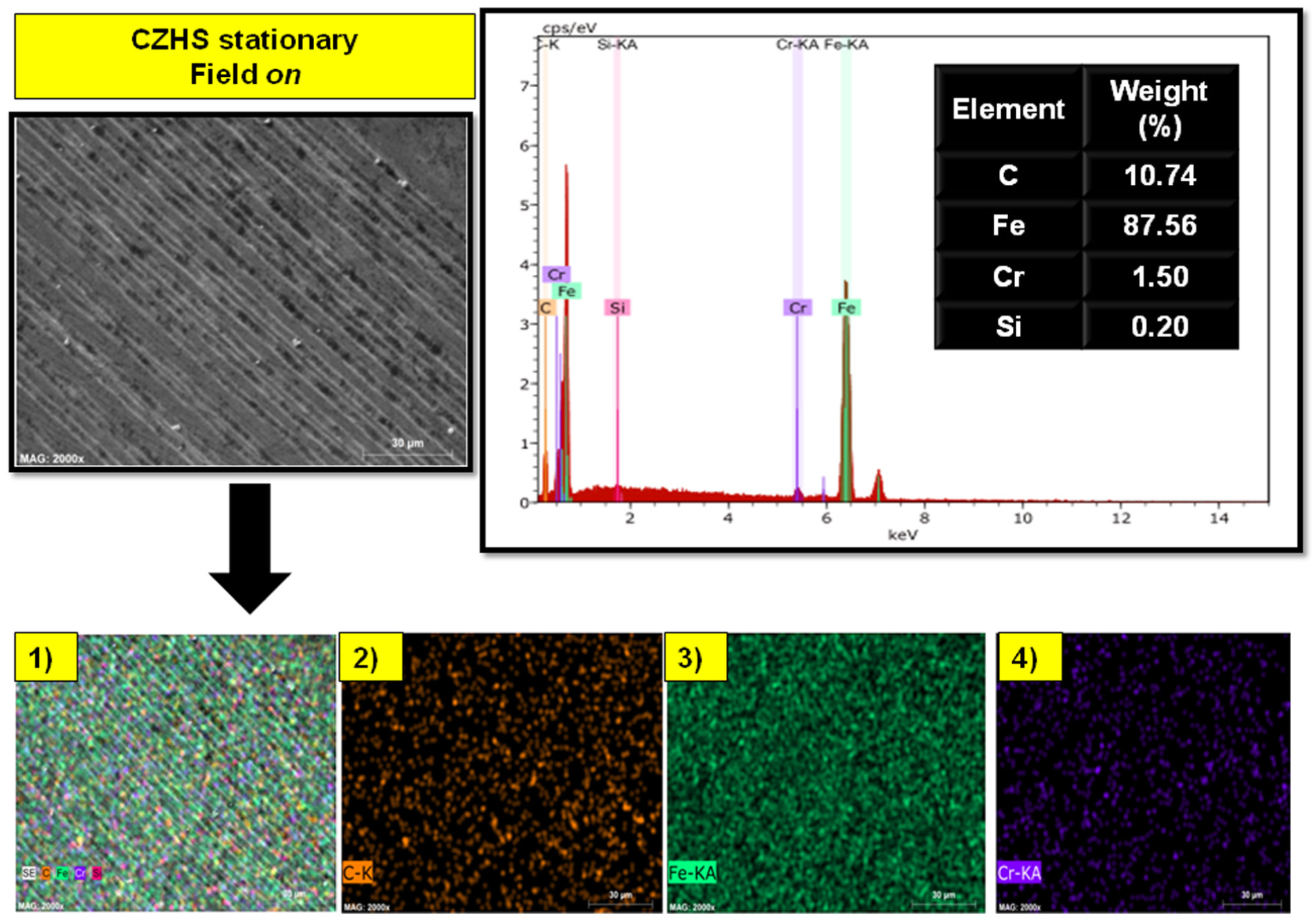
Energy-Dispersive X-ray Spectroscopy (EDS) of the CZHS formulation. The spectrum and elemental maps confirm the predominance of iron (Fe) and carbon (C), indicating good compatibility between the carbonyl iron particles and the synthetic matrix composed of Crodabase™ and PTFE. (1) Combined map of detected elements; (2) Carbon (C–K) distribution; (3) Iron (Fe–Kα) distribution; and (4) Chromium (Cr–Kα) distribution.
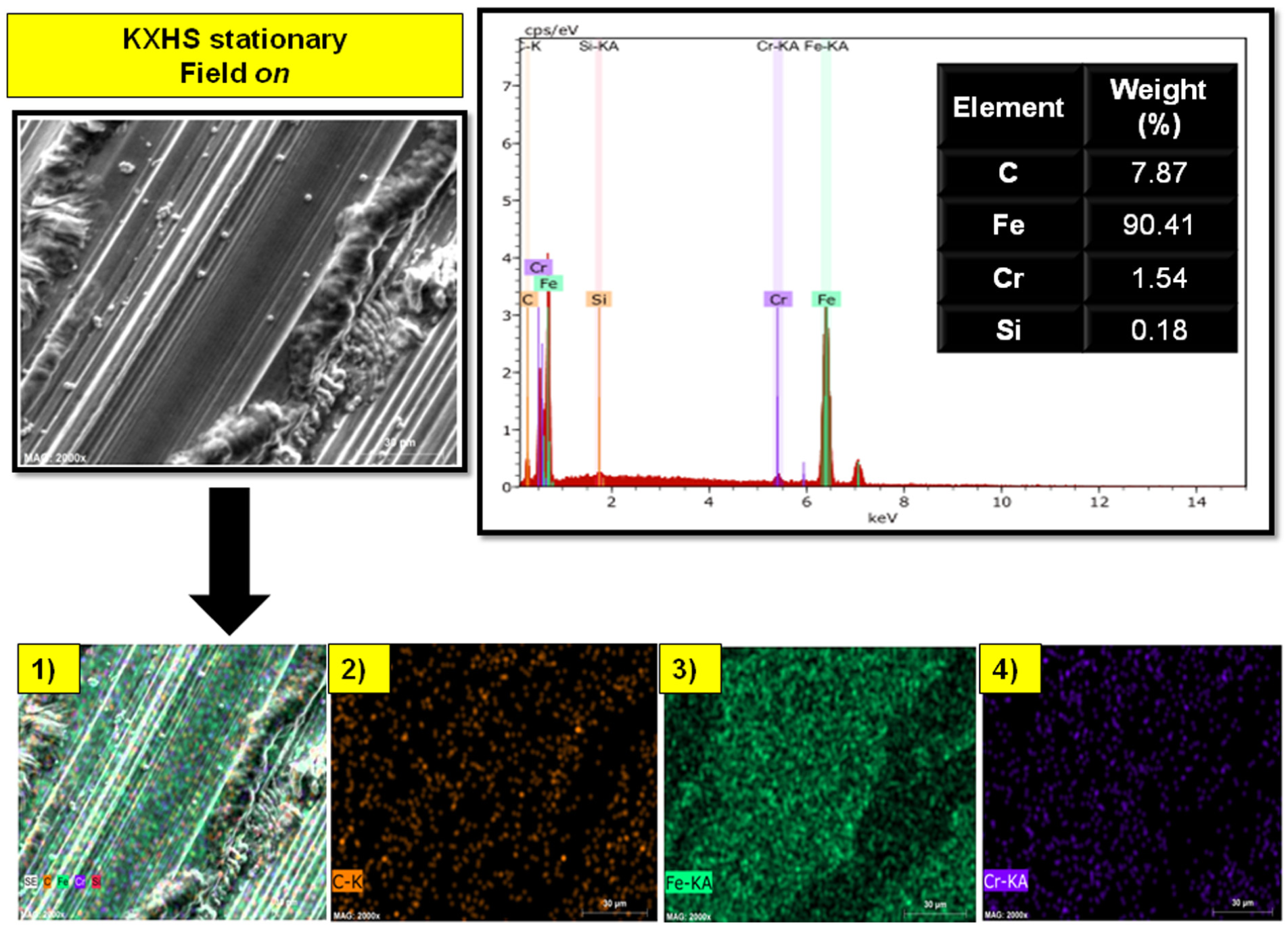
Energy-Dispersive X-ray Spectroscopy (EDS) of the KXHS formulation. The spectrum and elemental maps show the predominance of iron (Fe) and carbon (C). A more dispersed, less uniform distribution is observed relative to CZHS, consistent with the low polarity of the perfluoropolyether (PFPE) matrix and its limited interfacial interaction with carbonyl iron. (1) Combined map of detected elements; (2) Carbon (C–K) distribution; (3) Iron (Fe–Kα) distribution; and (4) Chromium (Cr–Kα) distribution.
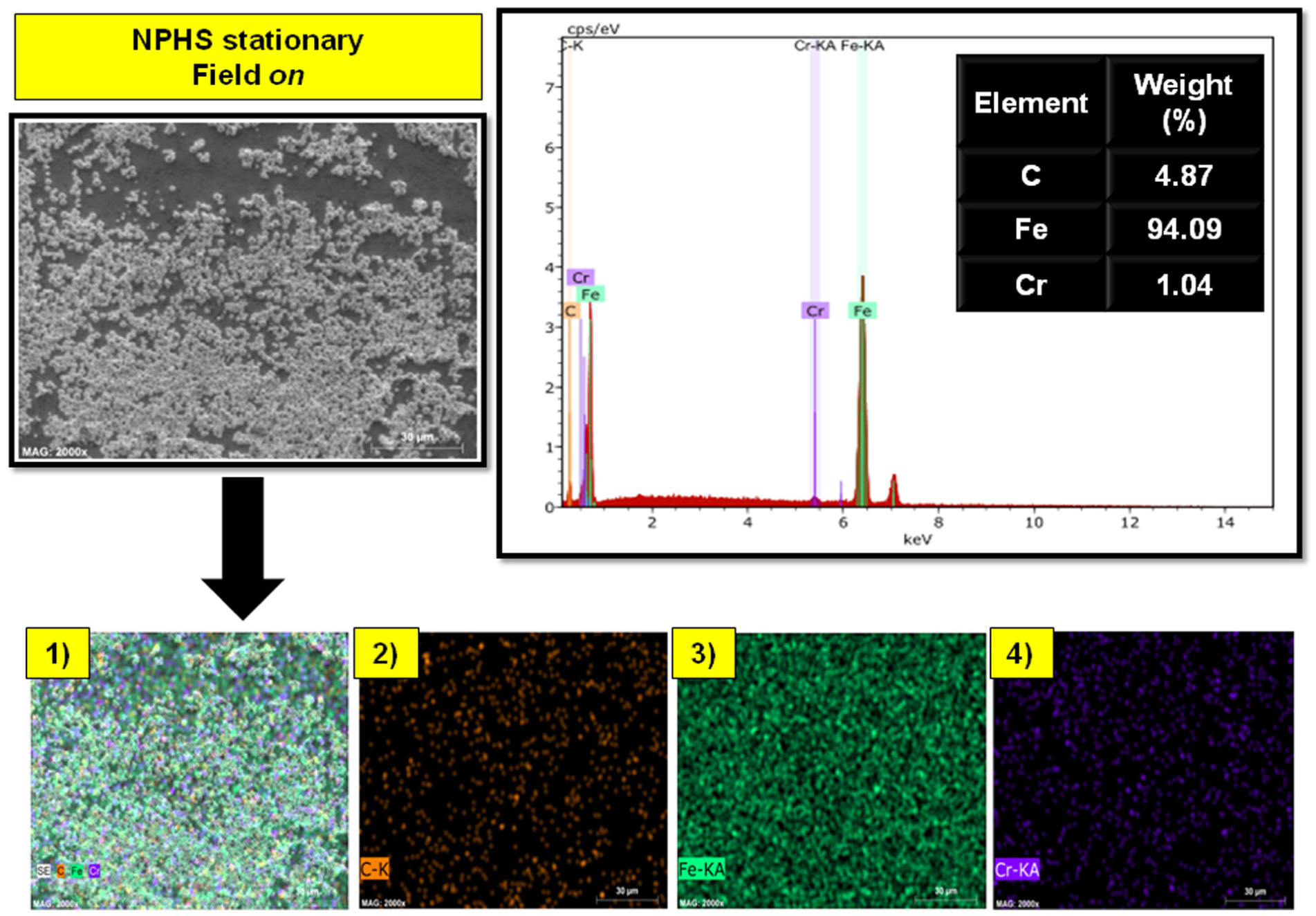
Energy-Dispersive X-ray Spectroscopy (EDS) for the NPHS formulation. (1) Composite elemental map; (2) carbon (C) distribution; (3) iron (Fe) distribution; (4) chromium (Cr) distribution. The results indicate a predominant presence of iron (94.09%) and a moderate carbon signal (4.87%), attributed to the organic lanolin-based matrix. This composition suggests chemical interaction between the iron surface and oxygenated organic compounds, contributing to the formation of a stable tribological film under magnetic field conditions.
In the CZHS sample (Figure 14.(1), (2), (3), (4)), the elemental maps indicate a uniform distribution of iron and carbon, demonstrating good compatibility between carbonyl iron and the synthetic matrix composed of Crodabase™ and PTFE. This homogeneity suggests a physically stable interaction between the metallic and polymeric phases, favoring the formation of a cohesive tribological film.
In the KXHS sample (Figure 15. (1), (2), (3), (4)), greater exposure of iron and less uniform elemental dispersion were observed, behavior consistent with the low polarity and reduced chemical affinity of the perfluorinated oil with metallic particles. This characteristic limits interfacial interaction and explains the moderate response under magnetic field.
For the NPHS sample (Figure 16.(1), (2), (3), (4)), a carbon content of 4.87% was observed, associated with the organic lanolin matrix, which is rich in esters and fatty alcohols. Although carbon is also present in the CZHS and KXHS formulations originating from the polymeric chains and fluorocarbon groups of these matrices the signal in NPHS predominantly reflects oxygenated organic compounds capable of chemically interacting with surface iron. This characteristic favors the adsorption and anchoring of particles within the matrix, promoting the formation of a cohesive and chemically stable tribological film under magnetic field conditions.
In an integrated manner, the SEM and EDS analyses demonstrate that the magnetic field reduces wear severity and reorganizes the ferromagnetic particles into oriented chains, resulting in greater surface stability and a decrease in both friction and wear-scar diameter.
The differences among the formulations are directly related to the nature of the lubricating matrix and the ability to suspend iron particles. The semisolid bases (CZHS and NPHS) exhibited better tribological behavior, characterized by the formation of a continuous and stable film, whereas the perfluoroether matrix (KXHS) showed limited performance due to its low polarity and weak interaction with carbonyl iron.
Correlation between roughness, friction, and surface morphology
Combined analyses of 3D confocal optical microscopy (LEICA), scanning electron microscopy (SEM/EDS), and COF curves indicated the influence of the lubricating matrix and magnetic field on the tribological performance of the magnetorheological formulations. In the tests performed without magnetic field (field off), the roughness parameters (Ra, Rq, Rp, Rv, and Rt) were obtained using confocal microscopy and processed in Gwyddion. The NPHS formulation (field off) exhibited the lowest average roughness (Ra = 5.97 ± 0.33 µm, i.e. Ra < 6 µm) and a regular wear-scar morphology, confirmed by SEM (Figures 11(d-d1-d2) and 17). The tribological efficiency is attributed to the self-adhesive and cohesive nature of purified Pharmalan™ lanolin, which acts as a viscoplastic matrix with high surface adherence, maintaining iron dispersion and film continuity during shear.
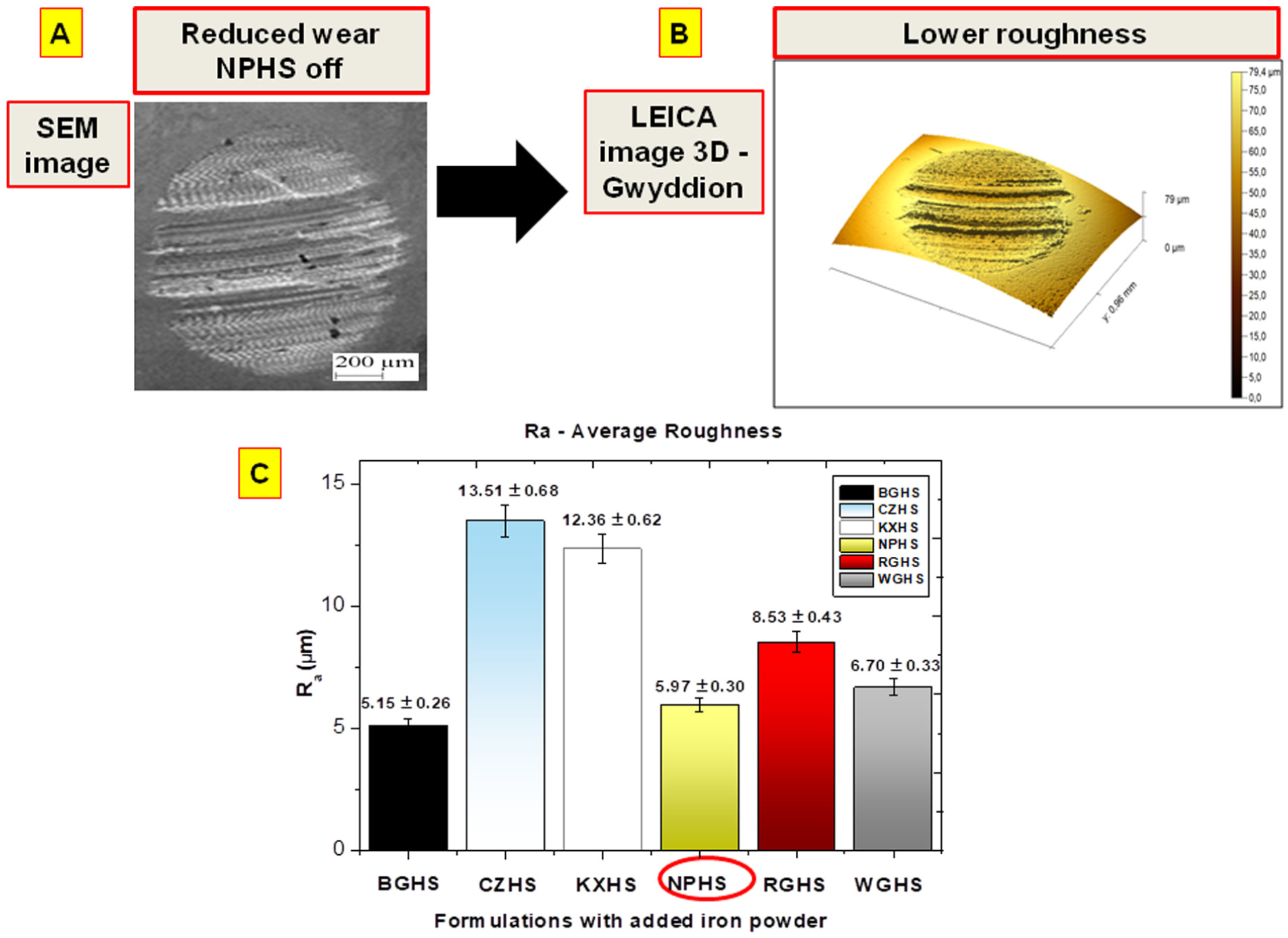
Correlated images from SEM, LEICA 3D confocal microscopy, and Ra roughness graph (Gwyddion) for the iron-containing formulations. The lowest average roughness (Ra) observed for the NPHS formulation (field off) indicates a homogeneous topography and higher surface integrity of the wear scar: (a) SEM image of the worn surface, (b) 3D reconstruction obtained by LEICA confocal microscopy, and (c) average roughness (Ra) graph processed using Gwyddion software, confirming the best tribological performance for NPHS (field off).
The BGHS and WGHS formulations exhibited low Ra values but failed by catastrophic wear (CW; Figures 6(a)–(c) and 7(b)), preventing interpretation as superior performance. This unstable behavior is associated with the breakdown of the metallic thickener and premature exudation (spontaneous separation of the base oil from the grease) of the oily phase under heating. Under applied magnetic field (field on), roughness parameters were obtained from 2D SEM images processed in Fiji, comparatively between CZHS, KXHS, and NPHS. Among these, CZHS presented the lowest relative roughness (Ra ≈ 49.55 a.u.), associated with a homogeneous topography and regular parallel tracks in SEM (100× and 2000×). Since the images derive from electronic acquisition without height (Z) mapping, the values represent variations in brightness intensity rather than direct micrometric measurements. However, considering a typical surface relief range of 10 µm for boundary-lubrication regimes, the estimated conversion indicates Ra ≥ 1.9 µm, consistent with the smoothed morphology observed in Figure 12. This behavior is directly related to the reduction in the coefficient of friction (COF ≈ 0.083 ± 0.004) and the alignment of ferromagnetic particles under H ≈ 120 kA·m−1, which increase local stiffness and stabilize the tribological film. EDS analysis confirmed the stable distribution of Fe and C within the Crodabase™ + PTFE matrix, validating the physicochemical compatibility between matrix and particles, in agreement with patents (Barbosa and Bombard, 2025a, 2025b).
The perfluorinated KXHS formulation exhibited higher roughness and pronounced micro-grooves, consistent with the low affinity between PFPE and carbonyl iron, resulting in micro-abrasion. NPHS (field on) showed particle adhesion and micro-agglomerates, reflecting intermediate performance.
The roughness parameters presented in Table 7 were obtained from 2D analysis of SEM micrographs using Fiji/ImageJ software. The values, expressed in arbitrary units (a.u.), represent variations in grayscale intensity—indicative of relative surface irregularity rather than actual height in micrometers. These data allow a qualitative comparison of the texture of samples subjected to the magnetic field, with Ra being the main parameter considered for correlation with COF and surface morphology.
Roughness parameters obtained from 2D SEM images processed using Fiji/ImageJ software. Values expressed in relative units (a.u.), corresponding to variations in grayscale intensity.

Source: Author’s data (2024).
In summary, the best tribological balances were achieved under two conditions:(i) NPHS in the field-off state, due to the intrinsic visco-adhesive property of lanolin, which stabilizes the film and reduces roughness; and (ii) CZHS in the field-on state, owing to the magnetic alignment of HS carbonyl iron particles and the physicochemical compatibility of the synthetic Crodabase™ + PTFE matrix, resulting in lower COF and controlled wear.
These results confirm the combined effect of cohesive matrix behavior (off) and magnetic organization (on) on the reversible tribological performance of magnetorheological greases.
Consistent with the findings presented, the reduction in both average roughness and coefficient of friction observed in CZHS under magnetic field agrees with the studies cited in Kocak et al. (2025), which demonstrate that magnetic field application tends to decrease surface roughness (Ra) and, consequently, friction, due to the reorganization of magnetic particles at the tribological interface. According to the authors, the use of magnetorheological fluids containing modified iron particles results in lower roughness and COF compared with systems tested without magnetic field, establishing a direct correlation between surface texture and tribological response.
Concluding Remarks
The results obtained demonstrate that the tribological performance of magnetorheological systems strongly depends on the interaction between the lubricating matrix and the ferromagnetic particles. The CZHS formulation, when subjected to the magnetic field (field on), exhibited the lowest coefficient of friction (COF ≈ 0.083 ± 0.004) and the smallest wear scars, resulting from the directional organization of HS carbonyl iron particles under a field intensity of H ≈ 120 kA·m−1. Scanning electron microscopy confirmed the formation of a continuous and homogeneous protective film, consistent with the presence of PTFE in the Crodabase™ matrix, as also evidenced by EDS mapping and described in patent (Barbosa and Bombard, 2025b).
Under the application of a magnetic field, the tribological response of magnetorheological systems arises from the formation and mechanical stability of field-induced particulate structures confined within the contact interface. The magnetic interaction does not act directly on the metallic surfaces, but rather through the reorganization of carbonyl iron particles into chain-like microstructures, which locally increase the apparent yield stress and induce a viscoplastic response of the lubricating film.
This magnetically structured interfacial layer promotes the redistribution of normal and tangential stresses within the contact zone, reducing localized stress concentrations and mitigating the severity of abrasive wear mechanisms. As a result, wear evolves in a more progressive and controlled manner, leading to reduced wear-scar diameters, more regular surface topographies, and enhanced stability of the friction coefficient under magnetic field conditions.
This behavior bears a conceptual analogy to the mechanisms described in magnetorheological polishing (Lu et al., 2024), in which magnetized particles confined within a fluid or semisolid matrix interact with the surface in a controlled and progressive manner, resulting in gradual and homogeneous topographical modification. In the present tribological context, this analogy reflects interface regularization rather than intentional material removal.
The effectiveness of this mechanism strongly depends on the physicochemical nature of the carrier matrix, which dictates particle mobility, the persistence of magnetically induced structures under shear, and the system’s capacity for internal energy dissipation. Semisolid and cohesive matrices favor particle retention and mechanical coupling, thereby enhancing the beneficial magnetorheological effects on friction and wear, whereas low-polarity or highly mobile matrices tend to limit the stability of these structures during sliding.
The NPHS formulation, in the field-off condition, showed the lowest average roughness (Ra < 6 µm) and a regular wear surface, attributed to the high cohesiveness and adhesiveness of purified lanolin (Pharmalan™ USP), properties already described in patent (Barbosa and Bombard, 2025a). This characteristic provided high mechanical stability to the lubricating film, allowing the matrix to remain cohesive and adhered to the metallic surface during testing, which resulting in low friction and minimal wear even in the absence of a magnetic field.
Lanolin, due to its relatively low dropping point of around 45°C, offers an interesting possibility in the preparation of MR formulations. At temperatures below 45°C, the formulation will solidify, eliminating the inherent sedimentation problem ubiquitous in any MR fluid, and will resemble grease. Upon reaching temperatures typical for use in MR devices, the lanolin will melt, and the formulation will become an MR fluid. This was previously described by Shahrivar and de Vicente, 2013, 2014). Therefore, the MR suspension in lanolin is a formulation with thermoreversible transition.
Three commercial formulations (BGHS, RGHS, and WGHS) did not complete the tests due to catastrophic wear (CW) associated with thickener rupture and base-oil exudation, reinforcing the structural limitations of conventional systems compared with the semisolid matrices studied. The correlation among roughness (Ra), coefficient of friction (COF), and surface morphology (SEM/EDS) demonstrates that optimal tribological behavior results from the combination of cohesive matrix performance (NPHS, field off) and magnetic particle organization (CZHS, field on; Figure 18). This synergy confirms the potential of semisolid magnetorheological greases as reversible lubrication systems capable of dynamically responding to external magnetic fields, with promising applications in active friction control devices, couplings, and intelligent automotive systems.
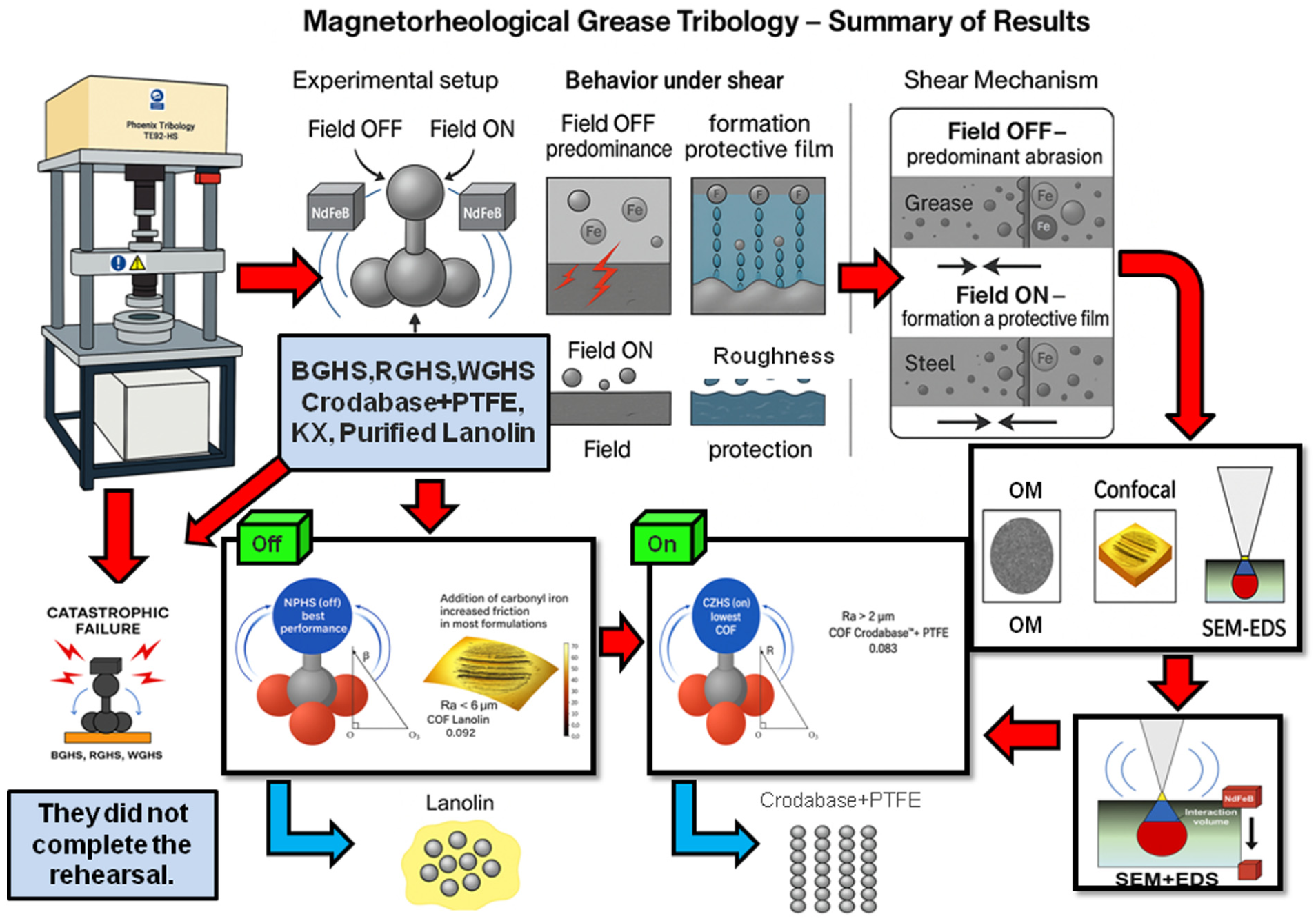
Experimental workflow and analytical sequence used in the tribological evaluation of magnetorheological greases in 4-ball tests. The diagram summarizes the test procedure under magnetic field on/off conditions, showing predominant wear mechanisms and the main performance outcomes. Commercial greases (BGHS, RGHS, WGHS) failed catastrophically, while NPHS (field off) exhibited the lowest roughness (Ra < 6 µm) and CZHS (field on) showed the lowest coefficient of friction (COF ≈ 0.083), confirming the influence of matrix composition and magnetic field on tribological stability and performance.
Footnotes
Acknowledgements
The authors are deeply indebted to Professors Sylvio Jose Ribeiro de Oliveira as well as Dr. Luis Carlos Vidal Castro (Laboratory of Tribology and Dimensional Metrology - UFRJ) for the 4-ball tribology tests; and Professor Luis Rogerio de Oliveira Hein (Laboratory of Materials Images, UNESP Guaratinguetá), for the confocal microscopy images.

Funding
The authors disclosed receipt of the following financial support for the research, authorship, and/or publication of this article: KFSB thanks CAPES for its master’s scholarship, and Dr. Maria S. C. Loureiro do Carmo for financial support. AJFB acknowledges the state agency of Minas Gerais, FAPEMIG, for the Grant # APQ-00620-23.
Declaration of conflicting interests
The authors declared no potential conflicts of interest with respect to the research, authorship, and/or publication of this article.
Data availability statement
Data sharing not applicable to this article as no datasets were generated or analyzed during the current study.