







Abstract
Digital twin (DT) technology establishes a computational mirror of physical systems, enabling real-time monitoring, predictive analytics, and informed decision-making throughout their lifecycle. However, large-scale deployment remains constrained by reliance on wired power or batteries, leading to extensive cabling, frequent battery replacement or recharging, and labor-intensive maintenance, particularly in distributed, large-scale, or hard-to-access harsh environments. Meanwhile, advances in energy harvesting, low-power electronics, and on-chip edge computing are enabling smart systems that operate sustainably by harnessing energy from ambient environments. This paper explores how emerging technologies collectively promote the development of the next generation of battery-free digital twins. We begin by reviewing the foundations of self-powered sensing, low-power communication, and intermittent computing, and discuss the architectural shifts required to sustain reliable digital representations under fluctuating and uncertain energy availability. Key challenges may arise from energy volatility, asynchronous and sparse data acquisition, scalability across large-scale sensor networks, and the hardware-algorithm gap that restricts on-node intelligence. Yet these challenges also create opportunities to reimagine digital twins as predictive, self-adaptive, and environmentally resilient systems. By tightly coupling energy and information flows, battery-free digital twins offer a promising route toward large-scale, maintenance-free cyber-physical intelligence spanning applications from smart infrastructure and healthcare to agriculture and marine engineering.
Keywords
Introduction
The rapid evolution of digital twin (DT) technology has led to a transformative change in how we perceive, monitor, and optimize physical systems (Attaran et al., 2024; He et al., 2025; Khan et al., 2022; Lim et al., 2020; Tao et al., 2019). By creating real-time cyber replicas of physical assets or processes, digital twins function as powerful tools for predictive maintenance (Luo et al., 2020; van Dinter et al., 2022; Xiong et al., 2021) and performance optimization (He et al., 2025; Hui et al., 2023; Li et al., 2024). Beyond that, they further support data-driven decision-making (Charitonidou, 2022; Hu et al., 2023) and are widely applied in various fields from smart manufacturing (L. Li et al., 2022a; Qi and Tao, 2018) and infrastructure (Gao et al., 2021; Liu et al., 2023), to healthcare (Elayan et al., 2021; Haleem et al., 2023; Sun et al., 2023) and smart cities (Deng et al., 2021; Ford and Wolf, 2020; Weil et al., 2023). Many systematic reviews and surveys have documented the trajectory of digital twin research, providing comprehensive overviews of its enabling technologies, diverse real-world applications, and persisting challenges (Botín-Sanabria et al., 2022; Khan et al., 2022; Kritzinger et al., 2018; Lim et al., 2020; Liu et al., 2023; Tao et al., 2019; Hu et al., 2021b).
At the same time, concurrent developments in energy harvesting have made it possible to harness micro- to milli-watt-scale power from ambient sources, including vibrations (Hu et al., 2021a; Ma and Zhou, 2022; Yang et al., 2021), thermal gradients (Ramkumar and Ramakrishnan, 2022; Usman et al., 2022), light (Gupta et al., 2024; Huang et al., 2021), and RF (Moloudian et al., 2024; Ullah et al., 2022). These technologies are rooted in a broad spectrum of transduction mechanisms, including piezoelectric (Li and Lee, 2022), triboelectric (Choi et al., 2023; Wang et al., 2024a), electromagnetic (Li et al., 2025), thermoelectric (Massetti et al., 2021), photovoltaic (Hwang and Yasuda, 2023), and RF-based conversion (Moloudian et al., 2024). For vibration energy harvesters, as electromechanically coupled systems, performance is primarily governed by the interplay between structural dynamics (Yang et al., 2021), material properties (Priya et al., 2019), and shunt circuits (Hu et al., 2019). In contrast, non-mechanical approaches, such as thermoelectric and photovoltaic conversion or radio frequency (RF) energy harvesting, rely heavily on thermoelectric material properties, photon absorption efficiency, or the strength of electromagnetic coupling. These diverse mechanisms highlight the multidisciplinary foundations of energy harvesting, where advances in materials, structures, and circuits collectively drive improvements in conversion efficiency (Brusa et al., 2023; Malaji et al., 2022). Extensive reviews have underscored the opportunities and challenges of self-powered sensing enabled by energy harvesting technologies (Ahmad et al., 2021; Saoda et al., 2021; Zahid Kausar et al., 2014). Within this context, backscatter communication has recently emerged as a promising approach to achieve ultra-low-power wireless transmission, making battery-free operation increasingly feasible (Jiang et al., 2023; Toro et al., 2022).
In the past years, these two areas of study, digital twins and battery-free sensing, have largely progressed in parallel, with only limited convergence. Some initial efforts have begun to bridge this gap by applying self-powered sensing in the development of DT models. For example, Zhang et al. (2022a) designed a triboelectric nanogenerator-powered sensor capable of capturing high-fidelity point cloud data without external power sources, thereby facilitating accurate and damage-free surface digitization for DT construction. In the context of civil infrastructure, triboelectric nanogenerators (TENGs) have been deployed as energy-autonomous sensors to feed real-time structural data into DT platforms, supporting predictive maintenance and structural health monitoring (SHM; Pang et al., 2024). Additionally, integrating TENG-based sensors with artificial intelligence (AI) has enabled smart environments, such as wearable devices and smart homes, to develop dynamic, low-power DTs for human and environmental monitoring (Zhang et al., 2022b). While early attempts to integrate self-powered sensing with digital twins are promising, key limitations persist. Most systems, such as those employing TENGs, achieve only partial energy autonomy due to the limited power output of TENGs. Their sensing fidelity often falls short in high-resolution or dynamic environments, constraining their suitability for real-time digital twin applications. Moreover, current designs are largely domain-specific and lack modularity, reducing their adaptability across diverse application scenarios. At the same time, the industry has already indicated a growing demand and interest for battery-free sensing. For example, companies such as Revibe Energy (2026) have developed vibration-powered sensors for industrial condition monitoring. A recent analysis by the International Telecommunication Union highlights ambient-power-enabled IoT as a key enabler for large-scale, maintenance-free sensing in future industrial and infrastructure applications (ITU, 2025).
The convergence of digital twin and energy harvesting is opening new horizons for what we term the Battery-Free Digital Twin (BF-DT) in this paper, as depicted in Figure 1. In this emerging paradigm, self-powered sensing nodes act as the physical interface of the digital twin model, collecting and transmitting data in an intermittent or event-driven manner, while the DT models preserve the continuity of the digital replica through predictive inference and data completion. Battery-free digital twins redefine conventional design principles by shifting from continuous, always-on monitoring to context-aware, energy-adaptive, and intermittently synchronized data exchange.
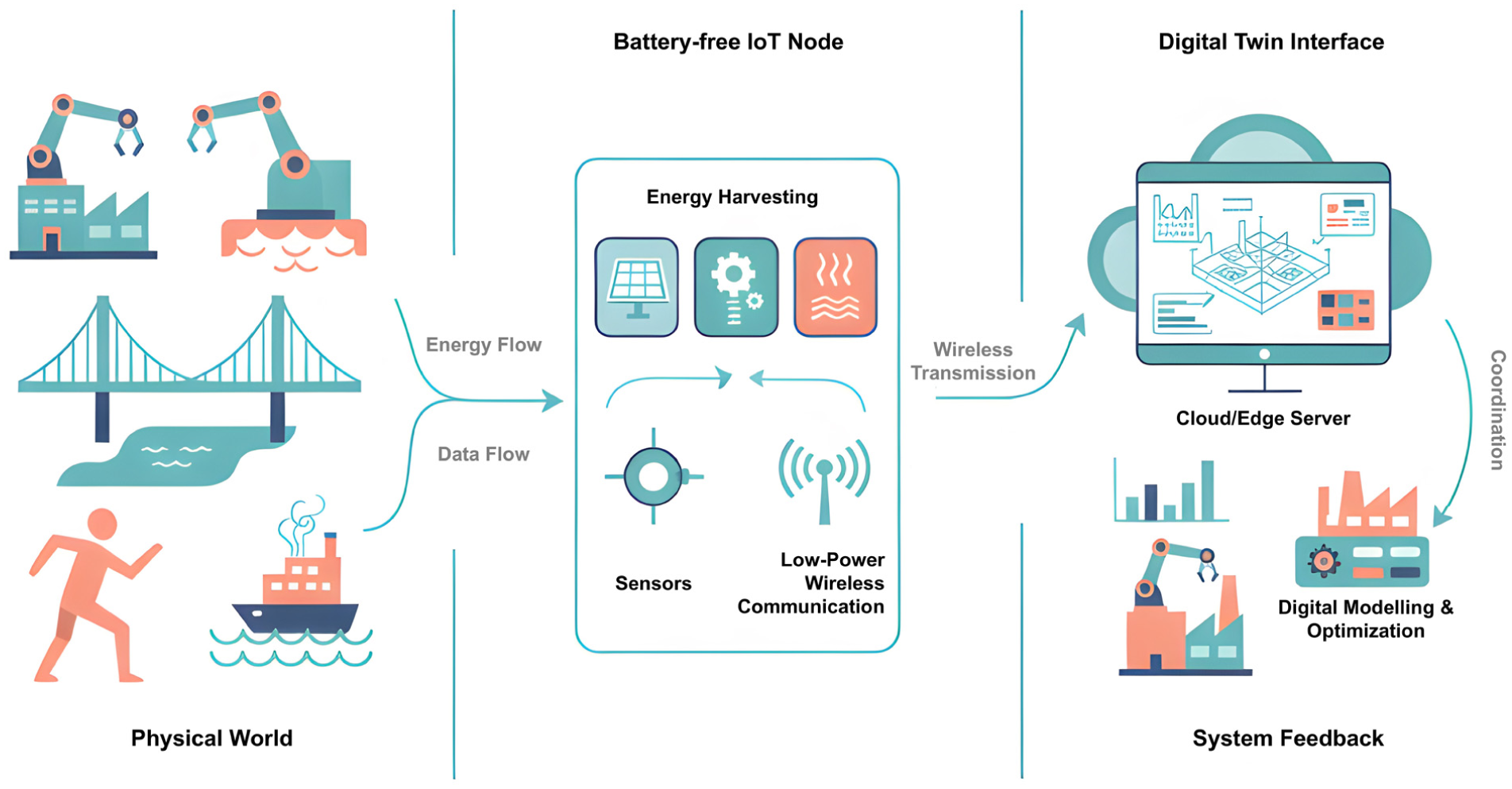
Framework of an envisioned battery-free digital twin system. Ambient energy and data are captured by battery-free IoT nodes that integrate energy harvesting, sensing, and low-power wireless communication. Intermittent or event-driven data are transmitted to cloud/edge platforms, where digital twin models perform analysis, optimization, and system-level feedback.
In this work, the terms ‘battery-free’ and ‘self-powered’ are used interchangeably to describe systems that operate without electrochemical batteries by harvesting ambient energy. In some of the cited literature, the term ‘batteryless’ is also used to refer to the same concept (Bakar et al., 2022; Fu et al., 2023; Hester et al., 2017). Building on this foundation, battery-free digital twins in this work refer to the systems that preserve bidirectional interaction at the system level, while recognizing the practical infeasibility of actuation at battery-free nodes. Accordingly, actuation may still be implemented through powered infrastructure, with control decisions informed by the digital twin. It is also important to distinguish battery-free digital twins from broader concepts such as Green IoT or Passive IoT. While the latter primarily emphasizes self-powered data acquisition, battery-free digital twins place the digital model at the center of the system, using sparse, intermittent physical measurements to continuously estimate, predict, and update the state of the physical asset. Accordingly, the ‘twin’ value thus arises from model-based inference, simulation, and decision support enabled by the coupling between energy-aware sensing and a predictive digital representation, rather than from sensing alone.
While the vision of battery-free digital twins is promising, it also introduces fundamental challenges at the intersection of energy harvesting, communication, and digital twin modeling. Achieving reliable synchronization between the physical and digital domains under intermittent power conditions requires a rethinking of both system architecture and algorithmic design. These considerations naturally lead to some key research questions. (1) How can energy-harvesting modules and power-management circuits be designed to support sensing under dynamically changing environments? (2) How can data fidelity and model accuracy be preserved when sensing is intermittent and asynchronous? (3) How can digital twin architectures be designed to remain robust amid irregular data arrival, missing inputs, and latency variations? (4) How can sensing, communication, and DT modeling be co-designed to operate effectively within stringent energy budgets?
This article explores these questions by developing a conceptual framework for battery-free digital twins. We begin by reviewing recent advances in self-powered sensing, ultra-low-power communication, and tiny machine learning (tiny-ML), and by identifying key technical bottlenecks along with promising research directions. Ultimately, we envision a sustainable future in which energy and information are co-harvested to enable next-generation battery-free cyber-physical systems that are scalable, resilient, and environmentally sustainable.
Battery-free sensing: The cornerstone of passive digital twins
In the context of battery-free digital twins, sensing plays a foundational role (Barr and Huang, 2022). Unlike traditional systems that rely on stable battery power or wired energy supply (Akhtar and Rehmani, 2015), battery-free systems must harness their operational energy directly from the environment. This transforms the conventional design paradigm from a power-abundant model into one constrained by the availability of ambient energy. Research has shown that energy harvesting techniques, such as triboelectric nanogenerators (TENGs) and piezoelectric energy harvesters (PEHs), can enable self-powered sensing in DT applications (Chen et al., 2021; Lu et al., 2020; Pang et al., 2024; Shirvanimoghaddam et al., 2019). Despite limited power availability, these systems offer a promising pathway toward pervasive, maintenance-free, and environmentally sustainable sensing infrastructures that can support future digital twin platforms (Ma et al., 2020).
Recent advances in energy harvesting have made it possible to extract small but usable amounts of power from various ambient sources (Brusa et al., 2023; Li and Lee, 2022; Malaji et al., 2022; Massetti et al., 2021; Yang et al., 2021). For instance, mechanical vibrations can be converted into electrical energy using piezoelectric (Li and Lee, 2022) or triboelectric (Choi et al., 2023) materials. Such mechanisms are well-suited for SHM applications in industrial environments where abundant sources of mechanical excitation are present (Ahmad et al., 2023). In thermal environments, the operation of machinery and the generation of waste heat create temperature gradients that can be harvested by thermoelectric generators (TEGs), which are now finding applications in industrial monitoring devices (Li et al., 2023). In indoor environments, even low-intensity light can drive ultra-low-power photovoltaic sensors for smart building applications (Rokonuzzaman et al., 2021; Yue et al., 2017). Additionally, in dense wireless environments, ambient RF signals can be harnessed as an energy source and then modulated through backscatter communication, enabling battery-free data transmission (Munir et al., 2019; Tang et al., 2021). The diversity and pervasiveness of these ambient sources allow sensing nodes to operate without batteries across a broad range of scenarios, from transportation infrastructure (Clementi et al., 2023) and ocean monitoring (Wang et al., 2024a) to human healthcare (Shuvo et al., 2022).
While these energy harvesting approaches enable battery-free operation across diverse scenarios, their long-term reliability and environmental robustness differ significantly and must be carefully considered for applications with multi-year lifetimes. PEHs, which rely on solid-state materials and mature fabrication processes, generally exhibit stable performance and high durability under prolonged operation, making them well-suited for long-term SHM (Brunner, 2023). TENGs, by contrast, offer high sensitivity, flexible form factors, and strong output under low-frequency excitation, but their performance may be easily affected by material wear, surface degradation, humidity, and packaging issues, particularly in harsh or high-cycle environments (He et al., 2023). Photovoltaic cells/panels and TEGs benefit from well-established materials and encapsulation technologies, enabling reliable long-term operation when sufficient light or thermal gradients are available (Mo and Davidson, 2013). RF energy harvesting typically provides lower power density but offers high robustness and minimal mechanical degradation (Du et al., 2020). These trade-offs indicate that the choice of energy harvesting technology for battery-free digital twins must balance power availability, environmental compatibility, and long-term reliability, rather than favoring any single mechanism.
Because these systems rely on harvested energy, they are fundamentally intermittent (Bakar et al., 2022; Fu et al., 2023; Liu et al., 2015). Rather than performing continuous real-time data acquisition, battery-free sensors start to operate only when sufficient energy has been harvested or to be triggered by specific physical events. While the event-driven mode may seem limiting, it also embodies a design principle that advances energy-aware intelligence. Instead of continuously transmitting redundant data, intelligent nodes transmit only significant deviations or anomalies (Du et al., 2020; Li et al., 2022b), resulting in more compact and informative datasets. This paradigm shift from always-on to intermittently active sensing prioritizes energy efficiency over continuous operation, as shown in Figure 2.
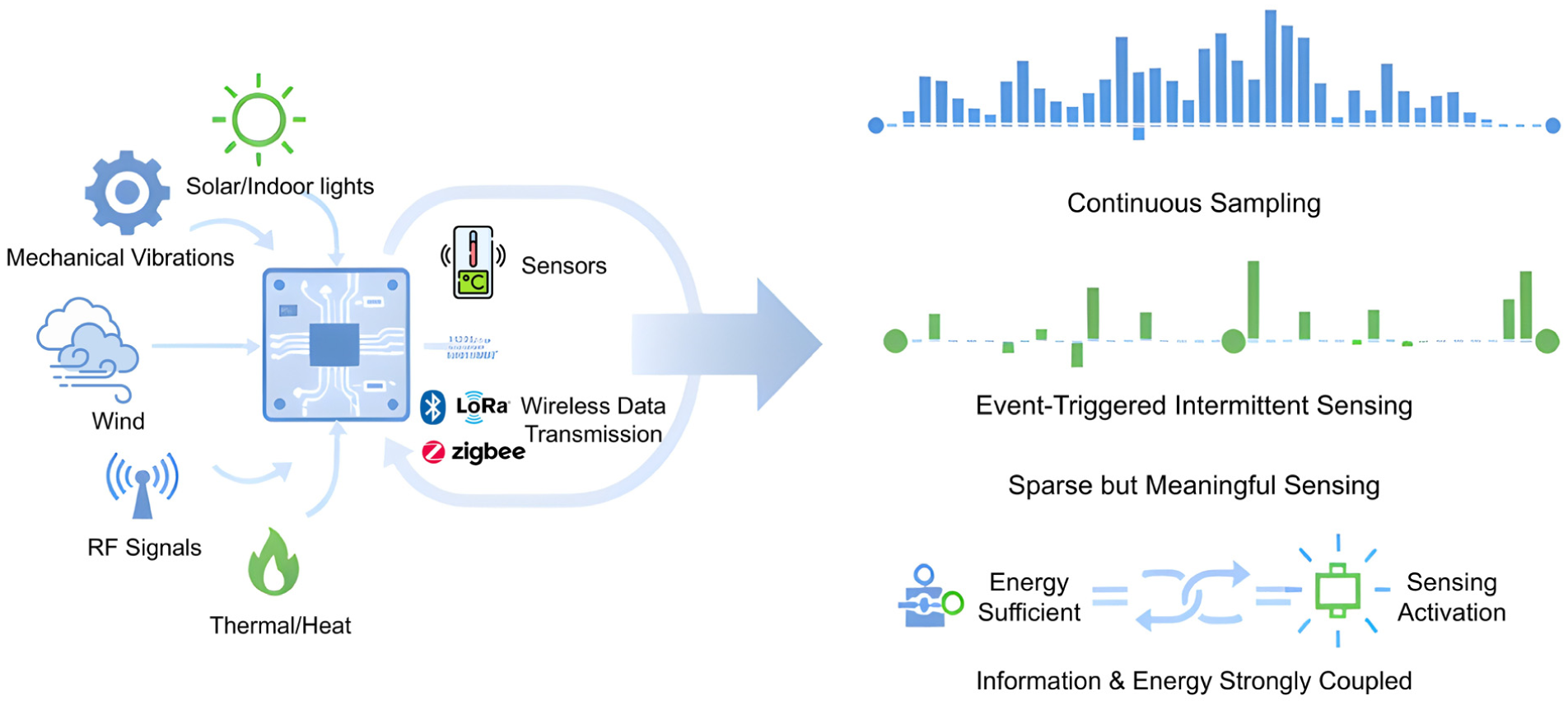
Energy-aware sensing paradigm for battery-free systems. Multiple ambient sources power sensing nodes that transition from continuous sampling to event-triggered, sparse yet meaningful data acquisition, where sensing activation is tightly coupled to available harvested energy.
Beyond merely reducing energy/power consumption, some battery-free systems integrate sensing and energy harvesting into unified transduction mechanisms (Asthana and Khanna, 2021; Gao et al., 2023; Kim, 2019). For instance, vibration energy harvesters based on triboelectric or piezoelectric transduction mechanisms can simultaneously serve as power sources and as sensors (Chen et al., 2025; Zhang et al., 2022a; Lu et al., 2020), with their electrical outputs carrying both energy and information. This dual functionality creates opportunities for in-sensor computing, where mechanical signals are not only measured but also pre-processed or classified using analog features before being transmitted digitally. In such cases, the energy and information flows are inherently coupled, allowing the system to adapt its behavior to the amount of energy harvested (Balsamo et al., 2020; Ben Halima and Boujemâa, 2022; Sandhu et al., 2023). These capabilities lay the foundation for more compact and intelligent nodes that are not only self-powered but also context-aware.
Applications of battery-free sensing span across diverse fields. In civil engineering, self-powered accelerometers have been deployed on bridges and railway tracks to detect structural anomalies and feed data for the development of digital twins (Castellini et al., 2024; Pang et al., 2024; Qi et al., 2022; Tang et al., 2024). In wearable health monitoring, thermoelectric (Sattar et al., 2024) and motion-powered (Ma et al., 2022a) sensors capture biological signals without the need for regular charging, enabling the development of digital profiles of human physiological states. In industrial IoT settings, factory assets are increasingly being outfitted with light- (Kantareddy et al., 2019) or RF-powered (Paolini et al., 2021) sensor tags that monitor vibration, temperature, or usage cycles, forming a foundation for predictive maintenance (Pech et al., 2021). Even in ocean environments, wave-driven energy harvesters (Wang et al., 2024a) have enabled the creation of low-maintenance distributed sensing platforms (Xi et al., 2025) that can be linked to digital ocean models. Across these examples, the common theme is: battery-free sensors enable deployment at scale, with minimal maintenance and strong long-term sustainability (Aldin et al., 2024; Paccoia et al., 2025; Rosa et al., 2024).
As battery-free sensing becomes more reliable and intelligent, it transforms the physical layer of DTs. Rather than relying on dense, power-hungry sensor networks, the paradigm is shifting toward sparse yet meaningful sensing that remains tightly coupled to physical events and energy conditions (Figure 2). This transition is crucial for achieving truly battery-free, scalable, resilient, and context-sensitive digital twins, particularly in environments where traditional power solutions are infeasible or prohibitively costly.
However, it is important to note that battery-free digital twins do not imply a universal transition toward intermittent sensing. The suitability of intermittent operation is inherently application dependent. For scenarios involving slowly varying or quasi-static physical variables, such as temperature and humidity, sparse and energy-aware sensing can provide sufficient information for reliable model updates. In such cases, intermittent sensing offers an effective means of balancing energy availability with information fidelity. By contrast, digital twin applications that require continuous or high-sampling-rate measurements to capture fast dynamics or transient responses cannot generally tolerate aggressive intermittency. In these scenarios, progress toward battery-free digital twins depends not on sacrificing temporal resolution, but on improving the power outputs of harvesters and further reducing the power consumption of sensing, computation, and functional circuit modules. Achieving this balance highlights the need for close collaboration among researchers in energy harvesting, microelectronics, sensing, and digital twin modeling.
This application-dependent sensing paradigm will also introduce new challenges for communication and edge computing. Intermittent energy availability naturally leads to asynchronous data generation and transmission, which can compromise the continuity of digital twin updates. To maintain the integrity of the digital replica, the system must compensate for missing information through compressed sampling algorithms (Procacci et al., 2023), adaptive modeling (Jiang et al., 2022), and energy-efficient communication (Jiang et al., 2023; Toro et al., 2022). Other representative approaches for compensating sparse or intermittent data include physics informed learning frameworks, probabilistic models such as Gaussian processes (Chang and Zeng, 2023), state estimation techniques such as Kalman filtering (Wang et al., 2024b), and hybrid model based and data-driven estimation methods (Qin et al., 2023), which can leverage prior knowledge and uncertainty quantification to reconstruct system states between sensing events.
The following section discusses these issues in detail, focusing on how the cutting-edge ultra-low-power communication and computation technologies can advance the development of battery-free digital twin architectures.
Low-power communication and computation: Enabling digital mapping
If battery-free sensing establishes the physical interface of a digital twin, communication and computation provide the nervous system that maintains the digital replica. The challenge lies in implementing these functions within microwatt-level power budgets harvested from ambient sources. Overcoming this constraint demands innovations in wireless communication, edge computation, and their tightly integrated co-design, as illustrated in Figure 3.
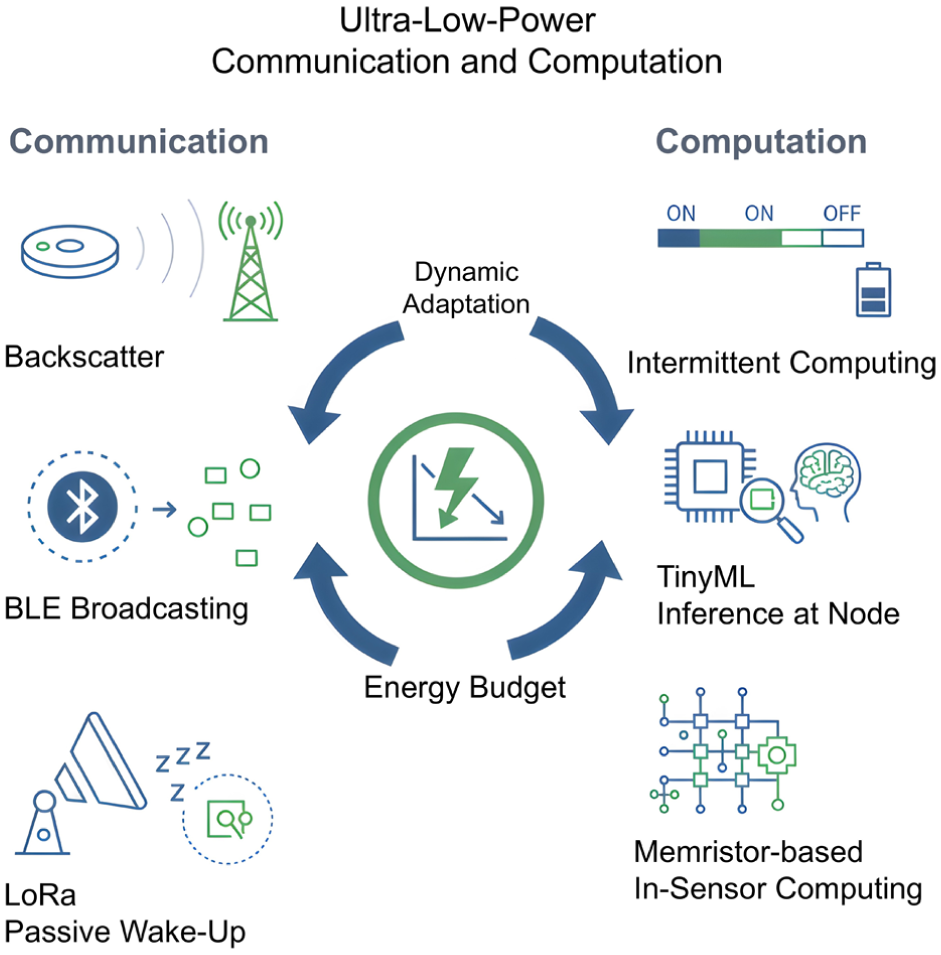
Ultra-low-power communication and computation. Backscatter, BLE broadcasting, and passive wake-up radios enable energy-efficient communication, while intermittent computing, TinyML, and memristor-based processing support on-node intelligence under constrained energy budgets.
On the communication side, traditional wireless protocols such as Wi-Fi or cellular are impractical for self-powered devices due to their high-power consumption (Ni et al., 2024; Toro et al., 2022). Instead, emerging techniques such as ambient backscatter (Liu et al., 2013; Van Huynh et al., 2018), low-power Bluetooth Low Energy (BLE; Townsend et al., 2014), and passive wake-up radios (Polonelli et al., 2021; Schulthess et al., 2025) have shown promise in drastically reducing power consumption while maintaining essential connectivity. These strategies do not strive for continuous transmission; instead, they adapt to the availability of energy, sending updates only when conditions permit. Such energy-aware communication ensures that digital twins can be sustained without exhausting the limited energy harvested by the nodes. It is important to note that ultra-low-power communication technologies differ substantially in their energy cost, communication range, and achievable data throughput. Backscatter communication operates at the microwatt or sub-microwatt level (Yuan et al., 2023), making it well-suited for fully battery-free operation, albeit at short ranges and limited data rates. In contrast, BLE offers a moderate range, but typically requires tens of microwatts to milliwatts during transmission, which may necessitate duty cycling and temporary energy storage for harvester-powered nodes (Ensworth, 2016). Long-range protocols such as LoRa or Zigbee provide extended communication distances, but their transmission power, often on the order of tens of milliwatts, generally exceeds what can be supported by instantaneous energy harvesting, requiring supercapacitors and long-charging times. These trade-offs highlight that no single communication protocol is universally optimal for battery-free digital twins. Instead, protocol selection must be co-designed with the available harvesting rate, required communication range, data volume, and update frequency. In practice, battery-free digital twin systems may adopt hierarchical or hybrid communication strategies (Zhang et al., 2025b), for example using backscatter or short-range links for frequent low-energy updates, and higher-power radios for infrequent but information-rich transmissions.
Equally critical is the question of computation at the node level. A digital twin requires frequent updates and local intelligence, yet battery-free nodes cannot perform uninterrupted processing. Intermittent computing (Lucia et al., 2017) has emerged as a solution, where tasks are paused and resumed across energy cycles by storing intermediate states in non-volatile memory (Bhattacharyya et al., 2022; Umesh and Mittal, 2021). This enables the execution of complex algorithms even under fluctuating power supply conditions. Complementing this, tiny machine learning (TinyML) has demonstrated that even kilobyte-scale memory and microwatt-level processing are sufficient for tasks like anomaly detection and pattern recognition (Chen et al., 2014; Lin et al., 2023; Warden and Situnayake, 2019), enabling nodes to provide meaningful updates rather than raw data. Beyond conventional microcontroller-based solutions that dominate current industrial digital twin deployments, emerging memory-centric computing paradigms offer a promising pathway to further narrow the hardware-algorithm gap under extreme energy constraints. In particular, memristor neural networks (MNNs) and compute-in-memory architectures integrate storage and computation within nanoscale devices, enabling massively parallel multiply-accumulate operations at exceptionally low energy cost (Aguirre et al., 2024; Jebali et al., 2024; Xia et al., 2025). Prototype MNN accelerators have already demonstrated their capability for edge inference and in-sensor computing (Shi et al., 2021). More recently, chip-level implementations have shown that digital compute-in-memory and near-sensor neural network accelerators can operate at sub-microwatt and even nanowatt power levels. For example, a 90.7 nW vibration-based condition monitoring chip integrating a digital compute-in-memory DNN accelerator has been reported (Zhang et al., 2025a), illustrating the feasibility of combining ultra-low-power condition monitoring with on-chip intelligence compatible with energy-harvesting-driven operation. Although such technologies remain at an early stage of adoption (Shi et al., 2021; Ren et al., 2025), their rapid progress suggests strong potential for future battery-free digital twin systems, particularly in applications where aggressive data reduction and local intelligence are essential.
In this new paradigm, as shown in Figure 3, communication and computation cannot be considered in isolation. Energy-aware protocols employ local intelligence to decide whether to transmit raw data, compressed features, or inference results, depending on system state and power conditions. Conversely, computational tasks are aligned with anticipated transmission periods to ensure that key information is transmitted once wireless communication is possible. Through this co-design, the digital twin shifts from a continuously synchronized but energy-intensive mirror to an asynchronous yet resilient model, sustained by lightweight predictive algorithms at the edge or in the cloud that reconstruct missing data between updates.
Beyond the challenge of reconstructing missing data, intermittently powered operation also introduces a fundamental challenge in reconstructing time itself. When harvested energy is depleted, battery-free nodes fully lose power, and the onboard clock stops. Upon restart, the node may no longer retain knowledge of absolute time, complicating the use of temporally coherent time-series data required by digital twins. Consequently, temporal alignment must be addressed at the system level, for example, through periodic gateway synchronization, event-driven timestamping, or model-assisted temporal inference at the Digital/Data layer.
Ultimately, ultra-low-power communication and computation are not merely supporting technologies but defining elements of battery-free digital twins. They recast synchronization as a dynamic, energy-adaptive process, enabling scalable deployment in environments where traditional connectivity and computing models are inadequate. By combining energy-aware communication protocols with innovations such as TinyML and MNNs, the vision of real-time digital mapping under extreme energy constraints is becoming increasingly tangible.
Digital twin architecture for battery-free systems
The realization of battery-free digital twins requires not only advances in ambient energy harvesting, sensing, communication, and computation, but also a fundamental rethinking of the system architecture that integrates these components. Traditional digital twin frameworks often assume continuous data streams and emphasize tightly coupled synchronization between the physical asset and its digital representation (Sharma et al., 2022; Tan and Matta, 2024; Touhid et al., 2024; Ward et al., 2023). In contrast, battery-free systems operate under conditions of intermittent power supply, irregular data flows, and constrained computational resources (Hester et al., 2017; Liu et al., 2015; Lucia et al., 2017). This calls for a novel architectural framework that is ultra-low-power, energy-aware, resilient to uncertainty, adaptive to sparse data, and capable of maintaining meaningful representations in the absence of continuous updates.
To address the distinct design requirements of battery-free digital twins, we introduce a dedicated four-layer architecture (Figure 4) that integrates sensing, data processing, modeling, and service interaction under energy constraints. These layers include the Energy-Sensor Layer, the Data Layer, the Digital Layer, and the Service Layer.
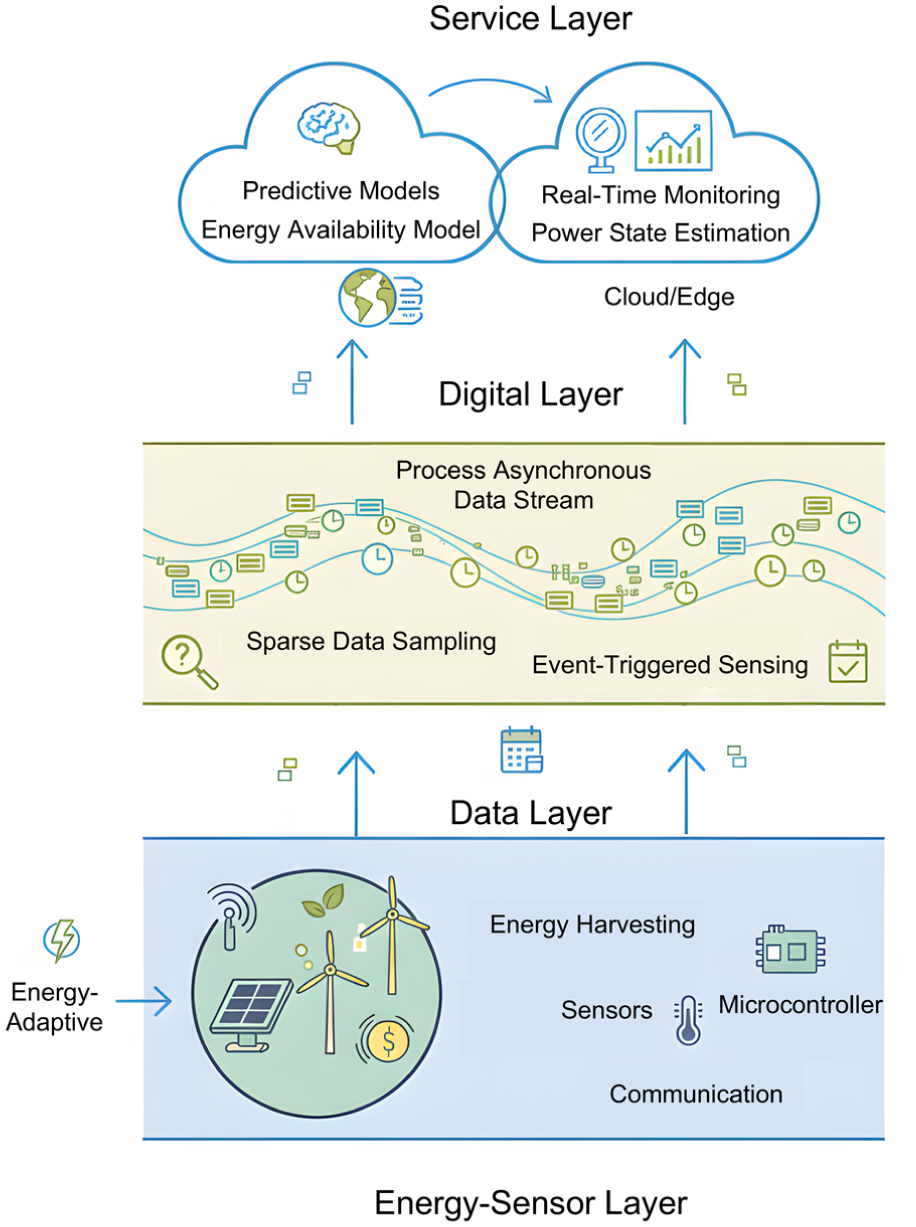
Four-layer architecture for battery-free digital twin systems. The energy-sensor layer harvests energy and acquires data; the data layer processes sparse and asynchronous streams; the digital layer fuses sensing with predictive modeling; and the service layer supports monitoring, decision-making, and cloud/edge integration.
The Energy-Sensor Layer consists of distributed nodes that integrate energy harvesting modules, power management circuits, embedded microcontrollers, self-powered sensors, and data transmission units. These nodes operate primarily in an event-driven manner, activating only when sufficient energy has been harvested or when specific environmental conditions are detected. Instead of adhering to fixed schedules, sensing tasks are determined by local energy availability and physical dynamics, resulting in data streams that are inherently nonuniform across time, space, and context and that reflect the ambient nature of both the energy source and the measured phenomenon. When ambient energy is abundant and consistently harvested, the same nodes can also function in real time, delivering higher-frequency sensing and more continuous updates to the upper layers of the digital twin. In essence, this layer supports two operational modes: (1) an intermittent mode under scarce or sporadic energy supply, and (2) a continuous mode when harvested energy allows for sustained operation. This dual capability enables adaptive sensing strategies across diverse deployment conditions.
The Data Layer serves as the intermediary between physical signals and their digital interpretation. It is responsible for receiving asynchronous data streams from the energy-sensor layer, compensating for missing or delayed measurements, quantifying uncertainty, and enabling lightweight edge processing when conditions permit. A key function of this layer is to assess whether the incoming data is recent and relevant, outdated, unnecessary, or essential for updating the digital model. Given the inherently intermittent nature of battery-free nodes, data transmission from the energy-sensor layer is often irregular and sparse. To maintain the continuity and integrity of the digital replica, the system must employ techniques such as adaptive sampling (Tayeh et al., 2019), spatial interpolation (Guo et al., 2011), and probabilistic modeling (Ma et al., 2022b) for data reconstruction and to ensure coherence in the representation. These strategies enable the digital twin to operate even when partial information is missing. In resource-constrained implementations, part of this data management logic may be embedded within the sensing node itself, leveraging intermittent computing and TinyML-based inference to extract features or make simple decisions locally. In more complex deployments, this responsibility can be offloaded to nearby edge gateways or aggregation servers, which coordinate and process inputs from multiple battery-free nodes, synchronize data across spatially distributed sources, and prepare the cleaned data for integration into the digital model.
Above this lies the Digital Layer, where the digital model of the physical asset resides. Since updates from the physical layer are irregular and sparse, this layer cannot rely on real-time synchronization. Instead, it maintains a continuously evolving state by fusing available sensor inputs with predictive algorithms that estimate system behavior during data gaps. This layer supports functions such as anomaly detection, forecasting, and control, and treats the digital twin not as a passive mirror but as an active estimator. The model is recalibrated whenever new observations are received, allowing it to adapt to changing conditions and remain operationally relevant even when power constraints disrupt the flow of input data. More importantly, unlike conventional architectures, the Digital Layer in a battery-free digital twin explicitly accounts for energy availability as a dynamic system state. Information related to harvested energy, operational duty cycles, and feasible communication or computation windows is incorporated into the digital model to guide synchronization strategies, data fusion, and update scheduling. In this sense, the Digital Layer implicitly maintains an energy-aware representation of those physical nodes, enabling adaptive operation under intermittent and energy-constrained conditions.
At the top of the stack, the Service Layer connects the battery-free digital twin to external systems and end users. This layer provides interfaces for data visualization, decision-making, and system-level control, and enables integration with broader cyber-physical infrastructure. Outputs from the digital model are translated into actionable insights or control commands, while application-level feedback can also influence sensing, communication, or modeling strategies across the stack. In distributed deployments, the Service Layer further supports coordination across multiple DTs, thereby facilitating scalability and modular system integration. Importantly, while battery-free nodes can perform sensing, actuation is typically carried out by externally powered actuators or infrastructure-level control systems, with control actions informed by the digital twin, rather than through local actuation at battery-free nodes.
One of the defining features of this architecture is its energy adaptive behavior. Each layer must not only tolerate energy variability but also actively respond to it. For example, during periods of energy scarcity, the system may reduce the sampling frequency, suppress low-priority updates, or rely more heavily on model-based inference. When energy becomes abundant, the system may increase data resolution, transmit richer features, or refine model fidelity. This energy-aware feedback loop ensures that the digital twin remains functional and informative across changing environmental and energy conditions.
Importantly, this architecture preserves scalability and interoperability. It allows nodes to join or exit without systemic failure, accommodates diverse energy sources and sensor types, and supports modular expansion into different application domains. By embedding energy dynamics into every layer of the stack, this architecture extends the boundaries of traditional digital twins into domains where wiring is infeasible, battery replacement is highly costly, and sustainability is essential. Rather than introducing a separate energy layer or energy twin, the proposed architecture embeds energy awareness across layers, with the Digital Layer serving as the locus where physical state estimation and energy-constrained operation are jointly considered.
Challenges and opportunities
Recent advances in self-powered sensing systems provide concrete pathways toward realizing battery-free digital twins. For example, a mantis shrimp-inspired energy harvester was demonstrated to convert sporadic mechanical excitations, such as vehicle motion or human footsteps, into high-density electrical energy sufficient to power radar and camera modules for intelligent surveillance without batteries (Li et al., 2025). In the reported work, the system functions as a fully self-powered sensing node, with event-triggered data acquisition and wireless transmission sustained solely by harvested energy. At the same time, perception and recognition tasks are executed at the edge or in the cloud. Although a complete Digital Twin was not implemented in that study, such a platform naturally lends itself to an event-driven Battery-Free Digital Twin architecture. In this context, the virtual counterpart would take the form of an asynchronous perception and asset-state model that integrates intermittent visual and radar observations to reconstruct traffic flow, human activity, or infrastructure usage. Instead of continuous sampling, the physical node would provide energy-aware, event-triggered updates, while the virtual model maintains continuous situational awareness through predictive inference and data fusion. In another example, a magnetically enhanced quasi-zero-stiffness galloping piezoelectric harvester was shown to simultaneously harvest wind energy and perform self-powered wind-speed sensing via frequency-based signal encoding (Zhang et al., 2025c). The reported system realizes an autonomous sensing node that exploits the intrinsic coupling between structural dynamics and environmental excitation. While the original work focused on sensing and energy harvesting rather than implementing a full Digital Twin, the system can be naturally extended to support an environmental twin. In such a framework, the virtual counterpart would consist of a physics-informed wind-field and structural-response model capable of reconstructing continuous wind conditions from sparse, intermittently transmitted frequency-encoded measurements. During periods of insufficient harvested energy, the twin could maintain state awareness through model-based prediction and data assimilation, and update its estimates whenever new measurements become available. Together, these examples highlight how high-efficiency energy harvesters, event-triggered sensing, intermittent communication, and sparse-data inference can jointly enable Battery-Free Digital Twin architectures. Rather than operating as continuously powered monitoring systems, these architectures transition toward adaptive, energy-aware cyber–physical integration in which sparse yet informative measurements sustain persistent virtual representations.
While these examples highlight the feasibility and promise of battery-free digital twins, several technical and systemic challenges, as outlined in Figure 5, must be overcome before this vision can be fully realized. The first challenge stems from the fundamental mismatch between harvested energy and the system’s power demands. Ambient energy sources are inherently variable and usually unpredictable (Hester et al., 2017; Yang et al., 2021), whereas sensing, computation, and communication impose strict timing and reliability requirements. Ensuring robust system functionality under such fluctuating conditions requires advances in adaptive power management, energy forecasting, and hardware-software co-design.
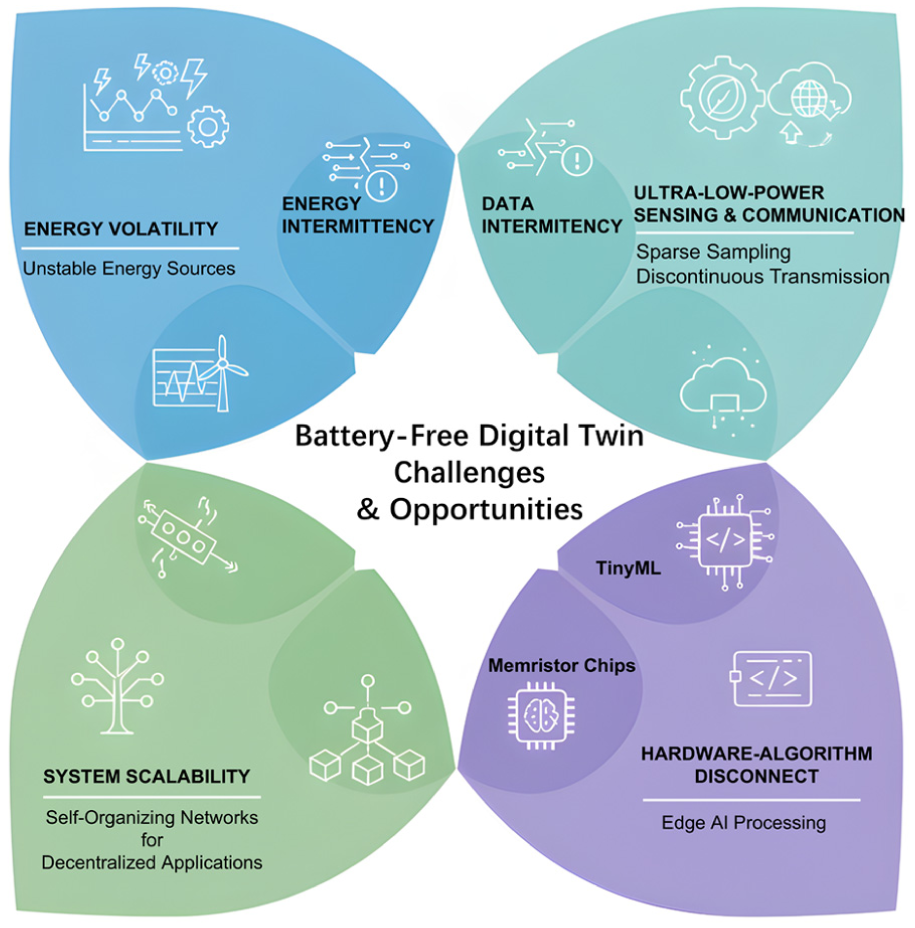
Key challenges and opportunities in battery-free digital twins. Energy volatility, data intermittency, and ultra-low-power communication constraints pose fundamental hurdles. Opportunities arise from scalable architectures, decentralized networks, TinyML, and memristor-based in-sensor computing that can bridge the hardware-algorithm gap.
A second major challenge stems from the intermittent nature of data acquisition. Battery-free nodes typically operate in intermittent modes, initiating measurements when sufficient energy is harvested but remaining inactive during periods of energy scarcity. Such irregularity poses a risk to the temporal accuracy and consistency of the digital twin. In addition, intermittent power cycles may disrupt onboard clocks, creating a time-synchronization challenge that requires timestamp reconstruction and probabilistic temporal alignment at the system level. To address this issue, future research must develop algorithms for reconstructing missing information, integrating model-based simulation with data-driven inference, and balancing accuracy with computational cost. The opportunity here is that digital twins can evolve from being passive mirrors of reality to becoming active estimators that intelligently interpolate and predict system states.
The third challenge lies in achieving scalability and seamless system integration. In large-scale deployments, thousands of heterogeneous nodes may operate asynchronously, each powered by different ambient sources. Coordinating such networks without centralized control or continuous connectivity will require robust architectures that support modularity, self-organization, and fault tolerance. Despite these difficulties, the challenge also presents a compelling opportunity. If realized, such architectures could lay the foundation for the next generation of resilient, low-maintenance cyber-physical systems, particularly in remote, harsh environments, such as offshore or marine settings, where batteries and wiring are impractical.
Security also represents a critical and largely open challenge for battery-free digital twins, particularly when deployed in public or shared environments. Battery-free sensing nodes may lack the energy budget to support conventional cryptographic protocols, such as continuous encryption or secure session management, which complicates the use of standard security frameworks (Duan et al., 2024; Rajesh et al., 2021; Thakor et al., 2021). As a result, security in battery-free digital twins must be addressed in a system-aware manner, combining lightweight authentication mechanisms, physical-layer security, redundancy, and trust-aware modeling at the digital twin level. In practice, the digital twin may need to assess data credibility, detect anomalous behavior, and adapt its confidence in individual nodes, rather than relying solely on node-level security guarantees. Developing security strategies that are compatible with intermittent operation and ultra-low-power constraints remains an essential research direction for the practical deployment of battery-free digital twins.
Another key barrier to real-world adoption is the disconnect between advanced hardware innovations and the algorithms designed to run on them. Despite promising developments in TinyML and MNNs, transforming them from lab-scale prototypes into reliable field systems remains a significant challenge. Issues of endurance, variability, and manufacturability must be resolved before these technologies can achieve widespread adoption. Nevertheless, the potential they offer is equally significant. Once matured, they could provide a computational backbone that aligns perfectly with the constraints of battery-free nodes, enabling on-device intelligence that substantially reduces the need for frequent transmissions.
Beyond architectural and algorithmic challenges, the transition from laboratory-level demonstrations to real-world deployment introduces additional engineering constraints. Despite the rapid progress in battery-free sensing and digital twin enabling technologies, long-term robustness, environmental durability, and operational reliability remain critical concerns. For instance, although recent studies, including our own demonstration of self-powered ocean environmental monitoring (Xi et al., 2025; Wang et al., 2024a), have validated battery-free operation in controlled environments and short-term field tests, prolonged exposure to harsh marine conditions introduces challenges such as salt spray corrosion, moisture ingress, biofouling, and mechanical fatigue, which can gradually degrade device performance and system reliability. Addressing these issues will require advances in materials engineering, encapsulation strategies, system-level redundancy, and long-term field validation.
Finally, broader systemic challenges must also be considered, including standardization, interoperability, and long-term sustainability. Without unified frameworks for interfaces and data exchange, battery-free digital twins may remain isolated prototypes rather than become scalable, practical solutions. Conversely, coordinated efforts to define open standards and embed energy-aware digital twins into industrial, urban, and environmental applications could pave the way for broader deployment and unlock substantial public value. By aligning with the goals of sustainable development (Karthick, 2025; Ryu et al., 2019; Timperi et al., 2024), battery-free digital twins can significantly reduce maintenance costs, eliminate battery waste, and enable intelligent monitoring across various fields, such as intelligent agriculture, healthcare, marine exploration, and smart infrastructure.
In summary, the path toward battery-free digital twins presents both technical challenges and transformative opportunities. Challenges such as energy volatility, data intermittency, scalability, and hardware limitations remain substantial, yet each also opens a unique avenue for innovation. Addressing these challenges will not only determine the viability of battery-free digital twins but also reshape the future of cyber-physical systems, making them more resilient, intelligent, and environmentally sustainable.
Outlook
The vision of battery-free digital twins is still in its early stages, yet its long-term implications extend far beyond technical innovation. By enabling sensing systems that operate without batteries or wired power, this paradigm has the potential to reshape how large-scale cyber-physical systems are deployed and maintained fundamentally.
In the long term, battery-free digital twins may enable truly ubiquitous monitoring infrastructures across cities, transportation systems, agriculture, healthcare, and marine environments without the environmental and economic burden of battery replacement. Eliminating billions of batteries from distributed sensing networks would significantly reduce electronic waste, lower maintenance costs, and improve the sustainability of future digital infrastructure.
The broader impact of this paradigm also lies in extending intelligent monitoring to previously inaccessible environments. Remote oceans, forests, industrial facilities, and developing regions, where power access and maintenance remain major barriers, could benefit from persistent, self-sustaining sensing and digital modeling. In this sense, battery-free digital twins support a transition toward cyber-physical intelligence that is both scalable and environmentally responsible.
Realizing this vision will require deep interdisciplinary collaboration across materials science, electronics, mechanical engineering, artificial intelligence, communication systems, and domain-specific application fields (Figure 6). Success will ultimately depend not only on technological progress but also on the development of interoperable standards, sustainable deployment strategies, and socially beneficial applications.
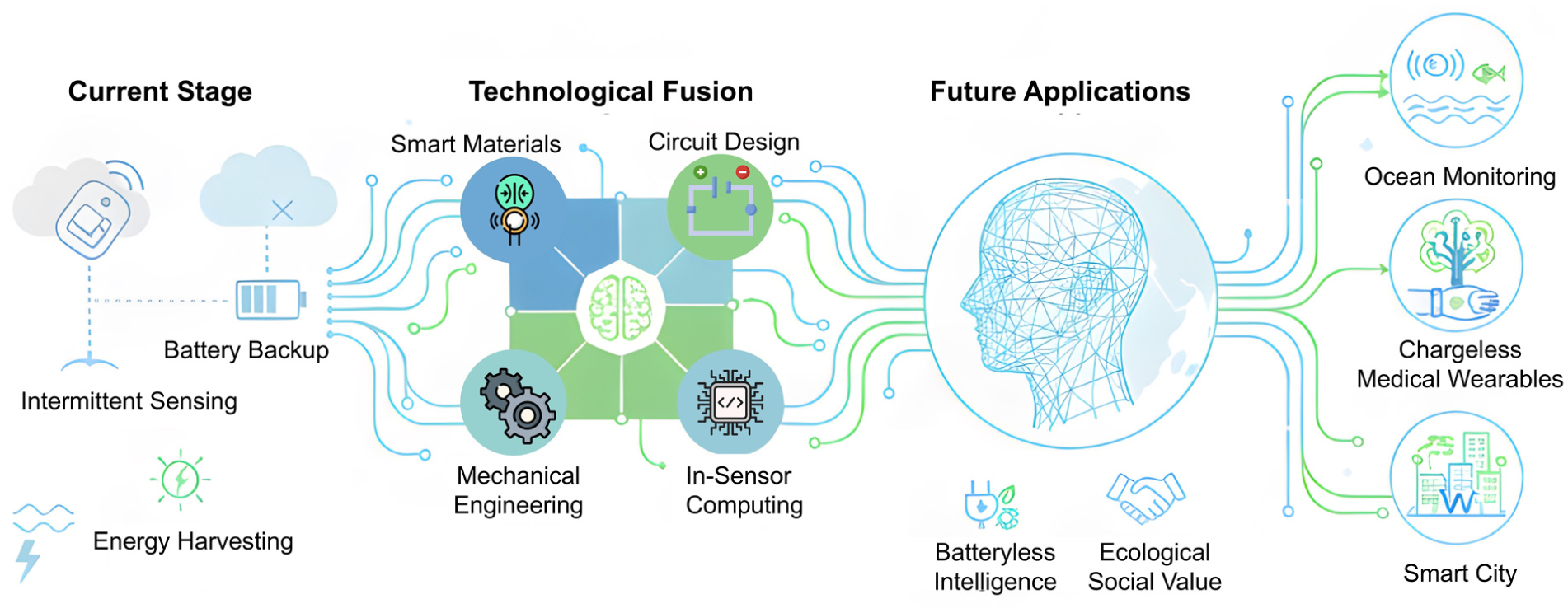
Cross-disciplinary technological fusion driving the evolution toward battery-free digital twins. Advances in smart materials, circuit design, mechanical engineering, and in-sensor computing are collectively pushing intermittent, battery-assisted sensing toward fully battery-free operation, enabling applications such as ocean monitoring, medical wearables, and smart cities.
In this broader context, battery-free digital twins represent more than just an incremental step in digital twin technology. They point toward a future in which energy and information are intrinsically coupled, where intelligent systems are sustained by the very environments they observe, and where the boundary between the physical and the digital becomes more seamless, adaptive, and enduring.
Footnotes

Funding
The authors disclosed receipt of the following financial support for the research, authorship, and/or publication of this article: This study was financially supported in part by the National Natural Science Foundation of China (Grant No. 52305135), Guangdong Provincial Project (Grant No. 2023QN10L545), Guangdong Provincial Key Lab of Integrated Communication, Sensing and Computation for Ubiquitous Internet of Things (Grant No. 2023B1212010007), and Guangzhou Municipal Key Laboratory on Future Networked Systems (Grant No. 2024A03J0623).
Declaration of Conflicting Interests
The authors declared no potential conflicts of interest with respect to the research, authorship, and/or publication of this article.
Data Availability Statement
Data sharing not applicable to this article as no datasets were generated or analyzed during the current study.