






Abstract
This study presents a phenomenological viscoelastic model for predicting the dynamic compressive behavior of hybrid magnetorheological materials formed by encapsulating magnetorheological fluid within a magnetorheological elastomer shell (MRF–MRE). Cubic specimens with identical geometry (30 mm edge length), including a solid MRE and a hybrid MRF–MRE, were experimentally characterized under uniaxial compression across a range of excitation frequencies, strain amplitudes, and applied magnetic fields. A modified Kelvin–Voigt formulation was developed in which both storage and loss moduli are expressed as coupled functions of magnetic excitation, loading frequency, and strain amplitude. Model predictions show good agreement with experimental measurements, yielding average errors below 5% for both materials. The hybrid MRF–MRE specimen exhibited a markedly enhanced magnetorheological response in compression, achieving an elastic modulus increase of up to 650% under magnetic excitation, compared with approximately 100% for the solid MRE. A similar amplification was observed in dissipative behavior, with the maximum relative change in loss modulus reaching 1340% for the hybrid material, versus 141% for the MRE. The proposed model provides a unified predictive framework for the analysis and design of hybrid magnetorheological materials in adaptive vibration isolation and semi-active control applications.
Keywords
Introduction
Magnetorheological (MR) materials enable adaptive stiffness and damping modulation through magnetic-field–controlled microstructural changes (Carlson and Jolly, 2000). These advanced smart rheological materials are increasingly used in adaptive systems and structures for semi-active vibration control applications because their mechanical properties can be instantaneously and directly controlled using an applied magnetic field, commonly referred to as the MR effect. In vibration isolation and semi-active control applications, this field tunability is particularly attractive as it allows a single device to operate effectively over a wide range of load and excitation conditions while maintaining stability and low power consumption (Ahamed et al., 2018). Unlike fully active control systems, MR-based semi-active systems can effectively utilize the motion of the structure itself to generate control forces, offering the inherent reliability of passive treatments while retaining much of the adaptability of active systems, without requiring large power sources or complex control architectures. In addition, compared to their electrorheological (ER) fluids counterparts (Munteanu et al., 2025), MR materials exhibit significantly higher achievable stresses, reduced sensitivity to temperature variations and contaminants, and operate effectively under relatively low power requirements (Bossis et al., 2002).
MR materials generally consist of micron-sized ferromagnetic particles, typically carbonyl iron particles due to their high magnetic saturation, dispersed within a non-magnetic carrier medium (Kikuchi et al., 2025). Among MR material classes, magnetorheological fluids (MRFs) exhibit strong field-dependent yield stress and apparent viscosity because particle chains can freely form, break, and reform under magnetic excitation, enabling substantial controllable energy dissipation (de Vicente et al., 2011). However, the liquid nature of MRFs introduces practical drawbacks, including leakage risk, sealing complexity, particle sedimentation, and long-term stability challenges when used as stand-alone working media (Chen et al., 2024; Wereley et al., 2023).
In contrast, magnetorheological elastomers (MREs) are solid-state MR materials in which magnetically polarizable particles, including soft and hard (Schümann et al., 2021), are dispersed (spatially isotropic or anisotropic (Tian and Nakano, 2018)) within a polymer matrix rather than a fluid (Fereidooni et al., 2020). MREs provide a solid form factor, geometric stability, and ease of integration into engineering structures (Li et al., 2014), and exhibit a field-dependent elastic modulus rather than a field-dependent yield stress (Ahmad Khairi et al., 2017). This characteristic makes MREs particularly attractive for the development of tunable stiffness elements or “smart springs” in vibration and noise control applications (Li et al., 2012) in shear (Spaggiari and Bellelli, 2021), compression (Xu et al., 2021), and mixed modes of operation (Leng et al., 2018). Nevertheless, the tunable range of MREs, particularly in terms of energy dissipation capacity, is often constrained because the embedded magnetic particles are immobilized within the elastomeric network, limiting the extent of field-induced microstructural restructuring and consequently restricting the achievable modulation of damping under dynamic loading (Ali et al., 2025; Kim et al., 2025b).
A widely explored strategy to reconcile these trade-offs is the encapsulation of MRFs within elastomeric matrices, producing hybrid MRF–elastomer (MRF–E) composites that maintain solid-like integrity while exploiting large energy dissipation simultaneously (Rouabah et al., 2025; Wang and Gordaninejad, 2009). Hybrid MREs bridge the gap between MRFs and MREs (Bastola et al., 2019). Early work on MR fluid–elastic mounts demonstrated that inserting MRF into an elastomeric mount enables substantial controllability of dynamic stiffness and damping (Mitchell Southern, 2008). For example, stiffness increased on the order of approximately 78% when the excitation current increased from 0 to 2 A in a tunable MR fluid–elastic mount tested over sinusoidal excitation frequencies of 1–35 Hz and a displacement amplitude of 0.50 mm (Mitchell Southern, 2008). In a related study, Wang and Gordaninejad (2009) sealed MR fluid within a central symmetric void in an elastomer and conducted harmonic compression tests across 0.1–10 Hz, 0.1–0.6 mm peak-to-peak displacement, and 0–2 A. The experiments showed that applying a magnetic field increased both the slope of the stress–strain hysteresis, associated with apparent stiffness and the enclosed hysteresis area related to energy dissipation capability, demonstrating simultaneous tunability of stiffness and damping under compression-mode loading (Leng et al., 2020; Wang and Gordaninejad, 2009).
More recently, engineered encapsulated MRF–E architectures have advanced toward intentionally designed fluid cavities, improved magnetic circuits, and repeatable manufacturing routes. A hybrid MR elastomers was developed by encapsulating MR fluid inside elastomeric casings using a staged curing process involving void formation, fluid filling, and final curing (Bastola et al., 2018). Under cyclic compression, this hybrid architecture exhibited strong field-dependent modulation, with reported increases of approximately 70% in stiffness and nearly 970% in energy loss per cycle per unit volume as the current increased from 0 to 3 A over a low-frequency range. The enhanced MR effect was explicitly attributed to the encapsulated fluid core, where particles can move and form stronger chain structures than in conventional particle-locked MREs. The study further employed a closed magnetic circuit, producing magnetic fields up to approximately 420 mT, enabling controlled and repeatable magnetic excitation during compression testing (Bastola et al., 2017). Additive manufacturing has enabled the fabrication of hybrid MRF-Es with embedded MR fluid domains arranged layer by layer within elastomeric matrices, further highlighting the promise of MRF–E systems as integrated tunable spring–damper materials (Bastola et al., 2017).
While MRF–E hybrids significantly improve practicality compared to free MRFs, their stiffness modulation remains limited by the passive nature of the elastomeric casing. This limitation has led to the development of hybrid MRF–MRE composites, where MR fluid is encapsulated within a magnetorheological elastomer shell. This configuration is motivated by the expectation of a coupled magneto-mechanical response: the fluid core provides strong field-dependent chain formation and rupture, leading to high dissipation potential, while the surrounding magnetically active elastomer shell contributes its own field-dependent stiffening and alters the internal magnetic field distribution. Unlike passive elastomer shells, the MRE shell actively participates in the magnetic response and can reduce magnetic reluctance, thereby enhancing the effective magnetic field acting on the fluid phase. Consequently, the response of MRF–MRE systems cannot be interpreted as a simple superposition of MRF and MRE behaviors, but rather as a synergistic interaction between the fluid core and the solid magneto-active shell, mediated by confinement, load transfer, and coupled microstructural evolution under magnetic excitation (Choi and Wereley, 2022).
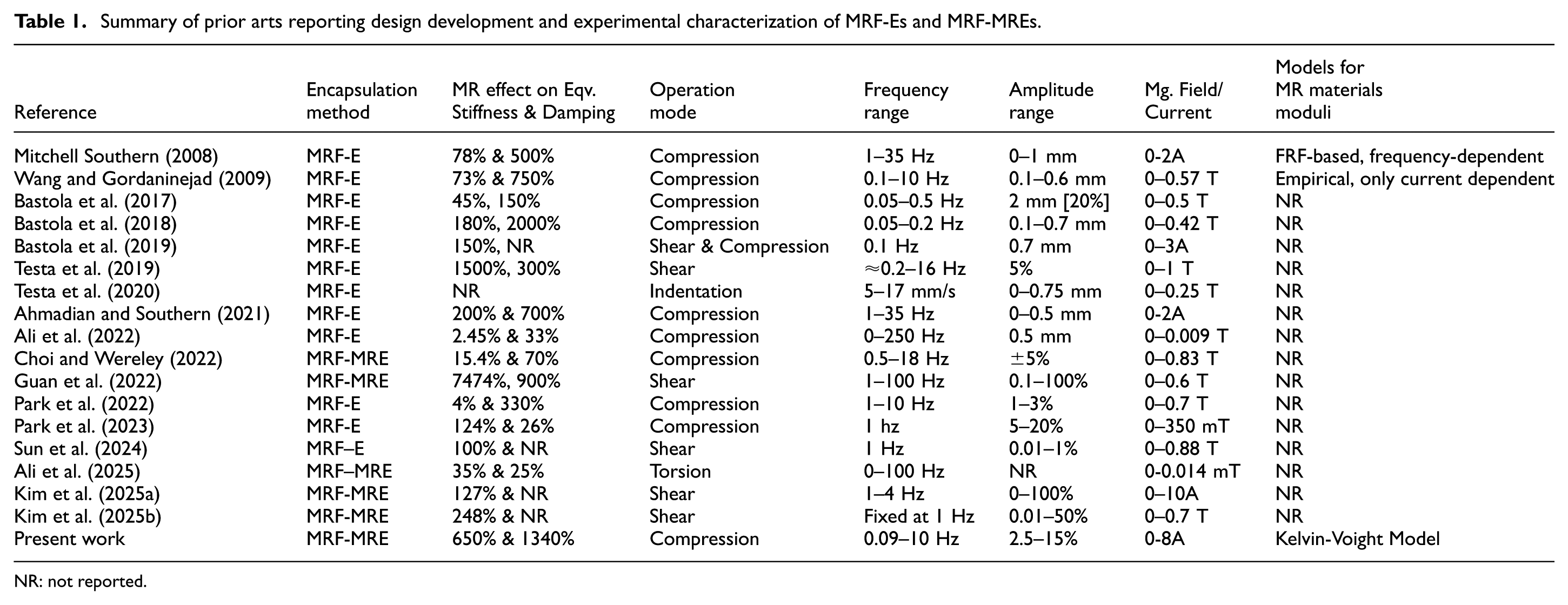
Table 1 summarizes prior design developments and experimental studies on hybrid MR materials, including both MRF–E and MRF–MRE composites, across different excitation frequencies, strain amplitudes, and magnetic field intensities under shear, tension, and compression loading modes. For example, an MRF–MRE composite was fabricated by first 3D printing the MRE matrix, followed by MR fluid filling and sealing (Guan et al., 2022). Compared with single MREs, the hybrid MRF–MRE exhibited substantially higher absolute and relative magnetorheological effects in shear mode, increased by factors of approximately 2.9 and 7.8, respectively. In a related study, a hybrid MRF–MRE composite outperformed alternative configurations, including MRF encapsulated in a non-magnetic elastomer, by exhibiting the highest relative MR effect (34.56%) in view of stiffness and the largest damping enhancement (25.35%) under torsional excitation, highlighting the superior vibration attenuation capability of MRF–MRE systems under magnetic-field control (Ali et al., 2022).
Summary of prior arts reporting design development and experimental characterization of MRF-Es and MRF-MREs.
NR: not reported.
Despite these demonstrated advantages of MRF–MRE composites compared to MRF–E systems, relatively few studies have systematically characterized MRF–MRE materials. Existing investigations have predominantly focused on shear and torsional loading conditions, while compression-mode characterization of hybrid MRF–MRE composites has received considerably less attention. This limitation persists despite the fact that compression loading has been widely reported to yield higher MR effects in particle-reinforced elastomeric composites. This gap is particularly important because compressive deformation dominates the operational loading of many adaptive vibration components, including vibration isolators, mounts, and seat-suspension systems (Fereidooni et al., 2020; Gordaninejad et al., 2012; Lerner and Cunefare, 2008; Popp et al., 2010; Schubert and Harrison, 2015; Sun et al., 2014, 2015; Yarra et al., 2019).
More importantly from a modeling standpoint, Table 1 indicates that, despite growing interest in hybrid MR systems, particularly MRF–MRE composites, there remains a clear lack of viscoelastic models capable of predicting stress–strain behavior together with equivalent stiffness and damping as simultaneous functions of magnetic field (or current), excitation frequency, and strain amplitude. Such magnetic- and loading-dependent viscoelastic models are essential for enabling predictive analysis, design, and optimization of advanced hybrid MR materials. To date, modeling efforts for MRF–MRE composites have been very limited, while only a small number of empirical models have been proposed for MRF–E systems. For instance, Mitchell Southern (2008) employed frequency-domain transfer-function modeling for stiffness and an exponential frequency-dependent damping formulation for MRF–E mounts (Mitchell Southern, 2008); however, these models are restricted to low-frequency or low strain amplitude operation and do not capture coupled field- and strain-dependent viscoelastic behavior (Bastola et al., 2018; Choi and Wereley, 2022). Similarly, Wang and Gordaninejad (2009) proposed an empirical formulation to predict current-dependent stiffness in MRF–E materials, but without establishing a unified viscoelastic constitutive framework (Wang and Gordaninejad, 2009).
Furthermore, review studies on MREs highlight the widespread use of phenomenological hysteresis models, such as Bouc–Wen formulations often combined with Kelvin–Voigt elements, while emphasizing that model parameters depend strongly on excitation frequency and strain amplitude (Díez et al., 2021). In parallel, MRF–E mount studies have relied on phenomenological force–displacement models calibrated separately for off-state and on-state conditions to reproduce measured hysteresis loops (Mitchell Southern, 2008). These observations collectively underscore that existing modeling approaches are either frequency-limited, state-specific, or empirical in nature, and are not readily extendable to hybrid MR architectures in MRF-MREs in which both fluid and solid phases are magnetically active. Accordingly, the primary objective of this study is to develop a phenomenological viscoelastic model, based on a modified Kelvin–Voigt formulation, to predict the compression-mode behavior of a solid MRE and a practical hybrid MRF–MRE configuration as functions of magnetic excitation, frequency, and strain amplitude. The two specimens share the same external geometry and shell formulation; however, the commercial MRF core contains a different magnetic particle volume fraction than the solid MRE specimen. Therefore, the present study should be interpreted as an investigation of the behavior of the tested hybrid architecture relative to a conventional solid MRE reference specimen, rather than as a strict iso-volume-fraction comparison.
Materials and methods
MR materials fabrication
In this work, two cubic magnetorheological specimens with identical dimensions of 30 mm × 30 mm × 30 mm (edge length 30 mm) were prepared, as shown in Figure 1(a) and (b), corresponding to a solid MRE and a hybrid MRF–MRE, respectively. The MRE sample was fabricated by uniformly dispersing carbonyl iron particles (CIP-SQ, BASF) at a volume fraction of 20% within a silicone elastomer matrix (Ecoflex 00-30, Smooth-On Inc.) and casting the mixture into a cubic mold. For the hybrid MRF–MRE specimen, a cubic cavity was formed at the center of the same MRE formulation, leaving uniform elastomer layers of 5 mm thickness at both the top and bottom surfaces as well as around the lateral boundary. This cavity was subsequently filled with a widely used commercial magnetorheological fluid (MRF-132DG, LORD Corporation), which contains a 32% volume fraction of magnetic particles, and sealed using an elastomeric cap, resulting in a fully enclosed fluid region surrounded by a magnetically active elastomer shell. Both specimens were cured under identical conditions to ensure consistent material integrity for subsequent dynamic testing and validation of the proposed viscoelastic model.
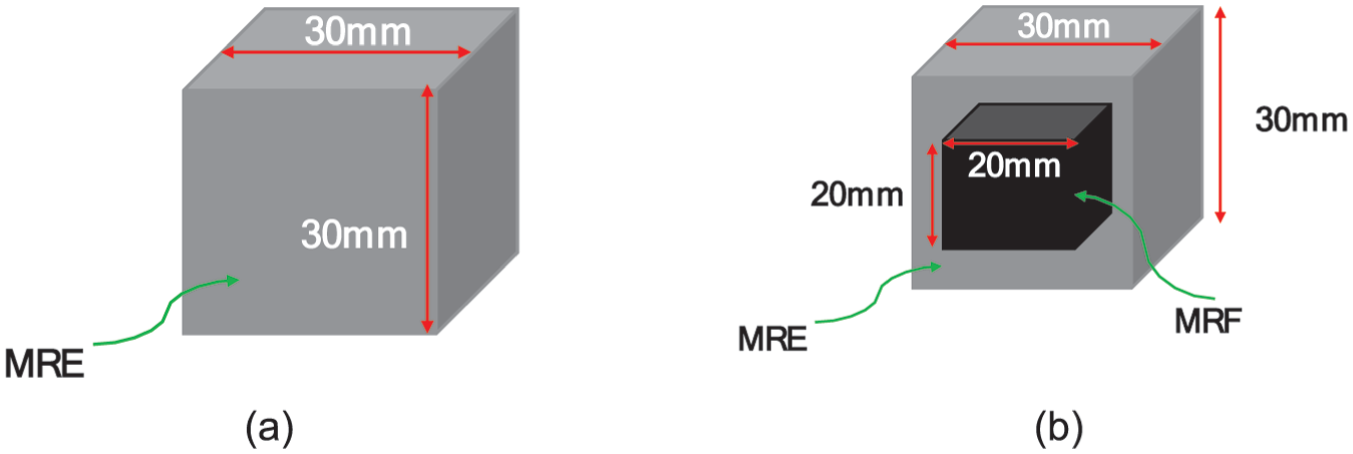
Schematic of cubic (a) MRE and (b) hybrid MRF-MRE.
It should be noted that the commercial MRF-132DG used as the fluid core contains a 32% volume fraction of magnetic particles, whereas the solid MRE specimen contains a 20% particle volume fraction. Consequently, the present study is not intended as a controlled equal-particle-loading comparison between the two materials. Rather, it compares a conventional solid MRE specimen and a practical hybrid MRF–MRE configuration having identical external geometry and the same shell formulation, while using a commercially available MRF core. The purpose of the comparison is thus not to contrast two materials having identical iron volume fraction, but to evaluate how replacing part of a conventional solid MRE architecture with an encapsulated commercial MRF phase changes the field-dependent storage and loss moduli under the same specimen-scale geometry and test conditions.
Experimental setup
Dynamic compression tests were conducted to provide validation data for the proposed viscoelastic model. The experiments were performed using a servo-hydraulic MTS testing frame equipped with a custom electromagnetic loading cell that generates a controlled magnetic field through a closed steel magnetic circuit, as schematically shown in Figure 2. Cubic MRE and hybrid MRF–MRE specimens were placed between high-permeability steel cores and subjected to uniaxial compressive loading under combined static pre-strain and harmonic excitation.
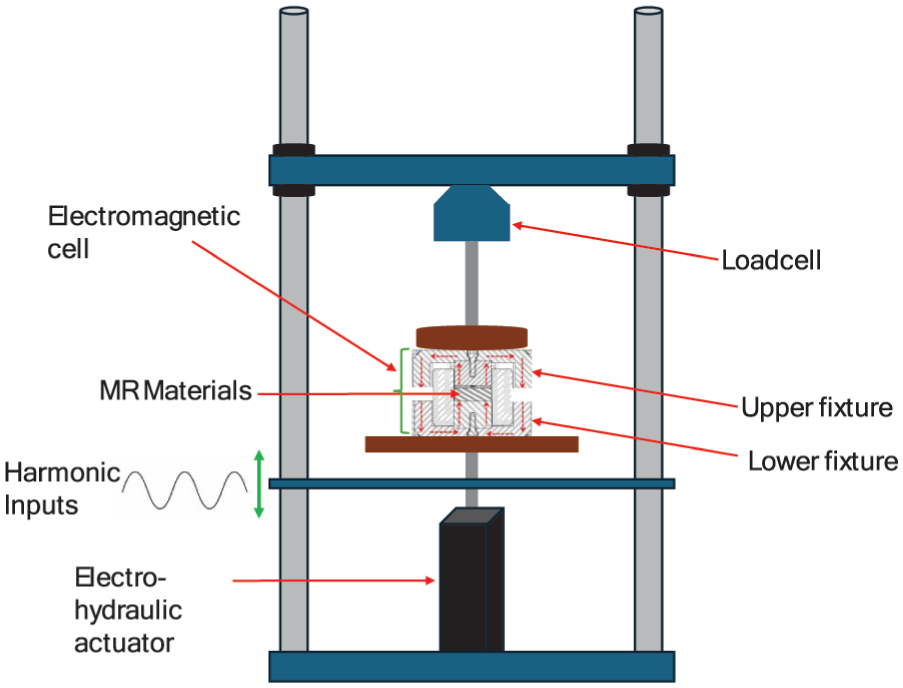
Experimental Rig.
The magnetic field was regulated indirectly by supplying DC current to the embedded coil, while force and displacement responses were recorded using an integrated load cell and actuator-mounted LVDT. Cyclic tests were carried out over a wide range of excitation frequencies (0.09–10 Hz), strain amplitudes (2.5%–15%), and current levels (0–8 A), enabling extraction of steady-state stress–strain hysteresis loops and the corresponding storage and loss moduli used for model identification and validation.
Data analysis
Steady-state cyclic force and displacement data were post-processed to isolate the intrinsic viscoelastic response of the MR specimens. Because the measured force includes both electromagnetic attraction and material deformation, the magnetic contribution was independently quantified under equivalent gap conditions and subtracted to obtain the deformation-induced stress–strain response. The compensated data were analyzed using a harmonic representation, and equivalent storage and loss moduli were extracted from the first harmonic approximation to characterize nonlinear compressive behavior. In this study, the magnetorheological effect is defined as the change in viscoelastic moduli relative to each material’s zero-field state, enabling consistent comparisons between isotropic MRE and hybrid MRF–MRE specimens tested under identical geometries and loading conditions. The focus on compression-mode response reflects the operating conditions of vibration isolators, mounts, and seat-suspension systems, and the resulting moduli form the basis for identifying and validating the proposed field-dependent viscoelastic model for hybrid MR materials.
To ensure that the extracted viscoelastic response was representative of steady-state behavior, force-displacement data for each loading condition were acquired in LabVIEW using a code that incorporated a low-pass filter for real-time signal denoising. During testing, both filtered and unfiltered signals were monitored live, and data were recorded only after steady-state behavior was confirmed from the force-time histories and force-displacement responses. The recorded steady-state response was then averaged over a minimum of three consecutive oscillation cycles before extracting the representative viscoelastic properties.
Since the present study forms part of a substantially broader experimental campaign, full triplicate repetition of every loading condition was not practically feasible. In the broader thesis-level study, 110 dynamic tests were conducted for each sample, and eight different samples were fabricated and characterized. Accordingly, repeatability was evaluated for selected representative loading conditions covering different frequencies, strain amplitudes, pre-strains, specimen geometries, and current levels. The corresponding repeatability statistics are provided in Appendix 1. For the selected repeated cases, the coefficient of variation ranged from 0.25% to 9.34% for the storage modulus
Model development
Accurate prediction of the dynamic response of magnetorheological (MR) materials is a critical requirement for the design, analysis, and control of MR-based adaptive systems. Reliable material models are essential not only for understanding the underlying field-dependent mechanisms but also for enabling the development of effective semi-active control strategies. In this section, a phenomenological viscoelastic formulation is introduced to represent the dynamic and hysteresis behavior of MR elastomers and hybrid MR materials (MRF-MRE) under compressive loading. The proposed model is constructed based on trends observed in the experimental results and is formulated to account explicitly for the influence of excitation frequency, strain amplitude, and applied electrical current.
It is noted that prior studies on modeling magneto-active fluid-elastomer materials under compression have focused predominantly on experimental characterization (Choi and Wereley, 2022). For magneto-active elastomers, reported studies have mainly addressed either: (i) experimental evaluation of compression properties under varying magnetic fields and loading conditions (Zhang et al., 2024; Zhao et al., 2019), or (ii) model development for specific quasi-static prediction or magneto-elastic/hyperelastic behavior without accounting for hysteresis properties (Qiao et al., 2020, 2022; Wang et al., 2023b). However, relatively few studies have considered the simultaneous representation of storage modulus, loss modulus, and compression hysteresis using a physically interpretable model with a low identification burden (Poojary and Gangadharan, 2018), and even then only under limited loading conditions. In several cases, the available models are either data-driven and nonphysical, such as ANN-based formulations (Koo et al., 2010), or require a relatively large number of fitted parameters, such as the seven-parameter Bouc-Wen model (Jaafar et al., 2023). By contrast, the Kelvin-Voigt framework provides a simple and physically meaningful representation in which the spring and dashpot correspond directly to the elastic and dissipative contributions, respectively (Wang et al., 2023a). This makes it well suited for describing the field- and loading-dependent compression response of MRE and hybrid MRF-MRE materials while maintaining model transparency and practical parameter identification. For these reasons, the Kelvin-Voigt model was selected in the present work.
Although fractional viscoelastic formulations are also effective for representing frequency-dependent behavior (Poojary and Gangadharan, 2018), the objective of the present work was to develop a simple and physically interpretable model for the simultaneous representation of storage modulus, loss modulus, and compression hysteresis of both solid MRE and hybrid MRF-MRE materials as functions of current, frequency, and strain amplitude. For this reason, the modified Kelvin-Voigt framework was preferred in the present study, while extension to a fractional viscoelastic formulation may be considered in future work.
Model formulation
A magnetic-field-sensitive viscoelastic model is developed in this work by extending the classical Kelvin–Voigt representation to capture the coupled elastic and dissipative response of MR materials. When the MR material is subjected to harmonic strain excitation of the form,

the resulting stress response is expressed as the sum of elastic and viscous contributions, written as:

Unlike conventional linear viscoelastic models, in which the storage modulus
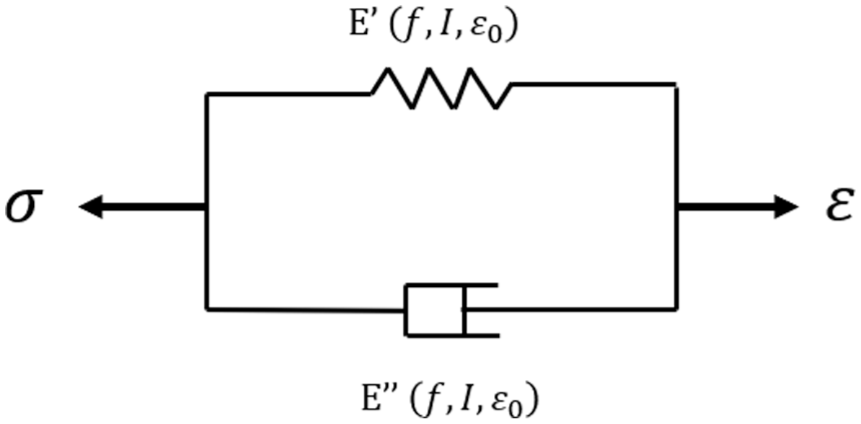
Proposed modified Kelvin-Voigt model for hybrid MR materials.
Previous investigations by Norouzi et al. (2016) evaluated several phenomenological approaches for describing the dynamic response of MR elastomers and demonstrated that a modified Kelvin–Voigt formulation provided superior agreement with experimental observations (Norouzi et al., 2016). Building on that framework, power-law expressions were proposed to describe the frequency and strain dependency of the elastic and viscous moduli, normalized by a reference frequency


where
Further examination showed that the current dependence of



While Norouzi et al. (2016) reported negligible strain-amplitude sensitivity of the loss modulus, the experimental results suggest that dissipative behavior in hybrid MR materials can vary with strain amplitude. To ensure consistency between the elastic and viscous formulations, a strain-dependent term is therefore introduced into the loss modulus expression in equation (4) using an exponential decay function, yielding:

Substituting the current-dependent expressions into the elastic and viscous formulations leads to the final phenomenological representation of the storage and loss moduli as:


This formulation provides a unified viscoelastic framework capable of capturing the coupled effects of magnetic excitation, loading frequency, and strain amplitude on the dynamic response of MR elastomers and hybrid MR materials.
Parameter identification procedure
The developed phenomenological viscoelastic formulation introduced in equations (9) and (10) contains a total of 11 unknown coefficients: six parameters associated with the storage (elastic) modulus
To quantify the discrepancy between the model and experimental observations, two objective (merit) functions,


where
The parameter estimation problem is solved using a hybrid optimization strategy that combines a genetic algorithm (GA) with Sequential Quadratic Programming (SQP). The GA, a population-based stochastic optimization technique inspired by evolutionary processes, is first employed to explore the parameter space and identify solutions in the vicinity of the global optimum. This initial solution is then used as the starting point for the SQP algorithm, a gradient-based nonlinear optimization method that efficiently refines the solution to achieve precise convergence to the global minimum. Multiple independent runs of the combined GA–SQP procedure produced nearly identical parameter values, confirming the robustness and repeatability of the identification process.
The final sets of identified model coefficients for the elastic and loss moduli corresponding to MRE and hybrid MRF-MRE specimens are reported in Tables 2 and 3, respectively.
The identified coefficients of the proposed modified Kelvin-Voigt model for predicting elastic modulus.

The identified coefficients of the proposed modified Kelvin-Voigt Model for predicting loss modulus.

It should be noted that the identified
Validation of the proposed viscoelastic model
To illustrate how well the modified Kelvin–Voigt formulation captures material behavior, elastic and loss moduli along with stress–strain hysteresis loops from cyclic compressive tests on multiple MR specimens are presented and evaluated using both experimental and model-estimated moduli. The identification dataset spans three strain amplitudes (2.5%, 5%, and 10%), five excitation frequencies (1, 2.5, 5, 7.5, and 10 Hz), and five current inputs (0, 2, 4, 6, and 8 A). This design yields 75 loading cases per specimen, each represented by a full hysteresis loop.
Elastic and loss moduli
The model parameters identified in Tables 2 and 3 were substituted into equations (9) and (10) to evaluate the storage and loss moduli for the MRE and hybrid MRF–MRE specimens. Comparisons between the predicted moduli and the experimentally extracted values are presented in Figures 4 to 6, where experimental data points are shown as discrete markers and the model predictions are represented by continuous curves. It should be noted that these figures present only the usable experimental cases. A small number of nominal loading cases were not included because the corresponding extracted modulus values exhibited nonphysical trends, which were attributed to experimental noise and the nonlinearities inherent to large-strain compression testing. Figure 4(a) and (b) illustrate the frequency-dependent variation of elastic modulus at a strain amplitude of 2.5% under different applied currents for the MRE and MRF–MRE specimens, respectively. At zero-state field, the value of storage modulus for MRE is higher than that of MRF-MRE irrespective of loading frequency, as shown in Figure 4, which is expected due to the fact that the MRE is a solid sample possessing higher stiffness than that of MRF-MRE sample.
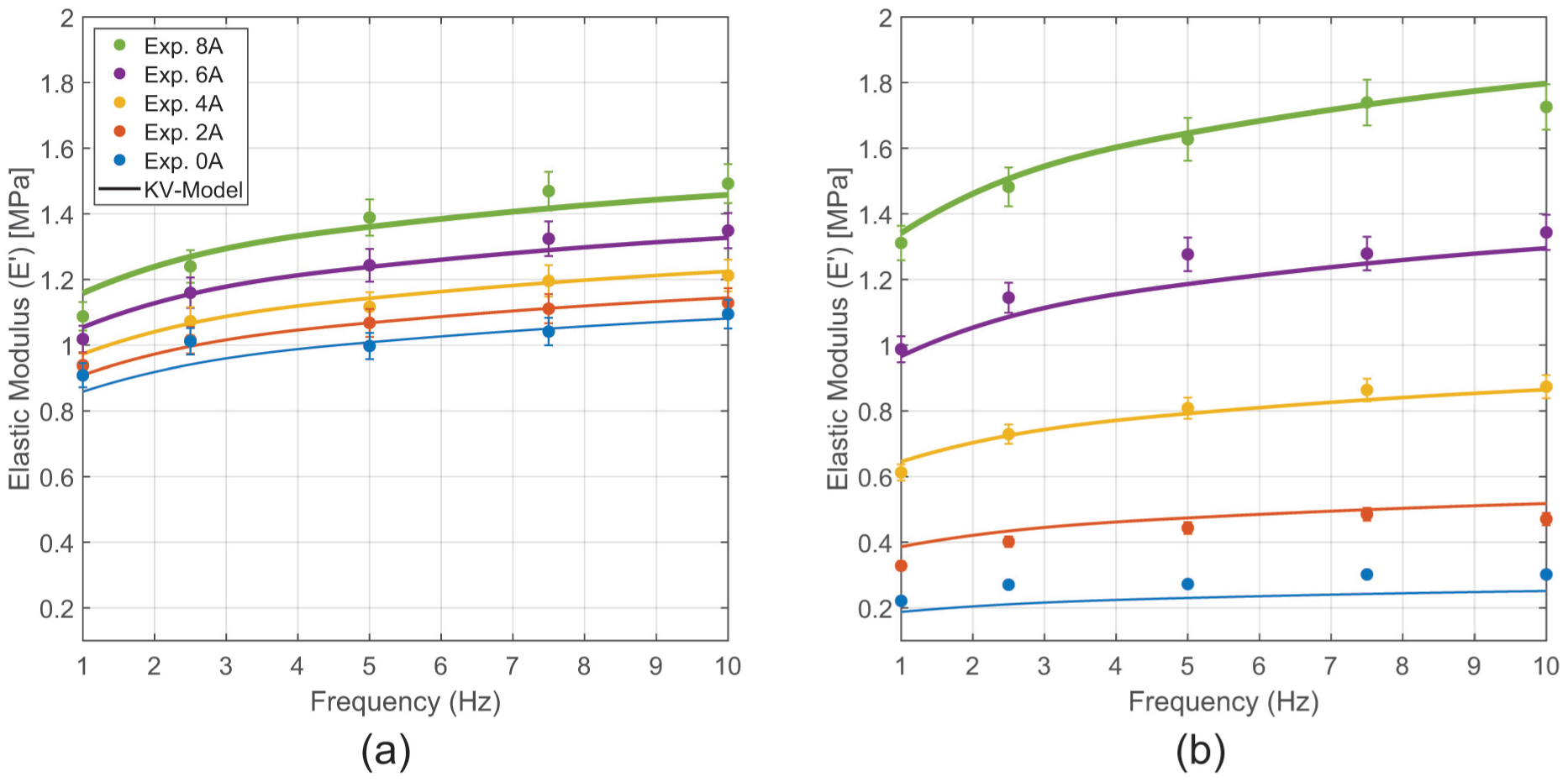
Comparison of measured and predicted elastic modulus for the (a) MRE specimen and (b) MRF-MRE hybrid MR material as a function of excitation frequency at 2.5% strain under varying current levels.
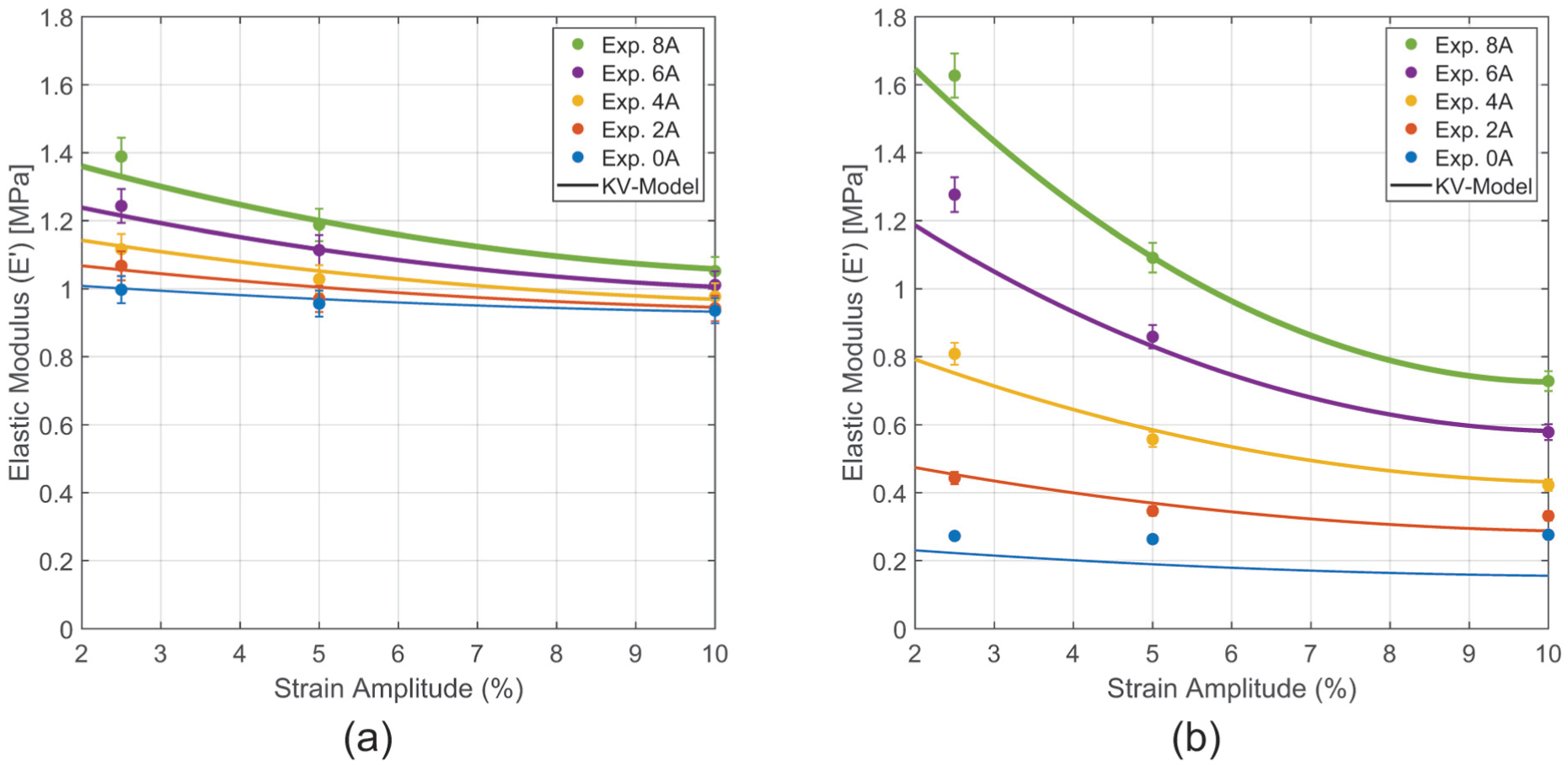
Influence of strain amplitude on elastic modulus at 5 Hz for the (a) MRE and (b) MRF-MRE hybrid MR composites under multiple current inputs.
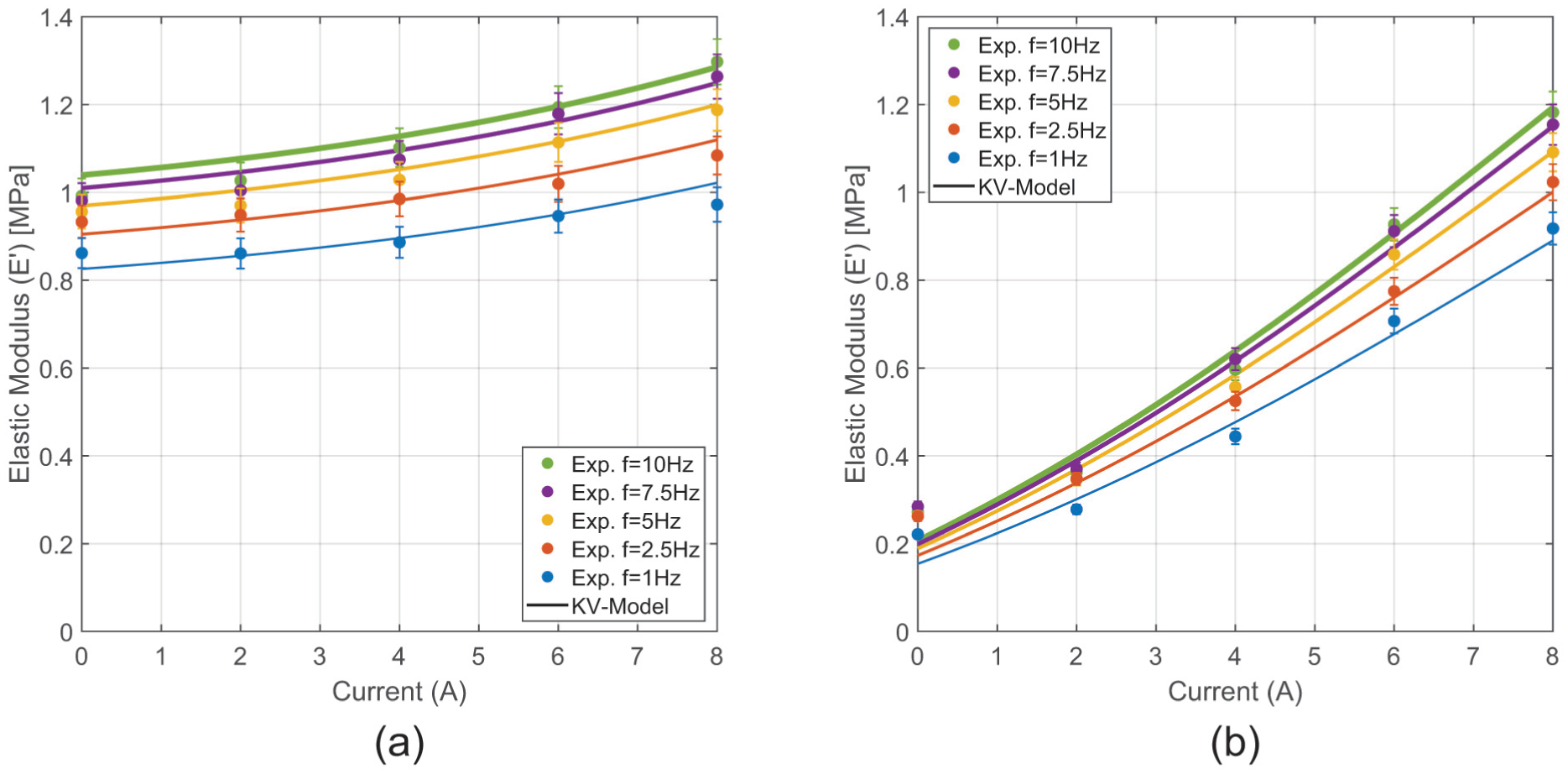
Current-dependent variation of elastic modulus for the (a) MRE and (b) MRF-MRE hybrid MR materials at 5% strain across selected frequencies.
Nonetheless, as the current increases from zero to 8A, the encapsulated MR fluids within hybrid sample become solidify, thereby yielding more stiffness than MRE sample. Thus, for the specific hybrid MRF–MRE configuration tested here, the measured relative MR effect reached about 550% at 1 Hz, compared with about 38% for the solid MRE specimen, and the corresponding absolute elastic modulus at high current also exceeded that of the solid MRE, as shown in Figure 4. These results demonstrate the response of the tested hybrid configuration. The provided comparison in Figure 4 does not assume equal magnetic particle volume fractions; instead, it evaluates how partially replacing a solid MRE with an encapsulated commercial MRF phase affects the field-dependent storage and loss moduli under identical geometry and test conditions. Besides, results presented in Figure 4 further show that the elastic moduli for both MRE and MRF-MRE samples increase in nonlinear manner relatively for both samples as frequency increases, referred to as strain-rate stiffening of MR materials. Rate of strain-rate stiffening is much pronounced for MRE sample as compared to the hybrid MRF-MRE due to fully elastic nature of the MRE solid sample.
The stronger field-dependent response of the hybrid MRF–MRE can be explained by the distinct role of the encapsulated MRF. In a conventional MRE, the magnetic particles are permanently constrained by the elastomeric matrix, so field-induced microstructural rearrangement is limited. By contrast, in the MRF core, the particles remain mobile and can form, break, and reform chain-like or columnar structures along the magnetic field direction, causing a reversible transition from a free-flowing liquid-like state toward a semi-solid state under excitation. This mechanism increases the resistance of the core to compression and substantially enlarges the hysteresis loop area, thereby enhancing both the effective stiffness and the energy dissipation capability. At the same time, the surrounding MRE shell actively participates in the magnetic response and provides confinement and load transfer, which helps intensify the effective field acting on the fluid phase and promotes stronger coupled magneto-mechanical behavior than in passive elastomeric encapsulations. This interpretation is consistent with previous studies on MRF-filled elastomeric composites, which showed that the application of magnetic field increases hysteresis area, complex stiffness, and dissipated energy because the encapsulated MRF develops field-induced particle chains and semi-solid behavior under compression.
Regarding the strain amplitude effect on elastic modulus of MR samples, Figure 5(a) and (b) compare measured and predicted elastic modulus as a function of strain amplitude for different applied current at frequency of 5 Hz. Similar to Figure 4, solid MRE possesses higher stiffness irrespective of strain amplitude when current increases from zero to 6A whereas when current exceeds 6A the stiffness of hybrid MRF-MRE sample become higher than that of MRE solid sample. This leads to higher relative MR effect and higher absolute elastic moduli at max current. The relative MR effect at 2% strain amplitude for hybrid MRF-MRE and MRE samples were obtained as 650% and 37%, respectively. Also, as the strain amplitude increases the magnitude of elastic modulus for both MRE and MRF-MRE samples decreases due to strain-softening or Payne effect. This effect becomes more pronounced as the applied current increases due to the fact that at higher currents, increase in strain amplitude not only break network of large molecules within polymeric matrix but also break the chain of iron particles both in MRE and MRF-MRE samples. The strain softening is more pronounced for MRF-MRE sample as compared to MRE irrespective of applied current due to very soft matrix of fluid as compared to elastomer for particles chains to be broken as the strain amplitude increases. For instance, at 8A, the percentage of relative decrease in elastic modulus of MRF-MRE obtained as 106% while for that of MRE sample obtained as 30%.
Figure 6(a) and (b) shows the variation of elastic modulus versus applied current for different excitation frequencies at 5% strain amplitude. For both samples elastic modulus increases when current increases from zero to 8A, which referred to as field-stiffening phenomenon. It should be noted that due to softer zero-state modulus of MRF-MRE, they offer higher relative MR effect as compared to MRE sample. For both samples it can be noted that the proposed model can effectively predict the behavior elastic modulus with respect to current and applied frequencies. Relatively similar trends were also observed for other strain amplitudes.
To further evaluate the performance of the model, the percentage error between the measured and predicted elastic modulus is evaluated for each sample at each individual loading condition increment and provided in Table 4. The table presents the minimum, maximum, and average percentage error between the proposed model and measured elastic modulus. It is apparent that the proposed model can predict the elastic modulus relatively well as the average error across the MR samples is below 5%. The higher accuracy is observed for MRE sample, followed by the MRF-MRE specimen.
The minimum, maximum, and average percentage error between the proposed model and measured elastic modulus for MR samples.

Further analysis of Figures 4 to 6 revealed a relative increase of up to 650% in the elastic compression modulus of the tested hybrid MRF–MRE specimen, whereas the solid MRE reference specimen exhibited an increase of about 100% under the investigated loading conditions. This result indicates that the tested hybrid configuration provides a substantially stronger field-dependent response than the solid MRE reference in the present experiments. However, because the commercial MRF core and the solid MRE do not contain the same magnetic particle volume fraction, this difference should not be interpreted as arising solely from architecture under equal magnetic loading content.
The nonlinear increase of elastic modulus with applied current can be interpreted in light of field-scaling concepts previously proposed for ER/MR suspensions (Choi et al., 2001; Seo et al., 2018). In such systems, the field-induced response commonly exhibits a strong low-field dependence associated with particle polarization and chain formation, followed by a reduced rate of increase at higher field due to saturation-type effects. Although those models were originally developed for yield stress in suspensions rather than compression modulus in elastomeric systems, they provide a useful physical explanation for the present results: the initial rise in modulus reflects progressive field-induced microstructural alignment, whereas the sublinear increase at higher current suggests diminishing incremental stiffening as the magnetic response approaches saturation. This trend is more pronounced for the hybrid MRF–MRE specimen because the encapsulated fluid core allows greater field-driven particle rearrangement than the solid MRE.
Figure 7(a) and (b) show variation of measured loss moduli with respect to model predicted loss moduli presented in equation (10). The results are presented for different applied currents when loading frequency increases from 1 to 10 Hz, as example for strain amplitude of 5%. Results are markedly indicative of higher loss modulus of hybrid MRF-MRE samples as compared to MRE material due to contribution of MR fluid encapsulation offering huge energy dissipation capability to the hybrid material. Results also show that increasing applied frequency increased loss moduli of both MRE and MRF-MRE materials with a nonlinear trend irrespective of applied current.
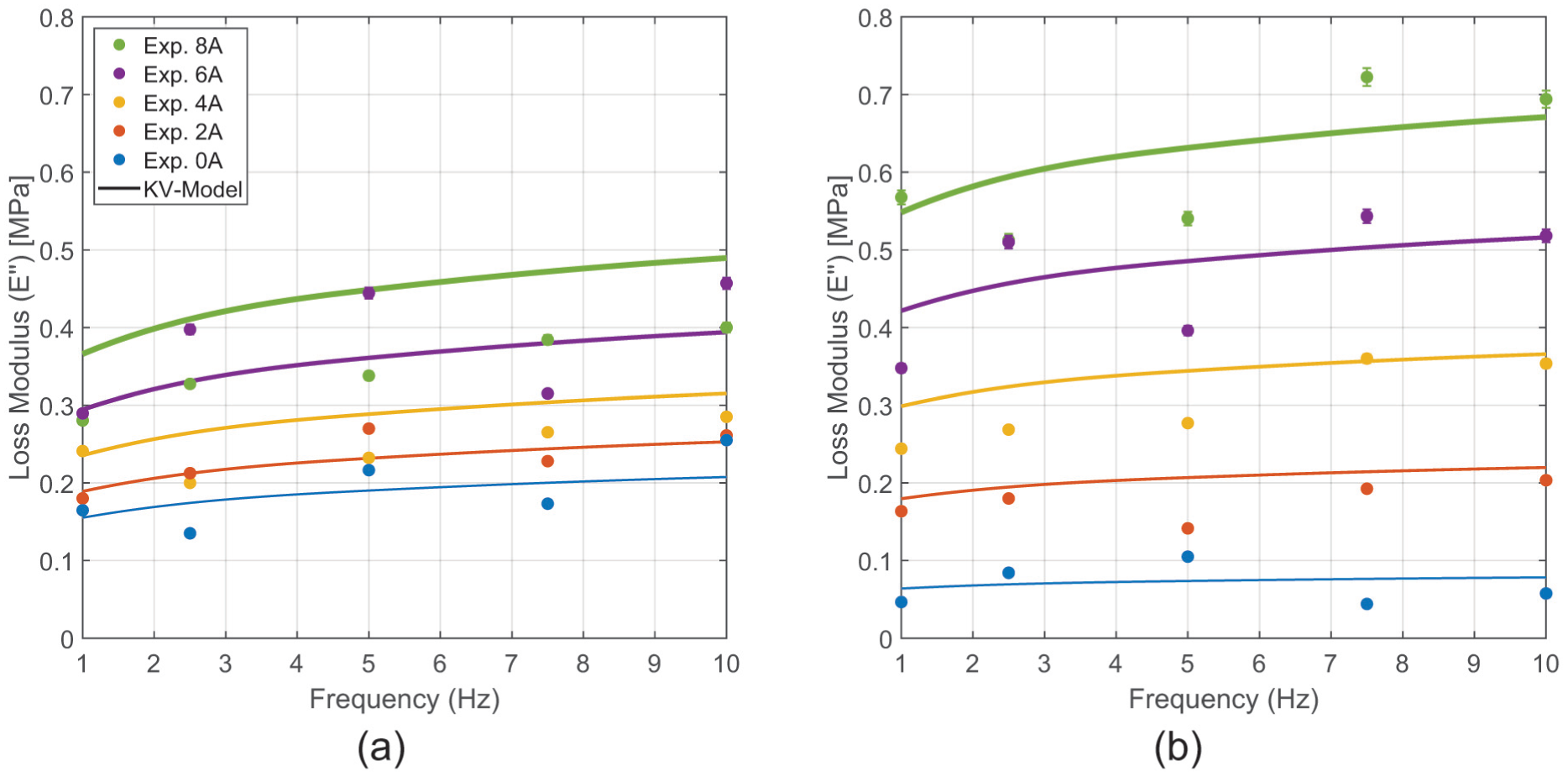
Measured versus modeled loss moduli with varying frequency under different applied currents for (a) MRE and (b) MRF-MRE (
Additionally, increasing applied current increased the loss moduli of both MR samples as expected due to magneto-rheological effect. This field-dependent characteristics is more pronounced for MRF-MRE sample as compared to MRE material. For instance, increasing current from 0 to 8 A yielded increasing the loss modulus of MRF-MRE from about 0.7 MPa at low frequency to 0.57 MPa while for MRE sample it increased from 0.16 to 0.28 MPa. Results further demonstrate that the proposed material loss moduli presented in equation (10) relatively well predicted the experimental loss moduli for different applied current and loading frequencies. Nonetheless, the loss modulus of MRE at maximum current is overestimate underestimated by proposed model as shown in Figure 7(a), partially due to saturation effect at higher currents. Relatively similar predictions were also observed under other loading amplitudes.
Results also show that the increase in applied current increases the loss modulus of MRE and MRF-MRE in a relatively nonlinear and linear manner, respectively, whereas the wider increments or higher MR effects in view of loss modulus for MRF-MRE sample are observed as compared to MRE material. Results further show that the highest relative MR effect in view of loss modulus is obtained as 1340% for MRF-MRE sample while is obtained as 141% for MRE materials, respectively at loading frequency of 7.5 and 2.5 Hz, under strain amplitude of 5%. The findings indicate that the loss modulus formulation introduced in equation (10) provides a relatively good agreement with measured dissipation behavior across varying excitation frequencies and levels of applied current.
Stress-strain characteristics
Figure 8 contrasts measured and simulated hysteresis stress–strain loops for two MR sample types, as a representative case, at 7.5 Hz and 5% strain while sweeping the applied current, using equation (2). The predicted responses closely follow the experimental curves. In particular, the model reproduces key current-dependent trends, including the larger loop area and the steeper effective stiffness as current increases. Results show that MR samples exhibit stress–strain hysteresis, confirming their viscoelastic response. The measured loops were used to quantify dynamic properties as functions of strain amplitude, strain rate, and magnetic field (current). The energy dissipated per cycle (damping capacity) was obtained from the area enclosed by the hysteresis loop, while the equivalent stiffness was inferred from the orientation and slope of the loop’s major axis, which is directly related to the storage modulus. With increasing current, the loop area increases and the major axis rotates counterclockwise, indicating concurrent increases in energy dissipation and effective stiffness. The above comparisons indicate that the proposed viscoelastic model provides reliable hysteresis predictions across broad ranges of strain level, excitation rate, and magnetic-field intensity.
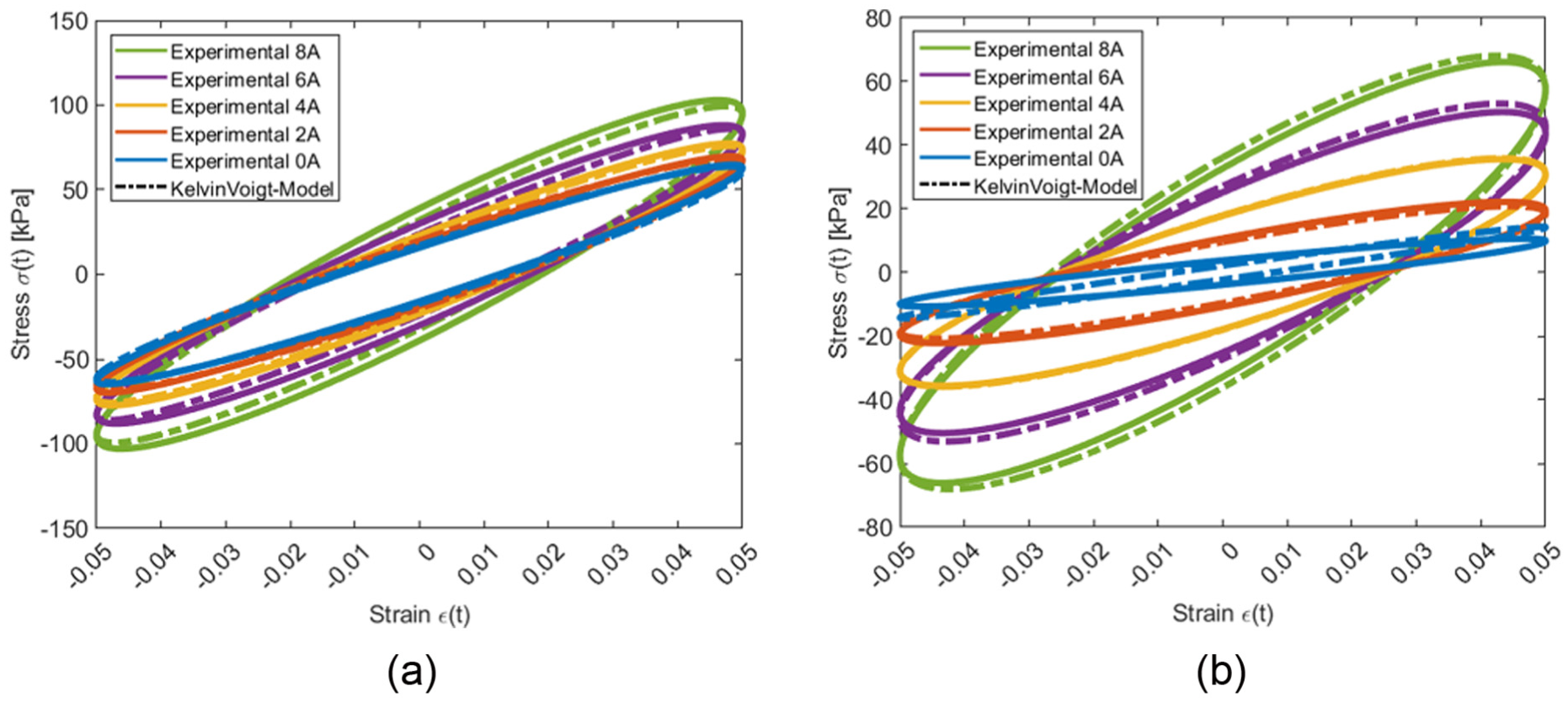
Measured versus Kelvin Voigt modeled stress-strain hysteresis with varying current for (a) MRE and (b) MRF-MRE (f = 7.5 Hz.
All in all, the proposed modified Kelvin–Voigt formulation captures the coupled effects of excitation frequency, strain amplitude, and magnetic field with good agreement. The model successfully reproduces strain-rate stiffening, strain softening at larger deformation levels, and the progressive stiffening induced by increasing magnetic excitation for both MRE and MRF–MRE specimens. These results demonstrate that the field-dependent viscoelastic model provides a reliable description of modulus evolution over the investigated loading space.
To quantify the model’s predictive accuracy, a normalized root-mean-square metric (often referred to as the coefficient of determination) is computed for all experimental datasets, covering the full set of tested currents, excitation frequencies, and displacement amplitudes. This metric is used as a fitness measure, evaluated using the expression below, where

The resulting fitness value (coefficient of determination) lies between 0 and 100%, with 100% indicating an exact agreement between model and experiment. The calculated fitness values revealed that that for the hybrid MR specimen, the corresponding fitness values range from 80% to 99%, yielding an average of approximately 89%. Inspection of results further indicates that the model tends to be less accurate when the excitation conditions (frequency and applied current) are near the lower end of the tested range. Table 5 provides a consolidated summary of the minimum, maximum, and mean fitness values for all samples.
Fitness value of the proposed model for the MRF-MRE sample.

Based on Table 5, the proposed phenomenological formulation exhibits the better agreement for the MRE specimens, with fitness values remaining consistently above 90%.
Concluding remarks
In this research study, a phenomenological viscoelastic model has been developed to predict the dynamic compressive behavior of magnetorheological elastomers and hybrid MRF–MRE composites. A modified Kelvin–Voigt formulation was proposed in which both storage and loss moduli evolve as coupled functions of excitation frequency, strain amplitude, and applied magnetic field. Model parameters were identified directly from experimental data obtained under harmonic compression, enabling predictive estimation of equivalent viscoelastic properties across a broad loading space.
Experimental results show that, for the specific hybrid MRF–MRE configuration examined in this study, encapsulating magnetorheological fluid within a magneto-active elastomer shell yields substantially larger field-induced tunability under compression than the solid MRE reference specimen. Under magnetic excitation, the tested hybrid specimen exhibited an elastic modulus enhancement of up to 650%, compared with approximately 100% for the solid MRE, while the peak relative increase in loss modulus reached 1340% for the hybrid material and 141% for the MRE. These findings demonstrate the strong potential of the tested hybrid configuration for achieving large, field-controllable stiffness and damping. At the same time, because the commercial MRF core contains a higher magnetic particle volume fraction than the solid MRE reference specimen, the present results should not be interpreted as a strict equal-particle-loading comparison or as a universal superiority claim for all hybrid architectures.
Beyond the peak MR effects, the results reveal several design-relevant trends. In the off-state, the solid MRE exhibits higher storage modulus than the hybrid specimen due to the presence of a soft fluid core in the latter. However, as the applied current increases, the hybrid material stiffens markedly as the encapsulated fluid becomes increasingly resistant to deformation, leading to a stiffness crossover. Under the investigated conditions, the hybrid MRF–MRE becomes stiffer than the solid MRE at higher current levels. The two materials also exhibit distinct sensitivities to loading conditions: both show strain-rate stiffening with increasing excitation frequency, but this effect is more pronounced for the solid MRE, whereas the hybrid material demonstrates stronger dependence on strain amplitude and more pronounced strain softening at larger deformation levels.
Overall, the proposed viscoelastic framework provides a unified and practically useful tool for predicting modulus evolution and stress–strain hysteresis under coupled magnetic excitation and dynamic loading. The model successfully reproduces key behaviors, including strain-rate stiffening, strain softening, and progressive magnetic stiffening, with high overall fidelity. While strong agreement is achieved across most of the investigated parameter space, reduced accuracy is observed at lower excitation frequencies and current levels. In addition, the loss modulus of the solid MRE at maximum current is underestimated, suggesting the influence of saturation-related effects that are not fully captured by the present formulation.
The results demonstrate the strong potential of hybrid MRF–MRE composites for semi-active vibration control applications where large, field-tunable stiffness and damping are required. The proposed modeling framework provides a foundation for the design and optimization of advanced hybrid MR materials. Future work will focus on extending the model to account for geometric effects, multi-axial loading conditions, and anisotropic material configurations, as well as integration with real-time control strategies for adaptive MR-based systems.
Footnotes
Appendix 1
Representative repeatability tests were performed for selected loading conditions to assess the consistency of the experimental measurements and post-processing method. These cases were chosen from the archived dataset to cover different specimen geometries and loading conditions, including variations in frequency, strain amplitude, pre-strain, and current. Here,
where
where
Using this approach, the representative combined standard deviation was 0.0311 MPa for
The corresponding combined coefficient of variation was calculated as:
where

Funding
The authors disclosed receipt of the following financial support for the research, authorship, and/or publication of this article: Support from Natural Sciences and Engineering Research Council of Canada (NSERC), Grant No. RGPIN-2021-03482, is gratefully acknowledged. The contribution of the National Research Council of Canada (NRC) in providing the magnetic cell for experimental characterization is also sincerely appreciated.
Declaration of conflicting interests
The authors declared no potential conflicts of interest with respect to the research, authorship, and/or publication of this article.
Data availability statement
All data that support the findings of this study are included within the article.