






Abstract
The growing concern for the environmental has boosted the use of recycled fibers for second life applications. However, achieving recycled fiber reinforced polymers with good mechanical performance remains challenging. Herein, basalt fiber (BF) fabrics were first recovered via solvolysis using hydrogen peroxide and then spray-coated with multiwalled carbon nanotubes (MWCNTs). The resulting recycled BF fabric after spray-coating showed a remarkable reduction in electrical resistance (22.5 kΩ) and a homogeneous coverage distribution of MWCNTs onto their fiber surface. The BF fabrics modified with CNT were used to manufacture recycled basalt fiber reinforced polymer with MWCNTs (BFRP-CNT) by vacuum assisted resin infusion technique and then cut into beam specimens for electromechanical flexural testing. The piezoresistive characterization showed that the change in electrical resistance of the recycled BFRP-CNT composite followed the flexural stress-strain response until composite’s failure and yielded gage factor value of 7.31 for the tensile side and −1.01 for the compressive side, confirming its piezoresistive sensing capability. The findings suggest that the developed recycled BFRP-CNT composite holds promise as an environmentally sustainable material suitable for strain monitoring and damage sensing through the piezoresistive response obtained during monotonic three-point bending up to failure.
Introduction
In recent years, the progressively increased use of the chemical recycling processes for recovering engineering fibers from fiber-reinforced polymer (FRP) waste has motivated the scientific community to develop new composite materials using these recycled fibers for second-life applications (Branfoot et al., 2023; Chohan et al., 2026; Oliveux et al., 2015; Petropoulos et al., 2026). However, the inevitable effects of chemical recycling process conditions may cause strength loss and sizing removal from recycled fibers which result in composites with lower mechanical properties than their virgin counterparts (Branfoot et al., 2023; Chohan et al., 2026; Oliveux et al., 2015). To overcome this problem, it is essential, the one hand, to apply chemical recycling processes with mild agents at low temperatures (<100°C) that minimize the thermochemical effects on the recovered fibers and, on the other hand, to apply methods of fiber surface modification that improve the interfacial bonding with the matrix, which is expected to improve the mechanical properties of the composites. In this regard, Fazeli et al. (2024) reported the surface modification of recycled carbon fiber (CF) with carbon nanotubes (CNTs) and microfibrillated cellulose (MFC) by using the electrophoretic deposition technique. Their results showed that recycled CFRP modified with CNT-MFC exhibited remarkable improvements in tensile and flexural properties. In another study, Salas et al. (2021) informed the influence of the addition of CNTs on the interlaminar shear strength of recycled CFRP composites. Nevertheless, they found that the growth of CNTs on recycled CF decreased the Mode I interlaminar fracture toughness of recycled CFRP compared with virgin CFRP composites. Hiremath et al. (2020) recycled glass fibers by a thermal process and then prepared composites based on epoxy resin reinforced with functionalized CNTs. Their results revealed that the tensile and flexural properties of recycled glass fiber reinforced epoxy composites with CNTs were improved. Despite these research efforts on the use of nanomaterials as surface modifiers for recycled fibers for improved mechanical properties of composites, until now there is no work that reports the incorporation of CNTs on recycled basalt fibers to fabricate multifunctional composites for piezoresistive sensing applications. Basalt fibers (BF) have emerged as a viable alternative for manufacturing in the composite industry due to their high mechanical properties, good corrosion resistance, flame resistance, environmental friendliness and low cost (Kim et al., 2022; Militký et al., 2018). Such properties, in combination with CNT modification of fiber surface are of utmost importance for the manufacturing of multifunctional BFRP composites toward damage self-sensing and structural applications (Balaji et al., 2024; Liu et al., 2025; Sun et al., 2023). Recent experimental studies have also demonstrated that improvements in the Mode I fracture properties and mechanical performance of BFRP composites can be obtained by using polyphenylene ether as a thermoplastic modifier (Beylergil et al., 2026). In another recent study, Ulus et al. (2026) proposed an effective nanofiber interleaf based on polyacrylonitrile to locally toughen the adhesive interface in hybrid joints for BFRP laminates. Their results showed that the nanofiber-reinforced hybrid joint exhibited the best interfacial properties. The effects of halloysite nanotubes and seawater aging on the bearing performance of BFRP composites have also been investigated by Kaybal et al. (2021). They found that the incorporation of 2 wt.% halloysite nanotube into BFRP composite improves their bearing strength and restricted the water uptake of the epoxy matrix. Thus, basalt fibers represent a suitable alternative for reinforcing polymer matrices in sustainable and structural terms compared to conventional glass fibers. Therefore, this work reports the manufacturing process and piezoresistive behavior of a composite material based on epoxy resin reinforced with recycled BF fabrics spray-coated with MWCNTs using a feasible methodology that could be potentially scaled for industry and applied to the development of composites with multifunctional capabilities for strain and damage self-sensing applications.
Materials and methods
Plain woven BF fabrics were acquired from Sudaglass Fiber Technology. Epoxy resin named Epolam 5015 with amine hardener 5015 was obtained from Sika. The mild chemical agent for the solvolysis process was 50 wt.% hydrogen peroxide (H2O2). The spray-coating solution was prepared using MWCNTs and isopropyl alcohol. The solvent was acquired from Ecopura and the commercial MWCNTs were supplied by Sunnano. MWCNTs had 95% of purity with a mean outer diameter of 10–35 nm and were used as-received. Thin copper wires (134-AWP) were used as electrodes, and the electrical contact was made using silver paint from Ted Pella Inc.
The manufacturing procedure used to obtain the recycled BFRP-CNT composite was performed following the steps shown in Figure 1.
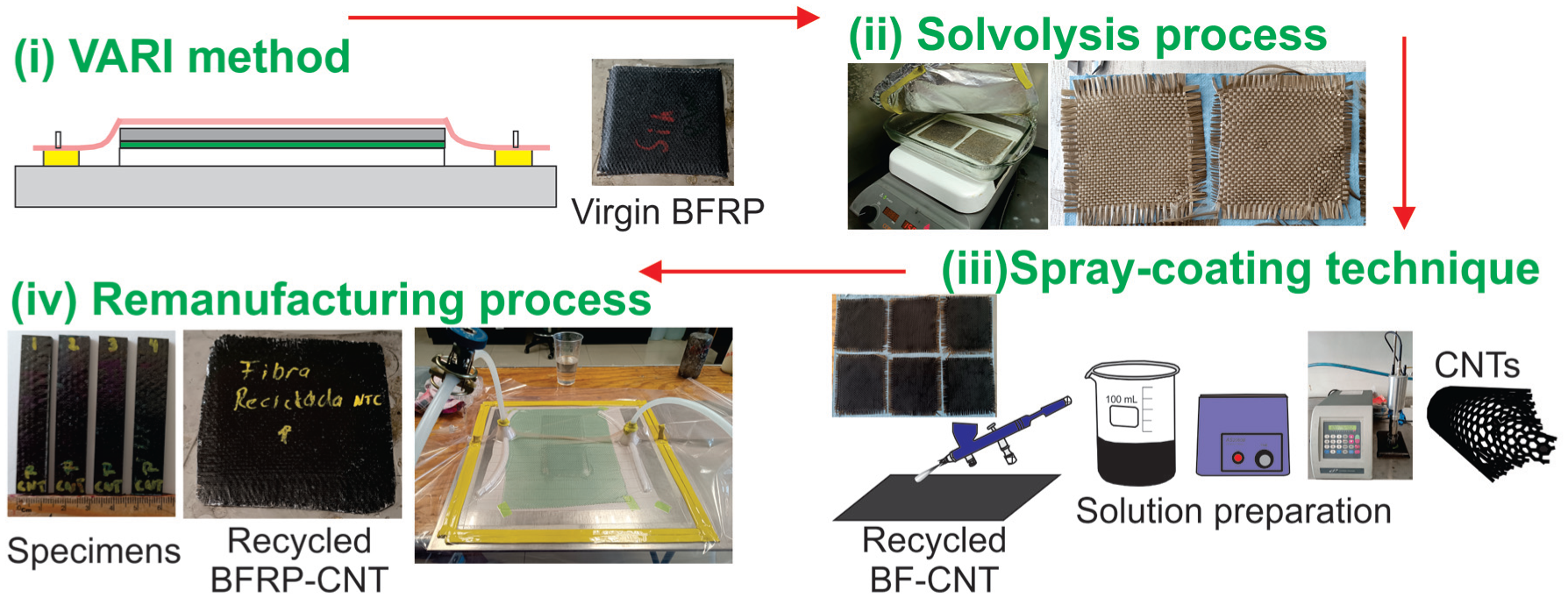
Manufacturing procedure of recycled BFRP-CNT composite.
First, virgin BFRP laminates were fabricated using the vacuum-assisted resin infusion (VARI) method (i). For that, six layers of virgin woven BF fabrics of 100 mm × 100 mm were subjected to impregnation with the mixture of epoxy resin and amine hardener at a 100:30 ratio (by weight). The vacuum pressure was 80 kPa, and the curing of the laminate was performed at room temperature for 16 h. Finally, the virgin BFRP laminate was demolded for the chemical recycling process. Second, the fiber recovery process (ii) was performed by immersing the virgin laminate in a 50 wt.% H2O2 solution heated to 75°C on a hot plate under a fume hood at atmospheric pressure for 8 h/day for a total of 3 days. The recovered BF fabrics were then removed from the solution and carefully washed with distilled water. The recovered BF fabrics were dried at room temperature for 24 h before reuse. The characterization of the BF surface after solvolysis in H2O2 is provided in Supplemental Material S1 and S2. Afterward, MWCNTs were deposited superficially onto the recovered BF fabric using the spray coating technique (iii). For that, 1 wt.% of MWCNTs with respect to the weight of the six recycled BF fabrics was mixed in 40 ml of isopropyl alcohol and dispersed using a sonic tip for 10 min in 30 s on/off intervals. The solution was then dispersed in an ultrasonic bath for 30 min. The solution was then spray-coated onto recycled BF fabrics using an airbrush operated at a pressure of 45 psi. After spray coating, the recycled BF fabrics coated with CNT were dried at room temperature for 24 h. Next, the remanufacture process (iv) of the recycled BFRP-CNT composite was performed using the VARI method following the same curing conditions as those used for the virgin BFRP composite. Afterward, the recycled BFRP-CNT laminate was demolded and then a post-cure of 16 h at 70°C was applied. For comparison, recycled BFRP composite without CNTs and virgin BFRP with CNTs were also prepared. Thus, a total of four composite laminates were considered in this study. The cured laminates were cut into 68 mm × 13 mm × 3.3 mm beam-type specimens for flexural testing and simultaneous electrical resistance measurement. The piezoresistive behavior of the specimens under flexural loading until failure was characterized by measuring the relative change in electrical resistance (ΔR/R0) during the flexural test. Flexural testing was performed on at least four specimens of each material type. Details of the electromechanical characterization are described in the Supplemental Material S3.
Results and discussion
Optical and scanning electron microscopy (SEM) images of the architecture and morphology of virgin BF (Figure 2(a)), virgin BF-CNT (Figure 2(b)) recycled BF (Figure 2(c)) and recycled BF-CNT (Figure 2(d)) are shown in Figure 2. It can be seen in Figure 2(c) that the recycled BF fabric maintain their plain woven architecture after the solvolysis process and the alignment yarns and configuration appear to be very similar to that of the virgin BF fabric (Figure 2(a)). This result can be explained by the fact that the recovery process by solvolysis with H2O2 was performed under mild and low temperature (<100°C) conditions. In Figure 2(a), it is also noted that the surface morphology of the virgin BF is very smooth and clean. SEM images of recycled BF also exhibit a smooth and clean surface but with the presence of some epoxy residues (Figure 2(c)). In contrast, SEM images of virgin BF-CNT (Figure 2(b)) and recycled BF-CNT (Figure 2(d)) samples show the presence of MWCNTs on the BF fabrics, in which their surface areas are completely covered and uniformly distributed. Moreover, the recycled BF-CNT surface exhibits a relatively homogeneous coating distribution of CNTs with only a few agglomerates in some regions, confirming the viability of spray-coating for surface modification of virgin and recycled engineering fibers.
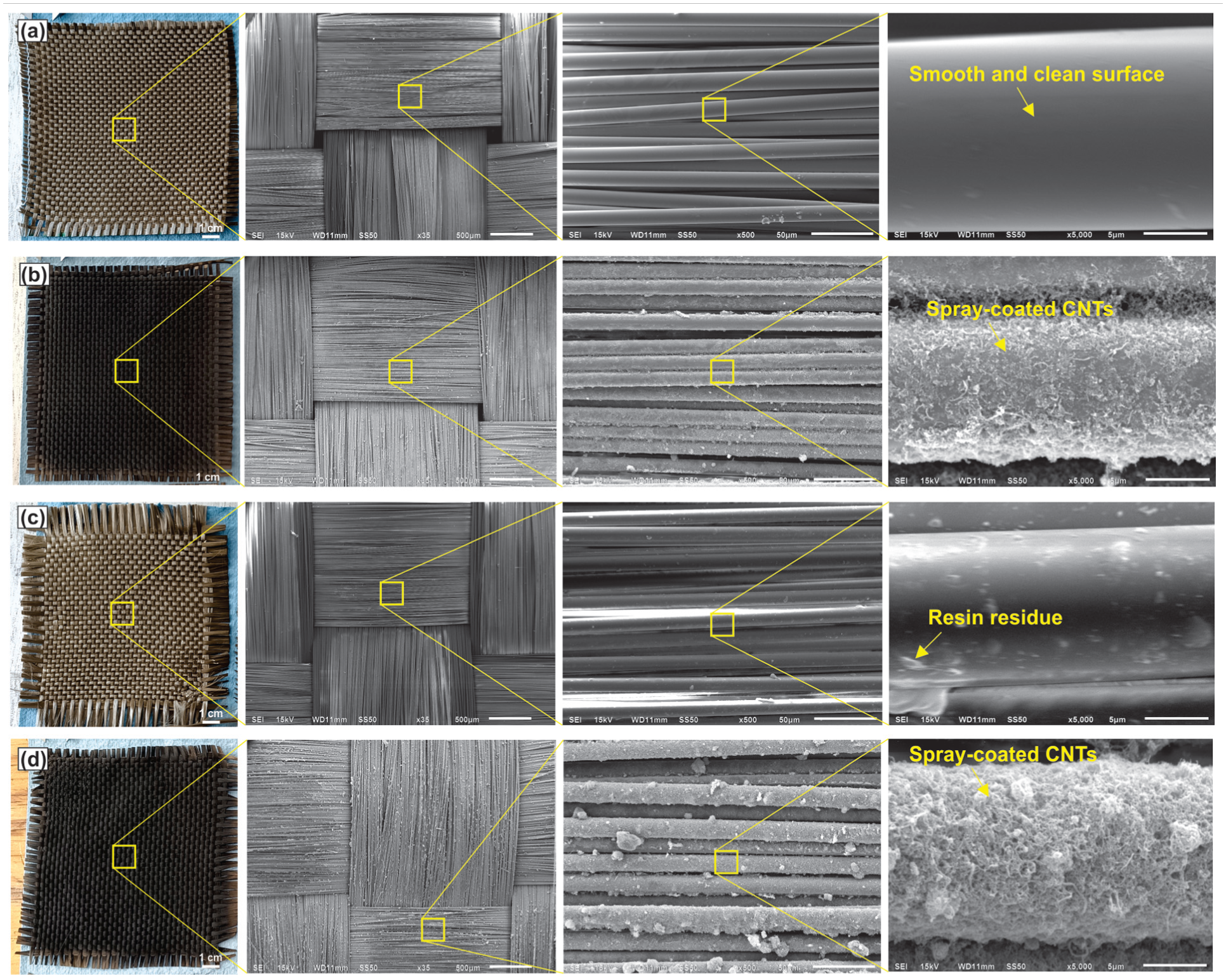
Optical and SEM images of BF fabrics: (a) virgin BF, (b) virgin BF with CNT, (c) recycled BF, and (d) recycled BF with CNT.
On the other hand, the CNT-modified BF fabrics showed a significant decrease in the electrical resistance, achieving a value of 83.2 kΩ for the virgin BF-CNT fabric and 22.5 kΩ for the recycled BF-CNT fabric measured using a digital multimeter, as shown in Supplemental Figure S4. These results further confirmed the effective formation of an interconnected electrical network of CNTs onto the virgin and recycled BFRP-CNT composites by measuring their electrical conductivities (by a standard two-probe method), which resulted in 1.34 × 10⁻² ± 0.002 and 1.18 ± 0.415 S/m, respectively. This result suggests that the recycled BFRP-CNT composite offered a good electrical conductivity for piezoresistive capability. The experimental details for electrical conductivity characterization is presented in Supplemental Material S4.
To examine the effect of CNTs on the flexural behavior of virgin and recycled BFRP composites, Figure 3 presents flexural stress-strain (σ-ε) curves of the virgin BFRP (Figure 3(a)) and recycled BFRP (Figure 3(b)) composites with and without CNTs.
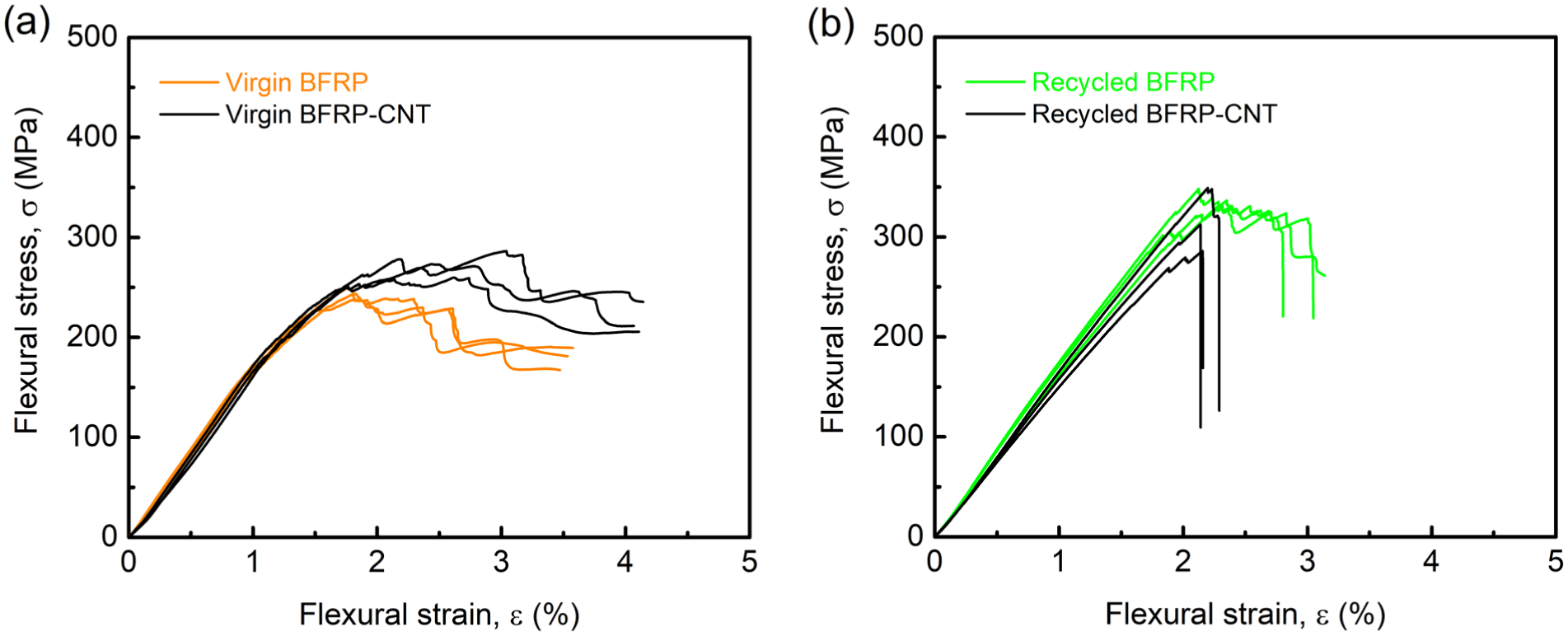
Flexural stress-strain curves of the BFRP composites with and without CNTs: (a) virgin and (b) recycled.
For the case of specimens made of virgin BFRP composites (Figure 3(a)), an initial linear response is noted up to ε∼1.25% followed by a non-linear behavior until to specimen failure. When the stress reached a maximum value, subsequent drops in the σ-ε curves were observed due to the process of damage in the composites with a substantial increase of the flexural strain. In this regard, virgin BFRP-CNT composite exhibited the highest flexural strain at break (∼4%). In contrast, for the case of the specimens made of recycled BFRP composites, the behavior of σ-ε curves was clearly linear-elastic until the specimens reached their maximum stress values and the σ-ε curves suddenly dropped at strains ranging between 2% and 3% strain, confirming that the recycled composites experienced brittle failure compared to virgin composites. On the other hand, the effect of MWCNTs on the flexural strength of the virgin and recycled BFRP composites can be observed by comparing Figure 3(a) and (b). The flexural strength values were 244 ± 5, 267 ± 19, 339 ± 8, and 315 ± 31 MPa for virgin BFRP, virgin BFRP-CNT, recycled BFRP and recycled BFRP-CNT composites, respectively. It can be noted that flexural strength increased by 9% when the MWCNTs were incorporated into the virgin BFRP composites. The increase in flexural strength means that there are more fiber matrix interactions due to the presence of CNTs on the fiber surface which increases both the surface roughness and mechanical interlocking (Fazeli et al., 2024; Tzounis et al., 2014). On the other hand, a reduction of the flexural strength of ∼7% is observed for the recycled BFRP composite with MWCNTs when compared to the recycled BFRP composite, probably due to the presence of residual resin on the recycled fiber surface which may act as a physical barrier and affect the adhesion of fiber/matrix interface. Nevertheless, a notable difference in the flexural strength values can be observed between the virgin BFRP and recycled BFRP composites with and without CNT. This difference is larger for the recycled BFRP composite (approximately 38%), while for recycled BFRP-CNT is small (29%), implying that the mechanical performance of BFRP composites is a direct consequence of the recycled fiber.
Figure 4 shows representative piezoresistive responses of both virgin BFRP-CNT (Figure 4(a) and (b)) and recycled BFRP-CNT (Figure 4(c) and (d)) composites subjected to flexural loading by electrical resistance measurement at their compressive and tensile sides (Figure S1). From Figure 4(a), it can be observed that the ΔR/R0 response for the compressive side linearly decreases with the applied strain, while, for the tensile side, the ΔR/R0 response increases at the elastic region (Figure 4(b)). Then, both ΔR/R0 at compressive and tensile sides shows a nonlinear response, which is disrupted when the specimen fails. Compressive (K C ) and tensile (K T ) gage factors of virgin BFRP-CNT composite yielded values of K C = −3.0 ± 0.29 and K T = 4.7 ± 2.3, respectively. As seen from Figure 4(c), the piezoresistive behavior (ΔR/R0-ε) on the compressive side of the recycled BFRP-CNT specimen showed a nearly linear response for almost all the mechanical response (σ-ε) with only minor changes in ΔR/R0 at ε > 1.75%. However, when the specimen’s failure occurs, the ΔR/R0-ε curve presents a sharp increase in its ΔR/R0 due to the disruption of the CNT network and conductive pathways, which is sensitive to the development of damage generated in the composite specimen under three-point bending. The electromechanical test performed on the tensile side of the specimen (Figure 4(d)) also shows a linear ΔR/R0-ε response that matches the behavior of the σ-ε curve until the specimen’s failure. It can also be observed in Figure 4(d) that there is a drop in the flexural stress at ε∼2% due to the final failure of composite which coincides with high accuracy to the strong increment of the ΔR/R0 values, evidencing an adequate capability for damage sensing under monotonic three-point bending. By comparing the measured gage factors on the compressive (K C = −1.01 ± 0.8) and tensile (K T = 7.31 ± 2.2) sides of the recycled BFRP-CNT specimens, it can be seen that K T is significantly larger than K C which means that the tensile side is more sensitive to strain than the compressive side.
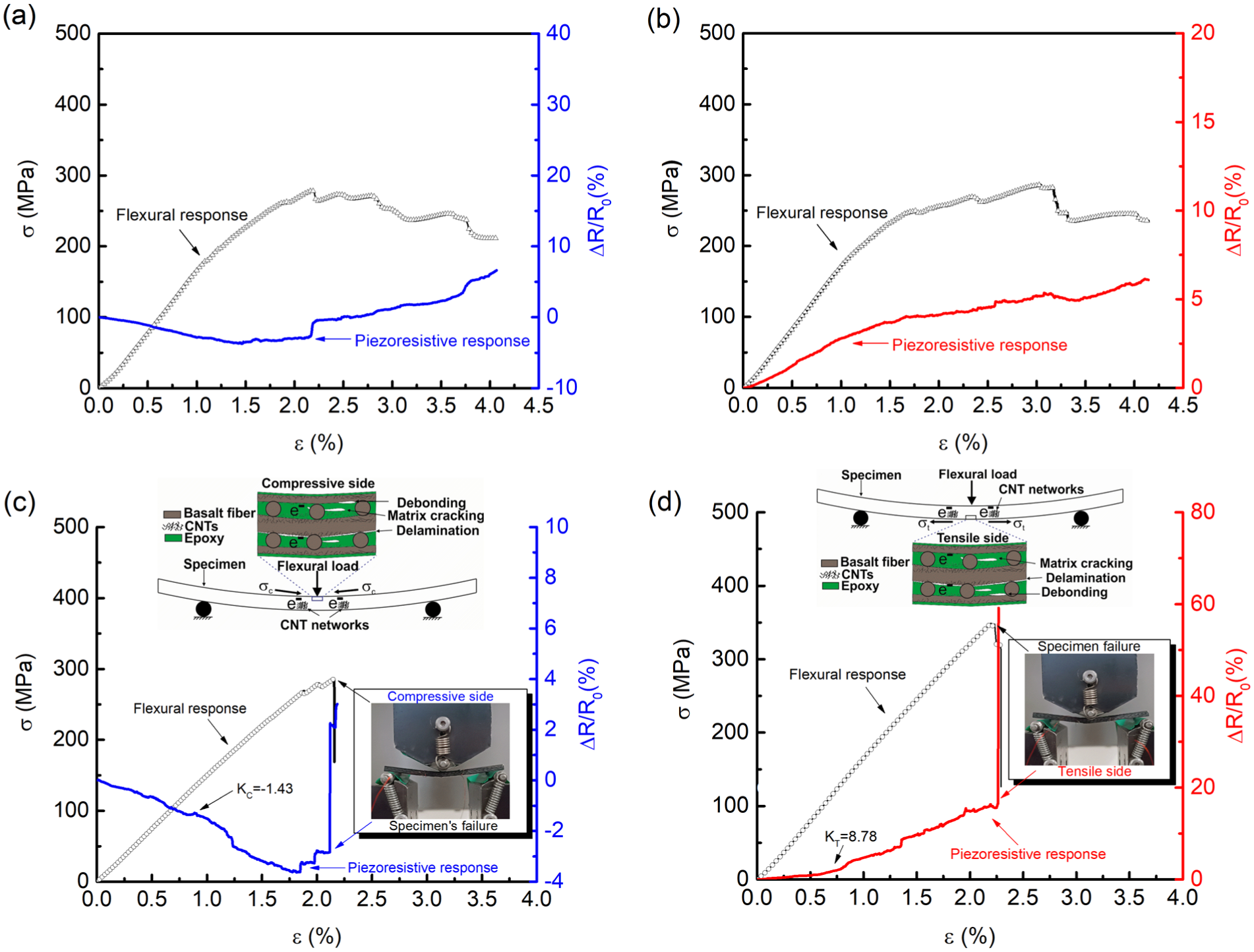
Flexural piezoresistive response (ΔR/R0-ε) of virgin and recycled BF-CNT composites: (a–c) compressive side and (b–d) tensile side.
Figure 5 shows SEM images of the specimen’s failure of the recycled BFRP-CNT composites. The SEM micrographs of the recycled BFRP-CNT specimens display that the dominant type of failure was flexural tensile mode as a result of normal stresses produced at the bottom side of the specimen.
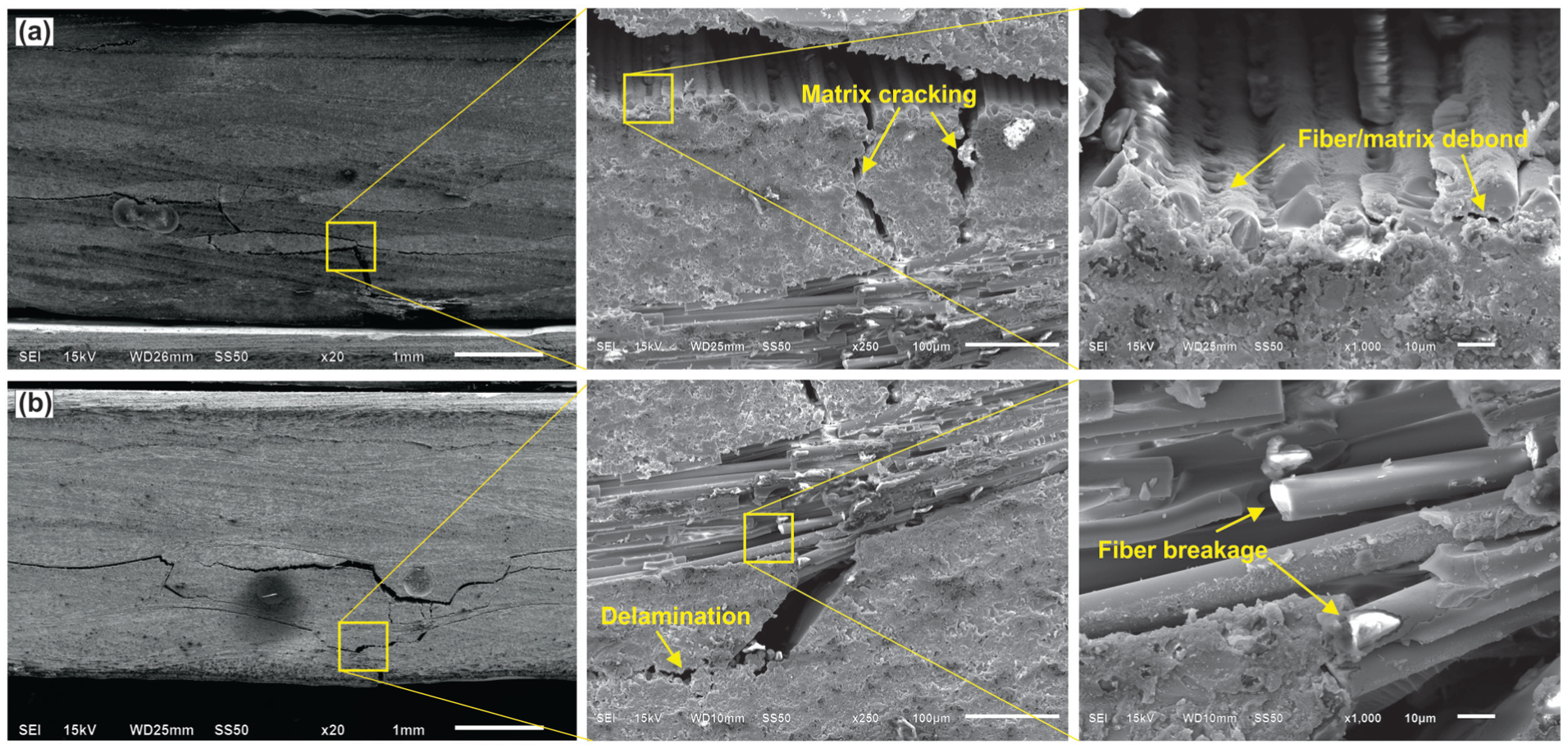
SEM micrographs of damage mechanisms for recycled BFRP-CNT specimens failed under three-point bending: (a) specimen with electrodes connected at its top surface (compressive side) and (b) specimen with electrodes connected at its bottom surface (tensile side).
The appearance of this failure in this zone coincides with the magnitude of the ΔR/R0 responses shown in Figure 4(c) and (d). The SEM images in Figure 5 allow us to identify that this failure mode generated a combination of damage mechanisms related to matrix cracking, fiber/matrix debonding, fiber breakage and delamination, as shown in Figure 5. Comparing both sides of the beam in Figure 5(a) and (b), it can be seen that the tensile side suffers more damage than the compressive side, where less damage can be observed. Thus, the integration of an electrically conductive CNT network into the recycled BFRP-CNT composite by spray-coating resulted in sensitivity not only to both compressive and tensile surfaces of the specimen but also at their onset and progression damage which can be suitable for monitoring strain and failure of composite structures.
Conclusion
In conclusion, a recycled basalt fiber reinforced polymer composite modified with multiwall carbon nanotubes by spray-coating was developed for piezoresistivity sensing applications under monotonic three-point bending. After spray-coating, SEM analysis of the recycled basalt fiber surfaces exhibited the presence of MWCNTs in a homogeneous and uniform coverage distribution. The electrical conductivity measurements confirmed the ability of the spray-coated CNT to integrate electrical conductive networks into recycled BFRP composite and the piezoresistive results of beam-type specimens tested under monotonic three-point bending loading indicated that the electrical resistance measurement at the compressive and tensile sides of the composite was capable of following the mechanical response up to specimen failure, demonstrating its in-situ monitoring and real-time strain sensing and damage detection capabilities.
Supplemental Material
sj-docx-1-jim-10.1177_1045389X261467794 – Supplemental material for Recycled basalt fiber-carbon nanotube/epoxy composite with piezoresistive behavior for strain and damage self-sensing
Supplemental material, sj-docx-1-jim-10.1177_1045389X261467794 for Recycled basalt fiber-carbon nanotube/epoxy composite with piezoresistive behavior for strain and damage self-sensing by Julio Alejandro Rodríguez-González, Víctor Daniel Capetillo-Hernández, Eduardo José-Trujillo, María del Pilar de Urquijo-Ventura, Carlos Rubio-González and José Alfredo Manzo-Preciado in Journal of Intelligent Material Systems and Structures
Footnotes

Funding
The authors disclosed receipt of the following financial support for the research, authorship, and/or publication of this article: Authors acknowledge support from CIDESI (QIV027) and thank M.Sc. Edgar Miranda and Dr. Antonio Banderas for their technical assistance.
Declaration of conflicting interests
The authors declared no potential conflicts of interest with respect to the research, authorship, and/or publication of this article.
Data availability statement
The data supporting the findings of this study are available from the corresponding author upon reasonable request.
Supplemental material
Supplemental material for this article is available online.
References
Supplementary Material
Please find the following supplemental material available below.
For Open Access articles published under a Creative Commons License, all supplemental material carries the same license as the article it is associated with.
For non-Open Access articles published, all supplemental material carries a non-exclusive license, and permission requests for re-use of supplemental material or any part of supplemental material shall be sent directly to the copyright owner as specified in the copyright notice associated with the article.
