







Abstract
Deception has been an important problem in interactive groups, impeding effective group communication and group work, yet deception detection in such a context remains understudied. Extrapolated from the interpersonal deception theory (IDT) and group composition research in cooperative contexts, this research proposes that group factors, including diversity and familiarity, have influence on the performance of deception detection. The measurement of group performance was not limited to success, as previous deception studies did, but included efficiency as well because it is fundamental to the effectiveness of deception detection. An analysis of data collected from a real-world online community found that behavioral familiarity had a positive effect, and gender diversity had a negative effect, on group success in deception detection. In addition, behavioral familiarity had a negative effect and functional diversity had a positive effect on the group efficiency of deception detection. The findings not only extend IDT in several important ways but also suggest the need to distinguish between noncooperative and cooperative groups, an important theoretical implication for group composition research.
Despite the long-standing recognition of the importance of group work to organizations (Guzzo & Shea, 1992), the benefits of working in a group would be diminished if there were a deceptive member who consciously attempted to direct the group to reach a false conclusion or impression. As the globalized economy and society continues to grow, and the cost of group communication and coordination continues decreasing (Byrne, 1993; Donnellon, 1996; Jones & George, 1998), computer-supported group work becomes increasingly common but not all group members willingly work toward a unified group goal. A group may consist of a variety of members, including some who intend to deceive others due to various motivations such as self-interest and malicious intentions. For instance, a mole or double agent pretends to be cooperative with one group, but is in fact loyal to another group. As a result, the mole may provide false, or true but irrelevant, information to the target group, aiming to either move the group off the right track or gain the group’s trust. A group involving such a deceptive member is not limited to intelligence operations, but also includes negotiation, policy making, economic decision making, and so forth. In a broader sense, online phishing and spamming also exemplify deception in groups. These various forms of deception pose increasing threats to group collaboration and online communities. Therefore, group detection of deception is essential to creating a trustworthy and secure environment for effective group collaboration and communication.
Although many studies have examined deception detection (Bond & DePaulo, 2006), research on group detection of deception is scarce. Park, Levine, Harms, and Ferrara (2002) and Frank, Feeley, Paolantonia, and Servoss (2004) compared deception detection accuracy between individual and small groups in a noninteractive setting using videotapes of stimulus communicators. The detection of deception in an interactive context, however, is distinctively different because it involves active and dynamic information exchanges between senders and receivers. Interpersonal Deception Theory (IDT; Buller & Burgoon, 1996) postulates that senders and receivers continuously adjust themselves during an ongoing interaction in the form of receivers’ suspicion display and senders’ reaction to those displays. In particular, receivers could be more suspicious when they are involved in less interactive or interpersonal context, which may impair the detection accuracy of some receivers (Burgoon, Buller, Ebesu, & Rockwell, 1994).
The detection of deception in dyadic interactions is also expected to differ from group interactions for several reasons. First, additional participants in a group decrease the perceived immediacy between any two participants, which may cause group members to be more circumspect with incoming messages and less tolerant of different opinions (Zhou & Zhang, 2006). Second, the likelihood of systematic processing of information is greater at a group level than at an individual level, which would lead to a decrease in the usage of the truth-bias heuristic (Park et al., 2002) and accordingly greater of deception detection. Third, a deceiver likely experiences a higher level of deception arousal and detection apprehension when confronting more than one group member because the deceiver has to divide his attention among all other members instead of focusing exclusively on one member only, which would in turn increase the nonstrategic leakage behavior (Zhou & Zhang, 2006). Lastly, deception detection can be viewed as an adversarial problem solving task (Johnson, Grazioli, Jamal, & Berryman, 2001). Empirical evidence has shown that groups are better at problem solving than individuals as they behave more consistently with game-theoretic predictions in economic games (Bornstein, Kugler, & Ziegelmeyer, 2004). Thompson, Peterson, and Brodt (1996) also found that groups were better than individuals at achieving Pareto-efficient outcomes in a multi-issue negotiation.
There are also alternative arguments for why detecting deception in group interaction may be less accurate than that in dyadic interaction. A larger group is expected to produce a greater amount of output (e.g., message exchanges), making it more difficult for a receiver to monitor the interactive behavior of another individual (e.g., deceiver). The greater amount of information may cause a receiver to selectively or heuristically process the information instead of carefully searching for real cues to deception (Bauchner, Brandt, & Miller, 1977). In addition, a deceiver may become more conscious of exploiting strategies and tactics (e.g., masking arousal cues) during the interaction with multiple receivers than in a dyad (Marett & George, 2004).
Zhou and Zhang (2006) examined the moderating effect of group size on deception behavior in dyadic and triadic interactions. Cohen, Gunia, Kim-Jun, and Murnighan (2009) compared groups and individuals in terms of who lies more. Zhou, Sung, and Zhang (2013) empirically investigated deception in midsized online groups. However, none of these studies addressed deception detection performance. In view that group factors such as group size and composition have important implications for group performance in cooperative group work (Campion, Medsker, & Higgs, 1993; Gruenfeld, Mannix, Williams, & Neale, 1996; Guzzo, 1986; Pelled, 1996; Valacich, Dennis, & Nunamaker, 1992), studying group detection of deception would not only extend existing deception research to the group environment, but also expand group research from cooperative contexts to noncooperative contexts.
This research investigates group detection of deception. The focus of this study is on the influences of familiarity and diversity of group members on the performance of deception detection. Deception detection performance has been routinely measured by success in terms of accuracy of deception judgments only. Although efficiency has been widely used to study group performance in traditional group work research, it is largely overlooked in deception research. The efficiency with which a group is able to collectively make a detection judgment through task-related interactions is particularly relevant to deception detection because early detection of deception would allow for reducing or even preventing possible losses caused by otherwise successful deception. We empirically tested the hypothesized effects of group familiarity and diversity on the accuracy and efficiency of group deception detection with real-world data collected from an online community. The findings of this study have significant research and practical implications for both deception detection and group work.
Theoretical Background
Deception detection has been historically and widely recognized as a difficult task (Bond & DePaulo, 2006; Burgoon et al., 1994; Caspi & Gorsky, 2006). Extant research on deception detection has focused on either a noninteractive context in which receivers passively form impressions of the believability of senders, or an interactive context where a single receiver is engaged in interpersonal exchange with the sender. However, group detection of deception that involves a group of receivers largely remains a largely uncharted territory. In this study, we use IDT (Buller & Burgoon, 1996) as the overarching theoretical framework for guiding the development of research hypotheses because the theory and its series of assumptions and propositions offer a number of implications for deceptive communication in a variety of communication contexts. More importantly, that theory focuses on interactive situations where receivers actively engage in communication with senders via dynamic interpersonal information exchanges. Nevertheless, we extend IDT by viewing deception as an intragroup as well as interpersonal interaction. We believe that research on deception detection from a group communication perspective would advance our knowledge and understanding of the nature of deception and the deception detection process.
IDT (Buller & Burgoon, 1996) was developed to explain and predict deception in interpersonal and interactive contexts that involve active exchange of information between senders and receivers who encode and decode information simultaneously. Interaction processes are assumed to be moderated by individual differences (e.g., behavioral repertoires and skills), by relationship factors (e.g., familiarity between the sender and a receiver), and by cognition (e.g., expectations and evaluation) related to behaviors. IDT analyzes both deception and deception detection within a communication framework with an emphasis on the dynamics of interpersonal information exchanges. Similar to deception, deception detection is a cognitively complex task in that receivers must add detection to their conversational goals and tasks. During deception detection, receivers may hold their belief with inadequate proof or certainty that a sender may be dishonest or untruthful. Moreover, receivers must be alert to the sender’s awareness of their suspicion and to the success of their own detection efforts to guide their subsequent behavioral adjustments.
IDT posits that some preinteraction factors influence the senders’ initial detection apprehension and deception displays, as well as receivers’ initial suspicion and continued detection accuracy. Particularly influential are individual behavioral repertoires and skills that senders and receivers bring to the interaction. Moving from interpersonal to intragroup deceptive interaction has implications for extending these influential factors. In addition, IDT postulates the effects of context interactivity and relational familiarity (including informational and behavioral familiarity) on deceptive interactions. The degree of familiarity is posited to alter interaction patterns in an iterative process of receivers’ suspicion display and senders’ reactions to those displays. The more the two people know each other, the more they could exhibit truth biases, selectivity, and low suspicion. In the group context, familiarity can be extended from the relationship between individuals to that between the sender and the receiver group or between an individual and a group (e.g., a single sender). Furthermore, behavioral familiarity and relational familiarity might have different bearings on the outcome of deceptive group interaction.
In group research, group composition, development, interaction process, and contextual influences have been examined in relation to group performance (cf. Guzzo & Shea, 1992). Group composition such as group diversity is one of the widely studied aspects. Jehn, Northcraft, and Neale (1999) proposed a complex conceptualization of group diversity, which contains informational diversity, social category diversity, and so forth. Informational diversity refers to differences in knowledge and perspectives that individual group members bring to a group. Such differences are likely to arise as a function of differences in education, experience, and expertise among group members. Social category diversity refers to explicit differences among group members in social category membership, such as gender, race, and ethnicity (Jackson, 1992; Pelled, 1996). Diverse groups have been found to outperform homogenous groups in problem-solving and creativity tasks (Hoffman & Maier, 1961; Jackson, 1992; Jehn et al., 1999; Nemeth, 1986). However, homogenous groups may avoid the process loss associated with poor communication and excessive conflicts that often plague diverse groups (Ancona, 1987; O’Reilly III, Caldwell, & Barnett, 1989; Steiner, 1972), thus becoming more effective than diverse groups (Schutz, 1958). A review of 40 years of research on group diversity did not yield consistent main effects of group diversity on organizational performance (Williams & O’Reilly, 1998). A more recent analysis (Mannix & Neale, 2005) concluded that surface-level social category differences would be more likely to have negative impact on the ability of groups to function effectively. In contrast, differences in functional background, education, or personality are often positively related to group performance by promoting creativity or group problem solving. Their impact, however, occurs only when the group process is carefully controlled.
Previous studies on group composition assumed that all group members would consciously work toward achieving the same goals or accomplishing some tasks via collaboration. They did not consider noncooperative behavior where a deceiving member intentionally leads a group to a wrong conclusion or bad outcome. It should also be noted that deception is qualitatively different from competition, and conflicts naturally arise when multiple people work together on the same task. Thus, the impacts of group composition on deception detection remain unclear. Accordingly, the overarching research question of this study is: How does group composition affect group detection of online deception?
Hypotheses Development
Extrapolated from IDT, group factors may influence the process of deception detection. According to group research, group performance may depend on group characteristics, such as the extent to which group members know one another and the extent to which they hold common or specialized knowledge (Gruenfeld et al., 1996). Therefore, to address the overall research question, this study aims to investigate the effect of group familiarity and group diversity on the success and efficiency of group deception detection.
Group Familiarity
IDT postulates the effect of relational familiarity on deceptive interactions (Buller & Burgoon, 1996). People with a higher level of familiarity (assuming that the relationship is not negative) tend to exhibit less suspicion. Familiarity is a complex understanding of others often based on previous interactions, experiences, or learning from others (Luhmann, 1988). Group familiarity or preacquaintance of group members is a group structure variable (Smolensky, Carmody, & Halcomb, 1990). We focus on two types of group familiarity that are likely related to deception detection: relational familiarity and behavioral familiarity.
Relational familiarity refers to the degree to which group members are acquainted with one another. It combines personal knowledge of information senders’ background and habits through the firsthand experience with their particular interaction styles (Burgoon et al., 1994). Trusting a familiar person may be essential to maintaining intimacy. Relational familiarity should enable receivers to utilize verbal and nonverbal information effectively to make accurate judgments of truthfulness. However, when attempting to detect whether a familiar person deceives, a large number of the target’s normal behavior patterns will be brought to mind, which then results in selective processing causing authentic deception cues to be missed and detection accuracy to be reduced (Millar & Millar, 1995). Specifically, as relationships among group members become more intimate and stronger, a group member will be more likely to consider other members as being truthful (i.e., truth bias; Stiff, Kim, & Ramesh, 1992). Such a truth bias will be intensified for familiar others (Burgoon et al., 1994; Van Swol, Malhotra, & Braun, 2012), resulting in decreased accuracy of deception detection (McCornack & Parks, 1986). In contrast, all-stranger groups were found to be more likely to correctly identify a suspect than familiar groups when information is fully shared (Gruenfeld et al., 1996). Thus, we predict that relational familiarity has a negative influence on group success.
Hypothesis 1 (H1): Relational familiarity impairs group success in deception detection.
If group members are familiar with one another, they will feel more comfortable working together (Gruenfeld et al., 1996) and are more likely to engage in social interaction, such as using informal speech (Castellá, Zornoza Abad, Prieto Alonso, & Silla, 2000). Although such kinds of informal interactions are important for fostering social cohesion and establishing a sound social climate; They divert group members’ attention from accomplishing the task at hand and from discussing a task (Kreijns, Kirschner, & Jochems, 2003). Additionally, familiar group members may feel more comfortable with expressing disagreement and reconciling conflicts than strangers (Gruenfeld et al., 1996), but such groups need to take time to resolve cognitive conflicts (e.g., opposing ideas). Furthermore, familiar members would be more likely to pool their unique information while groups of strangers would be more likely to aggregate individual choices and adopt the majority preference in group decision making (Gruenfeld et al., 1996; Kerr & Tindale, 2004). The information pooling strategy is expected to be less efficient than the aggregation strategy. Therefore, we hypothesize that a familiar group would be less efficient than an unfamiliar group in deception detection.
Hypothesis 2 (H2): Relational familiarity impairs group efficiency of deception detection.
Behavioral familiarity refers to a priori knowledge about or exposure to deception behavior, previous training on cues to deception, or experience with deceptive behavior in general (Burgoon et al., 1994). Following the principle of Constructivist Learning Theory (Glaserfeld, 1989), experiencing deceptive behavior first hand would allow people to identify and test new deception behavior, thus giving them reliable knowledge. Consistent with constructivists, experiential learning emphasizes the importance of learning through concrete experience, observation and reflection, and the formation of abstract concepts (Kolb & Fry, 1975). Both professionals (e.g., police and custom officers) and laypersons believe that professionals are better at identifying truth and lies than laypersons (Garrido, Masip, & Herrero, 2004). This can be attributed to the fact that professionals develop their expertise through experiential learning and appropriate training. Knowledge about deceptive behavior can also be obtained through specialized training of deception assessment criteria. For instance, deception detection training has been shown to improve people’s accuracy of discriminating between honest and deceptive transcripts (K. Colwell et al., 2009; L. H. Colwell et al., 2012). A similar training program was able to improve the “hit” rate of deception detection (i.e., correct identification of deception), leading to significant increase of participants’ overall accuracy of discriminating between genuine and falsified emotional displays (Porter, Juodis, ten Brinke, Klein, & Wilson, 2010). Therefore, we expect a positive effect of behavioral familiarity on the outcome of deception detection.
Hypothesis 3 (H3): Behavioral familiarity improves group success in deception detection.
Behavioral familiarity, by definition, increases with experience or task-related training. Research has repeatedly shown that professionals are more confident in their veracity judgments (cf. Vrij, Granhag, & Porter, 2010). Experienced professional lie detectors have more confidence in their credibility-assessment abilities than their less experienced counterparts (Porter, Woodworth, & Birt, 2000). A higher level of confidence often results in quicker decisions based on limited information (Levine & McCornack, 1992; Lord, Ross, & Lepper, 1979). For instance, high confidence may make investigators detect lies via demeanor alone and not search for physical evidence (L. H. Colwell, Miller, Lyons, & Miller, 2006). In addition, research has provided evidence showing that the average organizational tenure of a team is positively related to the team’s efficiency (Bell, Villado, Lukasik, Belau, & Briggs, 2011). Therefore, we propose the following hypothesis:
Hypothesis 4 (H4): Behavioral familiarity improves group efficiency in deception detection.
Group Diversity
Group diversity is typically referred to as differences among individuals on any attribute(s) that may lead to the perception that another person is different from self (Levine & McCornack, 1992; Triandis, Kurowski, & Gelfand, 1994; Williams & O’Reilly, 1998). Pelled (1996) conceptualized group diversity in terms of job-related attributes, which include experiences, skills, or perspectives pertinent to cognitive tasks. Other attributes that are less related to task performance include age, gender, race, and so forth. Such two ends of a group diversity scale can also be referred to as demographic diversity and functional diversity (van Knippenberg & Schippers, 2006).
In the demographic diversity dimension, we chose to focus on the gender diversity in this study. Gender diversity refers to the degree of heterogeneity of a group with respect to genders of group members (Pelled, Eisenhardt, & Xin, 1999). Demographic attributes such as gender form the context of general social relationships and are not directly associated with team objectives (Sessa & Jackson, 1995). Nonetheless, research has suggested that within a group, diversity with respect to members’ demographic backgrounds can have a powerful negative effect on a group’s performance (Bell et al., 2011; Hare, 1976; Pelled et al., 1999). In addition, dominance is related to deceptive interaction because it can be an integral part of deception strategy directing deception behavior (Bernstein, 1981; Burgoon, Johnson, & Koch, 1998; Cody & O’Hair, 1983; Zhou, Burgoon, Zhang, & Nunamaker, 2004), which in turn may influence group detection of deception. According to social dominance theory (Sidanius, Levin, Liu, & Pratto, 2000; Sidanius, Pratto, & Bobo, 1994), men have significantly higher social dominance orientation than women and such a difference is largely invariant across cultural, demographic, and situational contexts such as age, social class, religion, education level, political ideology, ethnicity, racism, region of national origin, and gender role. Scattered evidence has shown that men are inferior to women in detecting deception (McCornack & Parks, 1990; Tilley, George, & Marett, 2005). The dominant role of male members in group interaction would further exacerbate the influence of their bias in the group’s detection judgment. As a result, higher gender diversity is more likely to lead to social categorizations and accordingly low group cohesion, as well as social dominance and accordingly high bias, which will negatively affect the identification of cues to deception and the ultimate success of deception detection.
Hypothesis 5 (H5): Gender diversity impairs group success in deception detection.
Gender differences in social dominance orientation has been confirmed by numerous studies (cf. Schmitt & Wirth, 2009). It is found that men are assertive and opinionated, while women tend to act friendly, agree with others, and be process oriented (Myaskovsky, Unikel, & Dew, 2005; Wegge, Roth, Neubach, Schmidt, & Kanfer, 2008). Dominance occurs when an interpersonal behavior is initiated by one individual and accepted by another, resulting in reduced verbal communication of the other (Youngquist, 2009). Dominance is particularly salient in close relationships (Dunbar & Burgoon, 2005), which is the case for a deception detection group where individual members collectively identify deception and make a detection decision. On a related note, a decision-making group is more subject to the influence of dominance behavior than a brain-storming group because of the higher interdependence of members in the former group (Guzzo & Shea, 1992). Therefore, in a more diversified deception detection group, male members are more likely to dominate female members, with the latter likely being more submissive and agreeable than the former. Ultimately, the dominance–submission distinction in a gender-diverse group should help improve group efficiency in deception detection. Furthermore, gender-diversified groups are less likely to incur open debates (Palmer, 2001), which further contributes to the improvement of their efficiency. Therefore, we propose the following hypothesis.
Hypothesis 6 (H6): Gender diversity improves group efficiency of deception detection.
Simons, Pelled, and Smith (1999) argue that job relatedness leads to more effective team performance. Creating groups in a way that maximizes member differences may contribute to the performance of group problem solving and decision making (Guzzo, 1986; Guzzo & Shea, 1992) and organizational performance (Martin, Reinhard, & Ajay, 2000). This is especially the case when tasks assigned to a group are diverse, because a wide range of competencies are needed (cf. Campion et al., 1993). From an information/decision making perspective (Williams & O’Reilly, 1998), diversity in more job-related dimensions such as functional background is more likely to have positive effects on group performance (Bell et al., 2011; Jehn et al., 1999; Pelled et al., 1999). Functionally diverse groups are likely to possess a broader range of task-relevant knowledge, skills, and abilities, and consist of members with different opinions and alternative perspectives (Cox, 1993; Gruenfeld et al., 1996; Milliken & Martins, 1996). Such groups have a larger pool of resources that may be helpful in dealing with nonroutine problems (Williams & O’Reilly, 1998). Thus, we predict that groups with greater diversity will outperform less diverse groups in deception detection when members possess complementary knowledge.
Hypothesis 7 (H7): Functional diversity improves group success in deception detection.
Members of functionally diverse groups appear to communicate more formally but less frequently with each other than members of less diverse groups (Milliken & Martins, 1996). Accordingly, group members with functional diversity tend to focus on solving a task rather than participating in irrelevant interactions due to the lack of a common language. Thus, functional diversity is expected to improve group efficiency.
Hypothesis 8 (H8): Functional diversity improves group efficiency of deception detection.
Method
Data Collection
To test the hypotheses, we chose an online version of the Mafia game as the group task scenario. The goal of the game is for a group to identify one member who plays the role of mafia. Each game consists of the mafia, a policeman, and multiple villagers. The game roles can be split into two sides. One is the player in the role of mafia who has to simultaneously deceive and evade from detection in order to win a game. The other side includes players who play the roles of policeman and villager. They work collectively toward the goal of detecting the deceiver (i.e., mafia). All the roles in a game are randomly assigned to players (i.e., group members) by a third-party game coordinator. No one was aware of others’ roles in the same game. The group interaction takes place via online chat rooms. To minimize possible effects of group size on the proposed relationships, we chose a subset of games with the group size ranging from six to eight members, resulting in a total of 1,242 games.
The game proceeds through a series of runs. In each run, which lasts for a fixed period of time, a group discusses the problem of identifying the mafia member, and then each member votes one of other members as the possible mafia player based on his or her judgment. The player who receives the majority of the votes would be eliminated from the game. At the end of each run, the mafia player, if he/she does not receive the majority votes and get eliminated, will eliminate another group member of his/her own choice via a private chat room, and the policeman will investigate the true identity of one suspect. If one of the two game termination conditions is met, namely the mafia player is voted off the game and all players except the mafia player have been eliminated, the game ends. Otherwise, the game moves into the next run and the same process will be repeated.
We collected data from a popular Chinese gaming website. For each game, we collected the following data such as game setup (e.g., the number of villagers), the number of runs, and the final outcome of the game. In addition, we also collected information about each individual player’s game history, including the roles played, the number of games, and the outcomes of each game that he/she had played. We selected the mafia game for two main reasons. First, mafia players are motivated to deceive and other players are motivated to detect deception in order to compete for game rewards (e.g., virtual money and score ratings) and to improve their own game skills. This plus being situated in the natural setting of an online community lead to significant improvement of the ecological validity of the collected data over the data collected from laboratory experiments. Second, like many other games, a mafia game typically lasts multiple runs, allowing us to assess the efficiency of deception detection.
Independent Variables
The group was used as the unit of analysis in this study. In other words, all the independent variables were operationalized with respect to groups’ nonmafia members. Relational familiarity was measured by the average number of games in which each of the nonmafia members of the current group had played with the mafia member prior to the current game. Behavioral Familiarity was measured as the average number of games in which a nonmafia member had played as each nonmafia member prior to the current game. Functional diversity was conceptualized in terms of a player’s detection skill, which is measured by the percentage of games that the player has won as a nonmafia prior to the current game. To measure functional diversity, we adopted coefficient of variation (Allison, 1978; Jehn & Bezrukova, 2004), which is defined as the standard deviation of detection skill divided by its mean among nonmafia group members. Gender diversity measures how a group of nonmafia members are distributed across genders with Blau’s index (Blau, 1977). In view that Blau’s maximum is limited by the number of possible categories (0.5 in case of gender; cf. Harrison & Klein, 2007), we standardized the index of gender by its theoretical maximum. As a result, the value of gender diversity ranges between 0 (when a group is homogeneous) and 1 (when a group is equally divided).
Dependent Variables
Success of deception detection measures whether a group successfully detected the mafia player in a game. If the answer was yes, the value of success would be 1; otherwise, it would be 0. Efficiency was defined as the percentage of runs in a game where a group of players converged on whom the mafia player might be. The larger the value, the more efficient a group is. It is noted that each run follows a majority rule.
Data Analysis and Results
The data analysis started with descriptive analysis of individual-level measurements because all the variables were defined as the group aggregates of individual-level values. In addition to means and standard deviations, the skewness, kurtosis, and histogram of each variable (Tabachnick & Fidell, 1989) were also examined. The results show that the distributions of the values used to derive behavioral familiarity and relational familiarity were either skewed or peaked. To correct the potential problems of heteroscedasiticy and nonlinearity, those values were log-transformed before they were used to compute values for the two familiarity variables. In addition, to correct a similar problem for functional diversity, its values were transformed with the square root function. Further, the analyses of gender diversity were based on 35 games instead of the entire data set. This was because gender information was optional for user registration and most users chose not to disclose their gender. As a result, subsequent regression analyses were performed on gender diversity and the other three independent variables separately. The correlations and descriptive statistics are reported in Table 1. The results show that both behavioral familiarity and functional diversity are strongly correlated with efficiency (p < .001), and both behavioral familiarity and gender diversity are correlated with success of deception detection (p < .05).
Correlations and Descriptive Statistics (N = 1,242).
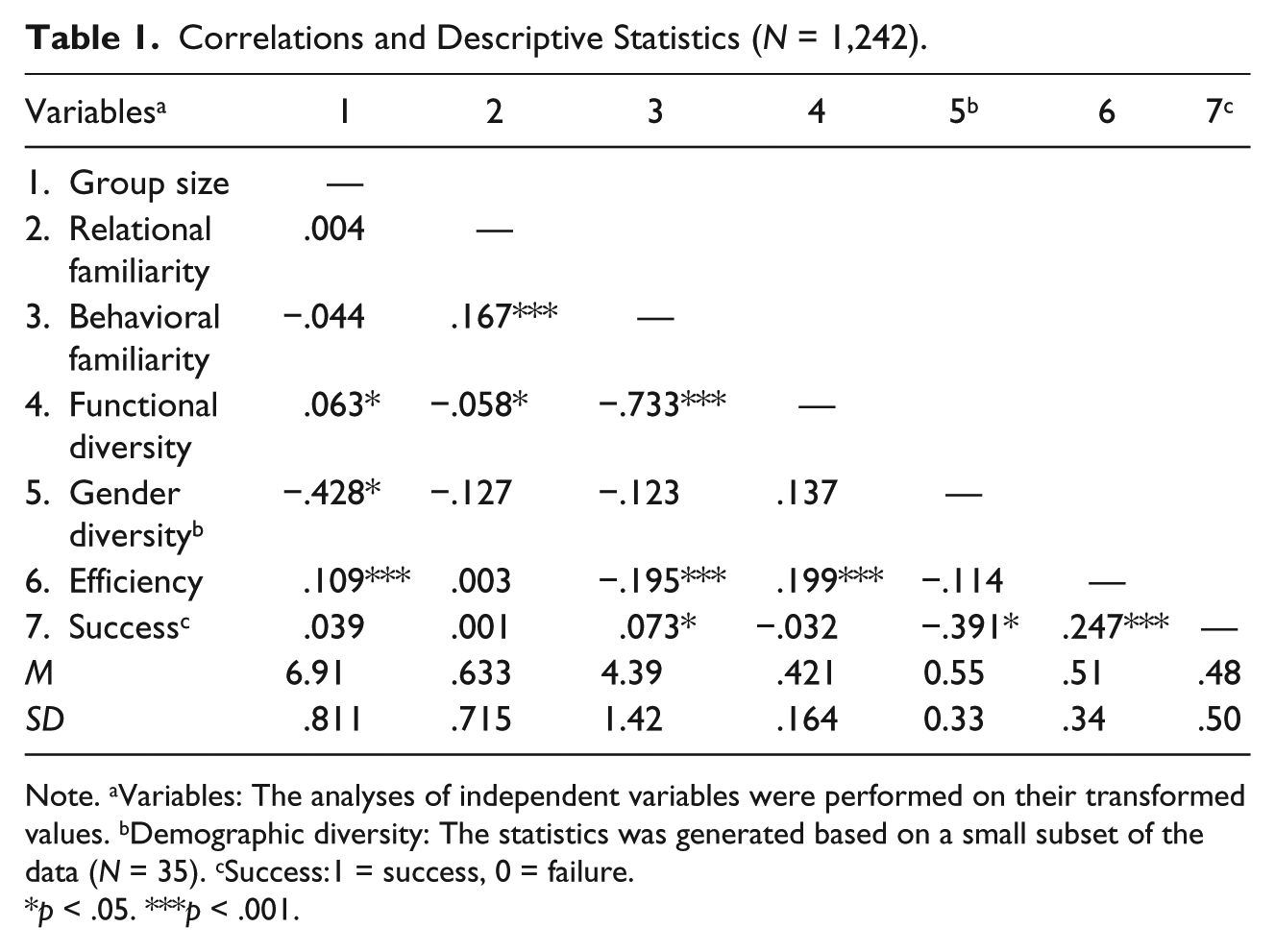
Note. aVariables: The analyses of independent variables were performed on their transformed values. bDemographic diversity: The statistics was generated based on a small subset of the data (N = 35). cSuccess:1 = success, 0 = failure.
p < .05. ***p < .001.
To test the hypotheses of behavioral familiarity, relational familiarity, and functional diversity in relation to efficiency, a multiple linear regression analysis was performed with an enter method. The method was preferred when no a priori hypotheses had been made to determine the order of entry for predictor variables (Tabachnick & Fidell, 1989). To control possible effects of group size, we first performed a hierarchical regression analysis. The results show that group size has a significant effect on efficiency of deception detection (adj. R2 = .011, B =.046, p < .001). After incorporating the three independent variables, the model fit was improved for the prediction of efficiency (adj. R2 = .052, p < .001), and the likelihood ratio test showed that the improvement of model fit was significant (p < .001). Specifically, behavioral familiarity (B = −.027, SE = .01, p = .006) and functional diversity (B = .229, SE = .085, p = .007), but not relational familiarity (B = .013, SE = .013, p = .324), were found to have significant effects on efficiency. Although the impact of behavioral familiarity on detection efficiency was significant, the impact was negative instead of positive as hypothesized. Collinearity diagnostics was also performed on the linear regression model. The results confirmed that the model did not have a high degree of multicollinearity because none of the condition indexes of the standardized variables approached 30, making it unnecessary to examine variance proportions. Thus, hypothesis 8 was supported, but hypotheses 2 and 4 were not supported.
The analysis of gender diversity followed a similar procedure. Since group size was not found to influence efficiency of deception detection (R2 = .016, B = .062, p = .47), a linear regression analysis was performed. Neither did gender diversity yield any significant effect on efficiency (adj. R2 = −.017, B = −.117, SE = .177, p = .513). Thus, hypothesis 6 was not supported.
To test the hypotheses related to the impacts of behavioral familiarity, relational familiarity, and functional diversity on group detection success, a multiple binary logistic model was applied. Group size was first included as a control variable and then dropped from the model because of its insignificant effect (Cox & Snell R2 = .001, B = .095, SE = .07, p = .174). It is shown from the analysis of three independent variables (Cox & Snell R2 = .006) that behavior familiarity had positive influence on group success (B = .155, SE = .06, p = .01), but relational familiarity (B = −.042, SE = .081, p = .609) and functional diversity (B = .578, SE = .513, p = .26) did not have significant effects. Thus, hypothesis 3 was supported and hypotheses 1 and 7 were not supported.
A similar binary logistic regression analysis was performed on gender diversity separately. Again, group size was removed from the model because of its insignificant effect (Cox & Snell; R2 = .047, B = .656, SE = .518, p = .205). The data analysis yielded a significant effect of gender diversity on group success in deception detection (Cox & Snell; R2 = .148, B = −2.65, SE = 1.22, p = .03). Thus, hypothesis 5 was supported.
Discussion
The objective of this research was to investigate the effects of group familiarity and diversity on the performance of group detection of deception. In this study, we used two diversity and two familiarity variables as predictors of group performance in deception detection, which was in turn measured by both success and efficiency. The empirical results show that behavioral familiarity has a positive effect, and gender diversity has a negative effect, on group success in deception detection. The results also show that behavioral familiarity has a negative effect and functional diversity has a positive effect on the group efficiency of deception detection.
Alternative Explanations
The finding on behavioral familiarity in relation to group success supports our hypothesis. Interestingly, it is opposite to some of the previous findings if we correlate behavioral familiarity with professional training in deception detection on the basis of experiential learning (Kolb & Fry, 1975), namely concrete experience and explicit feedback on deception detection provided by the game. Previous empirical results showed that professionals were not necessarily superior to laypersons in detecting deception (Vrij, 2004). That is because professionals are more suspicious of their interviewees, which may lead to high lie bias in deception detection (DeTurck & Miller, 1990; Stiff & Miller, 1986). In addition, professional detectors with training and expertise may be over confident in their detection abilities (Vrij, 2004). The current study differs from previous studies in three key aspects: (a) this study focuses on detection performance of groups instead of individuals. We speculate that it would be more effective for the entire group than for only a subset of group members to receive training for the task of deception detection; (b) the task environment selected in the current study affords immediate feedback to a detection decision, which allows players to adjust and improve their performance over time; and (c) the group task was carried out via online communication instead of face-to-face communication. The higher reprocessability the former communication medium in comparison to that of the latter medium (Dennis & Valacich, 1999)” may allow deceptive cues to be identified more effectively.
The negative effect of behavioral familiarity on efficiency of deception detection is opposite to our prediction. It suggests that the stereotypical cues used by experienced detectors require significant effort to encode, particularly in an online communication environment that lacks rich context for interpreting behaviors. Moreover, extracting concrete deception cues from online communication requires analytical thinking, which demands more effort than intuitive or heuristic information processing. Furthermore, disentangling the discourse of online interaction is particularly challenging in multiparty communication. The volume and pace of synchronous communication further magnify the challenge.
The lack of effect of relational familiarity also differs from previous research findings. We provide the following alternative explanations. First, interpersonal relationships can be developed both online and offline. In this research, we derived the relational familiarity among group members solely based on their online interaction during games, which excluded the relationship developed through other communication channels. On a related note, the data that we collected were left censored, meaning that all the participants were assumed to be strangers prior to the data collection. This assumption may not hold for some participants. Second, the development of relationships in groups may require different types of interactive processes than that in interpersonal contexts. One problem associated with group interaction is lurking ((Nonnecke & Preece, 2000), which could hinder the development of mutual relationships. Third, the type of workgroups might influence the effect of relational familiarity. Groups in the Mafia game are short-lived and narrow in their activities according to McGrath’s categorization of group tasks (McGrath, 1984). Most of the time players randomly join a game and are randomly assigned game roles. After a game is over, a player may join another game with other players. Thus, a group member may not have strong motivations to develop relationships with other members.
Gender diversity was found to be a drag on group success in deception detection. In other words, a predominantly male or female group would be more effective than one that is balanced in gender distribution. This is consistent with both our prediction and previous findings from other cognitive tasks (e.g., Pelled et al., 1999). Contrary to our expectation, gender diversity had no influence on group efficiency of deception detection. One possible explanation is that gender dominance in an anonymous online group may not be as salient as that in a face-to-face group.
The lack of effect of functional diversity on the success of deception detection was not expected. This may have occurred because the game task is narrowly focused, which does not require a wide range of competence and/or solutions for nonroutine problems. In addition, the operationalization of functional diversity based on detection skill also needs revisiting.
Research and Practical Implications
This is the first study that investigates the effects of group factors on group performance in deception detection. This study also introduces efficiency as a new measure of deception detection performance. In addition, most of the previous research on deception detection examined the problem from a perspective of observers, who played a passive role in and/or were disengaged from deceptive interaction. This study investigates deception detection from a viewpoint of receivers who directly interact with the deceiver. Further, research on group diversity itself has been dominated by U.S.-centric studies (Jonsen, Maznevski, & Schneider, 2011). Our research helps expand the field by examining diversity issues in a non-U.S. setting.
This research extends IDT in multiple aspects. First, we extend the theory from the context of interpersonal interaction to intragroup interaction by positing and validating the effects of group factors on the interactive process of deception detection and postinteraction outcomes and by explaining the receiver-related preinteraction features in the context of group communication. In particular, we approach deception as interaction between the sender and a group of receivers and among receivers themselves, and as their dynamic behavioral adaptations. Second, we distinguish the effects of behavioral familiarity and relational familiarity on the process and outcome of deception detection. Third, the lack of impact of relational familiarity on deception detection performance revealed in this study highlights the moderating role of communication context on deceptive interaction. It also suggests that the relational familiarity developed online has different implications for deception detection from that developed via face-to-face interaction. Fourth, we introduce diversity as a new category of factors in intragroup deceptive exchanges. Depending on its conceptualization, the diversity of group composition may either impair or improve some performance measures of deception detection.
This study provides some empirical evidence and concrete suggestions on how to compose a group for effective and efficient deception detection. The current findings show that functional diversity is desirable for deception detection because it improves group efficiency in deception detection without hurting its chance of success. One of its managerial implications is that in organizing a team for the task of deception detection, it is not necessary to seek only those who have demonstrated a track record of successful deception detection; instead, a mixed group consisting of members with varying levels of deception detection skills would achieve a higher level of efficiency while attaining a similar level of success in the task.
The findings on behavioral familiarity are encouraging for online deception researchers and practitioners in deception detection training. As more effective cues to online deception are identified and more users receive training on these cues, we can expect better performance in online deception detection. Several studies have suggested that legal decision makers have a lack of training in credibility assessment, have major misconceptions about deceptive behavior, and hold false stereotypes about deceivers (Porter & ten Brinke, 2009; Strömwall & Granhag, 2003; Vrij, Akehurst, & Knight, 2006). Thus, deception detection training and practice will not only benefit laypersons but professionals as well.
The negative effect of behavioral familiarity on efficiency calls for methods to improve the efficiency of extracting cues to deception. One possible solution is to develop techniques for automatic extraction of cues from the discourse of online communication. In view of the preliminary success in applying natural language processing techniques to extracting cues from online text messages (e.g., Zhou, Burgoon, Nunamaker, & Twitchell, 2004), augmenting human judgment with these techniques may improve detection judgments.
Limitations and Future Directions
This research only focuses on a few group factors related to group composition. Many other group factors such as value diversity and interaction process and contextual factors (e.g., type of groups) may also affect group performance in deception detection but were not included due to the scope of this study. In addition, there are alternative ways to operationalize the variables included in the current study. For instance, functional diversity can be measured based on job titles, and demographic diversity could be measured based on age.
We assumed that group members develop relationships over time, but we did not account for the valance of relationships. According to IDT (Buller & Burgoon, 1996), “When relationships are positively valanced, familiar others (such as friends) show a greater truth bias than strangers. However, when relationships are built on mistrust or are negatively toned, the truth bias should be attenuated or even become a lie bias” (p. 214). Thus, future research should look into the intersection between relationship familiarity and relationship valence.
We measured group gender diversity as a whole without looking into the nature of the diversity. For instance, highly heterogeneous groups could contain a high proportion of females or males. The dominant gender of a group could play a moderating role in the effect of gender diversity on group performance in deception detection.
The real-world data enhance the external validity of the findings of this study, compared with laboratory environments. The former data collection method presents, however, presents several challenges: real-world data are noisy. For instance, missing values are common, which was the case for gender diversity in our study. As a result, we had to perform two separate regression analyses due to two disparate sample sizes. Second, real-world data can lead to low explanatory power, despite the fact that explanatory variables can be very important and practical in explaining or predicting a response variable. Finally, there were many other factors that were out of our control. For instance, we did not have access to information about game players’ age and other relevant experience.
Concluding Remarks
Given the increasing deceptive behavior in group work and online communities and social networks, the objective of this research is to investigate the influence of group familiarity and diversity on group performance in deception detection. To the best of our knowledge, this is the first study that intertwines deception research with group research. The current work extends deception theories by providing insights into impacts of group composition on the performance of deception detection. This study also expands traditional group research from cooperative environments to a noncooperative environment. The findings suggest that group functional diversity is desirable for group detection of online deception, but gender diversity is not preferred. In addition, behavioral familiarity has mixed effects, depending on the measure of detection performance, but relational familiarity has no effect. These findings represent one step toward creating a trustworthy and secure online environment for effective group communication. This study can be extended in a number of directions such as the exploration of new group factors, the interaction of different group factors, and the effect of different types of groups.
Footnotes
Declaration of Conflicting Interests
The authors declared no potential conflicts of interest with respect to the research, authorship, and/or publication of this article.
Funding
The authors received no financial support for the research, authorship, and/or publication of this article.