







Abstract
The theoretical framework of vigilant interaction theory is used to examine information exchange and decision-making quality in virtual teams. Groups completed a hidden profile task in one of three geographic dispersion conditions: all members colocated, isolated, or mixed with two colocated and two isolated members. Vigilant interaction—discussion of task information, attention to other group members’ information, discussion of positive and negative attributes of the alternatives, and systematic information processing—predicted decision quality. Explicit reminders of information differences predicted pooling of unique information. No evidence was found for difficulties in interaction and task performance due to subgroup faultline dynamics; instead vigilant interaction was highest in groups with mixed distributions, suggesting they exerted compensatory effort. Exploratory analyses suggested that temporal vigilance was lowest in completely distributed groups. Implications for new dimensions of the vigilant interaction theory framework are discussed.
Keywords
Effective decision-making in a team—whether face-to-face or virtual—requires members to exchange relevant information thoroughly and to achieve mutual understanding of what that information means for their decision. This vigilance in decision-making (Hirokawa & Rost, 1992) has been found to be difficult to achieve in practice, however, especially for geographically dispersed teams (Cramton, 2001; Walther & Bunz, 2005). Chief among the challenges associated with the exchange and processing of information that is distributed across members of virtual teams are logistic difficulties related to coordination (Baltes, Dickson, Sherman, Bauer, & LaGanke, 2002; Cummings, Espinosa, & Pickering, 2009; Kanawattanachai & Yoo, 2007) and interpersonal difficulties related to lack of trust and sense of team identity (e.g., Hinds & Bailey, 2003). The focus of this article is on the role of vigilance—defined as explicit, consistent, and conscious attention to decision-making processes—in helping virtual teams meet these discussion coordination and information processing challenges.
Vigilant Interaction Theory
The construct of interaction vigilance was introduced by Janis (1989; see also Janis & Mann, 1977) as a set of guidelines to counteract groupthink and to help groups avoid making disastrous decisions. Vigilant interaction is characterized by a focus on procedural rationality (Tasa & Whyte, 2005), thorough search for information within the bounds of rationality and resources (Peterson, Owens, Tetlock, Fan, & Martorana, 1998), and critical and systematic analysis of information pertaining to the decision (Hirokawa & Rost, 1992). Vigilance increases the likelihood of reaching effective decisions and of avoiding mistakes by helping groups to achieve the core rational decision-making functions of (a) thorough understanding of the problem situation, (b) establishment of decision criteria and goals, and (c) careful evaluation of the positive and the negative aspects of the available decision options (Gouran & Hirokawa, 2003; Hirokawa & Rost, 1992). Evidence that vigilant discussion procedures improve group task performance has been found in analyses of historical events (e.g., Herek, Janis, & Huth, 1987), in organizational settings (e.g., Hirokawa & Rost, 1992; Peterson et al., 1998), and in laboratory studies (e.g., Hirokawa, 1988; Tasa & Whyte, 2005).
Three extensions to the vigilant interaction literature are offered here. To date, researchers in this area have either implicitly assumed that, or created conditions wherein all the relevant information is available to the group, and have focused primarily on a group’s understanding and evaluation of information. But no explicit attention has been given to the question of how information is exchanged between members so that it becomes available for analysis by the group as a whole. The first extension contributed by the current research therefore will be vigilance in exchange of information between group members. Second, past research on interaction vigilance has focused on synchronous face-to-face communication. Vigilance may be even more critical for decision quality in settings—typical of many decision-making teams today—where people as well as information are in different locations. The current research extends the previous vigilant interaction literature by considering the joint situation of distributed information and distributed people. Finally, the temporal dimension of vigilance has not received research attention. Vigilance involves not only care and depth of information processing but also consistency and constancy over time. This research will contribute exploratory analyses of how patterns of vigilant behaviors unfold over time, and the relationship of those patterns to decision quality.
Vigilance in Information Exchange
Organizations bring decision-making teams together primarily because of differences in members’ information, knowledge, and skills. The completeness of a team’s information depends not only on how well members search the environment but also on how well they exchange their information (Griffith & Neale, 2001). An extensive body of research has revealed however, that group members generally do a poor job of exchanging unique information during decision-making discussions; instead they tend to devote more attention to information that members had already known in common (Mesmer-Magnus & DeChurch, 2009; Reimer, Reimer, & Czienskowski, 2010; Stasser & Titus, 2003). A frequent result of this inefficient exchange of task-relevant information is that groups make suboptimal decisions (Lu, Yuan, & McLeod, 2011). Vigilant interaction theory provides a powerful framework that shows how faulty information processing contributes to poor group decision quality (Orlitzky & Hirokawa, 2001).
It has been generally shown that increasing group members’ motivation to seek out and attend to each other’s information improves information exchange. For example, Larson, Foster-Fishman, and Keys (1994) reported that information exchange improved when groups were trained in “information-vigilant” strategies such as “regarding as important each and every piece of information they are aware of” (p. 452), and in follow-up research Larson, Christensen, Franz, and Abbott (1998) found that vigilance training improved decision quality. Stasser and Stewart (1992) found that inducing group members to believe their task was to find a correct solution rather than a consensus agreement increased the likelihood of them mentioning and focusing on their unique task information. Scholten, van Knippenberg, Nijstad, and De Dreu (2007) found more thorough information exchange and processing when groups were made to believe they would be asked to provide a public account of how they reached their decision. Brodbeck, Kerschreiter, Mojzisch, Frey, and Schulz-Hardt (2002) found that prediscussion dissent between members in their solution preferences increased completeness of information exchange as group members looked for justifications of the variations in their opinions. Information exchange has been found to improve when groups are told which members possess what information (e.g., Stasser, Stewart, & Wittenbaum, 1995; Stasser, Vaughan, & Stewart, 2000), or which parts of their information are not known to the other members (e.g., Schittekatte, 1996; Schittekatte & van Hiel, 1996). Such strategies increase motivation to exchange information by making it clear to group members the importance of uncovering each other’s information, how each piece of information fits the overall decision-making picture, and where to find it when it is needed.
A critical function of vigilant decision-making is the careful evaluation of the positive and negative aspects of the available decision alternatives, once that information has been exchanged (Orlitzky & Hirokawa, 2001). Decision quality has been found to be predicted by the amount of discussion devoted to the information exchanged about the optimal decision alternative (Hollingshead, 1996; Schulz-Hardt, Brodbeck, Mojzisch, Kerschreiter, & Frey, 2006), by the volume of task information exchanged over preference advocacy (Cruz, Henningsen, & Williams, 2000; Van Swol, Savadori, & Sniezek, 2003), and by the extent of systematic reasoning applied to the exchanged information (Suthers, Vatrapu, Medina, Joseph, & Dwyer, 2008).
Taken together, the studies just reviewed suggest that vigilance in explicit and systematic attention to the information known to all of the group members increases the completeness of information exchange and decision quality. Whereas previous research on vigilance has focused on information processing in group discussion (e.g., Hirokawa, 1985; Hirokawa & Rost, 1992), I add a focus on information exchange. To achieve this objective I use in this study a hidden profile task (Stasser & Titus, 2003). Hidden profiles are created by distributing task information among group members prior to discussion, such that some information is known to all members (common information) while some is known to only one member (unique information), and the pattern of how the positive and negative information is distributed leads members to prefer a suboptimal task solution. The correct task solution is “hidden” from the group prior to discussion, and can be discovered only by thorough exchange and correct processing of the information items. Such tasks have thus proven very useful to researchers in examining information exchange processes (Stasser & Titus, 2003). Moreover, hidden profiles may arise naturally in virtual teams because physical separation among members very likely results in the comparable situation in which all members share common information while individuals each have unique information, perhaps associated with their respective local contexts (Cramton, 2001).
Indicators of vigilance for hidden profiles
The two keys to solving these tasks are the exchange of unique task-relevant information and the understanding of how to bring the information to bear on the decision (Lu et al., 2011). Vigilant interaction is fundamentally a rational model of decision-making characterized by informational rather than by normative influence (Deutsch & Gerard, 1955; Hirokawa & Johnston, 1989). Under normative influence group decisions are affected by contextual and social factors such as the opinions of powerful group members or preexisting organizational conventions, and concern for group harmony generally outweighs concern for decision quality. Such discussions are driven by group member preferences and majority influence processes (De Dreu, Nijstad, & van Knippenberg, 2008; Kaplan & Miller, 1987). Information-driven discussions, however, “are characterized by the communication and integration of relevant information” (De Dreu et al., p. 28). Preference-driven discussions should reduce decision quality for hidden profile tasks specifically because these tasks, by definition, lead group members to prefer suboptimal alternatives prior to their discussions. If normative influence prevails, discussion will be characterized by attempts to forge agreement between members’ suboptimal preferences rather than by analysis of information. It has indeed been found that groups are more likely to solve hidden profiles when discussions are focused more on task information than on group member preferences (Cruz et al., 2000; Van Swol et al., 2003). Therefore, I expected to replicate past findings that the exchange of unique information would predict decision quality, and also to find that the amount of discussion focused on task information relative to discussion about opinions would predict decision quality. The first two hypotheses to be tested are as follows:
The core interest of this article is on indicators of vigilance with respect to information exchange, with a focus on three specific behaviors. First is the degree of participation equality between group members. Participation equality should increase information exchange and decision quality based on the straightforward observation that the amount of information that group members exchange is positively related to participation rates. Because hidden profile task information is initially distributed across group members, the more evenly they participate the broader the sample of the available information mentioned. It has been shown that the breadth of the information sample strongly predicts the likelihood of solving a hidden profile task (Lu et al., 2011).
The second behavioral indicator of vigilance in information exchange is members’ repetitions of the unique information contributed by other members. Repetition of unique information, no matter who initially contributes it, has been found to have more positive effects on decision quality than does repetition of common information (Scholten et al., 2007; Winquist & Larson, 1998). Repeating information learned from another group member both acknowledges the information and suggests that the speaker considers it to be important (Scholten et al., 2007). Explicit repetition should be especially important in virtual teams where nonverbal acknowledgements of others’ contributions are not available. Furthermore, repetition keeps the information within group members’ attention while they consider its implications for their decision (Larson, Christensen, Abbott, & Franz, 1996). Information becomes part of a group’s discussion only when it is contributed and then acknowledged by at least one other member, and this exchange is a fundamental requirement for finding the solution to a hidden profile task. It was thus expected that decision quality would depend in part on repetitions of information mentioned initially by other members.
A third behavioral indicator of information exchange vigilance is explicit attention to the fact that each group member has unique information to contribute. References to differences in their information should remind members that as a whole the group has the information needed to solve the task, and therefore increase their motivation to seek information (De Dreu et al., 2008; Scholten et al., 2007). Schultz, Ketrow, and Urban (1995), for example, found that introducing regular reminders to follow vigilant interaction functions improved group decision quality. Although past research on hidden profile tasks has found no effect of forewarning groups about differences in information across members (e.g., Stasser et al., 1995), no studies have thus far reported evidence on how much members took such warnings into account during their discussions. It is reasonable to expect that decision quality will increase when group members remain vigilant in reminding each other that they need to contribute their different information.
The following hypotheses about the effects of information exchange vigilance on decision quality will be tested:
Even if they exchange sufficient information many groups nevertheless fail to make optimal decisions because the members do not correctly perceive how the information should be applied to their decision (Lu et al., 2011), an observation that is consistent with the vigilant interaction framework argument that decision quality depends on systematic and accurate analysis of task information. Hirokawa and Rost (1992) for example, found that the volume of task analysis behaviors was positively related to decision quality, and in a meta-analysis of vigilant interaction studies, Orlitzky and Hirokawa (2001) found more specifically that the evaluation of the negative aspects of decision alternatives was the strongest predictor of decision quality. It is reasonable to argue that the effects of considering the positive and negative consequences might differ across decision alternatives. Specifically, discussing negative consequences of poor choices and positive consequences of good choices may be more predictive of decision quality than the simple volume of mentioning positive versus negative information. It was of interest therefore to test the following hypotheses:
Vigilance in Virtual Teams
Following Fiol and O’Connor (2005), virtual team is defined in this study in terms of the amount and regularity of face-to-face contact among the team members. A virtual team is one in which all the members rarely, if ever, meet face-to-face, and whose primary means of communication is technologically mediated. The attractions of virtual teams to organizations include relatively cheap access to a wide variety of opportunities and resources across the globe (Cramton, 2001; Martins, Gilson, & Maynard, 2004). It is well documented, however, that such advantages come at a price arising from coordination difficulties (e.g., O’Leary & Cummings, 2007), interpersonal conflict (e.g., Hinds & Mortensen, 2005; Mortensen & Hinds, 2001), and reduced trust (Jarvenpaa & Leidner, 1999; Olson & Olson, 2012). In a survey study, Timmerman and Scott (2006) suggested that the factors shown to increase decision-making effectiveness within virtual teams in organizations could be summarized by the critical decision functions as described by Gouran and Hirokawa (2003) and Hirokawa and Rost (1992). Moreover, Timmerman and Scott found that those decision functions predicted trust, cohesiveness, and member satisfaction. Walther and Bunz (2005) showed that adherence to six “rules” of task behaviors related to vigilance (i.e., start immediately, communicate frequently, acknowledge others, be explicit, multitask, observe deadlines) increased interpersonal trust and liking and, with the exception of multitasking, performance quality on a research paper assignment among virtual teams of undergraduate students.
Juxtaposed against the evidence for the importance of vigilance in virtual teams is the evidence that vigilance is more difficult for virtual than for face-to-face teams (e.g., Baltes et al., 2002; Li, 2005). The previously mentioned difficulty in processing task information once it has been exchanged seems to be especially true for virtual teams (e.g., Dennis, 1996; Lu et al., 2011). There is a greater need for explicitness in virtual than in face-to-face interaction because tacit knowledge that affects a team’s work must be deliberately shared when members do not share a common physical environment. Such knowledge can include whether remote colleagues’ work facilities provide privacy for meetings, indicators of when a colleague can be interrupted or is available for an informal chat, intuitive understanding of how local tastes might affect customer acceptance of a new product, and so forth. Explicitness requires effort, however. Moreover, as geographic dispersion increases, information that comes from remote sources may be more difficult for members to assimilate due to the lack of shared contextual knowledge. The criticality of vigilance for virtual teams is suggested by research showing that the failure to communicate tacit knowledge is a major contributor to poor task performance and interpersonal strife in virtual teams (Cramton, 2001). This reasoning leads to the following hypothesis:
Geographic dispersion configurations
The effort required and simultaneous importance of vigilance may be more acute when groups are dispersed in a mixed pattern of colocated subgroups and isolates, due to faultline dynamics (e.g., Polzer, Crisp, Jarvenpaa, & Kim, 2006). Colocated colleagues may share a subgroup identity because they usually spend more face-to-face time with each other than with their remote teammates and they share tacit knowledge of the local environment. The opportunity to commiserate with colocated colleagues intensifies ingroup and outgroup dynamics related to low trust, negative evaluations, and lack of understanding among dispersed subgroups (Michinov, Michinov, & Toczek-Capelle, 2004; O’Leary & Mortensen, 2010). Overcoming these dynamics adds to the effort needed to maintain vigilant interaction. At the same time, these difficulties also increase the importance for vigilance. In short, based on this reasoning, it can be hypothesized that the volume of vigilant behaviors would be lower in mixed than in completely distributed or colocated teams.
A competing hypothesis is suggested by some findings that virtual teams may exercise more vigilance than do face-to-face teams. Specifically, Münzer and Holmer (2009) and Münzer and Borg (2008) found evidence for a compensatory model wherein virtual teams spontaneously increase vigilant behaviors (such as repetitions of information) in an effort to make up for the challenges of asynchronous computer-mediated communication. Their findings are consistent with past research on face-to-face teams that attention to interaction process may increase as a group’s task structure becomes more complex or intractable (Hirokawa, 1990; Poole & Roth, 1989). Whereas the previous hypothesis is based on an assumption that social identity processes operate largely at an unconscious level (Tajfel, 1982), the hypothesis based on compensatory effort assumes that group members’ explicit focus on geographic dispersion is the trigger that increases their task efforts. In other words, seeing their disparate locations may motivate group members to consciously seek ways of bridging the perceived distance. The compensatory effort notion leads to the expectation that mixed and completely distributed groups would exhibit similar levels of vigilance because any dispersion would be salient in both these kinds of groups, and hence the members would exert similar efforts. The current study compares a mixed distribution configuration to the two extremes of fully colocated and fully distributed configurations, and tests a social identity hypothesis against a compensatory effort hypothesis:
Temporal vigilance
Vigilance involves not only explicitness and attention to interaction and task processes, but also constancy over time. Delays and time lapses in communication may be detrimental in virtual teams because ready explanations are not always available due to the absence of visual cues or knowledge of shared context. Kalman and Rafaeli (2011), for example, showed that response delay in computer-mediated communication was associated with decrease in trust. Although plenty of evidence exists that the volume of vigilant behaviors predicts task performance, there is essentially no information about vigilance over time. Consider the case of two teams that each exhibit 10 actions related to evaluating decision alternatives over the course of an hour-long meeting. Now suppose that in Team 1 these behaviors are clustered within the first 15 min of the discussion, whereas in Team 2 they are evenly spaced throughout the second half. Though these two teams might appear equally vigilant based on volume measures, the sequential pattern suggests that Team 2 may be more vigilant.
Studies that have examined temporal factors specifically for hidden profile tasks have found that common information generally is mentioned earlier in discussion than is unique information, and that over time the rate of introducing common information decreases while that of unique information increases (e.g., Larson et al., 1996; Larson et al.,1994). None of these studies examined the effects of temporal factors on decision quality. Moreover they were conducted over short time periods of about 1 hr whereas tasks carried out by virtual teams in organizations likely span significantly longer periods. With enough time to thoroughly analyze the information contributed by each group member, virtual teams’ success in solving hidden profiles may increase (Lu et al., 2011). In the current study this gap in the literature about temporal factors related to vigilance is addressed by presenting exploratory analyses of temporal data from virtual teams working on a hidden profile task over a 2-week period. The following questions will be explored:
Method
Overview
Forty-nine groups of four members each (N = 196) participated in a field experiment in which they worked on a hidden profile task through asynchronous Internet communication for 2 weeks. The sample included participants from six different geographic locations, and members were placed in groups according to one of three geographic distribution conditions. The dependent variables included measures of information sharing, discussion processes, and decision quality.
Participants
Students from various majors were recruited from seven colleges or universities in North America to participate in a study on decision-making in virtual teams. Two schools were in New York State, one in Texas, one in Ohio, two in California, and one in Ontario. Participants received course credit and entry in a drawing to win an iPod®, contingent on the groups’ decision quality. Participants ranged in age from 18 to 49, with a mean of 21 and mode of 19, and 58% were female.
Geographic Distribution
There were three conditions of geographic dispersion: colocated, in which all four of the group members were from the same school; fully distributed, in which each of the four group members was from a different school; mixed, in which two of the members were from the same school and the remaining two were from two other schools. To make salient the locations of each group member, the name and school logo of each participant appeared on their discussion boards. No instructions precluded participants from sharing any personal information with one another.
Task
The task materials, developed for this study, described a fictitious city faced with the choice of three urban development projects. The information sets contained positive and negative items related to each project, and there was a demonstrably correct rank order among the three alternatives based on the net valence of the combined information items, computed by subtracting the number of negative items from the number of positive items for each alternative. The top-ranked alternative (Alternative A) described a fine arts and education center; the second-ranked alternative (Alternative B) described an inner city neighborhood renewal project; the bottom-ranked alternative (Alternative C) described a downtown convention center.
The task contained a total of 50 pieces of information—16 each about alternatives A and C, and 18 about Alternative B. 1 Each member received 10 pieces of information about each of the three alternatives. The information items were distributed so that prior to discussion three of the members would prefer the same, but incorrect, rank order among the alternatives, and the fourth member would prefer a different, but also incorrect, rank order. This configuration of a minority–majority information distribution was used to create initial dissent, which has been shown in past studies to increase the likelihood of information exchange (e.g., Brodbeck et al., 2002; Sniezek & Henry, 1989). The focus in the current study, however, is not on effects related to minority influence.
The three majority information sets contained eight positive and two negative pieces of information about Alternative B; six positive and four negative pieces about Alternative C; and four positive and six negative pieces about Alternative A. An example of a positive piece of information about the optimal alternative is that entertainment taxes would create revenue for the city, and a negative piece of information is that letters in the local paper criticized the plan for being out of touch with the city’s culture. When the number of negative items is subtracted from the number of positive items for each alternative the resulting net valence leads to a prediscussion preferred rank order of B > C > A for these three information sets. The fourth member received six positive and four negative pieces of information about Alternative C; four positive and six negative pieces of information about Alternative A, and three positive and seven negative pieces about Alternative B, and the net valence leads to a prediscussion preference of C > A > B. Furthermore, the positive information about Alternatives B and C and the negative information about Alternative A was common information distributed to all group members, whereas the negative information about Alternatives B and C and the positive information about Alternative A was unique information distributed to individual group members. In summary, the full set of information produces a correct rank order of A > B > C based on the net valence of the information items, and the hidden profile prediscussion produces an initial rank order of B > C > A for three members and C > A > B for the fourth member. Pilot testing confirmed that the information sets produced these rank orders, and that people could find the correct rank order when given the full information set.
Procedure
A stratified random sampling procedure was used to assign participants to geographic distribution conditions tentatively, blocking on participants’ locations to achieve equivalence across the conditions and to determine which information set each would receive. Participants received by mail paper copies of the experimental stimuli containing one of the four different information sets, and instructions for using the communication system. The instructions included the request that participants arrive at an individual solution to the task and to send it via email to the researchers. Participants’ assignment to groups was finalized and they were provided access to their discussion board only after they sent this task solution. The final sample included 12 groups in the completely colocated condition, 13 in the completely distributed condition, and 24 in the mixed distribution condition. 2 Participants retained access to their information sets throughout the study. The task instructions informed participants that their information sets may not be the same, but that as a group they possessed all the information necessary to find the optimal rank order among the three alternatives. The groups were instructed to reach a consensus agreement on a rank order among the three alternatives.
Participants communicated via an asynchronous discussion board created for each group in the Blackboard online courseware system. The discussion boards were available 24 hr a day for 2 weeks, and participants were instructed to restrict all communication to the discussion board. One group that imported an instant messenger exchange was removed from further analysis.
Every 2 days, all participants received generic email reminders to check their discussion boards. Members who had posted nothing after the 1st week received individually addressed messages encouraging them to join the activity and repeating the instructions on accessing the discussion board. Three days prior to each group’s deadline, a message was posted in its discussion board with a deadline reminder and instructions on how to finish the discussion. Irrespective of whether groups completed the task, each group’s discussion board was closed at the 2-week deadline.
Measures and data coding
Three coders, unaware of each group’s experimental condition, were trained to identify information items in the discussion transcripts. Cronbach’s alpha across the coders’ totals was α = .97. Disagreements were settled through discussion, and the reconciled codes were used in the final data set. The valence of each piece of information mentioned, and which group member mentioned the information were also recorded. From this coding, information pooling was calculated by (a) counting the number of pieces of common (unique) information mentioned, without regard to number of times mentioned, divided by the total number of pieces of that information available in the data set, and (b) repetitions of information items. A different set of two research assistants were trained to code for interaction process measures. These coders, also unaware of the experimental condition of each group, counted the following behaviors: (a) attempts to combine the information items using a systematic method (e.g., based on sum of the positive and negative values of the information items, or some salient information attributes), (b) proposals for a specific rank order of the alternatives, (c) statements of personal opinions about each alternative, (d) references to the deadline, and (e) explicit reminders of differences in their information sets. Percentage of agreement was 0.74 each on the information combination and proposed rank order codes, 0.91 for opinions, 0.97 for deadline references, and 1.00 for information difference reminders. The discrepancies on the systematic combination and rank order codes were resolved through discussion among the coders, and these resolved codes were used in the data analysis. For the remaining categories, the coding was averaged between the two coders. Participation equality was measured by calculating the Gini coefficient across the number of posts made by each group member (Dorfman, 1979; Weisband, Schneider, & Connolly, 1995).
Results
General Description of Information Sharing and Task Performance
The classic pattern of greater pooling of common than of unique information was found, t(48) = 7.00, p <. 001, d = 2.02. The discussions were predominated by positive information about Alternative B, the top-ranked choice in the majority of the prediscussion information set distributions. A single factor repeated measures ANOVA with information type as a six-level within-subjects factor (positive vs. negative information for the three alternatives) confirmed that significantly more positive information about Alternative B was mentioned relative to negative information about this alternative, and relative to positive and negative information about the other alternatives, F(5, 48) = 11.14, p < .001, η2 = 0.23, pairwise contrast test, p < .001. A second ANOVA showed that a significantly higher proportion of the common than of the unique information about Alternative B was mentioned relative to the respective proportions for the other two alternatives, F(5, 48) = 37.19, p < .001, η2 = 0.77, pairwise contrast test p < .001.
Looking at the total pool of information the groups mentioned an average of M = 15.67 items of information out of the total of 50 items (31%), but at the same time their discussions were predominated by information—that is, 82% of the posts contained information items. In other words, the discussions were focused on a few information pieces, primarily about the positive aspects of Alternative B. Thus, the prediscussion distribution of the information exerted strong effects on the discussion, in that the prediscussion information that the group members shared in common favored Alternative B, and this positive information about Alternative B was the main content in their discussions. Finally, two groups did mention all 50 pieces of information and one of these was the only group to discover the correct solution.
Tests of Hypotheses
Decision quality
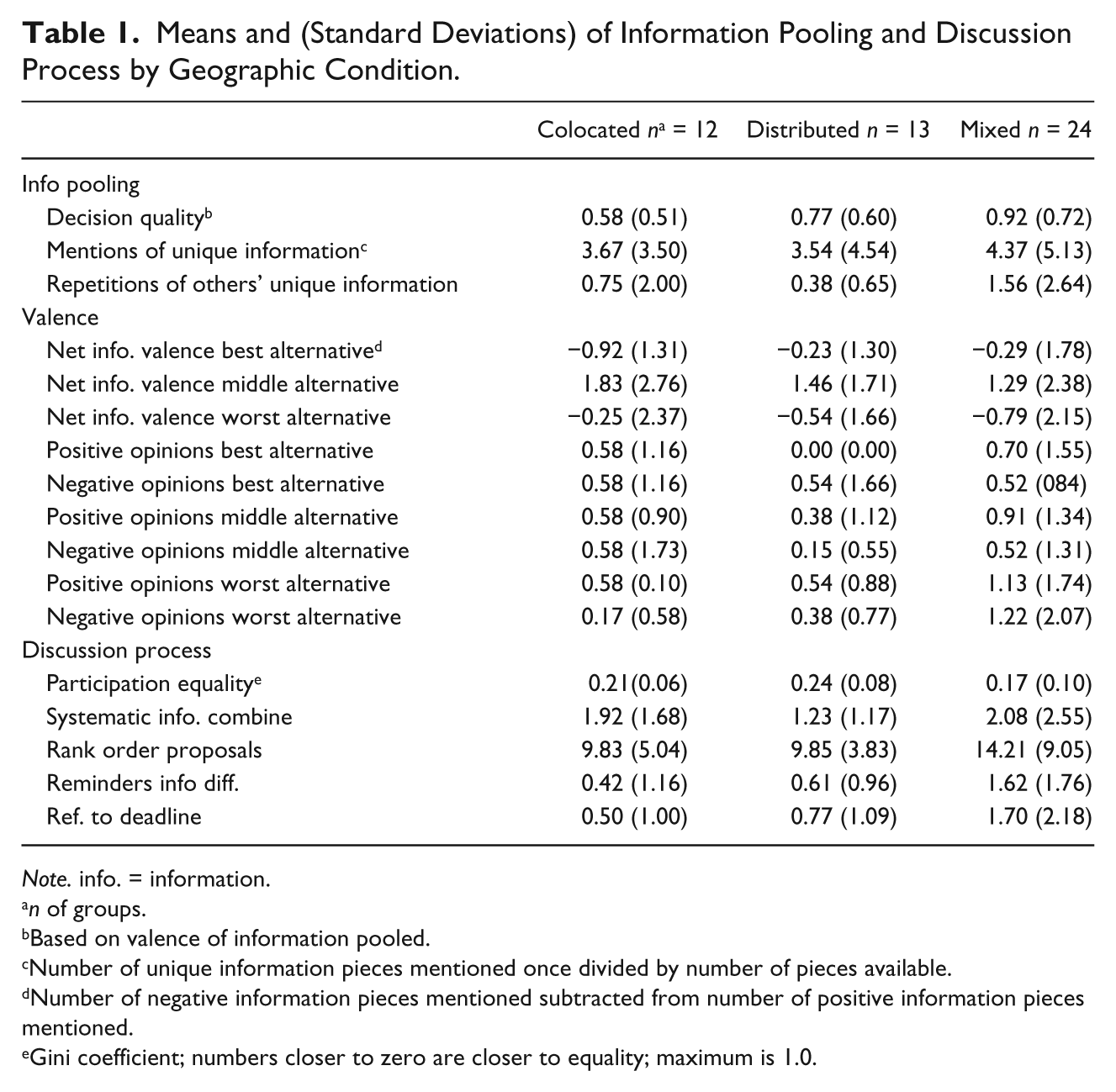
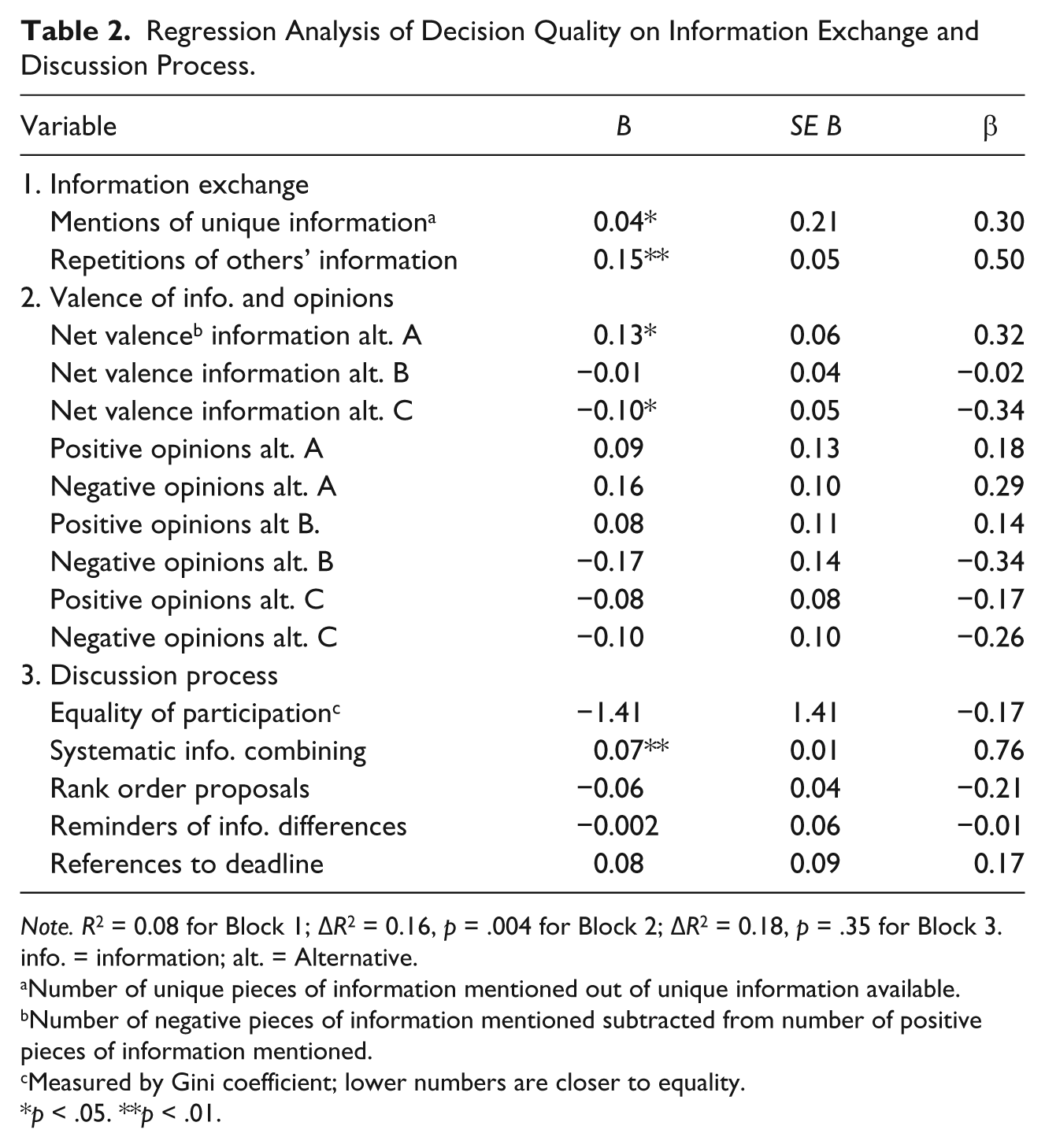
Table 1 presents the means and standard deviations of decision quality, information pooling, information and opinion valence, and discussion process measures for the three conditions of geographic dispersion. Decision quality was a continuous variable with scores ranging from 1 to 4 based on closeness to the correct rank order: Specifically, A > B > C = 4; A > C > B and B > A > C = 3; B > C > A and C > A > B = 2; C > B > A = 1. Because of the previous research showing that unique information is more important for decision quality in hidden profile tasks than is common information (Lu et al., 2011), only measures of unique information pooling are used in the subsequent analyses. Regression analysis was used to test H1 through H7. Decision quality was regressed on the following three blocks of predictors: (a) information pooling measures, (b) variables measuring the valence of pooled information and of opinions about each alternative, and (c) variables related to interaction process. The specific variables within each of these blocks are described below in the discussion of the regression results. The coefficients are presented in Table 2.
Means and (Standard Deviations) of Information Pooling and Discussion Process by Geographic Condition.
Note. info. = information.
n of groups.
Based on valence of information pooled.
Number of unique information pieces mentioned once divided by number of pieces available.
Number of negative information pieces mentioned subtracted from number of positive information pieces mentioned.
Gini coefficient; numbers closer to zero are closer to equality; maximum is 1.0.
Regression Analysis of Decision Quality on Information Exchange and Discussion Process.
Note. R2 = 0.08 for Block 1; ΔR2 = 0.16, p = .004 for Block 2; ΔR2 = 0.18, p = .35 for Block 3. info. = information; alt. = Alternative.
Number of unique pieces of information mentioned out of unique information available.
Number of negative pieces of information mentioned subtracted from number of positive pieces of information mentioned.
Measured by Gini coefficient; lower numbers are closer to equality.
p < .05. **p < .01.
The first block of variables included the amount of unique information mentioned and repetitions of unique information heard from other members. The means for these variables can be found in the second two rows of Table 1. As predicted by H1 and H4 respectively, decision quality was significantly predicted by mentions of unique information, B = 0.04, p = .02, and repetitions of unique information mentioned by other members, B = 0.15, p = .002.
The second block included variables related to valence of information and of opinions about each decision alternative (see the section in Table 1 labeled “Valence”). These measures included (a) the net valence of the information items pooled about each alternative, calculated by subtracting the total of negative from the total of positive items mentioned, and (b) the number of positive and negative opinion statements made about each alternative. As hypothesized (H7), the preponderance of positive information mentioned about the top-ranked alternative showed a significant positive relationship to decision quality, B = 0.13, p = .02, whereas a preponderance of positive information about the bottom-ranked alternative showed a significant negative relationship to decision quality, B = −0.11, p = .02. Consistent with H2, none of the opinion statements were found to be significantly related to decision quality.
The final block of variables was related to discussion process actions (see the section of Table 1 labeled “Discussion process” for the means). The variables in this block included (a) the Gini coefficient for participation equality (H3: lower numbers are closer to equality), (b) attempts to systematically combine the task information (H6), (c) proposals for a rank order among the alternatives (H6), (d) reminders of information differences (H5), and (e) references to the deadline (H6). Of these variables, only attempts to systematically combine the information predicted decision quality, B = 0.07; p < .001. These analyses provide limited support for H6, and none for H3 or H5.
Examination of the correlation matrix showed that these discussion process variables were significantly related to the pooling of unique information. Given the importance of unique information to decision quality, it was of interest to explore further the effects of the discussion process variables on information pooling. The dependent variable of mentions of unique information was regressed on the discussion process variables described above. Of these variables, reminders of information differences significantly predicted information pooling, B = 3.71, p = .001. Although this result is not a direct test of H5, the finding is consistent with the hypothesis in that reminders of information differences significantly increased mentions of unique information, which in turn improved decision quality.
To summarize, this first set of findings is consistent with past research showing that the pooling of unique information improves decision quality; the expected effects of vigilance in discussing positive information about the best alternative and negative information about the worst alternative predicted decision quality were found, whereas opinion statements were found to have no effect; some support was found that systematic information processing predicted decision quality. Indirect support was found for the expectation that reminders of information differences would predict decision quality.
Geographic distribution
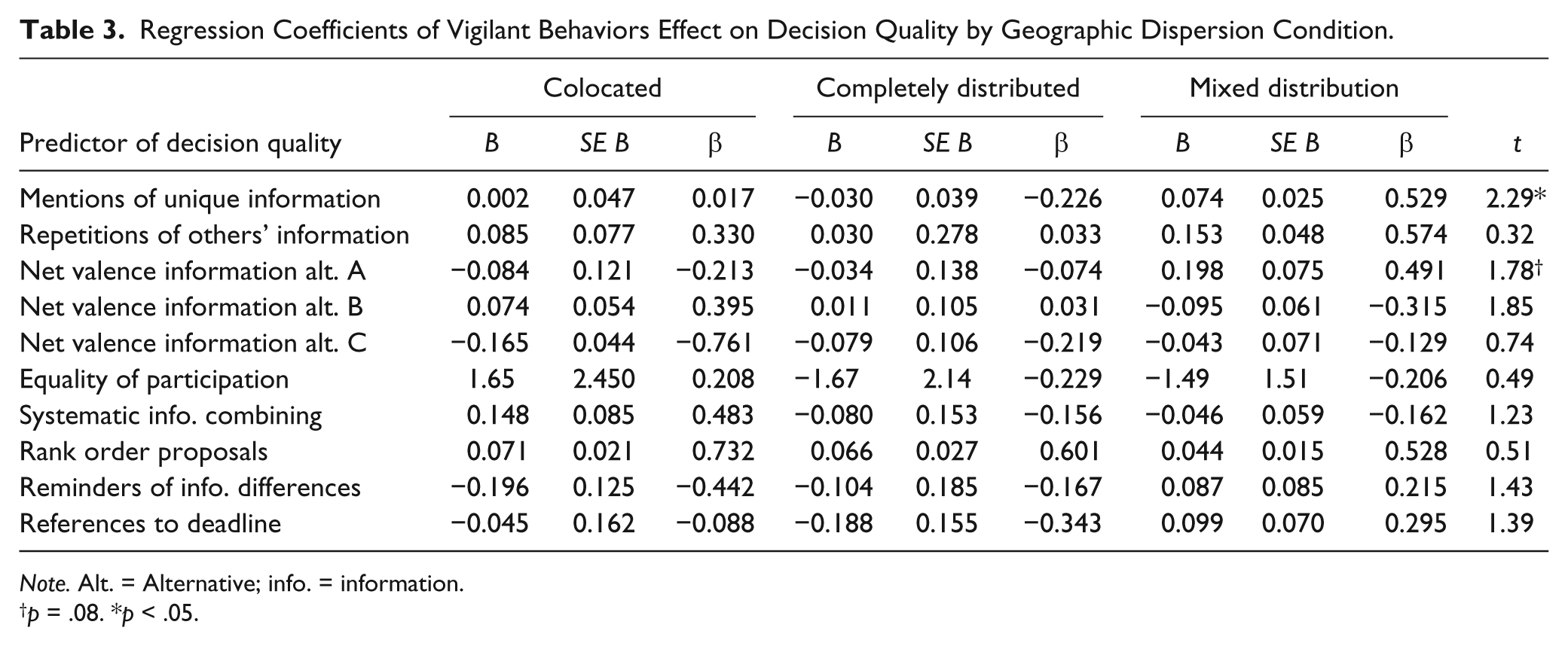
To test H8, that vigilance would be more predictive of decision quality in the two distributed conditions than in the colocated condition, I repeated the foregoing regression analyses, adding dummy codes for the geographic distribution with colocated as the base condition. The regression coefficients were calculated separately for each condition, and then the differences in the coefficients were tested. The coefficients are presented in Table 3. Decision quality was predicted significantly more strongly by mentions of unique information, t = 2.29, p = .03, and marginally more strongly by discussion of the positive qualities of the best alternative, t = 1.78, p = .08, in the mixed distribution than in the other two conditions. No other variables showed differences in strength of predicting decision quality across conditions. These results nevertheless offer partial support for H8.
Regression Coefficients of Vigilant Behaviors Effect on Decision Quality by Geographic Dispersion Condition.
Note. Alt. = Alternative; info. = information.
p = .08. *p < .05.
H9a and H9b were evaluated by means of one-way ANOVAs with geographic distribution as a single three-level factor on the vigilance measures of information pooling, mentions of positive and negative information about each alternative, and the discussion process behaviors, followed by planned comparisons testing the two competing hypotheses (compensatory effort vs. social identity) about the effects of geographic condition (Rosenthal, Rosnow, & Rubin, 2000). The first row of Table 1 shows that the mean for decision quality was highest in the mixed distribution condition, but this pattern did not approach statistical significance. With respect to information pooling, the means show that mentions of unique information and repetitions of other members’ information (rows 2 and 3 in Table 1) were also highest in the mixed distribution condition. The effects for mentions of unique information did not approach significance, but the planned comparison for repetition of other’s information was very nearly significant, t(46) = 1.63, p = .055, d = 0.48, partially consistent with the compensatory effort hypothesis (H9b). No significant differences for the discussion of positive and negative information about the alternatives were found.
For the discussion process variables, the planned contrasts showed significantly higher volumes in the mixed distribution condition of proposals for particular rank ordering among the alternatives, t(46) = 2.14, p = .02, d = 0.63, reminders of information differences, t(46), = 2.66, p = .006, d = 0.78, and references to the task deadline, t(46) = 2.15, p = .002, d = 0.63; and marginally higher volumes of repetitions of information pooled by others, t(46) = 1.62, p = .06, d = 0.48. Furthermore, participation rates were closer to equality in the mixed than in the other two conditions, t(46) = 2.24, p = .02, d = 0.66. In summary, all of the significant and near-significant results indicate the presence of a higher volume of behaviors associated with vigilance in the mixed than in the other geographic distribution conditions, which is more consistent with the compensatory effort hypothesis (H9b) than with the social identity hypothesis (H9a).
Exploration of Temporal Vigilance
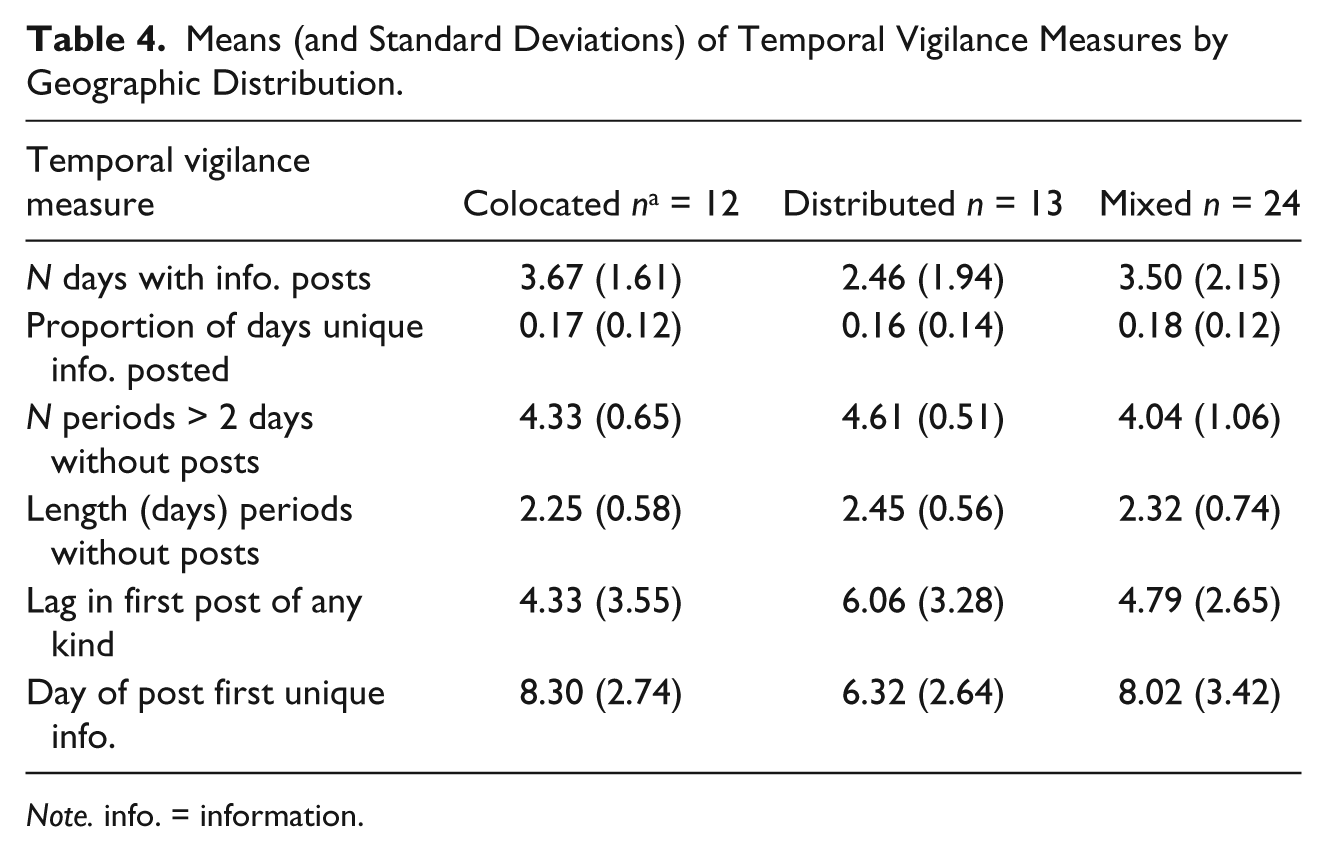
To examine the research questions related to temporal factors, the following time-related variables were developed: (a) time lag to the day of the first post by any member of the group, (b) the total number of days there were posts of any kind, (c) the number of days on which the posts contained unique information, (d) how early unique information was posted, (e) the number of time periods of more than 2 days in which there were no posts, and (f) the average length of those time periods. The means for these variables for the three geographic distribution configurations are presented in Table 4.
Means (and Standard Deviations) of Temporal Vigilance Measures by Geographic Distribution.
Note. info. = information.
Examination of the means showed a consistent pattern that temporal constancy was lowest among the groups in the completely distributed condition, and not different between the mixed and colocated conditions. These patterns were tested with one-way ANOVA followed by post hoc contrasts. Groups in the completely distributed condition posted on significantly fewer days, t(46) = 2.26, p = .01, d = .67; started posting marginally later, t(46) = 1.51,p = 07, d = .44; showed marginally more periods of 2 or more days with no posts, t(46) = 3.74, p = .06, d = 1.10; and those periods were marginally longer, t(46) = 1.41, p = .08, d = .42. Differences by geographic condition were not seen for any of the other temporal variables. With respect to decision quality, only the number of days on which unique information was posted significantly predicted decision quality, B = 0.14, p = .03.
Based on previous research suggesting that negative effects of geographic distribution on processes and performance in virtual teams may be due more to time zone differences than to geographic distance (e.g., Cummings et al., 2009), it was of interest to examine effects of time zones. The design of the study and the logistics of assigning participants to the different geographic conditions did not permit geographic distribution configuration to be crossed completely with time zone differences; thus these analyses are exploratory. The partially distributed condition contained 14 groups with members within a single time zone, and 10 groups with members in two time zones; in the completely distributed condition there were 3 groups with a single time zone, 9 with two time zones, and 1 group with three time zones. This latter group was combined with groups containing two time zones. Because of the degree of imbalance between the cells when combining time zone with the geographic distribution configurations, I conducted simple t-tests on the effects of time zone on decision quality, the information pooling and discussion process variables and the temporal pattern variables.
The mean for decision quality was slightly higher in groups with one time zone (M = 0.88), than in those with two time zones (M = 0.84) but the difference was not significant. Significant and marginally significant differences among the remaining variables all suggest that vigilance was higher in groups with one time zone than in those with two time zones. Mentions of unique information were marginally higher in groups with one time zone (M = 5.53) than in groups with two time zones (M = 3.00), t(34) = 1.58, p = .06, d = 0.54; participation was significantly closer to equality in the groups with one (M = 0.16) than with two (M = 0.23) time zones t(34) = −2.26, p = .01, d = −0.6; groups with one time zone (M = 1.88) repeated each other’s unique information significantly more than did groups with two time zones (M = 0.50), t(34) = 1.90, p = .03, d = 0.55; marginally more attempts to use a systematic method of combining the information items were seen in groups with one time zone (M = 2.41) compared with groups with two time zones (M = 1.26), t(34) = 1.59, p = .06, d = 0.45; and finally, the lag time from the beginning of the discussion period to the first post was significantly longer in groups with two time zones (M = 2.71) than one time zone (M = 1.78), t(34) = −2.43, p = .01, d = −0.70.
Discussion
The results of this study are consistent with the vigilant interaction theory arguments that decision quality is predicted by (a) thorough understanding of the problem situation, (b) establishment of decision criteria and goals, and (c) careful evaluation of the positive and the negative aspects of the available decision options (Gouran & Hirokawa, 2003; Hirokawa & Rost, 1992). The first two arguments were demonstrated by the findings that decision quality was improved by the exchange of unique information (H1), attention to information mentioned by others (H4), systematic attempts to combine the task information (H6), and indirectly by explicit reminders that team members all had different sets of information (H5). Consistent with the third principle, I also found that the discussion of positive qualities of the best alternative and the negative qualities of the worst alternative was associated with higher decision quality scores (H7). Vigilant interaction theory was developed in the context of meetings that occur face-to-face in real time, and by examining virtual teams communicating over a prolonged time period the vigilant interaction framework is extended in several directions.
Geographic and Information Distribution
Of particular interest was the comparison among different configurations of geographic distribution, and I argued that vigilance is more difficult and more important for distributed than for colocated groups. As a result of anticipating difficulties, distributed groups might be expected to exert more efforts (H9b). However, groups with a mix of colocated subgroups and isolated members might be overwhelmed by additional problems associated with social identity dynamics (H9a). The interaction vigilance data showed no evidence of difficulties associated with the social identity dynamics that would be expected in the mixed distribution teams. Instead, mixed teams showed evidence of increased effort in comparison with completely distributed and colocated teams. Moreover, interaction vigilance was most predictive of decision quality in the mixed teams. In contrast to the increased effort for both distributed conditions predicted by H9b, increased interaction vigilance was found only in the mixed configuration. The temporal vigilance variables add further to the story. Consistently across these variables temporal vigilance was lowest in the completely distributed conditions. If we focus for the moment on the two distributed conditions, this means that interaction and temporal vigilance were higher in the mixed than in the completely distributed groups.
These findings support the theoretical propositions offered by Hirokawa (1990) in the context of face-to-face discussion that process vigilance is more predictive of group task performance as the complexities involved in task accomplishment increase. Geographical dispersion is a further complexity perhaps not anticipated within the original framework of vigilant interaction theory. An extension to the theory suggested here is that thorough understanding of the task situation needs to include an understanding of how task-relevant information is distributed among geographically dispersed members and how different local conditions experienced by individual members affect the team’s work. This kind of understanding is comparable with the metaknowledge discussed in the transactive memory literature wherein groups need to know what they know (Austin, 2003; Griffith & Neale, 2001). Knowledge of which members hold specific information has been found in previous research to improve information exchange (Schittekatte, 1996; Stasser et al., 1995), and I found that reminders of information differences was the single best predictor of information pooling in this study. Therefore, attention to how information is distributed and the processes for making the information available to the group as a whole is a new aspect of vigilance precipitated by the rise in virtual teamwork. Although previous studies using information exchange tasks showed no effect on task performance and information pooling of informing groups explicitly about having different information sets (Stasser et al., 1995; Stasser et al., 2000), those studies provided no evidence about whether group members pay attention to this forewarning. The results reported here are more consistent with research by Schittekatte and colleagues (Schittekatte, 1996; Schittekatte & van Hiel, 1996) who found that when members were told not only that there were differences in their information but also told which pieces of their information were unique, information pooling increased. A limitation that should be mentioned here is that I did not manipulate reminders of information differences, and thus cannot claim that such reminders caused the increase in information exchange. Further research would need to be done to clarify the role of reminders.
No evidence was seen of negative effects associated with faultline dynamics. These effects would have been manifested by finding lowest vigilance and task performance in the mixed distribution groups, but instead interaction vigilance was highest in these groups and temporal vigilance was higher than that in the completely distributed groups. This finding is somewhat at odds with previous research findings about greater problems in mixed or partially distributed teams, associated primarily with decreased trust and cohesions and increased conflict (e.g., Polzer et al., 2006). Rather, my results are more consistent with research showing that computer-mediated groups can sometimes compensate for communication difficulties imposed by the technology by increasing vigilant interaction behaviors (Münzer & Borg, 2008; Münzer & Holmer, 2009). Consideration of two factors may help to explain this apparent divergence of findings. First is the difference in focus on trust and cohesion versus on task performance. For example, Bezrukova, Jehn, Zanutto, and Thatcher (2009) showed that faultlines created by social categories are detrimental, whereas faultlines created by diversity in information can enhance team performance. Second, previous studies of virtual teams have been conducted in field settings with intact groups in contrast to the zero-history groups in a controlled experiment as used in this study. It could be that the potentially detrimental social category dynamics associated with geographic location did not appear in my study because the social categories were not as meaningful and consequential for participants as they would have been in a real organizational setting. An important direction for future research would be to examine further the conditions under which members of virtual teams can be induced to exert sufficient effort to overcome the challenges associated with specific distribution configurations and with features of communication technologies.
Temporal Factors
In addition to extensions related to geographic distribution and information exchange, an extension to vigilant interaction theory in the dimension of temporal vigilance is offered in this study. Geographic distribution introduces concerns about temporal vigilance in several ways. Communication is more frequently asynchronous because of technological characteristics or because of time zone differences. The resulting delays or gaps in communication flow may contribute to coordination difficulties and deterioration of interpersonal relationships. The current study found that the temporal pattern in the completely distributed groups tended to be less constant and “smooth” over time in that their members started later, posted less frequently, and had more gaps in their discussions compared with the mixed and the colocated teams.
Having members in more than one time zone resulted in similar reductions in vigilance, especially in interaction vigilance. When members were separated across more than one time zone, I found that groups were slower in getting started, tended to discuss less of the task information, to pay less attention to each other’s information and to be less systematic in processing the information. More than one time zone was also associated with more unequal participation among the members. These results are consistent with previous studies demonstrating coordination difficulties associated with virtual teamwork (e.g., Armstrong & Cole, 2002), and reinforce the argument that time zone differences more than mileage differences may be detrimental to virtual teamwork (Cummings et al., 2009).
Despite the differences in temporal vigilance by geographic distribution and time zone, my results showed very little evidence that temporal vigilance was important for decision quality. Only the number of days on which unique information was posted significantly predicted decision quality, and that variable is as much a volume as a temporal measure. It is nevertheless intuitively appealing to expect that constancy in vigilance over time would be important for virtual teams, and empirical evidence from studies not specifically cast in a vigilant interaction theory framework support this expectation. Walther and Bunz (2005), for example, found that the sooner they started work, the more frequently they communicated, and the more they paid attention to deadlines, the better were performance and interpersonal dynamics within virtual teams. The results of the exploratory analyses reported here suggest that studies focused on difference dimensions of temporal vigilance would be a fruitful direction for future research on virtual teams.
Limitations and Conclusions
In addition to the already-mentioned limitation of no direct manipulation of reminders about information differences, the artificial nature of the study should be taken into account when interpreting these results. Most important is that the teams in the study had zero history, and the members had no reason to anticipate future interaction. This characteristic combined with the simulated task likely reduced the importance of the task to the participants, compared with what would be expected in a real organizational setting. As mentioned earlier, this could have affected the salience to the participants of some of the features of the situation, such as the bases for subgrouping.
Vigilant interaction theory has been shown to be a well-founded framework to guide effective decision-making in face-to-face groups (Orlitzky & Hirokawa, 2001), and the results of my study introduce additional dimensions to the framework. One is vigilance not only in the processing of information but also in the exchange of information. Even in face-to-face teams, the exchange of specialized information is important for task performance, and in virtual teams the distribution of information is likely to be accompanied by geographic separation of people. Therefore, an important consideration for future research within the vigilant interaction framework would be to devote attention to the processes used to ensure that information is available to a group as a whole for application to its task. The study also extended vigilant interaction theory to the context of virtual interaction. The differences I found in the vigilance between the mixed and the completely distributed conditions suggest that the dimensions of vigilance may have differential importance across configurations of virtual team configurations. Pursuing research along these lines could, for example, lead to guidelines for training and management for different kinds of virtual team settings. The final new dimension of vigilant interaction theory introduced is temporal vigilance. Differences were seen in this study in temporal vigilance across difference configurations of geographic dispersion, but the implications for task performance are unclear. It would nevertheless be an important and useful direction for future research to examine systematically the effects of temporal constancy in virtual teamwork.
Footnotes
Acknowledgements
The author thanks Joe Walther for extensive assistance with the design and conduct of the study and helpful comments on the manuscript; Kajsa Dalrymple, Blake Considine, and Sam Warren for coding work; and Natalie Bazarova, Fred Collopy, Jonathon Cummings, Randy Hirokawa, Angel Liu, Brian Mayer, Ozias A. Moore, and Kristen Steves for helpful comments.
Author’s Note
Any opinions, findings, conclusions, or recommendations expressed in this publication are those of the author(s) and do not necessarily reflect the view of the U.S. Department of Agriculture. A previous version of this work was presented at the International Communication Association, New York, May 2005.
Declaration of Conflicting Interests
The author(s) declared no potential conflicts of interest with respect to the research, authorship, and/or publication of this article.
Funding
The author(s) disclosed receipt of the following financial support for the research, authorship, and/or publication of this article: This research was supported in part by the Cornell University Agricultural Experiment Station federal formula funds, Project No. NYC 131412 received from Cooperative State Research, Education, and Extension Service, U.S. Department of Agriculture.