







Abstract
Some small groups perform their tasks in high-risk settings, where team leadership is crucial for the ability to deal with danger. However, we still know little about how the high-risk context may affect this ability. In this article, we draw on a single-case study to investigate team leadership in a high-risk organization. Present theories depict a rather static view on team context, which we argue do not comply with the complexity and dynamic environment of a high-risk organization. We show that in such an environment contextual factors can be of great importance to the internal dynamics of small groups at a different level and matter than previously thought. We argue that effective team leadership hinges upon how team leaders interpret and make sense of contextual factors. We believe that viewing team leadership in this light will contribute to a new understanding of the small group in relation to its surroundings.
Some small groups perform their activities in dangerous environments (i.e., environments that may cause injury or death to team members). Sometimes, action and interaction within small groups are involved in controlling hazards that have the potential to cause major disasters (i.e., inflict harm on a large number of people in addition to the group’s members). Operative team leaders are generally regarded to be important actors for the ability of teams to deal with these two aspects of risk (Flin, O’Connor, & Crichton, 2008; Weick, 1993). However, we know very little of the demands to team leadership at the sharp end in general, and even less so in high-risk environments. We use here the term operative team to denote a team that operates in the sharp end of an organization (i.e., where team members work directly with the organization’s value creation and directly exposed to any hazards involved in the activity). For instance, at a hospital it entails health professionals working directly with patients. Research has shown that in times of emergencies, small group dynamics at the sharp end play a vital role (Flin et al., 2008; Schiefloe et al., 2005; Weick & Sutcliffe, 2007; Weick, Sutcliffe, & Obstfeld, 2005). Team leadership is a vital factor in this regard (Salas, Goodwin, & Burke, 2009). In this article, we draw attention to the behavioral aspects of operative team leadership in high-risk environments, with a special emphasis on the link between team context and internal team dynamics. The importance of team context for the inner workings of teams was recognized decades ago by Tannenbaum, Beard, and Salas (1992) who argued that all aspects of team effectiveness should be seen in close relation to organizational and situational characteristics. We agree that context cannot be ignored in the study of teams, and aim to explore further how contextual factors can influence team dynamics.
The research question that has informed this study is the following: How can contextual factors influence small group dynamics and what is the role of team leadership in this process? In previous research, contextual factors are treated either as input factors in input–process–outcome (IPO) models or as input factors coupled with mediators in input–mediator–output–input (IMOI) models (Ilgen, Hollenbeck, Johnson, & Jundt, 2005). The present study is an attempt to take our knowledge of contextual factors one step further by following the advice of Salas and colleagues (2009) on the need for “moving past the basic IPO model, further unpacking the processes and dynamism lacking in early IPO models” (p. 7). We follow in the line of McGrath, Arrow, and Berdahl (2000), by viewing teams as complex, adaptive, dynamic systems. Ilgen et al. (2005) claimed that there was a need for theory-driven empirical studies within this domain. We hope to contribute to the field by digging further into how, and in what way, contextual factors influence team processes and thus impact team leadership.
The empirical basis of the article is a single-case, exploratory study of a Norwegian aluminum plant. Drawing on observational studies, interviews, and a standardized questionnaire to measure team leadership, we explore how production teams related to and were influenced by contextual factors. More specifically, we analyzed how contextual factors influenced team leaders’ ability to perform leadership. Building on previous research on contextual team factors, we suggest that contextual factors, such as organizational structure, management philosophy, change history, and society (a) interact in their influence on team leadership; (b) may impose strongly on, but do not determine, leadership; and (c) are not merely inputs to team processes, they are something team leaders need to address continuously in their leadership performances.
Our contribution to the small group research is to show how, and in what way, factors external to a team may influence internal dynamics in a complex and dynamic environment. Compared with previous research, we contend that contextual factors may exert more influence than previously believed and in a different way. Where previous models depict a team’s context as something static, we advocate a dynamic and continuous influence. Effective team leadership depends on how team leaders address and relate to this influence.
Team Leadership
Leadership may be defined as “the process of facilitating individual and collective efforts to accomplish shared objectives” (Yukl, 2013, p. 23). It has consistently been identified as a key component for the successful functioning of work teams (Kozlowski, Watola, Jensen, Kim, & Botero, 2009). It has also been emphasized as important for safety performance, within contexts as different as aviation (Helmreich, 2000), health care (Flin et al., 2008; Heldal, 2008), and oil and gas production (Flin, 2008). Different aspects of team leadership, such as transformational versus transactional leadership, leader–member exchange, or dynamic leadership have been shown to be measurable and related to safety outcomes (Parker, Yule, Flin, & McKinley, 2012).
The above definition of team leadership can be linked to a set of core team leadership functions. According to Zaccaro, Heinen, and Shuffler (2009), there are primarily three such core functions: (a) setting the direction for team action, (b) managing team operations, and (c) developing the team’s capacity to manage their own problem-solving processes. For the most part, previous approaches have emphasized the role of a recognized leader in subsequent team processes and outcomes. For example, Marks, Mathieu, and Zaccaro (2001) posited a functional approach to team leadership, whereby effective leaders provide whatever functions are most needed in their team. For operative teams, it may be defined as enabling the team to accomplish its task and being supportive of team members (McGrath, 1991).
Lately, there has been some interest in the behavioral aspects of operative leadership, that is, how operative team leaders perform their leadership tasks (see, for instance, Parker et al., 2012; Salas, Sims, & Burke, 2005). The works of Sjøvold are important here, as they incorporate relationship transactions at the group level (see Sjøvold, 1995, 2006, 2007). Team leader actions are viewed, not only as instrumentally related to the group’s task but also as transactions in building (or de-building) relationships with the team. In the so-called spin theory of groups, group functions encompassing such relationship transactions are labeled: control, nurture, opposition, and dependence (Sjøvold, 1995). The control function points to a perception of active, analytical, task-oriented, or even autocratic behavior, whereas the nurture function points to a perception of active, caring, empathic, or even spontaneous behavior. The opposition function points to a perception of active, critical, assertive, or even self-sufficient behavior. The dependence function points to a perception of active, passive, conforming, and obedient behavior.
The spin theory of groups is a further development of Bales’ SYMLOG theory (Bales & Cohen, 1979) and integrates SYMLOG and Bion’s (1961) theory of emotionality. The basic idea is that a team leader is an important actor in balancing various group functions in a way that is suited to deal with the specific problems that the group faces. Whether the team leader actually succeeds in doing this is evaluated by assessing how a team leader is perceived by his team. A successful team leader employs all functions when appropriate, thereby obtaining a balanced relationship with the members of his team. What is functional, or not functional, depends largely on the team itself and the task at hand, but the balancing of the control (focus on task) and nurture (supportive of team members) functions is particularly important (Sjøvold, 1995, 2006). This balance between supportive and task-oriented team behaviors is also evident in recent research on behavioral markers (see, for instance, Flin & Patey, 2009; Parker et al., 2012; Salas et al., 2005). Whether a team leader’s relationship transactions are balanced or not is rated along a continuous axis between synergy (functional behavior) and withdrawal (dysfunctional). A well-functioning team leader will be rated high on the synergy dimension, balancing supportive behavior with focus on task.
Team Leadership and Contextual Factors
One of the most widely cited publications analyzing team leadership in a specific context is Weick’s (1993) account of the Mann Gulch disaster. It describes the events in Montana, in 1949 when 16 fire-fighters were launched into a mountain area to take out what they thought was a “10 o’clock fire”—a small and simple fire which should have been put out in a few hours. However, the situation escalated, and the team suddenly found themselves trapped between a steep forest hill, a gulch, and a fast approaching inferno. At a moment where their leader, Wag Dodge, commanded “Drop your tools!!”—an order that could have saved their lives trying to outrun the fire, the whole group dismissed their leader’s order. The order went against their training of never dropping their fire-fighting equipment. After all, a fire-fighter’s equipment is the means protecting himself, and others, against fire. Consequently, the leader’s order for the men to drop their tools simply did not make sense to the team members. Moreover, the team leader not only ordered them to relieve themselves of heavy equipment but also lit an escape fire to create an area without flammable material where they could lie down in a cooler area and let the fire pass over them. None of the team members followed him. Wag survived by lying down in the escape fire area, but 13 of his men died.
The leadership lessons implicit in this story point to a team leader who had weak trust relationships with his men, and even when he was intentionally doing the right thing it was interpreted as wrong-doing. In Wag’s defense, however, the contextual factors under which he built his leadership relationships with his team heavily influenced his leadership behavior. First of all, he and his men were of military background, where, at the time, leadership behavior was heavily based on command, control, and rule compliance. Relationship building was not seen as important. Second, he was put in charge of a team he did not know very well. Third, he himself was an experienced fire-fighter, while the others were not. These surrounding conditions combined make it easier to understand Wag’s leadership behavior, although it is easy to criticize it.
It is this combination of the influence of external factors on small group dynamics we will investigate in this article and more specifically, the role of team leadership in this. The account of the Mann Gulch disaster is a story of a sudden change in the complexity of the situation surrounding team activity and decision making.
While we know a great deal about team leadership and team dynamics, we seem to know little about how contextual factors influence team leaders. The IPO framework deals with some of these issues, suggesting that teams have some input variables external to the team that may affect the outcome (Essens et al., 2009). Input factors are all factors that can be manipulated to change processes and outcomes (Cohen & Bailey, 1997). Processes in this model are observable group behaviors influenced by input factors and affecting the outcome. These may be understood as group dynamics. Team leadership is often mentioned as one important input factor (e.g., McGrath, 1991) in this model. This would suggest that team leadership influences team processes as an external factor in much of the same way as a contextual factor. Campion, Medsker, and Higgs (1993) presented a meta-model of 19 input factors related to team effectiveness, which can be categorized into job design (i.e., motivational job design), interdependence (i.e., characteristics of tasks, goals, and feedback process), composition (of team members), and context (i.e., external elements, such as inter-group communication and managerial support). Cannon-Bowers, Tannenbaum, Salas, and Volpe (1995) extended this model, incorporating organizational characteristics and structures, such as interventions and reward structures.
Ilgen et al. (2005) claimed that although the IPO model has had a powerful influence on recent empirical research, it fails to capture the “emerging consensus about teams as complex, adaptive systems” (p. 519). The main challenges that have been evoked against the model are its linear path from input to output, failure to incorporate feedback loops, and its insufficient recognition of the complexity between how the various IPO factors interact with each other. Colquitt, Noe, and Jackson (2002) and Dreu and Weingart (2003) highlighted these interactions as important, calling for attention to the boundary conditions of the traditional IPO model. Ilgen et al. (2005) proposed that a more adequate model may be IMOI, “adding an extra ‘I’ to include cyclical causal feedback, eliminating the hyphen to highlight the non-linearity between factors and finally substituting ‘M’ for ‘P’ to reflect the broader range of variables” (p. 520).
Thus, there still seems to be some confusion in how to regard team leaders’ relations to teams’ contexts and group dynamics. Sjøvold (2014) argued that team performance depends on how a team relates to its context. The more complex the environment, the more dynamic team functions the team should employ. This would imply that effective team leadership depends on how team leaders relate to the context. This view depends, however, on how team leadership is positioned: either as input to a team or as part of the team itself. Team leadership is regarded by some as inputs to team processes (e.g., Day, Gronn, & Salas, 2004), whereas others view it as a constituent part of team processes and group dynamics (e.g., Sjøvold, 2007). And while some authors employing the IPO model suggest team leadership as an input factor (e.g., McGrath, 1991), others regard it as a process factor (e.g., Baker, Gustafson, Beaubien, Salas, & Barach, 2005). The question in essence seems to be whether a team leader himself may choose his approach toward the team environment or whether this imposes and influences upon him.
We hope to clear up this confusion, investigating how teams and, more specifically, team leadership relate to a specific context that is both complex and dynamic. Our major problem with the previous literature is that contextual factors are treated merely as input factors. It offers little knowledge on how specific factors interact with team processes. This view may be sufficient in a stable environment with static contextual factors but problematic in a complex and dynamic environment where factors change continuously. In other words, we know little of how team leaders relate and combine teams’ internal and external factors as a process in complex and dynamic environments. Previous models offer little or no dialectic interaction between a team leader and his environment, underestimate the combined complexity of different factors, and overestimate the deterministic and unidirectional influence they may have. Input factors are presented as single determinants with little or no interaction between each other, and, once going into the process, serve seemingly as static variables (see, for instance, Salas et al., 2009). We believe that the IMOI model is a step in the right direction, as it acknowledges the complexity of team processes in real-life situations. However, we still believe that it is important to investigate more specifically how contextual factors influence group dynamics in a complex and dynamic environment and the role of team leadership in this process.
Method
Using a single-case study, we selected a high-risk organization which we investigated with both quantitative and qualitative methods.
Case Description
The empirical basis of the article comes from a case study of production teams in an aluminum plant located at a small and remote village in Norway. To provide an introduction to the work performed by the production teams, a brief description of the production processes and the manual tasks involved is offered.
The plant consisted of approximately 400 workers. Our main area of interest was the electrolysis department, with nearly 120 operators. The department was divided into operator teams, working on shifts. The teams were all appointed with a shift manager, a role which was designed as an appendage to being a normal operator. The shifts were overlooked by area managers, which was a more administrative managerial role. The general responsibility of the production teams was to monitor the production process. This consisted of monitoring key parameters of the temperature and mixture of the cryolite bath, venting out fluorized carbon gases by inserting wooden rods into the gas bubbles in the bath, and repositioning and changing the anode rods when needed. Occasionally, the inside of the ovens needed to be cleaned by removing solidified aluminum, which attached to the walls of the oven during electrolysis.
A lean management philosophy was implemented at the plant. This entailed, among other things, a special attention to standardization of activities (Womack, Jones, & Roos, 1991). Standard operating procedures (SOPs) were thus developed and were in use across the areas. The plant was a high-risk environment, in that the risk of major accidents was highly present. In particular, the presence of water in the cryolite bath can generate significant explosions, as the water will expand rapidly due to the heat, thereby causing pressure build-up in the ovens. In addition to the risks of major accidents, the regular work operations also included risk of personal injury and occupational accidents. In particular, the presence of high-voltage equipment constituted a high risk for the operators. The production halls were very narrow with high-voltage ovens on all sides. The halls were crowded with heavy machinery, which could occasionally come into contact with the ovens. Should a truck, or other metal equipment, touch two ovens at the same time, this would create an electrical circuit which could instantly kill personnel. Also, it was hard to gain visual contact with colleagues working nearby or the drivers of trucks passing through the hall, involving a risk of being hit by trucks or heavy production equipment. Such a hit could cause serious injuries or kill personnel.
Despite the presence of risk, the production process could be characterized as linear and with a low level of complexity (Perrow, 1999). The sequence of the steps of aluminum production was predetermined and predictable; there were few feedback loops between production steps, and the process was visible and fairly easy for operators/managers to understand. The operational structure was planned and organized in accordance with the lean management philosophy, singling out and emphasizing activities contributing to the value chain. This added up to a work situation for the members of the production teams that was characterized by a high level of routine tasks performed in predictable cycles, but which were, nevertheless, combined with a low tolerance for operator errors (narrow safety margins).
Despite thus a management logic pointing to linear processes and low complexity, the high-risk environment entailed a high level of rules that workers needed to attend to in addition to staying aware of multiple risk factors. The environment in which the teams should operate may in this sense be characterized as complex and dynamic.
The Production Teams
The production teams in the plant consisted of men and women aged between approximately 20 to 70 years. Some of the operators had worked there for more than 30 years and knew the facility very well. However, students would sometimes work there in their spare time or in holidays. Team leaders reflected this multitude of personnel. Some of the team leaders we followed were women, some were well-experienced operators, and some were quite new to the shop floor. Teams would normally consist of five members, including the team leader. They worked in shifts, thus changing between day-time, evening, and night-time operations. Work consisted of monitoring the status of the ovens with regard to temperature and outbursts, changing anodes and tap aluminum. Operators would work mostly by themselves but always with team members within eye-sight (although this could be challenging, as previously explained).
Data Collection
We conducted 22 in-depth interviews and 10 hr of participating observational studies at the plant. Operators, team leaders, and general managers were interviewed. The observations were not designed to be an assessment in themselves. It was more seen as a step toward understanding the work of the production teams, gaining the trust of informants, and increasing our ability to ask meaningful questions in interviews. We observed operators and their team leaders in important contexts where leadership was performed: on the shop floor, during pre-briefs and de-briefs, and in regular meetings and informal meetings. Notes were taken in situ, and then coded and analyzed. The interviews were conducted in a semi-structured way, and lasted from 1 to 1½ hr. The objective of the interviews, as described by Kvale (1996), was to obtain a phenomenological understanding of the interviewees’ thoughts on the subject, thereby drawing on the interpretative traditions within qualitative research (Broom, 2005). Interviewees were asked questions on their relationships to rules and regulations, their team leader, safety management at the plant, and their perception of risk on the shop floor. The interviews were not recorded due to technical challenges in blocking heavy noises from the machinery. However, lengthy notes were transcribed by a second interviewer to obtain as much specific data as possible. Notes were immediately coded and analyzed.
We further undertook an SPGR analysis. SPGR is an acronym for Systematizing the Person–Group Relationship and is an operationalization of Sjøvold’s spin theory on groups. It is a validated method for analyzing group dynamics (Sjøvold, 2002, 2014). We asked the operators to rate their team leaders, or shift managers, today and what they would see as an optimal team leader. The method is based on a factor analytical space where the evaluation of different behaviors is placed according to the evaluation from the respondent. Respondents rate their team leader according to 24 items, compiling a standardized questionnaire. The outcome places the leader in the factor analytical space, which in this article consists of a total of 12 vectors, all rating different impressions related to their leaders.
The operators’ ratings of optimal leadership do not offer an objective value of team leadership, but the difference between what subordinates experience today and what they see as optimal offers an insight into a team leader’s ability to lead his team. The larger the difference, the more likely the leader is to distance himself or herself from team members’ mental models of viable team leadership (Sjøvold, 1995). In turn, the mental models are important for both safety and efficient performance (Nissestad, 2008). Leadership behavior that diverges from this may thus influence the performance of activities in a negative way (Sjøvold, 2006). The SPGR analysis also offers a qualitative assessment of the difference (i.e., in the way leadership behavior diverges from what team members view as optimal).
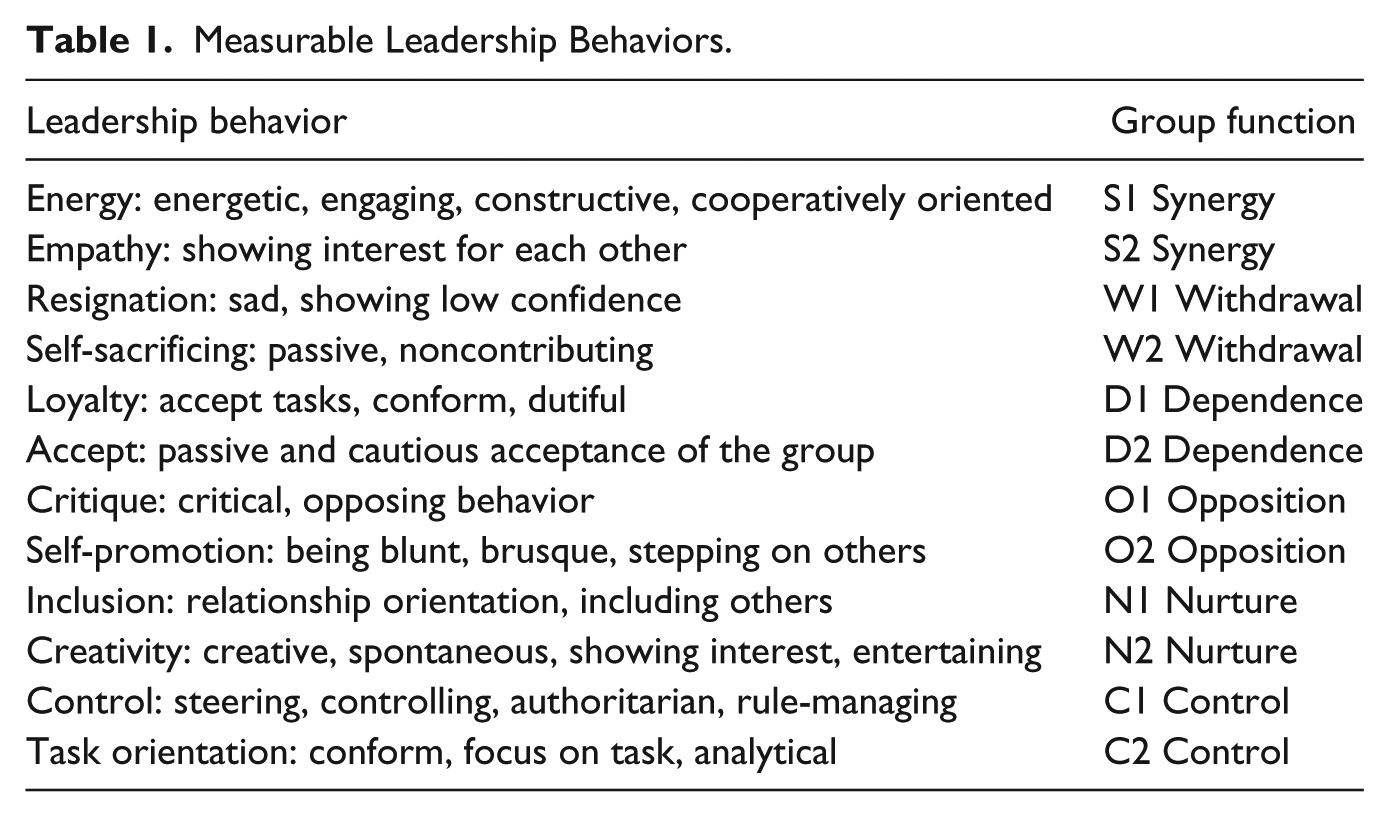
The different leadership behaviors (shown in Table 1) offer a comprehensive picture of leaders’ leadership behavior. The different behaviors are linked to correspondent group functions: synergy, withdrawal, dependence, opposition, nurture, and control. Each of the functions is subdivided into two similar but slightly different categories, thus assigned as 1 and 2 (Sjøvold, 2006, 2007, 2014). For instance, as shown in Table 1, Synergy 1 is related to energetic, engaging, constructive, and cooperatively oriented behavior, whereas Synergy 2 is related to behavior that demonstrates empathy and showing interest in other group members.
Measurable Leadership Behaviors.
Results were presented and discussed at the plant in a 6-hr workshop, where operators, shift managers (team leaders), and directors attended. This offered clarity and further understanding of the results.
Results
Team Leadership
Team leadership at the plant was performed in several areas. First of all, it was performed on the shop floor in connection with operative work (the team leaders functioned as normal operators as well as team leaders). Second, team leaders conducted several meetings with the operators. The most important of these was the shift meeting at the start of each shift. In these meetings, they would describe the tasks of the day, general information, and their interpretation of the status of important indicators. According to SOPs, they should also conduct short de-briefs after work, especially if something unusual had occurred. These meetings were scheduled to last about15 min. Other meetings were performed on a monthly basis, where they discussed performance issues more thoroughly. Team leaders diverged significantly in how they addressed these meetings, but it seemed normal to treat safety issues as a mere information element. This meant that they would inform their operators of issues that had emerged in the quality system but rarely would ask for a dialogue and discussion. In many ways, the shift meetings were not intended to start a lengthy discussion because of time constraints, but we saw the same dynamics in the monthly meetings where discussion and reflection were precisely the aim. This aim was not achieved. All team leaders had undergone leadership training before the study commenced.
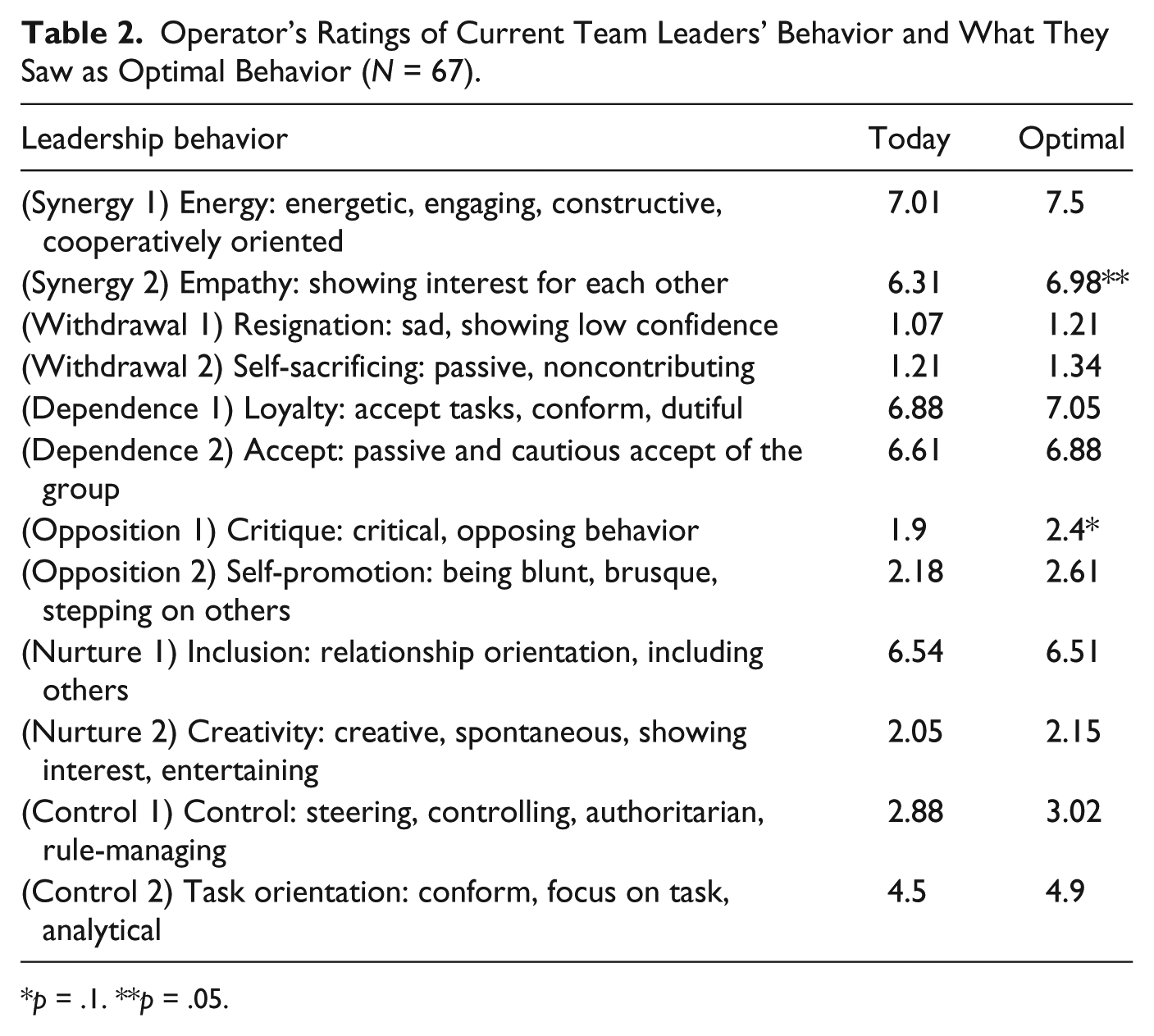
Table 2 shows the results from the SPGR analysis. These results as well as information obtained from the interviews and observations are integrated to analyze leadership performance. Operators were asked to rate their team leaders today, and how they saw optimal team leadership at the plant (in general, not focusing on either efficiency or safety). From the table, we infer the following: (a) operators wanted more of their leaders’ behavior in all but one of the categories, (b) there was a significant difference (p < .05) between how team leaders rated leaders’ ability to show empathy and interest today (the empathy category) and what they saw as optimal, and (c) there was a significant difference (p < .1) between how team leaders rated leaders’ ability to show correctional behavior today (the critique category) and what they saw as optimal.
Operator’s Ratings of Current Team Leaders’ Behavior and What They Saw as Optimal Behavior (N = 67).
p = .1. **p = .05.
The first point may be a clear sign that the operators wanted more quality time with their leaders. The team leaders also worked with their teams as a regular team member, thus being around nearly all the time. The difference pointed to here may thus be more of a qualitative matter. Operators have even pointed to wanting more of self-sacrifice and resignation, which would indicate a leader abandoning responsibility, giving up on tasks, and drawing himself away from the group. This is normally not associated with functional leadership (Sjøvold, 2007). However, taken together with the other categories, we interpret this as the operators simply wanting their leaders to start behaving as leaders. The team leaders themselves reported that they lacked the necessary time and space for this. For instance, pre-briefs and de-briefs were very short and descriptive, and some team leaders did not use these at all. Operators were also clear on the fact that team leaders were seen more as normal operators or peers, rather than as strong leaders; some did not even see their designated team leader as the authority figure of the team. This was evident especially at the regular meetings, where team leaders, at times, were almost invisible and with no influence.
The second point gives a clue to what operators wanted to see more of. The empathy category can be interpreted in terms of building trust. This was a complaint of both operators and team leaders. When they acted as leaders, this was mere handing over information from either performance indicators or the quality system. According to SPGR, this points to the categories of control and task orientation. This kind of leadership is imbalanced toward task solving, which also entails a lower rating along the withdrawal-synergy dimension. Operators thus felt that team leaders would perform better by balancing their behavior with the kind of supportive behavior of showing empathy. Team leaders themselves agreed on this issue when asked but retorted that they had neither the time nor the opportunity to do this. They attributed this to the fact that the plant was heavily burdened with rules, time constraints, and regulations, which hindered them in building trustful relationships with their operators. This was something they wanted as well but felt obstructed from doing. This was because they felt that the (a) time and space to focus on relational matters were obstructed, and (b) rules and regulations made leadership solely a matter of adherence to predefined systems.
The third point we want to highlight is the inclusion category (nurture 1). The operators wanted more of the behaviors coded by the other categories, while they wanted less of the behaviors covered in this category (although not a significant difference). This suggests that operators felt group cohesion strongly, not needing closer relationships with their team leaders. Rather, it may be a sign that operators felt the social context too imposing, disabling individual influence on their behalf. Leaders who obtain this kind of rating may be preoccupied with conformity and adherence to norms and consensus. This was further elaborated in the interviews, where operators called for a leadership style that involved addressing errors and mistakes and taking a clear stand toward them.
Contextual Factors
The SPGR analysis offers no objective answer to what is optimal team leadership. It is a measurement of teams’ perceptions of their own strengths and weaknesses. However, we may infer from this analysis that although teams and team leaders across the plant differed significantly, there were some common issues related to team leadership. Team leaders across the plant were judged to be weak on performing leadership, building relationships, and displaying corrective behavior. We interpret this as being attributes of something more than the team leaders and the teams, namely, contextual factors. In this section, we further investigate the surrounding conditions, drawing on data from interviews and observations.
Operators at the plant reported that there was a high level of preoccupation with deviances at the plant. Production lines were standardized and managed according to statistical process control (a method for measuring outcome and deviance from standards, based on statistical models in line with lean management philosophy). However, although the level of attention to deviance was high, the underlying reason for this was efficiency and not safety. Operator teams at the plant were attentive to indicators related to efficient performance but not safety performance. The efficiency demands were according to a lean philosophy, and the operators felt them to be pressuring and delimiting. This was to the extent that they literally would cut corners when moving through the factory to save time. They were preoccupied with deviances related to efficiency but not failures that could be related to safety. The reason was reported to be a strict efficiency regime, which by many was thought to override safety concerns. The management was aware of this challenge, as expressed by the plant manager: If people were as concerned with safety as with production numbers, I would not be concerned.
The overarching focus on efficiency had an obvious effect on the team leaders, in that they too would cut down on leadership issues that they did not perceive as important. As previously stated, most team leaders did not take the time to pre-brief and de-brief the teams, justifying this with it “not being efficient enough.” Time constraints thus led to team leaders not taking the time to be supportive of their team members. The management did not openly encourage this one-sided focus, claiming that the 15-min pre-briefs and de-briefs and, at least the monthly reflection meeting, would suffice for team leaders to address other issues than efficiency. The team leaders themselves were aware of this shortcoming, but felt it more important to focus on the concrete tasks at hand. Even in the monthly reflection meetings, where they had the possibility to focus more on relational aspects within the teams, they would maintain a focus on specific work tasks and challenges.
The management philosophy of lean production entailed standardized routines. In addition, working in a high-risk environment involved the presence of safety rules that added to standardized routines. In sum, many operators felt there to be “an abundance of rules at the plant.” The operators were instructed to develop the written routines themselves, which were called SOPs. This was a clever way of anchoring the standards with the operators on the shop floor. However, the sheer number of routines seemed excessive to the operators. Team leaders were monitoring key performance indicators, but it was very hard for them to understand the relevance of these. They would single out some important ones, stick to them, and manage accordingly. The consequence of having rules for “nearly everything,” as one operator put it, was that it was difficult to get an overview of what was happening. Therefore, safety performance by the book was not always considered possible, and for the team leaders this created a dilemma related to their leadership tasks. On one hand, their primary role was to see to that production ran as smoothly and efficiently as possible. On the other hand, they were to see to it that corners were not cut, which compromised the safety of the operators. This was, in some ways, a catch 22 situation where team leaders were to reconcile rules that were perceived to be inconsistent. They seemed to resolve this by withdrawing their leadership behavior and letting operators decide themselves how to relate to the strict rule system at the plant. The context of a rule-based organization was, thus, a massive factor in the way team leaders exercised their responsibility. It significantly restricted the leeway for how the teams could work, and at the same time, gave rise to situations where leaders themselves were not as rule compliant as they required their operators to be. 1
Another organizational aspect that was emphasized as important for the group dynamics was that many of the teams had senior team members, who had previously held leadership functions in the teams. This change of roles was due to a recent organizational change program in the company. The former team leaders had highly influential informal roles in the teams, sometimes challenging the authority of their less experienced formal leaders. It was as if the social role structure was lingering on, with previous team leaders maintaining their authority. New team leaders did not challenge old social structures. This may be a reason behind the new leaders’ reluctance to display correctional behavior. They said themselves that it was not in their role to oppose the informal status hierarchy at the plant. Although in interviews, operators and former team leaders were clear that they actually would see the new leaders step up; this seemed problematic for the new team leaders. The teams’ social role structures, although contrasting with the formal, were, therefore, something of a historical factor. This was built up and consolidated over time, making it difficult for new leaders to make their mark on team relationships.
A further organizational issue we highlight is that of the team leader’s place in the organizational hierarchy. The literature on high-reliability organizations describes several factors that create an organizational setting where accidents that are waiting to happen, do not (Weick & Sutcliffe, 2007). One of the important reasons for this is that decision making is, at crucial moments, moved out to the sharp end (Weick & Sutcliffe, 2007). At the plant, the opposite seemed to be the case. Safety was managed administratively and not operatively. The safety management was distant from shop floor safety. According to the operators, safety in itself was something they related to every day. But this was a different kind of safety than what the management sought control of through their reporting procedures. The only link between the risks experienced by the operators and safety management happened when something negative occurred. This made safety obtain a very pessimistic flavor and seemingly made the distance between safety management in the administration and at the shop floor even greater. As such, the organization was loosely coupled with regard to safety. A loosely coupled system is a system where links between various components are relatively soft (Weick, 2001b). As such, the organization could be characterized as a complex organization, characterized by a degree of autonomy among its interdependent parts and isolation between strata (Corwin, 1981). Gamoran and Dreeben (1986) noted that in loosely coupled systems “activities and decisions made at one level do not necessarily reverberate in clearly patterned ways elsewhere. Administrators do not directly govern activities that take place in the technical core” (p. 3).
In a high-reliability organization, the commitment to resilience is another way of saying that the relationships are strong throughout the organization. When one makes an error, another may step in to remedy it. This was especially true with the team leader role at the plant, where the opposite seemed to be true. The formal role was very weak, and thought of as an amendment to the operator role. Team leaders themselves complained that they had little room and time to perform their role as leaders; it was mostly a matter of bringing in information and giving orders. The operators complained that leaders never corrected them, which for them was puzzling. The team leader role, in itself, was a role with little trust, seemingly, regardless of the person put in the role. There was, thus, a relational distance between the operators and their team leader, which in some regards was a matter of how the role was designed and placed in the organization. Both operators and team leaders said that the leadership role being a mere amendment to the regular operator role caused a significant shortness and scarcity of team leadership. The SPGR analysis confirms that the operators wanted their team leaders to step up more and act as team leaders.
In addition to these organizational constraints on team leadership, there were also contextual factors outside the organization, which exerted an influence on how team leaders shaped their roles and behavior. The village where the plant was situated was described as a “peculiar place,” being a small local community where it was hard to maintain a clear distinction between professional relationships within the production team and off-work relationships. If a team leader was to give someone a ticking off or a reprimand, he or she had to be prepared to meet that same person at the local grocery store after work, face him as a neighbor, or other off-work arenas. One of the general managers summed up these challenges related to roles and statuses in the following way: “I’ve said this at courses several times; that you can’t continue drinking with the guys the same way you did before, if you are going to be a team leader.”
Metaphorically speaking, the local community displayed some traits resembling a total institution, as described by Goffman (1961): The lack of clear boundaries between formal and informal roles means that a person’s professional actions or decisions are likely to rub off on statuses and relationships in his private sphere. This seems to be fertile ground for a form of groupthink (Janis, 1982), where disrupting consensus at work becomes socially problematic. In the Norwegian context, known for a low power distance and a low acceptance of organizational hierarchies (Hofstede, 1984), the call for stronger leaders was somewhat counter-intuitive. In our interviews with both team members, team leaders and general managers, the informants highlighted the teams’ external social context as a major factor influencing the internal team relationships and processes.
To sum up the results, contextual factors for team leadership have been identified as management philosophy (lean management and rule-based management), organizational structure, change history, and surrounding community. We find resonances of these influential factors on how team leaders performed leadership.
Discussion
We have described that contextual factors influenced team leadership as follows: Lean management affected the time available for focusing on relationship building, rule-based management affected the space possible to focus on other issues than rule-adherence, the organizational structure implied little formal authority also affecting the informal status of team leader, the change history entailed that previous role structures in the teams were still eminent, and, finally, that the social context of a small-village community made the teams prone to groupthink.
Our intention with the discussion is to show how contextual factors, such as organizational structure, management philosophy, change history, and society (a) interact in their influence on team leadership; (b) may impose strongly on, but do not determine, leadership; and (c) are not merely inputs to team processes, they are something team leaders need to address continuously in their leadership performances. Previous theories, such as the IPO and IMOI models, suggest that certain contextual factors (such as reward structures) serve as input factors to team processes. We have previously argued that this research is not very clear on exactly how an input factor influences, and have underestimated the complexity of contextual factors’ relations with team processes. We argue here that previous models do not suffice to describe the complexity of the interactions between groups, team leaders, and the environment in our case. Drawing on the results, we propose that contextual factors may have an imposing role on team processes, both because team leaders need to address them continuously and because of their combined impact on team processes. Despite this, we contend that this is a matter of how team leaders interpret the environment and act accordingly. Our arguments apply to a context that is complex and dynamic but may have relevance also in other contexts. This is relevant for future research.
By themselves the contextual factors were influential, but in line with our suggestion that contextual factors interact in their influence on team leadership, we argue that together they formed an additional effect on the team leaders. This is important because it expands on previous theories and arguments about contextual factors, which have treated these as unique factors with no influence on each other. In addition to being a high-risk environment embedded with a lean philosophy, the organization’s structure made it an environment of standards, rules, and regulations. Safety management at the plant left little flexibility for the team leaders, and the lean philosophy implied a focus on pre-planned standards and indicators. However, there were both arenas and leadership educational efforts that could have mitigated the strict rule-based management (and lack of supportive behavior from team leaders). Nevertheless, the other contextual factors reinforced the static and task-oriented leadership behavior supported by the management philosophy. The social community of the village entailed a social structure, which also extended within the plant and that would reinforce the nonflexibility. The recent organizational change was more real on paper than in real life as the pre-change authority structure was still evident. The analysis showed that the team leaders were lacking in supportive and correctional behavior. A change here would entail a considerable move toward a more flexible leadership behavior. However, the contextual factors were all together exerting influences toward a static leadership behavior. The perception of strict time constraints, efficiency claims, and the high-risk environment may, in this way, have been reinforced by the other contextual factors identified as social community and change history. We see it as likely that these contextual elements together reinforced each other, thereby obtaining an additional effect on team leadership. It is possible to regard this as an emergent property (i.e., not reducible to single elements), thus in line with our first argument that contextual factors interact with each other in their influence on team dynamics. The team leaders were influenced to exert a static and task-focused leadership style, which together with a constraining organizational structure left little room to develop the role and status of team leaders.
Secondly, we contend that the factors described, however imposing, did not determine team leaders’ actions but influenced their reflections on leadership and which leadership practices that stood out as meaningful for both team leaders and team members. Although time constraints were real, the different arenas for leadership offered valuable space to exert, for instance, a supportive leadership behavior. The social hierarchy was seemingly imposing more on team leaders’ social conformity than operators, as the latter were clearly stating that they needed for their leaders to correct them. Indeed, we found that the team leaders had the possibility of building trust-building relationships and showing correctional leadership behavior but that these contextual factors were blind-sighted by the leaders. Team leaders’ responses to contextual factors were thus more a matter of interpretation than causality. This perspective on environmental factors is in line with the research of Snook (2000), who analyzed a friendly-fire incident between two F-15 pilots over Iraq in a high-risk environment. He argued that a natural question was why the pilots decided to shoot down two friendly helicopters, killing 26 people. This question moves the responsibility away from potent situational factors and onto the shoulders of the decision-maker. Snook (2000) contended, however, that “framing the individual-level puzzle as a question of meaning rather than deciding shifts the emphasis away from individual decision makers toward a point somewhere ‘out there’ where context and individual action overlap” (p. 206).
This is an argument of interpretation rather than causality. It signifies that rather than posing a causal relationship between A and B, the essential question is to understand and interpret how A and B influence each other in a dialectical way. This is different from previous models of contextual factors because it entails a focus on interactive processes between factors rather than a focus on the factors themselves. Thus, how and in what way the team leaders approached, interpreted, and acted on the contextual factors in a process becomes the important issue. The interplay between contextual factors and team leaders’ interpretation of them may have influenced the team leader role in as much a way as the factors alone.
We argue, thirdly, that the contextual factors described were not merely inputs to team processes; rather, they continuously formed parts of these. This is different than the IPO framework’s suggestion that contextual factors influence team processes in a unidirectional way. What we suggest is that they influence dialectically and continuously. The social role structure at the plant was maintained through a diversity of factors. The small community and recent organizational changes were obvious reasons but still not totally explaining why the status hierarchy was maintained. Although operators argued that off-plant behavior affected on-plant behavior, it is not unusual for the same persons to mix different social roles (and thus behaviors) in different settings (Goffman, 1959; Sjøvold, 2007). Furthermore, professional roles make for important influencing factors on behavior (Heldal, 2010; Heldal & Tjora, 2009). An afternoon barbecue is a totally different setting than a shop floor workday, with professional roles left at the plant. Our analysis indicated that the operators’ and team leaders’ perceptions of the efficiency and rule management at the plant left little room for supportive leadership behavior, which is the prime element of building trust with a team (Weick, 2001a). Contextual factors like these were, however, not outside the reach of the team leaders. The important point is that while the team leaders could not easily change the contextual factors themselves, they had the possibility to alter team perceptions of them. This would require, however, that they addressed them every moment they would interfere with the internal team processes and that also professional relationships were built on trust. As shown, there was a continuous challenge with steady interferences between the professional and the social life. Team leaders were not able to mitigate social relationships’ influence on the professional relationships, focusing one-sidedly on task solving leadership behavior.
The team leaders at the plant performed a leadership style that was one-sidedly focused on task solving, and fell short of being trustful and influential leaders for their team members. Combining the previous three arguments, we argue that this was affected by the combined influence of contextual factors and how the team leaders interpreted these in ongoing processes. Previous models describe contextual factors as inputs to other processes, thus posing a divide between what is external to the team and what is internal. What we argue, however, is that by employing this boundary, we lose sight of the considerable complexity in how teams relate to their environment. Contrary to serving as inputs, external elements form rather a continuous part of the internal processes of teams. Thus, a contextual factor is not a predetermining factor, it is ongoing. This argument may resolve some of the confusion in previous research regarding how to posit team leadership as either an input factor or a process factor. Team leadership is connected to both contextual and internal elements, and furthermore about making this intertwining functional within the small group. We believe that our arguments are important, especially for production teams in high-risk environments embedded with rules. Furthermore, our arguments offer new knowledge in how to understand the small group within an environment that is both complex and dynamic. We contend that in such an environment, a group’s internal dynamics may be more prone to contextual factors than previously believed. Our analysis is confined to team leadership, but our arguments may be of importance for other team factors as well.
Conclusion
In this article, we have focused on team leadership in a high-risk organization. Our point of departure was the lack of research on how team context influences group dynamics and the role of team leadership in this process. We have argued that contextual factors may interact and reinforce each other in their influence upon team leaders at the sharp end. The interaction between different contextual factors can exert considerable influence over which team leadership practices that stand out as meaningful for team members.
This finding illustrates the importance of including contextual factors in the study of small groups and teams, particularly related to contexts that are complex and dynamic. Previous research on contextual factors may fit well with a static and stable environment but offer little in our understanding of high-risk environments. These environments are unique because of their strong environmental influence, thereby affecting team leaders in particular ways. In this way, our arguments may have practical implications. Team leadership training in high-risk environments (as parts of team training programs) should address contextual factors more than what is done today.
Footnotes
This article is part of the special issue Leadership and the Group, Small Group Research, Volume 45(4).
Declaration of Conflicting Interests
The author(s) declared no potential conflicts of interest with respect to the research, authorship, and/or publication of this article.
Funding
The author(s) disclosed receipt of the following financial support for the research, authorship, and/or publication of this article: Both authors were offered financial support to the study by the company owner of the plant described in this article.