







Abstract
Attachment research to date has focused mostly on individuals and dyads and has demonstrated the disadvantages of attachment insecurities. The present study focuses on the potential positive effects of team-level heterogeneity of attachment orientations on team functioning (suggested by social defense theory) and examines the role of team cohesion in facilitating these effects. Students enrolled in courses that included a team project (N = 178 students comprising 52 teams) completed measures of attachment anxiety and avoidance, team cohesion, and team functioning. Their team performance evaluations were also assessed. Regression analyses revealed that when team cohesion was high, team heterogeneity in anxiety and avoidance scores was associated with better performance evaluations, and team heterogeneity in anxiety was also associated with better perceived functioning. Results highlight potential contributions of insecure team members to project teams’ functioning, which were heretofore overlooked in the literature, and suggest benefits of teams with heterogeneity in attachment orientations.
Attachment theory is one of the most broadly studied theories in social psychology in recent decades (Mikulincer & Shaver, 2007a). It emphasizes humans’ evolutionary need for closeness and suggests that relationships with significant others contribute to the development of attachment patterns (or orientations)—relationship-related internal working models (or schemas) regarding the self, others, and relationships, which shape people’s behaviors (Bowlby, 1969/1982). In the present study, we introduce the concept of attachment heterogeneity in teams, defined as the extent to which teams are comprised of members with different attachment patterns. We suggest that teams’ attachment heterogeneity can positively affect team functioning and examine its effects in student project teams.
Ainsworth (1969) classified three attachment patterns—security, anxiety, and avoidance. These attachment patterns were later empirically validated in studies of infants (Ainsworth, Blehar, Waters, & Wall, 1978) and adults (Hazan & Shaver, 1987), and studies have shown their relevance to several psychological and social phenomena, including group processes and teamwork (Rom & Mikulincer, 2003; E. R. Smith, Murphy, & Coats, 1999). Most studies on attachment and teams, however, have focused on the individual level, examining individuals’ attitudes and functioning when working in teams. These studies showed that attachment insecurities (anxiety and avoidance) were associated with various undesirable outcomes. Only a handful of published studies have examined the group-level effects of attachment patterns on team functioning and focused mainly on teams dealing with a threat (Ein-Dor, 2013; Ein-Dor, Mikulincer, & Shaver, 2011a, 2011b; Ein-Dor & Perry, 2012). These studies revealed possible advantages for attachment insecurities. In the present study, we examined the relevance of attachment heterogeneity to teamwork processes that are unrelated to life-threatening events. Specifically, we explored the effects of differences in team members’ attachment patterns on team functioning and performance and suggested that in cohesive teams that provide a supportive and secure atmosphere, attachment heterogeneity contributes to team functioning (Figure 1).
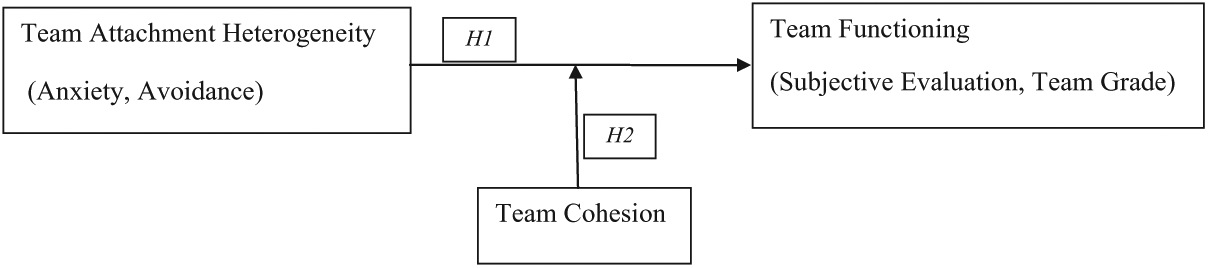
Summary of the research hypotheses.
Attachment Theory
Bowlby (1969/1982) argued that human beings possess an innate psychobiological system (the attachment behavioral system) that motivates them to seek proximity to significant others (attachment figures) when they need protection from threats. When attachment figures regularly respond sensitively to a person’s needs, that person develops a sense of attachment security while acquiring constructive strategies for coping with threats and regulating negative emotions. When attachment figures are unavailable, unreliable, or rejecting of bids for support, the person seeking support may become chronically insecure with respect to close relationships.
Social and personality psychologists generally conceptualize adult attachment patterns as regions in a continuous two-dimensional space (Brennan, Clark, & Shaver, 1998). The dimension of attachment-related anxiety reflects the extent to which a person worries that others will not be available or helpful in times of need. Anxious individuals exaggerate their sense of vulnerability and insistently call on others for help and care, sometimes to the point of being intrusive (J. A. Feeney & Noller, 1990). The second dimension, attachment-related avoidance, reflects the extent to which a person distrusts relationship partners’ goodwill, strives to maintain independence, and relies on deactivating strategies for dealing with threats and negative emotions (Fraley & Shaver, 1997). Attachment security is defined by low scores on both anxiety and avoidance. Secure people generally cope with threats by relying on internal resources developed with the help of security-enhancing attachment figures or by effectively seeking support from or collaborating with others (Shaver & Mikulincer, 2002).
To date, numerous studies have linked attachment orientations with a host of psychological, cognitive, and behavioral phenomena (Mikulincer & Shaver, 2007a). Overall, insecure attachment orientations were associated with several undesirable effects and characteristics. Among other things, insecure attachment was found to be related to low self-efficacy (Mikulincer & Florian, 1998), difficulties in coping with stress (Mikulincer, Shaver, & Pereg, 2003), higher burnout rates (Pines, 2004), and psychopathologies such as depression (Carnelley, Pietromonaco, & Jaffe, 1994) and anxiety (Riskind et al., 2004). In general, insecure individuals seemed to be less satisfied with their lives and function less adaptively than secure individuals in different situations (Mikulincer & Shaver, 2007a).
In the present research, we argue that although insecure attachment patterns may yield undesirable outcomes for individuals, having individuals with diverse attachment patterns in a group (including individuals with high attachment anxiety and/or avoidance) may be beneficial at the group level. This claim is based on social defense theory (SDT; Ein-Dor, Mikulincer, Doron, & Shaver, 2010), which highlights the potential unique and different contributions of individuals with different attachment patterns to group functioning.
Attachment and Groups
A few previous studies have indicated the relevance of attachment patterns to team processes and functioning (E. R. Smith et al., 1999). These studies typically focused on functioning of individual members in the team and indicated that team members with high attachment insecurities (anxiety and avoidance) report poorer functioning in this context. For example, Rom and Mikulincer (2003) found that attachment anxiety was associated with perceiving group tasks as threatening, reporting low self-efficacy and exhibiting poorer instrumental functioning in group activities. Attachment avoidance was associated with perceiving group tasks as unchallenging and exhibiting poorer instrumental and socio-emotional functioning in these tasks. E. R. Smith et al. (1999) found that highly anxious individuals felt unworthy of being part of the group, reported lower personal and collective self-esteem, and spent less time with the group. Highly avoidant individuals perceived the connection with the group as unnecessary and unwanted, and preferred to pursue autonomous actions. They were indifferent to other group members and did not try to approach the group. As a result, both anxious and avoidant people had negative perceptions of their groups (E. R. Smith et al., 1999).
However, these findings which link attachment avoidance and anxiety with poorer functioning in teams have focused on individual-level effects and have not considered the effects of team members’ attachment orientations at the team level (e.g., considering the composition of attachment orientations within groups). As previous team performance studies have shown, team-level effects of personal attributes can be substantially different from individual-level effects of the same attributes (Shin & Park, 2009).
Regarding the team-level effects of attachment orientations, SDT (Ein-Dor et al., 2010), an extension to attachment theory, posits that insecure attachment orientations (anxiety and avoidance) may have domain-specific advantages that secure attachment orientations do not share and that these advantages may promote the effectiveness of groups. Specifically, SDT posits that each attachment orientation (i.e., attachment security, anxiety, and avoidance) confers unique adaptive advantages that increase the inclusive fitness (Hamilton, 1964) of individuals. The present study examines these ideas by exploring the effects of team attachment heterogeneity on team functioning.
The hypotheses of the present study are based on previous studies, which point to specific operational advantages which individuals with unique attachment orientations may bring to the team and which can promote the team’s performance. People with secure attachment tend to remain emotionally stable in the face of threats and calmly and efficiently coordinate and lead group members’ problem-solving efforts (Rom & Mikulincer, 2003). This can be beneficial when the task is generally progressing well, and the timeline is reasonable. People who are high in attachment anxiety have a different behavioral advantage: They are more likely to demonstrate sentinel behaviors—noticing ambiguous signs of threat and warning others about the threat (see Ein-Dor & Orgad, 2012). For example, research has indicated that people with high scores on attachment anxiety had greater mental access to sentinel-related schemas (Ein-Dor et al., 2011b). When compared with their more secure counterparts, individuals high in attachment anxiety recognized sentinel-related sentences quicker and with greater accuracy than more secure individuals. When exposed to an experimentally created threatening situation (a room gradually filling with smoke because of a malfunctioning computer), the most anxious person in a group was the most likely to detect the presence of the threat, which contributed to the effectiveness of their group when dealing with the threat (Ein-Dor et al., 2011a). Anxious individuals were also less willing to be delayed on their way to deliver a warning message after they were led to believe that they accidently activated a computer virus that erased an experimenter’s computer (Ein-Dor & Orgad, 2012). Moreover, people high in attachment anxiety were more accurate in detecting social-oriented threats as deceitful statements and were better poker players—a social game that is partially based on players’ ability to detect cheating (Ein-Dor & Perry, 2014). Taken together, these findings suggest that having group members who are high on attachment anxiety can benefit the group and contribute to its performance because these individuals are more vigilant to problems or threats related to the group and its task (social and others), and more alert to notice these issues and inform the group about them.
The potential contribution of avoidant individuals to team performance is yet different. Avoidant individuals are accustomed to looking out for their interests, taking care of themselves, and pursuing what they believe to be a beneficial action, without hesitating or considering relational consequences (Collins & Read, 1990; B. C. Feeney & Collins, 2001; Van Lange, Otten, De Bruin, & Joireman, 1997). Thus, they are more likely to rely on self-protective fight-or-flight reactions in times of danger and act promptly and effectively without hesitating. For example, an avoidant person may enact the quickest protective maneuver (approach motivation) or quickly notice the best escape route from a threatening situation (avoidance motivation), reactions that Ein-Dor and colleagues (2010) called rapid responder behaviors (i.e., attacking, threatening to attack, and running away more likely in times of need). Research has indeed indicated that people with high scores on attachment avoidance had greater mental access to rapid-responder-related schemas (Ein-Dor et al., 2011b). When compared with their more secure counterparts, individuals high in attachment avoidance were more likely to process rapid-responder-schema information in a deep way and to generate more inferences and conjectures based on this information. In an experimentally created threatening situation (a room gradually filling with smoke because of a malfunctioning computer), attachment-related avoidance was associated with speedier escape responses to the danger once it was detected and with the effectiveness of groups when dealing with threats (Ein-Dor et al., 2011a). These studies suggest the potential value of highly avoidant individuals to group work. When quick and/or focused action is required, when time is a factor, or when fearless deeds are needed, avoidant individuals are expected to be quickest to act. Thus, teams that include highly avoidant individuals may benefit in terms of better team functioning when this kind of action is required.
The complex nature of team projects requires different kinds of responses at different parts and stages of the project. Thus, it is hypothesized that the most competent teams will be those which comprise team members that can generate a wide range of responses. Because individuals with different attachment orientations typically generate diverse responses, it is expected that the best functioning teams will be teams which include both members who are high on attachment anxiety and members who are high on attachment avoidance, as well as team members who score low on these two dimensions.
To date, only one laboratory study examined the premise that diversity in attachment scores is linked with the effectiveness of groups when dealing with threats. The study showed that more diverse groups with respect to attachment were appraised as more effective in dealing with a malfunctioning computer which presumably caught fire (Ein-Dor et al., 2011b). This finding, however, does not provide evidence for the relevance of attachment heterogeneity to ordinary group tasks, which do not involve a survival threat. Although the attachment system helps to regulate stress and to survive threatening situations, attachment orientations were also found to affect people’s everyday experiences (Mikulincer & Shaver, 2007a), including their experiences in groups (Rom & Mikulincer, 2003; E. R. Smith et al., 1999). Thus, attachment heterogeneity may affect team functioning not only in threatening situations but also in everyday tasks. For example, highly anxious individuals, having an exaggerated sense of vulnerability and vigilance, may serve as important markers of potential hazards related to the task (e.g., approaching deadline, deviation from instructions) or to the group (e.g., social difficulties, destructive criticism). Individuals with high avoidance can promote focusing on the task, even in the face of emotional hazards, and individual-based work when needed (i.e., a heightened results orientation). As delineated above, people with different attachment orientations make use of different behavioral mechanisms, different emotion regulation and coping strategies, and different work motivations (Hazan & Shaver, 1990; Mikulincer & Shaver, 2007a), and thus differences in attachment orientations are expected to enrich teamwork and improve team functioning.
These ideas correspond with the literature on team heterogeneity, which shows that certain kinds of team heterogeneity have positive effects on team effectiveness (Harrison & Klein, 2007; Milliken & Martins, 1996; Rink & Ellemers, 2010). Team attachment heterogeneity can fit into a few types of team heterogeneity (e.g., Harrison & Klein, 2007; Harrison, Price, Gavin, & Florey, 2002). For example, attachment patterns can fit the definition of deep-level diversity characteristics, reflecting underlying attitudes, values, beliefs, and skills (Harrison, Price, & Bell, 1998). But attachment orientations can also be considered in terms of functional categorical variability (Miner, Haunschild, & Schwab, 2003), despite the fact that they are not always measured with categorical tools. Diversity of attachment orientations brings multiple ways of processing information and responding to it (as delineated above) and can prove relevant to coping with team task. In this way, it can promote functional variety under appropriate circumstances (Harrison & Klein, 2007) and thus can fit the definition of diversity in terms of team variety. In this sense, it can be categorized as task-oriented diversity, which can have positive effects on performance (Horwitz & Horwitz, 2007; Joshi & Roh, 2009).
To assess team attachment heterogeneity in a way that would tap its task-oriented diversity (or variety), we define team attachment-related heterogeneity as the distance between the highest score and the lowest score of team members on each attachment dimension (i.e., anxiety and avoidance). This is different from the traditional assessment of heterogeneity in terms of variety (e.g., Blau, 1977; Miner et al., 2003) because attachment orientations are measured on two distinct continuous scales. Assessing attachment heterogeneity by calculating this difference will result in team heterogeneity scores which reflect the range of each attachment orientation in the team. This numeric range reflects the range of team members’ characteristics and attributes of each of the two attachment orientations, which can be translated to the range of responses and behaviors in different situations. A high range of responses within a team is expected to facilitate its functioning across the different stages and parts of the project/task. With this definition of attachment-related heterogeneity which depicts team members’ variety, based on the added value that individuals with different attachment orientations can bring to the team, we hypothesize the following:
Team functioning can be assessed in different ways, reflecting different aspects of functioning (e.g., socio-emotional functioning, instrumental functioning). In the present study we focused on teams task-related (instrumental) functioning, because this aspect of team functioning is expected to be enhanced/advanced in teams with high attachment heterogeneity (Ein-Dor et al., 2010). To overcome evaluation biases, we used two measures of teams’ task-related functioning: team members’ evaluations of team functioning and course lecturers’ evaluations of team functioning—as reflected in the team project grade.
The Moderating Role of Team Cohesion
In addition to its classification as a categorical variability (or variety) heterogeneity factor, team attachment heterogeneity can also fit the classification of diversity in terms of separation (Harrison & Klein, 2007), because differences in attachment orientations can be related to “disagreement or opposition—horizontal distance along a single continuum representing dissimilarity in a particular attitude or value, for example” (p. 1200). Team diversity in terms of separation can decrease team functioning, because it creates relationship-related buffers in trust and cooperation (Locke & Horowitz, 1990).
However, in the case of attachment orientations, the effects of diversity may be different. Rather than a specific attitude or value under contention, attachment orientations are general schemas, internal working models of perceiving and responding to the world. Hence, differences in attachment orientations are not expected to necessarily predict more conflict or opposition. This suggestion was not examined in teams, but is supported by data from studies of couples and friendships (Mikulincer & Shaver, 2007a). In fact, couple studies suggest that similarity in attachment orientations can sometimes lead to more conflicts than opposition, especially when both partners are highly insecure (Mikulincer & Shaver, 2007a). These studies generally indicate that low anxiety and avoidance ratings in a couple predict better marital adjustment and satisfaction and show how insecure individuals present a challenge to the relationship, especially when their partner is also insecure and does not provide a supportive atmosphere for their relationship needs.
Individuals with insecure attachment orientations can present a social challenge to the team, just like they can present a challenge in their dyadic relationship: Anxious individuals can be clingy, needy, and fearful and frequently seek approval of other team members (E. R. Smith et al., 1999). Avoidant individuals often neglect other team members, do not make efforts to connect with others, and generally have lower socio-emotional functioning in the team (Rom & Mikulincer, 2003; E. R. Smith et al., 1999). These characteristics of team members may facilitate conflict, which can have negative effects on team functioning (Pelled, Eisenhardt, & Xin, 1999) and buffer the positive effects of team attachment heterogeneity.
However, when insecure individuals are in a secure situation or environment which makes them feel safe, accepted, and trusted, their challenging relationship-related perceptions and behaviors are moderated (Mikulincer & Shaver, 2007b). In this study, we argue that a similar mechanism may be present in teams: If the team provides its insecure members with a sense of security, by providing a supportive, trusting, comfortable atmosphere, it may moderate the clingy perceptions and behaviors of anxious team members and the distrusting perceptions and behaviors of avoidant team members and buffer the potential negative effects of team attachment heterogeneity. Specifically, we suggest that a cohesive team would provide a supportive, trusting climate for handling the challenges that insecure individuals bring to teamwork, thus enabling manifestation of the benefits of team members’ heterogeneity in attachment orientations.
Team cohesion generally reflects a sense of trust and comfort among team members and a belief that the team can effectively resolve internal conflicts (Tuckman, 1965). Team cohesion was consistently associated with better team performance (Chang & Bordia, 2001), and its specific role in enhancing positive effects of team heterogeneity on team functioning has been demonstrated in previous research. For example, Sargent and Sue-Chan (2001) found that the positive effects of racioethnic diversity on effectiveness of student teams were enhanced by group cohesion.
There is also preliminary support for the specific claim that team cohesion may buffer potential negative effects of individuals’ attachment insecurities (anxiety and avoidance) and their functioning in teams (Lavy & Granot, 2010; Rom & Mikulincer, 2003). Rom and Mikulincer (2003) found that high cohesion within a group countered the negative association between attachment anxiety and instrumental functioning (this effect was apparent among teams low on cohesion). Similarly, Lavy and Granot (2010) found that high cohesion within a group reduced the negative effect of attachment avoidance on both instrumental and socio-emotional functioning. Here, we posit that team cohesion would promote individuals’ behaviors (including those related to their attachment insecurities) that benefit the team by bolstering trust and belief in the teams’ abilities. We hypothesize as follows:
A summary of the study hypotheses is presented in Figure 1.
Method
Participants
The study comprised 52 student project teams, recruited at courses in higher education institutions 1 in which students had to complete a group project as part of their academic duties (e.g., submission of an essay, drafting a research proposal, giving a group presentation). Each team comprised three to five members, with a total of 178 participants (67 men, 111 women), who ranged in age from 19 to 39 (M = 25.56, SD = 3.07).
Materials
Attachment orientations
Attachment orientations were assessed with a Hebrew version (Mikulincer & Florian, 2000) of the Experiences in Close Relationships (ECR) scales (Brennan et al., 1998). Participants rated the extent to which each item was descriptive of their feelings in close relationships on a 7-point scale ranging from not at all (1) to very much (7). Eighteen items assessed attachment anxiety (e.g., “I worry about being abandoned”) and 18 assessed avoidance (e.g., “I prefer not to show a partner how I feel deep down”). The reliability and validity of these scales have been repeatedly demonstrated (Brennan et al., 1998; Mikulincer & Shaver, 2007a). In the present study, Cronbach’s α was .92 for the anxiety items and .82 for the avoidance items, and the two scores were significantly correlated, r(176) = .29, p < .001.
After calculating attachment anxiety and avoidance scores of all team members, we calculated two attachment heterogeneity scores. To this end, we subtracted the lowest score on each domain (anxiety and avoidance) from the highest score in that domain, resulting in two team-level scores reflecting the largest distance between team members’ attachment anxiety and avoidance scores.
This heterogeneity measure reflects methodological operationalization of the heterogeneity considerations described in the introduction and the continuous nature of the attachment indices. This measure includes an indication of the distance between team members’ most extreme (lowest and highest) ratings of each attachment orientation (anxiety and avoidance). This distance is hypothesized to be the source of effects of heterogeneity in attachment orientations on team functioning, because it reflects the range of potential responses, and a wider range of responses potentially provides better ability to cope with team challenges. Furthermore, this measure is not affected by the variance or scattering of other team members’ ratings which are not expected to affect team functioning because more individuals who can react in a certain way do not contribute to the range of potential responses. Thus, we found it more suitable in this case than other distance measures such as standard deviation and Euclidian distance (Harrison & Klein, 2007). Other heterogeneity measures were also less appropriate, because they were based on typologies and categorical measures (e.g., Blau’s index), or because they were based on assumptions that are less relevant in this specific case. For example, aggregates or mean ratings of members on a certain characteristic suggests that the effects of heterogeneity on team functioning stems from the cumulative or additive or mean value of members’ characteristics (Barrick, Stewart, Neubert, & Mount, 1998). In a similar way, considering minimum or maximum ratings on the personality trait (and not their combination) suggest that only certain scores (either high or low) are desirable (e.g., Barrick et al., 1998).
Team cohesion
Team cohesion was assessed with the 10-item group cohesion questionnaire (Rom & Mikulincer, 2003; for example, “Members in this group are working well together”). Participants rated the extent of their agreement with each item on a scale ranging from strongly disagree (1) to strongly agree (7). In the present study, the scale’s Cronbach’s α was .94. Team cohesion at the group level was computed by the mean cohesion scores of all team members, rwg = .84, ICC(1) = .74, ICC(2) = .71.
Subjective team functioning
Team subjective functioning was assessed with a questionnaire developed specifically for this study, based on the Group Style questionnaire (Barry & Stewart, 1997). The current version of the questionnaire included three items assessing the team’s instrumental functioning (e.g., “I am pleased with the way the team performs its tasks”). Participants rated their agreement with each item on a scale ranging from strongly disagree (1) to strongly agree (5). The scale’s Cronbach’s α was .82. Subjective team functioning at the group level was computed by the mean functioning ratings of all team members, rwg = .83, ICC(1) = .75, ICC(2) = .75.
Team grade
The team grade, given by the course lecturer, was considered a more objective measure of team functioning, because it was generated by a professional outside the team (i.e., the course lecturer) as the team’s performance evaluation. Team grades were not available for all teams (due to practical difficulties in getting access to the data) thus the analyses using this measure were based on a smaller sample (40 teams, 133 subjects). The teams which were not included in this analyses did not differ from the other teams in any of the assessed measures (i.e., attachment heterogeneity, team cohesion, or subjective evaluations of team functioning).
Procedure
First, we received the consent of lecturers in courses which include team projects as part of the mandatory course requirements. Then, two researchers attended these classes and invited the students to participate in the study and complete the survey questionnaires. For courses in which the students did not attend a formal class, an online questionnaire was sent by email. Questionnaires were completed during the semester, after students had begun working in teams but before receiving the grades on the teamwork project, so that the subjective functioning measure is not affected by the objective functioning measure. After the course ended, and following the consent of all team members, the final grades of the teams were received from the course lecturers.
Results
All analyses were conducted at the group level. Means, standard deviations, score ranges, and inter-correlations between the main study measures are presented in Table 1.
Means, Standard Deviations, and Inter-Correlations Between the Study Measures (n = 52 groups).
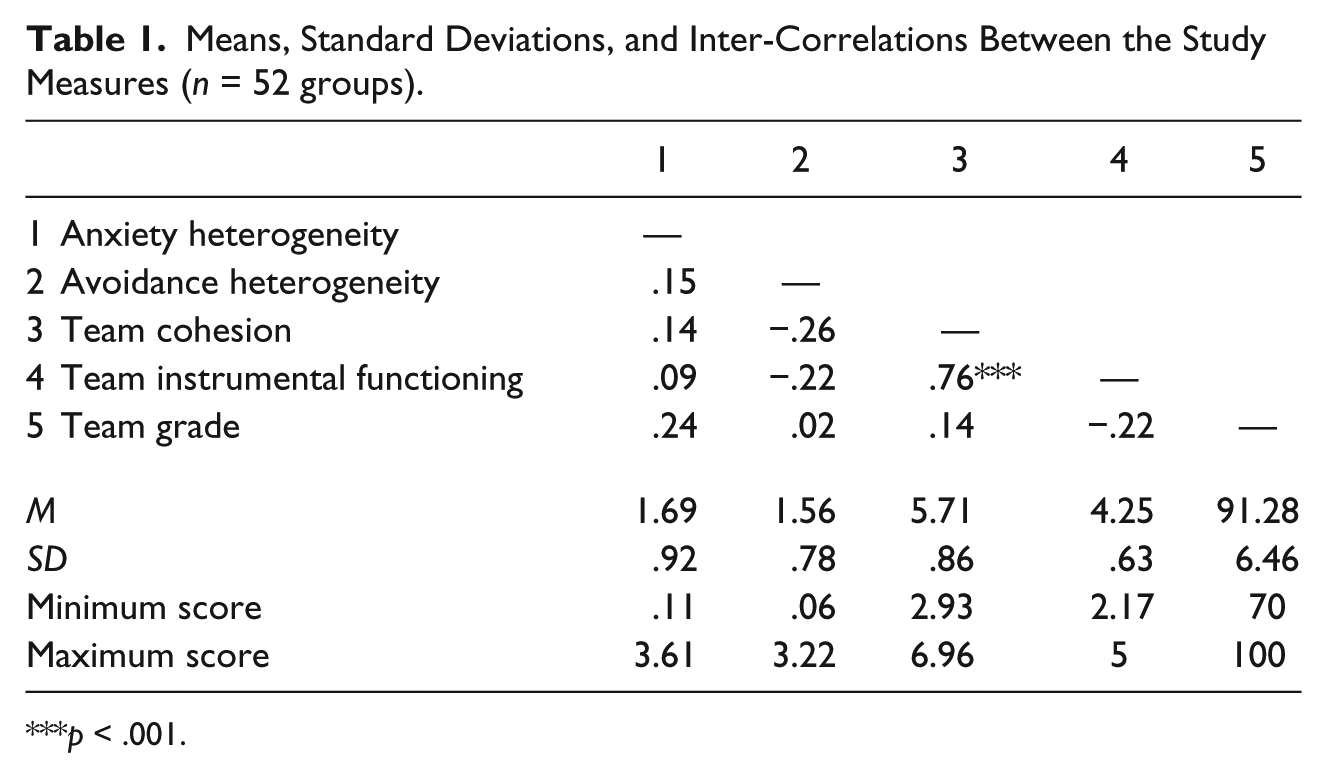
p < .001.
The main hypotheses were examined using hierarchical regression analyses with groups as the unit of analysis. Separate analyses were conducted for the two dependent variables (subjective evaluation of team functioning and team grade). In the first step of the analyses, we introduced as predictors the measures of heterogeneity in attachment anxiety and avoidance, as well as the measure of team cohesion. In the second step of the analyses, we added the interactions between the heterogeneity scores and team cohesion. To facilitate interpretation of the results, all measures were centered on the grand mean. Standardized regression coefficients are presented in Table 2.
Standardized Coefficients Predicting Team Functioning.
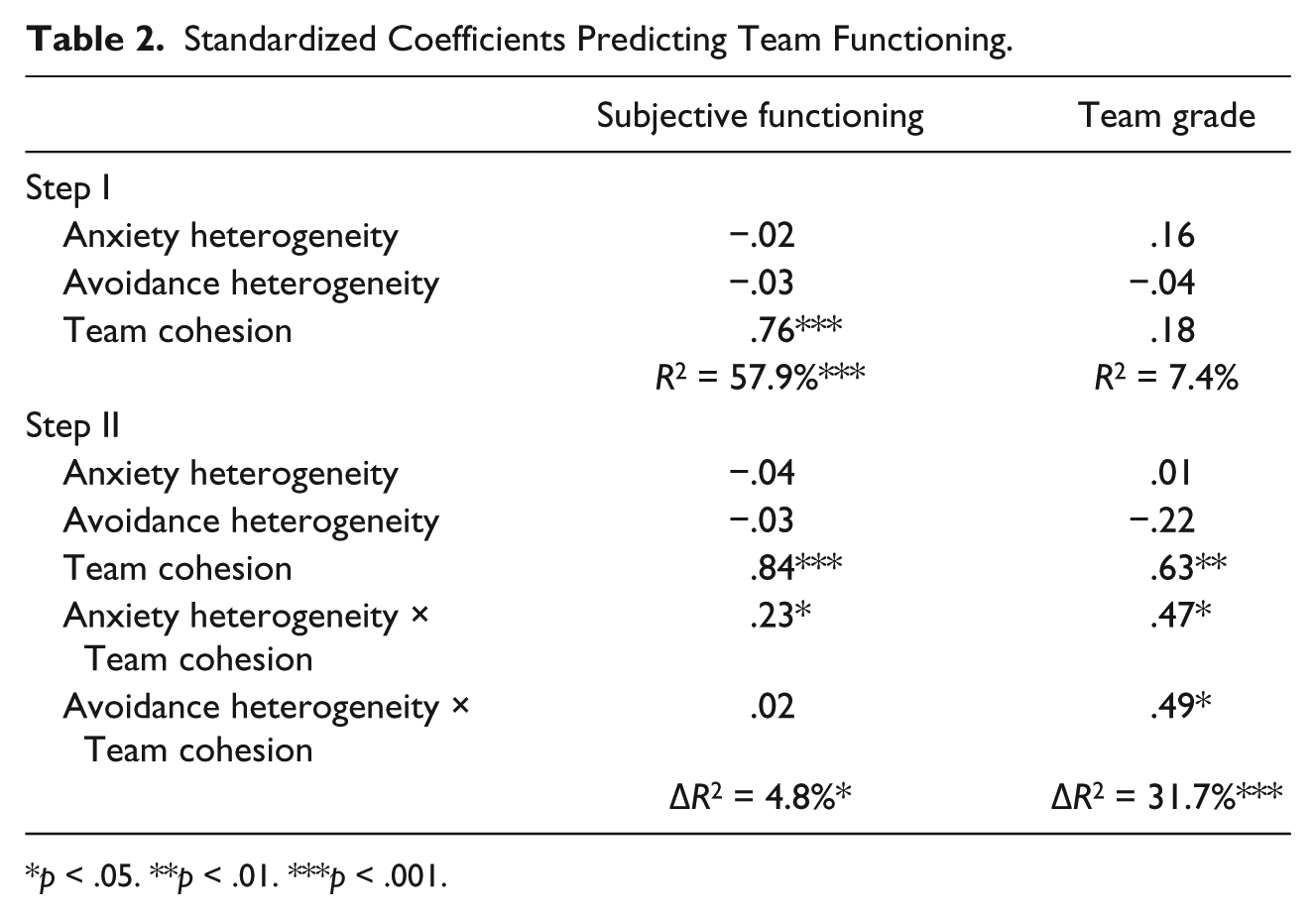
p < .05. **p < .01. ***p < .001.
Predicting Subjective Team Functioning
The first step of the analyses showed that team attachment heterogeneity was not associated with team functioning. However, the first step showed that the higher the team cohesion, the better were the team members’ subjective evaluations of the team’s functioning. The analyses also indicated that the association between heterogeneity in anxiety scores and teams’ subjective functioning was qualified by team cohesion (see Figure 2). Using Preacher, Curran, and Bauer’s (2006) procedure, we found that when team cohesion was high (+1 SD), heterogeneity in anxiety scores was related to higher instrumental functioning, b = 0.13, p < .05. When cohesion was low (−1 SD), however, heterogeneity in anxiety scores was linked with lower instrumental functioning, b = −0.17, p < .01. Thus, the hypothesized model (Figure 1) was supported for team heterogeneity in attachment anxiety, as the results indicated that there was a positive association between heterogeneity in attachment anxiety and team functioning when team cohesion was high.
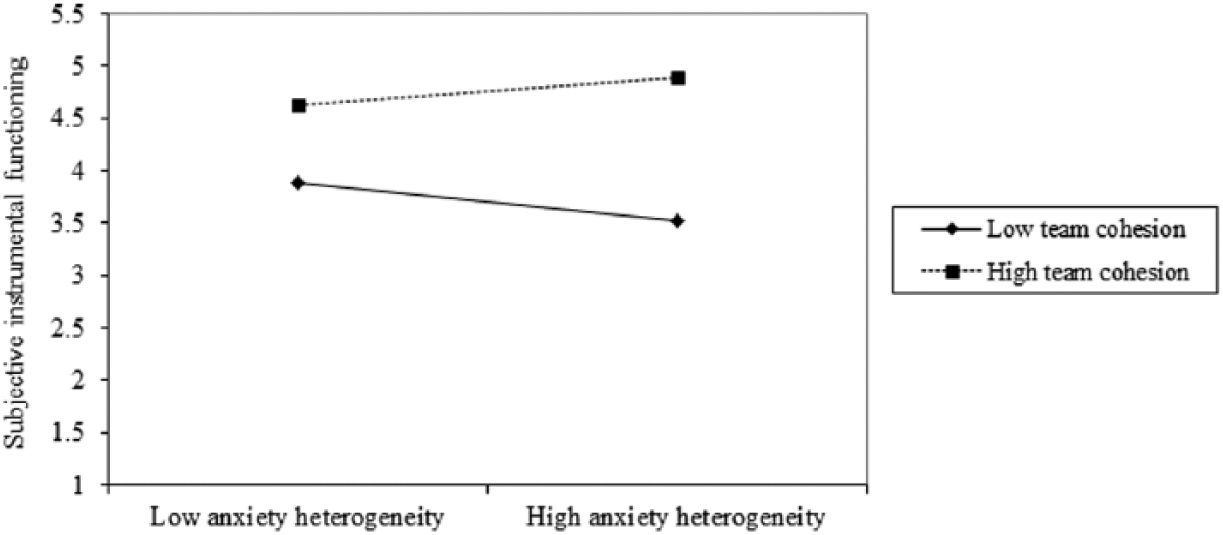
Probing the interaction between heterogeneity in anxiety and team-level cohesion on subjective instrumental functioning.
Predicting Team Grade
The analyses showed that team attachment heterogeneity was not associated with team grade in the first step. However, the first step showed that the higher the team cohesion, the better was the team’s grade. In addition, the analyses revealed that the associations between attachment heterogeneity (both anxiety and avoidance) and teams’ grade were qualified by team cohesion (see Figure 3). We found that when team cohesion was high, heterogeneity in attachment scores was associated with a higher grade in the course, b = 3.20, p < .05, and b = 3.45, p < .05 for heterogeneity in anxiety and avoidance, respectively. Conversely, when cohesion was low, heterogeneity in attachment scores was associated with a higher grade in the course, b = −3.20, p < .05 and b = −6.87, p < .01 for heterogeneity in anxiety and avoidance, respectively. Thus, the hypothesized model (Figure 1) was supported, as the results indicated that there was a positive association between heterogeneity in attachment orientations and team functioning when team cohesion was high.
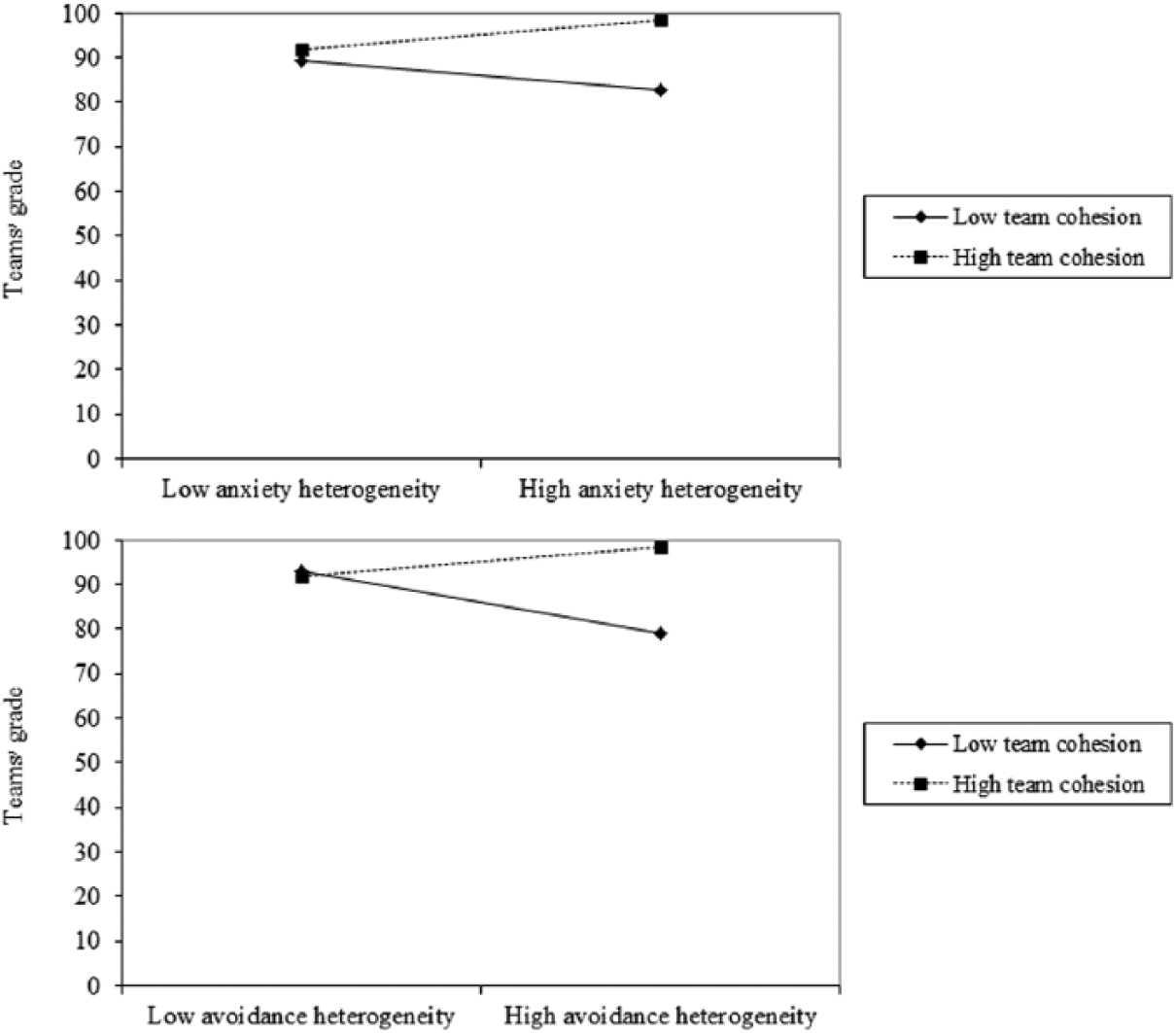
Probing the interactions between heterogeneity in attachment scores and team-level cohesion on teams’ grade.
Discussion
In this study, we examined the contribution of attachment heterogeneity to teams’ functioning and investigated how these effects are qualified by team cohesion. Our findings revealed that teams’ heterogeneity in attachment anxiety and avoidance was linked with better performance (i.e., better team grades) when team cohesion was high. Teams’ heterogeneity in attachment anxiety was also associated with higher subjective evaluation of team functioning when team cohesion was high.
Theoretical Implications
These findings suggest that individuals with diverse levels of attachment anxiety and avoidance can potentially increase teams’ achievements and quality of work, depending on the team’s ability to ensure cohesiveness (e.g., by using relevant team-building techniques; Carron & Spink, 1993; Newman, 1984) and overcome difficulties of working with diverse members. These findings provide the first evidence to date of a significant contribution of heterogeneity in attachment orientations to work-team performance in daily, non-threatening tasks. The findings highlight the role of team cohesion in moderating negative effects of insecure team members on team functioning and emphasize the role of cohesion in facilitating the positive outcomes of attachment heterogeneity at the team level.
Furthermore, our results show the potential advantages of groups comprising of highly avoidant individuals, suggesting that the contribution of team heterogeneity in attachment avoidance is more overt when measuring objective or external outcomes than when employing subjective ones. Thus, even if individuals are not aware of the increased effectiveness of their team, the actual work produced by the team demonstrates this effect. The findings are in keeping with SDT (Ein-Dor et al., 2010; Ein-Dor & Perry, 2012), which indicates that the advantage of teams with insecure members is reflected by the end-result—the actual outcomes—and not necessarily in the sense of effectiveness (or well-being) of its members. Despite this advantage, working in a heterogeneous team with respect to attachment avoidance is not necessarily easy because team members must cope with others who have different emotion regulation strategies and interpersonal behaviors. Specifically, attachment avoidance seems to be more difficult for the group to handle than attachment anxiety, suggesting that the social distancing of avoidant individuals is difficult to contain by other team members. According to SDT and the current findings, it appears that working in teams with high avoidance heterogeneity is not necessarily perceived by team members to be effective, although the teams’ actual functioning is better. This situation holds as long as team cohesion is high enough to ensure that its members will feel committed to one another and contribute to the team’s success.
The different effects of team heterogeneity in attachment avoidance on self-reported (subjective) evaluations versus their effects on external evaluations (considered to be more objective) also draw attention to potential gaps between self-perceptions and external evaluations of group functioning. This point should be taken into consideration in future studies, especially those examining the effects of attachment orientations because of the significant role of attachment orientation in shaping individuals’ perceptions of themselves and of others (Bowlby, 1969/1982).
Practical Implications
The present study has practical implications regarding effective team composition and development. The study’s findings reveal the potential contribution of highly anxious and avoidant individuals, when they are teamed with more secure team members, and highlight the potential benefits of team attachment heterogeneity to team performance. In terms of screening and placement, these results imply that under good conditions which enable team cohesiveness, it may prove beneficial to include individuals with diverse attachment orientations in each team.
However, the role of team cohesion in enabling advantageous team attachment heterogeneity should be duly noted. Thus, while team cohesion is commonly emphasized as an important antecedent of improved team performance (Beal, Cohen, Burke, & McLendon, 2003; Chang & Bordia, 2001; Jung & Sosik, 2002; Wech, Mossholder, Steel, & Bennett, 1998), its role in increasing performance in teams with high attachment heterogeneity becomes crucial.
Future Research
The present study is the first to examine attachment heterogeneity in student work teams, but as such, it suffers from a few methodological limitations that should be noted. First, the study was correlational in nature, which precludes confident conclusions regarding the direction of causality in the link between teams’ heterogeneity and cohesion, on one hand, and performance on the other. Theory and research on attachment, however, indicate that attachment orientations are formed initially in early childhood and are moderately stable over periods of years (Mikulincer & Shaver, 2007a). In addition, the students interacted with one another long before the measures of performance were taken. Thus, we believe that it is likely that teams’ performance is a manifestation of teams’ cohesion and composition with respect to attachment and not vice versa.
Second, the study is based on only one example of work teams, namely students’ academic teams, which may also be affected by other factors not examined in this study. Previous studies suggest that effects of team diversity may be stronger in ad hoc project teams similar to those examined here (Horwitz & Horwitz, 2007; Joshi & Roh, 2009). Therefore, future studies may benefit from exploring the associations between attachment heterogeneity and other kinds of teams, including teams which have been working together longer. Furthermore, the present study examined only one moderator of the attachment heterogeneity–performance association. Future research should examine other potential moderators, relevant to the effects of other kinds of team heterogeneity on performance, such as frequency and duration of member interactions, temporal effects, task interdependence, nature and complexity of team tasks, and so on (e.g., Chatman & Flynn, 2001; Horwitz & Horwitz, 2007; Joshi & Roh, 2009; K. G. Smith et al., 1994).
Finally, possible curvilinear effects of team attachment heterogeneity on performance should be considered. While moderate levels of attachment heterogeneity may benefit the team more than very low heterogeneity levels, very high levels of attachment heterogeneity may also be dysfunctional due to the relationship-related difficulties they produce (which even high team cohesion may not be able to moderate). These curvilinear effects should be examined in future research with larger samples.
Summary
Our findings support and extend SDT and provide first evidence for the relevance of team attachment heterogeneity to project team effectiveness. Insecure team members may have unique contributions to teams’ functioning not only in life-threatening situations but also in daily tasks. These findings are first to show the relevance of SDT to mundane teamwork, relevant to work organizations. Expanding the research in this field, and extending these findings to other organizational settings and occupations, may yield important theoretical implications regarding team dynamics and resources and provide applicable suggestions for screening, placement and management processes, especially in the construction and maintenance of work teams (i.e., creating teams that are heterogeneous in attachment orientations, while maintaining a high levels of team cohesion). Finally, our findings add to the literature suggesting that variations in attachment orientations relate to heightened effectiveness of groups. The advantage of having insecure members in groups is a possibility that attachment researchers have generally neglected when writing about the characteristics of insecure individuals, as well as when writing about the benefits of team heterogeneity. Studies like the one reported here offer a new perspective on the strengths and contributions of individuals who have long been viewed as deficient and poorly adapted.
Footnotes
Declaration of Conflicting Interests
The author(s) declared no potential conflicts of interest with respect to the research, authorship, and/or publication of this article.
Funding
The author(s) received no financial support for the research, authorship, and/or publication of this article.