







Abstract
The aim of this case study is to demonstrate how an innovative group counseling method, the narrative mediation path, promotes reflective mirroring in a group of underachieving university students. We used an adaptation of the innovative moments coding system, a reliable method for studying change by tracking narrative innovations throughout the intervention. The transcripts of the seven sessions of a single narrative mediation path counseling group were analyzed, and three types of innovative moments were identified: self-directed innovative moments (those directed at the participants themselves), other-directed innovative moments (those directed at another group member), and group-directed innovative moments (those directed at the group as a whole). To study the narrative sequences containing both other-directed or group-directed innovative moments and self-directed innovative moments, a microgenetic approach was adopted. Results suggested that across the narrative mediation path counseling sessions, different types of reflecting mirroring emerged, based on supporting, interpreting, and connecting members’ experiences.
The aim of this study is to demonstrate how an innovative group counseling model, the narrative mediation path (NMP), promotes reflective mirroring among members by using an adaptation of the innovative moments coding system (IMCS), which is a reliable method for studying change by tracking narrative innovations through the course of the intervention.
The NMP targets underachieving university students who form a broad category of marginalized students at risk of academic exclusion due to poor learning outcomes. In fact, academic performance is considered the main indicator of academic inclusion (Bacchini, Esposito, & Affuso, 2009; Muskens, 2011). Poor learning outcomes, in turn, influence students’ degree of involvement and commitment to formative goals. Underachievement may be characterized as a discrepancy between students’ levels of performance and their academic potential that persists over an extended period, and is not the direct result of a diagnosed learning disability (Reis & McCoach, 2000). The European Commission has recognized the need to develop innovative counseling approaches to prevent the academic exclusion of underachieving university students and allow them to fully reap the benefits of tertiary education (Council of the European Union, 2013). Consistent with these emerging needs, we developed the Innovative Solution to Acquire Learning to Learn (INSTALL) European Project, 1 which involved 198 underachieving students enrolled in four European university degree programs. For this project, the NMP was created and implemented with the overall goal of improving students’ academic performance. The idea of developing a counseling method based on a group setting stems from a diversity of theoretical and methodological issues. One of the most relevant is the proven effectiveness of group intervention in the higher education context. Specifically, group counseling has been shown to be an effective form of treatment for different categories of students (Burlingame, MacKenzie, & Strauss, 2004) and may positively influence feelings of hope and trigger social learning between group members (Yalom & Leszcz, 2005). Within the group setting, an individual may be conceived as part of a social network, and as such, meaning and significance occur not only within subjects but also between them. Intersubjectivity also plays a key role in producing self-growth and change. Within a group setting, members play the role of a reflecting mirror (Pines, 1984, 2003) by recognizing their experience in others as they empathize with the other and respond internally as if that person were the self. Mirroring is a metaphor that allows one to conceive each member of a group not as an opaque surface but as a human reflecting mirror who elaborates what is shared in the group setting, and absorbs and reflects it in a more meaningful way. In this way, each member of the group may serve a mirroring function that allows him or her to produce a mirroring reaction (Foulkes, 1948). Specifically, participants can learn something about themselves from the effects that they each have on other members of the group.
This article is organized into two main sections. The first section overviews the concept of mirroring from a theoretical perspective and its use in NMP counseling; moreover, it discusses the concept of reflectivity and the need to promote it in underachieving university students by adopting group counseling interventions. The second section presents the case study, which analyzes reflective mirroring in a single NMP counseling group by using an adaptation of the IMSC (Gonçalves, Ribeiro, Mendes, Matos, & Santos, 2011).
Enhancing Reflectivity in Group to Prevent Dropout
Among the most widely discussed and explored models in the higher education literature, Tinto’s (1975, 2006) integration model of student dropout explains students’ decisions to drop out as the outcome of a complex fit between students’ characteristics and the opportunities, resources, and services offered by the university. Students become integrated into the academic system when they successfully separate from the past norms of their communities; make a transition to the new values, beliefs, and norms of the college environment; and gradually adapt to them by adopting new behaviors and new ways of reflecting and give meaning to their university experience (Tinto, 2006). Underachieving students are a broad category of students at risk of dropout who present some difficulties in reflective competence (Taylor, 2011). They are more at risk to perform ineffective at university precisely as the reflectivity may be useful for critical thinking and for allowing students to perform strategically in a university setting (Esposito, Freda, & Bosco, 2015). Nevertheless, promoting reflectivity in underachieving students is a controversial issue in the field of higher education, as various definitions of the term have been proposed over the years which have inspired different models of intervention (Kember, McKay, Sinclair, & Wong, 2008; Moore, 2013). For example, an interesting perspective on reflectivity is the concept of mindfulness, namely, a mind-set of openness to novelty in which the individual actively constructs novel categories and distinctions (Langer, 2005). Recently, some of us (Esposito & Freda, 2015, 2016; Esposito, Freda, & De Luca Picione, 2016) proposed a semiotic and psychodynamic conceptualization of the reflective process which leaded and oriented some clinical interventions in different contexts (e.g., De Luca Picione, Dicé, & Freda, 2015; Freda, Gonzàlez-Monteagudo, & Esposito, 2016; Martino, Onorato, D’Oriano, & Freda, 2013). According to this conceptualization, the reflective process may be defined as a multidimensional and intersubjective product, conceived in terms of innovations in subjects’ meaning systems and as the ability to rethink to one’s own experience according to a new perspective (De Luca Picione & Freda, 2016; Freda & Esposito, 2017). Moreover, reflectivity is a process of meaning co-construction between subjects involved in a shared context, namely, each member of the relationship recognizes multiple perspectives of the experience (i.e., one listens, considers, and elaborates), allowing the subject to provide new meaning to the experience and enhance the reflective meaning construction of this experience (Salvatore, 2011). From the perspective of college student development, our view of reflective competence is strictly connected with the idea of self-authorship (Baxter Magolda, 2001, 2009), namely, students’ capacity to define one’s beliefs, identity, and social relations. Self-authorship entails a shift in students from uncritical acceptance of authority to critical analysis of knowledge, beliefs, behaviors, and values to establish their own internal or self-authority. Belonging to a group may enhance students’ self-authorship, namely, promoting a shift toward openness to novel situations and reconstruction of their meaning systems and allowing them to consider themselves part of the university community. For example, classmates can contribute to multiple perspectives on each other’s learning, as well as on their academic values, beliefs, and goals. They can also offer multiple perspectives on a situation and allow subjects to ascribe new meanings to the university experience. As a consequence, group members may play a key role in enhancing students’ reflectivity that, in turn, may influence their involvement and commitment to the university (Tinto, 2006).
Following this line of reasoning, we developed and implemented an innovative group counseling approach that aims to use a group as a methodological device to foster reflectivity among underachieving students and engage them in critical reflection on the need to re-author their university experience to achieve their formative goals. In this scenario, the intersubjective space of the group plays an important role in enhancing the reflective meaning reconstruction and, in turn, provides subjects with a different perspective for rethinking their own underachievement.
Mirroring in a Group
Over the years, there has been a shift from a view of the person as a self-contained, structured entity to a perspective in which the person is seen as being in the world with others. According to Foulkes (1948), the individual is a node in a social network who can only artificially be considered in isolation; thus, human beings must be understood only in relationship with each other. This perspective emphasizes intersubjectivity, with the in-between as the area of action and interaction. The intersubjective perspective is expressed by the introduction of the concept of the matrix (Foulkes, 1964) as the “hypothetical web of communication and relationship in a given group. It is the common shared ground that ultimately determines the meaning and significance of all events and upon which all communications and interpretations, verbal and nonverbal, rest” (Foulkes, 1964, p. 292). Matrix conjures up the image of a womb in which individual units are embedded, where meaning and significance reside in the intersubjective space rather than in the individual psyche (Foulkes & Anthony, 1965; Sampson, 1993).
Moreover, many scholars (e.g., Karterud, 2011) have argued that the presence of an intersubjective group matrix facilitates self-development and change. This may occur because the matrix allows the members of a group to experience mirroring, or reflect on the thoughts and feelings of others shared within the intersubjective psychological space of the group. Mirroring may be conceived as a metaphor for intersubjectivity (Schermer, 2010b). It is a concept that remains fresh and vital because it continues to offer an interesting perspective on understanding social and group development. Starting from Foulkes’s concept of group mirroring (i.e., when members of a group perceive parts of themselves in one another), Pines (1984, 2003) expanded this idea by including a broad range of human interactions and exploring the potential for socialization, personal growth, and group development. A mirror, Pine argued, serves as a metaphor for the reflection of the self in the other and extends the range of the eye by shifting the locus of observation outside of the observer.
Pines discusses two types of mirroring: (a) nonreflective mirroring and (b) reflective mirroring. The first is primitive, conflictual, and destructive mirroring that primarily happens within dyadic relationships. Due to the effect of primitive defense mechanisms (especially projection and splitting), the other is perceived as a partial object, and the possibility of recognizing a different perspective is not allowed. Reflective mirroring, instead, is characterized by the dialogical exploration between two or more persons who share the same psychological space, in which all the perspectives can be accepted despite their potential diversity. Thanks to the group matrix, members can avoid splitting and projecting unelaborated parts of themselves onto others, and in so doing, they create the foundation for dialogue, sharing, and self-change.
Mirroring is a complex interaction that may occur in both nonverbal interactions and in explicit or verbal utterances, sentences, or dialogue. Mirroring is constituted by both functions and reactions. Each member of a group can assume different functions that may focus on some aspects of the other of which members were previously completely or partially unaware. Mirroring may also focus on the mental states of others such as emotions, thoughts, desires, or needs. In other words, how members interact within the intersubjective space of a specific group may provide different forms of mirroring, and each subject may assume a different function in allowing others to see diverse aspects of themselves. Reflective mirroring functions play a key role in promoting change because they allow a subject to experience a mirroring reaction (Foulkes, 1948), defined as a process of learning, understanding, and comprehension of the self due to the mirroring functions of the others. The self may learn something about himself or herself from the reactions that the self evokes from the members of the group and the ideas that the members develop about themselves. In other words, the mirroring reaction consists of a series of responses aroused within an individual in a group by the behaviors and evocations of others. This definition encompasses a complex of therapeutic factors in a group, such as identification, reflection, projection, and internalization. The group is a hall of mirrors (Foulkes, 1948), and each member allows the self to explore, compare, and learn something by meeting hidden parts of the self through them. According to Foulkes (1964), when mirroring reactions are a product of reflective mirroring, they may play a fundamental role in ego development by allowing subjects to get to know themselves through the recognition of the influence they have on others and through their perception of themselves. The subjects’ realization that others have similar or contrasting ideas, beliefs, feelings, and behaviors serves as a therapeutic benefit specific to groups and facilitates a process by which a subject can establish a healthier and stronger base of functioning and thus, encourage self-knowledge, self-realization, and self-change. Nevertheless, as we have stated, not all types of mirroring are of a reflective nature. Other mirroring interactions may arise within the group, and unproductive mirroring reactions can be produced. This is the case of the malignant mirroring (Nitsun, 1998; Zinkin, 1992), in which a pathological attraction can arise between opposites in a group; this can have destructive effects on the whole process for both the individual and the group. In such cases, the mirroring reaction can be experienced as intensely persecuting and may cause distancing and alienation and become an obstacle to change. In other words, while reflective mirroring may be helpful in promoting one’s self-awareness and consequently self-change, nonreflective mirroring may have catastrophic effects for a person who is suddenly faced with a truth he or she is not prepared to accept.
The idea of mirroring has become extremely current again after the discovery of mirror neurons, brain cells that fire in response to perceiving another’s action in ways similar to when one is rehearsing or performing an action oneself (Iacobini & Mazziotta, 2007). Since this serendipitous discovery in monkeys, a variety of studies have been employed with human subjects that demonstrated the existence of a similar human neuron system that seems to be involved in complex functions such as intentionality, empathy, and decision making (Rizzolatti & Sinigaglia, 2006). Despite the ongoing debate on the exact functions of human mirror neurons, which have not yet been clearly demonstrated, the proven synchrony between action and observation supports the idea that our brains contain social neurons (Schermer, 2010a) that form a linkage among embodied selves (Damasio, 1999). The discovery of mirror neurons in the brain and their activation in response to observed actions has challenged the idea that minds function in relative isolation (Cozolino, 2006) and has reinforced, from a neurobiological perspective, the notion that the mind (and the brain) may be inherently biosocial, and that individuals tune to one another and represent themselves in and through each other. Actual studies on mirror neurons have not validated the existence of mirroring, but they seem to offer an interesting perspective that attempts to explain the kinesthetic basis of phenomena such as empathy, attunement, and resonance. In other words, despite our being quite far from proving the neurobiological basis of mirroring, the existence of mirror neurons seems to support the idea of an embodied cognition of the others among multiple embodied selves (Damasio, 1999).
There is general agreement in the literature on the role of mirroring interpersonal relationships in producing good outcomes in group psychotherapy (Davies-Osterkamp, Strauss, & Schmitz, 1996). Nevertheless, although the notion of mirroring has been extensively and theoretically studied, from a methodological perspective, reflective mirroring and its role in promoting self-change are particularly difficult to measure due to the complexity of human interactions in group interventions. For example, many tools have been developed to measure cohesion as an expression of mirroring functions and as a therapeutic factor (Q-sort, Yalom, 1995; Therapeutic Factor Inventory [TFI], Lese & Mac Nair-Semands, 2000). Moreover, on one hand, some self-report questionnaires have been developed for psychotherapists or counselors (Group Dynamics Inventory, Pan & Lin, 2004), whereas on the other, many tools have been created to analyze group verbal interactions. For example, a large amount of behavioral coding systems have been developed (e.g., Behavioral Interaction Codes, Roberts et al., 1991) with the aim of recording and analyzing verbal responses within a group setting by studying the themes and the direction of the interactions. Nevertheless, these types of behavioral coding systems provide a way to study all type of member interactions and, as far as we know, no specific tools have been developed for studying reflective mirroring along with a counseling intervention.
The NMP Group Counseling Model
For the purposes of the INSTALL Project, we created and implemented the NMP, a novel narrative group counseling model based on a narrative approach (Combs & Freedman, 2012). The NMP is a seven-session (weekly) narrative method that integrates individual and group narrative levels. The seven sessions are organized into four narrative modes: metaphoric, iconographic, writing, and bodily. The metaphoric mode (first and second sessions) involves expressions and proverbs, and the students are asked to choose the one that represents their university experiences (e.g., “He who makes his bed must lie in it,” “Yes, we can!”). Proverbs and expressions allow students to start to identify their problems, specifically their academic difficulties, by focusing on what has not yet been highlighted. In the iconographic mode (third and fourth sessions), six vignettes are given, each featuring a character engaged in a typical university situation (e.g., enrollment, self-study, informal moments), and students are asked to select one character in each vignette and write a speech balloon containing the character’s thoughts or feelings. Unlike the previous mode, which is focused on the problem, students are encouraged to ask themselves what they usually do to overcome their problems in different university experiences. In the writing mode (fifth and sixth sessions), three narrative assignments are given (writing about a low point, high point, and decisional turning point in students’ university experiences) in accordance with McAdams’s narrative model (McAdams et al., 2006). In contrast to the previous modes, writing assignments explicitly invite students to narrate their past actions and assume a more subjective position, namely, to be both the subject and object of their narration. In the written narratives, students are asked to reflect on the roles they assumed in orienting their university experience and to identify their strengths and limitations in overcoming their academic difficulties. Finally, in the bodily mode (seventh session), students are asked to create a sculpture about their university future using the bodies of all of the participants. The bodily mode conveys a symbolic and nonverbal representation of students’ university futures and focuses on learned competences and changes occurring during their participation in the group. Sculpture mobilizes the body and symbolically allows students to take action by working on how to act to reach their academic goals (Freda et al., 2016). Throughout these modes, students are asked to give new meanings to their university experiences in two ways: by reflecting on their own narrations, and by using other members’ narrations to revisit their experiences and give new meaning to their personal narratives.
Student reflection on their personal narratives is constantly promoted throughout counseling and aims to allow students to therapeutically reconstruct taken-for-granted meanings in new ways by recounting their university stories through different types of narrative inputs. In other words, students are continually asked to narrate their beliefs, intentions, and feelings in specific university situations and to reflectively recognize the roles they assumed in orienting their academic behavior. The variability of the experiences activated by the different narratives offers the participants opportunities to modify their positions before different metaphorical mirrors (the diverse narratives), to explore multiple perspectives, and to recognize the roles they assumed in orienting their behavior at university (Esposito & Freda, 2015; Freda & Esposito, 2017).
Like the personal narratives, members of the group are conceived as mirrors who may allow participants to identify new ways to cope, construct sense, and reprioritize their university goals. Members are asked to participate in each others’ stories, to be both performers and audience to re-author their personal stories and account for other alternatives (Baxter Magolda, 2001, 2009; Freda, Esposito, & Quaranta, 2015). Moreover, members are guided to develop a sense of shared membership with others in the group, who, despite some common characteristics (such as underachievement), can also acknowledge self-defining and personal themes and meanings.
In summary, over the seven sessions, the NMP prompts a horizontal transition between the four modes and also supports a vertical transition based on the back-and-forth shifts between the individual and the group narratives. These two types of transitions are achieved in each session independently of narrative mode using a common methodological sequence. First, the narrative medium (e.g., proverbs, vignettes) is presented; then, each group member engages in a narrative construction of the experience and is asked to give it meaning; thereafter, a group-level narrative metadiscourse is elaborated from each member’s narration. Finally, each participant re-constructs the narrative experience and is asked to elaborate a new meaning based on the previous individual and group narrative metadiscourse (Freda et al., 2016).
Throughout the NMP counseling, the counselor searches to promote the individual and collective reconstruction of meaning. The counselor is considered a reflective social mirror (Bateman & Fonagy, 2012) who records students’ narratives, encourages member participation, and contributes to co-constructing meaning in an intersubjective group setting. The counselor invites members into reflective and generative conversations (Strong, Ross, & Sesma-Vazquez, 2015) about their university experience, which may help participants consider new possible and functional actions within the university context (Freda & Esposito, 2017). In other words, the counselor recursively moves from subjectivity to intersubjectivity, working both on helping individuals reflect on their personal narratives and involving members of the group in co-constructing new meanings for their individual narratives. The final goal of this recursive methodology is to allow subjects to attain individuation, namely, a personal and distinct identity within the group. The individuation of a member within a group may be achieved by a process by which the group develops into a mature and separate entity and can be considered a group as a whole (Gibbard, Hartman, & Mann, 1974; Karterud & Stone, 2003; Wells, 1995), or one that perceives itself as an entity that grows and develops much as the individual group members do. The counselor’s role implies empathy with the group as a whole and allows members to realize that, despite their differences, participants share common emotional dynamics because they are all individual units of a group matrix (Karterud & Stone, 2003).
Research Objective
The general aim of this case study is to demonstrate how NMP counseling promotes reflective mirroring among the members of a counseling group for underachieving college students.
Method
Students
The group comprised seven students (5 women, 2 men) enrolled in the economics degree course at the University of Naples Federico II, Italy. The mean age of the students was 27.86 years (SD = 7.06). Five students were taking longer than usual to complete their master’s degrees, while one was enrolled in the third year and another student in the second year of the bachelor’s degree programs. Students were recruited and participated in the group counseling because they were all underachieving students who, at the time of their enrollment in the INSTALL project, had grade point averages (GPAs) of less than 23 and had earned less than 50% in the European Credit Transfer System (ECTS), a standard for comparing study attainment and performance among students in higher education throughout the European Union.
The group counseling sessions were held from February to April 2014. Participation was free. Each student signed an informed consent to use the narrative materials and audio recordings from the sessions for training and research purposes. Each student was given a certificate of participation in the INSTALL project.
Previous outcome measures (Esposito, Ribeiro, et al., 2016) suggested that the group was effective in improving students’ academic performance, as there was a significant increase in the ECTS (Z = −2.201, p = .028) and the number of examinations passed (Z = −2.214, p = .027) one year after the counseling concluded.
Counselor
A PhD clinical psychologist and postdoctoral researcher served as the counselor. She had been working as an NMP counselor for 4 years and had led many group-counseling engagements. She contributed to the development and testing of the NMP model.
Tools
To analyze how NMP counseling promotes mirroring among group members, an adaptation of the IMSC (Gonçalves et al., 2011) was used in this study. The IMCS stems from a narrative framework in which the interpretation of life experiences includes a dynamic process through which events become interconnected in a coherent meaning system (Adler, Skalina, & McAdams, 2008; Angus, Levitt, & Hardtke, 1999). The IMCS focuses on the movement toward self-reconstruction and proposes seven categories of novelties or innovative moments (IMs) that occur throughout the therapeutic process as the client progresses from the original, problematic meaning system, to a healthier one: low-level IMs (Action 1, Reflection 1, Protest 1), which allow the person to create some distance from the problematic pattern; and high-level IMs (Action 2, Reflection 2, Protest 2, and Reconceptualization), which facilitates the creation of more adjusted pattern. Table 1 describes each category and clinical examples taken from one of the NMP group counseling sessions (problematic narrative: feeling of being isolated at university).
Examples of Innovative Moments in One NMP Group Counseling.
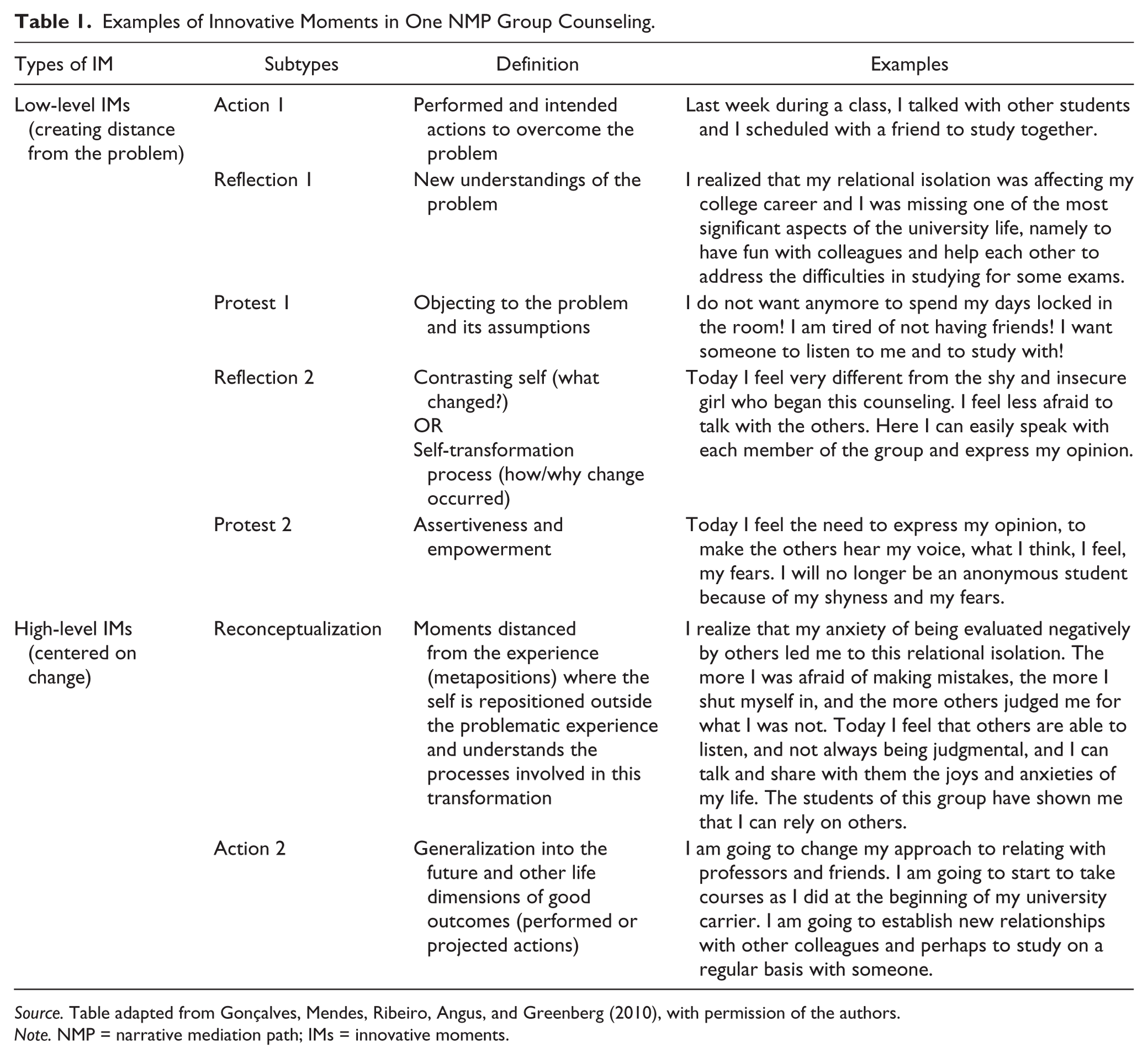
Source. Table adapted from Gonçalves, Mendes, Ribeiro, Angus, and Greenberg (2010), with permission of the authors.
Note. NMP = narrative mediation path; IMs = innovative moments.
Previous studies using the IMCS with diverse therapeutic modalities and samples (Alves et al., 2014; Gonçalves et al., 2010; Matos, Santos, Gonçalves, & Martins, 2009; Mendes et al., 2010) showed it to be a reliable and feasible method for studying change occurring during psychotherapy. Moreover, these studies demonstrated that high-level IMs are more typical of successful psychotherapy, while low-level ones dominate unsuccessful cases.
In a previous study (Esposito et al., 2016), we tracked the seven types of IMs in a counseling intervention group and showed how these innovations constituted opportunities for narrative discontinuity and change. Specifically, previous findings suggested that NMP fostered primarily IMs of a reflective nature (e.g., Reflection 1, Reflection 2, and Reconceptualization) and that along the counseling, more developed IMs (mainly Reflection 2 and Reconceptualization) tended to increase, while less developed ones (Reflection 1) tended to decrease.
Here, we refer to the same counseling group, but we adapted the IMCS to study mirroring among its members. Specifically, the IMs previously coded were not distinguished by their target of the narrative innovation (if the speaker directed the IMs to himself or herself, to others, or to the group as whole). In the present study, consistent with the aims of NMP counseling and the group setting, we expected that in addition to IMs directed at the participants themselves (self-directed IMs), which are the prevalent IMs in individual psychotherapy, narrative innovations directed to other members of the group (other-directed IMs) or to the group as a whole (group-directed IMs) would emerge during the intervention. Thus, this study aimed to track IMs with different targets and to explore, through a microgenetic method of analysis of the IMs sequences, if these three IM subtypes may shed light on members’ mirroring.
Procedure
The audio records of the seven sessions were transcribed verbatim in Italian, and their coding comprised the following three steps.
IM type and proportion
The first step of the coding process was detailed in the previous study (Esposito et al., 2016). This constituted the traditional coding of the IMCS, mainly applied to psychotherapy and counseling in an individual setting. Specifically, coders read (in sequential order) all of the transcripts from the seven sessions according to the IMCS. They first obtained a consensual definition of the group (feeling of inefficacy in performing at the university) and individual problematic patterns (e.g., resentment toward the university), then tracked all the IMs that differed from those problematic narratives and defined them by type (Actions 1 and 2, Reflections 1 and 2, Protests 1 and 2, and Reconceptualization). The proportion of IMs, the ratio between the numbers of words in the IMs and the total number of words in the counseling sessions were computed for each of the seven IM types and for the overall IMs during the counseling.
Targets of the IMs
This second coding step was needed because the IMCS was previously applied to individual psychotherapy or counseling, where narrative innovations are mainly centered on the speaker’s experience and directed to the self. We hypothesized that in a group setting, other kinds of narrative innovations with different directions would emerge. Thus, for the present study, all the IMs previously coded were categorized by target, based on whom the IM addressed (the participants themselves, other members of the group, or the group as a whole).
Because this comprised an adaptation of the IMCS, a great deal of prerating discussion and practice was required to the coders to create clear definitions of the rules for categorizing IMs with different targets. Specifically, the coders arrived at a consensual definition of the following rules to code the three types of IMs:
Self-directed IMs refer to those that a participant produces in relation to himself or herself. They demonstrate a reflective awareness of one’s own university experience, a reformulation of unacknowledged problems in one’s university career, and changes that students have experienced, for example:
“I think my delay at the university stems from my fear of being judged by others” (self-directed IM—Reflection 1).
Other-directed IMs refer to IMs a participant directs to another member of the group. They reflect the ability to reflect on others’ thoughts, beliefs, and emotions, and on the possibility that others may adopt new ways of coping and behaving within the university context. The following is an example:
From my perspective, you have chosen right! You have totally changed your perspective about your university path. At first, you were angry with everyone, with professors and with the university in general, and now you know that this was just an excuse not to face your real problem! (Other-directed IM—Reconceptualization)
Group-directed IMs are those a participant directs to the entire group conceived as an entity. In this category, the speaker is able to reflect on the group as a collective identity in which all members share common feelings and dynamics. Subjects seem able to recognize that members can show similar or different perspectives. For example,
I noticed a great change in all of us, both regarding our university experience and our being in general. Yes, of course, these changes are different for each of us, but today we are all different from when we arrived here. (Group-directed IM—Reflection 2)
Moreover, the proportion of the IMs with different targets was computed for the entire counseling period. Specifically, the proportion of self-directed IMs was calculated as the ratio between the number of words in self-directed IMs and the number of words in all IMs. The proportions of other-directed and group-directed IMs were computed following the same procedure.
IMs sequences
A microgenetic approach (Kuhn, 1995; Siegler, 2006) was adopted to study narrative sequences containing both other-directed or group-directed IMs and self-directed IMs. Generically, a microgenetic approach is a scientific method in which the same setting is repeatedly studied to observe change in detail through an in-depth analysis of the behavior of the system while it is changing. The microgenetic approach is especially applicable in studies with few cases or small samples, and it allows change to be examined in a number of different domains, including change in clinical groups. A type of microgenetic method is the sequential analysis of events assumed to occur over a temporal period (Valsiner, 2007).
Following this line of study, we analyzed the IM narrative sequences to observe in detail how these markers of change (IMs) occurred and the relationships between them. Specifically, an IM narrative sequence was defined as a series of more than one consecutive IM. This means that an IM narrative sequence must start and end with an IM and could contain two or more consecutive IMs. Moreover, these IMs could be of different types (e.g., Reflection 2) and have different targets (e.g., directed to the self, to others).
First, two coders independently identified all the sequences that emerged in the narrative group discourse containing at least two consecutive IMs, irrespective of type or target; thus, they calculated when the IM sequences started and ended. The coders then distinguished these sequences on the basis of the IM targets; thus, they counted the narrative sequences containing only IMs directed at the speaker’s own university experience (self-directed IMs) separately from those containing both self-directed IMs and other-directed IMs or group-directed IMs. Then the percentages of all the different types of sequences were computed. Furthermore, to understand if the production of the sequences could be ascribed to all seven students and not just to some of them, we observed if each student contributed to at least one IMs narrative sequence. Finally, to understand the distribution of the sequences during the process, we distinguished the sequences from the early sessions (metaphoric and iconographic) and the late sessions (writing and bodily).
Coders
As in the previous study, IMs’ proportions and types were calculated and the coding process conducted by two researchers who independently coded the seven sessions according to the IMCS. The first coder (the second author) has years of experience in psychotherapy and the use of the IMCS, while the second coder (the first author) has extensive training in the IMCS. In addition, a senior author of the IMCS (the third author) served as an auditor during the coding process.
In this study, the previously coded IMs were categorized as self-directed IMs, other-directed IMs, and group-directed IMs. Moreover, the narrative sequences containing other-directed or group-directed IMs next to self-directed IMs were analyzed. The first coder (the fourth author) and the second coder (the first author) conducted this coding process independently. Both were creators of the NMP counseling model and have years of experience in qualitative and narrative microgenetic analysis.
Coders scored the transcripts independently and arrived at consensus ratings for each step of the coding phase by discussing differences until an agreement was reached. Coders discussed potential confirmation bias in the study due to their high investment. To reduce such bias, the coding of the first rater (the fourth author) was preferred over the others in case of disagreement, as she was unaware of the group outcomes.
For the aims of the present study, we focused the microgenetic analysis only on those sequences containing (a) both self-directed IMs and other-directed IMs, or (b) both self-directed IMs and group-directed IMs. Furthermore, we observed in each type of sequence if self-directed IMs were preceded or followed by other-directed or group-directed IMs.
Results
Archival results of the previous study (Esposito et al., 2016) showed that across the seven sessions, 15.80% of the group’s narrative discourse was devoted to IMs, which were mostly of a reflective nature (Reflection 1, Reflection 2, and Reconceptualization). Among these, for the aim of this study and departing from the IMCS, we distinguished self-directed IMs from other-directed and group-directed IMs. Reliability for these three specific subtypes of IMs as assessed by Cohen’s kappa was .96, thus showing strong agreement among the judges.
Across the counseling sessions, the proportion of self-directed IMs was 79.99%, while the proportion of other-directed IMs was 11.90%, and group-directed IMs comprised 8.1%. Overall, these findings suggest that the group mostly produced self-directed IMs, followed by other-directed and group-directed IMs.
A total of 63 IMs narrative sequences emerged. Most of these sequences (n = 45; 71.42%) comprised only self-directed IMs. Eighteen (28.58%) IM sequences contained both self-directed and other-directed or group-directed IMs. Specifically, 13 (20.63%) IM sequences contained other-directed and self-directed IMs, while five (7.94%) comprised group-directed and self-directed IMs. The microgenetic analysis of the IM narrative sequences containing self-directed IMs and other-directed or group-directed IMs will be presented separately in the following section.
Sequences With Other IMs
We found two types of typical sequences in terms of the position of other-directed IMs in relation to self-directed IMs, namely, if other-directed IMs preceded or followed self-directed IMs.
In the sequence self-directed IM/other-directed IM/self-directed IM, the subject was already involved in producing a narrative innovation directed at himself or herself when another member intervened. After this intervention, the subject proceeded to produce another self-directed IM. We found seven sequences of this type. Sequences 1 and 2 are two examples of this type:
Sequence 1.
Self-directed IM: I think that in my life I have never been noticed by anyone. No one has ever noticed me! Maybe my behavior comes from the desire to be noticed, to be seen by someone! Other-directed IM: Yes, I agree. You are behaving this way because you want to say that you exist, now you are saying that you exist! Self-directed IM: Yes, I exist, I am alive! My family did not think I was important. Today I try to treat those I love as if they were important because I know how you can feel if no one pays attention to you. Everyone needs to be noticed, everyone needs to feel important to someone, everyone is needed.
Sequence 2.
Self-directed IM: This is my decision, to return to this counseling despite it being difficult for me to realize that I have so many limitations. But I think I am changing, so I decided to come back. Other-directed IM: Hooray for you! It was really good for you to make this decision. Yes, you’re changing, although it is difficult. Self-directed IM: Yes, it’s true! This was my decision, to continue to come here because even if I have trouble speaking, listening to your stories about your time at the university can be useful in helping me change.
In the other type of sequence, other-directed IM/self-directed IM, the other-directed IM triggered the production of the self-directed IM. We found six sequences of this type; Sequences 3 and 4 are two examples.
Sequence 3.
Other-directed IM: Sorry, but I don’t agree with you. What you are saying demonstrates that you are not stuck! From what I see, you’ve already taken a step forward because you’ve become aware that repeating dozens and dozens of the pages studied before is just a way not to break with the past, to continue to have control over things and not face anything new! That’s why I say that you are not stuck at all! Self-directed IM: Yes, maybe you are right. Before, I did not realize that this behavior meant all of these things. I could not imagine it at all. Now I have to turn this awareness into action. Thanks to all of you, I now know this, you have been a positive mirror for me.
Sequence 4.
Other-directed IM: I see you’ve changed a lot. You were locked into yourself for fear of being judged; you did not attend classes, and you did not relate to anyone. I think that now you realize that you are not stupid, and people will not judge you. Now you have self-confidence and you are consequently able to relate to people, to go to a class, to relate with your friends! Self-directed IM: Yes, I feel like a completely different person. In the past, when I had to go to a class, I thought, “No, that sucks!” I was anxious when I thought that I would have to meet other students in the university, students who were better than me. Instead, now I enjoy going to class, I look forward to meeting other people, I can study or share ideas with others, but also joke with them.
The sequences containing both self-directed and other-directed IMs were distributed across the seven group members, and each member contributed to the production of at least one sequence. Moreover, the sequences were evenly distributed throughout the process, with a total frequency of six in the first four sessions (metaphoric and iconographic) and a total frequency of seven in the late three sessions (writing and bodily modes).
Sequences With Group IMs
We found only one type of sequence, group-directed IM/self-directed IM. In this sequence, the group-directed IM triggered the production of the self-directed IM. There were in total five sequences of this type, two in the four early sessions (metaphoric and iconographic modes) and three in the late sessions (writing and bodily modes). In contrast to the previous findings, just three members of the group were involved in these sequences. Sequences 5 and 6 are two examples.
Sequence 5.
Group-directed IM: In the sculpture, I saw all of us as winners, as winners over our initial barriers, over the obstacles we have overcome together. Self-directed IM: Me too! I saw myself as a winner over the insecurity that caused my delay in the university.
Sequence 6.
Group-directed IM: It’s a pity that we are not video-recording our sessions. It would be beautiful to record our faces too, because, in comparison with the first sessions, we’re all smiling now, we are happier. Maybe every one of us has freed himself of a burden! Now everybody knows everything about the others, and everybody has become aware of the reasons for their problems in the university. Self-directed IM: Yes, I feel happy too. This is something that allows me to feel better: the fact that I am not alone in having these types of difficulties, and that my insecurities, my feelings of being an incapable student, were similar to your feelings. The fact that other people have the same problems makes me feel lighter.
Discussion
In this group counseling program, different kinds of markers of reflective change emerged that were directed to other members of the group or to the group as a whole. Specifically, we found that most IMs (79.99%) targeted the speaker’s own university experience (self-directed IMs), while in total, about 20% of the IMs were directed at other members of the group (other-directed IMs, 11.9%) or to the group as an entity (group-directed IMs, 8.1%).
Microgenetic analysis of the IM narrative sequences revealed three types of member interactions that occurred in this group. Specifically, we assume that in an IM narrative sequence, other-directed and group-directed IMs may have a mirroring function, while self-directed IMs can be conceived as a mirroring reaction in response to those mirroring functions. Moreover, due to the reflective quality of the IMs (Reflection 1, 2, and Reconceptualization), we may consider these types of mirroring to be reflective mirroring (Pines, 1984), which may have contributed to self-growth and change. Findings showed that 20.63% of the IM sequences comprised other-directed and self-directed IMs, whereas 7.94% comprised group-directed and self-directed IMs.
These findings could lead us to conclude that few mirroring interactions occur in group counseling, and that the effectiveness of the counseling could be ascribed to factors unrelated to group members’ interactions.
However, from our perspective, these are expected findings for a number of possible reasons, some of which relate to the type of methodology (IMCS) adopted, others to the intrinsic nature of mirroring, and another to the specificity of the NMP counseling. First, it is important to emphasize that our analysis is based on narrative innovations (IMs) as markers of change, not on the general group discourse. Thus, the IM sequences allowed us to study only a specific and a more complex type of meaningful interaction while other forms of member interactions probably also occurred in the counseling sessions. For example, according to the literature (Foulkes, 1948; Pines, 1984), mirroring can be conceived as a verbal and nonverbal interaction; thus, across the sessions, multiple implicit mirroring functions and reactions could have occurred that our method of analysis was not able to capture. Furthermore, a self-directed IM can also generate similar self-directed IMs in other members. That is because, by reflective mirroring, individuals can differentiate between the aspects of the mirror that belong to them and to the others. Thus, they can both reflect on the experiences of others and reflectively, but without making it explicit, revisit their own experiences by giving them new meanings and producing further self-directed IMs. As a result, there could be a reciprocal strengthening relation between the self-directed IMs that emerged throughout the group sessions and the different participants. Finally, these were expected findings from the aims of the NMP counseling, which are to encourage participants to reflect and elaborate on their academic underachievement. As discussed in the introduction, students are constantly asked to give new meanings to their university experiences in two ways: (a) by reflecting on their own narratives, and (b) by using other members’ narratives to revisit their experiences and construct new meanings for their personal narratives. In other words, the final goal of the NMP methodology is to allow subjects to achieve individuation, specifically, a distinct personal identity within the group.
By examining the first type of sequence, self-directed IM/other-directed IM/self-directed IM, in detail, we can interpret it as reflective mirroring in which the other is a sort of reinforcement for change. In this sequence, a member of the group reflects the image that the self has already started to narrate, namely, the other provides a positive reinforcement for self-change and encourages the self to continue in the direction already taken. In other words, the member does not produce a new meaning in the other, but simply amplifies and supports the meaning already produced by the self. The self reacts to this supportive mirroring by producing another IM, in some cases expanding upon it, perhaps because of the perception that the other supports this new image. This mirroring function is based on nurturing, encouraging, or approving of another group member and on offering tangible assistance, and allows the subject to react by producing a reflection of the self. In other words, within a group, the subject can stand in front of a mirror and share narratives about himself or herself by recognizing feelings that belong to the self and to others.
Instead, the mirroring that seemed to emerge in the second type of sequence (other-directed IM/self-directed IM) ascribes to the other the role of an interpretative sense-maker. In these sequences, the other plays a fundamental role in allowing the self to produce an IM because the other-directed IM invites the subject to produce a self-directed IM. Specifically, the other reflects a new image of the self, along with an interpretation of one’s own behavior that the self had not previously considered. The other is able to redefine another group member’s beliefs, emotions, or behavior by giving them new meaning. This leads the participant to reflect upon himself or herself; in other words, mirroring may lead to a different image of the self by inviting the subject to acknowledge the difference between the image of the self that one presents and the one that group members perceive (Schermer, 2010b). In both cases, these sequences revealed to us how the counseling served to enhance students’ ability to define their desires, feeling, thoughts, and behaviors. In other words, the sequences showed how reflecting mirroring contributed to the development of self-authorship (Baxter Magolda, 2001, 2009) in the members, especially by engaging students in the process of critical thinking about their choices and the revision of their beliefs. Students referred to new decisions taken, to a new desire to be noticed by others, to a new awareness of their limits and strengths, and about the need to transform this awareness into motivated and self-directed actions.
Finally, the third sequence, group-directed IM/self-directed IM, allowed us to identify mirroring in which the other seems to be a connector between the self and the group. The mirroring function in this case reflected a change in the group as a whole as an entity in which each member contributed to the collective change. In contrast to the previous two sequences, this is an expressive IM sequence whose focus is on associations more than on support or interpretations. The connections may take place between different stages of the counseling process, between self and other, or between similar or different events that express group dynamics in which each member plays a part. Furthermore, these sequences revealed how members’ mirroring allowed subjects to reflect on their change and on the problems and reasons that affect their university delays. However, they also revealed the role of group members in enhancing the process of change. Sharing the same status (that of underachieving students) amplified the process of mirroring. In other words, being in the same boat seemed to have enhanced the empathic attunement that formed the basis of reflective mirroring among members. By observing the contents of these sequences, some therapeutic factors specific to the group setting seem to have been operative in providing members with the normalization of the university experience (i.e., universality), and making them feel their experience was unique (Yalom, 1995).
Limitations and Future Directions
The main limitation of this study was that it was a case study based on only a single group counseling cohort. More research is necessary to ensure that these results can be replicated in other group case studies. Specifically, the small sample of IM narrative sequences limited our comprehension of these group interactions and allowed us to provide only speculative hypotheses on how mirroring functions promoted self-change among its members. For example, we cannot provide any interpretation for the even distribution of the IMs narrative sequences across the sessions, as they could be randomly distributed. Future studies with a higher number of sequences should focus on the analysis of this distribution throughout the process, and from a more qualitative perspective, on understanding the level of complexity in the reflecting mirroring across the sessions. Moreover, at the moment, these findings seem to introduce a new perspective on the study of mirroring by adopting the IMCS as the methodological criteria for reflective group interactions. Nevertheless, more group cases are needed to understand if the adaption of the IMCS presented in this study could be transformed into a new coding scheme to track different types of mirroring functions.
Other important limitations could be ascribed to the coding procedure and, specifically, to the potential impact of coders bias. Because of high personal investment in the study, confirmation bias could have affected intercoder decision making by leading coders to search for, interpret, favor, and recall information in a way that confirmed their beliefs or hypotheses while giving less attention to information that contradicted it.
Moreover, due to the limited data in the study, patternicity could have affected the coding process by leading coders to perceive meaningful patterns within a small population and overlooking how these patterns could have been due to potentially random data. To combat these biases and ensure the reliability of the findings, double-blind techniques will be employed in future research.
Furthermore, future studies should focus on comparing various counseling groups in terms of academic performance (e.g., high-performing and low-performing students) to understand the differences between evoking mirroring between students who benefit from NMP counseling method and those who do not.
Finally, it would be interesting to investigate the type of mirroring functions ascribed to the counselor and to understand how these functions contribute to self-change. Future research should consider group counseling led by different counselors to help researchers determine whether the patterns observed in this case study can be generalized to other cases in which different clinicians adopt the NMP model.
Footnotes
Declaration of Conflicting Interests
The author(s) declared no potential conflicts of interest with respect to the research, authorship, and/or publication of this article.
Funding
The author(s) disclosed receipt of the following financial support for the research, authorship, and/or publication of this article: This work was made possible by a grant from the European Commission (Grant Agreement 2011-4040 Project 517750-LLP-1-2011-1-IT-ERASMUS-ESIN). This work was also made possible due to funding from the Short International Mobility Program in the International Relations Office of the University of Naples Federico II, Italy.