







Abstract
Teams often experience negative affective states during the execution of innovative tasks. Negative group affective tone does not necessarily lead to unfavorable outcomes. Grounded in the theories of affect-as-information and mindfulness, this study proposes that team mindfulness nonlinearly moderates the relationship between negative group affective tone and team innovation through the mechanism of external knowledge acquisition. Data collected from 62 research and development teams were analyzed to test the proposed hypotheses. The empirical findings support our hypotheses. Both theoretical and practical implications are discussed.
Keywords
In dynamic and equivocal environments, organizations increasingly rely on teams rather than individuals to perform innovative tasks as teams can better access diversified knowledge from multiple sources, enabling the generation of innovative solutions (Parke et al., 2022; Van Knippenberg, 2017). Scholars have thus diligently endeavored to unravel the factors that either facilitate or impede team innovation (Choi et al., 2022; Van Knippenberg, 2017; Zhang et al., 2022). When performing innovative tasks, team members inevitably experience a range of affects, such as depression and disappointment when encountering difficulties and setbacks, and joy and excitement when witnessing progress and achievement. These collective affective states, referred to as group affective tone, have been established as pivotal factors influencing team innovation (Chi & Lam, 2022; Tsai et al., 2012).
Group affective tone is defined as the “consistent or homogeneous affective reactions within a group” (George, 1990, p. 108). The two most prominent aspects of group affective tone are positive group affective tone (PGAT) and negative group affective tone (NGAT). PGAT and NGAT have been conceptualized as distinct dimensions of group affective tone, as they result from different antecedents and influence team processes and outcomes in unique ways (George, 1990; George & King, 2007; Tsai et al., 2012). Existing research on group affective tone has consistently demonstrated PGAT’s positive effect on team innovation (Collins et al., 2013; H. S. Shin, 2014; Y. Shin et al., 2019; Tsai et al., 2012). In contrast, the arguments and findings pertaining to the effect of NGAT on team innovation have yielded mixed results, including positive (George & Zhou, 2002; Kooij-de Bode et al., 2010; Schwarz & Bless, 2020; Spoor & Kelly, 2004), negative (Rhee, 2007) and insignificant (George & Zhou, 2007; Grawitch et al., 2003) effects. In a recent study, Chi and Lam (2022) found NGAT fosters team creativity when the team exhibits a high level of learning goal orientation. Thus, scholars have called for a deeper examination of the effect of NGAT on team innovation (Barsade & Knight, 2015; Chi & Lam, 2022; Van Knippenberg, 2017). The current study aims to propose a way by which teams can harness the experience of NGAT to promote team innovation.
To address our research objective, we begin by analyzing how NGAT might influence team innovation. Previous studies exploring the mechanisms underlying NGAT and team innovation have primarily focused on internal team processes including social interaction (Rhee, 2007), knowledge sharing (Chi & Lam, 2022) and information elaboration (Huang et al., 2022). Choi (2002) suggested a comprehensive understanding of the mechanisms that transfer team inputs into outputs requires attention to both external and internal processes of the teams. Therefore, we adopt an external perspective to complement and resolve the conflicting conclusions concerning the association between NGAT and team innovation from the literature. Related research has uncovered that negative affect often stimulates an accommodative, bottom-up mode of thinking, drawing people’s attention to the specifics of the external environment, while positive mood tends to elicit an assimilative and top-down way of information processing, relying more on pre-existing internal knowledge (Bless et al., 2006; Forgas, 2017). This idea is often referred to as the adaptive function of affect, which suggests that, from an evolutionary or functional perspective, moods assist in preparing individuals to respond effectively to diverse environmental challenges. From this adaptive standpoint, NGAT is likely to steer team members’ attention to the details of the external environment. This may involve assessing the presence of novel information in the environment, the alignment of goals with the environment, and the availability of any solution from the external environment (Bless et al., 2006). Therefore, external knowledge acquisition, defined as a process by which team members actively access and synthesize new information and ideas from external sources into their existing knowledge base (Zhou & Li, 2012), may serve as a crucial mechanism through which NGAT influences team innovation.
However, the positive informational effect of NGAT on team innovation via external knowledge acquisition can only be realized when the team can successfully manage the unpleasant and stressful emotional aspects of NGAT (Chi & Lam, 2022). Mindfulness plays a crucial role in understanding the effects of moods on individual or team outcomes (Hülsheger et al., 2013; Lyddy et al., 2021). Previous studies have argued that team mindfulness is negatively correlated with NGAT (Good et al., 2016; Yu & Zellmer-Bruhn, 2018). Nevertheless, even mindful teams will inevitably experience NGAT in the workplace. Therefore, team mindfulness, as a moderating factor, may also influence group innovation through its interaction with NGAT, rather than as a direct predictor of it. For example, research has found that mindfulness helps individuals effectively cope with stressful emotional situations by allowing them to decenter from the automatic thoughts and feelings and by promoting actions that are consistent with their true needs (Montani et al., 2020). As such, we expect that team mindfulness can serve as the key factor that enables the beneficial informational effect of NGAT on team innovation through external knowledge acquisition. Yet, mindfulness is not devoid of cost, as it has been associated with the depletion of resources such as attention and control, which are crucial for optimally completing the tasks (Dane, 2011; Levinthal & Rerup, 2006; Lyddy et al., 2021). Studies have implied that the effect of team mindfulness in adverse situations, such as NGAT in the present study, is not linear (Lyddy et al., 2021). We therefore propose a nonlinear moderating effect of team mindfulness in the relationship between NGAT and team innovation.
This study contributes to the literature in several important ways. First, it offers an external perspective to understand the effect of NGAT on team innovation, complementing prior research that has primarily focused on internal team processes and states as the explanatory mechanisms (e.g., Chi & Lam, 2022; Shin, 2014). Second, our study identifies team mindfulness as a key contingent factor that helps to bring out the beneficial influence of NGAT on team innovation through external knowledge acquisition. Third, the current study also contributes to the literature on mindfulness. By demonstrating the nonlinear moderating effect of team mindfulness in the relationship between NGAT and team innovation, the study addresses calls to explore both the bright and dark side of mindfulness from the literature (Hafenbrack & Vohs, 2018; Hülsheger et al., 2013; Lyddy et al., 2021).
The remaining sections are organized as follows. We first review the ambivalent effects of NGAT on team external knowledge acquisition and team innovation. Then we discuss the theoretical background of team mindfulness and develop the hypotheses, followed by research methods and results. Finally, findings and their implications for theory and practices are discussed.
Theoretical Background and Hypotheses Development
Ambivalent Effect of NGAT
Group affective tone is commonly defined as the homogeneous affective state shared by team members (Shin et al., 2019; Tsai et al., 2012). Scholars have identified several distinct mechanisms that contribute to the formation of group affective tone (Emich & Lu, 2020). First, the emotional contagion perspective suggests that as team members engage intensively with each other during task completion, emotions are automatically and subconsciously transmitted among team members through facial expressions, voice tone, and body movements in their interaction, resulting in affective convergence within teams (Barsade & Knight, 2015; Elfenbein, 2014; Shin et al., 2019). Second, the attraction-selection-attrition perspective posits that individuals actively gravitate towards teams whose members share similar affective states and avoid teams where there is a substantial affective dissimilarity, thereby fostering affective convergence (George & King, 2007). Lastly, team members may consciously endeavor to influence the affective states of others to align with a desired affective state or may need to manage their own emotions to conform to team expectations or norms established by the broader context or by the team’s unique history of interactions (Kelly & Barsade, 2001).
Consistent with research on emotions and affective states at the individual level (e.g., Amabile et al., 2005), group affective tone is categorized into two primary types, PGAT and NGAT (George, 1990; George & King, 2007). PGAT refers to the degree of shared positive moods while NGAT pertains to the extent of shared negative moods, experienced by team members. Compared with positive affective states, negative affective states are more likely to converge at the team level as negative information and events are more readily noticed in the interpersonal situation (Bartel & Saavedra, 2000; Cacioppo et al., 1997).
Current research on group affective tone has predominantly focused on the beneficial effect of PGAT on team innovation through broadened attentional scope, enhanced flexibility in information processing and smoothened communication within teams (Grawitch et al., 2003; Tsai et al., 2012). Compared with PGAT, the effect of NGAT on team innovation is complex and ambiguous. Existing studies show that NGAT has an ambivalent effect on team external knowledge acquisition and team innovation. The affect-as-information theory suggests that mood informs team members about the nature of a situation (Schwarz & Clore, 2003). Specifically, negative affects signal that the situation is problematic and thus individuals need to make extra efforts to search for and analyze information to resolve the situation. In addition, the adaptive perspective of affect suggests that negative affect prompts accommodative thinking, which is characterized by an emphasis on external information and bottom-up processing (Bless et al., 2006). Therefore, NGAT impels team members to focus on external cues related to the task at hand, elaborate on collected information at both the individual and team levels until an innovative solution is reached, and adjust internal structures such as attitudes, beliefs and preferences to fit new information assembled from the environment (Bless et al., 2006; Fiedler, 2001). Chi and Lam (2022) also have empirically verified that when the team is more learning goal orientated, NGAT prompts team members to exchange more information, which is favorable for the team creativity. However, Tsai et al. (2012) and Rhee (2007) argued that NGAT can negatively impact team processes and innovative output by trapping team members in emotional distress and even exhaustion. Thus, the effect of NGAT on team processes and outputs depends upon whether situational factors are conducive to bring out the positive informative function of NGAT (Barsade & Knight, 2015; Mitchell et al., 2014). We propose that one of the most important contingent factors to reap the informative effects of NGAT is team mindfulness due to its close relationship with emotions and affect (Hülsheger et al., 2013, 2014; Yu & Zellmer-Bruhn, 2018).
Figure 1 presents the conceptual framework of the current study.
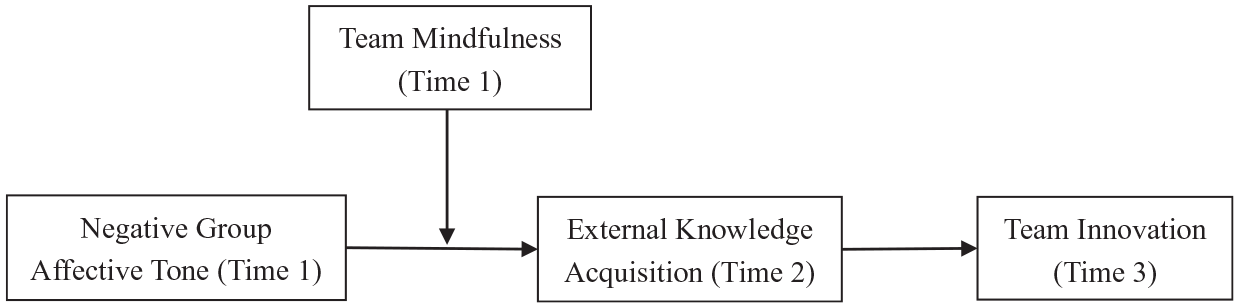
Conceptual framework.
The Moderating Effect of Team Mindfulness on the Relationship Between NGAT and External Knowledge Acquisition
The concept of mindfulness, which emphasizes awareness of the present moment and openness to experiential processing, can be traced back to Buddhism (Brown & Ryan, 2003; Good et al., 2016). In its early stages, mindfulness research has primarily focused on applications of mindfulness practices in clinical psychiatry (e.g., Kabat-Zinn, 2003). Management scholars have demonstrated surging interest in mindfulness in recent years, driven by the proliferation of mindfulness training programs in enterprises such as Google, Aetna, and Alibaba (Hafenbrack et al., 2020; Liu et al., 2020; Wolever et al., 2012). Research has shown that individual mindfulness has broadly beneficial impacts on employee well-being and performance, prompting a call to examine how team mindfulness affects teamwork (Good et al., 2016). Team mindfulness refers to “a shared belief among team members that team interactions are characterized by awareness and attention to present events, and by experiential, nonjudgmental processing of within-team experiences” (Yu & Zellmer-Bruhn, 2018, p. 326). Although the development of team mindfulness is grounded in individual mindfulness, it is not the mere aggregate of individual members’ mindfulness. It represents a shared perception of the team’s mindfulness state, emerging from interactions among team members (Liu et al., 2020; Yu & Zellmer-Bruhn, 2018). Team mindfulness consists of two dimensions, present-focused attention and an open-minded experiential approach to information processing (e.g., Brown & Ryan, 2003; Davidson & Kaszniak, 2015; Good et al., 2016; Yu & Zellmer-Bruhn, 2018). The first dimension refers to sustained, focused, and purposeful attention on what is happening at this moment, rather than on possible futures or past experiences. The second dimension involves an open, curious and experiential approach to information processing, without judging or labeling.
Previous studies have demonstrated that mindfulness, through the practice of present-moment and non-judgmental awareness, reduces arousal during stressful emotional events and aids in recovering from them (Good et al., 2016; Hill & Updegraff, 2012). It is therefore not surprising that mindfulness can regulate emotions, resulting in less experience of negative moods (Hülsheger et al., 2013; Sutcliffe et al., 2016). However, even teams with high levels of mindfulness may still experience NGAT in the workplace due to the pervasive and inevitable nature of negative moods. Therefore, we posit that team mindfulness moderates the relationship between NGAT and team external knowledge acquisition.
According to the resource conservation theory, individuals generally tend to avoid negative experiences and emotions in order to preserve their resources (Hobfoll, 1989). This natural inclination may lead team members to avoid confronting situations associated with NGAT, potentially hindering their ability to effectively address challenges. Team mindfulness, however, offers a powerful counterbalance to this avoidance tendency. By focusing on the present moment and adopting an open, experiential, and non-judgmental approach to information processing (Good et al., 2016), team mindfulness mitigates the heuristic avoidance towards NGAT. In other words, team mindfulness enables team members to confront and assess the adverse situations signaled by NGAT rather than evade them (Brown et al., 2007; Glomb et al., 2011), fostering more constructive engagement with challenges.
The first dimension of team mindfulness, which emphasizes present-focused awareness, plays a crucial role in maintaining attention stability and control over current task goals (Yu & Zellmer-Bruhn, 2018). This present-focused awareness helps team members avoid being derailed by shared negative moods associated with NGAT. As a result, team members are able to preserve their focus and cognitive resources to respond adaptively to the challenging situations signaled by NGAT. The second dimension of team mindfulness, characterized by an open and non-judgmental approach to information processing, fosters curiosity within teams (Orellana-Rios et al., 2018). Consequently, team mindfulness prepares the team to actively and openly address the issues at hand, transforming potential threats into opportunities for learning and growth. By embracing a non-judgmental stance, mindful teams are more likely to engage in exploration and seeking out novel solutions.
From an evolutionary perspective of affect, negative emotions can stimulate a detailed, bottom-up way of thinking that directs attention to specifics in the external environment (Bless et al., 2006; Forgas, 2017). This heightened attention to external environment, when combined with team mindfulness, positions teams to effectively seek information and solutions from external sources. In summary, by leveraging NGAT as a catalyst for deeper environmental scanning and information-seeking behavior, mindful teams can enhance their ability to acquire and process external knowledge.
Despite its benefits, team mindfulness is not without costs. Research has indicated that “mindfulness is not categorically beneficial—a point worth considering as research trumpeting the merits of mindfulness continues to blossom” (Sutcliffe et al., 2016, p. 70). Mindfulness has been theorized to lead to the depletion of personal resources, such as attention and self-control, which are crucial for task completion (Dane, 2011; Levinthal & Rerup, 2006; Lyddy et al., 2021). In adverse and challenging situations such as those characterized by NGAT, maintaining a high level of team mindfulness demands significant internal resources such as attention and collective self-regulation. This resource consumption can lead to diminishing returns of team mindfulness, as the prolonged effort to maintain mindfulness may deplete the team’s capacity to effectively process external information and acquire new knowledge. Consequently, while mindfulness can initially enhance the team’s ability to manage the negative affective tone and facilitate external knowledge acquisition, maintaining this heightened state over time may strain the team’s resources and reduce its effectiveness.
Therefore, we propose Hypothesis 1.
Hypothesis 1: Team mindfulness curvilinearly moderates the relationship between NGAT and team external knowledge acquisition, such that the relationship is more positive when team mindfulness is at the medium level, compared with when team mindfulness is low or high.
The Moderated Mediation Effect of Team Mindfulness and External Knowledge Acquisition in the Relationship Between NGAT and Team Innovation
External knowledge acquisition involves the identification, collection, assimilation and application of valuable external information and insights into a team’s existing knowledge base (Qu & Liu, 2017; Zhou & Li, 2012). It plays a critical role in facilitating team innovation, which essentially involves linking knowledge elements that have not been associated previously (Van Knippenberg, 2017). Assembling knowledge from external sources enlarges the knowledge pool of the team, which increases the possibility to generate novel ideas by building new linkage (Zellmer-Bruhn, 2003). The acquired external knowledge provides opportunities for team members to reflect upon their outdated or inadequate cognitive framework in light of current market and technical situations and then make adaptations accordingly with novel ideas (Qu & Liu, 2017; Zhou & Li, 2012). Hülsheger et al. (2009), in a meta-analysis, also confirmed the conducive effect of external communication of the team for the generation of innovative ideas. Therefore, team external knowledge acquisition is positively related to team innovation.
The above arguments, in conjunction with those developed in Hypothesis 1, present an integrated moderated mediation framework in which team mindfulness moderates the indirect effect of team external knowledge acquisition in the relationship between NGAT and team innovation. Specifically, according to the affect-as-information theory, NGAT signals a problematic situation where external environment and internal structure do not match (Schwarz & Clore, 2003). This signal has the potential to prompt team members to identify issues and seek solutions from the external environment, positioning NGAT as a key trigger for external knowledge acquisition to address those discrepancies. Previous research has found that mindful individuals tend to concentrate their thinking on new information from their surroundings with an open mind (Orellana-Rios et al., 2018; Yu & Zellmer-Bruhn, 2018). Therefore, mindful teams are more likely to identify issues related to, and then search for information and solutions from, the external environment. That’s being said, team mindfulness helps to bring out the positive informative effect of NGAT, prompting team members to actively search for and process information from the environment and make corresponding adaptations. External knowledge acquisition, in turn, encourages team members to break routines and understand the task from a fresh perspective, thus facilitating team innovation. Therefore, we propose Hypothesis 2.
Hypothesis 2: Team mindfulness moderates the indirect effect of team external knowledge acquisition in the relationship between NGAT and team innovation, such that the indirect effect is stronger when team mindfulness is at the medium level compared with when it is high or low.
Methods
Participants and Data Collection
We conducted a three-wave online survey to collect data. Participants were research and development (R&D) teams in organizations whose work involves a great amount of innovation. With the help of a university MBA supervisor who introduced this survey to top management, we accessed 63 R&D teams in several companies in China across a wide range of industries such as software development and transportation tools design. Data were collected from multiple sources, including team members and team leaders, across different time periods. To match the data from different sources across different waves, we adopted the following procedures. Supported by the top management and the team leaders, we first collected participants’ email addresses. Then we created a unique questionnaire and a corresponding unique link for each participant. Finally, participants were sent an email that explained the goal of the survey, reviewed data confidentiality procedures, and provided the participant’s unique link to their own questionnaire.
We collected data at three different time points with a two-week interval between each wave, following practices from previous literature (Gray et al., 2023; Zhang et al., 2022). At Time 1, we distributed the survey to the 374 team members to collect data concerning their demographic information, affective experience in the team (including PGAT and NGAT), and their perception of team mindfulness. At time 2, which is 2 weeks after Time 1, we collected data from the same 374 participants on external knowledge acquisition and internal knowledge sharing. Finally at Time 3, 2 weeks after Time 2, we distributed the questionnaires to the 63 team leaders in order to assess team innovative performance as well as collect basic information such as team size and longevity (in months). To encourage participation, we designed a raffle at the end of each survey, offering a small red packet (CNY2–CNY5 for T1 survey and CNY5–CNY8 for T2 survey) as a prize. In addition, we sent three follow-up emails for T1 and T2 survey, and two follow-up emails for T3 survey to ask the participants to complete the survey. Lastly, we provided an aggregated report to the team leaders for their reference.
We sent questionnaires to 63 teams; after discarding data from one team whose leader did not rate the team’s innovative performance, our final sample consisted of 62 teams, including 319 members and 62 leaders. The overall usable response rate was 85.29%. 74.09% of team member participants were male, and the average age was 29.56 (SD = 6.37). Among team leaders, 93.55% were male, and the average age was 38.73 (SD = 5.10). The average team size of core members reported by the team leader was 6.02, ranging from 3 to 11.
Measures
All variables were measured by 7-point Likert scales (1 = strongly disagree, 7 = strongly agree). Measurement items were sourced from established scales in previous studies to ensure validity and reliability. Minimal modifications were undertaken to align the items with the specific research context. As the participants in the current study were Chinese, we adopted the back-translation procedure (Brislin, 1980) to make sure that English and Chinese versions of the scale were comparable and compatible.
Team Innovative Performance
We measured team innovative performance using four items from Pirola-Merlo and Mann’s (2004) scale (sample item: “Our team’s output is creative”). As the team leader directly rated the team performance, the term of “our team” is usually adopted in the literature (Choi et al., 2022; Pirola-Merlo & Mann, 2004). Coefficient of the internal consistency α = .932.
NGAT
The measurement of NGAT adopts shorted version of PANAS (Watson et al., 1988), which has gained validity in previous research (Mitchell et al., 2014; Thompson, 2007). We requested team members rate how accurately the provided adjectives reflected their overall mood states during team work meetings in the past week. By focusing on the setting of team work meetings, we attempted to capture their mood states when they discussed task progress towards the goal or deliberated ideas or solutions for innovative projects (Chi & Lam, 2022; Tsai et al., 2012). This one-week period was chosen based on its balance between minimizing recall bias and capturing sufficient variability in group affective tone (Chi & Lam, 2022; Shin, 2014). The alpha coefficient for NGAT was .905.
Team Mindfulness
The 10-item scale of team mindfulness was derived from Yu and Zellmer-Bruhn (2018). The scale assessed two dimensions of team mindful ness: present-focused attention (sample item: “it is difficult for the team to stay focused on what is happening in the present”) and experiential and nonjudgemental processing (sample item: “the team is aware of thoughts and feelings without over-identifying with them”). The alpha coefficient for team mindfulness was .893.
Team External Knowledge Acquisition
Team external knowledge acquisition was measured with six items from Mitchell (2006) and Ancona and Caldwell (1992). A typical item is “our team spends time and efforts in finding out what competing firms or teams were doing on similar projects.” The alpha coefficient for external knowledge acquisition was .872.
Control Variables
Control variables included team size and team tenure (in months), as provided by the team leader. Previous studies on group affective tone have consistently reported the beneficial effect of PGAT on team innovation (e.g., Collins et al., 2013; Shin et al., 2019), so we controlled for PGAT, which was also measured by the shorted version of PANAS (Thompson, 2007). The alpha coefficient for PGAT was .883. In addition, we controlled for information sharing and team diversity, including age diversity, gender diversity and educational background diversity, as previous studies have verified the importance of information sharing and team diversity for team innovation (Chi & Lam, 2022; De Dreu et al., 2008; Van Knippenberg, 2017). Information sharing was measured with three items from Choi et al. (2010), with alpha coefficient being .917. One sample item for information sharing is “we share our work experience or know-how with other team members.” Age diversity was measured with the standard deviation of team members’ age, and gender diversity and educational background diversity were calculated with Blau’s (1977) index with the algorithm of
Data Analysis and Results
We analyzed the data through a three-step approach. We first conducted confirmatory factor analysis (CFA) to assess the validity and reliability of the scales. Then, an aggregation test was conducted to assess whether it is appropriate to average the data reported by members to measure the constructs at team level. Finally, we conducted hierarchical regression with ordinary least squares to test our hypotheses.
Confirmatory Factor Analysis
We first performed CFA using the data collected from individual members for the variables of NGAT, PGAT, team mindfulness, team external knowledge acquisition, team internal knowledge sharing and team innovative performance. The results indicated that a five-factor model (χ2/df = 1.433, RMSE = 0.062, CFI = 0.947, TLI = 0.925) fits better than a four-factor model (χ2/df = 4.072, RMSE = 0.231, CFI = 0.716, TLI = 0.662) and other models.
We further assessed the reliability and validity of all variables. Reliability assesses internal-item consistency with the index of Cronbach’s alpha (Nunnally, 1975). The Cronbach’s alpha of all variables exceeds .70, suggesting satisfactory reliability. Construct validity pertains to how well the items within a scale gauge the intended theoretical construct, including convergent validity and discriminate validity (Campbell & Fiske, 1959; Fornell & Larcker, 1981). All the factors load well on their respective latent variables as all the values of factor loadings exceed the threshold of 0.7 and the values of Average Variance Extracted (AVE) are above 0.50 (shown in Table 1), confirming good convergent validity. Table 3 also shows that the values of square root of AVE are greater than the correlations between the focal variable and other variables, providing strong evidence of discriminant validity.
Aggregation Indicators and Cronbach’s Alpha.
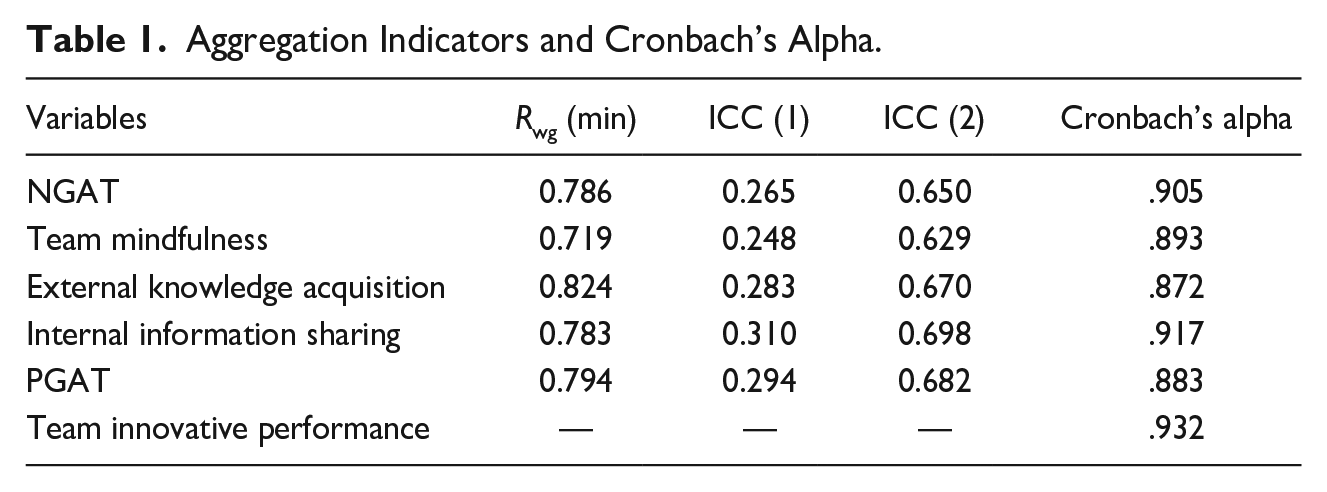
The results in Table 1 show that the minimum rwg value for each variable exceeds the threshold of 0.70. Additionally, all variables have ICC1 values above 0.12 and ICC2 values greater than the acceptable threshold of 0.60 (Kozlowski & Klein, 2000). Therefore, it is appropriate to aggregate the data collected from individual members to the represent the team level variables.
Data Aggregation
As the data for team variables were collected from individual participants, we assessed the appropriateness of aggregating individuals’ responses to the team level, using indicators of rwg (James et al., 1993) and intra-class correlation (ICC; Bliese, 2000). Rwg evaluates the level of consensus among individuals within each team (Chan, 1998; Kozlowski & Klein, 2000). ICC has two indicators, ICC1 and ICC2. ICC1 measures the between-group variance of individual responses, and ICC2 assesses the reliability of group-level means. The results of the three aggregation indicators are shown in Table 1.
Descriptive Statistics
The descriptive statistics of all variables are shown in Table 2, including mean, standard deviation and correlations among variables. While NGAT was relatively low on average (Mean = 2.208), this value is consistent with what we would anticipate in a mentally healthy population because organizations would punish or even dismiss a team experiencing extreme high NGAT in order to manage team morale (George, 1990).
Descriptive Statistics of Means, SD, and Correlations.
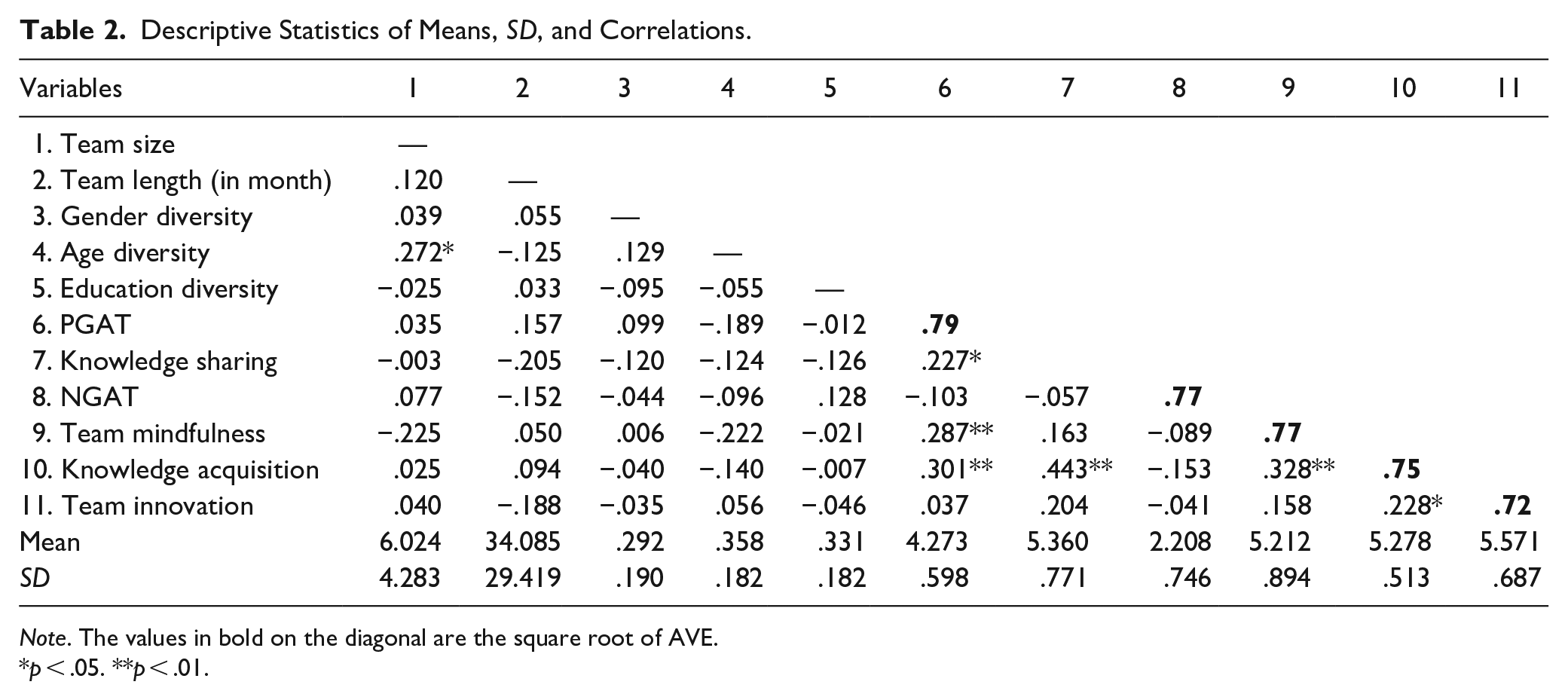
Note. The values in bold on the diagonal are the square root of AVE.
p < .05. **p < .01.
Hypotheses Testing
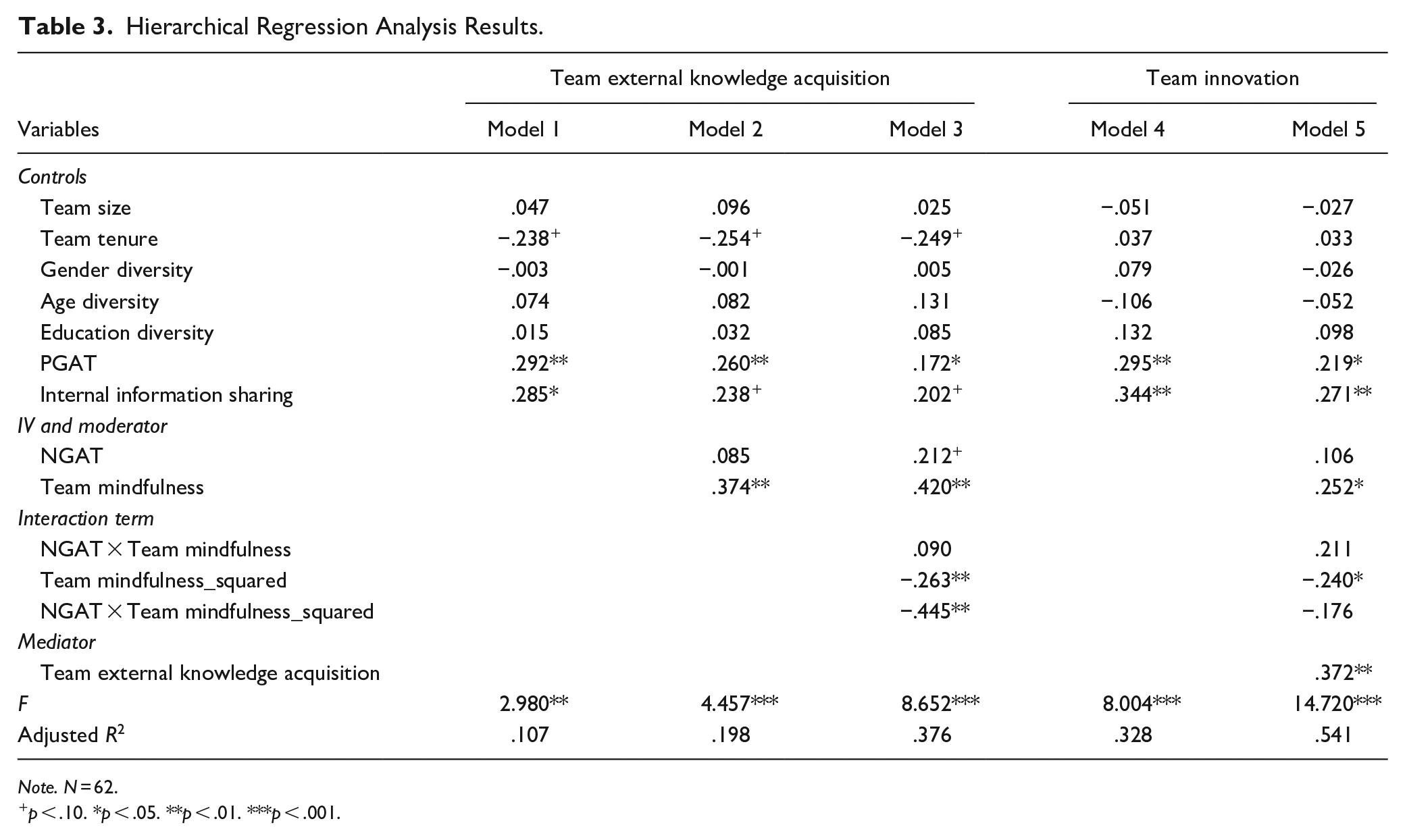
Hierarchical regression analysis was adopted to test the hypotheses in SPSS 20.0. In performing regression, we mean-centered all the variables as a precaution against multicollinearity when incorporating interaction terms into the regression. Table 3 presents the hierarchical regression analysis results.
Hierarchical Regression Analysis Results.
Note. N = 62.
p < .10. *p < .05. **p < .01. ***p < .001.
Model 2 in Table 3 shows that the relationship between NGAT and team external knowledge acquisition is not significant (β = 0.085, n.s.), empirically verifying the need to examine contingent factors in the relationship between NGAT and team external knowledge acquisition. Model 3 showed that team mindfulness significantly and nonlinearly moderated the relationship between the NGAT and team external knowledge acquisition (β = −0.445, p < .01), providing support for H1. To further validate H1, we adopted the method of Aiken and West (1991) to conduct the simple slope test. The results are shown in Figure 2.
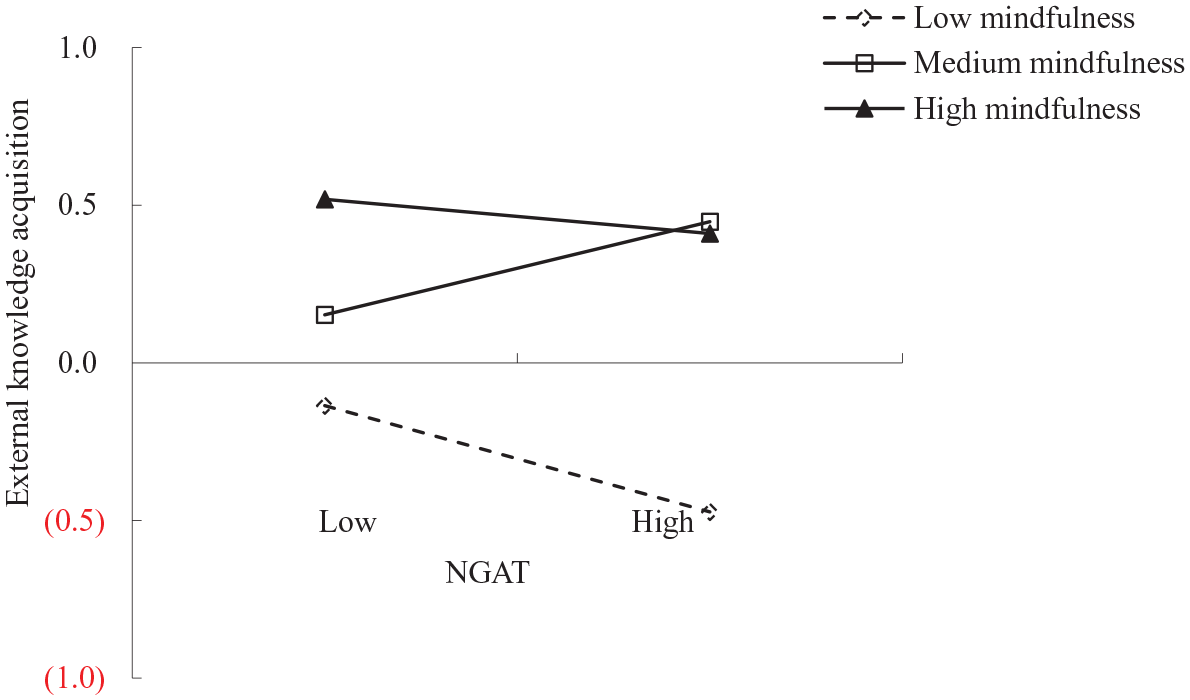
Simple slopes for the interaction effect of NGAT and team mindfulness of team external knowledge acquisition.
Figure 2 shows that when team mindfulness is at the medium level, the relationship between NGAT and team external knowledge acquisition is significantly positive (b = 0.212, t = 1.978); when team mindfulness is low (−1SD), the relationship between NGAT and team external knowledge acquisition is significantly negative (b = −0.224, t = −2.030); when team mindfulness is high (+1SD), the relationship between NGAT and team external knowledge acquisition is not significant (b = −0.063, t = −0.127).
Then, we followed the procedure of Preacher et al. (2007) to test the proposed mediated moderation effect in H2. The results are shown in Table 4.
The Indirect Effect of External Knowledge Acquisition.
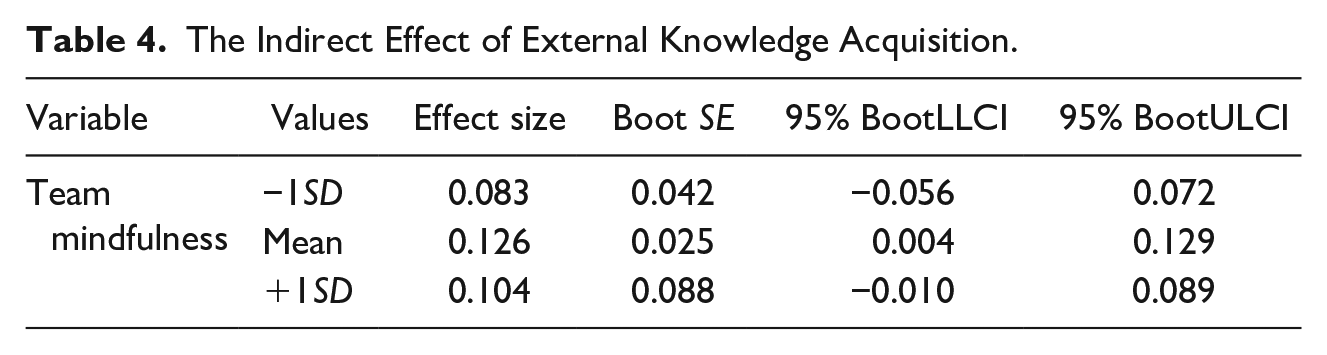
The results in Table 4 show that when team mindfulness is medium, the indirect effect of external knowledge acquisition in the relationship between NGAT and team innovative performance is positive (b = 0.126, 95% CI [0.004, 0.129]), and when team mindfulness is low (−1SD) or high (+1SD), the indirect effect of external knowledge acquisition in the relationship between NGAT and team innovative performance is not significant as both of the 95% CIs contain zero, providing support for H2.
Discussion
Based on the fact that teams inevitably and diffusively experience negative affective states, scholars have advocated for a deeper understanding of the complicated influence of negative feelings on team innovation (Barsade & Knight, 2015; Chi & Lam, 2022). Joining this body of literature, our study aims to investigate the nuanced effects of NGAT on team innovative outcomes from an external perspective. We developed a research model to examine how team mindfulness can bring out the beneficial effect of NGAT on team innovation through the mechanism of external knowledge acquisition. Two hypotheses were proposed and tested with empirical data collected from 62 R&D teams. The results showed that team mindfulness curvilinearly moderated the relationship between NGAT and team external knowledge acquisition, and team external knowledge acquisition mediated the interactive effect of NGAT and team mindfulness on team innovation. In addition, this study also empirically confirmed that PGAT benefits team innovation, consistent with previous studies (e.g., Collins et al., 2013; Shin et al., 2019).
Theoretical Contributions
This study makes significant theoretical contributions to the literature. First, it contributes to the research on group affective tone and team innovation by adopting an external perspective. This focus on NGAT aligns with the broader trend in organizational behavior research that increasingly emphasizes the role of affect (e.g., Barsade & Knight, 2015; Elfenbein, 2007; Parke et al., 2022; Van Knippenberg, 2017). While previous studies have examined the effect of NGAT on team innovation, they predominantly examined internal team dynamics and offered inconsistent arguments and mixed findings (Chi & Lam, 2022; Huang et al., 2022; Rhee, 2007; Shin, 2014). For example, Shin (2014) suggested that team reflexivity and team regulatory focus might account for the relationship between NGAT and team creativity. More recently, Chi and Lam (2022) demonstrated that team internal information exchange explains the positive effect of NGAT on team creativity when the team is learning oriented. The current study complements these prior findings by exploring the role of external knowledge acquisition in NGAT—team innovation relationship. By doing so, we extend the understanding of NGAT’s influence on team innovation from an external perspective, thus providing a more comprehensive view of the team dynamics at play.
Furthermore, our findings indicate that the impact of NGAT on team innovation through external knowledge acquisition is contingent upon the level of team mindfulness. NGAT can be beneficial for team innovation when team mindfulness is at a medium level, as team mindfulness helps members preserve their attention resources, keeping an open mind when searching for and processing information from the environment to address problems signaled by NGAT. However, when team mindfulness is low, team members are more likely to be overwhelmed by the negative feelings, leading to threat-rigidity interactions that impair innovation (Rhee, 2007). Maintaining an extremely high level of team mindfulness in an adverse situation such as NGAT is resource-consuming (Lyddy et al., 2021) and thus is not beneficial for team innovation. Therefore, team mindfulness is an important contingency in the relationship between NGAT and team innovation via external knowledge acquisition. It is important to note that while NGAT has potential benefits for team innovation, we are not advocating for teams to experience more negative affects. Instead, our focus is on how to better utilize NGAT to facilitate team innovation, acknowledging that NGAT is an inevitable part of organization life.
Finally, this study contributes to the literature on mindfulness. Although existing research has generally found positive effects of mindfulness on employee welling-being and performance (Good et al., 2016; Kay & Skarlicki, 2020), its effect on creativity and innovation remains ambiguous due to the inherent contradiction between mindfulness and innovation; that is, while mindfulness emphasizes being content with the status quo, innovation seeks to change it (Good et al., 2016; Hafenbrack & Vohs, 2018). Hülsheger et al. (2013) also suggested that researchers should explore “whether there is not only a bright but also a dark side to mindfulness” (p. 322). Our findings on the curvilinear moderation effect of team mindfulness advance this discussion. We demonstrated that a moderate level of team mindfulness enhances the beneficial effect of NGAT on team innovation, whereas low or extremely high levels of team mindfulness do not. The findings suggest that while team mindfulness can be beneficial, its effects are contingent on achieving an optimal balance.
Practical Implications
In organizations, managers typically tend to eliminate negative affective states and promote positive affective states. The underlying assumption is that positive affective states are preferable over negative affective states in achieving desirable outcomes. Our findings, however, suggest that naturally occurring NGAT is not necessarily a detrimental force to be avoided; instead, NGAT can bring desirable outcomes for organizations (e.g., team innovation). Therefore, rather than focusing solely on minimizing negative affect, managers should consider how to leverage these negative experiences. When teams encounter NGAT due to challenges or failures in R&D processes, team leaders or managers can view these situations as opportunities to identify potential problems and devise innovative solutions.
Nevertheless, the benefits of NGAT benefits can be realized only under certain conditions. Our research shows NGAT can positively impact team creativity when the team maintains a moderate level of mindfulness. Thus, managers could employ mindfulness techniques, such as meditation, to harness the positive effects of NGAT. Additionally, when a team is experiencing NGAT, leaders should encourage team members to seek out external information and knowledge, which can be used to adapt and develop innovative solutions.
Limitations and Future Research Directions
In general, this study successfully met its intended objective and derived some interesting conclusions. Nevertheless, it is necessary to acknowledge certain limitations. Addressing these limitations provides valuable insights into potential avenues for future research. The first concern pertains to the sample. The sample is from R&D teams in Chinese context. Although the sample meets the requirements of the present research, it is important to recognize the peculiarities of these teams. R&D work demands a high level of creativity and innovation. Therefore, more research is needed to determine whether these results can be extended to different contexts. Second, while acquiring external knowledge is beneficial, it does not automatically guarantee that team members can effectively integrate this knowledge with internal processes and structures, as indicated by hidden profile research (e.g., Stasser & Titus, 1985, 2003). Future studies may explore how teams can utilize external knowledge to generate innovative outcomes. Third, although the literature supports the notion that negative affect can lead to accommodative and externally-focused information processing (e.g., Bless et al., 2006; Forgas, 2017), this study was unable to replicate these findings due to data accessibility. Future research may consider incorporating the mode of information processing as the mechanism to further elucidate the relationship between NGAT and external knowledge acquisition. Finally, existing research (Dane, 2011; Levinthal & Rerup, 2006), alongside the present work, theoretically suggests that maintaining a high level of mindfulness in adverse situations like NGAT may deplete personal resources that are essential for task completion. This proposition also needs further empirical validation.
Conclusion
Work teams inevitably experience various negative affective states when performing innovative tasks. The present study suggests that negative affect in teams does not necessarily lead to negative outcomes. When a team possesses a moderate level of mindfulness, NGAT is positively related to team innovation through enhanced external knowledge acquisition. In addition to contributing to research addressing the importance of affect and emotions in organizational behavior, the study joins the ongoing debate on the impact of negative affect in teams. We hope researchers and practitioners embrace the challenge presented by NGAT and explore ways to leverage it towards desirable outcomes.
Footnotes
Declaration of Conflicting Interests
The author(s) declared no potential conflicts of interest with respect to the research, authorship, and/or publication of this article.
Funding
The author(s) disclosed receipt of the following financial support for the research, authorship, and/or publication of this article: This research was funded by National Natural Science Foundation of China (72401265) and the Natural Science Foundation of Shandong Province, China (No. ZR2022QG008).
